
Today’s guest essay by Karl North discusses how agriculture practices must change as oil depletes and we no longer have the diesel for machines and the natural gas for fertilizer that underpins our current industrial agriculture system.
Karl recently published this essay on his site and approached me about re-posting here. I read his essay and was impressed.
I’m not a farming expert however I have some relevant knowledge and experience having taken a one-year course on small scale farming, and having worked on four small organic farms over the last fifteen years.
One of the most sobering lessons I have learned is how completely dependent farms are today on non-renewable inputs, including small farms doing their best to use sustainable practices.
Examples of non-renewable inputs that are a challenge to farm without include:
- plastics and metals for irrigation tanks, valves, pipes, and drip lines
- rare earths, copper, and other materials for well and irrigation pumps
- plastics and metals for greenhouses
- steel and plastics for fences
- refrigeration equipment and insulation for produce storage coolers
- polyester for row cover fabric
- plastic for haylage wrap
- metals for hand tools
- electricity for irrigation pumps, coolers, and seedling bed heaters and lights
- diesel for big machines like tractors and combines
- gasoline for small machines like walk-behind tractors and strimmers
- gasoline for trucks to get supplies and to take produce to market
- lithium, cobalt, and copper for battery operated machines
- energy used to manufacture and transport fertilizer, including organic fertilizers not made from natural gas
- plus a LOT of non-renewable energy and materials to manufacture and maintain all of the equipment mentioned above, with emphasis on the word “maintain” because everything on a farm breaks on a regular basis – I know because I’m the fix-it guy.
One of the farms I worked on made a heroic effort to not use any machines or non-renewable inputs. We did almost everything by hand including scything and threshing grains and legumes. It was a LOT of work and I’m pretty sure I could not sustain that level of effort today having aged 10 years. Despite this effort we were still completely dependent on non-renewable irrigation equipment and a truck for transport, and we were blessed with unusually fertile soil that could be drawn down for a few years without having to replenish it somehow.
With this experience I am certain that 8 billion people cannot be fed when oil soon becomes scarce or unaffordable. I do however believe that a much smaller population can be fed using different agriculture methods.
Many “sustainable agriculture” methods promoted today are in my opinion naive and not grounded in reality. They often feel like an excuse to sell books and courses. I often wonder why it is necessary to sell books and courses if the idea being promoted produces a bountiful surplus. I did not get this feeling from Karl North as he seems grounded in reality and has built an impressive farm.
I like Karl’s model because 1) it includes animals 2) it sets aside the majority of land for the animals 3) it understands energy and ecology and takes a systems perspective 4) he understands that getting from here to there will be very difficult, and it won’t be easy when we do get there.
I did spot one important issue not addressed and my follow-up question with Karl’s answer is appended at the end of the following essay.
Introduction
Modern civilization is urban down to its rural roots, hates nature, ignores nature, depends on nature, destroys nature, yet expects nature to keep on giving. Now nature is striking back. The result is a slow-motion tragedy of catabolic collapse[1], like the oroboros tail-eating snake. To withstand the collapse, a revolution in food production will be critical. This essay is a contribution to that revolution.

My exploration of this subject will be based on three premises:
1. Following the laws of energy and matter known to scientists as the Laws of Thermodynamics, the geological record shows that affordable access to the resources that underpin industrial economies is finite and rapidly declining on earth due to ever more mining by those very industrial economies.
2. Human society is subject to the laws of nature we see working in natural ecosystems. Ecosystem science teaches that any species, including ours, that overshoots the carrying capacity of its resource base eventually goes into collapse. Hence, the science of ecosystems is the proper disciplinary framework to design ecologically healthy, durable farms to weather the collapse. That is, we must conceive farms as agroecosystems.
3. Our world is characterized by connections, and functions in wholes. Any attempt to understand it by looking only at parts will produce limited results, and ultimately, failure. Three centuries of scientific research looking at only relations of a few parts produced a body of knowledge whose technological consequences are reliable only under those laboratory conditions. A holistic approach to problems is essential to bring the process of advancement of knowledge back into balance.
These premises are not widely understood, and are actually often denied or opposed by currently dominant beliefs. Modern society holds these deeply indoctrinated myths: ‘resources are infinite and material progress has no limits’; ‘man is in control of nature, not the reverse’; ‘the miracles of technology prove that reductionist/laboratory science is good enough to solve all our problems’. Therefore, before presenting my thoughts on an agroecological model, the following discussion will expand on the perspective of each premise in the hope of gaining a better basis for understanding what follows.
Premise #1 – Resource Scarcity
A first premise of this essay is that the industrial age and the fossil energy that fuels it is gradually ending. This assumption will be bucking a headwind, the apparently secular religion of industrial times, that these times and their associated technological miracles will go on forever. The religion persists for two reasons: it is partly due to ignorance of the conclusive evidence from the historical, geological record of accelerating resource depletion, carefully kept from most of humanity’s sources of information. Faith in industrial progress also endures partly due to willful ignorance, because the end of the three-century industrial bonanza is too insufferable for most people to contemplate.
Therefore, this essay will target that slowly increasing marginal population that is open to taking the premise seriously. In short, the geological evidence from the extractive industry is that the easy oil (and all other raw materials essential to sustaining an industrial society) has been consumed. When we have to drill through a mile of seawater and another mile of bedrock in an extremely risky project in the Gulf of Mexico called Deep Water Horizon, which ended in a disaster that wiped out the fishing and tourist industries from Tallahassee to Houston, that should tell you that the age of easy oil is over.

The pattern of raw materials extraction is always to harvest the low hanging fruit at any given time. In most cases, humanity is now harvesting the dregs, throwing ever more scarce energy at the problem to temporarily keep the flow of raw materials going that the industrial economy needs to survive. An extensive literature documents this ‘energy descent’ from cheap finite resources to their increasing scarcity that is now occurring, so I hope readers will be prompted to do their homework on this critical issue. Moreover, the literature includes conclusive evidence that the attempted replacement of fossil energy at any significant scale by “renewables” will be too costly in fossil fuel itself as access to it declines. I provide homework suggestions from the energy descent literature in the references[2].

Consequently, this essay will offer a model of adaptation to living with increasing scarcity of fossil energy, a model of increasingly radical emancipation from external inputs and devotion to input self-sufficiency. And it will suggest a pathway from the luxury of the current energy-intensive distance economy to a decentralized, local one. It will focus on the challenges of adaptation of food production systems, one of the essentials of survival, to increasing resource scarcities. Viewed as a goal pursued incrementally, this historic paradigm shift will be more manageable. Rejected as impossible or insufferable, it likely will diminish chances of survival for multitudes of humanity.
Premise #2 – Subservience to Nature’s Laws
One way to convey the second premise might be that while man appears in control, nature bats last. It is easy to revel in the current bonanza of technological miracles and not see the undertow of consequent damage to the natural resource base on which our survival depends. We can see the laws of nature working out this way in the legacy of the ancient societies that were the cradle of Western Civilization. From an ecological perspective, the historical result of the advent of agriculture and the subsequent rise of urban civilizations in the ancient societies in Western Asia was progressive desertification, visible and continuing in the region today. Where today are the fabled cedars of Lebanon, which held the soil on the hilltops? Overshoot of its resource base, leading to erosion of its carrying capacity, has been a major factor in the rise and fall of civilizations ever since. As an ancient philosopher observed, ‘where man walks, deserts dog his heels’.
The science of ecosystems is replete with demonstrations that the survival of all species, including the modern human primate, is dependent on holding consumption of resources within the carrying capacity of its resource base. Ecology teaches that the wholes called ecosystems consist of interacting clusters of species whose populations are regulated in large part by the fact that each species is food for others. Thus, the capacity of the resource base of each species to ensure its survival varies as a result of a complex interdependency of many elements of the whole. When one species (ours, let’s say) overshoots the carrying capacity of its resource base, it can throw the whole food web into violent oscillation and even collapse. Ecology has demonstrated many examples of the oscillation, collapse and even extinction of species populations locked in a food web of interdependency. To give a simplified example, the tundra supply, the arctic hare population that feeds on it and the arctic fox population that feeds on the hare all experience complex changes and severe oscillation over time that are the result of interdependency in an arctic environment low in species diversity (and the resilience that diversity affords).
Farming in a future increasingly less dependent on fossil energy and its related external inputs must therefore rely more on internal inputs provided by a deep understanding of ecosystem processes and the complex interactions of the many parts of the wholes that farmers will have to manage primarily as agroecosystems, not just production systems. The size of the human population and perhaps its ultimate survival will hinge on such a redesign of the food system.
This challenge is daunting. Today, few farmers, including organic farmers, study ecosystem science, nor is it the basis of programs in agricultural schools. Farmers in the organic farming movement have developed many practices that will be useful. But lacking exposure to the study of how natural ecosystems work as complex wholes, few have undertaken the design of whole agroecosystems. This essay will offer examples and initial steps as food for thought along these lines.
Premise #3- A Holistic World
It is easy to see that our world is characterized by connections, and functions in wholes. But to claim that the pursuit of knowledge must acknowledge this reality challenges the dominant way scientific research has been done since the 17th century. It challenges and exposes the limitations of the reduction of inquiry to studying the interaction of two or three variables – known as the reductive method – when in the real world whole clusters of elements interact and are often interdependent, with very different consequences. It challenges us to find ways to understand how these real-world webs function and change over time. Holistic methods of inquiry have shown that only by studying a problem behavior over time in its relevant systemic context can we hope to explain those nonlinear behaviors generated by the interaction of elements in the whole. Known to complexity science as emergent properties, they are all too common in our world, as the time graphs included below reveal.
Despite three centuries of scientific advancement of knowledge, we have only a limited understanding of the workings of living systems, from earth science down to the science of organisms like ourselves. Why is that? Decades ago, in The Structure of Scientific Revolutions, Thomas Kuhn described a progression in scientific inquiry where anomalies accumulate that the dominant paradigm or way of doing science cannot explain, and this eventually provokes a revolution. The revolution in scientific inquiry that is now challenging reductionist laboratory science goes by various names – system dynamics, complexity science, holism, chaos theory or simply systems thinking. The prototypical systems science is systems ecology depicted in premise #2, not only because of its methods, but also because it brings all other fields of inquiry under its umbrella. Thus, the need for a holistic perspective discussed here and the need for an ecological perspective (premise #2) are clearly related, and must work together to address the present state of ecological scarcity.
Examples of the necessary marriage of the two perspectives have appeared to nourish the revolution that Kuhn described. Using the methods of system dynamics to study a planetary system that is both social and biophysical, the Limits to Growth world model[3], which originated fifty years ago, generated these dynamics (how things change over time):

Updates since then have shown that the model tracks the historical record to date regarding at least the shape of change:

In another example, in 1980 William Catton was one of the first to combine the perspectives of social and ecological science in his book, Overshoot: The Ecological Basis of Revolutionary Change[4], in which he said that the advent of fossil fuels had led to an unsustainable “phantom carrying capacity” in natural resource use. He called it phantom carrying capacity because it permitted temporary human population levels and in the rich societies, per capita resource consumption levels, that took the planetary ecological load far above real carrying capacity. Eroding carrying capacity due to overshoot would cause collapse, as would become clear once fossil fuels became scarce.

The systems revolution is not meant to displace reductionist science or to deny its utility, but rather to acknowledge its limitations and go beyond them. By studying problems in a real-world context that requires understanding of many disciplines, it challenges the compartmentalization of inquiry. An academic acquaintance once described his ivy league university as a gaggle of warring fiefdoms connected only by parking lots. Inquiry into the complexity that typifies our world must become transdisciplinary.
The investigation of complexity has revealed the limitations of even a systems approach. Although it can produce insights about how things work in holistic context, and can sometimes predict the rough shape of change, it can never completely crack the nut of complexity as a given way the world works, so it cannot deliver the predictive accuracy of laboratory science. Nor has any other existing method of studying problems in their real-world context, where cause and effect often feed back to generate unexpected consequences that are not accurately predictable.
However, the study of complexity has shown that, while revealing the limitations of science, systems thinking can improve with practice because, like proficiency as a musician, it is somewhat of an art. Peter Senge[5] advises The Five Whys (just keep asking why) to get to root causes in complex situations. Alan Savory[6] has created an accessible tool to gain practice in holistic thinking and decision making. Two of us organic farmers have adapted Savory’s work for farm planning in the US Northeast[7]. Such tools all train us to see problems in terms of their relevant larger systemic context.

To conclude this introductory discussion of premises, it appears that failure to take them seriously has led to a world whose ecosystems are so depleted and ecologically damaged as to threaten the collapse of our species as well as many others. In the words of William Ophuls[8], who has been tracking the process for fifty years:
“We have been spoiled by ecological abundance, a false abundance based on cornucopian premises, into thinking that the wants of the individual are more important than the needs of the human and natural communities.”
Because of strong resistance to accepting these premises, the revolutionary overhaul of all industrial societies will likely not be due to policy changes except at the very small scale, local level, and will be forced on society by the train of events. This essay will present some possibilities for adaptation in farming systems designed in ways that acknowledge and work within the premises I have outlined.
Agroecosystem design: natural ecosystems as models
Our planet consists of ecosystems, of which humanity and its works are a subservient subset. Ecosystems are clusters of elements, some animate, others not, that interact and become interdependent in complex ways, and are dynamic, changing over time. Long before the advent of our species, life self-organized into these complexes, whose interaction achieved two important synergies:
- They often maximized the carrying capacity of the system – the maximum biomass that the land could support.
- They also achieved a degree of self-regulation via food webs – a matrix of predator-prey and cooperative relationships – that enhanced the sustainability of the whole.
“To put it in thermodynamic terms, nature’s tendency is to internalize costs and thereby wring a maximum of life from a minimum of energy, trapping it and using it over and over within a given ecosystem to produce biological wealth before it decays into dispersed, random heat as the Second Law ordains.” – William Ophuls – The Tragedy of Industrial Civilization. 2023.
Historically, Nature’s ‘farming systems’ have a much better track record for durability than ours. This is why, in the words of two pioneering agroecologists[9], “farming in Nature’s image” needs to become our design standard. While no replacement for serious study of ecosystem science, this section will outline ecosystem processes and principles sufficiently to give direction to thinking about farming systems as agroecosystems. Thinking about sustainable design to respect carrying capacity has effectively focused the attention of ecological scientists on maximizing the long-term health of four fundamental ecosystem processes in agroecosystems:
Mineral cycle
Mother Nature does not buy fertilizer. Minerals tend to cycle through the plants, animals and microbes in the food web where each living thing becomes food for others, and back to the soil where they become nutrients for plants and subsequently for the rest of the food web all over again. The implication for farming is to design the agroecosystem so that each organism is best managed to carry out its function in the mineral cycle.
Water cycle
Mother Nature does not seed the clouds or dance for rain. Driven ultimately by solar energy, water cycles from earth to clouds and back, and is captured in various ways for use in the ecosystem. Good agroecosystem design will enhance that capture in many ways, not least in the organisms in the food web themselves.
Energy flow
Mother Nature is off-grid, relies entirely on the sun and its derivative energies, like wind and wave. Solar energy enters the system through plants, thus called ‘primary producers’, and flows through the food web, but is ultimately lost as heat to outer space. Continued flow, including storage for later use, is a necessity of survival. Farm systems that maximize the primary producer population and its productivity will capture the most energy for re-use in the rest of the system, and thus maximize productivity in the whole. Species diversity will store energy for re-use.
Biological community dynamics
Mother Nature puts all the organisms to work together for the health of the whole. Nature is not just competition: ‘bloody in tooth and claw’. Cooperation is essential for survival, not only of individuals, but of the whole ecosystem. Species collaborate in symbiosis, enhancing health and productivity of each. They perform regulatory roles to keep population growth of other species in check. Farm design will include not just production species, but all species that can work toward the health of the whole, deliberately placed in collaborative roles. It will include a species diversity that fills all niches in the ecosystem that are relevant to agroecosystem health and durability. It will include species that perform important functions in the recycling of energy, water and minerals.
The ecosystem processes described above all exist on farms, and work either for or against each other, depending on how we manage them. The weakest one will be the limiting factor that determines the health of the whole agroecosystem. As in all living systems, improving the weakest link in a chain will do the most to improve the whole. This general rule, known as Liebig’s Law of the Minimum was first stated in the 19th century by agronomist Justus von Liebig who discovered that the uptake of the minerals in plant nutrition is inhibited by the least available one.
Agroecologists have shown that sustainability pertains only to whole farming systems. Hence, thinking only about practices must become part of a larger design and management approach that judges practices according to their ability to improve the ecosystem processes and therefore the whole system. If that sounds complicated it is because farming in Nature’s image takes much more knowledge than conventional agriculture.
However, a focus on these four ecosystem processes has led to the development of principles or attributes of sustainable agroecosystem design intended to maintain, or in many cases regenerate, the health of these ecosystem processes. Some of these principles and their implications are:
- Low external inputs – Input self-sufficiency.
- Low losses – Relatively closed water, nutrient and carbon cycles that avoid losses of valuable resources, leaks that eventually cause environmental damage.
- Stability – Resilience – Adaptive Capacity – These qualities of sustainability are all necessary, but since they exist somewhat in tension, one must attempt a balance among them. Stability is the quality that produces reliable results and minimizes risk, but in excess, stability can become rigidity. Hence, a certain flexibility is required for resilience, which is the ability to rebound from sudden change, weather events like a dry period in the farming season. Flexibility also includes adaptive capacity to respond to slower environmental changes, both man-made and natural, that have been a constant for millennia. These include invasive species, decimation of keystone species, weather disasters and climate change with long-term consequences and management policies that provoke ecological succession or even its reversal, all of which are disturbing the natural tendency toward a rough balance in the ecosystem. Reserves of material or energy, overlaps, redundancy, or other slack in a system provide that flexibility, but at the price of efficient use of resources.
- Knowledge intensity – Reliance on technologies that are powerful but derivative of a narrow, specialist knowledge base will give way to a broader, more demanding knowledge of farms as complex ecosystems of interdependent species, a knowledge that enables the creation of biodiversity to capture synergies, to biologically control pests with trap crops, for example.
- Management intensity – Farming for input self-sufficiency and limited leaks will require more labor devoted to management planning and monitoring to replace other resources or use them more efficiently to maximize sustainable yield: productivity/acre.
Food for thought: historical models of agricultural systems

Some of the most durable and productive low input farming systems in history are designed around two concepts:
- Animals that can accelerate the growth and conversion of plants to fertilizer. Because they are highly multifunctional, ruminant mammals rank highest among these. Beyond their manure production function, they can consume fibrous perennials unusable for human food. These perennials can grow on hill land too rocky or too erodible for food cropping. Used as work animals, ruminants multiply the energy input from human labor many times. They provide a source of concentrated protein food that can be conserved and stockpiled for winter consumption. They provide hides and fiber for clothing as well. Cattle, sheep, goats, alpacas, llamas and bison are ruminants that we can most easily use in agricultural systems in our environment.
- 2. Water management schemes that integrate streams, ponds, paddies, floodplains or wetlands. Examples are Aztec Chinampas[10], East Asian rice-fish-duck paddy systems[11] and flood plain management systems in colonial New England[12]. Learning from models such as these, instead of draining wetlands, farmers could manage them for high production per acre, while retaining their function as wetlands that provide ecosystem services to the region.
Animal integration has emerged as a key to successful agroecosystem design. According to Albert Howard, regarded by many as the father of organic agriculture, Nature never farms without animals. A major revolution in animal integration was first documented in detail by the French farmer/scientist, André Voisin[13]. High organic matter soils are central to achieving healthy water and mineral cycles, and soils in humid temperate regions are exceptional in their ability to store organic matter and accumulate it over a period of years. Voisin’s book Grass Productivity demonstrated over fifty years ago that pulsed grazing on perennial pasture is the fastest soil organic matter building tool that farmers have, at least in temperate climates.
Based on Voisin’s methods, so-called ‘rotational grazing’ methods have spread among farmers in the US organic farming movement, but few have grasped the holistic nature and importance of Voisin’s work – to make intensively managed grazing the driving core of a crop/livestock agroecosystem that is highly productive with minimal external inputs. A notable exception is the group of Cuban agroecologists who came to the rescue of Cuban agriculture in 1989 when it lost access to the imports that its essentially high-input agriculture required. Building on Voisin’s thesis, their research showed that a system with roughly 3 acres of intensively managed forage land will both sustain itself in fertility and provide a surplus of fertility via vermicomposted manure to sustain roughly 1 acre of cultivated crops (Figure 2).

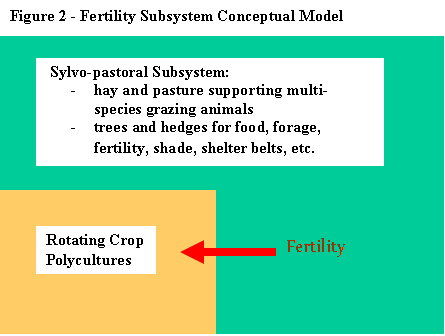
Like the Cubans, we operated Northland Sheep Dairy in upstate New York using insights from Voisin’s research. We designed our farm agroecosystem to adapt and improve on the natural grass-ruminant ecosystems that helped create the deep topsoils of Midwestern North America. In summary, the design focus is on three areas that are crucial to manage to maximize tight nutrient cycling. Key points of the farm nutrient cycle:
- Pasture management for a synergistic combination of productive, palatable perennial forages, kept in a vegetative state via high density, pulsed grazing throughout the growing season to maximize biomass production (according to planning principles developed by range ecologist Alan Savory[14]);
- Manure storage in a deep litter bedding pack built under cover during the cold season to maximize nutrient retention and livestock health;
- Vermicomposting the bedding pack at a proper C/N (carbon/nitrogen) ratio during the warm season to maximize organic matter production, nutrient stabilization and retention, and spreading the compost during the warm season as well, to maximize efficient nutrient recycling to the soil.
This design is working well on our farm and confirms Voisin’s thesis: in a few years forage production tripled on land previously abused and worn out from industrial methods of agriculture, and soil organic matter is slowly improving. Like the Cuban system, it provided a gradually increasing surplus to fertilize cropland.

Conclusion: A Historical context
What are the chances that the agroecosystem approach will prevail?
It helps to put the age in which we live into historical context. The era of cheap energy permitted the mechanization and chemicalization of agriculture. In turn, this produced the largest increase in food production since the advent of agriculture. Synthetic nitrogen fertilizer, although very energy-intensive, alone was responsible for tripling the global population since its use became widespread. At least 80% of the energy in food production comes from oil. Mechanization has permitted economies of scale, and driven out family scale farming in many countries. Where the small farm has survived, in the organic movement for example, it has found a niche or a gentrified market. As one US Secretary of Agriculture warned, farmers have to “get big or get out”.
In the short to medium run therefore, designers of agroecosystems will contend with powerful forces in the political economy of agriculture that oppose any change from the dominance of the industrial model. Moreover, as the collapse of industrial society progresses, elites desperate to maintain social control are already resorting to policies that are ever more desperate and violent in every area of society, including the farm economy and the larger food system. This complex subject merits separate treatment, which I may undertake in a sequel to this essay.
However, as the oil age wanes, industrial agriculture, its associated large-scale farms and distance food economy will be less affordable and will fade away. This will provide the opportunity to return to small farms that serve a local economy. In the best of scenarios, energy and raw materials depletion will be slow, thus offering the time to transition gradually to such a relocalized agrarian society. On the other hand, unfavorable scenarios are likely. The demise of industrial agriculture could easily accelerate due to wars over depleting resources and a resultant collapse of global supply chains, which will hasten the collapse of the industrial system as a whole, not just agriculture. Moreover, as depletion progresses, net energy and net mineral per unit energy will decline ever more rapidly (see graph), and accelerate the increasing scarcity of essential resources.

For longevity, natural ecosystems historically have far outperformed human managed ones in the modern age and every other age in the last 5000 years. All two dozen major civilizations since the advent of agriculture have crashed and burned from overshoot of carrying capacity and depletion of their resource base, or were overrun by peoples who still had resources to spare.
Whatever chance humanity might have of reversing this pattern will require a paradigm shift in the way we see ourselves and the world. A main thesis of this essay is that it will compel an acknowledgement of the premises on which I dwelt early in the essay. The shift must occur not just in our thinking, but in the way we live.
Despite lip service to learning from nature, only academic renegades and ecologist outliers like the Odum brothers, Holling, Wes Jackson, John Todd, Peter Rosset, Alan Savory, Miguel Altieri and Steven Gliessman learned enough ecosystem science to make serious contributions to improving agricultural sustainability to where food production might outlast the industrial, fossil fuel age. At least Altieri and Gliessman made the effort to write the first agroecology texts. These people are all outliers because almost no attempt has been made in academia to put agricultural science on a rigorous disciplinary basis, which is ecosystem science/systems ecology. Relying on these pioneers for inspiration and guidance, farmers will need to design their own agroecosystems to survive in the post-petroleum era. They should start now.
[1]A holistic view of catabolic collapse
Scenarios on the Downslope: Insights from Greer’s Ecotechnic Future
[2] My papers: Energy and Sustainability in Late Modern Society, The Industrial Economy is Ending Forever: an Energy Explanation for Agriculturists and Everyone
Books: The Long Descent: A User’s Guide to the End of the Industrial Age
Confronting Collapse: The Crisis of Energy and Money in a Post Peak Oil
The Crash Course: An Honest Approach to Facing the Future of Our Economy, Energy, and Environment
[3] Meadows et al. Limits to Growth. 2004
[4] Catton, William R. Overshoot: The Ecological Basis of Revolutionary Change. 1982.
[5] Senge, Peter. The Fifth Discipline: The Art & Practice of The Learning Organization.2006.
[6] Savory, Alan. 1999. Holistic Management: A New Framework for Decision Making.
[7] Henderson, Elizabeth and Karl North, Whole Farm Planning – Ecological Imperatives, Personal Values and Economics. Northeast Organic Farming Association. 2004
[8] The tragedy of Industrial Civilization: Envisioning a Political Future. 2023.
Ecology and the Politics of Scarcity. 1977.
[9] Piper, Jon and Judith Soule, Farming in Nature’s Image. 1992.
[10] http://www.chinampas.info/, http://en.wikipedia.org/wiki/Chinampa, Ancient Mayan Water Control Systems
[11] King, F. H.(Franklin Hiram). Farmers of Forty Centuries; Or, Permanent Agriculture in China, Korea, and Japan
[12] Donahue, Brian. 2004. The Great Meadow: Farmers and the Land in Colonial Concord
[13] Voisin, André. 1959. Grass Productivity. Philosophical Library, New York. Island Press Edition, 1988.
[14] Savory, Alan. Holistic Management. A Common Sense Revolution to Restore Our Environment. Third Edition. 2017
________________________________________
After reading his essay I sent Karl the following message:
“I agree with your ideas in the essay but have a question that the essay did not address.
Assuming a farm embraces your approach, and exports nutrients off of the property via the sale of food, do you believe that farm can be sustainable in the long run without being dependent on non-renewable imports to replace what was lost?
Basically I’m wondering if any form of commercial agriculture is sustainable in the long term, or will we eventually have to return to hunter-gatherer lifestyles?”
Hi Rob,
Thanks for your reply. Un-denial has been a quality source for me in recent years, attested also by the quality of your commentariat.
In Western history, I trace my concern with your question to Justus von Liebig’s concept of a metabolic rift (in the mineral cycle), exemplified he said by the pattern of London dumping its sewage into the Thames rather than trucking it back to the farms, ending with the impoverishment of the English farmland, forcing England to import guano and Chilian nitrates. In the East, I trace it to the widespread traffic in ‘night soil’ from the cities back to the farms. This seems to have sustained East Asian farming longer than it would have otherwise.
If humanure could be kept pure, it seems technically possible to mend the metabolic rift in a scale limited only by the economics or transporting the (composted) sewage. The main problem I see is political. Under capitalism, the maximization of profit whatever the cost overrules most ecological concerns. Hence, I am not optimistic about the sustainability of commercial agriculture beyond small agrarian communities practicing horticulture that might agree to something similar to the night soil solution.
I wrote about this question briefly in part three of a six part series, Visioning County Food Production, which was commissioned and published by an energy descent educational group in Ithaca, NY. The county, of which Ithaca is the urban center, has a population of about 100k. Here is some of what I wrote:
Because the agriculture of the future will need closed nutrient cycles, fertility for all county food production cannot be considered apart from county organic waste streams.[vi] To maintain fertility, organic waste must return in some form to food production sites. As the dense urban population produces the bulk of the waste, public institutions will need to take responsibility for separate collection of the purely organic component of the urban garbage and sewage waste streams, recycling part of it back to rural farms.[vii]
Fertility in urban and peripheral agricultural soils can be sustained with compost from the city organic garbage stream alone. A study of one urban community revealed that urban agriculture alone could absorb 20% of the organic waste production of the city.[viii] This will require a municipal policy and program of careful triage, collection, and composting at optimum C/N ratio by mixing high-nitrogen food garbage with high-carbon sources like leaves and shredded paper trash. The city could assign responsibility to urban institutional sources, such as schools and restaurants for moving their large organic waste streams to composting facilities at specific peri-urban food production sites. A map of existing Tompkins County composting sites demonstrates the composting potential (Figure 3).[ix]
As for sewage, eventually Ithaca will have to desewer, converting to urban night soil collection, biogas extraction, and the recycling of residual organic matter to county farms that will be necessary to maintain the mineral content of rural agricultural soils. In the short run, guerilla humanure composting from backyard compost toilets can build toward full conversion (Figure 4). These household facilities are satisfactorily self-policed, because the product will be used in closed-cycle residential food production.
[vi] For information about local waste processing facilities, see the TCLocal article “Wasting in the Energy Descent: An Outline for the Future” by Tom Shelley, http://tclocal.org/2009/01/wasting_in_the_energy_descent.html
[vii] Tom Shelley has recently begun to prototype this process with “The Sustainable Chicken Project,” which returns nutrients to the land by collecting kitchen scraps in the City of Ithaca on a subscription basis and feeding them to chickens at Steep Hollow Farm three miles outside the city in the Town of Ithaca. See http://www.sundancechannel.com/sunfiltered/2010/01/sustainable-chicken-project/ and the farm’s blog at http://steephollowfarm.wordpress.com/
[viii] Mougeot, Luc J.A. Growing Better Cities: Urban Agriculture for Sustainable Development. Ottawa: International Development Centre, 2006. http://www.idrc.ca/openebooks/226-0/
[ix] http://www.co.tompkins.ny.us/gis/maps/pdfs/CompostMap2000-E.pdf
https://wolfstreet.com/2023/09/18/congrats-america-%f0%9f%a5%82we-made-it-government-debt-spikes-past-33-trillion-1-6-trillion-since-debt-ceiling-2-2-trillion-from-year-ago/
Have you noticed that many of our best overshoot minds are spending a lot a time discussing genetic reality denial without realizing that’s what they’re discussing?
So sad so few understand the biology of our behavior as explained by Dr. Ajit Varki.
Today it’s Dr. Tim Morgan’s turn.
https://surplusenergyeconomics.wordpress.com/2023/09/18/261-the-post-truth-economy/
Kunstler nails the key question that I have been asking for a long time.
Are our leaders idiots or evil?
https://kunstler.com/clusterfuck-nation/boldly-into-the-chaos/
She might have been doing it from the beginning of the video – I noticed at the 4 minute 10 second mark, that she is speaking positively about the vaccines “… right now you can get your updated covid vaccine, can get your flu shot and for older adults you can get protected against RSV ….” but her head is emphatically nodding “NO”.
So I’m leaning toward she is profoundly, comprehensively, evil. The whole system is catastrophically broken.
Catastrophically broken is a great way to describe it. I find it very disturbing.
I don’t think she’s evil. I think she just denies reality because reality is unpleasant. You could show her studies that give weight to the argument that covid vaccines are useless and probably harmful and her eyes would glaze over. It’s no different than trying to teach a creationists about evolution.
The whole covid debacle makes me angry but I feel pity and sadness at the same time. Cohen is really no different than my mother or many close friends. I think she genuinely believes bullshit.
Good point. It was a brilliant sales strategy to name the novel mRNA technology a vaccine when it had zero in common with the traditional vaccines that we learned to trust over the last century. But now they have destroyed trust in all vaccines for many including myself. I no longer believe a word they say about anything. That’s a very bad thing for society.
It’s one thing to lie, for example, about statin efficacy and safety when the only person you harm is the person that believes your lie.
It’s another thing to lie about mRNA efficacy and safety and thus destroy trust in all vaccines which could harm everyone if we someday encounter a deadly virus.
Shame on them all.
Rintrah advises us to stay focused on the core mRNA issue. Other comments on this thread are also interesting.
https://www.rintrah.nl/the-first-signs-of-increasing-virulence/#comment-8676
So many feedback loops…
resource depletion -> rising energy price -> excess debt -> reduced growth -> money printing -> inflation -> higher interest rates -> deflation -> money printing -> deflation -> money printing – > BOOM
energy scarcity -> lockdowns -> work from home -> commercial real estate crisis -> debt defaults -> money printing -> BOOM
energy scarcity -> attempt Russia regime change -> Ukraine war -> Russia winning -> NATO escalates -> nuclear weapons -> BOOM
climate chaos – > food shortages -> refugees -> social unrest -> despot -> war -> BOOM
Hi Karl
You might like this podcast from Death In the Garden:
https://deathinthegarden.substack.com/p/56-chris-smaje-being-a-good-keystone#details
“On this episode of “Death in The Garden,” we spoke to author and farmer Chris Smaje about his new book Saying No to a Farm-Free Future which was written in response to George Monbiot’s book Regenesis. We talk about the dangers of the ecomodernist worldview, about how the narrative of progress inhibits practical solutions, and we discuss at length the importance of moving towards agrarian localism as a lifeway in order to weather the coming storms. We talk about the precariousness of urbanization, and how moving toward a more rural, local society offers resiliency. We talk about the issue of decoupling humans from nature, and how it’s imperative that we re-couple humans with nature in order to create a sustainable society. We talk about the problems with precision fermentation, as well as transitioning to a carbon-free society under the high-energy lifestyles we have today. We discuss at length what it means to become a good keystone species, and how doing so simultaneously heals our spiritual and cultural ills while also healing the environment. We discuss all of these topics in relation to Maren’s essay, The Quantitative Cosmology.”
Good pragmatic discussion. Key message: Don’t waste time debating rabbit holes. Focus on cutting fossil energy use and increasing local food production.
https://metatron.substack.com/p/massive-mortality-signal-in-young
He’d be less angry if he understood MORT.
https://www.rintrah.nl/its-already-here-but-youre-too-dumb-to-see-it/
What an amazing mind Dr. Robert Sapolsky has! It’s also clear Sapolsky is overshoot aware.
I’m looking forward to his new book on free will. His last book on behavior was superb.
This interview is deep and will require many listens.
My assignment is to try to integrate Dr. Varki’s MORT theory with Sapolsky’s no free will theory because I’m pretty sure both are true and must be related.
P.S. Sapolsky offered some interesting food for thought on Ukraine. He says the war has nothing to do with NATO encroachment and has everything to do with Slavic tribes hating each other. Although I suppose Ukraine’s desire to join NATO and Russia’s desire to prevent it has everything to do with them hating each other. Too bad Sapolsky did not elaborate.
This was spectacular. His book is on my must read next list after I finish Bright Green Lies. My wife took a class from him 50 years ago. She liked him but vehemently disagrees with his ideas on Free Will (of course she would, that is how they train lawyers (how I was trained in law also)). I can see his empirical marshalling of data as the basis for his refutation of any religion, soul, agency, or Free Will. As much as I emotionally don’t like what he is saying it makes intellectual sense. It would be interesting if he would be amenable to MORT (since we are only physical and our brains (and actions) are an emergent property of them)?
I think his comment on Ukraine was just a toss off and was not looking at other motivations that are also present.
AJ
One obvious relationship between MORT and no free will is that the former often denies the latter because many people find the reality of biology unpleasant.
I loved the free will bit. If it’s true (and I can’t think of any reason why it wouldn’t be) then it doesn’t even matter if people understood MORT. Nothing can be changed, except by external forces (e.g. environmental collapse) and understanding the drivers will not change things. Of course, in the detail, the knowledge will change the course of events somewhat but the ultimate course will remain unaltered. We will never know what awareness of “no free will” and of MORT by everyone in the world would do, but that is well into the hypothetical/speculation area. I think Sapolsky’s ideas on this fit in very well with my thoughts on humans being a species, acting like other species.
I just wanted to add one thing, with logical reasoning “why can’t both be true?” Ukraine and Russia can have BOTH Slavic tribal tensions and NATO interference. In fact (well demonstrated through colonial history) empires often exploit tribal conflict to their own advantage…..
As that little kid on TV always said, “Porque no los dos?”
Something else is also going on other than El Nino, lack of clouds from sulfate pollution.
Click to access FlyingBlind.14September2023.pdf
I take it soot from increased forest fires is not enough to compensate for us removing Sulphur from ship fuel?
It will be interesting to see what happens when we enter a deep depression and aerosols decrease further because much industry shuts down.
This may be of interest. Rob earlier asked for examples of a reasonable analysis of the war in Ukraine that included arming Ukraine. The author is a socialist.
https://lifeonleft.blogspot.com/2023/08/the-war-in-ukraine-four-reductions-we.html
Thanks. The essay seemed balanced and there was nothing I disagreed with. They did not however address what I consider to be the key issue in the Ukraine conflict.
Our goal should be to avoid a shooting war between the superpowers because that could lead to a nuclear war that would destroy us all. Every superpower has red lines that must not be crossed.
We know from history that a red line for the US is Russian weapons in Cuba. I expect Russian weapons in Canada or Mexico would also be red lines.
One of Russia’s red lines is western weapons in Ukraine. They warned us many times not to cross this red line and we ignored them.
I expect US military activity in Taiwan is a red line for China.
Xraymike79 today with a recap of climate change & overshoot.
https://collapseofindustrialcivilization.com/2023/09/14/homo-sapiens-are-working-overtime-to-join-the-great-silence/
The unspeakable evil continues. Our “leaders” make me sick.
Has anyone seen any rational explanation for injecting a new untested version of mRNA who’s predecessor has known serious side-effects into children who have zero risk of serious illness from the virus?
Weird in NZ there is no talk about vaccines anymore. It’s like everyone is trying to forget about it
Our western leaders have been streaming to Ukraine persuading/preparing them to accept a ceasefire at current battlelines.
No one seems to have thought it might be a good idea to ask the Russians what they think about this idea.
https://www.yahoo.com/news/putin-says-ukraine-only-likely-092608302.html
Our western leaders are morons.
h/t Panopticon
El Nino. 2016 and 1998 saw the same jump up in average global temperature. Next year should see the full effect of this ENSO cycle.
Yeah, the last 3 super El Nino’s saw the first year marking a record temperature and the following year exceeding that. It looks like we could end this first year at a large bump in temp, making next year almost unimaginable, if it is a super El Nino. Let’s hope not.
I’ve tried and failed to understand El Nino.
Are you saying the record temperatures we are seeing in many locations is to be expected and are not a big concern?
No, I’m just adding to what Joe said. Although I meant to write “the last 2 super el Ninos” (don’t know about the one before that). In those, global temps reached a new record in the first year but only by a small margin over the previous record. It was the second year which showed the biggest increase. The way things are going, this el Nino might show a big increase over the previous record in the first year and so I’d be wary of what could happen next year, when the full effects would be seen.
El Nino adds a big temporary boost to temps but on top of an increasing background trend that could make of some scary effects which will be a harbinger of what a more normal year might look like. In some ways, I hope it does produce some horrendous weather events as it just might wake up more people to what is happening. The 2016 record year was actually matched in 2020, so an exceptional temperature didn’t take long to become a “normal” year.
Thanks!
El Nino is just the warm water of the equatorial Pacific sloshing back and forth. Normal trade winds are east to west and they tend to push warm surface water in the tropics to the west. This water pools in the western Pacific, with much of it being pushed below the surface where it does not interact with the atmosphere. This is La Nina and it results in cooler than average atmospheric temps (or less of an increase from gradual warming due to higher CO2 levels).
Sometimes the trade winds weaken and westerly winds push the warm blob of water to the east. In so doing, much of the warm water that had been below the surface is pulled up to the surface and exposed to the atmosphere. This is El Nino and it results in warmer than average atmospheric temps.
As Mike said, all these up and down fluctuations in temperature are against a background of gradually rising temperatures. El Nino gives us a “sneak peak” at what the average temperature will be in a few years.
The ENSO phenomenon means that in our warming climate the increase in temperature goes up in a kind of stair step rather than a smooth annual increase.
The main thing is not to confuse the abrupt jump in temperature from El Nino with accelerating background warming or the cooler temperatures of La Nina with “there is no warming”. The super El Nino of 1998 was so extreme that average atmospheric temperatures didn’t “catch up” until almost ten years later and many climate change deniers used the pause as evidence to declare that there was no warming.
Here’s a somewhat dated (2017) report that shows the effect of El Nino on monthly air temps.
https://www.ncei.noaa.gov/access/monitoring/monthly-report/global/201703/supplemental/page-2
That was very clear and helpful. Thank you.
You can’t make this shit up.
This is clearly not incompetence. It’s something else.
OK, last comment from me on Covid (or Ukraine).
From the Washington Post:
The newly formulated vaccine is a monovalent, with a single component designed to target an omicron variant called XBB.1.5. Previous boosters, which were bivalents, aimed to counter the original coronavirus strain and the BA.4 and BA.5 variants — all long gone.
The XBB.1.5 variant accounts for a small proportion of the cases in the United States, but it is closely related to the other XBB variants making up most cases now. That includes EG.5, the most prevalent variant at the moment and responsible for more than 21 percent of cases, according to the CDC. Tests show the new shot will protect against EG.5 and similar variants, health officials said.
In addition, new data from Pfizer and Moderna and independent scientists suggests the shot will protect against the closely watched BA.2.86, a highly mutated variant that some scientists initially worried could evade protections from vaccines or earlier infections. New studies indicate the variant is not as dangerous as feared.
My interest in un-Denial is primarily for its coverage of overshoot and civilizational collapse. I’ve been prepping for both for many decades now. My interest is in figuring out the timing of likely tipping points and best practices for advance community preparation for the disintegration of the state (the US for me).
While Ukraine poses some massive geopolitical risks, those risks would only rival overshoot if they resulted in a big nuclear exchange.
Covid had modest potential to crash the world economy and instigate collapse, but it didn’t pan out that way (yet?).
I have my views on both, but to me they are a distraction from more important issues.
Unfortunately the Washington Post has completely discredited itself on all things covid and cannot be trusted. They print whatever pharma, who buys ads from them, tells them to print.
Why is the Washington Post not investigating and reporting on:
– US funding of virus at Wuhan lab
– Fauci’s involvement in covering up lab leak
– blocking of safe and effective alternate treatments
– all-cause mortality vaxed vs. un-vaxxed
– mRNA harms orders of magnitude higher than any previous vaccine
– censoring of dissenting experts
I suppose the same goes for all the other periodicals I subscribe to: NYT, Guardian, Economist, Atlantic, Scientific American, Science News, In These Times, National Geographic, Smithsonian. What print sources do you trust, if any?
Covid is a unique and VERY troubling issue. Pretty much everything we were told by authorities was not true, and most decisions made were not supported by our epidemic experience or science. There was much unnecessary death and harm.
Authorities are covering their asses now. For good reason. Many should be in prison.
I don’t read the journals you listed because they are not focused on the important issues:
1) who is responsible for the gain of function research that caused covid?
2) what are we doing to prevent a recurrence?
3) why did we block safe, effective, and inexpensive alternate treatments that could have prevented most deaths?
4) why did we vaccinate billions in the middle of a pandemic with a non-sterilizing vaccine when we knew this would create variants?
5) why did we force an unproven novel vaccine technology with serious side effects that did not prevent transmission on groups that had zero risk from the virus?
6) why did we not promote effective prevention measures like vitamin D?
7) why are we not investigating increased all-cause mortality that appears to be correlated with mRNA vaccination?
I trust intelligent experts with integrity. These are people that seek truth and that acknowledge and self-correct when they make mistakes. It takes a lot of time and effort to qualify these people.
The Deep State cashier’s checkout machine.
This group fascinates me. They have deep awareness of what’s going on and are prepping but also subscribe to a very strange religion.
Can anyone here that follows them shed any light?
Isn’t that normal process for empires in decline? As the “things” fail, attention/interest turns to the “not things”. Maybe they’re just ahead of the curve? I have quite a longing for some sort of religion, but in my heart I think I’m just a boring dogmatic materialist 🙁
Me too.
I was kind of hoping that someone here was familiar with their religion and would vouch for it as an amazing inspiring science-based faith.
Hello Rob,
It’s so interesting that somehow everything seems to find a time and place at the point in our lives that make the most meaning, or maybe that’s just another definition of denial!
I may be the one to try to shed some light (or Light, as this group would say) on what I think may drive this even more rarified band than ours. I actually have some familiarity with the Law of One through my earlier explorations, which is the driving spiritual/religious tenant of this group. However, I am still preoccupied with taking care of my mother as we wrap up our holiday (during which she has caught a cold, not Covid I’m sure! and not the happiest camper at the moment, unfortunately) and then we will be returning to Tasmania so I will probably be off-line for a while as I change gears. But I will try to attend to your request as soon as I can, it may fit into another response.
In any case, I believe the aspect of having a spiritual seeking is very soothing and purposeful at this time. Others whom you admire for their scientific and rational approach have also intimated this, and I know Nate has too, through some of his own comments and his interviewees.
Namaste. This is not a Law of One ritual greeting per se, but just the word I have chosen to express the “I see you” feeling I wish to cultivate for everyone. That idea is very much part of the Law of One, for all is One.
If you still have any curiosity about what happened on 9/11 I trust this account by Ray McGovern.
Gail Tverberg, being an actuary, is eminently qualified to judge this recent video by Dr. John Campbell.
…//ourfiniteworld.com/2023/08/31/fossil-fuel-imports-are-already-constrained/comment-page-7/#comment-435567
I would like to point out that our collective denial of this is a brilliant example of Varki’s MORT in action.
As with the holocaust, never forget.
I’ve included a link to a recent study comparing mortality rates in unvaccinated vs vaccinated. I’ve been vaccinated seven times so it’s nice to see that vaccination is not associated with all-cause mortality increases at all and offers good protection against mortality from Covid, which has historically always been much higher in the unvaccinated than the vaccinated. Now that the unvaccinated are either dead or have had one or more Covid infections, the mortality rate from Covid is converging with that of the vaccinated.
https://www.ncbi.nlm.nih.gov/pmc/articles/PMC10073592/
I was a regular viewer of John Campbell until I started actually reading the papers he referenced in his videos. More and more frequently he misrepresented the conclusions of the paper to the point where his conclusion was nearly the opposite that of the paper. I don’t know why this trend occurred. It may be that he was better able to monetize his videos by using more dramatic language. I have come to the conclusion that Campbell’s motto is more accurately stated as “Lead the evidence to please your followers.”
It’s great to finally meet someone that is overshoot aware (and therefore probably does not have normal denial genes) with some data that might support government covid policies.
I’ll do a little digging to see if the paper supports your conclusions, which are completely opposite to my conclusions.
FYI, I am not vaccinated, have never been tested so do not know if I got covid, and have not had any illness since covid began.
I know numerous people that chose not to get vaccinated, which I consider a reasonable choice for those under 40 or 50 years old. The death rate for Covid goes up rapidly for every decade over 50, so the risk from Covid to me (I’m 75) with all my vaccinations is greater than for an unvaccinated person under 50 (underlying conditions being equal).
By September 2022, 96.4% of the US population was sero-positive for Covid antibodies, either from infection or from vaccination. This means that the odds are great that you have had Covid since you have not been vaccinated. You may just not have noticed, which is also quite common, since asymptomatic cases are frequent.
I have not been sick since the pandemic began either, but without detailed antibody analysis to distinquish between spike protein antibodies from vaccination and antibodies to the other parts of the virus from infection, I won’t know whether I have been infected or not. It is quite likely that I have, but just didn’t get sick.
As far as government policies for pandemics go, I don’t have many complaints. Early in a pandemic, when the case fatality rate or infection fatality rate are unknown, the safest course is rigorous non-pharmaceutical interventions. This is pretty much what everyone did. Except in a few places, the NPIs kept the hospitalization rate low enough that the extremely ill could get good care and that kept the death rate as low as possible. If governments of countries with rich-world demographics (high proportion of elderly) had decided to do nothing and let the virus rip, the death rates would have been much higher, with most people dying at home without any medical care at all.
What to me is strange is to observe what happened with lock-downs, masks and all that, see that death rates were kept low, and then claim that since the death rates were very low there had been no need to do anything.
It is remarkable how intelligent well-intentioned people like you and I can arrive at different conclusions on a science-based issue like covid.
In the early days of covid I believe the data supported your decision to be vaccinated given that your age put you in the high risk group. Contrary to what we were told, this was solely to reduce the chance of you becoming severely ill, and had no effect on preventing transmission. They never even tested for effectiveness against transmission. Therefore there never was any scientific justification for vaccine mandates. Doubly so for young people who had zero risk from the disease, and which we now know have considerable risk from side effects.
For me this is just the tip of the iceberg on what our “experts” got wrong on covid. They got every single one of dozens of issues exactly wrong. You can’t explain this by pure incompetence because they would have done better by flipping a coin. Some other force is in play.
Rather than repeating myself, I compiled a list of things they got wrong here:
https://un-denial.com/2023/03/02/what-would-you-do/
I am not persuaded to change my views by this paper because:
1) The only statistic I trust is all cause mortality because we know cause of death data was distorted due to financial incentives to inflate covid deaths, and because of the uncertainty/complexity of assigning cause of death to people with co-morbidities. All cause mortality is clean, simple, and difficult to screw up: you’re either dead or alive. By not focusing on all cause mortality this tells me the authors are probably trying to prove what they already believe to be true.
2) They reviewed the death rate for vaccinated people and concluded vaccines were safe by observing the trend over 40 weeks to be flat. This is a meaningless conclusion unless you compare the death rate against unvaccinated people for the same period, which they did not do.
3) They conveniently stopped the study at 44 weeks exactly when the graphs show the start of an upward trend in the death rates.
Hi Rob and all,
Hope all are going well and thank you so much for the lively discussion on a wide range of as always, most pertinent topics (well, at least to this little band!)
I, too, am more than a bit surprised that we can come to completely opposite conclusions over the same issue, but then again maybe not so unexpected given how polarized the Covid chronicles have been.
If I may add my two cents (or brain synapses) I think there are several factors here that need to remembered when trying to dissect out the useful and robust conclusions from the morass of data. Forgive me for not providing here concrete links to substantiate what I am saying, I know that is an egregious error amongst such company as this but my aim is just to jog your memories of these considerations and there are plenty around (like el gato malo who really rallied to the cause from the first) who have presented it most substantively.
Firstly, in many of these studies, those who received the vaccine (at any of the doses) were not considered vaccinated until 21 days past the injection. This put all of the initial risk of all adverse effects and the ultimate of all, death, into the unvaccinated arm. The spike in sudden deaths were in the first few days in most age cohorts. You can see how this sleight of hand can skew results of morbidity and mortality greatly.
Secondly, the goal posts of what was a Covid case and what was due to underlying co-morbidities kept changing. In the beginning, anyone who died that had a positive Covid PCR test was deemed to have died from Covid, rather than from a pre-existing co-morbidity that may or may not have been exacerbated by an active Covid infection. In my medical experience (albeit short but still relevant for understanding the concepts), the primary cause of death was always the long-standing most prominent co-morbidity, such as end-stage heart disease or cancer, and secondarily the infection which may have tipped the balance. On the farthest spectrum of the most non-sensical categorisation, some people who died by homicide or motor vehicle accidents had their deaths registered as Covid deaths, because they had a positive test within a certain time frame of their demise! As we should know by now, the PCR test should never have been used for diagnosis as it effectively hyper-magnified the needle in the haystack so even minute particles of virus can register as a positive result. Later, after the vaccine roll-out, the cause of deaths were again re-aligned with the most salubrious narrative in favor of the vaccine, and co-morbidities were chosen to be referenced rather than Covid, regardless of a positive result.
Thirdly, and in this I have a biggest bone to pick, I am thoroughly over the claim that one can have an asymptomatic infection, especially in light of the PCR technique used which is practically like conjuring up . An analogy would be that if a PCR test given enough cycles could pick out a few rogue cancer cells in my body, (which we all have at any point only to be dealt with by our functioning immune system on its regular cleaning run) then I would be deemed to have cancer, even if completely asymptomatic. The very definition of a disease state is when the body has a homeostasis imbalance and function is compromised, not just because we can isolate certain cells or even particles of cells, even if they are damaged or irregular. If so, then I and everyone else have asymptomatic everything you can name, including heart disease because of course you can find a few heart blood vessel cells in my system that have a bit of thickening. And watch out, I would also be an asymptomatic case of Golden Staph infection, as just about everyone also carries this in our microbiome flora, totally innocuous and probably beneficial until the terrain has changed and balance upset. The definition of infection as a disease state is only reached when the organism becomes symptomatic as particles of virus or bacteria or parasite are shedding, causing typical end tissue alterations and our immune system has been activated. So, counting asymptomatic PCR positive Covid as cases to bolster results for either the vaccinated or unvaccinated is not valid if we are trying to gauge real life disease, not just semantic definition.
At the end analysis, the proof is in the pudding–all cause mortality. I am very pleased to know that all here who have gotten the shots or not are reporting generally robust health (we doomers must be a tough lot!) but that doesn’t detract from the numbers of others who have caused the graphs to skyrocket, across varied demographics. This must be explained, and the fact that neither government, academia or pharmaceutical are chomping at the bit to figure out why is more than telling. I know it’s only anecdotal, but since the vaccine roll-out in 2021, I personally know 12 people who have lost one or both of their parents. Of course they were elderly but some were previously healthy, although most had co-morbidities. All received their due doses (and here in Australia, the aged were encouraged to take every booster, I think it’s 5 shots for par now). I do not know of any sudden deaths first hand, but 3 cases through friends. The rate of deaths is greater than any other previous periods and I am not the only one to have this kind of experience.
Just a little shout out to Mike Roberts here at the end of this usual Gaia ramble. I do hear you on sometimes just wishing that the collapse would go a bit slower than the breakneck speed we are on. I, too, am finding it very poignant to look upon the trees I have planted and some are just starting to bear fruit, and knowing that I will not be the one to reap its full bounty. But to have lived and loved and also knowing how to let go and give blessing to all of it is still our ultimate joy and gift to bestow. I cannot ask for more than what is already more than enough.
Namaste, friends and fellow earthlings.
All excellent points Gaia however in defense of the paper Joe provided, the authors seemed to deliberately avoid the 21 day deceptive trick that was used to bias most other studies in favor of mRNA. This initially made me think their conclusion might be correct, however when I saw they did not compare against unvaccinated, did not use all cause mortality, and stopped the study when the data started to make them look bad, I changed my mind.
Thank you Rob for pointing that out to me, I did not read the paper in question but your criteria in analysis are rock-solid sound. My chirrupping was more a general one to perhaps highlight the usual booby traps of drawing conclusions amongst in-built bias.
Stopping a study when the curve starts to turn against your conclusion is very poor form, indeed. Is the word crafty or even devious?
Kind of like when they terminated the original mRNA study after (I think) 6 months because of a “huge success” using data manipulated to make it look much better than it was, when all prior vaccines studies required many years to make the same claim, and then vaccinated the control group so there was no means of assessing what happened to effectiveness or safety after 6 months. Later we learned that effectiveness waned after 6 months. What a coincidence. Unethical assholes!
Argh! Or rather Grrrrrr! Don’t get me started (too late!) on how sickened I am about the whole Covid caper, especially since I have come from a medical background and witnessed the beyond shameful response of that sector which should have been the most upstanding champion of rightful action and dignity. In consolation, it has been a real privilege to have undergone the journey of processing the truth behind the lies with those here, many a time my sanity saved and grief assuaged through the validation, information, and support given. Thank you all.
On John Campbell, one of the main reasons I respect him is that when he makes a mistake he publicly admits it and attempts to correct going forward.
Campbell started out a strong advocate for mRNA and then as data slowly emerged that it is neither safe nor effective, and that there are much safer and more effective alternatives, he changed his view.
Have you attempted to point out to him any of the errors you’ve caught him making in interpreting papers? If you are correct, I’ll bet he’ll admit he made a mistake. If you are incorrect, I’ll bet he’ll politely point out your error.
Well, I’ve been keeping an eye on the (sadly, sparse) data released on COVID-19 in New Zealand. The data don’t allow a full continuing analysis of deaths but the data in January, which did, showed 96 deaths per 100K unvaccinated and 65 deaths per 100K boosted. So, only about a 50% higher risk for the unvaccinated, compared to boosted. Rather surprisingly, deaths per 100K of those who’ve had only the primary course (2 doses, or 3 for the immuno-compromised) were only 28 per 100K. This kind of comparison is similar for hospitalisations (and the data are better for that). It seems the booster has increased the risk to that of the unvaccinated (more or less). Consequently, I decided not to add to my first booster and I wish you luck.
Well, we need a lot of excess mortality. That will bring down the population.
Good one from Tim Watkins today reviewing what has happened to renewable energy in Europe as fossil energy prices have risen over the last few years.
Apparently the often made claim by aware skeptics that renewable energy will become unaffordable as fossil energy becomes unaffordable is true.
Oops, that’s a rather big mistake because our idiot leaders are wasting a precious depleting resource that should be conserved and used instead to build a softer landing zone.
https://consciousnessofsheep.co.uk/2023/09/11/blown-out-of-the-water/
James today with a very interesting explanation of the underlying forces driving what Tim Watkins observes above.
https://megacancer.wordpress.com/2023/09/11/tainter-ants-and-eroei/
And Rintrah today elaborates on James’ conclusion above…
p.s. The comments are worth scanning to understand Rintrah’s core beliefs.
https://www.rintrah.nl/the-end-of-the-omicron-lull-back-to-virulence/
You’re right, Rob. But I do wonder what a “softer landing zone” would look like. Wouldn’t that require our so-called leaders to acknowledge that industrial technological civilisation is over and the population size can’t be supported? Even if they do that (they won’t), what on earth do they suggest in its place?
It looks to me like our leaders are on the one hand attempting to take resources and to destroy demand from enemies, and on the other hand, to prepare for the day when they will require tools to prevent their citizens from revolting and eating them.
If they were wise leaders they would do this:
https://un-denial.com/2016/06/27/what-would-a-wise-society-do/
I’m not, but If you’re worried about causing a herd panic, then many things on this list could be done without full disclosure of why.
They seem like great things to do but they would not provide a landing, soft or otherwise. The collapse would either continue more slowly or be slightly delayed. But there would still be collapse of industrial, technological civilisation. People’s lives, in developed countries at least, would get worse, in their eyes. So those with some semblance of democracy would vote in someone who promises to make it great again.
Finally a aspiring politician you might be tempted to vote for Rob. If only we lived in the US. Well actually I’m quite happy here in NZ but would love someone / group to stand on this platform in our upcoming elections.
https://davetheplanet2024.com/
“On day one I’ll declare a national emergency and mobilize government, business, media and the public in an urgent project to shrink our nation’s ecological footprint:
• contract GDP
• decarbonize and go on an energy diet
• work less
• consume less
• support and accelerate the current trend toward choosing smaller families”
I followed Dave Gardner closely after seeing his excellent GrowthBusters film in 2012 at a community film festival. I’ve lost touch and haven’t read anything by him for over 5 years. I recall he’s a good man working hard on population reduction. I have a copy of his film in my library that I can share if you can’t find a copy.
https://www.growthbusters.org/
https://www.imdb.com/title/tt1564355/
Thanks Rob. It’s available on YouTube.
8
Kurt Cobb with interesting comments on the Panama Canal.
http://resourceinsights.blogspot.com/2023/09/climate-change-and-hidden-water-cost-of.html
Deep discussion on the oceanapocalypse.
Whoa, there’s a lot here. Will require multiple listens.
Did you notice that every one of the guests mentioned doing frequent long distance travel? Apparently someone else needs to change their lifestyles to save the oceans.
Yes I notice this with a lot of Nates guests and Nate himself.
Kind of undermines the whole message 🙁
Just discovered Charlie Hunter and added him to my library.
He’s an amazing jazz guitarist that plays lead and bass at the same time on a custom 7 string guitar.
Re.” Bright Green Lies ” book. I liked it, but the analysis of what they advocate is very poor.
From the “Real Solutions ” chapter : page 433.
No mention in the rest of that chapter (or book) of the massive human die-off that would occur if we stopped using fossil fuels . The current human population bubble only exists because of the massive energy input of fossil fuels. Stop fossil fuels now, and around 90% would be dead within a year.
Maybe that would have been worth mentioning ?
Thanks. A lot of well-intentioned people miss the point you are making.
I like having a dentist, eyeglasses, garbage pickup, computer, and internet. I vote for a much smaller population so we can keep them.
People who refuse to address the population issue will be shocked when there is nothing left of modernity, nor enough food.
I like having those things too but I don’t see any way they can be retained indefinitely. None are sustainable. None can be made sustainable. Most people can’t imagine life without them (and other trappings of civilisation) and that includes me. Some of us may well have to start dealing with life without them.
Hey Begonia. This problem is well-covered in their other books, particularly Deep Green Resistance.
Also I know Derrick and Lierre would say this – we know this system is going to collapse at some point (sooner or later). The sooner it collapses, the more of a living world there is for future generations of humans and non-humans.
Very good discussion with John Mearsheimer on Ukraine.
Key points:
1) Inviting Ukraine to join NATO in 2008 was the biggest blunder of our lifetimes.
2) US does not pay a price for bad decisions due to its geography and economic strength. Europe (and Ukraine) will pay a big price.
3) No peace is possible now.
Great comment by Mearsheimer at around the 18:00 mark, that Sullivan, Biden and Blinken are “basically hopeless”…
There has been a remarkable decline in the intelligence and competence of our leaders (all parties) over the last 10 years.
Why?
Maybe our problems have become so intractable you have to be an idiot to run and win.
Hello again Karl,
There is something I am wondering about, I did not pay attention to before but just noticed from the graph of the limits to growth model you shared in your post:
http://karlnorth.com/wp-content/uploads/2023/08/limits-1.jpg
Shortly before the population peak, death rates skyrocket. But birth rates too increase. Why is that? Is this a fatality, a necessity? What element of the model triggers this behaviour?
We could well imagine both falling birth rates and increasing death rates as a preferable scenario. On the fertility front, it seems that’s actually what’s happening (even though not as quickly and despite messages against it from most governments to Rob’s despair 😉
Do you personally think there is a reason that births increase could be a necessity? For instance, that a much rapid rate of renewal and the exploration of a highly diverse genetic combinations (at the expense of short lives) are necessary strategies for the species in order to survive a rapidly changing environment?
Or is it just a model artifact?
No access to modern medicine and industry means no effective birth control. Lack of resources and no modern medicine means infant mortality sky rockets.
System dynamics modeling of complex systems cannot make accurate predictions, such as when a variable will peak or at what level. The pioneers at MIT from which the Limits to Growth model came were explicit about that in their book. Many users of the method, such as the scientists at the IPCC, falsely assume the method can make accurate predictions far out in time in a system as complex as the earth system.
Nor can the method predict the exact shape of a curve in a short time frame. So, to address your question, the long steep rise in birth and death rates in the time graph may be mistaken, as I and others have surmised. But like all the other variables except ‘resources’, both births and deaths must peak and fall eventually, due to the collapse of the population. The graph time frame is just too short to show it. The time frame of a century in the graph is only to give a rough idea.
What the method can do is demonstrate the probable rough trajectory of the variables over time as they interact under a given policy scenario. Thus, in the world model, for a business-as-usual policy scenario, increasing resource consumption causes all other variables to rise. Later, increasing resource depletion must cause all the other variables to eventually peak and then fall. Even pollution!
Thank you. I understand.
An outstanding discussion between Robert Jungk (Futurlogist) and Ulrich Horstmann (Philosopher) about his book “the beast”.
Unfortunately only available in german language:
From 1991!
https://www.wikiwand.com/en/Ulrich_Horstmann
see https://www.realgnd.org/ for the actionable options available under this crash scenario.
When I went to the RealGND site and saw that William Rees was a director, I was encouraged to explore the site. Unfortunately, nothing of real substance seems to be available without paying for a paper that outlines their recommendations. Perhaps you can summarize them for us.
This was a paper they put out a couple of years ago.
Through the Eye of a Needle: An Eco-Heterodox Perspective on the Renewable Energy Transition
https://www.mdpi.com/1996-1073/14/15/4508
I think this is the key takeaway from the paper: “(We must) face head-on that material life after fossil fuels will closely resemble life before fossil fuels”.
I agree, but must also point out (as does the paper) that the pre-fossil-fuel life cannot be lived by 8 billion people. World population before widespread fossil fuel use was well under a billion people and world carrying capacity was far greater then. Without fossil fuels, a couple of hundred million people is more plausible. The transition from 8 or more billion to 200 million is not going to be easy.
Bingo. This is the most important fact about our predicament, and yet only a tiny minority of people who study overshoot discuss it.
For example, Nate Hagens, who is one of the most impressive overshoot intellectuals, has never once mentioned this, and I know because I’ve watched and read pretty much all of his work over the last 15 years. Nate also disrespects and refuses to interview Jack Alpert, who is the only overshoot intellectual that not only acknowledges this fact, but has created a plan to humanely deal with it and retain some of our best accomplishments.
To be clear, I’m not picking on Nate. I could easily list a hundred prominent polymaths and overshoot intellectuals that never mention this fact.
I’d say it’s more compelling evidence in support of Varki’s MORT.
I think Nate has interviewed a few people who have talked about the need for massive population reduction (Bill Rees comes to mind) and I am very familiar with Jack Alpert’s proposals for rapid population decline, but I still don’t see how it is to be done.
Jack’s proposal is for everyone to agree that women will just stop having babies (births to go from 80 million per year to 500 thousand per year). I just don’t see a global “no babies” agreement as plausible even though it makes perfect sense.
Everybody is now relying on the demographic transition, whereby educating girls, giving them access to paid work, and coupling these with increased affluence results in a decrease in the total fertility rate (TFR). But the TFR is creeping up again in rich countries and the environmental cost of affluence for everyone would be horrendous.
I think we are stuck with the traditional four horsemen for our population reduction needs. The hoofbeats are already getting louder. They will be here soon.
Jack’s proposal is for most, not all, women to stop having babies. A democratic law would be passed requiring a birth permit to have a child. Any couple wanting a child would apply for a permit and once a year a fair lottery that could not be influenced with money would randomly allocate permits to about 1 in 200 applicants. We would need to do this for only about 50 years, then it would be business as usual. In return for a couple generations of sacrifice we get a healthy planet with thriving biodiversity, and a small human population that can continue with some comforts and some advanced technology for hundreds and maybe thousands of years (fyi it’ll be hundreds of years if we can’t make fusion work before the hydro dams silt in).
Yes a few of Nate’s guests have discussed the need for population reduction but none have said, nor has Nate, that we’re on a path to a couple hundred million via horrific means as soon as oil becomes unaffordable, and there is nothing we can do to avoid this destination.
We could reduce the suffering along the way, and perhaps retain some things worth keeping, if we proactively reduced our population rather than letting the four horsemen do it for us.
A good first step would be to get a bunch of people with audiences, like Nate, who understand what’s going on, to speak clearly. Even if political realities prevent us from implementing policies like Jack’s lottery, just having the conversation will cause many people not to have children, which is a success because n-1 is better than n suffering.
I still think that reducing births is not the way to go to get reduced population because of the demographic problems that would result. Increasing deaths is the best strategy but I’m not offering myself up.
The idea of retaining some semblance of modern civilisation is delusional, in my opinion. Perhaps that’s why Nate won’t interview Jack? Everything we do, now, is unsustainable, embedded in an unsustainable civilisation. Civilisations will never be sustainable. This is also part of the problem with the degrowth movement, which seems to believe that it’s possible to get down to a sustainable level of economic activity and then stay there. A lot of people are in for a very rude awakening, particularly if they have a life expectancy of more than a couple of decades.
I’m not certain, but I suspect the reason Nate won’t interview Jack Alpert, nor will he discuss the covid crimes, is because he’s worried about losing his audience.
Nate has acknowledge in personal communication with me that he soft-pedals or just ignores some issues – like the coming die-off – that might turn off large audiences who might otherwise seriously consider the rest of what he says. I admit to doing that myself: in my paper you posted, I never directly discussed the die-off. We are not alone among the energy descent writer network in doing this ‘editing’ of our views when hoping for a larger audience.
I understand but I think we’re out of time to soft pedal our situation.
We’ve tried the soft approach for over 50 years and have accomplished nothing.
In fact less than nothing, because everything is much worse.
yes, that is a summary of realgnd and actually is the paper that got me to find the website. I did find useful information that was not ‘pay to play’.
Rintrah, as with Kunstler, requires us to turn on a big filter to ignore political nonsense mixed in with often excellent overshoot observations.
I cut Rintrah some slack because I understand he’s very angry about the denial of our overshoot predicament, as was I until I discovered Dr. Ajit Varki’s MORT theory.
Rintrah today debunks John Michael Greer’s and Gail Tverberg’s claims that we are not facing a climate change catastrophe.
https://www.rintrah.nl/a-look-at-john-michael-greers-climate-change-comments/
See also yesterday’s very aggressive post directed at climate change deniers.
https://www.rintrah.nl/introducing-the-low-iq-low-status-white-male-challenge/
he should have included Chris Martenson
OK so having read both, I don’t think Rintrah has done a good job rebutting JMG. Looks like JMG made a significant mistake relying on one author for one fact. Take out the said paragraph the mistake is in, and the rest of JMG’s essay still stands on its own.
Thanks for letting us know. I did not read the JMG essay. I’ll be more careful about posting stuff from Rintrah in the future.
It was still a very good fact check that he did. I really appreciate it 🙂
Did JMG convince you that the climate change threat is overblown? If yes, how do you respond to Rintrah’s questions?
Well I spent some time reading through a few of Rintrah’s posts and I think he is doing his best to explain the shit show humanity finds itself in. He’s one of a few writers that I’ve come across that has written about covid vaccine harms and is not in denial about climate change or other symptoms of overshoot. It was interesting reading the comment section. He has quite a few detractors (deniers?). I wonder if he frequents this sight occasionally. It wouldn’t surprise me.
Many people make every issue political. Experts on covid crimes frequently deny climate change because they view both as government overreach into their lives. It’s sad. Both are scientific issues, not political.
I expect this partly explains why covid crimes are frequently dismissed as crazy talk since the same people deny climate change and vote for the enemy party.
JMG doesn’t think the climate threat is overblown. He just doesn’t think we’re all going to die next week. JMG has been warning for years about rising sea, drought, changing climate, harvest fails, mass migration, changing weather patterns, extreme weather, etc. What he has made very clear is that predictions of climate doom have a long track record of failing to appear; and that climate activism / policies have had zero measurable reduction in carbon emissions.
Thanks for explaining JMG’s view. Everything you said is true. I’m curious what happens next. My eyes tell me climate change has shifted a gear.
There are a few things making it worse at the moment:
– Solar maximum.
– Adding water vapour for 10 years follow Tongan volcano eruption – water is a potent greenhouse gas.
– Reduction in aerosols during covid = additional sun through the atmosphere.
– Regulations on shipping again reducing aerosols.
These factors would all balance out again over coming decades maybe?? I don’t know how to factor tipping points into this.
I think climate change is baked in now. I think humans will burn all the rest of the carbon we can until we collapse 🙁
Excellent detailed discussion from an insider on the events that provoked Russia to invade Ukraine.
I’d love to hear an equally knowledgeable person with high integrity present the mainstream view.
As with covid, I’ve been unable to find anyone intelligent with integrity that can make a strong case in support of our western leaders.
I’m tip-toeing here but let’s just say that whatever the perceived provocation, Putin’s incursion (in 2014 and 2022) was a choice. Agreements, either legal or handshake, are only made at one point in time. As Trump showed, new leaders can push for different outcomes and tear up even legal agreements. Countries (as represented by their elected or autocratic leaders) will always do what they perceive as in their best interests (rightly or wrongly), including interfering in the internals of other nations. None of this is right or wrong, good or evil, it just is what it is. I find it incredible that some people seem to believe that agreements, or just statements, made at one point in time by people around decades (or, in the case of NZ, centuries) ago must persist ad infinitum.
No country HAS TO invade another country though those that are invaded may argue that they are forced to fight to defend themselves. It is a choice. One can agree with the choice, or not, but I doubt it could be argued that it wasn’t a choice.
I agree that no country HAS to invade another, but any super power, including the US, that is threatened by weapons on its border WILL invade.
The US did it with Cuba, and would do it again if Russia put weapons in Canada.
Our western leaders should have put themselves in the shoes of the Russians but did not, and now the world is paying the price for their stupidity and lack of empathy.
Nyet means nyet.
Good satire on covid. Funny but sad because its mostly true.
h/t Rodster
New must watch presentation on overshoot and what needs to be done by Lierre Keith whom I respect very much.
Lots of clear-eyed reality here. Also nice to hear a little about her inspiring lifestyle.
At 47:40 she discusses population reduction policies that have been effective.
At 1:23:20 she discusses why we should declare annual crops a failed experiment and abandon them.
Keith laments the poor sales of her recent book Bright Green Lies and says she wishes larger publishers had not refused to accept the reality of what she was saying.
Lierre is awesome, very courageous message. I bought two copies of Bright Green Lies, one for me and one for my local library
Initially I thought that this would be way too long to listen to. IT WAS NOT. In listening to her talk, I was somewhat critical in thinking the she was living with some kind of hopium. The comments and her interaction with the commentators disabused me of that notion. She understands where we are and the future ahead of us looking very questionable. If not downright dire. She sees Mad Max as a possible future. I think because of MPP and Denial it’s probably where we’re going. Everyone should listen to this talk. I will buy the book.
AJ
I originally found out about peak oil by accident when I watched a documentary on it. I then googled peak oil stuff and Lierre was one of the first people who came up. I’ve read a bunch of her books, especially the Deep Green series with Derrick Jensen. It’s been nine years now of not being in denial, for better or worse.
I give that 5 stars
Nice to hear an update of the Lierre and Derrick show, which I had not followed in recent years. The most dramatic example I know of the success of the population control policies Lierre describes occurred years ago in the South Indian state of Kerala, where after a series of socialist governments, Kerala demonstrated markedly different demographics from the rest of India.
Lierre’s grand lines approach to the planetary situation and her litany of sordid consequences is always welcome. The risk of that approach is to reduce terms like ‘agriculture’ and ‘hunter/gatherer’ to monolithic categories, and then to reduce them further to epithets (agriculture) or panaceas (hunter/gatherers). Surely she is familiar with the theory that the prehistoric hunters wiped out the megafauna during the several hundred thousand years of human history that she says were relatively environmentally benign.
A finer grained look at supposedly pre-agrarian human land use reveals a huge variety, in which it becomes almost impossible to see where the line is crossed into agriculture. First humans in North America modified landscapes in many ways, quite apart from the large corn plantations that the first Europeans encountered in New England. Following the cardinal rule that intervention in complex systems never has just the one expected result, it becomes difficult to even judge how positive or negative the overall effect of pre-agrarian land use was, especially given the paucity of archeological data. What we can say is that all species, including humans, must impact their habitats, recreating them over time in complex interactions with other species, whose ripple effects are hard to calculate. Environmentalists seeking simple solutions tend to forget this rule. A perspective that acknowledges the limitations of understanding complexity in living systems raises questions like, What is an invasive? And when is it destructive or benign, and what are the criteria for judging that? All species were once invasive, no?
Very good points.
For me, all good paths, regardless of the lifestyle and technologies we employ, require a much smaller population. Conversely, there is no good outcome, regardless what we do, with 8 billion people. This should be the bedrock position of all people still trying to make the future less bad. But it’s not. Almost every influential overshoot intellectual, and every environmental organization, does not promote population reduction policies.
Yes, I think Lierre (for whom I have a great deal of respect) has not quite grasped that humans are a species and it would not be all sweetness and light, if civilisation collapsed though numbers would fall dramatically, giving the other species a chance to recover somewhat.
I don’t know why some people need to overstate things in order to convince others of some terrible environmental damage (Guy McPherson is an extreme example). It’s pretty clear that agriculture did untold damage to the ecosphere but to claim that agriculture is the clearing of land of all other life, even bacteria, to grow crops is just bizarre. With chemical agriculture one may be able to claim that, but, before that era, humans didn’t have the capability to sterilize a plot of land before planting crops. I recall film and photographs of flocks of birds following a plough, to get at all of the life still left in the soil. Those tracts of land most certainly did still have life, then.
I haven’t listened to it all, yet, but do intend to. Most of it is right on the money, so far.
I also don’t like her frequently repeated claim about sterilizing the land. I believe it’s true for non-organic strawberries in California but not many other crops that I’m aware of. It’s probably a sound bite that’s become muscle memory since I’ve heard her say it many times.
The best part of the video is the discussion after the presentation. Her awareness of reality and authenticity becomes clear.
I think I’ve become more of a doomer in the last few months. I probably would have taken what Lierre said about actions as solid. But now, she appears delusional when she says the actions are simple. Do this, do that and this will stop. She even seems to think that there are examples of countries which have done the right (in her eyes) things. But all of these actions seem to be actions with civilisation still intact. Civilisation is something she wants to tear down. So that seems a disconnect. Lowering birth rate seems a sensible thing in a civilisation that is in overshoot but it would just put a bigger burden on that civilisation, as the demographic changed. And it would still be unsustainable, so would collapse. In a collapsing civilisation, who knows what the survivors would do but it might involve having more kids, as death rates increased.
Anyway, I was sitting on our (partially built) verandah on this sunny Spring day, having a beer and listening to some nice music as I looked out on a sparsely built rural scene. I could live with this, I thought. Then I got selfish. I hoped the collapse would hold off for a couple of decades so I could see out my life in relative comfort and enjoyment. That hope isn’t based on anything concrete but I can dream.
Gosh, I’m critical of everything anyone seems to say on all sides of this debate. I think a dose of reality would be nice but few people seem to think it through. Even a hunter-gatherer existence might not be sustainable, if they use tools, especially anything more sophisticated than a branch or rock. So much damage has been done that there really is no prospect, whatsoever, of a soft landing.
Thanks for your honesty. I do find you somewhat critical of everything and supporting of nothing. I recently read Rare Earth: Why Complex Life Is Uncommon in the Universe by Peter Ward. We have a VERY rare and special gig on this planet. Doubly so if Varki’s MORT theory is correct which Peter Ward is unaware of.
Despite the near zero odds of implementing them, I think we should support the few people on this planet that have plausible plans, like Lierre Keith and Jack Alpert. If someone doesn’t like these plans, they should propose a different plan.
We all know what will probably happen if we do nothing and allow business as usual to unfold.
You’re right, Rob. I don’t know how to stop thinking critically though. If a plan doesn’t seem that it would prevent the coming catastrophe, then I will criticise it. I don’t need to offer an alternative.
My plan? Slowly remove health services, apart from palliative care, and increase voluntary euthanasia. That would start to bring down population. Outlaw any business that sells frivolous stuff. Outlaw billionaires and multi-millionaires, redistributing excess funds to the poorer folks and to paying off national debt. Plant food forests almost everywhere, using native plants wherever possible. Stop road building. Change all constitutions to outlaw promotion of economic growth, promoting sufficiency only. Educate everyone on the reality of species and ecosystems. Introduce the death penalty for all anthropogenic climate change deniers and rational optimists (that is a double win). Confiscate and destroy all weapons above the level of bows and arrows.
That’s a start (and off the top of my head) but would still not prevent civilisational or ecological collapse. However, Alpert’s and Keith’s plans would also not do that. So my plan is no better, and no worse, than theirs. Perhaps I should support theirs. Go Alpert and Keith!
I like your plan very much, however being a techie engineer I prefer Alpert’s because he’s trying to find a way for us to keep our science and best technologies.
OK. What is preferred is obviously nicer to believe in. Me too!
Ouch! Decoupling isn’t happening. This paper: “Is green growth happening? An empirical analysis of achieved versus Paris-compliant CO2–GDP decoupling in high-income countries.”
Findings The emission reductions that high-income countries achieved through absolute decoupling fall far short of Paris-compliant rates. At the achieved rates, these countries would on average take more than 220 years to reduce their emissions by 95%, emitting 27 times their remaining 1·5°C fair-shares in the process. To meet their 1·5°C fair-shares alongside continued economic growth, decoupling rates would on average need to increase by a factor of ten by 2025.
Interpretation The decoupling rates achieved in high-income countries are inadequate for meeting the climate and equity commitments of the Paris Agreement and cannot legitimately be considered green. If green is to be consistent with the Paris Agreement, then high-income countries have not achieved green growth, and are very unlikely to be able to achieve it in the future. To achieve Paris-compliant emission reductions, high-income countries will need to pursue post-growth demand-reduction strategies, reorienting the economy towards sufficiency, equity, and human wellbeing, while also accelerating technological change and efficiency improvements.
https://www.thelancet.com/journals/lanplh/article/PIIS2542-5196(23)00174-2/fulltext
Thanks, another good example of why this site exists. We are SO far from acknowledging obvious realities that stupidity cannot explain what we observe.
We could be conserving diesel for food production while we work to get our population down but instead we build things like this.
https://kunstler.com/eyesore-of-the-month/september-2023/
The greater the colossus of our decadence surely the harder our fall. It’s so depressing to think that many in our society think a trip on such a folly as this would be an ultimate achievement of a lifetime of work. Speaking of which, I’ve been off radar as of late because I’m partaking in a small facsimile of such behaviour, and not by choice for myself. I am taking my elderly mother on a holiday up in this area of Far North Queensland because I feel it is most likely the last time we will have this opportunity and it seemed the right thing to do for her enjoyment sake and sharing this time together. It has been so difficult for me to set aside my collapse/doom tinted glasses with which I am now fully accustomed to view the world to pick up the “BAU, consume and enjoy as is our god-given right” pair of rose-coloured spectacles that is the tourist persona.
Like Rob, I could not walk onto a city street without feeling the weight of impending collapse to follow on the indulgences that we have all taken for granted. I feel as a stranger in a strange land in this so-called civilised environment after so many months in my rural setting hardly leaving the property. Every shop, cafe, and entertainment offering just highlighted how unprepared we are for what is upon us. It is still high tourist season here and there are visitors from all around the world to see the main draw, the Great Barrier Reef, which will probably endure catastrophic bleaching this summer. On one hand, I am cringing with despair but interestingly enough, I began to adopt the view that since all of our time on a liveable planet is limited now, who am I to judge how people choose to spend theirs? What has been most challenging is pretending to enjoy myself as to not diminish my mother’s enjoyment.
I trust everyone is keeping well and finding beauty and joy in this changing of seasons.
Namaste.
Thanks for checking in Gaia. Glad you’re ok and hope you enjoy time with your mother. I wish I had spent more time having meaningful conversations with my mother. It’s too late now. Pretty good chance though she wouldn’t enjoy my definition of meaningful conversation. There’s a lot to said for denial. 🙁
The farm I help is doubling the size of their irrigation pond because we ran out of water this year due to drought.
It’s amazing to watch this machine work. It’ll take 2 days and about 1000 liters of diesel.

Great essay North! It’s got me thinking about what I can do with my own 11 acres. We have a small stream running through it. I would like to add a big pond, and re-design my paddocks for better rotational grazing. I’m interested in raising Wiltshire sheep and a small flock of chickens.
Thank you for pointing us to Karl North’s excellent web site; I had not heard of him before.
An excellent essay pulling together the general themes and threads of food production in harmony with nature. A good essay to send to anyone you are trying to onboard this way of thinking: paradigm shifting. It fits in with Joe Brewer’s Design Pathway for Regenerating Earth and related nascent movement. In Canada the organic sector is ramping up a new strategy to increase organic share of production, led by Canadian Organic Growers. (www.cog.ca) Ben Hartmann’s books on Lean Farming are another excellent framework for reducing the energy inputs to small scale intensive food production.
“In the short to medium run therefore, designers of agroecosystems will contend with powerful forces in the political economy of agriculture that oppose any change from the dominance of the industrial model. Moreover, as the collapse of industrial society progresses, elites desperate to maintain social control are already resorting to policies that are ever more desperate and violent in every area of society, including the farm economy and the larger food system.”
“At least 80% of the energy in food production comes from oil. Mechanization has permitted economies of scale, and driven out family scale farming in many countries. Where the small farm has survived, in the organic movement for example, it has found a niche or a gentrified market.”
“Historically, Nature’s ‘farming systems’ have a much better track record for durability than ours. This is why, in the words of two pioneering agroecologists[9], “farming in Nature’s image” needs to become our design standard. While no replacement for serious study of ecosystem science, this section will outline ecosystem processes and principles sufficiently to give direction to thinking about farming systems as agroecosystems.”
Gail Tverberg today on the link between energy and covid.
https://ourfiniteworld.com/2023/08/31/fossil-fuel-imports-are-already-constrained/comment-page-3/#comment-434642
Seems to align with my thinking here:
https://un-denial.com/2023/03/02/what-would-you-do/
Does anyone understand why the US would fund bioweapons research in the lab of an enemy?
Where is reliable evidence that the US was funding bioweapons research at the Wuhan Institute of Virology (WIV) or any other lab in China? The whole concept makes no sense. It would be like the Department of Energy cooperating with Russia on the design and testing of nuclear weapons. Not very likely, to the point of absurdity.
An extraordinary claim requires extraordinary evidence. An announcement by Biden and Xi admitting joint bioweapons research would be what it would take to convince me.
The National Institutes of Health was indeed funding research on corona viruses at WIV, but that is all I am aware of. The Office of the Inspector General has been looking into this research funding for quite a while.
https://www.science.org/content/article/federal-watchdog-finds-problems-nih-oversight-grant-funding-bat-virus-research-china
I know that this is your site Rob and you can do what you want, but your last two comments are not increasing its credibility.
I agree with you on bioweapons research. Does not make sense. But there is plenty of evidence that US funded GOF research at Wuhan lab.
Not sure which other comment you are referring to. Perhaps we disagree on Ukraine? Wouldn’t surprise me because everyone I know disagrees with me on Ukraine.
I thought you were promoting the concepts in the italicized text of your 10:19 am comment and that your question in your 11:26 am content was requesting information to back up the assertion that China and the US were cooperating on bioweapons research. It appears that I misinterpreted your views. I apologize.
By the way, where did the italicized text come from? I couldn’t find it in the Tverberg post, but I may have missed it.
As for Ukraine, I prefer not to go there since I subscribe to the mainstream view that the war was initiated by Russia.
Thanks. Italicized text was a comment made by Gail Tverberg today. I pasted the link to her comment but WordPress changed the link to her essay. Here is the comment link with the http:// removed:
ourfiniteworld.com/2023/08/31/fossil-fuel-imports-are-already-constrained/comment-page-3/#comment-434642
Thank you for a great and focused post on a fascinatingly complex topic.
I like that you stress the fact that both a paradigm shift in the philosophical basis of our society and resulting concrete actions are necessary.
Yes, farmers who are willing to adapt need to start now. Unfortunately, I am unsure large farmers will be willing. There probably aren’t any good large scale solutions to ensure the continuation of their revenue. Or maybe some form of neo-feudalism. In France, we have an ongoing controversy around the privatization of water through ‘mega-basins’ (https://www.theatlantic.com/science/archive/2023/06/water-mega-basins-reservoirs-france-drought/674313/). A feud between large land-owners and the state against small farmers and ecologists.
Reading your post raised thoughts which I am unsure make sense. I will shout anyway. Do you think there is a kind of theoretical “best” natural ecosystem which varies on earth both according to location and evolving climate?
If so, should our agricultural systems try to mimic these natural optimums, so that maybe cattle based system would make more sense in America, and forest based system in Europe?
Also, about cattle, doesn’t it need to move across the whole continent? Wouldn’t private property be a hindrance? Change one thing, change everything?
Ecologists have developed the concepts of ‘succession’ and ‘climax succession’ as an evolution toward a best fit of an ecosystem to its environment. Despite criticism that it is too rigid, I think that used flexibly it still explains a process we often see after a disruption (such as farming), where an ecosystem redevelops in stages toward an end stage (the climax) that is typical of a givern environment. This is the closest thing I know of to what you suggest. The problem is that succession does not always lead to the same climax. In the Amazon, clearcutting large areas of the rain forest for cattle farming is not leading back to rain forest. So your idea of agroecosystems imitatimg cimaix is interesting, but maybe should be used with caution. For example, the climax succession of conifer forest where I farm in Maine, USA would severely limit my farming options.
HHH@POB today with an interesting insight: “inflation is ultimately deflationary”.
I suspect this means we’ll adjust with a bang rather than a gradual decline.
https://peakoilbarrel.com/steo-and-tight-oil-update-august-2023/#comment-762728
Tim Watkins today does a lovely job of describing the rock and hard place that squeezes the morons that lead us.
https://consciousnessofsheep.co.uk/2023/09/04/trapped-in-the-maze/
He did a good job of trying to explain the complexities of the economic system in the U.K. and how they have an even more fragile economy than the U.S. (if that is possible?). Still most of the economic “system” confounds and makes no sense to me. I’m certain our leaders don’t understand it. The world economy is such an interconnected (fragile??) system I doubt if one country collapses the system as a whole (Global South??) can continue functioning. And this is a problem before a shooting war could break out between the rapidly being defeated west (in Ukraine) and Russia.
AJ
With respect to the overpopulation problem if people think they may need to become farmers some of them may decide they need to raise their own farm hands. I have a niece that is doing exactly that.
Farming without fossil energy requires a lot of labor and therefore big families have been common for peasants. This works for a few generations until available agricultural land is used up.
One of the few countries to successfully manage population stability in an agricultural setting was Japan during the Tokugawa shogunate, 1603-1868. How they did it is still something of an anthropological dispute.
See the book by Greg Jeffers, Prosperous Homesteading, 2017 for the extended argument in this vein. Also Better Off, a book by an MIT engineering grad who took his bride to live in an Amish community for a year (title is three way pun I think.).
I have been practicing sustainable food production on a very small scale for over 20 years using the techniques taught to me by John Jeavons at growbiointensive.org. It works especially if you have ruminant animals to provide manure. I think you can have a pretty sustainable system if you recycle everything including your own poop and have the animal manure. The trouble with ruminants in a temperate climate is they need a lot of winter feed. Making and storing hay by hand is a huge amount of work. Of course one bad harvest and you are in trouble, like we had here this year with all the rain and flooding. Even with good luck this method cannot produce a huge surplus
As a practical matter farming on a large enough scale to feed masses of people can only be done in a few select places like the Nile river valley or the Tigris-Euphrates that get annual flooding to replenish nutrients naturally. Such places no longer exist since humans have built dams to control flooding. Going back to hunter-gathering is not possible either since humans and domestic animals now make up 96% of the vertibrate biomass. Therefore we are doomed.
“Some of us are lucky. We’re going to be dead soon.” the late Jay Hanson
In addition to the Nile I think some rice paddies in Asia are a sustainable system without fossil energy by drawing nutrients from gravity fed glacier melt water which will work until climate change eliminates the glaciers.
This year here in the Comox Valley we had a poor first cut and no second cut of hay for the first time in my memory due to drought.
https://desdemonadespair.net/2023/09/one-dead-at-burning-man-as-flooding-strands-thousands-no-one-is-going-to-have-sympathy-for-us.html
Good points. The coming mega-greenhouse is the big one, though. John Gowdy’s analysis gets my vote.
Click to access Our-Hunter-Gatherer-future.pdf
Thanks, very good essay by Gowdy. So refreshing to see someone call for aggressive population reduction policies.
Here’s the abstract:
And the conclusion:
Excellent quote from Paul Ehrlich:
Gowdy’s paper is very good. One of my few quibbles is the lack of consideration of tropical agriculture. Tropical agriculture can include ruminents, tree crops and tubers (I’m not including rice here). Climate warming will likely make the deep tropics marginal for human habitability, but the margins of the tropics may well allow many of the current tropical crops, except perhaps for tree crops, which need several years of stable climate to grow the tree and have it bear fruit or nuts. It’s also important to remember that mountainous terrain allows for a rapid change of climate just by changing elevation. I live on a tropical island that gives me access to all the climatic zones of the earth (except permafrost) within a day’s walk.
Also, Gowdy’s comparison of the post-Holocene climate, especially if it is a hothouse earth, with the Pleistocene climate is suspect. Agriculture was much tougher in the Pleistocene not only because of climate variability but also because it was much colder. I think it is safe to say that we don’t have models that can predict anything about the details of the much hotter climate to come except that it will be much hotter.
In sum, while it is certainly true that large-scale industrial agriculture will soon be gone, mostly due to fuel shortages but also due to climate disruption, small scale horticulture and pastoralism are still likely to be able to provide a lot of food to future generations. Finding the right spot may require some migration, but humans have always been very good at that.
It’s probably more accurate to describe the effects of increasing CO2 levels as Climate Disruption, rather than just heating. While the global average temp. will increase, for example, the destabilisation of the atmospheric jet stream can lead to periodic unseasonal low temperatures in some regions. Another effect is if the AMOC (Gulf stream) stops, that leads to significantly cooler temps. in the U.K. and Europe, as well as precipitation changes. There is a long list of highly probable disruptive effects that will occur. Rainfall patterns from the Hadley cell changes leading to rainfall being distributed at higher latitudes. So in Australia, the Hadley cell rainfall currently deposited in Southern Australia will be deposited in the ocean to the south. Stronger cyclones. Less snow giving less snow-melt irrigation water to various regions. Sea level rise. Oceanic changes will have severe effects from the acidification and heating occurring.
What do you make of Sabine’s video on the jet stream stopping?
Normaly Sabine is top notch but in this she is …. inaccurate. She focuses too much on land mass, surface temperatures, and wind. We are an ocean planet, it is Mostly about ocean temps and salinity.
I certainly agree with the agroecological methods described by North and the importance of nutrient cycling underpinning those methods. My only reservation is that I doubt these methods can be applied to the kind of commercial agriculture required for the support of large urban populations. High urban population means low rural population (by definition) and that means mechanized agriculture. Because mechanized agriculture cannot continue without high flows of outside inputs, most of which are non-renewable, it means modern cities are doomed to failure.
But North suggests that with a slow enough failure of industrial agriculture, “this will provide the opportunity to return to small farms that serve a local economy.” I agree that this would be an ideal solution to the precarity of urban populations, just move them to the country and let them become their own food producers. It allows all of things that are truly sustainable over the long haul, the nutrient cycling, high manual labor, and skilled intensive management of a variable ecological landscape, including pasture, woodlands, orchards and arable crops.
But the same constraints on the continuation of industrial agriculture, diminishing availability of non-renewable inputs, especially fuels, will preclude any wholesale reruralization of urban populations. I have lived on two small “homestead style” small farms for almost my entire adult life, since 1975, and I know how much infrastructure even a low-energy subsistence farm requires. Equally important, I know how steep the learning curve is to be able to produce all the family necessities off of a small patch of land. There are just not enough resources available to maintain the urban status quo, even at rapidly diminishing standards of living, and also provide the rural infrastructure, training and interim support for millions of people leaving cities for life on the farm.
This means that industrial nations are stuck with the infrastructure and living situations they have developed over decades and centuries. It’s a shame, but there it is. A few individuals, families and small groups may be able to segue to a low-energy farm life, but the vast bulk of urban populations will die where they now live. As fossil fuels deplete and available surplus energy declines ever more rapidly, those dimishing resources will be concentrated on industrial agriculture and its inputs just to keep urban populations alive as long as possible. When those urban populations can no longer be supported, they will die, and the legacy of urbanism and industrial agriculture will be a vast wasteland of sterile and eroded soil, soil that will take a long time to recover enough to be any use to the subsistence farmers and hunter-gatherers that remain.
If anyone and their descendents are to have a chance at being among those who remain, it’s long past time to get out of the city. It may now be too late to make the move, but with a little luck there still may be enough time if one leaves now.
I agree with your excellent points. I did say in my introduction that the proposed agricultural model will be able to feed a much smaller population. I should have said MUCH smaller.
I too know how much infrastructure is required on even the smallest of farms. Basics like fences are going to be a big problem without an industrial machine.
Cities will indeed be a gong show. But so will many small towns. I spent my adolescent years in Campbell River, a prosperous town of 10,000 on the east coast of Vancouver Island that exploits nearby forest and mineral resources. In its earlier days before my arrival it was known as the salmon fishing capital of the world and there was plenty of fish to feed the population plus export surplus in cans. The salmon are now depleted. Campbell River is a lovely place to live and has grown to over 30,000 with high density condos sprouting everywhere for retirees cashing out their homes and escaping the cities. The thing is, Campbell River, like many small towns in British Columbia, has zero agricultural land. So all the new residents will have lovely lives until the trucks stop running, and then it will take only days to transform from a paradise into a gong show.
No matter which way one prefers to view our overshoot predicament, there is only one good path: rapid population reduction. I find it gobsmacking that so few overshoot aware people promote population reduction, and this partly explains why I started this site to explore our genetic tendency to deny unpleasant realities.
I agree that urban populations of any significant scale will disappear permanently. Even my scenario for the city of Ithaca, NY and its county hinterland would be a challenge. See my six part series, Visioning County Agriculture under Core Papers (http://karlnorth.com/?page_id=9).
Readers may find my Cities and Suburbs in the Energy Descent: Thinking in Scenarios worthy of critical comment (http://karlnorth.com/?p=553). In that article I viewed the metropolitan wasteland Joe Clarkson describes as also a salvage area, and the suburban belt as rebuilt into small farm communities. These farms would trade with the small remnant salvage mafias that remained in the cities.
Homesteading and herding in rural France, I lived in a village of compact clusters of farmhouses as they still are after centuries in many parts of Europe. That experience tells me that, to achieve the necessary multiple synergies, agrarian communities will have to be nodal clusters -, not isolated farms as in the present US. Even the Amish have a farm size limit (ideally) of 100 acres – to keep the neighbors close, as the Amish say.
As I mentioned in the article, on our NY farm I experimented with some of the steps toward a post-petroleum model. We did a lot of work with draft animals, built to passive solar design standards, built to some extent with local or salvage materials, and were self-sufficient in heat and hot water. But I realized that we were still a long way from cutting ties to the petroleum economy.
When I said, ” urban populations of any significant scale will disappear permanently”, I was thinking of the sort of cities produced by industrial civilization. We know that large cities existed in ancient times, but they depended on a mainly agricultural base, with some metal mining. A striking but not very well known example is Cahokia in the Mississippi Valley. At its height in 1050 AD the city covered six square miles and in pre-colonial times was the greatest city in the Americas north of Mexico. So it is plausible that after agriculture and its soil base recovers from the oil age, cities of some sort could reappear.
very much in agreement, I too am on livestock based permaculture farm of 20 acres for last 15 years. Not possible to even imagine (sorry Rob Hopkins) this being replicated at scale.