I haven’t had time to write a new essay, and I wanted a new post so newcomers don’t assume un-Denial.com has shifted its focus to Covid, which is a confusing space populated by crazy people assigning complex global conspiracies to a bunch of incompetent and sometimes corrupt leaders.
Thank you to reader Frank White for providing a good reason for a quick post with a new video by Neil Halloran on climate change.
It’s my first exposure to Halloran and I’m really impressed. He targets people that are skeptical of climate change and does an amazing job of leading them to conclude we are in serious trouble and must act.
I left this comment on his YouTube channel:
Brilliant content and production! This is best video I’ve seen for persuading climate change skeptics that we are in serious trouble. Thank you.
Your next step should be to address the human genetic tendency to deny unpleasant realities.
Might want to read this.
https://grftr.news/why-was-a-major-study-on-ivermectin-for-covid-19-just-retracted/
and this:
https://www.theguardian.com/science/2021/jul/16/huge-study-supporting-ivermectin-as-covid-treatment-withdrawn-over-ethical-concerns
The truth is out there, but forces have so warped the reality field that we won’t recognize it when we see it.
Thanks, I read those when they were published and I wondered if all the evidence I have read in favor of Ivermectin could possibly be wrong?
Bret Weinstein interviewed Tess Lawrie yesterday and did a wonderful job of clearing away the deliberate fog.
Lawrie said, “I’ve never seen such a huge body of evidence being ignored.”
https://odysee.com/@BretWeinstein:f/TessLawrie:0
Remember the good ol’ days when the Saudi’s used their huge surplus to buy our debt so we could live beyond our means and buy their oil?
https://oilprice.com/Energy/Energy-General/Huge-Dividend-Cripples-Worlds-Largest-Oil-Company.html
Weather everywhere is weird. Must be a coincidence.
https://climateandeconomy.com/2021/07/15/15th-july-2021-todays-round-up-of-climate-news/
We can avoid a climate disaster and thank god keep flying around the world in jets if we act boldly and innovate.
Get on it boys.
Clean jet fuel needs to be more like a microwave oven. And every child has a human right to own a pony.
https://www.gatesnotes.com/Energy/Introducing-a-new-way-to-invest-in-clean-energy-innovation
There goes Bill, barking up the unicorn tree again. I wonder what Melinda thinks of all this innovation stuff.
No hopium 😉 – just delusion and denial in service 0f social standing (as James (Megacancer’s back!!) said – humans evolved for 3 primary things, social standing, consumption and reproduction). Gates keeps going after the social standing thing. Wonder if it’s because of the divorce “problems”?
AJ
https://twitter.com/econundertow/status/1414931280056176663
Albert Bates in the past has argued for peak dog. Today he makes the case for peak cat.
https://peaksurfer.blogspot.com/2021/07/the-great-pause-week-69-one-dark-secret.html
Sorry,
I was a little unimpressed with Albert Bates screed today. Sure pet ownership is utilizing resources wastefully and that contributes to global warming . . . but it is small potatoes compared to the global warming that is driven by transportation (planes, train and automobiles), a high fat, meat centered diet (that’s us 1st world!), and all the concrete and infrastructure for 8 billion (but probably most of it is for the top 10% economically). Once economic collapse occurs there will be far few “pets”. I went to China 35 years ago to my wife’s ancestral village. Never saw a cat, the only dogs were for eating, and NEVER saw an obese person. China probably has an advantage on us in that they can probably go back more easily to an agrarian lifestyle (if that’s even going to be possible??) than anybody in the U.S./Canada/Western Europe. We need fewer people (with fewer people there will be fewer pets too).
AJ
You’re right on all the points.
I would completely agree with this socially/culturally, but resource wise they are still in trouble. China has destroyed approx. one third of their arable land to mining (especially for rare earth mining for things like EVs and solar panels). They are one of the few countries willing to get these minerals. They have also lost a lot of top soil in the last few decades due to erosion, flooding, and the gobi dessert expansion. And the population is bigger than ever.
Albert Bates is a long-time resident of The Farm (that’s what it’s called…) in Summertown, Tennessee. The Farm was founded by Stephen Gaskin, who with his wife, Ina May Gaskin (founder of the modern midwifery movement), led a group of hippies from the San Francisco Bay area to Tennessee in the 1970s. Albert was in Mexico when Covid hit, and has been stuck there for the last year and a half. The Farm went through growing pains in the 1980s, but found new life in the sustainable-living Global Ecovillages movement. My wife briefly hung out with the Gaskin crowd before they left the S.F. Bay area. The Farm has a thing against pets – dogs and cats – regarding them as part of the unsustainable Western lifestyle. They have a point – but there are plenty of other things to be more worried about.
Thanks for the back story.
The Farm has a web site, and a detailed Wikipedia entry: https://en.wikipedia.org/wiki/The_Farm_(Tennessee). Albert is even mentioned as one of the key people.
Nice rant from Mac10 today. It seems he’s coming out the closet and is worried about much more than the stock market bubble.
https://zensecondlife.blogspot.com/2021/07/bullshit-is-driving-global-warming.html
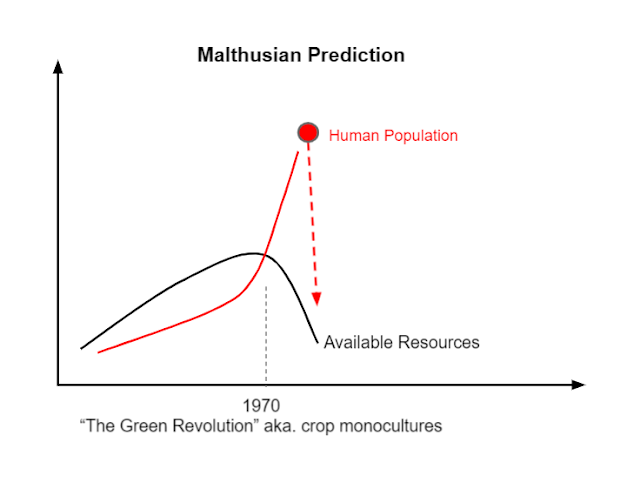
Seems to me that for the longest time, Mac10 has been often right detecting symptoms of the economic illness, but wrong in the final diagnosis of the disease. His economic model was a traditional one, and assumed – using all his stock and money charts – that there would at some point be reversions to historical means (or below), and the normal business cycle reckonings of recession or depression.
I have made this same mistake in assuming we might go through one last period of standard business and equity market cycles. Time will tell, but if Limits to Growth BAU scenario is the roughly correct scenario, if Dr. Morgan’s SEEDS model is directionally correct, if environmental and climate models are roughly correct, we are at the end of economic growth as measured by energy and non-energy natural resource flows through the economy. We are also at a point where the waste products of any additional economic activity feedbacks against material growth. (Loss of food supply due to weather pattern changes, for example.)
Therefore, as Christopher O. Clugston states in his book “Blip,” there will never be another recession (or a depression) as conventionally understood. We are nearing the end of the economic system that began circa 1750, and organized circa 1945 into its current financial and geopolitical structure. Many of the standard assumptions about economics will NOT apply, as those assumptions were mostly devised during the period of economic growth powered by fossil fuels and in particular by oil. Correlations and analogues often used by prognosticators to predict stock market behavior are no longer relevant, if they ever really were. All those charts Mac10 puts up…
We can only speculate what the end of this system means for equity and bond markets. My guess, just a guess, is that the central governments and central banks continue to create additional liquidity as long as possible, until the current system crashes rather completely. Equity prices remain elevated, bond yields continue to reach historical lows. Until…the system crashes in some way. Material consumption, particularly in the U.S., then resets at a significantly lower level, maybe 20-30% lower. From this lower plateau, we reset financially, socially, and politically in a domestic sense, and geopolitically from a global sense.
What happens to stocks and bond in this crash? How do money, stocks and bonds function in a world of degrowth? Hard to say.
Of course, it’s a little small minded of me to worry about stocks and bonds, in a world that is burning and being diminished more every day by industrial consumption and waste. But I was born and raised during The Great Acceleration, and so I am a product of that system. My brain assumes so many things about how the world works, that are probably not true anymore. I suspect only those born on the other side of the great reset, and in the great deceleration, will be able to think differently.
Thanks. It does feel like the next correction will be a big one due to the extreme debt we have used to delay the inevitable. I’d guess a 30-50% drop in our standard of living. If we had acted like adults and accepted reality we could have climbed down more slowly and had a better chance of retaining a civil society and avoiding war. The majority will of course say that no one saw it coming.
In the last year or two I started wondering if global resource wars are likely in the 2030s…
https://www.abc.net.au/radio/newcastle/programs/drive/ivermectin-covid-19/13418066
About time. Why did it take so long to hear this from our national broadcaster? Arrrrg!
Recall that the IPCC has an unblemished track record of being too optimistic.
Sometimes the explanation for a troubling phenomenon is staring me in the face and yet I cannot see it:
In addition to needing replacements for YouTube and Facebook, we now need to find a replacement for Wikipedia.
No more donations to Wikipedia from me.
Trigger warning: this article will make you angry.
https://www.thedesertreview.com/opinion/columnists/wikipedia-and-a-pint-of-gin/article_22ffa0d8-dde9-11eb-be75-d7b0b1f2ff67.html
A short post on the epistemology of COVID. 😊
To function well psychologically, and socially, you must mentally simplify and accept the “truth” of many assumptions and socially accepted assertions about the nature of the world. For an individual, there is not enough time or energy to continually check or challenge these assumptions and assertions. You must accept the “truth” of things and move forward as best as one can, under the constraints imposed by place and circumstance. To continually question the truth of every foundational idea is to be frozen into paralysis by analysis or lost in an epistemological quick sand, or ostracized from ones social circles.
So we human beings, including even scientists, will repeat assertions about the world we assume to be true, but that we do not really KNOW are true. God exists, and rides a chariot across the sky every day.
Of course, over time, we do challenge our foundational ideas. Science provides a methodological framework for challenging assumptions and assertions about the nature of the world and finding “truths” that are more effective enabling us to leverage the natural world. Scientific “Knowledge” is hard won and can take years or decades to confirm.
Are the these new mRNA vaccines (for just the spike protein) safe in the short term? Long term? Truly a game changing technology? Should we attempt to mass vaccinate 8billion people? Or will mass vaccination will create evolutionary pressure for more transmissible or virulent variants or not? Should we vaccinate people who were previously infected? etc. etc.
I do not have the scientific knowledge to know the provisionally “correct” answers to all the questions about the SARs COV 2 virus and vaccinations and treatment. But I think I can see that that there are many assertions and assumptions being made about what is “true” regarding SARs COV 2, that are not backed by hard won scientific knowledge, tested over time.
These assertions are being made by scientists, public policy folks, and the mainstream media, in order to move forward under the current circumstances and social pressures. No one really KNOWs these answers. We are in the middle of a giant science (and social) experiment, gathering the data necessary to reach some tentative conclusions, in a few years from now at best. It could be a decade or more before we KNOW the “correct” answers.
And yet, there is certainly some science on which these consensus views and public policy are based. So today, what is provisionally true, and what is not, with regard to SARs Cov2? Should we mass vaccinate or not? On a personal level, should I get vaccinated even though I have had COVID? I don’t think so to both, but have to admit I am now wading in that epistemological quick sand on these issues. My friends and family have a much easier time of things, just accepting what they are told and taking action based on that. I know that the people in Peru, where the COVID death rate appears to be 9%, would take all the vaccines they could get right now.
Well said.
I agree with you that the issues are very complex, we don’t yet know the answers to most of the questions, and we are conducting a giant experiment.
On the other hand, if a goal is to prevent people getting sick, we know that vitamin D helps with very little cost and zero risk.
And if a goal is to prevent death or serious illness for those who do get infected, we know Ivermectin helps with very little cost and near zero risk.
Yet our leaders are not promoting Vitamin D or Ivermectin. So what are their goals? And why should we trust anything they say if they can’t get the basics right?
Where did you get the 9% Peru death rate? It looks like 0.6% to me.
https://www.worldometers.info/coronavirus/country/peru/
My bad. I am churning through too much information these days. The article I saw was in the English? rag “The Sun” quoting 9% of all patients dying, not of infections (IFR). That Sun article is up on the web. It is correct that Peru is currently the leading the world right now in IFR.
https://www.bbc.com/news/world-latin-america-53150808
O.6% is 4 times worse than the annual flu of about .15. Do they have vitamin D and Ivermectin in Peru? I don’t know. Maybe they really need more vitamin D in general if darker skin native Peruvian ancestral groups now spend far less time outdoors than there ancestors. With my British Isles ancestry, I can get all the vitamin D I need in a day with 1o minutes of summer sunshine on my face. On the other hand, I burn in the tropical sun, or at altitude.
Correction to above comment.
IFR in my above comment should be CFR…Case Fatality Rate. CFR is the number of people who have died, divided by the total number of people DIAGNOSED with the disease.
See how Peru is in fact now at 9%. Mortality Analyses – Johns Hopkins Coronavirus Resource Center (jhu.edu) https://coronavirus.jhu.edu/data/mortality
The Infection Fatality Rate (IFR) is the number of deaths from a disease divided by the total number of cases/infections. Total number of cases in this calculation is usually estimated from antibodies in population blood samples, etc. This is the much lower figure of 0.6% above.
How to put all that in perspective? Don’t know. Peru has a total population of about 33Million. 193,909 have died to date.
And I should not be playing virologist on a web blog. ☹
The situation in Israel is developing more or less as outlined by van den Bossche: the number of cases is increasing and the vaccine is (much) less effective than it was thought. It seems that van den Bossche is not as wrong or clueless as insinuated by some/many.
Not really.
Look at deaths in last weeks – practically 0 for last 4 weeks.
Additionally 33 serious/critical cases in 2901 totak cases (1%) (what I can display now in worldometers.info).
So far this is exactly what mainstream promised – 80-90% of protection against getting sick and almost 100% against being sick morbidly.
I see nothing strange there – if we have millions of cases circulating around the world (as acive cases), you can expect that 10-20% of that get sick even after being vaccinated.
I have just read that YouTube has demonetised Brett Weinstein’s account. I find this deeply disturbing. I’m going to have to give some serious thought into how I interact with YouTube in the future.
He’s moved the Dark Horse podcast to Odysee. I’ve created an account and it seems to be a good alternative to YouTube.
https://odysee.com/@BretWeinstein:f?
New interview with Bossche.
I think Bossche might need to think about moving to Odysee. 😉
The Tyee is one of the better new outlets. Nevertheless they of course do not mention the need for population reduction (fewer new homes) nor consumption reduction (smaller homes) so that we cut fewer trees.
When I was a kid in the 70’s a 1000 sqft home was normal, now the normal exceeds 2000 sq ft. We are not happier or more comfortable today. We just consume more to keep up with our neighbors.
https://thetyee.ca/News/2021/06/24/Climate-Disaster-Hidden-BC-Forests/
Trillions are sloshing in and out with the daily tides.
I hope the baffles in the ballast tank hold.
This is not normal. Notice that the idiots in mainstream news ignore (aka deny) this.
https://wolfstreet.com/2021/06/30/feds-reverse-repos-spike-to-1-trillion-cash-drain-undoes-8-months-of-qe/
I have impression that things will happen quickly now…
Maybe not within weeks, but when people learn that “bright green future” is not there (and I guess it will be within 2-3 years maximum), the crumble spiral will be faster and faster…
It’s the big question. I have no idea, but I do say that interest rates will never rise significantly (above2% on the 10 year UST for more than six months) before collapse. The authorities will frantically pull demand forward as long as possible. It’s amazing to see. It’s the one prediction in which I have a lot of confidence.
Short thoughts on what collapse looks like financially?
Will it first be multiple countries on the periphery of this current global system falling financially or politically (food shortages, food prices as possible triggers), as the U.S. continues to “print” money to its advantage and the disadvantage of others? Or will the core of this current system, the U.S.A., suddenly reset downward to a much lower level of consumption and buying power? Can the Federal Reserve’s sustain it bond buying indefinitely? Maybe the test comes with the next geopolitical grey or black swan.
U.S. corporate earnings still look good, but maybe it is shortages of raw materials or much higher prices for those materials that start to eat into those profits and decrease consumer consumption levels, especially for discretionary items. A willingness to believe a materially prosperous future driven by technology still seems to be there, if frayed a bit by increasing social disorder/dis-union and increasing bad environmental news. Most people have their heads in the sand, or hands over there ears/eyes, to avoid thinking about the implications of those issues. There is no other alternative than continued belief in the existing system.
Behind all this discussion of possible outcomes of course is the invisible hand of energy supply and relentless depletion, and especially oil production. I think we are still down ~7mbpd global oil production from the November 2018 high, and if global GDP is tightly correlated, so real global GDP is down some commensurate amount. From memory the U.S. production today is something like 11mbpd down from 14mbpd. Maybe the globe and the U.S. could go back up to pre-COVID levels? But…
Background depletion on global oil fields in production is 3-6mbpd per year, so production activity is running on a faster and faster treadmill. Apparently, OPEC has quite a bit of surplus capacity still, but from two reports I saw that slack is gone in a year or two.
In any case, it seems like a bumpy ride from here on out in the best of economic cases. Supply chain issues from COVID will take several years to mend even if we had all the energy we needed. Then true oil shortages arrive. (Maybe they are there now, just masked by COVID. Environmental wastes including CO2 are now beginning to really impact food supply.
Seems like there is no “out” to a normal economy ever. Maybe there will be brief periods of respite, but the Federal Reserve will be forced to continue buy bonds until it cannot any longer.
Thanks. As long as there’s affordable oil and food the system seems to be quite resilient thanks to 8 billion clever monkeys all working hard to keep the system going. I’m amazed at how minor the inconveniences from Covid have been.
Your part of the world is even making news down under. I hope your well.
https://www.abc.net.au/news/2021-06-30/canada-us-heatwave-heads-into-uncharted-territory/100252678
Thanks, I’m surviving. The heat here is VERY unusual. Pretty much too hot to do anything.
“A picture is worth a thousand words” LOL. Not anymore. Not that I don’t accept the above pic as real, but fact is, today you can’t always unconditionally trust what you see in a picture or video. Or hear in a recording. Not with Photoshop , video editing, deep fakes and others forms of techno sorcery.
h/t Gail
https://www.pbs.org/newshour/show/a-leaked-un-report-warns-worst-is-yet-to-come-on-climate-change-heres-how-you-can-help
Good comment by CTG @ OFW.
https://ourfiniteworld.com/2021/06/18/how-energy-transition-models-go-wrong/comment-page-7/#comment-301446
https://www.cbsnews.com/news/heat-wave-dome-2021-seattle-portland-weather/
Doubly alarming that it’s still June.
Fascinating and perhaps a glimpse into the future of rich counties.
There’s no need for 18 wheel tanker trucks or paved roads when you have a 125cc motorcycle.
Thanks to Steve for sending me this and suggesting an additional panel for the 20’s “stop at one child”.

It’s endlessly fascinating that almost all of our vanishingly few aware people discuss everything except the one and only policy that would improve every one of our overshoot related problems: rapid population reduction.
It’s got to be the genes talking.
https://consciousnessofsheep.co.uk/2021/06/28/climate-change-relegated/
“Rapid economic simplification” Huh? Come again? You aint saying I have to give up my Starbucks Triple, Venti, Half Sweet, Non-Fat, Caramel Macchiato? Hot showers? Sushi takeout? No way man. The American way of life is non-negotiable.
Nice explanation today from the Dark Horse podcast for why Covid data cannot be trusted and how it is deliberately being skewed to push agendas.
https://odysee.com/@BretWeinstein:f/EvoLens85:9