I recently purchased a 6 piece queen sheet set for my bed and marveled at how something so useful, and so difficult to make myself, could be so inexpensive, costing only $30, or about 2 hours of my labor at minimum wage.
I did a little digging and found this video on how fabric was made before fossil energy:
And this video on how fabric is made today with fossil energy:
A podcast I monitor serendipitously had an episode today on the history of fabric making.
Author and journalist Virginia Postrel talks about her book The Fabric of Civilization and How Textiles Made the World with EconTalk host Russ Roberts. Postrel tells the fascinating story behind the clothes we wear and everything that goes into producing them throughout history. The history of textiles, Postrel argues, is a good way of understanding the history of the world.
For those who prefer video:
For those who prefer audio:
Postrel described the process required to make fabric products:
get fiber
grow plants or breed sheep
harvest plants or sheer sheep
clean fiber
transport fiber to spinner
spin fiber into thread
align fibers
stretch and twist
transport thread to weaver
weave fiber into fabric
set up warp threads
pass weft thread through alternate warp threads
cut and hem edges
transport fabric to manufacturer
manufacture final product
dye fabric
cut fabric
sew fabric
transport product to consumer
Postrel also provided some interesting data:
A single pair of jeans requires 10 Km of thread.
The fastest pre-fossil energy manual spinners in the world could produce 100m of thread per hour taking 13 x 8 hour days to produce enough thread for one pair of jeans.
A modern fossil energy spinning plant can produce 10 Km of thread in a few seconds.
Postrel did not provide data on how long it took to manually weave thread into denim for a pair of jeans, but the video above gives a pretty good idea.
A pair of jeans today costs me $15 or about 1 hour of my labor at minimum wage.
A basic twin sheet requires 46 Km of thread or 59 x 8 hour days for a fast pre-fossil manual spinner.
Again, no data on the weaving time.
Linen was, until the industrial revolution, a valuable family asset.
I can’t write a post without drawing a connection to reality denial.
In this case, Russ Roberts, a relative rocket scientist as far as mainstream economists go, never once in the interview drew a connection with non-renewable rapidly depleting fossil energy.
There was a long discussion on the economics of applying “technology” to textile production. But zero awareness of the link between technology and non-renewable energy.
Roberts did draw a connection between food and textiles in that he observed only 2% of the population are now farmers. Again, no apparent awareness of the centrality of natural gas for fertilizer and diesel for tractors and combines.
I’ve added Russ Roberts to my list of famous polymaths in denial, although I probably should have added instead “all economists except Steve Keen”.
Here is my simplified summary of Berman’s analysis:
both supply and demand for oil have recently fallen
oil demand has fallen more than oil supply
this despite an all-time record amount of debt conjured to stimulate the economy
which means the global economy is contracting and is in serious trouble
the contraction was underway before the virus – the virus accelerated but did not cause the contraction
the problem began in 1974 when oil prices increased above the level that the economy can grow without debt growing faster
we’re not going to run out of oil, we’re going to run out of people that can afford oil
the problem being geologic and thermodynamic in nature, has no business as usual fix, and will continue to worsen
Berman’s analysis is consistent with the conclusions of the other leading minds on the energy-economy relationship: Gail Tverberg, Tim Morgan, Nate Hagens, and Tim Garrett.
The most interesting question, by far, when viewed from 10,000 feet is why do none of our political or intellectual or business leaders understand the most important influence (energy) on the thing they care most about (economic growth)?
As an aside, recall that Eric Weinstein, the brilliant physicist/hedge fund manager whom I recently wrote about as a case study in denial believes correctly that economic growth and scientific advancement slowed in the late 70’s, but he doesn’t understand the cause despite thinking about it a lot. It’s no wonder that the much lesser intellects of almost all economists don’t have a clue what’s going on.
Berman believes that our economy, being a dissipative structure, will either collapse or spontaneously re-organize itself into a simpler form that uses less energy. I suppose the virus lockdown is a good example of a spontaneous lower energy re-organization. I put my money though on some form of collapse in the not too distant future. Despite a surfeit of entitled citizens, we could weather a significant reduction in living standards because we in the developed world consume so much more than we need to survive, however, the unprecedented debt bubble we have created by denying reality blocks a civil contraction.
Berman concludes that as the economy necessarily simplifies and we live much poorer lives, our energy mix will shift to lower productivity energy sources like wind and solar. My response to this is maybe. It’s more likely that Berman is denying the reality of his own analysis.
I can see solar panels being used for low power/high impact applications like, for example, LED lighting and pumping water into a gravity fed cistern. But it is unlikely and probably impossible that we will heat our homes, or cook our food, or cultivate and harvest our crops, or mine and smelt our minerals, or transport ourselves and our necessities with solar and wind.
When our solar panels and wind turbines wear out some decades in the future it is unlikely that the sophisticated factories and complex supply chains needed to manufacture and install replacements will exist. If some do exist to supply elite customers, like the military, most citizens probably won’t be able to afford their products.
I expect reality denial will prevent us from ever acknowledging peak oil and its offspring human overshoot. Instead, our consensus story all the way to a medieval lifestyle, at best, will likely be that there’s plenty of oil if the other tribes would stop using so much and we just need to elect someone tougher to deal with them and get our economy growing again.
Acknowledging our genetic tendency to deny reality would be a good thing because we might then focus on the best response to our overshoot predicament which is to rapidly reduce our population. Other wise responses can be found here.
Here’s the excerpted conclusion from Berman’s essay, but it’s definitely worth your time to read the whole thing for the data backing up these conclusions.
The Great Simplification
Energy is the economy. Money is a call on energy. Debt is a lien on future energy.
What is happening to oil markets and to the global economy is not because of a virus. The virus greatly accelerated what was already happening. Things won’t go back to normal when the virus ends.
The expansion of energy and debt have been leading toward some sort of reckoning for at least the last fifty years. That day of reckoning has been brought forward by coronavirus economic closures.
Oil prices had averaged $25 per barrel from the end of World War II until 1974 when average prices doubled (Figure 9). From 1979 through 1986, oil price soared to an average of $86 per barrel. These massive economic dislocations resulted in use of debt to maintain economic growth.
Excessive debt was the leading cause for the Financial Collapse of 2008. The crisis was resolved with more debt and monetary policies that ushered in the present era of central bank primacy in the world financial system.
Quantitative easing, near-zero interest rates and high oil prices led to the first wave of the tight oil boom. Over-investment resulted in over-supply and price collapse in 2014. By February 2016, WTI price reached $33 and investors rushed in to support the second wave of the tight oil boom.
WTI reached $72 by mid-2018 but by then, investors had begun to abandon tight oil as well as oil companies in general. The coronavirus economic closure brought monthly average prices to $17 in April, 2020—the lowest month on record. Unlike early 2016, investors weren’t writing any checks this time.
U.S. production may be 50% lower by mid-2021 than at year-end 2019. The implications for U.S. geopolitical power and balance of payments are staggering. It seems likely that the economy will weaken as government support for the unemployed decreases
I doubt that we are on the cusp of either a global energy crisis or the end of the oil age. It is more likely that both supply and demand will fall in tandem as the global economy contracts.
These observations are at odds with the mainstream view that both supply and demand are recovering. Some might concede that I am correct for the present but that things will improve and return to normal although it may some time.
Figure 10 shows credit growth and credit impulse for the United States from 1960 through the first quarter of 2020. Credit impulse is the change in flow of credit (debt) relative to economic activity (GDP).
Spikes in credit impulse correlate well with the oil-price shocks of the 1970s and 1980s. The extraordinary U.S. comparative inventory drawdown of early 2017 through the second quarter of 2018 also corresponds to credit impulse anomalies.
The chief feature of Figure 10, however, is that the magnitude of the first quarter 2020 credit impulse was more than twice as large as any previous increase. Moreover, GDP growth was either neutral or positive during previous spikes but was negative (-10%) for the first quarter of 2020. Also, oil prices were increasing during earlier periods but prices were decreasing in early 2020.
Ilya Prigogine was a chemist who won the 1977 Nobel Prize for his work on dissipative structures and self-organization. Dissipative structures are physical systems that release considerable heat as they consume ever-greater energy to support their growth and increasing complexity. A crisis occurs when growth can no longer be supported by available energy resources. The system either collapses or spontaneously re-organizes itself into a simpler form that uses less energy.
Empires, organizations and economies are dissipative structures. So is the human brain.
My friend Nate Hagens has applied some of Prigogine’s ideas to his own research about world energy, economics and ecology. He believes that we are on the cusp of something quite different from the scenarios suggested by Ahmed, and Goehring and Rozencwajg.
Hagens predicted a global economic decline in the 2020s and publicly expressed that opinion before the Covid pandemic. The main reason for decline, he stated, was too much debt undertaken to continue consuming and growing the economy. The virus has accelerated its timing and may result in contraction greater than the 30% drop during the Great Depression.
The Great Simplification will occur when the credit-supported part of the economy is removed. Economic activity will contract and less energy will be needed because it will be increasingly unaffordable to many parts of the population. People will be forced to adjust living standards downward and self-organize around energy with greater emphasis on local supply chains and regional economies.
I expect that the mix of energy sources will be similar initially. That will probably change as declines to meet the decreased carrying capacity of a society deprived of fossil energy productivity. Then, I imagine the world will move increasingly toward lower productivity energy sources like wind and solar. A viable economy may very well be created based heavily on wind and solar. It will, however, support a much poorer world than we have known for many decades in the world’s advanced economies.
Most ideas and analyses about future trends in energy and the economy fail to recognize that they are the two aspects of the same thing. That is why they are so far off the mark. This basic misalignment is painfully obvious because the energy sector represents only 2.5% of the S&P 500 valuation but underlies probably 95% of U.S. GDP.
Alpert explains why on our current default trajectory most of the global population that lives after 2050 will experience starvation and that by about 2100 our 8 billion will be reduced to about 600 million serfs leading a medieval lifestyle on a sick planet.
Alpert then describes an alternate trajectory via voluntary rapid population reduction that avoids unnecessary suffering and preserves a modern human civilization of 50 million living on a healthy planet.
Alpert remains the only person that I’m aware of with a thermodynamically feasible plan for maintaining a modern human civilization as fossil energy depletes.
His plan does require us to break through our evolved tendency to deny unpleasant realities. A few, such as the readers of this blog, have demonstrated this is possible but scaling to the majority remains in serious doubt.
You can find other work I’ve posted by Jack Alpert here.
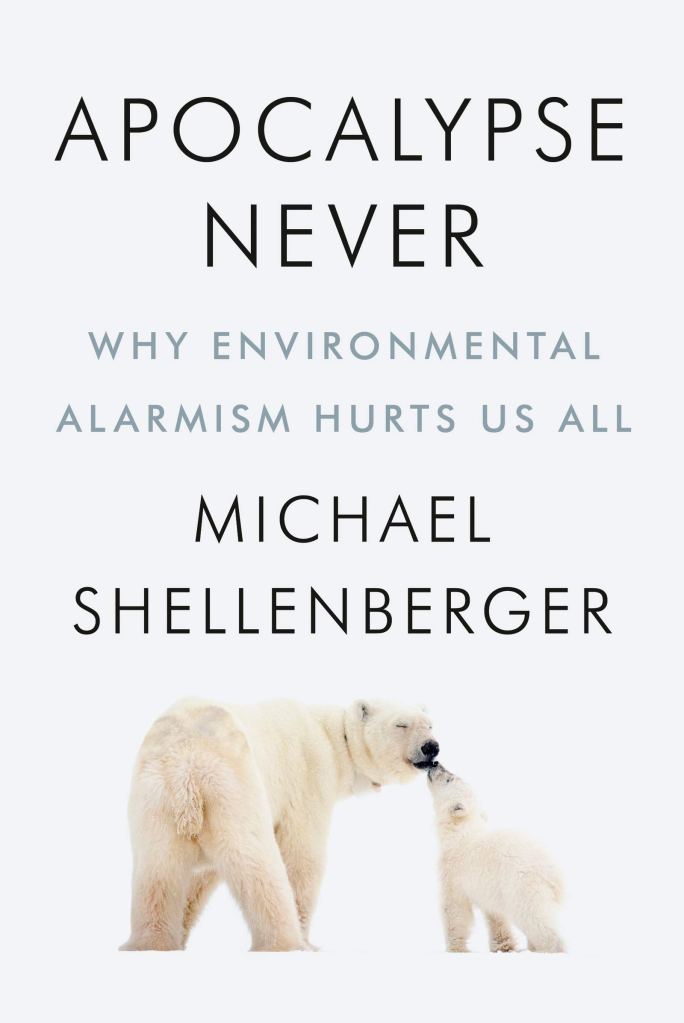
Apocalypse Never: Why Environmental Alarmism Hurts Us All
Michael Shellenberger has been fighting for a greener planet for decades. He helped save the world’s last unprotected redwoods. He co-created the predecessor to today’s Green New Deal. And he led a successful effort by climate scientists and activists to keep nuclear plants operating, preventing a spike of emissions.
But in 2019, as some claimed “billions of people are going to die,” contributing to rising anxiety, including among adolescents, Shellenberger decided that, as a lifelong environmental activist, leading energy expert, and father of a teenage daughter, he needed to speak out to separate science from fiction.
Despite decades of news media attention, many remain ignorant of basic facts. Carbon emissions peaked and have been declining in most developed nations for over a decade. Deaths from extreme weather, even in poor nations, declined 80 percent over the last four decades. And the risk of Earth warming to very high temperatures is increasingly unlikely thanks to slowing population growth and abundant natural gas.
Curiously, the people who are the most alarmist about the problems also tend to oppose the obvious solutions.
What’s really behind the rise of apocalyptic environmentalism? There are powerful financial interests. There are desires for status and power. But most of all there is a desire among supposedly secular people for transcendence. This spiritual impulse can be natural and healthy. But in preaching fear without love, and guilt without redemption, the new religion is failing to satisfy our deepest psychological and existential need.
Key points from the interview:
It’s unhelpful, unscientific, and depressing to describe our problems in apocalyptic terms.
Doomers are angry depressed people who want the world to collapse.
Environmentalism fills a spiritual need within atheists. When you’re living a life of prosperity and you stop believing in god and think you’ll become worm food after you die, you ask yourself what’s the purpose of life?
There is no 6th mass extinction underway. We are only causing 0.001% of species to go extinct each year. It is a problem that we’ve reduced wild animals by 50% since 1970 but the solution is to end poverty.
People are overreacting to Amazon deforestation.
CO2 emissions in advanced countries have been falling for years.
Nobel price winning economist William Nordhaus has shown that 4 degrees temperature rise is optimal considering the benefits of burning fossil energy and the costs of climate change; it’s a good thing we’re only going to experience 3 degrees rise thanks to us switching from coal to clean and amazingly abundant natural gas.
Nothing bad is going to happen at 3 or 4 degrees temperature rise, nor will it remove the flood control system that protects my house in Berkeley. The only bad thing that might happen at 4 degrees is we grow less food, but that can be solved by providing tractors, irrigation and fertilizer to farmers in poor countries.
The Netherlands has proven that sea level rise is not a problem for rich countries.
Eating less meat will not help climate change nor improve your health. We evolved to eat meat and CAFO’s have reduced our use of land for livestock by an area equivalent to Alaska.
People wanting to lower their impact should drive a used car and fly less.
Cheap abundant energy is the source of our well being.
Renewable energy has too low power density to support our lifestyle. If you want to reduce climate change you should support nuclear energy.
Using more energy is good for people and nature because it reduces the consumption of materials.
The solution to environmental problems is to bring poor people up to our standard of living.
To summarize what I think is Shellenberger’s message:
A modern affluent lifestyle is good for the environment and is enabled by abundant low cost energy.
Renewable energy does not have sufficient power density, we need fossil and nuclear energy.
There are serious environmental problems but helping poor countries achieve a similar lifestyle to ours will solve many of them, and if we’re wealthy we can cope with the remaining problems.
I think Shellenberger is intelligent and is correct on many of his points. Unfortunately the points he’s wrong on are fatal:
Affordable fossil energy will deplete much quicker than he assumes. Our economic problems of the last 12 years are evidence that power down is underway.
If I’m wrong on the depletion rate of affordable fossil energy, our economic growth will be constrained by other non-renewable resources.
Nuclear energy was once a good idea, but not now that fossil energy depletion is weakening economies and governments thus making good governance a too risky bet. Nuclear also doesn’t solve our dependency on diesel for tractors, combines, trucks, trains, and ships.
The consequences of our current 1 degree temperature rise are already dire due to the loss of ice. The 3 degrees Shellenberger is comfortable with will create a planet incompatible with modern civilization due to the impact on food production and sea level rise. Even if I’m wrong, we won’t have the wealth to cope.
People like Michael Shellenberger, Eric Weinstein, Matt Ridley, Steven Pinker, and Yuval Noah Harari demonstrate that regardless of how intelligent or well educated you are, if you deny the reality of energy depletion, then most of your beliefs are probably wrong, because pretty much everything depends on energy.
Perhaps this is why Nate Hagens once likened discussing peak oil to eating a bad oyster.
Every year Nate Hagens gives a talk on Earth Day. I missed the announcement of his talk a month ago, perhaps because I killed my social media accounts, but better late than never.
Nate’s presentation as usual is excellent, and this year he provides thoughts on how the virus may influence our overshoot predicament.
Here are a few of Nate’s predictions and ideas I thought were noteworthy:
The virus gave our economy a heart attack, although it was already sick.
The Great Simplification has begun: a GDP decline of 12-20% is likely this year.
Global peak oil was, with no uncertainty, October 2018.
Diesel availability is at risk because of surplus gasoline (my note: big problem because diesel powers everything we need to survive: tractors, combines, trucks, trains, and ships).
The financial system has been nationalized: central banks are now both the lender AND buyer of last resort.
Global debt/GDP, which was before the virus already unsustainable at 350%, will now rocket to 450+%, which sets us up for another more acute crisis in the not too distant future.
Poverty will increase in all countries.
Renewable energy is in trouble.
25+% of higher education institutions will go bankrupt.
The experts don’t have answers: they do not understand energy or how our system works.
We need humans to have better bullshit filters: if we don’t use science to help us going forward we have no hope.
We should nationalize the oil industry and drain America last.
Nate concludes with many constructive and positive ideas on how we might respond to our predicament.
Unfortunately Nate did not mention the most important response needed: rapid population reduction. Yes I know that reality denial and the Maximum Power Principle, which govern our behavior, make voluntary population reduction highly improbable, but so do they make improbable all of Nate’s suggestions.
I’m thinking that since it’s unlikely we’ll do anything except react to crises as they unfold we might as well focus on the one and only action that would improve everything: population reduction. It simplifies the conversation, and makes it (theoretically) effective. Much better than talking about many things that we also probably won’t do, but even if we did wouldn’t address the core issue: overshoot.
Imagine this political platform: “We only need to do one thing, and there’s only one thing we need to do, don’t have children unless you win the lottery, so there can be future generations.”
You can find other excellent work by Nate that I’ve posted in the past here.
Gail Tverberg is one of my favorite thinkers and has been writing about our overshoot predicament for years. In today’s essay she makes the most specific predictions I’ve seen on the probable outcomes of the economic deceleration caused by the Wuhan virus.
I suspect most of her predictions will happen, but I’m not confident on the timeline. It’s possible money printing will buy us a few more years, or maybe not.
I think we should hope for the best, and plan for the worst.
Regardless, time is running out to make preparations.
Our basic problem is a finite world problem. World population has outgrown its resource base.
In this post, I suggest the possibility that some core parts of the world economy might temporarily be saved if they can be made to operate fairly independently of each other.
The COVID-19 actions taken to date, together with the poor condition the economy was in previously, lead me to believe that the world economy is headed for a major reset.
A reset world economy will likely end up with “pieces” of today’s economy surviving, but within a very different framework.
There are clearly parts of the world economy that are not working:
The financial system is way too large. There is too much debt, and asset prices are inflated based on very low interest rates.
World population is way too high, relative to resources.
Wage and wealth disparity is too great.
Too much of income is going to the financial system, healthcare, education, entertainment, and travel.
All of the connectivity of today’s world is leading to epidemics of many kinds traveling around the world.
Even with these problems, there may still be some core parts of the world economy that perhaps can be made to work. Each would have a smaller population than today. They would function much more independently than today, like mostly separate economic pumps. The nature of these economies will be different in different parts of the world.
In a less connected world, what we think of today as assets will likely have much less value. High rise buildings will be worth next to nothing, for example, because of their ability to transfer pathogens around. Public transportation will lose value for the same reason. Manufacturing that depends upon supply lines around the world will no longer work either. This means that manufacturing of computers, phones and today’s cars will likely no longer be possible. Products built locally will need to depend almost exclusively on local resources.
Pretty much everything that is debt today can be expected to default. Shares of stock will have little value. To try to save parts of the system, governments will need to take over assets that seem to have value such as farm land, mines, oil and gas wells, and electricity transmission lines. They will also likely need to take over banks, insurance companies and pension plans.
If oil products are available, governments may also need to make certain that farms, trucking companies and other essential users are able to get the fuel they need so that people can be fed. Water and sanitation are other systems that may need assistance so that they can continue to operate.
I expect that eventually, each separate economy will have its own currency. In nearly all cases, the currency will not be the same as today’s currency. The currency will be paid only to current workers in the economy, and it will only be usable for purchasing a limited range of goods made by the local economy.
These are a few of my ideas regarding what might be ahead:
(a) There will be a shake-out of governmental organizations and intergovernmental organizations. Most intergovernmental organizations, such as the United Nations and European Union, will disappear. Many governments of countries may disappear, as well. Some may be overthrown. Others may collapse, in a manner similar to the collapse of the central government of the Soviet Union in 1991. Governmental organizations take energy; if energy is scarce, they are dispensable.
(b) Some countries seem to have a sufficient range of resources that at least the core portion of them may be able to go forward, for a while, in a fairly modern state:
United States
Canada
Russia
China
Iran
Big cities will likely become problematic in each of these locations, and populations will fall. Alaska and other very cold places may not be able to continue as part of the core, either.
(c) Countries, or even smaller units, will want to continue to limit trade and travel to other areas, for fear of contracting illnesses.
(d) Europe, especially, looks ripe for a big step back. Its fossil fuel resources tend to be depleted. There may be parts that can continue with the use of animal labor, if such animal labor can be found. Big protests and failing debt are likely by this summer in some areas, including Italy.
(e) Governments of the Middle Eastern countries and of Venezuela cannot continue long with very low oil prices. These countries are likely to see their governments overthrown, with a concurrent reduction in exports. Population will also fall, perhaps to the level before oil exploration.
(f) The making of physical goods will experience a major setback, starting immediately. Many supply chains are already broken. Medicines made in India and China are likely to start disappearing. Automobile manufacturing will depend on individual countries setting up their own manufacturing supply chains if the making of automobiles is to continue.
(g) The medical system will suffer a major setback from COVID-19 because no one will want to come to see their regular physician any more, for fear of catching the disease. Education will likely become primarily the responsibility of families, with television or the internet perhaps providing some support. Universities will wither away. Music may continue, but drama (on television or elsewhere) will tend to disappear. Restaurants will never regain their popularity.
(h) It is possible that Quantitative Easing by many countries can temporarily prop up the prices of shares of stock and homes for several months, but eventually physical shortages of many goods can be expected. Food in particular is likely to be in short supply by spring a year from now. India and Africa may start seeing starvation much sooner, perhaps within weeks.
(i) History shows that when energy resources are not growing rapidly (see discussion of Figure 3), there tend to be wars and other conflicts. We should not be surprised if this happens again.
Conclusion
We seem to be reaching the limit of making our current global economic system work any longer. The only hope of partial salvation would seem to be if core parts of the world economy can be made to work in a more separate fashion for at least a few more years. In fact, oil and other fossil fuel production may continue, but for each country’s own use, with very limited trade.
There are likely to be big differences among economies around the world. For example, hunter-gathering may work for a few people, with the right skills, in some parts of the world. At the same time, more modern economies may exist elsewhere.
The new economy will have far fewer people and far less complexity. Each country can be expected to have its own currency, but this currency will likely be used only on a limited range of locally produced goods. Speculation in asset prices will no longer be a source of wealth.
OPEC agreed on Thursday to cut oil output by an extra 1.5 million barrels per day (bpd) in the second quarter of 2020 to support prices that have been hit by the coronavirus outbreak, but made its action conditional on Russia and others joining in.
Notice that this and pretty much every other news report you read never explains the thermodynamic implications of what they report, because they are ignorant of, and/or deny, the relationships between wealth creation, credit availability, and fossil energy consumption.
Oil producers today cut production by about 1.5%.
Why? Because demand for oil is falling and the world has limited storage capacity. Oil must be burned at about the same rate it is produced. If they don’t curtail production prices will fall below the cost of production and everyone will lose money, except of course shale oil producers who have always lost money.
Why is oil demand falling? Because the oil powered machines that produce and deliver almost all of the things we use and eat are slowing down, which means economic growth is slowing or possibly declining.
What happens if economic growth stops or declines? Our banking system becomes fragile because the design of our debt backed fractional reserve monetary system requires growth to function.
Put more simply, money and debt retain value, and credit remains plentiful, only in the presence of economic growth.
Why are credit and debt important? Because our standard of living depends on them. For example, today you can save 5% of the price of a house, get credit for 95% in the form of a mortgage, and immediately enjoy 100% of the house. Your mortgage, in turn, funds someone else’s retirement portfolio. Without plentiful credit, most people will not enjoy their own home, or car, or iPhone, and most people will not be able to retire.
I explained the importance of growth and why we can’t have it forever in more detail here.
How have our leaders responded? Canada announced an emergency interest rate cut yesterday in the hope of stimulating economic growth. Our prime minister is planning to spend more printed money to stimulate growth.
Will it work? Does providing alcohol to an alcoholic work? Yes, for a while, unless he’s already too drunk, but doing so makes his bottom more painful.
How do you know when an alcoholic is too drunk? You offer him free liquor and he does not drink.
How do you know when an alcoholic has not yet bottomed out? He kills his hangover the next day with a drink.
How do you know when it’s too late to save an alcoholic? He dies from an overdose.
How do you know when an alcoholic is clean? He decides to promote and vote for a birth lottery.
<Edit Mar 8>
I’m going to go out on a limb and say the correction has begun that those of us with defective denial genes have anticipated since the rocket scientists that lead us “fixed” the too much debt crisis in 2008 with more debt. They’ll try again this time but I suspect the alcoholic is too drunk to drink. I don’t know if the drunk will respond if they try extreme measures like intravenous white lightning. Assuming he doesn’t, my guess is 20-50% of paper wealth will vaporize in this step down. There are more steps to follow in coming years until the alcoholic bottoms out when his preferred drink, oil, is gone. There’d be much less pain for all if he’d sober up now.
More evidence that intelligence and education do not reduce reality denial, and that the strength of denial is proportional to the unpleasantness of the reality, as Varki’s Mind Over Reality Transition theory predicts.
Two hundred scientists were recently surveyed on their perceptions of global risks.
Top risks by likelihood:
1. Extreme weather
2. Biodiversity loss
3. Water crises
4. Climate change
5. Urban planning
6. Man-made disasters
7. Involuntary migration
8. Food crises
9. Asset bubbles
10. Illicit trade
Top risks by impact:
1. Extreme weather
2. Climate change
3. Water crises
4. Biodiversity loss
5. Food crises
6. Man-made disasters
7. Urban planning
8. Natural disasters
9. Involuntary migration
10. Interstate conflict
Notice that depletion of affordable fossil energy does not make their list.
Notice also that fossil energy scarcity will worsen every single one of the risks they are worried about, except maybe climate change, and a good argument can be made that oil scarcity will in fact worsen climate change because we will probably burn anything and everything to survive.
Notice also that all actions (except rapid population reduction) to mitigate any of the risks the scientists are worried about requires surplus wealth that only abundant affordable fossil energy can generate.
Notice also that depletion of affordable fossil energy is a problem today for every country in the world, not a vague future risk, nor a risk for future generations, nor a risk that effects only a subset of less fortunate countries. Affordable fossil energy depletion is at the core of global social unrest caused by growing wealth inequality and falling standards of living, unsustainable runaway government debt that threatens monetary stability, and a dangerous asset bubble that threatens a collapse rather than a decline.
Notice also that fossil energy depletion (and climate change) is the only risk that we can’t do anything about, except make do with less, and rapidly reduce our population.
Notice also that most scientists believe we can keep our lifestyles and reduce the threat of their top risk, climate change, by switching from fossil energy to renewable energy, which is a thermodynamic impossibility.
Notice also that fossil energy depletion is the only risk that has 100% certainty.
The only reality more certain and more unpleasant than fossil energy depletion is our mortality, which I’ve previously discussed.
That’s why fossil energy depletion is not on the risk list of our best and brightest.
The strength and ubiquity of human reality denial is amazing!
P.S. This talk by engineer Jean-Marc Jancovici, which I posted a couple years ago here, is one of the best explanations of why everything I said above about the depletion of affordable fossil energy is true. In 90 minutes Jancovici demolishes pretty much everything the idiot professions of economics and central banking believe.
Tim Watkins, with some help from Chris Martenson, is very good today.
I observe that people fighting for our species to acknowledge its predicament, like Extinction Rebellion, are as much in denial as the people they oppose.
In his last section, Watkins suggests that the environmental movement has a choice to make between two paths. This implies that they understand what is going on. Here I disagree. I think genetic reality denial blocks almost everyone, including environmentalists, from understanding what is going on, as Varki’s MORT theory predicts.
An an aside, there is a Canadian federal election in a few days. I read the platforms of all the parties. Not one has a clue what is going on. I refuse to vote for idiots in denial.
Firstly, there is no net zero because humans have failed to figure out a viable means of capturing and sequestering carbon dioxide for the several centuries that would be required after we ceased burning fossil fuels to restore the climate to something akin to conditions today. At this point, no doubt, some readers will object that trees and soils are natural carbon sinks; and so we might plant more trees and restore more soils. The question, however, is which trees and soils, and to what end? Few trees live beyond a century (especially when some idiot comes along and harvests them to use as “green” biofuel). And when a tree dies and falls to the floor, it dumps all of the carbon back into the atmosphere. Similar problems affect attempts at soil restoration since any further use will unlock the carbon stored there.
There is, you will be pleased to know, one natural process that can sequester and lock up all of the carbon that we have dumped into the atmosphere in the course of the last three centuries. It involves a warmer and wetter climate washing nutrients off the land and out to sea; where plankton and algae blooms can flourish and multiply; giving off noxious hydrogen sulphide – which causes “red tide events” – as a by-product. As these microscopic plants die, they sink to the ocean floor where, along with the carcasses of any marine creature that happened into the oxygen-starved red waters beneath the surface, they gradually decompose into a glutinous mud. Over time, layers and layers of this hydrocarbon-rich mud will pile up. And over centuries it will be subsumed beneath the Earth’s crust, where it will be heated and compressed beneath an impervious layer of rock that prevents it from leaking to the surface. With the carbon sequestered in this way, over millions of years the climate will cool once more.
My more alert readers will be aware that the process that I just described is the one in which the fossil fuels that we have been burning for the past 300 years were created in the first place. As far as I am aware, it is the only process currently known that can lock up large volumes of carbon dioxide for the geological time period required to repair the damage that we have already done.
There is enough carbon dioxide in the atmosphere already to raise the temperature above 3 degrees over pre-industrial levels; so that even if we ceased burning fossil fuels today, it is highly unlikely that the global economy and a population approaching 8 billion can survive the devastation. Indeed, those at the more pessimistic end of the spectrum argue that we will be lucky if there are any humans at all on Earth by 2030. But even knowing that the current debate is between those who think things are about to get very, very bad and those who think they are about to become fatal will not be enough to prevent humanity from continuing to pump greenhouse gases into the atmosphere.
The reason is simple, the only way in which we can support a global population that is at least eight times the sustainable level; is to use fossil-powered industrial agriculture on a global scale. And while switching the diet to lower the volume of cow belches will make an insignificant difference, the fact remains that fossil-powered global plant farming is still a major source of greenhouse gases. Nor do we dare dispense with the fossil-powered global supply chains that have saved the largest part of humanity from the kind of famines that were commonplace just a few decades ago. Growing excess food in favourable regions and transporting it to less favourable ones has always been the means by which humans combatted famine. The only difference today is that we do it on a global scale; meaning that disruption in any one supply chain can rapidly undermine the entire system.
At this point, of course, the techo-utopian journalists, politicians and protestors will complain that I am ignoring renewable energy and the fourth industrial revolution. Once again, the reason for this objection is largely a product of an education system that is not fit for purpose. In a recent article on the Peak Prosperity website, scientist Chris Martenson refers to the sheer scale of the task that would be involved just in substituting (i.e. ignoring all of the technical engineering challenges involved) the quantity of energy we get from fossil fuels with renewable energy:
“Suppose we agree on the goal to entirely replace fossil fuel energy by 2050. (We’re going to have to do it by some point, because oil, coal and natural gas are all depleting finite resources.)
“With 2050 as a starting point we can run some simple math.
“We start by converting the three main fossil fuels – coal, oil and natural gas – into a common unit: the “millions of tons of oil equivalent” or Mtoe.
“A million tons of oil = 1 Mtoe, obviously. And there’s an amount of coal, if burned that has the same energy as 1 Mtoe. Ditto for natural gas. If we add up all of the fossil fuels burned in a given year, then we can express that as a single number in the many thousands of Mtoe.
“Roger Pilke has run the math for us in his recent article in Forbes:
‘In 2018 the world consumed 11,743 Mtoe in the form of coal, natural gas and petroleum. The combustion of these fossil fuels resulted in 33.7 billion tonnes of carbon dioxide emissions. In order for those emissions to reach net-zero, we will have to replace about 12,000 Mtoe of energy consumption expected for 2019’…
“So, what would it take to replace those 12,000 Mtoe with alternative fuels by 2050?
“Pilke answers that for us:
Another useful number to know is that there are 11,051 days left until January 1, 2050.
To achieve net-zero carbon dioxide emissions globally by 2050 thus requires the deployment of >1 Mtoe of carbon-free energy consumption (~12,000 Mtoe/11,051 days) every day, starting tomorrow and continuing for the next 30+ years…
“But that’s only half of the story.
“We’d also have to decommission and retire an equivalent 1 Mtoe amount of still-functioning fossil fuel property, plant and equipment. Do you have any idea how much money and embedded capital is contained in all the world’s current energy infrastructure — including our cars and homes — that’s built around fossil fuel use?
“Somehow, the world would have to replace the equivalent of the energy contained within 2.4 Ultra Massive crude ships. Every. Single. Day. For 11,000 days straight, without missing a single day. A 7,000 mile long cargo train of ultra massive ships retired at the rate of 2.4 per day for the next 30 years…
“What would that take? Again from Pilke:
So the math here is simple: to achieve net-zero carbon dioxide emissions by 2050, the world would need to deploy 3 [brand new] nuclear plants worth of carbon-free energy every two days, starting tomorrow and continuing to 2050. At the same time, a nuclear plant’s worth of fossil fuels would need to be decommissioned every day, starting tomorrow and continuing to 2050.
I’ve found that some people don’t like the use of a nuclear power plant as a measuring stick. So we can substitute wind energy as a measuring stick. Net-zero carbon dioxide by 2050 would require the deployment of ~1500 wind turbines (2.5 MW) over ~300 square miles, every day starting tomorrow and continuing to 2050.”
It has taken a Herculean effort in the developed western states just to deploy a relatively small number of wind turbines and solar panels into our electricity generation mix. The idea that we are going to replace the far larger fossil fuel consumption in transport, building temperature control, industry and agriculture is no more than magic thinking.
This is where the charge of hypocrisy that is often levelled against Extinction Rebellion hits home. It is doubtful that more than a handful of the protestors is prepared to make even a fraction of the lifestyle changes that would be involved just to lower the rate at which we are dumping greenhouse gases into the atmosphere. Certainly some will be prepared to give up flying, stop eating meat, use a refillable water bottles and put on an extra layer rather than turn the heating up. Mobile phones are a different matter – even though the data centres on which they depend are among the most polluting buildings on Earth. Few, one suspects, will be prepared to take the radical actions such as giving up the right to have children in favour of the birth licensing system that a rapid shift to a zero-carbon economy implies.
In the end, Extinction Rebellion is facing the same dilemma that has plagued the environmental movement from the start:
Should it spell out the enormous effort and sacrifice involved in changing course – and thereby risk alienating the majority of those who need to be won over? Or;
Should it pretend – despite all the evidence to the contrary – that a few windmills and solar panels will allow us to continue growing our planet-destroying economy without even pausing to draw a breath.
My fear is that – like the various green parties around the world – this latest manifestation of environmentalism will take the second option so as not to scare the horses. And if those at the gloomier end of the spectrum are correct and that we only have 10 years left, this may not be such a bad thing; after all, they say that dying in your sleep is far preferable than consciously looking death in the face. Either way, one can count on one hand the number of protest movements that have achieved the change they wanted to bring about. The enormity of the predicament does not change this fact. The sad reality is that we are all prisoners of the very system that is killing us; dependent upon it for the food, water, clothing and shelter that sustain us even as it destroys the habitat we depend upon. We could end it tomorrow if only the majority of us chose to stop playing the game; but the sacrifice is too great… and few of us are prepared to take the hit while others continue to get a free pass.
And so, while I salute those who have taken to the streets this month (my son is among them and I am proud that he is standing up for what he believes in) I would also caution them that the changes that are coming are not the ones they want; still less the ones the leaders of their movement are pretending they can have. Our current civilisation can be compared to the last moments of the Titanic – holed below the waterline and destined to sink into a watery grave. Most of those who are protesting are merely akin to the frightened passengers begging a Captain and crew to respond to a situation that they have already lost control of. The sensible few among the protestors will look to those who are assembling the lifeboats. But the majority – whether they believe the emergency is real or not – will soon meet their tragic end. And protesting icebergs and reckless Captains will do nothing to save them – or us – now!






 un-Denial