
I just finished the book Don’t Sleep, There Are Snakes: Life and Language in the Amazonian Jungle by Daniel L. Everett. Thank you to Perran for recommending it.
A riveting account of the astonishing experiences and discoveries made by linguist Daniel Everett while he lived with the Pirahã, a small tribe of Amazonian Indians in central Brazil.
Everett, then a Christian missionary, arrived among the Pirahã in 1977–with his wife and three young children–intending to convert them. What he found was a language that defies all existing linguistic theories and reflects a way of life that evades contemporary understanding: The Pirahã have no counting system and no fixed terms for color. They have no concept of war or of personal property. They live entirely in the present. Everett became obsessed with their language and its cultural and linguistic implications, and with the remarkable contentment with which they live–so much so that he eventually lost his faith in the God he’d hoped to introduce to them.
Over three decades, Everett spent a total of seven years among the Pirahã, and his account of this lasting sojourn is an engrossing exploration of language that questions modern linguistic theory. It is also an anthropological investigation, an adventure story, and a riveting memoir of a life profoundly affected by exposure to a different culture. Written with extraordinary acuity, sensitivity, and openness, it is fascinating from first to last, rich with unparalleled insight into the nature of language, thought, and life itself.
I read the book hoping to find some evidence either supporting or contradicting Ajit Varki’s MORT theory. It was an enjoyable and very interesting read. The author is smart, articulate, and an engaging expert on languages and anthropology.
Everett describes in detail the Pirahã (pronounced Pita-hah) which is (was?) a rare tribe whose culture has (had?) not yet been significantly modified or subsumed by contact with modern industrial civilization.
The Pirahã are unusual in that they have no origin myths or well defined religion, although they do believe in spirits, but Everett was very vague on how these spirits influence their culture. The Pirahã have no interest in, and resist conversion to, other religions like Christianity.
I was most interested to learn whether the Pirahã believe in life after death because this is central to Varki’s MORT theory. I found it very odd that the author, a former Christian missionary, would discuss almost everything about their culture except their belief, or lack thereof, in life after death. Everett did say the Pirahã bury their dead with the few valuable items they own, which to me suggests they do believe in life after death, otherwise why not keep the wealth for the living?
I found it difficult to identify Pirahã behaviors that suggested they do or do not deny unpleasant realities. Perhaps this is a side effect of them living in the moment and therefore having many fewer unpleasant things to deny.
In summary then, with respect to support for or against Varki’s MORT theory, I’d say there was evidence for denial of death, but not much else.
The book offered, as a pleasant surprise, some genuine inspiration on how to lead a happier and more sustainable life.
The behavior of the Pirahã suggests that the Maximum Power Principle (MPP) may not be a primary driver in all human cultures, as I had previously assumed. The Pirahã work hard to acquire enough resources to survive, and will fight to protect those resources if necessary, but do not acquire nor desire more resources than required to survive.
The Pirahã live in and enjoy the moment. They do not obsess about bad events in the past. They do not worry about the future. They forgive quickly. They laugh, tell stories, and dance. They are proud of their way of life. Everyone is expected and does contribute to the tribe, unless they are physically unable, in which case the tribe looks after them.
I very much like stories with happy endings and this book delivered. Everett began his work as a devout missionary trying to convert the Pirahã to Christianity. Over time his scientific training that required evidence based reasoning, and the obvious fact that the Pirahã led happy fulfilling lives without Jesus, caused Everett to abandon Christianity and become an atheist. Hallelujah!
I wish the Pirahã would turn the table and send out missionaries to convert the 8 billion lost souls that need salvation.
P.S. Everett did a nice take-down of Noam Chomsky’s linguistic theories, which I enjoyed, because Chomsky irritates me as yet another famous polymath who knows a lot about everything, except what matters.
P.P.S I’ve started another book by Daniel Everett, How Language Began: The Story of Humanity’s Greatest Invention.
P.P.P.S. Here are a few videos of Everett talking about the Pirahã.
“To cite one example of needless war from the last century, consider America’s horrendous years of fighting in Vietnam and a critical lesson drawn first hand from that conflict by reporter Jonathan Schell. “In Vietnam,” he noted, “I learned about the capacity of the human mind to build a model of experience that screens out even very dramatic and obvious realities.”
As a young journalist covering the war, Schell saw that the US was losing, even as its military was destroying startlingly large areas of South Vietnam in the name of saving it from communism. Yet America’s leaders, the “best and brightest” of the era, almost to a man refused to see that all of what passed for realism in their world, when it came to that war, was nothing short of a first-class lie.
Why? Because believing is seeing and they desperately wanted to believe that they were the good guys, as well as the most powerful guys on the planet. America was winning, it practically went without saying, because it had to be. They were infected by their own version of an all-American victory culture, blinded by a sense of the United States’ obvious destiny to be the most exceptional and exceptionally triumphant nation on this planet.”
https://asiatimes.com/2020/07/americas-war-on-its-own-democracy/
Nice Apneaman, thanks.
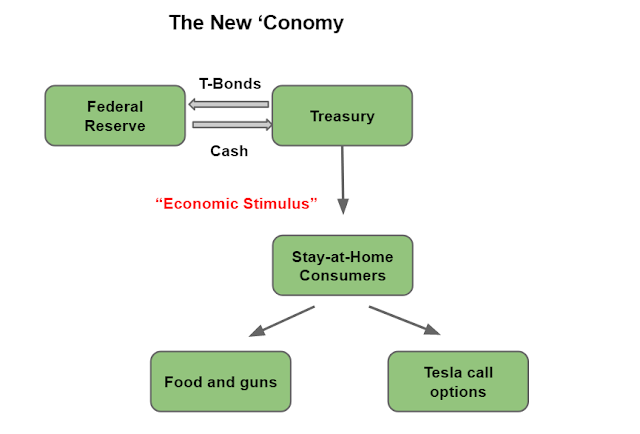
Denial is so powerful and so ubiquitous in “normal” society that it’s sometimes hard to see despite being right in your face. For example, today’s widespread belief that printing money has no consequences.
Important message from the White House…
Nice to see Richard Heinberg discuss Varki’s MORT theory.
Not so nice that Heinberg still doesn’t acknowledge that rapid population reduction policies are the only rational priority for anyone still trying to make the future less bad.
https://www.resilience.org/stories/2020-07-24/doom-or-denial-is-there-another-path/
Richard Heimberg’s book “The party’s over” has a special place on my bookshelf. It was the first book I read on resource depletion. The year was 2006. I didn’t know what I was getting myself into. I’ve never recovered 🙂.
Me neither. I remember the exact instant in about 2006 when I understood the implications of peak oil. It was like someone hit me with a 2×4.
At least Heinberg, born in 1950, never personally reproduced. He’s an extreme rarity in the groups involving doomers/environmentalists/scientists/anybody intellectually capable of understanding the math behind exponential growth. The very few, off the top of my head, who have taken the overpopulation topic seriously by having zero kids are the following [a pathetically short list]:
Alice Friedemann, born in mid-1950s
Dennis and Donella Meadows, born in 1942 and 1941, respectively
Terry Tempest Williams, born in 1955
Chris Packham, born in 1961
Guy McPherson, born in 1960
Sam Mitchell, born in 1959
Les U. Knight, born in late 1940s
Paul Ehrlich, born in 1932, had one daughter in 1955, years before he became aware and wrote his book; unfortunately, she went on to have three daughters, who have provided her with numerous grandchildren. Pentti Linkola, born in 1932, had two daughters, born in 1961 and 1963, years before overpopulation hit the news. His daughters were much wiser and certainly more empathetic, since they chose to have zero children.
Thanks. I can imagine that there are many people with children who became overshoot aware later in life since it is not taught in the school system, or reported on in the news, or discussed by neighbors, or studied by scientists, or debated by leaders.
Heinberg is a great man but he still can’t bring himself to say what needs to be said.
Unfortunately, I could give you a long list of those who were quite aware of overpopulation and still chose to bring children to a dying planet. I would do so now, but I’m in a very good mood today and don’t want to ruin it, ha ha!
However, I’ll leave this May 2020 Vandara Shiva/David Suzuki video here. Somebody made this accurate comment about them:
Thanks for discussing THE most important, most moral topic there is . . .
Thanks. I’m not a fan of Suzuki or Shiva. Neither are very bright.
Wolf Richter makes a convincing case that it’s going to be very hard to get out of this virus caused economic downturn, and he’s not even aware of peak oil and other elements of overshoot.
An interesting article on Alice Friedman’s blog. http://energyskeptic.com/2020/methane-apocalypse-not-certain/
While it’s nice to know we’re not going to boil even 2 degrees warming will push many ecosystems over the edge. Where I live the alpine ecosystems only inhabit the last 100 to 300 metres of the mountain top. In a world that’s 2 degrees warmer 90 percent of those ecosystems will disappear. There’s no where higher up to go.
Thanks. I agree with you. We have several high impact high probability problems without worrying about the low probability stuff.
I finished reading Daniel Everett’s book How Language Began: The Story of Humanity’s Greatest Invention
https://www.goodreads.com/book/show/32191675-how-language-began
It was ok but not as good as his book Don’t Sleep, There Are Snakes.
Key points:
– language evolved slowly, not a big bang
– Homo Erectus had sophisticated language
– language is integrated with culture, cannot consider one without the other
– Chomsky is an idiot
My criticism:
1) strong opinions backed by weak data, for example “early hominids traveled long distances, therefore they must have had language”
2) no discussion of the most interesting questions:
a) what happened to cognitive capabilities and language at the emergence of behaviorally modern humans?
b) why are humans the only species with complex language?
c) why are humans the only species with a culture that has gods?
It seems Tim Watkins also thinks the outcome would be better with informed citizens, although he also thinks it won’t happen due to a lack of rational thinking, whereas I attribute genetic denial because most people are smart enough to understand reality.
https://consciousnessofsheep.co.uk/2020/07/20/the-symptom-of-our-disease/
Humans aren’t designed to be happy – so stop trying
“A huge happiness and positive thinking industry, estimated to be worth US$11 billion a year, has helped to create the fantasy that happiness is a realistic goal. Chasing the happiness dream is a very American concept, exported to the rest of the world through popular culture. Indeed, “the pursuit of happiness” is one of the US’s “unalienable rights”. Unfortunately, this has helped to create an expectation that real life stubbornly refuses to deliver.
Because even when all our material and biological needs are satisfied, a state of sustained happiness will still remain a theoretical and elusive goal, …”
“Humans are not designed to be happy, or even content. Instead, we are designed primarily to survive and reproduce, like every other creature in the natural world. A state of contentment is discouraged by nature because it would lower our guard against possible threats to our survival.
The fact that evolution has prioritised the development of a big frontal lobe in our brain (which gives us excellent executive and analytical abilities) over a natural ability to be happy, tells us a lot about nature’s priorities.”
https://theconversation.com/humans-arent-designed-to-be-happy-so-stop-trying-119262
I’ve read a few books about “wild” people over the years. From this I’ve come to the conclusion that while the stone age was definitely not some sort of utopia most (not all) of our wild ancestors lived contented happy lives. The piraha are just one example.
Having said that, I’m fairly certain that the coming stone age will contain vast amounts of misery.
Interview
James Lovelock: ‘The biosphere and I are both in the last 1% of our lives’
On the eve of his 101st birthday, the father of the Gaia theory discusses Covid-19, extreme weather… and freezing hamsters
https://www.theguardian.com/environment/2020/jul/18/james-lovelock-the-biosphere-and-i-are-both-in-the-last-1-per-cent-of-our-lives
“Yes, we developed a method of freezing hamsters so they were lumps of ice that you could bang on the table. Then we would bring them back to life in one of the first microwave ovens that existed. It turned out the reasons the hamsters could survive and other animals could not was that their fat had freezing points well below that of water.”
I bet budding young scientists don’t perform these sort of experiments today!
Rob, I agree with “A lot of the anger in society seems to be rooted in citizens knowing they are being lied to and that their wishes are ignored by the powerful regardless of party.” but what I mean by “..our shit show would be a worse shit show if the majority of citizens understood what’s going on.” is if they understood at the root. Meaning we would be screwed even if we had the most honest leadership & equatable pie sharing society imaginable because we would still be in unprecedented overshoot. Our oligarchs would be multi millionaires instead of multi billionaires and deplorables would have good paying factory jobs, new trucks & less debt & the middle class would not have shrunk so much – the energy gets dissipated nonetheless. The MPP don’t care about how the energy is split amongst individuals within any biological system. As long as enough worker bee-wage slave’s share of the energy pie is enough to maintain them their tribe/system/colony will continue. If they can’t maintain their level due to infighting over the split & it causes a system wide reduction in energy use or their collapse, another tribe will pick up the difference as long as it’s available. The MPP is non negotiable. It’s law. When I look at Jay Hanson’s OVERSHOOT LOOP: Evolution Under The Maximum Power Principle, it’s pretty clear that is exactly what’s happening. Consider BLM, ProudBoys, anti-maskers, Woke iconoclasts & all the other recently formed subtribes & coalitions. Then look at the steps in the loop:
“Eventually, members of the weakest group (high or low rank) are forced to “disperse.”[6] Those members of the weak group who do not disperse are killed,[7] enslaved, or in modern times imprisoned. By most estimates, 10 to 20 percent of all the people who lived in Stone-Age societies died at the hands of other humans.[8] The process of overshoot, followed by forced dispersal, may be seen as a sort of repetitive pumping action — a collective behavioral loop — that drove humans into every inhabitable niche of our planet.”
Here is a synopsis of the behavioral loop described above:
Step 1. Individuals and groups evolved a bias to maximize fitness by maximizing power, which requires over-reproduction and/or over-consumption of natural resources (overshoot), whenever systemic constraints allow it. Differential power generation and accumulation result in a hierarchical group structure.
Step 2. Energy is always limited, so overshoot eventually leads to decreasing power available to the group, with lower-ranking members suffering first.
Step 3. Diminishing power availability creates divisive subgroups within the original group. Low-rank members will form subgroups and coalitions to demand a greater share of power from higher-ranking individuals, who will resist by forming their own coalitions to maintain power.
Step 4. Violent social strife eventually occurs among subgroups who demand a greater share of the remaining power.
Step 5. The weakest subgroups (high or low rank) are either forced to disperse to a new territory, are killed, enslaved, or imprisoned.
Step 6. Go back to step 1.
The above loop was repeated countless thousands of times during the millions of years that we were evolving[9]. This behavior is inherent in the architecture of our minds — is entrained in our biological material — and will be repeated until we go extinct. Carrying capacity will decline[10] with each future iteration of the overshoot loop, and this will cause human numbers to decline until they reach levels not seen since the Pleistocene.
http://www.jayhanson.org/loop.htm
What the groups stated mandates are does not matter. They could be based on any grievance, real or imagined, because they are just proxies for “WE WANT MORE PIE”.
More from Hanson…“Organisms evolved a bias to maximize fitness by maximizing power. With greater power, there is greater opportunity to allocate energy to reproduction and survival, and therefore, an organism that captures and utilizes more energy than another organism in a population will have a fitness advantage.
Individual organisms cooperate to form social groups and generate more power. Differential power generation and accumulation result in a hierarchical group structure.
“Politics” is power used by social organisms to control others. Not only are human groups never alone, they cannot control their neighbors’ behavior. Each group must confront the real possibility that its neighbors will grow its numbers and attempt to take resources from them. Therefore, the best political tactic for groups to survive in such a milieu is not to live in ecological balance with slow growth, but to grow rapidly and be able to fend off and take resources from others[5].”
If every human was born knowing this it would change nothing.
It’s all about power & survival. The beliefs – religion, ideology, tribalism, morality are just pretexts to justify dominance & whatever actions are necessary to gain it. Peculiar to humans & their abstract brains & hyper sociality. With or without pretexts the survival competition goes on. There is no real choice & that fact along with their mortality is too much for most people & is the mother of denial & the other cognitive biases – evolution’s box of band-aids.
Thanks Apneaman. Lots of good stuff to to discuss here but I’m packing for a camping trip and will be offline for a few days. I’m thinking about starting a new post to continue this discussion when I return.
Kurt Cobb on how climate change will impact population.
One way or the other, population will fall. One way is civil, the other is not.
http://resourceinsights.blogspot.com/2020/07/if-you-cant-stand-heatget-off-of-planet.html
James today on human overshoot…
http://megacancer.com/2020/04/22/conspiracy-theory/#comment-9721
Today’s interview of Matt Taibbi by Bret Weinstein is very good.
As I listened I thought about Apneaman’s comment above that our shit show would be a worse shit show if the majority of citizens understood what’s going on. I’m not sure that’s true. A lot of the anger in society seems to be rooted in citizens knowing they are being lied to and that their wishes are ignored by the powerful regardless of party.
I’m thinking an honest message about overshoot and the need for simplifying and downsizing backed by strong policies to ensure all share fairly in the pain would resonate well.
Thanks for posting, but a message about overshoot would NOT resonate well, IMO. Denial rules. Dr. Weinstein said a political message for the public would be successful. Perhaps it might, but I doubt it would deviate from the maximum power principle. Imagine the message: cut your plane trips, fewer people with a car, turn down the thermostat, et cetera. A message that we have to share the pain could not include these things.
BOOK REVIEW 30 October 2019
The rise of the greedy-brained ape
Gaia Vince takes an enjoyable sprint through human evolution — Tim Radford reviews.
“How did we do it? Vince examines, for instance, our access to and use of energy. Other primates must chew for five hours a day to survive. Humans do so for no more than an hour. We are active 16 hours a day, a tranche during which other mammals sleep. We learn by blind variation and selective retention. Vince proposes that our ancestors enhanced that process of learning from each other with the command of fire: it is 10 times more efficient to eat cooked meat than raw, and heat releases 50% of all the carbohydrates in cereals and tubers.
Thus Homo sapiens secured survival and achieved dominance by exploiting extra energy. The roughly 2,000 calories ideally consumed by one human each day generates about 90 watts: enough energy for one incandescent light bulb. At the flick of a switch or turn of a key, the average human now has access to roughly 2,300 watts of energy from the hardware that powers our lives — and the richest have much more.”
https://www.nature.com/articles/d41586-019-03084-4
Thanks! Looks very interesting and is available as an audiobook which means I can read it while hiking. I added it to my library.
Rob, I started reading your posts recently but I have a question about MORT.
I agree that the theory is a good way to explain human behavior and it can be useful to us on a personal level – we don’t have to get so frustrated with people reactions if we understand the reasons for them.
My doubt is about the impact of MORT theory on collapse. Obviously other animals and bacteria have had overshoot and collapse. So we cannot say that MORT causes collapse. We cannot even say that there is an alternative once we understand MORT – the max power principle guarantees that people that consume more will thrive more (at least in the short term).
Is there any other reason to justify the importance of MORT?
Thanks!
Thanks for stopping by. You ask a good question.
The difference with human overshoot is that we have a uniquely powerful brain that is capable of understanding what we should have done 50 years ago to avoid collapse, or today what we should be doing to mitigate the suffering caused by a collapse that is now too late to prevent.
Our evolved tendency to deny unpleasant realities blocks us from doing the intelligent thing, and is causing us to do exactly the wrong things thus making our predicament much worse than it needs to be.
So why is MORT important?
In my early years of exploring MORT I was optimistic, for example:
The majority understands that alcoholism is partially genetic and that alcohol impairs judgement. Therefore we carefully screen airplane pilots for alcohol abuse and do not permit drunk people to fly planes.
If the majority of citizens understood MORT then we would screen people for reality denial before they are permitted to run for political office, or hold other influential positions in society.
Unfortunately this won’t happen because denial of denial is the strongest form of denial, and I expect MORT will never be broadly acknowledged.
So I now think the main reason MORT is important is the personal satisfaction of understanding the evolution of one very rare species, and why it is unable to use its uniquely powerful intelligence on every issue that matters.
Rob said:
“Unfortunately this won’t happen because denial of denial is the strongest form of denial, and I expect MORT will never be broadly acknowledged.”
I think I am starting to understand. Even if MORT only allows me to stay calm and ignore the sports cars and motorcycles racing through my quiet little street then I am thankful!
But yes, it would be nice if there was a feedback loop that allowed people to understand their own denial and then grow from there to overcome the denial.
I don’t believe in free will but the only way I could imagine it might work is like one of those chaotic iterative math functions that cannot be predicted – the only to see what happen is to iterate step by step.
It’s the same with our minds – if we can take a step in the right direction (understand our limitation) then react to it by trying something new and then iterate it – if this process is not blocked by denial of denial then yes we might be able to change our nature.
Some monks do it – so why not everybody? I know, it’s a rhetorical question.
Thanks again for the great discussion!
I’m only a sample of one but I changed from denial to awareness, so it can be done, but it cost a lot in family and friends.
Notice that the artist did not include a wave for affordable energy depletion, which will destroy more of what most humans care about in the next 3 decades than the other waves combined. Denial is amazing.
I wrote about how denial is proportional to the unpleasantness of the reality here:
https://un-denial.com/2020/02/27/denial-is-proportional-to-the-unpleasantness-of-the-reality/
Thanks to Dave Lysak for finding this image.
You might be asking yourself why I think the artist is in denial when she’s discussing COVID, recession, climate change, and biodiversity collapse?
Good question.
1) We’ve had many pandemics in the past and we’ve always recovered. The brain is saying to itself, no big deal.
2) We’ve had many economic recessions in the past and we’ve always recovered. The brain is saying to itself, no big deal.
3) The artist knows that climate change is a big problem but also believes there is a solution because she hasn’t studied Tim Garrett’s work on the thermodynamics of our economy. All we need to do is constrain the evil fossil energy companies from influencing our politics and then we’ll all switch to solar panels and electric cars and climate change will be solved. The brain is saying to itself, no big deal.
4) The artist knows that biodiversity collapse is a big problem but thinks it is caused by our evil capitalist system and to solve the problem all we need to do is vote for the Green Party. The brain is saying to itself, no big deal.
Now compare these issues with affordable energy depletion. If you dig into and understand energy depletion you will realize there is no solution, and that socialism or any other “ism” won’t help, and that it will very soon make worse at least 3 and maybe all 4 of the previously discussed problems, and that the best path forward is for everyone to consume a lot less of everything, and to mostly stop having children.
The brain simply can’t accept this reality and denies it by not even acknowledging the existence of energy depletion.
Gail Tverberg today provides more reasons why we deny our energy predicament.
https://ourfiniteworld.com/2020/07/17/why-a-great-reset-based-on-green-energy-isnt-possible/
In one of the comments following her essay Gail provided this excellent advice:
Perhaps they are ignorant of declining surplus energy. In reality, there are very few people like us who have spent such huge amounts of time educating themselves on the host of subjects that make up the complex systems of civilization, the biosphere & their interconnections & interdependencies. Plus history, evolution, evolutionary psychology, etc.
You know what the Kruger-Dunning effect is? The stupid lack the necessary skills it takes to determine that they lack said skills & knowledge. There is an observed flip side to that. Those who posses the skills & knowledge tend to underestimate themselves compared to average people. Me & you are freaks. We’re obsessives. Ok there are other obsessives – money, sex, gambling, food, celebrity watching, etc, but there are fewer of us big picture obsessives than any other cult and for good reason. One, it’s too depressing & triggers anxiety in many, and two, it’s scholarly – tons of time reading & contemplating & making connections.
How many actual live humans have you met that you can converse with on all these topics? I’ve met one. A maths professor from Vancouver Island. I’ve met a few who were interested listeners, but that’s more teaching than conversing. Mostly it’s been denial, anger, silence & subject changing which is why I have not bothered in years. I think MORT predicts these responses.
MORT + MPP = talking, teaching, preaching, warning are a waste of time. You did the only things you can by hanging up your own shingle (blog) so others like-minded may find you and finding the few others who have done the same.
After enough shit hits & it is indisputable that our living arrangements are gone & not coming back then you will have many who will be willing to listen, but for survival, not out of curiosity.
IMO, if the masses truly understood the power of inertia – climate + dieoff + net energy principle, they’d just go deeper into denial, magical thinking & wilful ignorance. There is no version of the future that’s not a horror show.
Thanks Apneaman, you’re right, as usual.
The only point of possible disagreement is that ignorance rather than denial explains the energy awareness vacuum. It’s too much of a coincidence that energy is the only topic most polymaths do not discuss.
I’ve met no one that is interested in discussing MORT or overshoot. I’m on my own.
The pursuit of understanding gives me a lot of personal satisfaction. I feel like a young curious naturalist in a zoo observing the behavior of strange animals.
I pity the person that expires without glimpsing the miracle of our origin or the reason for our demise.
Mulling more your suggestion that ignorance is a better explanation than denial. It doesn’t sit right with me. The key points about energy are not complicated. Everyone knows oil is non-renewable so the only debatable points are when will the decline begin and by how fast? Ditto on renewable energy. It’s not complicated. There is zero evidence for anyone that cares to look at their own lives that we can power our lifestyle without fossil energy. No need to do any research. Just look. I’m sticking with denial as the best explanation.
Some nice prose this morning from Kunstler about the good ol’ days.
https://kunstler.com/clusterfuck-nation/a-bigger-picture/
There was some drama in my yard today.
I have three blue heron nests with chicks in my trees. An eagle grabbed one of the large chicks and both came crashing to the ground.
I was planning to let the eagle enjoy its meal but one of my neighbors chased off the eagle and phoned the local wildlife rescue organization to pick up the injured blue heron chick.
It would seem my neighbors deny the reality of nature.
I’ll leave these videos and photos on the server for a week or so before deleting them.
https://drive.google.com/drive/folders/1lm7DBlU9Rl1AU4Bq-BAMbQid5QAp-Aaa?usp=sharing
Steve St. Angelo wonders why new cars are not much lighter than the cars of yesteryear despite using a a lot more plastic.
https://srsroccoreport.com/the-green-electric-car-myth-772-pounds-of-petro-chemical-plastics-in-each-vehicle/
I guess he’s not old enough to remember the cars of my childhood that had no:
– power steering
– power brakes
– ABS
– air bags
– air conditioning
– power windows
– manual or power sunroofs
– power mirrors
– power seats
– rear wipers
– radios with more than one speaker
– navigation systems
– etc.
If you were really thrifty back then, you drove a VW beetle which also got rid of the radiator and water pump, and the need for 4 wheel drive.
I also remember new middle class homes being about 1000 sq ft which is less than half those built today, and an international trip was a once in a lifetime treat.
We were very happy and were not aware that we were making do with a lot less.
Why is it that we are unable to even discuss a planned contraction, which would be so much better than an unplanned collapse? Denial of course.
St. Angelo also makes the case that electric cars are not green because of the 700+ lbs of fossil fuel based plastic they use. He’s right but new internal combustion cars are also not green.
The greenest car is an old used car that is only driven for essential activities.

My favourite car I owned was like that – 1969 Beaumont
Tim Watkins does a nice job today of explaining the predicament that governments face.
I struggle to imagine how this plays out and doubt what Watkins predicts will occur in an orderly manner. Reality denying fire apes who feel entitled to a modern middle class lifestyle but instead face scarcity of everything including food may react in unpleasant ways.
https://consciousnessofsheep.co.uk/2020/07/16/a-taxing-predicament/
A friend sent me this article on falling fertility rates.
https://www.bbc.com/news/health-53409521
I replied to my friend as follows:
They predict fertility will drop from 2.4 today to 1.7 in 2100 which means population will peak at 9.7 billion around 2064 before falling to 8.8 billion by 2100.
Unfortunately that’s not fast enough if our goal is to maintain a modern civilization with minimal loss of life from starvation over the next 80 years.
The problem is declining affordability of non-renewable energy due to depletion (and by extension, declining renewable energy because it requires non-renewable energy for manufacture, installation and maintenance).
We can expect total energy consumption to fall about 4 to 6 % per year starting about now. Due to the magic of compounding this means we will have 50% of the energy we enjoy today in 2037 and 25% that of today in 2051.
Wealth (and the amount of food we produce) is proportional to the energy we consume so to maintain our lifestyle we need the population to fall to 4 billion by 2037 and 2 billion by 2051.
In addition, there are many poor people on the planet that would like the same lifestyle you and I enjoy. To permit them to consume more we need the population to fall even faster.
In addition, rising temperatures and extreme weather due to climate change will soon reduce crop yields which means we need the population to fall even faster.
If our goal is to have a medieval lifestyle (at best) in 2100 with billions dying from starvation along the way then we are on the correct path.
It simply cannot be overstated that without a massive, rapid reduction in human population all of the commonly accepted goals towards a more sustainable existence on the planet are nearly (if not completely) impossible to satisfy. And that doing so with the least possible amount of suffering (likely to be colossal, regardless) should be the highest priority for our species. The denial of this reality by 95 percent (maybe less, maybe more, but certainly the vast, vast majority) of humans is a supreme validation of MORT. Your repeated emphasis on this astoundingly important topic never fails to inspire and encourage me, as nearly everywhere else I’m met with extremely defensive positions and hostility when discussing it.
I need to search un-Denial more thoroughly to locate content describing how it is that a small minority of humans deny reality less than the average (and sometimes very significantly less). I’m struggling to understand how some of us have come to be less affected by MORT. Has MORT just not had enough time yet to completely infiltrate the human nervous system, and thus the human intellect, via evolution? Or were some humans 100,000 years ago not, or not as much, affected by MORT which has carried through successive generations until the present allowing for a minority to still more accurately comprehend reality?
Someday I think, if they look, researchers will find the mutation that caused reality denial and the emergence of behaviorally modern humans. My guess is that it won’t be that complicated because of our rapid emergence from one small group in Africa.
Some small percentage of humans today are apparently born with defective denial systems. I often refer to us as mutants, which is intended to be both humorous and factual.
Most of the mutants probably go through life as clinically depressed people that lack optimism and hope.
A few of the mutants were also born curious about how the world works and were lucky enough to have the time and ability to study and connect the dots.
I suspect reality awareness does not spread back into the general population because most mutants will be less successful and breed less.
To end on a brighter note for any mutants reading this, I can attest that understanding the insanity we swim in has made me a much happier person.
When I interact with other people now I feel like Darwin must have felt on the Galapagos.
[youtube
Thanks, I’ve watched this in the past and thought it was very interesting.
There’s seems to be a clear link between autism and scientific genius, and also with a reduced theory of mind.
Do you see evidence of a link between autism and reality denial?
http://www.climatecodered.org/2020/07/as-warming-approaches-15c-target-talk.html
Recycling one of my favorites from the un-Denial gallery.
Have you seen this great Carlin bit where he exposes Anglo denial language?
Excellent. Carlin had great insights. There is another explanation for some of what Carlin describes. When you inject energy into a system it gets more complex. We’re about to learn that when you remove energy from a system it gets simpler.
I’ll add this video to the un-Denial gallery.
https://un-denial.com/gallery/
The minds & behaviour of the energy degraders gets simpler too. Regression.
I used to read Dave Pollard’s blog regularly. He’s written quite prolifically on our predicament but in the last couple of years he’s started writing about radical non duality. I don’t really get it and frankly I think it’s probably horse shit. However Dave is a smart guy so I don’t feel like I can simply dismiss the theory. I’d be interested to hear your opinion. Here’s his latest
https://howtosavetheworld.ca/2020/07/12/evolutions-misstep/
I’m not sure what Pollard’s saying but I think it may be something like “nothing is real and therefore nothing matters so be happy”. I agree with your horseshit assessment.
Pollard’s done good work in the past and is probably a good person so what’s going on here?
When you go down the rabbit hole of human overshoot and deeply understand that we are screwed from many different directions, and with that knowledge observe your fellow species going about their lives oblivious to and making the outcome worse, it can make even the stoutest person a little crazy. Without naming names you can see this phenomenon in many overshoot thinkers.
I think Pollard may be seeking an explanation for why a highly intelligent species can behave so badly. He’s latched on to radical non-duality, as I latched on to denial. I prefer denial because it’s grounded in evolution by natural selection and thermodynamics, and explains many other wacky things about our species.
Nice heartfelt essay by Chris Martenson about the ugly reality of living in the US.
They’re bailing out pedophiles now.
https://www.peakprosperity.com/a-serious-message-from-chris-martenson/
Some days Mac10 is hilarious, but he’s always serious.
https://zensecondlife.blogspot.com/2020/07/here-comes-extreme-deflation.html
Charles Hugh Smith with a nice analogy between the virus and the Titanic.
https://www.oftwominds.com/blogjuly20/titanic7-20.html
Yesterday’s essay by Bill Bonner made me laugh. It’s a balanced view of the strengths and weaknesses of Donald Trump.
https://www.rogueeconomics.com/bill-bonner-diary/even-donald-trump-is-right-sometimes/
Nice overview of intelligence but no mention of the most interesting questions:
1) Why has no other species evolved intelligence similar to that in humans?
2) What genetic change occurred about 100,000 years ago that must be both modest in complexity and extreme in effect to explain the explosive emergence and dominance of behaviorally modern humans?
3) Why are humans the only species that has gods and denies death?
4) Why are humans unable to use their intelligence to solve or prevent (or even discuss) the extinction threatening problems their intelligence has created?
More questions here:
https://un-denial.com/2017/06/25/why-my-interest-in-denial/
The moral of the story is that if someone pisses on your leg, urine big trouble. Hopefully, none of the pee bounces off you thigh and makes it’s way to Uranus.
LOL.
Look at these poor guys in anguish trying to explain why reality is not recognized and their predictions have not come true. They would be a peace if they understood Varki’s MORT theory.
My favorite denial mutant kills another sacred cow.
http://backreaction.blogspot.com/2020/07/do-we-need-theory-of-everything.html
Every time I read Wolf Richter presenting the data and trying to articulate just how insane our economies have become, I marvel at the power and ubiquity of genetic reality denial. These are vital facts that people should understand and act on. Yet none of our main stream news sources ever even mention them. How is this possible without Varki’s MORT?
Richter understands the what much better than most, but like most analysts, has no clue about the why. It’s too bad Richter doesn’t understand the underlying rising energy cost of energy that is driving the insanity, then he could connect the dots and see further into the future. I often wonder why smart guys like Richter never ask WHY. Could this be another side-effect of denial?
https://creditbubblebulletin.blogspot.com/2020/07/weekly-commentary-utmost-crazy.html
COVID whistleblower speaks out, accuses Beijing of cover-up.
h/t Zerohedge who asks the obvious question, “Why would China go to such great lengths to cover up a naturally occurring outbreak of an ultra-virulent coronavirus that they insist wasn’t created in one of their labs?”
A recent interview with Steve Keen, one of the only economists on the planet with a clue, in which he explains why the wealth gap is growing and what we should be doing instead. I observe that Keen fades in and out of denial. I know he understands the thermodynamics of the economy and the coming permanent contraction. Yet he frequently discusses what we should be doing in the short term to avoid collapse while ignoring the fact that his prescriptions will make the medium term worse.
I like today’s essay by Ugo Bardi on his new blog. It’s a nice big picture view of our predicament. He blames our refusal to act wisely on culture: “Imagine a banker stranded on a remote island trying to get food by building a automated cash teller.” I’m thinking it’s genetic reality denial, not culture, that explains the banker’s action. Bardi’s concluding paragraph is milk-toast in that he was not brave enough to discuss the only action that could change things in a permanently positive direction: rapid population reduction. The rest of the essay is very good.
https://theproudholobionts.blogspot.com/
Rob, you’re on fire with your recent posts and comments. Thank you for your consistently excellent work here. I learn so much here which expands and deepens my understanding of many supremely important topics you present and which speak to present reality. I also appreciate the comments from others here as the general quality of them is also very good.
I am primarily here to learn, and though I should comment more often you and others set a pretty high bar to meet so I stay pretty quiet (with a few exceptions 😉). Just wanted to let you know I read, appreciate, and benefit from every post.
Thanks kindly David. I have a wide and deep library in case you are ever looking for something. Don’t hesitate to ask.
Nice find by James @ Megacancer.com

Gotta keep our denial genes happy. It’s time to change our goal from a dangerous target we will not achieve to a more dangerous target we will not achieve.
https://www.independent.co.uk/environment/climate-crisis-change-temperature-degree-wmo-met-office-emissions-2020-a9609481.html
h/t Panopticon
An “expert” explains MMT (Modern Monetary Theory aka Magic Money Tree)
– The government can print money.
– A government’s deficit is someone else’s asset.
– It’s good to import more than you export.
As usual, she did not discuss anything that matters:
– The relationship between energy and wealth.
– The implications of rising energy cost of energy.
– The implications of the end of growth.
– How low interest rates affect the wealth gap and social unrest.
– What should be the goal given the destination?
I think I might need to read the book again and read his other books. He’s certainly got some interesting talks. Thanks for the links.
It certainly had an impact on me when I read it the first time.
Nice update today from J.C. on the source of the virus and how it works.
Typo : “… expect what matters.” Should be except.
Fixed, thanks!