By Tim Morgan: Perfect Storm Gets Nearer: Surplus Energy Economics Update


Here is the latest brilliant post by Dr. Tim Morgan, ex Global Head of Research at Tullett Prebon and author of the best financial research reports ever published from inside the finance industry, especially his last report from 2013 “Perfect Storm: Energy, Finance, and the End of Growth“.

https://surplusenergyeconomics.wordpress.com/2017/01/09/85-perfect-storm-gets-nearer/

What is Surplus Energy Economics?

Very briefly, SEE says that the economy is an energy system, not a monetary one. Prosperity is determined by surplus energy – that is, the energy available after the deduction of the energy which is always used up whenever we access energy.

Our entire history can be seen in this way. As hunter-gatherers, all the energy that people obtained from food was consumed obtaining that food, so there was no surplus, no economy and no society.

Agriculture was the “first great breakthrough” because it created the first energy surplus. Put simply, the greater efficiency of farming compared with hunter-gathering, plus the use of animal labour, enabled twenty people to be fed by the labour of nineteen, freeing the twentieth to do other things. This first energy surplus was small, and most people continued to undertake subsistence activities. But there was now an economy of sorts, and a society developed in parallel with it. People could now, for the first time, invest, sacrificing current consumption to create capital assets (such as barns, bridges, agricultural implements and rudimentary workshops) which would improve their lot in the future.

A vastly bigger energy surplus was created when we learned to tap fossil fuels, such as coal, oil and natural gas. This triggered two centuries of exponential growth, not just in economic output, but in population numbers and energy consumption as well. So sophisticated have economies become that, most notably in the West, very few people are engaged in producing food.


The end of growth?

For decades, people have speculated about the relationship between exponential growth and a finite planet. This debate rages on, but the balance is tilting, in two very obvious ways.

First, we are discovering the limitations of the earth as an ecosystem and, second, the surplus energy which has driven growth in economic output and population numbers is coming under mounting pressure.

Where fossil fuels – still well over 80% of our energy consumption – are concerned, two factors are in play. Depletion is robbing us of the gigantic, ultra-low-cost sources of energy which hitherto powered economic growth. Technology is endeavouring to offset this, both increasing the efficiency with which we access conventional fuels, and enabling us to tap energy from renewable sources.

Technology will doubtless continue to progress, but we are in danger of complacency over technological solutions. Renewables still account for barely 3% of global energy consumption, and no-one has yet worked out how to power a 747-size jet using renewables, or how to extract 1 tonne of ore from 500 tonnes of rock without using fossil fuels.

We should be optimistic about renewables, but also realistic. Renewables can supply energy more cost-effectively than fossil fuel sources discovered and brought on stream today. But my interpretation of the thermodynamic balance is that renewables are not going to take us back to an age of vast, low-cost, high-surplus energy from giant fields.


What next?

If the surplus energy interpretation of the economy is correct, growth should continue to prove elusive. But our system is so predicated on growth – a topic for another article – that we cannot accept even stagnation, let alone adjust to decline.

So we have been faking growth by borrowing. By 2008, the debt mountain had become so big that we could no longer afford to pay a normal rate of interest on it, so the authorities adopted ZIRP (zero interest rate policy) in order to prevent the economy being engulfed. But ZIRP, and other forms of monetary manipulation, cannot resolve the situation, and have their own costs. At zero- or near-zero rates, the economy cannot function normally, and it certainly cannot provide for the future, which is why huge deficits are now imperilling pension provision.

In theory, we might go on faking growth for many more years yet, and I’m pretty sure the authorities will be mightily tempted to try. But this would result in a further escalation of debt, which would also mean that raising interest rates significantly – let alone restoring them to something resembling normality – would become out of the question (which may already be the case). Comparing 2020 with 2015, and taking inflation out of the equation, the world seems likely to grow its GDP by close to $10tn, but to add at least $50tn to its $151tn non-financial debt mountain.

If (or, rather, when) debt escalation reaches crisis point, some kind of write-off might be tried, unless the authorities decide to unleash high inflation in an attempt to destroy the real value of debt. Inflation, which has been described as the “hard drug” of our economic system, can very rapidly get out of control.

So here we have some pointers to the future – debt escalation, and/or hyper-inflation, both of which would be insane choices, but neither of which are beyond the short-termism of the political class.

Ultimately, and whichever folly is chosen, faith in fiat currencies is likely to collapse, to which I will only add that there are already at least two major currencies that I, for one, would not want to hold. In the normal course of events, inflation strips money of its value, but this tends to be gradual – we have little widespread (though plenty of local) experience of what happens when a fiat currency falls apart.

People cannot be expected to accept any of the post-growth consequences described here with a resigned shrug. They are not doing so now – instead, and naturally, they are beginning to blame, and repudiate, established political leaderships, and this was the most significant trend to emerge in 2016.

If the economy – and, in the first instance, the financial system – does start to implode, governments are highly likely to resort to coercion, spouting precious claptrap about “the national interest” as they try to maintain their hold on power.

By Alex Smith: Radio Ecoshock interview with Ajit Varki

ajit-varki

I am a fan of Ajit Varki and his revolutionary theory that explains the singular emergence of a species with an extended theory of mind, the uniqueness of humans, as well as human optimism bias and denial of reality.

I consider Varki’s theory to be of similar importance to Darwin’s theory.

Radio Ecoshock is the best (and maybe only) weekly podcast that interviews experts on climate change and related issues. I suggested to the host, Alex Smith, that he interview Ajit Varki because I think it is important that we try to awaken our society from its deep state of denial on many important issues.

I am very pleased to report that Alex Smith interviewed Ajit Varki this week.

Congratulations and thanks to both Alex Smith and Ajit Varki for a fabulous interview that is even better than I had hoped for.

Alex Smith said to me:

“The man’s a genius. In addition to being one of America’s top medical researchers, he’s totally aware of the climate threat.”

As of this writing, I am the only amateur enthusiast of Varki’s theory on the planet that I am aware of. I’m hoping this interview might locate a few companions.

Here is the interview with Ajit Varki and an excellent essay by Alex Smith introducing it:

http://www.ecoshock.org/2017/01/climate-denial-is-human.html

You know you are in trouble when…

Bizarro.com Our Extended Forecast


Examples of denial are both profound and unacknowledged.

The short-term solution to our problems is the long-term cause of our problems: economic growth

The long-term solution to our problems is the short-term cause of our problems: reduced consumption

Reduced CO2 emissions from an economic collapse caused by low-cost oil depletion is not sufficient to prevent civilization collapse from climate change caused by previously emitted CO2.

All political parties in all countries and almost all citizens, including the few citizens that understand our predicament, reject our best course of action: austerity

Most citizens have no idea how fortunate they are to be alive at this point in history: Blindspots and Superheroes

Despite wildly different beliefs about our predicament, there is one thing that almost everyone agrees on: I don’t want to change my behavior

The only problems society does not acknowledge, or discuss, or act on, are the only problems that matter: species extinction, limits to growth, debt, peak oil, overshoot, resource depletion, climate change, sea level rise, fisheries collapse & ocean acidification, nitrogen imbalance & tree decline 

Every country has similar economic problems and not one leader anywhere in the world connects the dots and publicly acknowledges the root cause, even after they leave office: declining energy surplus a.k.a. energy extraction cost + debt

Citizens believe the exact opposite of reality: technology creates wealth and energy rather than energy creates wealth and technology

Citizens misunderstand the root cause of social unrest and wars because the media presents these conflicts as political or economic problems and ignores their underlying forces: biophysical constraints

There is evidence that feedback loops are taking over and causing some problems to go exponential: climate change, CO2 emissions, ice loss, sea level rise, debt

The previous year’s worst case predictions are tending to become this year’s most likely prediction: sea level rise

Actions that improve the long-term worsen the short-term: air pollution masks 0.5C of warming, austerity and debt reduction, renewable energy, population reduction 

The only possible permanent solution is rejected by the belief systems of 90+% of citizens: population reduction

The only possible permanent solution is too slow to avoid the worst problems: population reduction laws

Countries fortunate to have a low birth rate often cancel their good fortune with immigration: Canada

The few people who understand the severity of our problems do not set good examples in their personal lives: leaders, climate scientists, environmentalists

History suggests that the consequence of not voluntarily contracting our economies as non-renewable resources deplete is an unthinkable war, so we don’t think about it: nuclear weapons

The quality of our leaders is declining because those people with high intelligence, wisdom, and integrity do not want to be in charge of our predicament, and because citizens are feeling the impact of overshoot, do not understand what is going on, and are angry: Trump

The leader of the free world denies science and issues daily, jaw-dropping, cringe-inducing tweets: Trump

The one world leader that did understand the problem and spoke out was rejected by the citizens and no longer speaks out: Jimmy Carter

We do not acknowledge that the world’s economic problems began with the peaking of a key non-renewable resource: conventional oil

Low energy prices have led citizens to believe we have a glut of fossil energy when in fact: all types of energy have peaked

We do not discuss or act on economic history research that shows countries always get into serious trouble when they permit an important ratio to exceed a threshold we long passed: debt to GDP

Bankers, the creators of money, do not understand the one thing that creators of money should understand: thermodynamics of wealth

The professionals with the most influence on public policy use models that violate the most trusted laws of physics: economists

The scientific theory that explains the relationship between the economy, energy, and climate is ignored by everyone that should understand it: Tim Garrett

The people who deserve the most respect and admiration get the least: scientists

The people who deserve the least respect and admiration get the most: celebrities

All types of non-fossil energy do not provide a substitute for the only energy we can’t live without: diesel for trucks, trains, ships, tractors, and combines, and mining machines; plus natural gas for fertilizer

Operating our economy on renewable energy is not renewable or feasible.

People who think the shale revolution will make America prosperous and energy independent ignore one thing: facts and more facts

Intelligent people who understand the climate change threats, like James Hansen and Bill Gates, and who want business as usual to continue, know that nuclear energy is the only option, but they ignore a problem: peak uranium

If climate deniers continue to win elections and try to maintain the existing electric grid they’ll find that strategy may not work for long: peak coal

A key component of our infrastructure appears durable but is not: reinforced concrete

Citizens most vulnerable to a fragile global supply chain with only a few days of inventory experience the strongest illusion of abundance and security: inhabitants of large cities

The “green” revolution, which increased food production to enable 7+ billion humans, was and is entirely dependent on fossil energy, and has long-term consequences that will make a return to traditional agriculture very difficult.

Most citizens are not even vaguely aware of the invention that enabled their existence and created about 50% of the nitrogen in their bodies: Haber-Bosch conversion of natural gas to fertilizer

Well meaning environmentalists demand that we stop subsidizing fossil energy companies without understanding the source of all that they cherish in modern civilization: fossil energy

Well meaning environmentalists demand that we stop subsidizing fossil energy companies without realizing that many fossil energy companies are going bankrupt: ExxonMobil

A solution frequently advocated makes things worse by accelerating growth and decreasing system resilience: efficiency

The best solution for removing CO2 from the atmosphere is being harmed by the same activity that creates CO2: planting more trees which are then injured or killed by ground level ozone

All climate science models that do not predict disaster now depend on an unproven technology that we probably can’t afford and other species definitely can’t afford: BECCS (bio-energy with carbon capture and storage)

We have not acted to prevent a predictable and very dangerous side effect of trying to maintain business-as-usual with low interest rates: increasing wealth gap

We still enjoy historically vast surplus wealth that could be deployed to improve our future lives but we are squandering it: military, airports, highways, new cars, high rises, etc.

Earth with its diverse complex life and a highly intelligent species is extraordinarily rare, precious, and worth fighting to protect, yet we dream of other barren homes: colonizing Mars

The tool that could be used to unite citizens in common purpose and useful action is instead being used to create tribes that reinforce preexisting beliefs: internet

Many people are hurting and lashing out in anger because they do not understand the cause of their pain: Brexit, Trump, Syria, Venezuela, etc.

The few sources of information that understand and communicate the truth are under threat: fake news

Few people study or heed the best predictor of the future: history

The majority of citizens share a common characteristic that makes the election of an intelligent and wise leader empowered to do the right thing unlikely: wacky beliefs

None of our schools teach skills useful and relevant to our future: growing food and other forms of lower complexity life skills

The thing that enabled the evolution of our high intelligence and its ability to understand and act on problems is the same thing that causes our problems and prevents us from acting on them: denial of reality

The theory that best explains our existence and our self-destructive behavior is ignored by everyone, including those people seeking to understand our problems: Varki and Brower’s Mind Over Reality Transition (MORT) theory

Readers are encouraged to submit additions to the list.

A good place to go next is What would a wise society do?

By James Howard Kunstler: Forecast 2017: The Wheels Finally Come Off

Here is Kunstler’s year-end summary and predictions for 2017.

Kunstler does an amazing job of weaving many complex threads into an interesting, coherent, and (I believe) true story.

Long time students of overshoot won’t find any new ideas here but it’s an excellent refresher for experts, and a great place to start for newbies.

This year’s predictions are specific and very short-term so we won’t have long to wait to see if he’s right. If he is wrong, it will likely be in timing rather than outcomes.

Highly recommended.

http://kunstler.com/clusterfuck-nation/forecast-2017-wheels-finally-come-off/

“There is no other endeavor in which men and women of enormous intellectual power have shown total disregard for higher-order reasoning than monetary policy.” — David Collum

By Chris Martenson: As We Enter 2017, Keep the Big Picture in Mind

An excellent year-end piece by Chris Martenson.

https://www.peakprosperity.com/blog/105291/we-enter-2017-keep-big-picture-mind


Truthfully, there’s a lot about which we should all be concerned, and I think that people’s sense of unease heading into 2017 is well-deserved, if sometimes misplaced.

What do I mean by that?  Well, it is misplaced to be worried about symptoms instead of causes.  The fever is worrying but it is not the cause of the illness.


Perhaps the most vexing challenge remains how to more effectively communicate the various predicaments and problems we face.

It’s not having more numbers, or more data, that’s for sure.  If numbers and data ‘worked then we’d have taken a very different path sometime back in the 1950’s.


As Admiral Hyman Rickover said in a speech to a group of doctors in 1957:

“I think no further elaboration is needed to demonstrate the significance of energy resources for our own future. Our civilization rests upon a technological base which requires enormous quantities of fossil fuels. What assurance do we then have that our energy needs will continue to be supplied by fossil fuels: The answer is – in the long run – none.

The earth is finite. Fossil fuels are not renewable. In this respect our energy base differs from that of all earlier civilizations. They could have maintained their energy supply by careful cultivation. We cannot.

Fuel that has been burned is gone forever. Fuel is even more evanescent than metals. Metals, too, are non-renewable resources threatened with ultimate extinction, but something can be salvaged from scrap. Fuel leaves no scrap and there is nothing man can do to rebuild exhausted fossil fuel reserves. They were created by solar energy 500 million years ago and took eons to grow to their present volume.

In the face of the basic fact that fossil fuel reserves are finite, the exact length of time these reserves will last is important in only one respect: the longer they last, the more time do we have, to invent ways of living off renewable or substitute energy sources and to adjust our economy to the vast changes which we can expect from such a shift. Fossil fuels resemble capital in the bank.

A prudent and responsible parent will use his capital sparingly in order to pass on to his children as much as possible of his inheritance. A selfish and irresponsible parent will squander it in riotous living and care not one whit how his offspring will fare.”

(Source)

His logic was as irrefutably sound then as it is today.  Such information was known at the highest levels throughout government and academia.  But there was no, and continues to be no, sustained and well-funded efforts to grapple with the basic dilemma posed by increasing population as dramatically as we have all the while living on, literally eating, fossil fuels to encourage that rapid population growth.

“Can you think of any problem in any area of human endeavor on any scale, from microscopic to global, whose long-term solution is in any demonstrable way aided, assisted, or advanced by further increases in population, locally, nationally, or globally?”  ~ Al Bartlett


The predicament we face is really quite profound.  I submit to you that people know this in their guts and the fact that they do goes a long way towards describing the feeling dread many people report they are carrying here at the start of 2017 and cannot seem to shake.

And of course they are.  Not having a plan for how to even feed 7.4 billion people, heading to 9 or 10 billion people, without massive fossil fuel calorie subsidies is a troubling thought.  If it’s not troubling, then more thinking needs to be applied.

By Raúl Ilargi Meijer: Mass Extinction and Mass Insanity

mass-extinction-denial

This essay by Ilargi will break your heart, if you have the courage to read it.

He calls it insanity. I call it evolved denial. Same thing.

https://www.theautomaticearth.com/2016/12/mass-extinction-and-mass-insanity/


We killed 58% of all vertebrate wildlife just between 1970 and 2012, and at a rate of 2% per year we will have massacred close to 70% of it by 2020, just 4 years from now. So what does it matter who’s president of just one of the many countries we invented on this planet? Why don’t we address what’s really crucial to our very survival instead?


Two thirds of our world is gone, and it’s we who have murdered it, and what’s worse – judging from our lifestyles- we seem to have hardly noticed at all. If we don’t stop what we’ve been doing, this can lead to one outcome only: we will murder ourselves too. Our perhaps biggest problem (even if we have quite a few) in this regard is our ability and propensity to deny this, as we deny any and all -serious, consequential- wrongdoing.


We treat this entire extinction episode as if it’s something we’re watching from the outside in, as if it’s something we’re not really a part of. I’ve seen various undoubtedly very well-intentioned ‘green people’, ‘sustainable people’, react to the WWF report by pointing to signs that there is still hope, pointing to projects that reverse some of the decline, chinook salmon on the North American Pacific coast, Malawi farmers that no longer use chemical fertilizers, a giant sanctuary in the Antarctic etc.

That, too, is a form of insanity. Because it serves to lull people into a state of complacency that is entirely unwarranted. And that can therefore only serve to make things worse. There is no reversal, there is no turnaround. It’s like saying if a body doesn’t fall straight down in a continuous line, it doesn’t fall down at all.

The role that green, sustainability, conservationist groups play in our societies has shifted dramatically, and we have failed completely to see this change (as have they). These groups have become integral parts of our societies, instead of a force on the outside warning about what happens within.

Conservationist groups today serve as apologists for the havoc mankind unleashes on its world: all people have to do is donate money at Christmas, and conservation will be taken care of. Recycle a few bottles and plastic wrappings and you’re doing your part to save the planet. It is utterly insane. It’s as insane as the destruction itself. It’s denial writ large, and in the flesh.


Every species that finds a large amount of free energy reacts the same way: proliferation. The unconscious drive is to use up the energy as fast as possible. If only we could understand that. But understanding it would get in the way of the principle itself. The only thing we can do to stop the extinction is for all of us to use a lot less energy. But because energy consumption provides wealth and -more importantly- political power, we will not do that. We instead tell ourselves all we need to do is use different forms of energy.


Our inbuilt talent for denying and lying (to ourselves and others) makes it impossible for us to see that we have an inbuilt talent for denying and lying in the first place. Or, put another way, seeing that we haven’t been able to stop ourselves from putting the planet into the dismal shape it is in now, why should we keep on believing that we will be able to stop ourselves in the future?


After all, if destroying 70% of wildlife is not enough for a call to action, what would be? 80%? 90? 99%? I bet you that would be too late. And no, relying on conservationist groups to take care of it for us is not a viable route. Because that same 70% number spells out loud and clear what miserable failures these groups have turned out to be.


We ‘assume’ we’re intelligent, because that makes us feel good. Well, it doesn’t make the planet feel good. What drives us is not reason. What drives us is the part of our brains that we share in common with amoeba and bacteria and all other more ‘primitive forms of life, that gobbles up excess energy as fast as possible, in order to restore a balance. Our ‘rational’, human, brain serves one function, and one only: to find ‘rational’ excuses for what our primitive brain has just made us do.

On Religion and Denial

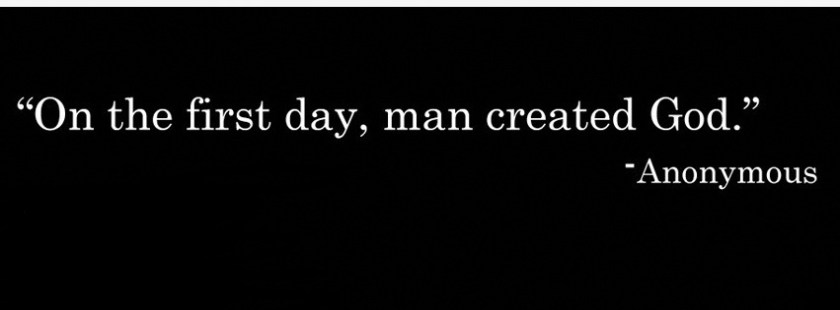
On the First Day, Man Created God


Let’s pretend an alien came to earth to study the evolution and behavior of humans. What would it observe and conclude?

The alien observed that every human group, in every location of the planet, throughout all of human history, has had some form of religion. The alien logically concluded that religions must be associated with a reproductive fitness advantage.

The alien observed that the human species succeeds in large part due to social cooperation, and that religions serve to define, unite, govern, motivate, and entertain groups, and (especially in times of scarcity) define outside groups as enemies. The alien then understood that the reproductive fitness advantage of religions is to increase the probability of survival through enhanced social cooperation.

The alien observed that there are thousands of different religions, each with a unique story, and that each religion thinks it is the only (or most) true religion. The alien logically concluded that all religions are human imagined stories.

The alien then noticed something very odd.

The one and only thing common to the thousands of religions is that they each have some form of life after death story. Religions can and do tell every conceivable story, but religions do not need a life after death story to define, unite, govern, motivate, and entertain a group. It might be reasonable for a few random religions to include life after death in their stories, but it is not reasonable that every religion has a life after death story.

Unless, observed the wise alien, the need for a life after death story has an important genetic foundation.

The archaeological record suggests that religions with their life after death stories emerged at the same time that humans with enhanced intelligence and an extended theory of mind emerged. The alien concluded that the two must be linked. The alien reconfirmed this conclusion by observing that no other species has comparable intelligence or an extended theory mind, and no other species has a religion.

The alien was stumped to explain the link but knew that there were a few good human scientists so it went to the library and found a book on human evolution by Ajit Varki and Danny Brower. The alien learned that a mutation for an extended theory of mind, which enables an individual to understand the mind of another, would be advantageous to a social species, and would have enabled an individual through normal daily observations to understand her own mortality. All mammals have a useful inherited fear of injury and therefore mortality awareness would have caused the individual to become depressed and less likely to take the risks necessary for survival and reproduction. The mutation for an extended theory of mind would therefore not fix in the gene pool.

Varki went on to explain that if a mutation for an extended theory of mind occurred simultaneously with a mutation for denial of death, then what was a reproductive fitness disadvantage would become a powerful fitness advantage, and the two mutations would fix in the gene pool.

The probably of two rare mutations occurring simultaneously is small and the alien now understood why other social species like dolphins, elephants, crows, and chimpanzees, which would also benefit from an extended theory of mind, had not evolved one.

The alien saw that inherited denial of mortality would have caused each human group to believe a life after death story, which over time through elaboration and transmission errors, became a unique religion.

The alien observed that denial of mortality is a very strong inherited behavior. Groups frequently devote all of their surplus wealth to constructing structures to please and communicate with gods in the after life. Pyramids and cathedrals being two of many examples. The alien observed that the behavior remains strong in modern times because new religions, like Scientology, continue to have life after death stories. And atheists are often spiritual with a belief in some form of life after death.

Varki went on to explain that the mechanism within the brain for denying mortality would be relatively simple to create by mutating the fear suppression module used by mammals when they need to fight, but by necessity of how it works, is quite broad in scope. This means that humans not only deny their own mortality, but also tend to deny anything they find unpleasant which creates an optimism bias that is useful when not facing limits to growth, but harmful with limits to growth, and harmful with lifestyle choices like insufficient exercise and nicotine.

Ah, said the alien, now I understand why almost no humans acknowledge or discuss or act on their severe state of overshoot. And why climate scientists frequently fly long distances to conferences where they criticize fossil energy use, promote green growth, and never mention population reduction.

The human brain, the God it believes in, and the overshoot it enabled and denies, all resulted from the same improbable genetic mutation that occurred about 100,000 years ago.

The alien was finally able to tie up the loose ends that had been troubling it.

The alien saw, on the one hand, an intelligent species capable of impressive intellectual feats such discovering a theory to explain the origin of the universe and technologies for visiting the moon, and on the other hand, a species in a severe state of overshoot dependent on rapidly depleting non-renewable resources and destroying the habitat it needed for survival.

The alien had been perplexed at how such an intelligent species could be in such peril without acknowledging, discussing, or acting on its predicament.

The alien now understood and concluded its report with “Denial created humans, and denial will destroy humans.”

As it boarded its ship for home, the alien reflected on how lucky it was to have come from a planet where life had evolved without the need for death and therefore was able to evolve intelligence without denial.

Denial not only makes us believe in god, it is god, because denial created us, and denial may destroy us.

By Chris Martenson: Get Ready… Change Is Upon Us

I’ve read quite a few good commentaries on the election of Trump but this piece by Chris Martenson is the best as it points to many of the other good articles, and ties them together with a coherent story based on human behavior, economics, and thermodynamics.

I agree with everything that Chris said and have only three points to add.

First, it is true that most cities voted for Clinton and most rural areas voted for Trump. But another more illuminating way to describe this divide is the center vs. the periphery. As the total wealth of a country decreases, the remaining wealth shifts to the centers because that’s where the power is. The result is a widening wealth gap and increasing social unrest.

Second, the total wealth of all countries in the world will decrease a lot over the next decade due to falling net energy. There is nothing that can be done to avoid this. What can be done are policies from enlightened and brave leadership to prevent a widening wealth gap. It remains to be seen if Trump will be enlightened and brave.

Third, in case you haven’t noticed, interest rates are starting to rise. It’s a REALLY big deal if they continue to rise because they will negatively impact just about everything, including Trump’s plan for infrastructure investment. This sets up an interesting natural experiment as central banks know that rising interest rates will implode the system and so will do everything in their power to prevent rates from rising. Many people think central banks have total control of interest rates. I think not. Soon we will know the truth.

https://www.peakprosperity.com/blog/103343/get-ready-change-upon-us

The political upheaval of Donald Trump is best understood through the lens of economic erosion suffered by the vast majority of people.  If a democracy is measured in how well it serves the interests of the majority, the United States is not a democracy at all.

Of course, nearly everyone already knows this. But it’s been all but unspeakable in polite circles to say so.

Now, it is finally becoming okay to voice.

By xraymike79: Some Fun Facts for a Dystopic Future

Here is an excellent new post by xraymike79 in which he provides a big picture summary of the facts that should be at the top of our election priority list and yet we do not acknowledge or discuss them.

https://collapseofindustrialcivilization.com/2016/11/02/some-fun-facts-for-a-dystopic-future/

Denial is amazing.

History has proven considerably worse than the Club of Rome’s projections. The original report made only passing reference to some of the most critical environmental problems of today. In response to this, the Stockholm Resilience Centre identified a set of nine ecological processes regulating land/ocean/atmosphere and their accompanying boundaries within which humans must stay to avoid biospheric collapse. In 2015, researchers found that four of these planetary boundaries had already been breached: biodiversity loss, damage to phosphorous and nitrogen cycles, climate change and land use. None of these critical boundaries were picked up by the original Limits to Growth report. We have destroyed the stability of the Holocene Epoch and continue to wreak havoc with every passing day. In other words, there are many other environmental crises too numerous to list that are coming to a head, and catastrophic sea level rise is just the icing on the burned cake. The last time Earth had such a disruptive species, cyanobacteria altered the atmosphere and killed off all the anaerobic life forms including itself. Ironically, oxygen was the byproduct of the cyanobacteria that proved lethal to those ancient lifeforms and paved the way for the rise of photosynthetic organisms. The cyanobacteria had a 500 million year run, but modern man has only been around for 0.01% of that time. Our large brain has made it possible for us to destroy ourselves in record time.

So you would think that these stark facts laid out before us would be causing panic in the global markets and seats of power around the world because, clearly, no one is safe from this unfolding apocalypse. In what many call the ‘most powerful nation on Earth’, surely a leader must be on the verge of taking the helm of this sinking ship. In any rational world, they would be compelled to battle this planetary emergency with the war-time urgency it demands. In the election year of 2016 there are only two prospects in our corporatocracy, one of whom is so frightening that hundreds of the world’s scientists felt compelled to issue a warning against his possible election. The other candidate seems much more palatable on the surface, but her record and recent emails illustrate just how tortured her positions are on environmental issues. Anyone who has studied the numerous practices that make modern civilization truly unsustainable, the depths of corruption and waste in its global socio-economic system, and how predatory one has to be in order to survive and “succeed’ in it realizes in the end that it wouldn’t matter much who fills that figurehead position. Toeing the line of the dominant culture is a prerequisite for the job. That’s one reason why nations are building walls in response to climate change refugees and putting faith in unproven and unrealistic techno-fixes to save themselves while at the same time drilling for new oil, financing new coal plants, allowing climate goals for corporations to add up to only a quarter of the amount needed to limit warming to 2°C, and giving the shipping industry a pass on curbing its emissions(if shipping was a country it would be the world’s 8th biggest carbon polluter).

By Gail Tverberg: Why energy prices are ultimately headed lower; what the IMF missed

Gail Tverberg continues to produce superb work. In her latest piece she provides a very nice summary that explains:

  • why the economy performed well in the past
  • why the economy is struggling today
  • why we should expect a Minsky moment

I’ve been expecting a Minsky moment for several years. Unfortunately it’s much easier to predict what will happen than when it will happen.

In this case it’s much better to prepare too soon because when the Minsky moment occurs it will be too late to do anything to protect yourself.

Isn’t it fascinating that none of our political and business leaders discuss this issue? Why aren’t they curious to understand the real reason that global growth has slowed and is not increasing despite unprecedented measures?

Why do so few care about understanding the scientific underpinning of economics?

Denial is amazing!

https://ourfiniteworld.com/2016/10/11/why-energy-prices-are-ultimately-headed-lower-what-the-imf-missed/