Why my interest in denial?

why1

I’ve been aware of our overshoot predicament for a decade and have moved on from studying specific aspects of human overshoot. 

What fascinates me now is our collective denial and inability to discuss or act on overshoot, despite some threats being imminent.

I used to believe denial was caused by a lack of awareness and understanding, but having made an effort to educate many people, and observing that they almost always aggressively choose not to understand, I began to look for a different explanation.

I concluded that denial must be an inherited behavior because every country, culture, political party, and religion is in denial. And denial must be central to who we are as a species because of its depth, breadth, and aggressiveness.

A few years ago I stumbled on Varki’s Mind Over Reality Transition (MORT) theory and a light went on. Varki’s theory provides the most simple, logical, plausible, and probable answer to the big questions that demand an answer:

  1. Why has no other species achieved our brain power despite common evolutionary forces and fitness advantages? Other advantageous inventions, like the eye, evolved several times, yet our brain, which is so advantageous it enabled us to take over the planet, has evolved only once.
  2. Why did the technology and culture of hominids stall for over a million years until something happened in one small tribe in Africa about 100,000 years ago?
  3. Why did all 7 billion of us emerge from one small tribe in Africa? And why did that tribe replace the many other similar hominid species?
  4. What genetic change occurred about 100,000 years ago that must be both modest in complexity and extreme in effect to explain the explosive emergence and dominance of behaviorally modern humans?
  5. Sapiens successfully bred with both Neanderthals and Denisovans at different times and locations. Sapiens retained a few of the other’s useful genes, mainly for disease immunity, but there is no evidence of full hybrids as you would expect. Why?
  6. Why do most people deny the many obvious dimensions of human overshoot like over-population, climate change, sea level rise, peak oil, resource depletion, soil loss, aquifer depletion, nitrogen imbalance, species extinction, fisheries collapse, and ocean acidification?
  7. Why do many people deny personal health realities like smoking, poor diet, lack of exercise, and obesity?
  8. Why do many people deny scientific realities like evolution, climate change, thermodynamics, vaccine utility, and the improbability of UFOs?
  9. Why do most people deny economic realities like the impossibility of infinite growth on a finite planet, unsustainable debt, and asset bubbles?
  10. Why do many people choose to believe fake news, like the Russians are to blame?
  11. Why do many people seek to avoid all forms of reality with mind altering drugs?
  12. Why do democratic elections never discuss, or debate, or even whisper about, the issues associated with overshoot? What could be more important to vote on?
  13. Why don’t environmental political parties, like the Green party, have overshoot policies in their platforms?
  14. Why do experts commonly and aggressively ignore or deny the most important (and unpleasant) facts associated with their domain? Economics, climate change, renewable energy, and nutrition being notorious examples.
  15. Why do people who understand climate change rarely modify their lifestyles to reduce CO2 emissions?
  16. Why are humans the only species with religions?
  17. Why did religions emerge simultaneous with the behaviorally modern human brain?
  18. Why has every human group everywhere through all history had some form of religion?
  19. Why does every one of the thousands of religions think it is the only (or most) true religion?
  20. Why does every religion, including new religions like Scientology, have a life after death story? Many aspects of religion can be easily explained by their positive effect on group survival, but it is not easy to explain why every religion denies death with a life after death story. A few random religions with life after death stories might be reasonable, but not every religion, unless the need for a life after death story has a genetic basis.
  21. Why do many atheists retain some form of spirituality which usually includes a belief in some form of life after death?

A good place to go next is On Burning Carbon

On Free Will and the Great Barrier Reef

By Dahr Jamail – Great Barrier Reef Reaches “Terminal Stage” as CO2 Levels Rise at Record Rate

Dahr Jamail reports on the dying Great Barrier Reef and other recent casualties of climate change.

He concludes the article by blaming the denial of Trump and other leaders.

Jamail does not mention his own denial demonstrated by flying long distances to report on climate change.

Everyone, myself included, has a justification for their lifestyle.

Genes have evolved over billions of years to compete for finite energy so they can survive to replicate.

There are 7.5 billion humans in severe overshoot because their genes out-competed the genes of all other life by learning to dig up and burn ancient solar energy.

Having genes that make us smart enough to understand our mortality and the implications of our genes’ ability to exploit fossil energy requires genes that cause us to deny reality to avoid depression and a consequent decrease in reproductive fitness.

Our genes are in charge.

Free will is an illusion.

Enabled by denial of reality.

How could it be otherwise?

On the Tragedy of Trends

Tim Garrett, the world’s most under appreciated scientist, makes a persuasive case that wealth is proportional to energy consumption. More specifically, US$1 (1990) = 10 mW. This makes intuitive sense because energy is required to make and/or maintain everything that we assign a monetary value to.

Yesterday the Visual Capitalist published some charts showing energy consumption trends for the US.

http://www.visualcapitalist.com/visualizing-americas-changing-energy-mix-1970-2030/

chart-energy-mix-usa-2030

In the following discussion I deliberately ignore the chart’s forecast for the future because it comes from the deeply in denial Energy Information Administration (EIA), which bases its forecasts on expected demand rather than geologic and thermodynamic reality. In other words, the EIA makes forecasts based on what we will likely desire, rather than what is likely to be available, or what we will likely be able to afford.

I also ignore changes in energy efficiency because I think we have already harvested all of the low hanging fruit and recent efficiency gains are in the noise.

By applying Garrett’s theory we can draw some illuminating conclusions:

  1. The total wealth of the US peaked around 2000 and has been in slow decline since.
  2. The wealth of individuals peaked around 2000 after 3 decades of little growth, has been in steep decline since, and today is about 15% lower on average than 1970.
  3. The contribution of renewable energy to our wealth has been and remains insignificant. Doubly so if you consider the fossil energy required to manufacture, install, and maintain renewable energy equipment.

The actual decline in wealth for the majority of citizens will be larger than these charts suggest because of the widening wealth gap, which has resulted from the low interest rates employed to offset declining net energy. Low interest rates increase the opportunity for the rich to profit from the bubbles created by low interest rates.

I expect trends in other industrialized countries will mirror those of the US, and in many cases will be worse because the US is so well-endowed with natural resources and its reserve currency.

It is clear why social unrest is increasing in most countries.

No one is to blame for these trends. They are simply a consequence of the scientific laws of geology and thermodynamics. It is true however that low and middle income citizens are carrying a disproportionate share of the impact because governments did not implement tax policies to prevent a predictable wealth gap increase caused by low interest rates.

Our inherited denial of reality prevents most people from understanding what is going on, and thus most people seek someone to blame.

Awareness and understanding could lead to cooperation and voluntary lifestyle changes.

Denial and blame will likely lead to tragedy.

Tribes Trump Reality: War is Probable

About 100,000 years ago a small tribe of hominids experienced a rare double mutation for an extended theory of mind plus denial of reality, which switched having a more powerful brain from being a reproductive fitness disadvantage into a strong advantage, thus enabling the mutations to fix in the gene pool. That species then used its unique brain to take over the planet and to grow itself into a severe state of overshoot.

This first and only extended theory of mind to emerge in a brain increased the effectiveness of social cooperation through improved morality, communication, planning, and the invention and transmission of new technologies.

The denial of reality mutation was required to mute the awareness of mortality and its negative impact on reproductive fitness that the extended theory of mind enabled. The inherited denial of mortality caused each tribe to create a life after death story. Over time these stories were elaborated into what we now call religions (and political parties) which serve to define, unite, govern, and entertain tribes.

The tribe with its story was and is central to the success of the species. For most of history it mattered not whether the story was true. Today the survival of the species has bumped up against the laws of physics and truth does matter. This is a wicked predicament because tribes can’t easily change their stories, and inherited denial of reality tends to block unpleasant truths from being added to the stories.

Today we have two angry bickering tribes within the most powerful country on earth. Each tribe comprises about 50% of the population. Neither tribe has a story grounded in reality or truth. Each thinks the other is the cause of the very real thermodynamically based pain it is experiencing. Neither understands what is going on. Inherited denial of reality blocks each from learning what is going on.

The best and perhaps only method for uniting and distracting these two tribes would be to identify a third tribe as a threat. Fighting that third tribe will unfortunately accelerate the depletion of low-cost oil which caused the pain in the first place. So it may be necessary to identify a fourth tribe as a threat. And so on.

This will probably not end well.

It’s Time to Get Real: Trump’s a Symptom, Not the Problem

I’ve lost patience with the widespread whining about Trump.

Trump’s a symptom, not the problem.

Unless we acknowledge and respond to reality there will be many more and worse Trumps to follow.

Lower and middle class citizens around the world are angry for good reasons:

  • Their incomes have been stagnant or falling despite governments telling them the economy is strong.
  • Their cost of living for things that matter has been rising despite governments telling them inflation is low.
  • They see the upper class getting richer and not being punished for crimes.
  • They carry a high debt load and see that interest rates have nowhere to go but up.
  • For the first time in a long time they worry that the future may be worse than the present.
  • They sense that something is broken and that leaders are not speaking the truth.

Their anger has resulted in:

  • Brexit
  • Trump
  • blame of others
  • extreme parties gaining power around the world
  • social unrest in many countries
  • war drums

The economic stresses experienced by many citizens (and by most countries) are real and have been caused by the depletion of low-cost oil.

The tricks of increasing debt and lowering interest rates have reached their limits and no longer work to mask the depletion of low-cost oil.

Governments have responded with reckless financial policies that guarantee a high-speed crash into a brick wall.

There is no solution to the depletion of low-cost oil.  It is not possible to operate our civilization as currently configured without low-cost oil. There is no substitute for oil.

We need to understand and accept that there will be much less of everything in the future.

We were lucky to witness the peak of human prosperity, and unlucky to witness the beginning of its decline.

No one is to blame. It’s reality.

We need a new story to unite us.

We need new government priorities focused on ensuring the necessities of life are available in the future.

We need to slow down as we approach the brick wall.

We need to stop wasting the precious oil that remains.

We need to get real and vote for wise people who understand what is going on.

We need to break through our inherited denial of reality.

You know you are in trouble when…

Bizarro.com Our Extended Forecast


Examples of denial are both profound and unacknowledged.

The short-term solution to our problems is the long-term cause of our problems: economic growth

The long-term solution to our problems is the short-term cause of our problems: reduced consumption

Reduced CO2 emissions from an economic collapse caused by low-cost oil depletion is not sufficient to prevent civilization collapse from climate change caused by previously emitted CO2.

All political parties in all countries and almost all citizens, including the few citizens that understand our predicament, reject our best course of action: austerity

Most citizens have no idea how fortunate they are to be alive at this point in history: Blindspots and Superheroes

Despite wildly different beliefs about our predicament, there is one thing that almost everyone agrees on: I don’t want to change my behavior

The only problems society does not acknowledge, or discuss, or act on, are the only problems that matter: species extinction, limits to growth, debt, peak oil, overshoot, resource depletion, climate change, sea level rise, fisheries collapse & ocean acidification, nitrogen imbalance & tree decline 

Every country has similar economic problems and not one leader anywhere in the world connects the dots and publicly acknowledges the root cause, even after they leave office: declining energy surplus a.k.a. energy extraction cost + debt

Citizens believe the exact opposite of reality: technology creates wealth and energy rather than energy creates wealth and technology

Citizens misunderstand the root cause of social unrest and wars because the media presents these conflicts as political or economic problems and ignores their underlying forces: biophysical constraints

There is evidence that feedback loops are taking over and causing some problems to go exponential: climate change, CO2 emissions, ice loss, sea level rise, debt

The previous year’s worst case predictions are tending to become this year’s most likely prediction: sea level rise

Actions that improve the long-term worsen the short-term: air pollution masks 0.5C of warming, austerity and debt reduction, renewable energy, population reduction 

The only possible permanent solution is rejected by the belief systems of 90+% of citizens: population reduction

The only possible permanent solution is too slow to avoid the worst problems: population reduction laws

Countries fortunate to have a low birth rate often cancel their good fortune with immigration: Canada

The few people who understand the severity of our problems do not set good examples in their personal lives: leaders, climate scientists, environmentalists

History suggests that the consequence of not voluntarily contracting our economies as non-renewable resources deplete is an unthinkable war, so we don’t think about it: nuclear weapons

The quality of our leaders is declining because those people with high intelligence, wisdom, and integrity do not want to be in charge of our predicament, and because citizens are feeling the impact of overshoot, do not understand what is going on, and are angry: Trump

The leader of the free world denies science and issues daily, jaw-dropping, cringe-inducing tweets: Trump

The one world leader that did understand the problem and spoke out was rejected by the citizens and no longer speaks out: Jimmy Carter

We do not acknowledge that the world’s economic problems began with the peaking of a key non-renewable resource: conventional oil

Low energy prices have led citizens to believe we have a glut of fossil energy when in fact: all types of energy have peaked

We do not discuss or act on economic history research that shows countries always get into serious trouble when they permit an important ratio to exceed a threshold we long passed: debt to GDP

Bankers, the creators of money, do not understand the one thing that creators of money should understand: thermodynamics of wealth

The professionals with the most influence on public policy use models that violate the most trusted laws of physics: economists

The scientific theory that explains the relationship between the economy, energy, and climate is ignored by everyone that should understand it: Tim Garrett

The people who deserve the most respect and admiration get the least: scientists

The people who deserve the least respect and admiration get the most: celebrities

All types of non-fossil energy do not provide a substitute for the only energy we can’t live without: diesel for trucks, trains, ships, tractors, and combines, and mining machines; plus natural gas for fertilizer

Operating our economy on renewable energy is not renewable or feasible.

People who think the shale revolution will make America prosperous and energy independent ignore one thing: facts and more facts

Intelligent people who understand the climate change threats, like James Hansen and Bill Gates, and who want business as usual to continue, know that nuclear energy is the only option, but they ignore a problem: peak uranium

If climate deniers continue to win elections and try to maintain the existing electric grid they’ll find that strategy may not work for long: peak coal

A key component of our infrastructure appears durable but is not: reinforced concrete

Citizens most vulnerable to a fragile global supply chain with only a few days of inventory experience the strongest illusion of abundance and security: inhabitants of large cities

The “green” revolution, which increased food production to enable 7+ billion humans, was and is entirely dependent on fossil energy, and has long-term consequences that will make a return to traditional agriculture very difficult.

Most citizens are not even vaguely aware of the invention that enabled their existence and created about 50% of the nitrogen in their bodies: Haber-Bosch conversion of natural gas to fertilizer

Well meaning environmentalists demand that we stop subsidizing fossil energy companies without understanding the source of all that they cherish in modern civilization: fossil energy

Well meaning environmentalists demand that we stop subsidizing fossil energy companies without realizing that many fossil energy companies are going bankrupt: ExxonMobil

A solution frequently advocated makes things worse by accelerating growth and decreasing system resilience: efficiency

The best solution for removing CO2 from the atmosphere is being harmed by the same activity that creates CO2: planting more trees which are then injured or killed by ground level ozone

All climate science models that do not predict disaster now depend on an unproven technology that we probably can’t afford and other species definitely can’t afford: BECCS (bio-energy with carbon capture and storage)

We have not acted to prevent a predictable and very dangerous side effect of trying to maintain business-as-usual with low interest rates: increasing wealth gap

We still enjoy historically vast surplus wealth that could be deployed to improve our future lives but we are squandering it: military, airports, highways, new cars, high rises, etc.

Earth with its diverse complex life and a highly intelligent species is extraordinarily rare, precious, and worth fighting to protect, yet we dream of other barren homes: colonizing Mars

The tool that could be used to unite citizens in common purpose and useful action is instead being used to create tribes that reinforce preexisting beliefs: internet

Many people are hurting and lashing out in anger because they do not understand the cause of their pain: Brexit, Trump, Syria, Venezuela, etc.

The few sources of information that understand and communicate the truth are under threat: fake news

Few people study or heed the best predictor of the future: history

The majority of citizens share a common characteristic that makes the election of an intelligent and wise leader empowered to do the right thing unlikely: wacky beliefs

None of our schools teach skills useful and relevant to our future: growing food and other forms of lower complexity life skills

The thing that enabled the evolution of our high intelligence and its ability to understand and act on problems is the same thing that causes our problems and prevents us from acting on them: denial of reality

The theory that best explains our existence and our self-destructive behavior is ignored by everyone, including those people seeking to understand our problems: Varki and Brower’s Mind Over Reality Transition (MORT) theory

Readers are encouraged to submit additions to the list.

A good place to go next is What would a wise society do?

Climate Change Policies: 2 required + 1 optional

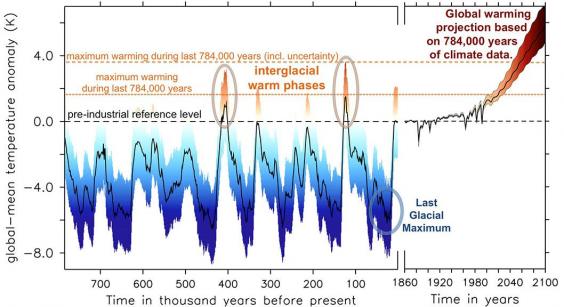
Most scientists consider 2 degrees of warming to be dangerous. Common sense says 1 degree is unsafe because the recent extreme weather and loss of Arctic ice and glaciers have been caused by 1 degree of actual warming.

A new paper in the journal of Science Advances says 7 degrees is likely this century because the climate becomes more sensitive to greenhouse gases as the temperature warms.

Independent newspaper overview.

Full paper.

Interview with the author.

To be clear on the implications, 7 degrees will kill your children.

Much time and effort has been wasted establishing climate change agreements that will not work because the relationship between wealth, consumption, and CO2 has not been acknowledged or addressed.

We have not to date met any of our (ineffective) commitments because we do not understand the nature of our predicament. We cannot reduce climate change with a different type of economic growth. We must stop growing and contract.

Assuming feedback loops have not already taken over (meaning there is nothing we can do to avoid runaway climate change), here are the only 2 policies that would positively impact climate change and every other overshoot threat we face:

1) Increase the interest rate until the economy begins to contract on a sustained basis. An economic crash may or may not be avoidable but we have no choice.

2) Establish a one child policy with a penalty tax of say 25% of total income for every extra child. No exceptions. Countries with cultures that value males more than females should provide a subsidy to families with a daughter to keep the male/female ratio at about 50/50.

Wise countries will implement one additional optional policy:

3) Tax excess wealth and use the funds to pay down public debt.

As the economy and population contracts there will be a natural tendency for the wealth gap to widen which usually leads to social unrest, despots, and war. Wise countries will anticipate this and implement policies to prevent the wealth gap from widening. Collected taxes should be used to pay down public debt because this will help to stabilize our debt backed currency as the economy shrinks.

These policies will cause pain but doing anything else (or nothing) will cause a lot more pain.

On Religion and Denial

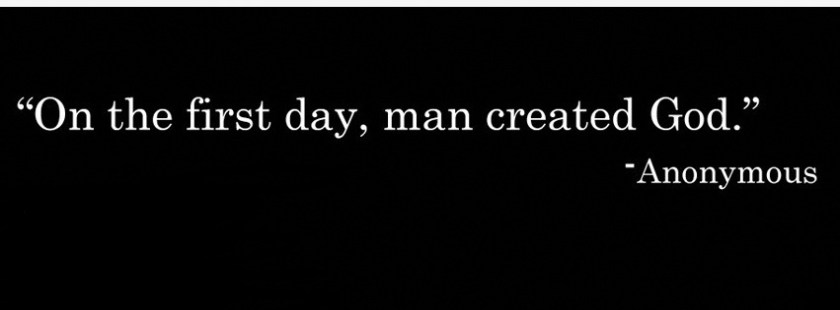
On the First Day, Man Created God


Let’s pretend an alien came to earth to study the evolution and behavior of humans. What would it observe and conclude?

The alien observed that every human group, in every location of the planet, throughout all of human history, has had some form of religion. The alien logically concluded that religions must be associated with a reproductive fitness advantage.

The alien observed that the human species succeeds in large part due to social cooperation, and that religions serve to define, unite, govern, motivate, and entertain groups, and (especially in times of scarcity) define outside groups as enemies. The alien then understood that the reproductive fitness advantage of religions is to increase the probability of survival through enhanced social cooperation.

The alien observed that there are thousands of different religions, each with a unique story, and that each religion thinks it is the only (or most) true religion. The alien logically concluded that all religions are human imagined stories.

The alien then noticed something very odd.

The one and only thing common to the thousands of religions is that they each have some form of life after death story. Religions can and do tell every conceivable story, but religions do not need a life after death story to define, unite, govern, motivate, and entertain a group. It might be reasonable for a few random religions to include life after death in their stories, but it is not reasonable that every religion has a life after death story.

Unless, observed the wise alien, the need for a life after death story has an important genetic foundation.

The archaeological record suggests that religions with their life after death stories emerged at the same time that humans with enhanced intelligence and an extended theory of mind emerged. The alien concluded that the two must be linked. The alien reconfirmed this conclusion by observing that no other species has comparable intelligence or an extended theory mind, and no other species has a religion.

The alien was stumped to explain the link but knew that there were a few good human scientists so it went to the library and found a book on human evolution by Ajit Varki and Danny Brower. The alien learned that a mutation for an extended theory of mind, which enables an individual to understand the mind of another, would be advantageous to a social species, and would have enabled an individual through normal daily observations to understand her own mortality. All mammals have a useful inherited fear of injury and therefore mortality awareness would have caused the individual to become depressed and less likely to take the risks necessary for survival and reproduction. The mutation for an extended theory of mind would therefore not fix in the gene pool.

Varki went on to explain that if a mutation for an extended theory of mind occurred simultaneously with a mutation for denial of death, then what was a reproductive fitness disadvantage would become a powerful fitness advantage, and the two mutations would fix in the gene pool.

The probably of two rare mutations occurring simultaneously is small and the alien now understood why other social species like dolphins, elephants, crows, and chimpanzees, which would also benefit from an extended theory of mind, had not evolved one.

The alien saw that inherited denial of mortality would have caused each human group to believe a life after death story, which over time through elaboration and transmission errors, became a unique religion.

The alien observed that denial of mortality is a very strong inherited behavior. Groups frequently devote all of their surplus wealth to constructing structures to please and communicate with gods in the after life. Pyramids and cathedrals being two of many examples. The alien observed that the behavior remains strong in modern times because new religions, like Scientology, continue to have life after death stories. And atheists are often spiritual with a belief in some form of life after death.

Varki went on to explain that the mechanism within the brain for denying mortality would be relatively simple to create by mutating the fear suppression module used by mammals when they need to fight, but by necessity of how it works, is quite broad in scope. This means that humans not only deny their own mortality, but also tend to deny anything they find unpleasant which creates an optimism bias that is useful when not facing limits to growth, but harmful with limits to growth, and harmful with lifestyle choices like insufficient exercise and nicotine.

Ah, said the alien, now I understand why almost no humans acknowledge or discuss or act on their severe state of overshoot. And why climate scientists frequently fly long distances to conferences where they criticize fossil energy use, promote green growth, and never mention population reduction.

The human brain, the God it believes in, and the overshoot it enabled and denies, all resulted from the same improbable genetic mutation that occurred about 100,000 years ago.

The alien was finally able to tie up the loose ends that had been troubling it.

The alien saw, on the one hand, an intelligent species capable of impressive intellectual feats such discovering a theory to explain the origin of the universe and technologies for visiting the moon, and on the other hand, a species in a severe state of overshoot dependent on rapidly depleting non-renewable resources and destroying the habitat it needed for survival.

The alien had been perplexed at how such an intelligent species could be in such peril without acknowledging, discussing, or acting on its predicament.

The alien now understood and concluded its report with “Denial created humans, and denial will destroy humans.”

As it boarded its ship for home, the alien reflected on how lucky it was to have come from a planet where life had evolved without the need for death and therefore was able to evolve intelligence without denial.

Denial not only makes us believe in god, it is god, because denial created us, and denial may destroy us.

What would a wise society do?

A wise society would choose some short-term pain in exchange for much less future pain.

A wise society would understand that the foundation of the cliff it is climbing is crumbling and that it should start climbing down to reduce future harm.

A wise society would move slowly and deliberately as it climbed down to avoid falling.

A wise society would use some of the following techniques to climb down:

  1. Educate citizens on what is going on and why.
    • The goal is to minimize responses like panic or blame that can cause a breakdown of law and order or war; and to increase social cohesion and cooperation.
  2. Implement population reduction policies.
    • The goal is to achieve a humane population reduction before nature forces an inhumane population reduction. Given the severity of human overshoot we may not be able to out-race nature however, as Albert Bartlett said, every problem on earth improves with fewer people, so we should do what we can.
  3. Hold referendums to allow citizens to set priorities for reduced government spending.
    • The goal is to engage and empower citizens in difficult decisions that will have to be made. We need to move away from traditional and divisive left vs. right politics into pragmatic resource husbandry.
  4. Reduce government spending until expenditures are a little less than tax revenues.
    • The goal is to configure a government that can function effectively through a prolonged economic contraction punctuated with occasional shocks, and that offers services its citizens can afford.
  5. Model the availability of key resources taking into account the increasing cost of production caused by depletion, and declining demand (what people can afford) caused by falling incomes, declining debt, and decreasing government spending.
    • The goal is to understand the shape of our Seneca curve which is needed for the next point.
  6. Implement policies to proactively reduce the consumption of key resources a little faster than the models predict will occur in a free market.
    • The aim is to maintain social order by controlling the decline rather than being controlled by the decline.
  7.  Prepare fair rationing policies and mechanisms.
    • The goal is to be prepared for possible supply disruptions.
  8. Increase the interest rate enough to cause a steady decline in debt.
    • The aim is to climb down to a lower and safer elevation.
  9. Hold a referendum to decide a maximum reasonable wealth gap between the average and the rich. Tax excess wealth from the rich to pay down public debt. There are 3 justifications for this policy:
    • In a shrinking economy the wealth gap between rich and poor will naturally tend to widen through no fault of the poor or skill of the rich. This is already occurring and will accelerate as the economy contracts.
    • A too wide wealth gap is unhealthy and dangerous for a society. Think French revolution.
    • Paying down public debt with excess wealth benefits everyone, rich and poor, because it helps to stabilize the money system in a shrinking economy.
    • Note that the excess wealth should not be redistributed to the poor because this will accelerate our problems by increasing inflation, resource depletion, and CO2 emissions.
  10. Implement an aggressive luxury consumption tax.
    • In our new world, conservation is good and gluttony is bad.
  11. Place a tariff on imported food and use the funds to support small-scale local food production.
    • The goal is to build resiliency to global food supply shocks that might result from a financial or energy crisis, or climate change damage to crop productivity.
  12. Prohibit the development of farm land or the sale of land to non-residents.
    • This policy recognizes that in the long run the most valuable asset a country will have is its arable land.
  13. Encourage soil restoration.
    • As fossil energy derived fertilizers become scarce we will once again have to rely on organic practices for soil fertility. We have depleted most soils. It will take time to rebuild them. We should start as soon as possible.
  14. Plant trees.
    • Planting trees is one of the few things we can do to remove CO2 from the atmosphere. In addition, wood will be a very valuable future resource.
  15. Protect and restore watersheds.
    • Water is the only thing more important to life than food.
  16. Encourage schools to teach skills required in a less complex society.
    • Much of what is taught today will not be useful at our destination.

I realize that denial and other human behaviors make it highly unlikely we will do any of the above.

I also realize that some of the ideas require more thought to ensure a good balance between increased short-term pain vs. decreased long-term pain.

I wrote this to demonstrate that we are not without means to influence the future in a positive direction.

On the Wealth of Citizens: An EU Perspective

Those Who Study History


The UK voted to leave the EU yesterday.

What’s really going on?

In an industrialized world with abundant resources citizens typically prosper in economies of all sizes.

As populations rise faster than finite resources, the growth rate of per-capita resources slows and eventually must decline. Over time it becomes more difficult to increase the wealth of citizens. In a resource constrained world there are two methods available to grow the wealth of citizens: efficiency and debt.

The first method available to grow the wealth of citizens is to increase the efficiency of producing and using resources. We have done an excellent job of improving efficiency:

  • We optimized the type of energy we use for each application such as using coal and hydro instead of oil to generate electricity, and using oil instead of coal or horses for transportation.
  • We learned how to squeeze oil from sand and rock, how to drill for oil in mile deep oceans, and how to mine coal from the surface with giant machines.
  • We optimized our machines such as switching to lighter fuel-efficient cars, using heat pumps, and abandoning supersonic air travel.
  • We learned how to convert oil and natural gas into cheap and durable materials like plastic.
  • We used electronics and computers to more efficiently control just about everything.
  • We optimized communication with the internet and cell phones.
  • We reduced waste such as insulating our homes.
  • We recycled energy intensive materials such as aluminum cans.
  • We optimized the productivity of our arable land with Haber-Bosch factories that convert natural gas into nitrogen fertilizer, by replacing horses and rain with diesel powered tractors and pumped irrigation, and by growing mono-crops.
  • We optimized the cost of calories by manufacturing high-fructose corn syrup and vegetable oils, and by operating concentrated animal feeding operations.
  • We optimized the harvest of our oceans with powerful ships that net and scrape everything.
  • We optimized the efficiency of global trade with agreements between many countries.
  • We optimized manufacturing by moving it to locations with the lowest labor and energy costs, and the fewest pollution regulations.
  • We optimized shipping with standard containers and ships and trucks to carry them.
  • We optimized distribution to consumers with Walmart and Amazon.

The laws of thermodynamics and the cost of technology and transport mandate a limit to efficiency gains. We are approaching the limits to efficiency improvement.

The second method available to grow the wealth of citizens is to borrow resources from the future. This amazing trick is done with debt. Cash and credit behave the same when spent. Credit however commits us to produce wealth in the future to repay it. This future wealth represents yet to be produced resources. Hence debt’s magic of letting us spend future resources now.

We started using debt in the 80’s to support the wealth of citizens and total debt has grown exponentially since. There are limits to how much debt can be carried by a citizen or government. Money available for living equals income minus interest payments plus any change in debt plus any change in savings.

The combination of stagnating or falling income due to declining per-capita resources and/or rising interest payments eventually imposes a limit on the total debt an individual or government can carry. There are three methods for extending this limit on debt.

The first method for extending debt is to increase the size of economic organizations. Size matters to debt. The larger an economy is the more internal and external resources it can control, the more taxes it can collect, the larger military it can afford, the more confidence and fear it can inspire, and as a consequence, the more credit it can generate. A good example is the USA and the privileges it enjoys from having the world’s reserve currency.

As the wealth of citizens became increasingly dependent on debt there was pressure to increase the size of economic organizations. This in large part explains the formation of the EU. The majority of European countries were keen to join the EU because it promised them access to more debt. Imagine, for example, how much debt and purchasing power an independent Italy with its own currency could have compared to today as a member of the EU.

The second method for extending debt is to reduce the interest rate. We have steadily reduced the interest rate since the early 90’s. We reached the limit of 0% shortly after the 2008 crisis and the interest rate has remained at 0% for an unprecedented 90 months. Some countries are experimenting with negative interest rates however it seems unlikely that this technique will work without dramatic and improbable changes to the rules of money and banking.

The third and final method for extending debt is to print and give money to citizens and/or governments. Most countries have not yet used this method because it reduces confidence in a currency and risks hyperinflation that destroys wealth and can cause war as happened with Germany after WWI. There will be a strong temptation to try this method in the future because it can work well for a period of time. For example, it took 10 years for hyperinflation to take hold after money printing started in Zimbabwe. A politician forced to choose between riots now and hyperinflation 10 years later might well choose to print money.

As an aside, I leave the reader with a question to ponder about the dark side of debt. What will happen if the depletion of finite resources and climate change prevents us from producing the future resources our debts commit us to? The answer to this question explains why I frequently call for reduced public debt.

In summary, a resource constrained world has two methods for supporting the wealth of citizens, efficiency and debt, and as explained above, we are already at fundamental limits for both efficiency and debt.

What must happen next, and what is already starting to happen, is that the wealth of citizens will decrease. This will create social unrest, and given our genetic denial and the difficulty of understanding our complex world, citizens will seek someone to blame.

Yesterday UK citizens blamed the EU. Because most UK citizens do not understand the underlying forces that are causing their hardship they probably have made things worse for themselves, at least in the short-term. Longer term, when there is insufficient affordable oil to support long distance trade, all communities will have to re-localize to survive.

Other independence movements within Europe are building momentum for similar reasons. A primary message of Donald Trump is that “others” are to blame for the hardship of US citizens.

A recurring theme on this blog is that some form of civilization collapse is inevitable and not too many years away. If the majority of citizens do not understand and/or deny what is going on the collapse will be much worse than it needs to be.

We still have sufficient resources to prepare a softer landing zone.

The first step is an adult conversation about what’s really going on.