By Nate Hagens: Reality 101: What every student (and citizen) should know

Nate Hagens

Nate Hagens just released a new video course titled “Reality 101” that he produced for honors freshman at the University of Minnesota where he teaches.

The course is backed by 15 years of research by Nate into our overshoot predicament created by the interaction of human behavior, energy, economy, and ecology, and distills his 45 hour university course of the same name into 4 hours of video.

I’ve followed Nate for many years and have posted some of his work here.  Nate is a rare multidisciplinary dot connector, and has one of the best big picture understandings of our predicament.

Nate differs from others doing similar research in that he retains hope and offers positive advice to young people for how they might help make the future a more desirable place to live.

I suspect this new video course will become a go-to resource for people seeking enlightenment on vitally important topics that are usually ignored, and when occasionally broached, are almost always misunderstood or denied by most educators, leaders, and news sources.

Nate can be found on both Twitter and Facebook.

Nate’s Facebook announcement of the video course:

I’ll be putting the entire Reality 101 course content (two 500 page books co-written w DJ White plus related content and videos) online for free this spring. In the meantime, the Honors Program at U of Minnesota asked for a ‘hologram’ of that material that could be watched in 4-5 hours (instead of ~150 hours of the course) for the Nexus One experience for all freshmen. They’ll watch this in 3 pieces: 1) Brain/behavior 2) Energy/economy and 3) Ecology/Earth systems/what to do/how to live during these times. The Energy videos (link below) are ‘finished’ (with a bunch of small errors to fix when I get time), The 12 videos are 1 hour 45 minutes total – as usual both too long for most peoples attn spans but too short to really get into some important nuances. Our culture is energy blind. This new choreography outlines the story of humans, growth, energy and the future in the most comprehensive way I could envision for a short(ish) summary. (thanks to Katie Fischer and Keegan L Robinson for tireless help and suggestions and to Katie for doing great work on the tech side)

Reality 101 full course description:

How is the economy like a hurricane? Where does money come from? Will economic growth last forever? What is wealth? How many hours would it take you to generate the same amount of energy in a gallon of gasoline? Why are you so confident in your own beliefs? Why do you spend so much time on social media? Why do we want “more” than our neighbors? What do all of these questions have to do with the environment? With your future? And what if our most popular societal beliefs about these issues turn out to be myths?

Reality 101 will delve into these questions and unify them as they apply to the major challenges humanity faces this century, among them: slow economic growth, poverty, inequality, addiction, pollution, ocean acidification, biodiversity loss, and war. The seminar will provide students with broad exposure to the foundational principles central to addressing these interrelated issues. The readings and lectures will cover literature in systems ecology, energy and natural resources, thermodynamics, history, anthropology, human behavior, neuroscience, environmental science, sociology, economics, globalization/trade, and finance/debt with an overarching goal to give students a general understanding of how our human ecosystem functions as a whole. Such a systems overview is necessary to view the opportunities and constraints relevant to our future from a realistic starting point. Though the hard science relating to sustainability will be surveyed, few answers will be presented and it is hoped that creativity and group dialogue will lead to emergent ideas on how these big themes fit together. While the class material is daunting and intense (reflecting our world situation), the course itself will be enlightening and deeply informative, with an open, engaging, and entertaining class atmosphere.

Dr. Nathan John Hagens worked on Wall Street at Lehman Brothers and Salomon Brothers and closed his own hedge fund in 2003 to pursue interdisciplinary knowledge about the bigger picture of modern society. Nate was the lead editor of the online web portal theoildrum.com, and is currently President of the Bottleneck Foundation and on the Boards of the Post Carbon Institute, Institute for Energy and Our Future, and IIER.


 Section 1 – Brain & Behavior

Click here to play all 10 parts in sequence.

Part 1: Evolution, Natural Selection, and the Agenda of the Gene


Part 2: Sexual Selection and Social Status


Part 3: Dopamine, Supernormal Stimuli and Consumerism, Part 1


Part 4: Dopamine, Supernormal Stimuli and Consumerism, Part 2


Part 5: Our Social Natures, Part 1 (Groups and Tribes)


Part 6: Our Social Natures, Part 2 (The Superorganism and Culture)


Part 7: Self-Blindness, Part 1 (Cognitive Biases)


Part 8: Self-Blindness, Part 2 (Cognitive Biases)


Part 9: Time Biases


Part 10: From Self Blindness to Self Awareness


Section 2 – Energy & Economy

Click here to play all 16 parts in sequence.

Part 1: Energy Blindness


Part 2: Energy Surplus


3 – Energy Benefits


Part 4: Energy Scale


Part 5: Energy Impacts


Part 6: Energy Primacy, Part 1


Part 7: Energy Primacy, Part 2


Part 8: Energy Primacy, Part 3


Part 9: Energy Primacy, Part 4


Part 10: Energy Primacy, Part 5


Part 11: Energy Remoteness


Part 12: Energy Depletion


Part 13: Energy Fungibility


Part 14: Energy Transitions


Part 15: Energy and Happiness


Part 16: Energy and Our Future


Section 3 – The Big Picture

Click here to play all 8 parts in sequence.

Part 1: Intro


Part 2: Ecology and Systems


Part 3: Externalities, Part 1: Intro


Part 4: Externalities, Part 2: Heating and Oceans


Part 5: Externalities, Part 3: The Web of Life


Part 6: The Superorganism (short version)


Part 7: 8 Great Questions for our Time


Part 8: What to Do? (short list)

By Michael Mills: How to Avoid Population Overshoot and Collapse

Dr. Michael Mills

Thanks to James at Megacancer for bringing my attention to this 2011 essay by Dr. Michael Mills, an associate professor of psychology at Loyola Marymount University in Los Angeles California. The interests of Dr. Mills include the evolutionary psychology of peak oil.

https://www.psychologytoday.com/us/blog/the-how-and-why-sex-differences/201111/how-avoid-population-overshoot-and-collapse

In this essay Mills demonstrates an excellent understanding of human overshoot, and uses his expertise in evolutionary psychology to offer strategies for shifting human behavior in a more sustainable direction.


As shown in the graph below, this is an example of a general phenomenon.  All species suffer population collapse or species extinction if they overshoot and degrade the carrying capacity of their ecology.

Carrying Capacity & Overshoot

This is also the fate that awaits bacteria growing in a Petri dish, as you might remember from your high school biology course.  Imagine a Petri dish with enough nutrients to support a growing bacteria culture until the dish is completely full of them.  One bacterium is placed inside the dish at 11:00am, and the population of bacteria doubles every minute — such that the Petri dish will be full by noon.

At what time will the Petri dish be half full of bacteria?

Most people reply incorrectly that the Petri dish will be half full at 11:30am, because we are more familiar with linear, rather  than with exponential, rates of growth.  The correct answer is 11:59am — which seems rather unintuitive. However, because the rate of growth is exponential (doubling every minute)  the time at which the Petri dish is half full is 11:59am.   With just one more doubling, in the next minute, the Petri dish is completely full, at noon.

Anyone who perceives a linear rate of growth, but who is actually up against an exponential rate of growth, is likely to be very surprised at how the end comes very quickly and seemingly out of nowhere. They will be completely blindsided.


Generally it is healthy to be optimistic, but optimism can be deadly if it produces a Pollyannaish denial of real problems. We should not ignore ecological problems by assuming “someone else” will take care of it, or that “the free market” or “technological breakthroughs” will always come to the rescue in time. Solutions may not come in time, and we may get quite a rude Malthusian smack down later.


One example of resource depletion is the gradual depletion of fossil fuels, especially oil.  The amount of oil produced by a particular oil field, or a region, shows a regular pattern: first oil production increases, then it reaches a peak, and, finally, as the oil field begins to dry up, oil production starts to  decline.   World “peak oil” is when world oil production peaks, and then starts an inexorable decline as oil fields start to dry up.  Many experts believe that world oil production has already peaked, or that it will occur within the next few years. This presents us with a problem:  as of now, no combination of renewable energy sources can scale up quickly enough, or provide anywhere near the energy equivalent of oil.   We can anticipate that the world is about to enter a severe, worldwide energy shortage. Since food production is so dependent on energy production, following an energy famine will be a food famine.  Many poor people, especially in developing countries, will literally starve to death as oil energy depletes.


Optimists will be quick to rebut that shale oil has pushed oil production to record highs since Mills wrote this. I would remind those optimists that it took unprecedented zero percent interest rates, many trillions of unrepayable debt to force growth equal to only 25% of the debt, investors willing to pour money into unprofitable fracking companies, and a socially destabilizing increase in the wealth gap to achieve this increase in oil production.


The 1972 book Limits to Growth  also made some pretty frightening predictions back in 1972, as did the follow-up book in 2004  Limits to Growth: The 30 Year Update.  Using computer simulations, they predicted a world peak population around mid-century, followed by population decline.

Given that these predictions are now approaching 40 years old, how accurate were they?  Are they still on track today?

The analysis shows that 30 years of historical data compares favorably with key features… [of the Limits to Growth] ‘standard run’ scenario, which results in collapse of the global system midway through the 21st Century.”  To prevent this scenario, the Limits to Growth authors suggested that we must achieve ecological sustainability by 2022 to avoid serious ecological overshoot and population collapse.

Limits to Growth Predictions


Mills then gets to the meat of his essay:

Can evolutionary psychology provide insights to aid in our survival?

Can humans be “smarter than yeast?” Can we be the only species that can successfully anticipate and avoid ecological overshoot and collapse?  Issues of sustainability are psychological problems.  Are we sufficiently psychologically sophisticated to manage our own collective behavior to achieve sustainability on a finite planet?

One sobering answer provided by evolutionary psychology is that we, like all other species,  have no evolved psychological adaptations designed specifically to perceive, anticipate and avoid ecological overshoot. In fact, we have just the opposite.

One problem is that inclusive fitness, the “designer” of psychological adaptations, is always relative to others; it is not absolute.  That is, nature doesn’t “say,” “Have two kids (or help 4 full sibs), and then you can stop. Good job! You did your genetic duty, you avoided contributing to ecological overshoot, and you may pass along now…” Instead, nature “says” (relative inclusive fitness): “Out-reproduce your competitors. Your competitors are all of the genes in your species’ gene pool that you do not share. If the average inclusive fitness score is four, then you go for five… “In other words, our psychological adaptations are designed to not just “keep up with the Joneses” but to “do better than the Joneses.” This is in whatever means that may have generally helped to increase inclusive fitness, such as status, conspicuous consumption, and resource acquisition and control.

If we are to have a fighting chance to be “smarter than yeast,” we have to out-smart our own psychological adaptations; we have to “fool Mother Nature.” Garrett Harden recognized that the problem of ecological overshoot is the tragedy of the commons writ large.  He suggested that the way to solve the tragedy of the commons was “mutual coercion, mutually agreed upon by the majority of the people affected.”  That is, we must consent, collectively, to use our knowledge of our psychological adaptations to tweak them in the service of sustainability.

For example, we can use such knowledge to manipulate our own perceptions of status so that we actually compete to reduce our consumption of finite resources, such that we compete to “keep down with the Joneses.”


Mills thinks we can hack our behavior with psychological tricks if the majority of citizens understand our overshoot predicament and consent to being manipulated.

He then provides some examples of psychological techniques that have been, or could be, successful at changing human behaviors:

  • Foster competition (and status) for being more sustainable than your neighbors.
  • Manipulate women to prefer men with more sustainable lifestyles.
  • Use virtual reality to trick ourselves into treating all humans as if they belonged to our tribe.
  • Create psychological illusions that cause us to treat ecological issues as personal issues, and the entire planet as our tribal territory.
  • Use Public Service Announcements (PSAs) to change behaviors, like the successful campaign to promote seat belt use.


Mills concludes by saying we need a new sustainability movement that makes being a “consumerist” as toxic as being a “racist” or “sexist”.

A new social movement is needed – a sustainability movement.  This is particularly important for anyone who plans to live in the future. A grass-roots movement of the magnitude of the civil rights movement in the 1960s, and the women’s rights movement of the 1970s, is needed. Today no one wants to be called a racist or a sexist (but being called a “consumerist” does not yet sting). Those movements had clearly defined out-groups to vilify as the “enemy” — and that may have helped to mobilize and motivate activists.

But who is the enemy now?  There is no out-group. The enemy is us. We are fighting against ourselves — our base psychological adaptations to compete for relative status, mates and resources.  Evolutionary psychology can help by identifying which of our “psychological buttons” might be manipulated to promote sustainability.  But we must collectively agree to manipulate our psychological adaptations to attempt to “transcend” our self-ecocidal nature.  If we succeed, there may be a glimmer of hope of mitigating our own ecological overshoot, and the potential Malthusian nightmares of the future.


I like the creative ideas offered here by Mills and wish we would try them. Unfortunately it seems we must first find a way to break through our denial of overshoot reality before we can obtain the consent of citizens to be manipulated.

On the other hand, we allow ourselves to be manipulated every day without consent by the commercial advertisements and agenda driven media messages that crowd our daily lives. There’s a clear precedent here to proceed without consent.

Perhaps all we need is a wise government to get on with hacking our behavior to have fewer children and consume less.

But then we’d need a government that was not in denial, which means we’d have to elect genetic mutants, which I’ve proposed in the past.

Which brings us full circle to the core problem discussed many times on this blog:

Finding a way to pick our genetic reality denial lock is the key to any progress, and possibly the survival of our species. This is a hard lock to pick because denial of denial is the strongest form of denial.

I wish Mills would study Varki’s MORT theory and write another essay.

As an aside, check out the comments left by the readers of Mill’s essay. They offer a nice snapshot of the human belief system. Several intelligent people attempt to poke holes in Mill’s thesis, and Mills then calmly and rationally responds with the facts on why they are wrong. Not one reader changes their views. Not one reader stands up and says “great ideas, let’s try them”.

WASF

By Chris Martenson: Collapse is Already Here

Charles Mackay quote


Chris Martenson is a rare journalist with a wide view and deep understanding that is able to connect the dots between ecology, economy, energy, and human overshoot.

Martenson’s free video course titled “The Crash Course” is the best place to start for someone wishing to get educated on our predicament.

Martenson yesterday published an excellent essay surveying the collapse of ecosystems that is underway around the world.

https://www.peakprosperity.com/blog/114741/collapse-already-here


Many people are expecting some degree of approaching collapse — be it economic, environmental and/or societal — thinking that they’ll recognize the danger signs in time.

As if it will be completely obvious, like a Hollywood blockbuster. Complete with clear warnings from scientists, politicians and the media.  And everyone can then get busy either panicking or becoming the plucky heroes.

That’s not how collapse works.

Collapse is a process, not an event.

And it’s already underway, all around us.

Collapse is already here.


Be very skeptical when the cause of each new ecological nightmare is ascribed to “natural causes.”

While it’s entire possible for any one ecological mishap to be due to a natural cycle, it’s weak thinking to assign the same cause to dozens of troubling findings happening all over the globe.

As they say in the military: Once is an accident. Twice is a coincidence. But three times is enemy action.


Martenson covers a lot of territory in his essay:

  • million fish die-off in Australian rivers
  • one third of bats dead in Australia
  • wild horses and camels dying in Australia
  • kauri trees in New Zealand dying
  • baobab trees in Africa dying
  • squid catches collapsing in Japan
  • 98% decline of insects in Puerto Rican rainforest
  • 86% decline of Monarch butterflies in California
  • seabird collapse in the Baltic Sea
  • 50% decline of ocean phytoplankton
  • seagulls gone in Maine
  • worldwide amphibian collapse
  • depleting the Colorado river to grow cotton in a desert
  • elites denying all of the above

I’m seeing a similar ecological collapse in my front yard that I documented here.

Martenson concludes with some wise words:

The bottom line is this: We are destroying the natural world. And that means that we are destroying ourselves. 

I know that the mainstream news has relegated this conversation to the back pages (when they covered it at all) and so it’s not “front and center” for most people.  But it should be.

Everything we hold dear is a subset of the ecosphere. If that goes, so does everything else. Nothing else matters in the slightest if we actively destroy the Earth’s carrying capacity.

At the same time, we’re in the grips of an extremely dangerous delusion that has placed money, finance and the economy at the top spot on our temple of daily worship.

Any idea of slowing down or stopping economic growth is “bad for business” and dismissed out of hand as “not practical”, “undesirable” or “unwise”.  It’s always a bad time to discuss the end of economic growth, apparently.

But as today’s young people are increasingly discovering, if conducting business” is just a lame rationale for failed stewardship of our lands and oceans, then it’s a broken idea. One not worth preserving in its current form.

The parade of terrible ecological breakdowns provided above is there for all willing to see it. Are you willing?  Each failing ecosystem is screaming at us in urgent, strident tones that we’ve gone too far in our quest for “more”.

We might be able to explain away each failure individually. But taken as a whole?  The pattern is clear: We’ve got enemy action at work.  These are not random coincidences.

Nature is warning us loudly that it’s past time to change our ways.  That our “endless growth” model is no longer valid. In fact, it’s now becoming an existential threat

The collapse is underway. It’s just not being televised (yet).


From here, there are only two likely paths:

(1) We humans simply cannot self-organize to address these plights and carry on until the bitter end, when something catastrophic happens that collapses our natural support systems.

(2) We see the light, gather our courage, and do what needs to be done.  Consumption is widely and steeply curtailed, fossil fuel use is severely restrained, and living standards as measured by the amount of stuff flowing through our daily lives are dropped to sustainable levels.

Either path means enormous changes are coming, probably for you and definitely for your children and grandchildren.

By Jack Alpert: Why a One Child Policy is Not Sufficient

Alpert on Civilization


https://www.quora.com/How-would-you-feel-about-a-global-1-child-policy-to-help-slow-down-the-population-growth/answer/Jack-Alpert

Jack Alpert here explains that a one-child policy will not reduce our population fast enough to avoid the starvation of over 8 billion people this century.

Our survival is totally dependent on rapidly depleting non-renewable resources, especially oil and other fossil energy, but also aquifer water, and minerals.

Our survival also depends on over-exploited and rapidly depleting renewable resources like soil, fish, and forests.

In addition, the wastes created by our large population are disrupting the earth systems required for our survival like the climate, and the carbon and nitrogen cycles.

To avoid unimaginable suffering, in our children’s lifetimes, we need to support and vote for a birth lottery in which anyone wanting a child must apply for a permit, and then once a year, a sustainable number of birth permits will be randomly allocated to applicants.

Only about 1 out of 140 women will be permitted to have a child because our overshoot predicament is so severe. This will be very sad for the unlucky 139 couples, but the good news is we only need the birth lottery for about 50 years after which our population of about 100 million people will be permitted to have as many children as they wish, because the natural birth rate of prosperous advanced civilizations is sustainable.

While at first glance Alpert’s plan may seem bat shit crazy, but when you consider the alternatives, his plan is the only fair and feasible solution to a very nasty problem.

In summary, our choices are:

1. Continue business as usual for a decade or so more and then experience unimaginable suffering as more than 8 billion people starve to death this century, leaving the survivors with a lifestyle at best equivalent to medieval times on a very sick planet.

2. Vote for a birth lottery which will disappoint the majority of people desiring children for the next 50 years, after which people may have as many children as they wish and continue to enjoy the advantages of a healthy planet and a prosperous advanced civilization, like a stable climate, forests, biodiversity, abundant food, health care, education, and technology.

If we can somehow muster the strength and wisdom to break through our inherited tendency to deny unpleasant realities, the correct choice seems obvious.

Thirty years of research by Jack Alpert in support of the above can be found here, and other work I’ve posted by Jack Alpert can be found here.

By Gail Zawacki: Why Are Climate Scientists Less Than Truthful?

what's a tipping point

Gail Zawacki is an important thinker, activist, and chronicler of human overshoot. You can find my favorite work by Gail here, and all of Gail’s work at her blog Wit’s End.

Gail’s largest contribution has been to bring attention to the worldwide decline of tree health due to the rising concentration of ground level ozone caused by most forms of industrial combustion.

Gail has also tackled many other topics including climate change. Eight years ago she wrote a leaflet to shame some climate change deniers, and to protest the dishonesty of climate scientists. Anyone with a functioning pair of eyes can see the dishonesty today, but eight years ago it was much less clear.

Today, despite increasingly ominous warnings from the scientists, we’re not taking climate change seriously. In fact, we’re making things much worse and doing absolutely nothing to reduce the threat.

Now layer on this the fact that climate scientists are still not being fully honest about the gravity of our situation and you will begin to understand my fascination with our tendency to deny unpleasant realities.

If the majority of us were somehow magically able to see the severity of our predicament, the required responses of austerity, conservation, and population reduction would not only seem reasonable, they would be the obvious things to do.

Unfortunately genetic behavior is a very powerful force.

Following is Zawacki’s protest leaflet extracted from an excellent essay she wrote about her experience attending a conference of climate change deniers.

https://witsendnj.blogspot.com/2011/07/beware-banality-of-evil-heartless-at.html

WHY ARE CLIMATE SCIENTISTS LESS THAN TRUTHFUL?

If you suspect that climate scientists aren’t being truthful, you would be correct. They are not leveling with us. Are they part of an alarmist conspiracy to embezzle government grants…furthering a plot to regulate, tax and destroy the American way of life?

Not exactly. (For one thing, the amount of money spent on climate research is trivial compared to the profits of the international oil, gas, coal and biofuel industries which are primarily causing climate change – and have oodles left over to fund a well-organized cadre of opposition.)

So, what secrets *are* those pesky climate scientists withholding?

Like doctors reluctant to diagnose a fatal cancer…THEY AREN’T TELLING US HOW BAD THE PROGNOSIS ACTUALLY IS. And why not? They have several inhibitions:

Reason #1. Scientists don’t want to jeopardize their careers by being branded hysterical or unprofessional. Traditional scientific reticence limits predictions researchers can prudently risk when their calculations are subject to complex uncertainties. Because they can’t accurately model the timing of delayed effects from system inertia, or the precise influences from positive amplifying feedbacks, they simply DON’T INCLUDE the most important variables and tipping points in consensus reports – like the albedo effect, and temporary aerosol cooling – even though they know climate change is provoking extremely violent storms, sea level rise, and desertification. And oops…they’ve completely left out of the equation the ramifications of ocean acidification leading to near total extinction of sea life (which produces much of our oxygen!).

Reason #2. Scientists mistrust public reaction. They are fearful that if it were widely recognized how inevitably and rapidly climate destabilization is occurring (and will accelerate exponentially), the majority of people would become resigned, depressed, and lose motivation to do anything about it…or worse – succumb to collective terror and derangement; and

Reason #3. Societal consequences are not in their purview. They know that only an urgent and drastic curtailment of emissions can mitigate the worst effects on society…and that imposing such harsh measures is politically impossible. Following natural laws rather than wishful thinking means that what is required is no less than a revolutionary change in modern lifestyles, including economic systems built on nonsensical faith in unlimited growth and unsustainable resource extraction. Issues such as government energy subsidies, corporate personhood, justice for climate refugees, prevention of famine and wars are foreign to the realm of atmospheric physics, and only the rare scientist has enough courage to venture into policy implications; and

Reason #4. Scientists are human and hope for the survival of their children too. They can’t believe how absurdly awful and inconceivable it is that humans have ignored consistent warnings from decades ago that releasing 90 million tons of greenhouse gases per day means we are knowingly and unnecessarily destroying the habitability of our only home, Earth. Like the most stubborn ideological deniers, many prefer to think the destruction of an environment hospitable to agriculture must be a preposterous nightmare – and that any minute, someone will pinch them and wake them up. They themselves don’t want to admit that

CATACLYSMIC CLIMATE CHANGE IS ALREADY BAKED IN THE CAKE!

What remains to be seen is how much more disastrous we allow it to become for future generations. The blog Wit’s End links to studies indicating exposure to toxic tropospheric ozone is killing trees – even faster than warming from CO2 (oh, yes indeed, no kidding – pollution is really killing trees! Go look carefully at some). We CAN and MUST stop that before the entire ecosystem that depends upon them enters irretrievable collapse.

By Tad Patzek: A Requiem for the Beautiful Earth

Tad Patzek

Tad Patzek is a professor of engineering working on the thermodynamics and ecology of human survival, and food and energy supply for humanity.

Because Patzek is an engineer, and not an economist, you can pretty much believe everything he says. 🙂

http://patzek-lifeitself.blogspot.com/2018/12/a-requiem-for-beautiful-earth.html

I like this essay he wrote last month, especially since he kicked it off talking about genetic reality denial.

First, let me remind you that a pessimist is an optimist who shed his delusions and denial, and educated himself. Please keep this in mind, if you continue reading. If you don’t, that’s fine too. You will remain in your blissful bubble of denial and ignorance, which are the dominant genetic traits of most denizens of the fossil superorganism. Please understand that many democratically elected governments know very well about your truth aversion and are making best use of it.

Patzek had some interesting things to say about the yellow vest uprising, and I’ve seen similar comments from other intelligent people who read between the lines, so I suspect there’s something to this speculation.

The French riots are directly related to the depletion of many resources, but specifically to the intermediate distillates (abbreviated here as the naphtha fraction) that are disappearing from the refinery feedstock crudes worldwide. The ultralight condensates produced from the US shale plays have none. Naphtha is the petroleum fraction from which diesel fuel is produced. Since almost all trucks run on diesel fuel, which one would you rather have: food and other goods in stores or an unrestricted supply of fuel to private diesel cars?

The fossil amoeba will never admit that she is limited by anything. She cannot violate her own principle of indiscriminate, eternal growth that will pay for the ginormous debt the rich took everywhere to bail themselves out. This debt is now sloshing around the world killing what remains of the healthy environment and speeding up the collapse of our civilization.

The detached Macron was manipulated into an environmentally friendly explanation: less emissions. Of course, this explanation is nonsensical, and it came on the heels of many real and perceived social injustices in France that span two decades or more. To make things worse, air quality has become so bad in most places that ships will have to use low-sulfur fuel, which will further increase demand on the heavy naphtha fraction. Aviation too is growing everywhere to move people and goods across the global economy (soon to be discontinued). Jet fuel, which is essentially diesel fuel, also competes with your poor little diesel car. Finally, please do not forget that heating oil you use to avoid freezing in winter, is diesel fuel that is a little heavier.

Patzek also provided a nice take on “You know you are in trouble when…

Meanwhile, at every step, humanity has become more destructive to Earth’s ecosystems. I see no trend that we are solving more problems than we are creating. When the techno-optimists hail future “solutions,” I’m reminded that all the problems we face today are the results of earlier “solutions,” and all the solutions of today are creating new problems.

I know you know all this, but it’s worth saying: There are no significant ecological trend lines that are getting better for the ecosystems:

  • Human population is growing, getting worse
  • Human livestock population is growing, getting worse
  • Human consumption is increasing, getting worse for all but the consumers
  • Human ecological and war-victim refugees are increasing, getting worse
  • Toxin load in biological systems is growing, getting worse
  • Wild flora / fauna diversity is shrinking, getting worse
  • Aquifers, and all freshwater resources  are shrinking, getting worse
  • CO2 content in atmosphere is increasing, getting worse for existing biodiversity
  • Acid content of oceans is increasing, getting worse
  • Human economic unpayable debt load (fake energy, fake “growth”) is increasing, getting worse
  • Quality and availability of every critical resource are shrinking, making these resources more expensive and more destructive to recover
  • Net energy from energy resources is shrinking
  • Habitats and food for wild fauna are shrinking
  • Carbon and nutrient content of arable soils are shrinking
  • Nitrogen and Phosphorus cycles are disrupted and concentrated, creating dead lakes and dead ocean zones
  • Coral bed sea-life nurseries are shrinking
  • Tropical forest terrestrial nurseries are shrinking
  • Estuaries are shrinking
  • Ponzi schemes, stock swindles, and scams are increasing in frequency and monetary value
  • Forest fires and violent storms are increasing with CO2 and heating
  • War budgets are increasing,  etc.

And what, pray-tell, is offsetting this Earth balance sheet asset collapse? Windmills? Solar panels? Carbon capture? Artificial intelligence? A few rich humans getting richer? Computer chip processing speeds increasing? Video conferences?  “Smart” bombs?

No, whenever I doubt we are right about collapse, I take stock of this large-scale Earth balance sheet and must conclude again that human enterprise itself is a giant Ponzi scheme, plundering the mother that gave birth to us, high-grading every resource, squandering the riches for idle pleasures, and leaving behind a smoldering, toxic trail.

There’s more good stuff in his essay so you should check out the whole thing.

But wait, there’s more…

Here’s Patzek explaining why industrial agriculture (i.e. our food supply) will collapse within a few decades…

Here’s Patzek speaking about the unpleasant reality of climate change…

Here’s Patzek talking about how we could and should make do with less…

Here’s Patzek discussing authentic recycling…


On Meaning

What Gives You Meaning?

I’m an atheist without a supernatural bone in my body. When I die my “spirit” will extinguish into nothing forever.

This reality does not trouble me or cause me to wish that I denied death with some form of religion or spirituality, as do most of my 8 billion close cousins.

Given that I’m a mutant with defective reality denial genes, and therefore have nothing to look forward to beyond my brief life, how do I find meaning?

I find meaning by studying the origin of life on a rare planet, with its improbable evolution of complex life, and the singular emergence of a species with an extended theory of mind, and the improbability of being a member of that species alive at the peak of a brief 200 year period (out of 4,000,000,000) when we leveraged an improbable store of photosynthetically generated hydrocarbons to advance scientific knowledge and technology.

The fact that I’m writing this, and you’re reading this, is cause for awe and thankfulness.

Meaning comes from understanding why we can understand there is no meaning.

By Tom Lewis: It’s Too Late to Brace for Impact

Abrupt Climate Change

A succinct climate change status report by Tom Lewis…

Here, in the 18th year of the New Millennium, the 28th Year of Our Internet (delivering unlimited information to all), and the 30th year of the Great Harangue over Climate Change (dating it from James Hansen’s testimony to the Senate), this is where we are:

  • The world’s emissions of greenhouse gases — the kinds of pollution that trap solar radiation like greenhouse windows and heat the climate — not only increased in 2018, but increased faster, setting a new all time record — despite the wildly hyped growth of “renewable” energy sources — according to two new studies published last week. Scientists said the emissions’ growth and the resulting acceleration of climate change, resembles a “speeding freight train.”  
  • The world’s people bought more cars, and drove them farther, in 2018 than in any year in history, driving oil consumption up for the fifth consecutive year despite the advent of hybrid and electric vehicles.
  • In November the Trump White House published findings by 13 Federal agencies and hundreds of scientists concluding that climate change is well under way and will cost the economy hundreds of billions of dollars by the end of the century. Never mind the millions of deaths, the migrations, the homelessness, the dislocations — we have to put a dollar value on it to pay any attention to it. Asked what he thought of the report, President Trump said “I don’t believe it.”
  • In October the UN’s Intergovernmental Panel on Climate Change issued an alarming report warning that greenhouse gas emissions are rising so fast that they will cause widespread food shortages, wildfires, coastal flooding and population displacement, not by the end of the century, but by 2040. One of the latest studies — the “speeding freight train” one — says all those effects may be seen by 2030. That would be just over 11 years from now
  • Last week, the Climate Change Conference meeting in Poland — this is among other things the conference of 200 nations that agreed to and is trying to implement the Paris Agreement on how to combat climate change — refused to adopt the October IPCC report on objections by the United States, Saudi Arabia, Russia and Kuwait. Thus what one major international UN organization had concluded about the facts of climate change were deliberately ignored by another major international UN organization working on climate change.
  • Last week, France cancelled a planned increase in taxation of fossil fuels, part of a four year effort to reduce carbon emissions and slow global warming. Carbon taxes have long been advocated as one of the few effective things government could do to reduce emissions. The prospect of this tax ignited violent protests by thousands of so-called “yellow vest” demonstrators who threatened to destabilize the country, and continue to do so after the cancellation of the fuel tax.

The secretary general of the United Nations, Antonio Guterres, told the climate change conference in Poland now in session, “We are in trouble. We are in deep trouble with climate change.” He went on to say, as hundreds of scientists and bureaucrats before him have said, that we are not doing enough. But he’s dead wrong about that. We are not doing anything. We are making it worse, faster. In part by jetting hundreds and thousands of people hither and yon around the world to conduct endless air-conditioned meetings on what we might think about doing, if we were ever going to do anything.

Here’s how I would put it: forget Brace for Impact, it’s way too late for that. What we need to do now, collectively, is bend over, take a firm grip on our knees, and …. well, you know the rest.

h/t Ian Graham & Kevin Hester

http://www.dailyimpact.net/2018/12/10/its-too-late-to-brace-for-impact/

By Antonio Turiel: The Sunset of Oil (2018 Edition)

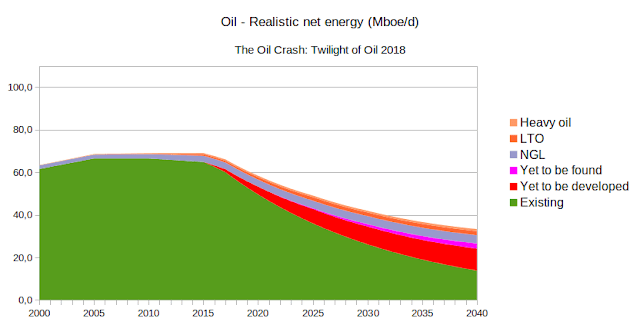
Oil Realistic Net Energy

Antonio Turiel reads between the lines of the latest official IEA data to provide his annual forecast on oil availability.

He predicts that in 2040 we will have less than half the oil we enjoy today.

I consider this a best case scenario because when economic contraction overwhelms our ability to mask reality with debt, many other actors will conspire to disrupt the complex technology network we depend on.

Like hungry people rioting in the streets, trucks with empty diesel tanks, no letters of credit for trade, and war.

P.S. Economists are idiots.

http://crashoil.blogspot.com/2018/12/el-ocaso-del-petroleo-edicion-de-2018.html


For readers who have just arrived at this blog , that graph will probably be quite impressive. Basically, it is telling us that the net energy that we can most realistically expect to receive from oil will fall from 69 Mboe / d in 2015 to 33.3 Mboe / d in 2040, that is, a fall of more than 50 % in a period of 25 years. It is certainly an ominous prospect, but it is similar to what we have obtained in other years and in fact this year’s is slightly better (0.9 Mb / d more in 2040) than last year.


With each passing year, the IEA is forced to make a new return on its forecasts regarding the production of liquid hydrocarbons. This year for the first time it has shown two graphs that anticipate a very unpleasant scenario in terms of oil production, something that seems to be already beginning to notice with the possible arrival of the peak of diesel production. As the years go by and the production data are known, it shows that the trends that we anticipated a few years ago are beginning to consolidate. More importantly, something that radically changes the situation has not just appeared, but rather the opposite: investment in exploration and development of new deposits falls worldwide except in the US, to the extent that currently North America , which produces less than 20% of all the world’s oil, it invests more than 50% in exploration and development.


And in the USA, the myth of fracking as a great revolution is increasingly exposed: the Financial Times questions the quality of the hydrocarbon extracted by fracking (it can not be used to produce diesel because it would be very expensive, among other things ); and a few days ago Art Berman showed that, contrary to the myth of ever decreasing exploitation costs, it turns out that in the last year and a half they have experienced an appreciable increase.


The classical economists, who only look at the price of oil, consider that there is nothing to worry about because right now the price is low. They have not understood the price volatility , they do not understand the effects of the energy spiral . The analysis of the production data, on the contrary, shows us a very complex situation ahead, forecast that as the years pass it seems to be confirmed.

By Gail Zawacki: Diva of Doom Interview

I’m a long-time admirer of the intellect and work of Gail Zawacki, the self-described Diva of Doom. You can find some of my favorites by Gail that I’ve posted here, and all of Gail’s work at her blog Wit’s End.

Here in a new 60 minute interview with Sam Mitchell, Gail provides an articulate description of the what and why of our overshoot predicament, and concludes with some wise advice on what to do about it:

Enjoy every good day that remains.