By Jacob Freydont-Attie: The Cross of the Moment

TheCrossoftheMoment2016260051JF1U_f

This excellent 2015 documentary is a series of bright minds discussing the human predicament from different insightful perspectives.

Most of the big issues like over-population, fossil energy dependence, climate change, and species extinction are discussed with honesty and an absence of denial.

I particularly like how the director Jacob Freydont-Attie set the ominous tone by opening with a discussion of the Fermi Paradox.

A couple of participants made the common uniformed claim that we can easily continue business as usual without emitting carbon, and no one commented on how odd it is for such an intelligent species to deny it’s predicament, but on balance I think this is one of the best documentaries I’ve seen on human overshoot.

Thanks to GailZ for bringing this to my attention.

Here is some information from the home site:

A deep-green, deep-time, highly cerebral discussion of the environmental crisis, The Cross of the Moment attempts to connect the dots between Fermi’s Paradox, climate change, capitalism, and collapse. Interviews with top scientists and public intellectuals are woven together into a narrative that is challenging, exhausting, and often depressing as it refuses to accept the easy answers posited by other overly-simplistic climate change documentaries. No fancy graphics or distracting introductions detract from what is essentially an 80 minute constructed conversation among a group of highly informed experts on the most important topic in human history; will our species survive catastrophic climate change?

The film is divided into seven chapters that start from the widest perspective, why do we appear to be alone in the galaxy, and slowly narrows its focuses through a series of topics including Rare Earth Theory, human impact on the biosphere, potential solutions, structural barriers to implementation, the possibility of the collapse of civilization, and a final call for immediate engagement at all levels of society.

Interviewees are Don Brownlee, Roger Carasso, Robin Hanson, Mark Jacobson, Derrick Jensen, David Klein, Bill McKibben, Guy McPherson, Bill Patzert, Gary Snyder, Jill Stein, Peter Ward, and Josh Willis. Some of these are household names, other are more obscure scientists working in academia or for government institutions such as NASA. What they all share is a pressing concern for the future of our planet. Certainly more demanding on its audience than similar films, there is also present here a layer of humor and, more importantly, a deep sense of humanity. By the end the audience has not just explored our current crisis from a variety of thoughtful perspectives, but also become acquainted with these highly original intellectuals as people seeking truth as we all are.

The film takes its title from a stanza of W. H. Auden’s poem The Age of Anxiety, published in 1947.


A New International Journalism Standard: Certified 100% Denial-Free™

no_denial_here1


Thanks to the millions of people that visit this site every day, awareness of Varki’s revolutionary Mind Over Reality Transition (MORT) theory is exploding.

Many citizens in every country are now aware that most sources of journalism are deeply in denial and incapable of accurately reporting on the reality of world affairs and the human predicament.

Thanks to this growing demand for reality based journalism, we have launched a new international certification standard for journalism: Certified 100% Denial-Free™

Only those organizations that agree to follow our rigorous certification guidelines, and which permit us to conduct regular compliance audits on their employees and publications, may use our trademarked designation Certified 100% Denial-Free™.

Aware citizens may confidently trust content when they see the Certified 100% Denial-Free™ designation.

Aware citizens also know that any content lacking the Certified 100% Denial-Free™ designation should be viewed with suspicion and assumed to deny reality.

Dozens of influential organizations have enrolled in our program and are working hard to achieve certification. We can expect many more organizations to enroll as momentum grows and consumers vote with their wallets.

Please be patient because certification takes time given the rigor and difficulty of compliance, which often involves terminating many executives and employees that have denial genetics too strong to override with re-training.

You are encouraged to pressure your favorite journalism sources to seek or accelerate certification.

We are offering certification as a non-profit public service. Enrollment is free and the only cost is reimbursement for actual certification and auditing expenses.

On Winning the Game

world-leaders-attempting-to-control-world-economy1

Gail Tverberg in her latest essay uses an airplane video game as a nice analogy for the world economy and concludes that there is no way to win the game.

Gail’s implicit definition of “win” is to maintain or improve our standard of living. I agree with Gail there is no possibility of winning this game and our standard of living will fall dramatically in the not too distant future.

Where we might disagree is that I think we should use a different definition of “win”. We are in a severe state of overshoot. Nothing can be done to avoid a permanent economic contraction. Given this reality we should redefine “win” as achieving the best possible outcome for a plane that is running low on fuel.

Criteria for “best possible outcome” should include:

  • Population reduction policies.
  • Austerity and conservation policies designed to manage our descent in a civil and humane manner, rather than resisting the inevitable with debt and money printing that will cause a much worse uncontrolled crash.
  • Taxation policies to ensure the wealth gap does not widen to a level that causes dangerous social unrest or revolution.
  • Programs to use what surplus wealth remains to protect ecosystems and to build infrastructure needed at our destination.
  • Policies to prevent wasting surplus wealth on things that will have no value at our destination.
  • Educating citizens on what is happening to avoid despots, false blame, and war.

How to implement this new definition of “win” is of course the big question.

It is discouraging that even the Green Party is unable to whisper the word overshoot, let alone offer appropriate overshoot policies.

As always, I return to the core issue:

Reality denial enabled the powerful brain that is central to our success;

AND

Reality denial threatens our existence by preventing us from acknowledging and acting on our overshoot predicament.

It is encouraging that by understanding other genetic traits, like our susceptibility to nicotine addiction, and our brain’s inability safely drive while texting, we have made some progress via government policy to reduce these threats.

The first step to redefining “win” must be to increase awareness of Varki’s Mind Over Reality Transition (MORT) theory.

With awareness, a portion of the population might be able to override their genetic tendency to deny reality, and to influence elections to redefine “win”.


Here are a few excerpts from Gail Tverberg’s essay however it’s worth your time to read in entirety.

By Gail Tverberg: A Video Game Analogy to Our Energy Predicament

https://ourfiniteworld.com/2017/11/28/a-video-game-analogy-to-our-energy-predicament/

The way the world economy is manipulated by world leaders is a little like a giant video game. The object of the game is to keep the world economy growing, without too many adverse consequences to particular members of the world economy. We represent this need for growth of the world economy as being similar to making a jet airplane fly at ever-higher altitudes.

What Happens As Coffin Corner Limits Are Reached in the Economic World?

What do world leaders do, as the world economy hits limits? One temptation is for the world leaders in Figure 1 to take their foot off the throttle that is operated by low interest rates and more debt, because they don’t seem to be providing very much benefit anymore. The leaders fear that if more debt is added at low interest rates, it risks creating “asset bubbles” that are easily disturbed if any little bump to the economy occurs. If a big bubble pops, there is a significant risk that the economy could fall down to a much lower level. This is like stalling the jet at high altitude.

World leaders can also use approaches that create situations more like “making the wings come off” the economy. These approaches involve favoring one group over another. For example, a government can give big tax breaks to businesses, but raise taxes on individual citizens. Businesses will ultimately be harmed by this approach, because they depend on individual citizens for their sales. The result is like tearing the wings off the airplane.

Another approach that would tear the wings off the economy involves actions by a different group of world leaders than those shown in Figure 1, namely the leaders from OPEC and Russia. These leaders have different video game screens and different game controllers. They can manipulate the world economy by reducing the supply of oil they provide. With this approach, they hope to increase the price of oil, and thus obtain a larger share of the world’s goods and services through higher tax revenue.

Raising the oil price would benefit oil exporters, but would make goods and services more expensive for oil importing countries. Ultimately, this approach would lead to recession in oil importing nations. The result would likely be worse than the 2008-2009 recession–another way to make the wings come off the economy.

[5] The real enemies of continued economic growth are (a) diminishing returns with respect to oil and other energy production, (b) continued population growth, and (c) increasing wage and wealth disparity. 

We seem to be playing a video game where the players don’t understand who the real enemies are.

Diminishing returns with respect to oil and other energy production have to do with the cost of energy extraction rising ever-higher, as more resources are extracted. There are a lot of resources that we can “see,” but that we cannot economically extract, unless prices rise to very high levels.

Continued population growth is a problem because it is really “energy per capita” that matters. Each individual needs food, transportation, and housing. All of these things take energy. Many years ago, when most of the workers were farmers, it was necessary to create ever-smaller farms, as population rose. This clearly would lead to lower food production per farmer, unless some sort of technological breakthrough was taking place at the same time. Today, we have a parallel issue.

Increasing wage disparity tends to be associated with the rising use of technology. When most labor is hand labor, workers truly do “pay each other’s wages.” All wages can be fairly equal. With increased technology, some workers have specialized training; others do not. Some workers are supervisors; others are laborers. Unless the overall output of the economy is rising very rapidly, non-elite workers find themselves increasingly unable to afford the output of the economy. It is this falling “demand” (really affordability) that tends to pull an economy downward.

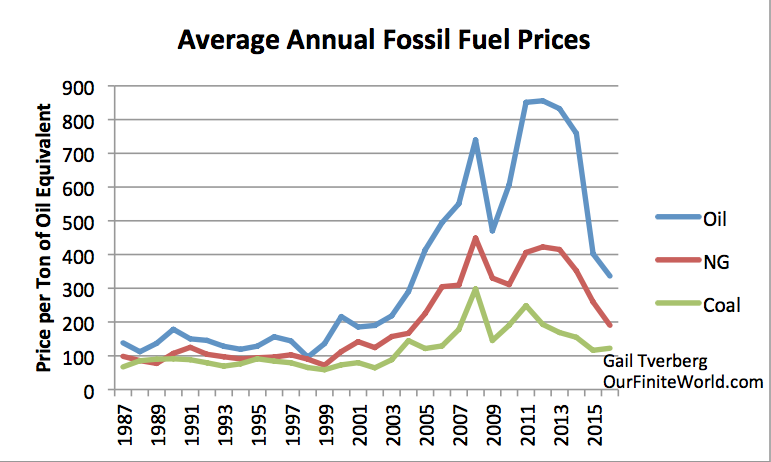
[8] In fact, since 2014, the selling prices of oil, natural gas, and coal have all fallen below the cost of extraction.

It is popular to think that the reason why oil prices are too low is because of overproduction by the United States or Saudi Arabia. When a person stops to realize that essentially the same situation arises for all three fossil fuels, a person begins to understand that there likely is an affordability issue underlying the low prices for all three fuels. The affordability issue, of course, arises because energy supply is not rising quickly enough because (at over $20 per barrel), it is too expensive to be truly affordable. The “atmosphere is too thin” at today’s high cost of energy extraction.

[11] The whole “game” has been confused by a lot of not-quite-correct pronouncements from academic circles.

A lot of well-meaning people have tried to solve our energy problems, but haven’t gotten the story right.

Economists have gotten the story pretty much 100% wrong. Energy is very important for the economy. Furthermore, energy prices don’t rise endlessly.

Peak Oilers have confused matters by talking about oil, coal and natural gas being determined by the amount of technically recoverable resources in the ground. This might be true if energy prices could rise endlessly, but clearly they cannot. By following the wrong views of economists, Peak Oilers have led world leaders to believe that far more resources are available to be extracted than really is the case.

People who call themselves Biophysical Economists haven’t really gotten the story correct either. The Biophysical Economists realized that there was a need for a measure for diminishing returns. They put together a measure which they called Energy Returned on Energy Invested. The measure, unfortunately, only “sort of” works. It gives a lot of wrong answers. It does not suggest that oil prices above $20 per barrel are a problem. It also does not suggest that substitutes for oil that are priced above $20 per barrel are a problem. It tends to give a lot of “false positives” when it comes to the question of whether renewables can be substituted for fossil fuels. It seems to suggest that a particular ratio is important, when it is really the total quantity of an energy product available at a very low price that is important.

I should not pick on the Biophysical Economists. There are many others with academic credentials who produce metrics that really aren’t very helpful. Energy payback time is not a very helpful metric, especially from the point of view of deciding whether or not to use a particular device. It is not the energy that the economy must pay back; it is the full cost of manufacturing the device that needs to be recovered, including human labor costs and taxes. In some applications, the cost of mitigating intermittency may also need to be considered.

Even the standard Levelized Cost of Energy calculations can give misleading indications, if they are used on intermittent renewables without taking into account the cost of mitigating the intermittency.

With all of these issues, it is not surprising that world leaders have difficulty playing the energy and economy game. In fact, it is hard to see any winning strategy.

One of the issues that makes the game impossible to win is the fact that all sides must win. A solution that cuts out the oil exporters is a problem for an economy dependent on oil. Any solution that cuts out the workers is a problem, partly because businesses need workers as consumers, and partly because governments need workers as taxpayers.

The reason I have not included any discussion of renewables is because at this point in time, we do not have any renewables that are sufficiently inexpensive and sufficiently scalable to represent a solution.

Reality Denial Harm Prevention: A Proposal for Screening and Licensing

wn0218-22028229

All 7 billion humans originated from one small tribe of hominids in Africa about 100,000 years ago. Despite their close relatedness individuals are born with considerable genetic variation in physical and mental characteristics. Examples of genetic variation include height, weight, strength, speed, eyesight, intelligence, aptitudes, demeanour, sexual orientation, dietary tolerance, disease susceptibility, addiction tendency, mental health, and longevity.

The laws and practices of most countries have acknowledged that genetic variation exists and that certain levels of variation can be harmful to society, or may prevent the individual from performing certain tasks. Examples include:

  • Most professions such as engineering, medicine, science, and law implicitly screen candidates for adequate intelligence and aptitude with challenging university entrance and degree requirements, exams, and professional certifications.
  • Airline pilots, air traffic controllers, train engineers, and truck drivers are required to have vision acuity and color vision above a minimum level.
  • Law enforcement, firefighting, and some military roles require adequate strength and agility to perform the work.
  • Many professional sports require a minimum speed, height, weight, or strength.
  • Many employers screen for substance abuse which is known to have a genetic predisposition.

A recent scientific breakthrough by Varki and Brower shows that the behaviorly modern human brain was enabled about 100,000 years ago by a simultaneous mutation for an extended theory of mind and denial of reality.

Denial of reality is therefore central to the behavior of most humans, and is characterized by a tendency to deny the reality of anything unpleasant, regardless of evidence or science. As with other genetic characteristics like color blindness, the level and type of reality denial varies widely in the population from benign to dangerous.

Benign forms of reality denial may benefit or harm the individual, but rarely do serious harm to society, future generations, or other species. Examples of benign reality denial include:

  • Belief in a god that promises life after death.
  • Unhealthy lifestyles and diets.
  • Use of mind altering substances.
  • Wacky beliefs like miracles, fate, luck, conspiracy theories, and UFOs.

Dangerous forms of reality denial, on the other hand, often benefit the individual or society in the short-term, but cause severe mid and long-term harm to society, future generations, and other species. Examples of dangerous reality denial include:

  • Denial of human overshoot.
  • Denial of species decline and extinction, and damage to ecosystems.
  • Denial of climate change severity, actions required to make the future less bad, and personal responsibility.
  • Denial of many limits to growth, including some imminent threats like low-cost oil depletion.
  • Denial of the implications of excessive debt and low interest rates.

Clearly, the risks and potential harm from genetic variation associated with reality denial, which for example could cause the collapse of civilization or extinction of many species, far exceed the risks and potential harm from the already regulated genetic variations, like vision accuracy, which could cause a fatal surgery mistake or a plane to crash.

We should therefore urgently act on the recent discovery of Varki and Brower and pass laws to screen and license people before they are permitted to function in roles inappropriate for certain levels of reality denial.

Upon reaching the legal age of consent, all citizens should be assessed for their inherited level of reality denial using a scale from 0 to 6 as follows:

  • full reality acceptance (0)
  • benign reality denial: low (1), medium (2), high (3)
  • dangerous reality denial: low (4), medium (5), high (6)

The screening process would include a review of activities in the community, social media, interviews with teachers and acquaintances, and a written examination.

The process would focus on assessing the strength of the following beliefs:

  • There are no limits to growth.
  • Green growth is better.
  • Technology is the solution to all problems including energy.
  • There are two sides to the climate change debate.
  • We must increase food production to keep pace with population growth.
  • iPhones, the internet, and Tesla are more important innovations than Haber-Bosch, concrete, and the diesel engine.
  • I’ve already done enough by shopping with a reusable bag.

In the future as brain scanning technologies improve, it is expected that the screening process will be replaced with a quick and inexpensive brain scan that will detect activity in the region of the brain responsible for reality denial.

Upon completion the individual will be issued an official government identification card stating the level of reality denial that they were born with.

Critical occupations and activities in society may not be filled or conducted by anyone exceeding a specified level of reality denial. Examples of maximum allowed levels include:

  • right to vote (3)
  • right to run for elected office (2)
  • right to make political donations (3)
  • senior position in any company (3)
  • senior position in government (2)
  • teachers and professors (1)

Please contact your elected representatives and make them aware of the new science associated with reality denial and lobby for this vital extension to existing harm prevention laws and practices.

Lunch Price Increase

Honest growth driven by low cost energy is over.

What’s left is fake growth driven by debt and money printing.

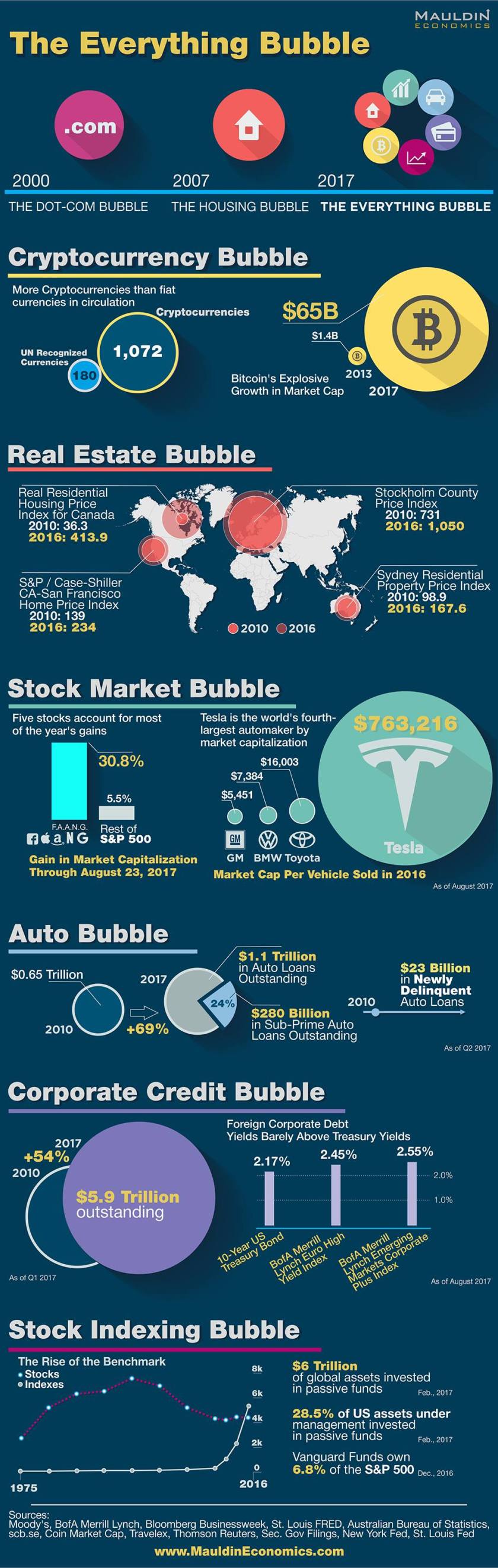
I think the illusion of growth created by debt and money printing will eventually end when something awakens the herd to the bubbles and causes it to sell assets in a panic which will harm a lot of people, including innocents without assets.

On the other hand, if I am wrong and central banks continue to succeed with their illusion, then it seems the end game will be 90+% of assets owned by the 1% elite, and 99% of citizens angry and impoverished by a destroyed currency.

It would be so much wiser and safer to accept the necessity of a decline in our standard of living, and to allow the economy to deflate with taxation policies designed to prevent the wealth gap from widening as everyone becomes poorer.

I understand that it may be impossible to orchestrate a gradual deflation without triggering a crash, however every day that we postpone reality increases the pain we will eventually experience.

There is no free lunch.

21765598_10155072425313261_5674136948384125200_o

By Alice Friedemann: German Military Study on Peak Oil

German Military - Peak Oil Study - 2010

Alice Friedemann summarizes here a 2010 study on peak oil conducted by the German military.

http://energyskeptic.com/2017/german-military-peak-oil-summary/

The original full report can be found here.

And what was the German government’s response to this excellent report on peak oil by their own military?

They increased their population with immigration.

Denial is amazing!


Today approximately 90% of all industrially manufactured products depend on the availability of oil. Oil is not only the source material for producing fuels and lubricants but is also used as hydrocarbon for most plastic. It is one of the most important raw materials in the production of many different products such as pharmaceuticals, dyes and textiles. As the source material for various types of fuels, oil is a basic prerequisite for the transportation of large quantities of goods over long distances. Alongside information technology, container ships, trucks and aircraft form the backbone of globalization. Oil-based mobility also significantly influences our lifestyle, both regionally and locally. For example, living in suburbs several miles from their workplace would be impossible for many people without a car.


Societal risks of peak oil

  1. Economic collapse
  2. Transportation restricted
  3. Erosion of confidence in state institutions

There are not sufficient alternatives to oil for transportation, so when oil grows short, there are likely to be extreme restrictions for private vehicles, especially in suburbs, resulting in a “mobility crisis” that would make the economic crisis much worse.

Scarce or expensive oil would drive up the cost of all goods. Our current international movement of goods has largely been made possible by the technological progress in the field of freight traffic (container ships, trucks, cooling systems), which are based on fossil fuels.  So trying to switch all modes of transport to alternative energy sources is much more complex with today’s common means of transportation and technology. Mobility on the basis of fossil fuels is likely to remain a long time.   Oil shortages could lead to bottlenecks in delivering food and other life-sustaining essential goods.

After peak oil, there would be significant differences from past food shortages:

  • The crisis would concern all food traded over long distances, not just single regions or products. Regions that are structurally already at risk today would however be particularly affected (see figure 6).
  • Crop yields also depend on oil. Lack of machines or oil-based fertilizers and other chemicals to increase crop yield would therefore have a negative effect on crop production
  • The increase in food prices would be long-term
  • Competition between the use of farmland for food production and for producing biofuels could worsen food shortages and crises.


After oil shortages people will experience a lowering of living standards due to an increase in unemployment and the cost of oil for their vehicles. Studies reveal that only continuous improvement of individual living conditions provide the basis for tolerant and open societies. Setbacks in economic growth can lead to an increase in the number of votes for extremist and nationalistic parties.


Other likely consequences

Banks left with no commercial basis. Banks would not be able to pay interest on deposits as they would not be able to find creditworthy companies, institutions or individuals. As a result, they would lose the basis for their business.

Loss of confidence in currencies. Belief in the value-preserving function of money would dwindle. This would initially result in hyperinflation and black markets, followed by a barter economy at the local level.

Collapse of value chains. The division of labor and its processes are based on the possibility of trade in intermediate products. It would be extremely difficult to conclude the necessary transactions lacking a monetary system.

Collapse of unpegged currency systems. If currencies lose their value in their country of origin, they can no longer be exchanged for foreign currencies. International value-added chains would collapse as well.

Mass unemployment. Modern societies are organized on a division-of-labor basis and have become increasingly differentiated in the course of their histories. Many professions are solely concerned with managing this high level of complexity and no longer have anything to do with the immediate production of consumer goods. The reduction in the complexity of economies that is implied here would result in a dramatic increase in unemployment in all modern societies.

National bankruptcies. In the situation described, state revenues would evaporate. (New) debt options would be very limited, and the next step would be national bankruptcies.

Collapse of critical infrastructures. Neither material nor financial resources would suffice to maintain existing infrastructures. Infrastructure interdependencies, both internal and external with regard to other subsystems, would worsen the situation.

Famines. Ultimately, production and distribution of food in sufficient quantities would become challenging.

War.  Oil shortages are likely to be seen by importing nations as a national security issue leading to conflict, which could also emerge over renewable energy resources.

By Chris Martenson: Signs of Distress

https://www.peakprosperity.com/blog/110096/signs-distress

What if there’s nothing wrong with the people who are anxious or depressed, but the exact opposite is true; those who are cheerful and chipper are missing the plot?


The world is edging closer to the final moments after which everything will be forever changed. Grand delusions, perpetuated over decades, will finally hit the limits of reality and collapse in on themselves.

We’re over-budget and have eaten deeply into the principal balances of all of our main trust accounts. We are ecologically overdrawn, financially insolvent, monetarily out past the Twilight Zone, consuming fossil fuels (as in literally eating them), and adding 80,000,000 net souls to the planet’s surface — each year! — without regard to the consequences.

Someday there will be hell to pay financially, economically, and ecologically as there simply isn’t any way to maintain these overdrafts forever. Reality does not renegotiate. Its deal terms aren’t compromisable.

For those who have the neural plasticity to actually see what’s happening around us, the changes are already here, blatant and frightening. Younger folks, with their fresher eyes and fewer ties to the past, can see them a lot easier than their elders.

The prosperity enjoyed by the past few generations — especially the Baby Boomers — was stolen from future generations. All the while, they pretended as if their borrowing-heavy standards of living were the result of sheer genius and intelligence; like trust fund babies who mistake being born on third base for hitting a triple.

Young people have sussed this out; and are now pulling back from many of the principal occupations of their forebears — like marriage, babies and buying homes and cars. This perplexes older folks, who are beginning to find themselves increasingly at odds with the generations following after them.

Humans can be very very smart, but the flip-side of our ingenuity is our capacity for self-delusion. We’ve very consistently preferred to look past our faults. That can work for a while, but eventually an incomplete view will lead to a complete disaster. For example: depleting our topsoils today to grow more eventually leads to a collapse of our food system tomorrow. Similarly, increasing societal complexity ultimately drains the resources out of an empire, until it withers and fails. Such is what we can learn from history. Each of these examples is rooted in the self-delusion that today’s actions don’t have real consequences.

Monetary printing experiments like those currently being run by the world’s central banks are the ultimate form of self-delusion. Money is the most potent form of social communication, underlying all contracts and agreements. Violate those and literally everything falls apart, as we are seeing happen in real-time in Venezuela right now.

Money printing and its other historical debasement equivalents, serve to cover up (barely) critical signals. Derelict ideas that should die a quick death, instead, persist. Mis-priced money leads mal-investment (e.g., Italian junk debt selling with the same yield as ten year US Treasury debt!!). Extremely unfair redistributions of wealth from the bottom to the top result. Every. Single. Time. This time is no different.

By Richard Heinberg: Are We Doomed? Let’s Have a Talk.

climate_change_is_real_is_the_doom

Richard Heinberg is one of the early voices that sounded the alarm on limits to growth. He has a wide and deep understanding of the issues, and is an excellent and prolific writer.

In earlier years he usually concluded his books and essays with some variation of “the good news is everything will be ok if we just do xyz”.

Lately he has been speaking more openly and honestly.

This latest essay is a no holds barred full-on dose of reality.

Good on him. Someone needs to speak the truth.

One quote stood out for me:

Accepting that a crash is more or less inevitable is a big step, psychologically speaking. I call this toxic knowledge: one cannot “un-know” that the current world system hangs by a thread, and this understanding can lead to depression. In some ways, the systemic crisis we face is analogous to the individual existential crisis of life and death, which we each have to confront eventually. Some willfully ignore their own mortality for as long as possible; others grasp at a belief in the afterlife.

Heinberg, apparently without awareness of Varki’s theory, is dancing around the fact that denial of reality is central to what makes us human, as it was the barrier created by awareness of mortality, and nature’s solution of evolving denial of death via a more general denial of realty mechanism, that enabled us to evolve an extended theory of mind, which we used to take over the planet, and to enter an extreme state of overshoot.


Are we doomed if we can’t maintain current and growing energy levels? And are we doomed anyway due to now-inevitable impacts of climate change?

First, the good news. With regard to energy, we should keep in mind the fact that today’s Americans use roughly twice as much per capita as their great-grandparents did in 1925. While people in that era enjoyed less mobility and fewer options for entertainment and communication than we do today, they nevertheless managed to survive and even thrive. And we now have the ability to provide many services (such as lighting) far more efficiently, so it should be possible to reduce per-capita energy usage dramatically while still maintaining a lifestyle that would be considered more than satisfactory by members of previous generations and by people in many parts of the world today. And reducing energy usage would make a whole raft of problems—climate change, resource depletion, the challenge of transitioning to renewable energy sources—much easier to solve.

The main good news with regard to climate change that I can point to (as I did in  this essay posted in June) is that economically recoverable fossil fuel reserves are consistent only with lower-emissions climate change scenarios. As BP and other credible sources for coal, oil, and natural gas reserves figures show, and as more and more researchers are pointing out, the worst-case climate scenarios associated with “business as usual” levels of carbon emissions are in fact unrealistic.

Now, the bad news. While we could live perfectly well with less energy, that’s not what the managers of our economy want. They want growth. Our entire economy is structured to require constant, compounded growth of GDP, and for all practical purposes raising the GDP means using more energy. While fringe economists and environmentalists have for years been proposing ways to back away from our growth addiction (for example, by using alternative economic indices such as Gross National Happiness), none of these proposals has been put into widespread effect. As things now stand, if growth falters the economy crashes.

There’s bad climate news as well: even with current levels of atmospheric greenhouse gases, we’re seeing unacceptable and worsening impacts—raging fires, soaring heat levels, and melting icecaps. And there are hints that self-reinforcing feedbacks maybe kicking in: an example is the release of large amounts of methane from thawing tundra and oceanic hydrates, which could lead to a short-term but steep spike in warming.  Also, no one is sure if current metrics of climate sensitivity (used to estimate the response of the global climate system to a given level of forcing) are accurate, or whether the climate is actually more sensitive than we have assumed. There’s some worrisome evidence the latter is case.

But let’s step back a bit. If we’re interested in signs of impending global crisis, there’s no need to stop with just these two global challenges. The world is losing 25 billion tons of topsoil a year due to current industrial agricultural practices; if we don’t deal with that issue, civilization still crash even if we do manage to ace our energy and climate test. Humanity is also over-using fresh water: ancient aquifers are depleting, while other water sources are being polluted. If we don’t deal with our water crisis, we still crash. Species are going extinct at a thousand times the pre-industrial rate; if we don’t deal with the biodiversity dilemma, we still crash. Then there are social and economic problems that could cause nations to crumble even if we manage to protect the environment; this threat category includes the menaces of over-reliance on debt and increasing economic inequality.

If we attack each of these problems piecemeal with technological fixes (for example, with desalination technology to solve the water crisis or geo-engineering to stabilize the climate) we may still crash because our techno-fixes are likely to have unintended consequences, as all technological interventions do. Anyway, the likelihood of successfully identifying and deploying all the needed fixes in time is vanishingly small.

Many problems are converging at once because society is a complex system, and the challenges we have been discussing are aspects of a systemic crisis.

Many problems are converging at once because society is a complex system, and the challenges we have been discussing are aspects of a systemic crisis. A useful way to frame an integrated understanding of the 21st century survival challenge is this: we humans have overshot Earth’s long-term carrying capacity for our species. We’ve been able to do this due to a temporary subsidy of cheap, bountiful energy from fossil fuels, which enabled us to stretch nature’s limits and to support a far larger overall population than would otherwise be possible. But now we are starting to see supply constraints for those fuels, just as the side effects of burning enormous amounts of coal, oil, and natural gas are also coming into view. Meanwhile, using cheap energy to expand resource-extractive and waste-generating economic processes is leading to biodiversity loss; the depletion of soil, water, and minerals; and environmental pollution of many kinds. Just decarbonizing energy, while necessary, doesn’t adequately deal with systemic overshoot. Only a reduction of population and overall resource consumption, along with a rapid reduction in our reliance on fossil fuels and a redesign of industrial systems, can do that.

Economic inequality is a systemic problem too. As we’ve grown our economy, those who were in position to invest in industrial expansion or to loan money to others have reaped the majority of the rewards, while those who got by through selling their time and labor (or whose common cultural heritage was simply appropriated by industrialists) have fallen behind. There’s no technological fix for inequality; dealing with it will require redesigning our economic system and redistributing wealth. Those in wealthy nations would, on average, have to adjust their living standards downward.

Now, can we do all of this without a crash? Probably not. Indeed, many economists would regard the medicine (population reduction, a decline in per-capita energy use, and economic redistribution) as worse than whatever aspects of the disease they are willing to acknowledge. Environmentalists and human rights advocates would disagree. Which is to say, there’s really no way out. Whether we stick with business as usual, or attempt a dramatic multi-pronged intervention, our current “normal” way of life is toast.

Accepting that a crash is more or less inevitable is a big step, psychologically speaking. I call this toxic knowledge: one cannot “un-know” that the current world system hangs by a thread, and this understanding can lead to depression. In some ways, the systemic crisis we face is analogous to the individual existential crisis of life and death, which we each have to confront eventually. Some willfully ignore their own mortality for as long as possible; others grasp at a belief in the afterlife. Still others seek to create meaning and purpose by making a positive difference in the lives of those around them with whatever time they have. Such efforts don’t alter the inevitability of death; however, contributing to one’s community appears to enhance well-being in many ways beyond that of merely prolonging life.

But is a crash the same as doom?

Not necessarily. Our best hope at this point would seem to be a controlled crash that enables partial recovery at a lower level of population and resource use, and that therefore doesn’t lead to complete and utter oblivion (human extinction or close to it). Among those who understand the systemic nature of our problems, the controlled crash option is the subject of what may be the most interesting and important conversation that’s taking place on the planet just now. But only informed people who have gotten over denial and self-delusion are part of it.

This discussion started in the 1970s, though I wasn’t part of it then; I joined a couple of decades later. There is no formal membership; the conversation takes place through and among a patchwork of small organizations and scattered individuals. They don’t all know each other and there is no secret handshake. Some have publicly adopted the stance that a global crash is inevitable; most soft-pedal that message on their organizational websites but are privately plenty worried. During the course of the conversation so far, two (not mutually exclusive) strategies have emerged.

The first strategy envisions convincing the managers and power holders of the world to invest in a no-regrets insurance plan. Some systems thinkers who understand our linked global crises are offering to come up with a back-pocket checklist for policy makers, for moments when financial or environmental crisis hits: how, under such circumstances, might the managerial elite be able to prevent, say, a stock market crash from triggering food, energy, and social crises as well? A set of back-up plans wouldn’t require detailed knowledge of when or how crisis will erupt. It wouldn’t even require much of a systemic understanding of global overshoot. It would simply require willingness on the part of societal power holders to agree that there are real or potential threats to global order, and to accept the offer of help. At the moment, those pursuing this strategy are working mostly covertly, for reasons that are not hard to discern.

The second strategy consists of working within communities to build more societal resilience from the ground up. It is easier to get traction with friends and neighbors than with global power holders, and it’s within communities that political decisions are made closest to where the impact is felt. My own organization, Post Carbon Institute, has chosen to pursue this strategy via a series of books, the Community Resilience Guides;  the “Think Resilience” video series; and our forthcoming compendium, The Community Resilience Reader.  Rob Hopkins, who originated the Transition Towns movement, has been perhaps the most public, eloquent, and upbeat proponent of the local resilience strategy, but there are countless others scattered across the globe.

Somehow, the work of resilience building (whether top-down or bottom-up) must focus not just on maintaining supplies of food, water, energy, and other basic necessities, but also on sustaining social cohesion—a culture of understanding, tolerance, and inquiry—during times of great stress. While it’s true that people tend to pull together in remarkable ways during wars and natural disasters, sustained hard times can lead to scapegoating and worse.

Most people are not party to the conversation, not aware that it is happening, and unaware even that such a conversation is warranted. Among those who are worried about the state of the world, most are content to pursue or support efforts to keep crises from occurring by working via political parties, religious organizations, or non-profit advocacy orgs on issues such as climate change, food security, and economic inequality. There is also a small but rapidly growing segment of society that feels disempowered as the era of economic growth wanes, and that views society’s power holders as evil and corrupt. These dispossessed—whether followers of ISIS or Infowars—would prefer to “shake things up,” even to the point of bringing society to destruction, rather than suffer the continuation of the status quo. Unfortunately, this last group may have the easiest path of all.

Can we succeed? It depends on how one defines “success”…

By comparison, the number of those involved in the conversation is exceedingly small, countable probably in the hundreds of thousands, certainly not millions. Can we succeed? It depends on how one defines “success”—as the ability to maintain, for a little longer, an inherently unsustainable global industrial system? Or as the practical reduction in likely suffering on the part of the survivors of the eventual crash? A related query one often hears after environmental lectures is, Are we doing enough? If “Enough” means “enough to avert a system crash,” then the answer is no: it’s unlikely that anyone can deliver that outcome now. The question should be, What can we do—not to save a way of life that is unsalvageable, but to make a difference to the people and other species in harm’s way?

This is not a conversation about the long-term trajectory of human cultural evolution, though that’s an interesting subject for speculation. Assuming there are survivors, what will human society look like following the crises ensuing from climate change and the end of fossil fuels and capitalism? David Fleming’s book, Surviving the Future, and John Michael Greer’s, The Ecotechnic Future, both  offer useful thoughts in this regard. My own view is that it’s hard for us to envision what comes next because our imaginations are bounded by the reality we have known. What awaits will likely be as far removed from from modern industrial urban life as Iron-Age agrarian empires were from hunting-and-gathering bands. We are approaching one of history’s great discontinuities. The best we can do under the circumstances is to get our priorities and values straight (protect the vulnerable, preserve the best of what we have collectively achieved, and live a life that’s worthy) and put one foot in front of the other.

The conversation I’m pointing to here is about fairly short-term actions. And it doesn’t lend itself to building a big movement. For that, you need villains to blame and promises of revived national or tribal glory. For those engaged in the conversation, there’s only hard work and the satisfaction of honestly facing our predicament with an attitude of curiosity, engagement, and compassion. For us, threats of doom or promises of utopia are distractions or cop-outs.

Only those drawn to the conversation by temperament and education are likely to take it up. Advertising may not work. But having a few more hands on deck, and a few more resources to work with, can only help.

Imagine You Are a Smart Leader

Note: I make a distinction between being wise and smart. I wrote about wise leaders and citizens here. Today I am talking about smart leaders of citizens in denial.

Imagine you are a smart leader with a good understanding of science and engineering, like many Chinese leaders, and unlike our idiot Western economists and lawyers.

You know cheap money policies have created the largest bubble in history.

You know there is not enough affordable energy left to grow out of the problem.

You know that austerity policies will cause a depression, at best, and will cause you to lose your job.

You know that thermodynamics and mathematics guarantees an economic reset in the not too distant future.

You know that there will be much less energy and other critical resources like food available after the reset.

You know that there will be much less credit available to purchase anything with after the reset.

You know that you will not be able to feed your people, and keep your job, without access to energy, food, and other critical resources.

You know that you cannot afford a massive military build-up to forcibly secure resources, and even if you could, the future shortage of energy to power it makes a big military an unwise investment.

You know that a few cheap nuclear weapons are probably sufficient to prevent someone with a bigger military from taking your resources.

You know that fiat currencies, like those every country uses, have value because they are a claim on energy that is expected to be burned in the future.

You know that there will not be enough energy in the future to fulfill claims made by fiat currencies, and therefore they will lose most of their value after the reset and will not be useful for purchasing resources.

You know that gold’s value comes from the energy that was burned in the past to produce it, and therefore other countries may exchange energy and food for gold after the reset.

What would you do?

You would print money to purchase gold from other countries with leaders that are too stupid and/or too deeply in denial to understand what is going on.

By Steve St. Angelo: CLOSE TO NEW GOLD STANDARD? Australia Exports Record Amount Of Gold To China

australia-us-gold-mine-suppy-vs-exports

Australia and the U.S. continue to export the majority of its gold to Hong Kong and China. For example, Australia and the United States exported 121 mt of gold to Hong Kong and China during the first quarter of 2017. Australia exported 57.4 mt, while the U.S. exported 63.3 mt. Thus, Hong Kong and China received 55% of all Australian and U.S. gold exports Q1 2017.

By James Hansen: March 2017 Address to Young People

James Hansen is a great man.

In this wide-ranging talk he addresses young people saying they need to lead a peaceful revolution to create a new political party that will support science and reason, a carbon tax, and renewed investment in nuclear energy.

He argues that we are at a historic low point of leadership. All parties, left and right, are clueless and ineffective. Hansen has hope for political change because he has seen young people influence elections, and because he has seen in his younger years good leaders that did the right thing, even in the absence of popular support.

Hansen sadly concludes by saying to young people, “sorry to leave you such a friggin’ mess”, but unfortunately it’s up to you to fix it.

Hansen struggles a little in the talk, perhaps because he is tired, or perhaps because despite having worked hard to warn citizens about the dangers of climate change since 1981, every indicator and action by society continues to move in the wrong direction.

As an aside, I think Hansen makes a serious error by stating that a carbon tax will be effective without damaging the economy. A carbon tax will indeed reduce CO2 emissions, but it will also reduce our standard of living, as will any effective climate change policy. He should state this clearly to avoid a dangerous backlash when the truth emerges.

With regard to nuclear energy, it really is the only option that might maintain our modern technology, and I say might because it does not replace our vital diesel. I personally think the risks are unacceptably high that nuclear can be kept safe with proper maintenance and governance as civilization becomes simpler, poorer, and chaotic due to overshoot, the depletion of affordable oil, and the end of growth. But reasonable people could disagree on this, especially people who think modern technology should be retained as a top priority.

I wrote more about Hansen here, and you can find more on the implications of a carbon tax here.