One Less Blog to Follow

This denial thingy is amazing.

Almost every time I find someone who has a deep understanding of one dimension of human overshoot I dig deeper and find they are in complete denial of other dimensions. Not just a little denial. I’m talking total non-scientific bat shit crazy denial. Wasdell. Anderson. Martenson. 10,000 climate scientists, etc.

The latest is Robert Marston Fanney. I’ve been appreciating his climate change blogs as he often seems to report on new issues first with excellent insights.

Then today he writes a blog on how renewable energy is going to save us. No data on carbon emissions to build out renewables or to maintain them or the impact on the environment. No data on cost and where the money will come from or the impact of falling net energy. No mention of the fact that we’ve already emitted enough to take us to at least 2 (and probably 4-6) degrees. Total bullshit. Capped off with the following reply to a reader’s comment:

“So let’s put this bit into context. Air travel currently represents about 3 percent of global carbon emissions. But its growth is certainly a matter of concern. Fortunately, there are a number of ways to reduce net carbon emissions from air travel including biofuels, hydrogen powered aircraft, lightweight batteries, and electric engines. Lighter than air airframes are also a potential solution. Though innovations for switching air travel to zero carbon solutions are among the least available currently, we can certainly provide incentive structures that push air travel in that direction.”

Fucking unbelievable. The only way to explain how a high intelligence person can be so willfully stupid in other domains is genetic denial.

One less blog to follow.

Welcome to the Renewable Energy Renaissance — Fight to End Fossil Fuel Burning is Now On

By Ron Patterson: A Closer Look at OPEC

In summary, OPEC has peaked with the possible exceptions of Iran and Iraq. Game over soon.
 
Funny, I don’t remember Obama discussing this civilization threatening issue in the state of the union.
 
But then again, neighbors, friends, and family don’t want to discuss it either.
 
Denial everywhere.
 

Cause for Hope, Despair, or Both?

Here is a new video by Nick Breeze titled “1.5ºC: A New Boundary for Global Heating”.

At 3:30 Kevin Anderson, one of the climate scientists I respect, says the developed world must stop using fossil fuels by 2030-2035.


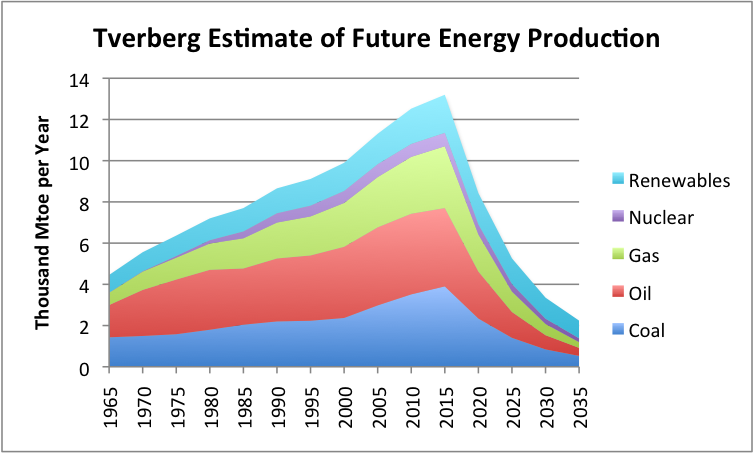
Gail Tverberg, the energy analyst with the best track record of predicting the future, says fossil energy production will be almost zero by 2035.

http://ourfiniteworld.com/2016/01/07/2016-oil-limits-and-the-end-of-the-debt-supercycle/

Figure 4. Estimate of future energy production by author. Historical data based on BP adjusted to IEA groupings.

Are these predictions a coincidence? Or do they have something to do with the earth’s carbon cycle and balance?

I don’t know but I suspect the dates are dependent on each other.

Maybe the answer can be found by looking at earth’s environment when fossil energy started to accumulate. Note to self: research this.

Kevin Anderson also says that in addition to stopping fossil energy use by 2035 we must draw down existing CO2. My understanding of the technologies is that this is not feasible and/or affordable. On the other hand, the decline in CO2 emissions may be faster than Anderson predicts due to the likelihood of a fast economic collapse that Anderson does not understand.

Will the inevitable collapse of civilization caused by fossil energy depletion occur in time to prevent runaway climate change?

Is this cause for hope or despair or both?

By Gail Tverberg: 2016: Oil Limits and the End of the Debt Supercycle

Yes it’s true. I post a lot of links from Gail Tverberg these days.

She’s writing a lot, it’s all high quality stuff not commonly seen anywhere else, and she always seems to have something fresh to say.

Gail also has a good track record for accurate predictions.

“What is ahead for 2016? Most people don’t realize how tightly the following are linked:

  1. Growth in debt
  2. Growth in the economy
  3. Growth in cheap-to-extract energy supplies
  4. Inflation in the cost of producing commodities
  5. Growth in asset prices, such as the price of shares of stock and of farmland
  6. Growth in wages of non-elite workers
  7. Population growth

It looks to me as though this linkage is about to cause a very substantial disruption to the economy, as oil limits, as well as other energy limits, cause a rapid shift from the benevolent version of the economic supercycle to the portion of the economic supercycle reflecting contraction. Many people have talked about Peak Oil, the Limits to Growth, and the Debt Supercycle without realizing that the underlying problem is really the same–the fact the we are reaching the limits of a finite world.

We are certainly entering a worrying period. We have not really understood how the economy works, so we have tended to assume we could fix one or another part of the problem. The underlying problem seems to be a problem of physics. The economy is a dissipative structure, a type of self-organizing system that forms in thermodynamically open systems. As such, it requires energy to grow. Ultimately, diminishing returns with respect to human labor–what some of us would call falling inflation-adjusted wages of non-elite workers–tends to bring economies down. Thus all economies have finite lifetimes, just as humans, animals, plants, and hurricanes do. We are in the unfortunate position of observing the end of our economy’s lifetime.

Most energy research to date has focused on the Second Law of Thermodynamics. While this is a contributing problem, this is really not the proximate cause of the impending collapse. The Second Law of Thermodynamics operates in thermodynamically closed systems, which is not precisely the issue here.

We know that historically collapses have tended to take many years. This collapse may take place more rapidly because today’s economy is dependent on international supply chains, electricity, and liquid fuels–things that previous economies were not dependent on.

What is Ahead for 2016?

  1. Problems with a slowing world economy are likely to become more pronounced, as China’s growth problems continue, and as other commodity-producing countries such as Brazil, South Africa, and Australia experience recession. There may be rapid shifts in currencies, as countries attempt to devalue their currencies, to try to gain an advantage in world markets. Saudi Arabia may decide to devalue its currency, to get more benefit from the oil it sells.
  2. Oil storage seems likely to become a problem sometime in 2016. In fact, if the run-up in oil supply is heavily front-ended to the December to April period, similar to what happened a year ago, lack of crude oil storage space could become a problem within the next three months. Oil prices could fall to $10 or below. We know that for natural gas and electricity, prices often fall below zero when the ability of the system to absorb more supply disappears. It is not clear the oil prices can fall below zero, but they can certainly fall very low. Even if we can somehow manage to escape the problem of running out of crude oil storage capacity in 2016, we could encounter storage problems of some type in 2017 or 2018.
  3. Falling oil prices are likely to cause numerous problems. One is debt defaults, both for oil companies and for companies making products used by the oil industry. Another is layoffs in the oil industry. Another problem is negative inflation rates, making debt harder to repay. Still another issue is falling asset prices, such as stock prices and prices of land used to produce commodities. Part of the reason for the fall in price has to do with the falling price of the commodities produced. Also, sovereign wealth funds will need to sell securities, to have money to keep their economies going. The sale of these securities will put downward pressure on stock and bond prices.
  4. Debt defaults are likely to cause major problems in 2016. As noted in the introduction, we seem to be approaching the unwinding of a debt supercycle. We can expect one company after another to fail because of low commodity prices. The problems of these failing companies can be expected to spread to the economy as a whole. Failing companies will lay off workers, reducing the quantity of wages available to buy goods made with commodities. Debt will not be fully repaid, causing problems for banks, insurance companies, and pension funds. Even electricity companies may be affected, if their suppliers go bankrupt and their customers become less able to pay their bills.
  5. Governments of some oil exporters may collapse or be overthrown, if prices fall to a low level. The resulting disruption of oil exports may be welcomed, if storage is becoming an increased problem.
  6. It is not clear that the complete unwind will take place in 2016, but a major piece of this unwind could take place in 2016, especially if crude oil storage fills up, pushing oil prices to less than $10 per barrel.
  7. Whether or not oil storage fills up, oil prices are likely to remain very low, as the result of rising supply, barely rising demand, and no one willing to take steps to try to fix the problem. Everyone seems to think that someone else (Saudi Arabia?) can or should fix the problem. In fact, the problem is too large for Saudi Arabia to fix. The United States could in theory fix the current oil supply problem by taxing its own oil production at a confiscatory tax rate, but this seems exceedingly unlikely. Closing existing oil production before it is forced to close would guarantee future dependency on oil imports. A more likely approach would be to tax imported oil, to keep the amount imported down to a manageable level. This approach would likely cause the ire of oil exporters.
  8. The many problems of 2016 (including rapid moves in currencies, falling commodity prices, and loan defaults) are likely to cause large payouts of derivatives, potentially leading to the bankruptcies of financial institutions, as they did in 2008. To prevent such bankruptcies, most governments plan to move as much of the losses related to derivatives and debt defaults to private parties as possible. It is possible that this approach will lead to depositors losing what appear to be insured bank deposits. At first, any such losses will likely be limited to amounts in excess of FDIC insurance limits. As the crisis spreads, losses could spread to other deposits. Deposits of employers may be affected as well, leading to difficulty in paying employees.
  9. All in all, 2016 looks likely to be a much worse year than 2008 from a financial perspective. The problems will look similar to those that might have happened in 2008, but didn’t thanks to government intervention. This time, governments appear to be mostly out of approaches to fix the problems.
  10. Two years ago, I put together the chart shown as Figure 12. It shows the production of all energy products declining rapidly after 2015. I see no reason why this forecast should be changed. Once the debt supercycle starts its contraction phase, we can expect a major reduction in both the demand and supply of all kinds of energy products.”

2016: Oil Limits and the End of the Debt Supercycle

Peak Oil and Low Prices??

I spent a few days over Christmas with my brother. He is bright, has a degree in Engineering Physics, and has discussed (and understood) resource depletion with me over the years.

He said he thought peak oil was no longer an issue due to the current global oil glut and low prices. I tried to explain to him that nothing had changed but I could tell he was not convinced. If my brother feels this way I have no doubt that most other citizens also believe peak oil is a non-issue.

They are wrong. In fact really wrong. The low prices are an indicator that the end game is in sight and that we should be very concerned.

It’s difficult to explain in a few words but here is my attempt…

  • Oil is non-renewable. This means the total quantity of oil is finite.
  • The quantity of oil we can extract and use is dependent on the price. If the price is high we can use more technology, energy, materials, and labor to extract it.
  • Consumers want to minimize their expenditures and companies want to maximize their profits. This means we always exploit the lowest cost sources first. As the low cost sources are depleted the cost of a finite resource will increase.
  • We built our civilization on oil that cost about $20 per barrel and that oil is all gone. What’s left costs on average about $80 to $100 per barrel to extract.
  • It is difficult, maybe impossible, for the economy to grow with oil at $80+. After paying for the energy that every product and service depends on, there is insufficient surplus left to reinvest for growth.
  • The design of our debt based money system requires growth or it collapses. We kept growth going despite high oil prices by reducing the interest rate thereby making it possible for us to afford the higher cost oil by increasing our debt load. This in turn allowed high cost producers like the tar sands, shale oil, and deep water to increase production.
  • This trick of using debt to create growth works well for a while but must come to an end when the total debt reaches a level that is not sustainable even with zero interest rates. We are there now.
  • Because private sector debt is now saturated the global consumer is no longer able to afford $80+ oil. This created an imbalance between supply and demand. The oil industry is a finely tuned “flow” business with a lot of inertia. A small drop in demand can have a large impact on price because global storage capacity is limited, and because oil producers are motivated to produce at the maximum rate because their capital expenditures are already spent and cash flow can keep them alive for a period, even if they sell at a loss. Similarly, countries like Saudi Arabia are motivated to produce at the maximum possible rate, even if prices are low, because they need the cash to pay for the social services that keep them in power.
  • In summary, oil now costs more to produce than consumers can afford. And maybe more than is required for economic growth.
  • The first expected outcome is low prices. Check.
  • The next expected outcome is a reduction in exploration and production investment. Check.
  • The next expected outcome will be oil company bankruptcies and austerity and social unrest in oil producing countries. Starting.
  • The next expected outcome will be a decrease in oil production as existing wells deplete and new wells are not brought on line due to a decrease in investment (see above). Coming soon.
  • The next expected outcome will be a decrease in global GDP because every product and service we make or use requires energy. As energy declines so must GDP. Due to the inherent instability of high debt levels in a no or low growth environment this step may occur at any time and may actually precede a decline in oil production.
  • The next expected outcome may be a deflationary collapse as existing debts can no longer be serviced by a shrinking economy. There is some uncertainty in this step because governments will do everything possible to avoid a collapse and may take extreme measures such as printing and spending money to force inflation. This may work for a while but will end at the same destination by destroying the value of money.
  • In the end the world will one way or the other be much poorer. It may be impossible to invest enough to rebuild oil production to the level we enjoy today, and it will certainly be impossible to invest enough to replace oil with renewable energies as they cost more than today’s $80+ oil we already cannot afford.

A caveat. Economic changes rarely move in a straight line. The oil price has oscillated since the 2008 crisis and may do so again. We can be certain however that with each oscillation the oil that is left in the ground will be more expensive to extract and therefore the trend will and must be bad.

So to answer the opening question, the low oil prices we see today are in fact an indicator that peak oil is upon us now.

What should we do?

There are no good solutions. I believe that aggressive conservation policies are needed. And we should do what we can to reduce our debt level through austerity. Conservation and debt reduction will further reduce economic activity and may cause a depression but we might have some ability to control the contraction rather than being forced to surf an uncontrolled crash.

The good news is that most in the developed world can survive with much less than we currently consume. And an economic contraction will be good for climate change.

The bad news is that economic depressions almost always result in war and war this time will only make things worse, even for the victor, because there are no spoils to capture, and war will burn up what’s left even faster.
By RE: Descent to Darkness: 2015 Collapse in Words & Pictures

“2015 was a banner year for doom” – RE @ Doomstead Diner”

This is one of RE’s best rants.

Lots of depth and breadth plus his usual acidic humor.

By Ron Patterson: All Roads Lead to Peak Oil: Oh Shit Moment Now

An aha quote from Ron Patterson a.k.a. Rockman…

“Look at the US oil production curve. We peaked about 35 years ago. And during those decades the inflation adjusted price of oil was less the current prices…and considerably less then during the height of the shale boom.

And the shales boomed when oil price boomed. And not due to technology: horizontal drilling for unconventional reservoirs, like the Austin Chalk in Texas, was well established 15 years earlier. And fracking has changed very little for decades.

In other words US oil production peaked because oil prices essentially peaked decades ago. Yes: up and down but no great movement like we saw when the shales boomed. And US oil production almost reached a new peak because oil prices reached near peak levels once again. Which means that we may not only be at global PO but the longer it takes for oil prices to significantly increase we may never again approach current production levels as depletion continues to take its toll. The recent increase in global oil production actually is the result of low oil prices…not higher. The oil price collapse has forced some producers, like the KSA, to bring their reserve capacity into play so as to increase the revenue stream. Which also means the lower oil prices are also increasing the depletion rate of existing proven reserves as well as hampering the development of new reserves.

The recent oil price collapse may eventually be viewed as the ultimate “Oh shit” moment in the global energy dynamics.”

All Roads Lead to Peak Oil

Coincidence or Expected?

Is it coincidence or expected that we are simultaneously facing:

  1. economic collapse
  2. peak oil
  3. runaway climate change

And yet everything appears sort of normal, if you close one eye and squint.

I think it’s to be expected:

  • wealth is proportional to energy consumption
  • wealth growth is facilitated by debt
  • debt requires economic growth
  • economic growth requires increasing energy consumption
  • most energy useful for creating wealth is non-renewable
  • non-renewable means finite
  • the use of anything finite must eventually peak and decline
  • more debt can delay the onset of finite resource decline
  • energy consumption releases CO2
  • CO2 causes temperature rise
  • temperature rise triggers many self-reinforcing feedback loops
  • many self-reinforcing feedback loops acting together cause runaway climate change
  • declining energy causes economic contraction
  • climate change causes economic contraction
  • more debt can temporarily mask economic contraction
  • low interest rates can temporarily make more debt affordable
  • debt growth must eventually stop when it saturates the system
  • economic contraction with high levels of debt causes collapse
  • denial prevents most people from seeing or acting on any of the above
  • forces build until they overwhelm the herd’s faithThen something snaps.

India Plans to Double Coal Output: Truth on Renewables Revealed

If solar and wind can grow an economy and lift millions out of poverty why then does India still plan to double its use of coal?

Those seeking to understand the truth about renewable energy need only observe where countries invest their energy dollars. Opinions cannot be trusted. Actions reveal the truth.

Many people point to Germany as a role model for what’s possible with renewable energy. Developed countries like Germany can increase renewable energy because they are rich enough to eat their seed corn for a while, and because they outsourced some of their manufacturing to developing countries like China, and therefore need less energy to maintain the same lifestyle.

Developing countries, on the other hand, have little extra seed corn to eat and need fossil energy to create wealth and lift their people out of poverty.

By Gail Tverberg: Economic Growth: How It Works; How It Fails; Why Wealth Disparity Occurs

Mark Twain wrote, “It ain’t what you know that gets you in trouble. It’s what you know for sure, that just ain’t so.” This is especially a problem for academic researchers who depend on the precedents of past academic papers. A researcher may have come to a conclusion years ago, based on a narrow set of research that didn’t cover today’s conditions. The belief can get carried forward endlessly, even though it isn’t really true in today’s situation.

Another excellent piece from Gail Tverberg on energy, debt, limits to growth and why this time really is different.

It is frightening that none of political or economic leaders understand this stuff.

Imagine trusting your life to a doctor that was trained as an astrologist.

Economic Growth: How It Works; How It Fails; Why Wealth Disparity Occurs