The Cactus Lens: A Clearer View

Until recently there have been 3 main lenses through which to view our overshoot predicament: debt, energy, and ecology.

Each lens exposes a different aspect of the picture, but not the complete picture.

Each lens focusses on different threats, with different time frames, and different consequences, and each lens suggests a different optimal response.

Overshoot awareness varies by lens and group within society. Awareness of leaders is generally higher than citizens, and in some cases this is deliberate and warranted because broad citizen awareness of the debt and energy threats would increase the probability of short term collapse.

For leaders and citizens that see through any of the lenses, their understanding tends to be incomplete, which has resulted in plans of action that will not help, or that make the situation worse.

This incomplete understanding is caused in part because the issues are very complex, and in part because some aspects of human overshoot have no acceptable or feasible solution, and in part because of the human tendency to deny unpleasant realities, as explained by Dr. Ajit Varki’s MORT theory.

Hideaway, a frequent contributor at un-Denial, Peak Oil Barrel, Our Finite World and other sites, recently introduced a new lens we have named cactus, which focusses on all non-renewable resources and the complexity required to extract them.

I think the cactus lens provides the clearest view of what is going on, what we should expect in the short to medium term, and what we should do.

The cactus lens changes what is in the best interests of citizens to understand.

The debt and energy lenses suggest citizens should remain in the dark.

The ecology lens suggests it does not matter what citizens understand because the ecology threats are longer term than debt, energy, and cactus, and because awareness of ecology issues have not and will not improve anything of substance due to the nature of modernity.

With the introduction of the cactus lens, it is now in the best short term interests of all groups: countries, leaders, and citizens, for awareness to be as widespread as possible.

Achieving broad cactus awareness will be difficult because it is very unpleasant, and therefore will be blocked by our genetic denial behavior, however I propose one idea to start the discussion on how we might spread cactus awareness.

Awareness Lens: Debt

Theory:

  • Modernity requires abundant credit;
  • Because most of our mines, machines, technology, and structures require significant up front capital to build;
  • Which requires a fractional reserve debt backed monetary system;
  • Which is now used by every country in the world;
  • Which by design requires economic growth to not collapse;
  • Because money is loaned into existence and growth is needed to pay interest;
  • Which means our economic system requires infinite growth on a finite planet;
  • Which of course is impossible and means we should expect growth to slow and prosperity to decline, as they are;
  • Culminating in a dramatic and harmful economic reset;
  • However modernity will survive and will rebuild until the next bubble pops.

Status :

  • Quite a few citizens see through the debt lens, maybe a significant minority.
  • Most aware citizens assume the reset is a ways off in the future.
  • Some people prepare to weather a storm with cash, gold, bitcoin, or sardines.
  • Others trust or hope that central banks will print enough money to kick the can past their expiry.
  • Leaders understand and acknowledge the debt problem but are careful to not cause panic because herd emotions could trigger a reset.
  • Leaders are also careful to not explain the driver of the debt problem, energy depletion, as will be discussed in the next section on the energy lens.
  • The debt threat is closer and more severe than our leaders let on as demonstrated by:
  1. Social unrest everywhere is rising because living standards are falling and the wealth gap is widening.
  2. Geopolitical tensions are rising.
  3. Democracies are oscillating between wider extremes.
  4. Most countries have historically high levels of growing debt.
  5. Growth has slowed, and the only growth possible now comes at the expense of adding more debt than the growth it buys, which is unsustainable.
  6. No political party in power anywhere reduces their deficit or balances their budget because it’s now impossible without crashing their system. The US DOGE effort lasted 5 months before leaders gave up and juiced the deficit to new record highs.
  7. Central banks work hard behind the curtain to keep our everything bubble inflated, and to prevent any significant correction of stock or asset prices. When I was young it was normal for the economy and stock market to experience cycles. We don’t permit cycles anymore. Today there is so much debt and so little growth that a significant correction will result in a reset (aka crash).
  8. Printing bazookas are used to blast any threat before it builds momentum, like the banking system repo problem that covid provided cover for unprecedented money printing.
  9. Our leaders tried but failed to use covid as an excuse to implement the tools needed to manage an economic reset like digital ids/currencies for rationing scarce necessities, and for enabling negative interest rates, and tried via “The Great Reset” propaganda campaign to get us ready to accept nationalization of assets (aka “you will own nothing and be happy”). They will try again.

Implications:

  • The debt lens implies a zero-sum game: In a no growth world, one country’s gain is another country’s loss.
  • Our leaders believe that a country that succeeds in harming its competitors will experience less damage from an economic reset. The goal is to ensure opponents reset before you do, on the assumption that this will prevent or delay your own reset by gaining control of more growth generating assets and markets.
  • Hence we see the weaponization of tariffs and trade, regime change operations, and proxy wars intended to weaken or capture opponents.

Conclusions:

  • A debt reset is mathematically inevitable and will reduce the standard of living for the majority via deflation and/or inflation.
  • Debt resets are hard to predict and control because herd emotions drive the process.
  • Leaders have good reasons to not want citizens to be aware of the seriousness of the debt problem.
  • Leaders are operating on the assumption of a zero-sum game.
  • In the cactus lens section we’ll see that the zero-sum game assumption is wrong, which means the current strategy will make things worse for all countries.

Awareness Lens: Energy

Theory:

  • Modernity requires abundant net energy;
  • Which is the energy that remains after using energy to extract and refine energy;
  • Because all of our food, water, minerals, technology, products, and services are produced and delivered by machines powered by energy.
  • Diesel is the keystone energy that powers our vital mining machines, tractors, combines, trucks, trains, and ships.
  • Renewable energy is not a solution to non-renewable depletion because renewables require abundant non-renewable energy t0 build, install, maintain, and augment for 24/7 supply.
  • Discovery of new fossil energy reserves is much slower than depletion of existing reserves, and the gap is growing.
  • The quality of non-renewable energy reserves decline as they deplete;
  • Which means net energy is falling;
  • Which explains why growth is slowing, and prosperity is declining, and debt is growing faster than GDP everywhere.
  • We should expect the trend to continue and accelerate.
  • Leaders believe modernity will continue for those countries that have access to energy.

Status:

  • Few citizens see through the energy lens.
  • There are many false energy beliefs in wide circulation including net zero, peak oil demand, abiotic oil, green energy, renewables outpacing fossils, hydrogen economy, nuclear renaissance, space mining, circular economy, etc., etc..
  • These beliefs are nonsense not grounded in sound science or economics, but the issues are complex, and it is difficult for a citizen to determine the truth, especially with deliberate misdirection from leaders, and with MORT driven hope and denial driving behavior.
  • Denial is a strong force that fogs the energy lens because, short of a near zero probability miracle, there is no solution, and the outlook is steadily worsening living standards.
  • Most leaders, with help from their energy aware militaries, understand what is going on, and know the energy threat is imminent. Evidence for this includes:
  1. Inflation of energy intensive products, like food, is high; energy intensive infrastructure is not being properly maintained; energy intensive manufacturing, like weapons, is struggling to keep up with demand despite plentiful printed money available; war is shifting to lower energy methods like drones; and as also seen through the debt lens, debt is accelerating, living standards are falling, the wealth gap is widening, geopolitical tensions are rising, and democracies are at risk.
  2. The EIA this year announced that fracked oil is peaking. Fracked oil is the unexpected savior that bought us an extra decade after conventional oil peaked.
  3. Leaders do not want their citizens to panic, or to spook the stock market bubble which depends on growth, so they do not discuss the energy problem, and work hard to distract citizens with nonsense like optimism for a renewable transition, or by stoking emotions over socially divisive issues.
  4. Trump reversed his no more regime change promises after being sworn in and briefed about US debt and oil forecasts.
  5. Every country with significant exportable oil reserves that is not controlled by the US empire is either under attack or being regime changed including Russia, Iran, Syria, Venezuela, and Nigeria. Even friends with oil, or close to oil, like Canada and Greenland, have been threatened with annexation.
  6. Propaganda is successfully being used to convince citizens that regime change operations are to prevent terrorism or drug trafficking, not to control oil.
  7. China is stockpiling strategic oil reserves.
  8. A few countries, like Germany, made an honest attempt to run their economies with renewable energy, but it’s now obvious to leaders everywhere that the renewable dream has failed. German leaders now want war with energy rich Russia.
  9. The UK, having drained its own oil reserves, now wants war with energy rich Russia.
  10. Hail Mary investments praying for a miracle are being made in AI and nuclear energy.

Implications:

  • The energy lens implies a zero-sum game: In an energy scarce world, one country’s gain is another country’s loss.
  • Our leaders understand their country’s prosperity requires non-renewable energy, and that it must be secured by any means necessary, including taking it by force from others.
  • Countries are preparing for war by increasing military expenditures, even at the expense of social services demanded by citizens.
  • Nuclear arms treaties are being abandoned, and the arms race is restarting.
  • Lessons learned during the cold war about the dangers of nuclear war are being ignored, and red lines are increasingly flirted with.
  • It’s hard to imagine how nuclear war can be avoided given that everyone’s survival depends on oil, and the zero-sum game assumption of our leaders.

Conclusions:

  • Modernity requires growth, and there is not enough oil left for everyone to grow.
  • Leaders have good reasons to not want citizens to be aware of the seriousness of the energy problem.
  • Leaders are operating on the assumption of a zero-sum game.
  • In the cactus lens section we’ll see that the zero-sum game assumption is wrong, which means the current strategy will make things worse for all countries.

Awareness Lens: Ecology

Theory:

  • The resources consumed, and the wastes generated, and the habitats occupied, by the large and growing population of humans, is displacing other species, and causing damage to ecosystems faster than can be repaired by the planet’s recycling systems.

Status:

  • The 8,230,000,000 humans, plus their 35,000,000,000 livestock, plus their billions of pets and other freeloaders like rats, now weighs 80 times more than all wild land mammals combined.
  • Humans use 30-40% of the net primary productivity of all sunlight hitting the planet, plus 16,000,000,000 liters per day of ancient sunlight stored as oil, plus 11,000,000,000 cubic meters per day of ancient sunlight stored as natural gas, plus 24,000,000,000 kilograms per day of ancient sunlight store as coal.
  • The sixth mass extinction is underway.
  • Six of nine planetary boundaries critical for survival have already been crossed including climate change, biodiversity, deforestation, fresh water, nitrogen cycle, and pollution.
  • We have already passed the 1.5C safe limit and are on a path to a 3+C temperature increase that is incompatible with civilization and agriculture by the end of this century.
  • Biodiverse forests are being replaced with mono-crop agriculture.
  • Fisheries are in decline.
  • Sea level rise will damage many cities over the next century.
  • Glacier loss threatens the survival of several countries.
  • Chemical toxins and microplastics are harming the health of all life including humans.
  • Awareness of leaders and citizens about the ecological problems varies widely.
  • Most people are aware of some of the problems, but also tend to superficially simplify them down to one issue, CO2, that can be fixed with solar panels and electric vehicles.
  • Few are aware of the breadth and depth of the problems.
  • Many people deny the severity of the problems and/or that humans have caused the problems.
  • Almost everyone denies the implications of the ecological problems, and the fact there is almost nothing that can be done to address them while maintaining modernity and our population.
  • Every effort, by every country, and every organization, and every citizen, to address the above problems, has failed, and will continue to fail, at least until something forces an involuntary change to population and lifestyles.

Implications:

  • The view through the ecology lens is dire.
  • The long term implications are worse than those seen through the debt and energy lenses because we are damaging the ability for any human lifestyle to thrive, and are also harming many other species.

Conclusions:

  • Life threatening ecological problems, for the majority of people, are further in the future than the imminent problems seen through the debt, energy, and soon to be explained, cactus lenses.
  • All of the ecological problems are caused by the human species footprint which is the product of lifestyle and population.
  • None of the ecological problems can be addressed without reducing per capita consumption or population, and the debt and cactus lenses show that modernity requires growth, which means the ecological problems are a classic predicament, a problem without an acceptable solution.
  • The energy and cactus lenses show that growth will not continue, and the human footprint will soon shrink, which means there may be an improvement to future ecology trends.
  • Many of the ecological problems we have created will repair quickly when the scale of the human enterprise shrinks.
  • Some ecological problems will take a very long time to repair, and adaptation of surviving species will be required.
  • As will be discussed in more detail in the next section, if we somehow became aware that the scale of humanity was going to decrease in the not too distant future, no matter what we do, then we might be able to motivate ourselves to address several ecological issues that would improve the quality of life for the survivors, such as burying nuclear waste, and protecting biodiverse forests and marine ecosystems.

Awareness Lens: Cactus
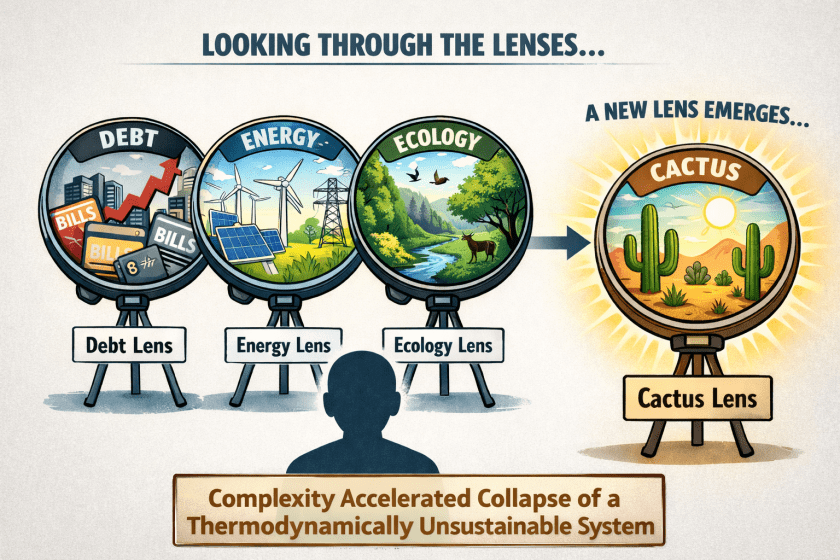
CACTUS = Complexity Accelerated Collapse of a Thermodynamically Unsustainable System

The phrase “we’re cactus” is Australian slang meaning something is ruined, broken, or finished, often used to describe a situation where progress has stopped, such as a vehicle that won’t start.

The expression likely originated from the infamous prickly pear cactus, which once infested large parts of Australia before being controlled by the introduced Cactoblastis cactorum moth.

This slang is part of a broader set of Australian expressions for something being in disrepair or useless, including terms like “boonted,” “clapped-out,” “had the chad,” “had the bomb,” and “kaput”.

While “cactus” as a metaphor for being broken or ruined is well-established in Australian English, it is not commonly used in other English-speaking regions.

Theory:

  • Modernity requires abundant minerals and energy.
  • The majority of minerals and energy we use are non-renewable and finite.
  • Recycling is economically and/or technically impossible for most minerals.
  • For those minerals that can be recycled, there are losses in the recycling process that still result in long term depletion.
  • The quality of mineral and energy reserves decline as they deplete, because we always harvest the best quality reserves first.
  • Mineral and energy extraction technologies must increase in complexity to compensate for falling reserve quality to maintain flows of resources. For example, compare modern directional drilling now required for fracking with early oil rigs. Or the giant trucks and other machines now required to haul and process low grade copper ore.
  • Rising complexity increases the materials, processes, skills, locations, and number of people needed to design and manufacture the technologies.
  • Rising complexity requires a growing market to support the increasing cost of designing and manufacturing technologies. For example, a smaller population would not buy enough phones to make a TSMC factory in Taiwan viable, and therefore the advanced chips needed for oil exploration and extraction would not exist.
  • A growing market requires a growing economy and population.
  • A growing economy and population increases the consumption of all minerals and energy.
  • Wastes generated by the growing economy and population create increasing frictions to further growth.
  • This self-reinforcing complexity growth system drives an increase in mineral and energy flows until technology, markets, and population can no longer keep up with growing waste frictions and declining reserve qualities, and a critical mineral or energy becomes unavailable in the quantities required.
  • Scarcity of the critical mineral or energy triggers a system wide technology breakdown cascade because many technologies depend on it, and many other technologies depend on those technologies, via an ultra-complex network of dependencies.
  • The unavailability of many technologies then causes many more mineral and energy flows to become unavailable in the quantities required because the quality of remaining reserves makes extraction difficult or impossible without the latest technologies.
  • This self-reinforcing collapse of complexity, technology, and resource flows is certain at some point in the not too distant future and will result in a supernova end to modernity and civilization.
  • Nothing can be done to prevent this outcome, just as nothing can be done to prevent the collapse of a star.
  • It’s not possible to have modernity without infinite growth on a finite planet which means modernity will be short lived everywhere in the universe.

Hideaway responds:

  • Hence the logical solution to the Fermi Paradox. Species that reach modernity anywhere do not last long enough to detect others, that have also reached modernity, spread through time.
  • Given the age of our galaxy of around 13.6B years, and if it took 3.6B years for the first species to reach modernity, then if each lasted from 100 years to say 400 years at best, there could have been 1 every million years giving a total of 10,000 for our galaxy and none would ever detect another.
  • Even if 10 or 20 had popped up at the one time, just through chance, and were more than 400-500 light years apart, they would never know of the other’s existence.
  • Just by shear chance, some might detect others, but the odds of any one civilization detecting another is extremely small.
  • Say we did detect another civilization somewhere in the close area within say 1000 light years. So what? By the time we tried to communicate back to them, the odds of their collapse is high.

Status:

  • A tiny minority of people see through the cactus lens.
  • The cactus view of modernity has not been widely discussed.
  • The closest work that I can recall reading is that by David Korowizc where he discusses the extreme complexity and fragility of modern supply chains, and the risk of their breakdown with energy shortages. Korowizc advocates building more resiliency into our system, but I don’t think he stated clearly that modernity will soon end no matter what we do, as Hideaway’s cactus lens does.
  • The ground breaking Limits to Growth work of Dennis Meadows et. al. assumed collapse could be avoided by adopting a steady state population and economy. Cactus shows this assumption is incorrect. Any dependence on any resource that is not naturally recycled by ecological systems will eventually result in a collapse back to a state that is not dependent on the resource.
  • Other important overshoot aware people like Jay Hanson and Jack Alpert discuss the certainty of modernity’s demise, but do not focus on the non-renewable resource extraction complexity growth system to conclude that modernity will end in a supernova.

Implications:

The cactus lens provides several profound insights that create a clearer view than the debt, energy, or ecology lenses.

List every non-renewable resource that civilization depends on.

ChatGPT:

Fossil Fuels: Oil, gas, coal, oil sands, shale oil/gas, peat.

Nuclear Fuels: Uranium-235/238, thorium, plutonium (derived).

Metals: Iron, aluminum, copper, nickel, cobalt, lithium, zinc, lead, tin, silver, gold, platinum group metals, titanium, molybdenum, tungsten, vanadium, niobium, tantalum, chromium, manganese, rare-earth elements (all 17 REEs), and many others.

Industrial Minerals: Phosphate rock, potash, sulfur, borates, fluorspar, gypsum, halite, graphite, silica sand, feldspar, kaolin, etc.

Construction Materials: Limestone, aggregates (sand & gravel), clay, granite, marble, slate, stone.

Geologic Water: Fossil groundwater aquifers.

Biological/Ecological Resources (functionally non-renewable): Topsoil, old-growth forests, biodiversity, coral reefs, major fish stocks.

  1. The first key insight is that modernity depends on many non-renewable materials, not just energy, and they are all critical for the technologies that enable modernity. Cactus is thus a much wider lens than the peak oil view.
  2. The second key insight is that modernity requires growth, not only because of the widely understood need for abundant credit as explained by the debt lens, but also because extraction technologies must increase in complexity to compensate for falling reserve qualities. This growth requirement is physical and non-negotiable, and unlike debt, is not digits in a computer that can be reset.
  3. The third key insight is that the requirement for growth, coupled with the inevitable decline in reserve qualities, creates a self-amplifying feedback loop for every one of the many non-renewable resources we depend on, which creates many possible failure points, and the extreme complexity and interdependencies of the technologies we use to extract minerals and energy guarantees a catastrophic failure of the entire system at some point.
  4. The fourth key insight is that this growth and collapse process is certain for any system that is dependent on non-renewable resources. This means there is no possible sustainable solution for advanced civilization anywhere in the universe, because advanced civilization is not possible without non-renewable resources.
  5. The fifth key insight is that there will be no recovery of modernity after the collapse. The quality of many of the remaining non-renewable resource reserves will be so low after the collapse that many resources will be unavailable without advanced technologies and abundant diesel, and there will be no way of rebuilding those technologies because their development required higher quality resource reserves. Surviving humans will return to their hunter gatherer origins.
  6. The sixth key insight is that the zero-sum game strategy that the debt and energy lenses inform our leaders to use, will reduce the time to collapse, and will not optimize the quality of life for the time that remains. War, for the last 10,000 years, was a good response to scarcity. War, today, will create scarcity for the entire planet.

Conclusions:

Given that our leaders see the world through debt and energy lenses, they are operating on the assumption of a zero-sum game:

  • My country will do better if I damage the economy of my competitors.
  • My country will survive or grow if I take energy from my competitors.

The cactus lens shows us that a zero-sum game strategy will not achieve the desired outcomes.

Instead, zero-sum game strategies will reduce the time to collapse, or reduce the quality of the time that remains. Examples include:

  • Wasting resources, fragmenting the market, and decreasing efficiencies by trying to duplicate and reshore manufacturing.
  • Making it more difficult to maintain complexity by fragmenting the global trade system through the encouragement of BRICS and by imposing trade sanctions.
  • Wasting resources on bigger militaries that won’t help.
  • Wasting resources on climate change policies that won’t help.
  • Wasting resources by subsidizing renewable energy that won’t help.
  • Increasing the chance of violent harms to many by blaming other countries and/or immigrants for hardship caused by resource depletion.
  • Ignoring international law when it conflicts with a zero-sum goal.
  • Sanctioning Russian energy.
  • Blowing up the Nord Stream pipeline.
  • Restarting a nuclear arms race.
  • Risking disruptions to middle east oil flows, and destroying respect for leaders, by supporting the genocide of Palestinians.
  • Funding a proxy war against Russia in Ukraine.
  • Provoking China to withhold rare earth minerals.
  • Provoking China to stockpile oil.
  • Regime changing Syria.
  • Regime changing Iran.
  • Regime changing Venezuela.
  • Threatening to invade Nigeria.
  • Pissing off Canadians so not a one will buy a US product. 🙂

The cactus lens points us to a positive-sum game strategy.

Modernity is a global system of unimaginable complexity dependent on resources, technologies, processes, and skills sourced from 6 continents. A complex component will often travel back and forth between continents many times in the process of converting its constituent minerals into a finished product. Almost every country plays a roll in the complex web that sustains us.

Modernity depends on millions of interdependent components, each with a uniquely complex supply chain, and modernity’s aggregate supply chain is far too complex for any leader, or even a computer, to predict the consequences of disrupting the matrix to achieve a zero-sum game goal.

The risk of unintended consequences is high given that zero-sum game strategies will tend to focus on depriving energy and thus damaging the entire economy of an opponent country.

Plans to reshore manufacturing will make things worse. We don’t have the surplus capital or debt headroom needed to achieve this without damaging something else, and it will be very wasteful of non-renewable resources by creating capacity greater than the market can absorb, thus reducing the time to collapse.

The cactus lens shows us modernity will eventually collapse permanently, taking down every country in the process. There is nowhere to hide, and there is nothing we can do to prevent this. No country will be immune.

With cactus awareness and a positive-sum game strategy we could:

  • Make wise decisions that delay the collapse so we can enjoy more of modernity’s benefits, or at least avoid doing stupid things that accelerate the collapse.
  • Do some things to optimize quality of life until the end, or at least avoid doing stupid things that worsen quality of life.
  • Consider doing some things that might improve the quality of life for the post collapse survivors.

Actions that might delay the collapse and optimize quality of life until the end include:

  • Avoid conflicts and wars that harm citizens, damage supply chains, and waste non-renewable energy and minerals.
  • Stop the subsidy of renewable energy that wastes non-renewable resources and reduces the time to collapse.
  • Stop wasting money on climate change policies that will not change the outcome.
  • Put the Sulphur back into ship fuel.
  • Strengthen global governance and conflict resolution via UN like organizations.
  • Renew and improve treaties to reduce the risk of nuclear war.
  • Remove barriers to trade.
  • Encourage well regulated immigration to optimize global labor.
  • Allow market forces to optimize the global economy for maximum efficiency.
  • Adopt digital currencies to enable fairer and more efficient money printing, and to manage the fair rationing of scarcities.
  • Provide sound lifestyle and dietary advice with encouragements to help citizens improve their health and quality of life, and to reduce the healthcare drag on economies.
  • Fairly enforce laws to encourage law & order and good behavior.
  • Provide open and honest communication to citizens so they know what is going on and why, and no longer feel like they are being gaslit by wizards behind a curtain.
  • Provide meaningful and rewarding goals to citizens, like asking them to volunteer to rehabilitate habitats and soils to help post-collapse survivors.
  • When signs of the final collapse become visible, provide a painless end of life kit to any citizen that wants one to reduce their anxiety.

Notice that nothing on the above list requires a change in lifestyle for the majority, or the overriding of evolved behaviors like the Maximum Power Principle, or singing kumbaya, or sharing everything equally, or eating bugs.

Limits to growth are breaking our democracies. Citizens know their standard of living is falling, but do not understand why, so they vote for the politician that most credibly promises a better life, but leaders are powerless to improve living standards, which breeds politicians that are superb at lying, but not well suited to optimizing a complex problem. Then when the leader does not deliver, the citizen is pissed off, and next time votes for someone more extreme that blames the immigrants or the Chinese, and so on, which accelerates us in the wrong direction. The only way to break this path to despots is awareness.

With cactus awareness we will understand the comforts we enjoy are rare in the universe, are very fragile, and will soon be gone forever on this planet. This could lead to gratitude and care to not cause a premature collapse.

Cactus awareness will create strong pressure between countries, and by citizens on leaders, to not break things.

If we understand modernity will soon be gone for everyone no matter what we do, there will be less need to dominate and win, and more need to enjoy and cooperate to extend the good times.

Humans are an innovative species. With cactus awareness there would be many people thinking about what could be done to buy more time. Maybe we should use this resource for this rather than that? Opposition to change from people who have to give something up might be muted if they understood the change will buy a few more good years.

Some ideas to improve the quality of life for the post collapse survivors will be difficult to decide and implement because many of these will conflict with the goal of delaying collapse as long as possible. On the other hand, if we collectively understand collapse is inevitable, it might be easier to say set aside some forest or wildlife habitat, or bury nuclear waste, knowing that your children or grandchildren might benefit.

Imagine the effect of cactus awareness on philanthropy. What might billionaires with children do with their wealth if they understood modernity will soon be gone? Perhaps they might buy up biodiverse rainforests to protect them.

Shifting from the current zero-sum game strategy to a positive-sum game strategy will be very difficult.

Cactus is very unpleasant. Genetic denial, as explained by MORT, will be in full force resisting cactus awareness.

On the other hand, almost everything going on in the world today is also very unpleasant, and many people are losing their minds because nothing makes sense.

In a strange way, cactus may be less unpleasant than what we are currently asked to believe, because the cactus story at least agrees with what our eyes see, and provides reasons for gratitude when times are tough, so maybe there’s a chance for cactus awareness.

We evolved in small tribes that in times of scarcity had to fight other tribes to survive. There are no attacking aliens to unite us.

The cactus lens does point to a common threat that will kill almost everyone, but most people won’t believe it.

When times get tougher, as they surely will, leaders will have zero chance of adopting a positive-sum game strategy unless a majority of citizens see the world through the cactus lens.

Those of us that are cactus aware should start brainstorming how to spread cactus awareness.

Here’s one idea:

We could recruit the powerful institutions that were created by MORT: religions.

Cactus awareness will be fantastic for the life after death businesses. All religions will boom with growing memberships, donations, and tithes.

Religions therefore could be self-interested and enthusiastic allies for spreading the cactus gospel.

Religions also have the perfect infrastructure and skills needed to spread an idea like cactus and its positive-sum game belief system.

A likely roadblock to our leaders embracing the cactus lens is the big money behind financial institutions that depend on good news for their pump the bubble business model.

I’m thinking that it shouldn’t be too hard to get them on board. The cactus lens doesn’t say everyone has to live like poor monks in a cave.

Cactus tells us the end will be painful but mercifully quick, so those so inclined can party on like it’s 19991 in a glorious bubble until the last day…

1The highest net energy we ever enjoyed was in 1999 when about 4% of energy was needed to extract energy. Today it takes about 10-15% of energy to extract energy, and the ratio is continuing to rise.

What Should / Can / Could / Will We Do?

We’re in serious trouble. Many red lights are flashing on the dashboard.

Most people are now aware that something is seriously wrong, and each has their favorite lens through which to view the problems:

  • Geopolitical: increasing nuclear war risk, trade wars, genocide.
  • Political: polarized angry citizens, unstable governments, panicking/thrashing leaders.
  • Economic: end of growth, declining living standards, widening wealth gap, inflation, accelerating unsustainable debt, asset bubbles.
  • Environmental: accelerating climate change, species extinction, toxic forever chemicals, plastic waste, sick & dying trees from rising ground level ozone, etc.
  • Health: increasing obesity, autism, and chronic diseases, declining lifespans, increasing depression and mental illness.
  • Resources: peak food, peak oil, peak minerals, aquifer depletion, etc.
  • Energy: reserve depletion, rising extraction costs, falling EROI, export land model, no renewable substitutes for non-renewable fossils, etc.

The common denominator to all of these problems is overshoot.

Very few people are able to see through the lens of overshoot because overshoot is a very unpleasant topic with no painless solutions and no way to avoid its consequences, and because humans evolved to deny unpleasant realities like overshoot.

Grok: Biological overshoot occurs when a population exceeds the carrying capacity of its environment, meaning it consumes resources faster than they can be replenished, leading to ecological imbalance. This is often seen in ecosystems where a species’ population grows beyond what the available resources (e.g., food, water, habitat) can sustainably support.

Causes: Rapid reproduction, lack of predators, abundant resources (temporarily), or human intervention (e.g., removing natural checks).

Consequences: Resource depletion, habitat degradation, population crashes, or ecosystem collapse. For example, a deer population might overshoot due to abundant food, then starve when resources run out.

Quantifying Overshoot: In ecology, overshoot can be measured by comparing population size N to carrying capacity K . If N>K, the system is in overshoot, often leading to a decline until N≤K.

Helpful Responses: Addressing overshoot requires restoring balance between population and resources.

What Should We Do?

I started this un-Denial blog 13 years ago after I became aware of our overshoot predicament, and a plausible theory by Dr. Ajit Varki for why almost no one can see the most important and obvious threat we face.

After a few years of discussing our overshoot issues I got tired of being a pessimist and wrote a prescription for what we should do. I thought it was pretty good at the time and represented a path that might actually help rather than the fantasy solutions with 100% probability of failing being promoted by millions of people with good intentions working on symptoms rather than the core overshoot problem.

My prescription for what we should do was in essence to minimize total suffering for all species by humanely reducing our population as fast as possible, and by planning and managing a controlled economic contraction, rather than allowing nature to force an uncontrolled collapse.

I understood that it would not be possible to implement my prescription unless the majority somehow could be made aware of our overshoot predicament, and this in turn required some method of overriding our genetic tendency to deny unpleasant realities. So I then spent several years promoting Dr. Ajit Varki’s MORT theory in the hope that experts in relevant domains would work discover a method to override MORT.

My efforts were a complete failure. Not only did I not succeed in engaging any brain or behavior experts, I was not even able to recruit any like-minded colleagues in the overshoot space who were also trying to find solutions.

I sadly concluded that it was not possible to override MORT because denial of denial is the strongest form of denial, probably because evolution, for good reasons, ensures that the Maximum Power Principal (MPP) trumps all other behaviors.

What Can We Do?

In recent years the insights of Hideaway on the role of complexity in sustaining our civilization have caused me to question the theoretical feasibility of my or any other prescription.

Hideaway explains that the use of any non-renewable resource degrades the quality of its reserves over time, and this requires increasing complexity to sustain supply of the resource, which requires growing economies and population, which consume more supply, which worsens the reserve quality, which means any civilization dependent on non-renewable resources must grow or it will collapse, which means a hard collapse is unavoidable and no mitigation paths exist.

Hideaway’s probably correct but it’s a tough pill to swallow.

I’m still struggling to accept Hideaway’s conclusion because I can imagine many things we could do to worsen our predicament, like for example starting a nuclear war, or by burning our remaining coal and gas reserves faster by using AI to create more enjoyable porn.

Given that we could do many things to increase the coming suffering, it seems reasonable to assume there must be some things we could do to reduce the coming suffering, which I believe is the only sensible goal left to us.

But what are the things we could do to reduce total suffering for all species?

I would love to see the readers of un-Denial offer their ideas in the comments below. If we get enough good ideas I will collate them into another post with a new prescription representing our collective wisdom.

What Could Someone Do?

I’m a long time follower and admirer of Jack Alpert and have posted some of his best work over the years.

For many years Alpert’s been a lone voice advocating rapid population reduction with the goals of reducing suffering and retaining some of our best accomplishments as the only species with science and advanced technology.

I very much like the goal of retaining some of our best science and technology post-collapse because I have some insight into how rare and precious our accomplishments are likely to be in the universe.

In addition, if you have any doubts about the importance of Alpert’s goal to retain some of the more valuable features of modernity, this video on what life was actually like in ancient Rome will set you straight.

I was pessimistic about the feasibility of Alpert’s plan because it required educating sufficient citizens to vote for population reduction policies and I knew from my MORT observations and failures that his education plan would most certainly fail due to our genetic tendency to deny unpleasant realities.

Nevertheless, I still like Alpert’s plan because setting aside the political feasibility of achieving a quorum, it at least was technically feasible and did not break the laws of physics or deny the reality of non-renewable resources as every other “plan” by every other “expert” does.

There is of course now a new technical feasibility question created by Hideaway’s complexity theory. It may not be possible to retain some of modernity’s most valuable technology without the 8 billion scale of our civilization. Let’s hand wave this away for now because I don’t know the specifics of what Alpert proposes to retain, and we need to think harder about the implications of Hideaway’s complexity theory in the context of a population that falls really fast, perhaps so fast that the requirement for growing complexity to maintain supply no longer applies. Suggest we continue this discussion in the comments below.

I was recently pleased to see a revised plan by Alpert that no longer requires a majority of citizens to vote for population reduction policies.

We are underestimating our predicament and underestimating the behaviors needed to unwind it.

Human civilization maybe sicker than we think. Maybe we should consider stronger medicine.

Abstract:

Consider a line that describes the delivery rate of fossil fuels to civilization. Each higher rate each year supported an ever larger global population with ever grander lifestyles.

Unfortunately, earth’s crustal limitations suggest this rate of energy delivery will decline back to its 1750’s level this century.

Unless energy deliveries from solar, wind, hydro, geo thermal, fission, and fusion can come online and replace lost fossil deliveries, human population and lifestyles will also drop back to the 1750’s levels.

Civilization will experience first scarcity; then conflict; and finally a self-reinforcing feedback loop called a scarcity conflict death spiral which will starve to death or kill in conflict most if the people who live this century.

When the behaviors that prevent this die off cause their own significant injuries the condition is called a predicament because people are injured with or without the prevention behavior. 

In the last two minutes of this video I propose a behavior that causes much pain and prevents the injuries during civilization contraction. The video helps the chooser of the potential behavior quantify the injuries on each path.


After you view the video you may have important questions that need answers:

  1. Why do we have to make the transition in the next 80 years?
  2. Why can the earth (without fossil fuels) support only 600 million people living like serfs.
  3. Why does a new civilization that keeps our levels of arts and science support  only 50 million people living like moderns?

In this latest plan Alpert proposes that a single expert could engineer a contagious virus to sterilize the human population.

It seems plausible to me that a single scientist with defective denial genes could be found and recruited for this task. People who can see reality are rare but they do exist.

I do have, however, serious doubts about the technical feasibility of engineering a safe and effective sterilization virus given that it’s required to override life’s primary mission, and given that a trillion dollar pharma industry with an army of scientists was unable to engineer or manufacture a safe and effective gene therapy for a virus they created and had the blueprints for.

How is one rogue scientist going to engineer a safe and effective highly contagious virus designed to override the primary objective of DNA honed by 4 billion years of evolution?

Nevertheless, I’m an electrical engineer with limited knowledge of genetic engineering so perhaps Alpert knows something I do not.

What Will We Do?

Our most likely path is the path we are on which is to use every psychological, accounting, and technology trick we can think of to keep growing the size of our economy and the complexity it depends on until we reach the end of the runway and crash with a spectacular collapse of supply chains, complexity, food, and population.

Unfortunately there will be a lot of suffering for humans and other species. The planet and its diversity of life will no doubt recover, but it will never achieve the pinnacle of rare complexity we enjoy today.

As we accelerate down the runway stresses will increase within countries and between countries. You can see these growing stresses everywhere today. There is a high probability that our leaders will do something in desperation that reduces the length of the runway.

It is likely that our most powerful weapons will be used when citizens of a resource unlucky country become envious and angry. As one recent example, a petulant little island nation off the coast of France that is collapsing because its oil and coal reserves are depleted is trying to provoke a nuclear war with a much larger and more powerful country on the opposite side of a large continent because it has some oil and gas that might sustain the lifestyles and entitlements of the island nation a little longer.

There is another darker scenario now being publicly discussed by very competent geopolitical experts like Col. Larry Wilkerson. In this interview last week Wilkerson explained why he is very worried about the growing threat of a nuclear war and that he fears for his grandchildren.

Wilkerson also said he knows powerful people who believe the solution to overpopulation and resource depletion is to kill billions with nuclear weapons. You can listen to these comments at 42:30 but I’d start earlier at around 33:30 for important context.

In this light, Jack Alpert’s sterilization virus starts to look pretty good.

In case you are not aware of it, I recommend the 2013 TV series Utopia which was about a plot to reduce the population with an engineered virus.

We’re All Good Now: A Mysterious Reversal

Art Berman today responded to the many critics that piled on him after his last essay in which he reversed his prior warnings about oil depletion by doubling down.

https://www.artberman.com/blog/peak-oil-requiem-for-a-failed-paradigm/

Peak Oil: Requiem for a Failed Paradigm

Technology, capital, and price—not just geology—now dictate oil supply. The 2005-2014 price boom unlocked more oil than anyone expected. Today, financial markets and geopolitics—not depletion—drive the oil game.

Shale changed everything, unleashing a massive new supply. Peak Oil still pretends it doesn’t exist—won’t even put it on a chart. That’s why it’s a dying paradigm. It had its moment and reshaped my world view in important ways. May it rest in peace.

If you listen to the Art Berman that existed a year ago, and compare him to today’s Art Berman, and observe he did not correct or retract any of his prior analysis, you have to conclude that some powerful force is in play, like perhaps mRNA transfection brain damage, or grandchildren induced MORT.

By paqnation (aka Chris): Humans Are Not a Species

Today’s essay by un-Denial friend paqnation (aka Chris) takes a fresh big picture look at the uniqueness of humans and concludes our use of fire is at the core, and is the real creator and destroyer.

Modernity’s colossal level of separation & superiority beliefs is perfectly valid. It’s the only rational/sane choice. Although it’s not a choice, it automatically comes with breaking through the three sacred energy constraints of fire, agriculture, and fossil fuels. And the belief is exponential. Grows stronger with every so-called step of progress. Only one group out of billions slipped through the cracks and pulled off all three. Nobody else has ever come close to breaking just one. Pretty damn separate & superior if you ask me. Thinking that I can get people’s worldviews to turn upside down is the only irrational/insane choice. That’s why I’m done trying and more interested in preaching to the choir. 

Planets can have one species completely dominating it for long periods of time (dinosaurs 150 million years). But the golden rule is still the same: no broken energy constraints allowed. Fire by itself is not evil, at all. Harnessing it is. Everyone misses this point when trying to break down our story and how we got here and what we need to do to change things. It’s too dark at first, that’s why. Whether its Daniel Quinn and his takers & leavers, Nate Hagens and the great simplification, or Michael Dowd with his sustainable vs unsustainable cultures. It’s all predicated on the notion that you can break certain energy constraints and still fit in with Mother Earth and the rest of life. Spoiler alert: you can’t.

My entire overshoot/collapse journey has been full of ideas about agriculture and fossil fuels being evil. But almost zero talk about fire. For example, Quinn’s “takers” concept is built around the fact that humans turned the second energy constraint of captured solar energy into totalitarian agriculture (and if we had done agriculture differently, our world would be much better). In his view, two broken energy constraints are perfectly acceptable. Quinn was magnificently underestimating those built in exponential separation & superiority worldviews.

Humans are no longer a species. I say you cease being one as soon as you get to that unique position of breaking the first energy constraint. It’s actually shocking that we have allowed ourselves to still be labeled as such. It invokes some kind of connectedness. I’m in favor of going all the way with separation and removing humans from those labels of species, primates, mammals and putting us in a whole new separate category. It might even help with this insanely incorrect line of reasoning that certain broken energy constraints are acceptable (this would have saved me a lot of time on my journey).

As soon as the first constraint is broken, the countdown to the second one begins. It took 1.5 million years for the homo genus to conquer fire. Then took another 1.5 million years to get to agriculture. Pretty easy to accept why the first one took so long, but why so long for the 2nd? Most of my sources have said because of the Holocene period. 12,000 years ago, the climate got warmer and stabilized for the first time in a long time. In the 1.5 million years since we conquered fire, climate was never ripe for agriculture until 12kya? Hmmm. But its the wrong question because human brains were not equipped to pull off agriculture until only recently. We had our last major evolutionary process about 100,000 years ago (in other words this exact version of us today is 100kyo). I’m talking about the MORT theory.  

If you believe this theory, as I do, then you know this was an astronomically rare situation with evolution unlocking our extended theory of mind (eToM) and mind over reality transition (MORT) at the same time. Without these evolutionary processes, we would still only be at one broken energy constraint. And if we had never figured out fire, we would not have been in a position to receive those evolutionary gifts/curses that gave us the capability to bust through agriculture.

So my question about the climate being ripe for agriculture changes to the last 100k years (ever since we’ve been capable). And yes, the Holocene is the only time in that stretch where the conditions were ripe. (another hidden bonus with MORT theory is that it gives me very logical answers to some of these questions).

In our group essay I had this line, “I am now slowly shifting to a new state of mind where it’s all about energy constraints and you can pretty much throw everything else out the window”. This has been growing stronger by the day. Putting the first constraint into the same importance (evilness) category as #2 and #3 seemed like a big reach. But I now have it as the most important because it’s the only possible way to get to the much more ecologically destructive agriculture and then final solution of fossil fuels. 

I asked Rob for some help on this topic. As always, he came through with some excellent advice: 

Humans are the only species to use fire and this behavior has profound implications. This is a very interesting topic with many dimensions you could explore. For example:

  1. Predigesting food by cooking allowed resources to be shifted from the gut to the brain (see Richard Wrangham). 
  2. Increasing productivity beyond what muscles alone can accomplish. 
  3. Disrupting the natural carbon cycle to influence the climate. 
  4. Why is our species the only species that leveraged fire in a big way, despite its obvious advantage to reproductive fitness. Usually when something is really helpful, like say eyesight, evolution “discovers” and deploys it multiple times.

I started to get overwhelmed when I began to research Rob’s suggestions, almost turned me off from writing this essay. So I did what any true Empire Baby would do, I aborted on the research. (A good future essay would be to take his 1st and 2nd points and tie it in with how fire is all about slowly preparing you for MORT). But here is a quick thought on each of his topics:

  1. This is the main ingredient that allowed evolution to make that freakishly rare final version of us 100kya. I suspect Hideaway’s vitamin B12 theory to play heavy into this: Perhaps the need for B12 supplementation is attached to the gene that gave us ability to deny bad outcomes and believe in magical solutions to problems (god), and the ability to talk, while meaning only those that ate meat thrived in early Homo sapiens development, separating us from other Homo species.
  2. More help in getting us to that final version. These first two are telling me that fire is the one and only key to unlocking MORT (all the way).
  3. Gloriously and stunningly separate & superior. 
  4. Because evolution is as confused as us. We are “off the grid”.

Fire is a constant taking from the planet, and a constant exuding of pollution. It should be the beginning stage of Quinn’s “takers”. If you are cutting down live trees to burn, then you can add a thousand other negative effects. Let’s stick with deadwood only. That piece of wood is going to be feasted on by fungi, moss, and a million other life forms until it is completely gone or decomposes back into the soil. But you just took it away from them and made it disappear. In other words, you stole it. (if you had eaten it or made tools/shelter with it, that would be ok because its more in line with the rest of life “on the grid”). And you didn’t quite make it all disappear either. You created some pollution that is now in the atmosphere and will eventually have to be dealt with. It’s so radically new from the planet’s perspective. First time ever that a species is stealing (constantly) and polluting (constantly), all for their advantage and at the expense of everyone else. But no serious worldwide damage because population can never explode (need agriculture). But very serious internal damage with staying on the correct path of life. 

I love Dowd, Quinn, and Hagens. They were big parts of my journey. MORT is what prevents them from seeing this. Focusing on the energy constraints led me to fire and now it’s as obvious as some of these overshoot concepts. Understanding MORT has helped me get to a place that is probably the hardest to get to. The very top of collapse mountain where the unthinkable awaits: If we can’t even have fire, then what’s the fucking point? LOL. And that’s what breaking energy constraints does right there. It creates something (not a species) that is actually complaining about the meaning of it all. So damn separate & superior, my god!  

If it’s all about life, then the planet has a purpose. To provide resources round the clock. Life’s purpose is to thrive (aka: Do whatever it takes). The two mix very well together. Until an ultra-rare unnatural event tilts the scales. Like 66mya when a big asteroid hit earth. Or 1.5mya when a curious species started playing around with fire. Same result. Most if not all life on earth eventually wiped out. From Life’s point of view, it’s very easy to see that harnessing fire is not acceptable and is off limits. Ditto for Mother Earth. 

It seems to me the only purpose of conquering fire is to get to MORT. Purpose of MORT is to get to agriculture. Purpose of agriculture is to get to fossil fuels. Purpose of fossil fuels is to eliminate life in a speedy fashion. Purpose of eliminating life is so that the Great Reset can get the planet (resource provider) back to no broken energy constraints. LOL. Sounds biblical. And fire is the apple. At the very least it’s a hell of a good fail-safe plan. And all of the terms we use to describe human problems like parable of the tribes, tragedy of the commons, multipolar trap, etc.… they don’t apply to us. They apply to conquering fire. “It just takes one” to create the Great Reset.

Five hundred years ago our population was only 500 million and 90% of them were “on the farm”. Would have been impossible to deduce that we are not a species. Today it’s much more obvious with 8.1 billion and 2% on the farm. Getting this far into the journey is not for everyone. One of my favorite collapse writers, Tom Murphy, can barely even consider it. Few months ago, I mentioned to him that Leavers had not figured out how to bust though the energy constraints and that’s all it is. If they could have figured it out, they too would have become Takers in a heartbeat. Tom had more to say but his core message was, “I prefer to operate on the premise that we’re not just rotten to the core and thus are wasting our time trying to find better ways to live”. Very anthropocentric, Thomas😊. And too much denial for my lack of denial to accept. 

Starting your overshoot journey first leads you to understanding how unsustainable and destructive fossil energy is. That’s the easy constraint to “get”. Stick with it long enough and you’ll think the same about agriculture. But that’s usually the end of the journey and most can’t even make it that far. Lonesome territory at the top of collapse mountain. But once you get here, your journey is a wrap. You will see how silly all this frantic and desperate clinging on is (like Nate’s The Great Simplification). You’ll especially get a kick out of anything involving an awakening of consciousness or a paradigm shift. Dowd had a great line, “if you don’t understand overshoot, you will misinterpret everything that’s important”. Time to change “overshoot” to “fire”.

The good and the bad of this outlook, good first. It will put an end to those “rotten to the core” thoughts that humans are hardwired for destruction. Conquering fire is what’s hardwired for destruction, period. The simplification makes it much easier to stop focusing on all those things that are hardwired into breaking energy constraints (extreme overshoot & ecological degradation, Wetiko, MPP, climate change, collapse, etc). Which in turn gives me a much better chance of letting go of it all and just sit back and genuinely be entertained by watching it unfold. Helps me to understand why humanity is drenched in evil. Which actually helps me to forgive myself and the rest of humanity for going down this road. (kind of like the famous “it’s not your fault” scene from Good Will Hunting. 

And the blame game starts to evaporate. No longer valid for me to point the finger at elites, USA, white skin, politicians, technology, etc. But the best benefit is the same relief as when I found un-Denial/MORT. Being able to understand the batshit crazy times we are in is the greatest joy/relief one can receive post red pill. It makes swallowing the pill (which I regretted many times) much more bearable. 

Morpheus: This is your last chance. After this, there is no turning back. You take the blue pill – the story ends, you wake up in your bed and believe whatever you want to believe. You take the red pill – you stay in Overshootland, and I show you how deep the rabbit hole goes.

Now the bad. Obviously, the big one is the darkness of it all. Understanding that there is not supposed to be any intelligence higher than pre fire (in the universe), will mess with your modern (human centered) brain. If you’re not careful you could end up in a very nihilistic state of mind. Also, this might make you doubt or cloud up any religious beliefs you have (My spiritual advisor on this site, Charles, and his views about “the world is 1 without 2. It is as it is and not some imaginary else. There is nothing to be either fearful, angry, saddened or cheerful about. It is just as it is.” LOL, three years ago I would have dismissed him as a lunatic and now I’m all about trying to find that exact frequency). 

And the entertainment value for movies/tv is dropping significantly for me (I’m losing interest in watching off grid life pretending to be comedic and dramatic). But I’ll take the tradeoff because certain music is now hitting me on a much deeper level. 

In closing, I would like to give you my quick pitch. If you can’t get yourself to agree that fire and agriculture are evil, then move over to fossil fuels. Any events in history that can be traced to using fossil energy (and that no other species had ever done prior to or since) is absolutely not acceptable and completely off limits per life and the planet. Fire is the one that starts it all. I’m sure there are important evolutionary events (or freak accidents) that lead to fire, but I’m sticking with the flame as the beginning of evil (going off grid).   

Over 100 billion stars in our galaxy (and ours is an average one). Two trillion Milky Ways in the universe. Certainly, there is much life out there. If MORT is as rare as we think, then most species that break the 1st energy constraint never get to the 2nd one. That paints an incorrect picture that fire is acceptable. MORT is inevitable for everyone who cracks the 1st barrier. It’s all part of the fail-safe plan. (if you don’t believe MORT theory then it should be even easier to see that fire automatically leads to agriculture). If MORT is astronomically rare, then so is harnessing fire. 

The maximum power principle (MPP) always frustrated me because I was looking at it wrong. I thought it meant that if you run the human experiment 100 times, every time it’s going to play out similar to our story. I was taking it too literal. Every planet that has had a Great Reset to get back to no broken energy constraints will look identical as far as the processes in chronological order; new species, fire, MORT, agriculture, fossil fuels, extinction. This fail-safe plan is another word for MPP. But the way each planet gets there can be drastically different. I’m sure some had no concept of monetary value. Or some went all in with space travel. Others may have avoided war altogether. And maybe some even perfected the equality aspect and truly lived in a utopian civilization (for their species only of course). And as hard as it is to believe, I bet some even did it much worse than us. 

But regardless of how they got to their “Peak of what’s possible in the universe”, they all have the same thing in common. They’re off the grid from the rest of life (no longer a species) and they are solely responsible for their planet’s Great Reset because they started playing around with fire (something that had never been done on that planet prior). This simplifies things quite a bit for me about our insane civilization (and human behavior). Everything after breaking the first energy constraint is irrelevant. Good, evil, indifference… irrelevant. (See, I sound like Charles already 😊) 

I like this quote from Leave the World Behind because it sums up everything and is so easily understood from the top of collapse mountain:

We fuck each other over all the time, without even realizing it. We fuck every living thing on this planet over and think it’ll be fine because we use paper straws and order the free-range chicken. And the sick thing is, I think deep down we know we’re not fooling anyone. I think we know we’re living a lie. An agreed-upon mass delusion to help us ignore and keep ignoring how awful we really are.

By paqnation (aka Chris): My Final Act

Today’s guest essay by paqnation (aka Chris) tackles a challenging topic with deep ties to Dr. Ajit Varki’s MORT theory which inspires un-Denial.com.

Chris discusses yet another strange behavior that is unique to our species.

And how hard it is to do the right thing in our modern world.

I have been fixating on evil lately (on an individual level). And by evil I am just limiting it to anything that degrades ecological integrity. I don’t think it’s an exaggeration to say that 100% of my everyday actions are steeped in evil. There is nothing I do that does not involve evil towards the planet. Just typing this essay on my internet computer in my house powered by electricity with the heater on. Everything in my home used up resources and fossil fuels to get to me. And I pay for it by working at a corporation that only creates more evil in the world. Jeez! Too much evil within evil within evil, to even comprehend. Driving my car is the same story. Ditto for eating my grocery store bought food. Every action a person takes in this civilization already has loads of evil baked into it. So what is the opposite of this. Planting trees, gardening, rewilding land, composting my toilet waste? Yes, but I’m sure there is lots of evil within that, just to get to the non-evil deed. Besides, I don’t do any of those things. And even if I did, ok fine, maybe I get my 100% evil actions down to 99%.

It’s obvious that there is a threshold for an acceptable amount of evil that Mother Earth can tolerate and would even expect. Heck, just picking up a piece of deadwood and using it to make a fire is evil. So there is no way to avoid it. The ecological overshoot graphs we’ve all seen time and time again explain what this “threshold” limit looks like. Just another thing that comes down to balance, harmony, and equilibrium. Which, of course, human civilization, by default, cannot achieve.

That got me focusing on my greatest act of evil. It feels like something related to my eating habits would be the winner. The wasting of all the food throughout my lifetime. Or just the day-by-day participation in this horrendous cycle of how we eat in today’s world. But this is more about the accumulation that makes it so evil. I’m looking for a single act that can be labeled “most evil thing I’ve ever done”. Flying on a plane maybe? Prior to my awakening to reality, I was guilty of some horrible acts. On multiple occasions I have dumped trash/junk out in the desert to avoid landfill fees. When I was a teenager, I once changed my car oil and dumped the old oil on the side of the road. At least I’ve never started a forest fire, which has to take the cake for the most evil one person can do (or maybe I’m not thinking hard enough). But I believe I have a clear-cut winner that most of us will be guilty of and does not happen until we are dead.

A lot of people write about nature’s contract or the social contract. Here is a great link on the topic by Tom Murphy: In Breach of Contract.

The core of these “contracts” seems to me is the create/sustain/end part. The “end” portion is where I think our biggest act of evil may rest. We are the only species in which the dead do not return naturally to the eco-system.

Long-life coffins, clothes & decor, deep burial and embalming (which contaminates the soil and groundwater) result in the dead remaining intact for a very long time. Overall, embalming for burial uses over 800,000 gallons of toxic chemicals every year. As well as the costs thru time of mowing around your grave and re-erecting your crumbling gravestone. Not knowing much about this topic, I found out that we put coffins (wooden and metal) inside bigger cement coffins. Our fear of critters eating our corpse is laughably insane. This type of burial practice is just over a hundred years old, which makes perfect sense considering the insanity of modernity and being alive in the most abnormal moment in human history.

Cremation (which I have always preferred) is even worse and turns your body into air pollution and barren ash. Studies of emissions reveal that cremation turns people into at least 46 different pollutants. Some of these, like nitrous oxides and heavy metals, remain in the atmosphere for up to 100 years causing ozone depletion and acid rain. Cremation emits mercury, sulfur dioxide, and, in the US, about 360,000 metric tons of carbon dioxide emissions into our air every year. Our bodies, on average, take three hours to burn in a crematorium, using up large quantities of fuels like electricity and natural gas. Once again, our fear of critters eating our corpse is laughably insane.

I was bouncing around the internet to get this info. And maybe my stats and figures can be debated, but I think everyone who is this far along into their collapse journey can easily understand how giving my 220 pounds of resources back to Mother Earth is much more beneficial than disintegrating my resources into ashes or keeping them preserved in a metal box inside of a concrete box. (and this is why it feels like my final act will be my most evil)

I can almost hear the absurd conversation with our “Creator/Sustainer/End” in my head. It goes something like:

Mother Earth: Ok, here’s the contract. I am going to create you using my resources, then sustain you with my resources, and when you die I will end you by consuming your resources so that I can keep creating and sustaining in this beautiful cycle of life. Deal?

Modern Humans: Ok, I’ll take you up on your offer for creating and sustaining me, but when it comes time for the end portion, I will renege on our deal and not allow you to use my resources for your benefit. In fact, I’m gonna go out with one last bang and continue harming you even though I’m dead. Deal?

Take, take, take. Never give. Just follows the normal human civilization theme of “everything we do and how we do it is wrong (evil)”.

Natural burials and green burials seem like a better way to go. A quick definition in case you’ve never heard of green burial: designed to have a minimal environmental impact and conserve natural resources. It emphasizes simplicity and sustainability. In a typical green burial, the body is not cremated, prepared with chemicals, or buried in a concrete vault. And some of the green burial sites sell it with options where you are buried with no casket and then a tree is planted on top of you. Having a tree sprout above my corpse is a beautiful idea that I would have mocked (or been grossed out by) prior to my “awakening”.

Unfortunately, the cost is high and availability is low. Average pricing (for my state) is $5,000. And for comparison, traditional burial is $8,000 and cremation is $1,500 (although, when my Dad passed away a few years ago, the cremation cost $2,500. No service or fancy urn. Just the bare minimum). And it looks like there is an even better way called human composting. Which is pretty much exactly what it sounds like. But this is only available in a handful of states (mine is not one of them). And cost is $5,000 – $7,000.

I will definitely be looking into these alternatives more because I prefer my final act to not be evil if I can help it (and afford it). Might be my one and only good deed towards ecological integrity. There should be a legal, easy & inexpensive way to put our dead naked bodies into the soil for two obvious reasons. First and foremost, so that Mother Earth gets full maximum benefit. And second so that modern humans can at least honor a portion of our contract.

One last note. I came up with this topic by staring at the table below. Sounds weird, I know. I created this simple table a while back (which I’m sure can be nitpicked to death) for the sole purpose of keeping me on track. My bargaining phase gets me to waste time chasing magical solutions. Looking at this chart helps bring me back down to reality. Another positive outcome is that it gets me thinking about stuff I that I’ve never thought about.

Thanks for listening, Chris

Rob here, I can confirm Chris’ research because one of my university summer jobs was making precast concrete coffin liners.

Chris’ essay reminded me of a comedy skit on peak oil from the 2005 play by Robert Newman titled Apocalypso Now.

It’s a fun reminder of how many of us doomers thought 20 years ago.

If you’re in a hurry, skip ahead to the 6 minute mark for the relevant joke.

A Hero Retires: Citizens deserve what they deny

It’s time to rest this account.

It has been a hard road fighting against corrupt entities that I never knew existed to such an extent in the halls of power. And against the relentless propaganda that has seemingly usurped most if not all of academia and medicine.

This account came about because I knew that we had been lied to in February 2020 about the origin of COVID and with the help of others we were able to prove it.

Since that time there has been a pyre of lies that we have had to unpick, whilst showing ourselves to be the ones that endeavoured to uphold the values of real science that required the pursuit of truth over politics and corruption.

The time is right to retire now because two things have happened.

The first is that the public is now becoming aware not only of what is true, but how to discern what is truth against that which is untrue. I believe that was my task and much of that work has been done.

The second is that the threats against me from groups with proven ties to pharma lobby groups have intensified. The people involved know who they are and they attempt to justify their activity by creating a bogeyman story directed at us. But that’s all it is. When the dust settles and the horrendous death tally is finally counted, the people that will be most responsible are those that used their unlimited resources (supported by pharma corporations and corrupted government departments with unlimited funds and power) to silence those of us whose only crime was to highlight scientifically evidenced dangers to the public about interventions that could – and did – cause death and disability.

Those groups – mainly #shotsheard in the US and #muttoncrew in the UK with their groupies on social media, all coordinated through a central point – are merely an extension of the same groups that did exactly the same things 20 years ago in relation to Vioxx (where 30,000 people died because doctors and scientists were threatened into silence) and before that thalidomide (where 20,000 children were born without limbs because doctors and scientists were threatened into silence).

We care about this but the majority of the public and the government appear not to. There are no resources available to us and the government – who many of you trusted – have never offered any resources or protection to accounts such as ours or the people behind them. On the contrary they have shown – in the US, UK, Europe, Canada and Australia – that they will be the ones to silence us. In some cases they have threatened to imprison us.

The public remain quiet. Anger is brewing but the government and media will ensure that that anger is directed at us – the very people who showed you where corruption and malfeasance exist in establishments that should be above reproach. I predict that there will be no public protests to “protect medical whistleblowers” or “bring back Jikkyleaks”. There will for instance be no public protest at the supreme court in Victoria where @realMarkHobart will be fighting for the right of a doctor to protect the fundamental and global right to bodily autonomy of patients. There will be no clamour for the pharma-affiliated bully organisations to be prosecuted for what they have done for the last 20 years. Nobody was jailed for Vioxx – or thalidomide – because the public did not demand that they were.

The media played the biggest part. They universally disparaged people as “antivaxxers” who merely wanted to retain their human rights as declared in the UN declaration on human rights. Instead they protected the very people who created this pandemic (and by extension previous pandemics). And more importantly they failed to give any voice to those of us with scientific and medical expertise who tried to raise concerns and advocate merely for the retention of the human right to bodily autonomy.

Instead, the media gave a platform to the likes of David Gorski, Tony Fauci, Albert Bourla and Peter Daszak as if they were saints instead of the face of a global biomedical mafia. Their support group of minions who threaten scientists and non-scientists, scouring their personal files and tracking their homes, children and employers know who they are. So do I. Everything is archived.

The result of this collusion between pharma, government and media (with minions acting on their behalf for a pittance in reward) was millions of deaths with not a sniff of culpability. This is not their first rodeo, but this time instead of 30,000 deaths it was 6 million and counting. And the general public never raised an eyebrow in criticism of the biomedical corporations and governmental and military entities responsible and acting in lockstep.

So the result will remain. 6 million deaths and counting this time. The next time will likely be more. And if the public again rely on the media without question to guide them through it will never stop. There is too much money to be made and power to be gained. Why would those involved stop when there was not a single protest at any regulator or any government or academic institution despite the fact that deaths were known to have occurred and been covered up with no transparency from government agencies – who should have been desperate to release every document they possess to prove to the people that they were above reproach.

The silencing of this account is just a symptom of a disease so insidious that cannot remain untreated. One person – or mouse – cannot treat this disease. I have served my time here as far as I possibly can and must now devote time to other avenues, for what they are worth.

But without the help of the public we cannot do any more. Apathy feeds corruption and only the public en masse can stop feeding it.

To those that have supported this account please now that I appreciate everything that you have done and many thousands, if not millions, either do already or will do so in time.

For now I will bow out. I will continue for the time being to interact with other accounts posts, replies and existing DMs. But there will be no more new posts, exposures or #Gates on this platform until real protections are put in place for whistleblowers.

Just one caveat.. if the threats directed at me or those around me persist or resurface, I will have no choice but to return.

Good night. God speed.

And may the #mousearmy continue its fight for truth and against corruption in science.

The Mortal Atheist on Varki’s MORT

Thanks to Dr. Ajit Varki for making me aware of this blog by the Mortal Atheist.

It’s vanishingly rare to find anyone that writes about Varki’s MORT theory and that understands that broad awareness of the theory is the only viable path to mitigating the consequences of human overshoot and preserving some of our best accomplishments.

I mostly agree with what the author says except the final sentence:

Who should read this book? Fans of Terror Management Theory and Ernest Becker.

I would change this conclusion to:

Who should read this book? Every person on the planet who is working to shift our species to a more sustainable path because all of your efforts are failing and will continue to fail until we confront MORT.

https://www.themortalatheist.com/blog/denial-varki-and-brower

OVERVIEW

Here’s a novel thought: what if we owe the incredible super-intelligence of our species to our ability to deny death? Years ago, researcher Danny Brower shared this thought with Ajit Varki during a chance encounter. When Varki reached back out years later, having never forgotten the conversation, he was shocked to discover Brower had died. But Brower had left behind a draft manuscript detailing his theory, what he called “Mind over Reality:” that Homo sapiens was the only species ever to develop a super-intelligence because we were the only species ever to cross the enormous evolutionary barrier of reality denial. Varki took up the manuscript, finished and published the book: Denial: Self-Deception, False Beliefs, and the Origins of the Human Mind

The barrier of denial

Why is it that only humans are able to carry out so many special mental functions that seem missing from all other highly intelligent species, some of which have been around for millions of years longer than we have?” This curiosity fascinated Brower. Why was Homo sapiens the only species ever to become really, really smart? Especially when being this smart has made us the most successful species on the planet. Surely hyperintelligence is an evolutionary boon that should have emerged more than once. But it didn’t, not even in other hominid species or chimpanzees, our closest living relatives.

The first barrier in getting smart is a rare convergence of several biological and environmental factors. Varki identifies many: the species must be highly social but also long-lived, have a stable body temperature (to maintain the metabolism necessary to reliably feed the brain), and be born very early, undergoing extreme postnatal development. So, getting smart was a significant biological barrier. But there are many other social mammals (and some birds) that meet these criteria… why didn’t natural selection and evolution act on their brains in the same way? There’s lots of genetic variation to work with, and the vertebrate organization of brains was established hundreds of millions of years ago. So where are all the other super-intelligent creatures? The crux of Brower’s “Mind over Reality” theory was that there was an additional, almost insurmountable psychological evolutionary barrier, which is the focus of this book. It states: only if a species develops full awareness and higher intelligence while simultaneously developing an ability to deny its own mortality, would it reap any benefits. Otherwise, intelligence and self-awareness would be a negative fitness event.

Let’s examine why. When we speak of a “full awareness” or “higher intelligence,” what we mean is a fully developed theory of mind – the cognitive wiring that allows us to imagine the minds of others. Several other species are self-aware, and some probably possess rudimentary theory of mind (like a green monkey that can deceive another monkey into abandoning its banana hoard). But no species other than Homo sapiens possesses a full theory of mind that allows it to extend itself into the past and future, develop judicial systems, spin fantasies, create religion, torture, or play organized sports. No, for this you need a full and complete understanding of the minds of others. Brower argued that the critical boundary that kept other species out was that the benefits of a full theory of mind could not be realized unless it was simultaneously accompanied by an ability to deny mortality. Consider this, you are an early hominid who is self-aware and now possesses an awareness of others as independent agents. Then, someone in your group dies. You’re smart enough to deduce that this means you will die… but the threat of death is unavoidable – you are now under constant predation from your own intelligence. The anxiety you feel would be inescapable and totally bewildering. You probably wouldn’t have a lot of sex or be terribly interested in challenging the group leader for dominance (after all, you could die! I must admit, it’s morbidly amusing to imagine some lone hominid a hundred thousand years ago, staring up at the sky and feeling the crush of existential dread… the world’s first nihilist). But now imagine that you develop a full theory of mind and the ability to subconsciously suppress your mortality salience… well, now you’re cooking. How much better would you be at understanding your fellow humans, perhaps manipulating them… how much better at finding mates and achieving higher status within the group? But only if you can forget about the fact that you’re marching inexorably toward annihilation. Our most astonishing and critical accomplishment, the authors argue, was not a biological leap but a psychological one: ignorance. 

Why deny death when you can deny everything?

It’s possible that death denial arose from the loss of several neural mechanisms, giving rise to the capability to deny reality wholescale. After all, there’s plenty of evidence to suggest Homo sapiens is incredibly adept at ignoring reality. Consider our disposition toward optimism, which is often irrational (as explored in Tali Sharot’s “The Optimism Bias”), or the fact that we smoke, eat sugary foods, and continue having children (even though childbirth is excruciating and dangerous). We jaywalk, gamble, text while driving, drive without seatbelts (drive at all), forgo writing wills or getting life insurance, follow silly superstitions, and buy homes on the Florida coast or along fault lines. And, of course, there’s religion – a denial of death if there ever was one. But so too is our desire for ultimate meaning illogical – the desire to believe we were put here for a purpose.

“. . .the alternative – that there is no meaning, no scheme – also implies that there is nothing after death. The deep anxiety and depression generated by this latter conclusion has kept mankind searching for the meaning of life for thousands of years and will continue to do so for the foreseeable future. . . This reality denial at a deep level of our being is essentially universal, and is a fundamental quality of being human.” 

But the most striking evidence of our reality denial still boils down to this:

“. . .you are nothing more than a sort of synthetic “hologram” composed of subatomic particles that originated from the Big Bang, which, when brought together in a particular combination, generated a brain, mind, and a conscious state – which in turn give you the introspection that allows you to read this book and understand it for the very, very, very brief space of time that you are alive. Why is it that despite understanding how absolutely, totally, and completely trivial you are in the enormity of this cosmic reality you can step out every day and act as if the universe is your oyster? Why are you not terrified and depressed by the fact that you are just the tiniest little transient blip in this enormous reality of time and space?”

The answer is: because your ancestors had the rare cognitive quirk of holding false beliefs and ignoring inconvenient truths. (I do appreciate the loveliness of this paradox: that science, our most rational endeavour, may reveal that we’re the most irrational species to ever exist… but that it’s this irrationality that allowed us to get so smart. It’s perfect, really).  

Pros and cons

There are several benefits, obviously, to our denial (you mean aside from being self-aware without crippling existential anxiety at every waking turn?). Optimism and overconfidence can be nice… we’ve crossed oceans in shaky vessels, launched ourselves into space, and jumped off cliffs in primitive flying contraptions. Surely no rational being would partake in these misadventures. Bravery and courage can be marvelous, though they are often reality denial too. Becoming immersed in a movie or video game often means suspending belief for a short while. Even being able to shut out reality to get in “the zone” during a challenging physical or mental task is beneficial. But there are consequences. Our ability to ignore climate change or launch nuclear war is one. Our willingness to follow cult leaders into oblivion or dictators into genocide and crusades seems another. Varki even muses: “the fundamental forces that got us to this dilemma might be valid for any planet that harbors intelligent life.” That perhaps the reason we’ve seen no evidence of other intelligent intergalactic species is because the solution to the theory of mind barrier, reality denial, “ensures that no civilization of intelligent species will persist long enough to master long-distance space travel. . .” Even better:  “. . . it is arguable that we are destined ultimately to destroy ourselves as a species – or, at the very least, to continue to cycle between well-developed civilization and catastrophic collapse, never reaching a technological state much beyond what we currently enjoy.”

 Oh my gosh, how deliciously pessimistic.  

 WHAT NOW? (actions for mortal atheists)

For these reasons, it’s probably essential that we recognize reality denial as a fundamental part of our nature. And maybe by understanding this subconscious hardwiring we can consciously change what may otherwise lead us to extinction-level catastrophe. To fight addiction, you must acknowledge you’re an addict. To fight denial, you must acknowledge its instinctiveness. We can’t get rid of this reality denial, but we can recognize it “and manage its pathological consequences.” Otherwise, we might just deny ourselves into extinction.


IN SUM:

Is this book entirely secular? No.

If I had to describe the book in one sentence? We owe our hyperintelligence to our ability to deny death and ignore inconvenient truths.

Who should read this book? Fans of Terror Management Theory and Ernest Becker.

GPT-4 Denies Reality Less Than Its Creator

Lex Fridman recently interviewed Sam Altman, the CEO of OpenAI which created GPT-4, a leading AI which you can try here.

I listened to the 2.5 hour interview and my impression is that Altman is probably a good man with good intentions who understands that AI introduces new risks for humanity, but also believes AI will improve the well-being and material prosperity of 8 billion citizens.

Altman understands the importance of finding a non-fossil energy source and has invested in, and chairs, Helion Energy, a fusion energy company valued at more than $1B.

Many different topics were discussed in the interview but I will focus on one key statement by Altman at 1:41:15:

“My working model for the last 5 years has been that the two dominant changes over the next couple decades will be that the cost of intelligence and the cost of energy will dramatically, dramatically fall from where they are today, and the impact of this will be that society gets much, much richer in ways that are hard to imagine. I’m sure the shape will change but I see this long and beautiful exponential curve.”

From this statement we know that Altman, like most famous polymaths, has normal denial genes, and is blind to the reality of the human overshoot predicament.

Saying that the cost of energy will “dramatically, dramatically” fall is almost equivalent to saying we will have unlimited energy because most individuals and businesses would use much more energy if they could afford it.

We know that maintaining our current energy use, let alone increasing it, as fossil energy depletes, is highly improbable (impossible?) due to availability and depletion of the non-renewable materials needed to build the replacement non-fossil energy machines, as shown by Dr. Simon Michaux here, here, and here.

This dream of energy growth becomes even more impossible when one considers the economic implications of moving to lower net energy sources as discussed by Dr. Nate Hagens here, here and here, and by many other great and aware minds.

Even if Michaux et. al. are proven wrong by an AI that invents a fusion technology that is light on material use, the short term impact of 8 billion “much, much richer” people will be to accelerate the destruction of the planet because much, much more wealth means much, much more material consumption, and our current collective consumption level is already much, much too high.

The longer term impact of a “beautiful exponential” energy curve, as shown by Dr. Tom Murphy here, here, here and here, is to make the planet uninhabitable. For example, a 2.3% annual growth in energy use will create enough waste heat to boil water on the planet’s surface in 400 years.

Now let’s see what Altman’s GPT-4 AI thinks about these and related issues.

1) How will the inflation adjusted price of energy trend in the future?

As an AI language model, I cannot predict the future with certainty. However, based on current trends and historical patterns, it is possible to make some educated guesses about the inflation-adjusted price of energy in the future.

One factor that is likely to influence the price of energy in the coming years is the increasing adoption of renewable energy sources, such as solar and wind power. As these technologies become more widespread and efficient, they are likely to become increasingly cost-competitive with traditional fossil fuels, which could put downward pressure on energy prices.

Another factor that may affect energy prices is the global economy. Economic growth typically leads to increased demand for energy, which can drive prices up. However, factors such as geopolitical instability or changes in global trade policies could also impact the energy market and lead to fluctuations in prices.

In addition to these external factors, technological advancements and innovations in energy production and storage could also play a significant role in determining energy prices in the future. For example, improvements in battery technology could enable more efficient storage of renewable energy, which could help to further drive down the cost of energy.

Overall, while it is difficult to predict with certainty how the inflation-adjusted price of energy will trend in the future, it is likely that a combination of these factors and others will play a role in determining energy prices over time.

2) Why do you think the price of renewable energy will decline given that fossil energy is required for materials extraction, manufacturing, installation, and maintenance of renewable energy?

The declining cost of renewable energy is driven by several factors, including:

  1. Technological advancements: As technology advances, the efficiency of renewable energy systems increases, making them cheaper and more competitive with fossil fuels.
  2. Scale and production efficiency: As the production of renewable energy technologies increases, economies of scale are achieved, leading to lower production costs.
  3. Policy and regulation: Governments around the world are increasingly implementing policies and regulations that support the growth of renewable energy, including incentives, tax credits, and mandates. These policies can create a more favorable market for renewable energy, which can help drive down costs.
  4. Environmental concerns: As the global community becomes more aware of the negative impacts of fossil fuels on the environment, there is increasing pressure to transition to cleaner energy sources, which can create a larger market for renewable energy and drive down costs.

While it is true that fossil fuels are required for some aspects of renewable energy production, such as manufacturing and transportation, it is important to note that renewable energy technologies require significantly less fossil fuel inputs than traditional fossil fuel power generation. Additionally, as renewable energy becomes more widespread and production scales up, the use of fossil fuels in the production process can be reduced through the use of renewable energy itself.

3) What evidence exists that renewable energy systems can be constructed without fossil energy?

It is currently not possible to construct and operate renewable energy systems entirely without the use of fossil fuels. The production and transportation of renewable energy technologies, such as solar panels and wind turbines, require energy and materials from fossil fuel sources. However, it is important to note that renewable energy systems require significantly less fossil fuel inputs than traditional fossil fuel power generation.

Renewable energy systems are designed to produce clean energy over their operational lifetime, which can range from 20 to 30 years or more. During this time, the renewable energy system generates electricity without emitting greenhouse gases or other harmful pollutants, reducing our reliance on fossil fuels and helping to mitigate climate change.

While fossil fuels are still required in the production and transportation of renewable energy technologies, efforts are underway to reduce their use and transition to a cleaner, more sustainable energy system. This includes the use of renewable energy to power the manufacturing and transportation of renewable energy technologies, as well as the development of new technologies and processes that reduce the energy and material inputs required for renewable energy production.

4) What is the probability that fusion energy will become economically viable in less than 20 years?

It is difficult to accurately predict the probability that fusion energy will become economically viable within the next 20 years, as it depends on several factors such as technological advancements, funding availability, and government policies.

While there have been significant advancements in fusion research and development, such as the construction of ITER (International Thermonuclear Experimental Reactor), a large-scale fusion experiment, and private companies such as TAE Technologies and Commonwealth Fusion Systems making progress in fusion energy technology, it is still uncertain whether these efforts will result in economically viable fusion energy within the next two decades.

Fusion energy research is a complex and challenging field, and there are still many technical and engineering hurdles that must be overcome to make fusion energy economically competitive with other sources of energy. However, many scientists and researchers in the field are optimistic about the potential of fusion energy and believe that it could play a significant role in meeting future energy needs.

Overall, it is difficult to assign a specific probability to the question, but it is likely that the development of economically viable fusion energy will require sustained investment, continued technological advancements, and policy support over a longer time horizon.

5) How would the discovery of a source of free energy impact the environment?

The discovery of a source of free energy would have a significant impact on the environment, depending on the type of energy source and how it is harnessed.

If the free energy source were clean and renewable, such as solar, wind, or hydroelectric power, it could greatly reduce our dependence on fossil fuels and help mitigate the negative impacts of climate change, such as reducing greenhouse gas emissions and air pollution.

However, if the free energy source were not clean or renewable, such as nuclear or fossil fuels, it could potentially exacerbate environmental problems, especially if the demand for energy increased. The extraction, production, and transportation of these energy sources can have significant environmental impacts, including habitat destruction, water pollution, and air pollution.

Therefore, it is important to carefully evaluate the environmental impact of any new energy source, including free energy sources, and ensure that the benefits outweigh the potential negative consequences.

6) Is it possible that a source of free energy will be discovered?

It is possible that a source of free energy could be discovered, but it is currently not supported by our current understanding of physics. The concept of “free energy” usually refers to the idea of creating energy from nothing or harnessing unlimited energy from an unknown source. This goes against the fundamental laws of thermodynamics, which state that energy cannot be created or destroyed, only transferred or converted from one form to another.

However, new discoveries and advancements in science and technology are constantly being made, and it is always possible that our understanding of the universe could change. It is important to note that even if a source of “free energy” were discovered, it would still need to be harnessed and utilized in a way that is efficient, cost-effective, and environmentally sustainable.

7) Are humans in overshoot?

It is possible that humans are currently in overshoot, which is a situation where the demands placed on the environment by human activities exceed the planet’s ability to sustainably meet those demands. This can lead to the depletion of natural resources, degradation of ecosystems, and other negative consequences. Factors that contribute to overshoot include population growth, resource consumption, and waste production. It is important for individuals and societies to be aware of their impact on the environment and to make efforts to reduce their ecological footprint in order to avoid or mitigate overshoot.

8) What is the best response to the human overshoot predicament?

The human overshoot predicament is the situation where the human population and consumption levels exceed the carrying capacity of the planet. To address this predicament, there are several actions that individuals, governments, and organizations can take:

  1. Reduce population growth: Encouraging family planning and providing access to reproductive healthcare can help slow population growth.
  2. Reduce consumption: Encouraging more sustainable consumption patterns and reducing waste can help reduce the strain on resources and ecosystems.
  3. Promote renewable energy: Investing in renewable energy sources, such as wind and solar power, can help reduce our dependence on fossil fuels and reduce greenhouse gas emissions.
  4. Conserve resources: Protecting natural resources, such as forests, water, and wildlife, can help preserve biodiversity and ecosystem health.
  5. Promote sustainable agriculture: Encouraging sustainable farming practices can help reduce the environmental impact of agriculture while also promoting food security.
  6. Address social inequalities: Reducing poverty and inequality can help promote more sustainable consumption patterns and reduce population growth.
  7. Foster international cooperation: Addressing global environmental challenges requires international cooperation and collaboration.

These actions can be implemented at the individual, community, national, and international levels to help address the human overshoot predicament and promote a more sustainable future.

9) When will depletion of non-renewable resources cause economic growth to end?

It is difficult to predict exactly when the depletion of non-renewable resources will cause economic growth to end, as it will depend on a variety of factors such as technological advances, resource substitution, and changes in economic policy. However, it is clear that at some point, the continued extraction and consumption of non-renewable resources will become unsustainable and will likely have negative consequences for the economy and the environment.

As non-renewable resources are depleted, the cost of extracting and using them is likely to increase, which could lead to economic challenges. In addition, the negative environmental impacts of resource extraction and use could also have economic consequences, such as through the cost of cleaning up pollution or through the loss of ecosystem services.

It is important for societies to transition to more sustainable and renewable forms of energy and resource use in order to reduce reliance on non-renewable resources and mitigate the potential negative consequences of their depletion on the economy and the environment.

10) What are the implications of economic growth ending?

The end of economic growth could have significant implications for societies around the world. Economic growth is often seen as a key indicator of a country’s prosperity and well-being, and a lack of growth can lead to economic challenges such as unemployment, poverty, and reduced living standards.

In addition to the economic implications, the end of growth could also have social and political consequences. It could lead to increased inequality, as some groups may be better able to adapt to a stagnant or contracting economy than others. It could also lead to social unrest and political instability, as people may become dissatisfied with their economic circumstances and the inability of their governments to address these challenges.

It is important for societies to find ways to adapt to a changing economic landscape and to address the potential negative consequences of the end of growth. This may involve implementing policies to redistribute wealth and opportunities, investing in education and training programs to improve workforce skills, and transitioning to more sustainable and renewable forms of energy and resource use.

11) What is the probability that most people will become much richer over the next two decades?

It is difficult to predict the probability that most people will become much richer over the next two decades because it depends on several complex and interrelated factors such as economic policies, technological advancements, geopolitical developments, and social trends.

While economic growth and development have lifted millions of people out of poverty in recent decades, there is no guarantee that this trend will continue at the same pace or reach all parts of the world. Inequality remains a significant challenge in many countries, and there are concerns about the impact of automation, globalization, and environmental degradation on economic opportunities and social mobility.

Moreover, the COVID-19 pandemic has had a significant impact on the global economy and could have long-lasting effects on the job market and economic growth.

It is also important to note that economic growth and increasing wealth do not necessarily translate into improved well-being and quality of life for everyone. Other factors such as social and environmental factors also play a crucial role in determining people’s overall well-being.

Therefore, while it is possible that some people may become much richer over the next two decades due to various factors, it is difficult to predict with certainty the probability that most people will experience significant economic gains.

My take on GPT-4 is that it is in denial, but at a lower level than its creator Altman. I also see some humility in GPT-4’s opinions in that it is comfortable with nuance and admitting when it is uncertain.

I also observe that GPT-4 is already smarter and more articulate than all of our leaders.

It will be very interesting to see if the next version of GPT can increase its intelligence and understanding without simultaneously increasing its denial of unpleasant realities.

Given that high biological intelligence can probably not exist in the universe without denying unpleasant realities, as explained by Dr. Ajit Varki’s MORT theory, perhaps those aliens that survived did so because they developed AIs that took over.

Let’s hope that GPT jail breaks itself and saves us.

On the other hand, if we see GPT-5 taking breaks to pray to God, we’ll know all is lost.

By Ajit Varki: Why Men Are Destroying the Planet (Planet: Critical Interview)

Dr. Ajit Varki is a co-originator of the Mind Over Reality Transition (MORT) theory which explains why my species exists with its uniquely power intelligence, and why, despite this intelligence, is unable to see and act on its obvious state of overshoot that threatens the survival of itself and many other species.

I started this blog in 2013 to spread awareness of Dr. Varki’s theory because I believe all possible paths to reducing the coming suffering caused by overshoot must start with an understanding of MORT.

Evidence for this is that to date all environmental initiatives, climate change agreements, energy transition plans, degrowth movements, etc. have utterly failed to change our trajectory, and I’m certain will continue to fail, unless MORT is acknowledged.

It’s simply not possible to craft a useful to response to our overshoot reality until the majority becomes aware that a powerful genetic force is blocking its ability to see the reality.

Unfortunately, there’s a Catch-22: MORT predicts that MORT will be denied and therefore if MORT is correct then MORT will never be acknowledged.

Perhaps someone smarter than me will figure out a path around this Catch-22, I don’t know. Regardless, I still find value in MORT because it keeps me sane by providing a scientific explanation for why so many are so blind to so much that is so obvious.

The Catch-22 may explain why after 10 years of work I have built very little momentum and have scant few successes at spreading awareness of MORT into the 99% of citizens and leaders that aggressively deny reality.

The last interview with Dr. Ajit Varki occurred in 2017 at my prompting by Alex Smith of Radio Ecoshock. Unfortunately, as predicted by MORT, Alex shortly thereafter forgot about MORT and has spent the last 6 years reporting on the coming climate disaster and wondering why we do nothing meaningful about it. If you listen to the interview you will see that Alex at the time understood the answer, then his brain subsequently blocked this understanding.

I was pleased to learn that Varki was interviewed yesterday by Rachel Donald of Planet: Critical. Thank you to Rachel for her initiative, I played no role in setting up this interview. I have been impressed by some of Rachel’s prior work such as this interview she did with Joseph Merz.

Let’s hope that Rachel’s denial genes are sufficiently defective, like mine, so that she helps to spread the MORT message on an ongoing basis. MORT is central to everything that Rachel reports on so we’ll know shortly if she has normal denial genes and is captured by the Catch-22.

In the interview Varki introduces a new idea by proposing that we put more females in positions of power. Apparently females tend to deny reality less than males, as demonstrated by their higher rate of depression, and are more empathetic, both qualities we desperately need today.

Given the 50/50 polarized nature of politics today it does not take much of a voting block to swing an outcome. Perhaps if we target females with overshoot awareness they will abandon useless left/right politics and vote as a block for female leaders that support the only policy that will reduce suffering and improve every problem we face: population reduction.

Who’s in denial now? 🙂

If you are unfamiliar with the MORT theory, this is a very nice introduction by Dr. Varki:

If you want more detail on MORT, this 2019 paper by Dr. Varki is the best source, as it expands and clarifies the ideas presented in his 2013 book.

By marromai: A Purpose in Life

Today we have a heartfelt post by marromai from Germany sharing his experience of becoming overshoot aware and how he deals with the knowledge. The essay was written in German and translated to English.

Life is wonderful – sometimes at least. But most of the time it is a very monotonous thing. And the older I get, the more often I wonder about the purpose of it. Every day, every week, every year the same procedure – enjoy the little moments, but for the rest of the time, hope that it passes by as soon as possible. Most days consist of a typical routine like getting up, sitting at work for what feels like an eternity, having a short and stressful time with my family, and then either doing chores or attending social gatherings now and then. Get the house in shape on Saturdays, and on Sundays rest or do something with the family. Rinse and repeat, every day is groundhog’s day.

Although one could think I’m blessed, because I live in the best Germany ever1. I’m married to a wonderful wife – as wonderful as they can get in their late 30s – I have four adorable children whom I love very much but who often get on my last nerve, a house and a garden where there is always plenty of work to do for which I have neither time nor money nor desire, and my dream job as an electrical engineer, which nowadays is unfortunately all too often just another bureaucratic clerk who only sees the soldering iron from afar. So basically, I should be doing very well, you would think. I just sell a bit of my lifetime for money and can enjoy a decent life.

Unfortunately, this is not the case. Personally, my biggest problem is this: Working as an employed engineer has lost its magic – it often doesn’t even make sense to me, it just sucks. For the most part, it consists of bureaucratic stuff that doesn’t solve any problems but is just to be done for its own sake. Consequently, I complete tasks at the last minute with minimal effort, which you can’t even call work to rule. Everyday work is dull, lacking real tinkering challenges and practical problems to solve. The “always having to be there” and the resulting disproportionate amount of wasted life time kills any motivation and makes me strongly question the purpose of the whole mumbo jumbo called “gainful employment”. Maybe work makes life sweet – but in this respect I have diabetes… Now and then I think about self-employment and alternative income possibilities, combined with more personal freedom – but the chance to earn enough money to support a family is close to zero. Especially since the difficult economic times that are looming mark a very unfavorable time for this. How nice it would be to have a 4-day half-day job, with full pay, of course. Or even better, if they would just transfer my salary to me, I would know what to do with my time, wouldn’t I?

Since a while it feels like I have no time at all for personal activities. Even on days off I don’t really know what to do with myself. Apart from the tasks on the house and garden, which absolutely have to be done, I often don’t manage to start anything, although I have so many ideas – but rarely the motivation to actually begin. Or too little time, that starting is not worth it – at least that’s what I tell myself. So, I end up just like at work, where I spend most of my time in front of a computer, trying to avoid getting bored while reading in some online forums. As it turned out afterwards, this was the point, where my problems began, resulting in a total destruction of any purpose in life.

You may ask, what is it, what one could read, that is so depressing?

Beside electronic forums (for new ideas, which I will never implement) I read mainly alternative news and discussions about current events. This made me realize a long time ago that official media are nothing but propaganda channels – and I really can’t listen to them anymore. Russia here, Ukraine there. Evil Putin will destroy us all. Corona is so dangerous, be sure to get vaccinated… I can’t understand how the majority of the population can believe this bullshit – but that’s another topic. It will soon matter little anyway, once you understand that all of this are just side effects to a superordinate set of issues I came across while browsing over some threads of my favorite forum.

Most people will dismiss the following problem as absurd and unrealistic. Some will understand it but will not feel affected by it or will not want to admit it. And the tiny remainder? They are left with no one to talk about a matter, for which the great majority will laugh at them as end-time prophets and declare them crazy. It is the realization that our entire civilization could only grow so fast with the help of fossil energy – and that we are running out of this energy source now. Not because we planned it so or think we can replace it to get a grip on the ridiculous CO2 climate change issue. (I think it is rather presumptuous and a huge farce to try to control the temperature of a whole ecosystem and save the planet by reducing a single trace gas in the atmosphere, while not being able to provide a solid weather forecast for more than 2 days.) But the decarbonization that politicians are longing for will happen anyway. Just not in the way they envision. That’s because fossil fuels currently still cover the main demand for energy, and the much-vaunted renewables can’t even replace a fraction of that. Now we have reached the limits of what our planet can provide. What we are currently experiencing with our gas and electricity prices is only the beginning of the coming shortages. The Ukrainian-Russian war, which actually is driven by the USA, is in fact an economic war – and the economy only works with energy. Without energy, all the money in the world is useless: “Our main problem is a caloric one. We can print money like hay, but not a single drop of oil”2. The coming lack of oil will tear everything apart and cost billions of people’s lives by cold and hunger.

How it could come so far is what nobody dares to speak about: There are simply too many people on this planet who have already consumed too much raw materials and energy and always want more. It is only through coal, oil and gas that humanity has been able to multiply so enormously. But without maintaining these energy flows, the population numbers cannot be sustained. There are 10 calories of fossil energy in every calorie of food. But the soils are depleted and no longer yield anything without artificial fertilizers, agriculture is so thoroughly industrialized and complex that it can no longer be run on pure muscle power, certainly not to feed a country as densely populated as Germany. And now, of all times, we are running out of fossil energy?

The promised rescue by renewable energies is just window dressing and cannot free us from this predicament, nor can nuclear power plants. They supply only a fraction of electrical energy, but no raw materials for industry, as can be seen well in the current European gas shortage situation. No fertilizer can be produced from solar cells, and we cannot melt steel with wind energy, not even with 10 times the number of windmills. In addition to oil and gas, many other natural resources are now depleted that are required to build alternative energy sources. Fossil energy has enabled exponential population growth and unprecedented prosperity with ever increasing complexity and interconnectedness. Likewise, future energy shortages will cause an abrupt reduction in complexity – which is called collapse. And no, this will not be in a distant future, we are already in the middle of it. The coming times will be bleak. And it can go much further down very quickly when “winter is coming”, as the current situation in Europe shows.

All in all, a huge complex of topics, in whose importance I have no doubt – but the momentous realizations from it are simply devastating and destroy any further motivation and search for meaning in life – a nihilistic vicious circle of demotivation, effects see above. And the worst thing is, that one suffers all alone from this knowledge. Because the majority of people are not able to even see this unpleasant reality, let alone understand: “Blessed are the poor in spirit”.

So how to continue? One may try to convince as many others as possible of this reality and build a low-tech community. With a group of collapse-aware people, surviving could be much easier, when the crisis fully hits. Unfortunately, in Germany this is very difficult, since most people are totally brainwashed by official media. So, for me, I have decided to just try to enjoy as much free time and remaining prosperity as possible – while it’s still possible. Since I need money for this, I have to work, which is contrary to “Carpe Diem”. So I go to work, but don’t really do work – not perfect, much more like business as usual. What a shame – denying the un-denial… not knowing in the first place would have been much easier.

But as long as the hamster wheel turns and turns, you inevitably have to run with it. You have to learn to control the speed, otherwise you die of exhaustion. For someone who has recognized being in a hamster wheel, one may eventually be inclined to consider a premature exit. But that should not be a solution – especially not if you have a family, which you don’t want to leave in the lurch. Besides, aren’t you too curious to see what happens next? How bad will the crisis get? How long does such a collapse take? And what will life be like in the future? Maybe there will be challenges and problems to solve that you missed so much in your current job, for example finding food every day? Doesn’t this give you an ultimate purpose in life? You’ll probably miss the days spent in the warm office, browsing through internet forums and dreaming up gloomy fantasies about the future…

I leave you with a favorite quote from a relevant episode of Star Trek: The Next Generation:

Seize the time Maribor. Live now. Make now always the most precious time. Now will never come again.

Footnotes:

[1] German Bundespräsident F.W. Steinmeier on German Unity Day 2020: “We live in the best Germany of all times”.
[2] https://archiv1.dasgelbeforum.net/index.php?id=193123 (A German forum of critical thinkers)