By Robert Marston Fanney: Warm Arctic Storms Aim to Unfreeze the North Pole Again — That’s 55 Degrees (F) Above Normal For January

Some very bad things are happening at the north pole.

Disturbingly, what we’re seeing now starting to take shape is another warm air invasion of the Arctic with the potential to bring above-freezing temperatures to the North Pole during the long polar night. An odd and highly abnormal event that may again take place this Winter in just a few more days. If it does happen it will be yet another case of a never-before-seen warming event occurring in a record hot world.

To put such extraordinary temperatures into context, this predicted record polar warmth is in the range of 55 degrees (F) above normal for January. And for such a typically frigid region, these temperatures are more usual for June, July, or August.

http://robertscribbler.com/2016/01/24/warm-arctic-storms-aim-to-unfreeze-the-north-pole-again-thats-55-degrees-f-above-normal-for-january/

On David Wasdell’s Apollo-Gaia Project: Denial to the Moon

David Wasdell published a paper and video  in September 2015 titled “Climate Dynamics: Facing the Harsh Realities of Now”.

http://www.apollo-gaia.org/harsh-realities-of-now.html

Wasdell does an excellent job of showing that the models used by our leaders to craft climate change policies are grossly optimistic.  He shows that we are already past 2 degrees and on a path for 10 degrees; that we must get back to less than 1 degree to be safe; and that the only way to do this is to stop using fossil energy AND remove CO2 from the air. So far so good up to page 28 of the 31 page report.

Then Wasdell gets into solutions on page 29 and falls apart with the usual lame blather about evil profitable fossil energy companies and how a transition to a solar energy economy will save us.

He does not recognize that many fossil energy companies were losing money with oil at $80, let alone today’s $30. He does not recognize the fact that the world uses about 16 T Watts of power nor the economic implications of reducing this. He demonstrates no understanding of the density, scalability, and quality limitations of solar energy. There is no discussion about shrinking the economy or reducing the population.

I’ve seen a lot of denial but this example is extreme. He’s clearly a very smart guy who understands better than most the severity of our predicament but is in total denial about what we can and/or need to do to improve the situation.

Wasdell concludes with:

“I have a dream: that humanity will break out of its state of denial and find the courage to face the harsh realities of now.”

He should start with his own denial.

Cause for Hope, Despair, or Both?

Here is a new video by Nick Breeze titled “1.5ºC: A New Boundary for Global Heating”.

At 3:30 Kevin Anderson, one of the climate scientists I respect, says the developed world must stop using fossil fuels by 2030-2035.


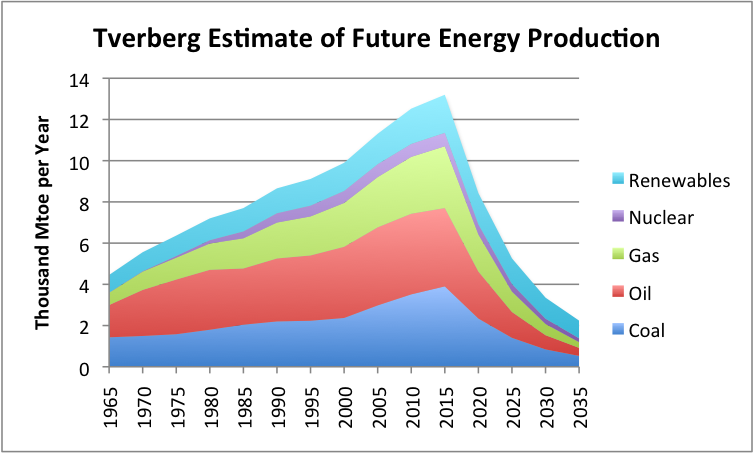
Gail Tverberg, the energy analyst with the best track record of predicting the future, says fossil energy production will be almost zero by 2035.

http://ourfiniteworld.com/2016/01/07/2016-oil-limits-and-the-end-of-the-debt-supercycle/

Figure 4. Estimate of future energy production by author. Historical data based on BP adjusted to IEA groupings.

Are these predictions a coincidence? Or do they have something to do with the earth’s carbon cycle and balance?

I don’t know but I suspect the dates are dependent on each other.

Maybe the answer can be found by looking at earth’s environment when fossil energy started to accumulate. Note to self: research this.

Kevin Anderson also says that in addition to stopping fossil energy use by 2035 we must draw down existing CO2. My understanding of the technologies is that this is not feasible and/or affordable. On the other hand, the decline in CO2 emissions may be faster than Anderson predicts due to the likelihood of a fast economic collapse that Anderson does not understand.

Will the inevitable collapse of civilization caused by fossil energy depletion occur in time to prevent runaway climate change?

Is this cause for hope or despair or both?

By Gail Zawacki: No Mercy (on trees)

It took me a while to read this. When Gail Zawacki writes on the global decline of trees it upsets me, a lot. I can live with the extinction of a frog or an insect, but not trees. I really like trees.

Gail here presents the latest science. It’s not pretty. And you probably won’t read about it anywhere else. But it’s important.

Gail also comments on how our scientific knowledge of the details continues to expand, yet our understanding of the whole, the system, the thing we should actually care about, is in decline.

I think about this a lot. We need more systems experts like Dana Meadows, rest in peace. All of our problems are systemic and complex.

http://witsendnj.blogspot.ca/2016/01/no-mercy.html

When I first started writing about trees drying around the globe, I was ridiculed and ostracized as being an hysteric.  Scientists and foresters unanimously told me I was imagining the symptoms of an alarming decline.  Merely pointing out the consequences to carbon storage was enough to antagonize virtually everyone from obscure peak oil preppers like John Michael Greer to prominent climatologists like Gavin Schmidt.  Mostly I was ignored by everyone from journalists like George Monbiot to the physicist blogger Joe Romm.

Now, however, the swathes of dead trees are too ubiquitous to deny.  The Ecological Society of Australia claims that “climate change is killing our trees”.  Science Magazine devoted their August issue to forests, which is summed up by one overview article as “Every forest biome on Earth is actively dying right now”.

Since it has become widely acknowledged that trees are threatened and dying prematurely, researchers persist in blaming drought.  One widely distributed study predicting that drought is going to cause massive tree mortality in the Southwest US bases it on the distant year of 2050, which is ludicrous since trees are demonstrably dying right now.  Another equally limited survey reveals that up to 58 million trees in California are estimated to have experienced water loss due to drought.  Unfortunately, that survey only looked back four years, to 2011 – had they bothered to look earlier, they would have found damage prior to the drought.

There is no question that megadroughts and higher temperatures will eventually kill forests.  Climate change is irreversible, and accelerating far too fast for trees to adapt.  However, they are dying ahead of predictions AND in places not in drought.  Indeed, trees dying from pollution are themselves contributing to drought.  Consider that researchers who predicted trees dying from pine beetle attacks would cause increased stream flow, found out the exact opposite has occurred.  And it has been established that ambient ozone reduces stream flow, as well, “…due to an enhanced water loss via the leaf pores.” – and nobody has any idea just how bad the combined effects of elevated ozone and enhanced nitrogen deposition from fertilizers and combustion will be.  But it’s not auspicious.

COP21 and Air Travel

Earlier I criticized the COP21 agreement for accomplishing nothing to reduce the climate change threat and for leading uninformed citizens to believe things are moving in a positive direction.

It gets worse. I just learned that COP21 does not require countries to reduce air travel.

Long distance travel is one of the most disgraceful things we do as humans. It consumes large quantities of non-renewable fossil energy and releases large quantities of CO2 for a discretionary luxury we call vacation.

Long distance travel is a relatively new phenomenon. Travel was rare or non-existent for most people in the 50’s, 60’s, 70’s and early 80’s. During this period the downslope of oil production and the threat of climate change were not in sight, yet we traveled very little, and were at least as happy as today. Hawaii might have been a once in a lifetime trip for a special occasion like a 25th anniversary.

Today the remaining expensive to extract oil is constraining growth which underlies our global economic problems, and climate change threatens the lives of our children, yet we travel more than ever. Most people think they are entitled to travel, and many link their happiness to a mega annual vacation.

It’s obscene.

I went to a climate change meeting of concerned citizens. I proposed we target the high schools to stop their current practice of flying the graduating class to some far away location each year. When I was in high school in the 70’s our big annual trip was to take a yellow school bus to the West Coast Trail and hike for 5 days. No one supported my proposal. “Our children have a right to travel”.

This issue is deep. I have immediate family and close friends that have some understanding of the unfolding climate change disaster yet refuse to change their lifestyles on something as simple and painless as stopping long distance travel.

This behavior might be understandable if they have rationally concluded that climate change is unstoppable and will cause human extinction regardless of what we do, which by the way is quite possibly true, however I don’t think these people have given up.

They just don’t want to make any meaningful sacrifices.
By RE: Descent to Darkness: 2015 Collapse in Words & Pictures

“2015 was a banner year for doom” – RE @ Doomstead Diner”

This is one of RE’s best rants.

Lots of depth and breadth plus his usual acidic humor.

By Robert Marston Fanney: Top Scientists Declare Links Between Extreme Weather and Climate Change

“Andy Lee Robinson said it all-too-well — “El Nino + Climate Change = El Diablo.”
And as the Washington Post so cogently notes — the world is now experiencing a rash of Freakish Weather from the North Pole to South America. It’s what appears to be happening as these two major record weather makers fire off simultaneously. A grim tally that includes the highest river levels ever seen in Missouri, the worst floods England has seen since the Middle Ages, the first time the North Pole has seen significantly above freezing temperatures during Winter in modern record keeping, city and region-crippling droughts spanning Central and South America, and seemingly everywhere, but especially in the North Atlantic where Greenland melt outflow has backed up the Gulf Stream, storms that seem to laugh in the face of our weather history.”

By George Mobus: Celebrating the Darkness of Winter Solstice

George Mobus writes less frequently these days but still has good insights.

“So is this what a global civilization collapse looks like? Or am I the only one who sees the world crumbling at a seemingly accelerating rate? I am open to the possibility that I am suffering from confirmation bias since I have been a commentator on this subject for many years now. But as I continue to survey the dynamics of things like the refugee crises, the growing spread of terrorist acts, and American politics, among others, I am more convinced than ever that we are sliding into a serious decline of civilization on a global scale.”

Coincidence or Expected?

Is it coincidence or expected that we are simultaneously facing:

  1. economic collapse
  2. peak oil
  3. runaway climate change

And yet everything appears sort of normal, if you close one eye and squint.

I think it’s to be expected:

  • wealth is proportional to energy consumption
  • wealth growth is facilitated by debt
  • debt requires economic growth
  • economic growth requires increasing energy consumption
  • most energy useful for creating wealth is non-renewable
  • non-renewable means finite
  • the use of anything finite must eventually peak and decline
  • more debt can delay the onset of finite resource decline
  • energy consumption releases CO2
  • CO2 causes temperature rise
  • temperature rise triggers many self-reinforcing feedback loops
  • many self-reinforcing feedback loops acting together cause runaway climate change
  • declining energy causes economic contraction
  • climate change causes economic contraction
  • more debt can temporarily mask economic contraction
  • low interest rates can temporarily make more debt affordable
  • debt growth must eventually stop when it saturates the system
  • economic contraction with high levels of debt causes collapse
  • denial prevents most people from seeing or acting on any of the above
  • forces build until they overwhelm the herd’s faithThen something snaps.

COP21: Doubling Down on Denial

What have we done to date?

  • We set a goal to limit temperature rise to 2 degrees, despite it being clear that the current 1 degree rise is already unsafe.
  • We did absolutely nothing to achieve the goal; we didn’t even try.
  • We emitted enough CO2 to guarantee at least 2 degrees, even if we stopped all emissions today.
  • No one knows for sure, but we may have already triggered self-reinforcing feedback loops that will increase the temperature by a civilization killing 4-6 degrees; the point being that time is of the essence.

What should we have done at COP21?

  • We should have acknowledged the severity of our predicament.
  • We should have discussed the relationship between wealth and climate change; namely that wealth is proportional to energy consumption, CO2 emissions are proportional to energy consumption, and temperature is proportional to accumulated CO2; therefore to mitigate climate change we must reduce our total wealth.
  • We should have discussed the differences between fossil energy and renewable energy, and why the latter do not have the density, quality, or scale to run our advanced civilization.
  • We should have discussed the depletion of fossil energy and why aggressive conservation now would be a really good idea for both climate change and world peace.
  • We should have acknowledged that there are no easy solutions but lifestyle changes to focus on needs rather than wants, and population reduction policies would help.
  • We should have acknowledged that rich people and countries will have to reduce consumption much more than the poor if we want to maintain peace.
  • We should have acknowledged the good news that most people in developed countries have much more than they need to have a comfortable life.
  • We should have explained all of this to the citizens of the world and asked for their cooperation.

What did we actually do at COP21?

  • We changed the already impossible goal of 2 degrees to a more impossible goal of 1.5 degrees, thus grossly misleading the citizens of the world that our leaders are doing something useful.
  • We took no actions that will reduce CO2 emissions.
  • We made the situation worse by emitting tons of CO2 to fly 40,000 people to Paris to achieve nothing, and set a bad example in the process.
  • In summary, we doubled down on denial, instead of having an adult conversation.