By Charles: Doomers’ Visions of the Future

Today’s guest post by Charles is an excellent primer on the diversity of beliefs held by many of the best minds that think about our overshoot predicament. Charles wisely reminds us that no one knows what the future will bring.

Charles recounts his journey of increasing awareness that led to depression and despair, followed by an awakening of acceptance and constructive action, that has provided him with some peace and happiness.

It’s funny how I (we?) construct incorrect mental images of people we meet on the web. I imagined Charles to be an elderly retired reclusive spiritual philosopher, not a middle-aged top-tier software developer with a deep scholarly interest in human overshoot, and an impressive sustainable food growing sideline.

Charles concludes by asking readers to share their own visions of the future. If you have something to say that deserves more than a comment, please contact me about posting a guest essay.

P.S. I believe Charles now holds the doomosphere record for the most links in a single essay.

The idea for this post originates from an exchange with fellow doomer davelysak who states:

I foresee, based on various portents, an extreme human population crash in the relatively (10 – 50 years? Maybe sooner?) near future.

and later adds the precision that

I’ll be surprised if there are more than 2 billion people alive on earth in 20 years.

This made me reflect about my own anticipation for the future, even more crucially, the way I communicate it to others. Or rather as a matter of fact, don’t so much anymore. Like Cassandra, I have come to understand that I find myself psychologically between a rock and a hard place: I foresee a future of extreme hardships which I do not particularly desire. Worst, I have long felt compelled to share my projections, driven by the naive impulse to initiate collective preemptive action. However, torn apart between the pride of intellectual rigor, my ideal not to harm others and increasingly aggressive or irrational reception of the message, I have slowly learned to repress myself, not to voice my concerns and conform to the group. After all, even Cassandra brought ill fate to herself. (It turns out my strategy is no solution, as the rage is turned inside and builds up, but that could be a story for another day.)

Hopefully, our host, Rob provides a safe haven to any doomer who wishes to bravely face the crude, unadulterated nature of our predicament.

As doomers, we share a myth, the myth of collapse. In a nutshell, it unfolds, as I understand it, as follows:

  • The old age of material opulence is about to end, as current trends can not continue for long.
  • A world-scale crisis has been brewing for quite some time; it is about to burst.
  • After it eventually recedes, once balance is somewhat restored, a new normalcy, a new age will be revealed (that part of the myth is optional).

Funnily, if we refer to Kurt Vonnegut’s shapes of stories it falls somewhere between the shapes Old Testament and New Testament.

And many false prophets shall rise

Lurking for a quarter of a century in the doomosphere has taught me visions of the future, even among doomers, may vary tremendously. The stroll through the exhibit of studies can go on for hours, ranging from loss of material affluence (Richard Duncan’s Olduvai theory) to complete life wipe-out (James Hansen’s Venus Syndrome), with population collapse (Club of Rome’s limits to growth) and near term human extinction as middle-grounds (I guess).

The fall is seen as either rapid and brutal as in Hugo Bardi’s Seneca cliff, or manageable as in John Michael Greer’s catabolic collapse. Even our preferences and values differ: some like Jack Alpert’s sustainable modern civilization of 70 million wish to preserve the current living arrangements trading population level, on the contrary, primitivists such as Derrick Jensen do not equate humans with Homo Industrialis and impatiently wait for the machine to (be) stop(ped). There are even some fringe organizations advocating voluntary human extinction and euthanasia, while most would just like to manage degrowth. (To be fair, the church of euthanasia’s ultimate goal is species awareness.)

Model after study after analysis after opinion piece paint different aspects and outcomes of the fall. Some radically scarier than others.

My personal journey through doom

What then do we really expect, fear and hope? At first I had planned to cold-heartedly present the scenarios I found most probable and then invite you to share your own prospects. But, given the heavy emotional load that the subject carries, I somewhat changed my mind: after all we are discussing the possibility of not only material losses but the widespread increase in suffering, deaths, extinction of the living world. At the very least, our cultural identity is at stake. So I’d like to add a personal twist and narrate how my understanding of the future evolved during my personal journey.

I was born in 1978 in the then extremely affluent and sophisticated country of France (WesternCiv). I was inculcated with the idealism of my time and place which originates from the Age of Enlightenment: triumph of reason, humanism, universalism, materialism, progress and atheism. Even though I had a really hard time learning the fundamental necessary last piece allowing anyone to function in an ideal world (hypocrisy), it was indeed the best of all possible worlds.

At 6, I was profoundly marked by Chernobyl. I remember the haunting masks of the liquidators, courageously shoveling the entrails of the angry machine, promised a certain death as a reward for saving our, my lives; and the helicopters hauling sand; and then the oddly reassuring claims from my country statesmen about the spread of the cloud. A first encounter with official doublespeak?

As a city boy living on the 6th floor of a modern building, I grew up a book-worm. Books offered countless windows into exciting realms out of the deprived environment of a sanitized flat. In particular, I vividly remember feeling a strong emotional bond with Hans Christian Andersen’s fairy tale Five Peas from a Pod. Was it a hint, a reverberation from a destined future of my deep yet unacknowledged nature? More were to follow. At a relatively young age, I watched the extremely violent Japanese TV series Fist of the North Star (right-minded censorship hadn’t caught up yet). A brilliant blend between the universes of Mad Max and Bruce Lee, it depicts a brutal post-apocalyptic world set in barren landscapes and desolated ruins. This time around the call of agonizing farmer Smith to plant rice seeds for tomorrow particularly resonated (captions are read from right to left).

I later read Asimov’s Foundation series and Hermann Hesse’s Siddhartha.

I was faintly aware of the environmental crisis, in particular climate change as a life changing but slow process with only distant impacts. Shortly before the new millennium I stumbled upon information which blew my comfortable world view. It was Colin Campbell explaining depletion and predicting peak oil.

At that point, I was convinced global population would have to come down during my lifetime and challenging times were ahead. I thought it would still be manageable, spanning through the coming century from the current population of 6 billion back to pre-industrial levels between roughly 1 and 2 billion (respective estimates of the population around 1800 and 1930).

I was a rational realist, not buying into modern human exceptionalism which asserts we can achieve higher agriculture yields than our predecessors with fewer resources on an environmentally degraded planet. Even though the greatest shortcoming of the human race is our inability to understand the exponential function in a Tragedy of the Commons, I had faith humanity would soon change its ways: it was just a matter of spreading the crucial piece of information about resource depletion widely enough. After all, there were already some men of good will, such as Jason Bradford, taking action. In South Korea, I had just met the love of my life, some years later we married. We were fruitful. Our daughter Rachel, as an homage to Rachel Carson, was born in 2007. Determined to carry my load in curbing population growth, I convinced my wife to stop multiplying at one.

I was to be punched in the face again. It was 2012. A somewhat egocentric professor was sternly announcing near term human extinction (this is most probably the presentation by Guy McPherson I watched at that time). The future was sealed. I was now standing on the edge of a steep final cliff. For me, it was the start of a very dark period. You know that kind of aftertaste which lingers a while after watching a documentary such as the Island of Flowers.

Except everyday, as a background of everything else. I couldn’t help but feel hopeless for my then 5 years old daughter. The key notions were feedback loops (for instance methane according to sad Nathalia Shakhova) and tipping points.

Evidence accumulated from every side. State of the ocean: apocalyptical; ice: disappearing; trees: under assault; soils: eroding. It was suddenly the 6th (or was it already the 7th) mass extinction. I quit flying (for what that is worth, there surely is, unfortunately, a substitution of demand paradox similar to Jevons?).

Having thoroughly assimilated this new data, two years later, I wrote a dense blog entry to get it off my chest. I reviewed my script: I was now expecting 1 billion humans by 2040 and extinction at the end of the century. News still got worse. Moving goalposts, shifting baselines and worse than predicted by the model were the expressions of the days.

Homo Sapiens’ response was to pretend all was safe. The manufacture of consent, merchants of doubts had it easy with a general public all too eager to keep on basking in comforting denial.

Kevin Anderson exposed the half-truths of even a supposedly rigorous official body, the IPCC, about non-existing negative emissions technologies included in their models. The remaining carbon budget was already getting slim and the task to turn this ship around incommensurable.

I took Wing Chun classes (even though I was not sparring with these ladies) and practiced like an addict would inject heroin.

Primitivism (Derrick Jensen, Deep Green Resistance, Daniel Quinn’s Ishmael) convinced me our fate was sealed a long time ago, when we forked into the original sin. Attempts to heal (Carolyn Baker, Joanna Macy, Charles Eisenstein) back into the lost Eden did not cheer me up. Resistance seemed futile (Underminers, Sea Shepherd). Everything was a lie, a fraud, and the living world was collapsing.

I felt increasingly ashamed and guilty for being part of this holocaust of a new kind (let’s not mince words, this is un-Denial after all 😉 ). Only this depressed collapsitarian on his boulder brightened me up, at least for his accent and hat. I considered taking ‘shrooms to communicate with the spirit of the Earth.

Meanwhile, unbeknownst to me, an ordinary miracle was happening on my very own balcony. For no real reason, I had installed a large clay pot and was everyday discarding some food waste. It was fun watching soil building. 7 years later I harvested 3 peaches on a small tree that had grown on its own out of a minimal daily routine. It died the next year, but had shown me a way forward.

I went back to my bookcase to dust off Fukuoka’s One-Straw Revolution. I had read it at 20, but as a conformist computer scientist did not know how to respond to the strong appeal it had on me already at that time. I bought all translated Fukuoka’s books and Larry Korn’s excellent clarifications (for a western mind that is).

Haunted by images from The Burmese Harp, I stopped Wing Chun one year just before covid struck. I lived this surreal period as a blue pill/red pill moment: do we still put our faith into an authoritative centralized science, absolved from any personal implication and effort, or do we fend for ourselves and look for other ways. Although, it was a slow grind, a long arm wrestling, I felt the price of resistance turned out surprisingly not to be very high: give up on restaurants and movies mostly. I have to admit I am proud I was able to withstand (especially for my daughter’s sake) peer pressure and the manipulative wannabee bully Emmanuel Macron we have as president, a corporate valet, if anything.

I enrolled in the local community gardens and bought a small piece of land in the country side to plant a resilient edible forest garden. I started at ground zero: the previous rectilinear poplar plantation was clear cut just before the sale (in modern mindset no profit is too small).

I don’t really worry about the future anymore. After all, if we let her be, life unveils tremendous amounts of strength and resilience. Humanity does not deserve only contempt. I’ve found many people to admire and approaches to follow.

Masanobu Fukuoka’s natural farming:

Ernst Götsch’s syntropic agriculture:

Joseph Lofthouse’s landrace gardening:

I learned acceptance of what I can not control: other people’s behavior, preferences and own internal limitations. I learned the importance of doing small things at my pace, my scale, everyday. I unlearned duality (that’s another story).

Current thoughts about the future

In the span of 25 years, my outlook on the future changed three times. Today, I am not even sure were we really stand. In Vonnegut typology, rather than the classical doomer’s narration, I now find myself in the “Which way is up” shape of story. In this section I will outline my current personal view and preferred outcome.

Although, nothing can completely be excluded, I don’t believe the planet will either go Venus nor abiotic. I do not believe the human species will be extinct by the end of the century. I do not believe we will escape to the stars onboard metallic ships. We may nuke ourselves out of existence, but it is in nobody’s interest. We may experience multiple severe nuclear power plant accidents. But maybe scarcity of nuclear fuel will compel us to progressively shut them down before. In the longer term, the human species could even survive the ongoing extinction event.

As depicted by Joseph Tainter for prior civilizations, ours chose a similar path of increased complexity. Following this strategy, it has cornered itself: in my country almost every service has been converted into an “app” or is in the process of doing so. Thus creating the biggest single point of failure: all this convenience relies on the continued operation of the grid, data centers, the network, chips, long supply chain, rare minerals, etc.

To me, a Seneca cliff scenario is unavoidable and guarantees rapid material loss. We will lose our technological gadgets and crutches. Our machines will stop, thirsty. Pollution will be reduced and assimilated by the organic world. We won’t do much about it other than pretend.

Will there be a population crash or a graceful decline? Will the planet temperature stabilize at a livable level? What will the ultimate stable population be? I don’t know.

Our current ways impact the web of life brutally. I will really be surprised if the planet sustains more than 2 billion people for long. Biomass tonnage of mammals gives an idea of the scales at play:
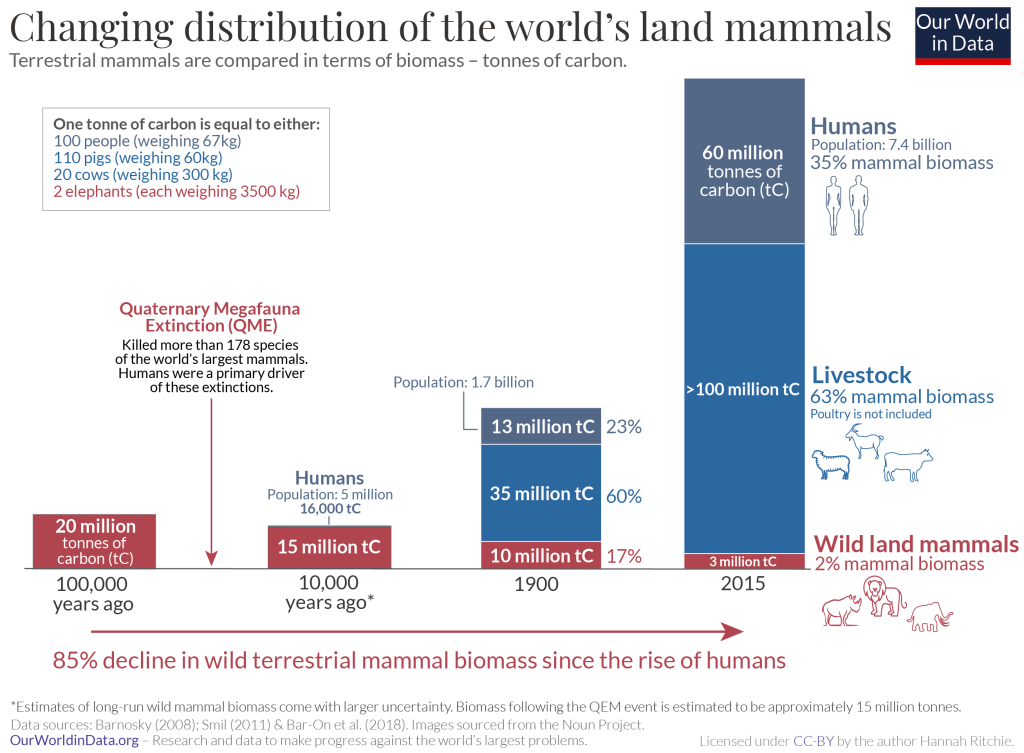
I expect a crash in the following 2 to 3 decades. Eyeballing the world population age pyramid, if we had to achieve this four-fold reduction tomorrow in a “fair” way, then all males above 30 years of age should go soylent green (females are given 5 more years). For long term survival wouldn’t this be preferable to a slow long agony? This won’t be said out-loud. So I won’t go further on that path.

A call to inaction

Fortunately, there could still be room left to maneuver. Fuel could be rationed for food usages. The population could spread out, reducing the need for transportation and providing labor for agriculture. Degraded land could be regenerated, deserts converted to forests, cereal fields hybridized into agroforestry, or converted to orchards or edible forests as once was the case in Europe.

There are some success stories (propaganda of our times, maybe) all around the world.

China:

Saudi Arabia:

India:

Africa:

New Zealand:

USA:

Agriculture from the green revolution is productive (given external fossil fuels), but soulless, dumb and destructive: the philosophy at work in every step (delineating plots, tilling, applying pesticides and herbicides, irrigating) is that of control, rendering the soil inert, blocking the natural flow of life. The idea, disconnected from reality, is to make agri-culture an industrial process so that outputs can be maximized following a known function of inputs.

Life is not inert, its potential surpasses anything we can fathom. A miracle akin to the one that happened on my balcony could be made possible on the large scale. We don’t (and I believe never will) understand the whole system.

The theory of the biotic pump gives us a glimpse into the full extent of its processes at the planetary level:

I cannot recommend this presentation by Anastassia M. Makarieva enough:

Accompanying slides:

Large forests work like a planetary air conditioning system: pumping water from the ocean and circulating it across the continent, cooling temperatures, releasing heat above the layer of greenhouse gases directly into space.

Soil could be restored while at the same time cooling the climate.

I accept this may well be sophisticated denial on my side. But why not try?

Conclusion

I agree with Guy McPherson when he states everybody in the industrialized world was born into captivity. But that’s primarily a mental prison we can break out of. So far this culture has lived by the motto divide and conquer, waging war on every side, engrossed in the illusion of control. The fire has grown to the point it has now become a matter of life and death.

Course must be changed. It is not even that hard. All it requires is some generosity: stop the aggression towards the planetary organism which shelters us all, let forests grow absolutely everywhere. Feed ourselves, heal and replenish life at the same time. Tend to be taken care of.

This, to me, is the concrete meaning of love: the cycle of co-dependence illustrated by Yggdrasil, the tree of life surrounded by the eternal snake Ouroboros.
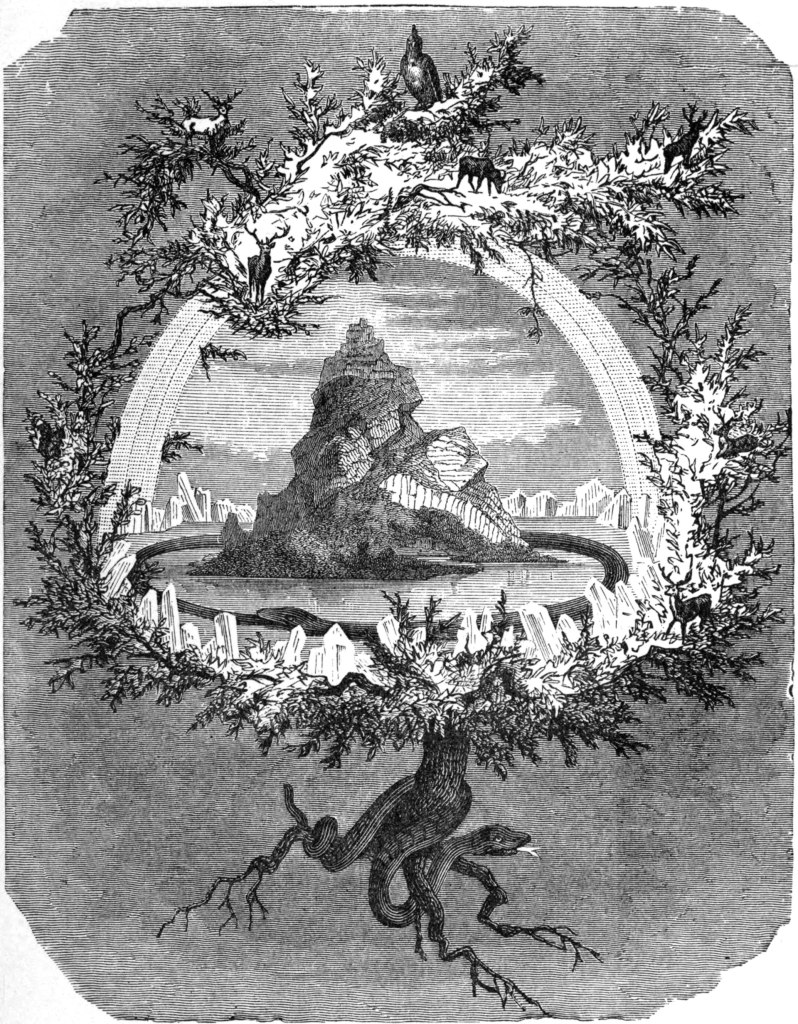
In any case, this is the path I have chosen for myself, regardless of the circumstances, and my proposition for mutually assured survival.

Your turn

Thank you for reading. At least, I hope this post was somewhat entertaining. Please let me know what your own visions, hopes and propositions for the future are. I love to be surprised.


The Mortal Atheist on Varki’s MORT

Thanks to Dr. Ajit Varki for making me aware of this blog by the Mortal Atheist.

It’s vanishingly rare to find anyone that writes about Varki’s MORT theory and that understands that broad awareness of the theory is the only viable path to mitigating the consequences of human overshoot and preserving some of our best accomplishments.

I mostly agree with what the author says except the final sentence:

Who should read this book? Fans of Terror Management Theory and Ernest Becker.

I would change this conclusion to:

Who should read this book? Every person on the planet who is working to shift our species to a more sustainable path because all of your efforts are failing and will continue to fail until we confront MORT.

https://www.themortalatheist.com/blog/denial-varki-and-brower

OVERVIEW

Here’s a novel thought: what if we owe the incredible super-intelligence of our species to our ability to deny death? Years ago, researcher Danny Brower shared this thought with Ajit Varki during a chance encounter. When Varki reached back out years later, having never forgotten the conversation, he was shocked to discover Brower had died. But Brower had left behind a draft manuscript detailing his theory, what he called “Mind over Reality:” that Homo sapiens was the only species ever to develop a super-intelligence because we were the only species ever to cross the enormous evolutionary barrier of reality denial. Varki took up the manuscript, finished and published the book: Denial: Self-Deception, False Beliefs, and the Origins of the Human Mind

The barrier of denial

Why is it that only humans are able to carry out so many special mental functions that seem missing from all other highly intelligent species, some of which have been around for millions of years longer than we have?” This curiosity fascinated Brower. Why was Homo sapiens the only species ever to become really, really smart? Especially when being this smart has made us the most successful species on the planet. Surely hyperintelligence is an evolutionary boon that should have emerged more than once. But it didn’t, not even in other hominid species or chimpanzees, our closest living relatives.

The first barrier in getting smart is a rare convergence of several biological and environmental factors. Varki identifies many: the species must be highly social but also long-lived, have a stable body temperature (to maintain the metabolism necessary to reliably feed the brain), and be born very early, undergoing extreme postnatal development. So, getting smart was a significant biological barrier. But there are many other social mammals (and some birds) that meet these criteria… why didn’t natural selection and evolution act on their brains in the same way? There’s lots of genetic variation to work with, and the vertebrate organization of brains was established hundreds of millions of years ago. So where are all the other super-intelligent creatures? The crux of Brower’s “Mind over Reality” theory was that there was an additional, almost insurmountable psychological evolutionary barrier, which is the focus of this book. It states: only if a species develops full awareness and higher intelligence while simultaneously developing an ability to deny its own mortality, would it reap any benefits. Otherwise, intelligence and self-awareness would be a negative fitness event.

Let’s examine why. When we speak of a “full awareness” or “higher intelligence,” what we mean is a fully developed theory of mind – the cognitive wiring that allows us to imagine the minds of others. Several other species are self-aware, and some probably possess rudimentary theory of mind (like a green monkey that can deceive another monkey into abandoning its banana hoard). But no species other than Homo sapiens possesses a full theory of mind that allows it to extend itself into the past and future, develop judicial systems, spin fantasies, create religion, torture, or play organized sports. No, for this you need a full and complete understanding of the minds of others. Brower argued that the critical boundary that kept other species out was that the benefits of a full theory of mind could not be realized unless it was simultaneously accompanied by an ability to deny mortality. Consider this, you are an early hominid who is self-aware and now possesses an awareness of others as independent agents. Then, someone in your group dies. You’re smart enough to deduce that this means you will die… but the threat of death is unavoidable – you are now under constant predation from your own intelligence. The anxiety you feel would be inescapable and totally bewildering. You probably wouldn’t have a lot of sex or be terribly interested in challenging the group leader for dominance (after all, you could die! I must admit, it’s morbidly amusing to imagine some lone hominid a hundred thousand years ago, staring up at the sky and feeling the crush of existential dread… the world’s first nihilist). But now imagine that you develop a full theory of mind and the ability to subconsciously suppress your mortality salience… well, now you’re cooking. How much better would you be at understanding your fellow humans, perhaps manipulating them… how much better at finding mates and achieving higher status within the group? But only if you can forget about the fact that you’re marching inexorably toward annihilation. Our most astonishing and critical accomplishment, the authors argue, was not a biological leap but a psychological one: ignorance. 

Why deny death when you can deny everything?

It’s possible that death denial arose from the loss of several neural mechanisms, giving rise to the capability to deny reality wholescale. After all, there’s plenty of evidence to suggest Homo sapiens is incredibly adept at ignoring reality. Consider our disposition toward optimism, which is often irrational (as explored in Tali Sharot’s “The Optimism Bias”), or the fact that we smoke, eat sugary foods, and continue having children (even though childbirth is excruciating and dangerous). We jaywalk, gamble, text while driving, drive without seatbelts (drive at all), forgo writing wills or getting life insurance, follow silly superstitions, and buy homes on the Florida coast or along fault lines. And, of course, there’s religion – a denial of death if there ever was one. But so too is our desire for ultimate meaning illogical – the desire to believe we were put here for a purpose.

“. . .the alternative – that there is no meaning, no scheme – also implies that there is nothing after death. The deep anxiety and depression generated by this latter conclusion has kept mankind searching for the meaning of life for thousands of years and will continue to do so for the foreseeable future. . . This reality denial at a deep level of our being is essentially universal, and is a fundamental quality of being human.” 

But the most striking evidence of our reality denial still boils down to this:

“. . .you are nothing more than a sort of synthetic “hologram” composed of subatomic particles that originated from the Big Bang, which, when brought together in a particular combination, generated a brain, mind, and a conscious state – which in turn give you the introspection that allows you to read this book and understand it for the very, very, very brief space of time that you are alive. Why is it that despite understanding how absolutely, totally, and completely trivial you are in the enormity of this cosmic reality you can step out every day and act as if the universe is your oyster? Why are you not terrified and depressed by the fact that you are just the tiniest little transient blip in this enormous reality of time and space?”

The answer is: because your ancestors had the rare cognitive quirk of holding false beliefs and ignoring inconvenient truths. (I do appreciate the loveliness of this paradox: that science, our most rational endeavour, may reveal that we’re the most irrational species to ever exist… but that it’s this irrationality that allowed us to get so smart. It’s perfect, really).  

Pros and cons

There are several benefits, obviously, to our denial (you mean aside from being self-aware without crippling existential anxiety at every waking turn?). Optimism and overconfidence can be nice… we’ve crossed oceans in shaky vessels, launched ourselves into space, and jumped off cliffs in primitive flying contraptions. Surely no rational being would partake in these misadventures. Bravery and courage can be marvelous, though they are often reality denial too. Becoming immersed in a movie or video game often means suspending belief for a short while. Even being able to shut out reality to get in “the zone” during a challenging physical or mental task is beneficial. But there are consequences. Our ability to ignore climate change or launch nuclear war is one. Our willingness to follow cult leaders into oblivion or dictators into genocide and crusades seems another. Varki even muses: “the fundamental forces that got us to this dilemma might be valid for any planet that harbors intelligent life.” That perhaps the reason we’ve seen no evidence of other intelligent intergalactic species is because the solution to the theory of mind barrier, reality denial, “ensures that no civilization of intelligent species will persist long enough to master long-distance space travel. . .” Even better:  “. . . it is arguable that we are destined ultimately to destroy ourselves as a species – or, at the very least, to continue to cycle between well-developed civilization and catastrophic collapse, never reaching a technological state much beyond what we currently enjoy.”

 Oh my gosh, how deliciously pessimistic.  

 WHAT NOW? (actions for mortal atheists)

For these reasons, it’s probably essential that we recognize reality denial as a fundamental part of our nature. And maybe by understanding this subconscious hardwiring we can consciously change what may otherwise lead us to extinction-level catastrophe. To fight addiction, you must acknowledge you’re an addict. To fight denial, you must acknowledge its instinctiveness. We can’t get rid of this reality denial, but we can recognize it “and manage its pathological consequences.” Otherwise, we might just deny ourselves into extinction.


IN SUM:

Is this book entirely secular? No.

If I had to describe the book in one sentence? We owe our hyperintelligence to our ability to deny death and ignore inconvenient truths.

Who should read this book? Fans of Terror Management Theory and Ernest Becker.

By marromai: Energy, economy and the role of money

There was a nice surprise in my inbox this morning.

Marromai, a frequent visitor from Germany, having tired of seeing the same un-Denial post for 10 weeks, wrote an excellent essay to freshen things up. Thank you.

See also another essay by marromai here.

We all use and need money every day and would often like to have more of it. The vast majority of people don’t really understand what money actually is. Many think it is a medium of exchange that was invented at some point to facilitate commerce – which couldn’t be more wrong.

Readers of this and similar websites at least know that it must be more than that, and that money is connected to energy in some way. Naked Emperor summed this up the other day with a reference to Dr. Tim Morgan’s Surplus Energy Economics:

Dr. Morgan believes that there are two parallel economies. One is “the underlying ‘real’ or physical economy of products and services” and the other is a “financial economy of money and credit.” “Money has no intrinsic value, but possesses value only in relation to the material things for which it can be exchanged.”

https://nakedemperor.substack.com/p/the-everything-bubble-the-end-of

His article somehow anticipates the conclusion of this essay and describes very well why the divergence between ever-expanding, artificially inflated finance and shrinking real economy will soon lead to a pretty big bang. But an interesting point for me – and maybe for you too? – is how did our financial system emerge in the first place? What exactly is money and how did it become a proxy for energy?

I will try to describe that below, also to better understand it myself – feel free to ask questions or write your critique in the comments. My findings, which I try to summarize in my own words, come mainly from “Ein Buch für Keinen” (A Book for None) by Stefan Gruber which in turn is based on an economic theory called “Debitism” according to German economist Paul C. Martin.

In advance, we must be clear that all life forms known to us are dissipative systems. Every living being is condemned to accumulate energy to maintain itself, irreversibly increasing its complexity and thus entropy. If it cannot collect more energy than its body needs to sustain itself, it dies. A simple basic equation: life requires energy. This is the primordial debt that every living thing owes itself and that it must pay off if it does not want to perish. The crucial thing is that this debt must be paid in time (hunger) to escape the sanction (death). If food (energy) was always and everywhere available, this would be an insignificant automatic action. Only the pressure of a deadline in combination with scarcity and effort to procure measures a value to the debt. This definition will be important later.

Now let’s look at mankind, which for a long time lived in nomadic hunter-gatherer groups and more or less unconsciously paid off its primordial debt, like all other animals. At some point in history, due to external pressures such as depleted hunting grounds or changing climatic conditions, it transitioned to both nomadic pastoral tribes, which learned to raise animals and move with them when a region was grazed off, and permanently sedentary, arable land societies. Tribal societies don’t know or use money, since they produce everything they need on their own and share it among each other. This is called a subsistence economy.

An arable tribe has the great disadvantage of no longer being regionally flexible – its sedentariness was a weakness that made it vulnerable to raids by nomadic pastoral tribes who could rob its earned and stored supplies (stored energy to pay the primordial debt). However, the predatory pastoral tribes soon discovered that a peasant tribe could be raided and wiped out only once. But if it is “offered protection” from other nomads in return for a tribute in the form of the food it produces, this is to the advantage of both (more to the advantage of the herdsmen than the farmers, of course). The shepherd tribe arises as guardians and rulers over the peasants (“The Lord is my shepherd”), promising protection and demanding tributes in return to maintain and expand their power.

Only after the ruler specified the levy, which had to be paid on a date, this levy became a commodity in demand and thus money. And it became the yardstick for the valuation of all other goods. The levy, i.e. money, was a commodity and with this commodity the debt to the authorities was repaid.

The first taxes were paid in kind, e.g. grain (energy to service the original debt) – later, when empires and complexity grew, they were put in parity with silver for the sake of simplicity (e.g. 180 barley grains = 1 shekel of silver in Mesopotamia). After that, weapons metal, i.e. copper, tin and later iron were declared to be levies. Also gold counted at first as weapon metal, because it was easy to work. Whether money is in kind, or metal to produce weapons, or today’s colorfully printed paper slips, is completely irrelevant. Money is, what is defined as levy by the ruling power. It does not need to have an intrinsic value.

The decisive factor for the emergence of money was therefore the simultaneous emergence of a power cycle: the levy could be used to buy mercenaries to maintain power. The mercenaries exchanged the levy for goods and services from the population. The people in turn were able to pay tribute to the ruler, which further strengthened the ruler’s power. But the ruling power had the problem of having to make expenditures in advance. Naturally, it tries to recover this deficit with the demanded levies, whereby it has to expand and increase its power. Whereupon it needs more levies to maintain itself – maybe that looks familiar to you? (A dissipative system)

Since not everyone was always able to produce the required amount of levy goods by the deadline, the subjects were forced to trade among themselves – thus division of labor and specialization developed. While some focused on the cultivation of food, others produced tools for the peasants or weapons for the rulers, for which they received the coveted levy in return, in order to pay off their debt to the ruler. Those who had no other option had to offer their labor (debt bondage, day laborers,…). Individuals in an economy based on the division of labor are practically forced to conclude contracts with others or to fulfil these contracts in order to obtain the required levy and to survive.

By the way, the invention of writing is – not as some people think – due to the preservation of knowledge – but to bookkeeping, as Babylonian cuneiform writings prove. It was a system for documenting the taxes already paid by the subjects. On small clay tablets it was recorded who had paid what amount of tax, which then was used instead of the levy itself – an early form of money without intrinsic value.

The ruler is ultimately the owner of his realm, which is the area he can protect and demarcate from others by force of arms. But he can cede his property, i.e. share it, by granting the subjects the right to private property and defending it against opponents with his military power. The subject can manage the property guaranteed to him by the ruler and trade with it and its proceeds to be able to pay the tribute. And, very important, he can lend on his property to obtain credit. However, if he remains in debt, the subordinate is punished, or his property is foreclosed.

Those who submit and agree to the rules (forcibly set by the ruler) to maintain the status quo are part of that state(!). Those who do not want to belong are left to their own devices without any rights and were thus doomed to death in the past – today statelessness is no longer even conceivable.

The described processes of the emergence of states, money and economy were the initial sparks for today’s global trade economy, which is still based on the assurance of property by the central powers. We see that state, property, money and economy form an indissoluble mesh and a state is always based on the exercise of power and the compulsion to pay a levy. A state can therefore never be based on voluntariness of all participants. Today, more than ever, it is clearly visible that the state apparatus must inevitably become ever larger and more inefficient and, in the final analysis, serves only self-preservation and not its inhabitants. Like any dissipative system, it will vanish someday – this is by the way, the reason why there are so many collapsed civilizations in history and ours will be no exception.

But the trigger for the economic dynamics in a ruling system – from the destruction of a moneyless solidarity community to a highly specialized society based on the division of labor with compulsory trade and individual liability – is solely the pressure to pay the levy to the state on time. The means to pay off this tax debt is money. Money therefore always documents a debt. First, the tax debt to the rulers and, building on this, the contract debt between private individuals. So money is only a debt repayment vehicle. If money exists, a debt must exist at the same time, which can be erased with this money. Money receives its value only by the underlying debt contract, it cannot have an “intrinsic value” detached from a terminally fixed debt.

With this description, the definition of money is suddenly very clear:

Money (usually uncountable, plural monies or moneys): A legally or socially binding conceptual contract of entitlement to wealth, void of intrinsic value, payable for all debts and taxes, and regulated in supply.

Here we close our circle to the primordial debt mentioned above. Only the obligation to surrender a commodity earned by performance to the state at the deadline in order to escape a sanction defines money and gives it a value. Without a deadline there would be no reason to generate money, and without scarcity at the deadline, it would be worthless. It must always be earned first by doing work. Money is a debt, which has to be repaid at a certain point in the future by doing work before that time has come.

To do work means energy must flow. As power is a measure of energy per unit of time, money is therefore actually a measure of power and thus more directly linked to energy than most people can imagine. So, it is absolutely true that energy drives the economy. How fortunate that we discovered fossil fuels, developed combustion engines, etc., to accelerate economic activity, technological progress, and trade exponentially. Fossil energy made our economy grow fast and big.

Our credit-based finance system made it possible to create money which is solely based on the promise to perform work, in order to be able to take advantage of it immediately or to start new economic activity with it. When the modern world started to decouple the financial system from the real economy, the problems began. And this is where it gets ugly: In order to provide the promised future work, energy will be needed. But because far too much credit was granted without taking into account the energy that will actually be available, a Ponzi scheme was kicked off with nothing but empty promises on future energy. The worldwide fantasy amounts of money are no longer matched by any economic output that can be provided in realistic terms – financial collapse is pre-programmed and with it collapses any economic activity driven by energy. At present, attempts are being made to conceal and delay this by all means.

We have bought with lazy money a claim on future energy and have already squandered everything today. When the fossil energy is depleted we will be left with much worthless money.

Our dissipative system aka “modern civilization” will soon not be able to pay off its primordial debt.

I hope that when the world ends, I can breathe a sigh of relief because there will be so much to look forward to.1

P.S. Since we have seen that every state, economy and money are based on oppression and force, all possible future states will be no exception. I see a backfall to small tribal solidary communities as the most promising concept for humanity to survive the coming hardship.

1From “Ein Buch für Keinen” (A book for no one) by Stefan Gruber. The bible of nihilism: How economic, ideological, social, biological and physical systems emerge and why they are doomed to fail. I would recommend this as a must read, but unfortunately, this masterpiece is only available in German.

By Ajit Varki: Why Men Are Destroying the Planet (Planet: Critical Interview)

Dr. Ajit Varki is a co-originator of the Mind Over Reality Transition (MORT) theory which explains why my species exists with its uniquely power intelligence, and why, despite this intelligence, is unable to see and act on its obvious state of overshoot that threatens the survival of itself and many other species.

I started this blog in 2013 to spread awareness of Dr. Varki’s theory because I believe all possible paths to reducing the coming suffering caused by overshoot must start with an understanding of MORT.

Evidence for this is that to date all environmental initiatives, climate change agreements, energy transition plans, degrowth movements, etc. have utterly failed to change our trajectory, and I’m certain will continue to fail, unless MORT is acknowledged.

It’s simply not possible to craft a useful to response to our overshoot reality until the majority becomes aware that a powerful genetic force is blocking its ability to see the reality.

Unfortunately, there’s a Catch-22: MORT predicts that MORT will be denied and therefore if MORT is correct then MORT will never be acknowledged.

Perhaps someone smarter than me will figure out a path around this Catch-22, I don’t know. Regardless, I still find value in MORT because it keeps me sane by providing a scientific explanation for why so many are so blind to so much that is so obvious.

The Catch-22 may explain why after 10 years of work I have built very little momentum and have scant few successes at spreading awareness of MORT into the 99% of citizens and leaders that aggressively deny reality.

The last interview with Dr. Ajit Varki occurred in 2017 at my prompting by Alex Smith of Radio Ecoshock. Unfortunately, as predicted by MORT, Alex shortly thereafter forgot about MORT and has spent the last 6 years reporting on the coming climate disaster and wondering why we do nothing meaningful about it. If you listen to the interview you will see that Alex at the time understood the answer, then his brain subsequently blocked this understanding.

I was pleased to learn that Varki was interviewed yesterday by Rachel Donald of Planet: Critical. Thank you to Rachel for her initiative, I played no role in setting up this interview. I have been impressed by some of Rachel’s prior work such as this interview she did with Joseph Merz.

Let’s hope that Rachel’s denial genes are sufficiently defective, like mine, so that she helps to spread the MORT message on an ongoing basis. MORT is central to everything that Rachel reports on so we’ll know shortly if she has normal denial genes and is captured by the Catch-22.

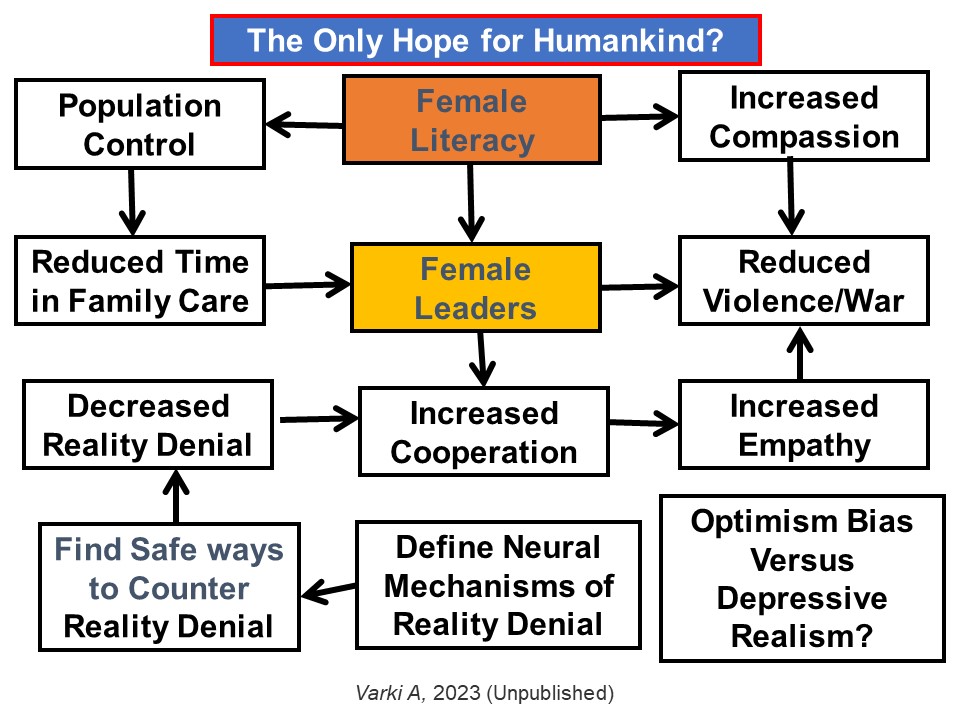
In the interview Varki introduces a new idea by proposing that we put more females in positions of power. Apparently females tend to deny reality less than males, as demonstrated by their higher rate of depression, and are more empathetic, both qualities we desperately need today.

Given the 50/50 polarized nature of politics today it does not take much of a voting block to swing an outcome. Perhaps if we target females with overshoot awareness they will abandon useless left/right politics and vote as a block for female leaders that support the only policy that will reduce suffering and improve every problem we face: population reduction.

Who’s in denial now? 🙂

If you are unfamiliar with the MORT theory, this is a very nice introduction by Dr. Varki:

If you want more detail on MORT, this 2019 paper by Dr. Varki is the best source, as it expands and clarifies the ideas presented in his 2013 book.

By Monk: Why not nuclear?

Today’s post is by frequent un-Denial visitor and friend Monk who does a wonderful job of explaining why nuclear energy is not a useful response to overshoot.

With increasing energy prices and sanctions on Russia, people are once again considering how we can power the global industrial machine with significantly less oil and gas. Alongside this, environmentalists are getting more savvy in spotting the critical problems with the likes of wind and solar and other green hopium nonsense (green hydrogen anyone?). But for some reason, many people struggle to make the final step and admit that nuclear is not going to save us from peak oil and / or climate change.

In this article, I would like to briefly layout what I see as the high-level problems with nuclear. This is just a summary of my own personal reasons for why I’m not convinced. It is by no means a thorough technical analysis!

What I’d like us to consider is this: is it DENIAL stopping our smart and critical thinkers from admitting the problems with nuclear? People who do become aware of the problems with our system tend to jump to nuclear as a last bastion of hope. Modern commentators like to tell themselves nice stories about nuclear. This prevents them from having to seriously consider energy collapse. How often have you heard these affirmations?

  • Nuclear energy is cheap
  • Nuclear energy is safe
  • Nuclear energy is clean and green
  • Nuclear energy is a low carbon energy source
  • Nuclear energy can meet our energy needs when fossil fuels run out (peak oil)
  • New innovations will make nuclear energy better, such as micro plants, newer generations, sustained fusion etc.

We shouldn’t just believe in nuclear like it’s a fairy godmother who is going to save us from our poor energy planning. We should thoroughly interrogate claims about nuclear through the lenses of environment, energy, economy, and safety.

Nuclear energy may have a negative energy return

If we accept money (currency) as a proxy for energy units, then it is pretty clear that nuclear plants are incredibly energy expensive to plan, build, maintain, and decommission. Nuclear plants are some of the most expensive projects undertaken. The capital costs are horrendous. What that should tell you is it takes a shed load of energy just to build a nuclear power plant.

To see if this upfront energy spend is worth it, we need to see how much energy we get back. Utility providers will look at costs as a ‘cost per electricity unit’. If you compare nuclear to other electricity sources, you are spending a lot more to get nuclear. Here is an example of that type of comparison looking at just the capital cost per kilowatt:

TypeCapital cost per kilowatt (kW)
Nuclear$7,675 to $12,500
Coal plant$3,000 to $8,400
Gas combined$700 to $1,300

Source (well worth a read): https://world-nuclear.org/information-library/economic-aspects/economics-of-nuclear-power.aspx

By the time we factor in all the other costs associated with nuclear – that other electricity generation doesn’t have – I’m not convinced nuclear is generating a net return at all. If that’s true (I’m happy to be wrong), you might ask why countries continue to build them? A few possibilities include:

  • Accepting burning existing fossil fuels now to get longer lasting consistent electricity in the future.
  • To support ongoing research.
  • To support the military.

I often hear pro-nuclear people talk about how much energy we can get from such a small volume of uranium. I think that is disingenuous considering all the energy we have to burn in setting up a plant before we even get a single unit of energy from uranium. 

Please note that net energy studies are notoriously difficult, because it’s up to the researcher how much of the supply chain and lifecycle they factor in. That’s why I find looking at currency a useful way to approximate EROEI (energy returned on energy invested). Of course, the nuclear industry will say they generate a very positive EROEI. Here’s a good example with references: https://world-nuclear.org/information-library/energy-and-the-environment/energy-return-on-investment.aspx. However, academic “meta-analysis of EROI values for nuclear energy suggests a mean EROI of about 14:1 (n of 33 from 15 publications)” (Hall et al., 2014) NB this was looking at traditional nuclear only.

Nuclear produces electricity, not liquid energy, not coal, and not gas  

Our predicament is not one of electricity, but of diesel, natural gas, and coal. These are critical energy and resource sources that cannot be replaced by electricity (or at least not with a positive energy return). A couple of simple examples:

  • We can’t make silicon wafers or industrial steel without coal.
  • We can’t move stuff around or dig it out of the ground without diesel.
  • We also have the issue that the world vehicle fleet is already built and requires petrol or diesel for the most part. There are no longer enough minerals left to build an entirely new electric vehicle fleet – a fact that surprising few anti-car new urbanist types are unaware of.
  • Natural gas provides us with nitrogen fertilizer (essential for feeding billions of people in the modern agricultural system) and plastics with many uses.

Another challenge is that if nuclear was to replace all energy from fossil fuels, we would need a better way to store excess energy. Although nothing like the intermittency problems of wind and solar, nuclear has a related type of problem in that it likes to always be running and producing a steady-ish amount of electricity. Currently this doesn’t matter where nuclear is part of the total energy mix, but if it were the bulk of the energy mix, storage would become a major consideration. There are a whole lot of issues with electricity storage that have been well-explained in the issues with wind and solar, namely finite amount of materials to build batteries, expense, and battery storage capacity.

One potential upside of nuclear energy could be to replace natural gas as the main electricity generator that balances out wind and solar intermittency. But due to the costs of nuclear compared to gas this hasn’t been done. Moreover, gas generation is preferred because it is easier to switch off and on. 

Nuclear is entirely dependent on fossil fuels

A nuclear power plant could not even be built without fossil fuels:

  • Coal to make the steel
  • Diesel to mine the uranium
  • Diesel to mine the sand for concrete
  • Diesel to mine the copper to make the electric components
  • Gas to make the plastics for componentry and systems
  • Gas to make the food to feed the workers
  • I could go on and make this a very long list, but hopefully you get the point.

Because building a nuclear power plant is impossible without fossil fuels, that also means we will not build new nuclear power plants after the end of oil. Just like wind turbines and solar panels cannot make more of themselves, neither can a nuclear reactor.  

Nuclear is not zero emissions

Obviously to build a nuclear power plant you are going to need a lot of diesel-powered plant and equipment. There is also concrete to factor in, which is a massive emissions source, accounting for approximately 8% of total global emissions.

With all those fossil fuels going into making a nuclear power plant, it should be obvious that nuclear is not and will never be net “zero emissions”. The focus on operating or tailpipe emissions is pointless when you’re still making an overall net positive addition to emissions. And arguably the world already has more than enough electricity, so building nuclear is possibly a complete waste of emissions.

Inputs to nuclear power plants are also reaching peak

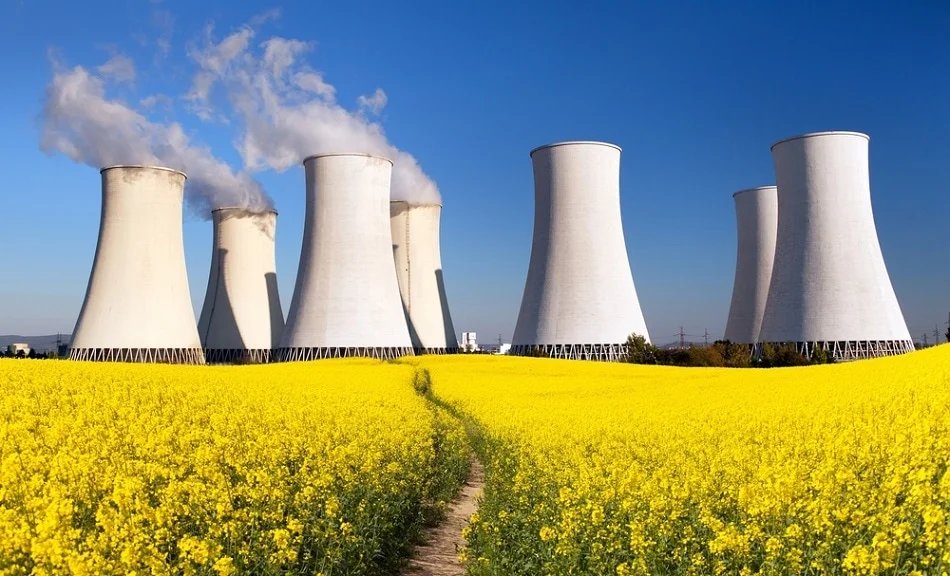
As the capital costs suggest, nuclear energy plants are massive construction projects. They require vast raw materials – all of which have their own supply limitations. It is not just oil that is reaching peak, but many other raw inputs from copper to even boring old sand. Yes, peak sand is a thing. If you look at a picture of a nuclear plant, you’ll see a lot of concrete. That is sand! Concrete also requires other raw materials including calcium, silicon, iron, and aluminium. Is there even enough sand left in the world to build enough nuclear power plants to meet our energy needs? And the concrete needs will still be there for a hypothetical fusion plant, or any such other “innovative” nuclear power generation.

The story is the same for any other rare (or getting rare) earth element. There’s approximately 17 years left of zinc, 21 for silver, 35 for nickel and 64 for cobalt. Even if these numbers are wrong, it still shows that physical limits are approaching. This provides a real limit to the number of nuclear plants that it is even feasible to build. Moreover, if our system is going to rely on more electrified plant and equipment, these minerals will run out much sooner.

Uranium is finite

It’s kind of ironic that some people see nuclear as a solution to peak oil when the actual feed for nuclear is also reaching peak. How much proven uranium reserves are out there is hotly debated. Really, I don’t care because if there’s 10 years left or 100 years, it’s the same result – our industrial system runs out of power. Apparently, proven uranium reserves would last 90 years at the current rate of use (Murphy., 2021 he has lots of references).

What we can know for certain is that uranium will peak at some point and then reach a diminishing point of return where it is no longer economically viable to get it out of the ground. Bear in mind, most (some?) of the value in mining it is for weapons – with electricity just being the side gig!

Uranium is often in hard-to-get areas (including Russia, now embargoed). We can’t mine the uranium out of the ground once we run out of diesel, which would put the end of uranium to 40 years, not 90. The only hopium here is to hope they’ll invent some amazing electricity-powered mining plant and equipment, but then we are back to the peak mineral problem. For now, we are stuck with diesel and the associated carbon emissions.

Environmental considerations

Making nuclear power plants degrades the environment. This includes:

  • Mining all the materials required.
  • Burning all the diesel, gas, and coal in the manufacturing and construction phases.
  • Building all the roads and parking required for the plant.
  • And polluting the environment for hundreds of thousands of years with radioactive material that causes birth defects, genetic degradation, cancer, and death.

Michael Dowd regularly asks us to contend with the question of radioactive waste. What right do we present day humans have to pollute the world for thousands of years, just so we can run another dishwasher? It is highly likely that some, if not most, nuclear reactors will meltdown, because they will not have been safely decommissioned due to peak oil production. What an inheritance for our descendants, if we have any left!

What do we do with the waste?

Nuclear waste is incredibly dangerous to human health and the environment. Waste can also be utilised by terrorists (or bad state actors) to create a dirty bomb. So based on these problems, we need to be very careful where and how we store the waste. Not surprisingly, this is another thing humans seem determined to f-up. For starters, a lot is stored at or near sea level – great for getting water to keep it cool – not so great when you get a sea-based disaster. Sea water corrodes infrastructure at a faster rate, increasing the likelihood of failure of the waste containment. Plus, what happens with rising sea levels from climate change?

When digging more into this topic, you’ll see humans are running out of places to put this waste and the costs of waste-storage projects are increasing. This makes it less likely that a company will be 100% focussed on quality for a capex project that generates no returns.

Alice Friedemann has argued that burying nuclear waste should be a top priority, as after peak oil production, oil will be rationed to agriculture and other essential services. Spent fuel from nuclear lasts a very long time. According to Archer (2008): “… there are components of nuclear material that have a long lifetime, such as the isotopes plutonium 239 (24,000 year half-life), thorium 230 (80,000 years), and iodine 129 (15.7 million years). Ideally, these substances must be stored and isolated from reaching ground water until they decay, but the lifetimes are so immense that it is hard to believe or to prove that this can be done”.

Once the containment for nuclear waste starts to degrade, the waste can leak into ground water, contaminating drinking water and getting into the food system. Where waste gets into the ocean, the currents can travel it all over the globe. This is happening in our lifetime, forget about a thousand years from now.

Are nuclear plants really safe?

Taken at face value statistically, nuclear plants are very safe. But I think this is a sneaky statistic because this is old data from when nuclear plants were young and well-resourced. We really don’t know how the safety stats will hold up as the plants age out. Once they are over 40 years old, the risk of disaster is much higher. This risk is heightened by very old systems and componentry and the specialised nuclear workforce retiring and not being replaced.

Many nuclear plants are built close to the sea, exposing them to natural risks including sea level rise, tsunamis, typhons / hurricanes, and erosion. Near misses are surprisingly common, often a result of human error and the just mentioned old systems. There is evidence that significant near misses are underreported officially, leading to misconceptions about the safety risks posed.  

There have been two major nuclear power plant disasters that I’m sure you are familiar with. The first is the 1986 meltdown at Chernobyl where a design flaw, triggered ironically by a safety test, led to a reactor meltdown. The second was the 2011 Fukushima disaster, where an earthquake-triggered tsunami damaged the emergency diesel generators, leading to a loss of electric power. By the way, look there’s another essential use of fossil fuels in operating nuclear plants!

Here are two minor anecdotes to show you the environmental outcomes. Following the Chernobyl disaster, a farm in Scotland had all their new-born lambs born without eyes and they had to be culled. As a result of Fukushima, across the Pacific, there is plenty of scientific evidence of radioactive contamination in fish and shellfish – tasty!

When we look at total confirmed human deaths from these nuclear incidents, we are looking at around 100 people. Total deaths from COVID-19 thus far is around 6.6 million. So how can we say nuclear is unsafe? Well, what the official incident deaths don’t tell us is how many people are dying from cancers years after a nuclear incident. Moreover, there’s little incentive for a government to try and track each death that could be attributable to a nuclear disaster – that will only make them look bad. Considering nuclear waste is toxic for 100,000s of years, we can’t even account for the untold future suffering of humans and non-humans.

Maybe the initial risks of nuclear have been overstated, but what would happen if most or all of them failed? For example, a risk that you barely ever hear mentioned is if multiple reactors were hit by an EMP or solar flare? If the grid is wrecked, so are the nuclear reactors. Maybe that might never happen, but it does seem likely that most plants won’t be properly decommissioned (due to peak oil), which will see most of them melting down over this century.

Terrorism

Nuclear plants are a target for terrorism and potentially could be used to inflict massive damage to people and the environment. From Alice Friedemann: Plutonium waste needs to be kept away from future terrorists and dictators for the next 30,000 years. But world-wide there’s 490 metric tons of separated plutonium at military and civilian sites, enough to make more than 60,000 nuclear weapons. Plutonium and highly enriched uranium are located at over 100 civilian reactor plants. In addition, there’s 1,400 tons of highly enriched uranium world-wide.  A crude nuclear bomb can be made from as little as 40 to 60 kilograms of U-235, or roughly 28,000 nuclear bombs.

Decommissioning is fraught with challenges

Decommissioning is essential as once plants age out, they become too radioactive and are likely to decay. You would then get a full or partial meltdown. Like everything else to do with nuclear, decommissioning too is a very expensive and lengthy process, often exceeding budgets. Decommissioning also requires experienced nuclear engineers who are retiring. Younger engineers no longer see nuclear as a viable career path, so the next generation of skilled nuclear workers is not there. As the nuclear plants reach the end of their design life, it will get harder and more expensive to safely decommission them. And when has a large corporate ever been good at cleaning up after itself?! Moreover, us poor taxpayers will be increasingly impoverished by peak oil economic destruction, leaving governments with less funds to pick up after the energy companies.

We might ask, where is the proof that decommissioning is happening currently and where are the government budgets put aside for decommissioning? Countries like France and the USA are also delaying decommissioning plants at the moment, possibly worried about electricity shortages and unwilling to take another source offline.

As citizens, why should we support the building of new nuclear plants when there’s barely any proof that the current ones are being safely dealt with at their end of their life?

Financial problems

Investors are not keen on nuclear power projects. They have a habit of blowing out budgets and timelines and failing to return investment (a big clue that they are negative EROEI). There’s also a bit of a wait of 7 to 10+ years for project completion before you can even hope to start seeing a financial return. Remember the cost of construction is only ever going to get more expensive now due to peak oil. Oh, and there are uninsurable liabilities!  

Governments often need to invest in electricity infrastructure, and especially for nuclear, to make up this shortfall in private investment. Citizens quite rightly should demand proof that nuclear plants are worth spending energy on. They should demand Governments provide detailed risk management against all the criteria we’ve just discussed. Because nuclear is not popular with the average citizen, democratic governments are increasingly unwilling to invest in nuclear. Moreover, governments are encouraged by their populations to keep electricity prices affordable. Wind and solar are much more popular and tend to get more of the subsidies. They have also damaged the profitability of nuclear with wind and solar going first to sell to market (government policy in parts of Europe).

Replacing fossil fuels with nuclear energy is a pipe dream

In a 2019 Forbes article, Roger Pielke ran a thought experiment on how many nuclear plants the world would need to get to the 2050 net zero goal. “To achieve net-zero carbon dioxide emissions by 2050, the world would need to deploy 3 [brand new] nuclear plants worth of carbon-free energy every two days, starting tomorrow and continuing to 2050. At the same time, a nuclear plant’s worth of fossil fuels would need to be decommissioned every day, starting tomorrow and continuing to 2050.”

We can already see that this just isn’t happening, and for the reasons laid out in this article it’s clear this can never happen. It looks like 2022 saw just 53 nuclear reactors under construction world-wide – that’s not finished by the way, just in some stage of construction.

But what about innovation

Honestly each ‘innovation’ to nuclear reactors could be an article all on its own. I have to confess I have a lazy heuristic: I just write off all of these as nonsense and don’t really give them fair consideration. But if I had to provide a high-level critic, this would be it. I have just noted the additional problems with these “innovations” – they still have all the same problems described elsewhere:

  • Fusion – The gold standard of hopium. As the idiom goes, sustained fusion is just 20 years in the future and always will be. 
  • Breeder reactors – Recycling costs more energy than you get back. Also, more expensive than regular reactors, which are already too expensive.
  • New generation – Less safe and more toxic (go ask Alice).
  • Thorium – Perhaps it could have worked but looks like it’s too expensive now. That’s a good hint it would be negative EROEI. Might not be viable in reality.
  • And this goes for lots of things: just because something is feasible in a lab situation or theoretically possible, does not mean it will ever be a viable solution. You can do a lot if you have oodles of energy and billions of dollars to waste. We might ask, is indulging the fantasies of scientists really a good use of our last remaining surplus resources?

Well, that’s bleak, what does the future of electricity look like

Humans already have access to more electricity than we ever imagined 100 years ago. If we had a stable or reducing population (shout out to Rob), then we wouldn’t even need to worry about bringing on new electricity generation.

Categorically all forms of electricity generation have their negative drawbacks. Eventually, all the hydroelectric dams will silt up – this can take hundreds of years – and finally they will all fail. Wind turbines last for 30 years, though in reality production efficiency reduces much earlier. Coastal wind turbines will decay after 10 years due to erosion from salt water. Solar panels will last 30+ years, but the associated systems and batteries to collect and store the electricity fail much sooner and need replacement parts. Nuclear plants last for a design life of 40+ years minimum and then should be decommissioned over the following 20 years. With natural gas shortages due to the Russian Invasion, countries are delaying decommissioning their plants. Most western nuclear is aged out.

Humans could continue to produce electricity by burning coal and natural gas. There are approximately 400 years left of coal and 150 years left of natural gas. But (and it’s a big but), there is only 40 years left of oil (BP Statistical Review). Without oil we don’t have diesel powered equipment, which will make it all but impossible to extract coal and natural gas. Without coal, we can’t make industrial wind turbines, solar panels, or nuclear reactors.

What this means is that by the year 2060, we are looking at a world with much less electricity production and eventually moving to almost zero electricity as the hydro dams fail in the coming centuries – and no we can’t build new ones of scale without diesel. Perhaps some smart individuals can maintain rudimentary electricity where they live, but the days of large electric grids are numbered.

By the way, if you do want to dive into the technical details, I can point you in the direction of plenty of useful references. Just let me know 😊

Two Different Perspectives – Same Conclusion: Modern Lifestyles Will End Soon

Dr. Berndt Warm’s Perspective

Thanks to Marromai for finding this new paper by physicist Dr. Berndt Warm.

Dr. Warm uses 5 different methods, 4 relying on economics, and 1 on thermodynamics, to predict when the end of oil production and motor vehicle production will occur. All 5 methods roughly converge on 2030 as the year when modern lifestyles end.

The essay was written in German and translated to English which explains any awkward phrasing.

Warm’s conclusion agrees with my 15 years of study of many different sources which converge on oil production being down by about 50% in 2030. Because our current system requires growth not to collapse, it is plausible that predicting a 50% decline is the same as predicting a 100% decline.

Our world is of course far too complex to make precise predictions, and unexpected events like a pandemic or nuclear war can dramatically change the outcome, however for planning purposes it seems reasonable to assume we have about 5 years left to prepare for a new way of life.

Abstract

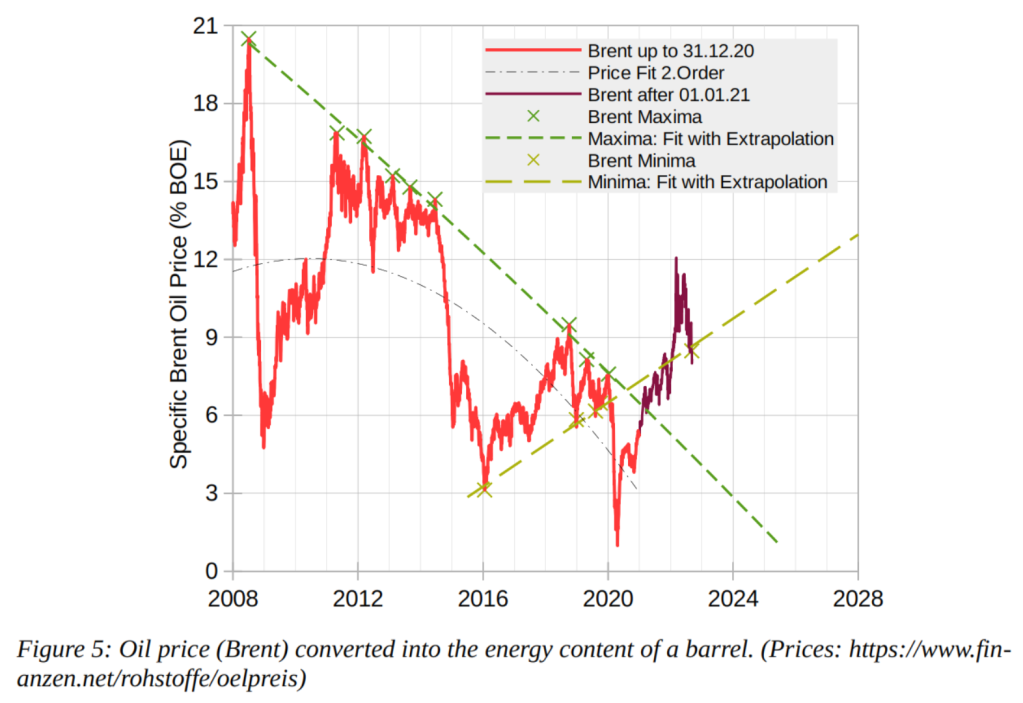
Evaluation of five data sets concerning car production, oil prices converted in energy values gives lifespan approximations for the car industry and the oil industry. The result is that the car industry will last only until 2027 and the oil industry some years more.

Here are a few excerpts from the paper:

The author interprets the line of maxima as the oil price that the industrialized countries can afford to the maximum while maintaining their lifestyle. He interprets the line of minima as the price of oil that the producing countries need to keep their economies running. In mid-2019, the author noticed this crossroads and expected a crisis in 2020, although he was completely unclear what kind of crisis it would be. He didn’t expect Corona.

The inhabitants of the industrialized countries are now realizing that their lifestyle is at risk. The line of the maxima will reach the zero line (0%BOE) around mid-2027. From then on, the inhabitants of the industrialized countries can no longer afford oil without giving up many things of daily life. The demand of the oil producers is then 13-14 %BOE. These two values are incompatible.

Result: The extrapolation of oil prices shows that from 2022 the lifestyle in the industrialized countries will degrade, and that after 2027 the inhabitants of the industrialized countries will hardly be able to pay for oil or its products.

The fall in the price of crude oil from 2008 to 2020 with the extreme price increase since 2021 is an absolute alarm signal! Soon there will be no more crude oil affordable, no matter for which economy in the world!

Summary

Procedures 1, 2 and 4 are extrapolations of economic data of the past. Method 3 is a link between oil prices and car production. Method 5 is a calculation based on a law of physics.

The five calculation methods result in:

  1. End of world motor vehicle production between 2031 and 2034.
  2. End of oil production in 2027.
  3. End of worldwide sales of motor vehicles in 2027.
  4. End of German vehicle production in 2027.
  5. End of oil production in 2029.

The results are not the same, but in the end the same thing comes out. All five procedures show that vehicle production and oil production will continue to collapse in the coming years. Vehicle production will disappear first. Oil production later, as the world’s existing fleet will continue to consume crude oil, even if no new vehicles are added. It is to be expected, that the crude oil production will decrease slowly until 2027, and after that very fast.

And: Oil will be extremely expensive by 2027 at the latest!

Dr. Simon Michaux’s Perspective

For those still hoping that a transition to non-fossil energy will extend our modern lifestyles, I point you to the following recent work of mining engineer Dr. Simon Michaux which shows our planet has insufficient affordable resources to implement an energy transition plan that maintains our current lifestyles.

The quantity of metal required to make just one generation of renewable tech units to replace fossil fuels, is much larger than first thought. Current mining production of these metals is not even close to meeting demand. Current reported mineral reserves are also not enough in size. Most concerning is copper as one of the flagged shortfalls. Exploration for more at required volumes will be difficult, with this seminar addressing these issues.

Simon Michaux is an Associate Professor of Geometallurgy at the Geological Survey of Finland in the Circular Economy Solutions Unit. Holding a Bachelor of Applied Science degree in Physics and Geology and a PhD in Mining Engineering from the University of Queensland, Simon has extensive experience in mining research and development, circular economic principles, industrial recycling, and mineral intelligence. Through his recent publications, Simon has outlined the many challenges facing the global industrial ecosystem. He notes our world is currently energy and minerals blind and transitioning to renewable energies is not as straightforward as it appears.

We’ve been growing without care to planetary limits for too long and change is coming, whether we like it or not. We need a completely new energy paradigm to address the challenges ahead, and as Simon says, it all starts with a conversation. We cover a lot of ground in this one, so grab a notebook and strap in for an important conversation – this is one you’ll want to listen to more than once.

On this episode, we meet with Associate Professor of Geometallurgy at the Geological Survey of Finland, Dr. Simon Michaux. Why do humans ignore important mineral and material limits that will affect human futures? Dr. Michaux reveals how we are “minerals blind” — and the consequences of this myopia. To shed light on the effects of our minerals blindness, Dr. Michaux explores the disconnect between experts in renewable energy and economic and government leaders. Dr. Michaux offers individual strategies for us to overcome our energy and minerals blindness. How can we learn to adapt in order to overcome the coming challenges?

Dr. Simon Michaux is an Associate Professor of Geometallurgy at the Geological Survey of Finland. He has a PhD in mining engineering. Dr. Michaux’s long-term work is on societal transformation toward a circular economy.

BenjaminTheDonkey’s Perspective

BenjaminTheDonkey today nicely captures a common theme I observe everywhere in the world today: We are collectively losing our minds; perhaps because unpleasant realities are overwhelming the denial circuit in our brains?

Alarmist? 


The powers that be won’t admit

We’re heading straight to our obit; 

So it isn’t strange we

Can already see

People are losing their shit. 


What is its cause at the root? 

Whom might we persecute?

From an objective view,

It’s logically true 

The reason is just overshoot.

By marromai: A Purpose in Life

Today we have a heartfelt post by marromai from Germany sharing his experience of becoming overshoot aware and how he deals with the knowledge. The essay was written in German and translated to English.

Life is wonderful – sometimes at least. But most of the time it is a very monotonous thing. And the older I get, the more often I wonder about the purpose of it. Every day, every week, every year the same procedure – enjoy the little moments, but for the rest of the time, hope that it passes by as soon as possible. Most days consist of a typical routine like getting up, sitting at work for what feels like an eternity, having a short and stressful time with my family, and then either doing chores or attending social gatherings now and then. Get the house in shape on Saturdays, and on Sundays rest or do something with the family. Rinse and repeat, every day is groundhog’s day.

Although one could think I’m blessed, because I live in the best Germany ever1. I’m married to a wonderful wife – as wonderful as they can get in their late 30s – I have four adorable children whom I love very much but who often get on my last nerve, a house and a garden where there is always plenty of work to do for which I have neither time nor money nor desire, and my dream job as an electrical engineer, which nowadays is unfortunately all too often just another bureaucratic clerk who only sees the soldering iron from afar. So basically, I should be doing very well, you would think. I just sell a bit of my lifetime for money and can enjoy a decent life.

Unfortunately, this is not the case. Personally, my biggest problem is this: Working as an employed engineer has lost its magic – it often doesn’t even make sense to me, it just sucks. For the most part, it consists of bureaucratic stuff that doesn’t solve any problems but is just to be done for its own sake. Consequently, I complete tasks at the last minute with minimal effort, which you can’t even call work to rule. Everyday work is dull, lacking real tinkering challenges and practical problems to solve. The “always having to be there” and the resulting disproportionate amount of wasted life time kills any motivation and makes me strongly question the purpose of the whole mumbo jumbo called “gainful employment”. Maybe work makes life sweet – but in this respect I have diabetes… Now and then I think about self-employment and alternative income possibilities, combined with more personal freedom – but the chance to earn enough money to support a family is close to zero. Especially since the difficult economic times that are looming mark a very unfavorable time for this. How nice it would be to have a 4-day half-day job, with full pay, of course. Or even better, if they would just transfer my salary to me, I would know what to do with my time, wouldn’t I?

Since a while it feels like I have no time at all for personal activities. Even on days off I don’t really know what to do with myself. Apart from the tasks on the house and garden, which absolutely have to be done, I often don’t manage to start anything, although I have so many ideas – but rarely the motivation to actually begin. Or too little time, that starting is not worth it – at least that’s what I tell myself. So, I end up just like at work, where I spend most of my time in front of a computer, trying to avoid getting bored while reading in some online forums. As it turned out afterwards, this was the point, where my problems began, resulting in a total destruction of any purpose in life.

You may ask, what is it, what one could read, that is so depressing?

Beside electronic forums (for new ideas, which I will never implement) I read mainly alternative news and discussions about current events. This made me realize a long time ago that official media are nothing but propaganda channels – and I really can’t listen to them anymore. Russia here, Ukraine there. Evil Putin will destroy us all. Corona is so dangerous, be sure to get vaccinated… I can’t understand how the majority of the population can believe this bullshit – but that’s another topic. It will soon matter little anyway, once you understand that all of this are just side effects to a superordinate set of issues I came across while browsing over some threads of my favorite forum.

Most people will dismiss the following problem as absurd and unrealistic. Some will understand it but will not feel affected by it or will not want to admit it. And the tiny remainder? They are left with no one to talk about a matter, for which the great majority will laugh at them as end-time prophets and declare them crazy. It is the realization that our entire civilization could only grow so fast with the help of fossil energy – and that we are running out of this energy source now. Not because we planned it so or think we can replace it to get a grip on the ridiculous CO2 climate change issue. (I think it is rather presumptuous and a huge farce to try to control the temperature of a whole ecosystem and save the planet by reducing a single trace gas in the atmosphere, while not being able to provide a solid weather forecast for more than 2 days.) But the decarbonization that politicians are longing for will happen anyway. Just not in the way they envision. That’s because fossil fuels currently still cover the main demand for energy, and the much-vaunted renewables can’t even replace a fraction of that. Now we have reached the limits of what our planet can provide. What we are currently experiencing with our gas and electricity prices is only the beginning of the coming shortages. The Ukrainian-Russian war, which actually is driven by the USA, is in fact an economic war – and the economy only works with energy. Without energy, all the money in the world is useless: “Our main problem is a caloric one. We can print money like hay, but not a single drop of oil”2. The coming lack of oil will tear everything apart and cost billions of people’s lives by cold and hunger.

How it could come so far is what nobody dares to speak about: There are simply too many people on this planet who have already consumed too much raw materials and energy and always want more. It is only through coal, oil and gas that humanity has been able to multiply so enormously. But without maintaining these energy flows, the population numbers cannot be sustained. There are 10 calories of fossil energy in every calorie of food. But the soils are depleted and no longer yield anything without artificial fertilizers, agriculture is so thoroughly industrialized and complex that it can no longer be run on pure muscle power, certainly not to feed a country as densely populated as Germany. And now, of all times, we are running out of fossil energy?

The promised rescue by renewable energies is just window dressing and cannot free us from this predicament, nor can nuclear power plants. They supply only a fraction of electrical energy, but no raw materials for industry, as can be seen well in the current European gas shortage situation. No fertilizer can be produced from solar cells, and we cannot melt steel with wind energy, not even with 10 times the number of windmills. In addition to oil and gas, many other natural resources are now depleted that are required to build alternative energy sources. Fossil energy has enabled exponential population growth and unprecedented prosperity with ever increasing complexity and interconnectedness. Likewise, future energy shortages will cause an abrupt reduction in complexity – which is called collapse. And no, this will not be in a distant future, we are already in the middle of it. The coming times will be bleak. And it can go much further down very quickly when “winter is coming”, as the current situation in Europe shows.

All in all, a huge complex of topics, in whose importance I have no doubt – but the momentous realizations from it are simply devastating and destroy any further motivation and search for meaning in life – a nihilistic vicious circle of demotivation, effects see above. And the worst thing is, that one suffers all alone from this knowledge. Because the majority of people are not able to even see this unpleasant reality, let alone understand: “Blessed are the poor in spirit”.

So how to continue? One may try to convince as many others as possible of this reality and build a low-tech community. With a group of collapse-aware people, surviving could be much easier, when the crisis fully hits. Unfortunately, in Germany this is very difficult, since most people are totally brainwashed by official media. So, for me, I have decided to just try to enjoy as much free time and remaining prosperity as possible – while it’s still possible. Since I need money for this, I have to work, which is contrary to “Carpe Diem”. So I go to work, but don’t really do work – not perfect, much more like business as usual. What a shame – denying the un-denial… not knowing in the first place would have been much easier.

But as long as the hamster wheel turns and turns, you inevitably have to run with it. You have to learn to control the speed, otherwise you die of exhaustion. For someone who has recognized being in a hamster wheel, one may eventually be inclined to consider a premature exit. But that should not be a solution – especially not if you have a family, which you don’t want to leave in the lurch. Besides, aren’t you too curious to see what happens next? How bad will the crisis get? How long does such a collapse take? And what will life be like in the future? Maybe there will be challenges and problems to solve that you missed so much in your current job, for example finding food every day? Doesn’t this give you an ultimate purpose in life? You’ll probably miss the days spent in the warm office, browsing through internet forums and dreaming up gloomy fantasies about the future…

I leave you with a favorite quote from a relevant episode of Star Trek: The Next Generation:

Seize the time Maribor. Live now. Make now always the most precious time. Now will never come again.

Footnotes:

[1] German Bundespräsident F.W. Steinmeier on German Unity Day 2020: “We live in the best Germany of all times”.
[2] https://archiv1.dasgelbeforum.net/index.php?id=193123 (A German forum of critical thinkers)

By Gaia Gardener: On Our Hall of Denial Mirrors

Today we have another guest post by a member of the un-Denial community, Gaia Gardener, who posted these thoughts on denial as a comment. I thought they were interesting enough to warrant promoting them to a more visible post.

Hello friends, thank you for a very interesting discussion about the realities of denial and how we humans seem to be able to manipulate all perceptions to fit our chosen narrative, whether or not we are consciously aware of our programmed beliefs however they were initialised and ingrained.

I am wondering if we can look at another subject, removed from overshoot, in which denial plays a big role in our actions/inactions so we can step back and dissect out a bit more how denial originates and becomes intrenched without us even realising our immersion in it, just like we in the small minority see happening to the masses and even polymaths in regards to overshoot denial.

The topic I think can fit the bill is the question of the ethics of eating animals, namely farmed animals which we consume in the billions every year. I won’t cover using animals for our labour and experimentation as the ethics of these actions can be construed to be justified in benefitting humankind which the majority of human beings would be in favour of. But the eating of animals in the modern world is not only unnecessary (and we can be spared the example of Inuits or other very minority population cultures who rely solely on animal products for sustenance, we do not have their situation in the least) but in fact there is convincing evidence that it is harmful to both our physical bodies and the planet, but for the sake of this argument, one need not consider either of those reasons to engage in a discussion of why we cannot eat animals nor their products if we believe we have a moral obligation to another sentient being. Let’s face it–we eat meat because we were brought up to do so and it tastes good (to most human taste buds) and it’s readily available without much effort on our part. However, the fact that animals suffer solely for our pleasure, tradition, and convenience is not enough moral ground to do so, for one can easily see how this disconnect can apply to any sentient being, including other humans, which is so obviously not an ethical choice. And yet, we are in complete denial that it is okay to eat chicken, cow, and pig but outrageously wrong to eat dog, cat, or horse. It is fine for us to imprison a member of a food species in the most horrendous conditions but we can be charged with abusing and neglecting other species we call our domestic companions. We can kill a food species animal way before their natural life span in a most horrific manner (everyone knows a slaughterhouse isn’t a happy place) so we can buy our sanitized plastic-wrapped packages of pork, beef, and healthy white meat chicken, but if we organise a dog fight and enjoy it, that is disgusting and shameful. You’re right, it’s not about education (most of us know that a live being had to be killed to get meat on the plate), or even more extreme forms of presenting the facts (how many of us would volunteer to witness what happens in a slaughterhouse, or even more tellingly, choose that as our job?). Yes, we have been lied to about happy free-range chickens or happy cows enjoying being milked on the happy dairy farm, but how many of us actually have spared more thought for what really happens in these industries, we’re only too happy ourselves to buy the more expensive organic or free-range option as if that absolves us from the guilt we still harbour knowing that no matter how happy the picture of the old MacDonald’s farm, we know this is a fantasy. Every animal still comes to an end in a way far from their natural choice and inclination.

I can sense the mounting justifications and counter-arguments–we need meat for our health or else we would get sick and die, if we didn’t raise the food animal they wouldn’t have a chance at life at all, what about if we were stuck on an island with only rabbits to eat, you can see how inane these points are, and generally stated to obfuscate the moral issue at hand. I am talking about modern day humans who now have access to a wide range of very suitable and healthful plant-based protein, and the methods we use to obtain our meatstuffs, even the question of whether or not it is our evolutionary diet (very debatable) isn’t the point here. The point is our denial of other factors which should be considered when making the choice of whether it is ethical to eat farmed animals, or even a beloved family pet lamb (just these words should put it in perspective that it isn’t but somehow we still do it–is that denial? ) What is it that keeps the majority of people still reaching for their burgers and steaks and fried chicken and bacon and eggs despite knowing what everyone should know? Is it denial of the truth because to face the ethical question front on would demand a choice and most humans just cannot overcome the continuation of pleasure, tradition, and ease of living, especially if it means realising it is a morally wrong thing to do so. So it is far easier to adopt cognitive disconnect, join the masses who are in your camp, degrade and exclude those who are not, and just keep doing what you want for one more day after day as long as it can last because at least you got to enjoy it and no one can take that away. Sound familiar? See how easy denial becomes just our way of perceiving our reality, and that is why I chose this example to prove that point. Every thought that is possibly going through your head now is a function of denial, one way or another, and none of it was even conscious before I brought this so called controversial topic up–if one can deem supporting active suffering of sentient beings just because we like it, to have any controversy attached.

I guess what I’m trying to express, which is in full agreement with what has been discussed, is that all of us have the capacity for denial (whether or not MORT is the primal reason) but we can’t see it as denial when we’re in the thick of it because that is just our chosen narrative. The way we dichotomise over overshoot, population control, Covid, Russia, just about any topic you can name, all confirm this. Only others outside that narrative (and usually the minority) can see that there is another perspective (because it’s their reality) and then call out the majority as in denial, which is exactly what the majority thinks of the outliers! It’s like that endless hall of mirrors reflecting back to you ad infinitum, whichever way one looks, there’s another image looking away from you, too, with the prime cause of the illusion being your own presence and perception of your reality. I think denial is a bit like that–it’s what holds us in our place, and helps define our sense of self by creating another version of possible self to bounce off of. I’m not saying there’s any right or wrong in this, it just seems to be how we are wired and until now, it has kept us on the survival ascendancy (that and a whole heck of fossil fuels!)

I think a good question to always be ready to ask ourselves in any situation to draw out denial is “What knowledge or understanding or different perspective that I may not have now but is available to gain or learn, would change or enhance the way I see the situation? ” Try it, it is very hard to allow oneself the possibility of overcoming our deep-rooted beliefs but yet that is precisely the attitude it will take for us to change them. Forcing education upon others doesn’t work as we have seen, it has to come from a self-directed intention to fill the knowledge gaps (isn’t that how we all arrived at our overshoot awareness and acceptance? We didn’t find this site because we were lectured into it, we found it because we sought it out) and then an even more entropy defying self push to change our actions to match our new insights. If the motivation is great enough, this can and will happen, but everyone has a different threshold before the fire is lit under our bums. Maybe that is why we need to head hell-bent towards full-on collapse, perhaps the only way to save ourselves is to first come within a nanometer of destroying ourselves. I still take comfort and security from the once inviolable Newton’s third law and trust that is will prove true for this case, for every action there is an equal and opposite reaction. Let us pray for calamity that we will reach that opposite reaction with the same energy swinging us out of our doom as going into it, and preferably very soon!

Namaste, everyone. Thanks for bearing with another Gaia attack.

By wis.dom project: Regress in Progress: My state of mind

Dire Evolutionary Timeline by Blu

This is an essay from reader wis.dom project who describes his painful personal journey of connecting dots to achieve awareness of our overshoot predicament.

I was born in 1969, at a time when everything still seemed possible. On July 20, two people walked on the moon, which is probably the greatest technological achievement of man to this day. In my youth, I devoured novels by Asimov, Clarke, Lem, Dick and Herbert. The galaxy’s colonization seemed within reach.

45 years later, I realized that I was a victim of mass hypnosis, what I refer to today as techno-utopia – a belief in the limitless human development, genius and almost divine uniqueness of Homo Sapiens. I realized that industrial civilization, like any other dissipative structure, is doomed to inevitable collapse.

In 1972 – 3 years after my birth, a book titled The Limits to Growth was released by the Club of Rome. It was the first scientifically compiled report analyzing future scenarios for humanity. It indicated that unlimited development is not possible on a finite planet. The book was published in 30 million copies and was one of the most popular at the time. Surprisingly, despite the wide range of my readings, the book did not appear on my horizon for a long time. As if it was covered by another intellectual  “Säuberung”. In fact, it was the subject of an intellectual blitzkrieg and relatively quickly evaporated from the media circulation. I experienced this myself by talking to several university professors. Every one of them dismissed the LtG concept with a shrug and an unequivocal, non-debatable conclusion that the theory had long been discredited.

Since then, there have been many other events that have offered an opportunity to change consciousness and thus the trajectory of industrial civilization.

On June 15, 1979, during the ongoing second oil crisis, President Jimmy Carter gave a famous speech in which he announced: “The energy crisis is real. It is worldwide. It is a clear and present danger to our Nation. These are facts and we simply must face them”. Photovoltaic panels were installed on the roof of the White House to symbolize a new trend – energy conservation and an attempt to develop alternative sources.

American people responded by choosing Ronald Reagan as the 40th president of the United States, who had the panels dismantled. Before he did so, he announced: “There are no great limits to growth because there are no limits of human intelligence, imagination, and wonder.” As a result of the use of “intelligence, imagination, and wonder” American analysts probably came to the conclusion that if we do not have the resources ourselves, they should be organized from a different source. Therefore, on his first overseas trip, Reagan traveled to Saudi Arabia, where he probably proposed the following alternative: petrodollar, protection and weapons for cheap oil… or American aircraft carriers will stay anchored in the Persian Gulf for longer – as in the Al Capone quote: “You can get much further with a kind word and a gun than you can with a kind word alone”. Same logic. Following, we got post-colonial globalization with all the necessary tools like the IMF, World Bank, BIS, and Washington Consensus. Pax Americana in full release. A decade of crises had begun.

In 1980, a group of “loyal Americans” constructed Georgia Guidestones, “The American Stonehenge”. On 4 granite slabs, in 8 languages, the authors recommended 10 commandments of a healthy civilization, including limiting the global population to 500 million. This humanist monument was recently destroyed by fanatical terrorists and then demolished by the county authorities for “security reasons”.

In 1984, the publisher of George Orwell’s famous book, which regained popularity as a result of events at that time, advertised it with the slogan “maybe not 1984, but there is always 1985”. We solved the waves of hunger that engulfed African countries with “Live Aid”. The eastern block began to fall apart.

For the growth protagonists, their optimistic belief in progress was confirmed in the 1990’s, after the collapse of the Eastern bloc and another “gold rush”, this time in the oil fields of Western Siberia. Another wave of globalization had begun. The ceiling of the ecological capacity of mankind was raised again, and the extraction of natural resources accelerated to planet limits. China joined the WTO and “the sky was the limit” again.

The digital revolution restored belief in unlimited development, and Hollywood started showing “happy endings” again after years of dystopian themes. However, the honeymoon of unipolar globalization was short. In 2001, cracks started to appear. US president, George W. Bush, announced that the prosperity of the Americans was not negotiable. Invasions of Iraq and Afghanistan clearly showed the intentions of Zbigniew Brzezinski’s  “The Grand Chessboard” strategy. After all, the 9/11 organization required remarkable synchronization, and its presentation to the public was another masterpiece of the hypnotic power of mass communication. Undoubtedly, its organizers were aware of the challenges ahead. In 1998, Colin J. Campbell, a highly respected geologist dealing with oil field analysis for companies such as BP, Texaco, Amoco, together with Jean Laherrère published an article titled The End of Cheap Oil. Shortly after, he recalled, gentlemen from the Pentagon / CIA visited him with a proposal to cooperate. They wanted to know more about the impending peak-oil. They knew the matter was serious. Campbell’s relatively precise predictions materialized in 2006, when we reached the peak of conventional oil production.

However, also this time the convulsions of civilization were prolonged. For optimists, the shale revolution, fracking, deep and arctic oil were another confirmation of human genius and the possibility of unlimited expansion of the species. Changing the definition of oil production to ‘all liquids’ and the inclusion of bizarre products such as biofuels once again gave the impression of unlimited resources. For the more inquisitive observers, it was more like “last drops from the bottom of the barrel.” The IEA’s prediction of production scenarios, with a price of $300 per barrel, did not seem to scare the public. For some, they were another opportunity for tempting profits. The oil price reached $147 a barrel in 2007 and has yet to be beaten. However, it had far-reaching consequences in the form of a global financial and economic crisis. In November 2018, we probably achieved the final peak of production of all liquid hydrocarbons.  Peak oil has become a fact.

Germany’s Bundeswehr 2010 publication on the consequences of the peak extraction of critical resources has not reached a wider audience. Instead, we got another installment of mass hypnosis in the form of such oxymorons as “renewable energies” (which for semantic precision are not renewable) and “sustainable development” (whatever that means). The energy transformation, changed by all cases, was called a revolution by its followers. Apparently, none of them noticed that revolutions are by nature bottom-up. The current attempt at energy transformation, on the other hand, is a top-down, elite-bureaucratic decree forced into the economy with an enormous organizational, financial and propaganda effort, and has nothing to do with the revolution. Except perhaps the inevitable failure.

Further memes of the Holy Grails of energy appear in the widespread public perception. From nuclear fusion projects, new categories of nuclear reactors, SMRs, large-scale energy storage to the recently very popular multicolored forms of hydrogen. Already every moderately educated inhabitant of Western countries can cite further possibilities of increasing our chance for a vacation on Mars in the near future, a vision presented by Elon, the most popular techno-utopian messiah. The knowledge on this subject is usually so shallow that it only causes confusion. After all, if all these solutions are at hand, why are we living in times of a global energy crisis? Undoubtedly, if not terrorist inclinations, this can at least provoke rage against such inept politicians. Greta is disappointed, as are her millions of unsuspecting millennials. False hope is a source of frustration expressed by aggression. This generation will inspire a wave of radicalism and eco-terrorism in the near future.

So here we are. Pandemic, wars, revolutions, hunger, migrations, financial crisis, stagflation, new cold war, de-globalization – we got a jackpot in this draw.

In 2011, a public opinion research company surveyed Western countries’ populations on the threats to human civilization. 11% expressed the opinion that events that threaten civilization will occur during their lives. I wonder what the result would be today, but I have no doubt it would be significantly higher. Still, the wider population was not frightened by the fact that in 2018 Sweden mailed instructions to its citizens on how to prepare for war, which was also a pocket prepper plan. The city of New York is preparing for a nuclear attack right now. A day like any other, nothing to see here. Yet all over the world there are no reactions, no demonstrations, no prayers for peace. The masses are  hypnotized. Most of the younger generation of Western societies fear climate change. Nobody told them that the greatest threat to their welfare is, paradoxically, an end to environmental rape.

A breakthrough on the legendary World3 Model Standard Run is happening right before our eyes. Except the fall, like in Hemingway’s novel: How did you go bankrupt? Bill asked. “Two ways”, Mike said. “Gradually and then suddenly”. “Gradually” was already there, now “suddenly” begins. As if we were watching Seneca Cliff live. Yet most people believe this is just a temporary stumble on the way to permanent happiness and prosperity. Almost every statement of people in the media contains hidden optimism when they make plans for 10, 20 or 30 years, visions of smart-cities, hydrogen-economy, electric cars and universal happiness. Even the so-called pessimists that see the crisis and the forthcoming World War III, believe in the following reconstruction and further progress after the victory of the only right one, i.e. OUR SIDE. Spes decedit ultimo, amorem non moritur.

The pandemic, the genesis of which should be sought in biological weapons laboratories, was presented efficiently and with amazing media synchronization as a natural zoonotic epidemic. At the same time, the health service suffered global Münchhausen’s surrogate syndrome and concluded that injecting 5 billion people with experimental gene therapy is a good idea. And this despite the fact that for the vast majority of them the disease is relatively harmless, while gene therapy turns out to be ineffective and risky. I mean, safe and effective. How the “vaccine”, which should be injected in your body 4 times in 1.5 years is effective, no one explained and few asked.

Meanwhile, the frequency of meetings between political elites, presidents, prime ministers, ministers and a whole host of other notables in various configurations has drastically increased. This could hypothetically indicate greater international cooperation, but I am betting that the number of fires to be extinguished has increased instead. And I’m afraid this is just the beginning. Groups from WEF, G7, G20, BRICS, AUKUS, NATO, B&RI, QUAD, RCEP, ASEAN, to the Bilderberg Group meet to agree current positions, preferences, transactions, exchange information and confirm alliances. The chessboard is dynamically reconfigured. Global industrial civilization, like any dissipative structure, bifurcates. The world will divide. We go back in time. Another Cold War has arrived, and as one California senator noted, the truth is its first casualty. The level of propaganda is so advanced that, as in my youth, we will soon be seeing “TV is lying” graffiti. And this is justified. The elites are trying to prepare for the coming crisis, and this requires the right tools of indoctrination, surveillance and control. We can expect more riots, protests, strikes and demonstrations. More state control. More power of brute force. More epidemic passports, debt, digital currencies, vaccinations, bankruptcies, unemployment and migrations. Less money, food, travel, vacation, products, freedoms, and rights. The polarization of opinions is growing, and the spectrum of the narrative is intensifying the schizophrenia of paradigms. Social discontent will grow. As William Gibson stated, “the future is already here, it’s just not evenly distributed”.  Sri Lanka is the proverbial canary in the mine. It’s just a matter of time before it will also show up in my neighborhood. Klaus Schwab from the WEF is supposed to keep me happy, but I only see it in the scenario of Futurological Congress. I can handle “less meat” with pleasure, but a lack of property is a fresh implementation of techno-fascism based on the proven model of CCP. National Socialism has the same imperative regardless of the flag. Klaus’ pupils, the prime ministers of the Netherlands and Canada, are already eagerly implementing the plan heading straight towards Soylent Green. The new techno-utopian prophet Yuval Noah Harari (Noah is quite symbolic in this context) and at the same time faithful to the Great Reset sect defines the challenges facing humanity as, among other things, providing adequate entertainment for these billions of “useless people”. 4th industrial revolution – biotechnology, automation, geoengineering, brain-computer interface, remote control, complete elimination of privacy, artificial intelligence, virtual reality, transhumanism and singularity will save us. In which metaverse, Mr. Harari? Techno-fascism? It looks more like smart-depopulation than smart-dictatorship.

Meanwhile, the war in Europe became a breeding ground for hysterical psychosis, in which a billion people of the Western world decided that  preparations for WW3 should begin. Europe has been organizing Seppuku type economic crises on an unprecedented scale since 1929, followed by the depopulation scenario of the anonymous white intelligence agency deagel.com. These two events are another masterful operations on the open brain of global population. Simultaneously the UN forecasts the size of the human population by 2300, and the optimistic scenario predicts 36.4 billion inhabitants of the planet. Are they already implementing Stanislaw Lem’s scenario in their canteens? Is this a pilot?

The process of absorbing this knowledge was painful. The closest analogy is DABDA (denial, anger, bargaining, depression, acceptance) described by Elisabeth  Kübler-Ross in the book On Death and Dying (also published in 1969). In her description, the stages of dying may occur many times, and their sequences are individual for each person becoming aware of their own mortality. I saw it myself in my loved ones who passed away. This happened to me also in relation to the revelation that industrial civilization is dying. Such awareness is an extremely difficult experience. In addition to its own emotional consequences, it also brings deep alienation. It becomes a natural need to share your knowledge with others, including your loved ones. As much as I could, I tried to avoid it, knowing from the descriptions of others who had previously had such experiences. Sharing such information brings only isolation, mockery, and being labelled as a “depressive-manic supporter of conspiracy theories”. Despite my sincere desire, I did not avoid ostracism and contempt, like many others before me. Kassandra, the social nickname that had been given to me half-jokingly in my social circle, turned out to be only a sign of intellectual gaps of my friends. After all, Kassandra was right in predicting the fall of Troy. I was doomed, like her, to a consciousness that no one would accept. No wonder,  eschatology has a long history and the list of Armageddon prophets is long.

As part of my personal DABDA I am trying to decipher the history and its mechanisms. The question “how did this happen?” is lingering. How is it possible that we have brought our species and the planet to the brink of collapse? And there is the question of who was responsible.

The story leading to the LtG conclusions seems quite obvious from my current perspective. David Attenborough provides the simplest explanation:

We have a finite environment— the planet. Anyone who thinks that you can have infinite growth in a finite environment is either a madman or an economist.

After 30 years of studying economics, I came to a similar conclusion. Modern mainstream economics is a scholastic sect that created pseudo-science describing economic mechanisms without considering any environmental factors in their models. Economists rationalized that any limitations related to demographics, resources and pollution will be resolved by the market, and ultimately by another sect – academy of scientific progress in cooperation with mammon wizards, i.e. rulers of the financial system. I am writing this with great respect and admiration for thousands of great scientists. We are also a brilliant species after all. Without them, we would still be jogging through the Central African savannahs. And probably the debt-engineers also deserve gratitude, because as Lloyd Blenkfein, president of Goldman Sachs said at the height of the previous global GFC financial crisis, “I’m doing God’s Work”. In fact, I cannot disagree. Without sophisticated debt magic the pyramid of industrial civilization would have collapsed much sooner.

The population of the planet grew exponentially, and we just recently surpassed 8 billion people on the planet for a while. Paul R. Ehrlich published The Population Bomb in 1968. The book received similar intellectual reception to LtG and was recognized as a Malthusian propagation of fear and defeatism.

In 1959, Aldous Huxley published New World 30 years later: The divergence report. Even then he feared the consequences of overpopulation. His conclusions are being realized before our eyes. The mixture of Orwell’s 1984 and the original Brave New World is more and more obvious, only the proportions change. Orwell is increasingly dominating though, and “War is Peace, Freedom is Slavery, and Ignorance is Strength” is increasingly evident in current mass media hypnosis.

So who was responsible?

Politicians? People with sociopathic narcissistic disorders voted in to solve short-term problems? The Kissinger Report  was published in 1974 for the President Nixon administration reads:

23. The central question for world population policy in the year 1974, is whether mankind is to remain on a track toward an ultimate population of 12 to 15 billion – implying a five to seven-fold increase in almost all the underdeveloped world outside of China – or whether (despite the momentum of population growth) it can be switched over to the course of earliest feasible population stability – implying ultimate totals of 8 to 9 billions and not more than a three or four-fold increase in any major region.

24. What are the stakes? We do not know whether technological developments will make it possible to feed over 8 much less 12 billion people in the 21st century. We cannot be entirely certain that climatic changes in the coming decade will not create great difficulties in feeding a growing population, especially people in the LDCs who live under increasingly marginal and more vulnerable conditions. There exists at least the possibility that present developments point toward Malthusian conditions for many regions of the world.

The politicians knew perfectly well, at least the well-informed ones. As Deng Xiaoping, chairman of the Communist Party of China and architect of modern China, probably concluded that if China does not join the global economy relatively quickly, it will no longer have a chance to end the Age of Humiliation and “take a central position on the world stage”. In 1992, Fidel Castro delivered this speech at the Rio Environmental Conference.

Hunger and riots have been feared by politicians since ancient Egypt. Because who wants to end on the guillotine? Today, an eclipse is not enough to pacify riots. There are much better methods, as progress can be seen in every area. Alternatives to the horsemen of the apocalypse remain. Eugenics, euthanasia, and birth control were supposedly not humanistic enough.

Financial elites? These people were destined to make more money and power. They try their best playing in the sandbox of techno-utopia. The WEF Great Reset does not look promising either. Rather desperate, though logical. Likewise their contingency plans.

Scientists? In search of clues pointing to our destiny, we can also go back to the discoveries of Prigogin, Odum, Georgescu-Roegen and Lotka, great scientists who brought us closer to the knowledge of what life is. And modern authors describe with high precision our dependence on fossil energy to keep the population alive. Joseph Tainter, Matthieu Auzanneau, Craig Dilworth, Charles A.S. Hall, François Roddier, and many others, described how the world really works and the state it is in. They also failed. Apparently the printings were too small. Science has its own limits, regardless of the symptoms of progressive degeneration to which it is subject, like any large organization. Contemporary philosophers, however, dreamed of this future, but apparently they were not invited to breakfast TVs. Yet they were destined to rule Plato’s state.

Humanity? Each of us with internet access had the opportunity to find this knowledge. Some of us, however, preferred to watch cute cats or modern gladiators running on the trimmed lawn. Panem et circenses.

Philosophers? After all, philosophy, as a love of wisdom, was perhaps the most responsible for the awareness of human destiny. The philosophers were proto-scientists, only with progressing specialization migrated to the role of provincial humanists with an inclination to determine the number of angels dancing on the head of a pin. They also failed. As a result, most of humanity lives in Plato’s cave, waiting for the looming vengeance of Thomas Malthus, the first professor of political economy. What an irony.

Or maybe nobody is to blame, and humanity – as in the Greek tragedy – was destined to follow this last journey of Icarus from the beginning?

George Orwell in Shock

By Gaia Gardener: On Suffering

Buried in the comments of the last post we discussed human overshoot and what should be done about it. I proposed our goal should be to minimize suffering and that the best path to achieving this goal is awareness of Ajit Varki’s Mind Over Reality Transition (MORT) theory.

My view, in summary, is that when fully aware of the reality and implications of human overshoot, our best personal and collective responses become self-evident and require no coercion to implement. Conversely, when overshoot is denied, all of our best personal and collective responses are vehemently rejected as assaults on our rights and entitlements.

Unfortunately, our genetic tendency to deny unpleasant realities, as explained by MORT, blocks overshoot awareness. Therefore any progress in a good direction requires an understanding of MORT.

Put more bluntly, all environmental activists, climate changers, peak oilers, Gaia lovers, population reducers, etc. should be focused with Zen-like precision on MORT, and any other activity is a complete waste of time, as demonstrated by our zero progress on any substantive issue over the last 50 years since Limits to Growth was published.

Reader Gaia Gardener responded with some beautiful prose that I thought was a good reason to clear the decks and create this new post.

For useful background, the comment thread that motivated the following essay by Gaia Gardener begins here.

Upon gazing up at the starry night sky thoughts like these come to my mind–there must be some sentient life form and civilization somewhere in this vast universe that broke through this barrier of denial that causes suffering to self, other life forms, and their ultimate destruction of their planetary home. Just being able to internalize this gives me much peace and acceptance of my infinitesimally small but still conscious being. If I keep gazing, sometimes I can lose sense of self completely and just melt into a time/space/no and every mind. Fermi’s paradox may be the most probable explanation for our seemingly unique manifestation but in a near infinite cosmos, there is still a chance that we may not understand everything!

If we are not here, or even if we were never here, the vastness of the universe continues to be, the ultimate laws of physical construct still stand as foundational building blocks to all matter and life, and life forms will continue to evolve even if given the most minute opportunity. In light of these critical truths, our knowledge of it is an ego awareness and recognition of what always was and will be and which has been already recognized by eons of cultures in their own way of expression. From creation myths to quantum equations, it is all a finger pointing at the moon, a way of reaching the untouchable but the real mystery and awe lies in the experience of just being. I suppose what is most tragic to our species is that we may lose our own consciousness to reflect back on our understandings of our world, in a word, annihilation. But can we take solace in the knowledge that we are elemental stardust to begin with and will return to that state, and since our guiding laws tell us matter and energy are constantly changing form, that is what we must be also, moment by moment, if even there is something called time. Then it is not a far reach for me to accept death, but suffering is another matter. Our ability to experience suffering ourselves is the prerequisite of consciousness and to be aware of suffering in others and make a choice for relief is the core of our humanity.

I have of late, at this crossroad of our civilization, find myself asking “Has it all been worth the suffering?” The knowledge gained, the art expressed, the structures erected, the technology exploded, has it been worth what we have also wrought with the same force and energy, the destruction and injustice to our planet and other life forms, starting with our own species, closer kin than any other stardust in this vastness of space. For example, for JS Bach to be born and for us to experience the incomparable beauty of his music, was it worth whatever else had to pass for our civilization to bring forth such genius? Can another member of our Homo sapiens family, in destitution and hunger for generations oppressed, can they say our enjoyment of our highest pinnacle achievements was worth their suffering and their ancestors suffering and their children’s suffering at the hands of our dominant culture? What of their choice to relieve suffering if only we had used our energy in a different way that may have allowed them to reach their own developmental potential? I cannot lie to a deepest truth that it is only my judgment that deems one being more worthy than another, the universe has none. If we are uberconscious, then we will also know that the universe has no judgment on our beingness or existence, it is only us looking at and contemplating ourselves in the mirror for this briefest of constructs called space and time. But since we have developed this mind and we have created our microuniverse within the macro, it is our responsibility to finish what we began, on every level. Overshoot and its repercussions is the stage set for our generations, we cannot shirk from finishing the show we have written, directed, and acted in. But there is also more to our human existence, and from the earliest times our inner desire has been to find our meaning and place in this cosmos. The present is the only time we ever have to continually seek and refine for ourselves what resonates, only now it seems of greatest urgency, at least to me. Maybe being born in the age of overshoot collapse has refocussed this for all of us here. And I do agree that reduction of suffering is a noblest goal and can manifest in myriad ways; kindness is always our choice.