
I just finished the new book by Jeff Hawkins titled “A Thousand Brains: A New Theory of Intelligence”.
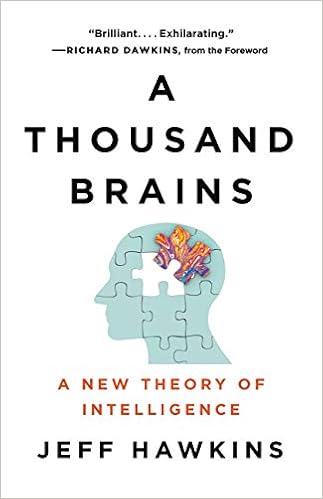
A bestselling author, neuroscientist, and computer engineer unveils a theory of intelligence that will revolutionize our understanding of the brain and the future of AI.
For all of neuroscience’s advances, we’ve made little progress on its biggest question: How do simple cells in the brain create intelligence?
Jeff Hawkins and his team discovered that the brain uses maplike structures to build a model of the world-not just one model, but hundreds of thousands of models of everything we know. This discovery allows Hawkins to answer important questions about how we perceive the world, why we have a sense of self, and the origin of high-level thought.
A Thousand Brains heralds a revolution in the understanding of intelligence. It is a big-think book, in every sense of the word.
I’ve followed Hawkins for many years and he’s one of my favorite neuroscience researchers. He started as an electrical engineer and created in 1996 the groundbreaking handheld PalmPilot (which I owned 🙂 ), and then switched careers to his passion of figuring out how the brain works.
In his book he proposes a new theoretical framework for how intelligence works. I think he’s on to something important. So does Richard Dawkins who wrote the forward and compares the book to Charles Darwin’s On the Origin of Species.
I see an opportunity to build on Hawkins’ intelligence framework to push Varki’s MORT theory forward by refining why and what we deny, and how denial is implemented in the brain. Some of my still rough ideas are presented at the end of this essay.
There’s a second aspect of Hawkins’ book that is also interesting.
After presenting his new theory on intelligence, Hawkins spends the last half of the book explaining how our old brain behaviors and false beliefs (aka denial) threaten the survival of our species, and he proposes several ways we might avoid these threats.
He’s clearly worried and knows we are in trouble.
Yet when discussing the threats to our species he is blind to the biggest, imminent, and certain threat we face: fossil energy depletion. Hawkins, like most polymaths, can’t see that the technology he loves, was created by, and totally depends on, rapidly depleting non-renewable resources.
So we have a world expert on how and why our brain creates false beliefs, that can’t see his own false beliefs.
We could ask for no better evidence that MORT is true!
But wait, there’s more.
In the last chapters Hawkins obsesses over inventing a lasting means for our species to signal to other life in the universe that human intelligence once existed. As I was reading this I kept thinking, what the hell are you going on about? The odds are extremely low that other intelligent life will ever see our signaling satellites, and who the hell cares if they do? Then a light went on. His signal is a high tech version of an Egyptian pyramid, and is his brain’s mechanism for denying death.
So how could it get any better?
- a well written enjoyable book
- with an important new theory
- on the most interesting aspect of a unique species
- that may push forward Varki’s MORT theory on why we exist
- by a brilliant polymath
- that is blinded by the same denial that created his species
Following is a brief recapitulation of Hawkins’ cortical column framework for intelligence integrated with my musings on how it might be used to clarify and focus Varki’s MORT theory.
This hypothesis will be revised, possibly substantially, after I complete a 2nd more careful reading of Hawkins’ book and published papers, which I’ve just started. I’m also hoping to incorporate criticism from Dr. Varki which may improve or kill my ideas.
Downvoting the Cortical Column Death Model to Breach the Extended Theory of Mind Barrier
Version 1.2, April 17, 2021
Note: For the sake of brevity, every occurrence of “not die” should be read as “not die until viable offspring are produced”.
- Genes evolve and collaborate to create bodies.
- Bodies exist to replicate genes.
- A body must not die to achieve its purpose of replicating genes.
- The brain exists to help the body by choosing the best action to not die for a given set of sensory inputs.
- The old brain uses simple static models to directly cause actions to not die.
- The neocortex uses more complex learned models to indirectly cause actions to not die by requesting the old brain to execute actions.
- Learning is moving: the neocortex learns by moving senses around the subject to create (up to about 1000) reference frame models.
- Thinking is moving: concepts without physical form, like mathematics, are learned by moving between models to create new reference frame models.
- Models have redundancy which makes knowledge more resilient and repurposable.
- Models are stored in cortical columns.
- The neocortex is composed of many nearly identical cortical columns.
- Senses (and outputs from other models) are evaluated for matches by models.
- Models collaborate by voting to decide our conscious reality.
- The agreed reality is used by other models to select the best action to not die.
- Evolution increases the number of cortical columns in species that benefit from more intelligence to not die.
- Social species have the most cortical columns because modeling social relationships is hard.
- The human neocortex has about 150,000 cortical columns.
- There are two important thresholds on the continuum of increasing social intelligence.
- “Theory of mind” is the threshold where a brain learns a model of another brain, and that model includes an understanding that the other brain can die.
- “Extended theory of mind” is the threshold where a brain learns that its model of another brain also models itself, and that it can also die.
- The extended theory of mind threshold may be difficult for evolution to cross, because it has happened only once on this planet.
- A model that predicts possible death from injury and certain death from old age results in fewer actions to not die.
- Fewer actions to not die is called depression.
- Genes for an extended theory of mind thus do not persist.
- To break through the barrier, evolution requires a mechanism to prevent the learned death model from evaluating true.
- A mechanism consistent with the archeological record was to learn a model for life after death (aka God) which downvotes the death model thus continuing the actions to not die.
Modern Implications of the Death Model
- Climate change acceptance combined with the common false belief that renewable energy can replace depleting non-renewable fossil energy, and the common false belief that technology can remove sufficient CO2 from the atmosphere, does not trigger the death model, and the false beliefs cause our species to take actions that worsen our overshoot predicament.
- Awareness of human overshoot and its implications are present in less than 0.01% of humans, including most highly educated polymaths, because it triggers the death model. Most people deny overshoot with false beliefs that non-renewable resources are abundant.
https://wolfstreet.com/2021/04/19/freight-expenses-spike-the-most-on-record/
Dr. Varki asked me to study the End of History illusion.
https://en.wikipedia.org/wiki/End-of-history_illusion
Humans predict they will change less in the future than they changed in the past, yet the actual rate of change is similar for past and present. Researchers do not understand why this illusion occurs.
I’m not seeing a connection to MORT.
Tverberg also thinks the paper is junk.
https://ourfiniteworld.com/2021/04/11/we-cant-expect-covid-19-to-go-away-we-should-plan-accordingly/comment-page-6/#comment-290055
Dr.Varki and I are discussing MORT. He’s thinking about Hawkins’ theory and mulling my ideas. In the interim Dr. Varki has asked me to think about the following:
I don’t know if it’s old age, or if it’s inherent to the mental task of using a brain to understand a brain, but I find this work exhausting, and my thinking often gets muddled.
To clarify my thoughts, and to open the door to anyone else interested in joining the discussion, I’m going to try to summarize the differences between MORT2 explained by me above, and MORT1 explained by Dr. Varki here:
https://link.springer.com/chapter/10.1007%2F978-3-030-25466-7_6
Both MORT1 and MORT2 say that an extended theory of mind (ETOM) is central to the success of behaviorally modern humans, and that an ETOM has evolved only once on this planet because there is a barrier that must be crossed.
MORT1 says that some mutation specific to the requirements of an ETOM must occur. MORT1 thus requires evolution to discover something new for an ETOM.
MORT2 says that an ETOM is a brain with some number of additional replicated cortical columns that create enough additional intelligence to enable learning the complex model that another’s brain is the same as it’s own brain. Evolution was already on the path of increasing the number of cortical columns in hominids because their success was improved by additional social intelligence for learning and cooperation. MORT2 thus does not require evolution to discover anything new.
The barrier to achieving an ETOM is the same for both MORT1 and MORT2. An ETOM includes a learned model for death (from hunting, childbirth, sickness, old age, etc.) and this death model causes the brain to generate less actions to not die (aka depression). An ETOM is initially a disadvantage for both MORT1 and MORT2 and the genetic changes do not persist.
MORT1 says that occasionally a mutation occurs to (I think) the fear suppression module in the amygdala that is used when a mammal is forced to fight to survive. This change has the effect of causing the denial of all things unpleasant, including mortality. The change manifests as increased risk taking which is a disadvantage and so the genetic change does not persist.
MORT1 says that with simultaneous mutations for an ETOM and denial, the two disadvantages combined become one strong advantage by enabling an ETOM to persist. The improbability of this event explains why it has occurred only once on this planet.
MORT2 says that to cross the barrier, one tribe had to invent the cultural learned belief of life after death (aka God). This new learned model participated by downvoting in the network of models representing death and thus the conscious reality of death was suppressed and the depression barrier was sidestepped. The tribe that invented God was then able to evolve an ETOM.
The ETOM barrier is less difficult to cross with MORT2 than with MORT1, and the barrier was crossed only once, so this suggests MORT1 is more probable than MORT2. A contra-argument is that the first tribe to invent God may have had enough of a head start to outcompete or kill all the other hominids that had not yet invented God.
I like the simplicity of MORT2. No new mutations are required. Evolution just keeps doing what it was trying to do anyway: increase the intelligence of a social species. All that had to happen was for one tribe to invent God.
Denial of death is hardwired in MORT1 and learned in MORT2. Dr. Varki correctly points out that if MORT2 is true then we need to explain why atheists are not depressed. Using myself as a lab rat, I think I do not fear death because I have learned enough science about consciousness to know that that death is no different than being asleep or sedated, and thus my learned models downvote the fear associated with death. I also observe many non-religious people often believe in some form of vague spirituality which I think includes a non-religious form of life after death.
Now let’s consider how what we observe today might change if MORT1 or MORT2 is true.
Most humans created by MORT1 will tend to deny all things unpleasant, including death.
Humans created by MORT2 will fall into 3 buckets:
• Religious and spiritual humans will tend to deny all things associated with death.
• Atheists who fear death will tend to be depressed.
• Atheists who have learned to not fear death will deny nothing.
I like MORT1’s more general denial of all things unpleasant because I think it does a nice job of cleanly explaining the false beliefs common in our world today. It is less clear with MORT2 what to predict about false beliefs.
I like with MORT2 that I no longer have to refer to myself and others that do not deny unpleasant realties as genetic mutants.
I’m now going to study the end of history illusion, optimism bias, and the amygdala as Dr. Varki suggests.
Opinions and ideas are welcome.
Hi Rob
Just a few random thoughts, I am mostly busy buying things that look to go into short supply in the coming months and maybe years.
The fear of death appears to be variable by culture. I don’t know if men in warrior cultures are completely free of the fear, but some mythologies and ideologies appear to support an embrace of death. Not so much a denial, just stupidity, at least from our non-religious perspective. But group level evolutionary selection might explain these behaviors and death sacrifice beliefs. Or high levels of in-group genetic relatedness between individuals within groups. (Incest, first cousin marriages, high polygamy). As in-group genetic relatedness decreases, so does our willingness to sacrifice our lives for others?
My memory is faded a bit on the history religion, but fully fleshed out concepts of GOD and after lives are the product agriculture societies and hierarchical control by elites? When is it suggested that a specific genetic adaption took place for a denial mechanism in the brain? I suppose that burial rituals and cave paintings dated 40K BC and back show some concern for a second life. But those relics are from populations migrated out of Africa. Presumably, our ancestors that stayed in Africa did well enough. So you would have to push the “one tribe” that developed God back pretty far.
Risk aversion in general appears to be inverse to the level of testosterone in your body. Young men take greater risks. We send young men into battle….
The process of what the brain chooses to remember, or forget, might explain more things than a specific mechanism for denying aspects of reality? Maybe that is saying the same thing. Anyway, I read a few recent articles on how the brain encodes memories, versus real time sensory input and pattern generation guesses. The brain guys seems to be making a lot of progress now in understanding how that 3lbs of grey matter works.
Death seems to be more feared, when it is less frequently in our lives. In the modern west, we seem to have pushed the experience of death to its lowest point. The pre-antibiotic world was much different.
Is awareness of reality and the need to deny all or part of it variable by level of intelligence? Maybe a lot of us don’t worry about anything existential at all.
Thanks. Dr. Varki and I are pretty confident that behaviorally modern humans emerged by breaching a barrier to an ETOM by denying death. It’s consistent with all the evidence and we’ve found no evidence yet that kills the theory. In the 1-200,000 years since we acquired an ETOM it is possible (probable?) that culture (learned models) have modified how we respond to unpleasant realities.
Very nice big picture summary of our planet.
Many moons ago, many, I took a course from a prof at the UofA that turned out to be most unusual in the field of psychology. This man presented his theory of how a human mind and the consequent thought patterns were created and maintained. He aligned the myths of our society and various cultures with the synapses and dendrites of brain function: how they were created and maintained. The upshot of what I learned is that getting people to change, to accept facts that do not fit with what was innoculated into our brains, is extremely difficult; to actually change goes against all that past that we came to ‘know’ through a lot of people we trusted to tell us what is true and good and useful. In religious traditions the needed change is called “metanoia”, a radical transformation of one’s life, one’s thinking, one’s social orientations. It is a very difficult thing to go through – leads some to suicide, others to social isolation, others to cultism, etc.. I am not suggesting that this sort of mind reset is only religious, but in any case, it is hard to get into and go through. But now, it is absolutely necessary! What is needed is for others to be there through the turmoil, to give a living example of coming out through the other side. As Texas engineer Ted Patzek said, “let me remind you that a pessimist is an optimist who shed his/her delusions and denial, and educated him/herself”. I would suggest that self-education is not real, but requires those others who are willing to continue the journey from illusion and delusion past denial.
Well said. I agree.
Your thoughts were reinforced for me by Hawkins’ book.
Our brains learn models to represent everything in our world, both physical things and non-physical beliefs.
It does not matter a whit if those models are scientifically true. It only matters that the models help the brain decide what actions to tell the body to take to keep it alive until it produces viable offspring.
New models can be learned and existing models can be changed. But it’s hard. My observations suggest a good method to change someone else’s models is by setting an example. Words alone are less effective.
I just read through the entire AMA. It was good to see a few thoughtful questions and your usual informative, lucid responses. It appears to have been a worthwhile venture, Rob, and I’m glad you tried it.
Thank you for the kind and encouraging feedback. I find it difficult and stressful to give young people advice today while being honest and true to my (unpopular) beliefs.
I just finished the Reddit AMA. Not too many questions. A couple trolls but nothing serious.
I’ve been mulling the AMA.
I told everyone my niche was “why” things are the way they are and encouraged everyone to ask questions that begin with why.
I don’t believe there was a single why question.
I’ve noticed the same with people around me IRL.
I do not understand.
What provides no insight.