
Three years ago I wrote about Garrett Hardin’s famous 1968 paper “The Tragedy of the Commons” here. The gist of it is that the collective effect of individuals making independent, well-intentioned, rational decisions regarding the use of a shared resource, such as livestock pastures in the past, and our entire planet today, leads to the degradation of the resource such that it can no longer support the individuals that depend upon it.
I was impressed with Hardin’s clear and direct thinking about over-population:
To couple the concept of freedom to breed (in a welfare state) with the belief that everyone born has an equal right to the commons is to lock the world into a tragic course of action.
It is a mistake to think that we can control the breeding of mankind in the long run by an appeal to conscience.
I summarized Hardin’s position on population control as follows:
- Failure to control population growth will result in ruin.
- Population control via appeal to reason or conscience, or threat of shame, will not work, and will in fact make the situation worse. Population can only be effectively controlled by coercion, that is, laws with penalties for overbreeding.
- The key to passing population control laws is to educate citizens on the reality that if they do not relinquish the freedom to breed they will lose all of their freedoms, including eventually the freedom to breed.
I concluded that since Hardin wrote his paper 50 years ago the accessible evidence for severe overshoot is overwhelming and proves that Hardin was wrong in that education alone is not sufficient to pass the necessary population control laws.
I asked, how can a majority emerge to support a contentious law to control breeding when the vast majority of 7.6 billion people deny human overshoot?
If you deny the existence or implications of overshoot, then it is logical to embrace one or more of the many arguments against population control, austerity, and conservation. On the other hand, if you embrace the reality of overshoot, then population control, austerity, and conservation not only become perfectly reasonable, they become the most important, ethical, moral, and rational things we must do.
There was a hint in Hardin’s paper that he may have understood the centrality of reality denial to our predicament:
… natural selection favors the forces of psychological denial. The individual benefits as an individual from his ability to deny the truth even though society as a whole, of which he is a part, suffers.
Hardin did not elaborate further on reality denial but did reference another paper he wrote titled “Denial and the Gift of History” published in a 1964 book edited by himself titled “Population, Evolution, and Birth Control”.
I was unable to obtain this book and 3 years ago asked readers to help me find it. A kind reader named “V” recently found it and I thank him/her very much.
You can download the book here.
It appears to be an important book that will be of interest to students of human overshoot. Here is an enticing summary I created from the best bits of the 1st and 2nd edition back covers:
Population, Evolution, and Birth Control: A Collage of Controversial Ideas
Assembled by Garrett Hardin, University of California, Santa Barbara
“Every year Malthus is proven wrong and is buried—only to spring to life again before the year is out. If he is so wrong, why can’t we forget him? If he is right, how does he happen to be so fertile a subject for criticism?”
“The emerging history of population is a story of disaster and denial—disaster foreseen, but disaster psychologically denied in our innermost being. How can one believe in something—particularly an unpleasant something—that has never happened before?”
With these questions Professor Hardin introduces this unique collection of readings on what is perhaps the most important social problem besetting mankind—the population problem.
For the past twenty years Garrett Hardin has focused his interests on the social implications of biology. He has drawn together here what he considers the most effective published statements made in support of, and in opposition to, the questions at issue. Arranged to show the historical development of major ideas, the more than 100 articles, reviews, and criticisms serve to clarify the points of controversy. Editorial comments accompany the readings, but the reader is urged to draw his own conclusions.
Among the selections are writings dating from Old Testament times to the present. They include extracts from Malthus’ first essay, from Margaret Sanger’s autobiography, from the book Famine—1975! by William and Paul Paddock, which despite its startling and unpopular conclusions, may prove to be a turning point in population literature, and a recent essay by Roman Catholic Dr. Frederick E. Flynn that presents the startling new interpretation of “natural law” that Dr. John Rock used in his book, The Time Has Come, to argue that progesterone oral contraceptive is theologically acceptable to the Catholic Church.
Other important readings include J. H. Fremlin’s “How Many People Can the World Support?”, Paul Ehrlich’s “Paying the Piper”, Kingsley Davis’ “Population Policy: Will Current Programs Succeed?”, and Garrett Hardin’s “The Tragedy of the Commons”.
Each article was selected in the light of its proved effectiveness in stimulating classroom discussion. The collection provides excellent collateral reading for any course of study that deals with the social impact of science—whether taught in departments of biology, anthropology, economics, sociology, geography, or others.
GARRETT HARDIN studied at the University of Chicago and at Stanford University, where he received a Ph.D. in 1941. He has been associated with the Carnegie Institution of Washington, Stanford University, and the California Institute of Technology; and he is now professor of biology at the University of California, Santa Barbara. He has written a popular introductory textbook, “Biology, Its Principles and Implications”, and a general work, “Nature and Man’s Fate”. The present collection of readings was a natural product of his experience in developing discussion classes in universities and in adult education programs.
My initial reaction was, OMG, we’re definitely not becoming wiser. Over 50 years look how far we’ve fallen in public discourse and university teaching of important matters.
So far I’ve only studied the one essay “Denial and the Gift of History”, which I extracted in full below, and the remainder of this post discusses it. A quick scan of the book suggests it contains many more essays worthy of future time and discussion.
I summarize Hardin’s “Denial and the Gift of History” as follows:
- Denial of death is a widely recognized human behavior.
- Humans have also denied unpleasant realities throughout history.
- Due to denial’s ubiquity, a biologist must conclude it is at least in part genetic.
- Denial in moderation is more advantageous to the survival of an individual than extreme denial, or the absence of denial, hence denial’s ubiquity in humans.
- While advantageous to an individual, denial is a grave threat to society, because the rate of change of overshoot threats is slow relative to a single lifetime, and thus are easy to deny.
- “The Gift of History” is that studying prior collapses of ecosystems and civilizations can teach us to overcome our denial of current events.
My conclusions about Hardin on denial:
- Hardin got a lot right:
- denial is ubiquitous in humans
- denial is genetic
- denial of overshoot is a key threat to the species
- Hardin missed a lot:
- denial is not an interesting oddity of human behavior, denial is central to the emergence of behaviorally modern humans
- the need for denial of death with an extended theory of mind drove the evolution of the more generic denial of unpleasant realities – in other words, denial of death is central, denial of everything unpleasant is an artifact
- Hardin was wrong on the solution to overshoot:
- 50 years of history has proven that knowledge and education will not overcome our genetic tendency to deny unpleasant realities like overshoot
Here’s the complete essay:
Denial and the Gift of History by Garrett Hardin
“None believes in his own death,” said Sigmund Freud. “In the unconscious everyone is convinced of his own immortality.” He was not the first to say this. The poet Edward Young, more than two centuries earlier, wrote: “All men think all men mortal but themselves.” Very likely others, even before Young, recognized this power of denial in man’s life.
The operation of denial is evident in all literature, particularly heroic literature, which is the visible monument of this psychological process. “A thousand shall fall at thy right hand, ten thousand at thy left, but it [i.e., death] shall not come nigh thee,” said the Psalmist. How our breast swells with confidence at these words! Religion must surely be good if it can instill in man this most useful confidence in his powers! So says the apologist for religion, after giving up the defense of its verity. It is a powerful apology. It is no doubt the cornerstone of the philosophy of life of both geniuses and habitual criminals. Arthur Koestler has reminded us that during the days when pickpockets were executed in England, the day of a hanging was a day of great profit for other pickpockets who circulated through the tense and orgasmic crowd. Statistics gathered from the early nineteenth century showed that out of 250 men hanged, 170 had, themselves, witnessed an execution. Denial plays havoc with the deterrence theory of punishment.
“Nothing can happen to me,” said Freud’s poor Hans, the road mender. Great kings are no wiser. When Croesus contemplated waging war against the Persians he consulted the oracle at Delphi, who replied, with her characteristic ambiguity: “If Croesus should send an army against the Persians he would destroy a great empire.” Delighted with the reply, Croesus attacked, and the prophecy was fulfilled: a great empire was indeed destroyed—his.
Are we less the victims of denial now, two and a half millennia later? Consider an article published in the Wall Street Journal discussing the dangers of thermonuclear war. More than four columns were devoted to a glowing description of how our stockpiles made us capable of destroying the Soviet Union “in several ways and several times over.” But, as Jerome Frank has pointed out, the article included just two slight references to what the USSR could do to us. The oracle of Wall Street has spoken: “If we wage thermonuclear war, a great nation will be destroyed.” Nothing could be clearer.
But perhaps it is only men of great affairs, practical men, who are the victims of the impulse of denial? Hardly; the biographies of scientists and scholars are replete with accounts of behavior that denies the implications of knowledge. Herbert Conn, a pioneer in the public hygiene movement, did not hesitate to use the public drinking cup himself; and though he warned that the housefly was a carrier of typhoid he did not bother to close his own screen doors. And Freud, who declared that children should receive sex instruction from their parents, left his own children to learn the facts of life “from the gutter,” like everyone else.
How are we to explain the persistence and ubiquity of denial? As biologists we adhere to the working hypothesis that every trait has both genetic and environmental components. As evolutionists we ask, what is the selective advantage of the trait that the hereditary component should so persist through centuries and millennia? Does nonrealistic thinking have a survival value? Is denial superior to truth? These are unpleasant surmises. The problem is a difficult one, and it cannot be said that any man has the answer. But biologists know of a suggestive model—the sickle-cell trait. It is caused by genes.
In malarious regions of Africa the human population is genetically diverse with respect to this trait, and the diversity is stable (so long as we don’t drain the swamps to kill mosquitoes or introduce atabrine to destroy the malarial parasites). The sickle-cell gene causes the red blood cells of the body, normally disc shaped, to become sickle shaped. Only the disc-shaped cells support the life of the parasite. But sickle cells are bad for the human; if a person has only sickle genes, he suffers from anemia, and usually dies young. In a malarious environment it is best to be a hybrid; such individuals are resistant to malaria, but do not suffer from anemia. Individuals having completely normal cells are not anemic, but suffer from malaria. To be hybrid is (individually) best, but a hybrid population is not stable; it constantly throws off some offspring having only genes for normal cells (these are eliminated by malaria) and some having only sickle-shaped cells (who are eliminated by anemia). Only some (50 percent) of the offspring are hybrid.
Is this perhaps the analogical model we need to explain the persistence of denial among humans? The purest deniers live in a world of magic; its lack of congruence with the real world causes the statistical early death of this group. Among these magicians we must number early aeronauts, men who go over Niagara Falls in a barrel, gold prospectors, and indeed all compulsive gamblers. At the other extreme are men of so realistic and cautious a disposition that they are left behind so long as there remains a frontier where rewards are great. A world made up only of such men of pure sensibleness would never invent the submarine or the airplane, never discover the New World. Denial, dangerous though it is, does have some survival value.
The power of denial, valuable though it may be to the individual competitive man of action, is a grave danger to society as a whole. The time scale of historical change, extending as it does over many human generations, makes denial easy and plausible. We tend to assume that as things are now, they have always been, and there’s nothing to worry about in the future. The tourist of the Mediterranean lands naturally assumes that the picturesque and poverty striken countrysides of Spain, Italy, Greece, and Lebanon looked always thus, not realizing that these deserts and near deserts are the work of unconscious man. Plato, in his Critias, says:
“There are mountains in Attica which can now keep nothing but bees, but which were clothed, not so very long ago, with fine trees producing timber suitable for roofing the largest buildings, and roofs hewn from this timber are still in existence. There were also many lofty cultivated trees.
The annual supply of rainfall was not lost, as it is at present, through being allowed to flow over a denuded surface to the sea, but was received by the country, in all its abundance—stored in impervious potter’s earth—and so was able to discharge the drainage of the heights into the hollows in the form of springs and rivers with an abundant volume and wide territorial distribution. The shrines that survive to the present day on the sites of extinct water supplies are evidence for the correctness of my present hypothesis.”
Every move today to preserve the beauty of the forests, the purity of the air, the limpidity of the streams, and the wildness of the seashore is opposed by practical and powerful men. The reasons they give are various, and are (of course) couched in the noblest terms. Freely translated, the voice of the practical man is that of Hans the Road Mender: It can’t happen to me. Other Edens have become deserts, other empires have fallen, other peoples have perished—but not us. We deny the evidence of logic and our senses. As La Fontaine said, “We believe no evil till the evil’s done.”
The gift that history has to give us is freedom from denial. Historical decay takes longer than the efflorescence and decay of a single life, and so it is not easily perceived as a real process and a real danger. But the study of history, if it is to have any real worth, must convince us of the reality of processes that extend over more than a single life span. To achieve this goal we must explicitly state the therapeutic function of history, which is this: to reveal and neutralize the process of denial in the individual. If we fail in this our fate will be that which Santayana described: “Those who cannot learn from the past are doomed to repeat it.”
From someone who actually bothered to read Malthus, professor Giorgos Kallish shows in his latest book that Malthus, a cleric and pro-growth economist, did not predict limits to growth but instead invoked the specter of scarcity in order to advocate for more growth and defend capitalist class society against redistribution. Malthus reasoned that the poor would become lazy and food production would drop if any redistribution was instituted to lessen inequality. According to scholars who have seriously studied Malthus, he actually promoted population growth because it acted as a stimulus to industry and would keep food production ahead of the geometric ratio of population growth. In defending the capitalist economic system of the time, Malthus suggested industry must keep expanding more and more. The labor in those factories would most assuredly be provided by the commoners who were forced off their land in the Enclosure Movement. His essay was “the first rejection of redistribution and welfare in the name of growth of free markets.” The supposed prophet of overpopulation considered population growth the ultimate good; he himself fathered three children. Malthus has been grossly misinterpreted.
That’s very interesting. Thank you!
I’ve never read Malthus directly. He’s always been explained to me as saying food grows arithmetically (linearly) and population grows geometrically (exponentially).
I do remember Tim Garrett saying that Malthus went crazy worrying about these matters and that Garrett didn’t want to follow in his footsteps. LOL
Malthus’ paper “An Essay on the Principle of Population” is on page 2 of Hardin’s book discussed and linked above.
Here are a few extracts:
The balance of Malthus’ long essay is wordy and tedious to read. I saw hints of him saying accelerating growth from agriculture to industry might help but I’m not sure and I don’t have the patience to figure it out.
I detest writers that use 10,000 words to describe a 100 word idea.
The fact that Malthus lived from 1766 until 1834 is probably a good, obvious explanation of why he had three children, ha ha! And the fact that he even publicly articulated the concepts of birth control, postponement of marriage, and celibacy during that restrictive period displays his brilliance and guts.
I’ve tended to read material much more recent than his and am thankful that I had the good taste in picking my wife, who had a deep grounding in ecology when I met her in 1976. We chose not to bring babies to a planet that was being systematically destroyed by human greed and hubris.
A nice, simply written essay by one of my favorite people, Donella Meadows, one of the masterful authors of The Limits to Growth and childfree by choice:
[Quote] Thousands of others, including me, were so moved by their warnings about pollution and overpopulation that we changed our lives. Silent Spring and The Population Bomb influenced the careers we chose, the families we planned, the politicians we supported, the organizations we joined, the products we bought. [End Quote]
http://donellameadows.org/archives/silent-spring-and-the-population-bomb-can-books-or-lives-make-any-difference/
I’m a big fan of Donella Meadows.
https://un-denial.com/2015/05/06/by-dana-meadows-on-sustainable-systems/
Fascinating engineering detail here on what we’re capable of when threatened by another tribe.
An election is underway in my province of British Columbia. I went to the web sites of the competing parties to review their platforms. Not one mentioned anything about the only issues we should be debating and voting on:
human overshoot
population reduction
conservation
austerity
infrastructure necessary for a less complex society
I will not be voting. There is nothing to vote for.
James with advice on who to vote for…
http://megacancer.com/2020/09/27/from-dna-to-dna/#comment-10229
h/t Tim Groves
“The real problem of humanity is the following: we have paleolithic emotions; medieval institutions; and god-like technology. And it is terrifically dangerous, and it is now approaching a point of crisis overall.”— E. O. WILSON
In spite of at least 5500 years of civilization & a population approaching 8 billion we still have paleolithic social brains wired for tribal life of 150 social connections (Dunbar number). Survival & status are the primary concerns. All else is secondary if given any thought or effort at all.
Here’s a throwback explainer from the good ole days, 2007, pre GFC.
What is the Monkeysphere?
‘What do monkeys have to do with war, oppression, crime, racism and even e-mail spam? You’ll see that all of the random ass-headed cruelty of the world will suddenly make perfect sense once we go Inside the Monkeysphere.’
https://www.cracked.com/article_14990_what-monkeysphere.html
I hadn’t thought of “Cracked” for the last fifty or so years. I always used to buy “MAD” although they were together on the magazine rack. The humor helped shape my cynical outlook.
Monkeysphere would be a good word to represent the social parts of the analog mind. I can see where 150 humans would be a lot to keep up with and anything beyond doesn’t leave a mark. My monkeysphere is rather paltry. I suppose that means I’m a pinhead or I’ve shut off the monkeysphere for things I find more interesting. It may even be safer to have a virtual monkeysphere while you barely interact with any real monkeys. Of course in that case no one will miss you when you’re gone while you might miss a virtual friend like Eddie Van Halen. One way or another the water passes under that bridge and is never to seen again. Once out of sight it evaporates, condenses and falls back to the ground to miraculously bring forth new monkeys or other clueless organic beings.
Very good explanation of gravity.
Wired
https://www.wired.com/story/opinion-why-degrowth-is-the-worst-idea-on-the-planet/
Why Degrowth Is the Worst Idea on the Planet
Despite still growing over the last 50 years, we already figured out how to reduce our impact on Earth. So let’s do that.
Let’s Keep Climbing
“Throughout our history, we humans have been climbing a difficult path toward longer, healthier, more prosperous lives. As we climbed that path, we turned the environment around it brown and gray. Our mania for growth was in many ways bad news for the planet we all live on.
Recently, however, we have figured out how to make our path a green one, how to continue to grow while reducing our impact on Earth. The world’s richest countries are also putting more land and water under conservation, reintroducing native species into ecosystems from which they had been hunted into oblivion, and improving Earth in many other ways.
For reasons that I don’t understand well, and that I understand less the more evidence I look at, degrowthers want to make us turn around and start walking back down the path, away from higher prosperity. Their vision seems to be one of a centrally planned, ever-deepening recession throughout the rich world for the sake of the environment.”
I really think we’re getting through to people. I’m not going to go tribal with the meat robots. I don’t want to die feeling stupid. I would rather go to Kindom Kong. Just think, it’s only our tribalism that has given us all of the beautiful weapons we will inevitably use against each other.
Thanks! That Wired article reinforces one of my favorite sayings:
If you do not understand energy, you understand nothing.
They talk like we have a choice. Choice requires energy that does not deplete. Idiots.
The author, Andrew McAfee, can’t help himself. Andy was called by the Lord MPP in a dream to be his prophet – Andy Cancerseed! – and tasked with spreading the techno industrial gospel.
Oh, the MPP is good to me,
And so I thank the MPP,
For giving me the things I need;
The rare earths and the oil and the Cancer seed.
The MPP is good to me
all together now…………
Very interesting. Smart money is setting up to scalp the dumb money. Or maybe a crash on the horizon?
h/t Nehemiah
Alex Smith’s Radio Ecoshock today was interesting and particularly dire.
https://www.ecoshock.org/2020/10/worse-than-what-you-heard.html
What I found interesting in this episode is that Alex Smith is still advocating for solar panels, fossil energy divestment, and carbon capture technology, which won’t help, and he’s still not talking about rapid population reduction laws and austerity policies, which will help. He also expresses concern about lost jobs due to Covid-19 in the airline industry, instead of pointing out that this is a great opportunity to cut CO2 emissions by redeploying pilots and flight attendants to working on farms, which will need labor when we close the borders to further reduce our population.
I know that 3 years ago Smith understood the MORT theory because he interviewed Ajit Varki at my suggestion.
https://un-denial.com/2017/01/11/by-alex-smith-radio-ecoshock-interview-with-ajit-varki/
So what this suggests, rather disappointingly, is that understanding our genetic tendency to deny unpleasant realities is sometimes not sufficient to overcome it.
Before I became aware of how finite the world’s supply of fossil fuels actually are these sort of articles scared the shit out of me. While I still find such articles alarming I now think that we are facing a climate catastrophe not a total apocalypse. While I haven’t totally ruled out out the high end temperature scenarios, resource depletion is making them look increasingly improbable. There again if all the forests burn and all the permafrost melts who knows….
Other smart people like Nate Hagens agree with you, and it’s an important plausible idea for hope.
I’m not sure. Here’s the argument against that hope:
With only 1 degree of warming we’ve already lost the Artic, some of Antarctica is melting, and extreme weather is getting pretty bad. There’s another 1 degree baked in due to inertia even if we stop all emissions now. There’s another 0.5 – 1 degree masked by soot that will express itself quickly if industry shuts down. I think 10m sea level rise is already guaranteed. When fossil energy becomes unaffordable people will burn everything including all the forests to keep warm and cook food.
Yes, but the tech overlords & Gov have been & will continue to pour all their will & malice into a total dystopian surveillance & control state, so until the lights go out the ass fucking will continue. They want everything & only catastrophic collapse will stop them.
Example:
Bill Gates’ Global Agenda and How We Can Resist His War on Life
“On March 26, 2020, at a peak of the coronavirus pandemic and in the midst of the lockdown, Microsoft was granted a patent by the World Intellectual Property Organization (WIPO). Patent WO 060606 declares that ‘Human Body Activity associated with a task provided to a user may be used in a mining process of a cryptocurrency system….’
The ‘body activity’ that Microsoft wants to mine includes radiation emitted from the human body, brain activities, body fluid flow, blood flow, organ activity, body movement such as eye movement, facial movement, and muscle movement, as well as any other activities that can be sensed and represented by images, waves, signals, texts, numbers, degrees, or any other information or data.
The patent is an intellectual property claim over our bodies and minds. In colonialism, colonisers assign themselves the right to take the land and resources of indigenous people, extinguish their cultures and sovereignty, and in extreme cases exterminate them. Patent WO 060606 is a declaration by Microsoft that our bodies and minds are its new colonies. We are mines of ‘raw material’—the data extracted from our bodies. Rather than sovereign, spiritual, conscious, intelligent beings making decisions and choices with wisdom and ethical values about the impacts of our actions on the natural and social world of which we are a part, and to which we are inextricably related, we are ‘users.’ A ‘user’ is a consumer without choice in the digital empire.”
https://www.counterpunch.org/2020/09/24/bill-gates-global-agenda-and-how-we-can-resist-his-war-on-life/
The future already is over for the humans (CC + mass extinction), it’s baked in & that’s not counting if they unleash their nuclear arsenals on each other (what are the chances?).
You know me, I assume most people are mostly good but they also deny unpleasant realties and are often ignorant. There is another way to view state surveillance and control.
If we assume economic collapse is baked in, and that laws will not be passed for rapid population reduction, and that overshoot and its implications will never be discussed and rationally planned for, then state surveillance and control to maintain a civil society rather than Mad Max might be a very wise thing to implement.
What’s the alternative? We can’t even discuss reality let alone rationally plan for what’s coming.
In late stage, rational people are either discounted or branded an enemy by all the competing sub-tribes – you’re either with us or against us. This is how it goes as the end approaches. The humans are at their worst, or apathetic or hiding, when they need to be at their best, assuming the goal is preserving some semblance of a peaceful society.
I always refer to Jay Hanson’s Overshoot Loop because he explains the repeating collspse process so adeptly
“I have been forced to review the key lessons that I have learned concerning human nature and collapse over the last 25 years. Our collective behavior is the quandary that must be overcome before anything can be done to mitigate the coming global social collapse. The single most-important lesson for me was that we cannot re-wire (literally, because thought is physical[1]) our basic political agendas through reading or discussion alone. Moreover, since our thoughts are subject to physical law, we do not have the free-will to either think or behave autonomously.
We are “political” animals from birth until death. Everything we do or say can be seen as part of lifelong political agendas. Despite decades of scientific warnings, we continue to destroy our life-support system because that behavior is part of our inherited (DNA, RNA, etc.) hard wiring. We use scientific warnings, like all inter-animal communications, for cementing group identity and for elevating one’s own status (politics).
Only physical hardship can force us to rewire our collective-political agendas. I am certainly not the first to make the observation, but now, after 25 years of study and debate, I am totally certain. The “net energy principle” guarantees that our global supply lines will collapse.
The rush to social collapse cannot be stopped no matter what is written or said. Humans have never been able to intentionally-avoid collapse because fundamental system-wide change is only possible after the collapse begins.
What about survivors? Within a couple of generations, all lessons learned from the collapse will be lost, and people will revert to genetic baselines. I wish it weren’t so, but all my experience screams “it’s hopeless.” Nevertheless, all we can do is the best we can and carry on…
Individual organisms cooperate to form social groups and generate more power. Differential power generation and accumulation result in a hierarchical group structure.
“Politics” is power used by social organisms to control others. Not only are human groups never alone, they cannot control their neighbors’ behavior. Each group must confront the real possibility that its neighbors will grow its numbers and attempt to take resources from them. Therefore, the best political tactic for groups to survive in such a milieu is not to live in ecological balance with slow growth, but to grow rapidly and be able to fend off and take resources from others[5].
The inevitable “overshoot” eventually leads to decreasing power attainable for the group with lower-ranking members suffering first. Low-rank members will form subgroups and coalitions to demand a greater share of power from higher-ranking individuals who will resist by forming their own coalitions to maintain it. Meanwhile, social conflict will intensify as available power continues to fall.
Eventually, members of the weakest group (high or low rank) are forced to “disperse.”[6] Those members of the weak group who do not disperse are killed,[7] enslaved, or in modern times imprisoned. By most estimates, 10 to 20 percent of all the people who lived in Stone-Age societies died at the hands of other humans.[8] The process of overshoot, followed by forced dispersal, may be seen as a sort of repetitive pumping action — a collective behavioral loop — that drove humans into every inhabitable niche of our planet.
Here is a synopsis of the behavioral loop described above:
Step 1. Individuals and groups evolved a bias to maximize fitness by maximizing power, which requires over-reproduction and/or over-consumption of natural resources (overshoot), whenever systemic constraints allow it. Differential power generation and accumulation result in a hierarchical group structure.
Step 2. Energy is always limited, so overshoot eventually leads to decreasing power available to the group, with lower-ranking members suffering first.
Step 3. Diminishing power availability creates divisive subgroups within the original group. Low-rank members will form subgroups and coalitions to demand a greater share of power from higher-ranking individuals, who will resist by forming their own coalitions to maintain power.
Step 4. Violent social strife eventually occurs among subgroups who demand a greater share of the remaining power.
Step 5. The weakest subgroups (high or low rank) are either forced to disperse to a new territory, are killed, enslaved, or imprisoned.
Step 6. Go back to step 1.
The above loop was repeated countless thousands of times during the millions of years that we were evolving[9]. This behavior is inherent in the architecture of our minds — is entrained in our biological material — and will be repeated until we go extinct. Carrying capacity will decline[10] with each future iteration of the overshoot loop, and this will cause human numbers to decline until they reach levels not seen since the Pleistocene.
http://www.jayhanson.org/loop.htm
The steps, the tribing up, is well underway & the violence has been sporadic, but you have to be blind or in denial to not see more is coming.
IMO, it can’t be stopped, but if one has more faith in humans than I do or their constitution won’t allow them to quit, I’d advise directing most of their efforts locally. Start at home & work your way out. Talk to people/neighbours, plant seeds & let them know what you are doing to prepare. Lead by example & don’t berate the disbelievers. It’ll take patience & diplomacy. Kinda like a missionary. When things get worse people will be looking for leadership & guidance on how to survive their new day to day reality. When the big impersonal corporate & Gov system start failing people will naturally revert to family, friends & community for mutual support. Adapt or suffer & die. It’s not really a choice since the survival instinct is supreme.
Thanks. I’m familiar with Hanson’s work and while he understood a lot about human behavior I know that he did not understand one of the most important pieces, Varki’s MORT. In addition, you and I both know from reading Sapolsky’s Behave that there are other plausible outcomes than the one favored by Hanson.
What troubles me is that we do not discuss reality, debate possible directions, and then vote and act to prepare for what is coming. Some Canadians, like myself, might vote for population reduction, austerity, and deployment of remaining resources to build a softer landing zone. Others, as Hanson envisions, might vote for Canada to quickly build a nuclear arsenal so we can deter the US from stealing our resources, and nationalizing our energy industry and banning energy exports so we can be among the last men standing.
The point is that either path would be better than the one we are on, which is to deny reality and to drift into the worst possible outcome by doing nothing.
Finally, back to my original point, if we are going to continue to deny reality and do nothing intelligent, then government surveillance and control of our citizens to prevent Mad Max might be a wise idea.
State of Dystopia: September 2020
https://presentpunk.com/state-of-dystopia-september-2020/
The owner of the site appears to be a young man. He lists 8 threats in his manifesto. Energy depletion and overshoot are not on the list. Young kids think our dystopian future will be filled with tech like Blade Runner. They can’t imagine a future with hard dirty physical labor and lots of manure near by.
Just finished the new David Attenborough documentary I mentioned above.
It’s very good, and very sad. At 94 Attenborough reflects on the destruction of nature he’s witnessed in his lifetime. He extrapolates through to the end of this century and predicts extinction of most life, and collapse of human civilization.
I bet we’d get even better results if we gave everyone a nice high paying job with lots of travel and a great pension at the BBC. Maybe throw in a pony too.
Attenborough’s a good man with good intentions but doesn’t have a clue about energy and wealth. Nevertheless he’s plenty smart enough to understand what really needs to be done is to pass emergency laws for rapid population reduction.
Other solutions he discussed:
– stop eating meat to reduce farmland by 50% (might help in the short term but we’ll need mixed farms with livestock when there’s no affordable fossil energy to make nitrogen fertilizer or to plow the fields);
– increase farming intensity and productivity like the Netherlands (oops, their secret sauce is cheap natural gas to light and heat their greenhouses, and to make the glass);
– vertical farming (see Popular Mechanics for another great idea: flying cars)
– halt deforestation and replant forests (good idea but no chance if population does not shrink, and it will get a LOT worse when there’s no affordable fossil energy to heat our homes or cook our food)
He ended with a partial truth: “It’s not about saving our planet, it’s about saving ourselves. We require more than intelligence, we require wisdom. All we need is the will.”
Nope, the first step is to understand Varki’s MORT theory so we can break through our genetic tendency to deny unpleasant realities. Just like we now understand epilepsy is a genetic disorder rather than witchcraft.
Attenborough had a rare platform and an adoring audience to speak the truth and he blew it. But I’m sure his denial genes are making him feel good for doing his best.
I checked to confirm Attenborough’s already on my list of famous polymaths in denial. Yep, he’s already there, thanks to his prior works.
https://un-denial.com/2018/09/03/on-famous-polymaths/
Don’t disagree with your assessment, but Sir David does not come off as much of an optimist in the interview with PBS, even after the interviewer tried to put words in his mouth. About halfway down in the transcript.
https://www.pbs.org/newshour/show/amid-planets-crisis-filmmaker-sir-david-attenboroughs-vision-for-the-future
Yes, his assessment of our peril was excellent, what to do about it very poor.
Here’s a quote from Sapolsky which sums up why the fucked over plebs take it out on each other instead of going after the criminal architects of their ever shitter lives & prospects.
“A final depressing point about inequality and violence. As we’ve seen, a rat being shocked activates a stress response. But a rat being shocked who can then bite the hell out of another rat has less of a stress response. Likewise with baboons—if you are low ranking, a reliable way to reduce glucocorticoid secretion is to displace aggression onto those even lower in the pecking order. It’s something similar here—despite the conservative nightmare of class warfare, of the poor rising up to slaughter the wealthy, when inequality fuels violence, it is mostly the poor preying on the poor. This point is made with a great metaphor for the consequences of societal inequality. The frequency of “air rage”—a passenger majorly, disruptively, dangerously losing it over something on a flight—has been increasing. Turns out there’s a substantial predictor of it: if the plane has a first-class section, there’s almost a fourfold increase in the odds of a coach passenger having air rage. Force coach passengers to walk through first class when boarding, and you more than double the chances further. Nothing like starting a flight by being reminded of where you fit into the class hierarchy. And completing the parallel with violent crime, when air rage is boosted in coach by reminders of inequality, the result is not a crazed coach passenger sprinting into first class to shout Marxist slogans. It’s the guy being awful to the old woman sitting next to him, or to the flight attendant.”
― Robert M. Sapolsky, Behave: The Biology of Humans at Our Best and Worst
This is probably a big factor in why revolutions are so rare & the humans appear to so often passively except getting fucked over so badly.
For me a key to happiness since I disengaged from “normal” life is to avoid contact with people I do not want to compare myself with, and if forced to connect, focus on all the things I prefer about my “simpler” life.
If you don’t want to feel bad about not being in first class, or you don’t want to feel bad about climate change, don’t get on the fucking plane.
P.S. Just finishing my second (third?) reading of Behave. Was looking for anything related to Varki’s MORT. Very good book but huge quantity of facts makes it hard for my brain to focus on what’s important.
‘Behave’ is indeed dense. It’s like a reference book that you can open & read anywhere & learn some facts on the ‘biology’ of human behaviour. Good bathroom book.
As for 1st class & the others, I do not acknowledge it. I’ve long rejected their hierarchical monkey tree along with most of their cultural norms, beliefs & aspirations which are mostly corporatized & plastic. Any organic culture that sprouts will be corporatized as soon as it’s popular enough to turn a profit. I keep the peace & mind my own. 90% dropping out is the best move I ever made.
Here’s the new American political protesters operating manual. It’s the same for both Antifa & Proud boy types.
https://www.mtholyoke.edu/courses/rschwart/hist257/stephwhit/final/malleus.html
It’ll likely be adopted in other nations since extremism is at least 9x as contagious as Covid.
Thanks Rob.
R.I.P. Eddie
Me-N-the boys went to their 1984 tour concert at the Pacific Coliseum. We were so dumb & stoned (teenagers) we thought David Lee Roth was awesome!
We’re no longer stoned.
I saw him live with my son 10+ years at Rogers Arena. Great concert.
I like finding smart people with new insights that question my own beliefs. Anyone heard of Nehemiah? He’s arguing against Tverberg’s thesis.
My view? I think oil prices will swing up and down. The important piece he did not discuss is that when geology and economics conspire to prevent growth in oil consumption, for whatever reason – the cause doesn’t matter, economic growth must stop due to the laws of physics, which will cause our debt backed fractional reserve monetary system to collapse.
https://ourfiniteworld.com/2020/09/23/reaching-the-end-of-early-stimulus-whats-ahead/comment-page-24/#comment-262762
https://ourfiniteworld.com/2020/09/23/reaching-the-end-of-early-stimulus-whats-ahead/comment-page-24/#comment-262912
There are still some things worth smiling about in this world.
Speak it girl.
Good one. Not partisan politics in case anyone is concerned. She’s discussing American culture, values, and behavior.
RIP
Covered by a young fan…
Interesting comment by Oh Dear at OFW…
https://ourfiniteworld.com/2020/09/23/reaching-the-end-of-early-stimulus-whats-ahead/comment-page-24/#comment-262810
I was listening to this Ted talk in the tractor the other day. Looks like we can add depression to a growing list of diseases caused by our way of life.
Sorry Rob (because it’s not your fault) but I’m taking a break from un-Denial as I’m sickened by the attempts of “False Progress” to take over too many comment threads here with his idiotic partisan bullshit. I’ll certainly be back soon as I so much appreciate the unique and vital forum it provides to discuss human denial and its effects on reality. Unfortunately, it’s been temporarily taken over by this fool.
I’m sickened too. He’s blocked from further comments and I’m deleting anything to do with race or partisan politics.
I really don’t want to discuss partisan politics or race issues on this site. There’s a million other places on the web that love those topics. Not here. Final warning.
I’ve just started reading a book called “What we Cannot Know” by Marcus Du Sautoy a Professor of Maths at Oxford and Simonyi Chair for the Public Understanding of Science – he’s generally considered a good guy over here.
Anyway he went to the House Of Lords to interview a Bob May (Lord May Of Oxford) an Australian who was Chief Scientific Advisor to various governments here both conservative and Labour. His great breakthrough paper was published in Nature in 1976 and called “Simple Mathematical Models with very Complicated Dynamics.” Du Sautoy asked him “How do politicians cope with the challenges of predicting or manipulating the future given that we can only have partial knowledge of the systems being analysed?”
May replied “I think that’s a rather flattering account of what goes on here. With some notable exceptions it’s mainly a bunch of very egotistical people, very ambitious people, who are primarily interested in their own careers.”
We’re not going to hear any career damaging hard truths from politicians, even if they ever think about such things, because we don’t want to hear them-it’s denial all the way down and up.
Well said. It’s very odd that fringe principled parties like the greens, do not discuss what matters. Nor do independent candidates. Nor do retired politicians who have nothing to lose. Even Jimmy Carter, the only big leader to honestly discuss the need for energy conservation, no longer talks about it.
I think this denial thing is more powerful than we can imagine.
https://un-denial.com/2016/04/26/book-review-a-full-life-reflections-at-ninety-by-jimmy-carter/
Thanks Rob. Those two commentators have it in for each other. It’s pretty tiresome. Kunstler has gone political and commentators on his website just yell at each other.
Now available at the usual sites.
https://www.nytimes.com/2020/10/04/movies/david-attenborough-a-life-on-our-planet-review.html
I like and read Mac10 because when he sees bullshit in the financial markets he calls it out with gusto, rather than following the herd.
At the same time it’s sad to see him flailing around incorrectly diagnosing and proposing solutions that won’t work because he has no clue what is causing the insanity.
If you do not understand energy, you understand nothing.
https://zensecondlife.blogspot.com/2020/10/the-way-forward.html
https://zensecondlife.blogspot.com/2020/10/falling-from-grace.html
“In today’s Chronicle of the Collapse, we check in with fellow Doomer Rob Mielcarski, for his latest notes about Garrett “Tragedy of the Commons” Hardin. Here is a link to Rob’s latest post from his excellent blog, “Undenial”:”
The
menboys who are gunna save Merica & Western civilization.If I had a daughter, I’d so want her to marry one of these winners.
They’re serious, I’m speechless.
Proud boys……certainly more testosterone than brains.
Meanwhile….the REAL damage is being done under our very noses. (All on the public record btw – on the US Federal Register)
The Environment
https://en.wikipedia.org/wiki/Environmental_policy_of_the_Donald_Trump_administration#Endangered_species_threats
https://www.nationalgeographic.com/news/2017/03/how-trump-is-changing-science-environment/
The Workplace
https://www.americanprogressaction.org/issues/economy/reports/2019/08/28/174893/president-trumps-anti-worker-agenda/
https://www.epi.org/publication/50-reasons/
Consumer protection
https://www.nydailynews.com/opinion/99-reasons-to-dump-trump/ny-edit-99-reasons-trump-election-consumer-protection-regulations-20200909-ltyd5ft7u5hcri37mpz4iwrde4-story.html
Click to access consumeragencies.pdf
The Swamp. On steroids
(Interactive)
https://prospect.org/mapping-corruption-interactive#agriculture-dept-info
Wildlife ( just 2 of several of this nature)
https://www.dailytelegraph.com.au/technology/science/donald-trump-to-allow-hunters-like-his-sons-eric-and-donald-jr-to-import-elephant-trophies/news-story/bf892c2ea7f0ba0f317bcb8f93a14e97
https://blog.humanesociety.org/2020/05/breaking-news-u-s-will-allow-cruel-trophy-hunting-practices-to-kill-hibernating-bears-and-wolf-pups-on-alaskas-federal-lands.html
Scientists: ‘Look, One-Third Of The Human Race Has To Die For Civilization To Be Sustainable, So How Do We Want To Do This?’
“WASHINGTON—Saying there’s no way around it at this point, a coalition of scientists announced Thursday that one-third of the world population must die to prevent wide-scale depletion of the planet’s resources—and that humankind needs to figure out immediately how it wants to go about killing off more than 2 billion members of its species.
Representing multiple fields of study, including ecology, agriculture, biology, and economics, the researchers told reporters that facts are facts: Humanity has far exceeded its sustainable population size, so either one in three humans can choose how they want to die themselves, or there can be some sort of government-mandated liquidation program—but either way, people have to start dying.
And soon, the scientists confirmed.
“I’m just going to level with you—the earth’s carrying capacity will no longer be able to keep up with population growth, and civilization will end unless large swaths of human beings are killed, so the question is: How do we want to do this?” Cambridge University ecologist Dr. Edwin Peters said. “Do we want to give everyone a number and implement a death lottery system? Incinerate the nation’s children? Kill off an entire race of people? Give everyone a shotgun and let them sort it out themselves?”
“Completely up to you,” he added, explaining he and his colleagues were “open to whatever.” “Unfortunately, we are well past the point of controlling overpopulation through education, birth control, and the empowerment of women. In fact, we should probably kill 300 million women right off the bat.”
Because the world’s population may double by the end of the century, an outcome that would lead to a considerable decrease in the availability of food, land, and water, researchers said that, bottom line, it would be helpful if a lot of people chose to die willingly, the advantage being that these volunteers could decide for themselves whether they wished to die slowly, quickly, painfully, or peacefully.
Additionally, the scientists noted that in order to stop the destruction of global environmental systems in heavily populated regions, there’s no avoiding the reality that half the world’s progeny will have to be sterilized.
“The longer we wait, the higher the number of people who will have to die, so we might as well just get it over with,” said Dr. Chelsea Klepper, head of agricultural studies at Purdue University, and the leading proponent of a worldwide death day in which 2.3 billion people would kill themselves en masse at the exact same time. “At this point, it’s merely a question of coordination. If we can get the populations of New York City, Los Angeles, Beijing, India, Europe, and Latin America to voluntarily off themselves at 6 p.m. EST on June 1, we can kill the people that need to be killed and the planet can finally start renewing its resources.”
Thus far, humanity has been presented with a great variety of death options, among them, poisoning the world’s water supply with cadmium, picking one person per household to be killed in the privacy of his or her home, mass beheadings, and gathering 2.3 billion people all in one place and obliterating them with a single hydrogen bomb.
Sources confirmed that if a death solution is not in place by Mar. 31, the U.N., in the interest of preserving the human race, will mobilize its peacekeeping forces and gun down as many people as necessary.
“I don’t care how it happens, but a ton of Africans have to go, because by 2025, there’s no way that continent will be able to feed itself,” said Dr. Henry Craig of the Population Research Institute. “And by my estimation, three babies have to die for every septuagenarian, because their longer life expectancy means babies have the potential to release far more greenhouse gases going forward.”
While the majority of the world’s populace reportedly understands this is the only option left to save civilization, not all members of the human race are eager to die.
“I personally would rather live, but taking the long view, I can see how ensuring the survival of humanity is best,” said Norwich, CT resident and father of three Jason Atkins. “I guess if we were to do it over again, it would make sense to do a better job conserving the earth’s finite resources.”
https://www.theonion.com/scientists-look-one-third-of-the-human-race-has-to-di-1819573235
What can we conclude about human behavior given that satire is the only accepted channel for speaking the truth about unpleasant realities?
I suspect there’s a strong link to reality denial. Any psychology experts out there?
This one I had read before, I think in 2012 when it was first published. It’s just as heartbreakingly hilarious and true eight years later.
Gail Tverberg on oil surplus vs. renewable deficit….
https://ourfiniteworld.com/2020/09/23/reaching-the-end-of-early-stimulus-whats-ahead/comment-page-19/#comment-262515
Oil is the product that historically customers would pay large amounts for. A large percentage of these high prices went into taxes of various kinds. These taxes, in a sense, represented at least part of the surplus energy oil was able to generate. Some of high prices went into dividends to shareholders. These shares were owned by pension plans. In a way, these oil profits thus helped to subsidize pension plans.
When people talk about electricity replacing oil, they lose sight of the fact that the price of oil has historically been hugely higher than the cost of extraction of oil, so that the energy surplus could be returned to the rest of the economy. If renewables are to replace oil, they really need to replace this function as well, paying high taxes and lots of dividends. Instead, they need subsidies and more subsidies.
Unhinged? Chimps just getting started.
How America Became The Land Of Conspiracy Theories
A comprehensive mapping of paranoia, propaganda, moral panics, misinformation, and extremism
“To be clear with how terms are used in this paper, conspiracies are defined as covert plots to do harm and can be uncovered through abductive reasoning and material evidence, whereas conspiracy theories are unfalsifiable narratives formed through prejudices, sensationalism, and flawed assumptions based outside material reality. Both are explored throughout, along with propaganda, misinformation, moral panics, and extremism, all of which relate to varying degrees.”
“There’s a crisis around every corner today. Institutions are crumbling with racial tensions, poverty, and deaths on the rise. People are afraid and seeking stability. Ideological conspiracy theories offer a simple, affirming narrative and clear enemy to help people cope, whether it’s conspiring that the Chinese Communist Party created COVID-19 or that Trump is secretly working with a military agent named “Q” to bring down a global cabal of satanic pedophiles, such as QAnon ascribes to. In a bizarre way, creating these stories of good and evil help people make sense of a chaotic world. They believe that a deep state divide-and-conquering America with a race war is easier to embrace than addressing America’s racial history, current political landscape, and failures at handling this pandemic. ”
View at Medium.com
The days of reason are long gone & none here will see them again. Fear rules their minds now & fear is the antithesis of reason.
Overpopulation & Overshoot are baked it. So is the remedy – the cull of nature. It was never up to the humans to begin with. Available energy is why there is almost 8 billion. As it dwindles, so will the population. No choosing either way.
Energy is at the core of everything important:
origin of life: geothermally active planet
complex multicellular life: chemical energy converting cell (mitochondria) within a cell
plants & animals: solar energy converting cell (chloroplast) within a cell
behavior of all life: maximum power principle (MPP)
8 billion people: food grown with nitrogen fertilizer from natural gas
everything we need to survive: diesel for tractors, combines, trucks, trains, ships
wealth: US$1 (1990) = 10 mW
advanced technology: totally dependent on fossil energy
renewable energy: totally dependent on fossil energy
debt bubble: must buy growth with debt due to depletion of low cost fossil energy
social unrest: increasing wealth gap due to depletion of low cost fossil energy
economic collapse: energy use unable to grow due to rising extraction cost
Here’s another one. Nathan Allebach is Mossad and wants to diminish conspiracy theories. But Steak-Uuuuum is kosher food.
Thanks for the interesting blog Rob. I will read Varki now but not all cultures surely had a denial of death? Surely some such as the Tibetan culture had it as an integral aspect of their living and religion? I have not read Varki so it is just a thought on that, however looking at the social media generally I find many well intentioned people saying, we have a problem, it is dire, but that keeps repeating. Surely these people are rightly concerned but this communication is not effective, effectiveness arises from diminishing outrage, not explaining the data.
One may well ask why no one is looking at how to make effective change, after all without that then this crisis will be such a collapse that we have an unspeakably bad effect on the rest of the inhabitants of the planet, all the other life forms we share the world with and also it is truly an existential threat to our continuation as a species as well.
So we are like the frogs in the hot water, getting hotter but unable to make any change, we can complain but manage no effective change at all. So what does it take to make change?
It is the sort of thing Microsoft would know about, and it is studied in business so it is not new.
You can’t address an adaptive challenge with a technical solution and information is a technical solution. telling what to do is trying to apply a technical solution to an adaptive challenge. These challenges can only be met by transforming our mindset and changing our behavior.
See –
Immunity to Change: An Exploration in Self-Awareness” By Scott J. Allen, Ph.D. Assistant Visiting Professor, John Carroll University
“Kegan’s Constructive Development Theory” -Professor John E Barbuto
“Immunity to Change: A Report From the Field” By Jonathan Reams
Reality is that it was never going to be the climate scientists who would provide the solutions to changing our behavior. Why do they even not realize now that all the alarm and calls to the UN or whoever, mostly just unfocussed alarm, that this is utterly ineffective?. The end of their career is – I tried to warn them, I did my best to tell them but I failed, nothing changed – but this is not their job at all and so there is actually no body, no entity who is focused on what it takes to make effective change to ensure the one thing that matters is way to live sustainably here on this planet.
Even for managing Deep Adaptation now, we should embrace complex adaptive system theories and network perspectives in order to gain functional strategies against a broad range of amplifying feedbacks in our environment, social and political systems. The links between the variables oblige us to attend to a great many features simultaneously, and that, concomitantly, makes it impossible for us to undertake only one action in a complex system.
For our debate about our future it is important to understand, that we are talking about unbelievably forceful polarization, a civilizational divide.
There are abundant signs that people are disgusted with the status quo. Everyone sees that big corporations call the shots. Except for a very few people at the top, no one likes that arrangement.
The challenges can only be met with an adaptive approach – an efficient method for uncovering hidden assumptions, fears that hold us in one mindset, with which we must make peace before we can make good on our intention for change and adaptation
Perhaps one hidden assumption worth uncovering is the myth of autonomy.
We are fooling ourselves if we think that individual independence is the mark of personal and evolutionary success and instead consider the nature of our true relationships with the world and each other.
Can we shift from behaving like half evolved hunter gatherers to caretakers who are part of the ecosystem rather than apart from it?
It’s time to debunk this mythology of autonomy and consider the nature of our true relationships with the world and each other and if we could come to the realization we are part of the world then at least that is a change we need to make if we are to have any chance of making it so to speak.
Hi Brad,
Tibetan Buddhists believe in life after death (aka they deny death) as Varki’s MORT theory predicts.
https://en.wikipedia.org/wiki/Tibetan_Buddhism#Ritual
If we identify a religion anywhere in time or place that does not believe in some form of life after death I will consider this to be evidence against Varki’s MORT theory.
On the remainder of your post I’m not sure what point you are trying to make. You correctly say we have become polarized and disgusted with the status quo, but I see no group discussing human overshoot, nor any group arguing for rapid population reduction, which is the only thing that will help our overshoot predicament.
How do you propose we get the majority of people worldwide to vote for population reduction policies?
Hi Rob – we are OK to disagree here. It seems we have a fundamental disagreement in that I find there is enough scientific evidence consciousness does survive eg https://pimvanlommel.nl/en/consciousness-beyond-life/ as a good proof of concept book, since he is a cardiologist who was investigating these phenomena from the skeptical point of view but because of an open mind he actually ended up writing a proof of concept book that is very comprehensive, scientific and worth having a look at. Still I did have a misinterpretation of what you meant by death. If you propound a totally materialistic, reductionist model of life here now then I disagree with that fundamentally and I am not religious but this issue of consciousness and what we call reality we obviously have differing opinions on and I take view of the transpersonal psychologists, morphogenic fields and while it is fair to disagree on this point I am able to indicate my view is that “The total number of minds in the universe is one.” – Erwin Schrodinger
So this is my point in terms of the myth of autonomy, that it is a fundamental illusion and if we are to move to a position of being sustainable then we have to consider ourselves as part of our world not apart from it, not takers or hunter gatherers but caretakers. So that is the point I was making but really I advocate that change of thinking only because it is possibly going to let us not have a complete meltdown, a death spiral where we use the last fossil fuels in maintaining a system where the consequences of an undue pessimism about human nature are momentous.
Misanthropy grants a free pass to the grasping, power-mad minority who tend to dominate our political systems. we need to move beyond capitalism They—oligarchs who hoard society’s wealth and maximize corporate profits at our expense—are few but for the corporate culture to maintain its strong hold then it will use military right to access all the resources it can obtain until a momentous collapse, a hard one.
So the shift in attitude is positive, it is ameliorating and in all consciousness it is what needs to be done if we have any consideration for the other entities on this planet now, the habitat and each other.
I am personally of the opinion it is already too late to avoid collapse, but it is better to at least make amends rather than end in horror.
I cannot say I am right, I respect your opinion and like your blog, it is not necessary we agree at all, but yes I think we are done here now, but if we face this collapse without fear and can come to terms with what we have done then this may be the best we can be at this time and in the same way the attitude of fearlessness is precisely the attitude that the Tibetans say is required to avoid contraction in the after death states, that in the way they live their lives and accepting transition then this fearless release allows compassion and empathy rather than fear, contraction and isolation. That is what I meant by the Tibetans and other cultures acknowledging death, we have a disagreement on whether we are bodies, chemical entities only or consciousness in a body but as I point out I will cite “Consciousness cannot be accounted for in physical terms. For consciousness is absolutely fundamental. It cannot be accounted for in terms of anything else.” and “There is no kind of framework within which we can find consciousness in the plural; this is simply something we construct because of the temporal plurality of individuals, but it is a false construction…” Erwin Schrodinger
I do not propose any method to get a vote on population reduction as I said we are done, I asked why the increasingly shrill voices we hear on social media that repeat the situation is dire, are not aware they are blowing into the wind? I point out there is no effective communication in passing technical data for the reason it is not going to assist in making an adaptive behavioural change. we have trouble prioritizing future concerns over current needs—what psychologists call our “present bias.” This makes it hard to convince people to make dramatic lifestyle changes now to prevent some remote and slow-moving catastrophe down the road. We also tend to be too selfish or paranoid to cooperate with people we don’t know to protect common resources. Campaigns that use stories of doom and gloom to sway behavior are fairly common but rarely successful; people are generally good at ignoring or rationalizing away inconvenient information. Scaring people into action, guilting people into action, works well if you can do one thing to make yourself feel better for a problem as big and overwhelming as climate change, however, negative messaging tends to leave people feeling hopeless or defensive.
The problem is the inability to close the gap between what we genuinely want and what we are actually able to do. The problem is not a lack of willingness, but a lack of awareness and methodology to overcoming this immunity to change. This is the central learning problem now and this is what I was pointing out. How many of these climate scientists as well have a vested interest in maintaining a position such as the IPCC which is really just a flak catcher, ready to comfortably numb the population that we can draw down the carbon or whatelse, have a grab at the concept of green new deal which is also a corporate take over of the last resources?
So for whoever may be yelling now we are in a dire situation, we are, ”Based on the current resource consumption rates and best estimate of technological rate growth our study shows that we have very low probability, less than 10% in most optimistic estimate, to survive without facing a catastrophic collapse.”
https://www.nature.com/articles/s41598-020-63657-6
and I imagine we are in agreement with these last 2 people. If I were to say how to get the population to accept reduction then follow Jack Alpert vid on sustainable population
OK to skip to 14 min mark
and
Geologic and Human time scales: How can we salvage our global civilization?
Dr. Tad Patzek, Director of the Ali I Al-Naimi Petroleum Engineering Research Center and Professor of Petroleum and Chemical Engineering at the King Abdullah University of Science and Technology (KAUST)
OK to skip to 30 mins point in this one.
in particular the 40 min mark shows population and energy
So this is the point that hardly anyone has any concept at all what is required to be sustainable. I did not address that, but we can go down in fear and isolation or we can go down with a sense of dignity and compassion.
I do not even expect we will even turn off the nuclear plants on the coast before they flood, but I would like to be surprised we could do the right thing and so I was proposing that. We all die, better to die well if we can.
Hi Brad, the number of points you made exceeds my cpu power so I’ll only address a few.
Consciousness is not woo-woo. It’s a complex network of nerve cells. When we die the lights go out forever. Using near death experiences to prove some form of life after death is the same as using psychedelic drugs to prove there’s some form of spirituality. When you deprive the brain of oxygen or scramble it’s function with drugs, it’s ability to model reality becomes unhinged and we see and believe things that don’t exist.
I disagree that we do not know what it is means to be sustainable. If you depend on non-renewable resources and/or consume renewable resource faster than they’re replenished then we’re not sustainable. A child can understand this but most adults deny it.
Our history as a species strongly suggests that your hope for a peaceful let’s love each other as we contract outcome is very unlikely.
If you want to make the future less bad, you should advocate for awareness of Varki’s MORT, and for rapid population reduction laws.
BTW, I’m a huge fan of Tad Patzek. Here is some of his other excellent work:
https://un-denial.com/2019/01/08/by-tad-patzek-a-requiem-for-the-beautiful-earth/
https://un-denial.com/2019/02/02/by-tad-patzek-on-human-overshoot/
https://un-denial.com/2019/07/05/by-tad-patzek-on-the-green-queens-race/
In case anyone missed recent news, nuclear fusion might finally happen by 2025 in an MIT design. You know researchers have said for decades it’s almost there, but the brightest engineers see the energy predicament with new urgency. That tends to be what it takes for a big shift.
https://www.google.com/search?&q=mit+sparc+tokamak+fusion+reactor+2025
We’ve been able to harness atoms peacefully since the mid-1950s and should stop assuming it’ll always be dangerous because it’s complex. There’s emotional confusion between nuclear weapons, archaic power plant designs and modern ones. Fusion would have no serious waste or weapons potential, and runaway meltdowns don’t happen in plasma. Fission designs with molten salt are also self-limiting.
Plans to reduce our carbon footprint with wind & solar – while hugely growing our physical footprint – are ethically corrupt to me. Nuclear power could be society’s best/only bet for normalcy until 20–? And if electric modernization reduces birthrates, it’s a win for carrying-capacity. The celebration constraint would be things fossil fuels alone can do, especially in agriculture and heavy industry.
Your plan of endless free energy will just grow more breeders to breed more breeders to eat more resources and spread huge human tumors ( urban sprawl)
On the surface of the earth. THERE ARE TOO MANY HUMANS , why run after silly dreams that just make more humans possible. We are in fatal over shoot WE are the cancer cells growing the tumors . Smell the coffee
I was sure none of the comments would be of interest, but wrong again. I was ignorant of Schrödinger as philosopher and will add to my David Bohm and Fritjof Capra list. Fellow fedeist Martin Gardner, whose merest skeptical accolades I am unworthy to admire, had a need to believe in life/consciousness after death (and God), of which I know nothing. The NDE narratives are common but have more parsimonious ways to account for than a persistence of consciousness. I did read the Varki/Brower book, but so far as I know I don’t have a ToM.
PDF is 1964 edition so I just ordered the 1969 updated one. I could scan it as some point. But I added it to my list of ‘ecolate messages’ that may have some idiosyncratic offerings of interest. http://www.sustainable.soltechdesigns.com/system-the-ecolate-message.html
Your list of important “awareness” events in history is the best I’ve seen for demonstrating that our species has more than enough intelligence to understand reality, yet consistently denies unpleasant realities, which provides more evidence in support of Ajit Varki’s MORT theory.
Please consider adding to your list the publication of Ajit Varki’s 2019 seminal paper:
https://link.springer.com/chapter/10.1007%2F978-3-030-25466-7_6
I looks like Garrett Hardin originated the word ecolate.
https://www.garretthardinsociety.org/articles/art_ecolate_view_human_predicament.html
I agree there needs to be a better method of getting the word out but I don’t do Trumpian style. Why don’t you start and I’ll do what I can to help?
Starting well before the Internet, I’ve done things along those lines, and made a point to never cause physical damage, like fools who burn down ski resorts or disable bulldozers, forcing more resource waste for rebuilding. I got into Edward Abbey for awhile but find him more of a rebel against crowds than a deep thinker. Too much griping about the government to notice that it also controls a lot of bad people. Monkeywrenching just hardens the opposition.
I’ve been in (hindsight) hypocritical lines of tech work I didn’t want to jeopardize publicly. Note how you got into this after retiring, as did others like Jay Hanson. That’s the world we’re stuck in to get by. One of the worst right-wing arguments is that “anyone who uses technology is a hypocrite” for promoting ecology and balance.
Artist Nina Paley, for example, born in 1968 and childfree by choice, gave up the overpopulation message because she discovered the conformist human herd couldn’t tolerate hearing about it. She’s a friend of Les U. Knight, founder of VHEMT, and contributed this fine gem back in 2001. It’s not surprising that no one since then has produced an accessible work like this for the masses.
Three minutes in length, just right for the typical viewer attention span:
And here’s another example of her nicely scathing clarity in cartoon format, perfect for the modern human:
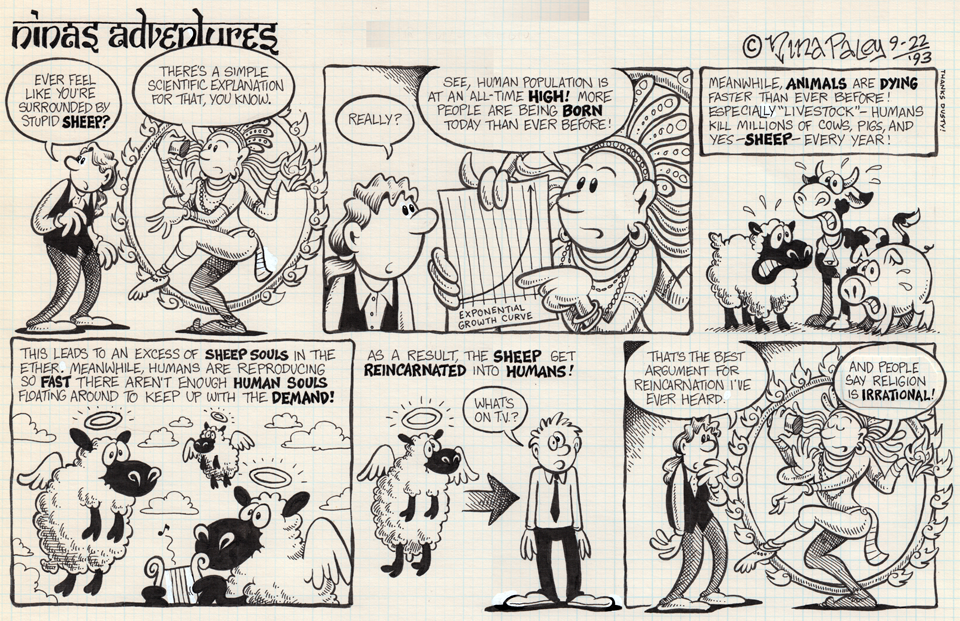
very good!
Nina’s work is great, and I am the proud recipient of Les’s award for non-breeding, which my wife gave me after my vasectomy decades ago.
Click to access msa.pdf
FABULOUS! Thank you! Stress R Us, population density stress that is! ( :))
These blogs will most probably always remain echo chambers, especially regarding overpopulation. I’ve been reading doomer pages since around 2009 and have seen very little interest emanating from commenters.
This disingenuous 2019 article illustrates why most people will continue to breed, as they’ve done since the ’70s when overpopulation was inserted into the forefront of educated humans’ awareness . . . and ultimately put aside as just “way too out there.”
[Quote] Consider the case of David Wallace-Wells. He is the author of the recent best-seller “Uninhabitable Earth,” which contains a sobering litany of the many ways the world’s ecosystems are under assault by global warming. He is also a new father. Although thoroughly steeped in the scientific literature of climate doom, he and his wife chose to have a baby last year because they retain a whiff of hope. “Further degradation isn’t inescapable, it is optional,” is what Wallace-Wells says he would aim to convey to his new daughter. [End Quote]
[Quote] What the BirthStrikers can legitimately claim is that they have made a sacrifice — by forswearing procreation, they authenticate their call for radical action on climate change. The point is taken, and their intentions are laudable. Still, there are other means to establish a moral advantage that do not diminish our humanity. [End Quote]
https://www.wbur.org/cognoscenti/2019/03/20/birthstrike-protesting-climate-change-frederick-hewett
David Wallace-Wells is another poster child for a reality denial case study, like the one I did on Eric Weinstein.
https://un-denial.com/2020/08/08/eric-weinstein-a-case-study-in-denial/
You watch Wallace-Wells’ stuff and he demonstrates a deep understanding of our overshoot predicament until the last 60 seconds of an hour presentation when he waves his hands and says good thing solar panels will save us.
It’s fascinating to observe denial in full plume.
Why would humans listen to a few relatively unknown bloggers about overpopulation, False Progress? Even climate scientists in the field don’t pay attention to that pesky idea.
This is a good article with a bunch of experts who do NOT discuss human overshoot or the immorality of breedin’ babies, except for two women:
Quote about Katharine Wilkinson: At a recent panel discussion, she recalls, she blurted out, “I have no child and I have one dog, and thank god he’ll be dead in 10 years.” Afterward, people asked Wilkinson if she truly believed that. “The truth is, I do,” she says. “And it’s only going to get more intense—the emotional nature of this work—as climate change happens and the necessary actions become more urgent.”
Quote about Priya Shukla: About a year ago, Shukla and her partner decided not to have children out of a concern about contributing to climate change. “I feel uncomfortable discussing this with colleagues,” she says. “It seems nihilistic.” She avoids conversations in which she might have to explain this decision, which further exacerbates her “sense of isolation.”
https://www.motherjones.com/environment/2019/07/weight-of-the-world-climate-change-scientist-grief/
Here’s another article that contains bullshit thinking by selfish parents:
Toney’s response was pragmatic: She would show her daughter where the candles were kept, and teach her to make her own light.
“I think, when a lot of people talk about climate change and having kids, they’re looking to the future and despairing,” [Kate Marvel] says. “For me, it makes me look at the present and be incredibly resolved.”
“These are the first beautiful days he is feeling: We walk out in the warm sun, we laugh together, we look at a tree,” Britton-Purdy says. “Yet the experience is infused with all of this harm, all of this damage that has made this beautiful, beautiful day that I’m having with him.” He sighs. “We really haven’t figured out, he and I, what to do with that yet.”
https://www.washingtonpost.com/lifestyle/on-parenting/how-climate-experts-think-about-raising-children-who-will-inherit-a-planet-in-crisis/2020/02/14/b4f3405a-4e69-11ea-b721-9f4cdc90bc1c_story.html
Relatively unknown is the status of eco-doomers until TSHTF and people scramble to see who was right all along, assuming the Internet even works then.
But I think “un-denial” could become a popular, simple slogan at some point. It would already make a good bumper sticker. Write it in beach sand, etc. That’s how the message could spread beyond these halls.
I think it’s much more likely when TSHTF that there’ll be a mob outside my home blaming me for ruining the optimism needed for economic growth, and for poisoning community morality by casting doubt on life after death. Luckily my blog stats say the mob size should be about 2 people.
Contraception is not “nihilistic” as it saves the planet for the grand diversity of life. Stress R Us
I really do wonder what thoughts and feelings people went through when genocides occurred throughout human history – not from those who wrote what their class and culture considered “real history” (learned way too much of that in school in the 50’s and 60’s). Oral histories of the Mayans who went through a climate/agricultural crisis that devastated their once “thriving” civilization with cities and towers, etc. Or that of the Native Peoples of North, Central, and South America who went through the devastation of diseases put upon them by European colonization (not to forget the outright physical destruction of communities and persons by those ‘enlightened’ colonizers!). The loss of so many millions of people must have had some very severe effects on the foundations of ‘denial’ that we descendants of the colonizers cannot fathom.
I’m re-reading Robert Sapolsky’s book Behave. It’s an amazingly rich and dense discussion of human behavior. Unfortunately he’s not aware of Varki’s MORT theory. Sapolsky discussed the 1994 Rwandan genocide:
That looks like black gold in that shovel.
The human brain can only be reviled at any attempt in retarding its primary energy gathering and reproductive mission. We can fear spiders and snakes, high places, closed-in places, aggressive members of another tribe etc. that may have killed us in the past, but climate change death and destruction is not one of the fears instilled by evolution and therefore it will not guide our actions. Not only do we have denial mechanisms to dampen fear inducing thoughts, past evolution has seen no reason to give us any hardwired fear of climate change.
The mortality rate of those giving birth prior to antibiotics and sterile consideration would be enough to prevent any female from getting pregnant. But of course the brain must overwhelm any fear of death and malformation with the visions of a beautiful bouncing baby. Evolution could never instill a fear of giving birth or having babies as it would be immediately, competitively extinguished by those that have absolutely no fear. Based upon observation and rationality much fear can be generated but the “it can never happen to me”denial defense can be employed.
This person seems to have the Mary P. Poppins (MPP) love of children and absolutely zero fear of destroying the biosphere.
I agree we should forget about breeding pairs ever seeing reality. What about grandparents too old to breed who worry about the future of their grandchildren? They could vote as a block and swing elections for population control laws. But they don’t. They don’t even talk about it.
That Mary P. Poppins 🙂 video made my skin crawl. I couldn’t watch more than a minute.
I think I read on Alice Friedman’s blog that less than 1 percent of people are truly rational. How do you break through to somebody like that? I don’t think seeing starving kids on the streets of Vancouver would even do it because she wouldn’t blame over population but something else.
“ The mortality rate of those giving birth prior to antibiotics and sterile consideration would be enough to prevent any female from getting pregnant. But of course the brain must overwhelm any fear of death and malformation with the visions of a beautiful bouncing baby. Evolution could never instill a fear of giving birth or having babies …”
I’ve been doing some family history. Great grandmothers and those further back, ended up dying in their 30’s after also losing half or more of their numerous children to illnesses, malnutrition etc.
I remember my grandmother ( born about 1900) saying that she, her sisters and friends secretly dreaded getting pregnant. In a time with no electricity, hot water, washing machines, refrigerators etc, life was horrendously busy and difficult for mothers of many children. Just think – continuous nappies, meal preparation and household duties often whilst breastfeeding and pregnant. And not having sufficient time to properly look after the needs of individual children.
Women wanting numerous babies wasn’t the problem. The problem was the greater male sex drive and the influence of the church – in telling women that producing babies and not resisting their husbands sexual needs was their duty and mission in life. It must have been highly distressing watching their sisters, female cousins and friends dying in childbirth and leaving so many orphans. There could be no ‘denial’ about it. Reliable contraception has made all the difference in women’s lives. Most still want children, but no more than two. Even in Moslem countries like Bangladesh, WHO programs have made contraception widely available and the current birthrate there averages 2 children per couple. ( Africa is still the major problem globally).
And, in developed countries, one in four women are now not having ANY children – most by choice. For those that do, they do not fear death in childbirth, which is now very rare and modern analgesia makes a huge difference compared to their female forbears. On that point too, many women ( including myself) opt for elective cesearean to avoid the pain, the tearing, the weakening of the bladder etc etc. Over 50% of mothers have cesearean sections in China, about 70% in countries like Brazil. Good on them , I say!
Too damn cute!
Excellent post, btw. 🙂
I’ve been critical lately of formally wise people for becoming unhinged.
It’s as if something’s in the air making people crazy.
Perhaps it’s the end of growth + looming economic crash + climate change in our face + Covid-19 + fact free politics?
Today was my turn to become unhinged. I spent the day spreading bullshit on (red) Russians (garlic).
Thanks for the Photo, you look a bit cold but determined.
Just to add my (probably not greatly wanted) two cents here are three links to not terribly long pieces that challenge Hardin’s thesis somewhat
The first is from Elinor Ostrom from 2008 – in the Palgrave Dictionary of Economics
https://dlc.dlib.indiana.edu/dlc/bitstream/handle/10535/5887/tragedy%20of%20the%20commons%20_%20Th…pdf?sequence=1
This is a piece of homework from a Danish student who also made a summary and had his own take on what he thought Hardin got right and did not get right, nice to see a young one doing analytical labour
http://faculty.wwu.edu/gmyers/esssa/Hardin.html
Quite a nice 50 year retrospective, I think. It presents a good overview as well as certain ‘conceptual mistakes that distort the usefulness of his case’ (p.14): https://halshs.archives-ouvertes.fr/halshs-02288208/document
Thank you.
The first paper argues that with communication, users of a shared resource can reach agreements to sustainably manage it. That’s encouraging and I have no reason to think they’re wrong on some non-global shared resources, like say for example a watershed. The critical global resources that do matter, namely the percent of the earth’s primary net productivity that should be allocated to the human species, and the amount of CO2 and pollution that our planet can absorb, clearly are not being effectively managed, despite decades of discussion. So even if in some cases the authors are right, they don’t change Hardin’s conclusions.
It’s not clear what point the 2nd author is making. He concludes “Blunt forms or coercion such as China’s one-child policy are likely to have negative unintended consequences.” That might be true but is shallow. For example, China’s one-child policy caused an imbalance of males, but that could have been corrected with financial incentives to have girls. Most importantly, the author fails to discuss how a massive die-off or nuclear war caused by human overshoot will not have much greater unintended consequences.
The 3rd paper has a very low idea to word ratio, and did not seem to discuss anything that matters, like human overshoot, climate change, and global pollution.
Thanks for taking the trouble I threw in the Danish student rather for fun and should not have!
On Elinor Ostrum maybe a lecture she gave in 2013 makes her point more forcefully
If you are busy you could focus on her presentation of Hardin’s variables around 30 minutes into the lecture.
Thanks again for your trouble.
Thank you. I watched the relevant section but do not understand how what she is saying translates to our most pressing problems like climate change and the depletion of resources needed globally like oil. Please explain.
Dear Rob,
As you are a very active seeker of knowledge, I assumed that just a few short and light references to Elinor Ostrom would have been sufficient to trigger your curiosity. Your summary of those, admittedly superficial texts, and your request for an explanation of what she has discovered or what stance she has contributed to dealing with ecological overshoot shows that I made a mistake. I should have introduced her using more serious sources.
Since the subject at hand was Hardin’s model I also assumed you would see the relevance of Dr. Ostrom’s work to your essay. It should have been possible, I thought, (clearly mistakenly) for you to see how her theoretical framing and practical approach derived from experience and experimentation, could be and in fact has been used to overcome the dilemma that Hardin posited and contribute a pathway for governing the commons that can be more socially and economically equitable as well as ecologically sound. Elinor Ostromand her husband Vincent’s research and project experiences and insights into the complexity of a natural resource such as a river, riparian basin or forest used by many actors simultaneously were innovative. As I understand it, their intellectual openness led them to start using complexity theory many years before almost anyone else in ecology or economic as a research and analytical avenue.
Often stakeholders with little ‘social capital’ must needs share resources with powerful stakeholders whose interests may not align with theirs in messy entangled situations.
In just such difficult situations, the Ostrom’s aimed from the start not only to widen theoretical understanding but to help groups of stakeholders of all types together with researchers from different disciplines, to identify ‘institutions for collective action’ which emerged from their understanding of the reality as a complex adaptive system.
Dr Ostrom is surprisingly poorly known, although it is quite easy to find out about her partly because she was the first woman to be awarded a Nobel prize for political/ecomonics (in 2009) focussed on shared natural resources (her term is common-pool resources – CPR). In her later work she called this a ‘multi-diagnostic approach for social ecological analysis’. Araral noted, ( https://www.dandc.eu/en/article/nobel-laureate-elinor-ostroms-contribution-develpment-theory-and-policies )
*Elinor Ostrom, whom the Nobel committee praised for her work on economic governance and especially for her work on common pool resources, is of immediate relevance to fighting poverty. The livelihoods of hundreds of millions of poor people in developing countries all over the world depend upon such common pool resources.*
One should be able to recognize that the identification of collective action for CPR (Ostrom notes that such action goes beyond the typical panaceas of either private ownership or government control) using communication as a major force is relevant in situations characterized by overshoot.
As Frischmann stated in a tribute essay in the year of her death Ostrom’s contributions are both substantive and methodological. He called them ‘lessons’
*1.**Substantive Lesson**: Embrace complexity and context—or simply, reality; avoid distorting reductionism and overstated gains from simple models. *
*2.**Methodological Lesson**: Embrace systematic, evolutionary learning through various interdisciplinary methodologies, theories, and empirical approaches, including case studies; be aware of, and try to avoid, path dependencies from disciplinary or methodological blinders. *
Fischmann remarks further:
*Ostrom’s contribution goes well beyond recognizing the limits of models and acknowledging what is theoretically feasible. While it is important to understand Ostrom’s concerns about model-induced myopia, it is equally if not more important to appreciate how she responded to those concerns. In Governing The Commons: The Evolution Of Institutions For Collective Action, for example, Ostrom (1990) explained how models such as the tragedy of the commons lead to myopic analysis of solutions and policy prescriptions. She suggested that neither the Leviathan (government regulation) nor Privatization (market regulation) is a panacea, and that model-induced myopia leads analysts to ignore alternative institutional arrangements that may be more effective tools for governance. But that is merely the beginning—literally, chapter one of the book (Ostrom, 1990). Ostrom was a scientist. Her response to concerns about model-induced myopia was to do the scientific work of systematically studying actual resource systems and governance institutions. *
*Over decades, Ostrom demonstrated through a rich empirical program how self-organized community governance often is an effective alternative for a wide range of shared resources. In some contexts, communities can and do solve tragedy of the commons, collective action, and other related resource management problems without (turning to) government regulation or market- driven allocation as a panacea. They do so in a variety of ways, often relying on informal mechanisms for coordinating behavior. Community solutions do not always succeed or always fail; they sometimes succeed and sometimes fail. “The temptation to seek out regulatory panaceas based on universal models, whether through private property, state action, or even notions of community, must be resisted in favor of a more nuanced approach” (Madison, Frischmann and Strandburg, 2010a: 676). Context matters. *
Frischmann, B.M. (2013). Two enduring lessons from Elinor Ostrom. *Journal of Institutional Economics *9 (4): 387 – 406. (open source University of Indiana)
Yes, I am convinced that nuance matters, that context matters, that taking complexity on board and not just giving lip service to it means that the researchers and stakeholders have to identify multiple layers, multiple variables, and engage with them from a plurality of epistemic traditions and multiple disciplines across multiple iterations. In addition the hard slog of drilling down into the data produces a depth of analysis seldom seen. It also makes the iterative interweaving of experimentation, observation and analysis possible and indeed quite natural. In order to do this and keep all actors involved in a fair way a quality of communication is required that goes beyond typical stakeholder consultation rounds. (One of my research mentors referred to the pitfalls of consultation as tending to mold the parties into ‘fakeholders’.)
If you have been in situations where you were involved as researcher, policy maker, or direct participant in projects for the hopefully sustainable and fairly distributed use of common resources you would know what Ostrom’s work can contribute. This is certainly the case where people with strongly differing interests and strongly unequal degrees of influence or power are at the table.
Let’s hope this third attempt of mine is the charmer, still I won’t be completely surprised if I fail again to either show you the value of Dr. Ostrom’s work or stimulate you to find out what that could be for yourself.
Regards,
Marion
Thank you for the additional info. I think we’re talking past each other. I had and have no reason to doubt your claim that Ostrom is a great woman and that she made a big contribution to commons management issues.
I’d like to understand how her ideas might help us with the existential threats of climate change and peak oil, two particularly nasty dimensions of human overshoot.
These are wicked problems because:
1) We must first acknowledge human overshoot, which is blocked by our genetic denial of unpleasant realities.
2) Any solution requires a contraction of population and/or consumption, both of which are opposed by our genetic MPP behavior.
3) Any stable solution will require rich countries and individuals to give up a lot more than poor countries and individuals, also opposed by our MPP behavior.
So I ask again, how can Ostrom’s ideas help us with climate change and peak oil?