I thought I was aware of pretty much everyone that studies oil depletion but somehow I missed Lars Larsen.
I am both impressed and alarmed by his work. I expect you will be too.
Fair warning, the book is more like a collection of essays and blog posts, with some repetition because Larsen frequently revisits his calculations from different perspectives, or with alternate data, because the results are so troubling that they demand re-checking.
Larsen is 40 years old, lives in Sweden, has recently retired from 18 years of blogging, and his final post on his new blog has a nice primer on overshoot and prepping with many links to information. It seems Larsen copes with overshoot and collapse awareness by believing Jesus will return.
This blogpost is the end point of almost 18 years of blogging, the crown that crowns it. I have put a lot of effort into it. And I want it to be the most important practical, spiritual and prophetic information I can ever offer.
A big love adventure lies before us, and it is about returning to a simpler lifestyle, forced by the deepening collapse of industrial civilization, a collapse which is deepening at an accelerated rate, i.e. exponentially.
In this blogpost, my last one, I have tried to help you make the coming transition easier.
To begin, I want to be clear that I am not an oil depletion expert. I have no first hand experience or research to validate the work of Larsen. It would have been better for an expert like Art Berman, Steve St. Angelo, or Hideaway to have reviewed this book, but given the importance of the topic, I will start the ball rolling and hope that more people look at Larsen’s work.
My small role in this world is as a dot connector of overshoot issues, with a unique focus on the MORT theory, which I think explains why we are collectively unable to see nor act wisely on our obvious overshoot predicament. I also like to think I am a reasonable judge of intelligence and integrity, which means I can sift wheat from chaff.
My sense is that Larsen is intelligent, with strong integrity, and has a lot of wheat.
Following are some aspects of Larsen’s work that impressed me.
Oil depletion analysis is complex and nuanced. It’s easy to get lost in the trees and not see the forest. Larsen focusses his analysis on what will likely be the most important trigger for collapse: the date when diesel becomes unavailable to import.
We can make do without some oil products like gasoline, however diesel is central to everything we need to survive because it powers the engines in our tractors, combines, trucks, trains, ships, and mining machines. Alice Friedemann elaborates on this in her excellent book When Trucks Stop Running.
There are many factors that affect oil supply and demand including technology, geopolitics, economic cycles, interest rates, inflation, wars, extreme weather, and pandemics. Larsen stays focused on the 3 most important forces driving oil depletion:
Total Supply (new supply minus depleted supply times % diesel): Wells deplete over time and are replaced with new wells. New wells tend to deplete faster and often produce unconventional oil which has a lower percentage of diesel. We are also consuming reserves much faster than we are discovering new reserves.
EROEI (Energy Returned on Energy Invested): It takes energy to extract energy. We first exploit the best quality reserves with the easiest to extract oil. Over time reserve quality declines which requires more energy for extraction leaving less energy for powering everything else in civilization.
Available Exports (Export Land Model): Oil producing countries tend to have strong economic growth which means over time they consume a larger percentage of the total oil they extract, which leaves less available for export.
Each of these 3 forces is now trending in a negative direction, and the rate of each is accelerating. Many experts discuss the implications of one of the three big forces, but Larsen is the first person I’ve seen try to calculate the combined effect of all 3 forces, which is of course what we care about, because the aggregate best predicts diesel availability over time.
Larsen acknowledges that the source data needed for his analysis is often confusing, incomplete, and inaccurate. He is transparent about this and does his best to validate data by cross checking and questioning assumptions.
Larsen is extremely well read and has clearly been studying oil depletion for a long time. His awareness of the work and opinions of other experts is encyclopedic. Experts he references include:
Jeffrey J. Brown
Gail Tverberg
Steve St. Angelo
Alice Friedemann
Art Berman
Kurt Cobb
Matt Simmons
Charles A.S. Hall
Richard Heinberg
Nate Hagens
Chris Martenson
Tim Morgan
Ron Patterson
Euan Mearns
Dennis Coyne
Andrii Zvorygin
John Peach
Larsen is open to criticism and revisits his calculations when challenged.
Larsen publicly corrects errors he has made in the past. This for me is a key sign of integrity which means we probably can trust him.
Larsen tries to avoid being an alarmist. He offers reasons that diesel might be available for a longer period of time. On the flip side, Larsen lists 10 forces that are not accounted for in his calculations and which might make reality worse than he predicts:
Wars like Ukraine and the Middle East.
Natural disasters like extreme weather events affecting offshore oil or coastal refineries.
Oil reserves are probably overstated by exporting countries.
Popping of the US shale oil bubble.
Steep decline of conventional oil due to advanced enhanced oil recovery (a bigger straw).
Insufficient capital for exploration due to green energy policies and/or economic recession.
Economic collapse due to insufficient growth and extreme debt.
Reserves left in the ground because rising extraction costs eventually exceed what consumers can afford to pay.
Peak oil awareness may cause exporting countries to leave oil in the ground for future generations.
Depleted exporting countries become importers thus accelerating the decline of diesel available to import.
Hideaway, in an un-Denial comment, added an 11th issue. Modern oil extraction technology is very complex with many global networked dependencies. Given the nature of remaining reserves, it is not possible to use older simpler technology. When disruptions to supply chains begin they may cascade to accelerate the decline of oil supply.
A few comments on Jeffery J. Brown’s export land model (ELM). For those unfamiliar, the ELM says that export supply falls faster than total supply because oil exporters grow and therefore consume over time a greater share of the surplus oil they have available to export. I remember the ELM was widely discussed in the early days of peak oil. Now I rarely hear anyone like Berman, Hagens, Tverberg, Friedemann, Martenson, etc. discuss it. I wonder why? It seems like a very important model for predicting depletion of exports.
Larsen asks the same question about the ELM. He also ponders the same type of questions that motivated me to create un-Denial. How is it possible that we do not see or discuss the most important issues? It seems Larsen has not yet discovered Dr. Ajit Varki’s MORT theory which provides an answer.
It’s very strange that people do not focus more on the end of oil exports than on peak oil and the decline of overall oil, when the fact is that the end of oil exports comes way before the end of overall oil.
Jeffrey J. Brown was the one who brought the issue of oil exports to the focus of many peakoilers and collapsologists ten, fifteen years ago. If you google for recent texts by him or interviews with him, you don’t find much, the latest by him or about him is only one article on Forbes in October 2021,”The Road To Clean Energy Is Messier Than We Thought”, written by Loren Steffy, UH Energy Scholar (not easy to find if you google for it), and after that you find on google some comments on http://www.oilprice.com from the beginning of 2018, and one interview from 2017 at the Peak Prosperity blog, see here.
After 2021 there is, basically, a deafening silence around him and from him. Why? Shouldn’t he become more and more famous the closer we get to the end of the oil export market? Shouldn’t all countries calculate oil exports and imports, so we can plan for the end of the oil age? So we could degrow in a controlled way, collapse in a controlled way, not in a chaotic way? This silence and disinterest is for me incredible, unfathomable stupidity. I can’t almost believe it’s true, so strange it is.
The same one could say about the whole issue of calculating oil exports according to the Export Land Model, it has just vanished from the scene, you don’t find anything about it since 2017 (this is still true on June 17, 2024, later comment). In fact, rationing the remaining oil, yes all the remaining fossil energy, is maybe the single most important thing to do in the whole world right now. And Peak Oil is the single most important event in modern time, or, maybe Peak Oil Exports (which happened in 2005, google “peak oil exports happened in 2005” and you only find one article about it, or, it is not even an article, it is a comment to an article. I wrote this in the end of 2022) is even more important, but it is linked to Peak Oil, which also happened at the same time, if you only count conventional oil.
We are walking blind and deaf over the “Energy Cliff”. Not even the current energy crisis and the record high energy prices are able to get us to explore oil exports according to the Export Land Model on the internet.
It would have been nice to know how much time we have left to live as a civilization, yes, even more as individuals. This can be best known by calculating the remaining volume of oil exports, if our country doesn’t produce any oil itself, and if we produce oil ourselves, by also calculating our remaining oil reserves and the volume of probable future oil discoveries.
If you are a dying cancer patient, you would like your physician to estimate how long you have left to live, so you can plan accordingly. In fact, it is the duty of every physician to try to figure this out and tell the results to the patient. And yet we usually do not calculate the time civilization and we ourselves have left. Shouldn’t we be interested in knowing this?
I noticed one assumption that Larsen makes that he never explains. He assumes China and India will be first in line for oil exports, and because they are large rapidly growing countries, many smaller oil importing countries will be pushed off the table and forced to collapse first. Perhaps their military might will place them first in line? Another possible explanation is that China and India are low cost manufacturers of necessities which means they will have something of value to trade for scarce oil unlike countries like UK/France/Germany/Japan etc., which after SHTF, may have nothing affordable of value to offer for oil so may not be able to import any oil.
Hideaway pointed out that if the shale bubble pops the US will probably try to use its military power to push aside China and India. This may explain the recent hostility to China by Europe/US with policies in essence to “keep China down”. This may also explain the insanity of NATO’s opposition to Russia’s reasonable security concerns. One can imagine much risk of nuclear war in the future. Starving citizens create motivated leaders.
Larsen pauses to ask if the conclusions of his calculations pass the smell test. Often he admits his conclusions seem too dire given day to day life, and then he rechecks, or proposes possible reasons reality may be less bad than he predicts.
I have done many different calculations, from different angles and with different parameters, to try to validate my results, and all calculations confirm my results above, more or less, all point in the same direction. I have counted them, and it is eleven different sets of calculations, all pointing in the same direction. Regarding the end of “ANE” (“available net ex-ports”) one say it will happen 2023, four say 2024, seven say 2025, six say 2026, four say 2027, one say 2028 and one say around 2030 (my starting point in the beginning of the book). “ANE” means global net oil exports minus the combined net oil imports of China and India.
I have serious trouble believing in my own calculations. They feel too radical. Maybe there is something wrong with the data or with my calculations (but I cannot calculate otherwise, I’m not an expert in math). Therefore I think 2027 is the most likely time for the end of “ANE” globally.
It is almost not possible to really believe that global oil exports are declining exponentially right now (i.e. at an accelerated rate of decline, which means that the decline goes faster and faster with time), as I have shown in this book (because almost no one talks about it, we do not want it to be true). This means that the collapse of civilization will also be exponential, going faster and faster. It means that it is exponential right now. Who can really fathom this fact? We have to be really deep into collapse news to be able to feel the realism of this. And I am. But I have still problems believing it, because I don’t see it happening in Stockholm, where I live. It happens elsewhere, though, to some degree.
This is not reflected on the site https://oilprice.com/, the most important website of the global oil industry. It is never mentioned. Even Peak Oil is seldom mentioned there. Almost only when Gail Tverberg is allowed to post the blogposts from her own blog there, which happens about once a month, the reality of Peak Oil is coming through. I follow this site regularly.
This is really bad for our adaptation to a post carbon future, which has to come, it is a mathematical certainty. It is also a mathematical certainty that the collapse will be exponential.
Larsen’s conclusion is that 2027 is the most probable year that diesel imports will become unavailable to all countries except China and India.
Diesel shortages will break everything that matters. Given our extreme $88 trillion global debt, complex global supply chains, and 12,100 nuclear weapons, it is impossible to predict how the collapse will play out.
But I expect food will be at the epicenter.
In about 3 years from now.
I wonder if this explains why most leaders seem to be losing their minds?
Ecologists Eric R. Pianka (University of Texas) and Laurie J. Vitt (University of Oklahoma) provide a scientific summary of the overpopulation crisis facing humanity and itemize its many consequences, including climate change (global warming), conservation biology, economic systems, energy and resource shortages, human instincts, immigration conflicts, politics, pollution, poverty, technological problems, and solutions needed. Their underlying thesis is that denial and delusion work synergistically to undermine our ability to confront these serious issues, and unless we undertake proactive measures now, overpopulation and its impact on resource competition and climate change will ultimately lead to the collapse of civilization.
Authors’ Overview
In Road to Survival 70 years ago, William Vogt tried to call attention to the human overpopulation crisis, but failed. Paul Ehrlich raised this issue again 20 years later but was also widely ignored. We wish to re-open this long overdue and much needed discussion about population, a toxic topic that politicians globally avoid. We have written a book “Our One and Only Spaceship:Denial, Delusion and the Population Crisis.” We are two well-known ecologists Eric R. Pianka (University of Texas) and Laurie J. Vitt (University of Oklahoma).
Our book is based on a great deal of research that we have conducted into the topic and on a course that Pianka taught. http://www.zo.utexas.edu/courses/THOC/
We have edited and written books together, both scientific and semi-popular. Using fact-based analyses, we make the case that human population size and growth is the greatest threat to human survival, and that most if not every major global problem (including spread of AIDS and other communicable diseases, wars and other conflicts, climate change and in particular global warming, food water and energy shortages, poverty, political unrest, pollution, extinctions, etc.) are all direct results of overpopulation. Our birth rate far exceeds our death rate and the current global population of 7.7 billion in itself is unsustainable even without additional growth. This has put us on a collision course with disaster. It is perilous to remain in denial about all of the threats emanating from overpopulation.
As we become ever more and more desperate in trying to provide resources necessary to meet critical demands, our environmental problems will only worsen as we continue to deregulate thus allowing increased exploitation of dwindling natural resources. The thin skin of life on our planet is seriously threatened by the actions of a single species, Homo sapiens. Remarkably, even with our putative high intelligence, we don’t seem to be able to even admit that the problem is population such that discussions can begin on how to stop population growth. One thing is certain, it must and will stop—either we can do it through a series of logical steps (educating the public, coming up with a global plan, implementing the plan), or it will occur as the result of a combination of wars over resources, spread of infectious disease, or even famine. Such a discussion will have a greater impact on human survival than any of the many news stories currently dominating our media.
Overpopulation has only one outcome, and we have all seen it when mold takes over an orange—unlike mold growing on an orange, we do not have another “orange” to which we can send our offspring (There is no planet B). We are fully aware that discussions on population are “politically incorrect” and will be extremely sensitive to many people (especially religious groups) who take up arms in response to any discussion to limit reproduction. The ultimate biological reason for this response is simply that our genes control much of what we do, and reproduction is the currency of future generations. A more proximate reason is simply that our hormonal systems kick in when we reach puberty and all reason is washed away in the maelstrom of hormonal activity pushing us to reproduce. We must do something — ignoring our pressing problem and expecting it to go away is like hoping in vain to win the mega-lottery.
AJ’s Review
This is my brief review of the book, “Our One and Only Spaceship” subtitled “Denial, Delusion and the Population Crisis” written by Drs. Eric Pianka and Laurie Vitt. Copyright 2019.
I came across this book through one of the comments on your website. Since it was one of the few books that concerned population (in the title) I decided to buy it and read it.
The authors are ecologists. Dr. Eric Pianka is a Professor at UT Austin and Dr. Laurie Vitt is a Professor Emeritus at the University of Oklahoma, Norman. The forward was by Paul & Anne Ehrlich.
I overall liked the book. My feeling is that it is somewhat like Tom Murphy’s book and was intended for an intro college course in ecology/sustainability (without the math). That said I never had the impression that the authors were talking down to the reader.
There is some hope in this book. “This generation will be the last with decision-making powers to save our spaceship for all future earth-lings, including human beings.” But as the authors state in the Prologue, “The problem can be easily framed in three words, population, population, and population.” Human civilization is in overshoot and that we in the west are living far beyond the carrying capacity of the planet is covered in detail. So, the problem is both overshoot and population.
There is an acknowledgement that denial and optimism bias are part of our problem. But, I think that the authors are also in a little denial, “If humans are to survive into the next century, we need to reduce population growth, convert to renewable energy sources, use much less energy overall, and develop a plan for the future this is based on fact and not on fiction.” Their opinion is that we can maintain much of our technology (through “green” tech transition) and slowly reduce population with education and enlightenment. I don’t know if they really believe this or like Tom Murphy need to give students something positive to live for in the face of a depressing predicament.
Don’t get me wrong. This book touched all the right notes and I only disagreed with a tiny bit of it. I thought that the preface/into to the last chapter was perhaps the best quote I have seen on our place in the universe (other than Rob’s quote):
“Man did not have forever to harness the forces of the sun and stars. The Sun was an elderly light, long past the turbulent heat of youth, and would some day join the senile class of once-luminiferous bodies. In some incredibly remote time a chance collision might blow it up again into incandescent gas and start a new local cosmic cycle, but of man there would be no trace. In Balfours’s terms, he “will go down into the pit, and all his thoughts will perish. The uneasy consciousness, which in this obscure corner has for a brief space broken the contented silence of the universe, will be at rest. Matter will know itself no longer. ‘Imperishable monuments’ and ‘immortal deeds,’ death itself, and love stronger than death, will be as though they had never been. Nor will anything that IS be better or worse for all that labour, genius, devotion and suffering of man have striven through countless generation to effect.” –Homer Smith (1952) “Man and His Gods” and Earl Balfour (1895) “Foundations of Belief”
Nate Hagens has published a new book on the predicament that fossil energy consumption and depletion, and our denial of this reality, have created for life on this planet.
A skim suggests the book will be excellent and I hope to write a review after reading it.
I observe there is no mention of Varki’s Mind Over Reality Transition (MORT) theory which is sad because MORT provides an evolutionary foundation for the denial that Nate discusses, and explains why only one species has emerged with the intelligence to exploit fossil energy.
Denial of our genetic tendency to deny reality is apparently the strongest form of denial, even among the few of us that are aware of the human predicament.
You can read Nate’s book for free and purchase a copy here:
A bestselling author, neuroscientist, and computer engineer unveils a theory of intelligence that will revolutionize our understanding of the brain and the future of AI.
For all of neuroscience’s advances, we’ve made little progress on its biggest question: How do simple cells in the brain create intelligence?
Jeff Hawkins and his team discovered that the brain uses maplike structures to build a model of the world-not just one model, but hundreds of thousands of models of everything we know. This discovery allows Hawkins to answer important questions about how we perceive the world, why we have a sense of self, and the origin of high-level thought.
A Thousand Brains heralds a revolution in the understanding of intelligence. It is a big-think book, in every sense of the word.
I’ve followed Hawkins for many years and he’s one of my favorite neuroscience researchers. He started as an electrical engineer and created in 1996 the groundbreaking handheld PalmPilot (which I owned 🙂 ), and then switched careers to his passion of figuring out how the brain works.
In his book he proposes a new theoretical framework for how intelligence works. I think he’s on to something important. So does Richard Dawkins who wrote the forward and compares the book to Charles Darwin’s On the Origin of Species.
I see an opportunity to build on Hawkins’ intelligence framework to push Varki’s MORT theory forward by refining why and what we deny, and how denial is implemented in the brain. Some of my still rough ideas are presented at the end of this essay.
There’s a second aspect of Hawkins’ book that is also interesting.
After presenting his new theory on intelligence, Hawkins spends the last half of the book explaining how our old brain behaviors and false beliefs (aka denial) threaten the survival of our species, and he proposes several ways we might avoid these threats.
He’s clearly worried and knows we are in trouble.
Yet when discussing the threats to our species he is blind to the biggest, imminent, and certain threat we face: fossil energy depletion. Hawkins, like most polymaths, can’t see that the technology he loves, was created by, and totally depends on, rapidly depleting non-renewable resources.
So we have a world expert on how and why our brain creates false beliefs, that can’t see his own false beliefs.
We could ask for no better evidence that MORT is true!
But wait, there’s more.
In the last chapters Hawkins obsesses over inventing a lasting means for our species to signal to other life in the universe that human intelligence once existed. As I was reading this I kept thinking, what the hell are you going on about? The odds are extremely low that other intelligent life will ever see our signaling satellites, and who the hell cares if they do? Then a light went on. His signal is a high tech version of an Egyptian pyramid, and is his brain’s mechanism for denying death.
So how could it get any better?
a well written enjoyable book
with an important new theory
on the most interesting aspect of a unique species
that may push forward Varki’s MORT theory on why we exist
by a brilliant polymath
that is blinded by the same denial that created his species
Following is a brief recapitulation of Hawkins’ cortical column framework for intelligence integrated with my musings on how it might be used to clarify and focus Varki’s MORT theory.
This hypothesis will be revised, possibly substantially, after I complete a 2nd more careful reading of Hawkins’ book and published papers, which I’ve just started. I’m also hoping to incorporate criticism from Dr. Varki which may improve or kill my ideas.
Downvoting the Cortical Column Death Model to Breach the Extended Theory of Mind Barrier
Version 1.2, April 17, 2021
Note: For the sake of brevity, every occurrence of “not die” should be read as “not die until viable offspring are produced”.
Genes evolve and collaborate to create bodies.
Bodies exist to replicate genes.
A body must not die to achieve its purpose of replicating genes.
The brain exists to help the body by choosing the best action to not die for a given set of sensory inputs.
The old brain uses simple static models to directly cause actions to not die.
The neocortex uses more complex learned models to indirectly cause actions to not die by requesting the old brain to execute actions.
Learning is moving: the neocortex learns by moving senses around the subject to create (up to about 1000) reference frame models.
Thinking is moving: concepts without physical form, like mathematics, are learned by moving between models to create new reference frame models.
Models have redundancy which makes knowledge more resilient and repurposable.
Models are stored in cortical columns.
The neocortex is composed of many nearly identical cortical columns.
Senses (and outputs from other models) are evaluated for matches by models.
Models collaborate by voting to decide our conscious reality.
The agreed reality is used by other models to select the best action to not die.
Evolution increases the number of cortical columns in species that benefit from more intelligence to not die.
Social species have the most cortical columns because modeling social relationships is hard.
The human neocortex has about 150,000 cortical columns.
There are two important thresholds on the continuum of increasing social intelligence.
“Theory of mind” is the threshold where a brain learns a model of another brain, and that model includes an understanding that the other brain can die.
“Extended theory of mind” is the threshold where a brain learns that its model of another brain also models itself, and that it can also die.
The extended theory of mind threshold may be difficult for evolution to cross, because it has happened only once on this planet.
A model that predicts possible death from injury and certain death from old age results in fewer actions to not die.
Fewer actions to not die is called depression.
Genes for an extended theory of mind thus do not persist.
To break through the barrier, evolution requires a mechanism to prevent the learned death model from evaluating true.
A mechanism consistent with the archeological record was to learn a model for life after death (aka God) which downvotes the death model thus continuing the actions to not die.
Modern Implications of the Death Model
Climate change acceptance combined with the common false belief that renewable energy can replace depleting non-renewable fossil energy, and the common false belief that technology can remove sufficient CO2 from the atmosphere, does not trigger the death model, and the false beliefs cause our species to take actions that worsen our overshoot predicament.
Awareness of human overshoot and its implications are present in less than 0.01% of humans, including most highly educated polymaths, because it triggers the death model. Most people deny overshoot with false beliefs that non-renewable resources are abundant.
Physicist Tom Murphy is one of the brightest and most articulate people in the overshoot awareness space.
A decade ago Murphy wrote frequently for a few years on his blog “Do the Math” where he explored the energy opportunities and constraints for powering our civilization. Then, having said what he wanted to say, he went silent.
Here is some of Murphy’s work that I’ve posted in the past which includes my all time favorite talk on limits to growth:
After a long hiatus from teaching the general education energy course at UCSD—due mostly to a heavy administrative role for five years—I picked it up again for Winter quarter 2020. I had always been discontented when it came to textbook choices: my sense was that they tended to play it safe to avoid the risk of being provocative. But provocative may be what our situation calls for! I had been inspired by David MacKay’s fabulous and quantitatively rich Sustainability: Without the Hot Air, but its focus on the UK and not-quite-textbook format kept me from adopting it for the classroom.
So I set out to capture key elements of Do the Math in a textbook for the Winter 2020 class, following a somewhat similar trajectory: growth limits; fossil fuels and climate change; alternative energy capabilities and pros/cons; concluding with a dose of human factors and personal adaptation strategies.
Abstract
Where is humanity going? How realistic is a future of fusion and space colonies? What constraints are imposed by physics, by resource availability, and by human psychology? Are default expectations grounded in reality?
This textbook, written for a general-education audience, aims to address these questions without either the hype or the indifference typical of many books. The message throughout is that humanity faces a broad sweep of foundational problems as we inevitably transition away from fossil fuels and confront planetary limits in a host of unprecedented ways—a shift whose scale and probable rapidity offers little historical guidance.
Salvaging a decent future requires keen awareness, quantitative assessment, deliberate preventive action, and—above all—recognition that prevailing assumptions about human identity and destiny have been cruelly misshapen by the profoundly unsustainable trajectory of the last 150 years. The goal is to shake off unfounded and unexamined expectations, while elucidating the relevant physics and encouraging greater facility in quantitative reasoning.
After addressing limits to growth, population dynamics, uncooperative space environments, and the current fossil underpinnings of modern civilization, various sources of alternative energy are considered in detail— assessing how they stack up against each other, and which show the greatest potential. Following this is an exploration of systemic human impediments to effective and timely responses, capped by guidelines for individual adaptations resulting in reduced energy and material demands on the planet’s groaning capacity. Appendices provide refreshers on math and chemistry, as well as supplementary material of potential interest relating to cosmology, electric transportation, and an evolutionary perspective on humanity’s place in nature.
I skimmed the book to assess its tone. Murphy is trying to strike a balance between being honest about the difficulties we face, while not saying that civilization collapse is a certainty, and offers some constructive suggestions for how his young students might respond. It’s a similar (and understandable) strategy that Nate Hagens, another well known overshoot teacher has taken.
Here are a few excerpts filled with wise words from Murphy’s book:
19.1 No Master Plan
The “adults” of this world have not established a global plan for peace and prosperity. This has perhaps worked okay so far: a plan hasn’t been necessary. But as the world changes from an “empty” state in which humans were a small part of the planet with little influence to a new “full” regime where human impacts are many and global in scale, perhaps the “no plan” approach is the wrong framework going forward.
19.2 No Prospects for a Plan
Not only do we lack a plan for how to live within planetary limits, we may not even have the capacity to arrive at a consensus long-term plan. Even within a country, it can be hard to converge on a plan for alternative energy, a different economic model, a conservation plan for natural resources, and possibly even different political structures. These can represent extremely big changes. Political polarization leaves little room for united political action. The powerful and wealthy have little interest in substantial structural changes that may imperil their current status. And given peoples’ reluctance to embrace austerity and take personal responsibility for their actions, it is hard to understand why a politician in a democracy would feel much political pressure to make long-term decisions that may result in short-term hardship—real or perceived.
Globally, the prospects may be even worse: competition between countries stymies collective decision-making. The leaders of a country are charged with optimizing the prosperity of their own country—not that of the whole world, and even less Earth’s ecosystems. If a number of countries did act in the global interest, perhaps by voluntarily reducing their fossil fuel purchases in an effort to reduce global fossil fuel use, it stands to reason that other countries may take advantage of the resulting price drops to acquire more fossil fuels than they would have otherwise—defeating the original purpose. Then the participating countries will feel that they self-penalized for no good reason. Unless all relevant nations are on board and execute a plan, it will be hard to succeed at global initiatives. The great human experiment has never before faced this daunting a set of global, inter-related problems. The lack of a global authority to whom countries must answer may make global challenges almost impossible to mitigate. Right now, it is a free-for-all, sort-of like 200 kids lacking any adult supervision.
20.1 Awareness
How many people do you know who are concerned about a legitimate threat of collapse of our civilization? It is an extreme outcome, and one without modern precedent. It seems like a fringe, alarmist position that is uncomfortable to even talk about in respectable company. Yet the evidence on the ground points to many real concerns:
1. The earth has never had to accommodate 8 billion people at this level of resource demand;
2. Humankind has never run out of a resource as vital as fossil fuels;
3. Humans have never until now altered the atmosphere to the point of changing the planet’s thermal equilibrium;
4. We have never before witnessed species extinction at this rate, or seen such dramatic changes to wild spaces and to the ocean.
20.3.1 Overall Framing
In the absence of a major shift in public attitudes toward energy and resource usage, motivated individuals can control their own footprints via personal decisions. This can be a fraught landscape, as some people may try to out-woke each other and others will resist any notion of giving up freedoms or comforts—only exacerbated by a sense of righteous alienation from the “do-gooders.”
Some basic guidelines on effective adaptation:
1. Choose actions based on some analysis of impact: don’t bother with superficial stuff, even if it’s trendy.
2. Don’t simply follow a list of actions or impart a list on others: choose a more personalized adventure based on quantitative assessment.
3. Avoid showing off. It is almost better to treat personal actions as secrets. Others may simply notice those choices and ask about them, rather than you bringing them up.
4. Resist the impulse to ask: “what should I buy to signal that I’m environmentally responsible?” Consumerism and conspicuous consumption are a large part of the problem. Buying new stuff is perhaps counterproductive and may not be the best path.
5. Be flexible. Allow deviations. Rigid adherence makes life more difficult and might inconvenience others, which can be an unwelcome imposition. Such behavior makes your choices less palatable to others, and therefore less likely to be adopted or replicated.
6. Somewhat related to the last point, chill out a bit. Every corner of your life does not have to be perfect. We live in a deeply imperfect world, so that exercising a 30% footprint compared to average is pretty darned good, and not that much different than a “more perfect” 25%. Doing a few big things means more than doing a lot of little things that may drive you (and others) crazy.
7. In the end, it has to matter to you what you’re doing and why. It’s not for the benefit of others.
20.4 Values Shifts
In the end, a bold reformulation of the human approach to living on this planet will only succeed if societal values change from where they are now. Imagine if the following activities were frowned upon—found distasteful and against social norms:
1. keeping a house warm enough in winter to wear shorts inside;
2. keeping a house so cool in summer that people’s feet get cold;
3. having 5 cars in an oversized garage;
4. accumulating enough air miles to be in a special “elite” club;
5. taking frequent, long, hot showers;
6. using a clothes dryer during a non-rainy period;
7. having a constant stream of delivery vehicles arrive at the door;
8. a full waste bin each week marking high consumption;
9. having a high-energy-demand diet (frequent meat consumption);
10. upgrading a serviceable appliance, disposing of the old;
11. wasteful lighting.
At present, many of these activities connote success and are part of a culture of “conspicuous consumption.” If such things ran counter to the sensibilities of the community, the behaviors would no longer carry social value and would be abandoned. The social norms in some Scandinavian countries praise egalitarianism and find public displays of being “better” or of having more money/stuff to be in poor taste. Abandonment of consumerist norms could possibly work, but only if it stems from a genuine understanding of the negative consequences. If curtailment of resource-heavy activities is imposed by some authority or is otherwise reluctantly adopted, it will not be as likely to transform societal values.
20.6 Upshot on Strategies
No one can know what fate awaits us, or control the timing of whatever unfolds. But individuals can take matters into their own hands and adopt practices that are more likely to be compatible with a future defined by reduced resource availability. We can learn to communicate future concerns constructively, with out being required to paint an artificial picture of hope. Our actions and choices, even if not showcased, can serve as inspiration for others—or at least can be personally rewarding as an impactful adventure. Quantitative assessment of energy and resource demands empowers individuals to make personal choices carrying large impacts. Reductions of factors of 2 and 3 and 4 are not out of reach. Maybe the world does not need 18 TW to be happy. Maybe we don’t have to work so hard to maintain a peaceful and rewarding lifestyle once growth is not the driver. Maybe we can re-learn how to adapt to the seasons and be fulfilled by a more intimate connection with nature. The value of psychological preparedness should not underestimated. By staring unblinking into the abyss, we are ready to cope with disruption, should it come. And if it never does in our lifetimes, what loss do we really suffer if we have chosen our adventure and lived our personal values?
In this sense, the best adaptation comes in the form of a mental shift. Letting go of humanity’s self-image as a growth juggernaut, and finding an “off-ramp” to a more rewarding lifestyle in close partnership with nature is the main goal. Continuing the freeway metaphor, the current path has us hurtling forward to certain involuntary termination of growth (a dead end, or cliff, or brick wall), very probably resulting in overshoot and/or crash.
The guidelines provided in this chapter for quantifying and reducing resource demands then simply become the initial outward expressions of this fresh vision. Ignore the potentially counterproductive allure of fusion, teleportation, and warp drive. Embrace instead a humbler, slower, more feasible future that stresses natural harmony over conquest and celebrates life in all forms—while preserving and advancing the knowledge and understanding of the universe we have worked so hard to achieve. Picture a future citizen of this happier world looking back at the present age as embarrassingly misguided and inexplicably delusional. Earth is a partner, not a possession to be exploited. Figuratively throwing Earth under the bus precludes our own chances for long-term success. A common phrasing of this sentiment is that humans are a part of nature, not apart from nature. Let’s not lose the path in a flight of fossil-fueled fantasy.
March 22, 2021 Update: Tom Murphy wrote a post highlighting the ideas from his book that will be new for Do the Math readers, and asking for our help to promote his free book.
Last week, in the first Do the Math post in years, I kept the post brief, only pointing out the new textbook: Energy and Human Ambitions on a Finite Planet, and giving a brief account of the backstory.
In this post, I take a bit more time to introduce new elements in the book that Do the Math readers have not seen represented in some form in earlier posts. In other words: what new insights or calculations lurk within the book?
The following is organized into three sections. The first takes a brief tour of the book, pointing out large, new blocks that are not already covered by Do the Math in some form. The second highlights the results of new calculations or figures that bring new context to our understanding. Finally, I summarize some of the new big-picture framing that emerges in the book.
Rather than laboriously inserting associated graphics into this post, my intent is that you treat this as a companion to be used side-by-side with the downloadable PDF of the book. References are to sections, figures, boxes, etc. rather than page numbers, which vary between electronic and print forms. So go ahead and get a version of the PDF up, and let’s jump in…
Brief Tour of New Content
The Preface may be worth reading for overall framing and motivation. The middle part about student learning and approach to mathematics/problems might not be as worthwhile, but the beginning and end are likely of interest.
The first four chapters attempt to lay out constraints on growth, initially hewing closely to the first two Do the Math posts on Galactic Scale Energy and Can Economic Growth Last. Chapter 3 on population echoes some points in The Real Population Problem, but adds substantial analysis of the demographic transition. I felt this was an important addition because many academics look to this mechanism to “solve” the population problem. What I point out is that the transition is a double-whammy for planetary resources: even though the result is zero-growth, the road to that point involves a population surge and increasing resource usage per capita. More people multiplied by a higher per-capita resource use is bad news for resource constraints. The dream, therefore, has a nightmarish element that might be neglected by many because demographic transitions of the past were not constrained in this way and seemed to be very positive, on balance. A recurring message: the highly abnormal recent past offers poor guidance to the future. Finally, Chapter 4 echoes the popular Why Not Space post, closing off this exit—or at least prompting the invested believers to cast the book aside and waste their time in a manner more to their liking.
Chapter 5 is a dry one on units, and does not exist on Do the Math except in a static page called Useful Energy Relations. Chapter 6 consolidates several posts on thermal energy and heat pumps. Chapter 7 is basically new, as a snapshot of U.S. and global energy and plots of recent trends.
Elements of Chapter 8 on fossil fuels can be found among the Do the Math posts—especially those on peak oil. But no overview of fossil fuels really existed on the blog. Chapter 9 on climate change is similar to the Recipe for Climate Change in Two Easy Steps, but is considerably expanded to detail the expected impact on temperature, explore limiting-case scenarios for the future, and delve into the thermal requirements for heating the ocean and melting ice.
Chapter 10 provides an overview of Earth’s energy budget and introduces the alternative and renewable energy options. This short chapter has no direct analog in Do the Math.
The heart of the book covers topics that do not change much over time: technologies for harnessing alternative energy. Prices might change, but the fundamentals tend not to. Thus, Chapters 11 through 16 largely echo Do the Math content. Note that the writing itself is new, and has benefited from extensive student feedback to improve clarity and accessibility. So it’s not a cut-and-paste job, but the overall take-aways are going to be familiar to Do the Math readers. Chapter 17 is the book’s version of The Alternative Energy Matrix, and is the closest thing to cut-and-paste in the book, being billed as a slightly edited reproduction of an existing chapter in the State of the World 2013 book.
The two main changes in the alternative energy chapters have to do with solar prices going down (now at under $3/Watt for residential and $1/Watt for utility-scale installations; the panels themselves being $0.50/Watt) and new recommendations for wind-farm turbine spacing, lowering the estimated power per land area available. I also added state-by-state maps for hydroelectricity, wind, and solar photovoltaic utilization in the U.S., for four different attributes (total power, power per area, power per person, and capacity factor).
The last three chapters depart the most from Do the Math content, although containing familiar elements like an exploration of personality types and a description of the Energy Trap. Chapter 20 bears some resemblance to posts on household energy and dietary choices. But the packaging may be different enough that it does not feel like repetition of Do the Math.
The Epilogue is completely new, and likely of interest to Do the Math readers.
Appendix D is the most thoughtful Appendix. Of greatest interest will be D.3 on electric transportation, D.5 on the long view of human success, and D.6 on an evolutionary perspective regarding human intelligence and how that may or may not mesh well in the natural world.
Highlights of New Results
The following tidbits are arranged in chronological order, and for the sake of brevity only represent the more thought-provoking additions.
In Chapter 2, Figure 2.3 on lighting efficiency progress surprised me in that the same 2.3% growth rate adopted for Chapters 1 and 2 on growth of energy fits the lighting history rather well. If the trend continues, we reach theoretical limits well before century’s end.
Chapter 3 has one new development and one new presentation of interest. The development is the recognition that the population surge associated with a demographic transition is proportional to the exponential of the change in birth/death rate times the lag between declining death rate and declining birth rate (Figure 3.16). The factor can easily more than double the pre-transition population. The new presentation is in Figure 3.17, exposing how preposterous the “dream” scenario looks of advancing a growing population to “western” energy standards by the year 2100. Substances that facilitate such delusions are usually illegal.
The only thing I’ll say about Chapter 4 here is that I planted an (accurate) Easter egg in Figure 4.2—only applicable to the electronic version.
I was surprised by Figure 7.9, showing the U.S. as a literal super-power (as measured in Watts) in the mid-twentieth century—using more than 80% of global natural gas and over 70% of global petroleum. I don’t think it’s a coincidence that some Americans long to return to these “glory” years (not at all glorious for less privileged individuals, it should be noted). The mistake is thinking that it’s a matter of choice. America’s dominant role in the world had a resource foundation, and that ship has sailed. It’s not a matter of politics: it’s physics, and anger won’t solve it.
Figure 8.8 made an impression on me as well. A simple calculation based on discovery and consumption of conventional oil, as presented in Figure 8.7, provides a measure of how many years appear to remain in the resource. Simply dividing unconsumed reserves by current consumption gives a timescale, and this can be tracked as a function of time as new discoveries accumulate and consumption rate increases. The startling result is that the predicted endpoint has not budged from around the year 2050 for about four decades! I caution readers not to take this literally to mean that oil runs out in 2050. First, the plot only applies to conventional oil reserves. Second, reduced consumption rate due to scarcity, prices, policy directives, or suitable substitutes will mean a tapering beyond 2050 rather than abrupt termination. Still, it’s a relevant and alarming data point: conventional oil is unlikely to persist in its present dominance for even three more decades! I think that’s big news, people. How many decades old are you?
A number of new results accompany Chapter 9 on climate change. Most rewardingly, I “took it up a notch” from the previous calculations of annual and cumulative CO2 emissions from fossil fuels and used annual data on fossil fuel use to produce a graphs of emissions from the three fossil fuels across time (Figure 9.3). Doing so shows coal’s prominence as the king of CO2 emitters—now and throughout the past. Since we still have more coal than any other fossil fuel, it may just be the gift that keeps on giving. But most remarkable was the exercise of plotting the predicted emission on top of measurements in Figure 9.4. Prior to this, I was satisfied by getting the annual and cumulative emission numbers to match measurements. But to see it graphically: faithfully following the curvature and lying right atop the measurements brought a smile of despair to my face. The same approach lends itself well to exploring CO2 emissions scenarios for fossil fuel expenditures going forward: what happens if we cease growth in consumption; if we replace all coal with natural gas; or if we taper off entirely by 2100 or 2050. Only the last, draconian option limits the ultimate temperature rise to 2.0°C, according to my math.
I also had some “fun” in Chapter 9 stepping through the process by which a radiative imbalance equilibrates (Figure 9.15), and computing the timescales for melting ice and heating up the ocean (section 9.4.2).
Box 13.3 in Chapter 13 looks at solar-powered transportation. Why had I never before computed that a Boeing 737 could only get 4% of its cruise power from direct solar power? It’s an important demonstration of physical limitations.
Box 14.3 computes the thickness of all life on the planet, if squashed to a uniform layer surrounding the globe. It’s 4 mm thick! Or should I say 4 mm thin? That’s precious thin: a fragile wafer. It’s what makes this planet special, and our own lives possible. That’s the ultimate treasure of the planet, and deserves every protection we can offer.
Figures 15.14 and 15.15 are my attempt to explain the origin of nuclear waste, and why the neutron-rich daughter nuclei are radioactive hazards. This resurfaces in Figure 15.19 on nuclear waste radiated power, which I derived from probabilities and decay energies found in the Chart of the Nuclides. On another front, a quick-and-dirty financial assessment for both fission and fusion does not put them in a favorable light against (also expensive) solar, while solar is much safer.
The only good part about Chapter 16 is the fish duo in Figure 16.2.
Box 17.1 is a bit of a follow-up to Box 13.3 on solar transportation, exploring electric (battery-powered) passenger airplanes, concluding that for the same “fuel” load, range would be cut by a factor of 20 (to about 200 km), making them sort-of useless.
Chapter 17 also introduces an alternative scoring of the Matrix, based on student weights for the ten attributes of each source. I was interested to see if the fossil fuel gap persists (it does), and if the rankings change (mostly, they don’t).
Box 19.1 takes a stab at quantifying the dollar value of Earth. It’s a crude approach, and not entirely defensible. But even under dubious assumptions, the resulting price is so preposterously large that the point is fairly robust: Earth is far more valuable than our global annual economy, by as much as a factor of a million. Decisions based on money (i.e., most decisions) are therefore woefully misguided. Earth and its ecosystems should come first in societal decisions. Sorry if capitalism gets hurt in the process. Money ceases to have meaning without a life-bearing planet. Priorities!
Chapter 20 works to frame individual adaptation and quantitative assessment of energy footprints. The biggest new piece is the quantitative toolset developed in Section 20.3.4 for assessing dietary energy impact. I think this kind of analysis has the potential to meaningfully reshape our habits and expectations around food choices.
Section D.3 in the Appendices represents a first attempt on my part to nail down the implications of electrified transport for shipping as well as personal transport. Part of the work was already done for Box 17.1 (airplanes), but I had never put pencil to paper on cargo ships or long-haul trucking. The results address the “why can’t we just…” musings on electrifying all transportation. It’s hard. Table D.2 is still new enough to me that I need to study it more and internalize it.
Big Stuff
Okay—that takes care of the nuts-and-bolts additions. What larger messages might emerge from the textbook that may not have been apparent in previous Do the Math content?
Life is Precious
Much of the focus of this blog, and of the textbook, is on energy and resources. But a consistent undercurrent advocates prioritizing nature above ourselves. See, for instance, the reference to Box 14.3 in the section above. Also, Box 19.1—in computing the monetary value of the planet—stresses the backwards way we assess value. We put the flea (economy) in charge of the dog (Earth), ignoring the important fact that the flea can’t live without the dog. An upcoming post will illustrate this theme in an absurd yet compelling manner.
In the end, as the Epilogue wraps up, I try to encapsulate this in a message to the future (but not too soon to adopt the message now!!): Treat nature at least as well as we treat ourselves. It’s a partnership, and the health of the former is a prerequisite to the health of the latter.
Focus on the Long Term
Chapters 18 and 19 discuss the limitations of short-term focus in the face of our challenges. Democracy and business interests tend to have a very short focus, making us vulnerable to the Energy Trap.
But Section D.5 in the Appendix takes this to an expansive vista. It starts with the observation that civilization (cities, agriculture) began roughly 10,000 years ago. Lest we be nearer our end than the beginning, we should be thinking about practices consistent with another 10,000 years on this planet, at least. Maintaining uninterrupted civilization (preserving knowledge without a catastrophic reset) for this long is what we will call successful. Failure to do so is, well, failure.
What would it take to achieve success? As spelled out in section D.5, almost nothing we do today contributes to ultimate success. Therefore most of our actions today only make failure more likely. To me, that is sad to contemplate. Each passing day that we do not prioritize the natural world makes ultimate success a more distant prospect.
Section D.6 follows this up with musings on the role of human intelligence in an evolutionary context. My conclusion is that evolution tinkers, and is capable of producing a being that is too smart to succeed. We have the power to create our own failure, and take many species down with us. It’s time to “ask not” what we can do with our power, but what we should do to best ensure a long, rewarding existence in partnership with the rest of nature.
This Moment is Abnormal
Perhaps the most important message the new textbook can convey is that the abnormality of the last few centuries has turned us into the worst judges of future possibilities. Several times in the book, I compare the present era to a fireworks show: dazzling, awe inspiring, and a short-lived exception to “normal” activity. At least we can appreciate the aberration that a fireworks display represents by comparing it to a longer baseline: we have a broader context. Yet for those born and raised entirely within the fireworks show, it is easy to understand how their world view would be badly distorted.
Margin note 12 in Chapter 2 and the one below it points out our tendency to extrapolate, and think that just because we got “lucky” once (finding and learning to exploit fossil fuels) does not mean the trend will continue indefinitely. People often process the abnormality of our time in a dangerous way: because people 200 years ago could not possibly have predicted the amazing life of today, we are equally ill-equipped to fathom the miracles of tomorrow. I appreciate the bigness of thought that it takes to conceive of this. It’s a fair and alluring point. But it also ignores data and context: physical limits; a “full” earth; exhaustion of one-time resources; climate change perils; systemic collapses in ecosystems around the globe. Please work harder to incorporate these “wrinkles” into an otherwise grand notion.
Somewhat relatedly, margin note 24 in Chapter 2 and note 11 in the Epilogue make reference to the “Boy Who Cried Wolf” parable. This is a story told by adults to caution kids against raising false alarms, as setting up a reflexive dismissal of “fake news” can have damaging consequences. But consider two overlooked aspects of this story: first, a wolf did eventually appear and wreak havoc; and second, shouldn’t the adults bear responsibility for not protecting the town? Is the child really to blame? What idiots would put the responsibility of town protection on a child? I say that the failure rests mostly on the adults. They should recognize that children are prone to false alarms, and admonish them for knowingly creating disruption—after checking on the possibility of a real threat, for goodness sake! They utterly dropped the ball, and paid the price.
I came to think as I put finishing touches on the textbook that if asked to pick one message to communicate with this book it would be that the recent highly anomalous past has cruelly misshapen our perception of future possibilities. I put this into the abstract (and the back cover of the paperback), and sprinkled it into the text as an afterthought (search the word fireworks for some instances). As important as this point is, its presence throughout is implicit. I will likely try to more directly integrate the thought into a future edition.
A grounded understanding that our time is grossly abnormal in the long view is, I think, a necessary first step in snapping out of our current mindset, shaking off fantastical dreams, and getting to work defining and implementing a future that can actually work. It’s time to break the spell.
HELP SPREAD THE WORD
I am too close/biased to judge whether this book has enough intrinsic merit and appeal to “catch on” and reach a broad audience. But people will not give it a chance and instructors won’t adopt it for classrooms if too few people even know about it. Because I intentionally bypassed a for-profit publisher to make the book freely available, I lose the benefit of any publicity apparatus a publishing company might provide. So it’s down to “the people” to let others know of its existence. Fortunately, social media channels are well suited to this. Please consider sharing this book with others (reference the link to the book, not this “inside baseball” post). I hope the book is written in a way that can draw people in and then inspire them to keep turning pages. If recommending to friends and family, perhaps think about targeting a section or two to avoid their feeling overwhelmed by a textbook-sized reading assignment. If you can think of a personal connection to make it more directly relevant to them, all the better.
I don’t think I have ever asked for this sort of favor, and am not wholly comfortable with the appearance that I am shamelessly self-promoting here. But since I receive no financial benefit (even from the printed book) or prospect of job promotion as a result, I can convince myself that it’s out of a hope that the book might have some power to change minds and play some small role in setting us onto a more successful path. Call it optimism, bias, over-confidence, or whatever, but if the book can gain significant traction, then perhaps it deserves every chance and advantage. If months or years go by, this “old news” textbook will no longer have the shiny luster of newness, and will be less likely to spark a flame equal to the task ahead of us. The book may flop on its own (lack of) merits; then it flops—so be it. But let’s at least be able to say that it wasn’t for lack of trying to make people aware of its presence.
Apneaman wrote a song to celebrate the return of Tom Murphy:
Hey-la-day-la my Physicist’s back
He went away and hopium hung around And bothered me, every night And when I wouldn’t buy into it You said things that weren’t very nice My Physicist’s back and you’re gonna be in trouble (Hey-la-day-la my Physicist’s back) You see him comin’ better SHUT UP on the double (Hey-la-day-la my Physicist’s back) You been spreading lies that collapse was untrue (Hey-la-day-la my Physicist’s back) So look out now ’cause his math foretells doom He’s been gone for such a long time (Hey-la-day-la my Physicist’s back) Now he’s back to prove we’re out of time (Hey-la-day-la my Physicist’s back) We’ll all be sorry we were ever born (Hey-la-day-la my Physicist’s back) ‘Cause his brain’s kinda big and his math’s da bomb (Hey-la-day-la my Physicist’s back) (You’re a Green dreamer now but he’ll cut you down to size (Wait and see) My Physicist’s back he’s gonna prove our damnation (Hey-la-day-la my Physicist’s back) If I were you I’d pray for endtimes salvation (Hey-la, hey-la, my Physicist’s back) Yeah, my Physicist’s back (La-day-la, my Physicist’s back) Look out now, yeah, my Physicist’s back (La-day-la, my Physicist’s back) I could see him comin’ so you better get a runnin’ alright now (La-day-la, my Physicist’s back) Yeah, yeah, yeah, yeah, yeah (La-day-la, my Physicist’s back) My Physicist’s back now (La-day-la, my Physicist’s back) Know he’s comin’ after you because he knows I’ve been true to doom (La-day-la, my Physicist’s back)
Three years ago I wrote about Garrett Hardin’s famous 1968 paper “The Tragedy of the Commons” here. The gist of it is that the collective effect of individuals making independent, well-intentioned, rational decisions regarding the use of a shared resource, such as livestock pastures in the past, and our entire planet today, leads to the degradation of the resource such that it can no longer support the individuals that depend upon it.
I was impressed with Hardin’s clear and direct thinking about over-population:
To couple the concept of freedom to breed (in a welfare state) with the belief that everyone born has an equal right to the commons is to lock the world into a tragic course of action.
It is a mistake to think that we can control the breeding of mankind in the long run by an appeal to conscience.
I summarized Hardin’s position on population control as follows:
Failure to control population growth will result in ruin.
Population control via appeal to reason or conscience, or threat of shame, will not work, and will in fact make the situation worse. Population can only be effectively controlled by coercion, that is, laws with penalties for overbreeding.
The key to passing population control laws is to educate citizens on the reality that if they do not relinquish the freedom to breed they will lose all of their freedoms, including eventually the freedom to breed.
I concluded that since Hardin wrote his paper 50 years ago the accessible evidence for severe overshoot is overwhelming and proves that Hardin was wrong in that education alone is not sufficient to pass the necessary population control laws.
I asked, how can a majority emerge to support a contentious law to control breeding when the vast majority of 7.6 billion people deny human overshoot?
If you deny the existence or implications of overshoot, then it is logical to embrace one or more of the many arguments against population control, austerity, and conservation. On the other hand, if you embrace the reality of overshoot, then population control, austerity, and conservation not only become perfectly reasonable, they become the most important, ethical, moral, and rational things we must do.
There was a hint in Hardin’s paper that he may have understood the centrality of reality denial to our predicament:
… natural selection favors the forces of psychological denial. The individual benefits as an individual from his ability to deny the truth even though society as a whole, of which he is a part, suffers.
Hardin did not elaborate further on reality denial but did reference another paper he wrote titled “Denial and the Gift of History” published in a 1964 book edited by himself titled “Population, Evolution, and Birth Control”.
I was unable to obtain this book and 3 years ago asked readers to help me find it. A kind reader named “V” recently found it and I thank him/her very much.
It appears to be an important book that will be of interest to students of human overshoot. Here is an enticing summary I created from the best bits of the 1st and 2nd edition back covers:
Population, Evolution, and Birth Control: A Collage of Controversial Ideas
Assembled by Garrett Hardin, University of California, Santa Barbara
“Every year Malthus is proven wrong and is buried—only to spring to life again before the year is out. If he is so wrong, why can’t we forget him? If he is right, how does he happen to be so fertile a subject for criticism?”
“The emerging history of population is a story of disaster and denial—disaster foreseen, but disaster psychologically denied in our innermost being. How can one believe in something—particularly an unpleasant something—that has never happened before?”
With these questions Professor Hardin introduces this unique collection of readings on what is perhaps the most important social problem besetting mankind—the population problem.
For the past twenty years Garrett Hardin has focused his interests on the social implications of biology. He has drawn together here what he considers the most effective published statements made in support of, and in opposition to, the questions at issue. Arranged to show the historical development of major ideas, the more than 100 articles, reviews, and criticisms serve to clarify the points of controversy. Editorial comments accompany the readings, but the reader is urged to draw his own conclusions.
Among the selections are writings dating from Old Testament times to the present. They include extracts from Malthus’ first essay, from Margaret Sanger’s autobiography, from the book Famine—1975! by William and Paul Paddock, which despite its startling and unpopular conclusions, may prove to be a turning point in population literature, and a recent essay by Roman Catholic Dr. Frederick E. Flynn that presents the startling new interpretation of “natural law” that Dr. John Rock used in his book, The Time Has Come, to argue that progesterone oral contraceptive is theologically acceptable to the Catholic Church.
Other important readings include J. H. Fremlin’s “How Many People Can the World Support?”, Paul Ehrlich’s “Paying the Piper”, Kingsley Davis’ “Population Policy: Will Current Programs Succeed?”, and Garrett Hardin’s “The Tragedy of the Commons”.
Each article was selected in the light of its proved effectiveness in stimulating classroom discussion. The collection provides excellent collateral reading for any course of study that deals with the social impact of science—whether taught in departments of biology, anthropology, economics, sociology, geography, or others.
GARRETT HARDIN studied at the University of Chicago and at Stanford University, where he received a Ph.D. in 1941. He has been associated with the Carnegie Institution of Washington, Stanford University, and the California Institute of Technology; and he is now professor of biology at the University of California, Santa Barbara. He has written a popular introductory textbook, “Biology, Its Principles and Implications”, and a general work, “Nature and Man’s Fate”. The present collection of readings was a natural product of his experience in developing discussion classes in universities and in adult education programs.
My initial reaction was, OMG, we’re definitely not becoming wiser. Over 50 years look how far we’ve fallen in public discourse and university teaching of important matters.
So far I’ve only studied the one essay “Denial and the Gift of History”, which I extracted in full below, and the remainder of this post discusses it. A quick scan of the book suggests it contains many more essays worthy of future time and discussion.
I summarize Hardin’s “Denial and the Gift of History” as follows:
Denial of death is a widely recognized human behavior.
Humans have also denied unpleasant realities throughout history.
Due to denial’s ubiquity, a biologist must conclude it is at least in part genetic.
Denial in moderation is more advantageous to the survival of an individual than extreme denial, or the absence of denial, hence denial’s ubiquity in humans.
While advantageous to an individual, denial is a grave threat to society, because the rate of change of overshoot threats is slow relative to a single lifetime, and thus are easy to deny.
“The Gift of History” is that studying prior collapses of ecosystems and civilizations can teach us to overcome our denial of current events.
My conclusions about Hardin on denial:
Hardin got a lot right:
denial is ubiquitous in humans
denial is genetic
denial of overshoot is a key threat to the species
Hardin missed a lot:
denial is not an interesting oddity of human behavior, denial is central to the emergence of behaviorally modern humans
the need for denial of death with an extended theory of mind drove the evolution of the more generic denial of unpleasant realities – in other words, denial of death is central, denial of everything unpleasant is an artifact
Hardin was wrong on the solution to overshoot:
50 years of history has proven that knowledge and education will not overcome our genetic tendency to deny unpleasant realities like overshoot
Here’s the complete essay:
Denial and the Gift of History by Garrett Hardin
“None believes in his own death,” said Sigmund Freud. “In the unconscious everyone is convinced of his own immortality.” He was not the first to say this. The poet Edward Young, more than two centuries earlier, wrote: “All men think all men mortal but themselves.” Very likely others, even before Young, recognized this power of denial in man’s life.
The operation of denial is evident in all literature, particularly heroic literature, which is the visible monument of this psychological process. “A thousand shall fall at thy right hand, ten thousand at thy left, but it [i.e., death] shall not come nigh thee,” said the Psalmist. How our breast swells with confidence at these words! Religion must surely be good if it can instill in man this most useful confidence in his powers! So says the apologist for religion, after giving up the defense of its verity. It is a powerful apology. It is no doubt the cornerstone of the philosophy of life of both geniuses and habitual criminals. Arthur Koestler has reminded us that during the days when pickpockets were executed in England, the day of a hanging was a day of great profit for other pickpockets who circulated through the tense and orgasmic crowd. Statistics gathered from the early nineteenth century showed that out of 250 men hanged, 170 had, themselves, witnessed an execution. Denial plays havoc with the deterrence theory of punishment.
“Nothing can happen to me,” said Freud’s poor Hans, the road mender. Great kings are no wiser. When Croesus contemplated waging war against the Persians he consulted the oracle at Delphi, who replied, with her characteristic ambiguity: “If Croesus should send an army against the Persians he would destroy a great empire.” Delighted with the reply, Croesus attacked, and the prophecy was fulfilled: a great empire was indeed destroyed—his.
Are we less the victims of denial now, two and a half millennia later? Consider an article published in the Wall Street Journal discussing the dangers of thermonuclear war. More than four columns were devoted to a glowing description of how our stockpiles made us capable of destroying the Soviet Union “in several ways and several times over.” But, as Jerome Frank has pointed out, the article included just two slight references to what the USSR could do to us. The oracle of Wall Street has spoken: “If we wage thermonuclear war, a great nation will be destroyed.” Nothing could be clearer.
But perhaps it is only men of great affairs, practical men, who are the victims of the impulse of denial? Hardly; the biographies of scientists and scholars are replete with accounts of behavior that denies the implications of knowledge. Herbert Conn, a pioneer in the public hygiene movement, did not hesitate to use the public drinking cup himself; and though he warned that the housefly was a carrier of typhoid he did not bother to close his own screen doors. And Freud, who declared that children should receive sex instruction from their parents, left his own children to learn the facts of life “from the gutter,” like everyone else.
How are we to explain the persistence and ubiquity of denial? As biologists we adhere to the working hypothesis that every trait has both genetic and environmental components. As evolutionists we ask, what is the selective advantage of the trait that the hereditary component should so persist through centuries and millennia? Does nonrealistic thinking have a survival value? Is denial superior to truth? These are unpleasant surmises. The problem is a difficult one, and it cannot be said that any man has the answer. But biologists know of a suggestive model—the sickle-cell trait. It is caused by genes.
In malarious regions of Africa the human population is genetically diverse with respect to this trait, and the diversity is stable (so long as we don’t drain the swamps to kill mosquitoes or introduce atabrine to destroy the malarial parasites). The sickle-cell gene causes the red blood cells of the body, normally disc shaped, to become sickle shaped. Only the disc-shaped cells support the life of the parasite. But sickle cells are bad for the human; if a person has only sickle genes, he suffers from anemia, and usually dies young. In a malarious environment it is best to be a hybrid; such individuals are resistant to malaria, but do not suffer from anemia. Individuals having completely normal cells are not anemic, but suffer from malaria. To be hybrid is (individually) best, but a hybrid population is not stable; it constantly throws off some offspring having only genes for normal cells (these are eliminated by malaria) and some having only sickle-shaped cells (who are eliminated by anemia). Only some (50 percent) of the offspring are hybrid.
Is this perhaps the analogical model we need to explain the persistence of denial among humans? The purest deniers live in a world of magic; its lack of congruence with the real world causes the statistical early death of this group. Among these magicians we must number early aeronauts, men who go over Niagara Falls in a barrel, gold prospectors, and indeed all compulsive gamblers. At the other extreme are men of so realistic and cautious a disposition that they are left behind so long as there remains a frontier where rewards are great. A world made up only of such men of pure sensibleness would never invent the submarine or the airplane, never discover the New World. Denial, dangerous though it is, does have some survival value.
The power of denial, valuable though it may be to the individual competitive man of action, is a grave danger to society as a whole. The time scale of historical change, extending as it does over many human generations, makes denial easy and plausible. We tend to assume that as things are now, they have always been, and there’s nothing to worry about in the future. The tourist of the Mediterranean lands naturally assumes that the picturesque and poverty striken countrysides of Spain, Italy, Greece, and Lebanon looked always thus, not realizing that these deserts and near deserts are the work of unconscious man. Plato, in his Critias, says:
“There are mountains in Attica which can now keep nothing but bees, but which were clothed, not so very long ago, with fine trees producing timber suitable for roofing the largest buildings, and roofs hewn from this timber are still in existence. There were also many lofty cultivated trees.
The annual supply of rainfall was not lost, as it is at present, through being allowed to flow over a denuded surface to the sea, but was received by the country, in all its abundance—stored in impervious potter’s earth—and so was able to discharge the drainage of the heights into the hollows in the form of springs and rivers with an abundant volume and wide territorial distribution. The shrines that survive to the present day on the sites of extinct water supplies are evidence for the correctness of my present hypothesis.”
Every move today to preserve the beauty of the forests, the purity of the air, the limpidity of the streams, and the wildness of the seashore is opposed by practical and powerful men. The reasons they give are various, and are (of course) couched in the noblest terms. Freely translated, the voice of the practical man is that of Hans the Road Mender: It can’t happen to me. Other Edens have become deserts, other empires have fallen, other peoples have perished—but not us. We deny the evidence of logic and our senses. As La Fontaine said, “We believe no evil till the evil’s done.”
The gift that history has to give us is freedom from denial. Historical decay takes longer than the efflorescence and decay of a single life, and so it is not easily perceived as a real process and a real danger. But the study of history, if it is to have any real worth, must convince us of the reality of processes that extend over more than a single life span. To achieve this goal we must explicitly state the therapeutic function of history, which is this: to reveal and neutralize the process of denial in the individual. If we fail in this our fate will be that which Santayana described: “Those who cannot learn from the past are doomed to repeat it.”
Apocalypse Never: Why Environmental Alarmism Hurts Us All
Michael Shellenberger has been fighting for a greener planet for decades. He helped save the world’s last unprotected redwoods. He co-created the predecessor to today’s Green New Deal. And he led a successful effort by climate scientists and activists to keep nuclear plants operating, preventing a spike of emissions.
But in 2019, as some claimed “billions of people are going to die,” contributing to rising anxiety, including among adolescents, Shellenberger decided that, as a lifelong environmental activist, leading energy expert, and father of a teenage daughter, he needed to speak out to separate science from fiction.
Despite decades of news media attention, many remain ignorant of basic facts. Carbon emissions peaked and have been declining in most developed nations for over a decade. Deaths from extreme weather, even in poor nations, declined 80 percent over the last four decades. And the risk of Earth warming to very high temperatures is increasingly unlikely thanks to slowing population growth and abundant natural gas.
Curiously, the people who are the most alarmist about the problems also tend to oppose the obvious solutions.
What’s really behind the rise of apocalyptic environmentalism? There are powerful financial interests. There are desires for status and power. But most of all there is a desire among supposedly secular people for transcendence. This spiritual impulse can be natural and healthy. But in preaching fear without love, and guilt without redemption, the new religion is failing to satisfy our deepest psychological and existential need.
Key points from the interview:
It’s unhelpful, unscientific, and depressing to describe our problems in apocalyptic terms.
Doomers are angry depressed people who want the world to collapse.
Environmentalism fills a spiritual need within atheists. When you’re living a life of prosperity and you stop believing in god and think you’ll become worm food after you die, you ask yourself what’s the purpose of life?
There is no 6th mass extinction underway. We are only causing 0.001% of species to go extinct each year. It is a problem that we’ve reduced wild animals by 50% since 1970 but the solution is to end poverty.
People are overreacting to Amazon deforestation.
CO2 emissions in advanced countries have been falling for years.
Nobel price winning economist William Nordhaus has shown that 4 degrees temperature rise is optimal considering the benefits of burning fossil energy and the costs of climate change; it’s a good thing we’re only going to experience 3 degrees rise thanks to us switching from coal to clean and amazingly abundant natural gas.
Nothing bad is going to happen at 3 or 4 degrees temperature rise, nor will it remove the flood control system that protects my house in Berkeley. The only bad thing that might happen at 4 degrees is we grow less food, but that can be solved by providing tractors, irrigation and fertilizer to farmers in poor countries.
The Netherlands has proven that sea level rise is not a problem for rich countries.
Eating less meat will not help climate change nor improve your health. We evolved to eat meat and CAFO’s have reduced our use of land for livestock by an area equivalent to Alaska.
People wanting to lower their impact should drive a used car and fly less.
Cheap abundant energy is the source of our well being.
Renewable energy has too low power density to support our lifestyle. If you want to reduce climate change you should support nuclear energy.
Using more energy is good for people and nature because it reduces the consumption of materials.
The solution to environmental problems is to bring poor people up to our standard of living.
To summarize what I think is Shellenberger’s message:
A modern affluent lifestyle is good for the environment and is enabled by abundant low cost energy.
Renewable energy does not have sufficient power density, we need fossil and nuclear energy.
There are serious environmental problems but helping poor countries achieve a similar lifestyle to ours will solve many of them, and if we’re wealthy we can cope with the remaining problems.
I think Shellenberger is intelligent and is correct on many of his points. Unfortunately the points he’s wrong on are fatal:
Affordable fossil energy will deplete much quicker than he assumes. Our economic problems of the last 12 years are evidence that power down is underway.
If I’m wrong on the depletion rate of affordable fossil energy, our economic growth will be constrained by other non-renewable resources.
Nuclear energy was once a good idea, but not now that fossil energy depletion is weakening economies and governments thus making good governance a too risky bet. Nuclear also doesn’t solve our dependency on diesel for tractors, combines, trucks, trains, and ships.
The consequences of our current 1 degree temperature rise are already dire due to the loss of ice. The 3 degrees Shellenberger is comfortable with will create a planet incompatible with modern civilization due to the impact on food production and sea level rise. Even if I’m wrong, we won’t have the wealth to cope.
People like Michael Shellenberger, Eric Weinstein, Matt Ridley, Steven Pinker, and Yuval Noah Harari demonstrate that regardless of how intelligent or well educated you are, if you deny the reality of energy depletion, then most of your beliefs are probably wrong, because pretty much everything depends on energy.
Perhaps this is why Nate Hagens once likened discussing peak oil to eating a bad oyster.
I just finished the book Don’t Sleep, There Are Snakes: Life and Language in the Amazonian Jungle by Daniel L. Everett. Thank you to Perran for recommending it.
A riveting account of the astonishing experiences and discoveries made by linguist Daniel Everett while he lived with the Pirahã, a small tribe of Amazonian Indians in central Brazil.
Everett, then a Christian missionary, arrived among the Pirahã in 1977–with his wife and three young children–intending to convert them. What he found was a language that defies all existing linguistic theories and reflects a way of life that evades contemporary understanding: The Pirahã have no counting system and no fixed terms for color. They have no concept of war or of personal property. They live entirely in the present. Everett became obsessed with their language and its cultural and linguistic implications, and with the remarkable contentment with which they live–so much so that he eventually lost his faith in the God he’d hoped to introduce to them.
Over three decades, Everett spent a total of seven years among the Pirahã, and his account of this lasting sojourn is an engrossing exploration of language that questions modern linguistic theory. It is also an anthropological investigation, an adventure story, and a riveting memoir of a life profoundly affected by exposure to a different culture. Written with extraordinary acuity, sensitivity, and openness, it is fascinating from first to last, rich with unparalleled insight into the nature of language, thought, and life itself.
I read the book hoping to find some evidence either supporting or contradicting Ajit Varki’s MORT theory. It was an enjoyable and very interesting read. The author is smart, articulate, and an engaging expert on languages and anthropology.
Everett describes in detail the Pirahã (pronounced Pita-hah) which is (was?) a rare tribe whose culture has (had?) not yet been significantly modified or subsumed by contact with modern industrial civilization.
The Pirahã are unusual in that they have no origin myths or well defined religion, although they do believe in spirits, but Everett was very vague on how these spirits influence their culture. The Pirahã have no interest in, and resist conversion to, other religions like Christianity.
I was most interested to learn whether the Pirahã believe in life after death because this is central to Varki’s MORT theory. I found it very odd that the author, a former Christian missionary, would discuss almost everything about their culture except their belief, or lack thereof, in life after death. Everett did say the Pirahã bury their dead with the few valuable items they own, which to me suggests they do believe in life after death, otherwise why not keep the wealth for the living?
I found it difficult to identify Pirahã behaviors that suggested they do or do not deny unpleasant realities. Perhaps this is a side effect of them living in the moment and therefore having many fewer unpleasant things to deny.
In summary then, with respect to support for or against Varki’s MORT theory, I’d say there was evidence for denial of death, but not much else.
The book offered, as a pleasant surprise, some genuine inspiration on how to lead a happier and more sustainable life.
The behavior of the Pirahã suggests that the Maximum Power Principle (MPP) may not be a primary driver in all human cultures, as I had previously assumed. The Pirahã work hard to acquire enough resources to survive, and will fight to protect those resources if necessary, but do not acquire nor desire more resources than required to survive.
The Pirahã live in and enjoy the moment. They do not obsess about bad events in the past. They do not worry about the future. They forgive quickly. They laugh, tell stories, and dance. They are proud of their way of life. Everyone is expected and does contribute to the tribe, unless they are physically unable, in which case the tribe looks after them.
I very much like stories with happy endings and this book delivered. Everett began his work as a devout missionary trying to convert the Pirahã to Christianity. Over time his scientific training that required evidence based reasoning, and the obvious fact that the Pirahã led happy fulfilling lives without Jesus, caused Everett to abandon Christianity and become an atheist. Hallelujah!
I wish the Pirahã would turn the table and send out missionaries to convert the 8 billion lost souls that need salvation.
P.S. Everett did a nice take-down of Noam Chomsky’s linguistic theories, which I enjoyed, because Chomsky irritates me as yet another famous polymath who knows a lot about everything, except what matters.
Whether pondering black holes or predicting discoveries at CERN, physicists believe the best theories are beautiful, natural, and elegant, and this standard separates popular theories from disposable ones. This is why, Sabine Hossenfelder argues, we have not seen a major breakthrough in the foundations of physics for more than four decades.
The belief in beauty has become so dogmatic that it now conflicts with scientific objectivity: observation has been unable to confirm mindboggling theories, like supersymmetry or grand unification, invented by physicists based on aesthetic criteria. Worse, these “too good to not be true” theories are actually untestable and they have left the field in a cul-de-sac. To escape, physicists must rethink their methods. Only by embracing reality as it is can science discover the truth.
My review is brief but accurate:
Brilliant.
Lucid.
Brave.
Not in denial.
Rare.
Most of the physics Hossenfelder discussed was over my head but it makes me happy to be reminded of what the brain of our species is capable of achieving.
I also very much enjoyed watching a great intellect take down other great intellects that are denying reality.
I’m pretty sure Hossenfelder’s a denial mutant. I wish she would read and discuss Varki’s MORT theory.
I will read her book again soon.
Hossenfelder blogs here, and makes physics videos here.
Here is a must watch 7 minute synopsis of the book by the author.
Her most recent video took down Trump using quantum mechanics.
Hossenfelder also makes music videos here and here. These are a couple of my favorites.
After watching this book sit near the top of popular book lists for several years I thought I should re-read it to see if I missed something. I posted the following refreshed review on Goodreads.
Another fine example of Panglossian cognitive dissonance in the tradition of Pinker’s Enlightenment Now and Ridley’s Rational Optimist.
Harari gets everything right except what matters: human overshoot and the total dependence of everything he admires about humans on rapidly depleting non-renewable resources.
Harari does seem to get the fact we’re trashing other species and the planet but then leaves that thought unfinished and shifts to an abundant future with genetically engineered humans and artificial intelligence.
By pandering to and reinforcing the human tendency to deny unpleasant realities it’s no wonder his book is popular.
Despite being very well read he’s just another clever monkey in denial.

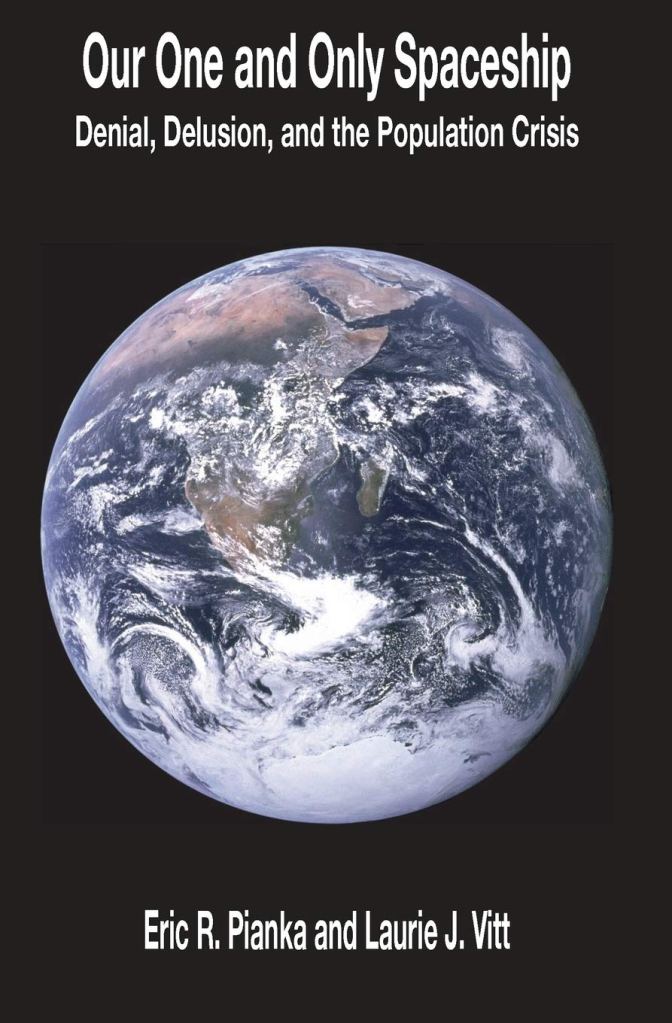
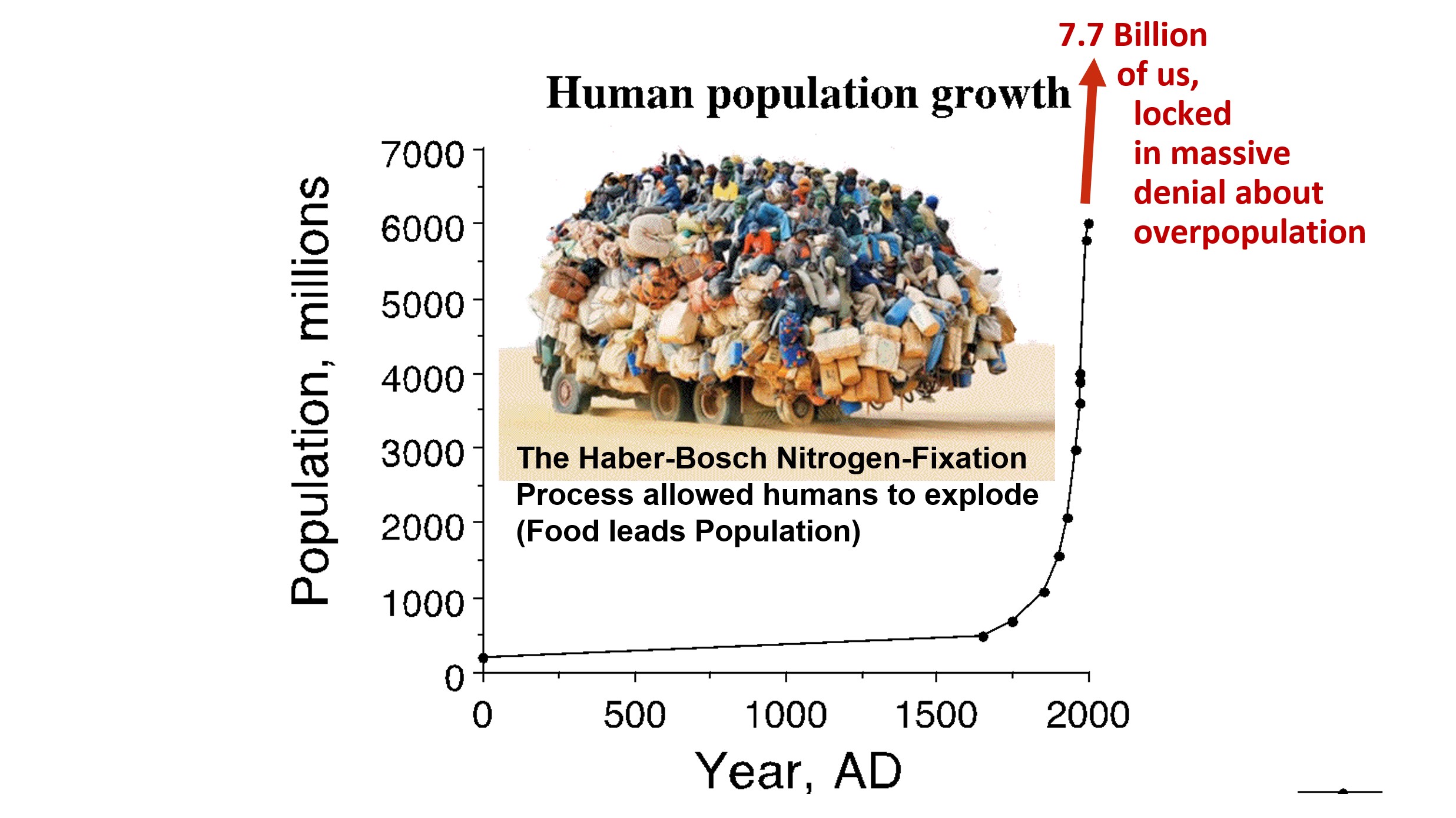


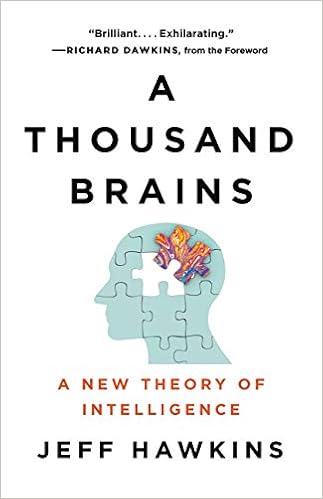
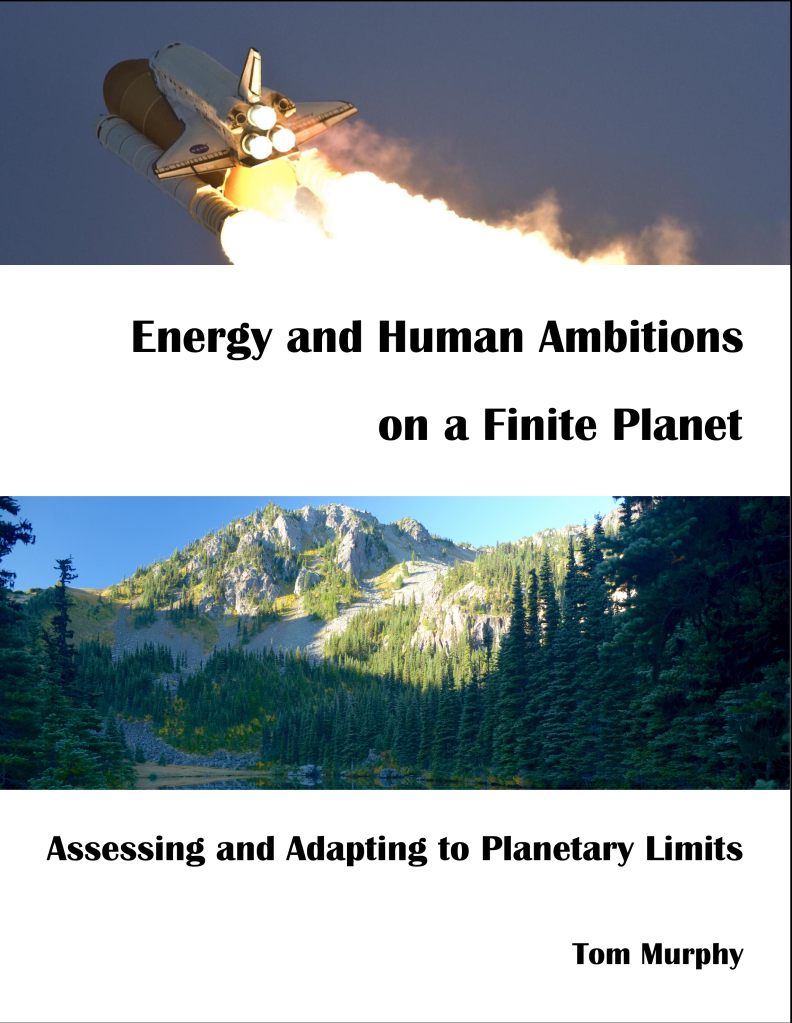

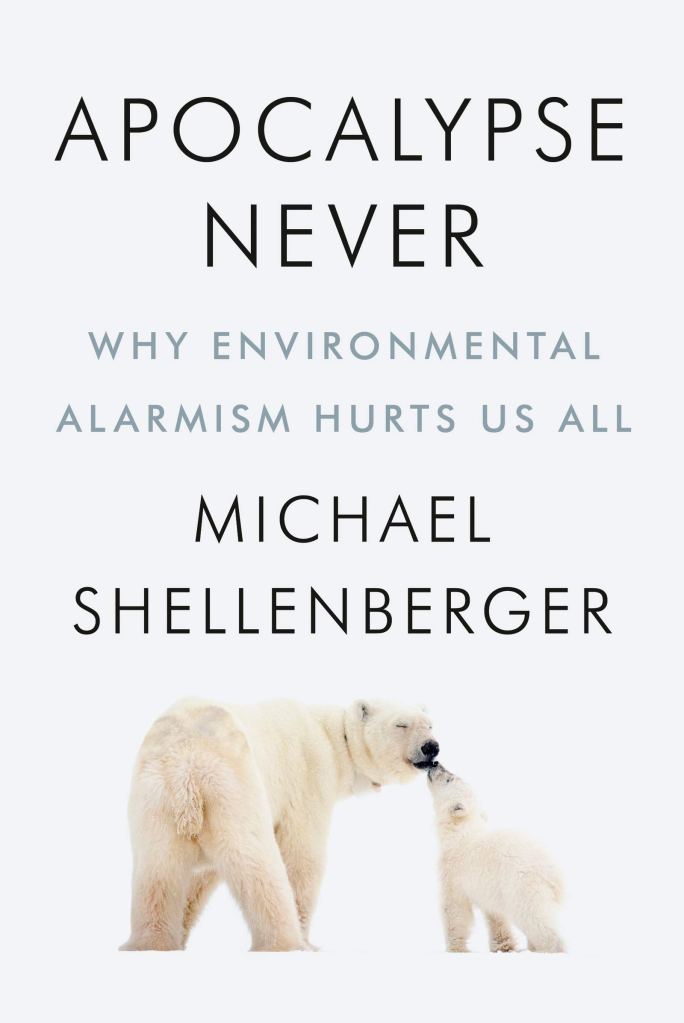


 un-Denial