
Thanks to AJ for contributing this book review.
https://oneandonlyspaceship.com/
https://www.barnesandnoble.com/w/our-one-and-only-spaceship-eric-pianka/1133496721?ean=9781733030533
Publisher’s Summary
Ecologists Eric R. Pianka (University of Texas) and Laurie J. Vitt (University of Oklahoma) provide a scientific summary of the overpopulation crisis facing humanity and itemize its many consequences, including climate change (global warming), conservation biology, economic systems, energy and resource shortages, human instincts, immigration conflicts, politics, pollution, poverty, technological problems, and solutions needed. Their underlying thesis is that denial and delusion work synergistically to undermine our ability to confront these serious issues, and unless we undertake proactive measures now, overpopulation and its impact on resource competition and climate change will ultimately lead to the collapse of civilization.
Authors’ Overview
In Road to Survival 70 years ago, William Vogt tried to call attention to the human overpopulation crisis, but failed. Paul Ehrlich raised this issue again 20 years later but was also widely ignored. We wish to re-open this long overdue and much needed discussion about population, a toxic topic that politicians globally avoid. We have written a book “Our One and Only Spaceship:Denial, Delusion and the Population Crisis.” We are two well-known ecologists Eric R. Pianka (University of Texas) and Laurie J. Vitt (University of Oklahoma).
Our book is based on a great deal of research that we have conducted into the topic and on a course that Pianka taught. http://www.zo.utexas.edu/courses/THOC/
We have edited and written books together, both scientific and semi-popular. Using fact-based analyses, we make the case that human population size and growth is the greatest threat to human survival, and that most if not every major global problem (including spread of AIDS and other communicable diseases, wars and other conflicts, climate change and in particular global warming, food water and energy shortages, poverty, political unrest, pollution, extinctions, etc.) are all direct results of overpopulation. Our birth rate far exceeds our death rate and the current global population of 7.7 billion in itself is unsustainable even without additional growth. This has put us on a collision course with disaster. It is perilous to remain in denial about all of the threats emanating from overpopulation.
As we become ever more and more desperate in trying to provide resources necessary to meet critical demands, our environmental problems will only worsen as we continue to deregulate thus allowing increased exploitation of dwindling natural resources. The thin skin of life on our planet is seriously threatened by the actions of a single species, Homo sapiens. Remarkably, even with our putative high intelligence, we don’t seem to be able to even admit that the problem is population such that discussions can begin on how to stop population growth. One thing is certain, it must and will stop—either we can do it through a series of logical steps (educating the public, coming up with a global plan, implementing the plan), or it will occur as the result of a combination of wars over resources, spread of infectious disease, or even famine. Such a discussion will have a greater impact on human survival than any of the many news stories currently dominating our media.
Overpopulation has only one outcome, and we have all seen it when mold takes over an orange—unlike mold growing on an orange, we do not have another “orange” to which we can send our offspring (There is no planet B). We are fully aware that discussions on population are “politically incorrect” and will be extremely sensitive to many people (especially religious groups) who take up arms in response to any discussion to limit reproduction. The ultimate biological reason for this response is simply that our genes control much of what we do, and reproduction is the currency of future generations. A more proximate reason is simply that our hormonal systems kick in when we reach puberty and all reason is washed away in the maelstrom of hormonal activity pushing us to reproduce. We must do something — ignoring our pressing problem and expecting it to go away is like hoping in vain to win the mega-lottery.
AJ’s Review
This is my brief review of the book, “Our One and Only Spaceship” subtitled “Denial, Delusion and the Population Crisis” written by Drs. Eric Pianka and Laurie Vitt. Copyright 2019.
I came across this book through one of the comments on your website. Since it was one of the few books that concerned population (in the title) I decided to buy it and read it.
The authors are ecologists. Dr. Eric Pianka is a Professor at UT Austin and Dr. Laurie Vitt is a Professor Emeritus at the University of Oklahoma, Norman. The forward was by Paul & Anne Ehrlich.
I overall liked the book. My feeling is that it is somewhat like Tom Murphy’s book and was intended for an intro college course in ecology/sustainability (without the math). That said I never had the impression that the authors were talking down to the reader.
There is some hope in this book. “This generation will be the last with decision-making powers to save our spaceship for all future earth-lings, including human beings.” But as the authors state in the Prologue, “The problem can be easily framed in three words, population, population, and population.” Human civilization is in overshoot and that we in the west are living far beyond the carrying capacity of the planet is covered in detail. So, the problem is both overshoot and population.
There is an acknowledgement that denial and optimism bias are part of our problem. But, I think that the authors are also in a little denial, “If humans are to survive into the next century, we need to reduce population growth, convert to renewable energy sources, use much less energy overall, and develop a plan for the future this is based on fact and not on fiction.” Their opinion is that we can maintain much of our technology (through “green” tech transition) and slowly reduce population with education and enlightenment. I don’t know if they really believe this or like Tom Murphy need to give students something positive to live for in the face of a depressing predicament.
Don’t get me wrong. This book touched all the right notes and I only disagreed with a tiny bit of it. I thought that the preface/into to the last chapter was perhaps the best quote I have seen on our place in the universe (other than Rob’s quote):
“Man did not have forever to harness the forces of the sun and stars. The Sun was an elderly light, long past the turbulent heat of youth, and would some day join the senile class of once-luminiferous bodies. In some incredibly remote time a chance collision might blow it up again into incandescent gas and start a new local cosmic cycle, but of man there would be no trace. In Balfours’s terms, he “will go down into the pit, and all his thoughts will perish. The uneasy consciousness, which in this obscure corner has for a brief space broken the contented silence of the universe, will be at rest. Matter will know itself no longer. ‘Imperishable monuments’ and ‘immortal deeds,’ death itself, and love stronger than death, will be as though they had never been. Nor will anything that IS be better or worse for all that labour, genius, devotion and suffering of man have striven through countless generation to effect.” –Homer Smith (1952) “Man and His Gods” and Earl Balfour (1895) “Foundations of Belief”
Eric Pianka on Kurt Vonnegut‘s Requiem:
From a presentation by Eric Pianka:
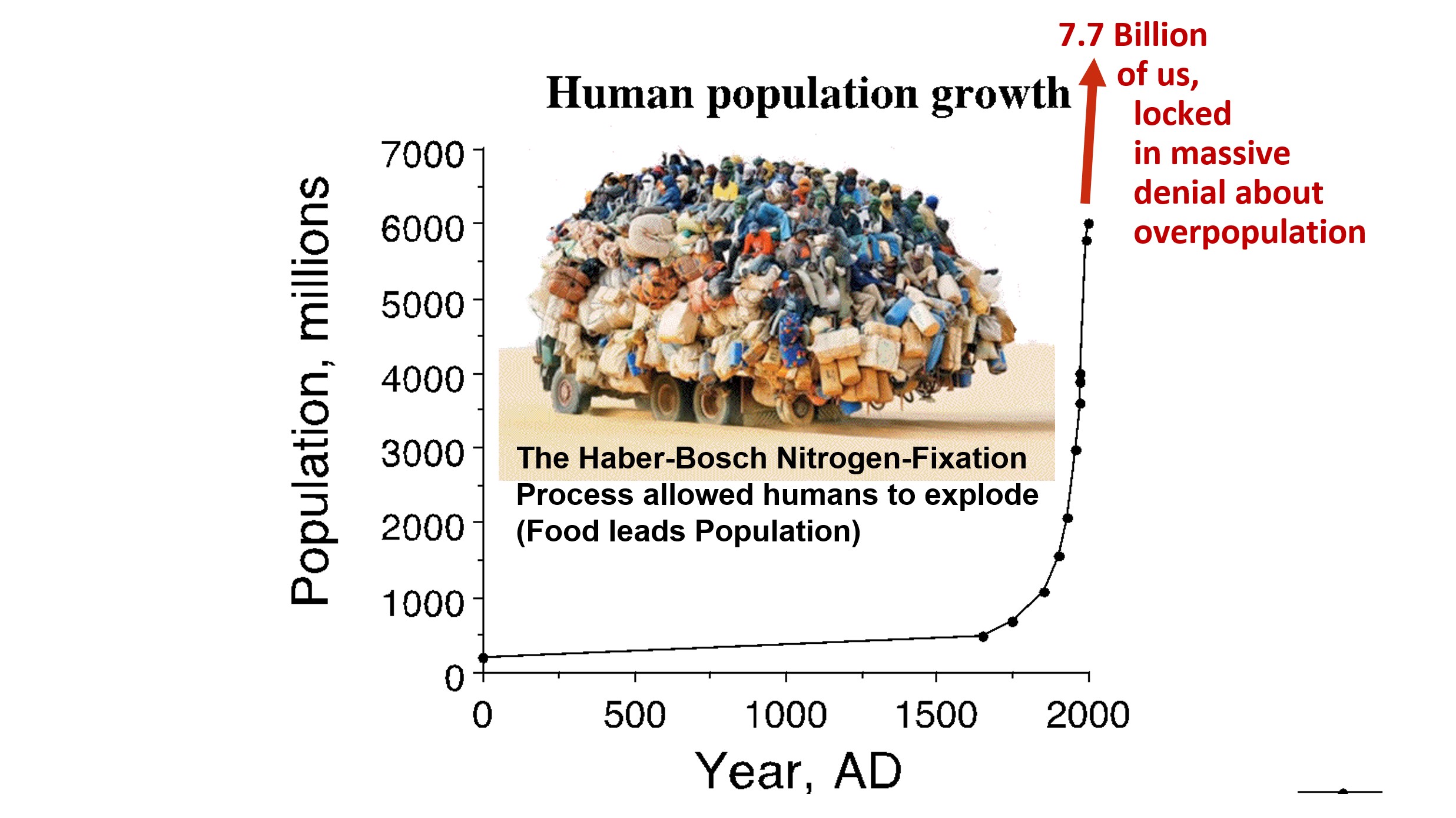

According to that quote from Smith and Balfour which is supposed to constitute the preface to the concluding chapter of the book being reviewed, everything we do that’s directed to a cause is a waste of time — including presumably the book itself, this website, our efforts to prolong the tenure of humanity on this planet, and so on. Even to tell people who don’t buy the message of the quote that they’re deluded would be a futile and meaningless undertaking.
Fine, so let’s eat, drink and be merry, then, for tomorrow we die. Stop caring about issues like overpopulation, climate change, social justice etc. Don’t waste your time and money buying and reading the book (much less take any action urged by the book) — except if you reckon it’s actually going to be an enjoyable read, that is. If the whole show is ultimately a tale told by an idiot, hey, then we might as well end it sooner. 🙂
It does appear that we are just along for the ride, and that much more powerful forces than consciousness are driving the bus.
I think for all species the main force is the Maximum Power Principle (MPP), which in essence is genes maximizing replication given finite resources.
For the human species we need to add one more force which is required to prevent our uniquely powerful intelligence from overriding MPP, and that is genetic denial of unpleasant realities.
[…] Book review by AJ: Our One and Only Spaceship: Denial, Delusion and the Population Crisis by Eric Pi… […]
https://boriquagato.substack.com/p/updating-the-uk-data-on-ve-vs-delta
I’m trying to understand why there is no re-evaluation of strategy in light of this data.
Perhaps leaders are looking at this data and realize that in frightened haste they made an error by pushing vaccination beyond high risk groups. Might this explain why they’re now doubling down and pushing for 100% vaccination, even in low risk groups?
Anyone have any thoughts?
In the short term reduce deaths and hospitalizations. Good for my re-election. Longer than that? Don’t really care.
Yes maybe. But many of these people have friends and family that they care about in the long term.
They could have said we’ve protected the high risk groups and there’s no need to go further, without any admission of error. If they’re worried about the Mareks scenario, this might explain why they’ve pushing for 100% coverage in low risk groups.
Here in the good old USofA it’s all about your tribe I think. I used to be a liberal Dem, but quit that a few years ago and am now Independent (not that it makes a diff.). But when it comes to all things, and Covid in particular I try to sample all perspectives – left, right and middle – and see who is thinking scientifically and rationally. So, I don’t watch MSM news much anymore (to much supporting the left) and I sure don’t watch Fox or their replacements. But, I try to read both left and right on-line. So, I sometimes look at Zero Hedge(but not as much anymore), I read a few articles in Automatic Earth, and I read The Morning Jolt by Jim Geraghty of the National Review (for those who don’t know, the National Review is the child of William F. Buckley the father of modern U.S. conservatism). The National Review was not a fan of Trump but more a conservative establishment philosophy.
So (long lead in – sorry), yesterday on The Morning Jolt, Mr. Geraghty had an interesting perspective:
“Why do so many Americans want to moralize the pandemic and turn it into a simplistic story of good and wise people who managed to avoid the virus while reckless and foolish people exposed themselves to the virus? Why do the kinds of people profiled by NPR see themselves as having failed in some way when they realize they’ve been infected, even though they believe they took all appropriate preventative measures?
The pandemic has vividly demonstrated that there are a lot of Americans — accomplished, successful, well-off, highly educated — who see “following the rules” as a preeminent social value. (Chris Arnade’s description of an America with “front row kids” and “back row kids” is vivid, memorable, and, I suspect, quite illuminating.)
“Your faith that American society is a meritocracy probably is directly proportional to how close you are to the top, and those at or near the top are convinced they got there because they were the best at fulfilling their duties and following the rules. The rebels, free spirits, and malcontents didn’t get into the Ivy League schools, the most prestigious graduate school and law school programs, and didn’t get hired by the top-tier law firms or McKinsey Consulting. Every day that these high-achieving rule-followers wake up in a nice house in a nice neighborhood and go to work at a nice job is further confirmation that they’re the kind of wise person who makes good decisions and avoids foolish risks. Getting infected with COVID-19 — an outcome that they have now come to associate with MAGA-hat-wearing, COVID-denying, anti-vaccine, anti-mask Trump voters — interrupts the happy narrative of these elites’ lives and suggests that random chance is a bigger factor in their lives than they want to admit.
As my colleague Michael Brendan Dougherty observes today:
https://www.nationalreview.com/the-morning-jolt/a-fresh-reminder-that-covid-19-infections-do-not-reflect-a-moral-failing/?utm_source=blog-landing&utm_medium=desktop&utm_campaign=continue-reading
I know from personal experience that this is/was my wife’s perspective, she has always believed in following the rules and meritocracy. It came as a great shock to her that we got Covid.
I think this goes some way toward explaining why our leaders want 100% vax. Your thoughts??
AJ
With regard to typical citizens, I suspect you’re right. It’s all about supporting what our tribe leaders have decided to do. Logic and evidence are irrelevant. Evolved behaviors are no doubt involved. Those tribes that united around their religion survived better than those who squabbled over whether the bible was true. This behavior is helpful for social cohesion and fighting wars over scarce resources, but I’m worried could be disastrous with a complex system like a contagious disease.
I have few friends and I’ve got a bad feeling the number is dropping because of my questions about our virus policies. They seem angry at me, and are not comfortable engaging in a deep discussion about evidence and data. It makes me sad. No one, including me, wants to be alone and a pariah.
My original question was directed at the behavior of our leaders. I suppose there are four broad possibilities:
1) Incompetence and/or being outgunned. They do not understand the risks and/or do not understand the data. This is a definite possibility. Having just finished a book by Dr. Kendrick, it was an eye opener to learn how easy and common it is for pharmaceutical companies to manipulate data, without lying, to influence a desired outcome.
2) Self-preservation and recovery. They do understand that they made a mistake and are betting that 100% vaccination coverage is the best path to recovering from their mistake. If true, its seems there should be some small countries that break away blaming the big boys for bad advice, but I’m not seeing this.
3) Our leaders are right and the people I follow are wrong. There is no problem except for unvaccinated people filling the hospitals. It’s possible that Malone, Bossche, Weinstein, Martenson, and el gaot malo are wrong, but I think I have a good nose for smart people that know what their talking about. The words being emitted by the authorities are at a kindergarten level compared to the PhD’s I follow. And I’m not seeing any intelligent rebuttals from intellects of equal stature. Most importantly, the predictions of the people I follow seem to be coming true.
4) There is some evil agenda afoot. I don’t buy this, but given that Fauci is still in charge, I guess it might explain US polices, but not the policies of the other vaccine focused countries of the world.
AJ, it sounds like you choose #1. I currently agree with you.
El gato malo on competence…
https://boriquagato.substack.com/p/the-cathedral-vs-the-bazaar
Yes, I do think our leaders are mostly following #1 with a little #2. I doubt that the people I read (yes, #3 is the crowd) are completely wrong – they may be occasionally wrong on particulars but they seem wedded to rationality and self correction. I think there is a small chance some of #4 is correct – there are a few malevolent actors – maybe it’s just a CYA by people like Fauci and the WHO, CDC, etc.
You are not alone (as long as the internet stays up!).
Keep up the good work.
AJ
I wrote the comment from a politician’s POV.
It’s one thing to have to admit you over reacted out of fear. It’s quite another to give up on or walk-back a moral judgmental attitude. By the time the virus was politicized I think our path was set. I don’t think any amount of data or potential consequences will change this for those who would have to admit “during the pandemic I became spiteful ideologically bigotted and morally entitled.”
I reacted very strongly during Jan-April of 2020. But by summer it was clear that the virus was not as dangerous as either the news out of China or the early models predicted. I was chagrined, relieved, and baffled.
I think the west will double down until they destroy the economy, then they will blame it on those who didn’t want to shut down the economy.
In the USA, GDP in 2020 was 96.5% of what it was in 2019. 2021 is greater than 2020 (so far). The debate on how serious the virus is will never cease, but saying the economy was “shut down” appears to be a bit hyperbolic. Those directly hurt probably should have received more support, but general stimulus for those still employed and retirees was a bit of overkill. The billionaires could have been taxed a little, but of course not.
Does your GDP figure include debt/stimulus?
Excellent talk by Bill Rees.
h/t Gail Z
View at Medium.com
https://www.google.com/amp/s/amp.abc.net.au/article/100506980
There appears to be a coordinated campaign to discredit Ivermectin in preparation for the approval of similar but patented, possibly less effective, and definitely more expensive antiviral drugs (first Molnupirivar by Merck, other antivirals to follow soon).
A friend who is skeptical about Ivermectin sent me this BBC article which references a study by Kendrick et al which claims one third of the studies supporting Ivermectin are fraudulent. No links are provided to fact check the claims.
https://www.bbc.com/news/health-58170809
I tried to chase down the Kendrick study without success but found Kendrick went a step further and claims without a link to evidence:
https://www.linkedin.com/feed/update/urn%3Ali%3Aactivity%3A6851689835237928960/
I smell something rotten but will watch for the emergence and discussion of the Kendrick study.
This excellent article from 3 days ago follows the money and corrupt double standards associated with the soon to be released patented antiviral drugs, and provides links to permit you to fact check their claims:
https://www.thedesertreview.com/opinion/columnists/ivermectin—truth-and-totalitarianism/article_2e03f334-252f-11ec-a086-eb72bc65ec02.html
Here is a database of all ivermectin COVID-19 studies which includes 121 studies, 77 peer reviewed, 64 with results comparing treatment and control groups:
https://c19ivermectin.com/
Here is a nice summary of the evidence in support of Ivermectin, written by doctors who have tried it, with links to permit fact checking:
Click to access SUMMARY-OF-THE-EVIDENCE-BASE-FINAL.pdf
Agree with what you wrote and linked to Rob. But, time marches on (one day in fact). The Automatic Earth had a link to a Matt Taibbi article (https://taibbi.substack.com/p/the-cult-of-the-vaccine-neurotic) that says the Vax crowd couldn’t stomach molnupiravir for more than one day. The argument is that no treatment for Covid is good because we need 100% vaccination, and treatments will make those concerned about the vax not get them. I agree vaccination is now a cult.
AJ
The cult may need a new god if this UK pattern repeats in North America. Some people in the comments claim that US and Canada are blind to this because our “leaders” conveniently stopped measuring the necessary data at about the same time we needed the data. I have been unable to confirm if this change in data measurement is true.
https://boriquagato.substack.com/p/an-epidemic-of-the-vaccinated
AJ, thank you for this concise review of an important book. And thanks Rob for posting it. I appreciate that both of you, along with many others who regularly visit this website, perfectly understand that human overpopulation is by far the most important problem on Earth. And I love that we keep discussing it here and will never stop discussing it (until the power goes out 😉).
Chris Martenson is doing a very good job these days. Mainstream news is now worse than useless.
I love the wise simplicity of kerosene appliances. They have no pumps, valves, pressure seals, filters, electronics, batteries, etc. My kerosene lanterns, cooking stove, and space heater are essentially a cloth wick dangling in bowl of kerosene. The only moving part is a simple mechanism for raising and lowering the wick. The only consumable (besides the fuel) is the wick which lasts forever and spares can be purchased for a few dollars. The appliances require no maintenance. If kerosene is scarce, you can burn diesel in the stove provided you cook outdoors.
In case you’re not aware, kerosene is a very nice fuel for emergency cooking, lighting, and heating. It has the highest energy to weight ratio of any fossil fuel, which is why it’s used as jet fuel. Unlike diesel, it burns fairly cleanly and can be used indoors, which is why kerosene was the preferred fuel for pre-electric lighting. Like propane, and unlike gasoline and diesel, kerosene can be stored for a very long time which makes it a good emergency fuel. Lastly, like diesel, and unlike gasoline, it’s fairly safe with a high flashpoint.
Funny how being at DEFCON1 changes what you pay attention to. When I walk into a grocery store I pay attention to the available supply of fats, protein, rice, and coffee. When I walk into a hardware store I pay attention to kerosene supplies. Got the last 10 liters available in my town yesterday. Hopefully another shipment is on the way.
Rob,
Whenever I go into Costco, Home Depot, or the feed store I am always thinking, “Is this my last time here?”. I think that one of these days it will be. Had the wife pick up a few torx bits that I didn’t have and a couple of brass adapters that go from MPT to female hose thread. Without some of those it’s impossible to hook the water storage system to the spare hoses. I also look and the cornucopia of food at Costco or Safeway and think “oil”. It’s all fossil sunlight made and without fossil sunlight there will be a lot of plain old squash, beans and corn bread. I always thought JHK’s novels about the future had the food situation after collapse pretty close to perfect – nothing processed, everything my grandparents would be familiar with. Soon we will all be there.
AJ
I agree and have the same feelings when shopping. It’s not normal to eat fresh food not grown near home every day of the year.
I like documentaries about periods of scarcity in modern history, and on how poor peasants live today and in the past. They provide great ideas for someone trying to prepare for what’s coming. One of my favorites is “The Wartime Kitchen and Garden (1993)”.
https://www.imdb.com/title/tt0879767/
If anyone wants this and can’t find it at the usual sites, send me a private message and I’ll help you get it.
Mac10 doesn’t permit comments on his site but I’ve been trying to educate him on Varki’s MORT theory via Twitter. I’m seeing the frequency of denial as the central theme of his posts increase. Might be a coincidence since you don’t need to understand MORT to realize denial is THE main problem for our species.
https://zensecondlife.blogspot.com/2021/10/the-china-lehman-moment.html
Meanwhile, stupidity and denial have not yet bottomed out.
https://omny.fm/shows/the-take/can-china-encourage-a-baby-boom
Brilliant summary of the most probable source of the virus, and the “miracle” vaccines we are using in response.
No cabal of villains conspiring to build back better with a great reset.
Just some powerful people with good intentions and really bad ethics and judgment seeking fame and fortune.
The precedent we set by not prosecuting anyone powerful who committed the frauds that led to the 2008 GFC is now being repeated.
https://boriquagato.substack.com/p/peter-daszak-supervillain-origin
Hey Peter, seems like it’s getting a bit hot in the kitchen lately… The consequences are starting to bubble up the surface in that witch’s SARS-CoV-2 brew vat:
https://www.msn.com/en-us/news/technology/peter-daszak-who-sought-u-s-funds-for-wuhan-lab-and-aided-cover-up-faces-calls-to-quit/ar-AAPcXxK?ocid=msedgdhp&pc=U531
“Matter will know itself no longer. ‘”
I have always thought that was the whole point in this human venture.
Todd
Response to AJ: Thanks for your work on presenting this book. Only comment I can come up with is that the present generations would look at this and consider the “end is nigh”, thus ‘living’ like there will be no tomorrow for anyone. So why not just go for the gusto and to hell with what happens! That seems to be happening already.