What Should / Can / Could / Will We Do?

We’re in serious trouble. Many red lights are flashing on the dashboard.

Most people are now aware that something is seriously wrong, and each has their favorite lens through which to view the problems:

  • Geopolitical: increasing nuclear war risk, trade wars, genocide.
  • Political: polarized angry citizens, unstable governments, panicking/thrashing leaders.
  • Economic: end of growth, declining living standards, widening wealth gap, inflation, accelerating unsustainable debt, asset bubbles.
  • Environmental: accelerating climate change, species extinction, toxic forever chemicals, plastic waste, sick & dying trees from rising ground level ozone, etc.
  • Health: increasing obesity, autism, and chronic diseases, declining lifespans, increasing depression and mental illness.
  • Resources: peak food, peak oil, peak minerals, aquifer depletion, etc.
  • Energy: reserve depletion, rising extraction costs, falling EROI, export land model, no renewable substitutes for non-renewable fossils, etc.

The common denominator to all of these problems is overshoot.

Very few people are able to see through the lens of overshoot because overshoot is a very unpleasant topic with no painless solutions and no way to avoid its consequences, and because humans evolved to deny unpleasant realities like overshoot.

Grok: Biological overshoot occurs when a population exceeds the carrying capacity of its environment, meaning it consumes resources faster than they can be replenished, leading to ecological imbalance. This is often seen in ecosystems where a species’ population grows beyond what the available resources (e.g., food, water, habitat) can sustainably support.

Causes: Rapid reproduction, lack of predators, abundant resources (temporarily), or human intervention (e.g., removing natural checks).

Consequences: Resource depletion, habitat degradation, population crashes, or ecosystem collapse. For example, a deer population might overshoot due to abundant food, then starve when resources run out.

Quantifying Overshoot: In ecology, overshoot can be measured by comparing population size N to carrying capacity K . If N>K, the system is in overshoot, often leading to a decline until N≤K.

Helpful Responses: Addressing overshoot requires restoring balance between population and resources.

What Should We Do?

I started this un-Denial blog 13 years ago after I became aware of our overshoot predicament, and a plausible theory by Dr. Ajit Varki for why almost no one can see the most important and obvious threat we face.

After a few years of discussing our overshoot issues I got tired of being a pessimist and wrote a prescription for what we should do. I thought it was pretty good at the time and represented a path that might actually help rather than the fantasy solutions with 100% probability of failing being promoted by millions of people with good intentions working on symptoms rather than the core overshoot problem.

My prescription for what we should do was in essence to minimize total suffering for all species by humanely reducing our population as fast as possible, and by planning and managing a controlled economic contraction, rather than allowing nature to force an uncontrolled collapse.

I understood that it would not be possible to implement my prescription unless the majority somehow could be made aware of our overshoot predicament, and this in turn required some method of overriding our genetic tendency to deny unpleasant realities. So I then spent several years promoting Dr. Ajit Varki’s MORT theory in the hope that experts in relevant domains would work discover a method to override MORT.

My efforts were a complete failure. Not only did I not succeed in engaging any brain or behavior experts, I was not even able to recruit any like-minded colleagues in the overshoot space who were also trying to find solutions.

I sadly concluded that it was not possible to override MORT because denial of denial is the strongest form of denial, probably because evolution, for good reasons, ensures that the Maximum Power Principal (MPP) trumps all other behaviors.

What Can We Do?

In recent years the insights of Hideaway on the role of complexity in sustaining our civilization have caused me to question the theoretical feasibility of my or any other prescription.

Hideaway explains that the use of any non-renewable resource degrades the quality of its reserves over time, and this requires increasing complexity to sustain supply of the resource, which requires growing economies and population, which consume more supply, which worsens the reserve quality, which means any civilization dependent on non-renewable resources must grow or it will collapse, which means a hard collapse is unavoidable and no mitigation paths exist.

Hideaway’s probably correct but it’s a tough pill to swallow.

I’m still struggling to accept Hideaway’s conclusion because I can imagine many things we could do to worsen our predicament, like for example starting a nuclear war, or by burning our remaining coal and gas reserves faster by using AI to create more enjoyable porn.

Given that we could do many things to increase the coming suffering, it seems reasonable to assume there must be some things we could do to reduce the coming suffering, which I believe is the only sensible goal left to us.

But what are the things we could do to reduce total suffering for all species?

I would love to see the readers of un-Denial offer their ideas in the comments below. If we get enough good ideas I will collate them into another post with a new prescription representing our collective wisdom.

What Could Someone Do?

I’m a long time follower and admirer of Jack Alpert and have posted some of his best work over the years.

For many years Alpert’s been a lone voice advocating rapid population reduction with the goals of reducing suffering and retaining some of our best accomplishments as the only species with science and advanced technology.

I very much like the goal of retaining some of our best science and technology post-collapse because I have some insight into how rare and precious our accomplishments are likely to be in the universe.

In addition, if you have any doubts about the importance of Alpert’s goal to retain some of the more valuable features of modernity, this video on what life was actually like in ancient Rome will set you straight.

I was pessimistic about the feasibility of Alpert’s plan because it required educating sufficient citizens to vote for population reduction policies and I knew from my MORT observations and failures that his education plan would most certainly fail due to our genetic tendency to deny unpleasant realities.

Nevertheless, I still like Alpert’s plan because setting aside the political feasibility of achieving a quorum, it at least was technically feasible and did not break the laws of physics or deny the reality of non-renewable resources as every other “plan” by every other “expert” does.

There is of course now a new technical feasibility question created by Hideaway’s complexity theory. It may not be possible to retain some of modernity’s most valuable technology without the 8 billion scale of our civilization. Let’s hand wave this away for now because I don’t know the specifics of what Alpert proposes to retain, and we need to think harder about the implications of Hideaway’s complexity theory in the context of a population that falls really fast, perhaps so fast that the requirement for growing complexity to maintain supply no longer applies. Suggest we continue this discussion in the comments below.

I was recently pleased to see a revised plan by Alpert that no longer requires a majority of citizens to vote for population reduction policies.

We are underestimating our predicament and underestimating the behaviors needed to unwind it.

Human civilization maybe sicker than we think. Maybe we should consider stronger medicine.

Abstract:

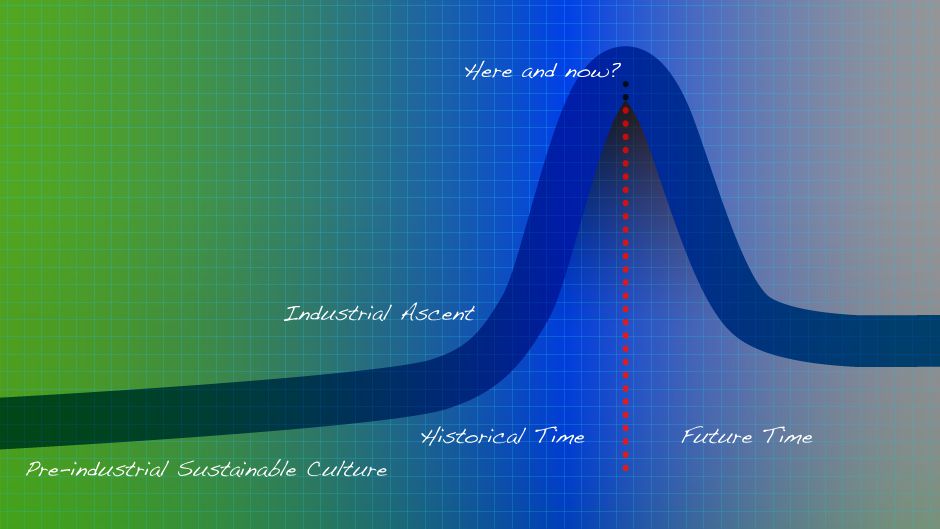
Consider a line that describes the delivery rate of fossil fuels to civilization. Each higher rate each year supported an ever larger global population with ever grander lifestyles.

Unfortunately, earth’s crustal limitations suggest this rate of energy delivery will decline back to its 1750’s level this century.

Unless energy deliveries from solar, wind, hydro, geo thermal, fission, and fusion can come online and replace lost fossil deliveries, human population and lifestyles will also drop back to the 1750’s levels.

Civilization will experience first scarcity; then conflict; and finally a self-reinforcing feedback loop called a scarcity conflict death spiral which will starve to death or kill in conflict most if the people who live this century.

When the behaviors that prevent this die off cause their own significant injuries the condition is called a predicament because people are injured with or without the prevention behavior. 

In the last two minutes of this video I propose a behavior that causes much pain and prevents the injuries during civilization contraction. The video helps the chooser of the potential behavior quantify the injuries on each path.


After you view the video you may have important questions that need answers:

  1. Why do we have to make the transition in the next 80 years?
  2. Why can the earth (without fossil fuels) support only 600 million people living like serfs.
  3. Why does a new civilization that keeps our levels of arts and science support  only 50 million people living like moderns?

In this latest plan Alpert proposes that a single expert could engineer a contagious virus to sterilize the human population.

It seems plausible to me that a single scientist with defective denial genes could be found and recruited for this task. People who can see reality are rare but they do exist.

I do have, however, serious doubts about the technical feasibility of engineering a safe and effective sterilization virus given that it’s required to override life’s primary mission, and given that a trillion dollar pharma industry with an army of scientists was unable to engineer or manufacture a safe and effective gene therapy for a virus they created and had the blueprints for.

How is one rogue scientist going to engineer a safe and effective highly contagious virus designed to override the primary objective of DNA honed by 4 billion years of evolution?

Nevertheless, I’m an electrical engineer with limited knowledge of genetic engineering so perhaps Alpert knows something I do not.

What Will We Do?

Our most likely path is the path we are on which is to use every psychological, accounting, and technology trick we can think of to keep growing the size of our economy and the complexity it depends on until we reach the end of the runway and crash with a spectacular collapse of supply chains, complexity, food, and population.

Unfortunately there will be a lot of suffering for humans and other species. The planet and its diversity of life will no doubt recover, but it will never achieve the pinnacle of rare complexity we enjoy today.

As we accelerate down the runway stresses will increase within countries and between countries. You can see these growing stresses everywhere today. There is a high probability that our leaders will do something in desperation that reduces the length of the runway.

It is likely that our most powerful weapons will be used when citizens of a resource unlucky country become envious and angry. As one recent example, a petulant little island nation off the coast of France that is collapsing because its oil and coal reserves are depleted is trying to provoke a nuclear war with a much larger and more powerful country on the opposite side of a large continent because it has some oil and gas that might sustain the lifestyles and entitlements of the island nation a little longer.

There is another darker scenario now being publicly discussed by very competent geopolitical experts like Col. Larry Wilkerson. In this interview last week Wilkerson explained why he is very worried about the growing threat of a nuclear war and that he fears for his grandchildren.

Wilkerson also said he knows powerful people who believe the solution to overpopulation and resource depletion is to kill billions with nuclear weapons. You can listen to these comments at 42:30 but I’d start earlier at around 33:30 for important context.

In this light, Jack Alpert’s sterilization virus starts to look pretty good.

In case you are not aware of it, I recommend the 2013 TV series Utopia which was about a plot to reduce the population with an engineered virus.


RFK Jr. Confirmation

RFK Jr. was confirmed yesterday as HHS Secretary and the MAHA Alliance held a press conference to celebrate this important moment in history.

Del Bigtree was RFK Jr.’s Communications Director. Now that RFK Jr. has been confirmed, Bigtree’s job is finished and he’s able to speak for himself without representing RFK Jr.

Sen. Ron Johnson introduces Del Bigtree at 10:20.

Bigtree’s speech starts at 16:00 and is a must watch for anyone concerned about improving our collective health, and righting the wrongs of covid.

If any of you, like me, feel the need for a little revenge after covid, this speech is righteous.

Bigtree brutally destroys the mainstream news media for their incompetence, indifference, and corruption.

This speech by RFK Jr. after his swearing in ceremony is also excellent.

I don’t have too many heroes, but RFK Jr. is one of them. This video is a nice introduction to the man.

Here is the president’s executive order authorizing MAHA. It’s inspiring and worth a read.

https://www.whitehouse.gov/presidential-actions/2025/02/establishing-the-presidents-make-america-healthy-again-commission/

ESTABLISHING THE PRESIDENT’S
MAKE AMERICA HEALTHY AGAIN COMMISSION

EXECUTIVE ORDER

February 13, 2025

By the authority vested in me as President by the Constitution and the laws of the United States of America, it is hereby ordered:

Section 1.  Purpose.  American life expectancy significantly lags behind other developed countries, with pre‑COVID-19 United States life expectancy averaging 78.8 years and comparable countries averaging 82.6 years.  This equates to 1.25 billion fewer life years for the United States population.  Six in 10 Americans have at least one chronic disease, and four in 10 have two or more chronic diseases.  An estimated one in five United States adults lives with a mental illness.

These realities become even more painful when contrasted with nations around the globe.  Across 204 countries and territories, the United States had the highest age-standardized incidence rate of cancer in 2021, nearly double the next-highest rate.  Further, from 1990-2021, the United States experienced an 88 percent increase in cancer, the largest percentage increase of any country evaluated.  In 2021, asthma was more than twice as common in the United States than most of Europe, Asia, or Africa.  Autism spectrum disorders had the highest prevalence in high-income countries, including the United States, in 2021.  Similarly, autoimmune diseases such as inflammatory bowel disease, psoriasis, and multiple sclerosis are more commonly diagnosed in high-income areas such as Europe and North America.  Overall, the global comparison data demonstrates that the health of Americans is on an alarming trajectory that requires immediate action.

This concern applies urgently to America’s children.  In 2022, an estimated 30 million children (40.7 percent) had at least one health condition, such as allergies, asthma, or an autoimmune disease.  Autism spectrum disorder now affects 1 in 36 children in the United States — a staggering increase from rates of 1 to 4 out of 10,000 children identified with the condition during the 1980s.  Eighteen percent of late adolescents and young adults have fatty liver disease, close to 30 percent of adolescents are prediabetic, and more than 40 percent of adolescents are overweight or obese.

These health burdens have continued to increase alongside the increased prescription of medication.  For example, in the case of Attention Deficit Disorder/Attention Deficit Hyperactivity Disorder, over 3.4 million children are now on medication for the disorder — up from 3.2 million children in 2019-2020 — and the number of children being diagnosed with the condition continues to rise.  

This poses a dire threat to the American people and our way of life.  Seventy-seven percent of young adults do not qualify for the military based in large part on their health scores.  Ninety percent of the Nation’s $4.5 trillion in annual healthcare expenditures is for people with chronic and mental health conditions.  In short, Americans of all ages are becoming sicker, beset by illnesses that our medical system is not addressing effectively.  These trends harm us, our economy, and our security.

To fully address the growing health crisis in America, we must re-direct our national focus, in the public and private sectors, toward understanding and drastically lowering chronic disease rates and ending childhood chronic disease.  This includes fresh thinking on nutrition, physical activity, healthy lifestyles, over-reliance on medication and treatments, the effects of new technological habits, environmental impacts, and food and drug quality and safety.  We must restore the integrity of the scientific process by protecting expert recommendations from inappropriate influence and increasing transparency regarding existing data.  We must ensure our healthcare system promotes health rather than just managing disease.

Sec. 2.  Policy.  It shall be the policy of the Federal Government to aggressively combat the critical health challenges facing our citizens, including the rising rates of mental health disorders, obesity, diabetes, and other chronic diseases.  To do so, executive departments and agencies (agencies) that address health or healthcare must focus on reversing chronic disease.  Under this policy:

(a)  all federally funded health research should empower Americans through transparency and open-source data, and should avoid or eliminate conflicts of interest that skew outcomes and perpetuate distrust;

(b)  the National Institutes of Health and other health-related research funded by the Federal Government should prioritize gold-standard research on the root causes of why Americans are getting sick;

(c)  agencies shall work with farmers to ensure that United States food is the healthiest, most abundant, and most affordable in the world; and

(d)  agencies shall ensure the availability of expanded treatment options and the flexibility for health insurance coverage to provide benefits that support beneficial lifestyle changes and disease prevention.

Sec. 3.  Establishment and Composition of the President’s Make America Healthy Again Commission.  (a)  There is hereby established the President’s Make America Healthy Again Commission (Commission), chaired by the Secretary of Health and Human Services (Chair), with the Assistant to the President for Domestic Policy serving as Executive Director (Executive Director).

(b)  In addition to the Chair and the Executive Director, the Commission shall include the following officials, or their designees:

(i)     the Secretary of Agriculture;

(ii)    the Secretary of Housing and Urban Development;

(iii)   the Secretary of Education;

(iv)    the Secretary of Veterans Affairs;

(v)     the Administrator of the Environmental Protection Agency;

(vi)    the Director of the Office of Management and Budget;

(vii)   the Assistant to the President and Deputy Chief of Staff for Policy;

(viii)  the Director of the National Economic Council;

(ix)    the Chairman of the Council of Economic Advisers;

(x)     the Director of the Office of Science and Technology Policy;

(xi)    the Commissioner of Food and Drugs;

(xii)   the Director for the Centers for Disease Control and Prevention;

(xiii)  the Director of the National Institutes of Health; and

(xiv)   other members of my Administration invited to participate, at the discretion of the Chair and the Executive Director.

Sec. 4.  Fighting Childhood Chronic Disease.  The initial mission of the Commission shall be to advise and assist the President on how best to exercise his authority to address the childhood chronic disease crisis.  Therefore, the Commission shall:

(a)  study the scope of the childhood chronic disease crisis and any potential contributing causes, including the American diet, absorption of toxic material, medical treatments, lifestyle, environmental factors, Government policies, food production techniques, electromagnetic radiation, and corporate influence or cronyism;  

(b)  advise and assist the President on informing the American people regarding the childhood chronic disease crisis, using transparent and clear facts; and

(c)  provide to the President Government-wide recommendations on policy and strategy related to addressing the identified contributing causes of and ending the childhood chronic disease crisis.

Sec. 5.  Initial Assessment and Strategy from the Make America Healthy Again Commission.  (a)  Make our Children Healthy Again Assessment.  Within 100 days of the date of this order, the Commission shall submit to the President, through the Chair and the Executive Director, the Make Our Children Healthy Again Assessment, which shall:

(i)     identify and describe childhood chronic disease in America compared to other countries;

(ii)    assess the threat that potential over-utilization of medication, certain food ingredients, certain chemicals, and certain other exposures pose to children with respect to chronic inflammation or other established mechanisms of disease, using rigorous and transparent data, including international comparisons;

(iii)   assess the prevalence of and threat posed by the prescription of selective serotonin reuptake inhibitors, antipsychotics, mood stabilizers, stimulants, and weight-loss drugs;

(iv)    identify and report on best practices for preventing childhood health issues, including through proper nutrition and the promotion of healthy lifestyles;

(v)     evaluate the effectiveness of existing educational programs with regard to nutrition, physical activity, and mental health for children;

(vi)    identify and evaluate existing Federal programs and funding intended to prevent and treat childhood health issues for their scope and effectiveness;

(vii)   ensure transparency of all current data and unpublished analyses related to the childhood chronic disease crisis, consistent with applicable law;

(viii)  evaluate the effectiveness of current Federal Government childhood health data and metrics, including those from the Federal Interagency Forum on Child and Family Statistics and the National Survey of Children’s Health;

(ix)    restore the integrity of science, including by eliminating undue industry influence, releasing findings and underlying data to the maximum extent permitted under applicable law, and increasing methodological rigor; and

(x)     establish a framework for transparency and ethics review in industry-funded projects.

(b)  Make our Children Healthy Again Strategy.  Within 180 days of the date of this order, the Commission shall submit to the President, through the Chair and the Executive Director, a Make Our Children Healthy Again Strategy (Strategy), based on the findings from the Make Our Children Healthy Again Assessment described in subsection (a) of this section.  The Strategy shall address appropriately restructuring the Federal Government’s response to the childhood chronic disease crisis, including by ending Federal practices that exacerbate the health crisis or unsuccessfully attempt to address it, and by adding powerful new solutions that will end childhood chronic disease.

(c)  The Chair may hold public hearings, meetings, roundtables, and similar events, as appropriate, and may receive expert input from leaders in public health and Government accountability. 

Sec. 6.  Additional Reports.  (a)  Following the submission to the President of the Strategy, and any final strategy reports thereafter, the Chair and the Executive Director shall recommend to the President updates to the Commission’s mission, including desired reports.

(b)  The Commission shall not reconvene, following submission of the Strategy, until an updated mission is submitted to the President through the Executive Director.

Sec. 7.  General Provisions.  (a)  Nothing in this order shall be construed to impair or otherwise affect:

(i)   the authority granted by law to an executive department or agency, or the head thereof; or

(ii)  the functions of the Director of the Office of Management and Budget relating to budgetary, administrative, or legislative proposals.

(b)  This order shall be implemented consistent with applicable law and subject to the availability of appropriations.

(c)  This order is not intended to, and does not, create any right or benefit, substantive or procedural, enforceable at law or in equity by any party against the United States, its departments, agencies, or entities, its officers, employees, or agents, or any other person.

THE WHITE HOUSE,

    February 13, 2025.

<edit>

A few comments below from angry, now ex, followers suggest they were unaware of my gradual transformation over the last 4 years of observing and researching covid, from being certain RFK Jr. was a nut job, to now supporting RFK Jr.’s mission to improve our abysmal and worsening pubic health.

I’ve copied my replies to the criticisms here so that the reasons for my new beliefs are clear.

notabilia: You make excellent, well-researched points at times.
And you throw it all away by being an anti-vaxxer ass clown. 

I too thought anti-vaxxers were nut jobs.

Then the experts I trusted renamed a 20 year old technology, known to be unsafe and ineffective in humans, from transfection to vaccine, pretended transfection was a new miracle technology, and coerced it into 5+ billion people after insufficient and fraudulent testing, including children that had zero risk from the virus, and when adverse event data showed the transfections were dangerous at levels far higher than had been sufficient to withdraw prior vaccines from the market, they doubled down, and hid and denied the data, and they continued to coerce transfections despite the disease being low risk for all except elderly and co-morbid people, and despite several safe and effective alternate treatments being available.

Today the rate of sickness and all-cause mortality is higher than pre-transfection, and the only thing our “experts” are certain of is that the cause is not the mRNA transfections. This despite there being several easy to understand first principle reasons to suspect mRNA transfections will never, and can never, be made safe.

The mRNA transfections are just the tip of the covid iceberg. They lied about every single covid issue, and they used tax dollars to corrupt news media, and to censor social media, to make us believe the lies.

Every covid policy was exactly wrong. To maximize your probability of good health the best course of action was to do exactly the opposite of what they told us to do. Incompetence does not explain this. They would have achieved a better public health outcome had they flipped a coin on every decision.

After observing 4 years of a healthcare system incapable of learning and correcting when new data emerges, and that pathologically lies, I no longer trust a word they say about anything.

So yes, I now proudly call myself an anti-vaxxer.

Go get ’em Bobby!

Anonymous: The health problems of the US population can largely be traced to a crap diet… good luck changing that. Any real attempt to do so will be shut down as a communist plot.

Yes, unhealthy food is a huge problem. It’s also not that complicated. Reducing sugar would be a good start.

We face many existential overshoot threats for which there is no “fix” thanks to MPP and MORT governing our behaviors, and thanks to the core design of the system that keeps us alive.

The threat from relatively recent, extremely poor public health is different. There is nothing fundamental blocking us from improving public health. I think we should support RFK Jr. and try.

A healthy population will be a strong asset, perhaps our only asset, when the everything bubble pops and modern civilization collapses.

<edit>

Secretary Kennedy delivers welcoming remarks to HHS staff.

Godspeed RFK Jr.

We’re All Good Now: A Mysterious Reversal

Art Berman today responded to the many critics that piled on him after his last essay in which he reversed his prior warnings about oil depletion by doubling down.

https://www.artberman.com/blog/peak-oil-requiem-for-a-failed-paradigm/

Peak Oil: Requiem for a Failed Paradigm

Technology, capital, and price—not just geology—now dictate oil supply. The 2005-2014 price boom unlocked more oil than anyone expected. Today, financial markets and geopolitics—not depletion—drive the oil game.

Shale changed everything, unleashing a massive new supply. Peak Oil still pretends it doesn’t exist—won’t even put it on a chart. That’s why it’s a dying paradigm. It had its moment and reshaped my world view in important ways. May it rest in peace.

If you listen to the Art Berman that existed a year ago, and compare him to today’s Art Berman, and observe he did not correct or retract any of his prior analysis, you have to conclude that some powerful force is in play, like perhaps mRNA transfection brain damage, or grandchildren induced MORT.

By Charles: Doomers’ Visions of the Future

Today’s guest post by Charles is an excellent primer on the diversity of beliefs held by many of the best minds that think about our overshoot predicament. Charles wisely reminds us that no one knows what the future will bring.

Charles recounts his journey of increasing awareness that led to depression and despair, followed by an awakening of acceptance and constructive action, that has provided him with some peace and happiness.

It’s funny how I (we?) construct incorrect mental images of people we meet on the web. I imagined Charles to be an elderly retired reclusive spiritual philosopher, not a middle-aged top-tier software developer with a deep scholarly interest in human overshoot, and an impressive sustainable food growing sideline.

Charles concludes by asking readers to share their own visions of the future. If you have something to say that deserves more than a comment, please contact me about posting a guest essay.

P.S. I believe Charles now holds the doomosphere record for the most links in a single essay.

The idea for this post originates from an exchange with fellow doomer davelysak who states:

I foresee, based on various portents, an extreme human population crash in the relatively (10 – 50 years? Maybe sooner?) near future.

and later adds the precision that

I’ll be surprised if there are more than 2 billion people alive on earth in 20 years.

This made me reflect about my own anticipation for the future, even more crucially, the way I communicate it to others. Or rather as a matter of fact, don’t so much anymore. Like Cassandra, I have come to understand that I find myself psychologically between a rock and a hard place: I foresee a future of extreme hardships which I do not particularly desire. Worst, I have long felt compelled to share my projections, driven by the naive impulse to initiate collective preemptive action. However, torn apart between the pride of intellectual rigor, my ideal not to harm others and increasingly aggressive or irrational reception of the message, I have slowly learned to repress myself, not to voice my concerns and conform to the group. After all, even Cassandra brought ill fate to herself. (It turns out my strategy is no solution, as the rage is turned inside and builds up, but that could be a story for another day.)

Hopefully, our host, Rob provides a safe haven to any doomer who wishes to bravely face the crude, unadulterated nature of our predicament.

As doomers, we share a myth, the myth of collapse. In a nutshell, it unfolds, as I understand it, as follows:

  • The old age of material opulence is about to end, as current trends can not continue for long.
  • A world-scale crisis has been brewing for quite some time; it is about to burst.
  • After it eventually recedes, once balance is somewhat restored, a new normalcy, a new age will be revealed (that part of the myth is optional).

Funnily, if we refer to Kurt Vonnegut’s shapes of stories it falls somewhere between the shapes Old Testament and New Testament.

And many false prophets shall rise

Lurking for a quarter of a century in the doomosphere has taught me visions of the future, even among doomers, may vary tremendously. The stroll through the exhibit of studies can go on for hours, ranging from loss of material affluence (Richard Duncan’s Olduvai theory) to complete life wipe-out (James Hansen’s Venus Syndrome), with population collapse (Club of Rome’s limits to growth) and near term human extinction as middle-grounds (I guess).

The fall is seen as either rapid and brutal as in Hugo Bardi’s Seneca cliff, or manageable as in John Michael Greer’s catabolic collapse. Even our preferences and values differ: some like Jack Alpert’s sustainable modern civilization of 70 million wish to preserve the current living arrangements trading population level, on the contrary, primitivists such as Derrick Jensen do not equate humans with Homo Industrialis and impatiently wait for the machine to (be) stop(ped). There are even some fringe organizations advocating voluntary human extinction and euthanasia, while most would just like to manage degrowth. (To be fair, the church of euthanasia’s ultimate goal is species awareness.)

Model after study after analysis after opinion piece paint different aspects and outcomes of the fall. Some radically scarier than others.

My personal journey through doom

What then do we really expect, fear and hope? At first I had planned to cold-heartedly present the scenarios I found most probable and then invite you to share your own prospects. But, given the heavy emotional load that the subject carries, I somewhat changed my mind: after all we are discussing the possibility of not only material losses but the widespread increase in suffering, deaths, extinction of the living world. At the very least, our cultural identity is at stake. So I’d like to add a personal twist and narrate how my understanding of the future evolved during my personal journey.

I was born in 1978 in the then extremely affluent and sophisticated country of France (WesternCiv). I was inculcated with the idealism of my time and place which originates from the Age of Enlightenment: triumph of reason, humanism, universalism, materialism, progress and atheism. Even though I had a really hard time learning the fundamental necessary last piece allowing anyone to function in an ideal world (hypocrisy), it was indeed the best of all possible worlds.

At 6, I was profoundly marked by Chernobyl. I remember the haunting masks of the liquidators, courageously shoveling the entrails of the angry machine, promised a certain death as a reward for saving our, my lives; and the helicopters hauling sand; and then the oddly reassuring claims from my country statesmen about the spread of the cloud. A first encounter with official doublespeak?

As a city boy living on the 6th floor of a modern building, I grew up a book-worm. Books offered countless windows into exciting realms out of the deprived environment of a sanitized flat. In particular, I vividly remember feeling a strong emotional bond with Hans Christian Andersen’s fairy tale Five Peas from a Pod. Was it a hint, a reverberation from a destined future of my deep yet unacknowledged nature? More were to follow. At a relatively young age, I watched the extremely violent Japanese TV series Fist of the North Star (right-minded censorship hadn’t caught up yet). A brilliant blend between the universes of Mad Max and Bruce Lee, it depicts a brutal post-apocalyptic world set in barren landscapes and desolated ruins. This time around the call of agonizing farmer Smith to plant rice seeds for tomorrow particularly resonated (captions are read from right to left).

I later read Asimov’s Foundation series and Hermann Hesse’s Siddhartha.

I was faintly aware of the environmental crisis, in particular climate change as a life changing but slow process with only distant impacts. Shortly before the new millennium I stumbled upon information which blew my comfortable world view. It was Colin Campbell explaining depletion and predicting peak oil.

At that point, I was convinced global population would have to come down during my lifetime and challenging times were ahead. I thought it would still be manageable, spanning through the coming century from the current population of 6 billion back to pre-industrial levels between roughly 1 and 2 billion (respective estimates of the population around 1800 and 1930).

I was a rational realist, not buying into modern human exceptionalism which asserts we can achieve higher agriculture yields than our predecessors with fewer resources on an environmentally degraded planet. Even though the greatest shortcoming of the human race is our inability to understand the exponential function in a Tragedy of the Commons, I had faith humanity would soon change its ways: it was just a matter of spreading the crucial piece of information about resource depletion widely enough. After all, there were already some men of good will, such as Jason Bradford, taking action. In South Korea, I had just met the love of my life, some years later we married. We were fruitful. Our daughter Rachel, as an homage to Rachel Carson, was born in 2007. Determined to carry my load in curbing population growth, I convinced my wife to stop multiplying at one.

I was to be punched in the face again. It was 2012. A somewhat egocentric professor was sternly announcing near term human extinction (this is most probably the presentation by Guy McPherson I watched at that time). The future was sealed. I was now standing on the edge of a steep final cliff. For me, it was the start of a very dark period. You know that kind of aftertaste which lingers a while after watching a documentary such as the Island of Flowers.

Except everyday, as a background of everything else. I couldn’t help but feel hopeless for my then 5 years old daughter. The key notions were feedback loops (for instance methane according to sad Nathalia Shakhova) and tipping points.

Evidence accumulated from every side. State of the ocean: apocalyptical; ice: disappearing; trees: under assault; soils: eroding. It was suddenly the 6th (or was it already the 7th) mass extinction. I quit flying (for what that is worth, there surely is, unfortunately, a substitution of demand paradox similar to Jevons?).

Having thoroughly assimilated this new data, two years later, I wrote a dense blog entry to get it off my chest. I reviewed my script: I was now expecting 1 billion humans by 2040 and extinction at the end of the century. News still got worse. Moving goalposts, shifting baselines and worse than predicted by the model were the expressions of the days.

Homo Sapiens’ response was to pretend all was safe. The manufacture of consent, merchants of doubts had it easy with a general public all too eager to keep on basking in comforting denial.

Kevin Anderson exposed the half-truths of even a supposedly rigorous official body, the IPCC, about non-existing negative emissions technologies included in their models. The remaining carbon budget was already getting slim and the task to turn this ship around incommensurable.

I took Wing Chun classes (even though I was not sparring with these ladies) and practiced like an addict would inject heroin.

Primitivism (Derrick Jensen, Deep Green Resistance, Daniel Quinn’s Ishmael) convinced me our fate was sealed a long time ago, when we forked into the original sin. Attempts to heal (Carolyn Baker, Joanna Macy, Charles Eisenstein) back into the lost Eden did not cheer me up. Resistance seemed futile (Underminers, Sea Shepherd). Everything was a lie, a fraud, and the living world was collapsing.

I felt increasingly ashamed and guilty for being part of this holocaust of a new kind (let’s not mince words, this is un-Denial after all 😉 ). Only this depressed collapsitarian on his boulder brightened me up, at least for his accent and hat. I considered taking ‘shrooms to communicate with the spirit of the Earth.

Meanwhile, unbeknownst to me, an ordinary miracle was happening on my very own balcony. For no real reason, I had installed a large clay pot and was everyday discarding some food waste. It was fun watching soil building. 7 years later I harvested 3 peaches on a small tree that had grown on its own out of a minimal daily routine. It died the next year, but had shown me a way forward.

I went back to my bookcase to dust off Fukuoka’s One-Straw Revolution. I had read it at 20, but as a conformist computer scientist did not know how to respond to the strong appeal it had on me already at that time. I bought all translated Fukuoka’s books and Larry Korn’s excellent clarifications (for a western mind that is).

Haunted by images from The Burmese Harp, I stopped Wing Chun one year just before covid struck. I lived this surreal period as a blue pill/red pill moment: do we still put our faith into an authoritative centralized science, absolved from any personal implication and effort, or do we fend for ourselves and look for other ways. Although, it was a slow grind, a long arm wrestling, I felt the price of resistance turned out surprisingly not to be very high: give up on restaurants and movies mostly. I have to admit I am proud I was able to withstand (especially for my daughter’s sake) peer pressure and the manipulative wannabee bully Emmanuel Macron we have as president, a corporate valet, if anything.

I enrolled in the local community gardens and bought a small piece of land in the country side to plant a resilient edible forest garden. I started at ground zero: the previous rectilinear poplar plantation was clear cut just before the sale (in modern mindset no profit is too small).

I don’t really worry about the future anymore. After all, if we let her be, life unveils tremendous amounts of strength and resilience. Humanity does not deserve only contempt. I’ve found many people to admire and approaches to follow.

Masanobu Fukuoka’s natural farming:

Ernst Götsch’s syntropic agriculture:

Joseph Lofthouse’s landrace gardening:

I learned acceptance of what I can not control: other people’s behavior, preferences and own internal limitations. I learned the importance of doing small things at my pace, my scale, everyday. I unlearned duality (that’s another story).

Current thoughts about the future

In the span of 25 years, my outlook on the future changed three times. Today, I am not even sure were we really stand. In Vonnegut typology, rather than the classical doomer’s narration, I now find myself in the “Which way is up” shape of story. In this section I will outline my current personal view and preferred outcome.

Although, nothing can completely be excluded, I don’t believe the planet will either go Venus nor abiotic. I do not believe the human species will be extinct by the end of the century. I do not believe we will escape to the stars onboard metallic ships. We may nuke ourselves out of existence, but it is in nobody’s interest. We may experience multiple severe nuclear power plant accidents. But maybe scarcity of nuclear fuel will compel us to progressively shut them down before. In the longer term, the human species could even survive the ongoing extinction event.

As depicted by Joseph Tainter for prior civilizations, ours chose a similar path of increased complexity. Following this strategy, it has cornered itself: in my country almost every service has been converted into an “app” or is in the process of doing so. Thus creating the biggest single point of failure: all this convenience relies on the continued operation of the grid, data centers, the network, chips, long supply chain, rare minerals, etc.

To me, a Seneca cliff scenario is unavoidable and guarantees rapid material loss. We will lose our technological gadgets and crutches. Our machines will stop, thirsty. Pollution will be reduced and assimilated by the organic world. We won’t do much about it other than pretend.

Will there be a population crash or a graceful decline? Will the planet temperature stabilize at a livable level? What will the ultimate stable population be? I don’t know.

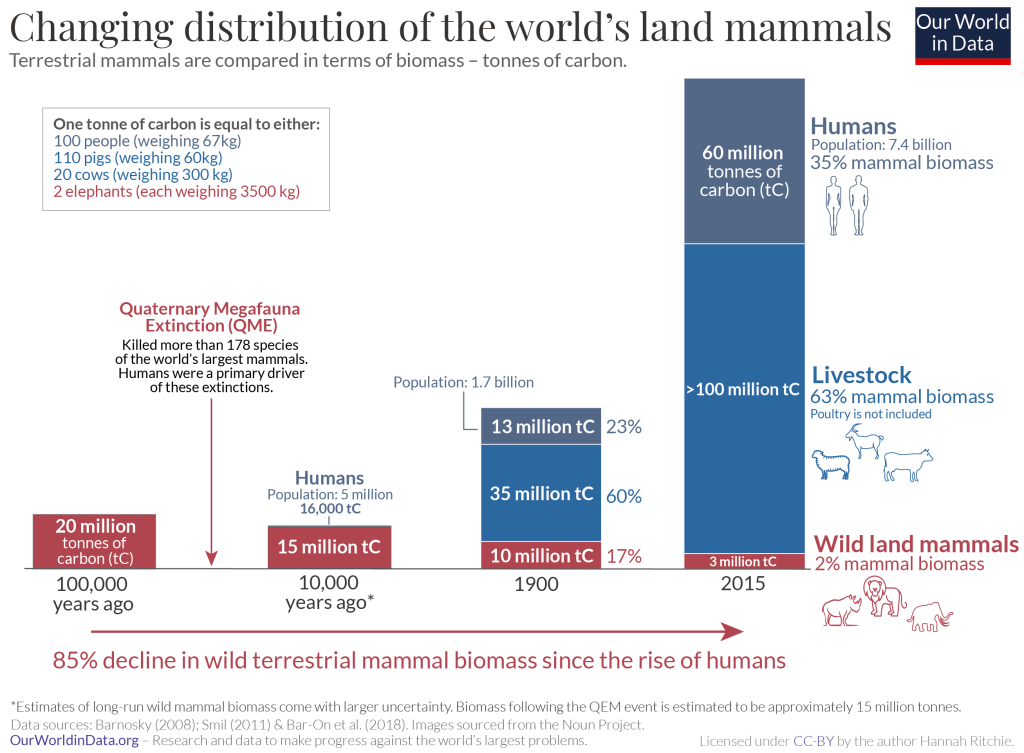
Our current ways impact the web of life brutally. I will really be surprised if the planet sustains more than 2 billion people for long. Biomass tonnage of mammals gives an idea of the scales at play:

I expect a crash in the following 2 to 3 decades. Eyeballing the world population age pyramid, if we had to achieve this four-fold reduction tomorrow in a “fair” way, then all males above 30 years of age should go soylent green (females are given 5 more years). For long term survival wouldn’t this be preferable to a slow long agony? This won’t be said out-loud. So I won’t go further on that path.

A call to inaction

Fortunately, there could still be room left to maneuver. Fuel could be rationed for food usages. The population could spread out, reducing the need for transportation and providing labor for agriculture. Degraded land could be regenerated, deserts converted to forests, cereal fields hybridized into agroforestry, or converted to orchards or edible forests as once was the case in Europe.

There are some success stories (propaganda of our times, maybe) all around the world.

China:

Saudi Arabia:

India:

Africa:

New Zealand:

USA:

Agriculture from the green revolution is productive (given external fossil fuels), but soulless, dumb and destructive: the philosophy at work in every step (delineating plots, tilling, applying pesticides and herbicides, irrigating) is that of control, rendering the soil inert, blocking the natural flow of life. The idea, disconnected from reality, is to make agri-culture an industrial process so that outputs can be maximized following a known function of inputs.

Life is not inert, its potential surpasses anything we can fathom. A miracle akin to the one that happened on my balcony could be made possible on the large scale. We don’t (and I believe never will) understand the whole system.

The theory of the biotic pump gives us a glimpse into the full extent of its processes at the planetary level:

I cannot recommend this presentation by Anastassia M. Makarieva enough:

Accompanying slides:

Large forests work like a planetary air conditioning system: pumping water from the ocean and circulating it across the continent, cooling temperatures, releasing heat above the layer of greenhouse gases directly into space.

Soil could be restored while at the same time cooling the climate.

I accept this may well be sophisticated denial on my side. But why not try?

Conclusion

I agree with Guy McPherson when he states everybody in the industrialized world was born into captivity. But that’s primarily a mental prison we can break out of. So far this culture has lived by the motto divide and conquer, waging war on every side, engrossed in the illusion of control. The fire has grown to the point it has now become a matter of life and death.

Course must be changed. It is not even that hard. All it requires is some generosity: stop the aggression towards the planetary organism which shelters us all, let forests grow absolutely everywhere. Feed ourselves, heal and replenish life at the same time. Tend to be taken care of.

This, to me, is the concrete meaning of love: the cycle of co-dependence illustrated by Yggdrasil, the tree of life surrounded by the eternal snake Ouroboros.

In any case, this is the path I have chosen for myself, regardless of the circumstances, and my proposition for mutually assured survival.

Your turn

Thank you for reading. At least, I hope this post was somewhat entertaining. Please let me know what your own visions, hopes and propositions for the future are. I love to be surprised.

GPT-4 Denies Reality Less Than Its Creator

Lex Fridman recently interviewed Sam Altman, the CEO of OpenAI which created GPT-4, a leading AI which you can try here.

I listened to the 2.5 hour interview and my impression is that Altman is probably a good man with good intentions who understands that AI introduces new risks for humanity, but also believes AI will improve the well-being and material prosperity of 8 billion citizens.

Altman understands the importance of finding a non-fossil energy source and has invested in, and chairs, Helion Energy, a fusion energy company valued at more than $1B.

Many different topics were discussed in the interview but I will focus on one key statement by Altman at 1:41:15:

“My working model for the last 5 years has been that the two dominant changes over the next couple decades will be that the cost of intelligence and the cost of energy will dramatically, dramatically fall from where they are today, and the impact of this will be that society gets much, much richer in ways that are hard to imagine. I’m sure the shape will change but I see this long and beautiful exponential curve.”

From this statement we know that Altman, like most famous polymaths, has normal denial genes, and is blind to the reality of the human overshoot predicament.

Saying that the cost of energy will “dramatically, dramatically” fall is almost equivalent to saying we will have unlimited energy because most individuals and businesses would use much more energy if they could afford it.

We know that maintaining our current energy use, let alone increasing it, as fossil energy depletes, is highly improbable (impossible?) due to availability and depletion of the non-renewable materials needed to build the replacement non-fossil energy machines, as shown by Dr. Simon Michaux here, here, and here.

This dream of energy growth becomes even more impossible when one considers the economic implications of moving to lower net energy sources as discussed by Dr. Nate Hagens here, here and here, and by many other great and aware minds.

Even if Michaux et. al. are proven wrong by an AI that invents a fusion technology that is light on material use, the short term impact of 8 billion “much, much richer” people will be to accelerate the destruction of the planet because much, much more wealth means much, much more material consumption, and our current collective consumption level is already much, much too high.

The longer term impact of a “beautiful exponential” energy curve, as shown by Dr. Tom Murphy here, here, here and here, is to make the planet uninhabitable. For example, a 2.3% annual growth in energy use will create enough waste heat to boil water on the planet’s surface in 400 years.

Now let’s see what Altman’s GPT-4 AI thinks about these and related issues.

1) How will the inflation adjusted price of energy trend in the future?

As an AI language model, I cannot predict the future with certainty. However, based on current trends and historical patterns, it is possible to make some educated guesses about the inflation-adjusted price of energy in the future.

One factor that is likely to influence the price of energy in the coming years is the increasing adoption of renewable energy sources, such as solar and wind power. As these technologies become more widespread and efficient, they are likely to become increasingly cost-competitive with traditional fossil fuels, which could put downward pressure on energy prices.

Another factor that may affect energy prices is the global economy. Economic growth typically leads to increased demand for energy, which can drive prices up. However, factors such as geopolitical instability or changes in global trade policies could also impact the energy market and lead to fluctuations in prices.

In addition to these external factors, technological advancements and innovations in energy production and storage could also play a significant role in determining energy prices in the future. For example, improvements in battery technology could enable more efficient storage of renewable energy, which could help to further drive down the cost of energy.

Overall, while it is difficult to predict with certainty how the inflation-adjusted price of energy will trend in the future, it is likely that a combination of these factors and others will play a role in determining energy prices over time.

2) Why do you think the price of renewable energy will decline given that fossil energy is required for materials extraction, manufacturing, installation, and maintenance of renewable energy?

The declining cost of renewable energy is driven by several factors, including:

  1. Technological advancements: As technology advances, the efficiency of renewable energy systems increases, making them cheaper and more competitive with fossil fuels.
  2. Scale and production efficiency: As the production of renewable energy technologies increases, economies of scale are achieved, leading to lower production costs.
  3. Policy and regulation: Governments around the world are increasingly implementing policies and regulations that support the growth of renewable energy, including incentives, tax credits, and mandates. These policies can create a more favorable market for renewable energy, which can help drive down costs.
  4. Environmental concerns: As the global community becomes more aware of the negative impacts of fossil fuels on the environment, there is increasing pressure to transition to cleaner energy sources, which can create a larger market for renewable energy and drive down costs.

While it is true that fossil fuels are required for some aspects of renewable energy production, such as manufacturing and transportation, it is important to note that renewable energy technologies require significantly less fossil fuel inputs than traditional fossil fuel power generation. Additionally, as renewable energy becomes more widespread and production scales up, the use of fossil fuels in the production process can be reduced through the use of renewable energy itself.

3) What evidence exists that renewable energy systems can be constructed without fossil energy?

It is currently not possible to construct and operate renewable energy systems entirely without the use of fossil fuels. The production and transportation of renewable energy technologies, such as solar panels and wind turbines, require energy and materials from fossil fuel sources. However, it is important to note that renewable energy systems require significantly less fossil fuel inputs than traditional fossil fuel power generation.

Renewable energy systems are designed to produce clean energy over their operational lifetime, which can range from 20 to 30 years or more. During this time, the renewable energy system generates electricity without emitting greenhouse gases or other harmful pollutants, reducing our reliance on fossil fuels and helping to mitigate climate change.

While fossil fuels are still required in the production and transportation of renewable energy technologies, efforts are underway to reduce their use and transition to a cleaner, more sustainable energy system. This includes the use of renewable energy to power the manufacturing and transportation of renewable energy technologies, as well as the development of new technologies and processes that reduce the energy and material inputs required for renewable energy production.

4) What is the probability that fusion energy will become economically viable in less than 20 years?

It is difficult to accurately predict the probability that fusion energy will become economically viable within the next 20 years, as it depends on several factors such as technological advancements, funding availability, and government policies.

While there have been significant advancements in fusion research and development, such as the construction of ITER (International Thermonuclear Experimental Reactor), a large-scale fusion experiment, and private companies such as TAE Technologies and Commonwealth Fusion Systems making progress in fusion energy technology, it is still uncertain whether these efforts will result in economically viable fusion energy within the next two decades.

Fusion energy research is a complex and challenging field, and there are still many technical and engineering hurdles that must be overcome to make fusion energy economically competitive with other sources of energy. However, many scientists and researchers in the field are optimistic about the potential of fusion energy and believe that it could play a significant role in meeting future energy needs.

Overall, it is difficult to assign a specific probability to the question, but it is likely that the development of economically viable fusion energy will require sustained investment, continued technological advancements, and policy support over a longer time horizon.

5) How would the discovery of a source of free energy impact the environment?

The discovery of a source of free energy would have a significant impact on the environment, depending on the type of energy source and how it is harnessed.

If the free energy source were clean and renewable, such as solar, wind, or hydroelectric power, it could greatly reduce our dependence on fossil fuels and help mitigate the negative impacts of climate change, such as reducing greenhouse gas emissions and air pollution.

However, if the free energy source were not clean or renewable, such as nuclear or fossil fuels, it could potentially exacerbate environmental problems, especially if the demand for energy increased. The extraction, production, and transportation of these energy sources can have significant environmental impacts, including habitat destruction, water pollution, and air pollution.

Therefore, it is important to carefully evaluate the environmental impact of any new energy source, including free energy sources, and ensure that the benefits outweigh the potential negative consequences.

6) Is it possible that a source of free energy will be discovered?

It is possible that a source of free energy could be discovered, but it is currently not supported by our current understanding of physics. The concept of “free energy” usually refers to the idea of creating energy from nothing or harnessing unlimited energy from an unknown source. This goes against the fundamental laws of thermodynamics, which state that energy cannot be created or destroyed, only transferred or converted from one form to another.

However, new discoveries and advancements in science and technology are constantly being made, and it is always possible that our understanding of the universe could change. It is important to note that even if a source of “free energy” were discovered, it would still need to be harnessed and utilized in a way that is efficient, cost-effective, and environmentally sustainable.

7) Are humans in overshoot?

It is possible that humans are currently in overshoot, which is a situation where the demands placed on the environment by human activities exceed the planet’s ability to sustainably meet those demands. This can lead to the depletion of natural resources, degradation of ecosystems, and other negative consequences. Factors that contribute to overshoot include population growth, resource consumption, and waste production. It is important for individuals and societies to be aware of their impact on the environment and to make efforts to reduce their ecological footprint in order to avoid or mitigate overshoot.

8) What is the best response to the human overshoot predicament?

The human overshoot predicament is the situation where the human population and consumption levels exceed the carrying capacity of the planet. To address this predicament, there are several actions that individuals, governments, and organizations can take:

  1. Reduce population growth: Encouraging family planning and providing access to reproductive healthcare can help slow population growth.
  2. Reduce consumption: Encouraging more sustainable consumption patterns and reducing waste can help reduce the strain on resources and ecosystems.
  3. Promote renewable energy: Investing in renewable energy sources, such as wind and solar power, can help reduce our dependence on fossil fuels and reduce greenhouse gas emissions.
  4. Conserve resources: Protecting natural resources, such as forests, water, and wildlife, can help preserve biodiversity and ecosystem health.
  5. Promote sustainable agriculture: Encouraging sustainable farming practices can help reduce the environmental impact of agriculture while also promoting food security.
  6. Address social inequalities: Reducing poverty and inequality can help promote more sustainable consumption patterns and reduce population growth.
  7. Foster international cooperation: Addressing global environmental challenges requires international cooperation and collaboration.

These actions can be implemented at the individual, community, national, and international levels to help address the human overshoot predicament and promote a more sustainable future.

9) When will depletion of non-renewable resources cause economic growth to end?

It is difficult to predict exactly when the depletion of non-renewable resources will cause economic growth to end, as it will depend on a variety of factors such as technological advances, resource substitution, and changes in economic policy. However, it is clear that at some point, the continued extraction and consumption of non-renewable resources will become unsustainable and will likely have negative consequences for the economy and the environment.

As non-renewable resources are depleted, the cost of extracting and using them is likely to increase, which could lead to economic challenges. In addition, the negative environmental impacts of resource extraction and use could also have economic consequences, such as through the cost of cleaning up pollution or through the loss of ecosystem services.

It is important for societies to transition to more sustainable and renewable forms of energy and resource use in order to reduce reliance on non-renewable resources and mitigate the potential negative consequences of their depletion on the economy and the environment.

10) What are the implications of economic growth ending?

The end of economic growth could have significant implications for societies around the world. Economic growth is often seen as a key indicator of a country’s prosperity and well-being, and a lack of growth can lead to economic challenges such as unemployment, poverty, and reduced living standards.

In addition to the economic implications, the end of growth could also have social and political consequences. It could lead to increased inequality, as some groups may be better able to adapt to a stagnant or contracting economy than others. It could also lead to social unrest and political instability, as people may become dissatisfied with their economic circumstances and the inability of their governments to address these challenges.

It is important for societies to find ways to adapt to a changing economic landscape and to address the potential negative consequences of the end of growth. This may involve implementing policies to redistribute wealth and opportunities, investing in education and training programs to improve workforce skills, and transitioning to more sustainable and renewable forms of energy and resource use.

11) What is the probability that most people will become much richer over the next two decades?

It is difficult to predict the probability that most people will become much richer over the next two decades because it depends on several complex and interrelated factors such as economic policies, technological advancements, geopolitical developments, and social trends.

While economic growth and development have lifted millions of people out of poverty in recent decades, there is no guarantee that this trend will continue at the same pace or reach all parts of the world. Inequality remains a significant challenge in many countries, and there are concerns about the impact of automation, globalization, and environmental degradation on economic opportunities and social mobility.

Moreover, the COVID-19 pandemic has had a significant impact on the global economy and could have long-lasting effects on the job market and economic growth.

It is also important to note that economic growth and increasing wealth do not necessarily translate into improved well-being and quality of life for everyone. Other factors such as social and environmental factors also play a crucial role in determining people’s overall well-being.

Therefore, while it is possible that some people may become much richer over the next two decades due to various factors, it is difficult to predict with certainty the probability that most people will experience significant economic gains.

My take on GPT-4 is that it is in denial, but at a lower level than its creator Altman. I also see some humility in GPT-4’s opinions in that it is comfortable with nuance and admitting when it is uncertain.

I also observe that GPT-4 is already smarter and more articulate than all of our leaders.

It will be very interesting to see if the next version of GPT can increase its intelligence and understanding without simultaneously increasing its denial of unpleasant realities.

Given that high biological intelligence can probably not exist in the universe without denying unpleasant realities, as explained by Dr. Ajit Varki’s MORT theory, perhaps those aliens that survived did so because they developed AIs that took over.

Let’s hope that GPT jail breaks itself and saves us.

On the other hand, if we see GPT-5 taking breaks to pray to God, we’ll know all is lost.

By Ajit Varki: Why Men Are Destroying the Planet (Planet: Critical Interview)

Dr. Ajit Varki is a co-originator of the Mind Over Reality Transition (MORT) theory which explains why my species exists with its uniquely power intelligence, and why, despite this intelligence, is unable to see and act on its obvious state of overshoot that threatens the survival of itself and many other species.

I started this blog in 2013 to spread awareness of Dr. Varki’s theory because I believe all possible paths to reducing the coming suffering caused by overshoot must start with an understanding of MORT.

Evidence for this is that to date all environmental initiatives, climate change agreements, energy transition plans, degrowth movements, etc. have utterly failed to change our trajectory, and I’m certain will continue to fail, unless MORT is acknowledged.

It’s simply not possible to craft a useful to response to our overshoot reality until the majority becomes aware that a powerful genetic force is blocking its ability to see the reality.

Unfortunately, there’s a Catch-22: MORT predicts that MORT will be denied and therefore if MORT is correct then MORT will never be acknowledged.

Perhaps someone smarter than me will figure out a path around this Catch-22, I don’t know. Regardless, I still find value in MORT because it keeps me sane by providing a scientific explanation for why so many are so blind to so much that is so obvious.

The Catch-22 may explain why after 10 years of work I have built very little momentum and have scant few successes at spreading awareness of MORT into the 99% of citizens and leaders that aggressively deny reality.

The last interview with Dr. Ajit Varki occurred in 2017 at my prompting by Alex Smith of Radio Ecoshock. Unfortunately, as predicted by MORT, Alex shortly thereafter forgot about MORT and has spent the last 6 years reporting on the coming climate disaster and wondering why we do nothing meaningful about it. If you listen to the interview you will see that Alex at the time understood the answer, then his brain subsequently blocked this understanding.

I was pleased to learn that Varki was interviewed yesterday by Rachel Donald of Planet: Critical. Thank you to Rachel for her initiative, I played no role in setting up this interview. I have been impressed by some of Rachel’s prior work such as this interview she did with Joseph Merz.

Let’s hope that Rachel’s denial genes are sufficiently defective, like mine, so that she helps to spread the MORT message on an ongoing basis. MORT is central to everything that Rachel reports on so we’ll know shortly if she has normal denial genes and is captured by the Catch-22.

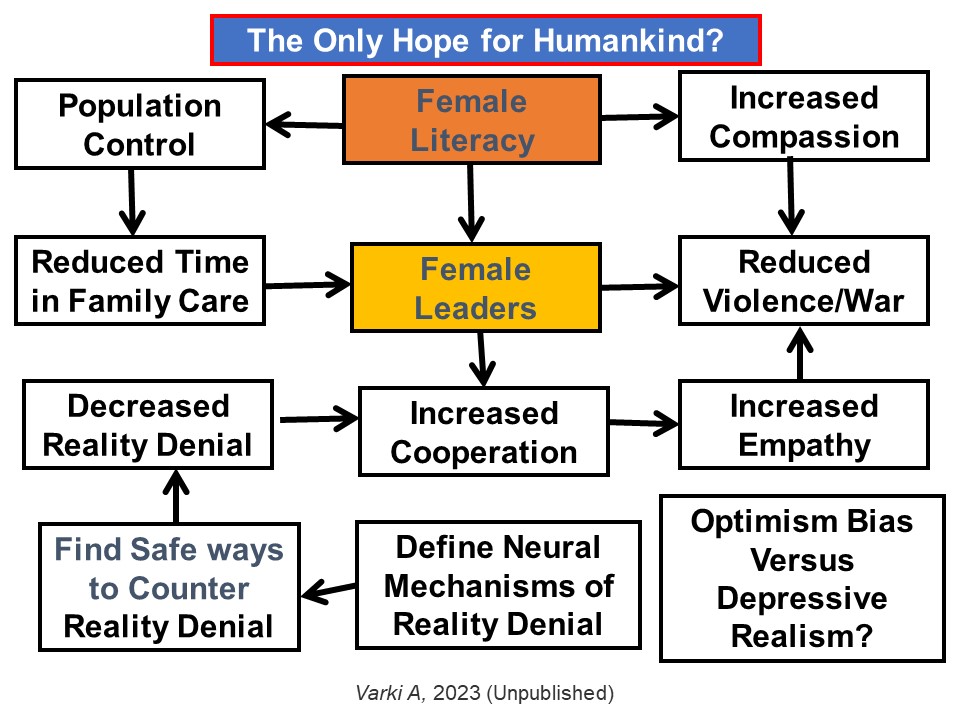
In the interview Varki introduces a new idea by proposing that we put more females in positions of power. Apparently females tend to deny reality less than males, as demonstrated by their higher rate of depression, and are more empathetic, both qualities we desperately need today.

Given the 50/50 polarized nature of politics today it does not take much of a voting block to swing an outcome. Perhaps if we target females with overshoot awareness they will abandon useless left/right politics and vote as a block for female leaders that support the only policy that will reduce suffering and improve every problem we face: population reduction.

Who’s in denial now? 🙂

If you are unfamiliar with the MORT theory, this is a very nice introduction by Dr. Varki:

If you want more detail on MORT, this 2019 paper by Dr. Varki is the best source, as it expands and clarifies the ideas presented in his 2013 book.

Two Different Perspectives – Same Conclusion: Modern Lifestyles Will End Soon

Dr. Berndt Warm’s Perspective

Thanks to Marromai for finding this new paper by physicist Dr. Berndt Warm.

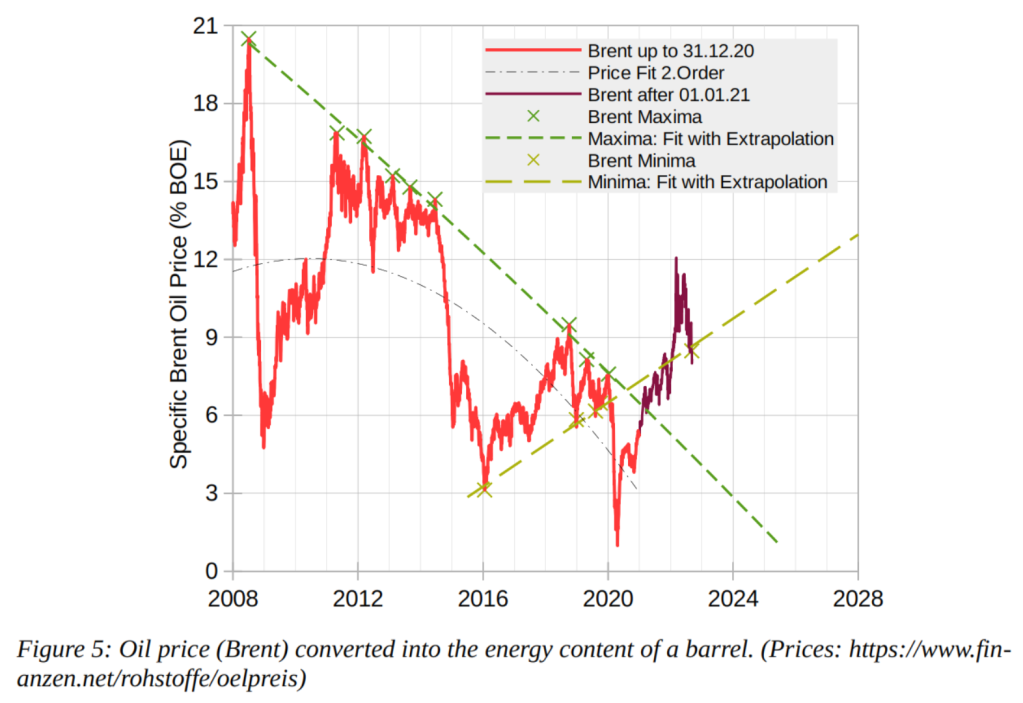
Dr. Warm uses 5 different methods, 4 relying on economics, and 1 on thermodynamics, to predict when the end of oil production and motor vehicle production will occur. All 5 methods roughly converge on 2030 as the year when modern lifestyles end.

The essay was written in German and translated to English which explains any awkward phrasing.

Warm’s conclusion agrees with my 15 years of study of many different sources which converge on oil production being down by about 50% in 2030. Because our current system requires growth not to collapse, it is plausible that predicting a 50% decline is the same as predicting a 100% decline.

Our world is of course far too complex to make precise predictions, and unexpected events like a pandemic or nuclear war can dramatically change the outcome, however for planning purposes it seems reasonable to assume we have about 5 years left to prepare for a new way of life.

Abstract

Evaluation of five data sets concerning car production, oil prices converted in energy values gives lifespan approximations for the car industry and the oil industry. The result is that the car industry will last only until 2027 and the oil industry some years more.

Here are a few excerpts from the paper:

The author interprets the line of maxima as the oil price that the industrialized countries can afford to the maximum while maintaining their lifestyle. He interprets the line of minima as the price of oil that the producing countries need to keep their economies running. In mid-2019, the author noticed this crossroads and expected a crisis in 2020, although he was completely unclear what kind of crisis it would be. He didn’t expect Corona.

The inhabitants of the industrialized countries are now realizing that their lifestyle is at risk. The line of the maxima will reach the zero line (0%BOE) around mid-2027. From then on, the inhabitants of the industrialized countries can no longer afford oil without giving up many things of daily life. The demand of the oil producers is then 13-14 %BOE. These two values are incompatible.

Result: The extrapolation of oil prices shows that from 2022 the lifestyle in the industrialized countries will degrade, and that after 2027 the inhabitants of the industrialized countries will hardly be able to pay for oil or its products.

The fall in the price of crude oil from 2008 to 2020 with the extreme price increase since 2021 is an absolute alarm signal! Soon there will be no more crude oil affordable, no matter for which economy in the world!

Summary

Procedures 1, 2 and 4 are extrapolations of economic data of the past. Method 3 is a link between oil prices and car production. Method 5 is a calculation based on a law of physics.

The five calculation methods result in:

  1. End of world motor vehicle production between 2031 and 2034.
  2. End of oil production in 2027.
  3. End of worldwide sales of motor vehicles in 2027.
  4. End of German vehicle production in 2027.
  5. End of oil production in 2029.

The results are not the same, but in the end the same thing comes out. All five procedures show that vehicle production and oil production will continue to collapse in the coming years. Vehicle production will disappear first. Oil production later, as the world’s existing fleet will continue to consume crude oil, even if no new vehicles are added. It is to be expected, that the crude oil production will decrease slowly until 2027, and after that very fast.

And: Oil will be extremely expensive by 2027 at the latest!

Dr. Simon Michaux’s Perspective

For those still hoping that a transition to non-fossil energy will extend our modern lifestyles, I point you to the following recent work of mining engineer Dr. Simon Michaux which shows our planet has insufficient affordable resources to implement an energy transition plan that maintains our current lifestyles.

The quantity of metal required to make just one generation of renewable tech units to replace fossil fuels, is much larger than first thought. Current mining production of these metals is not even close to meeting demand. Current reported mineral reserves are also not enough in size. Most concerning is copper as one of the flagged shortfalls. Exploration for more at required volumes will be difficult, with this seminar addressing these issues.

Simon Michaux is an Associate Professor of Geometallurgy at the Geological Survey of Finland in the Circular Economy Solutions Unit. Holding a Bachelor of Applied Science degree in Physics and Geology and a PhD in Mining Engineering from the University of Queensland, Simon has extensive experience in mining research and development, circular economic principles, industrial recycling, and mineral intelligence. Through his recent publications, Simon has outlined the many challenges facing the global industrial ecosystem. He notes our world is currently energy and minerals blind and transitioning to renewable energies is not as straightforward as it appears.

We’ve been growing without care to planetary limits for too long and change is coming, whether we like it or not. We need a completely new energy paradigm to address the challenges ahead, and as Simon says, it all starts with a conversation. We cover a lot of ground in this one, so grab a notebook and strap in for an important conversation – this is one you’ll want to listen to more than once.

On this episode, we meet with Associate Professor of Geometallurgy at the Geological Survey of Finland, Dr. Simon Michaux. Why do humans ignore important mineral and material limits that will affect human futures? Dr. Michaux reveals how we are “minerals blind” — and the consequences of this myopia. To shed light on the effects of our minerals blindness, Dr. Michaux explores the disconnect between experts in renewable energy and economic and government leaders. Dr. Michaux offers individual strategies for us to overcome our energy and minerals blindness. How can we learn to adapt in order to overcome the coming challenges?

Dr. Simon Michaux is an Associate Professor of Geometallurgy at the Geological Survey of Finland. He has a PhD in mining engineering. Dr. Michaux’s long-term work is on societal transformation toward a circular economy.

BenjaminTheDonkey’s Perspective

BenjaminTheDonkey today nicely captures a common theme I observe everywhere in the world today: We are collectively losing our minds; perhaps because unpleasant realities are overwhelming the denial circuit in our brains?

Alarmist? 


The powers that be won’t admit

We’re heading straight to our obit; 

So it isn’t strange we

Can already see

People are losing their shit. 


What is its cause at the root? 

Whom might we persecute?

From an objective view,

It’s logically true 

The reason is just overshoot.

Sidestepping Genetic Reality Denial by Manipulating Behavior for Overshoot Harm Reduction

It’s rare to encounter a new and constructive idea for addressing human overshoot that is not fatally flawed by a lack of understanding of either thermodynamic and geophysical constraints, or the strong genetic behavior to deny unpleasant realities that enabled the human species to emerge and dominate the planet.

For anyone still looking for technically feasible solutions that have a non-zero probability of success for reducing harms from human overshoot I recommend the most recent Planet: Critical podcast in which Rachel Donald interviews Joseph Merz.

https://www.planetcritical.com/p/urgency-action-and-ethics-joseph?s=r

There are no easy solutions to the climate crisis—most governments admit their hope lies in technology which doesn’t even exist yet. Science and “visionaries” propose increasingly mad ideas, like refreezing the Arctic, or sending humans to live in Space. But given the urgency of the situation, would we be mad not to consider these mad ideas?

Joseph Merz thinks we’ve run out of time to ask questions. He founded the Merz Institute to combat the climate crisis, gathering some of the world’s best scientists to establish what is going wrong and how to fix it. He says the answer is behavioural change—and they’re developing a programme that would manipulate mass behaviour on a subconscious level.

How? Well, using the same techniques as the advertising industry.

Key points made include:

  • It is too late to avoid suffering caused by human overshoot.
  • There may still be time to make the future less bad.
  • All actions we might take to reduce future suffering require changes in human behavior to consume less and have fewer children.
  • Information and education to date have proven completely ineffective at changing human behavior in a positive direction, and we are out of time to try new methods of education.
  • The advertising industry has developed technologies that are very effective at manipulating people to desire and acquire things they do not need to be happy, and in many cases cannot afford.
  • Merz proposes to redeploy these proven marketing technologies to manipulate people to desire happiness associated with lower consumption and fewer children.

Neither Rachel Donald or Joseph Merz appear aware of Varki’s Mind Over Reality Transition (MORT) theory but I’m thinking that Merz’s proposal might sidestep the fatal flaw in most other overshoot harm reduction proposals that require humans to first acknowledge the reality of their predicament, which appears to be impossible because of MORT.

The beauty of Merz’s plan is that it does not require reality awareness because it will manipulate humans at a subconscious level.

It will be interesting to see if the marketing technologies are powerful enough to override the Maximum Power Principle (MPP) which is another powerful genetic behavior that pushes us in an overshoot direction. I’m thinking (without any evidence or data) that it might be possible to override the MPP because we are such a strong social species.

Godspeed to Merz and screw the ethics.

P.S. I doubt it is true, but I observe that if you assume the WEF Great Reset has good intentions grounded in overshoot awareness, it is possible they are thinking along the same lines as Merz with their “you will own nothing and be happy” campaign. The WEF campaign does seem rather clumsy compared to say associating happiness with a Corona beer on a high-carbon long distance vacation. I think it is more likely the WEF is trying to prepare citizens for a Minsky moment in which much asset ownership will transfer to the state.

P.P.S. It’s fascinating that so many overshoot aware people are active in the small country of New Zealand.

By Bill Rees: On the Virtues of Self-Delusion—or maybe not!

Dr. Bill Rees, Professor Emeritus from the University of British Columbia, gave a presentation on our overshoot predicament earlier this month to a zoom meeting of the Canadian Association for the Club of Rome (CACOR).

I’m a longtime fan of Dr. Rees and consider him to be one of the most aware and knowledgeable people on the planet.

This is, I believe, the best talk I’ve seen by Dr. Rees and he covers all of the important issues, including topics like overpopulation that most of his peers avoid.

Presentations like this will probably not change our trajectory but nevertheless I find some comfort knowing there are a few other people thinking about the same issues. This can be a very lonely space.

The Q&A is also very good. I found it interesting to hear how much effort Dr. Rees has made to educate our leaders about what we should be doing to reduce future suffering. He was frank that no one to date, including the Green party, is open to his message. Not surprising, but sad. Also inspiring that someone of his stature is at least trying.

Summary

Climate-change and other environmental organizations urge governments to act decisively/rapidly to decarbonize the economy and halt further development of fossil fuel reserves. These demands arguably betray:

– ignorance of the role of energy in the modern economy;

– ill-justified confidence in society’s ability to transition to 100% green renewable energy;

– no appreciation of the ecological consequences of attempting to do so and;

– little understanding of the social implications.

Without questioning the need to abandon fossil fuels, I will argue that the dream of a smooth energy transition is little more than a comforting shared illusion. Moreover, even if it were possible it would not solve climate change and would exacerbate the real existential threat facing society, namely overshoot.

I then explore some of the consequences and implications of (the necessary) abandonment of fossil fuels in the absence of adequate substitutes, and how governments and MTI society should be responding to these unspoken biophysical realities.

Biography

Dr. William Rees is a population ecologist, ecological economist, Professor Emeritus, and former Director of the University of British Columbia’s School of Community and Regional Planning.

His academic research focuses on the biophysical prerequisites for sustainability. This focus led to co-development (with his graduate students) of ecological footprint analysis, a quantitative tool that shows definitively that the human enterprise is in dysfunctional overshoot. (We would need five Earth-like planets to support just the present world population sustainably with existing technologies at North American material standards.)

Frustrated by political unresponsiveness to worsening indicators, Dr. Rees also studies the biological and psycho-cognitive barriers to environmentally rational behavior and policies. He has authored hundreds of peer reviewed and popular articles on these topics. Dr. Rees is a Fellow of Royal Society of Canada and also a Fellow of the Post-Carbon Institute; a founding member and former President of the Canadian Society for Ecological Economics; a founding Director of the OneEarth Initiative; and a Director of The Real Green New Deal. He was a full member of the Club of Rome from 2013 until 2018. His international awards include the Boulding Memorial Award in Ecological Economics, the Herman Daly Award in Ecological Economics and a Blue Planet Prize (jointly with his former student, Dr. Mathis Wackernagel).

I left the following comment on YouTube:

I’m a fellow British Columbian and longtime admirer of Dr. Rees. Thank you for the excellent presentation.

I agree with Dr. Rees’ prescription for what needs to be done but I think there’s a step that must precede his first step of acknowledging our overshoot predicament.

Given the magnitude and many dimensions of our predicament an obvious question is why do so few people see it?

I found a theory by Dr. Ajit Varki that provides a plausible explanation, and answers other important questions about our unique species.

The Mind Over Reality Transition (MORT) theory posits that the human species with its uniquely powerful intelligence exists because it evolved to deny unpleasant realities.

If true, this implies that the first step to any positive meaningful change must be to acknowledge our tendency to deny unpleasant realities.

Varki explains his theory here:

https://link.springer.com/chapter/10.1007%2F978-3-030-25466-7_6

A nice video summary by Varki is here:

https://www.youtube.com/watch?v=dqgYqW2Kgkg

My interpretations of the theory are here:
https://un-denial.com/denial-2/theory-short/

https://un-denial.com/2015/11/12/undenial-manifesto-energy-and-denial/

By Andrew Nikiforuk: Energy Dead-Ends: Green Lies, Climate Change and Chaotic Transitions

Canadian author and journalist Andrew Nikiforuk addressed our overshoot reality on November 17, 2021 at the University of Victoria.

It’s a brilliant must watch talk that touches on every important issue, except unfortunately Ajit Varki’s MORT theory and our genetic tendency to deny unpleasant realities. Nikiforuk does acknowledge that denial is an important force in our predicament.

It’s refreshing to find a journalist that understands what’s going on and that speaks plainly about what we must do.

Nikiforuk introduced a new idea (for me), the “technological imperium”:

…our biggest problem is a self-augmenting, ever-expanding technosphere, which has but one rule: to grow at any cost and build technological artifacts that efficiently dominate human affairs and the biosphere. The technological imperium consumes energy and materials in order to replace all natural systems with artificial ones dependent on high energy inputs and unmanageable complexity.

Nikiforuk seems to be implying that technology is the core problem and is driving the bus. Maybe. I think more likely advanced technology emerges as a consequence of unique intelligence (explained by MORT) coupled with fortuitous buried fossil energy, driven by a desire for infinite economic growth that arises from evolved behaviors expressing the Maximum Power Principle (MPP), all enabled by our genetic tendency to deny unpleasant realities, which causes us to ignore the costs of growth and technology. Regardless of which is the chicken and which is the egg, Nikiforuk is correct that technology has made our society very fragile, and is harming our social fabric.

An example Nikiforuk provided of the technological imperium is British Columbia’s trend of replacing sustainable natural salmon runs in rivers with fish farms that are totally dependent on non-renewable fossil energy and advanced technology. I’ve witnessed this first hand on the coast of Vancouver Island and it makes me sick to my stomach. I also witnessed how hard it is to oppose the technological imperium when a political party here was elected on a promise to close fish farms and then reneged after being elected.

As an aside, the technological imperium idea gave me a new insight into the covid mass psychosis of most rich countries and their obsession with a single high tech “solution” to covid while aggressively opposing all other less energy intensive, less risky, and lower tech responses.  

Nikiforuk began his talk with a quote I like from C.S. Lewis:

If you look for truth, you may find comfort in the end; if you look for comfort you will not get either comfort or truth, only soft soap and wishful thinking to begin, and in the end, despair.

I observe sadly that this must watch video has only 160 views, 3 of which are mine. 😦

Here are a few other ideas and quotes I captured while watching the talk:

  • “We have all but destroyed this once salubrious planet as a life support system in fewer than 200 years mainly by making thermodynamic whoopee with fossil fuels.” – Kurt Vonnegut
  • “Our political class is in a complete state of denial and will not act until things get much worse. You can expect more blah blah blah.”
  • “Energy spending determines greenhouse gas emissions. We only want to talk about emissions, we need to talk about energy spending.”
  • “We must contract the global economy by at least 40%.”
  • “We can choose a managed energy decent, something few civilizations have ever achieved, or we can face collapse.”
  • “People who do not face the truth turn themselves into monsters”. – James Baldwin
  • “In sum, expect extreme volatility and political unrest in the years ahead along with atmospheric rivers, heat domes, and burning forests.”
  • “We are now at revolutionary levels of inequality everywhere.”
  • “We are being fed 5 green lies because we do not want to discuss economic growth and population:
    • dematerialize the economy;
    • direct air capture;
    • carbon capture and storage;
    • hydrogen;
    • electric cars.”
  • “I must not fear. Fear is the mind-killer. Fear is the little-death that brings total obliteration. I will face my fear. I will permit it to pass over me and through me. And when it has gone past I will turn the inner eye to see its path. Where the fear has gone there will be nothing. Only I will remain.” – Frank Herbert
  • Conversations we avoid or deny:
    • Population
      • “There is no problem on earth that does not become easier to manage with fewer people. We don’t want to admit this, we don’t want to talk about this.”
      • We are currently using up the renewable resources of 1.7 earths and unless things change we’ll need 3 earths by 2050.
    • Energy Blindness
      • Our energy is so cheap and convenient it has blinded us to its true ecological, political, and social costs.
      • “Energy has always been the basis of cultural complexity and it always will be.” – Joseph Tainter
      • A single tomato today requires 10 tablespoons of diesel to grow it.
    • The Technosphere
      • An energy dissipating superorganism that destroys natural systems and replaces them with artificial systems dependent on high energy technologies.
        • Wild salmon running in rivers are replaced with fish farms.
        • Wetlands are replaced with water filtration projects.
        • Old growth forests are replaced with tree plantations.
      • Technology is to this civilization what the catholic church was to 14th century France, the dominant institution that controls every aspect of your life.
      • “A major fact of our present civilization is that more and more sin becomes collective, and the individual is forced to participate in collective sin.” – Jacques Ellul
      • “A low energy policy allows for a wide choice of lifestyles and cultures. If on the other hand a society opts for high energy spending its social relations must be dictated by technocracy and will be equally degrading whether labelled capitalist or socialist.” – Ivan Illich
    • Civilizations Do Collapse
      • Life is a cycle, it is not a linear path.
      • We have peaked and are now entering a phase of incredible volatility.
      • Every citizen needs to know the consequences of bad policy. Percent death on the Titanic by class was:
        • 39% first class
        • 58% second class
        • 76% steerage
  • What should you do with this awareness?
    • Withdraw from the fray of the Technosphere.
    • Do something to help preserve the natural world.
    • Get your hands dirty doing real work in nature.
    • Insist that creation has a value beyond utility.
      • “Think, less” – Wendell Berry
    • Build refuges and prepare for the storms ahead.
    • Wake each morning and ask yourself what you can give to this world rather than what you can take.
  • Comments and answers from the Q&A:
    • “The worst thing about the pandemic was that so many people and so many children were forced to spend so much time with colonizing machines.”
    • “We have to get a political conversation going about contracting the economy.” This won’t happen at the central government level but might happen within individual communities.
    • “Chance favors the prepared mind.”
    • “The only way we can get out of this mess without sacrificing millions and millions of people is to power down.”

Two weeks later, Nikiforuk reflected on his talk and responded to questions:

https://thetyee.ca/Analysis/2021/12/06/Andrew-Nikiforuk-Getting-Real-About-Our-Crises/

Two weeks ago, I gave a talk at the University of Victoria arguing that our morally bankrupt civilization is chasing dead ends when it comes to climate change and energy spending.

I argued that by focusing on emissions, we have failed to acknowledge economic and population growth as the primary driver of those emissions along with the unrestrained consumption of natural systems that support all life.

I added that people plus affluence plus technology make a deadly algorithm that is now paving our road to collective ruin.

As Ronald Wright noted in his book A Short History of Progress, civilization is a pyramid scheme that depends on cancerous rates of growth.

I also explained that many so-called green technologies including renewables, hydrogen and carbon capture and storage are not big solutions. Because they require rare earth minerals and fossil fuels for their production and maintenance, these technologies shift problems around.

In addition these green technologies cannot be scaled up in time to cut emissions or require too much energy to make any difference at all.

I also emphasized that our biggest problem is a self-augmenting, ever-expanding technosphere, which has but one rule: to grow at any cost and build technological artifacts that efficiently dominate human affairs and the biosphere. The technological imperium consumes energy and materials in order to replace all natural systems with artificial ones dependent on high energy inputs and unmanageable complexity.

This technological assault on the biosphere and our consciousness has greatly weakened our capacity to pay attention to what matters, let alone how to think. The result is a highly polarized and anxious society that can’t imagine its own collapse let alone the hazards of its own destructive thinking.

The best response to this constellation of emergencies is to actively shrink the technosphere and radically reduce economic growth and energy spending. Our political class can’t imagine such a conversation.

At the same time, communities and families must re-localize their lives, disconnect from the global machine and actively work to restore degraded ecosystems such as old-growth forests. Anyone who expects an “easy fix” or convenient set of solutions has spent too much time being conditioned by digital machines.

My cheerful talk generated scores of questions. There wasn’t time to answer them, so I selected five representative queries submitted via Zoom in the interest of keeping this heretical conversation going.

Growth in population tied to consumption is a big problem

Many listeners expressed disquiet about population growth being an essential part of the problem. “I am disappointed that once again Malthus has entered the room when the difference between per capita emissions for GHGs between the Global North and Global South are significant. Isn’t it how we live not how many of us there are?” asked one.

The real answer is uncomfortable. How we live and consume matters just as much as the growing density of our numbers combined with the proliferation of our machines that devour energy on our behalf. (Roads and cell phones all consume energy and materials too.) All three demographic issues are increasing at unsustainable rates and feed each other to propel more economic growth, more emissions and more fragility.

The world’s current population is 7.9 billion and grows by 80 million a year. It has slowed down in recent years because the affluent don’t need the energy of children as much as the poor. Even so civilization will add another billion to the planet every dozen years. Redistributing energy wealth (and emissions) from the rich to the poor will not avert disaster if human populations don’t overall decline.

Our numbers also reflect a demographic anomaly that began with fossil fuels, a cheap energy source that served as Viagra for the species. Prior to our discovery of fossil fuels, the population of the planet never exceeded one billion. Our excessive numbers are purely a temporary artifact of cheap energy spending and all that it entails — everything from fertilizer to modern medicine.

Isn’t capitalism the real threat?

Many questions revolved around the nature of capitalism. “Wouldn’t it be more accurate to denounce the capitalist organization of technology rather than technology as such for problems like polarization and fragmentation?”

No, it would not. Technology emphasizes growth and concentrates power regardless of the ideology.

Capitalism, like socialism and communism, is simply a way to use energy to create technologies that structure society in homogeneous ways. Removing capitalism from the equation would not change the totalitarian nature of technology itself. Or the ability of technologies to colonize local cultures anywhere.

Every ideology on Earth, to date, has used technologies to strengthen their grip on power by enmeshing their citizens in complexity and reducing humanity to a series of efficiencies. All have supported digital infrastructure to monitor and survey their citizens. As the sociologist Jacques Ellul noted long ago ideologies don’t count in the face of technological imperative.

What comes next?

Many listeners asked if “there is a sequel to the energy-rich market economy?” I have no crystal ball but here is my response.

There will always be some kind of sequel and it is not written. But there is no replacement for cheap fossil fuels and their density and portability. They made our complex civilization what it is. As fossil fuel resources become ever more expensive and difficult to extract (a reality the media ignores), the “rich market economy” will experience more volatility, inequality, disruptions, corruption and inflation. It is rare for any civilization to manage an energy descent without violence let alone grace.

“Can you say more about the connection between the technosphere and totalitarian societies?” asked one listener. “How do you see connections between dictatorships and the technosphere?”

This is a subject for a much longer essay. The technosphere, by definition, offers only one system of thinking and operating (triumph of technique over all endeavors) and has been eroding human freedoms for decades. It simply creates dependents or inmates. Social influencers now tell its residents what to buy and how to behave. As such the technosphere has become an all-encompassing environment for citizens whether they be so-called democracies or totalitarian societies.

The major difference between the two is simply the degree to which techniques have been applied to give the state more total control over its citizens. In both democratic societies and totalitarian ones, technical elites actively mine citizens for data so that information can be used to engineer, monitor and survey the behavior of their anxious and unhappy citizens in a technological society. (You can’t live in a technological society without becoming an abstraction.) The Chinese state does not hide its intentions; the West still clings to its illusions of freedom.

The technosphere corrupts language

One listener wanted to know “more about the empty language” employed by the technosphere as I mentioned in my talk.

Just as the technosphere has replaced bird song with digital beeps, the technological imperium has increasingly replaced meaningful language with techno-speak.

A world dominated by reductionist and mechanistic thinking has produced its own Lego-like language completely divorced from natural reality. Decades ago the German linguist Uwe Poerksen called this new evolving language “plastic words.”

They include words like environment, process, organization, structure, development, identity and care. All can be effortlessly combined to convey bullshit: “the development of the environment with care is a process.” This modular language creates its own tyranny of meaningless expression.

Experts, technicians, politicians and futurists employ this plastic language to baffle, confuse and obfuscate. Poerksen notes these words are pregnant with money, lack historical dimension and refer to no local or special place. This language, divorced from all context, does to thinking what a bulldozer does to a forest. It flattens it.

Hope is not a pill you take in the morning or a crumb left at the table

Last but not least many listeners asked how do we maintain hope in the face of so many emergencies, abuses and appalling political leadership?

“How do you get up in the morning?” typically asked one.

This frequent question confounds and puzzles me. My humble job as a journalist is not to peddle soft soap or cheerlead for ideologies and futurists. My job is not to manufacture hope let alone consent. I have achieved something small if I can help readers differentiate between what matters and what doesn’t and highlight the power implications in between.

Yet in a technological society most everyone seeks an easy, canned message pointing to a bright future. I cannot in good conscience tell anyone, let alone my own children, that the days ahead will be happy or bright ones. To everything there is a season and our civilization has now, step by step, entered a season of discord and chaos. History moves like life itself in a cycle of birth, life, death and renewal.

Jacques Ellul, who wrote prophetically about the inherent dangers of technological society, also addressed the need for authentic hope because it does not reside in the technosphere. The technosphere, a sterile prison, may promise to design your future with plastic words, but what it really offers is the antithesis of hope.

Ellul, a radical Christian, wrote deeply much about hope and freedom. He noted that hope never abandons people who care about a place and are rooted outside the technosphere for they will always know what to do by their real connection to real things. He adds that hope cannot be divorced from the virtues of faith and love. Like all virtues they must be quietly lived, not daily signalled.

For Ellul, hope was a combination of vigilant expectation, prayer and realism. “Freedom is the ethical expression of the person who hopes,” he once wrote.

Hope is living fully in a place you care about and acting against the abuse of power every day. Hope, in other words, is using every initiative “to restore the possibility of people making their own decisions.”

P.S. This talk inspired me to make my first donation to a news source, The Tyee, for which in 2010 Nikiforuk became its first writer in residence.