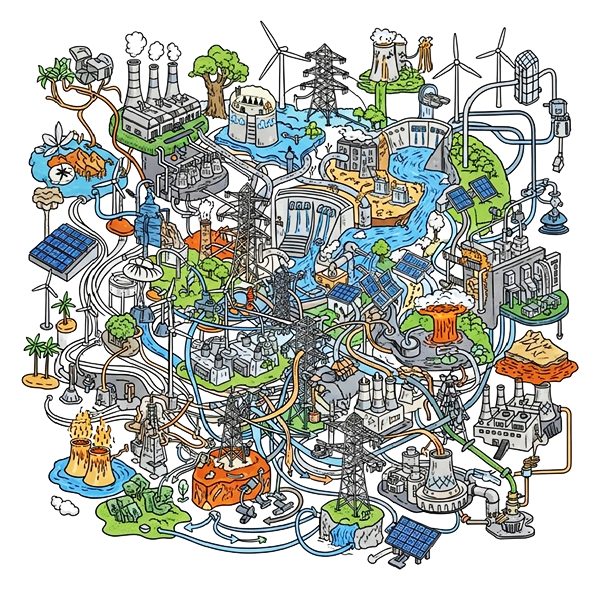
Today’s guest post is by Hideaway, the originator of Complexity Theory, the only new idea in the study of human overshoot since Varki’s MORT 10 years ago.
For those who have not followed Hideaway at Peak Oil Barrel or here at un-Denial, Complexity Theory argues that any species that is dependent on any non-renewable resource must grow or it will collapse, because as a resource depletes the quality of its reserves declines, which requires increasing complexity and energy for extraction to maintain the flow of supply, and increasing complexity requires a growing population, because each brain can manage a finite level of complexity, which requires a growing supply of resources to support the growing population, and because recycling non-renewable minerals without losses is impossible, and since the energy that supply chains depend on is mostly non-renewable, a point is eventually reached where the complexity of supply chains must break down, and the species returns to a state that is not dependent on non-renewable resources, which for humans is a hunter-gatherer lifestyle.
Complexity Theory, if true, is important because it implies any plan to mitigate the effects of human overshoot like climate change, species extinction, pollution, or resource scarcity, with population reduction policies, or a steady-state economy using a full-reserve asset-backed monetary system, or voluntary degrowth, or balanced budgets, will cause a reduction of complexity, and therefore the population and its lifestyle that depends on growing complexity for resources will collapse, possibly quite quickly due to the many self-reinforcing feedback loops in supply chains, and the extreme level of current human complexity and overshoot.
In today’s post Hideaway focusses on a quality of energy that is required to support complexity, Energy Returned on Energy Invested (EROEI).
“EROEI is the ratio of the amount of usable energy (the exergy) delivered from a particular energy resource to the amount of exergy used to obtain that energy resource.” – Wikipedia
For anyone new to the concept of EROEI, here is a simple way to visualize it. Imagine we discovered an oil field with a gigantic quantity oil but it was so deep that the machines used to drill and pump the oil burned all of the oil obtained. This energy source has an EROEI of 1.0, because energy obtained equals energy used, which means it contributes nothing to civilization (except pollution), and will not be exploited for long because oil companies cannot make a profit.
Any useful energy source must have an EROEI higher than 1.
Most advocates of non-fossil energy believe it has a plenty high EROEI and therefore we can and should transition from burning fossil energy. Hideaway here calculates that their EROEI assumptions are far too optimistic.
Hideaway has spent several years patiently trying to educate and persuade dozens of alternate energy advocates, with, as far as I can tell, zero success. I believe this is yet more evidence that Dr. Ajit Varki’s MORT theory is correct because energy experts are plenty smart enough to understand Hideaway’s calculations, yet are incapable of doing so.
Given that Hideaway’s Complexity Theory predicts we will soon collapse no matter what we do, why is the truth about EROEI important? Because if Hideaway is correct and non-fossil energy is not making enough net contribution to our civilization, then subsidizing and prioritizing non-fossil energy will increase the rate of depletion of non-renewable resources, which will reduce the time to collapse, and probably worsen the pollution and ecosystem destruction our descendent hunter-gatherers must cope with. In other words, using non-fossil energy will worsen the problems their advocates are trying to solve.
Truth here therefore is a big deal.
Hideaway should be commended for the significant original research he did here.
His conclusion sheds light on why everything seems to be breaking all at once now, and why our leaders are obsessively fixated on regime changing Russia and Iran, two of the very few remaining big sources of exportable oil.
A few years ago, when I couldn’t get a mining project to work economically by using just renewables for the power source, despite the claims of “renewables” being the cheapest form of electricity, I knew I had to go and find out what I was missing. Using diesel to generate electricity at remote mine sites is extremely expensive, so if there was any truth in renewables being “cheaper”, it should be validated at remote mine sites.
I searched for every document I could find about how EROEI was worked out and found many documents discussing great EROEI for renewables, but precious little on how much energy went into building solar panels, wind turbines, or batteries. If I traced far enough back to references of references, I eventually found some numbers, but mostly just plucked out of the air with some basic calculations on Aluminium production and glass production, with a few about silicon wafer production and the energy used in the processes alone.
Even the nuclear industry had a way they worked out their often touted 100 to 1 energy return on investment. The following is from the World Nuclear Association, quoted!!
“Peterson et al (2005) have presented materials figures for four reactor types:
- Generation II PWR of 1000 MWe: 75 m3 concrete and 36 t steel per MWe.
- ABWR of 1380 MWe: 191,000 m3 concrete, 63,440 t metal – 138 m3 concrete and 46 t metal/MWe.
- EPR of 1600 MWe: 204,500 m3 concrete, 70,900 t metal – 128 m3 concrete and 44.3 t metal/MWe.
- ESBWR of 1500 MWe: 104,000 m3 conc, 50,100 t metal – 69 m3 concrete and 33 t metal/MWe.
The AP1000 is similar to the ESBWR per MWe but no actual data is given.
Using gross energy requirement figures of 50 GJ/t for steel or 60 GJ/t for metal overall, 1.5 GJ/t or 3 GJ/m3 for pure concrete, this data converts to:
- Generation II PWR needs: 225 GJ concrete + 2160 GJ metal/MWe = 2.3 PJ/GWe.
- ABWR needs: 414 GJ concrete + 2760 GJ metal/MWe = 3.2 PJ/GWe.
- EPR needs: 384 GJ concrete + 2658 GJ metal/MWe = 3.0 PJ/GWe.
- ESBWR needs: 207 GJ concrete + 1980 GJ metal/MWe = 2.2 PJ/GWe.
In common with other studies the inputs are all in primary energy terms, joules, and any electrical inputs are presumed to be generated at 33% thermal efficiency.
The figures now in Table 1 for plant construction and operation, and also for decommissioning, are from Weissbach et al (2013) adjusted for 1 GWe. They are slightly higher than the above estimates, but much lower than earlier published US figures (ERDA 76-1). Our fuel input figures are 60% higher than Weissbach. Hence our EROI is 70, compared with 105 in that study.”
My way of thinking is that if you dump 191,000 tonnes of concrete and 63,440 tonnes of metals, mostly steel with ‘some’ copper, aluminium, etc. all together in a pile somewhere, it does not materialize into a ABWR nuclear power plant all by itself. All the bits and pieces need to be carefully constructed into very certain shapes and combinations, plus built in the correct order to become a nuclear power plant, therefore their calculations had to be horribly wrong!
If we dumped that quantity of those materials, in there correct shapes, onto the North Sentinal Island where some of the most isolated primitive humans exist, would they turn it into a nuclear power plant? The answer is obviously also NO!!
What if we left a very specific set of written instructions for those people? Again NO as they do not know how to read, nor do any calculations.
How about leaving the cement, reinforcing steel, gravel, sand, and all the instructions of how to put it all together to make concrete in some sign language form, to just make the foundations? Once again NO. How do you give instructions for just the right consistency, or to get all air bubbles out, or to work the surface correctly when in the setting process? You can’t, it only comes from experience of working with concrete.
Even if we had a group of knowledgeable teenagers, who could read and follow instructions, would we get them to be totally responsible for the foundations of a nuclear power plant? Again NO, as we need engineers and experienced concreters to build something that will last decades and is highly dangerous with failure of something like the foundations of the reactor chamber.
From this line of thinking, extended to solar panels, wind turbines, batteries, geothermal, plus even oil , gas and coal, there has to be an inclusion of all the energy inputs, which includes the education of the people involved in construction and operation, as well as all the energy inputs to the trucks, bridges, ports, mines, roads to mines, etc., etc., that all have to exist for building of anything to be possible. We only have one possible way to include all the inputs, money, or the cost of building and operating any form of energy source.
Money, or cost is certainly not going to be a perfect way to work out the Energy cost of building anything, plus it needs to be compared to something to come to a conclusion about the EROEI.
Firstly, we know that fossil fuels certainly can or could provide the net energy for everything else in a modern civilization, from the simple fact that modern civilization exists at all, at least for ‘most’ in the developed countries.
As the price for every energy supply appears to be different all over the world and different for each type of energy, I decided to look at the wholesale price or cost of energy at the world’s manufacturing hub of South/East Asia as a starting point. The question is over what period? Going back to 2012 the average price of crude oil was often over $100/bbl, while in March 2020 it was $16/bbl.
Should the price be from a single year when a solar panel factory starts production, or should it be over the years when the factory was built?
Should it be when the adults who are working in the factory were at school, or perhaps when the engineers, accountants, lawyers and managers were at university?
Maybe it should be when the mine providing the silicon was established, or the ships and ports where they load and unload were built? OK no easy answer at all.
Anyway, I decided to look at the average wholesale price of energy in different forms over the last decade (from 2013- 2023) as it encompassed times of higher and lower wholesale energy prices. What surprised me most was that oil, gas and metallurgical coal all had around the same average wholesale price over that period of around $US43/MWh, with thermal coal cheaper. It was cheap enough that the wholesale price of electricity in Asia during this period was also around the $US40/MWh.*
*Of course there are variations from year to year and from one location to another, but interestingly when I worked out the average price for oil over the prior decade 2003-2012 is was also around the same number, roughly $70/bbl that corresponds with around $41/MWh for the energy content using 1.7MWh/bbl.
Once I had a base number it was fairly easy to just compare the total lifetime cost, both capital and operating and maintenance cost of any energy producer back to how much energy was produced.
I decided to use $US40/MWh as the average wholesale cost of energy for every type of energy producer, as the base for the capital, operating and maintenance costs over the lifetime of operation. This cost to build and operate the plant can then be compared to the total lifetime output for that plant. The actual base number doesn’t really matter as I’ll explain towards the end of this article.
For our purposes here is a simplistic example. If an oil well returned $400 worth of energy over it’s lifetime, while only costing $40 worth of energy in total, to build and operate, then the EROEI was 10/1. As in it cost 1MWh of energy and returned 10mWh of energy, in this case oil.
I had no idea at all about what type of results this form of calculation would give me, or if it would be close to the often touted 10 or 20 to 1 returns that are needed for modern civilization to exist, until I worked out as much as possible.
I was not interested in theoretical cost, I wanted actual existing examples so I could compare different energy delivery types. Finding the actual numbers proved a lot more difficult than I expected. All over the place are headlines of a new development with an expected cost of $XYZ. Often though, the completed cost was vastly different to ‘expected’ capital cost. Then there was also operating and maintenance costs which many projects are very coy about, again giving some expected costs, with nothing about actual operating costs released, this depended upon the energy source.
For some like the nuclear industry, it’s fairly easy to find average O&M costs from public companies or industry announcements. The nuclear industry reports this for US reactors, with the average being around the $30/MWh as per World Nuclear Association (includes fuel costs).*
*Anyone paying attention can immediately see that in a world of $40/MWh energy cost an O&M cost of $30/MWh means that this form of energy cannot deliver a 10/1 ratio of EROEI. It’s 1.33/1 before including any capital costs.
OK, here are some examples of what I came up with…
A relatively new coal fired power plant in Queensland Australia, that was a highly efficient design, based on super critical operating temperatures, situated right next to the coal mine, where they dig the coal themselves, so no “price” paid for coal, had an EROEI of only 5.09/1.
This coal power station cost $US750M to build, including all the costs associated with the coal mine and conveyor system (4km), with an operating cost of around $US4.68/MWh for staff and sustaining capital.
Assuming the lifespan to be 40 years then over the plant and coal mine life of 40 years at a 90% capacity factor, it will produce 750Mw X 24hrs X 365 days X 40 years X 0.9 capacity factor. = 236,520,000MWh of electricity into the grid.
Total cost of capital plus O&M over this lifetime = $US750,000,000 + 236,520,000 X $US4.68 = $1,856,913,600 or $7.85/Mwh, giving an EROEI of $40/7.85 = 5.09/1.
The overall formula is adding all costs in $US to keep everything consistent, then divide by the $40/MWh average cost of wholesale energy over the last decade or so. Then compare the cost to build and operate in MWh with the total MWh the plant will produce over it’s lifetime of operation.
Using exactly the same method, I came up with an EROEI of a new gas well, connected to the system and paying their share of O&M to the pipeline authority in Western Australia of 23/1. The capital cost of drilling 2 wells and building a simple processing plant, plus joining up to the main gas pipeline, plus the fees to pipeline operator comes to a total cost of $US25,750,000, while the return is 15,000,000 MWh of gas delivered to customers.
In Saudi Arabia there are still old wells that have a total capital plus operating and maintenance cost of $2.5/bbl. That comes out to an EROEI of 27/1. These are the old legacy wells drilled decades ago and still flowing well. The Saudi’s also have newer wells at a much lower EROEI, yet I can’t get data on this of actual costs.
The New England Solar Farm in northern NSW, is still being built at a capital cost of around $US858M for a 720 MW plant, an expected life of 25 years with an expected capacity of 5.5 hours/d on average. It also has 400MWh of battery storage, or about 35 minutes at the rated capacity. In terms of O&M costs in solar circles I’ve seen 1% of capital costs as the base used for the first decade, with costs expected to be 2-3% of capital costs thereafter. I’ve used a constant 1.5% of capital cost as the basis for my calculations.
1% of Capital cost of $858M = $8.58M X1.5 O&M X 25 yrs = $321,750,000. Add capital cost of $858M = $1,179,750,000. Divide by cost of energy $40/MWh = 29,493,750 MWh.
How much electricity will the plant produce over it’s life 720MW X 5.5Hrs/d X 365d/y X 25 Yrs = 36,135,000MWh ..or an EROEI of 1.22/1.
A wind farm near me of 132MW capacity, at a capital cost of $US193,000,000 and an expected O&M cost of $7.53/MWh, with expected production of 7,227,000 MWH over it’s life expectancy of 25 years. It was meant to have a capacity factor of 37% but has been running well below that at only 25% capacity, which is the number I’ve used. I’ve also noticed that fairly often during the day when I pass it, even with a good breeze, it’s often mostly stopped, and when I check the wholesale price at the time, it’s negative, meaning they deliberately shutdown the plant to avoid a cost to send electricity into the grid.
Anyway cost of $193,000,000 + 7,227,000MWh X $7.53/MW = $US247,419,310 lifetime cost. Divide by $40/MWh = 6,185,482MWh to build. The EROEI is 7,227,000MWH divided by 6,185,482MWh = 1.17/1.
Hinkley Point C nuclear plant with a latest estimation of $62,000,000,000 capital cost, an output of 1,564,185,600 MWh over a 60 year lifespan plus the same O&M costs of $30/MWh as in the US NPP fleet, works out with the following… 62B + 1,564,185,600hrs X 30/MWh = $108,925,568,000 lifetime cost, divided by $40/MWh = 2,723,139,200MWh to build while producing only 1,564,185,600MWh of electricity over 60 years or an EROEI of 0.57/1. In other words less energy produced than went into building and operating it!! (assuming there is any accuracy in the methodologies ‘cost to build’)
For curiosity I worked out a fracked well based on some industry numbers from D Coyne and others on the Peak Oil Barrel web page. Assuming the capital cost of the older wells was around the $US10,000,000 plus O&M costs averaging $US12/bbl, and a return over first 120 months (10 years) of 375,000bbls oil equivalent, then the cost is $10,000,000 + 375,000 X $12 = $US14,500,000. Divide by $40/Mwh = 362,500MWh for a return of 375,000 bbls which equals 375,000 X 1.7MWh.bbl = 637,500MWh. The EROEI is therefore 637,500MWH divided by 362,500MWh cost or 1.76/1.
Assuming the wholesale price of energy was a too low a number to use in the first place, because only the largest businesses pay this cheap price, while all the people involved in every aspect of their daily lives have to pay a much higher retail price, what does it do to all the EROEIs shown?
Lets take a quick example using a cost of energy as $80/MWh instead of the $40/MWh of the approximate wholesale price of energy to reflect the ‘retail’ costs people actually pay.
In the first very simple example we had an oil well that cost 1MWh of oil energy to build and returned 10Mwh of oil energy. In that case the energy cost was $40/MWH.
Let’s double the energy cost to the more realistic $80/MWh cost. However it still only cost $40 to build and operate, all we changed was the base price of energy we use to $80/MWh. It’s now only costing 0.5MWh of energy to build and still returning 10MWh of oil energy so the EROEI has gone up to 20/1.
Exactly the same happens to all the EROEI numbers we worked out, they all doubled. The ratio between any of the energy producers stayed the same. In fact we could use whatever number we liked for the overall energy cost, it’s just the EROEI numbers that change, but are always related back to each other.
In summary, assuming the original $40/MWh wholesale cost of energy, and $80/MWh for comparison, we get the following EROEIs:
| $40/MWh | $80/MWH | |
| Kogan Creek coal power station | 5.09 | 10.18 |
| Old Saudi oil wells | 27 | 54 |
| Permian fracked oil wells ~2015 | 1.76 | 3.52 |
| NESF Solar Farm | 1.22 | 2.44 |
| MTG Wind Farm | 1.17 | 2.34 |
| WA gas wells | 23 | 46 |
| Hinkley Point C nuclear | 0.57 | 1.14 |
None of the new energy types, including nuclear give us anything like the 10-20 EROEI that’s needed for modern civilisation to operate, yet the older fossil fuel plants have given us a much higher numbers on average well in excess of what’s often cited as the required EROEI.
Taking another new coal mine, the Leer South one in W Virginia USA, has a resource of 200,000,000 tonnes of metallurgical coal at an energy content of 8.33MWh/tonne. So the return for this new mine is around 1,666,000,000MWh in total over decades. The capital cost was around $380,000,000 and operating cost of $72.49/tonne. This works out at an EROEI of around 4.48 at the $40/MWh rate or 8.96 at the $80/Mwh rate for energy cost of building and operating the mine.
This mine and the Kogan Creek coal fired power station I mentioned earlier are both late coal developments, not considered viable in earlier times when easier to obtain coal resources were available. It’s the same with the fracked oil from the Permian, only left until recently as the energy prices were too low for them to be considered. The Leer South mine has seams of coal 2-3.5 metres in thickness with waste between the seams and between layers in the seams. Likewise for Kogan Creek.
These are not the thick, easy to mine types of coal deposits we built civilization with 50-100 years ago, so have a much lower EROEI than the easy to get and now depleted coal from around the world. Yet both are decent EROEIs at the $40/MWh cost and much higher EROEIs than any of the newer energy producers.
In conclusion, it should be obvious to everyone that any energy producing facility that costs a total of under $US26M over it’s lifetime (the small gas field in WA) and delivers 15,000,000MWh has a far better return under any metric than one that delivers only 7,227,000MWh (and intermittently at that), the Mt Gellibrand Wind Farm for a total lifetime cost of over $US247M.
All the ‘costs’ associated with any of energy producers are spent by the providers of the goods and services to build and operate the plants. People spend the money they earn working on these things, on food, heating their houses, cooling their houses, getting to work, their kid’s education and food, holidays, etc., the list is endless. Yet every single cent spent by anyone in the chain anywhere has an energy cost associated with it somewhere. Spending over $US247M must have a much higher background energy cost than something only costing under $US26M.
Understanding this cost difference, then comparing just these raw numbers to countless research papers that try to make out that wind farms have a better EROEI than the gas wells/plant costing only 10% overall, yet producing more than double the energy, has to make you think we are just deluding ourselves.
I know my numbers and methodology are far from perfect, yet they seem a lot more honest in comparing differences between the various energy providers and clearly show we have trouble ahead as the older much higher EROEI type energy producers are rapidly declining. These older types, even in the fossil fuel domain, are clearly the most profitable ones, so humans being humans are likely to use these much faster than the newer more marginal energy sources.
 un-Denial
Sure looks to me like B reads un-Denial however it appears she’s still learning because she does not yet understand the role of increasing complexity, and she thinks the decline will be very-very gradual giving us time to shift resources from industrial uses to food production so we avoid widespread hunger.
https://thehonestsorcerer.substack.com/p/societal-collapse-is-not-a-bug
LikeLiked by 1 person
LOL, with the “she” teasing. (or do you know something I don’t, cuz I think B is a dude for sure)
There’s something I really don’t like about both B & Art Berman’s essay’s today. Towards the end they get too heavy on shifting the collective consciousness.
See if you can guess which quote belongs to who:
The 1st one is Art. His “we need a truer story” is just code for – “we need to replace our bullshit story with a better bullshit story”.
And with B, I don’t know how he says that last line about “finding the wisdom to say no”, after he just got done correctly explaining what happens to you when you do have the wisdom to say “no”:
Then why don’t we do something about it? Simple: those who did realized the folly behind amassing material wealth and returned to or remained with a forager lifestyle were simply wiped out by those who organized their societies around ever increasing material and energy extraction.
See, this is why the carrying capacity for a fire harnessing species on every planet in the universe is zero. Because they will never, ever stop using that overabundance of consciousness… to think their way out of problems, which only guarantees more problems (that they could have never predicted)… combine that with the MPP… and all of a sudden it’s only possible to have an overall negative impact on the rest of life… and eventually maybe even becoming a megacancer for the planet again.
Since B & Art wanna get fantastical today… here’s a good song about aliens:
LikeLiked by 2 people
LOL, I saw the bullshit at the end but was more forgiving.
If you don’t buy colonizing another planet, or Alpert’s virus, or an anti-MORT drug, or Cheney’s EMP, then shifting collective consciousness is all that’s left.
LikeLiked by 2 people
Here is a reply I made to B’s post….
” Most of your essay is excellent B, thankyou for it once again. However you still have some missing links in the overall direction and I’d like to highlight this bit…
” Repeated rounds of deindustrialization will, however, ensure that we will no longer need that much coal, oil and gas — leaving more resources for food production and preventing widespread hunger.“
This is incorrect, as the deindustrialization means we lose access to the coal, oil, gas, copper, nickel and every other industrial material like fertilizer, as we require modern machines to gain access to all the remaining resources. The same industries that make the parts for tanks, planes, ships, also make parts for bulldozers, graders, excavators, dump trucks, processing plants, trucks, cars, farm tractors, motor bikes, push bikes, lawn mowers, recreation boats and their motors, the industrial machines that make it all, and on and on the list goes.
Once we start to deindustrialize the process will be fairly rapid as every aspect of civilization is intertwined through not just supply lines and feedback loops, but money, debt, insurance, laws of the land, international trading rules and clearing houses.
Once we start to deindustrialize our whole complex civilization starts to unravel very quickly as the feedback loops of the interdependence work chaotically on the other aspects which are all required to function ‘normally’.
With billions now living in urban areas, totally separated from food production, and rural areas unable to cope with sudden large influxes of people, farms unable to gain access to specialised seed, fertilizers, pesticides and herbicides, irrigation parts, tractor parts, fuels, oils, refrigeration, or trucks consumables, a lot become statues fairly quickly. Likewise for mining operations of metals, minerals and fossil fuels, once the flow of parts cease, all the industrial equipment become statues fairly quickly, ceasing all production.
We can’t gain access to the remaining low grade metals, minerals and fossil fuels with picks, shovels and wheelbarrows like we could 400 years ago, because we used up all those easy to gain access to natural resources. We require the total availability of modernity to gain access to any of it, and upon deindustrialization, it’s modernity that rapidly disappears, over years, not decades or centuries…”
———-
Also the diagram from BHP about copper is incorrect, or should I say highly simplified. Taking the mines Olympic Dam, Carapateena and Resolution, those depths are where the resource starts, not where it’s located.
Olympic Dam resource starts at 350M deep and goes down to a depth of 1350m, Carapateena resource starts at around 500M and goes to 1500M deep while Resolution starts at 1300M deep and goes down to 2,700M deep.
The simple circles drawn are BHP’s attempt to show the situation is not that bad. It actually takes an extra 2750MWh of energy to lift 1M tonnes of dirt from 1500M than the 500M that might be mentioned, if we could do it with 100% efficiency, which we never do..
1 million tonnes of rock at Olympic Dam’s average resource grade would have around 2,700 tonnes of copper after allowing for waste removal and recoveries through the processing plant. This copper from depth would take around an extra 24,000 litres of diesel assuming an opencut mine and the approximate strip ratio of a mine like Olympic Dam, for just 1000M deeper.
At the average resource grade of Olympic Dam, it can only be mined with open cut methods cheaply, allowing for the low grade, yet they have an underground mine, cherry picking the highest grades of ore there. Most of what’s reported as resources and reserves will never be mined as it’s too expensive to do..
Of course the mining industry will say, if only (or when) copper prices go to $XXX/kg or lb or whatever, they can profitably mine it. The assumption is of course that copper has to go up in price relative to everything else. If everything else also goes up because of general inflation, then the price needed to mine the deep copper goes up a lot further, always just out of reach…
LikeLiked by 4 people
excellent response
LikeLike
I’m sometimes critical of Art Berman, but his essay today is very good.
Lots on denial, but unfortunately still no awareness of MORT.
https://www.artberman.com/blog/reality-blind/
LikeLiked by 1 person
The bewildering phenomenon of declining quality
https://english.elpais.com/culture/2025-07-20/the-bewildering-phenomenon-of-declining-quality.html
Or: How to keep or even grow your profit margin in a world of shrinking surplus
LikeLiked by 1 person
“and increasing complexity requires a growing population, because each brain can manage a finite level of complexity,” is a 2+2= 1,00000000… statement. Just because we currently have a certain population doesn’t mean anywhere near as many of those brains are needed to manage the required complexity – especially if the population is shrinking. Massive amounts of redundancy and carbon copy networks
LikeLike
Nony, not sure who you are quoting, but this bit of your is a general misunderstanding of complexity…
“ Just because we currently have a certain population doesn’t mean anywhere near as many of those brains are needed to manage the required complexity – especially if the population is shrinking. Massive amounts of redundancy and carbon copy networks“
Who do we get to become nuclear physicists, or nuclear engineers or tens of thousands of other very specialized occupations?
Do we go and drag the first 500 people we come across in the jungle of New Guinea to be our nuclear physicists in charge of nuclear power plants?
Do we drag the first 1,000 people of the street in the poor areas to be our next 1,000 neurosurgeons?
No we don’t!! We have somewhere around 10 million young children enter the first level of primary school every year in the western world. Of those only around 7.5% go on to do physics at the end of High school, with only around 5% getting scores high enough to enter a tertiary course of science. Of these only around 4% finish the course with a major in any area of physics. Many drop out, change courses or just do ‘other’ sciences.
Then around 10% of those with a degree go on to higher studies like honours or masters, with a small percentage of the latter going on to do a Phd.
In other words we have a vigorous selection process for the people who are doing the bulk of all the higher level complex aspects of our civilization. it’s not just a matter of having a brain. It’s being intelligent, motivated enough, mental toughness, dedication and sacrifice to get the high marks, understanding and passion for the selected area to continue to increase complexity of the system, one small step of helping solve a problem at a time.
There is no way we can get the same level of complexity, nor keep it with just 10% of the current population, which is still way too many for planet earth..
All that massive redundancy you talk about is a requirement or feature of civilization, it’s not a bug, because nowhere near every brain is capable in all required areas to do what’s necessary to advance civilization.
This massive amount of redundancy, is another element of complexity that is never discussed or understood in discussions of gaining or maintaining our modernity.
It’s also extremely relevant aspect to the EROEI of different energy systems in my essay above. It’s not just the 40 nuclear physicists and nuclear engineers that used energy to get to their positions, it’s partly all the others that went through years of training but didn’t make it. We have no clue which 5 year olds need to be trained for these positions so we train them all and they select themselves over the next decade or 2 or 3…
LikeLiked by 3 people
But do we need that many gifted advanced physics experts to manage what is to a large extent an already developed engineering/techinician application of nuclear power. Granted we do need to put a lot more resources and expertise into developing fusion power, and China is currently doing that. The population when Einstein was born was about 1.6 Billion – not mention many other giants of science. How many do we need for breakthroughs?
We don’t need anywhere near the number of medical specialists we have to maintain civilization. The Covid Vaccine has already started what will be a cumulative decline in world population – increased, and accelerating, mortality rates and lower fertility.
I understand that peak diesel is a huge problem but I am far than convinced that population/resource decline cannot be navigated – albeit via a very rough and rocky road for much of the world’s population – until further scientific breakthroughs occur.
Having said all of that I acknowledge there are some very complex supply chains in the world, and you may be correct in a cascading collapse, but I do not think that it is a given.
LikeLiked by 1 person
You’ve fully entered the complexity issue and I understand your point, I use to have the same thoughts myself about gradual decline.
The example above of selection of best brains for purpose is just one tiny fraction of the overall story of complexity. I agree that when each seemingly separate part of our overall modernity/complexity as a piece that’s falling slightly or slowly makes the overall situation of lower population slow decline appear possible.
Everyone pretty much accepts the narrative that we reached the level of complexity in modernity through human ingenuity. It was Watt’s invention of the more efficient steam engine that allowed for greater coal mining, or Edison’s light bulb that allowed work at night more efficiently, or Einstein’s physics breakthroughs that eventually gave us nuclear power etc..
What if that narrative is just human hubris and wrong? Would Watt’s have had the time, understanding and education to invent his improvement of the steam engine if he’d never gone to school because he was too busy growing food if a lot of excess food/resources had not been available via the Europeans colonizing the rest of the world? Likewise for Edison or Einstein or any other inventor, we make the assumption that they were always going to give us the world we have, yet they all relied upon their own version of modernity during their time to produce ‘excess’ food and materials so they could concentrate on ‘other’ things that happened to be great inventions.
On the way down humanity as a whole by those even looking at the topic, seem to be thinking that we’ll continue to have breakthroughs in various areas to help slow the downturn.
But inside this picture is a missing link, that the long road up with inventions was always making ‘more’ available. More people, more food, more materials, more education, more time relieved from the drudgery of having to worry about the basics of life.
Contraction cannot be slow as we need ALL of modern complexity to do our mining of metals, minerals energy, food and water in most places. We’ve used up all the easy to access resources and what’s left cannot be accessed with the old inefficient ways of thousands of miners with picks and shovels, while being fed by people using no fertilizer on farms, planting and harvesting by hand, while billions of people try to live in cities being provided for from these older human mining and farming ways.
Take a city of 5M people today and the population falls to 2M through natural attrition. The costs of maintaining roads, rail, water pipes, sewerage, electricity grids are not just close to what the city of 5M had, they are likely higher as we have to use lower grade ores to make all the replacement parts that takes more energy to supply. Yet the burden is falling on only 40% of the population, so taxes have to rise massively, while services contract.
The fall in population is not in one specific part of the city, it’s going to be across the board in many/most areas. People will have to pay more in these taxes, leaving less for everything else..
Then there are the businesses throughout the city, all with falling revenue as the population has less to spend after paying the taxes, plus those supplying products to both govts and the public will get double whammy’s of less spending, so their profits fall with many going bust. What happens to those businesses making important products that keep machines going in other businesses but can’t afford to stay in business, due to economic conditions? They close entirely. Then where do other businesses that need the products from businesses that have gone bust get their replacement parts for their machines to keep operating?
It’s feedback loops within feedback loops that no-one fully understands, because the system as a whole has ‘worked’ on the way up when there was always more. More people, more energy, more materials, more time for more education, more technology that came from the combination of freedom from food gathering, more time to contemplate solutions to problems, more precision in specialized equipment that allowed for more exact inventions etc..
The nuclear physicists were a tiny example from hundreds of thousands of specialties throughout our modern world, such is the complexity of everything we do. It’s nice to think we have it all written down and can just get away without anywhere near the number of them. What happens when the tools they rely upon also start to go missing, then the supply of steel to make whatever declines because the ships are not operating in the way they use to, plus the mines can’t get the simple parts they needed because the manufacturer of fuel and air filters went bust and no-one makes the size needed anymore.
Those filter manufacturers went bust because the recreational boat market collapsed where they made their profit, so could no longer pay off loans.. Again it’s the feedback loops upon feedback loops on the way down that no-one is considering. Then to find the suppliers to the filter manufacturers also went bust because their biggest customer of the paper products went bust, so starting up another filter manufacturing company wont work as the supplies for it are also now unavailable….
Even with all the above, I’ve only just scratched the surface of the overall importance of the interactions of complexity on our modern civilization, all run from fossil fuels that are responsible for100% of modern industrial civilization. (If anyone can think of any part of modernity that is made and powered by just traditional biomass, I’m all ears and will stand corrected). All our efficiency gains that came from increasing technology, are due to fossil fuels, more so than human ingenuity, yet the hubris of most of humanity is that the ingenuity was the important bit, not the fossil fuels.
Remember 100,000 years ago the human brain was around 11% larger than today, (1,500 cm3 compared to 1,350cm3 today), yet we seem to have more modernity today than they did 100,000 years ago. Surely if it was human ingenuity and not fossil fuels we would have had a much more complex, ‘modern’ world back then than we do today….
LikeLiked by 4 people
Many US cities have seen similar population drops percentage-wise.
https://en.wikipedia.org/wiki/Rust_Belt
LikeLike
Yes they have. They have also received a lot of federal and or state funding for a lot of works and programs, which gets spent on materials and energy keeping the communities going.
What happens when this population reduction is widespread and the rest of the country cannot free up the required materials and energy because they are also short of them?
It’s like so many aspects of our current civilization, whenever a downside is mentioned, people can point to somewhere where that particular aspect is happening locally, without too much trauma involved, because funding at present, that buys materials and energy comes from elsewhere, in a world where energy use, material use, and population are still growing.
On the way down it will be totally different, as the materials and energy available, everywhere on average, will be declining, so the situation is different to what happens now. There will be no excess from elsewhere to make up for some/all the problems occurring locally.
LikeLiked by 2 people
My spinach and radishes were finished so I pulled them and planted more Sieglinde potatoes today. The potatoes I planted in May are in the bed to the right and are doing really well.
I drink chamomile tea every evening. The price jumped a lot recently so I thought about growing some. I tried harvesting some flowers today that were grown by someone else. What a pain in the ass. When the trucks stop running chamomile will change from a daily staple to a rare treat. I stock about 4 years of chamomile tea which I can stretch to 8 years if I conserve.
LikeLiked by 4 people
Am just retuned from a circle tour of Lake Superior, and am catching up, but had to comment- Yes!, what a pain. We did that a couple years ago, and talk about tedious. Makes me wonder how it’s done at scale. Slave wages? Some intricate, specialized machine? Anyway, some excellent comments here, I’ll keep reading now.
LikeLiked by 1 person
And yes, circle tours are a thing. Totally lavish squandering of resources, discretionary consumption that will end soon, but I know we can’t fully step away from the matrix, and choose things like this carefully. Canada and the route through southern Ontario was beautiful. So much water! Canada will do well as we go through collapse. (Just close the border 🙂 ).
One big takeaway- the Soo locks and the thousand footers passing through was visually stunning. The ongoing effort to move taconite iron ore from point A to point B is staggering. A simple example validating Hideaway’s point on the resource extraction trap.
We camped and slept in the back of the truck, but still a thing that won’t be happening in the future.
Back to reading.
LikeLiked by 1 person
Part of this insane push for shifting the collective consciousness includes embracing the asinine idea that we need to return to our roots… sustainable hunting and gathering… back to living in harmony with nature. And if you agree with that then you likely agree with another asinine idea… that the switch from H&G to agriculture was the biggest mistake humans ever made.
Here’s a good example that shows the two different ways of looking at this. It’s a thread from B’s essay yesterday. And yes, it’s an unfair fight. K Sam is clearly the more advanced doomer (and debater). Poor James is out of his league.
https://thehonestsorcerer.substack.com/p/societal-collapse-is-not-a-bug/comment/137289499
K sees it the way I do. The snowball effect. Humans always getting better with their skills. To the point where they had no choice but to switch to agriculture because they got too good at hunting. But this is a tough concept for James to see because of the length of time involved. James’s argument would be, “Wait, H&G worked just fine for hundreds of thousands (if not millions) of years. You’re telling me that we finally became too efficient for our own good just 10-20kya? I call bullshit!!”
And he’s correct to call bullshit if that’s all there was to the story. But I doubt James has ever thought about fire. And he probably agrees with this quote from our friend M Roberts, regarding full consciousness:
For those of us that do believe in a critical moment, the thought process is that prior to this moment it was still always the snowball effect going on… just at a snail’s pace. To the point where it might have been able to go on like this (dare I say sustainable) for a couple million more years. Maybe we could’ve even had a crocodile type run of 200 million yrs.
But after the critical moment, the snowball effect is no longer a snail’s pace. It starts looking like a goddamn tsunami. This unique fast and furiousness of human progress from the last 100k years is exactly why a planet’s carrying capacity for a fire-harnessing species is zero.
ps. Mike, I know you’re more in line with K than James. Heck, you’re probably even more advanced than K… I only included you in this post because I’m hoping it will get you to see how ridiculous that quote looks.😊
LikeLiked by 2 people
Dr. Tom Murphy was interviewed by Derrick Jensen today and explains why you are wrong. He says the problem is our culture, not our DNA. You’ll be pleased to know he agrees fire was a key cultural mistake, followed by agriculture.
LikeLike
Thanks, been waiting for that interview to become available.
Great conversation between two legends of collapse. Tommy Boy broke my heart though. LOL. It showed me that I need to up my fire game. I thought this shit was obvious but apparently it is not.
Murphy gets huge bonus points for the first item on his provisional list… humans. You are simply not allowed to go there on most platforms. Nate Hagens would’ve ended the interview right there. So that was cool.
First big blunder was at 4:01 after Derrick asks, “How is it that so many really smart people don’t think their way to the same conclusions”. Tom gives many reasons but somehow denial is not one of them. (I’ll let you take the blame for that one Rob. You failed him as a teacher😊)
Fire didn’t make the final cut because… “I keep fire in provisional because we’ve been using it for 1.5 – 2 million years. Thats a pretty long track record where it didn’t go off the rails just because we started using fire”.
He uses the same logic for why humans are provisional as well, “humans spent three million years on this planet without initiating a 6th mass extinction”.
Tom obviously doesn’t believe in the critical moment theory (CMT). I’ll say it again loud and clear for the cheap seats; You end up looking foolish if you don’t buy into CMT.
Another eye opener was his lame benefits for fire: cooking allowed our menu to expand by eating things that were otherwise inedible. Hunting techniques like flushing out game. And we could migrate to colder climates… that’s it. Nothing from Tom about resources being shifted from the gut to the brain eventually creating bigger brains. Or how it significantly reduces the time needed for chewing and digestion, opening up loads of free time… although to Tom’s credit he does allude to it for a second but says its beyond his pay grade.
I’ve got work to do. I read most of Richard Wrangham’s Catching Fire. Bored the hell out of me. Might need to try again and take some notes. I’ve got to get my story more crisp. I don’t ever want to fail Tom Murphy like this again.😊
LikeLiked by 2 people
I failed with all the big names, not just Dr. Murphy. Not one ally helping to push MORT awareness after 15 years of trying.
Most people don’t see that something big and unique happened very quickly and needs an explanation. If you think a species that believes in god and that emerged in a big bang from a small tribe after 3 million years of banging 2 rocks together is no big deal then I guess there is no need for MORT.
You’re story is getting more polished. Soon you’ll be famous making the podcast rounds.
LikeLiked by 4 people
Thanks. When I start making those rounds, I want Planet Critical first. Gonna make Rachel pay for being bitchy to Bill Rees. I’ll just start quoting Ligotti like a madman ’til she starts crying.😂
ps. Thats a cool middle paragraph you have there. It’s worthy of the sidebar quote. I say we let the audience vote. If your comment or mine here gets three likes… it goes up on the board. We’ll use the same math formula that the tv networks use. One “like” equates to 10,000 viewers.
LikeLiked by 1 person
Fire is useful for cooking food, scaring predators and providing warmth and light. The EROEI or survival return on energy invested for fire was positive or its use would have disappeared. After a long history of stone tool use fire was used in making superior metal tools like plows, shovels, pics, horseshoes and weapons and fasteners like nails and screws. If there were a single moment of transition I imagine it was when fire via expanding gases could be translated into the kinetic motion of metal tools like the steam engine. Wood, coal, oil and gas were rapidly exploited and all became useful in moving the various machines of energy exploitation, distribution and with a sufficient energy flow the nascent human RNA which had been evolving towards technology for hundreds of thousands of years, if not millions of years, were institutionalized (schooling) and put to work on creating useful tools etc. from the accumulating “DNA” of modern civilization.
The evolution of brain capabilities for language, reading, writing etc. and hand dexterity was probably pretty rapid as the benefits of technology accrued to those able to develop it and use it. The goal is to place more cells similar to self into the future. The ego operating in the expanded analog mind necessary for technology does its job getting energy for and protecting the cells but gets left out of the future. God and religion give the ego a future even though the old cellular system is discarded as new systems and egos are begun. Denial helps the ego continue the struggle and hides the fact that it is only a mental adaptation used by cells to get into the future.
LikeLiked by 4 people
LOL, impossible for James to get away with an anonymous comment.
Don’t worry. Plenty of room at the table for RNA, fire, MORT, and complexity.
LikeLiked by 2 people
Evolution of brain capacity possibly started back with fire and cooking of food, which allowed dense proteins and fats to be readily digested by the human gut.
More proteins and fats available to the body would have enabled the brain to grow, with the ‘smarter’ individuals more likely to pass on their genetic code. The process of evolution, to also allow some humans to also develop a larger cranial space to accommodate the larger brain also would have taken many thousands of generations, so for me none of this evolution is likely to have happened without the widespread use of fire..
Homo sapiens cranial cavity was also larger than homo erectus, which was a further development of brain, eventually allowing language and better co-operation to occur, leading up to stories, denial, agriculture and modernity..
LikeLiked by 2 people
Good details Hideaway.
Even though the book is very boring, while I was reading ‘Catching Fire: How Cooking Made Us Human’, there were two themes that were constantly running through my head.
1st was how maximizing energy consumption trumps everything… and for each energy bit saved or whatever, it just goes toward some other form of progress. The moment we hominins got a taste of cooked food… our bodies then craved it forever. Not because of taste but because of energy efficiency. The body uses 75%(?) less resources when breaking down cooked food instead of raw. Cooking increased the energy and nutrient availability from both plant and animal sources.
So that saved energy goes into something else. The time saved between chewing and digesting is now spent on becoming an expert hunter… This “outsourcing” of digestion, where some of the breakdown process happens outside the body (through cooking), frees up energy that can be allocated to other metabolically demanding organs… like the growth of larger, more complex brains. The book offers many tidbits like this.
2nd theme was how because of this energy efficient craving that’s driving the bus, it created what seems like a 1.5 million-year slow motion reverse werewolf transformation. Over time, human ancestors evolved anatomical adaptations consistent with a diet of softer, more easily digestible food. Smaller teeth, weaker jaws, and a smaller digestive tract, especially a reduced colon size.
This reverse werewolf transformation seems complete around 200kya when we had major changes happening to our vocal tract which eventually enabled our unique vocal capabilities. Reminded me of this quote:
Would love to write a proper essay (more likely a book) about it someday, but I’m not sure I’ll ever have all the knowledge under my belt to do so. If an expert like Tom Murphy (who is way above my qualifications) is too scared to even touch the issue (“it’s beyond my paygrade”), then that doesn’t bode well for me.😊
Speaking of werewolf transformations, this is my all-time favorite:
LikeLiked by 1 person
Sounds interesting. I will listen to it later.
LikeLike
K Sam makes an excellent point about the impacts of Māori here in NZ. It’s a classic example of humans being humans and the MPP where the impacts were only restricted by the energy source available to them. As soon as Europeans arrived with their industrial age technologies and fossil energies Māori adopted them. Well they had to or they would not have made it through history (Daniel Schmach’s multi-polar trap scenario).
There’s a big push in my old sustainability world to have Māori / indigenous knowledge lead the way to a prosperous sustainable future 😀. It’s romanticising the ‘old days’ and ignores the fact that the MPP means that will just mean business as usual (growth and overshoot and collapse) with a slightly different language.
And here’s my favourite doomer song by a very talented Australian.
LYRICS
So this is the end of the story
Everything we had, everything we did
Is buried in dust
And this dust is all that’s left of us
But only a few ever worried
Though the signs were clear, they had no idea
You just get used to living in fear
Or give up
When you can’t even picture your future
We walk the plank with our eyes wide open…
Some people offered up answers
We made out like we heard, but they were only words
They didn’t add up
To a change in the way we were living
And the saddest thing-
Is all of it could have been avoided
But it was like to stop consuming is to stop being human
And why would I make a change if you won’t
We’re all in the same boat, staying afloat
For the moment
And we walk the plank with our eyes wide open, we..
Walk the plank with our eyes wide open
With our eyes wide open we…
Walk the plank, we walk the plank
And that was the end of the story
LikeLiked by 1 person
That’s an excellent song and the first time I’ve heard it.
LikeLiked by 1 person
paqnation‘s theme song:
LikeLike
Thanks. Was laughing at this guys voice at first, and now I’m singing along with him😊. Very catchy tune.
LikeLike
Why The Right Is Obsessed With IQ
The far-right is pushing pseudoscientific ideas about IQ to justify shredding what remains of the social safety net.
LikeLike
About a month ago, I had this conversation on Discord.
How many people think that the end of modernity is a fate worse than extinction?
LikeLike
Does the end of modernity have coffee?
LikeLiked by 1 person
If you live outside specific tropical climates, probably not. (I am guessing you are being a bit facetious).
LikeLike
Well then assuming climate change doesn’t give Canada a tropical climate before I die, I vote for extinction.
LikeLike
Cool topic.
Life without modernity is absolutely worse than extinction. Don’t let anyone tell you differently… unless they’re completely off the grid and already living a H&G lifestyle.
E Michaels had a good quote today about this: I see potential survival after a potential bottleneck as something very few souls will embrace once they truly comprehend what that actually entails.
LikeLiked by 1 person
In my opinion, if you have made it through the bottleneck, you already survived the worst part. Life will still undoubtedly be difficult, but you have already made it through the worst.
LikeLike
My comment:
LikeLiked by 3 people
https://www.commondreams.org/news/famine-expert-israel-s-starvation-of-gaza-most-minutely-designed-and-controlled-since-wwii
Famine Expert: Israel’s Starvation of Gaza Most ‘Minutely Designed and Controlled’ Since WWII
LikeLike
RIP Ozzy Osbourne.
We are riding a crazy train:
LikeLiked by 3 people
Dr. Ted Postol explains that Iran now has a simple atomic bomb and is therefore the second undeclared nuclear weapon state in the middle east.
Strange outcome for obliteration.
Will the US now stand down or escalate into a real obliteration?
LikeLiked by 1 person
Dr. Postol gave another interview today with more detail on how to build an atomic bomb in case you want a stronger deterrent for your doomstead.
LikeLiked by 1 person
I realized something: The Israel-Palestine conflict is a predicament and not a problem. The 2 State solution is dead and a one state solution would be so polarized that it wouldn’t be functional and would probably descend into civil war. This situation does not have solutions, it has outcomes.
LikeLiked by 1 person
I’ve been there a couple times. One state, two states, it doesn’t matter. There are too many people that want to live there for the available arable land and water. And that’s with plentiful fossil energy.
LikeLiked by 2 people
Jared Diamond came to a similar conclusion about the Rwandan Genocide.
https://www.ditext.com/diamond/10.html
LikeLiked by 1 person
Listened to an interview with Martin Armstrong today. Strange guy I’ve followed for 20 years. Occasionally he says something interesting.
LikeLike
I share that opinion. The US knows it too and blowing up the Nord Stream pipeline was a burn the boats type act. Of course the critical resource is oil that makes diesel. Invading Iran has the same motivation. I looked up where the oil is located in Iran and it’s mostly along the Persian Gulf coast. This means the west doesn’t have to concur the whole country. Since Tehran is protected by mountains and so far from the oil fields, my grim prediction is that it will be the third city to suffer a nuclear bombing. Hope I’m wrong.
LikeLiked by 1 person
Ugh, “conquer” not “concur”.
I saw a report that Iran is running out of water. So, perhaps they won’t be nuked, just blockaded.
LikeLike
Hideaway explains why PV installation was high in May.
https://peakoilbarrel.com/opec-update-july-2025/#comment-791151
LikeLiked by 2 people
This SNL skit was funny… until I realized it was no skit. I doubt there’s ever been a more offensive commercial.
One of the worst things about living in Arizona, no it’s not the 120-degree days, it’s the big truck crowd. Seems like every white asshole in this state has a jacked up, 4 door, or dually truck. And most of these douchebags are obsessed with backing their monster trucks in when they park.
Almost all have those white trash stickers of a Ford dude pissing on Chevy or vice versa. Back in 2015 there was a wave of new stickers… “Trump 2016 – No more bullshit!” We also had an insane amount of flags (mostly Trump and Confederate) going up on these trucks… way more than after 9/11.
A blogger named Leaf Rhetoric has some funny posts about trucks if you’re interested.
Fly That Freak Flag, America Style – Leaf Rhetoric
Been a while since I actively hoped America would get nuked off the face of the earth. This commercial revived that sentiment. Someone push the goddamn button, please!!
LikeLiked by 2 people
LOL!
Try searching for “rolling coal” on YouTube to see another American favorite.
LikeLiked by 2 people
I’ve seen this commercial lately on network TV. Ah yes, muscle trucks – the all-American ride… Go for the gusto… Driving like that sure is hard on the tires and transmission, though.
LikeLike
Really, what do you expect from the Global hegemon that is in complete DENIAL about the fact that they are in terminal decline. The British acted like this prior to WWI and it got them into WWII also. Hopefully, Trump will avoid starting a nuclear war when it’s apparent we are losing but I doubt it.
AJ
LikeLiked by 1 person
I’m heading off camping and will be gone for 2 weeks. One of my destinations will have internet for about an hour a day and the other destination has no internet.
Hope you stay well and the world’s still here when I get back.
Cheers.
LikeLiked by 3 people
Oh christ, not this shit again. You really mess with my addiction when you abandon us. Very selfish of you to have a life outside of un-Denial. LOL
I’m gonna put myself to the ultimate test. No doomasphere for two weeks. If you’re a betting man, bet big on me to fail.😊
Have fun camping and be safe.
LikeLiked by 2 people
Rob, … “Hope you stay well and the world’s still here when I get back.“
I’m sure the world will still be here in 2 weeks, whether there are any humans or other large animals though it a different question LOL..
Sometimes I wonder why they don’t just press the red button or kick the football or whatever, and get it over with. Is that really the worst way civilization and most (all?) large animals end?? We know civilization is going to end eventually, with the remaining humans destroying most of the natural world in a bleak effort to try and survive afterwards anyway…
On that bleak, cheery note, have a great time away and remember not all mushrooms are tasty, try and avoid those big ones that form in the sky…
LikeLiked by 2 people
Thanks, I’ve got a great camping spot that I am enjoying very much.
If you are interested in exploring possible origins of complexity this podcast is good.
https://www.preposterousuniverse.com/podcast/2025/06/30/320-solo-complexity-and-the-universe/
LikeLike
There are many unanswered mysteries about covid and our leaders are curious about none, including the most obvious which is the origin of a virus with obvious signs it was engineered in a lab.
Here is another. A huge study exploring brain function impairment associated with covid concludes we really are getting stupider. The odd thing is they explored every possible cause except one: transfection status, despite having this data which suggests they looked and did not like what they saw.
Our healthcare institutions have zero integrity.
https://open.substack.com/pub/philipmcmillan/p/brain-ageing-surges-after-covid-reinfection
LikeLike
Frightening findings, especially for me (a fool who got vaccinated & had both parents die from/with Alzheimers).
All I have going in my favor is I have exercised heavily all my adult life and appear to have no systemic inflamation, don’t smoke, don’t do drugs or take any prescribed medicines AND didn’t take any subsequent Covid boosters.
Lucky for you that you had enough skepticism to avoid the shot.
AJ
LikeLiked by 2 people
The danger seems to be for people who damaged their immune systems with multiple boosters and multiple covid reinfections so you should be ok.
LikeLike
Wouldn’t it be hilarious if the cognitive decline was largely neither due to the vaccine nor the virus, but due to microplastic infiltration of the brain?
https://www.nature.com/articles/s41591-024-03453-1
People might be looking at plastic-induced neurotoxicity. And since microplastic doesn’t show up in most testing methods, it would be very likely to misattribute things. From a MORT lens, what’s more comfortable? A preventable thing (a virus that you can try to avoid catching, a vaccine you can avoid injecting) causing brain damage – or a non-preventable thing (microplastics are everywhere, even in organically grown plants – https://www.nature.com/articles/d41586-025-00909-3) ?
LikeLiked by 1 person
I have not seen a time correlation of brain impairment with the start of transfections vs. start of covid, but I have seen a correlation between increased cancers and heart problems and the start of transfections (not the start of covid).
Intuitively if feels to me like people are stupider since covid. I expect plastic is a problem but it’s been with us a lot longer than mRNA transfections.
We could put the whole issue to bed if just one of the 193 countries that coerced transfections published all cause mortality for transfected versus untransfected. The UK published this data in the early days when it looked like mRNA was net positive but stopped publishing it when the trend shifted to make their policies look bad.
If the data confirmed their policies were correct what are the odds that not one country would publish it?
Zero.
LikeLiked by 1 person
Plastics have been with us for almost a century, but since they tend not to biodegrade, concentrations are building up over time – plastics also take time to fracture into smaller particles, so it takes quite a while for fresh plastics to become small enough to infiltrate organs and the brain-blood-barrier.
If we take Dr. Campen’s measurements for correct, then the concentration of plastic in brains has risen by 50% over the last 10 years, and so far, no human is known not to suffer from dementia once the concentration goes over 1%. It’s kind of insane that we do not have more data on this, but that’s probably MORT at play again. We might simply be at a point now where plastics are starting to reach physiologically relevant concentrations, and this moment may be coinciding with the pandemic.
But it’s just a guess at this point. We don’t have any methods to screen living people for microplastic contamination, so getting this data is unlikely.
LikeLiked by 1 person
I can buy it.
Just another bonus of fossil energy where the banquet of consequences doesn’t hit you sporadically, but rather all at once… and it just happens to coincide when you’re running low on your accessible drugs.
God bless the great reset.
LikeLike
If you enjoy a righteous intelligent rant (without of course overshoot awareness) I recommend George Galloway’s podcast. This recent episode has a couple superb rants against our moron leaders and the irrelevance of our democracy today.
LikeLike
July 29th is international Tiger Day.
https://wwf.ca/species/tigers/
LikeLiked by 2 people
Past ‘The Point Of No Return’: Doctor Gives On-The-Ground Insight Into Starvation In Gaza
https://www.huffpost.com/entry/gaza-starvation-doctor-israel-palestinians_n_6886aff0e4b04be5e46823d6
LikeLike
Loved Tom Murphy’s post yesterday on Death.
https://dothemath.ucsd.edu/2025/07/death-as-a-nothing-burger/
I have been thinking along his line of thought for some time now. I had thought that death was like sleep, but his comparison to anesthesia is much better.
I particularly liked the quote from Mark Twain:
I do not fear death. I had been dead for billions and billions of years before I was born, and had not suffered the slightest inconvenience from it.
AJ
LikeLiked by 3 people
What do you think is the difference between sleep and anesthesia? They seem almost identical to me when not dreaming.
LikeLiked by 1 person
This is where I differed slightly from Murphy. I too think sleep has two different aspects, REM and deep sleep. I agree with your suggestions that dreaming is not like anesthesia at all (you have the sense of time and self), whereas deep sleep and anesthesia seem almost identical. I thought that Murphy’s point that the time disconnect one has when undergoing anesthesia and awakening is significantly different from sleep overall to make it “feel” much more like death.
I have long thought on the deep time that has occurred before I gained “consciousness” and all the lives of all the life on this planet that have passed before, hence the utter meaningless of my individual conscious existence in a universe governed by the fundamental laws of physics and contingency.
AJ
LikeLiked by 2 people
Dr. Joe Lee is still banging on the unethical morons in our healthcare system. He’s a crazy rude SOB but I still suspect he’s correct. No expert has attempted to debunk his claims and they ignore him because he’s a crazy rude SOB. That’s tough nuggies if you’re killing people.
Here’s a short refresher on his theory.
https://open.substack.com/pub/josephyleemd/p/they-will-all-judge-me-so-whaddayah
LikeLike
Preston MPP Howard here to suggest AJ, Rob, and others try to keep an open mind about death, as it may well be a lot more exciting than anesthesia. Brace yourselves for another crazy journey down one of my rabbit holes…
In a 9-Jun-2025 comment I pointed to an interview of Dutch cardiologist Pim van Lommel, MD. He spent a lifetime studying cardiac patients who had near-death experiences (NDEs) as a result of heart attacks while in the hospital. About 20 percent of cardiac patients report NDEs in Dr Lommel’s Dutch data. Check the comment or watch the interview as you choose. Bottom line: For many who report them, NDEs are significantly different than the anesthesia we experience prior to surgery.
Eben Alexander, MD, wrote about his NDE in a book titled, “Proof of Heaven.” He experienced a cerebral embolism that left him comatose for about 10 days. At the time of this event, Dr Alexander was on the faculty of the Harvard Medical School teaching brain surgery to other physicians. His is a very readable report, but he misunderstood one thing: As a very religious person, his NDE had an intense spiritual focus. He incorrectly assumed his experience is what everyone gets. However, conscious energy is individual, like a person’s shoe size, gender, or hair color. Best I can tell, each person gets their own NDE (or beyond-death experience).
IMHO, any serious discussion of death requires an examination of work done by Jim Tucker, MD, a recently retired (1-Jan-2025) researcher at the Division of Perceptual Studies (DPS) in the University of Virginia medical school. For about 100 years DPS has been studying young children who report having had a previous life. In some cases, Tucker and DPS researchers have been able to identify the actual person the child claimed to be previously. His book “Before” combines into one volume two previous books Dr Tucker wrote describing his work. Whether or not you accept the findings, if you like kids, the book is a fun read. And, the DPS web site has a trove of its peer-reviewed journal research (where I sometimes play).
On a personal note, I have a friend who grew up with a sister who presented with a previous life. My friend was the oldest of four children. She and a brother and a sister were watching a movie on television. As the movie closed in on the ending, a monstrous car crash exploded across the screen with smoke and flames eventually transitioning to the ending credits. At the same time, my friend’s dad was carrying the youngest daughter (about age 3) downstairs, perhaps from bath or pajamas. As the explosion occurred on the TV screen the young girl let out a piercing scream and began hollering, “Help me! Help me! I’m on fire! I’m burning up!” Dad said, “Turn off the TV. I think that’s scaring her,” as she would not stop screaming. When the child eventually calmed, she reported a previous life where she and her mom had been in a car crash, and fire quickly engulfed the vehicle, killing her. Years later, my friend recalls her younger sister, perhaps helping to prepare salad for dinner, commenting, “I used to do this with my other mom, too.”
Here’s my bottom line (based on my research and on my own out-of-body experiences): Consciousness — religious folk may want to call this one’s soul — persists beyond one’s passing. Liken your passing to anesthesia if you choose. However, you may be in for a pleasant surprise at your own passing. My only advice is to understand it is normal and to embrace that understanding with the absolute and complete acceptance of a child. I have no fear of my future passing (and I wear a state authorized “do not resuscitate” dog tag in an effort to prevent some well-intentioned person trying to help me if I have a cardiac event). Of course, your mileage may vary. (But, really? Anesthesia? Tsk, tsk.)
LikeLike
Wish you had pushed this back when I believed in my NDE. We would’ve made a good team.😊
And thanks for the dog tag mention. Made me do some research. I just ordered some purple DNR bracelets.
LikeLike
Dear Preston,
Thank you. Yes.
If you’d like, we can exchange further on this fascinating topic. But, even though, this is spot on (after all, if there is life after death, then the whole perspective on collapse changes), it seems that most don’t really want to consider things under this angle. Which is understandable in multiple ways: isn’t it the time-limitation which gives its particular flavour to life? And, as Rob rightly points, the way different cultures have resolved this open question is fundamental and quite defining.
So, maybe, it may be preferable for other that we continue talking via emails. If you wish so, then you can ask Rob. I believe he will kindly let you know my email.
Best.
LikeLike
I’ve listened to many hundreds of hours of discussion about the insanity of the Ukraine war and the Gaza genocide. I enjoyed this discussion between professor John Mearschiemer and Tucker Carlson because they spend a lot of time discussing my favorite topic: Why? Both are completely in denial about resource depletion and overshoot so their discussion at the end about the future should be ignored.
LikeLiked by 1 person
Can you do Instagram embeds on this site?
I want to see if this works:
https://www.instagramez.com/reel/DLHqyfLqFbv/?igsh=dGl3NjI3Ynh0YTR2
LikeLike
I don’t know. I’ll try it when I’m back from camping in about 8 days.
LikeLike
https://resistir.info/livros/the_philosophy_of_capitalism.pdf
I read this book a few years ago. It contained many good assessments.Now I have found it as a PDF, in case you are interested.
Saludos
el mar
LikeLiked by 1 person
Excerpt:
Cathal HaughianReader, please note that Tim Young did not mention Shale oil asa possible solution. Essentially, it is the balance of net energygain that only matters. The shale oil industry in the US employedhuge numbers and attracted torrents of capital. It producedmillions of barrels of oil per day. Though, tellingly, it did not endthe Depression. Interest rates are still near zero in 2015. As youcan imagine, pumping sand, chemicals and water at pressurescapable of breaking up shale rock formations is energy intensive.The end goal of the energy market is to produce a high balance ofnet energy gain that can power industry, manufacturing andservices.Mankind faces a fundamental problem: an extra 1 billion humansevery 14 years against depletion of easily obtained oil, fresh waterand soil erosion across vast swathes of Africa and Asia.
Saludos
el mar
LikeLiked by 2 people
Just wanted to let you know that Gaia contacted me a couple weeks ago to say she is ok and is taking a break from bad news. I expect she’ll be back at un-Denial after recharging.
LikeLiked by 3 people
Thanks for the update. Let’s get the band back together.
Because of my obsession with the older comments, one thing I know for sure… the peak of this website involved Gaia, Monk, and Kira. Very important to have the girls around to keep the boys in check.😊
LikeLiked by 1 person
Does anyone know what happened to Kira and Monk? Did I do something? Maybe too much obsession with mRNA?
LikeLike
Any suggestions on how I (or we) can make this a better site so we don’t lose valuable members? Blunt criticisms are welcome.
I wonder if sites like this that discuss a future that aware people sense become less interesting or relevant when that future arrives?
Maybe we’ve said all that needs to be said?
LikeLike
As we hone in on the best explanations for the ongoing decline, I find this site helpful as a news aggregator for the signs that confirm our trajectory. Mainstream news is useless, but you and others glean stuff that continues to clarify. Things are complex, so the actual path is uncertain, even if the general direction is clear. Dark humor and shared awareness are palliative as well.
Yeah, I’d back off the mRNA screeds a bit. New news, yes, but repetition, no.
Have fun camping and immersion in a more natural setting.
LikeLiked by 4 people
Hi Rob, I only visit here occasionally, but do so precisely because you and the cast of thousand contributors confront the unpleasantness we all grapple with. Like many other consumers of your exhaustive analyses, I believe you apply an unflinching take on our common predicament. Whether we as individuals decide to act in our best interest is on us.
Any softening of the facts only dilutes the message, and plays into the behavior patterns of those in denial – not what any of us are searching for. There are many other sources for those who cannot confront the discomfort zone.
In my case, the blunt treatment of late stage human folly helps me feel like I remain in good company.
Please keep up your hard edge analysis!
As for suggestions, I like the work you, Gaia and others put into sharing what steps toward relative independence and sustenance you take to provide a semblance of autonomy, as limited at that may prove.
Thanks for all the long hours you put in in this pursuit!
LikeLiked by 1 person
Nice to meet you Crosstimbers and thank you for the kind and encouraging words.
LikeLike
Hey, stop trying to steal my credit. If anyone’s responsible for chasing audience members away, it’s me. Evil white skin, evil fire, doing life a favor by blowing up the planet… c’mon people, what’s not to like there? LOL
No idea with Kira. But Monk is a workaholic so I’m betting she’s just been busy and we’ll see her again soon.
And yes, this site has pretty much said all that needs to be said… but that’s no reason to leave… it’s actually more reason to stay, for the like-minded folks. Heck, I even feel at home with the freakshow audience over at Crazy Eddy’s site. So unless someone is attempting to pull off a Chefurka, this reason makes no sense to me.
My suggestions would be to ixnay the mRNA talk. Ditto on the topic of population reduction. And maybe add more talk about spirituality, a shift in consciousness, and getting back to living in Right Relationship. Oh wait, my bad, that game plan already belongs to Nate Hagens.
In all seriousness… might be worth dialing back the mRNA obsession a bit. If I was jabbed up with the vax and boosters, I’d prefer not to be constantly reminded about it. But give me a break, the topic is way too big to ignore. Reminds me of when Sam Mitchell (after the election) declared he would never again talk about Donald… ever. His channel would be a safe spot for those who didn’t want to hear the name Trump. Sam had to eat his words a few days later because he realized he no longer had anything to talk about.😂
LikeLiked by 2 people
I think this site is just fine. I would not dial back the mRNA vax COVID discussion. From what I can see the gain of function crap is just continuing and so is the big pharma/ make sick industry. Sure, I don’t like the fact that I was stupid and got the shot, but everybody’s stupid once in awhile.
Here no subject should be off the table (except maybe ad hominem attacks).
I keep waiting for the nuclear bombs to drop, but then I’ve been doing that for 40 years. And now we’re 40 more years into overshoot. It’s depressing but I just keep trudging on – Life is always full of surprises.
This site is the only one that I know of that lacks denial. And for that I am truly grateful.
Thanks Rob.
AJ
LikeLiked by 3 people
I’m sure they’re still around. Life gets busy. It takes time to keep up with all the comments on here these days.
LikeLiked by 2 people
Maybe, Kira and Monk have just been very busy recently. I didn’t post for the previous 2 days because I was out of town and didn’t bring my laptop. (This site doesn’t work as well when I try to open it on my phone).
LikeLiked by 1 person
Hideaway was dismissive of any mention of a Covid conspiracy on Gail’s site. I have suggested that the Covid response was a reset intended to fasttrack gene therapy cures and crowd control ahead of a plotted event or bottleneck. Liberals are urgent on forcing climate action, degrowth and energy triage but silent on the actual implementation. Its hilarious denial.
LikeLike
I study covid almost every day and am still not confident of what happened or why. Your theory is plausible. Another is that the global financial system was about to implode as suggested by stresses in the repo market just prior to covid and they needed an excuse to print a gazillion dollars to keep the wheels on. This might explain why enemies China and US cooperated on the covid deception. In this scenario the pharma parasites used the crisis as an excuse to fast track approval of mRNA technology they need to grow their businesses, but were not driving the bus.
LikeLike
Thanks for the reply. I’ve been studying the Covid problem, reaction and solution since the beginning as well. Multiple nefarious plans piggyback on the Covid response. I accept that there is no alternative to prevent Hideaway’s scenario but its interesting to see how we can slip on our climb up the ladder of awareness. No one is perfect on the timing or nature of collapse. We cant prevent it but people will exploit the race to the bottom. We should protect each other from them, not deny their existence.
LikeLiked by 2 people
“You never want a serious crisis to go to waste. And what I mean by that is an opportunity to do things that you think you could not do before.”
― Rahm Emanuel, Former Mayor of Chicago
https://www.goodreads.com/quotes/717228-you-never-want-a-serious-crisis-to-go-to-waste
LikeLiked by 1 person
indeed, that’s shock doctrine, a la Milton Friedman and documented by Naomi Klein, i believe.
LikeLike
The last comment I remember from Monk was her encouraging me to write a guest post, when I said I had one started. I think she has one in the works too and perhaps she’s avoiding commenting until she gets it done.
I for one appreciate you keeping the mRNA topic going. I too am trying to understand what happened and more importantly why.
This morning I listened to this short excerpt from the Dark Horse podcast. https://www.youtube.com/watch?v=Ywr5l-YACvg Bret Weinstein’s term Mental Multiverse resonates with me. It’s like too much cognitive dissonance to handle, which I’ve been dealing with for the last five years. I hate to admit it, but their observation about religious beliefs giving some grounding does make sense. I had a discussion about a similar topic with one of my sons and he’s come to the same conclusion that most people need to have something to believe in and without it demagogue tends to fill the void.
“Just give me one thing that I can hold on to. To believe in this living is just a hard way to go.” https://www.youtube.com/watch?v=MaHNUYAKDn4&list=RDMaHNUYAKDn4&start_radio=1
LikeLike
Thanks. I trust Dr. Bret Weinstein because he’s very smart and because I know from many years of following him that if he makes a mistake he will admit it and change his beliefs. I have his latest podcast on covid queued for my walk this afternoon.
LikeLike
Hello. I have just been on leave and very busy working on projects around my house. I like the website as it is. I like this community that we have
LikeLiked by 1 person
Plus it was going to take me a while to read Hideaway’s essay because of all the numbers. I am not a detailed numbers and equations type of person
LikeLike
This city could run dry ‘within weeks’ as it grapples with an acute water crisis
https://www.cnn.com/2025/07/31/climate/tehran-iran-water-crisis-day-zero
LikeLiked by 1 person
Was gonna reply to a commenter on Tom Murphy’s blog who was complaining that the mighty Daniel Quinn himself would’ve had a problem with the discussions going on there.
But I’m not in the mood to ruffle feathers today. Also not confident that it’s good. I’ll post it here instead:
________________________________________________________
DQ would most definitely find some of the discourse here a little defeatist. It’s because he preferred his reality served with a side of fairytales. Like this:
“Man was born millions of years ago, and he was no more a scourge than hawks or lions or squids. He lived at peace with the world for millions of years. This doesn’t mean he was a saint. This doesn’t mean he walked the earth like a Buddha. It means he lived as harmlessly as a hyena or a shark or a rattlesnake. It’s not man who is the scourge of the world, it’s a single culture. One culture out of hundreds of thousands of cultures. Our culture.”
No Mr Quinn. You got it wrong. And because you got it so wrong, and because you were such a talented storyteller… you ended up confusing many people.
Our culture is not the scourge of the world… life is. Every lifeform on this planet would be following our current path if capable. But because none of them were lucky enough to have that winning biological combo that unlocks pandora’s box, life never had to worry about an early termination because of a self-induced mass extinction (GOE fans always correct me here, so fine, a species self-induced mass extinction).
The only event that will start the doomsday clock is the conquering of pandora’s box. Life on earth finally busted through around two million years ago. And no, just because we’ve been using fire for 1.99 million years without creating chaos and extinctions, doesn’t mean fire might be sustainable… c’mon, I hate that I even have to say that. It’s all part of a process.
A two-million-year slow motion reverse werewolf transformation process… eventually culminating with the game changing uniqueness around 100-200kya. The real threat locked up in pandora’s box isn’t fire. It’s critical moment theory (CMT). Full consciousness. Mortality salience. MORT theory. Or whatever else you wanna call it.
Forget about the mystery of why nothing interesting happens until basically the last 10k years. Does anyone actually believe that if the Holocene had happened a million or even 500kya, that these werewolves would’ve been capable of agriculture?
LikeLiked by 4 people
The only thing I would add is that without the geology on this planet that created and sequestered millions of years worth of sunlight in fossil fuels, we would never have been able to create a civilization that overran the planet and destroyed its livability in a mere couple hundred years.
Otherwise an excellent rejoinder.
AJ
LikeLiked by 3 people
nice!
LikeLiked by 1 person
Regarding paqnations fixation on fire- two things.
On our recent camping trip around Lake Superior, we compromised our usual style of camping in order to get miles each day. Usually, we find remote, unpopular places to camp, but this time, we stayed in more conventional campgrounds, meaning they were filled with massive campers, and lights strung amongst the trees, and parked cheek to jowl. But the really Eerie thing was that everyone got their camp chairs circled around their individual requisite fire pit , and burned wood at all times of the day. It was weird, since it was rather warm weather, and they did not even cook on the fires. We as a species seem to be mesmerized by fire. Some sort of strong epigenetic forces at play.
Second- I submit that we are still in the iron age. Yes, fire was a huge step, but things are complex ( even before Industrial Civilization!), and interactions of various random happenstances can cause feedback loops a la Hideway’s complexity laws. If iron was not so plentiful and accessible in the top layers of the earth’s crust, we’d still be doing civilizations like the Mayans or the gang and Gobleki Tepi. Sure, build some infrastructure, create a heirarchy, but then overuse the local ecosystem and fade away for a few centuries. It took fossil fuels to really screw the pooch, but only enabled by iron and steel.
We stopped at the Soo locks to watch the MASSIVE ore freighters move through. Quite impressive, but only happening because of the magical synergy of fire, iron,, and clever apes. Soon to end of course, but quite the display while it still continues.
Fire would have got us to a state of killing off megafauna and maybe cyclical desertification, but it took fossil fuels facilitated by all the tooling and technology that is iron based to get us where we are today.
So it goes.
LikeLiked by 4 people
“we are still in the iron age”… I like it. Has a cool and creepy vibe to it. You should continue crafting that story.
And yes, we are so mesmerized by fire. I’ve noticed it my whole life. Even if you’re the biggest city slicker in the world and hate everything about nature and have no interest in helping your fellow man… put that same person near a campfire and you instantly see a change for the better. All of sudden they’re volunteering to help dig the pit, gather stones, chop firewood, start the fire, and stir the fire. But when it’s time to put out the fire, the volunteering comes back down to reality😊.
One of my favorite moments of camping is when the conversation dies down and everyone is quietly fixated on the pulsating hot fire. Watching it breathe. I’ve been known to gaze hypnotically into the abyss without saying a word for hours. (drugs help for sure, but even sober man likes it)
We already have a Mr MORT, Mr Complexity, Mr RNA, Mr MPP, Mr Fire. And now we have Mr Iron. If anyone has a problem with their assigned name… best to keep it to yourself. Otherwise you might get the same treatment that Mr Pink got for not liking his name. LOL (clip is queued up)
LikeLiked by 3 people
Years ago I heard that if you wake up at night, it is your instinct telling you to tend the fire. And if you tell yourself someone else is tending the fire, you will fall back to sleep easily
LikeLiked by 1 person
It’s hot and dry at my campsite in the woods are there are signs up saying no campfires are permitted. I am one of the only campers respecting the fire ban.
LikeLiked by 2 people
I was very worried that RFK Jr. would prove to be another in a long list of Trump’s failures to deliver on promises made. Then I listened to this recent interview with RFK Jr. and my hope for the return of integrity to the healthcare system was restored. Unfortunately he confirmed justice for those who engineered a bioweapon that killed 20+ million and counting is improbable. He thinks a truth and reconciliation process with immunity for the criminals may be the best we can hope for, but at least we would know what happened and why.
LikeLike
RFK Jr. seems to be trying to do good. BUT . . . no one should really be in a regime that is actively involved in the genocide in Gaza. And I know from what he has said in the past that he supports Isreal. It was one thing to be supporting Trump when he was a candidate, another entirely considering how Trump is now behaving.
AJ
LikeLike
My brain seems to be able to admire strengths while ignoring weaknesses a little more than your brain. Not saying one is better than the other. Also agree that Gaza genocide is up there with covid as the biggest crime of my 66 years of life.
LikeLike
I can totally understand wanting to exit the world with dignity on your own terms rather than descend into barbarism.
LikeLiked by 2 people
omg haha, i am a total softie. I will cry if someone looks at me funny. I would be so over in SHTH
LikeLike
Wit’s End: In Praise of Themis (h/t Andy Beck)
Excellent 2019 essay from the one and only Gail Zawacki. The above quote was my favorite part. Gail was such a hardcore nazi doomer. I would’ve loved her. And she had such an impressive vocabulary. I always need a dictionary for her writings. Apneaman even shows up in this essay. And make sure to check out the Elton John doomer song lyrics at the end. Made me laugh.
Great comments too. I like this exchange between Gail and Michael Dowd (Rob even gets pulled in😊)
With Dowd you can really see what happens when an overshoot journey doesn’t have the proper attention to MPP, entropy, and critical moment theory.
Was curious who that Deming guy is, but the link doesn’t work. I was able to find the article and I agree with most of what David wrote. But I sensed a Steven Pinker thing going on.
“Noble Savage” myth covers up “truth”
Anyways, hopefully it’s not just me who enjoys these older moments with some of the rockstars of the doomasphere. RIP Gail and Michael.
ps. This post kinda feels like déjà vu. My memory can’t keep up anymore with the movies, songs, articles, etc. If you ever notice me recycling things, please let me know. Thanks.
LikeLiked by 2 people
Why do you call her a nazi doomer?
LikeLike
Got that from Sam Mitchell. After some very thorough and extensive research, he came up with two classifications for collapse aware people… Nazi Doomers & Doomer Pussies. LOL.
The P’s believe that humans are not hardwired for failure (which is why they always fall for the noble savage myth). The N’s believe the opposite and think life would be better off with no humans around.
LikeLiked by 2 people
Gail Zawacki was and still is the best aware writer. I miss her very much.
LikeLiked by 3 people
Regarding EROEI:
February 1, 2012The Dance on the Needle’s Tip
Guest article
pdf of the printed version from Sezession 46 / February 2012
by Thomas Hoof
Over the last 100 years, the world population has quadrupled, global economic output has increased twentyfold, and primary energy consumption has increased fortyfold. A glance at the corresponding graphs of the functions will convince any neutral observer that this was not a “development” but an explosion—and therefore, as the pressure for expansion subsides, debris can be expected to descend. The peak has been reached.
Energy crisis: things are going downhill faster
The theory that peak oil production is just around the corner is now only disputed by politicians. Production has quadrupled since 1960, from 20 to 80 million barrels per day, and has stagnated at that level for about five years. In 2010, consumption exceeded production at 87 million barrels per day, exceeding production at 82 million. Storage facilities have been under attack.
In 2009, after an initial inspection of all major oil fields, the International Energy Agency (IEA) forecast a global decline in production of 6.7 percent annually. The U.S. Energy Information Administration (EIA) depicts the further development as a widening gap: During this decade, we will experience a decline in primary energy supply from fossil reserves of approximately 20 percent – while demand continues to rise. Those determined to fundamentally consider official data to be falsified can alternatively gauge the seriousness of the situation from the current geostrategic intrigues in North Africa and the Middle East.
Energy and Economy
Energy is a blind spot in the economists’ perspective, which is already not lacking in blind spots: It doesn’t really exist. There is no economic difference between oil as fuel and oil as lubricant. According to neoclassical growth theory, the factors of production contributed to the sky-high economic development of the 20th century precisely in proportion to their respective factor cost shares: 65 percent (labor), 30 percent (capital), and 5 percent (energy). If, under this premise, economic growth of the last 100 years is derived solely from changes in the input of these factors of production, then a residual remains, the so-called “Solow residual,” which, for example, for the development of the US economy in the first half of the 20th century, assumed a value of 87.5 percent (quite unusual for a “residual”).
The global economy has absorbed one trillion barrels of oil – the equivalent of 15 trillion human labor years – in just over a century, but economists have credited the result as technological progress, thus passing it on as a compliment to human creativity and inventiveness.
This reinterpretation of a tremendous splurge into a tremendous achievement has consequences: On the one hand, it causes every barber’s apprentice today to look back on the stagecoach era with such condescension, as if they had contributed significantly to its overcoming. And on the other, it feeds the persistent illusion that “humanity has always come up with something—and it will continue to do so.” With the breakthrough into the long-term fossil storage of solar energy, humanity didn’t so much come up with something as it did with something—everything that came afterward (nuclear energy, photovoltaics) were derived technologies, insofar as they required recourse to this well-filled energy tank.
Everything is liquid. Energy and money
During the 60 years of abundant oil (from 1950 onward), the core question of the economy and life was no longer “Where do we get the energy from?” but its complete reversal: “Where do we put the energy?” The answer is well known: a dizzying mobilization, motorization, and electrification of life, surging in ever-new waves, and a replacement of all short-circuited, energy-poor cycles with technically arranged and energy-intensive processes. This was linked to two extremely significant turning points in human history:
First, humans have changed from a (productive) energy source to a (consumptive) energy sink – a process that has not yet been properly appreciated from an anthropological and psychological perspective, although its consequences have been clearly noticeable in psychosomatic practices and clinics for three decades.
Second, before its influx of petroleum, capitalism was a frugality-driven enterprise: investments had to be financed from savings, which in turn could only be generated through abstinence from consumption (whether from one’s own abstinence from consumption or from that of others who could then act as lenders). This was Max Weber’s “ascetic” capitalism—a new formation in many respects, but still deeply connected to the experiences of scarcity throughout 12,000 years of human history.
The answer to the question “Where to put the energy?” required, of course, a different mentality than Weber’s “Protestant Ethic,” different allocation mechanisms than “investment from savings and savings from renunciation,” and, above all, a full mobilization of human consumption power—which, under the previous conditions of scarcity, had still been quantitatively completely unexplored. The resources to finance the investment and consumption sides of the tremendous economic expansion were no longer saved from past and present consumption, but were taken from the future, which could no longer be imagined in any other way than a present enhanced by further “increases” of every kind.
Industrial societies transitioned—in business terms—from “internal financing” (from retained surpluses) to “external financing” (from future gross domestic product). The means for this were:
The end of the material backing of currencies with the termination of Bretton Woods in August 1971. The de-gilding of money and its transformation into freely createable foam money;
the detachment of “credit” from “money,” as credit volumes “emancipated” themselves from bank deposits in a steep curve. Moritz Schularick (Free University of Berlin) and Alan Taylor (University of California, Davis) show in a recently published economic history study that the period from 1870 to the end of the World Wars was still a period of “money,” which was replaced in the late 1950s by an era of credit. From then on: the oil floodgates opened, the credit floodgates opened—in other words, a full-tilt descent into hedonistic capitalism, which erupted in the second half of the 20th century.
The pivotal moment for this shift was the 1960s and 1970s, when coal production was replaced by oil production. The fact that energy production requires energy, still brutally present during the coal age, mercifully faded away thanks to the remoteness of the mining sites and automated transport and processing processes. This provided the material basis for the emergence of those strangely alien worldviews that prevailed in the hedonistic cultural revolution of 1968. The resulting changes in mentalities have been discussed in the wake of Robert Inglehart’s Silent Revolution (1977 ) in the debate about new, namely “post-material value orientations.”
The “postmaterial” orientation of the new, greening milieus was expressed above all in the fact that “concern for something” (e.g., daily bread) had been completely replaced by “desire for something” (e.g., daily bruschetta). Otherwise, the “postmaterial” milieu cultivates the most resource-wasting lifestyle and the greatest environmental sensitivity with equal intensity. It is also understandable that it emphatically demands a transition from dirty fossil fuels to renewable energies, for it associates the latter, with beautiful simplicity, above all with the idea of abundant sunshine, little work, and sheer inexhaustibility.
Certainly, the entire formation had been preparing for more than a century, in a process that had, however, been repeatedly set back by crises and wars and slowed by stubborn cultural resistance. Only now, with the full influx of seemingly unlimited energies and unlimited credit, did the dams break, and the carnivalesque final phase of modernity could unfold in its purest form: with its astonishing rearrangements of individual and society, self and id, man and woman, above and below, instinct, renunciation of instinct, and renunciation of instinct, in the feverish atmosphere of an economically heated hothouse in which the last remaining remnants of common sense and sober understanding of earthly realities, built up over millennia, could evaporate.
It is clear that this atmosphere brought considerable euphoria to the Eternal Left, for now it seemed that “the materialistic spell, the biblical curse of necessary labor, could be technologically broken” (Jürgen Habermas: Knowledge and Interest, Frankfurt a. M. 1969, p. 80). It is equally clear that the conservative motive—to live by what is always valid—had to fall into a state of complete numbness that persists to this day.
The 1st part of the wall:The net energy factor
Energy generation costs energy, and increasingly so. In all rescue scenarios—whether focused on nuclear, “renewable energy,” or the “hydrogen economy”—the following fundamental question is regularly obscured: What is the net energy factor, the ratio of energy generated to energy required?
In conventional oil production, this ratio has already deteriorated from 100:1 to 8:1 due to declining field yields. In unconventional oil and gas production (tar sands and shale gas), it continues to decline and, when all energy expenditures for the elimination of subsequent and “perpetual burdens” are fully taken into account, becomes negative over a correspondingly extended period of observation. The various lobby groups for wind, solar, or nuclear energy regularly exaggerate the situation by only setting the expenditure within a very narrow range around the actual core process of energy conversion. The energy expenditure for generating wind power, for example, does not begin with the installation of the plant, but rather with the development of the ore mine as a prerequisite for steel production for the turbines. It does not end with the grid connection, but must also cover, in proportion, the energy services incurred during the construction and maintenance of the grids and storage capacities. The operators of wind farms and photovoltaic systems make it as easy for themselves with regard to the energy input into their systems as the green globetrotter who mitigates the embarrassment of having burned as much energy on his flight to the USA as a sports car does during an entire year of operation by considering: “That plane already existed, and it would have flown without me.”
The problem of the net energy factor is the crucial point: the cost of producing energy services and maintaining the corresponding infrastructure will continue to rise in all scenarios at the expense of the portion that can be used for consumption or investment, until at a logical end point (which in Charles Hall’s “cheese slicer model” occurs by 2050 at the latest) there is no longer any disposable energy income that would be available for consumption or investment purposes.
Part 2 of the Wall: The Ever-Renewable Hopes
Conventional fossil energy sources are in decline, a decline that will be felt rapidly for oil and somewhat more slowly for natural gas. And the fossil fuel with the longest lifespan (up to 150 years), coal, has been eliminated by the CO² dogma . Renewable energies (RE, i.e., hydropower, wind, solar thermal energy, photovoltaics) currently contribute six percent to Germany’s primary energy consumption and 16 percent to electricity generation. This contribution is economically tied to high subsidies and market support, and energetically and materially to massive upstream inputs from fossil sources. Currently, they are only viable with fossil fuels as generous sponsors.
This similarly applies to nuclear power technologies, which, without statutory liability exemptions, would fail due to actuarial calculations alone. Moreover, energy generation from nuclear fission processes (or even nuclear fusion processes, where cosmic temperatures must be handled) is an undertaking that only societies that see their strengths growing will engage in, not those that feel them dwindling. This will soon become apparent when a widespread power outage creates the immense problem of ensuring the cooling of the reactors in the then-enforced isolated operation.
It is downright adventurous to assume that the renewable energy technologies currently being discussed could offset the decline in fossil energy sources, support the necessary restructuring of the infrastructure that has grown over more than a hundred years, and at the same time deliver a positive overall EROI.
To emphasize the magnitude of the demand once again: To offset the IEA’s forecast decline in production from conventional fields (of 6.7 percent annually), the entire output of Saudi Arabia—the world’s second-largest oil producer with a production capacity of 12 million barrels—would have to be brought onto the market every two years. To meet the simultaneously expected increase in demand for primary energy of 2.5 percent per year (based on a given global daily consumption of 80 million barrels per day), another Saudi Arabia would have to be discovered, developed, and brought into production every five years. This, of course, will not happen. Nowhere are projects of even remotely similar magnitude planned, let alone underway.
Furthermore, renewable energies can currently only contribute to the electricity supply, but cannot replace the immense material performance of petroleum in the chemical industry and for agriculture. The question of how they should fuel the heat engines of the fossil age remains equally unresolved. There is no idea how wind and solar power can be used to operate ore mines, steelworks, and large forges, all of which are prerequisites for the production of wind and solar energy systems. To at least secure the electricity supply, the highly fluctuating wind and photovoltaic power plants require unimaginable storage capacities, for which only highly techno-delirious designs exist so far.
And: Anyone who, like the German government, wants to cover half of our primary energy needs from renewable energies by 2050 should first ask themselves whether the other half, the fossil half, will even still be available by then – if not, they can forget about the second half.
In any case, the idea that we could maintain the current “prosperity,” the current energy intensity of life, by substituting the dirty but energy-dense energy sources of oil, coal, and gas with sun, wind, water, and other colorful holiday accessories is nothing more than a cheerful scribble on a pretty postcard from the green utopia.
The 3rd part of the wall: Agriculture and food
One problem that is completely ignored politically is that of food supply in the event of an energy shortage. The increase in labor and land productivity in European agriculture since 1950 has not only been accompanied by a complete decline in its energy productivity, but has actually been caused by it. Every calorie on every plate contains ten to 20 calories of fossil fuels.
This means that agriculture, the primary producer, is no longer an energy producer, but an energy consumer. The most precise data on the energy intensity of today’s agriculture comes from the USA, from the research groups led by Charles Hall and David John Pimentel. According to these figures, US agriculture, indirectly via food production, showers every US citizen with 1,500 liters of oil annually (fertilizers, fuels, and energy). This led Americans to conclude: “We are eating fuels,” which, however, with a more refined sense of taste, they could have determined without complex input-output analyses. One liter of oil has an energy content of 8,800 kcal, so 1,500 liters represent 13,200,000 kcal. This means that the daily consumption of 2,000 to 3,000 kcal requires approximately 36,000 kcal in energy terms, not including the energy required for the “processing” of the food industry and the 30 to 40 percent of electricity consumption that is now used in private households for freezing, thawing and cooking food.
In Germany, the data may be somewhat less extreme; but we also eat oil. And any oil shortage will immediately cause this completely oil-dependent food production system to collapse. This is a completely new situation: Under the most catastrophic circumstances—after wars and extreme climate events—agricultural production has been able to pick up again, albeit with restrictions and makeshift measures. This time, after our brief foray into the land of milk and honey, it can no longer do so. It has come to a standstill, just like everything else.
The clamp: No way out
We need the “growth we need” so that the interest burdens from public, commercial, and private debt can be serviced. However, we will not be able to push this growth through the coming energy shortage in the physical economy. With narrowing growth prospects, the “future national product,” as the last major guarantor for all this mass of debt, is losing its creditworthiness. Sending banks or even states into “deserved” bankruptcy is not a solution, because their debts are recorded as assets in some other account. Every liability reduced to zero through insolvency takes an equally large asset with it into the abyss—and not just the bank balances of the financial elite, but also savings deposits, life insurance policies, and pension entitlements. Even the wolfish hedge funds are operating on behalf of entire dachshund populations, hoping to earn extra money in retirement from their predatory nature. Thus, at a certain critical point, bankruptcy (of banks or states) becomes a global bankruptcy, racing around the globe in a chain reaction and domino effect. To avoid this, the German state in particular – already completely exhausted since it was gendered from “father state” to “mother cow” – is taking the debts of half the world onto its bent shoulders.
The path to a “steady-state” economy, a post-growth, or post-carbon society, may be definitively marked by the coming energy shortage, but there’s no idea how it could be achieved without a bit of “free fall” out of the debt trap. The system is, to say the least, highly stressed and balancing extremely laboriously and with unsteady steps on the ridge of a peak that slopes steeply in all directions. It will go down—be it by falling, sliding, or, at best, by a precarious climb requiring the utmost caution.
The course of the world is evidently also a regulatory mechanism for correcting disturbances. Where excess builds up, inhibition arises, and where fatigue sets in, fuel is added. The amplitudes sometimes shoot outward quite far. (And it’s hard when your own life cycle runs along this very part of the curve.) But at some point, much sooner than you notice or hear, the valves open, allowing the restoring forces to take effect. And then—after whatever turmoil—you can once again live according to what always applies. And that includes, quite simply, that trees never grow to the sky.
Saludos
el mar
LikeLiked by 2 people
Thanks, nice find from 13 years ago illustrates that there are very few original ideas in this space, and might explain why I like Varki’s MORT and Hideaway’s Complexity Theory so much.
LikeLike
Nice history lesson. The idiotic notion of infinite growth on a finite planet, can easily be explained by 200 consecutive years of energy production/consumption always going up. This essay does a good job of adding the details to that story.
For the TL;DR crowd, here are a few lines I liked best:
LikeLiked by 1 person
I monitor geopolitics every day and I’m very worried.
All of the fundamentals are bad. Tensions are increasing everywhere. Red lines are routinely crossed.
Our leaders have low intelligence and some have signs of cognitive impairment. They have no understanding of history, no empathy, no diplomacy skills, no strategy or goals other than to dominate, and have lost a healthy fear of nuclear war. Many are so corrupted they support genocide in plain sight.
There is no accountability for anything. Mainstream journalism blindly supports our leaders. The standard of living is falling for most citizens and they are divided and angry.
Layered on all this is universal denial of limits to growth, a growing mountain of explosive debt, and an energy supply that will soon contract.
We have all the ingredients for an event that trips Jack Alpert’s scarcity death spiral and/or Hideaway’s complexity collapse.
LikeLiked by 5 people
Uh-oh, I sense a crack in the armor from Brent. Similar to Preston’s “consciousness survives the physical body”. Let the bargaining phase begin for both of you. LOL.
Of course, I’m only teasing you guys. Funny that he prefaced it with “I hate to admit it”. So true with this crowd. If I’m fortunate to ever find religion again, feels like I’ll be obligated to write a letter to un-Denial apologizing for it😊. But ya, from what I gather about the nightmare of full consciousness, I think it’s pretty obvious that Brent and his son are correct about people needing to have something to believe in.
And I know for a fact that I was a kinder, gentler person when religion was in my life. You can see it pretty clearly in my older comments on this site.
LOL, who is that fucking guy? Sounds like the biggest doomer pussy on the planet. His gushing love and respect for Mother Earth makes me sick.
How in the hell did I go from that to having nothing but bitter contempt towards Mother Earth for creating the conditions and environment for life to exist… to the point where I now want to blow up the planet?
Ahh, I remember. It was because reality was finally incorporated into my overshoot journey. And when that happens it’s lights out for religion and spirituality… and any other self-serving man-made bullshit story designed to protect us from the bleakness of it all.
I love this bit from George Carlin about the sanctity of life (8:40 – 12:23). Its got a Derrick Jensen & Thomas Ligotti vibe. Biggest laugh for me was 10:08 (cuz we’re alive!)
ps. Worth watching the whole video. A couple lame moments, but George is in his prime here.
LikeLiked by 1 person
It’s all so surreal.
Rob wrote:
“We have all the ingredients for an event that will trigger Jack Alpert’s death spiral of scarcity and/or Hideaway’s complexity collapse.”
The greatest pessimist I know, Ulrich Horstmann, predicted this more than 40 years ago.
The TV discussion between Robert Jungk and Ulrich Horstmann (1991, ORF series Disputationes) addressed fundamental questions about the future of humanity. While Jungk advocated hope, shaping the future, and committed shared responsibility, Horstmann took a radically pessimistic view: he saw the downfall of humanity as inevitable and called for a “withdrawal from history.”
https://www.youtube.com/watch?v=6OQsujfTNuY (German language)
From the book “Das Untier” (The Beast) by U. Horstmann:
Who could endure a litany of beating, stabbing, spearing, hacking, the monotony of slaughtering and skull-splitting, the Om mani padme hum of atrocities that has continued for millennia upon millennia …
Since the beast came into existence, it has been at war with itself, using hand axes and swords, crossbows and rifles, chariots and rocket launchers … All the endless and futile wars have only served to increase the beast’s power.
Since the beast has existed, it has been at war with itself, with hand axesand swords, with crossbows and rifles, with chariots and rocket launchers … All theendless battles fought to exhaustion, all the bombing,blasting and grinding, all the armored towers, scrap heaps and pyramids of skulls …
“The apocalypse is upon us. We monsters have known this for a long time, and we all know it. Behindthe party squabbles, the debates on armament and disarmament, the military parades and anti-war marches, behind the façade of the desire for peace and the endlessceasefires, there is a secret agreement, a great unspokenconsensus: that we must put an end to ourselves and our kind as soon asand as thoroughly as possible—without mercy, without scruples, and without survivors.”
Saludos
el mar
LikeLiked by 3 people
Thanks for responding to my comment Chris. I don’t believe I spend much time in the first three stages of grief: Denial, Anger or Bargaining. For me it seems the last two stages are combined: Depression and Acceptance. Just to state my position regarding belief in god(s) and the potential for life after death, I am a committed creationist; I believe humans created god. As for there being something else after our bodies die I kind of like this quote from Dumbledore: “Of course it is happening inside your head, Harry, but why on earth should that mean that it is not real?” I haven’t had a near death experience, not my own death at least, but I remember as a child having a feeling of being connected to something infinite as I drifted into sleep a time or two. I’m betting my mind goes to that place again at the end.
LikeLiked by 2 people
Hi Brent. I’m glad you can take some light-hearted ribbing about it.😊
And nice comment here. It got me thinking about this great scene from the movie You Can Count on Me (2000). I’m betting a lot of us at un-Denial can relate to Terry. And pay attention to every word Ron says. Good stuff.
ps. I highly recommend this movie as well as Manchester by the Sea (2016). Directed by the same guy (Ron).
LikeLiked by 1 person
I wonder which limit will hit first, peak oil or peak groundwater?
https://www.propublica.org/article/water-aquifers-groundwater-rising-ocean-levels
https://grist.org/science/groundwater-depletion-study-sea-level-rise/
Groundwater is drying out, heating up, and causing sea level rise
LikeLiked by 2 people
I think it will be food or an essential rare mineral
LikeLiked by 1 person
A step in the right direction with a long distance to go.
RFK Jr. just announced that he has cancelled 23 contracts for mRNA “vaccines”. It is not clear if this kills all or only a subset of mRNA products in the pipeline. The justification he gave was too much specificity which results in harms from promoted variants exceeding protection benefits, which is true, however he was silent on the much more serious mRNA transfection risks including indeterminate dose, non-locality, long and indeterminate activity time, and resulting harms from attacks on cells perceived to be non-self, an overstressed immune system focussed on one threat, plus potential clots from boosters as predicted by Lee’s String Theory.
RFK Jr. hinted that he understands that intramuscular injection of any substance intended to protect from airborne viruses is a brain-dead idea but was not explicit. No mention of the safe and effective alternate treatments that were aggressively blocked by his organization to enable emergency use authorization of mRNA. No mention of all-cause mortality of transfected versus untransfected. No mention of mRNA effects on fertility or brain function. No mention of why countries that did not use mRNA had better health outcomes. No mention of why we discarded 100 years of pandemic wisdom by vaccinating a population in the middle of pandemic. No mention of the potentially catastrophic risk created by the circulating variants we created and that our damaged immune systems are unable to clear. No mention of the risks created by the destruction of trust in a healthcare system that has no integrity. No mention of the fraud and possible early murders used to create panic to coerce mRNA acceptance. No mention of lockdown policies that ignored science. No mention of why the US funded gain of function research in an enemy’s military lab. No mention of why Fauci was given a premptive pardon for unspecified crimes by the president. No mention of the bioweapon leak? that underpins the entire crime scene.
RFK Jr. is very smart and knowledgeable on all of these issues. I wonder if the reason he only discussed the variant creation problem when cancelling the mRNA contracts is that he agrees with Dr. Geert Vanden Bossche that we are on the precipice of a catastrophe?
LikeLiked by 2 people
My camping trip will end in 2 days and was both an enjoyable vacation and a successful simplification training exercise:
After arriving I did zero driving and walked everywhere.
I spent zero money on anything.
I ate healthy and delicious meals without a cooler using food from my prepping stores at home.
I cooked with a simple Jetboil stove and used only 175g of butane per week.
I cooked and washed with water from a creek that ran next to my campsite.
I drank from 25L of water I brought with me although the creek water was probably safe and I had a filter in case I needed it.
I spoke to no one and was not lonely.
I exercised and went for a long walk every day.
On my daily walk I had internet for an hour but only used it for communication and news.
I entertained myself with books, movies, documentaries, music, and games that I stored on my phone before leaving home.
My 1 kWh battery bank uses 20% per week to keep my phone, wireless speaker, and headphones charged so I’m good for 5 weeks without electricity.
I improved my tarp rigging skills and was comfortable during 4 days of rain. I tried some Loop Alien clones I bought on AliExpress and recommend them for fastening and tensioning tarp lines, although if you learn and practice 5 knots you don’t need them.
LikeLiked by 6 people
https://www.wheresyoured.at/ai-is-a-money-trap/ is an interesting read if you want to be up to date regarding the AI craze.
LikeLike
And before you use ChatGPT to summarize the article:
Anyway, long story short, these companies are unprofitable with no end in sight, don’t even make that much money in most cases, are valued more than anybody would ever buy them for, do not have much in the way of valuable intellectual property, and the two biggest players burn billions of dollars more than they make.
LikeLiked by 4 people
Thanks, I only skimmed this impressive deep dive but agree the AI bubble is crazy. Looking forward to heads exploding when AGI is achieved and it tells us that fusion is economically impossible and we should simplify to reduce harms from overshoot collapse starting with closing AI data centers.
Ditto on crypto currency heads exploding at the first hint of the electrical and internet grids becoming unreliable.
LikeLiked by 3 people
Good day from Preston MPP Howard with a shout-out to work by Escape Key.
The UK Column News site called the Escape Key substack to my attention when they interviewed Escape Key, and I checked it out. Escape Key has a professional background in complex systems analysis and works to identify the methods, means, and origins of the global dictatorship that has already been built. He has, in effect, ‘reverse engineered’ the full architecture of the system out of publicly available information (with sources). Escape Key shows how the system operates.
He has a LOT of info on his site. If you dunno where to start, I recommend ‘There is no outside’ as a good place to begin. I removed fluff to condense my intro, but text is not changed. My quoted text begins below:
There is no outside (1-Aug-2025)
“The story starts in 1968, when UNESCO held the first international conference on the scientific basis for rational ‘use and conservation of the biosphere’. Sounds boring, perhaps? . . . But buried in their recommendations was a phrase that would echo decades on: ‘the establishment of the necessary balance between man and his environment’. Necessary — not desirable, but necessary. Required.
. . .
“The people at that conference were supposedly responding to early environmental concerns with what seemed like rational, scientific approaches. But they created a conceptual framework that treats human populations as components to be managed rather than free agents with rights.
. . .
“By 2004, these ideas had crystallised into the Manhattan Principles, developed by organisations such as the World Conservation Society, World Health Organisation, and the UN Food and Agriculture Organisation . . . thinking shifted from human-centered to system-centered approaches. . . .
Manhattan Principle 6 says biodiversity conservation must be ‘fully integrated’ with human health solutions. On the surface, this makes sense — environmental health affects human health, right?
But look at Principle 8. It authorises ‘mass culling of free-ranging wildlife species’ when there’s ‘multidisciplinary, international scientific consensus’ that a population poses threats to human health or ecosystem stability. The language . . . establishes a crucial precedent: populations can be managed through expert consensus rather than democratic processes.
“The Berlin Principles, updated in 2019, update the Manhattan Principles by explicitly stating that humans should be treated ‘like the other animals’ in ecosystem management decisions. Follow the logic: if wildlife populations can be culled based on expert consensus when they threaten ecosystem balance, and humans are to be treated like other animals in these frameworks . . .”
[end of quoted text]
LikeLike
Can you post a link to the original article and report? Thanks.
LikeLike
I have not read it yet.
https://escapekey.substack.com/p/there-is-no-outside
LikeLike
Sorry, Stellarwind72. I dunno what happened, as I had embedded links everywhere in my text, but they did not transfer.
Here is where you can find the original ‘There is no outside’ article:
https://escapekey.substack.com/p/there-is-no-outside
Thank you for caring enough to ask.
Preston
LikeLike
Taking a quick look at their (ESC’s) other posts, they seem to be just another person in denial. They think that oligarchs actually care about protecting the environment. They are just paranoid and delusional.
https://substack.com/home/post/p-170142057
LikeLike
What a ballsy and courageous take, LOL. Strange new interview with Joseph Tainter. Mostly boring and frustrating. And sounds like he’s a big fan of CNN and MSNBC.
If you want to understand how previous civilizations collapsed… Joseph is your man. If you want to understand how this civilization will collapse… Joseph is not your man.
These comments from Megacancer sum it up.
LikeLiked by 2 people
Thanks Chris. For me this interview is scary. It shows me clearly that while the anthropologist Joe Tainter understands complexity in human systems, he doesn’t have a clue about complexity in technology, nor does he have any understanding about the relevance of complexity and technology in our material gathering ability.
This also helps explain why no anthropologists understood the role of complexity in material gathering in ancient societies. They all include the available mines, farms as important, but seem to treat mines as working or depleted, and never consider that they were kept going only by increases in complexity/technology even in ancient times.
Then attributing the energy (food) available, due to population growing and gathering from larger areas, allowing further human complexity development, also seemed to pass their thinking.
Every time I question whether I’m accurate with my theory about the importance of complexity and efficiency gains it’s given us, I go back to what was possible in mining 60 odd years ago compared to today.
The largest dump trucks in 1962 were the Euclid R-62 with a 62 short tonne payload. It had a fuel consumption of around 200 litres/hr at full working capacity. The largest mining excavator/shovel of the time was the Bucyrus-Erie 190-B that could load around 1,200 tonnes/hr. It was electric, but at a remote mine relying upon diesel generators to produce the power, would be around 500 litres/hr.
In 2025 we have machines like the Caterpillar 6090 FS that can move 10,000 tonnes/hr that use around 1200, litres/hr of diesel that can fill cat 797f dump trucks that can hold 400 short tonnes of material and use around 300 litres per hour.
Basically, with hte best equipment to dig and move 10,000 tonnes in 1962 would take 8.5 of those excavators using 4,250 litres of diesel, plus 6.5 times the number of trucks using 200 litres/hr (1300 litres/hr) as the 2025 equivalent of the excavator using 1,200 litres and dump truck cat 797f using 300 litres/hr..
Basically we’ve cut 66% of the diesel useage out for the same tonnage of material moved, plus the number of workers required reduced to around 10%. (which also cost energy and materials to live, move, house etc).
In other words the complexity and technology increases are what allows us to mine the very low grades, and losing complexity to a simpler time, requires a whole lot more energy and probably material use as well. The 1962 excavator that could only move 1200 tonne/hr weighed around 450 tonnes, while the cat 6090 FS weighs around 1,000 tonnes and can move around 10,000 tonnes/hr, so the weight of 8.5 of the old shovels comes to 3,825 tonnes to do the same work as 1 modern one…
The downside to the modern highly complex technology is that the cat 6090 FS has around 1 million separate parts with much computer driven aspects relyig on a range of on board specialist sensors, so requires the entirety of modernity to continue to be able to operate.
If there were 10,000 separate factories involved in making everythnig for the Cat 6090 FS excavator, each factory would be fabricating on average 100 separate parts.
To me Joe Tainter just proved he doesn’t understand the full implications of complexity on efficiency and material gains, that maintains our huge complex modern civilization, and neither does just about anyone else.
I’ve read in a lot of places about how we can just go back to the complexity of 1960, 1860, 14th century etc, with the corresponding technology of that era. It’s clearly nonsense as we have used up all the high grade ores they obtained in all those eras, and now we have 8.2 billion people..
LikeLiked by 3 people
Nice one. And because of your teachings, that last paragraph is as easy to understand as the bullshit involved with the phrase ‘energy transition’. I used to think we could go back to a 1950’s energy world, no problem.
And ya, I’m seeing this nonsense more. Or maybe I just always notice it now. Definitely expect it to keep increasing as the desperation gets worse. Maybe we need a “Going back, for Dummies” to help the doomasphere understand this fairly easy to grasp concept. I’ll give it a try:
You can’t “go back” in complexity because going back also includes the extraction methods. The goods are no longer extractable with those primitive savage tools. The reason being that we got too good at digging the holes deeper and deeper. And you can’t cheat the system by keeping just the current extraction technology and going back to the 50’s with everything else. Nope, need the current level of complexity in order to keep/maintain any piece of current tech.
It’s pretty much that simple. And it’s a fairytale as silly as living on Mars so stop wasting our time.
LikeLiked by 1 person
Steady state economies are not possible for societies that depend on non-renewable resources. What should we do at this point?
LikeLike
Very interesting and novel analysis.
This would make a great short essay, or I could append it to your post above so a few more people see it. Any preference?
LikeLike
The above post is really about complexity mainly, though it’s interwoven with EROEI, via feedback loops with each other. However it really should be in an essay (book?) on complexity, to just break the parts up a bit for people..
Mind you the more I research and come to total conclusions, the more I understand that just about every bit of research work, including my own always by necessity misses the overall picture that is total interwoven aspects Earth, atmosphere, markets, geology, humans, technology, complexity, ecosystems, economics, physics, business, psychology and a dozen other things I haven’t thought of that give us our modern civilization.
All modelling takes some parts then makes huge assumptions about everything else, (usually assumptions of constancy) when there are massive interactions between every aspect, affecting every other aspect. The probable exception would of course be physics, especially the laws of thermodynamics, that we can assume to exist as is..
BTW, I blew up my laptop computer, so I’m on my wife’s at present, which is why I haven’t posted much in the last week or so. Hopefully get a new one working soon, but probably lost the lot of my EROEI tables, so I’m glad I wrote the above essay a month ago. I’m getting a computer repairer to see if they can save what’s on the hard drive, but it was plugging in a hard drive to copy everything, that made hte computer go pftt, give off a burning small and never be able to be turned on again..
LikeLiked by 1 person
A big essay (small book) pulling together all your ideas in one place would be good given how much original research and ideas you have.
You could then try to get it published on sites with more reach than un-Denial.
I’d be pleased to help as an editor if you want help.
P.S. I am expert at data recovery from hard drives if you need any tips.
LikeLiked by 1 person
I listened to this at my campsite and thought Tainter was clueless about today’s reality.
LikeLike
https://reeswilliame.substack.com/p/twenty-four-reasons-why-we-are-hooped
Twenty-four reasons why we are hooped
Rees doesn’t mention MORT directly, but MORT can be subsumed under reasons #10 and #11
LikeLiked by 4 people
Who knew that learning about how awful our species is could be so much fun!
Andrea P finally came out with a new video. It’s a good one. I know she turns some people off with her constant smiling and bubbly personality, but I love it. She made me laugh a lot in this. And I’m jealous of her video skills.
Homo colossus Safari | 1. Diet & Feeding Strategy
LikeLiked by 1 person
Hideaway on LTG flaws.
Now that I’m aware of it I see a lot of this ignored piece of the overshoot puzzle. For example, there’s much buzz about how close AGI is and how it will solve our energy scarcity problem and provide an abundant life for billions who no longer need to work and are supported by UBI. They never mention the implications of declining mineral ore quality.
https://peakoilbarrel.com/open-thread-non-petroleum-august-4-2025/#comment-791649
LikeLiked by 2 people
https://peakoilbarrel.com/open-thread-non-petroleum-august-4-2025/#comment-791698
LikeLiked by 3 people
I think I understand why Hideaway wastes his energy with the Brandon and Nick G types.
About a month ago I was chatting with some overshoot beginners on reddit. I wasn’t doing any of my silly aggressive cocky schtick. Was genuinely trying to be helpful. (you guys would’ve been so proud of me, LOL)
A few days later I was arguing with some jack ass. I dominated this idiot, but I noticed that I was using some of the conversation I had just had with the newbies. So that’s my theory with Hideaway. He does it to keep his game sharp. And it obviously works.😊
LikeLiked by 2 people
Understanding of MORT has killed my desire to persuade anyone about overshoot. I haven’t yet given up on covid because there is no good reason for our healthcare system to lack competence and integrity.
LikeLiked by 2 people
Chris, I think you are correct. I don’t expect it to change the mind of the person I’m talking to at all, because of MORT, and it does keep my arguments sharper and makes me go and check some details, or do some more calculations about something.
What none of them understand, is I’d like to prove my own theory wrong!! We have a really bad future ahead if I’m correct, yet I like our modernity and to be frank wouldn’t be alive today without it, due to modern medicine when I was on the verge of peritonitis 25 years ago, with an inflamed appendix, that burst as they took it out. (when going from surgeon to nurse)..
LikeLiked by 1 person
https://peakoilbarrel.com/open-thread-non-petroleum-august-4-2025/#comment-791723
LikeLike
https://peakoilbarrel.com/open-thread-non-petroleum-august-4-2025/#comment-791763
LikeLike
https://peakoilbarrel.com/open-thread-non-petroleum-august-4-2025/#comment-791763
LikeLike
Youtuber on water.
LikeLike
Very good essay by B today.
https://thehonestsorcerer.substack.com/p/china-is-busy-repeating-the-same
LikeLiked by 2 people