
The idea of rebuilding and relying on a supply of necessities near to where you live is called relocalization and is often promoted as a wise response by people aware of the simplification/collapse that will be soon be forced on us by fossil energy depletion.
The Post Carbon Institute defines relocalization as “A strategy to build societies based on the local production of food, energy and goods, and the local development of currency, governance and culture. The main goals of relocalization are to increase community energy security, to strengthen local economies, and to improve environmental conditions and social equity.”
It is common to observe cognitive dissonance, which is caused by our genetic tendency to deny unpleasant realities, in discussions about relocalization.
Un-Denial regular Kira pointed out some cognitive dissonance in a recent essay by the excellent overshoot writer ‘B’ The Honest Sorcerer. This resulted in an insightful exchange with another un-Denial regular Hideaway that I thought deserved more visibility so I have copied their comments with minor edits here as a post.
Kira:
I wonder what to make of B’s latest article? Looks like he’s beginning to struggle with a bit of cognitive dissonance. I wonder how many of his ideas are actually feasible taking into account all the feedback loops?
While it’s true that large and heavy, individually owned vehicles (and their manufacturers) are slowly going the way of the Dodo, ultra-small, ultra-light vehicles are not. Just think about it: how efficient it is to move an 80kg (or 176 pound) person in a one and a half ton vehicle? The monsters most people drive today not only take a ton of resources and energy to make, but also burn untold gallons of fuel (or kWs of electricity) to move around. I mean, there is demand for a lot of things, like traveling deep into space, but since neither the energy, nor the resources are available to do that, it simply does not happen. As soon as the penny drops that this energy crisis is here to stay, auto-makers will come out with smaller and cheaper to maintain automobiles (in both gasoline and electric versions). Many Chinese manufacturers are already well ahead of this curve producing tiny two-person cars or even miniature utility vehicles, taking up much less resources and utilizing a range of “primitive” but time-tested and dirt-cheap technologies. It’s a different question, of course, whether renown car makers can swallow their pride and come out with tiny boxes on wheels. (Or how about being spotted in one…?)
Another, even more low-cost / low-tech mode of transport to revert to in a world of much less fossil fuel energy is the plain old bicycle. Cheap, easy to maintain (at least the older models) and requires no fuel to run. And as for carrying stuff around just take a look at cargo-bikes — which is already a big thing in Europe, especially in the Netherlands. By fitting an electric motor and a small battery pack on them, these clever inventions can be cheaply upgraded into a veritable work-mule, able to carry a hundred sixty pounds of just about anything.
Hideaway:
Most overshoot aware people like B assume the collapse will only impact the vulnerable portions of our economy and not everything.
There is a lack of understanding about how a 6 continent supply chain actually works! Minerals and parts come from all over the world to make anything in our modern world. Visit any manufacturer and you will see that whatever they are ‘making’ is constructed from parts that were manufactured elsewhere. The ‘manufacturer’ might make the box that all the separate pieces fit in, or the circuit board that chips made elsewhere are soldered to.
When the economy starts to fail due to reductions in oil supply year after year, businesses around the world will go bankrupt, and production and transportation of the materials and components needed by every manufacturer to make any product will be impossible to organise in a fashion that suits the way modern industry operates.
No company makes all of the parts needed to manufacture a ‘car’, and attempts to do so will be impossible in a world of falling energy availability and businesses going broke everywhere.
To make anything, you need industrial machines that can forge, stamp, put plastic coatings on bits of metal, or coat ‘wire’ with plastic to make electrical wire, etc., etc., and all require someone else to make the machines, and they need parts and raw materials to make the machines.
Once contraction of the oil supply really gets going, 5Mbbl/d down, then 6Mbbl/d down, year after year, and economies are collapsing, governments will do things they hope will help there own people, but that harm the global supply chain and ability to manufacture anything, such as banning some exports, placing tariffs on some imports, and restricting certain activities.
With food production falling and insufficient food getting to cities, the last thing governments will be worried about is helping new businesses and industries to get started. The collapse will happen faster than governments can cope with, with failures in sector after sector across the country and everyone pleading for help.
It takes time and capital and coordination for a business to set up new production. In a crumbling world we’ll be lucky to have any old existing manufacturers operating, let alone new manufacturers.
The expectations of many overshoot aware people like Dr. Tim Morgan and B are that an economic contraction will only impact discretionary things on the periphery of civilization. This may be true at the beginning, but when oil (and therefore all energy) is in an accelerating decline, each year there will be less of everything, because energy is needed to produce everything, including for example oil drill pipe and oil rig replacement parts, which will accelerate the collapse via many feedback loops.
This chaotic collapse means that by the time we reach ‘bottom’ it will be a world without oil, without mining, most agriculture gone, billions dead, making a Mad Max world look like a party.
Kira:
It’s the year on year decline that is difficult for people to wrap their heads around because for the last 200 years all that we have experienced is an increase in energy supply. The positive feedbacks upon feedbacks pushed us at warp speed from horse drawn carts to stepping on the moon in little more than a century, which is almost akin to sorcery. This magic happened only because we shrank the world with oil to access multi-continent resources.
The cobalt of DRC and lithium of Chile are right next to a battery factory in China thanks to massive diesel powered cargo ships and diesel mining machines. When oil starts to decline the resources will move farther away each year, eventually being permanently out of reach. Even within a continent distances will increase, for instance, China’s western provinces are rich in minerals but transporting them to the eastern manufacturing area will become increasingly difficult.
It appears as though oil has altered the concept of distances for us modern humans. When people like B talk about relocalization they are not specific about the distance. Is it a radius of 10km, 100km or a 1000km? If it is 10km or 100km you may not have any easily accessible minerals or energy to make even a bicycle. If it is 1000km then it brings us more or less back to where we are today.
A microchip requires about 60 elements from the periodic table. How many of these 60 would be available within a radius of even 1000km? Without accessing six continents of resources, dense energy deposits, and thousands of global feedback loops in manufacturing, we never would have gone from Shockley’s transistor to a microprocessor. This applies to everything from a bicycle to an airplane engine.
I also think we should move on from EROEI as it may no longer be relevant in a world where all types of energy liquids are lumped together to show an increasing ‘oil’ supply. We have surely come a long way from 10 years ago when EROEI was pretty fringe, to today when governments like China’s have special committees to review EROEI before sanctioning any large energy project like CTL.
We need a new metric DRODI (Diesel Return on Diesel Invested) as this measures what is most important to modern civilization. Diesel powers everything we need to survive including tractors, combines, mining machines, trucks, trains, and ships.
Shale oil, for instance, may be DRODI negative as it produces little diesel but consumes a lot of diesel. A negative DRODI is ok in a world with surplus diesel the US can import, but without any diesel imports can the US continue any shale extraction? Seems unlikely to me.
When the diesel supply falls our ability to shrink and reshape the world to our liking goes away.
Hideaway, I want to add that observing your debates with Dennis Coyne at Peak Oil Barrel has taught me that a good way to evaluate any proposition is to deconstruct all the components and then apply the circumstances of no diesel and very low ore concentration to it. I have been training myself to do this. With this insight we can see that the only way you can make even a bicycle is if your community is within a 50km radius of a mine with accessible coal, and an iron ore mine with float ores, with access to machines like lathes, and people with expertise to do everything required. This might be possible today or even at the beginning of the energy downslope, but impossible near the end.
Hideaway:
Thanks Kira, you seem to understand the problems caused by energy depletion that multiply on top of each other. Localization is not an alternative for 8+ billion people. We rely on massive economies of scale that result from cities and a 6 continent supply chain. Sourcing everything from the ‘local area’, as in walking distance of a day or less, means a massive simplification of everything.
No one lives within a day’s walk of a coal mine, and an iron ore source, and a smelter that can operate without a source of electricity, plus food. The old smelters didn’t use electricity to drive the huge motors moving heavy hot metal and slag around. The first smelters were close to coal and iron ore sources, but we used them up, they no longer exist close to each other.
In the year 1500 we had a world population of around 450 million and grew massively over the next 250 years to the start of the industrial revolution by increasingly using the resources of the ‘new world’. We’ve been on an upward trajectory ever since, especially since around 1800 when fossil energy came into use.
People just don’t understand our extreme (and still growing) overpopulation problem given the imminent decline of oil, and especially diesel. Assuming “we’ll downsize this” or “relocalize that” ignores the fact that once oil supply shifts to contraction, the declines will be permanent year after year, and with diesel shortages the ability to build anything new all but disappears.
It will be a sad sight with suffering everywhere and increasing year after year. Survivors will have to be hard people, protecting and providing for their own, at the exclusion of others.
Everyone should look around their home and imagine it without the oil used to produce and deliver everything in it, because that’s the world of the future, with old decaying cold buildings and no food in cities.
Kira:
To be fair to people who advocate for simplification, as I also often do, the complete picture of our predicament only becomes visible by looking at both the supply and demand side. If you only consider supply the mindset of resource substitution can creep in. Tim Watkins recently wrote an excellent article that explains the supply and demand squeeze that is causing the “Death Spiral” of industries. He chose as examples the communication and airline industries but the idea applies to all industries.
Watkins defines “critical mass” as the minimum number of people needed as customers to maintain the complexity and economy of scale of any industry.
As I understand it, money is a lien on energy. When we pay Apple for an iPhone that lien is then given to Apple. Apple then uses it for direct energy purchase or passes it further down the chain till it reaches the bottom of the chain which is a mining company in Africa, South America, Australia, or Asia. The larger the critical mass, the more collective lien there is to increase complexity, or reduce cost, or both.
This is how solar panels, which were originally affordable to only NASA, are now affordable to even rural villages in Africa, as the critical mass and therefore the total energy lien of NASA has been far exceeded by a large number of customers using their discretionary income (lien) to buy solar panels. The complexity and efficiency has remained more or less the same but the cost has gone down.
When this process reverses and critical mass decreases, the profits of companies will decrease until they are losing money and need government bailouts. But governments cannot afford to bail out every company and will prioritize sectors critical for survival like agriculture and defense.
Soon every industry will enter the dreaded Death Spiral.
Rob here on 17-Sep-2024 adding a follow-up by Hideaway and Kira.
Hideaway:
‘B’ The Honest Sorcerer has a new post up with a lot of content that we understand and discuss here.
https://thehonestsorcerer.medium.com/the-end-of-the-great-stagnation-45473b60d243
Although GDP figures suggest otherwise, people of western (OECD) economies are in fact trapped in a great stagnation lasting for fifty years now. During these decades real wages struggled to keep up with inflation as neoliberal economics and globalization ruled supreme. Meanwhile, the wealth of the top 10% — and especially that of the top 1% — has kept rising exponentially, together with debt levels and the chances of a major financial meltdown coming sooner, rather than later. But could it really happened otherwise? Are the lucky few really behind the steering wheel when it comes to economic growth, or are they just that: the lucky, greedy, clueless few who are just riding the top of the wave while it lasts?
One aspect that B and many others in the peak oil/end of growth/collapse world miss, which guarantees our situation is much worse than most assume, is scale and complexity. We require economies of scale with our huge population to build the millions of complex parts that support modernity. When we lose scale or complexity it will take more energy and materials to keep the system running.
Localization doesn’t work, and can’t work, with the complexity of the modern world, because we have exceeded the scale for making ‘widgets’. If you require 500 ‘local’ factories to make widgets, that used to be produced by 10 factories around the world, it will take a lot more buildings, machinery, energy, and workers to produce the same number of ‘widgets’ for the world.
Multiply this by a million for all the different ‘widgets’ modernity uses, and consider that we can’t discard 80-90% of the ‘widgets’ because most are required to run modernity.
A lower population creates similar problems. Our cities still require maintenance, but with a lower population the taxation to pay for it becomes too high for an individual to afford. The number of people available to work in factories falls below that required, and the number of customers falls causing businesses making widgets to go bust.
The more I research how our civilization works, the more confident I become that civilization’s collapse has been certain from the beginning. There never was a way out once our species decided to live in a ‘civilized’ world instead of the natural world.
Every conquered culture around the world, when given a taste of modernity, grab it with both hands. A few people, especially the elderly, lament what’s been lost, but they too make use of modern appliances and conveniences. We no longer have the wild animals that people could hunt like their ancestors to survive. I shake my head in disbelief when I see native peoples trying to return to their ancestral hunting lifestyles by replacing their wood canoes and spears with aluminium boats with outboard motors and rifles.
A HUNTER has hit back at calls to ban dugong hunting, saying there’s no proof the animal is an endangered species despite its global classification as ‘vulnerable’.
Using all available resources to expand its population is what every species that’s ever existed has always done until some limit is reached. Consider at a mouse plague, enabled by human agricultural practices, with its huge population until the next frost or the grain is eaten, then a massive die off in a short time.
Whenever we read someone calling for more recycling, more repairable gadgets, more solar, more wind, more batteries, more recycling plants, more localization, etc., we instantly know the person doesn’t yet understand the big picture. They are in denial, still searching for answers.
People in cities will not be able to ‘grow’ their own food. In Melbourne, my nearest large city, all the old backyards were subdivided off and townhouses built where people use to grow some vegetables. Now there is just no room. We would need more tools, more land, more seeds… Oh, there’s that little nasty expression “we need more”, which simply wont happen.
“It won’t happen” also applies to the many other things we would need more of to relocalize our world.
We should live and enjoy every day, and not feel guilty, because there never was anything any of us could have done to change what’s happening now or will happen in the future.
One of these days the power will be off and the internet will be down which will signal the end, because our leaders knew there was no future and decided to end it all quickly.
Kira:
Good points Hideaway. I want to add that people underestimate the difficulty of growing food since most of them have never had to do it and assume a few urban community food gardens in vacant parking lots or backyards will suffice when fossil fuels are gone.
There are articles on how Cuba managed to move food production away from oil dependence after the Soviet collapse that reinforce this false narrative. I believed it myself for a few years but none of it is true. Cuba’s per capita fuel consumption is on par with Eastern European countries, always has been, yet still imports a lot of food, especially grains. Here is Cuba’s yearly oil consumption:
Cuba’s population has plateaued for decades so the decrease in consumption can probably be explained by an increase in efficiency.
Without potash, phosphate and nitrogen there is no feeding even a billion people.
Another topic commonly ignored is security. Even if you could somehow grow your own food, protecting it from raiders will be a massive challenge. A hallmark of modern states is its monopoly on violence and the umbrella of safety it provides. When states lose their ability to impose their will (which is certain once fossil fuels become scarce) and the threat of consequences disappear, the safety we take for granted will also disappear.
There is a good movie called The Survivalist released in 2015 that nicely captures this tension. Unless you join a sizable community of people you fully trust that is capable of defense there is no point in trying to grow food.
The certainty of collapse, knowing that this is how it was always going to be, knowing that the horrors we inflict everyday on the biosphere and on our siblings in it in the pursuit of being “civilized” will come to an end, and knowing that our arrogance of having conquered mother nature using the gifts she provided will also end, is very comforting.
Rob here on 24-Sep-2024 adding another interesting exchange between Kira and Hideaway from the comments below.
Kira:
I think B’s article was pretty good today cutting out all the noise of simplification and going straight for the core of the issue.
https://thehonestsorcerer.medium.com/2030-our-runaway-train-falls-off-the-seneca-cliff-cd51db4e7dfb
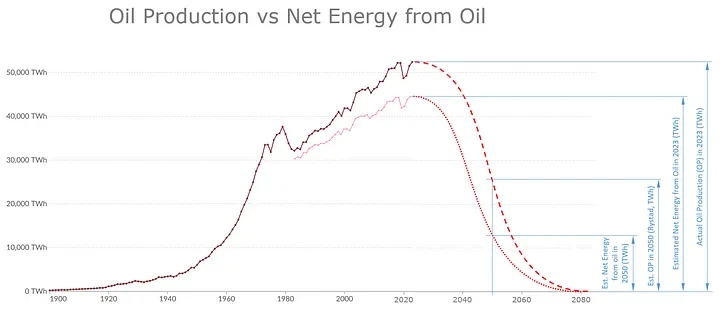
I had a few questions about this graph. I have seen this before and it has been mentioned on this site as well. This is the study but is it accurate?
https://www.sciencedirect.com/science/article/abs/pii/S0306261921011673
If our destination in 2050 is 1/3rd the amount of energy from oil that we get today, what happens on our way there especially with the economy?
Hideaway:
Hi Kira, have a close look at the graph and notice the exponential rise from around 1950 to the early 70’s. Hubbert showed that the rise and fall of world oil production should have followed a normal distribution curve, like individual oil fields tend to do.
When OPEC raised prices and the world realised oil was a finite resource there was a huge change and we implemented many efficiency improvements and substitutions (mostly gas) for oil use. The growth in oil production changed from exponential to linear, and instead of rolling over as predicted by Hubbert, has continued to rise.
We have been dragging future use of oil into the present for the last 25 years, while still growing overall oil extraction, as reserves deplete. Think about oil producers around the world. They have older wells still producing at EROEIs of 20-30:1 or more, plus newer wells in harder to reach places with much more expensive infrastructure and processing. The older wells that paid off their capital costs decades ago are easily the most profitable. They generate the most cash to keep the system going, however it’s the newer wells like shale oil, tar sands, deep water, etc. that help keep the overall price of oil lower.
Which are depleting faster? The old profitable wells, because the trade of goods and services runs on dollars and profit, so oil producers need lots of dollars coming in. Whenever the Saudi’s turn down production, it will be the expensive oil they reduce, not the cheap easy stuff, unless they desperately need to rest fields to protect future extraction.
What this leads to in our world of capitalism economics, is all the high EROEI wells depleting around the same time, just as the cost of maintaining production rises rapidly, because the wells are so much more expensive relative to the oil produced.
Complexity also enters the picture because the extraction processes for newer oils are highly complex operations. For example, horizontal drilling relies on sensors and computing power to keep the drill in exactly the correct strata, 10,000 feet below the surface. The oil sands extraction process uses large modern machines with the latest computers and sensors to maintain optimum efficiency.
Once the easy high EROEI oil is depleted, the remainder becomes much harder to extract because supply lines of equipment and spare parts become less reliable due to reduced economic activity, making everything required to support the complex processes harder to obtain and much more expensive.
Rapid loss of oil production quickly leads to higher oil prices and shortages, with businesses closing as people reduce spending, as happens in every recession, however the declining oil supply will accelerate as other high EROEI wells also reach total depletion, exacerbating the overall problem, with newer oil sources not keeping up with the declines. Deep recession leads to businesses shutting and restricted trade as countries can no longer afford imports, which causes more businesses to go bust.
Factories that earn 10% of their revenue from making essential ‘widgets’ for the oil sector go bust because the other 90% of their business starts operating at a loss, and it is impossible to restart the manufacturing because critical machinery was sold off for scrap in a clearing sale.
Thousands of factories stop making parts critical for a complex system. Without parts, oil rigs and refineries can’t operate, which brings down the entire system.
For us here at Un-Denial, it’s pretty obvious what happens next as the problems will mount and cascade affecting many businesses unexpectedly, thus triggering a self-reinforcing decline.
Most importantly, although demand for oil will fall with recession, oil will not become cheap because supply will also quickly fall. There will not be investment capital available to extract new marginal oil, especially in the Middle East where populations will be suffering from the high price of imported grains and other food, that will become difficult to purchase on the open market. Food exporters will struggle due to high diesel and fertilizer costs and will be forced to reduce production.
Then the next year oil supplies will fall another 5 Mbbls/d, and again the year after, and soon it’s over and most people will be left wondering how those in power let it happen or couldn’t see it coming…
Kira:
Thanks for the explanation.
I hadn’t considered at all that even within countries like Saudi Arabia and Kuwait you will have different EROEI fields. It makes economic sense to keep running the high EROEI wells to get most for your barrel of oil. After reading your explanation I was curious to see the status of old oil fields, the giants and super giants which are collectively responsible for the majority of our crude oil, but most importantly as you pointed out, high EROEI oil. This is the list from wiki:
https://en.m.wikipedia.org/wiki/List_of_oil_fields
Most supergiants were discovered more than 60 years ago. Taking the top two as example Ghawar and Burgan. They both started production nearly at the same time and apparently peaked at the same time (2005) although Saudis don’t confirm it. Ghawar seems to be declining at 2.5% annually and will be down to 2.5 million barrels from a peak of 5 million by 2030. I am sure Saudis are doing everything possible to slow the decline now which will make future decline worse.
It appears as though oil fields like Ghawar are subsidising the extraction of the low EROEI oil like shale and tar sands. The energy comes from the old ones and the volume comes from the new ones, keeping price low and maintaining the illusion of abundance. It’s quite deceptive when you think about it. The net energy keeps depleting while the volume remains same or even increases for a while.
Companies that make generators for offshore oil rigs are a great example of economy of scale tumbling. They probably make generators for hundreds of clients who are not oil companies, when these clients can no longer afford their product the critical mass is lost and they go out of business. Oil companies cannot keep them in business single handedly. This can be applied to other things like pipes as well. This is what the death spiral of the oil industry will probably look like.
Hideaway:
I was thinking when reading your post Kira, yes, yes, yes, yes, yes. I certainly couldn’t have written it better.
On the oilprice.com webpage, there is this article….
https://oilprice.com/Energy/Crude-Oil/Arab-Gulf-Producers-Are-in-Need-of-Much-Higher-Oil-Prices.html
After enjoying a rare budget surplus in 2022, most Gulf Cooperation Council (GCC) economies are seeing their budget deficits widen with current oil prices still well below what they require to balance their budgets. According to the IMF, Saudi Arabia, the GCC’s biggest economy, needs an oil price of $96.20 per barrel to balance its books, thanks in large part to MBS’ ambitious Vision 2030. The situation is not helped by the fact that over the past few years, the oil-rich nation has borne the lion’s share of OPEC+ production cuts after agreeing to cut 1 million barrels per day or nearly half of the group’s 2.2 mb/d in pledged cuts. In effect, Saudi Arabia has been selling less oil at lower prices, thus compounding the revenue shortfall.
Imagine how they cut back, will it be the most profitable oil wells or least profitable ones, when they are so desperate for revenue? Obviously the least profitable ones get reduced while the cheap easy to get oil gets depleted quickly.
What could possibly go wrong when all the cheap high EROEI oil extraction starts declining rapidly just as shale oil uses up its tier 1 and 2 locations…
Perhaps we should have been called Homo dumbass, because we are definitely not ‘wise’.
Rob here on 15-Oct-2024 adding some fresh calculations by Hideaway on the expected speed of collapse, and a response from Kira.
Hideaway:
An aspect of our situation I’ve been thinking of putting down in writing with numbers, so that people can get a better understanding of the collapse ahead…
In regard to oil, we are mining around 100Mbbl/d which will roll over at some point in the near future..
According to some paper I read recently, we currently use around 15.5% of oil to obtain oil and this will rise to 50% of the energy by 2050.. From this paper…
https://www.sciencedirect.com/science/article/abs/pii/S0306261921011673

At the same time as this is meant to be happening, we will be mining a bucket load more metals and minerals for the transition.
What people find so difficult to do is to put several aspects together, to see if it can work, so I’ve decided to try below.
Assuming the increase is 1Mbbl/d/yr in the energy used to gain oil, which is easily possible as we’ve mined all the easy to get oil and only have the harder, more distant supply left, plus allowing for oil production to roll over to a decline in production we get the following…
I’ve used a fall of oil production of 1Mbbls/d for years 2,3 and 4, then 2Mbbls/d for yr 5, and 6, then 3Mbbls/d, for year 7, 4Mbbls/d for yr 8, 5Mbbls/d for yr 9, then a maximum of 6Mbbls/d for years 10, 11, and 12. At no time does the depletion rate go over 10, in these 12 years…
Year 1 …production 100Mbbls input energy 15.5Mbbls … Left for society 84.5Mbbls
Year 2 99M ………………………….. 16.5M ………………. 82.5M
Year 3 98M…………………………… 17.5M ………………..80.5M
Year 4 97M ………………………….. 18.5M ………………..78.5M
Year5 95M ………………………….. 19.5M ………………..75.5M
Year 6 93M ………………………….. 20.5M …………………72.5M
Year 7 90M ………………………….. 21.5M …………………68.5M
Year 8 86M ………………………….. 22.5M ………………….63.5M
Year 9 81M ………………………….. 23.5M …………………..57.5M
Year 10 75M ………………………….. 24.5M ……………………50.5M
Year 11 69M …………………………… 25.5M …………………….43.5M
Year 12 63M …………………………… 26.5M ……………………. 36.5M
Because of the combination of more energy cost of energy (a la Tim Morgan), plus just plain slow decline, the available oil for the rest of society has gone from 84.5Mbbls/d in Year 1 to 36.5Mbbls/d by year 12..
But wait there’s more.. Assuming mining uses 10% of all energy, while in oil’s case makes it around 10Mbbls/d, we know that mining has to increase greatly for the ‘transition’. With the massive increase required, just assuming a 10% increase per year would be conservative, as we are talking a magnitude more copper, Aluminium, Nickel etc, plus all the steel in wind towers and solar farm foundations being built in the TW scale every year etc.
Mining’s use at just 10% growth rate goes from 10Mbbls/d in year 1 to 31.4Mbbls/d in year 12..
When we add this into our calculations of oil available for everything else, we go from 75Mbbls/d in year 1 (100 – 15.5 – 10 = 75Mbbls/d) to 5.1Mbbls/d (63Mbbls – 26.5Mbbls – 31.4Mbbls= 5.1Mbbls/d) for everything else other than oil production and mining..
The above assumptions are very conservative assuming oil doesn’t decline by more than 10% in any one year, that oil used to gain access to more oil goes up by only rises by 6.5%/yr at most, then the growth rate declines (unlikely), plus the 10%/yr increase in oil going to mining wouldn’t get us close to climate/transition/renewable expected growth rates…
Even with those very conservative assumptions, we go from 75Mbbls/d for “everything else” to 5.1Mbbls/d for “everything else” in just 12 years after reaching maximum possible oil production. It clearly can’t and wont happen that way!!
We’ve been dragging future oil use into the present for the last 40-50 years, as shown by the linear increase in oil production since then, whereas we had an exponential rise in production before then.
The above is just putting together 3 aspect of our modern world, instead of concentrating on one and assuming everything else stays constant as just about every ‘model’ does that I come across from ‘experts’ in various fields..
The big question is what happens instead of the above??
Do we cut back oil spending on gaining oil, so that the depletion of existing oil happens much faster than 10%/yr?
Do we cut back on mining so that the transition dies a lot earlier?
Do we assume we will find a magic energy solution to all our problems?
Do we just assume oil production will never decline quickly… because….. just because we don’t want it to???
I didn’t realise how bad the numbers were until I just did the simple calculations and put it down in writing. To me it means we collapse well before the 12 years are up after reaching peak oil production because of many feedback loops creating chaotic disruptions on the way down. Every year we remain close to the peak of oil production, means we are dragging more future oil to the present, meaning the decline when it starts to accelerate will likely be much faster than the sequence above…
Kira:
Excellent analysis!! I just want to mention that the oil that goes into getting oil is mostly in the form of diesel yet only about 75 million barrels that we extract today is the kind of crude that can be refined into diesel. The rest of oil is either shale, NGL, Biofuels among other things which have their uses but not as diesel.
There was also a video that was posted here about a gentleman who mostly agreed with what we discuss here about the irreplaceable nature of fossil fuels and the shortcomings of so called renewables but believed that there is so much oil out there that we will never run out, that we can have shale revolution after shale revolution. There are many who subscribe to this school of thought and think we can extract shale oil and gas from formations in Argentina, Russia, China and many other such places. Art Berman (who has expertise in this area) on Nate Hagen’s podcast has stressed several times that the geology of American shale is very unique and the shale revolution cannot be repeated anywhere else.
If one needs any proof of this please look at China. Despite the CCP pushing the state oil companies hard to extract shale deposits for years gas out has reached only about 30bcm per year which is less than 3% of American output. Part of the reason is the remote location of the deposits in the northern part of the country but we are talking about a country that can create entire cities from scratch within a few years. This is a matter of National security for the Chinese but the geology is the problem and has been unyielding so most efforts have been fruitless and abandoned.
As far as depletion goes even if we take super optimistic figures given by Rystad which predicts that oil production will be down to 50 million bpd by 2050 then the oil available by energy would be worth only about 25 million barrels. This is just a slightly stretched out version of numbers given by you.
It is interesting excersize to speculate on how things will play out on the downslope.
At the beginning of this downslope the airline industry will be the first casualty. Consuming about 8 million barrels of oil and mostly middle distillates at that, this shutdown will provide a much needed relief to the energy constrained world. Of course the commercial airplane manufacturers namely Boeing and Airbus will also go out of business. It is unlikely that governments will have any interest in bailing them out even if they had the ability which they won’t. The tourism industry which depends on air travel will also collapse, as will countries entirely dependent on revenues from it. Depletion will soon catch up and the gutting of industries will start again but this time it won’t be something discretionary and superfluous like air travel. This time industries that touch all our lives will start competing for the remaining share of energy.
Rob here on 7-Nov-2024 adding Hideaway’s answer to a question by ABC on whether Dr. Simon Michaux’s proposed solution of Thorium reactors and iron powder will work.
My take on why this type of future can’t happen is because Simon Michaux misses complexity and scale in the argument we can go to this type of future…
Let me explain, we can only have the complexity of nuclear power and running everything off electricity with an enormous scale of the overall human enterprise we call modern civilization. The scale of this complexity would require much larger markets than we currently have as the number of ‘widgets’ needed to be made for all the complex machinery would be greater than today.
We only have the complexity of today due to the total scale of everything we do. The highly specialised nature of building the best computer chips as an example happens in one place Taiwan with TMSC. The facilities they have built to make these computer chips can only be as sophisticated as it is because of the global scale of it’s customers. To build and operate 50 such facilities around the world would not be possible, they would all go broke. The scale of the facilities built needs the scale of the market size.
To build cheap thorium reactors or any SMR, the “modular” being the important point, would require a massive market as the factories involved, down to the smallest widget all have to be working in co-operation so everything fits together perfectly, so the market needs to be massive so everyone in the chain can make a profit. It also means all the suppliers of parts have to be operating smoothly and at large scale to supply all the inputed metals and minerals.
This all requires the existing system to be maintained while we get the growth in scale of the industry which relies upon the growing demand for the new products from the markets.
Notice how there is growth at every stage to make it all happen!! So if we had a spare planet or 2 of resources to use to accommodate all this growth, then we might get to a more advanced technological civilization, however running into limits of everything we currently use, because of growing energy cost from energy access itself to everything else mined, means we can’t get that advanced.
Also note that to get to where we are today in regards to the totality of civilization has taken growing energy use of all types for over 250 years. It’s been oil that has allowed for the increases of coal and gas use over the last 100 years. All the renewables plus nuclear and even modern hydroelectricity all rely upon oil themselves, and upon oil for the cheap coal and gas used in their production.
If we didn’t care about the environment at all and had another 2 earths worth of oil on this planet, then sure we might get to thorium reactors everywhere, but it will still all rely upon oil.
As oil production starts to rapidly decline, sometime in the near future, I have no idea exactly when, then the ability to keep our modern complexity will quickly unwind. We are getting a ‘sniff’ of this at present by all the countries that want to relocalise so much production, which isn’t possible as we lose the economies of scale of the current globalised system, unless there is an accompanying simplification as well. However no-one is planning for a simplification, the actual plan is to make aspects of the modern world at home. All these plans will quickly realise that they rely on imports of most/all the parts and the relocalisation is not very economic because of smaller market size.
Of course all the duplication everywhere is more inefficient using both more energy and materials to build and taking more people to operate and maintain. We lose some of the existing efficiency in the huge scale of many operations by trying to relocalise them.
What it means by even trying the relocalisation is that the population as a whole gets poorer because of inefficient use of energy and materials (unless we had spare planets worth of all these on this planet!!), due to lack of scale and overall the complexity has to fall to match the energy we have.
Please also note we have no shortage of any material on this planet, just a shortage of energy to access lower grades, and all the processing involved in making them useful goods. It all comes back to existing energy availability within the scale of complexity of what we have as current civilization and we can only build a lot more of any one aspect, while the entire system operates normally. Normally being in growth mode, providing the capital, goods and services required in the usual orderly manner to open new mines. Which means the population needs to be well fed and educated, with abundant services continuing to operate throughout.
We can’t take energy and materials away from one sector to go to another as the odds are they use different aspects of modernity and it’s not a simple swap, with whatever being constrained having feedback loops that are unexpected.
Anyway back to thorium reactors. The industry needs to grow and develop naturally in a world of increasing demand for this product, so it can develop naturally, which takes the rest of the system growing normally. Eventually factories that could build SMR would develop, providing the capital and operating costs were a huge advantage over the existing forms of energy. This can only happen in the background of our system operating ‘normally’, ie growing economies. It can’t be forced, as any developments of forced, as in uneconomic simply don’t last as industries when times turn tough.
When we get a real recession/depression brought on by oil getting more expensive for every other industry, all the expenditures on solar, wind, nuclear and batteries will probably start falling fairly quickly, as these expensive subsidised builds lose market share, as they are too expensive, even for a product (electricity) that is only one aspect of our energy use.
All heavy industry needs a constant cheap energy supply, often in different forms at the same time to produce the raw materials that feed our modern consumption. Without coke, coal, gas and plastics many of the items of modern civilization simply wouldn’t exist at all, so build a huge array of thorium reactors with say the last of the fossil fuel energy available, solves no problems. We wouldn’t be able to make the products we use today with just electricity.
If we were to build fancy new recycling facilities that somehow made use of all existing plastics for re-use in original forms, the whole enterprise would suffer the same entropy and dissipation as everything else and winds down fairly quickly, plus requires a rapidly growing system of modern civilization working normally in the background while it’s built to the scale and complexity required.
Every argument of how we can power a new civilization with solar, wind, batteries, nuclear, thorium or whatever form of electrical energy in the future, argues for a smaller supply of energy needed than now because fossil fuels are inefficient, we only use 25-50% of the energy (depending on the machine). It’s a terrible argument as the increase in the modern civilization growth to get to that point, would mean a much higher energy use than at present, just because of the growth in scale and complexity of everything to just build this future.
Someone should ask Simon Michaux or any other expert about the clean green future whether from renewables normal nuclear or thorium, about how much of it can be built without using fossil fuels at all, including down to the plastic insulation on all wires. The usual answer is it can’t be done yet, but improvements in technology and increased use of renewables/nuclear and how cheap they all become will allow it to produce synthetic fuel for these types of purposes.
I usually counter, with how none of it’s being done now, yet renewables and nuclear are already claimed to be cheaper, so all new factories would already be going to the cheaper ways if it was true, but no-one is doing it, so something is very wrong with the narrative. The argument usually flows to climate reasons why we have to move away from fossil fuels, which is unfortunately a different argument, because the energy required to then mine all the minerals to build this fantastic green future simply doesn’t exist without the use of fossil fuels.
We are in a total and utter catch 22 where we require cheap fossil fuels to build everything and maintain the current modern civilization, which collapses without their use leaving 8 billion cold, angry starving people looking to survive. Using another 2 planets worth of fossil fuels to build the entire renewable/nuclear/thorium future with electricity used for everything, including making plastics and synthetic fuels, will leave the climate and environment in ruins, then collapse anyway, when we turn off fossil fuel use, as that is a sudden energy loss when we continue to require more minerals and metals from the environment, due to those lost from entropy and dissipation, and the increase energy use from all the movement of materials for recycling..
I didn’t even get around to mentioning that a world of recycling everything as much as possible, uses fossil fuels for all the processes anyway, but that’s another story. It’s an incredibly complex situation we are in and any ‘easy’ sounding solution will simply not work as the proponent forgets we spend 97-98% of all our existing energy and materials on just maintenance of the existing system with only the other 2-3% going on ‘growth’ of everything.
Any one new major investment into a great sounding idea on a world wide scale, can simply not work by spending less than 1% of energy and materials use on it, unless the entire system of energy and materials grows massively. As the entire system has to grow, the number we start from in the future will be much higher energy and material use than it is today. The scale and complexity has to also grow to allow for more efficiencies in the system. the starting base of energy use in 30 years time will be double of what it is today..
If we don’t ‘grow’, then we can’t maintain existing subsystems within our civilization, as we need an increasing quantity of energy just for maintenance of material availability. The system can’t work ‘normally’ without the increase in energy, even without growth in the overall system. If we shrink the market size, then we can’t maintain the complexity of the current system either, as the affordability of the complexity goes down, so the system simplifies, which makes gaining access to lower grades of everything much more energy intensive as less complex equipment will mean lower recoveries in mining, lower food volumes from a given area of land etc.
Oops, sorry for excessively long answer. Our civilization is highly complex and so is the reason why none of the bright green ideas can work, and neither can a shrinkage of population while maintaining modernity, but hte attempt to do so, will lead to collapse of it all.
Rob here on 14-Nov-2024. Hideaway and ABC had an opportunity to ask some questions to a couple important leaders in the overshoot awareness community, John Michael Greer and Simon Michaux. Following are the questions and answers plus follow-on commentary from Hideaway.
A.) How can we have modernity without the scale of market size that we currently have to enable the mining, processing, distribution then manufacturing of the huge range of parts that go into making every aspect of modernity?
We can’t. It really is as simple as that. Modernity, as Dr. Richard Duncan used to say, was a transient pulse waveform a one-time, self-terminating affair.
B.) How do we make the machines that make the final product machines in a scale down world?
That asks the question the wrong way around. The right way around is “what kind of final products can we afford to have, given all the constraints on producing them in a deindustrializing world?”
The answer won’t be clear for several centuries, but it’s unlikely that any technology invented since 1900 or so will be included.
C.) How is it possible to maintain complexity, such as a thorium reactor and all the machines it powers on only a small scale?
I’m not a specialist in this technology, of course.
I’m open to the possibility that it can be done, but I want to see an affordable example first.
As we’ve seen over and over again, every nuclear technology is cheap, clean, and safe until somebody actually builds it…
D.) Where do the materials come from after many cycles where entropy and dissipation have worked their magic over many cycles of recycling?
Oh, in the long run say, another 10,000 years we’ll have to go to entirely renewable resources, and that will involve sweeping changes in everything; for example, some future society may cultivate chemosynthetic iron-fixing bacteria (the kind that currently produce bog iron) to keep it supplied with iron. Our immediate descendants won’t have to worry about that, though. Given the scale of population contraction we can expect (around 95% worldwide) and the gargantuan supplies of metal and other materials that have been hauled up from deep within the earth and stored in what will soon be urban ruins, our descendants for the next thousand years or so will have all the metal they can dream of using.
A.) How can we have modernity without the scale of market size that we currently have to enable the mining, processing, distribution then manufacturing of the huge range of parts that go into making every aspect of modernity?
I don’t think we can. It was all dependent on oil as a fuel. We have no replacement for this.
B.) How do we make the machines that make the final product machines in a scale down world?
We have to change our thinking in what we need all this stuff for. Do we need it? Can we do it in a more simplified form? Then ask how we can get there. If we can simplify how the tools are made using more abundant resources (iron vs. lithium for example) then use those machines differently, using modern knowledge.
What have we actually learned over the last 200 year?
The last 20 years in particular?
Can we take a backyard workshop, make a small foundry, have a blacksmith forge, run a basic lathe, drill press and welder, power it with a wind turbine on a lead acid battery?
Strip out useful products from all the places around us that no longer are in operation (cars in a carpark that have been abandoned).
Make an electric motor and a lead acid battery.
Can we shred rubber tyres and make gaskets?
Can we run a furnace to recycle ceramics and building waste into geo polymers
Then you have tech like 3D printers.
Can these be reinvented where we can make our own feedstock and make our own printer unit?
And so on.
C.) How is it possible to maintain complexity, such as a thorium reactor and all the machines it powers on only a small scale?
A Th MSR unit is about 12 m long, about the size of a shipping container and delivers 40 MW of electricity, or 100 MW of heat at 560 deg C.
They are made mostly from steel, nickel and a small number of exotic metals and alloys.
They have a working life of 50 years.
Complexity to run it is about that of running a modern medial isotope lab.
Their production is much simpler than most other devices.
I think it can be done in some cases.
The problem is getting permission to use them.
D.) Where do the materials come from after many cycles where entropy and dissipation have worked their magic over many cycles of recycling?
Contract our material needs per capita.
Simplify what we need to resources that are more abundant.
Most of the purple transition needs iron, which we have lots of.
Copper will be the limiting metal.
Industrial systems have to come into line with food production limitations.
Once we get to the point where recycling and mining can no longer deliver, then society has to work out a way of living without these things or go extinct.
Hideaway’s commentary:
Thanks ABC great work and answers by JMG. He gets the big picture of what’s going to happen, but appears to miss all the feedback loops that will accelerate everything to the downside. We have over 8 billion humans on the planet and 99.99% of them have no idea modernity is going to end abruptly, and when it does so will destroy the plans of the other 0.01% (or less!! ), that did see it coming and tried to prepare in some way.
Lots of people use Cuba as an example of what can happen with building vegetable gardens etc., except forget to mention that it’s in the tropics with fast growth and plenty of water, compared to say the UK which is 2.4 times the size and 6 times the population, plus Cuba today imports around 70%-80% of their food.
Where JMG says it’s asking the question the wrong way around, is incorrect. We are not planning anything about contraction as a species, every machine is becoming more complex allowing for more automation and hence cheaper costs. Once we go down there will not be the investment capital, energy nor materials, nor co-ordination to build any new machines to make anything.
He has once again used how we have done things on the way up, as in using more energy, materials and larger expanding markets; to think that some similar type of planning will occur during the collapse phase. It’s wishful thinking not close to reality.
Realistically, when food is not arriving in cities, who is going to be sitting around talking about what machines they are going to build and what level they can acquire, when there is no energy, nor materials in the appropriate form to do any of it??
One aspect JMG gets completely correct is about thorium reactors….. “As we’ve seen over and over again, every nuclear technology is cheap, clean, and safe until somebody actually builds it…”
There is a very good reason for the cost of all nuclear, of which thorium reactors will be no different, complexity. Every aspect of it is a highly complex specialty. It wont be made from ordinary stainless steel, it will be highly specialised stainless steel, probably with a high quantity of minor elements like molybdenum to allow for the highly corrosive environment of molten salt. “Salt” as in sodium chloride does not play well with most stainless steel, as the chloride is the one thing highly corrosive to stainless steel.
In the huge new refinery in Texas built by the Saudi’s a decade or so ago, upon commissioning someone turned on the wrong valve that sent hot seawater through the piping, causing something like $1.5B dollars in damage and delaying the opening by a long time. Interesting they now call it “caustic” released as it pitted all the stainless steel pipes. If seawater can do that, imaging what 600-800 degree molten salt will do to any weakness of the piping.
Scavenging materials, finding a smelter that can separate all the scavenged materials into the original metal forms, then recombined into the correct quality stainless steel to withstand high temperature molten salt, is a highly complex process by itself, involving a lot of coking coal for the heat. We don’t currently do this for new highest grade materials, we use newly mined purity, for the combination specialist metals, recycled metals doesn’t provide the purity required at this level of specialty. There is no way Simon’s thorium reactor can be rebuilt in a small community, as we would still need the mining of all the separate metals, including his one word reply of ‘exotics’.
What seems to happen is that we get answers about the future that all sound very plausible and comforting, until some person with a bit of knowledge of the intricacies of some part of it comes along to spoil the party.
It’s the highly technical nature of the materials that go into machines, that are then forged into specialized minor, often tiny, sometimes huge parts, with all the connections working in harmony, to make any modern kit, that will be impossible when people are desperate to find food and survive that’s the problem which is overlooked. They always assume some type of normality in the future, just with a much smaller group, forgetting that normality has been a growing human enterprise, with always more energy and materials to make stuff with for generations, and that normality is going to leave us in the near future.
Rob here on 5-Dec-2024 adding an interesting thought experiment by Kira on the energy and material savings benefits of economies of scale and our multi-continent supply chain. With follow-up comments by Hideaway and Kira.
Kira:
I have been trying to think about the benefits that economies of scale and multi continent supply chain provide in terms of energy and material savings and decided to try a simple thought experiment to try to visualize it.
Lets take a simple rudimentary motorbike as an example of the product that we intend to produce at scale. The raw materials will be the metals and alloys needed to make the parts and everything else will be done in house without depending on any external supply chain. The basic parts for a bike are as shown.
If we decide to make everything everything under a single roof (which is what localisation implies) we would have to dedicate seperate machining and fabrication units for each part along with the people with expertise in each of those departments all of which are massive upfront investments and would make the factory a mammoth operation on the scale and size of a gigafactory.
So what are the downsides of this approach?
- It requires massive upfront investment and upkeep.
- The output would be low.
- If we have to serve a country as large as US with localisation we are looking at at least one factory per state leading to large redundancy and waste of production capacity.
Lets approach the same problem and apply a distant supply chain solution.
Since all motorbikes are more or less the same and use same parts shown above we can do the following. Three companies A,B and C may be different bike companies making different types of bikes they will only design and make the frame(chassis) and engine in house and everything else will be outsourced to an external vendor. The suspension will be made by suspension manufacturing company, brakes by a brake manufacturer and so on. So how does this benefit everyone?
- Since the company is only making the frame and engine its factory size will be a fraction of what it would have been in scenario one.
- A dip in demand for company A’s bikes would not result in wasted capacity as company B and C can absorb the common capacity for the parts.
- Less labour requirements as there is lower redundancy as there is only one plant making suspension, brakes, tyres, clutch etc. instead of three.
- Since more resources are freed up the companies can focus resources on research and innovation thereby speeding up progress.
The obvious downside of this is the loss of redundancy and a single point of failure which can halt the production of all bike companies. But the benefits to the civilization as a whole far outweighs the risk as the more complex the product is the longer the supply chain is and the more difficult it would be to make it under a single roof.
If we take microchips as an example and try to take all the processes from raw materials to a finished chip and make everything under a single roof the factory will easily be the size of a small sized city.
When I mean everything I mean everything from the lithography machines to all the other machines, starting all the way from raw materials. That means first making this incredibly complicated machine below starting from metals and alloys mined,processed and shipped to the plant then machined, fabricated and assembled into the machine shown below.
So as complexity of the object increases multi continent supply chain is not only useful but essential to making high tech products. None of this is possible without fossil fuels and high grade minerals both of which are in irreversible decline and will soon lead to the supply chain collapsing leading to a loss of complexity creating a negative feedback loop.
The lithography machine shown above is just one of a hundreds of processes in getting from silicon ingots to a microchip (albeit the most important one). Some of the processes are shown above which require equally complex machines to perform.
Hideaway:

The caption with the photo states .. “just one of the benches the engine was laid out on”.
This was from a 1965 built motor..
Thanks Kira, a brilliant breakdown of complexity, with each of the above different main parts of a motor bike having so many components themselves. A simple motorcycle can have 2,000 – 3,000 separate parts.
Our complexity of modern life is just lost on so many people, not understanding that each and every part has to be made precisely from the exactly correct materials, to work together and function as a whole ‘machine’.
The other huge misunderstanding is that we need the total complexity to gather the food, energy, and materials that make up this complexity as we have used up all the easy to get food, energy and materials.
The motorbike example is a simple machine compared to a horizontal drill rig with tens of thousands of separate parts, including many computer chips, in many separate parts of the rig, from control systems to sensors to actuators, communication systems, power systems.
Without modern horizontal drill riggs our oil production would fall rapidly by a large percentage and these machines are dependent upon lots of spare parts arriving nearly every day.
When we start to lose overall energy availability, especially oil production because of depletion, the complexity has to rapidly unwind, as there is simply not enough energy to keep it all going. Once feedback loops kick in, of lack of parts, then machines we rely on become junk very quickly, which accelerates chaotic feedback loops.
The concept of going local, means massive simplification, because we don’t have either the energy nor materials locally to do anything differently, which means we will be unable to feed the current huge populations of local areas as all the modern machines cease to function. Fertilizer becomes a thing of the past, tractors can’t get oil and grease, let alone fuel, likewise for all transport from local rural areas, to cities.
Modern humans have just forgotten how reliant we all are upon 6 continent supply chains for our very existence…
“Kleiber’s law” of power/mass use to the 3/4 power most likely applies to human civilization. Studies have shown that in nature the law is a doubling of animal or plant mass requires a 75% increase in energy use because of efficiency gains is the easy explanation.
In human settlements research, done by Prof Geoffrey West and a host of others, they have found human population centres the power law is closer to 85%, as in we are not as efficient as nature with a 4B year head start. The problem with all the work on settlement sizes is that we live in a world of one global civilization and no city is an entity to itself, which they were 500-10,000 years ago, including their surrounds.
Kira:
Actually it was your exchange with Dennis on POB that lead me to have this train of thought. I found this line by him to be quite revealing of how people like him think.
Dennis: “Society is not based on physical laws alone, it is understood using knowledge such as sociology, psychology, and economics.”
Cornucopians like him always point out how GDP is growing with less energy use ie growth is becoming less energy intense. We know this is primarily because of massive financialization of economy but when you point that out his reply is that GDP calculation are a reflection of physical and thermodynamic reality of the society. It’s funny how he tries to have it both ways whenever it is convenient.
He is wrong as usual. Let’s take three bike companies on three continents North America, Europe and Asia – Harley, Triumph and Honda respectively. Assuming that there is no contact between the continents and each company has complete monopoly over their respective continents without any alternative then they can manufacture in whatever configuration they want. They could make everything under the same roof with redundancy and inefficiency or outsource their production of components to third party and cut costs.If they are inefficient their customers end up paying more than their counterparts on other continents.
But as soon as we apply the situation of globalization and they have to compete with each other they will have no choice but to reorganise themselves in a way to reduce material and energy costs and if they don’t they go out of business. You were right in your counter that civilization is very much like an ant hill and just like how no ant has the complete blueprint, no human has the complete design of civilization. It is not intentional, it is self organizing and self assembling. Complexity increases to solve problems and with increase in complexity comes increase in material and energy cost. When this happens the system reorganizes itself to optimize resource consumption. There is no way to intervene here.
For instance Ford could probably manufacture every component of its car under the same roof 85 years ago but with today’s complexity they probably have hundreds of suppliers that they share with many other car companies. If an American president declares that every inch of a Ford vehicle must be made on American soil the company would immediately go bankrupt as if they tried to do that a car that costs 20,000 would cost 200,000.
This pattern holds even across completely different industries.


This is a ridiculously condensed and shortened version of the supply chains of Apple and BMW. All supply chains end up either at pits of mines or oil and gas rigs as everything we produce comes from earth as raw materials. The suppliers in greens are the common ones for both companies and hundreds of others including oil and gas rigs. If we fully expand the supply chains we will see countless overlaps with one another with constant reorganization happening to optimize resource consumption. The true scale of feedbacks and overlapping is so complex that it is impossible to even comprehend. But there are some interesting things we can glean from the above diagram. The critical mass of consumers for the chip industry is coming from consumer electronics meaning that the auto industry and oil industry are just beneficiaries of this. If people stop buying smartphones and PCs then oil companies and car companies go out of business. There are several such critical dependencies that may not be so obvious at first glance and may be far down the supply chain.
Of course the connective tissue connecting the supply chain is oil since without we cannot maintain the multi continent movement or power the mining machines at the end of the supply chains.
Hideaway:
Thanks, Kira, excellent work again.
Trying to get people to understand the connection between the overall size of the growing market, relative to the complexity is extremely difficult, especially when added to the overall energy and material savings to the entire super organism of the human civilization.
Because of collapsing grades of ores of all types, we need the complexity of modern machinery, modern financing and modern supply chains, to gain access to all the requirements of all materials and energy used. It’s a self feeding monster that has to grow just to gain access to the requirements.
Unwind any aspect of modern complexity and the whole lot collapses, yet keep growing and the whole lot collapses due to environmental limits anyway.
Most likely oil will be the limiting factor, that sets in motion feedback loops in reduced consumption of all the requirements used in modern complexity, and your example of discretionary spending on computer chips is the perfect example, but we can multiply this by thousands for all the unknown links that are necessary to keep modern complexity going.
The concept of localizing industries, plus using tariffs to do so, will just hasten the collapse as it uses up more energy and material resources to build all the local manufacturing plants and tool them up, let alone gain the raw materials and energy for their operation. Just the attempt to do this will likely set off other unknown feedback loops as the extra energy and materials involved in the attempt to localize puts pressure on other aspects of the system.
Of course it’s all just a duplication of what’s already happening elsewhere, supplying the world, so the energy and materials are effectively wasted giving higher costs to consumers everywhere because of the duplication. Now imagine 5-50 countries trying to do the same for their local markets.
We can’t have 50 TMSC factories around the world as there is just not the market for that number of computer chips, with the complexity it takes to produce them. That factory/foundry whatever they want to call it has to churn out millions of wafers and chips to be viable. It wont work with 50 of them, unless the super-organism of human civilization grows by enough to accommodate the increase, which means every facet of civilization has to grow including population, energy and material use.
Once oil declines because of depletion and the impossibility of an increased production, whenever that happens, then overall energy availability turns down, meaning the growing organism can’t keep growing, nor even maintain what’s built and operating as entropy guarantees we require 97-99% of all energy and materials to just keep operating ‘normally’. (All while energy use keeps growing to supply the raw materials because of lower grades).
Once energy of all types that totally rely upon oil start suffering from increased costs, as oil’s harder for any one business to obtain, the civilization that relies upon cheap energy, suffers from reductions in internal markets from those struggling, meaning less markets for computer chips, and every type of machine that relies upon them, sending businesses broke, that manufacture essential requirements of other businesses, so creating a cascade of accelerating failures across civilization itself, in producing everything required to just maintain and operate what exists.
We’ve been in extend and pretend mode for over 50 years, making up a linear increase in oil supplies, with exponential increases in coal and gas energy supplies to make up the required energy of the growing civilization, then added some nuclear, solar, wind, geothermal etc, all just electricity providers, which are not providers of the full range of products and energy supplied by fossil fuels.
The increase in coal and gas though is totally reliant upon oil, with the rest being just derivatives of fossil fuels in total.
The complexity of the entirety of the system would take multiple books to explain just the merest of details of any one component of the overall complexity of how we live. It’s beyond the comprehension of anyone, as it’s exactly as explained by Kira above, so people without thinking of the overall complexity, assume we can just increase one part of this civilization by increasing something massively, on a world wide scale, without having implications elsewhere, nor have any understanding how everything else has to keep working normally for their one aspect to increase greatly. (EVs, batteries, solar, wind, geothermal, tidal, and nuclear).
Single cell organisms, multiple cell organisms, storms, stars and all prior civilizations have grown with increasing complexity over time, yet all eventually collapse due to some type of internal energy usage decline, that collapses the overall system.
To think our modern civilization will be ‘different’ to everything else in the universe that is large and grows complexity internally, increasing energy use until collapse, is denial in it’s finest form.
 un-Denial
I didn’t watch this because the headline explains all we need to know.
I don’t get how Canadian Prepper can build a food forest to feed his family in Saskatchewan from start to finish in 3 months when Gaia, Campbell, Hideaway, AJ, Charles and the other doomstead farmers here have taken years.
What’s wrong with you guys?
LikeLiked by 3 people
I flicked through it and despite spending a lot of money on plants he’s probably got less than 1% of his family’s calorie requirements. As all us gardeners know it takes 19 weeks to grow a cabbage and way longer for fruit and nut trees.
It’s also not really syntropic in my view as he’s used lots of weed suppressing geotextiles laid down.
On a positive note I’m pleased to say that after just under 3 years we have finally been able to stop buying bananas and leafy greens from the supermarket.
LikeLiked by 3 people
As I understand syntropic agriculture, this is not representative. Undesired plants are supposed to be suppressed by one own dense and continuous planting. So these geotextiles were added, either because that’s the way the consultant is selling syntropic agriculture and it has become a fad, or because it’s a way to do some product placement, who knows?
(Or I don’t understand syntropic agriculture) I am waiting for this book to be translated in English or French: https://books.google.fr/books/about/Vida_em_Sintropia.html?id=0vmdEAAAQBAJ
LikeLiked by 1 person
From the thumbnail, it seems to be a plastic food forest 😉 At least, he did not seem to cut old-growth trees in order to plant smaller trees. (I didn’t watch the video, just skimmed through it, so I am maybe just being silly). And, it’s as good as an entry point to start growing food as any other.
This gives me an opportunity to list the plants, that seem to be able to grow in my climate, with an extremely simplified practice. I do not till, water, apply fertilizers or pesticides. I do not fight the animals, plant diseases, never. Basically, every week, I walk around the plot and do all these actions, intertwinned (not one after the other, it’s a continuous whole):
Never is the soil without cover (some patches sometimes, after the passage of a mole, or if I just harvested a large root. In this cases, I seed immediately and preferably before a rain). I work without gloves and almost no tools. I found out and was surprised by the amount of things which can be done with one’s hands and presence only. Sometimes, it’s just a matter of a little patience: nature will give, if I just wait a little bit more. Whenever something is too hard, I simply stop.
Here is the list of plants which strive:
In this garden, I am about to start the fifth year. As the soil seems to be getting better, the yields are progressively growing too. (The starting point was very heavy orange clay soil, which “turns to concrete” in the summer and sludge in the winter: it originally came out of a nearby tunnel excavation site)
There are some plants I have a very hard time to grow in my soil and with the constraints I have chosen. They are, for instance, zucchinis, tomatoes, eggplant, carrots, parsley and coriander. The most limiting factor seems so far to be water and the duration of the sunny season: the plants grow correctly until the soil reserve seems to deplete (or maybe the plant roots are not sufficient). It’s around mid-July when suddenly all growth stops. When rain comes back, by the end of August, growth resumes. I am able to harvest the corn by mid-september (the very end of the season), but the tomatoes and zucchinis are usually too late or too few and the eggplants quite small (although edible). I hope this will improve as the soil depth increases and it can store more water. I also try to increase shading, even though hedges are forbidden and trees limited (by the rules of this community garden, go figure :(). Salsifys and parsnip are progressively structuring the soil. So I am hopeful.
I don’t know why I don’t have more carrots, maybe it’s my way of gardening, or the soil being too heavy for the fine seeds. Parsnip are a fine enough replacement…
Beans too are rare: they don’t seem to have the strength to go deep in the soil. I don’t know…
I especially love the fig tree, a survival tree if any: extremely hardy, fast growing, easy to multiply, providing rich fruits. Maize and potatoes too are golden plants: easy and productive.
I want to plant Yacon (https://en.wikipedia.org/wiki/Yac%C3%B3n), but haven’t found a store in France which sells it… I guess, I should use the internet more 🙂
LikeLiked by 3 people
What a great comment and list Charles. You are doing brilliantly. We are very lucky here on deep volcanic soils. In fact a challenge has been finding enough clay for our earth building projects.
Have you seen this video on Syntropic Agroforestry? Our friends started on clay and Kikuyu grass.
They have just released this online resource which may interest you to help with plant selection.
https://www.sapp.earth/
Here’s a link to a guide book I have.
https://drive.google.com/file/d/1x9DB4PHZuXw269eBmZYHZeN2F-BoB3NR/view?usp=drivesdk
And another.
https://drive.google.com/file/d/1xwHW83Y73uAwrtZKlrzY7zGLvhp-mltZ/view?usp=drivesdk
Are you restricted by plant height in your garden by rules? On clay soils you would usually plant some support species that have deep strong roots to help break up the clay. We use eucalyptus sp here a lot in NZ. Lots of biomass, take a good pruning well and produce timber and firewood in time. I’m no expert and there are probably plenty of other species that would do a similar job and don’t get higher than your fruit trees or can be kept that high by pruning.
Also do you have room for any nut trees like Hazelnuts or almonds? A good addition to an orchard.
Regards
LikeLiked by 1 person
Hello CampbellS,
Thank you very much for the great resources and the encouragements.
Yes, I had seen this video before (If I am not mistaken, you posted it before, alongside others from the same family). What they do is great. Ernst’s work is an incredible gift to humanity (and so is Fukuoka’s example :). At least for me.
Yes, the plot I am talking about in the previous comment is in the local community garden. They have strict rules about plant height and types: it’s a pretty conventional gardening culture which is passed down from gardeners to gardeners. I can go there several times a week on foot.
Hopefully, I have a few larger plots in the country side to experiment a lot more freely. But I can go there only during the vacations, so it’s a different dynamic.
All the best.
LikeLiked by 1 person
Go the gardeners Charles 🙏
LikeLike
Hey Charles,
You can buy yacon to plant in France at https://www.leaderplant.com/acheter-yacon-poire-de-terre-red-5562.html
I’m in France too, on similar soil (I’ve heard it described as “the worst soil in France” on a radio show!), and with quite similar intentions to you, I think. About the only things I’ve managed to get to grow in my heavy clay soil are plants in the Rosaceae and Poaceae families, apple/plum/quince/etc. and grains like wheat and barley. The only fertilizer I use is my own pee and horse manure from a local agricultural college. I’m increasingly coming to believe that the only form of genuinely sustainable (over millenia) agriculture is food forestry.
Anyway, should you happen to be anywhere near the Occitanie region, I’d enjoy meeting a fellow undenialist here in France, I can’t imagine there’s too many of us! Regardless, good luck with the gardening.
LikeLike
A fellow french undenialist 🙂
Thank you for the link and invitation. I haven’t been in the Occitanie region in a very long time, but should it happen, I will gladly pay a visit.
Good luck with your soil too. It must even be harder, since there is probably less rain in the south. But, then, some people have to work with polluted soil, or so depleted that it’s almost bare rock. If you persist, I am sure you will find a way. I trust life. At some level, we all receive what is most suited to us.(You know like somebody and his dog, often they look strangely alike)
How long have you been farming there? How big is the plot? Have you tried syntropic agriculture?
LikeLike
Have you added any gypsum to the soil? It really helps break up clay soil over a couple of years. The earth worms move it for you, so you can just sprinkle it on top. I have gardened in heavy clay soil before (with no top soil). It was tough. Raised beds for veges were essential
LikeLike
Hello Rob. I just wrote a very long reply, which I am unable to see :(. Maybe it got filtered out because it had a lot of links?
LikeLike
Sorry, that’s probably what happened, I fixed it.
LikeLike
Thank you for putting it back.
LikeLike
The vast majority of preppers are just lunatics living in delusion. They don’t know nothing about calorie tables, and thus they grow leafy greens, tomatoes, radishes. They don’t know nothing about yearly intake of calories, and thus they think 10 raised beds are enough. They don’t know nothing about food preservation, and thus they think canned food is the way to go. Some really stupid preppers don’t even store carbohydrates, because the keto diet is way better (it’s true actually), yet they can’t explain how their keto diet will be available when SHTF…
Best, Comrade
LikeLike
It’s probably quite hard to know, because really good preppers won’t even let on that they’re preppers. Some of the influencer preppers are quite ridiculous though, as you describe. They also often neglect to prep anything woman-related, which I find amusing
LikeLiked by 2 people
I had no idea how easy it is to hack a phone. Everyone is vulnerable.
Main take-away, don’t use 2 factor SMS authentication on accounts you are using to overthrow the government.
LikeLiked by 1 person
I sometimes feel that even if the policy planners in Washington and Pentagon are not overshoot aware the one thing that they are certainly aware of is the powder keg that US is sitting on. When looking at history the very idea of a country like US seems impossible where the civilian population has weapons and equipment better than most armies around the world along with a diverse population the likes of which has no precedent.
The only things that seem to have made this impossibility a reality are mindless consumption that sedates the populace and an overwhelming militarised police force that can keep the population in check. The prison system aids in this too I guess. Once oil starts to decline all of these things will start to wither away, violence will erupt based on existing fault lines and the chaos will quickly spread until governance collapses and militias and gangs start to wrestle for control of regions. Looking from this perspective of existential threat even a nuclear war seems worth the risk to secure oil supplies.
LikeLiked by 1 person
I have read a lot of “prepper” fiction (years ago). And now subsequently that I am somewhat more energy aware, I wonder how all those militias and gangs are going to have the energy for a “Mad Max” kinda world. Or, is that the energy blindness of all the authors? Who, when the U.S. fractures is going to work those oil fields, transport and refine all that gas/diesel so that militias and gangs can go around terrorizing the remaining “armed to the hilt” populace? I’m being quite sarcastic (if you didn’t get that).
I don’t think there are going to be any “militias and gangs” as that is a construct of plenty of oil and Hollywood Mad Max fantasy. The fractured U.S. will rapidly collapse because of all the “diversity” and guns and even the thought, that there will be “red” and “blue” areas, I think is wishful thinking. Maybe more homogeneous cultures like Japan, Korea, China (because of authoritarianism) or Russia (because of culture) might fare better, but who knows?
Just my two cents.
AJ
LikeLiked by 5 people
Do you think it will be fast collapse with a massive die-off as described by Hideaway?
LikeLike
I actually think it’ll be pretty fast in the U S., maybe a little slower in some of the Global South countries as as many of them are nearer their agrarian roots. In the U.S., I think it’ll be lots of people killing their neighbors or starving to death.
AJ
LikeLike
Imagine what happens to the suburbs when cars become unaffordable.
Do you think Europe will be better or worse off?
LikeLike
I don’t know enough to comment on Europe, except they have little indigenous energy and a large population.
AJ
LikeLike
Most authors seem to compartmentalize collapse to just a certain dimension but keep everything else the same. For instance environmental collapse based post apocalyptic movie will see forests replaced by desert (to drive cool looking trucks in) but everything else remains the same whereas zombie apocalypse movie has people becoming zombies but advanced technology and weapons remains as it is (to fight the zombies of course).
I agree that there is no way to produce oil or energy products without industrial civilization and anybody who thinks otherwise is not getting the whole picture. When I said militias and gangs I meant raiders and bandits who will steal or demand food from population for “protection”. They will be on foot or may have horses and will very likely have military grade weapons and gear. Their territory will be miniscule, confined to a radius of maybe a dozen miles or so.
I also believe that countries Iike Japan and South Korea will do better than most countries because of their declining populations, zero immigration, homogeneity, people-government relationship being better than other countries being some of the reasons.
LikeLiked by 3 people
Non collapse. I rewatched a couple Christopher Guest movies this weekend. He makes satirical comedy films shot in mockumentary style. And he uses a lot of the same actors. I’m betting his humor is the right tone for this un-Denial crowd that despises bullshit. Would love for this guy to make a movie mocking the doomer world. (a lot of comedy potential there)
If you have an interest in the subject matter, and you can handle some improv style acting, then good chance you’ll like it:
Best in Show & Mighty Wind are my favorites. Here’s a hilarious clip and a full movie link.
A Mighty Wind (youtube.com)
LikeLike
Guest movies have an instantly recognizable feel. Best in Show is really good.
LikeLiked by 1 person
@Rob Mielcarski
You use an add blocker IIRC. Could that be what is causing youtube embeds not to work for me?
It is that I am using Firefox on Linux?
Could it be a bug in WordPress?
LikeLike
Whether or not I (or you) use an ad blocker should have no effect on embeds.
I just did the following test with 4 browsers on Windows: Brave, Chrome, Edge, and Firefox.
Play a YouTube video and copy it’s URL from the browser address bar by ctrl-C.
Go to the un-Denial comment form and type a message. Then press return to make sure I’m on a new line. Then press ctrl-V to past the YouTube URL. Then press the Comment button to publish it.
The embed worked for all 4 browsers.
A couple times it looked like the browser had hung trying to display the embed before I submitted the comment but if you ignore this and press Comment anyway it works correctly.
It might be a Linux issue but I have no experience with it. Maybe another Linux user can do a test?
LikeLike
This is a test
LikeLike
It worked even though your URL is not clean and has some unnecessary stuff after the “&”.
LikeLike
Hideaway on “green renewable” liquid fuels…
https://peakoilbarrel.com/opec-update-september-2024/#comment-781290
LikeLiked by 1 person
I think Bs article was pretty good today cutting out all the noise of simplification and going straight for the core of the issue.
https://thehonestsorcerer.medium.com/2030-our-runaway-train-falls-off-the-seneca-cliff-cd51db4e7dfb
I had a few questions about this graph. I have seen this before and it has been mentioned on this site as well. This is the study but is it accurate?
https://www.sciencedirect.com/science/article/abs/pii/S0306261921011673
If our destination in 2050 is 1/3rd the amount of energy from oil that we get today what happens on our way there especially with the economy?
LikeLiked by 1 person
Thanks Kira, an excellent essay by B.
I’m almost certain B’s been reading Hideaway because no one else is publicly talking about the same issues.
B’s essay is a nice complement to the Lars Larsen book I reviewed because it identifies more forces (B lists 11) conspiring for a rapid decline in energy supply.
I note that B missed one of the most important forces: The implications of no-growth, or even worse de-growth, on our debt backed fractional reserve monetary system and its mountain of unrepayable debt.
LikeLiked by 2 people
LikeLiked by 1 person
Hi Kira, have a good look at the graph drawn and notice the exponential rise from around 1950 to the early ’70’s. According to Hubbert’s work world oil production and then decline should have followed a normal distribution curve like every separate oil field tends to do.
We had a vast change when OPEC raised prices and the world realised oil was a finite resource, so we had a whole host of efficiency improvements and substitutions (mostly gas) for prior oil use. The growth in oil production became linear, instead of exponential, and instead of rolling over at the appropriate time, as predicted by Hubbert has continued to rise.
We have been dragging future use of oil into the present for the last 25 years, while still growing overall oil extraction, as reserves deplete. Think about all the oil producers around the world. They have older wells still producing at EROEIs of 20/30:1 or more plus newer wells in harder to reach places with much more expensive infrastructure and processing. The older wells that paid off their capital costs decades ago, are easily the most profitable. They throw off the most cash to keep the system going. however it’s all the newer wells, shale oil, tar sands, deep water etc that help keep the overall price of oil lower.
Which are depleting faster? The old profitable wells, because the trade of goods and services runs off dollars and profit, so all producers of oil need lots of dollars coming in. Whenever the Saudi’s turn down production, it will be the expensive oil they reduce, not the cheap easy stuff, unless they desperately need to rest fields to maintain production later.
What this leads to in our world of capitalism economics, is all the high EROEI wells depleting around the same time, just as the costs to maintain production rises rapidly, because the wells are so much more expensive relative to the oil produced.
Complexity also comes into the picture as all the newer types of oil are highly complex operations, like horizontal drilling relying upon sensors and computing power to keep the drilling in exactly the correct strata, 10,000 ft below the surface. Or the oil sands that require a process to extract and transfer the oil involving large modern machines all with the latest computers and sensors to maintain an efficient operation as possible.
Once the easy high EROEI oil is depleted, the remaining becomes much harder to obtain as the supply lines of all the equipment and spare parts become much more iffy due to the reduced economic activity around the world, making everything needed harder to obtain and much more expensive. Rapid loss of oil production, quickly leads to higher prices and shortages of oil everywhere, with all types of businesses going out of business as people retract spending, just like every other recession, but the declining oil supply will accelerate as other high EROEI wells also reach total depletion, exacerbating the overall problem and the newer supplies just not keeping up with the falls. Heavy recession leads to businesses shutting and trade being restricted as countries can’t afford imports they use to, which sends more businesses bust.
For us here at Un-denial, it’s pretty obvious what happens next as the problems continue to mount, one cascade affecting a whole lot of other businesses unexpectedly, which leads to larger recession etc. But most importantly, oil doesn’t become cheap because supply is being reduced quickly as well, but there are not the investment dollars available get all the marginal oil going, especially in the Middle East where the populations will be suffering from the depth of recession and high prices for grains and the like as they become increasingly harder to obtain in the open market. Food producers have already suffered because of the high oil and fertilizer prices and cut back wherever they can.
Then next year oil supplies fall a further 5Mbbls/d, and then the year after… pretty soon it’s all over and most people will be left wondering how all those in power let it happen or couldn’t see it coming…..
It’s the factories that earn 10% of their revenue from making essential ‘widgets’ for the oil sector, that go bust because the other 90% of their business starts operating at a loss, that close shop with their internal machinery disappearing in a clearing sale that becomes the main problem, thousands of factories like this, that suddenly are not making important small parts of the complex system. Without the correct ‘widgets’, the oil rigs can’t operate or the refinery can’t operate etc that brings the system totally undone.
LikeLiked by 1 person
I’ve appended this nice exchange by Kira and Hideaway to the above essay.
LikeLike
Thanks for the explanation.
I hadn’t considered at all that even within countries like Saudi Arabia and Kuwait you will have different EROEI fields. It makes economic sense to keep running the high EROEI wells to get most for your barrel of oil. After reading your explanation I was curious to see the status of old oil fields, the giants and super giants which are collectively responsible for majority of our crude oil, but most importantly as you pointed out high EROEI oil.This is the list from wiki
https://en.m.wikipedia.org/wiki/List_of_oil_fields
Most supergiants were discovered more than 60 years ago. Taking the top two as example Ghawar and Burgan. They both started production nearly at the same time and apparently peaked at the same time (2005) although Saudis don’t confirm it. Ghawar seems to be declining at 2.5% annually and will be down to 2.5 million barrels from a peak of 5 million by 2030. I am sure Saudis are doing everything possible to slow the decline now which will make future decline worse.
It appears as though oil fields like Ghawar are subsidising the extraction of the low EROEI oil like shale and tar sands. The energy comes from the old ones and the volume comes from the new ones, keeping price low and maintaining the illusion of abundance. It’s quite deceptive when you think about it. The net energy keeps depleting while the volume remains same or even increases for a while.
Companies that make generators for offshore oil rigs are a great example of economy of scale tumbling. They probably make generators for hundreds of clients who are not oil companies, when these clients can no longer afford their product the critical mass is lost and they go out of business. Oil companies cannot keep them in business single handedly. This can be applied to other things like pipes as well. This is what the death spiral of oil industry will probably look like.
LikeLiked by 1 person
My entire thinking when reading your post Kira was, yes, yes, yes, yes, yes. I certainly couldn’t have written it better…
On the oilprice.com webpage, there is this article….
https://oilprice.com/Energy/Crude-Oil/Arab-Gulf-Producers-Are-in-Need-of-Much-Higher-Oil-Prices.html
“After enjoying a rare budget surplus in 2022, most Gulf Cooperation Council (GCC) economies are seeing their budget deficits widen with current oil prices still well below what they require to balance their budgets. According to the IMF, Saudi Arabia, the GCC’s biggest economy, needs an oil price of $96.20 per barrel to balance its books, thanks in large part to MBS’ ambitious Vision 2030. The situation is not helped by the fact that over the past few years, the oil-rich nation has borne the lion’s share of OPEC+ production cuts after agreeing to cut 1 million barrels per day or nearly half of the group’s 2.2 mb/d in pledged cuts. In effect, Saudi Arabia has been selling less oil at lower prices, thus compounding the revenue shortfall.”
Imagine how they cut back, will it be the most profitable oil wells or least profitable ones, when they are so desperate for revenue? Obviously the least profitable ones get reduced while the cheap easy to get oil gets depleted quickly..
What could possibly go wrong when all the cheap high EROEI oil production starts declining rapidly just as shale oil uses up all tier 1 and 2 locations…..
Perhaps we should have been called Homo dumbass, because we are definitely not ‘wise’..
LikeLiked by 2 people
I don’t know what we should call ourselves or if it matters.
I know there is a great diversity of people. This gives me joy.
The ones who have to confront the changing conditions, do: https://en.wikipedia.org/wiki/Tang_ping
Wisdom (or is it simply alignment with one’s true self) probably can’t be attained overnight, and only individually. This was pleasant for me to watch:
LikeLike
I appended these comments to the above essay.
LikeLike
This basically implies that all mining will halt at sometime in the not so distant future. That means humanity will have to recycle metals for the rest of history or until new ores deposits are formed. But recycling will only get us so far, which means basically in a few hundred to 1,000 years, the age of metallurgy will end.
LikeLiked by 1 person
Stellarwind72, the problem is you can’t recycle metals in cities without fuel. Go through the process from the very beginning to the end.
First you collect metals, on foot? Where do you take them? How do you melt them to separate anything or make anything new? Where does the charcoal come from?
I suspect rural areas will be able to recycle metals for a period of time, perhaps quite a number of times, but the total quantity available will fall due to entropy and dissipation. Iron is so abundant, that it is probably the only metal humans will have access to in a few thousands of years, provided we don’t/haven’t destroyed all the trees.
LikeLike
Some ores will never reform, because they were not made in the earth. They were made in space pre-earth.
LikeLike
Now, whenever I see a date in the future (2030, 2050 or 2100), I think they are talking about now, or maybe next year.
Surprisingly often, this turns out right.
This goes hand in hand with the “worst than expected” habit in climate models.
🙂
LikeLiked by 3 people
I frequently see well written articles filled with detailed facts by intelligent people that smell of integrity supporting my view that covid and Ukraine are crimes initiated by our western leaders.
I never see similar well written articles by intelligent people that smell of integrity supporting the actions of our western leaders.
Is it possible I live in an information bubble created by algorithms feeding me what I want to see?
If anyone here ever comes across a well written article filled with facts by an intelligent person that smells of integrity making the case that our leaders are doing the correct things on covid and Ukraine please post it.
I’d like to understand those I disagree with.
This long essay by Endurance on the history of our actions with Russia and Ukraine is superb.
https://endurancea71.substack.com/p/world-war-iii-watch
LikeLike
Preptips:
Based on a what happened with WWII rationing, I expected fat to experience a higher than normal inflation.
Harvested some apples from the farm today and plan to make a pie. Price of lard has gone up 250% in 2 years. Good thing I stocked up when it was cheap.
Next up, I expect a jump in coffee price due to drought and/or SHTF. Added another 5Kg beans and 3Kg instant to my stores.
LikeLiked by 3 people
Good quote today from Canadian Prepper:
LikeLiked by 1 person
Richard Heinberg today published a long tedious essay on political polarization in the US and concluded without saying so explicitly that it will get worse.
https://richardheinberg.com/museletter-378-us-vs-them
LikeLiked by 1 person
Dr. Tom Murphy today discusses those elements of our reality that he is certain are certain.
https://dothemath.ucsd.edu/2024/09/certainty/
LikeLiked by 1 person
Six isn’t good enough, let’s go for seven.
h/t Panopticon
https://www.theguardian.com/environment/2024/sep/23/earth-breach-planetary-boundaries-health-check-oceans
https://climateandeconomy.com/2024/09/24/24th-september-2024-todays-round-up-of-climate-news/
LikeLike
How The US Took Over The World
LikeLike
Another young, red lunatic…
I’m 100% sure he doesn’t even know what’s in Manifesto. And we can find pretty interesting things there: like the financial centralisation of credit/money in the hands of the state/central bank. Sounds familiar?
Also the part about the USSR being anti-colonial is really sweet. After all they wanted to create one global state/one colony where there’s nowhere to escape. Sounds familiar?
But after all what can you expect from an author who describes his channel like this:
“Second Thought is a channel devoted to education and analysis of current events from a socialist perspective.”
Best, Comrade
LikeLike
Dammit, dammit, dammit.
I’m going to have to shut down un-Denial because we’re the ones in denial.
Hideaway, how could you have possibly led us so far astray?
Anybody want some sardines that I don’t need anymore?
LikeLiked by 1 person
Hmmm — yes, there must be a creamy nougat of abiotic oil way down there… The YouTube channel is called decouple.media. If you go to the web site, and click on the “about” page, one finds that they are nuclear-energy buffs, and the fiscal sponsor is an outfit called Generation Atomic.
LikeLiked by 1 person
Yes, I’ve been following the channel for quite a while. They have deep discussions about nuclear power technology with a bias towards it solving our energy problems.
LikeLike
I took a quick glance at the channel and realized they were just peddling hopium of the nuclear variety. The host of the podcast (I can’t remember his name) has been on the great simplification.
LikeLiked by 1 person
LOL. He mentions the all-important Hideaway word of “scale” three times in that quote but conveniently does not apply it to humans. The quote is probably true for a population under 5million. But it’s ludicrous for 8billion.
Can you imagine someone in a sane state of mind actually made that comment. Twenty bucks says he’ll be a future guest on Nate Hagens channel.
LikeLiked by 1 person
Is Mark P. Mills delusional or just a shill for the fossil fuel industry?
LikeLike
Just finished watching it.
Mills is intelligent, well read, and articulate. He understands the importance of fossil energy and the impossibility of replacing it with other energy sources.
90% of what he said is correct, however for the 10% where he claims fossil energy is effectively unlimited because of the scale of shale oil reserves, and because we’ve become much better at extracting off-shore oil, he provided no data to support his argument.
He’s confident and persuasive and has a message people want to hear so I expect many will believe him.
LikeLike
Mills’ book The Bottomless Well is a little hard to find, probably because it was not released as an e-book. You can find a scanned pdf on Anna’s Archive.
Here is a 2019 essay by Mills explaining the benefits of fossil energy.
https://fee.org/articles/41-inconvenient-truths-on-the-new-energy-economy/
LikeLike
I’m only in a couple of minutes, but Mark mills brought up a really important point, which sort of states everything we need to know about humans….
His book being non fiction is technically a best seller and of course “the hurdle of sales to be a best seller is much lower for non fiction than for fiction”.
The sales of non fiction books are higher (depending on source, cut-offs etc), than fiction books, but people always prefer the fiction, so some fiction books become wildly popular, whereas non fiction books only become popular in specialised areas or topics.
Just like religion, people’s minds prefer a good story to reality, it’s an escape…
…………..
Anyway Mark Mills is correct in a lot of aspects until it gets to putting it all together. He is correct in that there are unlimited resources, for example I worked out that there is something like 4.7T tonnes of gold in Earths crust and mantle which is enough for every human on planet Earth to have 580 tonnes each. The problem is it’s at a ‘grade’ of around 1.2ppb. My share is spread over 483 Billion tonnes of rock, and it takes energy to separate it.
He also thinks that oil is vastly more abundant, especially in shale as he states near the end. Basically we can go on extracting greater quantities of oil with better technologies. He may be correct, except we will go over many tipping points of climate, animal and insect extinctions, pollution levels, etc, if he is.
The reason I don’t really give a date on when everything crashes, is exactly about the quantity of oil we can gain access to over time. Eventually we will get to the point when we’ve passed the maximum possible to extract in a year, and production will fall. Every prior prediction of peak oil has been incorrect. It’s always been due to no-one really knowing the exact details of all the oil that’s available with the technologies we actually have. I certainly don’t have this information.
If Mark Mills is correct in that we still have 2,3,or 4 times as much left as we’ve used, then peak might be 20-50 years away, and we pass climate, pollution, or extinction tipping points instead of energy and material ones.
All I know for certain, is that at some point oil production will start to fall, then after a period of time the fall in production will accelerate due to overall depletion. During this accelerating decline there will be less energy available for all other purposes on average, while the energy necessary for mineral extraction will continue to grow.
The chaotic, highly complex system, we call civilization, will start to unravel in chaotic fashion as the oil decline accelerates, because of totally unexpected feedback loops. The complexity has to simplify during this phase, which accelerates the negative feedback loops that allow us to collect energy and materials, as we have used increasingly complex methodologies to collect and distribute energy, materials and food, all with economies of scale due to the complexity.
Mark Mills talks of nearly unlimited oil due to technology, but forgets about the ecosphere and a habitable planet.
LikeLiked by 3 people
Good review. You are wise not to be specific on a date for oil decline.
LikeLike
Hello Hideaway.
Aren’t we already past peak? I mean, to the best of my understanding, C+C production hasn’t surpassed November 2018 levels so far?
So that will soon be already 6 years.
Maybe I am the one not understanding. For instance is shale oil production part of C+C production graph? If not, are there similar graphs but with shale oil?
Also, peak oil is really about rates, not the end of oil. So it may well be that the tail of oil production will be very long but an order of magnitude smaller than the peak. And it seems to me it’s the enormous current rates of production which matter to maintain the current arrangements of living.
In my location, it surely smells a lot like we are (have been) post affluence for a while: most (if not all) people I know have been getting poorer increasingly fast and everything is becoming more difficult/less reliable (either more expensive, more complex, more brittle, more useless or simply unavailable). Were it not for debt (staggering amounts), the true extent would be clearly visible: most “wealth” will not materialize.
LikeLiked by 2 people
Hi Charles, we may very well be past peak, or we may still be below it with OPEC having a stated “spare capacity” of 2-3Mbbls/d production. We will only be able to tell when production continues to fall despite much higher prices ($100-$200/bbl).
I don’t believe OPEC have much spare production, but we’ll see reality with the next spike in oil prices, that lasts over a year….
Like your area, ours also smells of post peak prosperity with people generally cutting back on expenditures where possible because property rates, insurance, land tax and electricity costs have gone up in price well beyond official inflation rates for year after year..
LikeLiked by 2 people
Oh, I understand: we know what we see, we don’t know what’s hidden. The true extent of OPEC’s space capacity, if any, is hidden.
(If we are honest about it: even the trustworthiness of production numbers, can be somewhat doubted… We know inflation numbers do not represent reality. All official numbers can probably be considered shady. And health data and, and, and…)
Thank you very much for the explanation.
Yes, the snake is eating itself: prices are increasing, people are cutting their expenditures, companies are having difficulties staying afloat, so they cut on maintenance, increase hidden fees and decrease the workforce costs. And, so less people are able to afford things, and so on.
Since, everything points to an economic crisis right now, this is not going to improve before a few years (at least 2, to 3). One can never totally be sure about what the future holds. But I really believe this is the start of the big inflexion point.
LikeLiked by 2 people
Good one today with US Col. Larry Wilkerson.
Near the end Wilkerson confirms he is energy and overshoot blind. But he does get the serious peril US is in due to debt and living beyond its means. He suspects the US will collapse.
LikeLiked by 2 people
Finally, some detailed competent technical information on how Israel exploded 4000 pagers and 400 walkie-talkies.
There’s no need to worry about your phone.
h/t Steve Gibson @ Security Now.
https://cryptomuseum.com/covert/cases/pager/
LikeLike
Good news for my mom because she’s been stressing about it from all the misinformation. Bad news for me because I’ve been the one feeding her all the misinformation. Oops🤭
LikeLiked by 1 person
Smartphones still seem to me weapons of mass destruction, if only to our emotional well-being and social fabric.
In my opinion, they should be banned. And that’s clearly a lost cause: not only does one get increasingly excluded of every parts of society without a phone, nobody is (consciously) expressing any hostility against them. (whereas, for instance, war, capitalism, empire, rich people get their faire shares of blame)
Or maybe I am just being too old-fashioned and should just accept human brains of young people are evolving and adapting to yet another new environment?
(Part of me, is really anticipating the end of complexity, if only to see these mental cages dismantled)
LikeLiked by 3 people
I agree phones have been harmful to the social fabric however I think it’s the social media platforms enabled by the internet that are doing the damage, not the phone itself.
I consider my phone to be an essential device because I use it to consume my large offline media collection of music, audiobooks, podcasts, books, papers, maps, documentaries, movies, TV shows, etc. A phone will be very valuable to me, even when the internet and cell networks become unreliable.
Preptip:
The battery in my top of the line Note9 phone is showing signs of age and I have already replaced the battery once. Rather than replace the battery again I decided to purchase a spare cheap phone for only a little more money than a new battery.
This is the first time I’ve purchased a budget phone and I’m very impressed. The Samsung A15 is the top-selling phone in the world and costs US$140 which is about 15% of high-end phones. It has all the features I care about: excellent AMOLED screen, 128GB capacity expandable to 1TB via micro-SD, big battery, decent camera, headphone jack, and 5 years of operating system updates.
Considering the fragility of supply chains for complex devices I expect phones to be an early casualty when SHTF so I’m glad to have a spare in my preps.
LikeLiked by 2 people
Perfect timing to hear about your new phone Rob as I have to get one to replace my 3G phone as the network is shutting down. I was thinking an A15 or another Oppo which I have at the moment. I pretty much use my phone the same way though barely watch things on it.
LikeLiked by 1 person
The A15 is available in 4G and 5G versions. I don’t care about 5G so I saved $20 and got the 4G version.
I also bought an international version with the optional 6GB RAM and no warranty to save even more money. I did buy via Amazon so I have 30 days to return in case there are any manufacturing defects.
LikeLike
HHH @ POB on pushing a string.
Reading between the lines you can see how the Great Reset’s “You will own nothing and be happy” will happen in reality, rather than the bullshit stories told by overshoot blind conspiracy cranks.
https://peakoilbarrel.com/open-thread-non-petroleum-september-19-2024/#comment-781320
Then Huntingtonbeach replied with the usual mainstream beliefs about the power and wisdom of central banks to which HHH replied:
Then JT followed up with some very interesting energy observations:
LikeLiked by 1 person
Wow.
LikeLiked by 1 person
el gato malo today on the breathtaking breakdown of public healthcare system integrity.
https://boriquagato.substack.com/p/moneypox-more-reasons-to-never-trust
LikeLike
Art Berman’s really good today with a data filled debunking of the claimed benefits of EVs and “green” energy.
https://www.artberman.com/blog/electric-vehicles-and-renewables-misleading-solutions-to-a-deeper-climate-crisis/
LikeLiked by 1 person
I am still engaging with this Rewiring Aotearoa outfit online. They make a huge deal about how much electrification will save NZ.
I challenged them saying I think they’re valuing renewables wrong, they can’t make themselves, they’re essentially oil storage technologies and without oil they won’t be able to be replaced at end of life. I linked to this article by Art Berman and also Bs latest.
The response focused on the costs…..
“Hi Campbell, you should read the Electric farms report about my farm which illustrates in great detail the significant operational savings I make by opting to use electric machines.
Not only can I generate the energy locally, eliminating the worldwide energy logistics of the status quo, but electric machines are also considerably more efficient meaning I need way less energy overall to get the same outcome.
A kWh of electricity from a diesel genset is about 80c per kWh, the average grid volume price is about 28c and the solar I can generate is around 7c.
Running a diesel farm I would have used about 270MWh in a year of primary energy of which 20-30% would be used for productive work and the rest wasted heat, noise etc.
On my full electric farm we use about 150MWh a year of which 80% we make ourselves and about 80% is used productively. This is the drastic reduction in energy consumption.”
I had a look at their report – https://www.rewiring.nz/electric-farms
These two paragraphs are interesting.
I must admit all the numbers are a bit over my head but my” too good to be true” and “that’s not the full picture” meters were on full alert. There’s also the obvious issue of wanting to do it all through debt and not recognising overshoot, limits to growth and resource depletion.
I’m interested in others thoughts on this if you have time to read their report. It’s only 14 pages.
Thanks
LikeLiked by 1 person
A few thoughts that came to my mind:
– Any farm that requires outdoor heaters to protect its crop is growing the wrong thing.
– Cherries will not be a priority when there are global food shortages, and require refrigeration to export, so are not a wise choice for a state sponsored investment.
– The short term numbers made sense for the farm due to government subsidies. This means other citizens paid for their upgrade. Do NZ citizens have the money to subsidize the other 50,000 farms with technology upgrades they’d also like to make? If not, how is it fair to favor a few?
– I expect batteries, inverters, and other vulnerable complex parts will be worn out and there will be no affordable replacement parts available in about 10 years.
– The diesel tractor at the farm I assist is about 70 years old and still runs well with minimal maintenance. I ran it yesterday for 4 hours cutting heavy grass and it only consumed about 6 liters of diesel. We have some electric equipment and I always grab the fossil powered version when there is heavy work to be done.
LikeLiked by 3 people
Thanks Rob. Excellent points. A company I worked for previously also received government money to help look for and implement energy savings and new technologies. It’s all been eaten up by company growth.
I remember feeling uncomfortable at the time about one of the countries biggest companies getting tax payers funding to basically make more money.
LikeLiked by 1 person
Hi Campbell, I read the report, watched the video, and did a background search on Mike Casey.
Mike was in a tech startup in Sydney for 12 years where he and 2 friends set a company called Gradconnect that they sold to Seek in February 2019 for $15M+. The goodwill of the purchase is in Seek’s annual report under one of the notes.
Assuming that Mike and his wife (an accountant) had a property in Sydney for those years he was there, and assuming the split of profit was an even 33.3% each, then he came back to NZ with a handy $NZ7-8M at least to buy his property and set up his business.
The above gives a perspective of the ‘risk’ he’s undertaking, by trying to go electric for everything.
BTW one of the tractors we have used for decades is now 65-70 years old and still runs, I also have a 10 year old battery electric reciprocating saw with built in rechargeable battery that does not work. It was the only way they made them back then.
The obvious weaknesses in his arguments are that all this electric ‘stuff’, equipment, solar, batteries, replacements for it all, are always going to be available and always getting cheaper. He totally ignores that the mining and building of it all relies upon other countries burning a lot of fossil fuels to make it cheaply. If it all had to be made with just electricity from renewable sources, it would become increasingly expensive each year, at a minimum. There are also many different steps of production we don’t even have any alternative for the use of fossil fuels. (The high temperature purification of silicon crystals for solar panels as just one example, or the 400kg/t of petcoke for aluminium production).
Some of the concepts like the batteries can be used for morning peak, don’t quite match with the batteries running the frost fans when needed either. by definition those fans need to be used in the very early morning before sun rise when needed, which is flowering time in late winter early spring on frosty mornings which are likely to be just before peak use of electricity overall because of the cold in the morning.
The cost to the small 9ha farm of $NZ1.154M is what the cost is, not the $450k he talks about. People starting out in farming or existing farmers do not have to buy all brand new diesel and petrol equipment. Someone swapping from existing diesel to electric would have the full cost also.
We also don’t know if the cherry operation can run profitably on the interest costs of buying all this electric gear on top of purchasing a farm with the usual mortgage size most would have instead of a many millions backup.
His expected yield is very optimistic, and weather he can sell his 100 tonnes at a decent profit after all expenses is also questionable. Yields never quite turn out to be the optimistic ones, and selling the lot in a bumper year usually becomes difficult as everyone else has had a bumper year as well. If whatever crop, cherries in his case is wildly profitable, then others will jump on the bandwagon and reduce price over time.
The realistic cost of interest on the $1.15M in ‘electrical gear’ is going to be more like $70-80k/yr, then a decent proportion of it (batteries especially) will need to be replaced with new spending after 10 years.
My suspicion on electric trucks and tractors is that the life wont be much longer than the batteries because they will be made ‘light’ because of the weight of batteries, so wont last the 60+ years that the old clunker diesel tractors could last (probably the same shorter life for new diesel tractors as well!!)
If half of his electrical gear needs to be replaced in year 11, then another ~$500k must be found and realistically the initial electrical gear cost $70-$80k/yr plus the capital depreciation of another $50k for 50% and $25k for the stuff that might last 20 years (solar panels)..
Please note, that solar panels erected only 12-15 years ago, which had 25 year warranties, are being replaced in massive numbers because they are breaking down here in Southern Australia (micro cracks in cells seems to be the main problem. It’s all the thermal expansion and contraction happening every day year after year, plus building structures moving slightly, which can put unknown stresses on panels as well leading to these cracks). The newer panels are made from thinner silicon and the new panels are mostly sold with 12 year warranties these days!! What could possibly go wrong!!
Back to the numbers, the operating costs might be well below existing, but full cost accounting of interest and depreciation means much higher than existing farmers using diesel that is increasing in cost. $80k + $50k + $25k, plus the $20k electricity bill for the other half of electricity from the grid, is a lot more expensive than the $40k/yr he claims he will be saving in energy operating costs.
By the way good luck running 2 30kw frost fans on a 120KWh battery set up, when it gets to minus 3 at midnight and you have to run them till after dawn, say 7 am. My calculations claim they will use 420KWh over that period of time, and not getting the lines upgraded means he can’t get that power from the grid. He has to learn the hard way, of needing a diesel generator of sufficient size sitting their anyway.
It’s basically like every calculation I ever see about the ‘transition’. Providing you don’t count everythnig properly and ignore all the fossil fuels used ‘elsewhere’ to make cheap solar, batteries and electric gear, then use faulty accounting, it all looks doable.
Realistically though, without the cheap fossil fuel use elsewhere, it can’t happen, and ‘in country’, anywhere that is going all renewables, ends up purchasing a lot more industrial machines and appliances, which all have a short life and have to be replaced. None of it is remotely close to sustainable.
I see the whole green movement has been hijacked by corporate interests in making people believe that more mining, more industrial processes, and more sales of machines with short lifespans, is somehow good for the environment.
LikeLiked by 2 people
Nice. You mentioned a probable backup diesel generator. I’ll bet he has a backup diesel tractor too, if not then a mature cherry farm does not need a strong tractor like most normal farms do. Those backups significantly increase the capital and maintenance costs.
Using outdoor heated fans to produce a luxury non-essential sugary fruit is crazy.
I would have been much more impressed if he powered the farm with horses which requires some serious skill rather than hiring some contractors to install solar panels and then pushing some buttons in a tractor.
I noticed tours are offered where you can ride the electric tractor. That sets off warning bells for me.
LikeLiked by 2 people
Thanks Hideaway for all this info and your time. All great points as usual.
A little digging shows they paid $1.66m for the property in 2019.
I found this paragraph on their website amusing too.
“JULY 2023
Monarch Open Day
The president of Monarch tractors Mark Schwagger flies over (from the US) to visit Forest Lodge Orchard and launch the MKV tractor.”
I hate the use of the word sustainability / sustainable by all these techno-optimists. I do get it as I used to be one myself. It wasn’t until I had basically given up hope that business might and I got to spend 2 months of a covid lockdown with a friend who is on a similar level of understanding the big picture as you are that everything clicked into place about overshoot and energy etc. It’s about that time I discovered Rons site.
I really appreciate this online community. I learn something new every day.
Cheers Hideaway, Rob and everyone else 🙏
LikeLiked by 1 person
I meant Robs site not Rons 😉
LikeLiked by 1 person
I think Hideaway has pointed out everything that is problematic with the claims and numbers provided by them. There was one thing that I found quite interesting reading Rob’s comment about a 70 year old tractor that I wanted to mention.
If we compare an EV with an ICE engine vehicle it does make economic sense to buy an EV. Taking Australian numbers I think cost of petrol is around 1.6A$ per litre. The price of electricity per KWh in Australia is probably an average of 25¢. So for the price of 1 Litre of petrol you can buy around 6KWh of electricity. Taking MG ZS SUV as an example you could get around 6-7km per KWh whereas you might get around 12-15 km per litre of petrol for ICE version. So the per km cost for petrol version is 13¢ per km and for the EV version it is around 4¢. For every km you drive you save 10¢ including maintenance.
The price premium for the EV over the ICE version is around 15000$. So to recover that premium you would have to drive around 150000 km. If you cover 20,000 km in a year or will take you 8 years to do so. If you are someone who drives 30-40,000 km yearly then thats great but what if your driving pattern changes and you are not driving as much?
With an ICE engine as Rob mentioned you could make the engine work even after half a century but that is not the case with a battery. There are two types of battery degradation, the first one is Cycle degradation which is well known and happens with usage but the second one is Calendar degradation which is far more insidious. Even if you leave the battery as it is and don’t use it there will be degradation because of inherent nature of a battery. So if you have an EV you are incentivised to cover more miles to recover that premium you paid before your battery degrades.
The payback times for Solar is more than a decade during which the battery and inverter must definitely be replaced and the panel also keeps degrading. The claimed number is 0.5% annually but I suspect the real number is higher. When we move from economics to energy the whole thing seems completely ridiculous. The EROEI is quite low when batteries are taken into account. Even if they are around an optimistic 10:1 for a lifetime of operation it will take decades to get that 10 units for a unit invested whereas for Coal, Oil and Gas it is weeks or months to get that energy back. I think this is a very important point and was made in a video that was posted here.
The only reason that these panels are even as cheap as they are is because of Coal powered manufacturing in China mass producing them like there is no tomorrow. China is burning half of world’s coal every year, if that is taken away the panels would get a lot more expensive immediately.
The whole thing perfectly encapsulates the madness that has taken hold of our society. Produce more and fast, consume more and fast and dispose more and fast but more importantly do it NOW, future be damned.
I apologise if there are any errors with the numbers and feel free to correct me.
LikeLiked by 3 people
Thanks Kira. Really good info as usual. We pay around 36c/kwh here plus 7.6c/km for the recently introduced road user charges for evs. Petrol is anywhere between $2.60 and $2.90/litre here and diesel $1.70-1.90/litre. Diesel pays road user charges but petrol not currently.
So while road user charges have narrowed the gap it we’re still better off with evs. Both of ours were bought second hand and we got very good deals. I’d not buy a new ev though.
We have a 2011 Nissan Leaf with original battery down to about 50% capacity and does maybe 50km/charge.
And we have a 2015 Nissan e-NV200 van at about 80% capacity and can do about 100km with a good tailwind 😉
We’re 9km from the local village so the Leaf is our local runabout mainly used by our oldest son who works there. I always thought at some point when the batteries won’t push a tonne any decent distance any longer I’d have a crack at repurposing the batteries for some basic solar storage for emergency backup or to provide some lighting etc for one of the kids cottages they’re building. Might get us another few years of the basics once the grid goes down but there’s some complexity as always to make them usable for solar.
Many thanks 🙏
LikeLiked by 2 people
Hi Campbell, how much electricity does the Nissan leaf use to charge to only 50% of capacity?
I know with our older battery electric tools, it takes just as long to charge them for only a fraction of the use. I haven’t bothered to work out the Watt hours used in charging, but with an off grid set up charging your Leaf you could work that out fairly easily. I notice the charger and battery get hotter the older they are when charging. Is this the same with the Leaf? It would be interesting if it still takes say 30KWh to charge it but it only gives 15KWhs of range.
LikeLike
That’s a good question. I don’t know but I might put a meter on the charger to check.
The original capacity was 24kwh and yes you can get replacement batteries but they are not cheap.
As an aside when we were travelling in the housebus we worked out a system for both charging the ev from the bus and charging the bus from the ev. I did it myself and it was very basic but got us out of a few remote situations and long cloudy days. We also charged the ev by towing behind the bus a few times. Not great on the fuel efficiency but again saved us a few times.
And just to show how techno we were we’ve also got an electric atv – https://www.switchevglobal.com/?page_id=140
This is our best purchase because for Nikki being an amputee it has transformed her ability to get around our property. This is the vehicle we will probably try to keep going the longest.
LikeLike
Hi Kira, you have missed out on the interest cost of the extra $15k or the opportunity cost of spending that money on something else. That alone adds years to the payback cost, plus there is the extra depreciation on EVs compared to ICE vehicles. Our ‘newer’ vehicle is 11 years old but in really good condition with relative lower miles on the clock, good for another decade or 2.
Once you include interest or opportunity cost, plus faster depreciation.
I notice on POB they always talk about charging the EVs on cheaper off peak power at night. At night our grid is mostly coal fired power, and when that goes away, power will become much more expensive at night when there is no wind.
In the big picture, none of these trivial numbers really matter, as we don’t make any of it with renewable electricity, we use fossil fuels for the mining and industrial processes, mostly with cheap Chinese or Indonesian labor to boot. Governments try to make it look good for consumers, by subsidising solar costs, battery costs etc, but just ignore the elephant in the room of not being able to make any of it without fossil fuels. Even using the last of the easily obtainable fossil fuels to build it all, just destroys the environment faster anyway, so we are OK for a while longer than crash/collapse harder later….
LikeLiked by 1 person
Forgot, is it possible to get a new battery for the Nissan Leaf at a reasonable cost fully fitted??
LikeLike
Yes, thanks for pointing that out. If we invest that 15k even in government instruments and risk free investments yielding a modest 6-7% returns that adds up to a 1000$ per annum, which means at 10c per km you have to drive another 10,000km per year.
This is the problem with EVs, even after governments trying to make it look as appealing as possible with subsidies for them and heavily taxing petrol and diesel it still has no takers.
In the end it makes sense for only a narrow segment of population. Someone who will drive 150-200km everyday mostly in city limits, can charge at home charger. In other words fleet operators running taxis within city.
This is again contingent on electricity prices always remaining cheaper relatively to oil prices which may not be the case all the time as seen from European gas crisis recently. There is also the risk of unexpectedly higher battery degradation which is not covered by warranty and small but certainly concerning risk of spontaneous combustion even in a parked vehicle.
Looking at the big picture this is just one last plunder before the lights go out on our civilization. None of this can outlast fossil fuels but the environmental damage and the poison it will leave behind may outlast even our species.
LikeLiked by 2 people
I missed this excellent post by Alice Friedemann a couple weeks ago where she reviews falling EROEI and compiles her own list of reasons the decline in oil supply will be rapid (which complements the lists of Hideaway, Kira, Lars Larsen, and B that have been recently discussed at un-Denial).
https://energyskeptic.com/2024/net-energy-cliff-collapse-by-2030/
LikeLiked by 3 people
Has anyone else here read Techno-fix by Michael and Joyce Huesemann?
LikeLike
I have it in my library but have not read it because a lot has changed in the 10 years since it was written. Let us know if you recommend it.
LikeLike
Some of the numbers cited are a bit old, but I would still highly recommend it. The core message of the book is just as relevant (if not more so) as in 2011.
LikeLiked by 1 person
Sarah Connor refreshes our memory about our violent past to help shine a light on what to expect in the future.
Ali R had a comment that reminded me of those old classic Universal monster movies like The Wolfman. As soon as you start to feel yourself turning into the monster, time to use that handy exit kit.
Our Violent Future (collapse2050.com)
LikeLiked by 1 person
What does this imply for multi ethnic western democracies like the U.S.? Given how polarized the U.S. is politically, it isn’t hard to see how the U.S. could end up like those historical case studies from the article. Many Americans believe “it can’t happen here”.
LikeLiked by 1 person
Study confirms microplastics are getting into brain tissue
LikeLiked by 1 person
If I were an American citizen I would be supporting the Rescue the Republic movement, and yet to do so this is what I would have to vote for. 😦
WASF
LikeLiked by 1 person
I liked Canadian Prepper’s comment that Donald seems stuck in the 80s
LikeLiked by 1 person
Found this short video last night. It’s ok, but it led me to finding this great song called Hey Moon.
LikeLike
Florida sheriff asks people who didn’t evacuate to write contact info on leg
https://thehill.com/homenews/state-watch/4902656-florida-sheriff-write-contact-info-leg-hurricane-helene/
LikeLiked by 3 people
Good advice….LOL…
LikeLiked by 1 person
LOL. At first glance I thought it was from The Onion.
Has that similar vibe to when some idiot politician said something like “If the power grid goes down, make sure you have 3 days worth of food & water”
Who needs Jack Handey’s wisdom when we have the real thing every day.
“I can picture in my mind a world without war, a world without hate. And I can picture us attacking that world, because they’d never expect it.” — Jack Handey
LikeLiked by 1 person
Cognitive dissident
Servile – surveilled
Dumbed-down – curtailed
Screen-grabbed – down-ranked
Un-tagged – de-banked
Nothing to hide – nothing to fear
No one to censor – no one to smear
The revolution’s been authorised
The future? Privatised
The consensus? Created
Reality? Curated
Every place you thought you belonged
Everything you thought you knew – is wrong
Left is right – black is white
Inside out – hope is doubt
Back to front – the witches hunt
Truth stands on the gallows
Lies sit on the throne
Something in the shadows
Communicates by code
The unthinkable is now thinkable
The poison? It’s drinkable!
So, get with the programme – get in sync
You’d better self-censor for wrong-think
Left is right – black is white
Inside out – hope is doubt
Below above – hate is love
Upside down – square is round
War is peace – west is east
Back to front – the witches hunt
Saludos
el mar
LikeLiked by 2 people
https://www.rintrah.nl/how-the-dutch-electricity-grid-is-going-to-fail/
LikeLike
Nate Hagens explains why climate change is not a hoax.
I left the following comment:
LikeLiked by 3 people
Had another person in my life voluntarily quit their medications altogether. In the last ten years, I’ve probably heard or seen for myself 20 different stories where this always works and the person ends up feeling better. And I’m talking about people who have so many meds that they need a pill organizer box. It’s a scary thing to do. When my mom did it, there were a couple times where we thought we were making a huge mistake, but it all worked out.
Once collapse is in full gear, obviously medications will disappear quick. A lot of peoples last revelation before they die will be how much better they feel now without their meds and what complete horseshit the entire healthcare system was.
p.s. Its 112F today in my lovely monument to man’s arrogance. Will be 114/46C tomorrow. Was complaining to friends about how idiotic we are to still be living in this desert, and they’re response was “ya, but at least the other 6 months of the year, it’s one of the best places to live”.
These people are stuck in 1985 when that statement was actually true. Nowadays we’re lucky if we get 3 months of “good” weather. (I’m basing it on how many days per year I don’t need to have the A/C on)
LikeLiked by 5 people
Hello Chris,
Yes.
I was just wondering. Do these grow where you live: https://en.wikipedia.org/wiki/Opuntia_ficus-indica?
(I am too far up North for that, yet…)
And I loved Rintrah’s latest video:
(I hope nobody posted it already) I feel he is right: life is getting a great diversity shake.
Cheers.
LikeLike
Hi Charles. Yes, I would say I’ve seen that type of cactus over a million times. We call it the prickly pear. But dont trust anything I say as I am just as ignorant about cacti as I am about any other plant.🤭
LikeLike
👍
LikeLike
Hideaway @ Surplus Energy Economics
LikeLiked by 2 people
Yes.
And I increasingly think that’s a good thing: humans are going to find themselves quickly pre-industrial, even almost pre-agricultural times (because so few people have the skills and there is a need to go back to objects at the human scale). Unable to do much harm anymore. Deactivated.
Then, a path forward gradually appears. And it won’t be as bad as many think. This modern world is deluding itself in so many ways.
Not every “solution” (the word is inappropriate) begins with “we need to build more”. First, solution to what exactly: keep modernity, or just somewhat ordered decline? What is wanted, what is needed?
Lower fertility rates, grow some food oneself, let go, let life do it’s way, go along life, disperse, live minimally, do without, help each other, share, lower expectations, give up, explore, accept, smile. That’s all already in place. Together with increase mortality rate, lie, enforce, exploit, enslave, consume, destroy, build, centralize, regulate, enrage, despair. One force is losing steam.
Live and see.
LikeLiked by 1 person
How steep do you think the collapse will be? Do you think it will be a slow collapse the way John Michael Greer has predicted or do you think it will be a fast collapse the way Hideaway has predicted? I think that in the long run we will descend back to a neolithic lifestyle as the available recycled metal becomes to dispersed to use, but that will take several centuries. It could happen quicker than that though if the climate becomes too unstable to support agriculture. Due to damage already done, (such as climate change, top soil erosion, deforestation, desertification and other symptoms of overshoot), vast areas of land used for agriculture will become unsuitable for agriculture.
https://www.sciencedirect.com/science/article/pii/S0016328719303507
LikeLiked by 1 person
Frankly, I don’t know 🙂 Everything, I am going to say is based on very deep intuitions.
And I could be totally wrong. I remember at some point, I thougth peak oil would have hit us by 2012.
I used to carry the image of a large, ancient, magnificent tree in me. Now, I see a lush planet blooming. Since December of 2022, I think that’s where we are heading to, after such a long period of war that mankind has waged against life. To me, we have entered the age of rebirth, regeneration, a new genesis if you will (Fukuoka’s religious wording, fine with me).
To me, at least in my location, we are right now already in (unacknowledged) collapse, slow collapse. Maybe since 2008, certainly since 2018-2019. I think Hideaway is right about fast material collapse not far ahead. Something will break: for instance, as soon as most people lose faith in the system, most paper wealth disappears (we are in make believe, borrowed time now). And so it will already be a drastically different world in less than 10 years.
Will this material collapse translate into hellish chaotic conditions? That’s where I disagree with Hideaway. (Not that he is necessarily wrong, either.) I believe this can certainly go a lot more smoothly than the worst humanity has already lived through. In particular, I don’t believe food has to be a problem. Deserts, depleted soils can be reversed, while producing food even. If one stops focusing on the people (mostly of status and power) who cling onto the past and old ways of being, there is a silent revolution ongoing. This is a complex adaptative system, people act in their interest, within their (changing) worldview. We will see.
The shock ahead will also be, to many, a liberation: the current artificial economic system is at odds with reality. It is mostly not encouraging actions which go towards the benefit of all (not only humans). This will change, either brutally or intelligently.
In the long run, maybe humans will have a neolithic lyfestyle. Fine with me. Fossil fuel based technology is not the only kind of technology.
Personally, I don’t really care about predicting the future. I don’t need to know the future. I know what I want to do and where I want to aim for. The rest is out of my hands.
I want to share something that I have found of value: it’s important to experiment within our accessible reality (papers, theories, generalisation, pure thinking can only bring us so far).
LikeLiked by 1 person
Hi Charles …” I think Hideaway is right about fast material collapse not far ahead.”
” I believe this can certainly go a lot more smoothly than the worst humanity has already lived through. In particular, I don’t believe food has to be a problem. Deserts, depleted soils can be reversed, while producing food even.”
Assuming there is a fast material collapse and we have many billions of people in cities, how do we get food for all these people in the short term?
I believe people in rural areas will increasingly look to produce food for themselves and when fertilizers and fuel become scarce will do so at an accelerating rate, to the detriment of those in cities.
I believe there will not be any options for the billions in cities as we wont have the materials to build them shelter out of the cities and the food problem accelerates faster than any adjustment possible. I also expect the climate to become more unfriendly to most types of agriculture because of the damage we’ve done with climate change, which exacerbates the overall problem of food production.
Could you please explain how you expect people to gain both food and shelter when we have billions stuck in cities after/during the fast material collapse?
LikeLike
Dear Hideaway,
I am not sure this is useful. We have had this argument multiple times before. Try answering your own question. I don’t particularly want to convince you. And I am not even saying you are necessarily wrong.
I know some things though. If I look for evil, I will find it and even amplify it. We are all adults, at some level, we choose the outcome. If we are all convinced nothing will work, then it won’t. That’s guaranteed. The reverse does not necessarily hold. That is: even if I try, I still can fail. Why should it prevent me from trying, from getting the fun?
I believe also that having a grim outlook on life has some internal cause (I can’t generalize, but I know for myself and a few others, and I have my doubts for even more others). Everybody needs to resolve this for himself. That’s part of undenial.
Also, reality is not what our mental models tell us. I have seen things you would think impossible. I don’t need to talk about them, because you won’t believe them. You won’t even witness them, if you don’t want to. At some level, we choose our experience. And that’s fine. That’s our inalienable freedom.
No, I am not becoming crazy or delusional. I am just tired of playing in the same old box, so constrained that the same questions will always lead to the same answers. If you like the box, that’s great for you. If you want to discover new horizons, let me know, I will be glad to “show you the beauty of the sky”.
I know I won’t have convinced you, because I talk at another level, in another channel. Maybe it will still resonnate with some aspect in you. Maybe not. It’s all fine to me 😉
Best to you 🙂
LikeLike
Hideaway on mining with electric trucks.
https://peakoilbarrel.com/open-thread-non-petroleum-september-27-2024/#comment-781461
LikeLiked by 2 people
Yes. Forget mining the human way. Tree roots mine. They also make a better use of the resource extracted.
LikeLiked by 2 people
Just wanted to add that the trucks have to carry ore up the incline costing a lot more energy than they can gain back down the incline with an empty truck bed.
Also fast charging all the time degrades the battery faster than charging slowly and the faster you charge (i.e the higher the capacity of charger) the more the degradation. So Hideaway’s 6000 cycles lifespan is quite optimistic.
The battery is around 1.5MWh from the reports which at 150$ per KWh will cost 225,000$ every two years assuming lithium and other raw materials remain at the same price. Unlike a diesel station needing just a pump for refueling these 3MW chargers will cost millions of dollars of investment.
Here is a wild prediction – The company will continue its tests at the Pilbara mine for a while which will no doubt help the company get some good press and help the stock, after which we will never hear about this again. I can say this with some confidence because Dennis had posted about a similar testing of similar electric dump truck nearly 4 years back, only that time it was caterpillar doing the testing.
LikeLiked by 4 people
Hideaway:
https://peakoilbarrel.com/open-thread-non-petroleum-september-27-2024/#comment-781492
LikeLike
Got this link from James at megacancer. I used to like these clips for the coolness factor and human ingenuity. I now like them because of the complexity and resources involved. Would love this video to break down how the ingredients got to the factory and how the pizza gets to my house. (also the creation of the factory and all the machines involved)
In the US alone, sales from frozen pizzas are $7 billion per year. About to throw a DiGiorno ham & pineapple in the oven right now. Mmm
LikeLiked by 1 person
I love and have 400 episodes in my library of the old Modern Marvels series (1993-2012) plus 430 episodes of the How It’s Made series (2001-2019).
Each episode discusses how something in our modern world is made.
LikeLiked by 1 person
Nice quote from HHH:
https://peakoilbarrel.com/short-term-energy-outlook-september-2024/#comment-781504
LikeLike
I just purchased a small inexpensive $300 freezer so I have space for more produce from the farm and for good sales on frozen food. It’s a convertible design which means it can also operate as a refrigerator which gives me some redundancy in the event of a failure.
It came with an excellent 5 year warranty and I have the option to purchase an additional 4 year warranty for a fair price of about $80 which would provide coverage until the end of 2033. I usually avoid extended warranties because for most products they do not make financial sense however refrigerators are prone to compressor failures so an extended warranty might be a wise purchase in this case.
What to do? Will the manufacturer still be in business in 2033? Will supply chains still be functioning in 2033?
I’m leaning against buying the extended warranty.
What would you do?
LikeLike
ext warranty: my vote is hell no!
Kind of a depressing post by you unless you were dishing out sarcasm. But if you think there is even a slight chance of BAU in 2030, then I want to slit my wrist right now.😊
The consensus for the magical year has moved a few times. When I started my overshoot journey, the end of BAU was 2100. Then after a year or two it was revised to 2050. And now it’s set in stone for 2030.
I shudder to think of us still on this site talking collapse in 2033… it’s scarier than the actual collapse.
LikeLike
It is a little crazy making trying to juggle awareness with trying to live in our modern world.
I went and got my winter supply of emergency gasoline. Probably not required but makes me feel good.
I was wrong about how long we’d last after the 2008 crash. I was unable to imagine they’d borrow and print a gazillion dollars and the markets would shrug ho hum.
Could be wrong again. What can’t I imagine this time? Maybe with digital currencies, AI to manipulate public opinion, and another pandemic lock down to conserve energy they will kick the can again.
LikeLiked by 1 person
Oh that motherfu#king kicking of the can! The gazillion dollars and the saved by the bell fracking stuff. How many more lucky breaks are humans gonna get?
I just found this comment on collapse chronicles, and it reminds me of you and the other lifers:
This is most certainly a bullshit comment. I’ve seen it or something similar floating around for a couple years (sometimes it has a Catton reference instead of Ruppert). More likely that one person said it a while back and now many doomers preach it but don’t actually practice it. Because its damn near impossible to pull it off. God bless the Paul Chefurka’s of the world who did it.
But it does remind me of you lifers and what you’ve had to go through. If I was at my current level of overshoot awareness for any of these events: 9/11, 2008 crash, start of covid… I would have been 100% positive that full collapse is underway and about to go pedal to the medal.
LikeLike
Because the can has been kicked down the road several times before, I don’t rule out they can somehow do it again, by what means I have no idea, which is precisely why I looked for the event that means collapse is impossible to stop.
That’s when I came upon the concept of the accelerating decline in oil production without naming any year for it to happen as the inevitable event. The modern world runs on energy, so a sudden great decline in this energy and an accelerating decline of it’s availability has to be the end. Sure a lot of ‘other’ things might bring collapse first, as in financial crash, real pandemic, WW3 etc, but assuming nothing like any of them gets us, it will be rapid energy decline, led off by a great oil decline.
Every prior major catalyst that looked like the end was saved by printing more money and followed by an expansion in overall energy use. It still is possible that the Middle East in total can put out more oil as in theory they have over 2Mbbls/d ‘spare capacity’. Whether real or not I have no idea, but too many times has peak oil been called in the past, only for production to then increase by some other means..
Here is one possibility for another decade or so of modern civilization.
The USA makes friends with Venezuela, with US companies immediately starting to produce a lot more oil from there, expanding to over 10Mbbls/d within a decade. They could make Venezuela a state of the US, at not much more cost than a stroke of a pen, there is prosperity for longer, while we burn a lot more fossil fuels and make the climate a lot worse. Instantly the doomers are all proven to be wrong again, and we proceed as normal with the ‘transition’ for another decade or 2, all while burning more and more, sending more species to extinction etc.
Because the oil price is not spiking upwards, and nearly everywhere I read people are expecting a market meltdown, because of the immense debt levels, I’m not expecting any meltdown, probably more like a melt up with another round of more, more, more of everything for a few years.
LikeLike
Thanks Hideaway. Watching for real oil decline is a good way to sift chaff from wheat.
I didn’t understand your comment that widespread belief in a recession suggests the markets will rise.
LikeLike
Hi Rob, Simply because we are not at the end yet with oil remaining relatively cheap and abundant at present, with the oil price half what it was 2 years ago, there is currently plenty of cheap energy to build and operate everything.
Governments, especially the US are printing huge quantities of new money, to keep economies going. This money works around the entire system but eventually finds a home in stocks. While we have nearly full employment there is plenty of cash going into pension funds as well, this also makes it’s way to stocks.
I’ve been reading about how the current high debt levels will be a drag on stock markets for 40 years, and yet they have kept going up with more debt. remember the debt is not really owed to anyone, it is created out of thin air by the banks and lent into existence. The more debt the more money is sloshing around the system, that tends to bid up stock and real estate prices.
It’s all part of the energy system of modern civilization. Plenty of cheaply available energy allows the printing of more money in the overall system. It’s only when high interest rates have reduced economies spending so far that money supply shrinks that markets tend to fall. The catalyst for higher interest rates has been higher oil prices for the last 50 years creating the inflation, that the central banks fight by raising interest rates.
We are in a completely different monetary/economic era to before the great inflation of oil prices (1970’s), yet just about every ‘economically’ literate person treats the 2 eras as mostly the same.
With the US govt printing an extra $1T every 3 months at present, it is not a set up for markets to fall, it’s a set up for markets to explode upwards, especially with interest rates starting to be lowered and relatively cheap energy.
LikeLiked by 1 person
Thank you. I’ve been studying this stuff a long time and I still get confused.
What you say makes sense: Low oil price means plenty of affordable oil which means economy can function correctly. Lots of new debt means plentiful money and higher stocks and real estate.
On the the other hand, low oil price can mean economy is slowing down which means degrowth, unemployment, and problems servicing the debt. And lots of new debt can mean money supply increasing faster than real economy which means inflation and higher interest rates.
LikeLiked by 1 person
This is a public health crisis in the making.
LikeLike
I remember Congressman Ron Johnson chairing a round table of covid expert dissidents. I was very impressed and thought he was an intelligent good man.
One of the only good politicians I can remember during covid.
LikeLike
Youtube’s War on Adblock Got Worse
LikeLike
uBlock has already been confirmed here by a few as the best ad blocker. But your video had me reading the comments and I ended up at reddit.
Damn, that uBlock is awesome. Its open sourced and when they start getting compromised (some other site figures out how to get the ads through) the developers have it fixed in a couple minutes to hours. Some examples took up to a week, but they always get it back to zero ads.
I take notice when I’m around someone’s computer that doesn’t have a good ad blocker. Ads non-stop and all over the page. It’s hilarious.
I’ve had ublock for years and take it for granted. Never paid one dime into that company. God bless them. But my cynicism wants to know the why. Too good to be true. How have they not been compromised by the greed factor yet.
Like all these musicians selling their catalogues to corporations. (sickening, but most of us would do the same thing). At this point I think ublock could fetch a couple billion$ just to “go away”.
LikeLike
just use a downloader and it removes the ads
LikeLike
Do not understand. Are you recommending downloading every YouTube video before viewing it? If yes, what’s your favorite downloader?
LikeLike
I am not experiencing you tube saying turn off adblock etc at present. I use three add ons. Adblocker ultimate, privacy badger, and ublock origin running on firefox. I only ever go through a vpn (nord) for all my internet activity.
If however it were to start causing me issues I download YT videos using clipgrab on from clipgrab dot org. It only works on windows but it is fantastic. I have been using it for near a decade.
LikeLike
Thanks. I installed ClipGrab and confirmed it works well.
I’ve been using 4K Video Downloader for years and it also works well.
https://www.4kdownload.com/products/videodownloader-42
I’m also not yet experiencing any problems with YouTube complaining about my ad blocker. Once in while they slow down loading speed to let me know that they know but then they give up and things go back to normal.
LikeLike
China seems to be pushing hard towards reducing their dependency on oil and moving towards gas powered trucks. Compared to oil gas is more abundant, especially in China’s neighborhood. Russia has the largest reserves along with massive reserves in Central Asian countries which can be transported via pipelines to the east.
https://www.woodmac.com/press-releases/lng-truck-sales-impacting-chinese-road-diesel-demand/
https://www.yicaiglobal.com/news/foton-motor-expects-to-keep-raising-proportion-of-heavy-gas-trucks-to-over-40-percent-next-year
Does this mean there is some awareness of the situation in the upper echelons of the CCP? China seems to be in a better situation as opposed to the U.S.
LikeLike
I believe Chinese leadership has some people with science/engineering backgrounds. US/Europe prefers lawyers and social studies majors.
LikeLike
That explains a lot.
LikeLike
They have a whole university dedicated to petroleum studies for starters
LikeLike
And Putin has a PhD in energy economics.
LikeLiked by 1 person
The Honest Sorcerer has another post out….
https://thehonestsorcerer.medium.com/power-down-a-scenario-5764002284b8
I would say, way too lacking in understanding of feedback loops. There is no way collapse would be this slow.
He seems to think that as lots of aspects of civilization start to fail, we can prioritise getting diesel to farmers, so food problem solved, for a while (decade or 2). The modern world simply doesn’t work like that. Grain farmers need seed and fertilizer, the tractors need parts and regular maintenance, fuel filters, oil filters, seals, hydraulic fluids, new computer chips, tyres, rubber hoses to replace broken hydraulic lines, replacement tines on cultivators, baling twine for hay balers,…. the list goes on and on.
All these separate industries cater to lots of other industries in the modern world, they are not just providing for farmers and wont survive without these other clients.
Everything is interrelated, yet so many people think we can just make sure one industry gets ….. (fuel in this case), and everything will continue normally in that industry. The world simply doesn’t work that way..
Even if everything could be provided to farmers, the food then needs too get to cities and distributed. This means trucks, which need all the maintenance items, roads that need to be passable, bridges that operate and have maintenance done. Then distribution points in cities and a way to evenly distribute the food, of which we have shops now, which need staff, and electricity, safe vermin free storage, etc. etc.
We have a system that is so highly interrelated and dependent upon fossil fuels, oil in particular, for every aspect of it’s operation. We’ve grown from towns to cities of millions, yet somehow expect food to normally turn up into these huge relatively recent edifices if we just get fuel to farmers.. It doesn’t and can’t work like that.
When the trucks stop running as Alice Friedemann puts it, that’s it, everything unravels at the same time. Forceful government intervention will buy days to weeks at best, not years or decades..
When oil is in really short supply and the price goes too high for most, first we get recession, then followed fairly quickly by depression, followed quickly by things getting a lot worse…
LikeLiked by 2 people
I read B’s essay before reading your comment so that I formed an independent opinion first and I agree with your comments.
Despite being one of the more gloomy essays you can find it’s still too optimistic.
LikeLiked by 1 person
Agreed.
LikeLike
It is also possible that the collapse will not play out evenly. Some may retain the trappings of modernity longer than others. But, I fear that Hideaway is correct though. In cities, the only available food may be “long pork”…
LikeLike
I follow Canadian Prepper (thanks to Monk’s recommendation) because I enjoy his geopolitical speculations.
I do not like the videos he makes on prepping tips because they are naive and adolescent.
He’s got a pretty big following and has made a comfortable life for himself selling doom porn.
I just noticed something very interesting.
He never ever discusses the reality and implications of energy and mineral depletion.
More evidence of MORT? Or maybe good business sense for what sells?
LikeLiked by 1 person
And he is very aware of peak oil and mineral depletion. He’s mentioned it in passing off and on. And he knows people who know a lot about it eg Nate Hagens. I think he doesn’t think it is as serious. Bit too much hope in electricity, AI, tar sands, etc.
LikeLike
I’ve started to read Ed Conway’s Material World for a second time and am enjoying it just as much as the first time.
My favorite book (after Varki’s Denial) is Nick Lane’s Life Ascending: The Ten Great Inventions of Evolution which discusses the most interesting aspects of biology.
Conway’s Material World has become another favorite as it discusses the most interesting aspects of our material world.
It’s well written and filled with interesting and little discussed facts about how our modern civilization actually works. I wrote a brief review here.
Material World is relevant to everything we’ve been discussing lately at un-Denial. I recommend you read it for deeper insights into the implications of mineral depletion and the complex supply chain dependencies discussed by Hideaway.
Here is an excerpt from the introduction:
LikeLiked by 1 person
Steve Bull just published It Bears Repeating, Volume 2, a new compilation of Best Of essays by overshoot aware writers.
https://un-denial.com/wp-content/uploads/2024/09/it-bears-repeating-v2.pdf
Nice to see that it is dedicated to the memory of Michael Dowd.
This edition has a few names I have not heard of: Will Falk, Jack Lowe, Justin McAffee, Jordan Perry, and Dr. Tony Povilitis.
Here is the table of contents:
Erik Michaels – Foreword
Dr. Ugo Bardi – A Concise History of the Global Empire
Will Falk – Park City is Damned: What Needs to be Done?
Fast Eddy – NZ is running out of gas–literally & The problem with cheap clean energy
The Honest Sorcerer – 2025: A Civilizational Tipping Point
Jack Lowe – Slow Down: The Future Is Already Here
Justin McAffee – Common Threads in Societies That Collapse
Matt Orsagh – Jevons Paradox
Jordan Perry – Make Preparations
Dr. Tony Povilitis – Big Trouble for the Living World in 5 Graphs
Charles Hugh Smith – Our Three Taboos
George Tsakraklides – Biology Lessons In Degrowth
Dr. Peter A. Victor – Escaping Overshoot
Dr. Guy McPherson – Afterword
Steve Bull – Addendum–Today’s Contemplation: Collapse Cometh CLXXXIII–Complexity and Sustainability
You can find Volume 1 here:
https://un-denial.com/2024/07/04/it-bears-repeating-best-of-overshoot-essays/
LikeLiked by 2 people
Dr. Guy McPherson’s essay is critical of the other essays for missing the 2 most important points:
McPherson says if he had known these facts at the time he would not have resigned his well paying job for a life of frugality.
I suppose you might also argue that if forced to override your denial genes to accept the inevitability of your own death then earn, consume, and party on to the max is the best path forward. I don’t, but you could.
LikeLiked by 1 person
This is really interesting. I always wondered how QR codes worked.
LikeLike
Serious drought on the Amazon River
LikeLiked by 1 person
https://www.odt.co.nz/news/world/villages-stranded-drought-hits-upper-amazon
LikeLike
LOL Kunstler just banned Fast Eddy from his substack for a week. Might want to make that permanent haha
LikeLike
FE’s a very strange guy but I forgive him because it’s hard not to be a little crazy when aware. 🙂
LikeLiked by 1 person
True and fair enough
LikeLike
Do you know why he left OFW?
LikeLike
No idea
LikeLike
He gets tired of people calling out his bad calls and leaves. He has done it three times.
Davidinatrillionyears always gives him a good stirring.
In real life he sounds like Steve Carrel the actor. He did a phone call rant at a pharmacist that was intense.
LikeLiked by 1 person
I made it to the big leagues baby!! LOL. In the last couple weeks, I’ve probably sent Sam Mitchell six comments/emails to read my essay. Turns out he already did. I just came across this video.
He only reads the last paragraph. Said he was gonna do the whole thing and that it’s a good read, but then changed his mind because he didn’t think it would be a good listen😢. Would have loved his wise cracks for the entire essay. But with only one paragraph Sam clowns me for saying “they” regarding humans, but he doesn’t realize I was talking about other fire ape civilizations in the universe. Also you can tell he thinks it was way too long.😊
And then he makes the sin of all sins. He gives Rob credit for the movie quote (the best part!)😠. Sam loves that quote. I’ve heard him use it in like 5 other videos.
Funny to hear someone read your own words. And just from one paragraph I could tell that I am definitely way too much of a preacher🤭.
LikeLiked by 2 people
Congratulations, you’re famous! Are you making any progress at starting your own YouTube channel?
LikeLiked by 1 person
Funny that you ask. Last week I had a tech savvy friend help me with three short videos. One was me reading an essay. One was a movie review, and one was just riffing and ranting about the doomer life.
All 3 were fu#king awful. I’m as stiff as an ironing board. Every word out of my mouth is “um” (including the one where I’m just reading). And the camera is not picking up on my wonderful sense of humor.😊
Talk about a humbling experience. Still interested in pursuing. Just trying to figure out my niche. The movie review had the most potential. But I don’t want to go that route. Kind of leaning towards starting out with videos of me reviewing collapse sites and doing the Siskel & Ebert thing of two thumbs up (or down).
LikeLiked by 2 people
Reviews of sites is a good idea. Don’t think it’s been done before. I imagine practice will improve your video presence. Good luck.
LikeLiked by 1 person
On the news this morning. The Airbus A220 is struggling with 15% of the fleet grounded due to higher than expected engine maintenance and longer than expected time in the shop. Main causes are:
LikeLiked by 2 people
I really think there is an upward trend in aeroplane issues and incidents. Part of the downward spiral as Tim Watkins would say
LikeLike
Tom Murphy asks himself, is he crazy and everyone else right?
Then he goes into another long explanation for why he is probably correct.
I think he’s overcomplicating it.
The evidence for overshoot is OBVIOUS but the majority can’t see it because of MORT.
https://dothemath.ucsd.edu/2024/10/evidence-please/
LikeLiked by 1 person