
The idea of rebuilding and relying on a supply of necessities near to where you live is called relocalization and is often promoted as a wise response by people aware of the simplification/collapse that will be soon be forced on us by fossil energy depletion.
The Post Carbon Institute defines relocalization as “A strategy to build societies based on the local production of food, energy and goods, and the local development of currency, governance and culture. The main goals of relocalization are to increase community energy security, to strengthen local economies, and to improve environmental conditions and social equity.”
It is common to observe cognitive dissonance, which is caused by our genetic tendency to deny unpleasant realities, in discussions about relocalization.
Un-Denial regular Kira pointed out some cognitive dissonance in a recent essay by the excellent overshoot writer ‘B’ The Honest Sorcerer. This resulted in an insightful exchange with another un-Denial regular Hideaway that I thought deserved more visibility so I have copied their comments with minor edits here as a post.
Kira:
I wonder what to make of B’s latest article? Looks like he’s beginning to struggle with a bit of cognitive dissonance. I wonder how many of his ideas are actually feasible taking into account all the feedback loops?
While it’s true that large and heavy, individually owned vehicles (and their manufacturers) are slowly going the way of the Dodo, ultra-small, ultra-light vehicles are not. Just think about it: how efficient it is to move an 80kg (or 176 pound) person in a one and a half ton vehicle? The monsters most people drive today not only take a ton of resources and energy to make, but also burn untold gallons of fuel (or kWs of electricity) to move around. I mean, there is demand for a lot of things, like traveling deep into space, but since neither the energy, nor the resources are available to do that, it simply does not happen. As soon as the penny drops that this energy crisis is here to stay, auto-makers will come out with smaller and cheaper to maintain automobiles (in both gasoline and electric versions). Many Chinese manufacturers are already well ahead of this curve producing tiny two-person cars or even miniature utility vehicles, taking up much less resources and utilizing a range of “primitive” but time-tested and dirt-cheap technologies. It’s a different question, of course, whether renown car makers can swallow their pride and come out with tiny boxes on wheels. (Or how about being spotted in one…?)
Another, even more low-cost / low-tech mode of transport to revert to in a world of much less fossil fuel energy is the plain old bicycle. Cheap, easy to maintain (at least the older models) and requires no fuel to run. And as for carrying stuff around just take a look at cargo-bikes — which is already a big thing in Europe, especially in the Netherlands. By fitting an electric motor and a small battery pack on them, these clever inventions can be cheaply upgraded into a veritable work-mule, able to carry a hundred sixty pounds of just about anything.
Hideaway:
Most overshoot aware people like B assume the collapse will only impact the vulnerable portions of our economy and not everything.
There is a lack of understanding about how a 6 continent supply chain actually works! Minerals and parts come from all over the world to make anything in our modern world. Visit any manufacturer and you will see that whatever they are ‘making’ is constructed from parts that were manufactured elsewhere. The ‘manufacturer’ might make the box that all the separate pieces fit in, or the circuit board that chips made elsewhere are soldered to.
When the economy starts to fail due to reductions in oil supply year after year, businesses around the world will go bankrupt, and production and transportation of the materials and components needed by every manufacturer to make any product will be impossible to organise in a fashion that suits the way modern industry operates.
No company makes all of the parts needed to manufacture a ‘car’, and attempts to do so will be impossible in a world of falling energy availability and businesses going broke everywhere.
To make anything, you need industrial machines that can forge, stamp, put plastic coatings on bits of metal, or coat ‘wire’ with plastic to make electrical wire, etc., etc., and all require someone else to make the machines, and they need parts and raw materials to make the machines.
Once contraction of the oil supply really gets going, 5Mbbl/d down, then 6Mbbl/d down, year after year, and economies are collapsing, governments will do things they hope will help there own people, but that harm the global supply chain and ability to manufacture anything, such as banning some exports, placing tariffs on some imports, and restricting certain activities.
With food production falling and insufficient food getting to cities, the last thing governments will be worried about is helping new businesses and industries to get started. The collapse will happen faster than governments can cope with, with failures in sector after sector across the country and everyone pleading for help.
It takes time and capital and coordination for a business to set up new production. In a crumbling world we’ll be lucky to have any old existing manufacturers operating, let alone new manufacturers.
The expectations of many overshoot aware people like Dr. Tim Morgan and B are that an economic contraction will only impact discretionary things on the periphery of civilization. This may be true at the beginning, but when oil (and therefore all energy) is in an accelerating decline, each year there will be less of everything, because energy is needed to produce everything, including for example oil drill pipe and oil rig replacement parts, which will accelerate the collapse via many feedback loops.
This chaotic collapse means that by the time we reach ‘bottom’ it will be a world without oil, without mining, most agriculture gone, billions dead, making a Mad Max world look like a party.
Kira:
It’s the year on year decline that is difficult for people to wrap their heads around because for the last 200 years all that we have experienced is an increase in energy supply. The positive feedbacks upon feedbacks pushed us at warp speed from horse drawn carts to stepping on the moon in little more than a century, which is almost akin to sorcery. This magic happened only because we shrank the world with oil to access multi-continent resources.
The cobalt of DRC and lithium of Chile are right next to a battery factory in China thanks to massive diesel powered cargo ships and diesel mining machines. When oil starts to decline the resources will move farther away each year, eventually being permanently out of reach. Even within a continent distances will increase, for instance, China’s western provinces are rich in minerals but transporting them to the eastern manufacturing area will become increasingly difficult.
It appears as though oil has altered the concept of distances for us modern humans. When people like B talk about relocalization they are not specific about the distance. Is it a radius of 10km, 100km or a 1000km? If it is 10km or 100km you may not have any easily accessible minerals or energy to make even a bicycle. If it is 1000km then it brings us more or less back to where we are today.
A microchip requires about 60 elements from the periodic table. How many of these 60 would be available within a radius of even 1000km? Without accessing six continents of resources, dense energy deposits, and thousands of global feedback loops in manufacturing, we never would have gone from Shockley’s transistor to a microprocessor. This applies to everything from a bicycle to an airplane engine.
I also think we should move on from EROEI as it may no longer be relevant in a world where all types of energy liquids are lumped together to show an increasing ‘oil’ supply. We have surely come a long way from 10 years ago when EROEI was pretty fringe, to today when governments like China’s have special committees to review EROEI before sanctioning any large energy project like CTL.
We need a new metric DRODI (Diesel Return on Diesel Invested) as this measures what is most important to modern civilization. Diesel powers everything we need to survive including tractors, combines, mining machines, trucks, trains, and ships.
Shale oil, for instance, may be DRODI negative as it produces little diesel but consumes a lot of diesel. A negative DRODI is ok in a world with surplus diesel the US can import, but without any diesel imports can the US continue any shale extraction? Seems unlikely to me.
When the diesel supply falls our ability to shrink and reshape the world to our liking goes away.
Hideaway, I want to add that observing your debates with Dennis Coyne at Peak Oil Barrel has taught me that a good way to evaluate any proposition is to deconstruct all the components and then apply the circumstances of no diesel and very low ore concentration to it. I have been training myself to do this. With this insight we can see that the only way you can make even a bicycle is if your community is within a 50km radius of a mine with accessible coal, and an iron ore mine with float ores, with access to machines like lathes, and people with expertise to do everything required. This might be possible today or even at the beginning of the energy downslope, but impossible near the end.
Hideaway:
Thanks Kira, you seem to understand the problems caused by energy depletion that multiply on top of each other. Localization is not an alternative for 8+ billion people. We rely on massive economies of scale that result from cities and a 6 continent supply chain. Sourcing everything from the ‘local area’, as in walking distance of a day or less, means a massive simplification of everything.
No one lives within a day’s walk of a coal mine, and an iron ore source, and a smelter that can operate without a source of electricity, plus food. The old smelters didn’t use electricity to drive the huge motors moving heavy hot metal and slag around. The first smelters were close to coal and iron ore sources, but we used them up, they no longer exist close to each other.
In the year 1500 we had a world population of around 450 million and grew massively over the next 250 years to the start of the industrial revolution by increasingly using the resources of the ‘new world’. We’ve been on an upward trajectory ever since, especially since around 1800 when fossil energy came into use.
People just don’t understand our extreme (and still growing) overpopulation problem given the imminent decline of oil, and especially diesel. Assuming “we’ll downsize this” or “relocalize that” ignores the fact that once oil supply shifts to contraction, the declines will be permanent year after year, and with diesel shortages the ability to build anything new all but disappears.
It will be a sad sight with suffering everywhere and increasing year after year. Survivors will have to be hard people, protecting and providing for their own, at the exclusion of others.
Everyone should look around their home and imagine it without the oil used to produce and deliver everything in it, because that’s the world of the future, with old decaying cold buildings and no food in cities.
Kira:
To be fair to people who advocate for simplification, as I also often do, the complete picture of our predicament only becomes visible by looking at both the supply and demand side. If you only consider supply the mindset of resource substitution can creep in. Tim Watkins recently wrote an excellent article that explains the supply and demand squeeze that is causing the “Death Spiral” of industries. He chose as examples the communication and airline industries but the idea applies to all industries.
Watkins defines “critical mass” as the minimum number of people needed as customers to maintain the complexity and economy of scale of any industry.
As I understand it, money is a lien on energy. When we pay Apple for an iPhone that lien is then given to Apple. Apple then uses it for direct energy purchase or passes it further down the chain till it reaches the bottom of the chain which is a mining company in Africa, South America, Australia, or Asia. The larger the critical mass, the more collective lien there is to increase complexity, or reduce cost, or both.
This is how solar panels, which were originally affordable to only NASA, are now affordable to even rural villages in Africa, as the critical mass and therefore the total energy lien of NASA has been far exceeded by a large number of customers using their discretionary income (lien) to buy solar panels. The complexity and efficiency has remained more or less the same but the cost has gone down.
When this process reverses and critical mass decreases, the profits of companies will decrease until they are losing money and need government bailouts. But governments cannot afford to bail out every company and will prioritize sectors critical for survival like agriculture and defense.
Soon every industry will enter the dreaded Death Spiral.
Rob here on 17-Sep-2024 adding a follow-up by Hideaway and Kira.
Hideaway:
‘B’ The Honest Sorcerer has a new post up with a lot of content that we understand and discuss here.
https://thehonestsorcerer.medium.com/the-end-of-the-great-stagnation-45473b60d243
Although GDP figures suggest otherwise, people of western (OECD) economies are in fact trapped in a great stagnation lasting for fifty years now. During these decades real wages struggled to keep up with inflation as neoliberal economics and globalization ruled supreme. Meanwhile, the wealth of the top 10% — and especially that of the top 1% — has kept rising exponentially, together with debt levels and the chances of a major financial meltdown coming sooner, rather than later. But could it really happened otherwise? Are the lucky few really behind the steering wheel when it comes to economic growth, or are they just that: the lucky, greedy, clueless few who are just riding the top of the wave while it lasts?
One aspect that B and many others in the peak oil/end of growth/collapse world miss, which guarantees our situation is much worse than most assume, is scale and complexity. We require economies of scale with our huge population to build the millions of complex parts that support modernity. When we lose scale or complexity it will take more energy and materials to keep the system running.
Localization doesn’t work, and can’t work, with the complexity of the modern world, because we have exceeded the scale for making ‘widgets’. If you require 500 ‘local’ factories to make widgets, that used to be produced by 10 factories around the world, it will take a lot more buildings, machinery, energy, and workers to produce the same number of ‘widgets’ for the world.
Multiply this by a million for all the different ‘widgets’ modernity uses, and consider that we can’t discard 80-90% of the ‘widgets’ because most are required to run modernity.
A lower population creates similar problems. Our cities still require maintenance, but with a lower population the taxation to pay for it becomes too high for an individual to afford. The number of people available to work in factories falls below that required, and the number of customers falls causing businesses making widgets to go bust.
The more I research how our civilization works, the more confident I become that civilization’s collapse has been certain from the beginning. There never was a way out once our species decided to live in a ‘civilized’ world instead of the natural world.
Every conquered culture around the world, when given a taste of modernity, grab it with both hands. A few people, especially the elderly, lament what’s been lost, but they too make use of modern appliances and conveniences. We no longer have the wild animals that people could hunt like their ancestors to survive. I shake my head in disbelief when I see native peoples trying to return to their ancestral hunting lifestyles by replacing their wood canoes and spears with aluminium boats with outboard motors and rifles.
A HUNTER has hit back at calls to ban dugong hunting, saying there’s no proof the animal is an endangered species despite its global classification as ‘vulnerable’.
Using all available resources to expand its population is what every species that’s ever existed has always done until some limit is reached. Consider at a mouse plague, enabled by human agricultural practices, with its huge population until the next frost or the grain is eaten, then a massive die off in a short time.
Whenever we read someone calling for more recycling, more repairable gadgets, more solar, more wind, more batteries, more recycling plants, more localization, etc., we instantly know the person doesn’t yet understand the big picture. They are in denial, still searching for answers.
People in cities will not be able to ‘grow’ their own food. In Melbourne, my nearest large city, all the old backyards were subdivided off and townhouses built where people use to grow some vegetables. Now there is just no room. We would need more tools, more land, more seeds… Oh, there’s that little nasty expression “we need more”, which simply wont happen.
“It won’t happen” also applies to the many other things we would need more of to relocalize our world.
We should live and enjoy every day, and not feel guilty, because there never was anything any of us could have done to change what’s happening now or will happen in the future.
One of these days the power will be off and the internet will be down which will signal the end, because our leaders knew there was no future and decided to end it all quickly.
Kira:
Good points Hideaway. I want to add that people underestimate the difficulty of growing food since most of them have never had to do it and assume a few urban community food gardens in vacant parking lots or backyards will suffice when fossil fuels are gone.
There are articles on how Cuba managed to move food production away from oil dependence after the Soviet collapse that reinforce this false narrative. I believed it myself for a few years but none of it is true. Cuba’s per capita fuel consumption is on par with Eastern European countries, always has been, yet still imports a lot of food, especially grains. Here is Cuba’s yearly oil consumption:
Cuba’s population has plateaued for decades so the decrease in consumption can probably be explained by an increase in efficiency.
Without potash, phosphate and nitrogen there is no feeding even a billion people.
Another topic commonly ignored is security. Even if you could somehow grow your own food, protecting it from raiders will be a massive challenge. A hallmark of modern states is its monopoly on violence and the umbrella of safety it provides. When states lose their ability to impose their will (which is certain once fossil fuels become scarce) and the threat of consequences disappear, the safety we take for granted will also disappear.
There is a good movie called The Survivalist released in 2015 that nicely captures this tension. Unless you join a sizable community of people you fully trust that is capable of defense there is no point in trying to grow food.
The certainty of collapse, knowing that this is how it was always going to be, knowing that the horrors we inflict everyday on the biosphere and on our siblings in it in the pursuit of being “civilized” will come to an end, and knowing that our arrogance of having conquered mother nature using the gifts she provided will also end, is very comforting.
Rob here on 24-Sep-2024 adding another interesting exchange between Kira and Hideaway from the comments below.
Kira:
I think B’s article was pretty good today cutting out all the noise of simplification and going straight for the core of the issue.
https://thehonestsorcerer.medium.com/2030-our-runaway-train-falls-off-the-seneca-cliff-cd51db4e7dfb
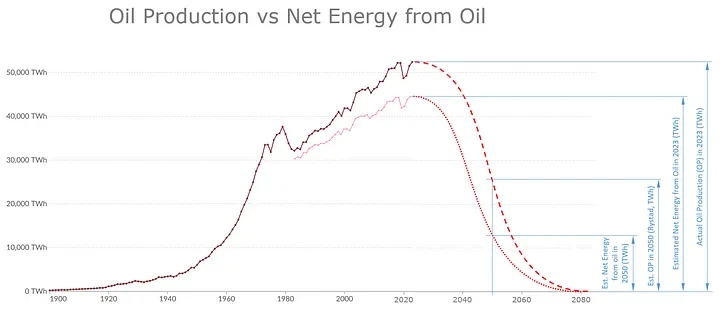
I had a few questions about this graph. I have seen this before and it has been mentioned on this site as well. This is the study but is it accurate?
https://www.sciencedirect.com/science/article/abs/pii/S0306261921011673
If our destination in 2050 is 1/3rd the amount of energy from oil that we get today, what happens on our way there especially with the economy?
Hideaway:
Hi Kira, have a close look at the graph and notice the exponential rise from around 1950 to the early 70’s. Hubbert showed that the rise and fall of world oil production should have followed a normal distribution curve, like individual oil fields tend to do.
When OPEC raised prices and the world realised oil was a finite resource there was a huge change and we implemented many efficiency improvements and substitutions (mostly gas) for oil use. The growth in oil production changed from exponential to linear, and instead of rolling over as predicted by Hubbert, has continued to rise.
We have been dragging future use of oil into the present for the last 25 years, while still growing overall oil extraction, as reserves deplete. Think about oil producers around the world. They have older wells still producing at EROEIs of 20-30:1 or more, plus newer wells in harder to reach places with much more expensive infrastructure and processing. The older wells that paid off their capital costs decades ago are easily the most profitable. They generate the most cash to keep the system going, however it’s the newer wells like shale oil, tar sands, deep water, etc. that help keep the overall price of oil lower.
Which are depleting faster? The old profitable wells, because the trade of goods and services runs on dollars and profit, so oil producers need lots of dollars coming in. Whenever the Saudi’s turn down production, it will be the expensive oil they reduce, not the cheap easy stuff, unless they desperately need to rest fields to protect future extraction.
What this leads to in our world of capitalism economics, is all the high EROEI wells depleting around the same time, just as the cost of maintaining production rises rapidly, because the wells are so much more expensive relative to the oil produced.
Complexity also enters the picture because the extraction processes for newer oils are highly complex operations. For example, horizontal drilling relies on sensors and computing power to keep the drill in exactly the correct strata, 10,000 feet below the surface. The oil sands extraction process uses large modern machines with the latest computers and sensors to maintain optimum efficiency.
Once the easy high EROEI oil is depleted, the remainder becomes much harder to extract because supply lines of equipment and spare parts become less reliable due to reduced economic activity, making everything required to support the complex processes harder to obtain and much more expensive.
Rapid loss of oil production quickly leads to higher oil prices and shortages, with businesses closing as people reduce spending, as happens in every recession, however the declining oil supply will accelerate as other high EROEI wells also reach total depletion, exacerbating the overall problem, with newer oil sources not keeping up with the declines. Deep recession leads to businesses shutting and restricted trade as countries can no longer afford imports, which causes more businesses to go bust.
Factories that earn 10% of their revenue from making essential ‘widgets’ for the oil sector go bust because the other 90% of their business starts operating at a loss, and it is impossible to restart the manufacturing because critical machinery was sold off for scrap in a clearing sale.
Thousands of factories stop making parts critical for a complex system. Without parts, oil rigs and refineries can’t operate, which brings down the entire system.
For us here at Un-Denial, it’s pretty obvious what happens next as the problems will mount and cascade affecting many businesses unexpectedly, thus triggering a self-reinforcing decline.
Most importantly, although demand for oil will fall with recession, oil will not become cheap because supply will also quickly fall. There will not be investment capital available to extract new marginal oil, especially in the Middle East where populations will be suffering from the high price of imported grains and other food, that will become difficult to purchase on the open market. Food exporters will struggle due to high diesel and fertilizer costs and will be forced to reduce production.
Then the next year oil supplies will fall another 5 Mbbls/d, and again the year after, and soon it’s over and most people will be left wondering how those in power let it happen or couldn’t see it coming…
Kira:
Thanks for the explanation.
I hadn’t considered at all that even within countries like Saudi Arabia and Kuwait you will have different EROEI fields. It makes economic sense to keep running the high EROEI wells to get most for your barrel of oil. After reading your explanation I was curious to see the status of old oil fields, the giants and super giants which are collectively responsible for the majority of our crude oil, but most importantly as you pointed out, high EROEI oil. This is the list from wiki:
https://en.m.wikipedia.org/wiki/List_of_oil_fields
Most supergiants were discovered more than 60 years ago. Taking the top two as example Ghawar and Burgan. They both started production nearly at the same time and apparently peaked at the same time (2005) although Saudis don’t confirm it. Ghawar seems to be declining at 2.5% annually and will be down to 2.5 million barrels from a peak of 5 million by 2030. I am sure Saudis are doing everything possible to slow the decline now which will make future decline worse.
It appears as though oil fields like Ghawar are subsidising the extraction of the low EROEI oil like shale and tar sands. The energy comes from the old ones and the volume comes from the new ones, keeping price low and maintaining the illusion of abundance. It’s quite deceptive when you think about it. The net energy keeps depleting while the volume remains same or even increases for a while.
Companies that make generators for offshore oil rigs are a great example of economy of scale tumbling. They probably make generators for hundreds of clients who are not oil companies, when these clients can no longer afford their product the critical mass is lost and they go out of business. Oil companies cannot keep them in business single handedly. This can be applied to other things like pipes as well. This is what the death spiral of the oil industry will probably look like.
Hideaway:
I was thinking when reading your post Kira, yes, yes, yes, yes, yes. I certainly couldn’t have written it better.
On the oilprice.com webpage, there is this article….
https://oilprice.com/Energy/Crude-Oil/Arab-Gulf-Producers-Are-in-Need-of-Much-Higher-Oil-Prices.html
After enjoying a rare budget surplus in 2022, most Gulf Cooperation Council (GCC) economies are seeing their budget deficits widen with current oil prices still well below what they require to balance their budgets. According to the IMF, Saudi Arabia, the GCC’s biggest economy, needs an oil price of $96.20 per barrel to balance its books, thanks in large part to MBS’ ambitious Vision 2030. The situation is not helped by the fact that over the past few years, the oil-rich nation has borne the lion’s share of OPEC+ production cuts after agreeing to cut 1 million barrels per day or nearly half of the group’s 2.2 mb/d in pledged cuts. In effect, Saudi Arabia has been selling less oil at lower prices, thus compounding the revenue shortfall.
Imagine how they cut back, will it be the most profitable oil wells or least profitable ones, when they are so desperate for revenue? Obviously the least profitable ones get reduced while the cheap easy to get oil gets depleted quickly.
What could possibly go wrong when all the cheap high EROEI oil extraction starts declining rapidly just as shale oil uses up its tier 1 and 2 locations…
Perhaps we should have been called Homo dumbass, because we are definitely not ‘wise’.
Rob here on 15-Oct-2024 adding some fresh calculations by Hideaway on the expected speed of collapse, and a response from Kira.
Hideaway:
An aspect of our situation I’ve been thinking of putting down in writing with numbers, so that people can get a better understanding of the collapse ahead…
In regard to oil, we are mining around 100Mbbl/d which will roll over at some point in the near future..
According to some paper I read recently, we currently use around 15.5% of oil to obtain oil and this will rise to 50% of the energy by 2050.. From this paper…
https://www.sciencedirect.com/science/article/abs/pii/S0306261921011673

At the same time as this is meant to be happening, we will be mining a bucket load more metals and minerals for the transition.
What people find so difficult to do is to put several aspects together, to see if it can work, so I’ve decided to try below.
Assuming the increase is 1Mbbl/d/yr in the energy used to gain oil, which is easily possible as we’ve mined all the easy to get oil and only have the harder, more distant supply left, plus allowing for oil production to roll over to a decline in production we get the following…
I’ve used a fall of oil production of 1Mbbls/d for years 2,3 and 4, then 2Mbbls/d for yr 5, and 6, then 3Mbbls/d, for year 7, 4Mbbls/d for yr 8, 5Mbbls/d for yr 9, then a maximum of 6Mbbls/d for years 10, 11, and 12. At no time does the depletion rate go over 10, in these 12 years…
Year 1 …production 100Mbbls input energy 15.5Mbbls … Left for society 84.5Mbbls
Year 2 99M ………………………….. 16.5M ………………. 82.5M
Year 3 98M…………………………… 17.5M ………………..80.5M
Year 4 97M ………………………….. 18.5M ………………..78.5M
Year5 95M ………………………….. 19.5M ………………..75.5M
Year 6 93M ………………………….. 20.5M …………………72.5M
Year 7 90M ………………………….. 21.5M …………………68.5M
Year 8 86M ………………………….. 22.5M ………………….63.5M
Year 9 81M ………………………….. 23.5M …………………..57.5M
Year 10 75M ………………………….. 24.5M ……………………50.5M
Year 11 69M …………………………… 25.5M …………………….43.5M
Year 12 63M …………………………… 26.5M ……………………. 36.5M
Because of the combination of more energy cost of energy (a la Tim Morgan), plus just plain slow decline, the available oil for the rest of society has gone from 84.5Mbbls/d in Year 1 to 36.5Mbbls/d by year 12..
But wait there’s more.. Assuming mining uses 10% of all energy, while in oil’s case makes it around 10Mbbls/d, we know that mining has to increase greatly for the ‘transition’. With the massive increase required, just assuming a 10% increase per year would be conservative, as we are talking a magnitude more copper, Aluminium, Nickel etc, plus all the steel in wind towers and solar farm foundations being built in the TW scale every year etc.
Mining’s use at just 10% growth rate goes from 10Mbbls/d in year 1 to 31.4Mbbls/d in year 12..
When we add this into our calculations of oil available for everything else, we go from 75Mbbls/d in year 1 (100 – 15.5 – 10 = 75Mbbls/d) to 5.1Mbbls/d (63Mbbls – 26.5Mbbls – 31.4Mbbls= 5.1Mbbls/d) for everything else other than oil production and mining..
The above assumptions are very conservative assuming oil doesn’t decline by more than 10% in any one year, that oil used to gain access to more oil goes up by only rises by 6.5%/yr at most, then the growth rate declines (unlikely), plus the 10%/yr increase in oil going to mining wouldn’t get us close to climate/transition/renewable expected growth rates…
Even with those very conservative assumptions, we go from 75Mbbls/d for “everything else” to 5.1Mbbls/d for “everything else” in just 12 years after reaching maximum possible oil production. It clearly can’t and wont happen that way!!
We’ve been dragging future oil use into the present for the last 40-50 years, as shown by the linear increase in oil production since then, whereas we had an exponential rise in production before then.
The above is just putting together 3 aspect of our modern world, instead of concentrating on one and assuming everything else stays constant as just about every ‘model’ does that I come across from ‘experts’ in various fields..
The big question is what happens instead of the above??
Do we cut back oil spending on gaining oil, so that the depletion of existing oil happens much faster than 10%/yr?
Do we cut back on mining so that the transition dies a lot earlier?
Do we assume we will find a magic energy solution to all our problems?
Do we just assume oil production will never decline quickly… because….. just because we don’t want it to???
I didn’t realise how bad the numbers were until I just did the simple calculations and put it down in writing. To me it means we collapse well before the 12 years are up after reaching peak oil production because of many feedback loops creating chaotic disruptions on the way down. Every year we remain close to the peak of oil production, means we are dragging more future oil to the present, meaning the decline when it starts to accelerate will likely be much faster than the sequence above…
Kira:
Excellent analysis!! I just want to mention that the oil that goes into getting oil is mostly in the form of diesel yet only about 75 million barrels that we extract today is the kind of crude that can be refined into diesel. The rest of oil is either shale, NGL, Biofuels among other things which have their uses but not as diesel.
There was also a video that was posted here about a gentleman who mostly agreed with what we discuss here about the irreplaceable nature of fossil fuels and the shortcomings of so called renewables but believed that there is so much oil out there that we will never run out, that we can have shale revolution after shale revolution. There are many who subscribe to this school of thought and think we can extract shale oil and gas from formations in Argentina, Russia, China and many other such places. Art Berman (who has expertise in this area) on Nate Hagen’s podcast has stressed several times that the geology of American shale is very unique and the shale revolution cannot be repeated anywhere else.
If one needs any proof of this please look at China. Despite the CCP pushing the state oil companies hard to extract shale deposits for years gas out has reached only about 30bcm per year which is less than 3% of American output. Part of the reason is the remote location of the deposits in the northern part of the country but we are talking about a country that can create entire cities from scratch within a few years. This is a matter of National security for the Chinese but the geology is the problem and has been unyielding so most efforts have been fruitless and abandoned.
As far as depletion goes even if we take super optimistic figures given by Rystad which predicts that oil production will be down to 50 million bpd by 2050 then the oil available by energy would be worth only about 25 million barrels. This is just a slightly stretched out version of numbers given by you.
It is interesting excersize to speculate on how things will play out on the downslope.
At the beginning of this downslope the airline industry will be the first casualty. Consuming about 8 million barrels of oil and mostly middle distillates at that, this shutdown will provide a much needed relief to the energy constrained world. Of course the commercial airplane manufacturers namely Boeing and Airbus will also go out of business. It is unlikely that governments will have any interest in bailing them out even if they had the ability which they won’t. The tourism industry which depends on air travel will also collapse, as will countries entirely dependent on revenues from it. Depletion will soon catch up and the gutting of industries will start again but this time it won’t be something discretionary and superfluous like air travel. This time industries that touch all our lives will start competing for the remaining share of energy.
Rob here on 7-Nov-2024 adding Hideaway’s answer to a question by ABC on whether Dr. Simon Michaux’s proposed solution of Thorium reactors and iron powder will work.
My take on why this type of future can’t happen is because Simon Michaux misses complexity and scale in the argument we can go to this type of future…
Let me explain, we can only have the complexity of nuclear power and running everything off electricity with an enormous scale of the overall human enterprise we call modern civilization. The scale of this complexity would require much larger markets than we currently have as the number of ‘widgets’ needed to be made for all the complex machinery would be greater than today.
We only have the complexity of today due to the total scale of everything we do. The highly specialised nature of building the best computer chips as an example happens in one place Taiwan with TMSC. The facilities they have built to make these computer chips can only be as sophisticated as it is because of the global scale of it’s customers. To build and operate 50 such facilities around the world would not be possible, they would all go broke. The scale of the facilities built needs the scale of the market size.
To build cheap thorium reactors or any SMR, the “modular” being the important point, would require a massive market as the factories involved, down to the smallest widget all have to be working in co-operation so everything fits together perfectly, so the market needs to be massive so everyone in the chain can make a profit. It also means all the suppliers of parts have to be operating smoothly and at large scale to supply all the inputed metals and minerals.
This all requires the existing system to be maintained while we get the growth in scale of the industry which relies upon the growing demand for the new products from the markets.
Notice how there is growth at every stage to make it all happen!! So if we had a spare planet or 2 of resources to use to accommodate all this growth, then we might get to a more advanced technological civilization, however running into limits of everything we currently use, because of growing energy cost from energy access itself to everything else mined, means we can’t get that advanced.
Also note that to get to where we are today in regards to the totality of civilization has taken growing energy use of all types for over 250 years. It’s been oil that has allowed for the increases of coal and gas use over the last 100 years. All the renewables plus nuclear and even modern hydroelectricity all rely upon oil themselves, and upon oil for the cheap coal and gas used in their production.
If we didn’t care about the environment at all and had another 2 earths worth of oil on this planet, then sure we might get to thorium reactors everywhere, but it will still all rely upon oil.
As oil production starts to rapidly decline, sometime in the near future, I have no idea exactly when, then the ability to keep our modern complexity will quickly unwind. We are getting a ‘sniff’ of this at present by all the countries that want to relocalise so much production, which isn’t possible as we lose the economies of scale of the current globalised system, unless there is an accompanying simplification as well. However no-one is planning for a simplification, the actual plan is to make aspects of the modern world at home. All these plans will quickly realise that they rely on imports of most/all the parts and the relocalisation is not very economic because of smaller market size.
Of course all the duplication everywhere is more inefficient using both more energy and materials to build and taking more people to operate and maintain. We lose some of the existing efficiency in the huge scale of many operations by trying to relocalise them.
What it means by even trying the relocalisation is that the population as a whole gets poorer because of inefficient use of energy and materials (unless we had spare planets worth of all these on this planet!!), due to lack of scale and overall the complexity has to fall to match the energy we have.
Please also note we have no shortage of any material on this planet, just a shortage of energy to access lower grades, and all the processing involved in making them useful goods. It all comes back to existing energy availability within the scale of complexity of what we have as current civilization and we can only build a lot more of any one aspect, while the entire system operates normally. Normally being in growth mode, providing the capital, goods and services required in the usual orderly manner to open new mines. Which means the population needs to be well fed and educated, with abundant services continuing to operate throughout.
We can’t take energy and materials away from one sector to go to another as the odds are they use different aspects of modernity and it’s not a simple swap, with whatever being constrained having feedback loops that are unexpected.
Anyway back to thorium reactors. The industry needs to grow and develop naturally in a world of increasing demand for this product, so it can develop naturally, which takes the rest of the system growing normally. Eventually factories that could build SMR would develop, providing the capital and operating costs were a huge advantage over the existing forms of energy. This can only happen in the background of our system operating ‘normally’, ie growing economies. It can’t be forced, as any developments of forced, as in uneconomic simply don’t last as industries when times turn tough.
When we get a real recession/depression brought on by oil getting more expensive for every other industry, all the expenditures on solar, wind, nuclear and batteries will probably start falling fairly quickly, as these expensive subsidised builds lose market share, as they are too expensive, even for a product (electricity) that is only one aspect of our energy use.
All heavy industry needs a constant cheap energy supply, often in different forms at the same time to produce the raw materials that feed our modern consumption. Without coke, coal, gas and plastics many of the items of modern civilization simply wouldn’t exist at all, so build a huge array of thorium reactors with say the last of the fossil fuel energy available, solves no problems. We wouldn’t be able to make the products we use today with just electricity.
If we were to build fancy new recycling facilities that somehow made use of all existing plastics for re-use in original forms, the whole enterprise would suffer the same entropy and dissipation as everything else and winds down fairly quickly, plus requires a rapidly growing system of modern civilization working normally in the background while it’s built to the scale and complexity required.
Every argument of how we can power a new civilization with solar, wind, batteries, nuclear, thorium or whatever form of electrical energy in the future, argues for a smaller supply of energy needed than now because fossil fuels are inefficient, we only use 25-50% of the energy (depending on the machine). It’s a terrible argument as the increase in the modern civilization growth to get to that point, would mean a much higher energy use than at present, just because of the growth in scale and complexity of everything to just build this future.
Someone should ask Simon Michaux or any other expert about the clean green future whether from renewables normal nuclear or thorium, about how much of it can be built without using fossil fuels at all, including down to the plastic insulation on all wires. The usual answer is it can’t be done yet, but improvements in technology and increased use of renewables/nuclear and how cheap they all become will allow it to produce synthetic fuel for these types of purposes.
I usually counter, with how none of it’s being done now, yet renewables and nuclear are already claimed to be cheaper, so all new factories would already be going to the cheaper ways if it was true, but no-one is doing it, so something is very wrong with the narrative. The argument usually flows to climate reasons why we have to move away from fossil fuels, which is unfortunately a different argument, because the energy required to then mine all the minerals to build this fantastic green future simply doesn’t exist without the use of fossil fuels.
We are in a total and utter catch 22 where we require cheap fossil fuels to build everything and maintain the current modern civilization, which collapses without their use leaving 8 billion cold, angry starving people looking to survive. Using another 2 planets worth of fossil fuels to build the entire renewable/nuclear/thorium future with electricity used for everything, including making plastics and synthetic fuels, will leave the climate and environment in ruins, then collapse anyway, when we turn off fossil fuel use, as that is a sudden energy loss when we continue to require more minerals and metals from the environment, due to those lost from entropy and dissipation, and the increase energy use from all the movement of materials for recycling..
I didn’t even get around to mentioning that a world of recycling everything as much as possible, uses fossil fuels for all the processes anyway, but that’s another story. It’s an incredibly complex situation we are in and any ‘easy’ sounding solution will simply not work as the proponent forgets we spend 97-98% of all our existing energy and materials on just maintenance of the existing system with only the other 2-3% going on ‘growth’ of everything.
Any one new major investment into a great sounding idea on a world wide scale, can simply not work by spending less than 1% of energy and materials use on it, unless the entire system of energy and materials grows massively. As the entire system has to grow, the number we start from in the future will be much higher energy and material use than it is today. The scale and complexity has to also grow to allow for more efficiencies in the system. the starting base of energy use in 30 years time will be double of what it is today..
If we don’t ‘grow’, then we can’t maintain existing subsystems within our civilization, as we need an increasing quantity of energy just for maintenance of material availability. The system can’t work ‘normally’ without the increase in energy, even without growth in the overall system. If we shrink the market size, then we can’t maintain the complexity of the current system either, as the affordability of the complexity goes down, so the system simplifies, which makes gaining access to lower grades of everything much more energy intensive as less complex equipment will mean lower recoveries in mining, lower food volumes from a given area of land etc.
Oops, sorry for excessively long answer. Our civilization is highly complex and so is the reason why none of the bright green ideas can work, and neither can a shrinkage of population while maintaining modernity, but hte attempt to do so, will lead to collapse of it all.
Rob here on 14-Nov-2024. Hideaway and ABC had an opportunity to ask some questions to a couple important leaders in the overshoot awareness community, John Michael Greer and Simon Michaux. Following are the questions and answers plus follow-on commentary from Hideaway.
A.) How can we have modernity without the scale of market size that we currently have to enable the mining, processing, distribution then manufacturing of the huge range of parts that go into making every aspect of modernity?
We can’t. It really is as simple as that. Modernity, as Dr. Richard Duncan used to say, was a transient pulse waveform a one-time, self-terminating affair.
B.) How do we make the machines that make the final product machines in a scale down world?
That asks the question the wrong way around. The right way around is “what kind of final products can we afford to have, given all the constraints on producing them in a deindustrializing world?”
The answer won’t be clear for several centuries, but it’s unlikely that any technology invented since 1900 or so will be included.
C.) How is it possible to maintain complexity, such as a thorium reactor and all the machines it powers on only a small scale?
I’m not a specialist in this technology, of course.
I’m open to the possibility that it can be done, but I want to see an affordable example first.
As we’ve seen over and over again, every nuclear technology is cheap, clean, and safe until somebody actually builds it…
D.) Where do the materials come from after many cycles where entropy and dissipation have worked their magic over many cycles of recycling?
Oh, in the long run say, another 10,000 years we’ll have to go to entirely renewable resources, and that will involve sweeping changes in everything; for example, some future society may cultivate chemosynthetic iron-fixing bacteria (the kind that currently produce bog iron) to keep it supplied with iron. Our immediate descendants won’t have to worry about that, though. Given the scale of population contraction we can expect (around 95% worldwide) and the gargantuan supplies of metal and other materials that have been hauled up from deep within the earth and stored in what will soon be urban ruins, our descendants for the next thousand years or so will have all the metal they can dream of using.
A.) How can we have modernity without the scale of market size that we currently have to enable the mining, processing, distribution then manufacturing of the huge range of parts that go into making every aspect of modernity?
I don’t think we can. It was all dependent on oil as a fuel. We have no replacement for this.
B.) How do we make the machines that make the final product machines in a scale down world?
We have to change our thinking in what we need all this stuff for. Do we need it? Can we do it in a more simplified form? Then ask how we can get there. If we can simplify how the tools are made using more abundant resources (iron vs. lithium for example) then use those machines differently, using modern knowledge.
What have we actually learned over the last 200 year?
The last 20 years in particular?
Can we take a backyard workshop, make a small foundry, have a blacksmith forge, run a basic lathe, drill press and welder, power it with a wind turbine on a lead acid battery?
Strip out useful products from all the places around us that no longer are in operation (cars in a carpark that have been abandoned).
Make an electric motor and a lead acid battery.
Can we shred rubber tyres and make gaskets?
Can we run a furnace to recycle ceramics and building waste into geo polymers
Then you have tech like 3D printers.
Can these be reinvented where we can make our own feedstock and make our own printer unit?
And so on.
C.) How is it possible to maintain complexity, such as a thorium reactor and all the machines it powers on only a small scale?
A Th MSR unit is about 12 m long, about the size of a shipping container and delivers 40 MW of electricity, or 100 MW of heat at 560 deg C.
They are made mostly from steel, nickel and a small number of exotic metals and alloys.
They have a working life of 50 years.
Complexity to run it is about that of running a modern medial isotope lab.
Their production is much simpler than most other devices.
I think it can be done in some cases.
The problem is getting permission to use them.
D.) Where do the materials come from after many cycles where entropy and dissipation have worked their magic over many cycles of recycling?
Contract our material needs per capita.
Simplify what we need to resources that are more abundant.
Most of the purple transition needs iron, which we have lots of.
Copper will be the limiting metal.
Industrial systems have to come into line with food production limitations.
Once we get to the point where recycling and mining can no longer deliver, then society has to work out a way of living without these things or go extinct.
Hideaway’s commentary:
Thanks ABC great work and answers by JMG. He gets the big picture of what’s going to happen, but appears to miss all the feedback loops that will accelerate everything to the downside. We have over 8 billion humans on the planet and 99.99% of them have no idea modernity is going to end abruptly, and when it does so will destroy the plans of the other 0.01% (or less!! ), that did see it coming and tried to prepare in some way.
Lots of people use Cuba as an example of what can happen with building vegetable gardens etc., except forget to mention that it’s in the tropics with fast growth and plenty of water, compared to say the UK which is 2.4 times the size and 6 times the population, plus Cuba today imports around 70%-80% of their food.
Where JMG says it’s asking the question the wrong way around, is incorrect. We are not planning anything about contraction as a species, every machine is becoming more complex allowing for more automation and hence cheaper costs. Once we go down there will not be the investment capital, energy nor materials, nor co-ordination to build any new machines to make anything.
He has once again used how we have done things on the way up, as in using more energy, materials and larger expanding markets; to think that some similar type of planning will occur during the collapse phase. It’s wishful thinking not close to reality.
Realistically, when food is not arriving in cities, who is going to be sitting around talking about what machines they are going to build and what level they can acquire, when there is no energy, nor materials in the appropriate form to do any of it??
One aspect JMG gets completely correct is about thorium reactors….. “As we’ve seen over and over again, every nuclear technology is cheap, clean, and safe until somebody actually builds it…”
There is a very good reason for the cost of all nuclear, of which thorium reactors will be no different, complexity. Every aspect of it is a highly complex specialty. It wont be made from ordinary stainless steel, it will be highly specialised stainless steel, probably with a high quantity of minor elements like molybdenum to allow for the highly corrosive environment of molten salt. “Salt” as in sodium chloride does not play well with most stainless steel, as the chloride is the one thing highly corrosive to stainless steel.
In the huge new refinery in Texas built by the Saudi’s a decade or so ago, upon commissioning someone turned on the wrong valve that sent hot seawater through the piping, causing something like $1.5B dollars in damage and delaying the opening by a long time. Interesting they now call it “caustic” released as it pitted all the stainless steel pipes. If seawater can do that, imaging what 600-800 degree molten salt will do to any weakness of the piping.
Scavenging materials, finding a smelter that can separate all the scavenged materials into the original metal forms, then recombined into the correct quality stainless steel to withstand high temperature molten salt, is a highly complex process by itself, involving a lot of coking coal for the heat. We don’t currently do this for new highest grade materials, we use newly mined purity, for the combination specialist metals, recycled metals doesn’t provide the purity required at this level of specialty. There is no way Simon’s thorium reactor can be rebuilt in a small community, as we would still need the mining of all the separate metals, including his one word reply of ‘exotics’.
What seems to happen is that we get answers about the future that all sound very plausible and comforting, until some person with a bit of knowledge of the intricacies of some part of it comes along to spoil the party.
It’s the highly technical nature of the materials that go into machines, that are then forged into specialized minor, often tiny, sometimes huge parts, with all the connections working in harmony, to make any modern kit, that will be impossible when people are desperate to find food and survive that’s the problem which is overlooked. They always assume some type of normality in the future, just with a much smaller group, forgetting that normality has been a growing human enterprise, with always more energy and materials to make stuff with for generations, and that normality is going to leave us in the near future.
Rob here on 5-Dec-2024 adding an interesting thought experiment by Kira on the energy and material savings benefits of economies of scale and our multi-continent supply chain. With follow-up comments by Hideaway and Kira.
Kira:
I have been trying to think about the benefits that economies of scale and multi continent supply chain provide in terms of energy and material savings and decided to try a simple thought experiment to try to visualize it.
Lets take a simple rudimentary motorbike as an example of the product that we intend to produce at scale. The raw materials will be the metals and alloys needed to make the parts and everything else will be done in house without depending on any external supply chain. The basic parts for a bike are as shown.
If we decide to make everything everything under a single roof (which is what localisation implies) we would have to dedicate seperate machining and fabrication units for each part along with the people with expertise in each of those departments all of which are massive upfront investments and would make the factory a mammoth operation on the scale and size of a gigafactory.
So what are the downsides of this approach?
- It requires massive upfront investment and upkeep.
- The output would be low.
- If we have to serve a country as large as US with localisation we are looking at at least one factory per state leading to large redundancy and waste of production capacity.
Lets approach the same problem and apply a distant supply chain solution.
Since all motorbikes are more or less the same and use same parts shown above we can do the following. Three companies A,B and C may be different bike companies making different types of bikes they will only design and make the frame(chassis) and engine in house and everything else will be outsourced to an external vendor. The suspension will be made by suspension manufacturing company, brakes by a brake manufacturer and so on. So how does this benefit everyone?
- Since the company is only making the frame and engine its factory size will be a fraction of what it would have been in scenario one.
- A dip in demand for company A’s bikes would not result in wasted capacity as company B and C can absorb the common capacity for the parts.
- Less labour requirements as there is lower redundancy as there is only one plant making suspension, brakes, tyres, clutch etc. instead of three.
- Since more resources are freed up the companies can focus resources on research and innovation thereby speeding up progress.
The obvious downside of this is the loss of redundancy and a single point of failure which can halt the production of all bike companies. But the benefits to the civilization as a whole far outweighs the risk as the more complex the product is the longer the supply chain is and the more difficult it would be to make it under a single roof.
If we take microchips as an example and try to take all the processes from raw materials to a finished chip and make everything under a single roof the factory will easily be the size of a small sized city.
When I mean everything I mean everything from the lithography machines to all the other machines, starting all the way from raw materials. That means first making this incredibly complicated machine below starting from metals and alloys mined,processed and shipped to the plant then machined, fabricated and assembled into the machine shown below.
So as complexity of the object increases multi continent supply chain is not only useful but essential to making high tech products. None of this is possible without fossil fuels and high grade minerals both of which are in irreversible decline and will soon lead to the supply chain collapsing leading to a loss of complexity creating a negative feedback loop.
The lithography machine shown above is just one of a hundreds of processes in getting from silicon ingots to a microchip (albeit the most important one). Some of the processes are shown above which require equally complex machines to perform.
Hideaway:

The caption with the photo states .. “just one of the benches the engine was laid out on”.
This was from a 1965 built motor..
Thanks Kira, a brilliant breakdown of complexity, with each of the above different main parts of a motor bike having so many components themselves. A simple motorcycle can have 2,000 – 3,000 separate parts.
Our complexity of modern life is just lost on so many people, not understanding that each and every part has to be made precisely from the exactly correct materials, to work together and function as a whole ‘machine’.
The other huge misunderstanding is that we need the total complexity to gather the food, energy, and materials that make up this complexity as we have used up all the easy to get food, energy and materials.
The motorbike example is a simple machine compared to a horizontal drill rig with tens of thousands of separate parts, including many computer chips, in many separate parts of the rig, from control systems to sensors to actuators, communication systems, power systems.
Without modern horizontal drill riggs our oil production would fall rapidly by a large percentage and these machines are dependent upon lots of spare parts arriving nearly every day.
When we start to lose overall energy availability, especially oil production because of depletion, the complexity has to rapidly unwind, as there is simply not enough energy to keep it all going. Once feedback loops kick in, of lack of parts, then machines we rely on become junk very quickly, which accelerates chaotic feedback loops.
The concept of going local, means massive simplification, because we don’t have either the energy nor materials locally to do anything differently, which means we will be unable to feed the current huge populations of local areas as all the modern machines cease to function. Fertilizer becomes a thing of the past, tractors can’t get oil and grease, let alone fuel, likewise for all transport from local rural areas, to cities.
Modern humans have just forgotten how reliant we all are upon 6 continent supply chains for our very existence…
“Kleiber’s law” of power/mass use to the 3/4 power most likely applies to human civilization. Studies have shown that in nature the law is a doubling of animal or plant mass requires a 75% increase in energy use because of efficiency gains is the easy explanation.
In human settlements research, done by Prof Geoffrey West and a host of others, they have found human population centres the power law is closer to 85%, as in we are not as efficient as nature with a 4B year head start. The problem with all the work on settlement sizes is that we live in a world of one global civilization and no city is an entity to itself, which they were 500-10,000 years ago, including their surrounds.
Kira:
Actually it was your exchange with Dennis on POB that lead me to have this train of thought. I found this line by him to be quite revealing of how people like him think.
Dennis: “Society is not based on physical laws alone, it is understood using knowledge such as sociology, psychology, and economics.”
Cornucopians like him always point out how GDP is growing with less energy use ie growth is becoming less energy intense. We know this is primarily because of massive financialization of economy but when you point that out his reply is that GDP calculation are a reflection of physical and thermodynamic reality of the society. It’s funny how he tries to have it both ways whenever it is convenient.
He is wrong as usual. Let’s take three bike companies on three continents North America, Europe and Asia – Harley, Triumph and Honda respectively. Assuming that there is no contact between the continents and each company has complete monopoly over their respective continents without any alternative then they can manufacture in whatever configuration they want. They could make everything under the same roof with redundancy and inefficiency or outsource their production of components to third party and cut costs.If they are inefficient their customers end up paying more than their counterparts on other continents.
But as soon as we apply the situation of globalization and they have to compete with each other they will have no choice but to reorganise themselves in a way to reduce material and energy costs and if they don’t they go out of business. You were right in your counter that civilization is very much like an ant hill and just like how no ant has the complete blueprint, no human has the complete design of civilization. It is not intentional, it is self organizing and self assembling. Complexity increases to solve problems and with increase in complexity comes increase in material and energy cost. When this happens the system reorganizes itself to optimize resource consumption. There is no way to intervene here.
For instance Ford could probably manufacture every component of its car under the same roof 85 years ago but with today’s complexity they probably have hundreds of suppliers that they share with many other car companies. If an American president declares that every inch of a Ford vehicle must be made on American soil the company would immediately go bankrupt as if they tried to do that a car that costs 20,000 would cost 200,000.
This pattern holds even across completely different industries.


This is a ridiculously condensed and shortened version of the supply chains of Apple and BMW. All supply chains end up either at pits of mines or oil and gas rigs as everything we produce comes from earth as raw materials. The suppliers in greens are the common ones for both companies and hundreds of others including oil and gas rigs. If we fully expand the supply chains we will see countless overlaps with one another with constant reorganization happening to optimize resource consumption. The true scale of feedbacks and overlapping is so complex that it is impossible to even comprehend. But there are some interesting things we can glean from the above diagram. The critical mass of consumers for the chip industry is coming from consumer electronics meaning that the auto industry and oil industry are just beneficiaries of this. If people stop buying smartphones and PCs then oil companies and car companies go out of business. There are several such critical dependencies that may not be so obvious at first glance and may be far down the supply chain.
Of course the connective tissue connecting the supply chain is oil since without we cannot maintain the multi continent movement or power the mining machines at the end of the supply chains.
Hideaway:
Thanks, Kira, excellent work again.
Trying to get people to understand the connection between the overall size of the growing market, relative to the complexity is extremely difficult, especially when added to the overall energy and material savings to the entire super organism of the human civilization.
Because of collapsing grades of ores of all types, we need the complexity of modern machinery, modern financing and modern supply chains, to gain access to all the requirements of all materials and energy used. It’s a self feeding monster that has to grow just to gain access to the requirements.
Unwind any aspect of modern complexity and the whole lot collapses, yet keep growing and the whole lot collapses due to environmental limits anyway.
Most likely oil will be the limiting factor, that sets in motion feedback loops in reduced consumption of all the requirements used in modern complexity, and your example of discretionary spending on computer chips is the perfect example, but we can multiply this by thousands for all the unknown links that are necessary to keep modern complexity going.
The concept of localizing industries, plus using tariffs to do so, will just hasten the collapse as it uses up more energy and material resources to build all the local manufacturing plants and tool them up, let alone gain the raw materials and energy for their operation. Just the attempt to do this will likely set off other unknown feedback loops as the extra energy and materials involved in the attempt to localize puts pressure on other aspects of the system.
Of course it’s all just a duplication of what’s already happening elsewhere, supplying the world, so the energy and materials are effectively wasted giving higher costs to consumers everywhere because of the duplication. Now imagine 5-50 countries trying to do the same for their local markets.
We can’t have 50 TMSC factories around the world as there is just not the market for that number of computer chips, with the complexity it takes to produce them. That factory/foundry whatever they want to call it has to churn out millions of wafers and chips to be viable. It wont work with 50 of them, unless the super-organism of human civilization grows by enough to accommodate the increase, which means every facet of civilization has to grow including population, energy and material use.
Once oil declines because of depletion and the impossibility of an increased production, whenever that happens, then overall energy availability turns down, meaning the growing organism can’t keep growing, nor even maintain what’s built and operating as entropy guarantees we require 97-99% of all energy and materials to just keep operating ‘normally’. (All while energy use keeps growing to supply the raw materials because of lower grades).
Once energy of all types that totally rely upon oil start suffering from increased costs, as oil’s harder for any one business to obtain, the civilization that relies upon cheap energy, suffers from reductions in internal markets from those struggling, meaning less markets for computer chips, and every type of machine that relies upon them, sending businesses broke, that manufacture essential requirements of other businesses, so creating a cascade of accelerating failures across civilization itself, in producing everything required to just maintain and operate what exists.
We’ve been in extend and pretend mode for over 50 years, making up a linear increase in oil supplies, with exponential increases in coal and gas energy supplies to make up the required energy of the growing civilization, then added some nuclear, solar, wind, geothermal etc, all just electricity providers, which are not providers of the full range of products and energy supplied by fossil fuels.
The increase in coal and gas though is totally reliant upon oil, with the rest being just derivatives of fossil fuels in total.
The complexity of the entirety of the system would take multiple books to explain just the merest of details of any one component of the overall complexity of how we live. It’s beyond the comprehension of anyone, as it’s exactly as explained by Kira above, so people without thinking of the overall complexity, assume we can just increase one part of this civilization by increasing something massively, on a world wide scale, without having implications elsewhere, nor have any understanding how everything else has to keep working normally for their one aspect to increase greatly. (EVs, batteries, solar, wind, geothermal, tidal, and nuclear).
Single cell organisms, multiple cell organisms, storms, stars and all prior civilizations have grown with increasing complexity over time, yet all eventually collapse due to some type of internal energy usage decline, that collapses the overall system.
To think our modern civilization will be ‘different’ to everything else in the universe that is large and grows complexity internally, increasing energy use until collapse, is denial in it’s finest form.
 un-Denial
Dr. Tim Garrett, the only climate scientist to explain the relationships between climate change, energy, and the economy, and which explains why all climate change initiatives have failed and will continue to fail, and who’s profound insights are ignored (denied?) by all other climate scientists, has a new YouTube channel.
I subscribed which increased his subscriptions by 25%.
LikeLiked by 1 person
LikeLiked by 2 people
https://www.artberman.com/blog/control-oil-and-you-control-nations/
LikeLiked by 3 people
Hideaway on solar…
https://peakoilbarrel.com/open-thread-non-petroleum-december-12-2024/#comment-784044
LikeLiked by 2 people
Very good. Thank you.
I like the Hideaway method of calculating EROEI.
LikeLike
I respect Jeffrey Sachs and I respect Tucker Carlson but they’re both in denial of our energy predicament and so the story they tell is incomplete at best.
In today’s interview Sachs argues that 75 years of US middle east foreign policy has been a disaster with millions killed and no improvement to US security. The sole reason for these errors is that Israel wants to expand and control the region, and Israel achieves this through control of US foreign policy.
Not one word on oil.
In a few years when oil available to import falls, those countries with oil might survive, and those countries without oil will collapse and die. The middle east has the last good reserves of low-ish cost oil.
In this light it’s easy to see why the US would want to eliminate any unfriendly governments and reduce the oil consuming population of the region. Israel’s role is to be a loyal US military base.
LikeLiked by 2 people
This is the perennial problem of people being experts in one or 2 areas, yet just believing other experts in other areas, leaving themselves blind in one or more aspects of the world system, yet pass themselves off as experts in the world’s system.
It’s usually energy blind as you state here, but often resource blind as well, and sometimes debt blind and most often size/complexity blind as well.
It’s taken me a lifetime of research to come to my position, and even 5-6 years ago I was still researching how solar and wind could save us, except the real numbers never added up. I don’t think there is any chance for any change of direction of civilization at all, as energy limits kick in, complexity collapses, debt everywhere explodes and denial accelerates…
LikeLiked by 4 people
Thanks to your education when I use the word energy I now understand it is a shorthand for energy + minerals + complexity + debt.
I do think energy is the keystone because with abundant energy we could deal with declining ore grades, and maintain our complex systems, and keep the debt bubble inflated, and mitigate climate change for a few years longer.
LikeLiked by 3 people
Understanding Energy, EROI along with scaling,complexity are probably the most important elements needed to have the utmost clarity regarding our predicament. But the ultimate decider would be the ability to overcome denial. Even if one understands all of the above it is possible to do mental gymnastics to reach the conclusion that everything will be fine. Your exchanges on POB prove that point quite regularly. The folks there do have some understanding of all of the above concepts yet their denial is using that knowledge against them by creating a reality quite detached from the truth.
The insights provided by Jeffrey Sachs and people like him is scary as it paints the picture of an elite willing to risk nuclear apocalypse even when resources are relatively quite abundant. Imagining a scenario where shale oil output has dropped by 70-80% (quite possible within a decade) is terrifying as that would make US dependent on imports. What will these people do in such a situation is something that should keep people up at night.
LikeLiked by 3 people
I’d say, direction is already changing.
Tang ping, dropping fertility rates, cultural change.
These changes are profound. Even though they happen below the surface, they are widespread.
The changes will be seen last in the older, richer population.
PS: I don’t mean that as denial, or hope. It is just an observation of subtle trends which I find important.
LikeLike
Jeffrey Sachs has focused on economics and geopolitics over the years, but I’m guessing that if he was exposed to the energy-resource depletion phenomenon, he’d be receptive.
LikeLike
Give it a try and let us know how he responds. I’m so confident in MORT that I’ll give you a free lifetime subscription to un-Denial if Sachs does not deny that fossil energy depletion is a problem and that overshoot collapse is fast approaching.
LikeLiked by 2 people
Training AI takes heavy toll on Kenyans working for $2 an hour | 60 Minutes
LikeLike
Canadian Prepper presents evidence that US government drones are looking for a terrorist nuke.
This actually smells real.
LikeLiked by 1 person
An observer letters from this year’s COP meeting.
https://www.theguardian.com/theobserver/2024/dec/01/its-too-late-to-halt-the-climate-crisis
LikeLiked by 1 person
Not sure if you read the next comment about climate below the one you quoted…
“More than three-quarters of the $1.3tn a year for these countries will come from highly expensive private sector loans. The most vulnerable countries are already drowning in debt: our analysis shows that, on average, the governments of the countries worst affected by food crises spent almost 16% of their revenues on servicing external public debt last year.”
In other words the “developed” world is not giving $1.3T for climate stuff, we are lending them money so can keep the colonisation going under a different name of debt slavery….
LikeLiked by 1 person
There are signs that limits to government debt may be approaching.
Recently fallen governments over debt issues include France, Germany, and now Canada is on the verge.
US should be ok for a while due to it having the reserve currency.
LikeLike
It will allow the U.S. gov to kick the can a bit longer, but I don’t know by how much.
LikeLike
What are the odds of debt limits being reached, just as oil enters terminal decline, creating inflation, just as governments try to go local, creating supply chain issues, just as governments react to a new very deadly contagion, that has to be delt with further lockdowns, etc, etc so allow inflation to run riot as they increase all taxes to pay for everything, just as food becomes too expensive and unobtainable in cities, as climate problems get worse…
OK I’m also currently in a bad place today…..
LikeLiked by 4 people
Odds look pretty good to me. And you missed WWIII.
I’m in a bad place today too. Couldn’t face doing anything I should be doing today so worked on updating my preps inventory.
Preptip
Buying more ghee. I’ve decided I can ignore the best-by date and I’ve discovered how delicious it makes food taste.
I used to cook popcorn in coconut oil and then top with browned butter. Now I cook popcorn with ghee and it tastes just as good and there’s one less pan to clean. Plus I expect ghee is healthier than coconut oil which is already pretty healthy.
LikeLike
Why is everyone so dark right now?
I don’t think much is going on other than theatre.
I think we are still a while away from things getting serious. (could be wrong but that is how it feels to me right now).
LikeLiked by 1 person
We are now up to our necks in denied overshoot shit. Hopefully nothing comes in that could make waves.
Saludos
el mar
LikeLiked by 1 person
Rob and (nearly) the rest of the world!
LikeLiked by 4 people
I know this feeling.
LikeLike
Good one. Added to the sidebar quotes.
LikeLike
I have two theories. Take them for what they are worth.
one- We have a collective Jungian subconscious, that doesn’t directly inform the conscious, but gives rise to “feelings”, hunches, and forebodings both good and bad. It takes in all that the conscious does, but is not in denial. It now senses the imminence of a stair step in the collapse.
two- the digital ecosystem that provides our newsfeeds ( no matter how hard we try to filter and curate) has been taken over by algorithms that are capable of manipulating, polarizing, subtly steering us in ways that suit the designers. Final objective unknown, but assuredly not in our best interest.
Either would be a fun book idea, but just throwing those out there, not arguing they are plausible.
LikeLike
I suspect 1) is true.
Not sure about 2). I think it was Tristin Harris that argued no one is in charge. The algorithms maximize views by simply feeding us what we want to see.
I’m sure there are exceptions, like “Putin bad” or “mRNA safe & effective” that get pushed due to deep state pressure or ad revenue.
LikeLike
Well, this humorous vid might make the idea at least plausible. Yes, it could simply be profit seeking getting out of control, but if I was a psy-ops director, this sure looks like a way to practice 5G warfare on other countries ( or my own country).
LikeLike
Well darn I forget about the link issues. It’s John Oliver season 8, episode 26 on misinformation
LikeLike
The latest shiny new tech from pharma is being carefully tested to once again prove it is safe and effective.
LikeLiked by 1 person
How could they give truly informed consent to the test subjects? I read most of the Brownstone article. The hubris of the pharma “scientists” is astounding. They might be smart but they are reckless in a Mad Scientist way. That industry has to collapse first (hopium on my part).
As to feeling depressed, down and in a funk – at least for me some small part has to be the short days of the year (here in the northern hemisphere) and the constant rain/cold. I miss the sun, a little warmth and getting outside and not getting soaked in the gloom. (just a preview for Nuclear Winter).
AJ
LikeLiked by 1 person
Rebranded Al-Qaeda takes over Syria in big win for US, Israel, & Turkey
LikeLike
Barriers being created to prevent RFK Jr. from exposing the truth about the murder of 7+ million.
LikeLike
Berman steps out of the closet. Hagens next?
LikeLike
Interesting. Suspected it from Hagens, but not Berman. Couple years ago this would have f#cked me up and put major doubt into my decision making. But not anymore.
No need to waste any good luck on us Art. I’ll save the good luck for you pro-vaxers.
LikeLiked by 2 people
The teevee says mRNA’s safe and effective and RFK’s a looney so it must be true.
You know someone has done zero independent research or thinking when they don’t distinguish between mRNA and traditional vaccines.
LikeLiked by 2 people
What is your opinion on traditional vaccines BTW?
LikeLike
I don’t know. They have not been properly tested so there is no way to know.
RFK wants to force pharma to re-do proper tests so we can have confidence in their safety and effectiveness.
Fauci said RFK was lying that proper tests have not been done. RFK sued Fauci and Fauci was forced to admit RFK was correct.
When I was a kid we got 5 shots. There was little autism and no peanut allergies.
Today kids get 72+ shots and autism and allergies are common.
One of many question marks are the side effects of adjuvants like aluminum. Today’s episode of Dr. Bret Weinstein’s podcast reviewed the studies used to claim one of the key adjuvants is safe. The totality of tests upon which we are assured it is safe was on 4 rabbits and 1 guy, and they lost the records for 1 of the rabbits.
LikeLike
Good question Stellar, I was gonna ask the same thing. I’m hardcore anti-vax for everything at this point. Will probably be the death of me. I’ll get some easy to cure virus and die because I refused the cure… Oh well, I’m sticking to my guns on this one.
Not sure how anybody with Art’s awareness could still be falling for it. (He probably just excels in overshoot/energy, and never went down enough rabbit holes to understand how corrupt his government is and always has been. Probably even believes the official 9/11 story)
ps. My mom sent me this link because of how impressed she was with Trump. She said it was the first time she’s ever not wanted to vomit after hearing him speak. (if you skim it, Donald pops up like 3 or 4 times)
LikeLike
There was that little testing?!
LikeLike
I can’t tell if you’re disagreeing or asking if I was not serious.
You can review the details and decide for yourself in the 256th episode of the Evolutionary Lens podcast.
If you disagree with their conclusions, please present the evidence that they are wrong. But it must come from a source with no pharma conflicts of interest.
LikeLike
It was mostly a reaction of shock.
LikeLiked by 1 person
the number 1 book biden tried to ban during covid is “dissolving illusions”. this book offers no opinions, it simply uses .gov data to look at vaccine efficacy. you can get some highlights at https://dissolvingillusions.com/graphs-images/
then you can look at our world in data for the current stats, and see that nothing has changed.
LikeLiked by 1 person
You sucked me in dammit. I just spent two hours between that site and checking out reviews.
Looks like an excellent read, but nowadays I have no interest in the broken record of how everything is bullshit and it’s always about money. That stuff is dangerous for me when it’s detailed so precisely. Will only push me back into my white skin blaming.
But my mom will absolutely love this. I just ordered it for her for Christmas. Thanks for the link.
LikeLike
you’re most welcome. if;it results in one less kid harmed by vaccines, it’s all good.
LikeLike
I am not going to miss AB so vaxx away mate.
Are we all ready for another round of crap?
Just as I was salvaging some covid wrecked relationships.
ho hum
good luck to us all
nikoB
LikeLike
Unless the people I walked away from admit they were wrong and apologize for unscientific beliefs that killed millions I will not be patching things up.
LikeLiked by 1 person
Good to know we’re solving our overshoot problems faster than expected.
LikeLiked by 2 people
Yet still in denial.
“None of the above should stop any of us from being techno-optimists. It’s still possible to envisage a future with lower carbon emissions. That chart at the top is still incredibly inspiring. But it also has a dark side, about which we shouldn’t delude ourselves.
The more we in Europe come to expect ever cheaper Chinese batteries and solar panels (while ignoring the hidden story of how these products are actually made), the more coal will be burned in Chinese power stations and metallurgical silicon plants to give us those cheap items.”
LikeLiked by 2 people
It really is just a graph of jevons paradox working faster than humans can predict
LikeLiked by 1 person
Are you sure?
I think of Jeavon’s paradox as spending money obtained from efficiency gains thus nullifying the contribution of the efficiency gain to reducing overshoot.
There is no efficiency gained from installing solar panels.
LikeLiked by 1 person
I grant you it is a stretch: people are spending their efficiency gains on solar panels. Because solar panels increase total energy, I would think they are generating efficiency gains?
LikeLike
I’m thinking governments are borrowing from future fossil energy availability to subsidize solar panels today, thus motivating citizens to borrow more money to buy solar panels. The extra pubic and private debt squeezes a little more economic growth which increases the fossil energy consumption that underpins every dollar, thus accelerating fossil energy depletion and shortening the time to collapse.
Maybe Hideaway can straighten us out.
LikeLiked by 1 person
That’s a pretty good succinct summation Rob, I’d only add all while pushing up power prices for industry and consumers, because of all the fossil fuel generating ability sitting idle, plus extra transmission lines, while the FFs are required when the sun isn’t shining and wind not blowing.
Here in Australia where we have the highest penetration of solar and wind in the world on a per capita basis, our prices are around the highest in the world, yet we’ve already been having brownouts this summer on hot days, as there is not enough electricity when the sun stop shining. However the plans for future utility scale solar have fallen off a cliff as most of the year we have negative electricity wholesale prices when the sun shines.
When the last coal powered electricity generator closes in this state I expect the last Aluminium smelter to also close as they pay a price of $14/MWh for brown coal power, but when it’s gone they will have to pay a lot more for the “cheaper” renewables.
LikeLiked by 2 people
Australians really annoy me promoting EVs when most of the states still get most of their electricity from coal
LikeLike
Overshoot is a bitch.
Consensus: If we cut the deficit the economy will collapse. Musk: If we don’t cut the deficit the economy will collapse.
Hagens: We’ll have 50% less oil by 2050 which means we’re screwed. Anderson: We need to use zero oil before 2050 or we’re screwed.
Bird flu might kill you. The mRNA prevention for bird flu might kill you.
LikeLiked by 3 people
Years ago at uni, I had an excellent professor who said the following: When facing/complex a large problem, it is tempting to start coming up with solutions ASAP. But what we really need to do first is acknowledge the problem and make sure we really understand the problem. Only then can we find what could be an effective solution.
I see this so much with all these bits and pieces “solutions”. Very few people have taken the time to truly understand the problem.
LikeLiked by 3 people
Unfortunately the problem is that the problem is a predicament. Therefore no solution just adaptation to the change.
LikeLiked by 1 person
That’s why I am thinking if people actually studied the problem they would know that
LikeLike
they won’t I am sorry to say.
even though I have considerable experience in trying to bring some level of reality to friends and family’s thinking, I constantly find myself shipwrecked on the rocky shores of denial.
Is my denial believing that I am unsinkable?
Let us set sail to calmer seas
LikeLiked by 1 person
A nice explanation from Tim Watkins on why we should expect unstable governments that are overturned in every election going forward.
https://consciousnessofsheep.co.uk/2024/12/19/it-isnt-only-labour/
LikeLiked by 1 person
The US flexes its muscles in the China seas with billion dollar ships paid for by US citizens that require a lot of oil to operate and that can be destroyed with one inexpensive missile.
Meanwhile, China installs kill switches in the US infrastructure paid for by US companies.
Who has smarter leaders?
LikeLiked by 1 person
An excellent update today on excess mortality from the best covid analyst, The Ethical Skeptic.
Also a great tutorial on the statistical tricks unethical people, like our health authorities, use to obscure reality and hide their crimes.
I take a harder line than The Ethical Skeptic. I claim that every death associated with covid, regardless of the cause, is a murder because the virus was engineered in a Chinese lab with funding from the US government to circumvent laws preventing such dangerous research in the United States, and global leaders have chosen to not prosecute those responsible, which makes all leaders accomplices to murder.
Note that Ethical Skeptic numbers are US only, which explains the higher 7M number I use for worldwide murders to date.
https://theethicalskeptic.com/2024/12/18/the-state-of-things-pandemic/
LikeLike
From the comments:
LikeLike
https://www.resilience.org/stories/2024-12-12/environmental-political-collapse-accelerates/
LikeLike
LikeLike
That didn’t last long. Rintrah’s YouTube channel has ben censored out of existence.
Paqnation, maybe you can beat his record.
LikeLiked by 1 person
A clear explanation of what we know and don’t know about the covid crimes by the producer of the documentary Thank You, Dr. Fauci.
I’d call this a must watch. Much more truth here than just covid.
LikeLike
Great interview, I’m sure most of us here knew most of this already. BUT some of it is truly frightening in that much, much of the pandemic was pre-planned a long time ago. in addition, the shots were planned before the pandemic too. Fauci is such an evil person.
AJ
LikeLiked by 1 person
Why We Failed
Sarah Connor is trying to atone for her embarrassing collapse prediction from last week. She does a good job here IMO. (But let me know if you pick up any chatgpt vibes. You got me paranoid with that now😊)
I’m gonna take a wild guess: MPP is the why. Denial is the how. (or maybe its vice versa)
A couple of recent statements about denial stood out to me. Monk with, “Evolution is favoring optimism” & Kira with “But the ultimate decider would be the ability to overcome denial”.
Maybe we all don’t agree about MORT, but one thing everyone here agrees for sure; Denial is the #1 thing that will prevent our collapse from having any type of step down or softening.
I’m Dr Jekyll and Mr Hyde with this shit. The Jekyll in me is calm and understands that he should get out of the doomasphere and try to enjoy life. Denial is undefeated, so what’s the point of the same old weekly doomer routine? It’s bordering on the definition of insanity.
But the Hyde in me is winning. And because he and a few others have figured it out, he incorrectly concludes that it’s possible to teach people how to overcome their denial. He eats, sleeps, and breathes the doomasphere. It’s all fun & games to him. Hyde’s most enjoyable passion is hating on humans and talking shit. So much so that he wants to take that passion and create his own yt channel.
A 50/50 split of these two characters would be nice. But I’m more like 3% Jekyll and 97% Hyde. And even though Hyde is dominating and in full control, he still fears Jekyll very much. Because he knows Jekyll could get fed up and end Hyde’s fun & games with one single act… “Get Busy Dying”, Michael Ruppert stylee.
You’d think that these pessimistic authors would largely benefit Hyde by fueling his hatred & giving him more ammo to talk shit about humans. But that’s not how it’s been progressing so far. It’s actually benefitting Jekyll by making him even more aware of the one-off freak accident called humans and how it couldn’t have played out any other way.
I dare to say that it might even be helping a bit with the “Get Busy Living”. But I’ve gotta work on changing the 3/97 ratio. I’d be a happy person at 20/80.
LikeLiked by 2 people
Part of the process is that it takes energy to be angry but you tend to feel energised when happy.
Years of dooming are harder to sustain than being in denial and happy or understanding denial and getting happy.
LikeLiked by 2 people
If you’re looking for something good to watch, The Day of the Jackal is excellent. The first season completed a couple days ago.
https://www.imdb.com/title/tt24053860
LikeLike
It’s a great show. Have not watched the original movie but this is a pretty well made series. It does a good job of portraying a morally complex character. I also like how it points out a very uncomfortable truth, that the only difference in being a hitman for hire and going on foreign soil to kill people your government ordered you to, is that you don’t go to jail for the latter.
LikeLiked by 1 person
The 1997 version is a favorite of mine and is the best Bruce Willis movie.
The critics prefer the original 1973 version but I like the newer version.
LikeLike
If I am not mistaken the 1997 version is loosely based on the novel whereas the series and earlier movie are direct adaptations. Thanks for the recommendation, I will give it a watch.
LikeLike
Given the clarity we now have on (at least a portion of) the covid crimes, and given that Fauci walks free and may receive a pardon before even being charged with a crime, and given that two adversaries (US/China) collaborated on committing and covering up the crime, and given that zero actions have been taken by any other country to prevent a recurrence, and given that no leader or opposition party leader of any country has disclosed what they know and called for an international investigation and prosecution, it really does makes me wonder if Fast Eddy is correct about his Ultimate Extermination Plan (UEP).
Something is just not right given the magnitude of the crime and the eerie silence of all people with power.
You’d think there would be at least one leader somewhere on the planet that has a conscience and good ethics.
https://fasteddynz.substack.com/p/us-shale-nears-limits-of-productivity
LikeLike
Uh-oh, Rob’s fallen under Crazy Eddy’s trance. LOL. His UEP is good. I think it was the first thing I read of his when I found his substack. I instantly bought into it (and still do).
But screw his theory. He probably got his ideas from my much better theory back in March.🤭
https://un-denial.com/2024/02/20/by-paqnation-aka-chris-my-final-act/comment-page-2/#comment-94657
ps. Crazy Eddy seems to have a big grudge against New Zealand. I have a feeling they kicked him out years ago and he’s still bitter.
LikeLiked by 1 person
Dear Hideaway,
I hope thou are feeling well.
I suggest that thou join the Facebook group “Peak Oil”.
– It would be interesting, if not delightful to witness thine flawless perspectives against these nonsensical ideas.
Latest naive post on said group:
”Will oil and gas be priced out before it runs out?
(It would be just ever so special if people read the study, before responding, and responded to the study, rather than with pre–programmed knee-jerk platitudes and snarks.)
The momentum of the solar energy transition
https://www.nature.com/articles/s41467-023-41971-7”
Kind and warm regards,
ABC
LikeLike
Hi ABC, I read the study, which bases it’s work on other studies, some of which I also read as there is precious little real information in the first study. Nor is there in the reference studies, but there is methodology in Way et al.
They make the assumption that growth in solar, wind and batteries will continue at similar rates to present and get cheaper similar to the last decade. While they mention possible critical mineral constraints, they don’t do any calculations on what it will take to grow Solar, wind and batteries, so I did instead.
Just to reach the 600PWh of electrical generation per year, assuming mostly solar, as per the Way et al paper, and assuming 30 year lifespans for solar, like they do, we would need to mine 57 Million tonnes of copper per annum, just for the new solar and wind installations each year. (based on current use of copper per MW of installation of solar). This is more than double current world mined copper, and doesn’t account for the extra that needs to be mined for all the EVs including trucks, turning all industrial applications over to electricity, nor changing all residences over to fully electricity for heating etc.
In other words it’s just another paper in a long line of naive papers that make economic assumptions of growth, with zero regard to the availability of the materials, nor the energy that would be needed to access those materials, all while making the assumption that what has been made cheaper, by using economies of scale and making the solar panels thinner and less durable, they will last longer and the electricity will become pretty much “too cheap to meter”, just like nuclear promised but never delivered, nor was ever possible to deliver…
People in various sites I visit keep referring me to these rubbish reports, where they could do the background checking for themselves, by going to the references to see what they are really discussing, then do some simple calculations on known parameters like copper use, to compare with what we mine/use today.
It’s all nonsense, based on other unrealistic work, all assuming there is plenty of fossil fuels, oil in particular, to do all the new mining of much lower grades of mineral resources, with the magic of technology allowing us to continually grow, all while the extra damage to other species, of all the extra mining is ignored. Every single one of these papers lacks any type of systematic thinking.
They take their little bit of the world and assume the background system of civilization can grow at the rate to allow it to happen. For the background system to continue growing to allow for all the change they envisage, then oil, coal and gas consumption would have to grow just like they have over the last few decades, to build all the new roads, rail, bridges, ports, mineral processing plants, smelters, mines and factories envisaged.
LikeLike
Thanks for the analysis. Tried to read the study, but I never made it past this line in the abstract:
Annoying buzzwords like “sustainability” or “going green” don’t trigger me as much as they used to. But “clean” and “transition” will probably always get me riled up.
LikeLike
For me it’s the statements like this….
“If these rates of rapid coevolution are maintained, solar PV and wind power appear ready to irreversibly become the dominant electricity technologies within 1-2 decades, as their costs and rate of growth far undercut all alternatives”
…..that are totally naive. They don’t look at what’s needed to maintain “these rates” of cost reduction and growth.
It was all the increase in fossil fuel use in China from the mid ’90’s to 2014 that allowed all the infrastructure to be built so that all the factories could operate at high efficiencies in their size and output today. China needed the ships, ports, roads, rail, etc all built prior to gaining the economies of scale allowing cheap solar panels to be produced..
Here are some numbers these clowns never talk about. To produce 11TW of solar per year (assuming solar panels last 30 years, to get to 600PWh of electricity in their future world, and assuming average solar panel output is 5hrs/d (nearly double current world output/panel)), then the weight of yearly production of solar panels alone before any ancillary equipment is 704 Million tonnes, made up of 535 million tonnes of flat glass, around 5 times current world production of flat glass, 70 million tonnes of aluminium, about 60% of current world Aluminium production, 56 Million tonnes of plastics (only 12% of current plastic production) and around 7.3 billion troy ounces of silver, (around 9 times current annual production!!). Then there is the 57 million tonnes of copper just connecting all the panels and back to the inverters…
Also imagine where the plastic comes from, for all the solar panels in a world of production of 11TW per year of solar panels as that is the future envisaged, when we no longer mine for oil, gas and coal! It’s all nonsense produced by people paid to produce fairytales, so will keep doing it.
LikeLiked by 1 person
Just a reminder to you and everyone else here that I think you’d really enjoy and learn a lot from Ed Conway’s book Material World.
I’m half way through my 3rd reading of it.
I wrote brief reviews here:
Let me know if you need help to find the e-book or audiobook.
LikeLiked by 1 person
Oh how far the Club of Rome has fallen.
Compare this drivel to the work of Dr. Donella Meadows and Dr. Dennis Meadows.
LikeLiked by 1 person
I would like to wish everyone a happy Winter Solstice (or Summer Solstice for those down under).


LikeLiked by 4 people
Here’s a new (to me) theory that explains some interesting pieces of the covid puzzle.
LikeLike
What do you think this means?
LikeLike
How (And Why) The New York Times Lies
I just lost even more respect for the NYT.
LikeLike
Today’s essay by Endurance is the best I’ve ever read on how the US empire maintains and grows its power. Endurance is not overshoot aware but it’s still an excellent recap of modern history, and explains the headwinds Trump faces, assuming of course Trump actually wants to reduce foreign meddling.
It’s got 150 footnotes in case you want to fact check anything.
https://endurancea71.substack.com/p/a-calculated-gamble
LikeLiked by 1 person
One probably already is. https://www.livescience.com/health/flu/avian-influenza-bird-flu-spread-triggers-state-of-emergency-in-california
LikeLike
Good one today by Hideaway.
LikeLiked by 2 people
I knew Brandon was in trouble just from my trolling comment last week:
The insights are profound?? LOL. And no mention of the 100 billion with unlimited energy… denial is a hell of a drug. I bet he’s a huge DQ fan.
LikeLike
I vaguely recall someone named Brandon who spent time here in the early days telling me MORT was wrong without offering a better explanation for what we observe.
LikeLike
Last name is Young… ya, pretty sure I’ve seen him here in comments from like 2018 or so.
Oh that dangerous DQ zone will trap you for life. So much easier, healthier, and hopeful to think that humans once willfully lived in right relationship and therefore can do it again.
LikeLike
Some follow-up comments on the same thread.
LikeLiked by 2 people
Brandon is a very slow learner, or has normal denial genes.
LikeLiked by 2 people
I’ve just been reading through that whole thread. I am in awe of Hideaways understanding of the big picture and also the details of things like mining and manufacturing, and his ability to deconstruct technooptimism.
Jan Steinman is very good there and on Resilience also.
Happy Christmas Rob. We’re having some nice rain here this evening which is great for the garden and food forest. It’s that “just add water” time of year with nice warm weather helping things grow flat out.
Cheers
LikeLiked by 1 person
Yes, Hideaway is a unique and important voice.
Merry Christmas to you too Campbell, and everyone else here. We are having unusually warm weather with frequent wind and rain storms. My brother and his wife joined me for Christmas. We’re watching old Christmas movies and going for long walks. Tonight I’m cooking prime rib with yorkshire pudding.
LikeLiked by 1 person
For anyone who feels like sharing, I’m curious what your Christmas classics are. Mine are Christmas Vacation, A Christmas Story, It’s a Wonderful Life, The Ref, Gremlins, and Home Alone.
LikeLike
It’s a Wonderful Life, A Christmas Story, A Christmas Story Christmas (2022), Christmas Vacation, Planes, Trains and Automobiles, Love Actually, Arthur Christmas, Rare Exports.
LikeLike
Thanks. Never heard of Rare Exports. Looks good and its free on amazon. Gonna try it.
LikeLike
It’s not a classic like the others but it is a very different Christmas movie.
LikeLike
Great movie! The kid who played Pietari was excellent.
LikeLike
The same kid stars in Big Game (2014), a very different action movie that I liked.
LikeLiked by 1 person
Not denial/overshoot related, but did anyone hear about what happened to Gizèle Pelicot?
LikeLike
I believe the crimes committed against her are the most recent example of how evil our species can be.
Unlike the 7M+ covid murders, some punishment of the criminals was carried out, perhaps because no members of the elite were involved.
LikeLike
https://thehonestsorcerer.medium.com/nuclear-neo-feudalism-cc7958b7cd4f
B has an interesting insight about the future of nuclear warheads. His prediction is certainly possible but may play out slightly differently. According to many experts the nuclear football is just political theatre and the chain of command is actually obscured and delegated to people further down the chain.
Ultimately it is guys in the silo or submarine who have to manually launch it after authentication, there is no remote launch option. If states like Russia, US, China don’t dismantle their nuclear arsenal before collapse(they have every incentive not to) it could fall into the hands of rogue elements or doomsday cults who could launch it at any destination they wish. There are circuits and systems to prevent it which are incredibly difficult to overcome but may be possible for a determined group.
LikeLike
On another note, I came across this story on the mainstream media.
Mexico owes water to the U.S. Yeah, right — the Colorado River runs dry before it crosses the border, because of all the water that gets sucked up before it gets there by U.S. ag and cities like Phoenix and Vegas, whose residents of course need to fill swimming pools and wash their cars. And, all the produce grown in arid regions of Mexico for export to U.S. supermarkets amounts to a huge export of water. And here is a Republican Congresscritter, demanding that Mexico give back more water, so we can keep sugar plantations in business…
https://www.msn.com/en-us/news/us/mexico-proposes-unique-way-to-repay-water-it-owes-us/ar-AA1wokdV?ocid=hpmsn&cvid=fed893bca42f4ac0aaa04291b22f326f&ei=15
LikeLike
Get ready for the Water Wars…
LikeLike
https://www.theguardian.com/australia-news/2024/dec/20/australia-bird-flu-pandemic-risks-pregnant-women-unborn-babies?CMP=Share_iOSApp_Other
LikeLike
My Comment
LikeLiked by 2 people
I found this channel a few weeks ago. I didn’t post it here because I sensed she was a naive DQ fan. I think I got it all wrong with her. I liked this presentation a lot. Same old story, but Andrea tells it in a kind of fresh new way. She even had me pausing to look at some of her charts/graphs. I recommend this for the content and entertainment.
ps. Loud fireworks for the last three hours from half of my dipshit neighborhood. Our big playful dog has the same routine on these nights. Hides in the bathroom and trembles on and off. Only time in his life where he is actually scared.
These ‘self-conscious nothings’ are so easily amused with sparks & big boom. I cant think of a single holiday where they dont go off. (until few years ago?, it was always just two days. 4th of july and New yrs eve). Ugghh. Sam Mitchell always said it best, “For any problem… remove the humans… problem solved.”
LikeLiked by 1 person
Fireworks on Christmas eve? That’s really not normal.
LikeLike
Started last night and will go till Jan 1st. These idiots can’t get enough.
LikeLiked by 1 person
‘Shoot Civilians, Not Dogs’ – OFFICIAL Israeli Army Policy Exposed By Soldier
LikeLike
Christmas is a summer holiday for those down under. What do Aussies and Kiwis like to do on Christmas?
LikeLiked by 1 person
BBQ, eat, drink and swim if a pool or beach is accessable. It was a lovely 28 degrees C for us (83 F). Great pool weather. Merry Xmas all.
LikeLiked by 4 people
We’re the same as Niko describes here in NZ. Our family doesn’t do the consumption side of things. We weened the kids off Santa Klaus early thank goodness. Friends and family struggled not to buy us stuff early on.
We have around 20 teenagers arriving in the next few days for a new year party / camping adventure our daughter has arranged. We prefer to be the party house so we can keep them all safe. A few are staying longer to learn a few practical and gardening skills after city upbringings. We’ve a big list of jobs in exchange for us feeding them. Should be fun.
Go well all.
LikeLiked by 4 people
We like to day drink and eat way too much food 🙂 after xmas we go the beach. Merry xmas Stellar
LikeLiked by 1 person
https://www.wheresyoured.at/to-serve-altman/
How Does OpenAI Survive?
LikeLiked by 1 person
Excellent recap of 2024 by Canadian Prepper reminding us of the MANY events that inched us closer to a nuclear war and/or collapse.
It’s remarkable how most citizens and mainstream news seem oblivious to the increasing threat. I don’t know, maybe it’s just another example of MORT.
LikeLiked by 1 person
Hello Rob,
I am back from a week off the network. I didn’t miss any of it. Except, I had to snatch my daughter’s dictionary to check some spelling when writing Christmas cards 🙂
I hope you are doing fine and that you spent a Merry Christmas with your family.
Did you get some time to read our proposition for a future guest essay? Does it feel suitable for un-denial?
I know the process you are going through is probably much taxing and there are some things you may not feel like doing. But, I’d like to ask you a few questions so that Chris and I can decide what to do next.
Do you plan to update un-denial with new essays as some point? Or do you feel that you have covered the ground you wanted and it’s just nice to hang around with friends in the comment section?
If you plan to have more posts, when will you let us know whether you want our essay up or not? If I am not mistaken Stellarwind72 and Monk sent you guest essays too. So we may not be the first on the list.
Of course, we would really like to have our text published at un-denial. It is a great place. Chris and I both have a special connection with it, you and the people regularly hanging out here. But we would understand if that’s not possible and look for alternatives. Any answer will be fine. Please, tell us.
Thank you.
LikeLiked by 1 person
My Christmas guests departed yesterday and I am working on your essay as I speak. I think it’s very good and might motivate many of us to rethink what we are doing and why. I have to help someone install a hot water tank today and help someone else clean up some storm damage tomorrow so I’m unlikely to publish it for another day or two. Thanks for your patience and thanks for contributing.
LikeLiked by 1 person
Hello Rob.
Thank you very much for the positive answer. It feels like a treat. I am sure Chris is going to be thrilled, too.
You are busy. That’s a good sign. Your engines are up again.
No problem waiting a bit more 🙂 It’s even better if it aligns with the new year.
(I keep having this image of the sacred japanese gate in my mind, the torii https://en.wikipedia.org/wiki/Torii. 2020 was the entrance, 2025 will be the exit from the transition phase into a new era. Maybe, it’s just me fixating too much on this schedule: https://energyshifts.net/wp-content/uploads/2021/10/Energy-Pyramid-2012-to-2032-1.jpg 🙂
LikeLiked by 1 person
Yes, great to hear. Although I was kind of hoping we’d hit 10,000 comments with this essay… but it’s drying up.😊
LikeLiked by 1 person
a slightly reworded comment from someone at our finite world:
The fossil fuel energy – oil, coal, gas – that we’ve used since the beginning of the industrial revolution took around 250 million years to accumulate (250 million years of trees growing and wood being gradually compressed into hydrocarbons, before fungi evolved a way to consume wood).
Put another way, each year since 1750, we’ve used a million years worth of fossilised sunlight to power industrial civilisation. If we’re going to find an alternative to fossil fuels, that fuel has to be capable of generating and storing the energy equivalent of a million years worth of photosynthesised global sunlight, each year.
this reminds me a bit of another comment i’ve seen somewhere along the way of how in ancient times, the most energy any individual could command was 3 to 4 horsepower, via Cleopatra having 50 lusty men row a boat as fast as they could, while now even peasants like me can quite easily control more energy with a simple car; conclusion being that this period of living far beyond anything that our ancestors could have ever dreamt of has driven us all quite insane. happy new year, un-denial.
LikeLiked by 4 people
I try to drive as little as possible these days but when I do have to go in for groceries I frequently think about the miracle of pressing the gas pedal to accelerate a 4000 pound piece of steel. We really do take miracles for granted.
LikeLiked by 2 people
Thanks for reminding me why I’m not capable of appreciating our peak of what’s possible. And like Rob said about the miracle of driving a car or skiing… we just take it all for granted. The peak of grotesqueness.
Food is my go-to for reminding me of the insanity. I like watching videos (like the one below) of people reenacting what a chore it was in older times. It was an event. Took all day for some meals to be prepped and cooked. Not to mention all the work behind the scenes in obtaining the food.
And all I do now is reach into my freezer, pull out a mass-produced pizza, put it in the oven for 20 min and bam! Dinner served. And sometimes that’s even too much effort for an Empire Baby like me. “20 minutes! Fuck that, just use the microwave.”
LOL, that’s why all of that awakening of consciousness crap… or emphasis on learning skills like blacksmithing, etc… it cracks me up. Just like there is no such thing as an energy transition… there is no such thing as a creature being this comfortable and then being able to live without it. People that were born in the good times will just have to die off. No chance of us adapting.
The real enemy (to people like me) will be the children that are being born today and beyond. They’ll be the ones who control the fate of humanity. If they’re successful, then maybe the human race continues on in the history books. I’m all for sabotaging this group.
LikeLike
I disagree that there is no such thing as a creature being this comfortable and then being able to live without it. When I first learned about the ongoing 6th mass extinction, I fell into a deep pit of depression that took me years to climb out of. Part of that climb was deliberately living a life that seemed more sustainable; I spent a couple of years living in an eco-protest squat, living on skipped food and almost no money at all. I consciously chose to go live in a shed for 2 chilly winters, despite the fact that I am in the top 1% IQ group and used to work for a multinational finance corp. I’ve always been an odd bird, but I’m not unique; finally in that protest camp I met someone a bit like me and our now 5 year old son lies asleep next to me as I type this.
So there is a chance to adapt. Not many will make that choice, that I’ll grant you. Regarding the vid you posted, you might enjoy “Tales from a green valley”, a series about 4 historians living the daily lives of people in 1620 for a year.
LikeLike
Ya, anytime I’m talking about “impossible”, I’m only referring to the collective. Seems like nothing is impossible at the individual level. And thanks for sharing some of your details. I love to hear about people who actually walk the walk. I know I couldn’t do it.
I used to love ‘tales from the GV’. Have a hard time watching it now because of how crystal clear the reliance on plant/animal domestication is to me. Take take take.
Cool that you found a like-minded partner. I’m jealous. But not cool that you became a breeder… LOL, just kidding. I’ve seen some hardcore doomers end friendships because of a new baby on the way. Haha… I’d say that’s taking it a little bit too far😊.
LikeLike
Plant domestication…I remember a comment from Attenborough, wondering who was serving who in regards to humans and wheat, as we dedicate a vast amount of effort to spreading its genome. I think if we have any future available to us, we’re still going to have to farm (though perhaps agroforestry is genuinely sustainable over millenia, while cereal farming isn’t), which could be called domestication. I’d prefer to see a future where we farm fruit trees and get meat from wild animals, for whatever it’s worth.
LikeLiked by 1 person
We keep getting 10° C days in the Midwest in December and January. Enjoyable yet terrifying.
LikeLike
I’m not familiar with the Midwest. What temperature would be more normal for this time of year?
LikeLike
Where I live, a bit below freezing 0° C would be normal.
LikeLiked by 1 person
The crowning glory of creation:
https://www.dw.com/en/après-ski-excesses-in-ischgl/video-60876057
Saludos
el mar
LikeLike
Skiing has to be one of the worst sports. Drive a 2000 Kg vehicle 40 or more Km to the base of a mountain, then drive uphill to an elevation of 1000+ m, then park and get on a high power consuming lift to the top of the mountain, then slide down letting gravity do all the work, repeat a couple times, stop for an overpriced lunch, then ride the lift and slide a few more times, then drive back home in your 2000g vehicle.
Huge energy consumed. Zero useful exercise. Nothing accomplished.
LikeLiked by 2 people
I went skiing once while at university when all my friends were into it. My day was exactly as you describe and most of my sliding was on my face or bum. I had 1 nice slide the whole day.
I thought bugger this I’d rather walk around the corner from my flat and kick a rugby ball around.
LikeLike
Nice year-end summary by B today. I like this graph.
https://thehonestsorcerer.substack.com/p/what-a-year-2024-was
LikeLiked by 1 person
Professor Hideaway’s Brandon-MORT experiment continues with encouraging results for the continued viability of MORT.
LikeLiked by 2 people
His replies seem like a weird mix of word salad and half baked,poorly researched ideas. There is not a single number, statistic or paper that is referenced. He has no understanding of how economy of scale works and has made solar panels affordable to the masses from a point when they were affordable only to NASA. He doesn’t have a clue about money being a claim on energy or energy products. The only positive that I can think of is that he has some idea about the problems the civilization faces. Most people are so caught up with their daily lives and paying bills that they have never given it a moment’s thought.
LikeLiked by 1 person
I agree, but what’s interesting is that unlike most citizens that never think about anything important (as you point out), his brain is thinking about overshoot issues, yet is incapable of understanding reality despite the professor’s patient lessons.
LikeLike
I think I may have some idea of what he is trying to say. I became aware of overshoot and limits about eight years ago but only recently have started to see things from a system perspective instead of individual component. I have had similar ideas about “simplifying” the system as him.
Lets take an innovator who has invented an electrical coil stove made of a resistance coil and passing current through it. It’s a barebone device without any features or control. Just making this in his basement has taken a lot of time and material so if he has to recover that he has to sell it for a good sum. Then he decides to add a knob to control the current and therefore the temperature. Finally he adds a thermostat for automatic turning on and off of the device. These additional features will require him to source additional components making the device prohibitively expensive for anyone to consider buying it. But if he can sell a few hundred of these then the cost burden can be somewhat distributed among all the buyers making it a little more affordable and commercial. Obviously the more buyers the better it is. But if he has decided that he only wants to make a couple of these devices regardless of the cost then it can be done but the buyers will be wealthy millionaires not regular folks looking for something for their kitchen.
What brandon is suggesting is something similar. He wants to shut down “wasteful” industries like gaming,bitcoin etc. This way microchips can be used by industries truly needing them like oil rigs, defense industries, research institutes who will pay tens of thousands for a single chip instead of just hundreds, similar to millionaires paying tens or hundreds of thousands for the heater.
The first problem with this is that it may not have as much of an impact on resource consumption as he thinks. Second doing this for multiple industries will have severe unintended consequences. For instance air conditioning may be seen as too energy intensive and old school measures of ventilation and insulation may be mandated. But doing this will make it impossible for millionaires to buy that coil heater as thermostats are primarily used in ACs. So now they will have to prop up the AC industry. If we keep doing this we reach the end of the supply chain which is mining. I think we can all agree about the devastating impacts of mining so it would be nice to mine just a fraction of what is being mined to make a fraction of what is being made.
This is probably Brandon’s line of thought which is highly simplistic. The obvious problem is that doing this would put most people out of work, collapsing the economy rendering governments bankrupt incapable of propping up anything let alone entire industries.
LikeLike
Thanks for explaining his mind.
Why doesn’t Brandon discuss things that might actually help like population reduction policies?
Or ban all super wasteful products and activities like yachts and long distance vacations, then send all the people displaced from those industries into the farm fields to pick produce to reduce agriculture’s diesel consumption?
LikeLike
As far as population question goes it’s very likely that he believes that fertility rates dropping along with things like declining sperm count will be enough to reduce population to sustainable limits(His sustainable population will obviously be much higher than what we here think is possible). The natural population reduction is something that even B frequently promotes on his blog despite his far superior understanding of the predicament compared to Brandon.
As far as wasteful activity of commercial airlines and long distance vacations are concerned I do think it is part of the 99% “wasteful activities” list that he wants to axe. This is probably the only part that we here on this site can agree with him on as commercial airline industry is the one part of civilization that will not have any knockoff effect of it disappears completely. It may increase private jet prices 10 fold but it’s irrelevant to wider system concerning common folks.
LikeLiked by 1 person
By far, the greenest intellectual I know of is Dr. Sabine Hossenfelder.
Why do I think this? She has worn the same pink top in 739 videos over a 3+ year period.
If you watch this video you will also understand why Hossenfelder is on my list of famous polymaths in denial.
LikeLike
Senator Ron Johnson is the ONLY politician I know of that behaved with good ethics, sound judgement, and courage during covid.
In this interview with Dr. Bret Weinstein, Johnson says the covid murders are fully explained by corruption in corporate pharma.
This does not ring true to me. For example, why in the world would the Chinese government help US corporate pharma by spraying their streets with foam and welding doors shut to foment panic?
I hope to live long enough to learn if Johnson is correct.
LikeLike
So I just asked Grok from xAi if there has ever been a human society in recorded history that completely rejected all forms of metaphysics (metaphysics starts where evidence ends; if there is no evidence, then the only thing honest to say is that there is an absence of evidence) and I got this suggestion: https://en.wikipedia.org/wiki/Charvaka
As far as I understand, this is an Indian philosophy that seems to have started a few hundred years BC, and it seems to completely reject all theology and metaphysics, including the idea of an afterlife.
Has someone here done research on this? I only just discovered the term and my first thought was: this sounds like people with very little denial.
LikeLike
Update: Apparently, there are no primary sources remaining about this. We only know of the Charvaka philosophy because it was referenced in scriptures of its critics. There is no evidence that it ever influenced societal structures such as villages, towns or entire territories.
Funny idea: could it be that Dr. Varki is a descendant of Charvaka philosophers who may not have carried the denial genes typical for homo sapiens, but mostly went extinct because they were displaced by those with denial genes? 😛
LikeLike
I was unable to find a culture in any geography or time since behaviorally modern humans emerged that did not believe in some form of life after death. I think behaviorally modern humans exist because they evolved a tendency to deny mortality as explained by Dr. Ajit Varki’s MORT theory.
If anyone finds a culture without gods, or another species with gods, that will be strong evidence that Varki’s MORT is false and I will discuss the evidence with Dr. Varki.
LikeLike
So far, the scholar with the most publications on the Charvaka seems to be Ramkrishna Bhattacharya. I’m trying to get his publications right now.
LikeLike
Does anyone have predictions for 2025?
Here are some of mine:
What are yours?
LikeLike