Thanks to Sam Hopkins for bringing my attention to the work of Chris Clugston.
I’m pretty well read in the overshoot space and I thought I knew all the important contributors. Somehow I missed Chris Clugston.
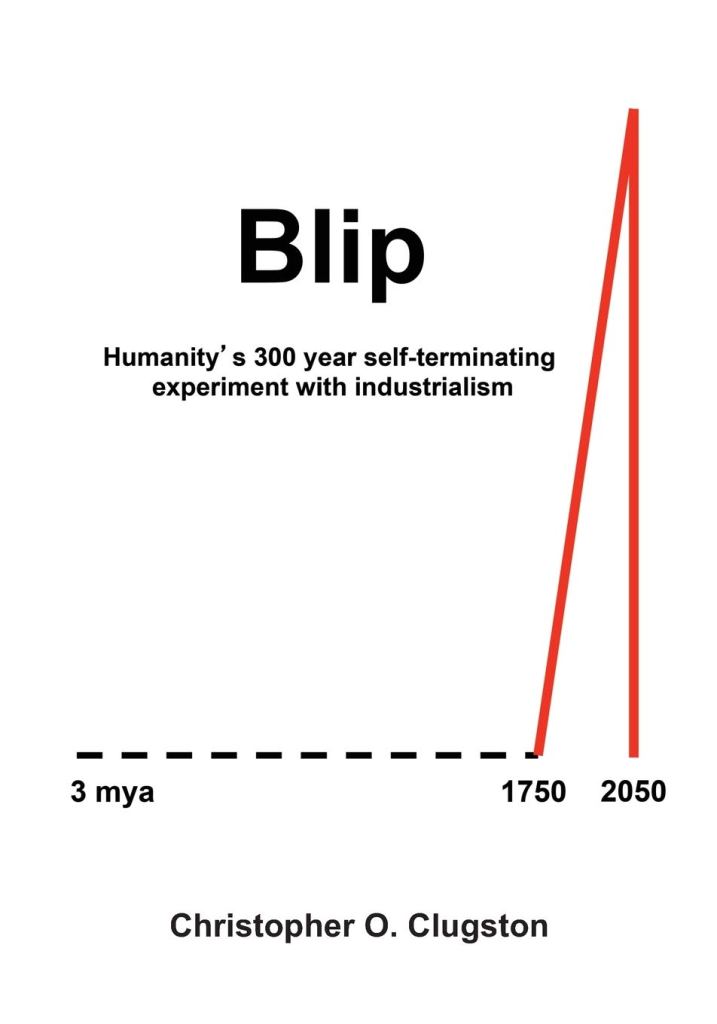
Clugston has written two books: Scarcity in 2012, and Blip in 2019.
His unique contribution is to research our consumption of depleting non-renewable resources. All 100+ of them, not just fossil energy.
For many people, fossil energy depletion is a fuzzy threat because it’s complicated and there are so many cheerleaders of false beliefs. Ditto for the climate change threat with its promoters of green growth and carbon capture machines.
Clugston presents so many tangible non-negotiable threats to modern civilization that after absorbing his work there is no room for doubt and no where to hide.
His conclusion is bleak. Clugston calculates modern civilization will be done by 2050, with or without climate change, with or without peak oil, and with or without any green new deal idea.
Harsh yes, but real, and honest, and helpful for those still trying to make the future less bad, because his work shows that the best path is democratically supported rapid population reduction policies.
Clugston’s visibility on the internet is low. I don’t know it that’s by choice, or because of the unpleasantness of his message. I’d like to see that fixed so the people working to make the future less bad can use his work as ammunition.
What we do to enable our existence simultaneously undermines our existence…
Our enormous and ever-increasing utilization of NNRs (nonrenewable natural resources) – the finite and non-replenishing fossil fuels, metals, and nonmetallic minerals that enable our industrial existence – is causing:
– Increasingly pervasive global NNR scarcity, which is causing
– Faltering global human prosperity, which is causing
– Increasing global political instability, economic fragility, and societal unrest.
This scenario will intensify during the coming decades and culminate in humanity’s permanent global societal collapse, almost certainly by the year 2050.
Since 2005, Chris Clugston has conducted extensive research into human “sustainability”, with a focus on non-renewable natural resources (NNR) scarcity. His goal has been to articulate and quantify the causes, implications, and consequences associated with industrial humanity’s “predicament” – our self-inflicted, self-terminating human/Earth relationship.
Here is the companion video to his book Blip:
Here is a 2012 presentation by Clugston in support of his book Scarcity:
Here is a summary of Clugston’s 2012 book Scarcity:
Here is a 2014 paper titled “Whatever Happened to the Good Old Days?
 un-Denial
What Happens When Apex Predators Take Over the Planet by Stefano Mancuso
https://lithub.com/what-happens-when-apex-predators-take-over-the-planet/
Good read! Included some interesting facts that I wasn’t aware of. Like
Every time that the energy produced by plants is transferred from a lower level to the next higher level of the pyramid (e.g., when the herbivores eat plants) only 10 to 12 percent of the energy is used to constitute new body mass, thus becoming stored energy, while the rest is lost in various metabolic processes. Therefore, at each successive level we will find 10 percent of the energy present at the preceding level. This is a precipitous drop. Just think, if we attribute to the primary producers (plants) an arbitrary energy level of 100,000, the successive levels will be 10,000, 1,000, 100, 10, 1, and so on. In practice, the organisms positioned at the top of the pyramid, the so-called apex predators, are the least sustainable in terms of energy that one can imagine.
LikeLiked by 2 people
Thanks. You’d probably enjoy Nick Lane’s book “Oxygen”. Or read the chapter on photosynthesis in his book “Life Ascending: The Ten Great Inventions of Evolution”.
The splitting of water to release oxygen using a photon is an amazingly difficult technical problem that evolution somehow figured out.
Photosynthesis and oxygen had a profound effect on our planet:
1) Stopped the oceans from boiling off into space. We’d be like Mars without oxygen.
2) Made life interesting by enabling the protein lignin which enabled the evolution of large plants and animals.
3) Made life diverse by enabling more efficient respiration which enabled 6+ levels in the food chain from apex to autotroph.
4) Created both our food and a means to digest it.
5) Enabled this conversation by creating fossil energy.
6) Some other big effects that I forget.
LikeLiked by 2 people
I gave the paper a quick scan and was not impressed.
1) Anyone that begins by drawing an analogy between a failed peak oil “theory” and a belief that metal ores are depleting really doesn’t have clue.
2) I saw no discussion of the thermodynamics of mining. We haven’t yet been hurt by declining ore quality because we made up for it with more diesel. That game will soon end.
3) They believe scarcity will create higher prices which will fix scarcity. That idea is out of date and wrong. See Gail Tverberg’s work for why.
If I read too quickly and missed something please correct me.
LikeLiked by 1 person
1 both are are exactly the same claim just regarding to seperate resources.
2 I have no reason to think that the remaing metals are a lower quality
3 we will not being hitting scarcity in decades who knows the advancmets of recyling and space travel will be in that time.
LikeLike
The ores are of a lower quality, we tend to mine the most concentrated forms first.
LikeLike
Poor Mac10 is going crazy.
He’d be so much more at peace if he understood Varki’s MORT.
https://zensecondlife.blogspot.com/2021/05/achieving-apex-of-stupidity.html
LikeLike
Kurt Cobb today addresses exactly this issue:
https://www.resilience.org/stories/2021-05-09/clean-energy-minerals-shortage-who-knew-it-could-happen/
There will be limits. The main question is when they will begin to bite.
LikeLike
Good find, thanks.
I like this quote:
Cobb neglects to mention “…and significantly reduce our population”.
Why is it that everyone neglects to mention the only thing that might help?
It’s quite remarkable once you notice this phenomenon.
LikeLike
The quote from Kurt Cobb ties in very nicely with Craig Dilworth’s “vicious circle principle” as set out in his “Too Smart for our Own Good” published in 2010. Dilworth IMO is almost certainly Canada’s (although settled in Sweden) most doomy doomer. The book (available at a very good price from re-sellers on Amazon UK) is a very dense and fact filled and to be honest it makes my brain hurt if I try to read too much at a sitting. There’s an excellent review of it on Amazon by Richard Reese (a bit of a doomer himself).
There is a talk by Dilworth at this link (although generally he seems to have a small internet footprint)
http://www.craigdilworth.com/home.html
There is also a very short YouTube video of him – to the point if not to say blunt
I have no idea how he managed to get Cambridge University Press to publish his book (although I’m very glad he did) as it is totally lacking false hope or wishful thinking and he strays (most wonderfully)from his usual field of expertise which is philosophy.
The book ends
“Consequently human civilization — primarily Western techno-industrial urban society — will self-destruct, producing massive environmental damage, social chaos and megadeath. We are entering a new dark age, with great dieback.”
Needless to say a very fine addition to what my wife calls my Library of Doom.
LikeLiked by 1 person
Thanks for presenting Craig Dilworth and his work – very interesting. Yes, in the YouTube video, he is very dry and very brief, to put it mildly. I just found this review of his book, Too Smart for Our Own Good:
https://wildancestors.blogspot.com/2012/11/too-smart-for-our-own-good.html
LikeLike
I remember “Too Smart for our Own Good” was one of my first doome books.
I remember I was absolutely astonished that completely obscure guy wrote such monumental book.
Those days I was still pretty naive about human condition and I hadn’t been able to understand how such great mind is not in top ten of science book 😀 …
LikeLike
First I’ve heard of Dilworth, thanks for introducing him.
I watched the interview. I like that he cuts through the fog and goes straight to population when explaining our predicament.
Here is his book:
https://ca1lib.org/book/941343/728cc3
LikeLike
Thanks, Mick. Craig’s pragmatic, terse speech and mannerisms made me chuckle as they’re so rare these days. His approach and style are, to me, similar to many of Rob’s posts and comments.
LikeLike
Meanwhile, over at OFW, one of the few places on the planet that researches our overshoot predicament, they are discussing whether the moon landings were fake.
It’s a shame that overshoot awareness frequently becomes entangled with wack jobs.
It’s no wonder that peak oil is discounted as a fringe idea.
LikeLiked by 2 people
The way people deceive themselves amazes me. The same is with COVID-conspiracy.
I guess people prefer to discuss anything but important subjects on which they don’t have any impact and are helpless.
We cannot do anything about reality of “peak oil”? Let’s make it a fringe subject.
We cannot do anything about the fact that COVID is some natural phenomenon and we cannot control it? Let’s create bunch of crazy theorie just to believe some evil created it.
We cannot do anything about reality of climate change and it overwhelms as? Let’s make it a hoax!
The worst thing for people is to concede that in many aspects “there is nobody in control”.
I always wonder with people disseminating these crazy killer-vacines theories. I don’t claim vaccines are safe – we cannot be sure, we will know in a few years. But for sure in comparison to the risk of COVID-isation, it is much more reasonable choice.
Now, if those vaccines are so evil, I have a few queations:
1) Are all vaccines so awful? I mean did all (probably 20+ now) producers colluded to kill population wih them? If so – this is really nice conspiracy; probably hundres of thousands of colluders and noone said a word! what a loyalty! Not to adding unprecedented agreement beween USA, Russia, China, India, EU…
2) If I am evil – I would rather design one simple diseases that “cleans” the ground and that is all. Why bother wih some vaccines that are pre-condition (as I understand) for diseases to work? Why make it so complex?
3) Assuming vaccines are prepared to control population. I would rather create a disease that kills everybody who didn’t take the vaccine! Why? Because vaccine takers are sheeple easy to steer! I would rather get rid of “resistance” 🙂 ….
LikeLike
The comment section at Megacancer got pretty wild too. Which is truly a shame as James is otherwise such a great mind.
LikeLiked by 1 person
Rune Likvern today with a detailed analysis of the Bakken.
https://runelikvern.com/2021/05/10/the-bakken-a-snapshot-from-40-000-feet-as-of-end-2020/
LikeLike
https://ca.finance.yahoo.com/news/acid-squeeze-latest-obstacle-facing-202458362.html
LikeLike
I’m usually not keen on inspirational quotes but I like this one.
LikeLiked by 1 person
Nice to see the lunatic fringe unwind first. A hint of sanity remains in the world.
https://wolfstreet.com/2021/05/11/the-most-hyped-corners-of-the-stock-market-come-unglued/
LikeLiked by 2 people
Steve Gibson with technical details on the Colonial pipeline ransomware attack (starts at 1:33:45).
LikeLiked by 2 people
https://www.spglobal.com/platts/en/market-insights/latest-news/oil/051221-iea-sees-major-oil-demand-rebound-of-65-million-bd-between-q1-and-end-2021
LikeLike
Tim Watkins today…
https://consciousnessofsheep.co.uk/2021/05/13/are-you-still-buying-this/
LikeLiked by 2 people
“And so, one of these days, maybe next year, maybe a couple of decades from now,….”
Predicting the future is hard. But for Tim Watkins, this seems like an unusually wide mark on when we might run short of fuels to burn in our personal transport vehicles…
That said, as we move from the age of plenty, to the age of scarcity, actual long term shortages of gasoline supply might not show up for a while. (Speaking here of North America.) Demand might be reduced from 1) decreased reduced personal income and spending, 2) decrease in the number of vehicles per family 3) cultural changes that rationalize a move away from monster trucks to smaller vehicles 20-30% more efficient, 4) move to EVs, etc. etc.
I am in North Carolina today, and experiencing the impact of the Colonial Pipeline shutdown and gas shortages. It is a sharp reminder of how our lives are so leveraged to fuels and internal combustion engines. All the reading and thinking about our future does not really prepare one for that future, as much as a dry run of what future shortages will be like. Very few will learn the lessons, however.
But is real preparation for the coming changes really possible on an individual level? I will not be moving to a cabin in the woods even as we begin the fossil fuel decline. Of course there are a few sensible things one can do, but for the most part, a person’s fate will be bound to the larger society in which they live.
LikeLiked by 1 person
Yes, that’s probably true, and it’s worrisome because the vast majority of our citizens are in complete denial of reality. I expect war.
LikeLike
Woohoo! The future is looking brighter. Space tourism is becoming a reality.
LikeLike
He’s back after 3+ months.
LikeLiked by 4 people
https://www.biznews.com/thought-leaders/2021/05/12/mailbox-ivermectin?fbclid=IwAR0UKWMTWaYzsEMq8UHFt30pxd2-XEc3RGUyyg2njok3m1_PeMwttAi1dpQ
I came across this today and thought it well worth the read.
LikeLiked by 1 person
Thank you very much. That is a very good article.
I’m struggling with deciding whether or not to get vaccinated. On the one hand, I expect the vaccines are reasonably safe and effective, for the current virus versions. On the other hand, my government is failing on all the simple issues like early mask advice, vitamin D, closing the borders to clear threats, and cheap Ivermectin treatment. If they can’t get the simple stuff right, I have a problem trusting them on the complicated stuff. I don’t have a lot of contact with other people so I’m thinking I’ll wait and observe a little longer.
LikeLike
Rob,
I think waiting is the right strategy. If you read the stuff James puts on his blog (MegaCancer) you wouldn’t get the shot. It’s hard to discover what the truth is when BigPharma only wants profits, doctors have abandoned the Hippocratic Oath(do no harm) in droves (group think) and the Science (post pandemic) seems to be flawed by politics/status. I think the science that unsettles me is that when virologists tried to make a SARS (original Coronavirus) vaccine the mice when later challenged by the virus died. I can’t find the exact link but I think this is the study (https://pubmed.ncbi.nlm.nih.gov/22536382/). With Ivermectin out there to treat Covid I think vaccines are probably unnecessary. That said, I had the J&J shot. Being old and with Collapse on the way I figure if I die, so what – not much to live for. I also had family pressure. J&J at least is not a mRNA vaccine. The mRNA vaccines are basically gene therapy and that doesn’t have a good record.
AJ
LikeLike
I find it frustrating that you can’t have a discussion about vaccines or ivermectin without a lot of people thinking your a wack job if your views differ from the official narrative. Just because I have my reservations about the covid vaccinations doesn’t mean I’m an antivaxer nut job!
Like you I think they’re probably safe but as the above article states they’re essentially still in stage 3 trials and we won’t know for sure that they are safe for quite a while. Why would you get the jab if there is a known safe alternative treatment that works?
LikeLike
I’d be more confident if I saw some evidence that our leaders were thinking independently rather than repeating without question what they are told.
LikeLike
hardly inspires confidence when
Dr. Anthony Fauci, the head of the U.S. National Institute of Allergy and Infectious Diseases (NIAID), said that about 40 percent of his agency’s employees have not received the COVID-19 vaccine, while a deputy at the U.S. Food and Drug Administration (FDA) said the agency is reporting similar numbers and the CDC don’t know about their employees.
there is little trust in these Vaccines for good reason.
LikeLike
I just have to rant about this to someone sensible, what are we doing complaining about natural population decline when we live on an island? I’m not talking about immigration policy, it’s the underlying opinion here that decline / de-growth is a terrible thing and we need to have a growing population WTF!?
https://www.stuff.co.nz/business/125043897/population-policy-debate-comes-into-focus
LikeLiked by 1 person
I feel your pain. No matter how many times I see it, I’m still amazed at the depth of denial in otherwise intelligent people. We should tell the growing segment of retired people that rather than being useless eaters they should plan on volunteering in the fields when fossil energy becomes scarce.
LikeLiked by 3 people
I fully agree with you. Of all the reasons given for population growth, that we need more young ones to take care of the old, is the weakest. I am seventy-two, I am still working and I do not want any young people waste their time and effort taking care of me. If I can not move on my own, feed me to the wild animals. Thank you!
LikeLiked by 1 person
A lot of older folks like to brag they’ll be dead before the worst of resource decline / climate change hits. I like to say, no you’ll be very old and vulnerable. Retirement and old age care is incredibly energy expensive, as is early child care and 18+ years of schooling. We have seen a trend over the last 3-4 decades of outsourcing activities that were handled within the family, may the next 4 decades will see us insourcing those again ….
LikeLiked by 1 person
I like Tim Morgan’s essay today on the debate between inflation and deflation.
https://surplusenergyeconomics.wordpress.com/2021/05/16/199-an-american-nightmare/
LikeLike
I will read in more detail, but bankruptcy does destroy assets. It’s what “discharging a debt” means.
LikeLike
However, he may be referring (for the United States, e.g) a Chapter 11 corporate bankruptcy.
LikeLike
I think Morgan agrees with you.
LikeLike
https://www.imdb.com/title/tt14306648/
Tonight I watched the documentary Bright Green Lies which is based on Derrick Jensen et. al.’s book of the same name (see above for a book review by Alice Friedemann).
The documentary did a good job of discrediting the greenness of renewable energy, and of explaining the destructive nature of our modern industrial civilization.
Their main conclusion is that industrial civilization and agriculture must end, however they provided no hint of how that might be achieved while feeding 8 billion people.
They did not say a single word about the need for rapid population reduction policies.
Not a word.
It’s quite amazing because population reduction is key for BOTH the goal of deindustrialization, AND the opposing goal of retaining industrial civilization, as non-renewable resources deplete.
In other words, population reduction is the only wise path forward, no matter what lifestyle you desire.
Thank goodness for Varki’s MORT.
I’d go insane without understanding why there are vanishingly few sane people on this planet.
You can download the documentary here:
https://yts.mx/movies/bright-green-lies-2021
LikeLike
Yes, it is depressing. I just read about the new IEA report outlining how the world can reach “net zero” by 2050. It is touted as authoritative and groundbreaking (acknowledging “peak oil demand”!), but I rather think it is all pie in the sky at best and just misleading nonsense at worst. How can that be? Do these people really believe what they have written here? If the answer is “yes”, the extent of denial must be horrendous. I am aware of Varki’s MORT, but I still find this shocking.
LikeLiked by 1 person
It is mind blowing.
As is the fact that the words “vitamin D” do not exist on my government’s extensive Covid web site.
LikeLike
Here is a summary of the IEA report:
https://www.resilience.org/stories/2021-05-18/iea-renewables-should-overtake-coal-within-five-years-to-secure-1-5c-goal/
Among many other crazy things, it says,
“On top of keeping below 1.5C, the Paris-based agency says its net-zero emissions by 2050 (NZE) scenario would boost global GDP, create millions of jobs, provide universal energy access by 2030 and avoid millions of premature deaths due to air pollution.”
“The amount of energy used by the global economy would fall 8% by 2050, despite a doubling of GDP, a population rise of more than two billion people and the provision of universal energy access by 2030.”
Who could ever believe all that?!?
LikeLike
It’s because of crazy beliefs like this that I don’t have confidence in anything that our leaders say.
LikeLike
Yes, I agree. But this one is special. It is a high-level publication that is discussed in newspapers all around the world today. What they are presenting here is not just denial; it is actively creating a fantasy world of sheer nonsense. That is more – and more serious – than denial. If it wasn’t so depressing and frustrating, I would say the report deserves a debunking.
LikeLiked by 1 person
You’re right but it’s not that different than dozens of other examples, like for example governments encouraging the burning of biomass and subsidizing electric cars to address climate change.
LikeLiked by 1 person
Can you spot the trend?
MMT clearly works. We don’t need no stinkin’ fossil energy.
https://wolfstreet.com/2021/05/17/who-bought-the-4-7-trillion-of-treasury-securities-added-since-march-2020-to-the-incredibly-spiking-us-national-debt/
LikeLike
Tom Murphy today makes a strong 21 point case for the collapse of civilization.
A theme throughout is how can something so obvious be so aggressively denied? And doubly so since denial will make the outcome worse.
I’ll try again to bring Murphy’s attention to Varki’s MORT theory with another comment on his blog.
https://dothemath.ucsd.edu/2021/05/why-worry-about-collapse/
LikeLiked by 2 people
Nate Hagens has a new version of his annual Earth Day talk up. This year he did not constrain his talk to a fixed duration and instead gave each topic the time it required resulting in a 3 hour talk. Time stamp links are provided to make it easy to watch topics of interest.
Here are a few notes on the topics that interested me (- means I disagree, + means I agree, ! means new info):
– consumption and economic growth are bigger problems than over population
– we can’t do anything about population reduction until we drop economic growth as a goal, after which a 1% population decline per year (1B per decade) is achievable and sufficient
+ we need to bend rather than break the system because we might not recover from a break
+ nuclear war is a much bigger short term threat than climate change
! using only 100 of our 13,000 nuclear weapons would extinguish most life on the planet
! USA is the only country that has not agreed to use nukes only for defense
! USA leadership thinks it can win a nuclear war
? we are not doomed, we will probably muddle through
+ we need more people understanding our predicament and working to design a new realistic future
+ social cohesion and democracy is at risk
+ something new must replace our monetary system this decade and the transition will entail risk
Nate concludes with many good ideas for how we might respond to our predicament. As in previous years, I think it’s all a waste of time until we confront head on our genetic tendency to deny unpleasant realities.
LikeLiked by 1 person
I don’t think humanity will muddle through. How should this be possible? We are large apex predators with high energy needs. Our current food source, fossil fuels, is going away. Our previous, organic agriculture, is on the way out due to climate and I don’t think there will be much game left at the end of this. Humanity can’t survive on hubris alone.
Or is a matter of time scale? We humanity go extinct this century? Rather unlikely. 400 years from now? Not so absurd anymore, is it? Our species seem to be akin to a sparkler (the firework type), very bright but lasts only so long. If we count generously it was a 2 million years spectacle. What a flash in geological history.
LikeLike
I think Nate might agree with you that 400 years is plausible if we do the wrong things. He thinks we can survive with much less, and that climate change will be much less of a threat when fossil energy depletes. It’s also important to remember that his primary audience is young university students seeking advice on what they should do.
I count less generously than you and start the clock when we evolved God to deny death 1-200,000 years ago.
LikeLike
“We humanity go extinct this century? Rather unlikely.”
I wish you were right. BUT, in the back of my mind are two semi related questions: 1. If civilization collapses, who is going to shut down and move to permanent storage all the spent fuel in 400 + nuclear reactors world wide? How many are just going to go Chernobyl (without a sarcophagus)? Baring storage of the fuel, I’ve heard (maybe incorrectly????) that the radionucleotides released will take away the ozone layer in a very short time and then UV solar radiation will destroy most primary plant production – there we go. 2. Just read somewhere yesterday that it will only take a nuclear war exchange of 100 weapons to do the planet in from radiation also. And we have 10,000 – 20,000 weapons out there, 100 seems like nothing. Will civilization collapse without any nuclear war?
So, I would wish humanity could survive a collapse, but I’m unsure if that is just hopium. Being my depressing self;)
AJ
LikeLike
Hi Rob
I just finished a quick run through Blip. Quick thoughts.
We gloomy/doomy non-denialists in this and other similar spaces tend to focus most on the exploitation of fossil fuels as the key explanation of our human history and future. And if you had to pick just one variable to understand our recent history, and our near and mid-term future, it would probably be something around oil production levels. Those levels correlate well with the “great acceleration” beginning circa 1945 and probably will track closely to future inflation and debt adjusted GDP.
But “Blip” makes it clear we must also look at the exploitation of metals and non-metallic minerals and their depletion curves to understand our history and future.
Dr. Nate Hagens speaks of people being “energy-blind” when talking about the human condition and future. Those analysists that do focus on energy, and fossil fuel depletion in particular, including Dr. Hagens himself, usually do not directly address the rising extraction cost curves for non-energy natural resources, and the impact of the depletion/exhaustion of those metals and non-metallic minerals on our future. For example, Dr. Hagens most recent YouTube video summarizing 15 years of work, “Earth and Humanity: Myth and Reality”, does not directly get to the deep issues pointed out in “Blip”. We are all generally natural resource blind.
But we have not always been blind to this issue. We have just forgotten it. Depletion of nonrenewable resources was one of the five major trends investigated in the World2 Model in Limits of Growth (LTG).
LTG uses simplified resource estimates and algorithms to estimate depletion. “Blip” provides greater detail and context for natural resource extraction and depletion, but on my first reading, I did not see an attempt to plot future depletion curves. Chris Clugston’s conclusions of timelines for depletion and the future history of the next 30 years seem to be based on his absorption of the material in writing the book and “eyeballing” depletion curves. Fair enough. Probably too many variables to do otherwise without massive data input and computer support.
The topic of non-energy minerals is now being discussed in terms of whether there are sufficient amounts to support conversion to a “green economy. Blip provides the context for this discussion: we are attempting to prolong industrial civilization by switching to “green” technologies that require even greater exploitation of non-renewable metals and non-metallic minerals. We are doomed to exhaust those at some point, by 2050 if Mr. Clugston is directionally correct on his estimates.
It is this sense of finality to the human endeavor that is the biggest impact of Blip. There is no going back to a time or place where large supplies of metals and non-metallic minerals can be found laying on the surface of the earth, or dug up from the crust with relatively minimal effort. Once this civilization is finished, there is no second industrial civilization possible within this geological age.
Predicting the future is hard. Mr. Clugston’s future history of the next three decades, based on the exhaustion of these resources, seems a pretty reasonable attempt. War of some kind does seem inevitable.
I do think there are some wild card variables that could possibly alter the depletion and industrial civilization sunset timeline. But generally those variables result in an involuntary reduction of human population. Engineered bioweapons, AI, etc. And what will be the ambitions of 1.3 billion ethnic Chinese.
Other “optimistic” scenarios seem implausible to me, like mining asteroids and going to Mars, but we need to believe in such things, to stay occupied and hopeful. At this point in our history, denial may not be such a bad thing for the general populace. UFO stories are also a nice distraction.
LikeLike
Thanks Shawn for the excellent review of Blip!
I’m going to make Chris Clugston aware of your review in case he’d like to comment.
In addition to us being energy blind, Nate Hagens also talks about fossil energy being indistinguishable from magic for most people. I suspect the reason we haven’t worried about non-renewable mineral depletion since LTG is that we had plenty of diesel to compensate for falling ore concentrations.
I like these three images from Chris Martenson’s Crash course on the modern history of copper mining:
Your observation about the finality of mineral depletion is sobering.
The only plan I have seen that might successfully sustain a modern civilization for the long term is that proposed by Jack Alpert. He calls for rapid population reduction to about 100 million, with very aggressive recycling of non-renewable minerals, and I think also assumes a small quantity of fossil energy remains available for mining those minerals that cannot be recycled, until fusion or some other energy source can be developed to replace diesel.
https://un-denial.com/?s=Alpert%3A
Even if elements of Alpert’s plan are infeasible, getting our population down quickly reduces the severity of every one of our many problems, and would provide more time for our best minds to craft a plan.
I try to bring attention to our genetic tendency to deny unpleasant realities because population reduction, which is the only possible solution, makes obvious sense only when reality is understood.
LikeLiked by 3 people
I think the vintage photo of the prospectors and the giant copper nugget is from Alaska.
Apparently, massive copper boulders were once scattered across portions of northern Michigan — known as “float copper”, because they were sliced off rock strata by glacial ice movement. Some of the boulders are on display in town squares and museums today:
https://www.amusingplanet.com/2018/10/michigans-massive-copper-boulders.html
But they’re mostly long gone, and now we’re digging mile-deep mines to go after the crumbs.
LikeLike
I don’t think this guy is overshoot aware but his video today on the scale and complexity of our food distribution system is a nice reminder of how fortunate we are, and how dependent the things we take for granted are on fossil energy.
LikeLiked by 1 person
I went back and watched Nate Hagen’s Earth Day talk a second time.
Nate really did an outstanding job this year but something doesn’t sit right with me. I tried to articulate my discomfort in the following comment I left on YouTube.
LikeLike
I’ve reached the point where I’m fully aware that humans, as a species, are not capable (i.e. willingness or choice isn’t at all involved) of acknowledging that their excessive breeding will completely destroy themselves (and possibly most or all life on Earth). I’m more accepting of that happening than I’ve ever been. I’m not happy about it in the least, but much more accepting of it.
So much of our focus, whether doomsayer or not, is that humans MUST continue on no matter the disaster that surely awaits us. I’ve yet to hear a good enough reason to justify this consistently desperate plea. Being intelligent and having the capacity to be aware and in awe of all that we can be isn’t a good enough reason for me. The bottom line for humans is that ONLY WE have created our current situation, on the utter brink of absolute catastrophe (total human and other species extinction, total environmental destruction). We have done these things to ourselves and our beautiful world. We are not a species capable of living within the limits of our existent circumstances. And we never will be. We would need to evolve into a different species for this to be possible. And there isn’t enough time for that to happen.
I’ve become very interested in trying to understand the reasons why this truth is so hard for so many to accept or acknowledge, even within the doomsayer community. I think one big reason is that many would simply give up their efforts (to reduce human population, to limit environmental destruction) if they accepted/acknowledged it. But this isn’t a necessary consequence of this acceptance. We can still enjoy the beauty that remains and try to reduce suffering in our own little ways while letting go of the absurd demand that humans must survive no matter what.
LikeLike
I think most overshoot aware people agree with you. For example Meadows, Rees, Chefurka, Morrison, Hall, Mobus, Garrett, Hanson, Korowicz, Tverberg, Morgan, Watkins, Dowd, Clugston, Zawacki, Friedemann, Foss, Ludlum, etc.
The number of overshoot aware people that argue for rapid population reduction policies, which is the only thing that might prevent a lot of suffering in human and other species, is tiny. I’m thinking Alpert and myself.
I don’t know what drives Alpert, but I view it as my responsibility to the universe because we might be the only species in existence intelligent enough to know better.
LikeLiked by 2 people
https://www.abc.net.au/news/2021-05-20/covid-surging-in-seychelles-worlds-most-vaccinated-country-why/100151306
Not sure if this ties in with what Bosche was forecasting. I think it might.
Interesting nevertheless.
LikeLike
I’m half way through the book “Epidemics and Society” by Frank Snowden. He discusses the history of small pox and explains that herd immunity occurred after sufficient people got sick and recovered. There was no herd immunity in the American aboriginals which is why a few Europeans wiped out entire civilizations with disease. Have you seen any data about the number of recovered Covid patients getting sick again?
LikeLike
Israel cases increased today for the first time since I started watching. Might be noise.
LikeLike
600HP, 0 to 60 in 4 seconds, and we’re finally doing something about climate change…
LikeLike
I am very excited about this vehicle. May I buy two? Until the four minute mark or so, I didn’t know it had batteries. But, rest assured, it does.
How many I wonder? More than a top of the line Tesla? I am sure the electric 18 wheeler cannot be far behind /s
LikeLike
Yes please buy two. That way you can make up for that inconsiderate neighbor that flies to Hawaii every year.
LikeLike
you are being sarcastic in the extreme no!?
LikeLike
Yes, however the majority of citizens, thanks to their genetic denial of reality, probably think I’m serious and agree with me. It’s really quite amazing.
LikeLike
I missed this interview when it was first broadcast on April 22. Bret Weinstein does an amazing job of helping Geert Vanden Bossche explain his concerns about our current Covid strategy.
It’s a must watch.
LikeLiked by 2 people
Nice essay today by Richard Heinberg on the history of what we once knew to be true and then denied…
https://richardheinberg.com/museletter-339-the-most-colossal-planning-failure-in-human-history
LikeLiked by 2 people
The Wuhan lab leak hypothesis is gaining momentum. The leader of the only other lab with similar capabilities to the Wuhan lab now publicly supports an investigation.
LikeLiked by 2 people
Thanks for linking me back to the comments on Nate Hagens’ presentation. In regards to population reduction – I don’t suppose you are familiar with Peter Pogany? An economist who passed away in 2014. His 2006 book, Rethinking the World, proposed what economists call a “transformation curve” that has population on one axis, and material output on the other. You want more material output? Fine, reduce your population. You want to grow your population? Fine, reduce your material output.
His language is a bit dense and flowery – an interesting combination that takes getting used to, but worth the effort – he had a lot of interesting and unique insights.
https://books.google.com/books?id=M8Tb25Fr6KoC&pg=PA271&lpg=PA271&dq=peter+pogany+population+curve&source=bl&ots=bLwgWtw96D&sig=ACfU3U25JiN4-Kzot6fsLdnXz9UxAOdy8g&hl=en&sa=X&ved=2ahUKEwjQ3eWJtvLwAhUKup4KHYdTCqUQ6AEwEnoECBYQAw#v=onepage&q=peter%20pogany%20population%20curve&f=false
LikeLike
Thanks. I haven’t heard of Pogany. I skimmed his book excerpt and don’t understand what he is saying.
If by “material output” he means energy and mineral consumption then it seems he is violating the Maximum Power Principle (MPP) which means he is wrong.
LikeLike
Pogany defines material output as “all ‘things’ made of matter. The social product, the GDP, is the final demand for material output (thus excluding intermediary inputs) plus the final demand for services. National GDPs summed and screened for double (or multiple) counting yield the Gross World Product (GWP). Global material output is ‘agriculture’ and ‘industry.’ The service sector’s independence from the material output is limited. Once the limit is crossed, increase in services entails increase in material output. Interdependence is also manifest when services decrease.”
He defines ecoplasm as “the amount of dependably usable low-entropy matter, ecological order, and consistent, accessible information about the environment, all at once…A given amount of ecoplasm constrains growth in both somatic and extrasomatic directions and does so in conformity with the law of increasing costs.”
He defines somatic as people, and extrasomatic as material output.
How do you see him violating HT Odum’s Maximum Power Principle?
I created a summary of Pogany’s views, but does not include any detail about this idea on the transformation curve. This chapter is probably the most challenging to digest, and the extract at google books leaves out some key pages. Here’s the summary document I created:
http://storage.ning.com/topology/rest/1.0/file/get/4565377457?profile=original
LikeLike
Thanks. It seems to me that Pogany is deliberately trying to be obtuse rather than clear, which makes my brain shut down and not care.
It’s easy to be obtuse and very hard to be clear when discussing complicated topics.
In one sentence, please summarize his key idea.
LikeLike
One sentence from me:
Pogany is using the classic Econ 101 model of the transformation curve (usually taught as “guns vs. butter” – allocation of labor between armament production and military service vs. civilian goods and services https://en.wikipedia.org/wiki/Guns_versus_butter_model) as a means for finding the most dignified means of survival as we determine the optimal trade-off between trade-off between global population and world material output in consideration of the Earth’s carrying capacity and declining resources.
One sentence from Pogany:
“There are, of course, an infinite number of intermediate combinations between Country Club
Palace (very high output with very low population) and Malthus Point (very low output and very
high population).”
This is consistent with what Howard Odum has written about population in A Prosperous Way Down, and Environment, Power, and Society for the 21st Century.
LikeLike
Thank you very much. Now I understand.
Pogany sure could be a lot clearer and persuasive in making the case for a lower population.
LikeLike