On the Trans Mountain Pipeline

Trans Mountain pipeline

Many environmental groups in my province of B.C. oppose construction of a new pipeline from Alberta to the west coast. The motives of these groups include:

  • preventing dirty oil from contributing to climate change;
  • preventing environmental damage from pipeline and oil tanker spills;
  • concern for First Nation rights.

While these motives are admirable, all of the groups lack an understanding of, and/or deny, the laws of thermodynamics that govern our economy, and our overshoot predicament.

It’s true that climate change is a serious threat. In fact it’s much more serious than most environmental groups acknowledge. We are already locked into a dangerous 2C higher climate with 10m of sea level rise no matter what we do. There are no actions we can take today to solve the climate problem and avoid future suffering. Our choices today are to try to maintain our current lifestyle and increase future suffering, or reduce our population and consumption, and constrain future suffering.

It’s also true that the pipeline will create some new risks for environmental damage, but these risks pale in comparison to the damage the human footprint is already causing. Habitat loss, species extinction, soil depletion, nitrogen imbalance, pollution, deforestation, overfishing, and non-renewable resource depletion are the real threats environmental groups should focus on. As with climate change, nothing can be done about these threats unless we reduce human population and consumption.

In addition, if you want to maintain our current lifestyle, and you are concerned about the risk of oil spills, then there is a good argument to build the pipeline.

With regard to First Nations rights, all 7.6 billion humans descended from one small tribe in Africa about 100,000 years ago, meaning we’re all basically the same. Environmentalists should focus on the rights of all future generations, including First Nations.

Our standard of living is completely dependent on the burning of fossil energy, especially oil. We have already burned most of the cleaner and cheaper oil. That’s why we are mining dirty expensive oil sands, and fracking. To reduce our use of fossil energy we must reduce our standard living and our population.

Put another way, new pipelines will be built for another decade or so, until even the dirty oil is gone, unless we reduce our consumption of oil, and the only way to accomplish that is to shrink our economy, standard of living, and population.

If environmental groups want to make a difference on the issues that matter, as well as lesser issues like preventing new pipelines, they must:

  • set good examples in their personal lives (no more than one child, no long distance travel, reduced consumption of everything);
  • advocate for a global one child policy;
  • advocate for austerity, conservation, and a smaller economy (the simplest and most effective way to accomplish this would be to implement a higher interest rate).

It’s true that our choices are unpalatable, but they are reality, and there is a key point that must be understood when weighing what to do. The remaining affordable fossil energy is depleting quickly. Extraction will, in a decade or so, become too expensive for us to afford, meaning fossil energy will be gone for all intents and purposes. When this happens, our lifestyles and population will collapse, thanks to the laws of thermodynamics, no matter what we choose to do.

The advantages of choosing to voluntarily contract today are threefold. First, we would constrain future suffering caused by climate change. Second, we could use some of our remaining wealth to prepare a softer landing zone and to orchestrate a fairer and more humane descent. Third, we might leave some oil in the ground for our grandchildren so they can enjoy some of the comforts we take for granted. The alternative of doing nothing until thermodynamics forces the issue is chaos, war, and much more suffering for all species, including humans.

This article today suggests that environmental groups may have succeeded in preventing construction of the Trans Mountain pipeline:

https://oilprice.com/Energy/Crude-Oil/Disaster-Hits-Canadas-Oil-Sands.html

Kinder Morgan said it would halt nearly all work on a pipeline project that is crucial to the entire Canadian oil sands industry, representing a huge blow to Alberta’s efforts to move oil to market.

Here is what I predict will happen:

  1. Environmentalists will continue to deny reality and focus on the wrong things.
  2. We will not voluntarily contract the economy.
  3. We will not implement a one child policy.
  4. The Trans Mountain pipeline will be built, provided that our luck persists at avoiding an accidental crash caused by the instability we have created by using extreme debt to maintain an illusion of economic growth.

Let’s check back in a year to see if I am correct.

By Steven Spencer: Interview with Richard Nolthenius

Environmental Professionals Postulating

Steven Spencer hosts a new podcast called Environmental Professionals Postulating.

On October 27, 2017 Spencer interviewed Dr. Richard Nolthenius, a professor of climate science at Cabrillo College, Santa Cruz California. I recently discovered Nolthenius and am very impressed, in part because he respects and acknowledges Tim Garrett’s work, and in part because he is so knowledgeable.

I’ve listened to hundreds of interviews with climate scientists over the years and this ranks among the very best.  Spencer asked good questions and Nolthenius responded with lots of depth, breadth, and candor.

Given that Nolthenius understands Garrett’s thermodynamics of climate change you will detect segments where he lapses into denial, but he does far better than most climate scientists.

Highly recommended.

The 3 hour interview was broken into 3 parts:

Part 1 – Policy Mechanisms for fighting Climate Change

Part 2 – Technological Solutions for fighting Climate Change

Part 3 – GeoEngineering and the “Garrett Relation”


Dr. Richard Nolthenius has a background in thermal engineering and astronomy. He currently runs the Astronomy Program at Cabrillo College, Santa Cruz California. He also lecturers and has been a visiting researcher for UC Santa Cruz since 1987. He describes his professional transition in to climate science as “quite a shock, not necessarily a pleasant one”!

Dr. Nolthenius suggests that Professor Tim Garrett’s work on linking global wealth and energy consumption has not been given the attention it deserves, Dr. Nolthenius also concludes that the only way to advert the increasingly critical climate change situation is in line with Prof. Garretts publications and therefore requires sharp, rapid cuts to our use of fossil fuels.

To achieve this end Dr. Nolthenius has compiled a list of 7 Policy Mechanisms which he will discuss in Part one. These include:

  • Tax and Dividend
  • End government subsidies to fossil fuel companies
  • Trade sanctions against all countries who do not enact Tax and Dividend or end fossil fuel subsidies.
  • Devise an efficient mechanism to impose Tax/Dividend on all externalized costs.
  • Tax consumption, not income.
  • End Child Tax Credit, and promote policies which economically discourage population growth.
  • Amend the Constitution.

Dr. Nolthenius explains exactly what the above may involve, and discusses ideas for getting them implemented with a million person Occupy DC movement.

In Part Two Dr. Nolthenius highlights potential technological ‘band aids’ (and their short falls) which could potentially be implemented alongside the Policy Mechanisms discussed in Part 1. These include:

  • Energy technologies (PV, Wind, Hydroelectric, Geothermal and Nuclear).
  • Carbon Capture and storage
  • Artificial capture of CO2 from the atmosphere via ‘Air Capture’
  • Climeworks commercially operated Air Capture CO2 machine.
  • BECCS – BioEnergy with Carbon Capture and Sequestration.

Dr. Nolthenius also points out how even if we ended all our carbon emissions today, the effect of Thermal Inertia would still cause global temperatures to rise.

Part 3 covers GeoEngineering including:

  • Permafrost Carbon
  • How do we choose?
  • Solar Radiation Management
    1. ‘Butterflies’
    2. Asteroids with dust secretion
    3. Reflective Aerosols
    4. Refreezing the Artic using pumped sea water.
  • ‘Loan Shark’ methods that won’t work long term
  • Why there is no ‘Magic Bullet’

Finally, in Part 3 Dr. Nolthenius takes some time to explain how economics is related to climate change, and why we need to stop our obsession with Growth.  The work of Prof. Tim Garrett / “The Garrett Relation” is expanded upon and discussed.

Reference is made by Dr Noltheius to “E.C.S”, although not covered in the series this stands for Equilibrium Climate Sensitivity. More information on this is available in Dr Noltheniuss presentation ‘Earth Climate Change in One (very long) Lecture’ available here: https://www.cabrillo.edu/~rnolthenius/Apowers/ClimateInOne.pptx

Many thanks to Dr Richard Nolthenius for joining me for this 3-part series, I hope I can discuss more issues with him in the future. I highly recommend visiting his website where there is a wealth of information freely available: https://www.cabrillo.edu/~rnolthenius/. His college lecture presentations (powerpoint and pdf versions) relevant to the topics covered can be found at: https://www.cabrillo.edu/~rnolthenius/astro7/A7PowerIndex.html .

Professor Tim Garretts work as discussed can be found here: http://www.inscc.utah.edu/~tgarrett/Economics/Economics.html

All 3 parts where recorded Friday 27th October 2017.

By Tim Garrett: Linking Wealth, Energy Demand, CO2 and Climate Change

Tim Garrett

Tim Garrett is the scientist with the best understanding of the relationship between energy and the economy, which means he has the best understanding of what can and cannot be done to mitigate the climate change threat.

Don’t take my word for this, read his papers and explore his site.

As far as I can tell, Garrett is ignored by all other climate scientists, and everyone that formulates climate change policies.

Think about that for a moment. Our experts ignore the one person they should not ignore.

Now you know why I am so fascinated by the human tendency to deny any reality we do not like. This tendency afflicts almost everyone, including our best and brightest.

I missed this excellent interview with Garrett when it was first broadcast in October 2017 although I have read and listened to almost everything previous he has done.

http://environmentalprofessionalspostulating.libsyn.com/ep-012-a-discussion-with-professor-tim-garrett

Paraphrasing a few quotes from the interview:

It is now generally accepted that a 5 degree rise in temperature will collapse civilization. At our current economic growth rate we can expect 5 degrees in 50 or 60 years from now. The only way to avoid this is to collapse civilization now.


I doubt there are solutions but if there are solutions we won’t get at them by imagining fairy tales like improved efficiency and renewable energy.


We need to start thinking now about the most humane way to deal with a collapsing civilization because we know from history that our tendency is to not behave well in such situations.


Interviewer: Why is your work so unknown?

Garrett: Humans have a deep-seated need for optimism and a belief that solutions exist.

Me: aka denial


By Tim Morgan: The need for new ideas

20180222_170822


This latest post by Tim Morgan may be my new all-time favorite essay because it discusses the topics that are near and dear to my heart:

  1. Growth is over due to surplus energy depletion.
  2. We are denying 1. with debt.
  3. Viable debt requires growth.
  4. We are denying 3. with printed money and low interest rates.
  5. We are denying the dangerous implications of 4.
  6. We should be acting to minimize harm, instead we are maximizing harm.
  7. We can’t address 6. until we confront our genetic denial.

I don’t think Morgan is aware of Varki’s MORT theory, but denial is central to the essay and reinforces my belief that the first step to developing a rational response to our predicament must be broader awareness of our genetic tendency to deny unpleasant realities.

I’ve extracted a few noteworthy paragraphs below but the whole essay is worth your time to read carefully. There is nothing more important for citizens to understand, except of course denial.

https://surplusenergyeconomics.wordpress.com/2018/02/23/120-the-need-for-new-ideas/


This article explores an issue that is always at or near the centre of where the economy is going. Worldwide, the long years of growing prosperity are over, and this change fundamentally invalidates many things that government, business and the public have always taken for granted.

The reason why growth is over, of course, is that we no longer have access to cheap energy. Where geographical expansion and economies of scale once drove down the cost of accessing energy, the driving factor now is depletion, which is pushing costs upward, and is doing so in an exponential way.


Thus far, and in spite of all the accumulating evidence, we haven’t recognised that growth in prosperity is over. Rather, we’ve tried to delude ourselves, by using cheap and easy debt, and latterly ultra-cheap money as well, to pretend that perpetual growth remains alive and well.


But prosperity in the developed West, already in decline, is set to deteriorate steadily. Comparing 2030 with 2016, prosperity is likely to be 7% lower in the United States, for example, and 10% lower in Britain. These projected declines are in addition to the deterioration that has already happened – prosperity has already peaked in the US, Canada, Australia and most European countries.


Worldwide, we’re subsidising an illusory present by cannibalising an already-uncertain future. We’re doing this by creating debt that we can’t repay, and by making ourselves pension promises that we can’t honour. So acute is this problem that our chances of getting to 2030 without some kind of financial crash are becoming almost vanishingly small.

Finally, any ‘business as usual’ scenario suggests that we’re not going to succeed in tackling climate change. This is an issue that we examined recently. Basically, each unit of net energy that we use is requiring access to more gross energy, because the energy consumed in the process of accessing energy (ECoE) is rising. This effect is cancelling out our efforts to use surplus(net-of-cost) energy more frugally.

The exponential nature of the rise in ECoEs is loading the equation ever more strongly against us. This is why “sustainable development” is a myth, founded not on fact but on wishful thinking.


The lure of denial

These considerations present us with a conundrum. With prosperity declining, do we, like Pollyanna, try to ignore it, whistling a happy tune until we collide with harsh reality? Or do we recognise where things are heading, and plan accordingly?

There are some big complications in this conundrum. Most seriously, if we continue with the myth of perpetual growth, we’re not only making things worse, but we may be throwing away our capability to adapt.

You can liken this to an ocean liner, where passengers are beginning to suspect that the ship has sprung a leak. The captain, wishing to avoid panic, might justifiably put on a brave face, reassuring the passengers that everything is fine. But he’d be going too far if he underlined this assurance by burning the lifeboats.


We know that supplies of petroleum are tightening, that the trend in costs is against us, and that burning oil in cars isn’t a good idea in climate terms. Faced with this, the powers-that-be could do one of two things. They could start to wean us off cars, by changing work and habitation patterns, and investing in public transport. Alternatively, they can promise us electric vehicles, conveniently ignoring the fact that we don’t, and won’t, have enough electricity generating capacity to make this plan viable, and that we’d certainly need to burn in power stations at least as much oil as we’d take out of fuel tanks. At the moment, every indication is that they’re going to opt for the easy answer – not the right one.

This is just one example, amongst many, of our tendency to avoid unpalatable issues until they are forced upon us. The classic instance of this, perhaps, is the attitude of the democracies during the 1930s, who must have known that appeasement was worse than a cop-out, because it enabled Germany, Italy and Japan to build up their armed forces, becoming a bigger threat with every passing month. Hitler came to power in 1933, and could probably have been squashed like a bug at any time up to 1936. By 1938, though, German rearmament reduced us to buying ourselves time.

Burying one’s head in the sand is actually a very much older phenomenon than that. The English happily paid Danegeld without, it seems, realising that each such bribe made the invaders stronger. It’s quite possible that the French court could have defused the risk of revolution by granting the masses a better deal well before 1789. The Tsars compounded this mistake when they started a reform process and then slammed it into reverse. History never repeats itself, but human beings do repeat the same mistakes, and then repeat their surprise at how things turn out.


Needed – vision and planning

The aim here is simple. There is an overwhelming case for preparation.  With this established, readers can then discuss what might constitute a sensible plan, and try to work out how any plan at all is going to be formulated in a context of ignorance, denial and wishful thinking.


As the cost of energy rises, economic growth gets harder. We’ve come up against this constraint since about 2000, and our response to it, thus far, has been gravely mistaken, almost to the point of childish petulance. We seem incapable of thinking or planning in any terms that aren’t predicated on perpetual growth. We resort to self-delusion instead.


Since the global financial crisis (GFC), we’ve added monetary adventurism to the mix. In the process, we’ve crushed returns on investment, crippling our ability to provide pensions. We’ve accepted the bizarre idea that we can run a “capitalist” economic system without returns on capital. We’ve also accepted value dilution, increasingly resorting to selling each other services that are priced locally, that add little value, and that, in reality, are residuals of the borrowed money that we’ve been pouring into the economy.

We seem oblivious of the obvious, which is that money, having no intrinsic worth, commands value only as a claim on the output of a real economy driven by energy. When someone hands in his hat and coat at a reception, he receives a receipt which enables him to reclaim them later. But the receipt itself won’t keep him warm and dry. For that, he needs to exchange the receipt for the hat and coat. Money is analogous to that receipt.


The first imperative, then, is recognition that the economy is an energy system, not a financial one, in which money plays a proxy role as a claim on output. In this sense, money is like a map of the territory, whereas energy is the territory itself – and geographical features can’t be changed by altering lines on a map.

It’s fair to assume that the reality of this relationship will gain recognition in due course, the only question being how many mistakes and how much damage has to happen before we get there. No amount of orthodoxy can defy this reality, just as no amount of orthodoxy could turn flat earth theories into the truth.

With the energy dynamic recognised, we’ll need to come to terms with the fact that growth cannot continue indefinitely. Rather, growth has been a chapter, made possible by the bounty of fossil fuels, and that bounty is losing its largesse as the relationship between energy value and the cost of access tilts against us.

In one sense, it’s almost a good thing that this is happening. If we suddenly discovered vast oil reserves on the scale of another Saudi Arabia, we would probably use them to destroy the environment.


Meanwhile, the invalidation of the growth assumption will have profound implications for debt, and may indeed make the whole concept unworkable. If borrowing and lending ceased to be a viable activity, the consequences would be profound.

To understand this, we need to recognise that debt only works when prosperity is growing. For A to borrow from B today, and at a future date repay both capital and interest, A’s income must have increased over that period. Without that growth, debt cannot be repaid.

There are two routes to the repayment of capital and the payment of interest, and both depend on growth. First, if A has put borrowed capital to work, the return on that investment both pays the interest, and also, hopefully, leaves A with a profit. Alternatively, if A has spent the borrowed money on consumption, A’s income has to increase by at least enough to for him to repay the debt, and pay interest on it.

In an ex-growth situation, both routes break down. Invested debt isn’t going to yield a sufficient return, because purchases by consumers have ceased to expand. A’s income, on the other hand, won’t have increased, because prosperity has stopped growing.

This scenario – in which repayment of debt becomes impossible – isn’t a future prediction, but a current reality, and a reality that is already in plain sight.

We need to be clear that the slashing of rates to almost zero happened because earning enough on capital to be able to pay real rates of interest has become impossible.

Businesses which aren’t growing cannot – ever – pay off their debts, and neither can individuals whose prosperity is deteriorating.


Financial exercises in denial (including escalating debt, ultra-cheap money and the impairment of pension provision) have already created a stark division between “haves” and “have-nots”. Essentially, the “haves” are those who already owned assets before the value of those assets was driven upwards by monetary policy. The “have-nots” are almost everyone else, especially the young.


A logical conclusion, then, is that we need a new form of politics, just as much as we need a new understanding of economics, new models for business and a new role for finance. Co-operative systems might succeed where corporatism – both the state-controlled and the privately-owned variants – have failed.

All of these new ideas need to be grounded in reality, not in wishful thinking, denial or ideological myopia. But reality becomes a hard sell when it challenges preconceived notions – and no such notion is more rooted in our psyche than perpetual growth.

On Burning Carbon: The Case for Renaming GDP to GDB

Burning Carbon

Following is a single sentence description of our predicament that includes a simple proposal for how we might increase awareness and shift behavior in a positive direction.

Given near perfect historic correlation,

and sound physics to expect causation,

between energy consumption and wealth,

more specifically US$1 (1990) = 10 mW;

and given over 85% of energy comes from burning carbon,

including ancient (oil, coal, gas), old (wood), and recent (biomass),

and the remaining 15% of energy requires burning carbon

for materials, construction, maintenance, and energy distribution,

for example, cement from natural gas, steel from coal, and diesel

machines to mine and transport the concrete, steel, and uranium,

required to build and operate hydroelectric dams and nuclear plants;

and given wind and solar can’t scale up to replace 18 TW of burning carbon,

which, for comparison, is 300 billion 60 watt bulbs, about 40 per person,

because of low power density, intermittency, and high storage cost,

and because wind and solar requires burning carbon

for materials, construction, maintenance, and energy distribution,

for example, concrete, steel, copper, glass, silicon, and composites,

and diesel trucks to transport, install, and maintain the equipment,

and diesel machines to build and maintain the access roads,

and because wind and solar equipment wears out and must be replaced

after 25 years, when there will be little remaining oil to do so;

and given that most do not understand the tight dependencies between:

burning carbon to create the wealth we enjoy and want more of, nor

burning carbon to make the nitrogen fertilizer our food requires, nor

burning carbon to pump the water we drink and irrigate crops with, nor

burning carbon for tractors and combines that permit us to specialize, nor

burning carbon to transport everything we depend on to survive, nor

burning carbon to make the concrete, steel, and glass we live in, nor

burning carbon for the vacations, recreation, and internet we enjoy, nor

burning carbon and population growth from 1 to 8 billion, nor

burning carbon and climate change that threatens our children, nor

burning carbon and sea level rise that threatens many cities, nor

burning carbon and aerosols that mask 0.5+C additional warming, nor

burning carbon and ocean acidification that is killing coral reefs etc., nor

burning carbon and the sixth great extinction, nor

burning carbon and the collapse of fisheries, nor

burning carbon and rising ground level ozone that is killing trees;

and given that most are not aware of, or preparing for,

the coming shitstorm, caused by

an energy price high enough to cover extraction costs,

that are rising 10+% per year due to depleting low-cost reserves,

is an energy price too high to permit economic growth,

and without growth, debt defaults causing a depression;

so we conjure growth with new money,

created out of thin air by increasing debt,

which is a useful trick when real growth is possible,

but a deadly trick when there are limits to growth,

because it is equivalent to eating seed corn;

and this debt is exploding to unprecedented levels worldwide,

because it now takes more than $3 of debt for $1 of growth,

with total debt about US$300 trillion, triple that in 2000,

forcing central banks to print money to keep interest rates low,

0% interest is not normal, as all grown-ups know;

and this free money has created an illusion of oil abundance,

because fracking companies can operate despite losing money,

meaning much oil will disappear when interest rates rise;

and this free money has created bubbles of unprecedented size,

in stocks, bonds, real estate, education, healthcare, etc.,

that must eventually burst and revert through their mean,

hurting even the innocents who did not participate;

thus printing money will someday cause suffering and social unrest,

via a deflationary or hyperinflationary monetary collapse,

depending on how politicians respond,

from a much higher and harmful elevation than it needed to be,

because there is no such thing as a free lunch,

and we chose not to acknowledge limits and to live within our means,

despite being warned of the dangers since at least 1972,

even though our means compared to most of history are excellent,

for example, a poor Canadian lives better than a pharaoh;

with our real wealth of net energy per person falling,

so falls our productivity,

because everything we do uses energy,

for example, 1 barrel of oil does 4.5 years of manual labor,

so $80 of oil replaces $120,000 of minimum wages,

and we burn about 33 billion barrels of oil per year,

meaning each of our 7 billion is helped by 20 energy slaves,

plus a similar number from coal, gas, hydro, and nuclear;

and because we’ve already captured most efficiencies,

so falls our real incomes,

for all except the upper 1%, which profit from money printing;

and in addition to using debt,

we further masked declining real incomes,

by lowering the cost and price of manufactured items,

by consolidating shopping at Walmart and Amazon,

and by moving good paying manufacturing jobs to poorer countries,

which made us more vulnerable to supply chain disruptions,

because everything we need is now made elsewhere,

and because trucks, trains, and ships all burn diesel oil,

and cannot practically be made to run on anything else;

and this loss of good jobs further lowered incomes,

making citizens angry, for example, Brexit and Trump;

and if citizens continue to not understand the cause of decline,

nor the plentiful reasons to be thankful,

they may someday support a despot, like Hitler,

who was supported because of harm from Weimar money printing,

and who blamed other tribes and promised war for gain;

but unlike past wars that rewarded victors with booty,

for example, the US empire and its reserve currency,

the next war will return few rewards to the victor,

because we’ve already burned most of the good booty,

and we’ll burn a lot more waging war,

and we’ll risk annihilation with nuclear weapons,

that a desperate country without oil and hope may use;

so it’s therefore a really good idea for citizens to understand,

that geology, biology, and thermodynamics caused our predicament;

so citizens can’t be persuaded to blame another person or tribe;

and so citizens see the blessing for their children of burning less carbon,

because a 1C rise caused the climate problems we’ve already experienced,

and another 1C rise is baked in no matter what we do,

because CO2 passed 400 ppm, and is still rising,

meaning our great, great, great, great, grandchildren

already have to contend with at least 10 meters of sea level rise,

and we’re on a catastrophic path to another 2C rise, or more,

meaning most humans in a few generations will not survive,

unless we soon mostly stop burning carbon,

which depletion will force anyway, unfortunately too late;

and so citizens see the wisdom of using some remaining carbon wealth,

to build a softer landing zone,

in preparation for a world with local food and local economies,

and much less energy, wealth, complexity, and population;

and given that our culture, leaders, and news,

focus almost exclusively on GDP growth,

which, as we’ve seen, is actually growth in burning carbon;

and given our need for constant reinforcement,

to fight our human tendency to deny unpleasant realities,

which blocks awareness, discussion, and action,

on every issue that matters, for example,

climate change, peak oil, and over-population,

all symptoms of overshoot,

which the Green Party doesn’t even mention;

we should seize a simple public education opportunity,

by renaming

GDP (Gross Domestic Product)

to

GDB¹ (Gross Domestic Burn);

so every time we discuss the economy we worship,

we are reminded how fortunate we are to be alive,

on an extraordinarily rare and beautiful planet,

with extraordinarily rare and beautiful eukaryotic life,

with an extraordinarily rare and intelligent brain,

during the brief 100 year period, out of 4 billion,

with abundant burning carbon,

and the many reasons for

thankfulness and temperance².


¹I first heard the term “GDB” in a presentation by Nate Hagens.

²tem·per·ance /ˈtemp(ə)rəns/ (noun): moderation or self-restraint in action, consumption, statement, etc.

A good place to go next is You know you are in trouble when…

 

Learn Not to Burn


Or, if you prefer to read as a paragraph…

Given near perfect historic correlation, and sound physics to expect causation, between energy consumption and wealth, more specifically US$1 (1990) = 10 mW; and given over 85% of energy comes from burning carbon, including ancient (oil, coal, gas), old (wood), and recent (biomass), and the remaining 15% of energy requires burning carbon for materials, construction, maintenance, and energy distribution, for example, cement from natural gas, steel from coal, and diesel machines to mine and transport the concrete, steel, and uranium, required to build and operate hydroelectric dams and nuclear plants; and given wind and solar can’t scale up to replace 18 TW of burning carbon, which, for comparison, is 300 billion 60 watt bulbs, about 40 per person, because of low power density, intermittency, and high storage cost, and because wind and solar requires burning carbon for materials, construction, maintenance, and energy distribution, for example, concrete, steel, copper, glass, silicon, and composites, and diesel trucks to transport, install, and maintain the equipment, and diesel machines to build and maintain the access roads, and because wind and solar equipment wears out and must be replaced after 25 years, when there will be little remaining oil to do so; and given that most do not understand the tight dependencies between: burning carbon to create the wealth we enjoy and want more of, nor burning carbon to make the nitrogen fertilizer our food requires, nor burning carbon to pump the water we drink and irrigate crops with, nor burning carbon for tractors and combines that permit us to specialize, nor burning carbon to transport everything we depend on to survive, nor burning carbon to make the concrete, steel, and glass we live in, nor burning carbon for the vacations, recreation, and internet we enjoy, nor burning carbon and population growth from 1 to 8 billion, nor burning carbon and climate change that threatens our children, nor burning carbon and sea level rise that threatens many cities, nor burning carbon and aerosols that mask 0.5+C additional warming, nor burning carbon and ocean acidification that is killing coral reefs etc., nor burning carbon and the sixth great extinction, nor burning carbon and the collapse of fisheries, nor burning carbon and rising ground level ozone that is killing trees; and given that most are not aware of, or preparing for, the coming shitstorm, caused by an energy price high enough to cover extraction costs, that are rising 10+% per year due to depleting low-cost reserves, is an energy price too high to permit economic growth, and without growth, debt defaults causing a depression; so we conjure growth with new money, created out of thin air by increasing debt, which is a useful trick when real growth is possible, but a deadly trick when there are limits to growth, because it is equivalent to eating seed corn; and this debt is exploding to unprecedented levels worldwide, because it now takes more than $3 of debt for $1 of growth, with total debt about US$300 trillion, triple that in 2000, forcing central banks to print money to keep interest rates low, 0% interest is not normal, as all grown-ups know; and this free money has created an illusion of oil abundance, because fracking companies can operate despite losing money, meaning much oil will disappear when interest rates rise; and this free money has created bubbles of unprecedented size, in stocks, bonds, real estate, education, healthcare, etc., that must eventually burst and revert through their mean, hurting even the innocents who did not participate; thus printing money will someday cause suffering and social unrest, via a deflationary or hyperinflationary monetary collapse, depending on how politicians respond, from a much higher and harmful elevation than it needed to be, because there is no such thing as a free lunch, and we chose not to acknowledge limits and to live within our means, despite being warned of the dangers since at least 1972, even though our means compared to most of history are excellent, for example, a poor Canadian lives better than a pharaoh; with our real wealth of net energy per person falling, so falls our productivity, because everything we do uses energy, for example, 1 barrel of oil does 4.5 years of manual labor, so $80 of oil replaces $120,000 of minimum wages, and we burn about 33 billion barrels of oil per year, meaning each of our 7 billion is helped by 20 energy slaves, plus a similar number from coal, gas, hydro, and nuclear; and because we’ve already captured most efficiencies, so falls our real incomes, for all except the upper 1%, which profit from money printing; and in addition to using debt, we further masked declining real incomes, by lowering the cost and price of manufactured items, by consolidating shopping at Walmart and Amazon, and by moving good paying manufacturing jobs to poorer countries, which made us more vulnerable to supply chain disruptions, because everything we need is now made elsewhere, and because trucks, trains, and ships all burn diesel oil, and cannot practically be made to run on anything else; and this loss of good jobs further lowered incomes, making citizens angry, for example, Brexit and Trump; and if citizens continue to not understand the cause of decline, nor the plentiful reasons to be thankful, they may someday support a despot, like Hitler, who was supported because of harm from Weimar money printing, and who blamed other tribes and promised war for gain; but unlike past wars that rewarded victors with booty, for example, the US empire and its reserve currency, the next war will return few rewards to the victor, because we’ve already burned most of the good booty, and we’ll burn a lot more waging war, and we’ll risk annihilation with nuclear weapons, that a desperate country without oil and hope may use; so it’s therefore a really good idea for citizens to understand, that geology, biology, and thermodynamics caused our predicament; so citizens can’t be persuaded to blame another person or tribe; and so citizens see the blessing for their children of burning less carbon, because a 1C rise caused the climate problems we’ve already experienced, and another 1C rise is baked in no matter what we do, because CO2 passed 400 ppm, and is still rising, meaning our great, great, great, great, grandchildren already have to contend with at least 10 meters of sea level rise, and we’re on a catastrophic path to another 2C rise, or more, meaning most humans in a few generations will not survive, unless we soon mostly stop burning carbon, which depletion will force anyway, unfortunately too late; and so citizens see the wisdom of using some remaining carbon wealth, to build a softer landing zone, in preparation for a world with local food and local economies, and much less energy, wealth, complexity, and population; and given that our culture, leaders, and news, focus almost exclusively on GDP growth, which, as we’ve seen, is actually growth in burning carbon; and given our need for constant reinforcement, to fight our human tendency to deny unpleasant realities, which blocks awareness, discussion, and action, on every issue that matters, for example, climate change, peak oil, and over-population, all symptoms of overshoot, which the Green Party doesn’t even mention; we should seize a simple public education opportunity, by renaming GDP (Gross Domestic Product) to GDB¹ (Gross Domestic Burn); so every time we discuss the economy we worship, we are reminded how fortunate we are to be alive, on an extraordinarily rare and beautiful planet, with extraordinarily rare and beautiful eukaryotic life, with an extraordinarily rare and intelligent brain, during the brief 100 year period, out of 4 billion, with abundant burning carbon, and the many reasons for thankfulness and temperance².


On Jordan Peterson

peterson_lecture_283352270114629

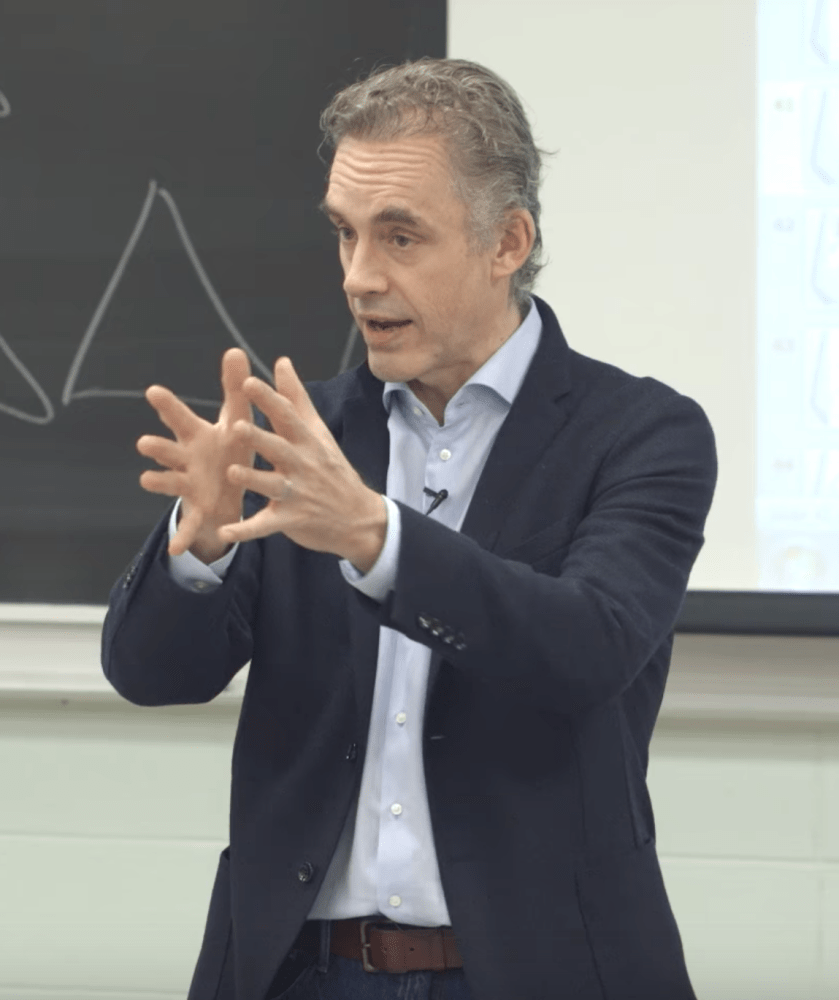
I recently started paying attention to Jordan Peterson.

This Canadian professor of psychology has built a huge international following, and his YouTube videos have millions of views.

Peterson is filling a hole in our culture about the importance of individuals taking personal responsibility for living an ethical life, and how this is the only path to a fulfilling life, and a healthy society, despite the reality that life is filled with malevolence and suffering.

Although Peterson is highly intelligent and well read, he appears unaware of overshoot and its many imminent threats.

Peterson also appears unaware of Varki’s MORT theory, which I suspect he would find interesting because Peterson is a dot connector and seeker of deep truth.

Nevertheless, Peterson offers fresh, inspiring, and wise advice useful for people, and especially young people, trying to navigate the coming storms.

I am reading Peterson’s new book, “12 Rules for Life: An Antidote to Chaos“, and may have more to say when done.

I so wish wise intellectual leaders like Jordan Peterson, Sam Harris, Lawrence Krauss, Steven Pinker, Richard Dawkins, Nick Lane, and Noam Chomsky were overshoot aware. Their intellect and influence could then be applied to the issues that matter.

The fact that most of the smartest people in the world are not overshoot aware, despite obvious elephants in the room, provides strong support in favor of Varki’s MORT theory.

This recent interview with Peterson is an excellent introduction to his work.


By Nate Hagens: Energy, Money and Technology: From the Lens of the Superorganism

Nate Hagens gives the best big picture talks, hands down.

What differentiates Nate is his wide and deep understanding of the economy, energy, ecology, and human behavior that he weaves into a coherent realty based description of our predicament.

Nate also does an admirable job of illuminating positive aspects of, and constructive personal responses to, the coming much smaller and less complex world we will all experience in the not too distant future.

Here is his latest talk, a keynote give January 23, 2018, at the King Abdullah University of Science and Technology in Saudi Arabia.

This talk is a refinement of similar talks by Nate I have previously posted. In addition to being more succinct and polished, this version benefits from high quality professional recording.

I’m looking forward to reading Nate’s new book which he said here will be published and made available for free in the next month or two.

Here are some comments Nate posted on his Facebook page.

Back from Saudi Arabia -was a short and great trip – the new King Abdullah University for Science and Technology is one of the richest schools in the world (something approaching $40 billion in endowment and as of yet only 1,000 students). My first trip to Middle East reasserted my belief that people the world over are pretty much the same (duh – we come from same place) – there are crazies and assholes in every country but most people are kind, warm, and pro-social. I had great conversations with taxi drivers, students, janitors, store clerks etc. I met a guy from Tunisia at airport and we laughed about all the world problems and what a time it was to be alive. Most humans just want to spend quality time w family and friends, tell stories and listen to music, play with their dog, do meaningful interesting work, and be free. It gives me hope that despite being African, Asian, European or American, despite being Christian, Buddhist, Muslim or Atheist, there is a growing group that transcends these tribal boundaries towards thinking about and working on the future transition. (another of a handful of silver linings facing some serious global storm clouds)

Below is the video of the keynote I gave – I finally condensed the relevant aspects of what we face into less than an hour, but had to speak pretty fast to do it. If you haven’t watched one of my talks for a while this would be the best one to watch (plus their technology was amazing, 5 cameras, etc.) (the 2nd talk The 40 Flawed Assumptions Underpinning Modern Civilization, was in a different venue and not filmed)


An interview with Nate was also recorded at the conference. I really like the thoughtful questions and responses, as well as it’s unhurried pace.

On Garrett Hardin’s Tragedy of the Commons

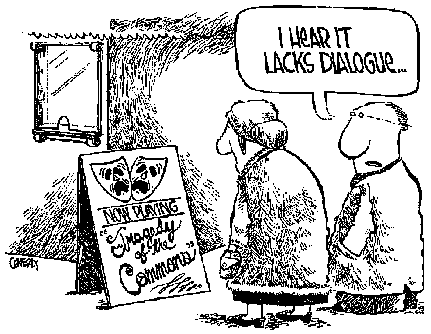
Tragedy of the Commons, Lacks Dialogue

“Freedom in a commons brings ruin to all.”

“The maximum is not the optimum.”

“We can’t cure a shortage by increasing the supply.”

“Birth control does not equal population control.”

“Exponential growth is kept under control by misery.”

– Garrett Hardin

Garrett Hardin (1915-2003) was a respected ecologist and philosopher who warned on the dangers of overpopulation. He wrote a famous 1968 paper titled “The Tragedy of the Commons” which you can download or view in full here.  More information on Garrett’s accomplishments and beliefs can be found at the Garrett Hardin Society site.

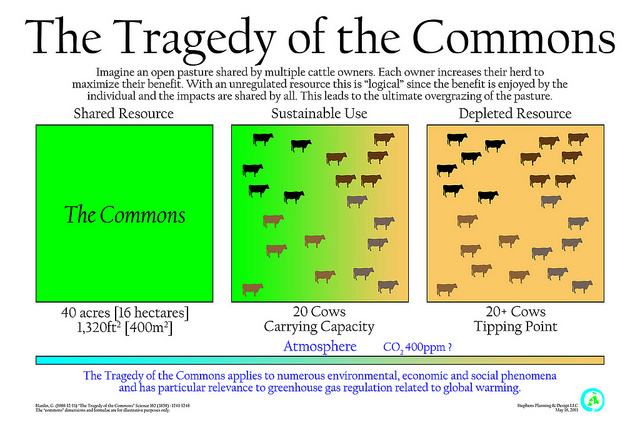
The central idea of the tragedy of the commons is that the collective effect of individuals making independent, well-intentioned, rational decisions regarding the use of a shared resource, leads to the degradation of the resource such that it can no longer support the individuals that depend upon it.

Tragedy of the Commons, Pasture and Climate

The classic example, and one we have repeated many times since we came to depend on agriculture 10,000 year ago, is the overgrazing of a pasture shared by herdsman.

A more modern example is someone who emits large quantities of CO2 into the atmospheric commons by flying long distances on a regular basis to spend quality time with family members whose lives will soon be harmed by climate change.

Tragedy of the Commons, Drivers

I was familiar with the concept of the tragedy of the commons but I was not aware that Garrett Hardin was the first modern scientist to write on the topic until a friend recently brought his paper to my attention. I read the paper, learned quite a bit, and recommend it to others.

I was particularly impressed with Hardin’s clear and direct thinking on the threat of over-population and what must be done to prevent it. Here are a few noteworthy excerpts from his essay.

The tragedy of the commons is involved in population problems in another way. In a world governed solely by the principle of “dog eat dog”–if indeed there ever was such a world–how many children a family had would not be a matter of public concern. Parents who bred too exuberantly would leave fewer descendants, not more, because they would be unable to care adequately for their children. David Lack and others have found that such a negative feedback demonstrably controls the fecundity of birds. But men are not birds, and have not acted like them for millenniums, at least.

If each human family were dependent only on its own resources; if the children of improvident parents starved to death; if, thus, overbreeding brought its own “punishment” to the germ line–then there would be no public interest in controlling the breeding of families. But our society is deeply committed to the welfare state, and hence is confronted with another aspect of the tragedy of the commons.

In a welfare state, how shall we deal with the family, the religion, the race, or the class (or indeed any distinguishable and cohesive group) that adopts overbreeding as a policy to secure its own aggrandizement? To couple the concept of freedom to breed with the belief that everyone born has an equal right to the commons is to lock the world into a tragic course of action.

Unfortunately this is just the course of action that is being pursued by the United Nations. In late 1967, some 30 nations agreed to the following:

The Universal Declaration of Human Rights describes the family as the natural and fundamental unit of society. It follows that any choice and decision with regard to the size of the family must irrevocably rest with the family itself, and cannot be made by anyone else.

It is painful to have to deny categorically the validity of this right; denying it, one feels as uncomfortable as a resident of Salem, Massachusetts, who denied the reality of witches in the 17th century. At the present time, in liberal quarters, something like a taboo acts to inhibit criticism of the United Nations. There is a feeling that the United Nations is “our last and best hope,” that we shouldn’t find fault with it; we shouldn’t play into the hands of the archconservatives. However, let us not forget what Robert Louis Stevenson said: “The truth that is suppressed by friends is the readiest weapon of the enemy.” If we love the truth we must openly deny the validity of the Universal Declaration of Human Rights, even though it is promoted by the United Nations.

It is a mistake to think that we can control the breeding of mankind in the long run by an appeal to conscience. Charles Galton Darwin made this point when he spoke on the centennial of the publication of his grandfather’s great book. The argument is straightforward and Darwinian.

People vary. Confronted with appeals to limit breeding, some people will undoubtedly respond to the plea more than others. Those who have more children will produce a larger fraction of the next generation than those with more susceptible consciences. The difference will be accentuated, generation by generation.

In C. G. Darwin’s words: “It may well be that it would take hundreds of generations for the progenitive instinct to develop in this way, but if it should do so, nature would have taken her revenge, and the variety Homo contracipiens would become extinct and would be replaced by the variety Homo progenitivus”.

Perhaps the simplest summary of this analysis of man’s population problems is this: the commons, if justifiable at all, is justifiable only under conditions of low-population density. As the human population has increased, the commons has had to be abandoned in one aspect after another.

The most important aspect of necessity that we must now recognize, is the necessity of abandoning the commons in breeding. No technical solution can rescue us from the misery of overpopulation. Freedom to breed will bring ruin to all. At the moment, to avoid hard decisions many of us are tempted to propagandize for conscience and responsible parenthood. The temptation must be resisted, because an appeal to independently acting consciences selects for the disappearance of all conscience in the long run, and an increase in anxiety in the short.

The only way we can preserve and nurture other and more precious freedoms is by relinquishing the freedom to breed, and that very soon. “Freedom is the recognition of necessity”–and it is the role of education to reveal to all the necessity of abandoning the freedom to breed. Only so, can we put an end to this aspect of the tragedy of the commons.

I summarize Hardin’s position as follows:

  • Failure to control population growth will result in ruin.
  • Population control via appeal to reason or conscience, or threat of shame, will not work, and will in fact make the situation worse. Population can only be effectively controlled by coercion, that is, laws with penalties for overbreeding.
  • The key to passing population control laws is to educate citizens on the reality that if they do not relinquish the freedom to breed they will lose all of their freedoms, including eventually the freedom to breed.

Garrett Hardin was a wise and prescient man who attempted to warn his fellow citizens of a serious threat to their well being, and most importantly, told them what they needed to do and why.  Other great people have attempted to do the same, for example, Dennis Meadows and his collaborators on the 1972 Limits to Growth study.

Hardin’s essay was written 50 years ago when the world’s population was 3.5 billion, a level already far in excess of what can be sustained without abundant, affordable, non-renewable, finite, and depleting fossil energy.

Over the last 50 years the population more than doubled to 7.6 billion and many new overshoot threats backed by solid scientific understanding have emerged like climate change, net energy decline, and ground level ozone.

There’s been plenty of information and (opportunity for) education. We can therefore conclude that Hardin’s assumption that education is the key to preventing overshoot is wrong.

As readers of this blog know, I think the key impediment to changing human behavior in a positive direction is the fact that humans evolved to denial reality, as explained by Varki’s MORT theory.

How can a majority emerge to support a contentious law to control breeding when the vast majority of the 7.6 billion people on the planet deny the existence of overshoot?

Much has been written by many people on the tragedy of the commons. Commentators typically fall into one of two groups:

The first group appreciates the centrality of the commons problem to human existence and spends much energy arguing how best to address the problem with the usual divisive, inconclusive, and unproductive positions of right vs. left, private vs. public, capitalism vs. socialism, libertarian vs. autocratic , etc.

The second group denies a commons problem exists, or thinks innovation and technology will solve any problems.

Where is the most important and missing third group?

That would be the group searching for an understanding of how an otherwise uniquely intelligent species can deny its obvious predicament. Brief reflection leads to the obvious conclusion that until we understand the genetic basis for our ability, on the one hand, to understand highly complex topics, like the laws of  physics that explain the creation of the universe and life, and on the other hand, to selectively deny much simpler and plainly obvious facts, like human overshoot and our own mortality, we have no hope of addressing the tragedy of the commons, or any of the other behaviors that threaten our species.

A few people have achieved some insight into our tendency to deny reality but I observe that they usually soon thereafter drop their pursuit of understanding.  I find this very curious because if you have a deep understanding of the human predicament there is nothing more import to understand and to raise awareness of than reality denial.

If you deny the existence or implications of overshoot, then it is logical to embrace one or more of the many arguments against a one child law, austerity, and conservation. On the other hand, if you embrace the reality of overshoot, then a one child law, austerity, and conservation not only become perfectly reasonable, they become the most important, ethical, moral, and rational things we must do.

There is an exciting (for me) passage in Hardin’s essay that hints he may have  understood or anticipated at least a portion of the MORT theory.

…the rational herdsman concludes that the only sensible course for him to pursue is to add another animal to his herd. And another; and another…  But this is the conclusion reached by each and every rational herdsman sharing a commons. Therein is the tragedy. Each man is locked into a system that compels him to increase his herd without limit–in a world that is limited. Ruin is the destination toward which all men rush, each pursuing his own best interest in a society that believes in the freedom of the commons. Freedom in a commons brings ruin to all.

Some would say that this is a platitude. Would that it were! In a sense, it was learned thousands of years ago, but natural selection favors the forces of psychological denial (8). The individual benefits as an individual from his ability to deny the truth even though society as a whole, of which he is a part, suffers.

Education can counteract the natural tendency to do the wrong thing, but the inexorable succession of generations requires that the basis for this knowledge be constantly refreshed.

Hardin demonstrated a flash of denial insight by correctly identifying the key issue, but then neglected to explore further in his tragedy of the commons essay.  Unfortunately the reference for his comment on denial is the book “Population, Evolution, and Birth Control“, which is a collection of essays by different authors that Hardin published in 1964, in which Hardin himself contributed an essay titled “Denial and the Gift of History”, and is not available on the internet. I would be grateful if a reader has a hard copy of this book and would be kind enough to provide a summary of his essay.

My expectation is that Hardin did not elaborate on denial of reality because there was ample opportunity for him to do so in his other books, papers, and interviews that I downloaded and searched.

I did find this one excerpt from an interview but it is not very insightful and he clearly thinks the solution is more education:

RUSSELL: Okay. The idea of statistics and the population–I have no reason to really go over that. The other one, of denial and the gift of history, which was a fascinating idea. Our view of working at it, our immortality.

HARDIN: Yes. Well, I think everybody, as he grows older and accumulates more experience and more observation of other people–of himself, too–is impressed with how often we try to fool ourselves. It’s an inescapable human tendency. This is part of original sin, trying to fool ourselves, and always to make things look better than they are. The question is, since we’re so ingenious at pulling the wool over our own eyes, what contrary measures can be taken? It seemed to me that this is one of the great apologies for teaching history: when you see other people in the past, people with whom you have no connection, making the same mistakes, then you can, I think, be more objective about yourself, and say, “Well, maybe I’m just repeating what this guy did two- or three-hundred years ago.” And this, I think, is one of the great gifts of history. It gives us long arms for holding instructive examples far enough from our eyes.

A search also suggested that no one else in 50 years thought Hardin’s comment on reality denial was worth discussing. Many people saw and see merit in Hardin’s work, but all seem to have missed his most important point, including perhaps Hardin himself.

I also note that Ajit Varki, the only surviving author of the MORT theory, is no longer researching, or attempting to spread awareness of his theory. Varki is instead leading some research on Glycobiology, which with time, will prove to be insignificant compared to MORT.

Because we understand the dangers, we do not permit alcoholics, or epileptics, or schizophrenics, or blind people to fly our planes.

If we understood our genetic tendency to deny reality, we might not permit reality deniers, which by the way are very easy to detect, to run for elected office.

Many impressive scientists and leaders are working hard to shift the needle on human overshoot. All have failed, and all will continue to fail, if they do not embrace the MORT theory.

We need some scientists and leaders of stature to step up and push awareness of the MORT theory.

A cranky old retired electrical engineer writing a blog doesn’t cut it.

It is too late to avoid a lot of suffering, but with awareness of our predicament we could reduce future suffering, and we might avoid harmful emotional reactions like nuclear war or revolutions.

If we have a hope, MORT awareness might be our only hope.

By Ugo Bardi: Are We Decoupling?

energygdp2017

http://cassandralegacy.blogspot.ca/2017/12/are-we-decoupling-not-really-but-happy.html

When driving at speed towards a brick wall should you accelerate or brake? The laws of physics prevent you from going through the brick wall, but you can influence the condition of your health at the brick wall.

This essay by Ugo Bardi shows that our standard of living is totally dependent on non-renewable resources that emit carbon. If we continue with monetary strategies to maintain business as usual we will experience a brick wall at speed when debt accumulates to a level that makes it ineffective at supporting the extraction of high cost fossil energy, and prior to the crash, we will continue to push the climate from an already unsafe state to something worse.

A wise society would acknowledge its denial of a dire predicament, set a goal to maximize well-being at the brick wall, and step on the brake to manage a fair and civil contraction of the economy via population reduction, austerity, and conservation.

Decoupling looks like an obvious idea, isn’t it? After all, isn’t that true that we are becoming more efficient? Think of a modern LED light compared with an old lamp powered by a whale oil. We are now hundreds of times more efficient than we were and we also saved the whales (but, wait, did we…..?). So, if we can do the same things with much less energy, then we could grow the economy without using more energy, solving the climate problem and also the depletion problem. It is part of the concept of “dematerialization” of the economy. Then we paint everything in green and all will be well in the best of worlds.
But there has to be something wrong with this idea, because it is just not happening, at least at the global scale. Just take a look at the above image.
In the end, society needs energy to function and the idea that we can do more with less with the help of better technologies seems to be just an illusion. If we reduce energy consumption, we’ll most likely enter a phase of economic decline. Which might not be a bad thing if we were able to manage it well. Maybe. Calling this “a challenge” seems to be a true euphemism, if ever there was one. But, who knows? Happy 2018, everybody!

The Great Story (A Reality Based Religion led by Michael Dowd)

2-gs-photo

Michael Dowd recently introduced himself in a comment on one of my blog posts. Reviewing his large body of work has been a pleasant surprise because I thought I was aware of most of the thinkers and activists in the overshoot space, and Dowd has some excellent fresh ideas.

We seem to share a few things in common. We were born within 7 days of each other. We have been deeply influenced by many of the same great minds. We have come to similar conclusions about the severity of human overshoot. And we both would like to find some path to making the future less bad.

I’ve long thought there might only be two possible paths to pulling humanity back from the precipice. All of our destructive behaviors were created in the crucible of evolution when daily survival was paramount and overshoot was a distant future problem. Any “solution” must acknowledge the genetic underpinning of our behaviors and find a way to shift those behaviors in a positive direction.

One possible path is to acknowledge the genetic disposition for spirituality in humans, and the power religions have had throughout history to influence behavior, and to create a new religion with an overshoot harm reduction agenda. This is the path it seems Dowd has chosen.

Dowd leads a new religion grounded in science and reality that worships the universe and life, and that acknowledges the special responsibility our species has because of its rare and possibly unique ability to understand how the universe and life were created, and how our behaviors are placing us and other species in peril.

Here are the ten commandments:

ten-commandments-one-slide

This is the third of a three-part series of videos Dowd recommended as an overview of his movement. I think this sermon is excellent and worth your time.

Dowd thinks that religions are stories created by humans to explain the reality they currently live in. Our reality today is much different from the reality 2000 years ago. Today we understand the science of lightning and floods and famine and plagues and life and death. Dowd says we need to update our religious stories to reflect our current understanding of the world. He makes a persuasive case that this new story is much more majestic and inspiring than any of the old stories. An example Dowd gives is that everything in the universe, including amazing brains capable of understanding this paragraph, emerged from a cloud of hydrogen that obeyed a few well understood physical laws.

Dowd thinks the genetic underpinning of religion is the brain’s propensity to give human characteristics to non-human things in our world. I do not disagree with Dowd that the brain has this behavior but I would explain it differently. The human brain is a computing machine that creates models to explain and predict reality. We create new models using fragments of models we already have to explain what we see and to influence what we hope will happen. Some of these models (or stories) have evolved over time into thousands of religions and gods.

So far so good. Where we may disagree is that I think Varki’s MORT theory points to a deeper and more important genetic foundation of religion, denial of mortality. There is much evidence to this claim which I explored here and here. An important point being that if religions were mainly about explanatory stories and not about denial of mortality we would expect to see a few random religions with life after death stories, but not as we observe, a life after death story central to every single one of the thousands of religions, including new religions like Scientology. As a famous comedian/actor whose name we may no longer speak once said, “I don’t want to live on in the minds of my fans, I want to live on in my apartment”.

The reproductive fitness of an intelligent social species is often improved by a more powerful brain. Therefore there is evolutionary pressure in some species to become smarter. As a brain evolves increased computing power it reaches a point at which it can understand its own mortality. The MORT theory rests on the assumption, which I believe to be true, that the human brain is the only brain on our planet that has evolved this level of power. MORT explains that sufficient brain power to understand mortality, on its own, lowers reproductive fitness through reduced risk taking and depression because all complex species have evolved behaviors to avoid injury and death. Thus there is a barrier to increased brain power that can only be crossed by simultaneously evolving denial of mortality. Crossing this barrier requires an improbable evolutionary event, analogous to the energy per gene barrier that blocked complex life for 2 billion years until a rare endosymbiosis (merging) of prokaryotes (simple cells) created the eukaryotic cell.

Humans are the only species, so far, on our planet to have crossed the barrier. Several other intelligent social species like elephants, dolphins, chimpanzees, and crows may be blocked at the barrier. It seems likely we outcompeted or killed all of our many hominid cousins that were blocked at the barrier for over a million years.

Evolution appears to have implemented denial of mortality in humans by tweaking the fear suppression module in our brain, which resulted in behavior that manifests as broad denial of all unpleasant realities, including mortality.

This then leads to the second promising path for trying to make the future less bad.  I believe it is our inherited denial of reality that is the most important obstacle to shifting human behavior in a positive direction.

There are several encouraging examples that suggest broad awareness of a harmful inherited behavior can shift society’s average behavior in a positive direction. I plan to explore these examples in a later essay.

So my chosen path is to try to increase awareness of our strong genetic tendency to deny the behaviors that cause overshoot, and to deny the imminent dangers of overshoot.

I nevertheless applaud Dowd’s chosen path and wish him well. It will be interesting to see if a religion can succeed that conflicts with the underlying goals of our genes, namely to maximize replication by competing for finite resources.

It must have been so much easier 2000 years ago when the message of religions was to go forth, multiply, and exploit the earth’s bounty that God created for the exclusive benefit of his chosen people.

I know from experience that a message of no more than one child, austerity, and conservation is a tough sell.

I recommend you spend some time at Dowd’s site The Great Story. It has a deep library of wisdom from many great minds relevant to our predicament.

Dowd has invested a large amount of time creating audio versions of important books and documents. I’m currently re-reading his audiobook version of William R. Catton, Jr.’s seminal 1980 book Overshoot: The Ecological Basis of Revolutionary Change.