By Alice Friedemann: German Military Study on Peak Oil

German Military - Peak Oil Study - 2010

Alice Friedemann summarizes here a 2010 study on peak oil conducted by the German military.

http://energyskeptic.com/2017/german-military-peak-oil-summary/

The original full report can be found here.

And what was the German government’s response to this excellent report on peak oil by their own military?

They increased their population with immigration.

Denial is amazing!


Today approximately 90% of all industrially manufactured products depend on the availability of oil. Oil is not only the source material for producing fuels and lubricants but is also used as hydrocarbon for most plastic. It is one of the most important raw materials in the production of many different products such as pharmaceuticals, dyes and textiles. As the source material for various types of fuels, oil is a basic prerequisite for the transportation of large quantities of goods over long distances. Alongside information technology, container ships, trucks and aircraft form the backbone of globalization. Oil-based mobility also significantly influences our lifestyle, both regionally and locally. For example, living in suburbs several miles from their workplace would be impossible for many people without a car.


Societal risks of peak oil

  1. Economic collapse
  2. Transportation restricted
  3. Erosion of confidence in state institutions

There are not sufficient alternatives to oil for transportation, so when oil grows short, there are likely to be extreme restrictions for private vehicles, especially in suburbs, resulting in a “mobility crisis” that would make the economic crisis much worse.

Scarce or expensive oil would drive up the cost of all goods. Our current international movement of goods has largely been made possible by the technological progress in the field of freight traffic (container ships, trucks, cooling systems), which are based on fossil fuels.  So trying to switch all modes of transport to alternative energy sources is much more complex with today’s common means of transportation and technology. Mobility on the basis of fossil fuels is likely to remain a long time.   Oil shortages could lead to bottlenecks in delivering food and other life-sustaining essential goods.

After peak oil, there would be significant differences from past food shortages:

  • The crisis would concern all food traded over long distances, not just single regions or products. Regions that are structurally already at risk today would however be particularly affected (see figure 6).
  • Crop yields also depend on oil. Lack of machines or oil-based fertilizers and other chemicals to increase crop yield would therefore have a negative effect on crop production
  • The increase in food prices would be long-term
  • Competition between the use of farmland for food production and for producing biofuels could worsen food shortages and crises.


After oil shortages people will experience a lowering of living standards due to an increase in unemployment and the cost of oil for their vehicles. Studies reveal that only continuous improvement of individual living conditions provide the basis for tolerant and open societies. Setbacks in economic growth can lead to an increase in the number of votes for extremist and nationalistic parties.


Other likely consequences

Banks left with no commercial basis. Banks would not be able to pay interest on deposits as they would not be able to find creditworthy companies, institutions or individuals. As a result, they would lose the basis for their business.

Loss of confidence in currencies. Belief in the value-preserving function of money would dwindle. This would initially result in hyperinflation and black markets, followed by a barter economy at the local level.

Collapse of value chains. The division of labor and its processes are based on the possibility of trade in intermediate products. It would be extremely difficult to conclude the necessary transactions lacking a monetary system.

Collapse of unpegged currency systems. If currencies lose their value in their country of origin, they can no longer be exchanged for foreign currencies. International value-added chains would collapse as well.

Mass unemployment. Modern societies are organized on a division-of-labor basis and have become increasingly differentiated in the course of their histories. Many professions are solely concerned with managing this high level of complexity and no longer have anything to do with the immediate production of consumer goods. The reduction in the complexity of economies that is implied here would result in a dramatic increase in unemployment in all modern societies.

National bankruptcies. In the situation described, state revenues would evaporate. (New) debt options would be very limited, and the next step would be national bankruptcies.

Collapse of critical infrastructures. Neither material nor financial resources would suffice to maintain existing infrastructures. Infrastructure interdependencies, both internal and external with regard to other subsystems, would worsen the situation.

Famines. Ultimately, production and distribution of food in sufficient quantities would become challenging.

War.  Oil shortages are likely to be seen by importing nations as a national security issue leading to conflict, which could also emerge over renewable energy resources.

By Chris Martenson: Signs of Distress

https://www.peakprosperity.com/blog/110096/signs-distress

What if there’s nothing wrong with the people who are anxious or depressed, but the exact opposite is true; those who are cheerful and chipper are missing the plot?


The world is edging closer to the final moments after which everything will be forever changed. Grand delusions, perpetuated over decades, will finally hit the limits of reality and collapse in on themselves.

We’re over-budget and have eaten deeply into the principal balances of all of our main trust accounts. We are ecologically overdrawn, financially insolvent, monetarily out past the Twilight Zone, consuming fossil fuels (as in literally eating them), and adding 80,000,000 net souls to the planet’s surface — each year! — without regard to the consequences.

Someday there will be hell to pay financially, economically, and ecologically as there simply isn’t any way to maintain these overdrafts forever. Reality does not renegotiate. Its deal terms aren’t compromisable.

For those who have the neural plasticity to actually see what’s happening around us, the changes are already here, blatant and frightening. Younger folks, with their fresher eyes and fewer ties to the past, can see them a lot easier than their elders.

The prosperity enjoyed by the past few generations — especially the Baby Boomers — was stolen from future generations. All the while, they pretended as if their borrowing-heavy standards of living were the result of sheer genius and intelligence; like trust fund babies who mistake being born on third base for hitting a triple.

Young people have sussed this out; and are now pulling back from many of the principal occupations of their forebears — like marriage, babies and buying homes and cars. This perplexes older folks, who are beginning to find themselves increasingly at odds with the generations following after them.

Humans can be very very smart, but the flip-side of our ingenuity is our capacity for self-delusion. We’ve very consistently preferred to look past our faults. That can work for a while, but eventually an incomplete view will lead to a complete disaster. For example: depleting our topsoils today to grow more eventually leads to a collapse of our food system tomorrow. Similarly, increasing societal complexity ultimately drains the resources out of an empire, until it withers and fails. Such is what we can learn from history. Each of these examples is rooted in the self-delusion that today’s actions don’t have real consequences.

Monetary printing experiments like those currently being run by the world’s central banks are the ultimate form of self-delusion. Money is the most potent form of social communication, underlying all contracts and agreements. Violate those and literally everything falls apart, as we are seeing happen in real-time in Venezuela right now.

Money printing and its other historical debasement equivalents, serve to cover up (barely) critical signals. Derelict ideas that should die a quick death, instead, persist. Mis-priced money leads mal-investment (e.g., Italian junk debt selling with the same yield as ten year US Treasury debt!!). Extremely unfair redistributions of wealth from the bottom to the top result. Every. Single. Time. This time is no different.

By Alice Friedemann: Why Did Everyone Stop Talking about Population & Immigration?

Alice Friedemann lists the top 20 reasons we stopped talking about the most important issue we should be talking about: population reduction.

I wrote an essay on the same topic here.

I note that we also stopped talking about the importance of living within our means and avoiding excessive debt.

And we don’t talk like adults about climate change.

Nor do we discuss peak oil.

Or species extinction.

All of these issues are dimensions of human overshoot and are underpinned by denial of reality.

As you read Friedemann’s excellent essay observe that every one of the 20 reasons has denial at its core.

http://energyskeptic.com/2017/why-are-population-immigration-taboo-topics/

1) The Consumption of Wealthy Nations is the problem. Not the Poor.

2) It’s taboo to mention the link between poverty and population

3) Don’t worry, America’s birth rate went down

4) Feminists and Human-rights groups took over the Sierra Club

5) Cornucopian and Leftists Environmentalists also destroyed immigration and population stabilization goals

6) The American public is not scientifically educated and ignores warnings from scientists

7) Educating Women to lower population a nice idea but…

8) Only humans matter, screw the other species on the planet

9) Anyone who wants to limit immigration or population is portrayed as a racist

10) The Sierra club and other environmental groups abandoned immigration level goals

11) We must have more population growth to fund retirees and grow the economy

12) Immigrants take jobs Americans don’t want

13) We’re wealthy, so we’re obliged to offer shelter to immigrants, and we are a nation of immigrants

14) Nature keeps us alive

15) 1994 United Nations International Conference on Population and Development

16) Standard demographic theory

17) It’s Human Nature not to worry about overpopulation

18) Don’t worry: the fertility rate and disease are driving population down

19) Propaganda from anti-abortion activists, religious leaders, and right-wing think tanks

20) Many people don’t understand how powerful exponential growth is

By Richard Heinberg: Are We Doomed? Let’s Have a Talk.

climate_change_is_real_is_the_doom

Richard Heinberg is one of the early voices that sounded the alarm on limits to growth. He has a wide and deep understanding of the issues, and is an excellent and prolific writer.

In earlier years he usually concluded his books and essays with some variation of “the good news is everything will be ok if we just do xyz”.

Lately he has been speaking more openly and honestly.

This latest essay is a no holds barred full-on dose of reality.

Good on him. Someone needs to speak the truth.

One quote stood out for me:

Accepting that a crash is more or less inevitable is a big step, psychologically speaking. I call this toxic knowledge: one cannot “un-know” that the current world system hangs by a thread, and this understanding can lead to depression. In some ways, the systemic crisis we face is analogous to the individual existential crisis of life and death, which we each have to confront eventually. Some willfully ignore their own mortality for as long as possible; others grasp at a belief in the afterlife.

Heinberg, apparently without awareness of Varki’s theory, is dancing around the fact that denial of reality is central to what makes us human, as it was the barrier created by awareness of mortality, and nature’s solution of evolving denial of death via a more general denial of realty mechanism, that enabled us to evolve an extended theory of mind, which we used to take over the planet, and to enter an extreme state of overshoot.


Are we doomed if we can’t maintain current and growing energy levels? And are we doomed anyway due to now-inevitable impacts of climate change?

First, the good news. With regard to energy, we should keep in mind the fact that today’s Americans use roughly twice as much per capita as their great-grandparents did in 1925. While people in that era enjoyed less mobility and fewer options for entertainment and communication than we do today, they nevertheless managed to survive and even thrive. And we now have the ability to provide many services (such as lighting) far more efficiently, so it should be possible to reduce per-capita energy usage dramatically while still maintaining a lifestyle that would be considered more than satisfactory by members of previous generations and by people in many parts of the world today. And reducing energy usage would make a whole raft of problems—climate change, resource depletion, the challenge of transitioning to renewable energy sources—much easier to solve.

The main good news with regard to climate change that I can point to (as I did in  this essay posted in June) is that economically recoverable fossil fuel reserves are consistent only with lower-emissions climate change scenarios. As BP and other credible sources for coal, oil, and natural gas reserves figures show, and as more and more researchers are pointing out, the worst-case climate scenarios associated with “business as usual” levels of carbon emissions are in fact unrealistic.

Now, the bad news. While we could live perfectly well with less energy, that’s not what the managers of our economy want. They want growth. Our entire economy is structured to require constant, compounded growth of GDP, and for all practical purposes raising the GDP means using more energy. While fringe economists and environmentalists have for years been proposing ways to back away from our growth addiction (for example, by using alternative economic indices such as Gross National Happiness), none of these proposals has been put into widespread effect. As things now stand, if growth falters the economy crashes.

There’s bad climate news as well: even with current levels of atmospheric greenhouse gases, we’re seeing unacceptable and worsening impacts—raging fires, soaring heat levels, and melting icecaps. And there are hints that self-reinforcing feedbacks maybe kicking in: an example is the release of large amounts of methane from thawing tundra and oceanic hydrates, which could lead to a short-term but steep spike in warming.  Also, no one is sure if current metrics of climate sensitivity (used to estimate the response of the global climate system to a given level of forcing) are accurate, or whether the climate is actually more sensitive than we have assumed. There’s some worrisome evidence the latter is case.

But let’s step back a bit. If we’re interested in signs of impending global crisis, there’s no need to stop with just these two global challenges. The world is losing 25 billion tons of topsoil a year due to current industrial agricultural practices; if we don’t deal with that issue, civilization still crash even if we do manage to ace our energy and climate test. Humanity is also over-using fresh water: ancient aquifers are depleting, while other water sources are being polluted. If we don’t deal with our water crisis, we still crash. Species are going extinct at a thousand times the pre-industrial rate; if we don’t deal with the biodiversity dilemma, we still crash. Then there are social and economic problems that could cause nations to crumble even if we manage to protect the environment; this threat category includes the menaces of over-reliance on debt and increasing economic inequality.

If we attack each of these problems piecemeal with technological fixes (for example, with desalination technology to solve the water crisis or geo-engineering to stabilize the climate) we may still crash because our techno-fixes are likely to have unintended consequences, as all technological interventions do. Anyway, the likelihood of successfully identifying and deploying all the needed fixes in time is vanishingly small.

Many problems are converging at once because society is a complex system, and the challenges we have been discussing are aspects of a systemic crisis.

Many problems are converging at once because society is a complex system, and the challenges we have been discussing are aspects of a systemic crisis. A useful way to frame an integrated understanding of the 21st century survival challenge is this: we humans have overshot Earth’s long-term carrying capacity for our species. We’ve been able to do this due to a temporary subsidy of cheap, bountiful energy from fossil fuels, which enabled us to stretch nature’s limits and to support a far larger overall population than would otherwise be possible. But now we are starting to see supply constraints for those fuels, just as the side effects of burning enormous amounts of coal, oil, and natural gas are also coming into view. Meanwhile, using cheap energy to expand resource-extractive and waste-generating economic processes is leading to biodiversity loss; the depletion of soil, water, and minerals; and environmental pollution of many kinds. Just decarbonizing energy, while necessary, doesn’t adequately deal with systemic overshoot. Only a reduction of population and overall resource consumption, along with a rapid reduction in our reliance on fossil fuels and a redesign of industrial systems, can do that.

Economic inequality is a systemic problem too. As we’ve grown our economy, those who were in position to invest in industrial expansion or to loan money to others have reaped the majority of the rewards, while those who got by through selling their time and labor (or whose common cultural heritage was simply appropriated by industrialists) have fallen behind. There’s no technological fix for inequality; dealing with it will require redesigning our economic system and redistributing wealth. Those in wealthy nations would, on average, have to adjust their living standards downward.

Now, can we do all of this without a crash? Probably not. Indeed, many economists would regard the medicine (population reduction, a decline in per-capita energy use, and economic redistribution) as worse than whatever aspects of the disease they are willing to acknowledge. Environmentalists and human rights advocates would disagree. Which is to say, there’s really no way out. Whether we stick with business as usual, or attempt a dramatic multi-pronged intervention, our current “normal” way of life is toast.

Accepting that a crash is more or less inevitable is a big step, psychologically speaking. I call this toxic knowledge: one cannot “un-know” that the current world system hangs by a thread, and this understanding can lead to depression. In some ways, the systemic crisis we face is analogous to the individual existential crisis of life and death, which we each have to confront eventually. Some willfully ignore their own mortality for as long as possible; others grasp at a belief in the afterlife. Still others seek to create meaning and purpose by making a positive difference in the lives of those around them with whatever time they have. Such efforts don’t alter the inevitability of death; however, contributing to one’s community appears to enhance well-being in many ways beyond that of merely prolonging life.

But is a crash the same as doom?

Not necessarily. Our best hope at this point would seem to be a controlled crash that enables partial recovery at a lower level of population and resource use, and that therefore doesn’t lead to complete and utter oblivion (human extinction or close to it). Among those who understand the systemic nature of our problems, the controlled crash option is the subject of what may be the most interesting and important conversation that’s taking place on the planet just now. But only informed people who have gotten over denial and self-delusion are part of it.

This discussion started in the 1970s, though I wasn’t part of it then; I joined a couple of decades later. There is no formal membership; the conversation takes place through and among a patchwork of small organizations and scattered individuals. They don’t all know each other and there is no secret handshake. Some have publicly adopted the stance that a global crash is inevitable; most soft-pedal that message on their organizational websites but are privately plenty worried. During the course of the conversation so far, two (not mutually exclusive) strategies have emerged.

The first strategy envisions convincing the managers and power holders of the world to invest in a no-regrets insurance plan. Some systems thinkers who understand our linked global crises are offering to come up with a back-pocket checklist for policy makers, for moments when financial or environmental crisis hits: how, under such circumstances, might the managerial elite be able to prevent, say, a stock market crash from triggering food, energy, and social crises as well? A set of back-up plans wouldn’t require detailed knowledge of when or how crisis will erupt. It wouldn’t even require much of a systemic understanding of global overshoot. It would simply require willingness on the part of societal power holders to agree that there are real or potential threats to global order, and to accept the offer of help. At the moment, those pursuing this strategy are working mostly covertly, for reasons that are not hard to discern.

The second strategy consists of working within communities to build more societal resilience from the ground up. It is easier to get traction with friends and neighbors than with global power holders, and it’s within communities that political decisions are made closest to where the impact is felt. My own organization, Post Carbon Institute, has chosen to pursue this strategy via a series of books, the Community Resilience Guides;  the “Think Resilience” video series; and our forthcoming compendium, The Community Resilience Reader.  Rob Hopkins, who originated the Transition Towns movement, has been perhaps the most public, eloquent, and upbeat proponent of the local resilience strategy, but there are countless others scattered across the globe.

Somehow, the work of resilience building (whether top-down or bottom-up) must focus not just on maintaining supplies of food, water, energy, and other basic necessities, but also on sustaining social cohesion—a culture of understanding, tolerance, and inquiry—during times of great stress. While it’s true that people tend to pull together in remarkable ways during wars and natural disasters, sustained hard times can lead to scapegoating and worse.

Most people are not party to the conversation, not aware that it is happening, and unaware even that such a conversation is warranted. Among those who are worried about the state of the world, most are content to pursue or support efforts to keep crises from occurring by working via political parties, religious organizations, or non-profit advocacy orgs on issues such as climate change, food security, and economic inequality. There is also a small but rapidly growing segment of society that feels disempowered as the era of economic growth wanes, and that views society’s power holders as evil and corrupt. These dispossessed—whether followers of ISIS or Infowars—would prefer to “shake things up,” even to the point of bringing society to destruction, rather than suffer the continuation of the status quo. Unfortunately, this last group may have the easiest path of all.

Can we succeed? It depends on how one defines “success”…

By comparison, the number of those involved in the conversation is exceedingly small, countable probably in the hundreds of thousands, certainly not millions. Can we succeed? It depends on how one defines “success”—as the ability to maintain, for a little longer, an inherently unsustainable global industrial system? Or as the practical reduction in likely suffering on the part of the survivors of the eventual crash? A related query one often hears after environmental lectures is, Are we doing enough? If “Enough” means “enough to avert a system crash,” then the answer is no: it’s unlikely that anyone can deliver that outcome now. The question should be, What can we do—not to save a way of life that is unsalvageable, but to make a difference to the people and other species in harm’s way?

This is not a conversation about the long-term trajectory of human cultural evolution, though that’s an interesting subject for speculation. Assuming there are survivors, what will human society look like following the crises ensuing from climate change and the end of fossil fuels and capitalism? David Fleming’s book, Surviving the Future, and John Michael Greer’s, The Ecotechnic Future, both  offer useful thoughts in this regard. My own view is that it’s hard for us to envision what comes next because our imaginations are bounded by the reality we have known. What awaits will likely be as far removed from from modern industrial urban life as Iron-Age agrarian empires were from hunting-and-gathering bands. We are approaching one of history’s great discontinuities. The best we can do under the circumstances is to get our priorities and values straight (protect the vulnerable, preserve the best of what we have collectively achieved, and live a life that’s worthy) and put one foot in front of the other.

The conversation I’m pointing to here is about fairly short-term actions. And it doesn’t lend itself to building a big movement. For that, you need villains to blame and promises of revived national or tribal glory. For those engaged in the conversation, there’s only hard work and the satisfaction of honestly facing our predicament with an attitude of curiosity, engagement, and compassion. For us, threats of doom or promises of utopia are distractions or cop-outs.

Only those drawn to the conversation by temperament and education are likely to take it up. Advertising may not work. But having a few more hands on deck, and a few more resources to work with, can only help.

By Ron Patterson: Africa in Peril

africa-1

http://peakoilbarrel.com/africa-in-peril/

The wildlife decline in most of the world is terrible, but in Africa it is catastrophic. By 2100 there will be no megafauna whatsoever in Africa. All elephants, giraffes, rhinoceroses, lions, gorillas, chimpanzees, and even zebras and wildebeest will be totally extinct. And the culprit in this huge animal extinction is Africa’s massive overpopulation problem. It is terrible today but is about to get a whole lot worse.

The population of Africa, in 2016, was 1.22 billion. The UN estimates that in 2100 the population of Africa will be about 4.45 billion. Notice that is an increase of about 300 million from their estimate just five years ago. But their 2100 population estimate has doubled since their 1998 estimate.

In 2100 one African country, Nigeria will have a larger population than all of Europe combined.

The reason for this Sub-Sahara African population explosion is the decline in infant mortality rates along with their very high fertility rate. With the exception of South Africa, Sub-Sahara African women have 5.5 children (average) during their life. This rate has been slowly decreasing but not enough to decrease the population growth significantly.

The top 15 fertility rates in the world are all in Africa. The Sub-Saharan population is increasing at the rate of 2.5 percent annually. This is double the rate of both Asia and Latin America.

By 2100 there will be no megafauna whatsoever left in Africa except for humans and their domestic animals. Elephants, giraffes, rhinos, and even zebras and wildebeest will all be gone. And of course, all the big cats like lions and cheetahs will be gone as well. Even the hyenas will disappear because there will be no prey for the prey animals to feed on. However, a few wild dogs may remain as there will likely still be a few small ground animals for them to feed on.

Many will say that Europe is even more overpopulated than Africa. And this is true at this point in time. But that will definitely not be the case in the future. And remember that the wildlife in Europe is already gone except for small animals like rabbits and squirrels and a few foxes that prey on them. The wild European megafauna disappeared decades or even centuries ago. Okay, a few mountain goats, lynx other such animals still thrive high in the Alps. But wherever in Europe it is possible for humans to settle and farm, the megafauna has been driven out, usually to extinction. And that will soon be the case for Africa as well. The last habitat for megafauna, in Africa, Asia, and the Americas, is disappearing fast. It will soon be gone.

Extinction is permanent! If civilization survives another million years the elephants, giraffes, lions and all the other megafauna will still be gone. If you don’t think this earth has a very serious human overpopulation problem, then you are stone blind to the peril of our wildlife.

By Ugo Bardi: When governments operate in “cheating mode”

Problems are frequently blamed on the other 50%, or immigrants, or Russia, rather than on pollution, resource depletion, and overshoot.

I often wonder if the elites are knowingly deceitful, or if they are in denial and believe what they tell us.

I suspect the latter.

It seems to be a general observation that, when facing a serious threat, the elites of a country can reason that the best strategy for them is to cheat the people and save themselves. In the present situation, the threat of global warming seems to be driving some elites to do exactly that. They deny the threat while at the same time maneuvering to save themselves by moving to higher grounds and equipping their mansions with air conditioning. For all they care, the rest of the people can drown or roast.

But, as the threat of climate change becomes clearer, the elites may discover that nobody can survive in an uninhabitable planet. Then, they may finally decide to try to do something to save the ecosystem from which we all depend. But it may well be too late.

http://cassandralegacy.blogspot.ca/2017/07/when-governments-operate-in-cheating.html

By Joe Barry: Over-population is the Real Cause of Climate Change

population-killing-us-may-16

Thanks to JH for bringing this article to my attention.

http://churchandstate.org.uk/2016/05/over-population-is-the-real-cause-of-climate-change-its-killing-us-all-off/

…if changing the way we behave requires a reduction in our living standards, then nothing will happen.

The remarkable thing is that the real cause of global warming is rarely mentioned. It is the elephant in the room. Everyone can see it but no one wants to speak about it, presumably because this subject is a contentious one and challenges the core beliefs of many religions.

The undeniable fact is that we, the human race, are the cause of our own difficulties and unless we reduce our numbers, we will self-destruct.

When famine struck in 1985 the population of Ethiopia was 36m. That famine eventually ended and their current population is now almost 100m. In 1960, there were only 11m in the entire country.

Like all animals, humans are programmed to reproduce and increase in number but like lemmings, which periodically breed beyond the carrying capacity of their surroundings, we are facing imminent disaster unless we change our ways.

In the past, wars, famine and plagues kept world populations in check. Happily these are now rare events, but if we continue to ignore the true reason for the environmental disasters facing us, we will rapidly pass the point where we can save ourselves.


By Nicole Foss: The Automatic Earth Primer Guide 2017

Nicole Foss has one of my favorite minds on the planet.

She used to write prolifically on our predicament but perhaps after having said most of what she thought needed to be said, and then attending to personal preparations by leaving Canada for the much safer New Zealand, she now writes infrequently.

Today Nicole published a greatest hits summary of her and her writing partner Ilargi’s essays.

If you are seeking to understand reality then I recommend you spend some time reading her catalog.

If you prefer to learn by video, then you might enjoy this interview with Nicole.

https://www.theautomaticearth.com/2017/05/the-automatic-earth-primer-guide-2017/

Nicole Foss has completed a huge tour de force with her update of the Automatic Earth Primer Guide. The first update since 2013 is now more like a Primer Library, with close to 160 articles and videos published over the past -almost- 10 years, and Nicole’s words to guide you through it. Here’s Nicole:

The Automatic Earth (TAE) has existed for almost ten years now. That is nearly ten years of exploring and describing the biggest possible big picture of our present predicament. The intention of this post is to gather all of our most fundamental articles in one place, so that readers can access our worldview in its most comprehensive form. For new readers, this is the place to start. The articles are roughly organised into topics, although there is often considerable overlap.

We are reaching limits to growth in so many ways at the same time, but it is not enough to understand which are the limiting factors, but also what time frame each particular subset of reality operates over, and therefore which is the key driver at what time. We can think of the next century as a race of hurdles we need to clear. We need to know how to prepare for each as it approaches, as we need to clear each one in order to be able to stay in the race.

TAE is known primarily as a finance site because finance has the shortest time frame of all. So much of finance exists in a virtual world in which changes can unfold very quickly. There are those who assume that changes in a virtual system can happen without major impact, but this assumption is dangerously misguided. Finance is the global operating system – the interface between ourselves, our institutions and our resource base. When the operating system crashes, nothing much will work until the system is rebooted. The next few years will see that crash and reboot. As financial contraction is set to occur first, finance will be the primary driver to the downside for the next several years. After that, we will be dealing with energy crisis, other resource limits, limitations of carrying capacity and increasing geopolitical ramifications.

The global financial system is rapidly approaching a Minsky Moment:

“A Minsky moment is a sudden major collapse of asset values which is part of the credit cycle or business cycle. Such moments occur because long periods of prosperity and increasing value of investments lead to increasing speculation using borrowed money. The spiraling debt incurred in financing speculative investments leads to cash flow problems for investors. The cash generated by their assets is no longer sufficient to pay off the debt they took on to acquire them.

Losses on such speculative assets prompt lenders to call in their loans. This is likely to lead to a collapse of asset values. Meanwhile, the over-indebted investors are forced to sell even their less-speculative positions to make good on their loans. However, at this point no counterparty can be found to bid at the high asking prices previously quoted. This starts a major sell-off, leading to a sudden and precipitous collapse in market-clearing asset prices, a sharp drop in market liquidity, and a severe demand for cash.”

This is the inevitable result of decades of ponzi finance, as our credit bubble expanded relentlessly, leaving us today with a giant pile of intertwined human promises which cannot be kept. Bubbles create, and rely on, building stacks of IOUs ever more removed from any basis in underlying real wealth. When the bubble finally implodes, the value of those promises disappears as it becomes obvious they will not be kept. Bust follows boom, as it has done throughout human history. The ensuing Great Collateral Grab will reveal just how historically under-collateralized our supposed prosperity has become. Very few of the myriad claims to underlying real wealth can actually be met, leaving the excess claims to be exposed as empty promises. These are destined to be rapidly and messily extinguished in a deflationary implosion.

While we cannot tell you exactly when the bust will unfold in specific locations, we can see that it is already well underway in some parts of the world, notably the European periphery. Given that preparation takes time, and that one cannot be late, now is the time to prepare, whether one thinks the Great Collateral Grab will manifest close to home next month or next year. Those who are not prepared risk losing everything, very much including their freedom of action to address subsequent challenges as they arise. It would be a tragedy to fall at the first hurdle, and then be at the mercy of whatever fate has to throw at you thereafter. The Automatic Earth has been covering finance, market psychology and the consequences of excess credit and debt since our inception, providing readers with the tools to navigate a major financial accident.


The second limiting factor is likely to be energy, although this may vary with location, given that energy sources are not evenly distributed. Changes in supply and demand for energy are grounded in the real world, albeit in a highly financialized way, hence they unfold over a longer time frame than virtual finance. Over-financializing a sector of the real economy leaves it subject to the swings of boom and bust, or bubbles and their aftermath, but the changes in physical systems typically play out over months to years rather than days to weeks.

Financial crisis can be expected to deprive people of purchasing power, quickly and comprehensively, thereby depressing demand substantially (given that demand is not what one wants, but what one can pay for). Commodity prices fall under such circumstances, and they can be expected to fall more quickly than the cost of production, leaving margins squeezed and both physical and financial risk rising sharply. This would deter investment for a substantial period of time. As a financial reboot begins to deliver economic recovery some years down the line, the economy can expect to hit a hard energy supply ceiling as a result. Financial crisis initially buys us time in the coming world of hard energy limits, but at the expense of worsening the energy crisis in the longer term.

Energy is the master resource – the capacity to do work. Our modern society is the result of the enormous energy subsidy we have enjoyed in the form of fossil fuels, specifically fossil fuels with a very high energy profit ratio (EROEI). Energy surplus drove expansion, intensification, and the development of socioeconomic complexity, but now we stand on the edge of the net energy cliff. The surplus energy, beyond that which has to be reinvested in future energy production, is rapidly diminishing. We would have to greatly increase gross production to make up for reduced energy profit ratio, but production is flat to falling so this is no longer an option. As both gross production and the energy profit ratio fall, the net energy available for all society’s other purposes will fall even more quickly than gross production declines would suggest. Every society rests on a minimum energy profit ratio. The implication of falling below that minimum for industrial society, as we are now poised to do, is that society will be forced to simplify.

A plethora of energy fantasies is making the rounds at the moment. Whether based on unconventional oil and gas or renewables (that are not actually renewable), these are stories we tell ourselves in order to deny that we are facing any kind of future energy scarcity, or that supply could be in any way a concern. They are an attempt to maintain the fiction that our society can continue in its current form, or even increase in complexity. This is a vain attempt to deny the existence of non-negotiable limits to growth. The touted alternatives are not energy sources for our current society, because low EROEI energy sources cannot sustain a society complex enough to produce them.

We are poised to throw away what remains of our conventional energy inheritance chasing an impossible dream of perpetual energy riches, because doing so will be profitable for the few in the short term, and virtually no one is taking a genuine long term view. We will make the transition to a lower energy society much more difficult than it need have been. At The Automatic Earth we have covered these issues extensively, pointing particularly to the importance of net energy, or energy profit ratios, for alternative supplies. We have also addressed the intersections of energy and finance.

By Erik Lindberg: Economic Growth – A Primer

growth6

Erik Lindberg thinks and writes about many of the issues I think and write about. Two differences between us are that Erik is more intelligent and is a much better writer.

Here is the impressive catalog of Lindberg’s work.

His most recent essay is a primer on economic growth and discusses:

  • relationships between the economy, energy, and environment
  • why we like and want economic growth
  • why economic growth is the greatest threat to humanity
  • the magnitude of human overshoot
  • why improvements in efficiency won’t help
  • how and why money is created
  • why the design of our system is brilliant (on an infinite planet)
  • why the design of our system requires economic growth
  • why economic growth must end
  • why the end of economic growth will be very painful
  • why the next economic depression will be different
  • why it is difficult to switch to a new economic system
  • why no one is to blame

I wrote a similar essay here, but I think Erik’s essay is the most accurate, complete, concise, unbiased, and well written treatment of the topic I’ve seen.

For anyone seeking to understand the most important issue we face, this is one of the best places to start:

http://www.resilience.org/stories/2017-02-22/economic-growth-a-primer/

The only topic that Lindberg does not discuss to my satisfaction is why, despite overwhelming evidence, do we not acknowledge or discuss, let alone attempt to act on, our predicament?

Lindberg acknowledges that denial is the reason we ignore facts, but does not explain the ubiquity and strength of denial in an otherwise intelligent species.

I remain the only person I know of that thinks Varki provides the best explanation for our collective denial of reality.

By Gail Tverberg: Elephants in the Room Regarding Energy and the Economy

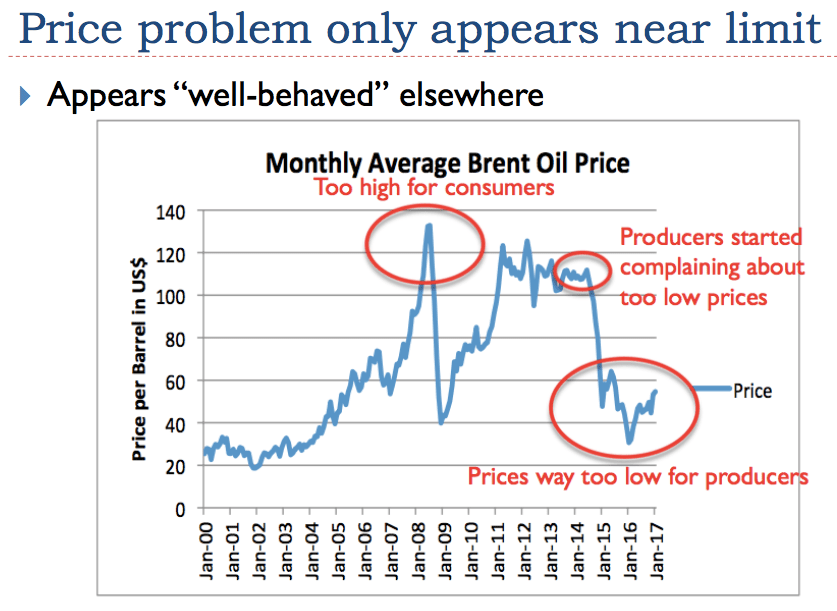
6-price-problem-appears-only-near-limit

Here is the latest version of Gail Tverberg’s thesis that limits to growth are causing too low energy prices which in turn will cause a decrease in energy extraction which in turn will cause the economy to collapse.

https://ourfiniteworld.com/2017/05/05/why-we-should-be-concerned-about-low-oil-prices/

The economists’ choice of the word “demand” is confusing. A person cannot simply demand to buy a car, or demand to go on a vacation trip. The person needs some way to pay for these things.

Falling resources per capita makes it harder to earn an adequate living. Think of farmers trying to subsist on ever-smaller farms. It would become increasingly difficult for them to earn a living, unless there is a big improvement in technology.

Or think of a miner who is extracting ore that is gradually dropping from 5% metal, to 2% metal, to 1% metal content, and so on, because the best quality ore is extracted first. The miner needs to work an increasing number of hours, to produce the ore needed for 100 kilograms of the metal. The economy is becoming in some sense “worse off,” because the worker is becoming “inefficient” through no fault of his own. The resources needed to provide benefits simply are less available, due to diminishing returns. This problem is sometimes reported as “falling productivity per worker.”

Falling productivity per worker tends to lower wages. And lower wages put downward pressure on commodity prices, because of affordability problems.

We seem to have already gone though a long period of stagflation, since the 1970s. The symptoms we are seeing today look as if we are approaching a steep downslope. If we are approaching a crisis stage, our crisis stage may be much shorter than the 20 to 50 years observed historically. Earlier civilizations (from which these timeframes were observed), did not have electricity or the extensive international trade system we have today.

The big problem that occurs is that non-elite workers become too poor to afford the output of the economy. Adding robots to replace workers looks efficient, but leaves many unemployed. Unemployment is even worse than low pay.

Peak oilers recognized one important point: our use of oil products would at some point have to come to an end. But they did not understand how complex the situation is. Low prices, rather than high, would be the problem. We would see gluts rather than shortages, as we approach limits. Much of the oil that seems to be technologically extractable, will really be left in the ground, because of low prices and other problems.

Many people miss the point that economy must keep growing. (…) As the economy grows, we tend to need more energy. Growing efficiency can only slightly offset this. Thus, as a practical matter, energy per capita needs to stay at least level for an economy to grow.

The fact that energy prices can, and do, fall below the cost of production is something that has been missed by many modelers. Prices can go down, even when the cost of production plus taxes needed by governments rises!

It takes energy to have an intergovernmental organization, such as the European Union. In fact, it takes energy to operate any kind of government. When there is not enough surplus energy to go around, citizens decide that the benefits of belonging to such organizations are less than the costs involved. That is the reason for the Brexit vote, and the reason the question is coming up elsewhere.

Oil prices have been too low for producers since at least mid-2014. It is possible to hide a problem with low prices with increasing debt, for a few years, but not indefinitely. The longer the low-price scenario continues, the more likely a collapse in production is. Also, the tendency of international organizations of government to collapse (Slide 38) takes a few years to manifest itself, as does the tendency for civil unrest within oil exporters (Slide 39).

Once an incorrect understanding of our energy problem becomes firmly entrenched, it becomes very difficult for leaders to understand the real problem.