By Gail Zawacki: Diva of Doom Interview

I’m a long-time admirer of the intellect and work of Gail Zawacki, the self-described Diva of Doom. You can find some of my favorites by Gail that I’ve posted here, and all of Gail’s work at her blog Wit’s End.

Here in a new 60 minute interview with Sam Mitchell, Gail provides an articulate description of the what and why of our overshoot predicament, and concludes with some wise advice on what to do about it:

Enjoy every good day that remains.


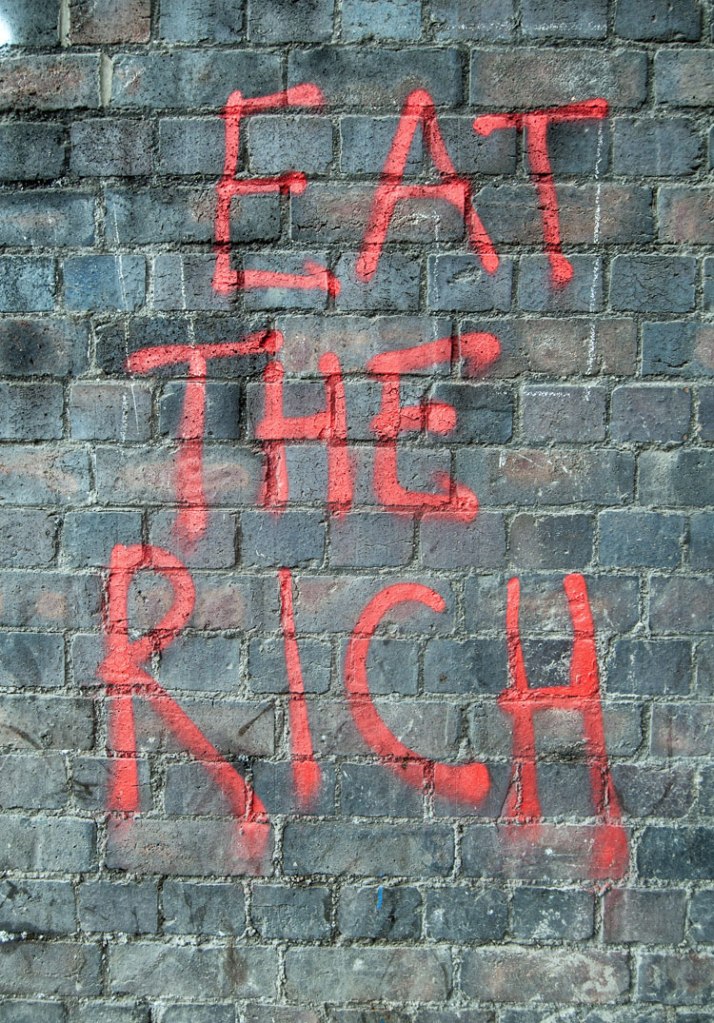
Eat the rich, save the planet?

Eat the Rich

A cursory look at human history or the genetic behavior of monkeys confirms that it is unwise for societies to permit the wealth gap between the rich and the majority to become too wide. Especially when the standard of living of the majority is falling.

Brexit, Trump, and the yellow vests are examples of increasing social unrest. Anecdotally I’m also seeing a meme emerge on the internet that can be summarized as “eat the rich, save the planet”. This meme is supported by some intellectuals like Kevin Anderson who argue that climate change can be addressed by focusing on reducing CO2 emissions from the rich.

We’ve been warned that to maintain a climate compatible with civilization we have 10 years to cut our CO2 emissions in half and 30 years to reduce them to zero. As Tim Garrett has shown, CO2 emissions are proportional to wealth, so to reduce CO2 emissions we must reduce the total wealth of civilization.

Many other important planks of our ecosystem’s health are sick and getting sicker, primarily due to the high consumption needed to support our collective wealth.

We also know (here and here) that the net return from our energy sources is declining due to the depletion of low-cost non-renewable reserves which means our productivity and thus ability to grow wealth is declining and this decline will accelerate.

Governments have responded to declining economic growth by reducing interest rates and increasing debt. This has deferred the reduction in our standard of living necessary to balance the books, but has also increased the wealth gap because low-interest rates have created a bubble in the value of most assets, and the rich own a disproportionate share of assets.

An individual cares primarily about their own wealth, not the total wealth of civilization. We could in theory keep individuals comfortable and maintain a healthy(er) planet by reducing our population without reducing our per capita wealth. Unfortunately, reproduction is the primary goal of our genes and we therefore don’t even discuss the obviously optimal solution of population reduction. To be fair on its potential effectiveness, we should have reduced our population back in 1970 when we were warned by our experts. It’s never too late to do the right thing but given that even the Green party doesn’t have a population reduction platform it is probable that any population reduction will be involuntary rather than voluntary.

The uniquely powerful human brain exists because it evolved to deny unpleasant realities. Topics don’t become much more unpleasant than overshoot so we collectively have not acknowledged, and do not discuss, and do not act, on any of the issues associated with overshoot.

To summarize:

  • The total wealth of civilization must decrease to maintain a planet compatible with civilization.
  • The total wealth of civilization will decrease due to the depletion of non-renewable resources (especially energy).
  • We are doing everything possible to prevent the decline of total wealth but our actions have increased the wealth gap and social unrest.
  • We do not discuss or act on the only “good” solution, population reduction.
  • We aggressively deny our overshoot predicament.

Governments react to pressure from their citizens, they do not lead their citizens. I sense some bubbling optimism about the yellow vest movement from people who seek fundamental change. A key question then is are movements like the yellow vests good or bad for our future prospects?

Put more succinctly, will eating the rich save the planet?

The answer lies in how we close the wealth gap.

If we close the wealth gap by taxing the rich and redistributing their wealth to the less fortunate we will temporarily reduce social unrest but will worsen our overshoot predicament. This is because the poor will tend to spend the liquidated assets of the rich which will increase the total consumption of energy and other resources.

In addition, the spending of liquidated assets will increase inflation because there are far more paper assets than real assets in our economy, and this inflation will be a new source of social unrest.

While it is true that total wealth will decrease no matter what we do, there are two paths we can take. The first path is deflation which means people have less money but the money is still worth something. The second path is inflation which means people have money but it is worth less. I think inflation is more corrosive to the social fabric than deflation. Inflation caused a modern civilized country to blame and exterminate 6 million members of a minority tribe.

If on the other hand, we close the wealth gap by taxing the rich and paying down public debt, then we benefit everyone, rich and poor, by helping to stabilize the currency in a shrinking economy. This is important because all modern currencies are debt-backed fractional reserve systems that tend to become unstable without growth.

So to answer our question, will eating the rich save the planet, we need to know what the yellow vests marching in the streets want.

Do they want the rich to be pulled down to their level?

Or do they want to be pulled up closer to the rich?

I suspect they want the latter. If true, this means the yellow vests are acting to worsen our overshoot predicament.

What we need is green vests marching in the streets demanding that our governments acknowledge our overshoot predicament and manage the required and inevitable decline in a fair and humane manner.

This of course requires citizens to understand what’s going on.

And that requires us to find some way to break through our tendency to deny reality.

And that requires us to study and communicate Varki’s MORT theory.


Comfort on a Razor’s Edge

You know you are in trouble when the only comfortable place is a razor’s edge.

When oil prices are rising we can soon expect trouble from reduced economic growth and inflation.

When oil prices are falling we can soon expect trouble from a slowing economy and deflation; and we can also expect oil shortages a few years out because investing in new oil production becomes unprofitable and most of our existing wells now deplete quickly.

Q: Why is it so important that the economy grows?

A: Most people mistakenly believe growth is important because it makes us a little more wealthy in the future. The real reason growth is important is that it makes us much more wealthy today.

Q: We never used to worry about a little inflation or deflation. What’s changed?

A: Total global debt has grown to over $250,000,000,000,000 (250 thousand billion dollars) and it’s consuming more and more of our income for interest payments.

Inflation causes interest rates to rise which makes it more difficult to service the debt.

Deflation removes money from the economy which makes it more difficult to service the debt given that interest rates are already as low as they can go.

Q: Why has debt become a problem?

A: Debt is growing much faster than our income. We must now borrow about $5 for every $1 of GDP growth.

Q: We used to achieve $1 of growth with less than $1 of debt. What’s changed?

A: We burned all the cheap oil which caused the price of oil to increase which forces us to borrow more money to maintain our lifestyles.

Q: Why do our lifestyles depend on the price of oil?

A: Our comfortable lives are made possible by a growing GDP. Most of our GDP is produced with machines, and energy is the food of machines. As the price of energy goes up, we can’t afford to feed our machines as much, and they produce less.

https://www.cnbc.com/2018/11/09/oil-markets-crude-supply-global-economy-in-focus.html

US crude oil posts longest losing streak in over 34 years, falling for 10th day

  • Oil prices fall for a 10th consecutive session, sinking U.S. crude futures deeper into bear market territory and wiping out the benchmark’s gains for the year.
  • Crude futures fell for a fifth straight week on growing output from key producers and a deteriorating outlook for oil demand deepen.
  • Signs that OPEC and several other oil producers including Russia could soon cut output have not put a floor under the market.

New Badass in Town: Jean-Marc Jancovici (Radio Ecoshock interview)

Jean-Marc Jancovici

Step aside all you established peak oil and climate change pontificators. There’s a new badass in town and he’s an engineer who specializes in energy and climate which means you don’t stand a chance. 🙂

It’s very rare to find someone who can articulately explain in one hour, without hyperbole or bullshit, everything important going on in the world, including the underlying causes, what the future holds, and what we should do in response. Jean-Marc Jancovici is one of those rare gems.

Jancovici’s native language is French so English works by him are scarce. I’ve already posted the only other recent English talk that I’m aware of here.

Today’s interview with Alex Smith of Radio Ecoshock is a treat. After investing an hour here you will understand much more about the issues that matter than 99% of the people in the world.

Alex Smith wrote a very nice summary of his interview here:

https://www.ecoshock.org/2018/10/jean-marc-jancovici-whistling-past-the-graveyard.html


Following are a few quotes from the interview that I thought were noteworthy. Notice how close Jancovici comes to discussing denial of reality on several occasions.


Tell me how much energy you use and I will tell you how you live.


Governments are not guided by [wise] advisors. They respond to external pressure.


The present standard of living cannot be sustained without the help of fossil fuels for physical reasons.


Two centuries ago the world was fully renewable and consisted of 1 billion peasants with a life expectancy of 30 years. [We therefore] know of at least one option available to us.


Every time you hear the words “energy consumption”, replace them with “fleet of machines” .


A future with no growth is considered unthinkable by so many people, including Nobel prize-winning economists, that nobody thinks about what to do if it happens for real.


Q: What do you think is the greatest soonest threat: peak oil or climate change?

A: I place my bets on the likelihood that nobody will understand what is happening with either of these threats.


No government understands that energy equals machines, and if machines work less, GDP goes down.

No political leader understands that climate change is already putting refugees on the road.


Think of peak oil and climate change as opposing scissor blades squeezing your finger. Asking which is worse does not make any sense.


You must wait over 10,000 years for surplus CO2 to evacuate from the atmosphere. There is no such thing as a reset button for climate change. The only thing we are sure of is the day that consequences become unbearable, it will become worse later on.


A huge misunderstanding is that energy is a sector of the economy rather than the blood of the economy.

By Tim Watkins: The Three Vortices of Doom (energy, debt, state)

The Net Energy Cliff


Tim Watkins today published a superb big picture essay explaining the troubling trends in our economy that everyone sees but few understand.

It’s a great primer for anyone curious why the stories they hear from their leaders and news media don’t make sense.

If you’re the kind of person that needs hope, Watkins advises to pray for a very large discovery of low-cost oil or a breakthrough in nuclear energy.

Or, if you’re the kind of person that likes to know the most probable outcome they should prepare for, Watkins advises to get used to living with less in a more local economy.

http://consciousnessofsheep.co.uk/2018/09/13/the-three-vortices-of-doom/

Despite the cheerleading efforts of the legacy media, the economic storm clouds are growing on the horizon.  Oil – the economic “master resource” – passed $80 per barrel yesterday.  Meanwhile, central banks around the world have begun to unwind the stimulus packages used to bail out the economy in the aftermath of the 2008 crash.  And all the while, governments are struggling to balance the need to manage their borrowing while maintaining the value of their currencies.  Add to that the politics of the new nationalism and you have a recipe for turbulent economic times in the very near future.

By far the biggest blind spot in economics, however, is its treatment of energy as just another cheap resource to be exploited.  In fact, energy should be treated as a separate category alongside capital, labour and resources in any model that seeks to explain the way the real world works.  This is because energy is the transformative force that allows us to (temporarily) defy the second law of thermodynamics, which says that things move from order to chaos; they break down not up.  As Steve Keen puts it:

“Capital without energy is a statue; labour without energy is a corpse.”

Another way of understanding this is to see that for a mere $80 dollars we get more than $350,000 worth of work (if we had to pay a human the average wage to do it).  This also explains why relatively small changes in the price of energy (particularly oil because its use is ubiquitous) have such a dramatic impact on the monetary economy.  Just three years ago, for every $40 spent on oil, companies were returning $350,000 worth of productive work.  Today, the same $40 is returning just $175,000 of productive work; something that largely explains the so-called “productivity puzzle,” as well accounting for why ten of last eleven recessions were preceded by a spike in the price of oil.

Without the net energy to allow for genuine economic growth, sovereign debt becomes as unpayable as consumer and corporate debt.  It can be defaulted or it can be inflated away; but it can never be repaid in real terms.  States, however, are unlikely to concede this point until it is too late. To put it another way, states will use all of the power at their disposal to maintain the exchange rate of their currencies even if this results in economic ruin for their national economies and their citizens.

These, then are the three vortices which (in the absence of some new high-EROEI energy source) are gradually choking the life out of our global industrial civilisation.  As the net energy remaining to us declines, an ever greater proportion of our currency and useable energy will be sucked into them until such time as our economy consists of nothing else but the growing of food and the generation of energy in the service of an ever more capricious state.  This process will inevitably involve the acceleration of the decline in living standards that those at the bottom of the income ladder have been experiencing since the 1970s.  It will also result in a re-localising of economies as the energy required to maintain global supply chains disappears.  In this respect, the conservative nationalism of Brexit and Trump may simply be the relatively benign early manifestation of the politics of our energy-starved future.

By Tom Murphy: The Energy Trap (we all scream for ice cream)

The Energy Trap

A friend reminded me of this 2011 essay written by the brilliant physicist Tom Murphy.

I read it when Murphy first published it but I had forgotten how good it was so I’ve dusted it off in the hope that it sees more daylight.

https://dothemath.ucsd.edu/2011/10/the-energy-trap/

Many Do the Math posts have touched on the inevitable cessation of growth and on the challenge we will face in developing a replacement energy infrastructure once our fossil fuel inheritance is spent. The focus has been on long-term physical constraints, and not on the messy details of our response in the short-term. But our reaction to a diminishing flow of fossil fuel energy in the short-term will determine whether we transition to a sustainable but technological existence or allow ourselves to collapse. One stumbling block in particular has me worried. I call it The Energy Trap.

In brief, the idea is that once we enter a decline phase in fossil fuel availability—first in petroleum—our growth-based economic system will struggle to cope with a contraction of its very lifeblood. Fuel prices will skyrocket, some individuals and exporting nations will react by hoarding, and energy scarcity will quickly become the new norm. The invisible hand of the market will slap us silly demanding a new energy infrastructure based on non-fossil solutions. But here’s the rub. The construction of that shiny new infrastructure requires not just money, but…energy. And that’s the very commodity in short supply. Will we really be willing to sacrifice additional energy in the short term—effectively steepening the decline—for a long-term energy plan? It’s a trap!


In the parallel world of economics, an energy decline likely spells deep recession. The substantial financial investment needed to carry out an energy replacement crash program will be hard to scrape together in tough times, especially given that we are unlikely to converge on the “right” solution into which we sink our bucks.

Politically, the Energy Trap is a killer. In my lifetime, I have not witnessed in our political system the adult behavior that would be needed to buckle down for a long-term goal involving short-term sacrifice.  Or at least any brief bouts of such maturity have not been politically rewarded.  I’m not blaming the politicians. We all scream for ice cream. Politicians simply cater to our demands. We tend to vote for the candidate who promises a bigger, better tomorrow—even if such a path is untenable.

The only way out of the political trap is for a substantial fraction of our population to understand the dimensions of the problem: to understand that we’ve been spoiled by the surplus energy available through fossil fuels, and that we will have to make decade-level sacrifices to put ourselves on a new track. The only way to accomplish this is through sober education, which is what Do the Math is all about. It’s a trap! Spread the word!


Tom Murphy stopped writing in 2013 after (I think) he realized that no amount of education will change the behavior of the majority.

By Tim Garrett: The Global Economy, Heat Engines, and Economic Collapse

BP Energy Consumption

Thanks to Apneaman for bringing my attention to a new blog by Tim Garrett.

Garrett is the most important and least recognized physicist in the world, having explained and quantified the relationship between energy consumption and economic wealth. You can find other work by Garrett that I’ve posted here.

This most recent essay provides a nice overview of Garrett’s theory and its implications.

http://nephologue.blogspot.com/2018/08/the-global-economy-heat-engines-and.html

Because the Gross World Product (GWP) exists, we grow, and then use our growth to access more energy which we can then consume with the higher infrastructure demands. The relevant equation is that every 1000 dollars of year 2005 inflation-adjusted gross world product requires 7.1 additional Watts of power capacity to be added, independent of the year that is considered.

Right now, energy consumption is continuing to grow rapidly, sustaining an ever larger GWP. But it is not the rate of energy consumption that supports the GWP, but the rate of growth of energy consumption that supports the GWP.

This important distinction is flat out frightening. The implication is that if we cease to grow energy and raw material consumption globally, then the global economy must collapse. But if don’t cease to grow energy consumption and raw material consumption then we still collapse due to climate change and environmental destruction.  Is there no way out?

By James Kunstler: The Uncomfortable Hiatus

The Next Financial Crisis Lurks Underground

I haven’t posted anything by Kunstler for a while. When he’s occasionally good, he’s really good, like today.

http://kunstler.com/clusterfuck-nation/the-uncomfortable-hiatus/

And so the sun seems to stand still this last day before the resumption of business-as-usual, and whatever remains of labor in this sclerotic republic takes its ease in the ominous late summer heat, and the people across this land marinate in anxious uncertainty. What can be done?

Some kind of epic national restructuring is in the works. It will either happen consciously and deliberately or it will be forced on us by circumstance. One side wants to magically reenact the 1950s; the other wants a Gnostic transhuman utopia. Neither of these is a plausible outcome. Most of the arguments ranging around them are what Jordan Peterson calls “pseudo issues.” Let’s try to take stock of what the real issues might be.

Energy: The shale oil “miracle” was a stunt enabled by supernaturally low interest rates, i.e. Federal Reserve policy. Even The New York Times said so yesterday (The Next Financial Crisis Lurks Underground). For all that, the shale oil producers still couldn’t make money at it. If interest rates go up, the industry will choke on the debt it has already accumulated and lose access to new loans. If the Fed reverses its current course —say, to rescue the stock and bond markets — then the shale oil industry has perhaps three more years before it collapses on a geological basis, maybe less. After that, we’re out of tricks. It will affect everything.

The perceived solution is to run all our stuff on electricity, with the electricity produced by other means than fossil fuels, so-called alt energy. This will only happen on the most limited basis and perhaps not at all. (And it is apart from the question of the decrepit electric grid itself.) What’s required is a political conversation about how we inhabit the landscape, how we do business, and what kind of business we do. The prospect of dismantling suburbia — or at least moving out of it — is evidently unthinkable. But it’s going to happen whether we make plans and policies, or we’re dragged kicking and screaming away from it.

Corporate tyranny: The nation is groaning under despotic corporate rule. The fragility of these operations is moving toward criticality. As with shale oil, they depend largely on dishonest financial legerdemain. They are also threatened by the crack-up of globalism, and its 12,000-mile supply lines, now well underway. Get ready for business at a much smaller scale.

Hard as this sounds, it presents great opportunities for making Americans useful again, that is, giving them something to do, a meaningful place in society, and livelihoods. The implosion of national chain retail is already underway. Amazon is not the answer, because each Amazon sales item requires a separate truck trip to its destination, and that just doesn’t square with our energy predicament. We’ve got to rebuild main street economies and the layers of local and regional distribution that support them. That’s where many jobs and careers are.

Climate change is most immediately affecting farming. 2018 will be a year of bad harvests in many parts of the world. Agri-biz style farming, based on oil-and-gas plus bank loans is a ruinous practice, and will not continue in any case. Can we make choices and policies to promote a return to smaller scale farming with intelligent methods rather than just brute industrial force plus debt? If we don’t, a lot of people will starve to death. By the way, here is the useful work for a large number of citizens currently regarded as unemployable for one reason or another.

Pervasive racketeering rules because we allow it to, especially in education and medicine. Both are self-destructing under the weight of their own money-grubbing schemes. Both are destined to be severely downscaled. A lot of colleges will go out of business. Most college loans will never be paid back (and the derivatives based on them will blow up). We need millions of small farmers more than we need millions of communications majors with a public relations minor. It may be too late for a single-payer medical system. A collapsing oil-based industrial economy means a lack of capital, and fiscal hocus-pocus is just another form of racketeering. Medicine will have to get smaller and less complex and that means local clinic-based health care. Lots of careers there, and that is where things are going, so get ready.

Government over-reach: the leviathan state is too large, too reckless, and too corrupt. Insolvency will eventually reduce its scope and scale. Most immediately, the giant matrix of domestic spying agencies has turned on American citizens. It will resist at all costs being dismantled or even reigned in. One task at hand is to prosecute the people in the Department of Justice and the FBI who ran illegal political operations in and around the 2016 election. These are agencies which use their considerable power to destroy the lives of individual citizens. Their officers must answer to grand juries.

As with everything else on the table for debate, the reach and scope of US imperial arrangements has to be reduced. It’s happening already, whether we like it or not, as geopolitical relations shift drastically and the other nations on the planet scramble for survival in a post-industrial world that will be a good deal harsher than the robotic paradise of digitally “creative” economies that the credulous expect. This country has enough to do within its own boundaries to prepare for survival without making extra trouble for itself and other people around the world. As a practical matter, this means close as many overseas bases as possible, as soon as possible.

As we get back to business tomorrow, ask yourself where you stand in the blather-storm of false issues and foolish ideas, in contrast to the things that actually matter.

On Oil

Oil

JTRoberts recently made an important and insightful observation which I paraphrase and elaborate here.

Oil is a non-renewable resource that we extract from the earth. Oil companies are motivated by profit so they start with low-cost reservoirs and as those deplete they move to increasingly higher cost sources like water injection, offshore, tar sands, and fracking.

All economic activity depends on energy, as the laws of thermodynamics explain, and as the near perfect correlation between wealth and energy consumption confirms.

Oil is the keystone energy because oil is required to extract or capture all other forms of energy including food, coal, natural gas, wood, solar, wind, nuclear, and hydroelectric energy.

The cost of oil can be viewed as a tax on economic activity. Our economy is configured to operate profitably on about $20 per barrel oil. We have already captured most feasible energy efficiency gains making it difficult for our economy to operate profitably on oil over $20.

Thus, as the cost of extraction due to depletion of low-cost reserves pushes the price of oil above $20, the difference must be made up with debt.

At today’s $70 oil, which we burn about 96 million barrels per day, that works out to 96 * 365 * ($70-$20) = $1.8 trillion, which as predicted, is about the rate that global debt is increasing.

If you believe we have many years of oil left, then you must also believe that debt can continue to increase much faster than our income for many years without consequence on the value of money.

Money has value because we have confidence that the debt which creates our money will be repaid with interest, which can only occur when the economy grows, which can only occur when the quantity of energy we burn grows, which due to continually increasing extraction costs, can only occur when debt grows faster than the economy, which at some point will erode our confidence, which will reduce the value of money, which will reduce the amount of energy we can afford to burn, which will reduce economic activity, which will further erode our confidence in the value of money.

Do you see our energy and climate predicament?

Do you see why our leaders deny we have a problem?

Do you see why the longer we deny the problem the worse the outcome will be?

Additional Thoughts (30-Jul-2018)

Most people do not think we have an imminent oil problem because they’ve read in the news that there is 50 years or more of unconventional oil left to extract. While probably true, this fact is misleading.

What does it mean to say oil is depleted?

Depleted does not mean that all the oil is gone. Depleted means that all the oil we can afford to extract and purchase is gone. Big difference.

To be a little more precise, depleted is the point at which the cost to extract oil exceeds the price that our economy can pay and still grow.

Today we are paying the price and achieving a little growth, but it is taking a lot of debt at a very low interest rate to do so, and each year it takes more debt.

The ability of our global debt-backed fractional reserve monetary system to function (i.e. not collapse), and the high standard of living we enjoy, and the high capital things we invest in like modern infrastructure and technology, all fundamentally depend on economic growth. If growth stops our system will collapse, and our monetary system will have to be replaced with a different design, such as an asset-backed full reserve system, which will mean much lower standards of living, and much less availability of many things we currently take for granted.

I wrote an essay on economic growth which I recommend you read because many people think they know why we want economic growth but in fact don’t know the main and much more important reason.

So what evidence exists that oil is getting close to being depleted?

  1. Our economy in aggregate is losing money. Debt is growing much faster than the economy. It now takes over $3 of debt to generate $1 of growth. This is not sustainable. A sustainable economy invests $1 of debt to create more than $1 of growth, as we did prior to 1970.  It’s important to note that this state of affairs exists despite the interest rate (i.e. the cost of money) being historically low (in some cases zero). It’s also important to note that this is a global phenomenon. So we can’t blame bad leaders, or the political system, or the culture. Every country in the world is growing their debt in an unsustainable manner, or wants to. The common denominator is energy which is the most important thing that drives every economy in the world. And the price of energy has been trending up for 5 decades simultaneous with our debt.
  2. The US central bank is starting to increase interest rates for their money that the world uses to buy oil. There are many different ways to interpret this action. My own speculation is they are worried about confidence in their money and want to maintain or strengthen its purchasing power for oil. Looking through the other side of the lens, this is the same as saying the Fed wants to lower the price of oil because they are worried about inflation since oil is required to make almost everything. If the price of oil drops, the supply of oil will drop.
  3. Most companies that extract high-cost oil are struggling. For example, the majority of US fracking companies are losing money.
  4. Countries that are highly dependent on profits from their high-cost oil reserves are struggling. For example, Venezuela with the largest unconventional oil reserves in the word seems to be collapsing.
  5. Countries with large low-cost reserves are behaving oddly for countries that used to be fantastically wealthy. For example, Saudi Arabia has implemented aggressive austerity and wanted to sell a portion of their state oil company to raise money. They’ve recently backed off from this sale, possibly because it would have required them to submit to an independent audit of their remaining reserves, which some smart people speculate are much lower than stated.
  6. War-like behavior is increasing towards countries that have large low-cost oil reserves and that are not viewed as close friends. For example, Russia and Iran.
  7. Weak countries that lack the ability to borrow US$ needed to buy oil are struggling.
  8. Our central banks, economists, and politicians appear to have no clue about what is causing our persistent global economic problems. I speculate this is a combination of the fact that they’ve never needed to understand thermodynamics until now, and the fact that they deny unpleasant realities as explained by Varki’s MORT theory. I do find it very telling that not one senior leader anywhere in the world has spoken publicly about this issue. A few must understand our predicament and they must be terrified.
 

On Shock and Awe

Shock and Awe (2017)


I watched the new movie Shock and Awe which dramatizes the American government’s use of fabricated intelligence to justify its war with Iraq. The producers made a good case that the decision to attack Iraq was made well in advance of finding any evidence of an Iraqi military or terrorism threat.

I found the movie to be a little stiff and ham-fisted so did not enjoy it very much. It did however provide another good example of the ubiquity of denial in our culture.

Shock and Awe was more interesting for what it didn’t say than what it said.

Not once did the producers ask or attempt to answer the question why did senior American leaders decide to attack Iraq?

How is it possible that the only question that matters is the only question that is not asked?

It isn’t, of course, unless you’re in denial and don’t want to know the answer.

Put yourself in the shoes of an American leader in the few years leading up to the 2003 Iraq war.

Your best minds are predicting a peak in global conventional oil production somewhere around 2005. The 2008 crash and resulting zero interest rate that enabled the unprofitable fracking industry to increase oil production has not yet occurred and was not predicted by the idiot economists that advise you. Iraq has the second best reserves of high quality oil left on the planet and is led by a dictator who is no longer friendly and is starting to sell oil to your enemies in euros which might undermine your reserve currency which enables your country to live far beyond its means. Your economy is totally dependent on imported oil and you have no chance of being re-elected if there is a recession and gas shortages.

Now the Iraq war makes more sense.

But you won’t learn any of this from Shock and Awe.