By Chris Martenson: As We Enter 2017, Keep the Big Picture in Mind

An excellent year-end piece by Chris Martenson.

https://www.peakprosperity.com/blog/105291/we-enter-2017-keep-big-picture-mind


Truthfully, there’s a lot about which we should all be concerned, and I think that people’s sense of unease heading into 2017 is well-deserved, if sometimes misplaced.

What do I mean by that?  Well, it is misplaced to be worried about symptoms instead of causes.  The fever is worrying but it is not the cause of the illness.


Perhaps the most vexing challenge remains how to more effectively communicate the various predicaments and problems we face.

It’s not having more numbers, or more data, that’s for sure.  If numbers and data ‘worked then we’d have taken a very different path sometime back in the 1950’s.


As Admiral Hyman Rickover said in a speech to a group of doctors in 1957:

“I think no further elaboration is needed to demonstrate the significance of energy resources for our own future. Our civilization rests upon a technological base which requires enormous quantities of fossil fuels. What assurance do we then have that our energy needs will continue to be supplied by fossil fuels: The answer is – in the long run – none.

The earth is finite. Fossil fuels are not renewable. In this respect our energy base differs from that of all earlier civilizations. They could have maintained their energy supply by careful cultivation. We cannot.

Fuel that has been burned is gone forever. Fuel is even more evanescent than metals. Metals, too, are non-renewable resources threatened with ultimate extinction, but something can be salvaged from scrap. Fuel leaves no scrap and there is nothing man can do to rebuild exhausted fossil fuel reserves. They were created by solar energy 500 million years ago and took eons to grow to their present volume.

In the face of the basic fact that fossil fuel reserves are finite, the exact length of time these reserves will last is important in only one respect: the longer they last, the more time do we have, to invent ways of living off renewable or substitute energy sources and to adjust our economy to the vast changes which we can expect from such a shift. Fossil fuels resemble capital in the bank.

A prudent and responsible parent will use his capital sparingly in order to pass on to his children as much as possible of his inheritance. A selfish and irresponsible parent will squander it in riotous living and care not one whit how his offspring will fare.”

(Source)

His logic was as irrefutably sound then as it is today.  Such information was known at the highest levels throughout government and academia.  But there was no, and continues to be no, sustained and well-funded efforts to grapple with the basic dilemma posed by increasing population as dramatically as we have all the while living on, literally eating, fossil fuels to encourage that rapid population growth.

“Can you think of any problem in any area of human endeavor on any scale, from microscopic to global, whose long-term solution is in any demonstrable way aided, assisted, or advanced by further increases in population, locally, nationally, or globally?”  ~ Al Bartlett


The predicament we face is really quite profound.  I submit to you that people know this in their guts and the fact that they do goes a long way towards describing the feeling dread many people report they are carrying here at the start of 2017 and cannot seem to shake.

And of course they are.  Not having a plan for how to even feed 7.4 billion people, heading to 9 or 10 billion people, without massive fossil fuel calorie subsidies is a troubling thought.  If it’s not troubling, then more thinking needs to be applied.

By Gail Tverberg: EROEI Calculations for Solar PV Are Misleading

Gail Tverberg has convinced me to stop using EROEI as a measure of the usefulness of alternate energies.

For me now the critical tests are: Does it pay more taxes than the subsidies it receives, and does it make a (small is ok) profit assuming a “normal” interest rate of at least 5%?

If yes, the energy is helpful. If no, the energy is not helpful.

I watch for alternate energy installations anywhere in the world that meet these criteria and have not found one yet.

Gail is this paper explains why EROEI is not a useful measure…

https://ourfiniteworld.com/2016/12/21/eroei-calculations-for-solar-pv-are-misleading

By Steve St. Angelo: End of the U.S. Major Oil Industry Era: Big Trouble at ExxonMobil

https://srsroccoreport.com/end-of-the-u-s-major-oil-industry-era-big-trouble-at-exxonmobil/

The era of the mighty U.S. major oil industry is coming to an end as the country’s largest petroleum company is in big trouble.  While ExxonMobil has been the most profitable U.S. oil company in the past, it suffered its worst year on record.

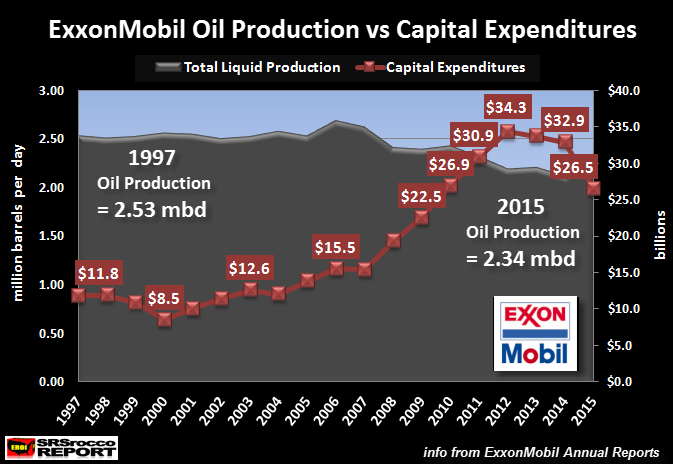
ExxonMobil’s free cash flow declined from $24.4 billion in 2011 to $1 billion for the first nine months of 2016. The reason for the rapidly falling free cash flow is due to skyrocketing capital expenditures and falling oil prices.  But, this is only part of the picture.

… in 1997, Exxon spent $11.8 billion on capital expenditures while producing 2.5 million barrels per day (mbd) of oil.  However, their capital expenditures nearly tripled to $34 billion in 2012 as total liquid production fell to 2.2 mbd.  Basically, Exxon spent three times more money in 2012 to produce 300,000 barrels per day less than it did in 1997.

It seems as if Exxon realized early on that peak oil had finally arrived (privately, of course), so it decided to not waste too much money on future oil projects.  Instead, the company spent a massive amount of money on stock repurchases over the past two decades… especially since 2005.

The lion’s share of their stock buybacks were between 2005 and 2014.  In that ten-year period, Exxon purchased a staggering $220 billion of its own shares.  Now compare that to the company’s total capex spending of $245 billion during the same time period.

As we can see, Exxon’s long-term debt has exploded from $6.9 billion in 2013 to $29.5 billion in the first half of 2016.  Basically, the company is now borrowing money to repurchase shares or pay dividends.

Exxon Mobil Corp. (recently) warned that it may be forced to eliminate almost 20% of its future oil and gas prospects, yielding to the sharp decline in global energy prices.

The 100+ year era of the U.S. major oil industry is coming to an end… and fast.  Unfortunately, Americans have no clue just how dire the situation has become as many probably still believe in the delusion of “U.S. Energy Independence.”

I would imagine by 2020, the U.S. will be a much different place.  Regrettably, most Americans are not prepared.

By Gail Tverberg: Why energy prices are ultimately headed lower; what the IMF missed

Gail Tverberg continues to produce superb work. In her latest piece she provides a very nice summary that explains:

  • why the economy performed well in the past
  • why the economy is struggling today
  • why we should expect a Minsky moment

I’ve been expecting a Minsky moment for several years. Unfortunately it’s much easier to predict what will happen than when it will happen.

In this case it’s much better to prepare too soon because when the Minsky moment occurs it will be too late to do anything to protect yourself.

Isn’t it fascinating that none of our political and business leaders discuss this issue? Why aren’t they curious to understand the real reason that global growth has slowed and is not increasing despite unprecedented measures?

Why do so few care about understanding the scientific underpinning of economics?

Denial is amazing!

https://ourfiniteworld.com/2016/10/11/why-energy-prices-are-ultimately-headed-lower-what-the-imf-missed/


Supply & Demand

Demand isn’t what we want, it’s what we can afford.

Supply isn’t what we need, it’s what’s available.

Everything we depend on depends on energy.

Renewable energy depends on non-renewable energy.

The supply of anything non-renewable must peak and then decline.

Energy decline begins as falling EROI with rising debt to support demand and supply.

Then interest rates fall to zero or negative because growth is not possible with low EROI.

We are here.

Then something really bad happens because we allowed debt to get so high.

We should be reducing debt and using what wealth we have left to prepare.

It’s not that complicated.

Why wasn’t this discussed in the presidential debate?

Denial.

What could be more important?

Maybe climate change but denial prevented that from being discussed too.

ngeni-there-aint-such-as-thing-as-a-free-lunch

By Nate Hagens: The Speech that should have been given at the Republican National Convention

https://www.facebook.com/nathan.j.hagens/posts/10155010081133496

Greetings conservatives, Americans and conservative Americans.

Welcome to Cleveland!

There are many speakers here this week who will tell us what we want to hear, because it fires us up and makes us feels good. I’m going to give a different speech, one that lays out the context of our reality if we want to Make America Great Again. Suffice it to say we are no longer a shining beacon on the hill, to those in other countries or to other generations in our own.

America has been great before, but if was under a different era, different culture, and different physical backdrop. When our great Constitution was signed we had a little over 2 million citizens – now we have over 2 million people who work at the Post Office! and our population is 325 million. Though this is about 4% of the total global population, we use 25% of the oil, 50% of the toys and 50% of the medical prescriptions. We now have more bartenders and waitresses than manufacturing employees. Most people are miserable and just hanging on. 50% of our citizens would be totally broke within 3 months if they lost their jobs. We have the highest prison population in the world. For the first time in our countries history parents expect their children will not have as good of lives as they did. I expect Mr. Trump will highlight some of these problems – the list of scary facts is pretty long so it could be a long night.

There will be those here that blame these things on President Obama, or the Muslims, or foreigners or Wall St. bankers or white cops or black men. There will be those here who will shout that Hillary Clinton will make things worse and that a Republican is our only chance. I’m sure that next week at the DNC the people there will be blaming us for our nations problems, and plead that a Democratic President is our only hope. They are wrong. Just like we are wrong. That’s what humans do – when our circumstances are worse than the recent past, we look to put the blame on others. Sure there are some unsavory characters on Wall St, in the Democratic party, and in Iran – but so too are there such types in our own party and even in this building.

If you look closely at the demographics of Democrats and Republicans you discover a basic truth: we are all quite similar in caring about the things that matter: our children, safety of our neighborhoods, clean air to breathe and water to drink, and meaningful educations and vocations. Instead we tend to focus on how we are different than the other party and rally and get fired up about our superiority and better ideas. We are – pretty much all of us – angry, frustrated, and scared about the future, but deep down we are also able to work hard, sacrifice, help each other and be the good people that Americans can be. But in our blaming of others we miss the real reasons for our malaise, and thus are pursuing the wrong pathways if we are to ‘make America great again’.

Lets be honest. The phrase ‘the American dream’ has seeped into our psyche. We are a special people – driven, ambitious, hardworking, creative, etc. But without discovering and having access to the most resource rich country in the world, our attributes alone would have attained less lofty outcomes. 1 barrel of oil, which we currently only have to pay $50 for, contains the work potential of a strong American man working for 10 years. The united states has used more oil in the last 10 years, the last 50 years and since the dawn of time than any other nation. If we add natural gas and coal which have similar properties, 90% of the work done in our society is actually done by fossils – but these fossils are not unlimited and the easiest and best have long been found, pulled out and burned. The cost that our energy companies pay to extract these has been going up 17% a year for almost 2 decades. One-third of oil production is now unconventional and is dependent on high prices >$80/barrel. In the period from 2005 to 2013, oil and gas investments increased by 60% yet the oil supply increased by only 6%.

We certainly have a lot of it left – but its more costly, and since we use so much of it, this cost increase ripples through our societies and reduces wages, increases the cost of basic goods and makes our economy grow slower. You might think that technology is more important than energy. Technology has given us some amazing things – but almost all of them need to be plugged in. Without energy, the great technology just sits there. Without technology but with plenty of energy, well that puts us squarely back in the 19th century.

We have used the first half? The first 2/3? of Americas energy endowment. Wind and solar are viable and mature technologies but a world run on renewable tech will look very different than today’s world. Instead of the natural conservative response to this situation being…well, ‘conservation’ we are eager to drill more holes and pull out every last hydrocarbon molecule hiding near the source rock, which is what we are doing with the shale oil and gas technology. We are feeding our faces with our seed corn resources, Republicans and Democrats alike, not worrying about being able to pay the bill, or what we will build the future with. Basically, the American Dream has been predicated on high quality, inexpensive natural resources, particularly fossil energy. Given the natural resource reality of the world – and our nation at present – we need to send some of the great thinkers in this room into a sweat lodge on a Vision Quest!

Finally, before I am booed off the stage, let me bring up what, as conservatives, we should be caring about and shouting about and being active about way more than Hillary Clinton and the democrats. Eleven score and seven years ago, our Constitution came into being. It was a fresh set of guidelines for a new country, full of open lands and resources, bright and independent spirits, and people yearning to be free. Our Constitution came much later than the Magna Carta, which came much later than the 10 Commandments, which came much much later than the Code of Hammurabi, the first known document dealing with rules and principles for humans to get along with other humans. Nowhere in any of these great historical documents is any language that protects the future, other species, other generations, or our common ecosystems. At the dawn of the agricultural revolution, human beings, our pets and our livestock comprised less than 1/10 of 1% of terrestrial biomass. Now we are over 98%! We are losing animal and insect species faster than any time of our planets history. 40% of insects – gone in last 40 years. Since I’ve been alive, we now have 50% fewer wild animals than when I was born. What a terrible thing to state at a convention where we should be celebrating our values and our accomplishments. And these facts do not even factor in the impacts to oceans and ecosystems from the additional carbon we are putting in the air from the burning of our fossil wealth.

Most of our own people deny or downplay this is happening, because it requires difficult choices, bold thinking, sacrifice and creativity. Can we rally around those traits, or instead be led by fear, apathy and ignorance? For, my fellow republicans and citizens of this great nation, that is what it comes down to. We face unprecedented challenges, to growth, to safety, to our environment, our children and to our future. Instead of leading by example, sharing, caring, going the extra mile to help our neighbor, and tightening our belts, we have become complacent, surly, and occasionally violent, expecting that if only the “other people” will change their ways that things will get back to the way they were. I have news for you my friends who are alive with me at this wondrous and perilous time. There’s an intermediate step if we want to make America great again. We first have to Make America Good.

In 5 months Obama will no longer be President, something many of you have been waiting for, for a long time. But whether Mr. Trump or Mrs. Clinton wins, their job will primarily be to put out short-term fires (and in the process create new longer term ones). Real change in the next 4 years will not come from a new president but from a new outlook, new ethic and new strength of our citizenry. We cannot see this clearly yet, our gut tells us this is so. Vote for whoever you want to in November. But then come home and be the change you want to see in your homes, in your cities, at your jobs and with your families. Games over gadgets, nature over neglect, family over Facebook, conservation over consumption.

Lets Make America Good.

By Alice Friedemann: An Interview on Energy

Alice Friedemann has one of the best big picture understandings of energy in the world and runs the web site http://energyskeptic.com which provides an excellent library of energy related information.

Alice has just published a book that looks at society’s dependence on trucks and the diesel that powers them.

Here is an excellent interview with Alice by Chris Martenson.

And another by James Howard Kunstler.

By Allan Stromfeldt Chris­tensen: Book Review: The Oracle of Oil

Here is a very nice history on peak oil and a review of a new biography on its first researcher, M. King Hubbert.

http://fromfilmerstofarmers.com/blog/2016/june/book-review-the-oracle-of-oil/

Living in highly technological civilizations that generally place the greatest importance and value upon the material gadgetry and inventiveness of our societies, it should come as little surprise that the luminaries and household names that we can readily conjure and associate with are those related to the technological aspects of our lives. For example, when one mentions the telephone, the light bulb, the automobile, the airplane, or nuclear bombs, it’s likely that many a grade-schooler can rhyme off the names Alexander Graham Bell, Thomas Edison, Henry Ford, the Wright brothers, and, perhaps, Albert Einstein.

But segue into more ecological matters and the fathers and mothers of these vocations are certainly not household names the way the aforementioned are. For what comes to mind when we think of organic farming, climate change, the environmental movement, or limits to growth? For most of those who flick light switches on and off as much as they eat food and depend on stable planetary ecological balances, the answers are probably little more than a shrug. While children can quite easily conjure up the aforementioned names, you’d be hard pressed to find even an adult who could easily slip off of their tongues the names Sir Albert Howard, Svante Arrhenius, Rachel Carson, and the team of Donella Meadows, Dennis Meadows, and Jørgen Randers.

But while the topics of organic farming, climate change, and the environmental movement can certainly elicit recognition in the average citizen, the reality of peak oil quite often does not, with even less of a recognition expected in reference to the person that initially brought it to our attention. That largely unknown individual would be M. King Hubbert, the subject of Mason Inman’s timely new biography, The Oracle of Oil: A Maverick Geologist’s Quest for a Sustainable Future.

As Inman describes it, after having spent his early formative years on a farm in the Hill Country of Central Texas, and gone through two years of community college, a young Hubbert ended up making his way through various hardscrabble jobs on his way to the University of Chicago. It was there that the mathematically inclined Hubbert got exposed to a variety of disciplines that would aid him in his future endeavours, those ranging from geology to physics to math.

It was while still an undergrad that the first inklings of Hubbert’s future interest can be seen, that moment when he first glimpsed a chart depicting the exponential growth of coal extraction rates. After a following lecture on petroleum extraction, Hubbert apparently couldn’t help but muse to himself, “How long will it last?” For now, as he put it, it was “Difficult to estimate reserves.”

By no means though was Hubbert afflicted with a one-track kind of mind, for as Inman astutely weaves within his story, Hubbert, and at only 26-years-of-age, accepted a job offer to teach geophysics at Columbia University in New York City, the place where he became an original member of what would become the second focus of his life – the nascent movement soon to be known as Technocracy. In short, Technocracy was a not-quite totalitarian system whereby government-owned industries were envisioned as being managed by scientists, engineers and technicians. In fact, all of North America, even all the way down to Venezuela (because it had oil?) would be under the “continental control” of a united government, known as a “Technate.” Technocracy also disdained “the price system” in favour of “energy certificates,” a highly relevant notion that Inman fortunately repeatedly returns to.

In the meantime, Hubbert was all the while dissatisfied with the supposedly common sense notion that the extraction of a given mineral increases exponentially until one day, poof!, there’s nothing left. As he understood it, extraction and depletion rates could be related to the so-called S-curve that can be seen in an isolated pair of breeding fruit flies: their population soars and eventually tapers off at a plateau (or a flattened peak). And as Hubbert was in the minority with his belief that there were limits to growth, he similarly saw various facets of industrial society as fitting on this S-curve.

Being one of the leading proponents of Technocracy and an ardent writer on its workings, it was in Technocracy publications that Hubbert dabbled in writing about peaks and declines of resources. Come 1938, Hubbert came up with his first, but somewhat unsubstantiated (and rather off), estimate of the year that US oil extraction rates would peak: 1950. But having moved from academia to the government in the early 40s, it wasn’t until he then took a job at the US branch of Royal Dutch Shell in 1943 (eventually becoming the top geologist in a new lab it created) that Hubbert would have the resources and access to information that would allow him to formulate a more detailed analysis which led to his ground-breaking predictions.

For it was on March 8th, 1956, that Hubbert gave his talk “Nuclear Energy and the Fossil Fuels,” his revelatory paper that laid out his thoroughly analysed prediction that US oil extraction rates would peak sometime between 1965 and 1970 (to go along with a global peak in 2000). I won’t spoil things with a recitation of the rather humorous tensions, but I will point out that Hubbert was in fact correct, and that US oil extraction rates peaked in 1970. Furthermore, while much derision of Hubbert’s findings resulted both before and after 1970 (to go along with a smattering of praise), what may come as surprising to those thoroughly familiar with peak oil but too young to have been around back then (such as I, who was busy being born while President Jimmy Carter was wearing cardigans and having solar panels placed on the White House) is the amount of media attention given to estimates of US oil supplies, including both before and after Hubbert’s famous paper.

For while peak oil is nowadays generally dismissed – and more commonly ignored – by the mainstream media in lieu of financial abracadabra and/or dreams of a 100% replacement of fossil fuel energy with renewable (“renewable”) energy, the amount of serious talk that domestic US oil supplies garnered in the mid to late-mid 20th century is comparatively astounding. Inman’s surprising historical account relays the fact that the topic made the front pages of the New York Times and the Washington Post on more than one occasion, while the New York Times even visited Hubbert at his home to interview him! And even more absurd is Inman’s account of the US administration’s – all the way up to President Jimmy Carter’s – interest in Hubbert’s work, President Carter even making a quasi-reference to Hubbert’s work in one of his talks.

The question(s) that these shocking revelations (shocking to me at least) that Inman conveys is, What happened? Why were oil supplies and extraction rates such a big issue a few decades ago, when today the talk, if anything, is all about energy prices?

As Inman points out, one of the ordeals that began to drown out talk of oil extraction rates was the Watergate scandal of 1973. Following that, the “doom and gloom” of President Jimmy Carter (Carter’s sources called for worldwide oil extraction rates to peak in the mid-1980s [!?], while Hubbert’s calculations saw 2000 as the peak year) was no match for the sunny optimism of Ronald Reagan in the 1980 election, resulting in a new President and the removal of the White House’s interloping solar panels.

Jump ahead a few decades, and from what I can tell, not only does it seem that this Reagan-esque sunny optimism continues to reign supreme, but that it has imbued itself into the thinking of many progressives and environmentalists today, through the optimistic attitude of the “clean and green” notion that “renewables” can provide a 100% substitution for fossil fuels. As far as I can see it, it is this techno-optimist attitude of technology-as-saviour, to go along with another round of obeisance to financialization as itinerant saviour, that has convinced many people that energy supplies, and thus peak oil, need not be an issue (anymore, supposing that they ever really were).

But as Inman’s account also explains, Hubbert wasn’t quite averse to the techno-optimist way of thinking either. Although he did eventually do away with his staunch support for nuclear power, Hubbert ended up trading a reliance on nuclear power for a rather oversized belief in solar power. That is, Hubbert envisioned deserts covered in solar panels that would generate electricity of which could be converted into methanol or to generate hydrogen, and that such ventures could power high-energy societies (New York City!) for thousands of years. It was thus Hubbert’s belief that

“with our technology and with adequate supplies of energy, we ought to have a lot of leisure. And the proper use of this leisure can bring us an intellectual renaissance.”

This attitude gels with the stated Technocratic “embrace [of] the abundance created by machines,” which for me is hard to equate with the notion that peak oil and diminishing energy supplies in general imply less energy to power those machines, unless you believe in the sunny optimism of solar-panel-covered-deserts (to go along with other “renewables”) that can match the energetic output of fossil fuels (which the low EROEI levels of, say, solar panels, says isn’t quite feasible).

Having said all that, Hubbert did fortunately have the all-too-rare understanding that

“One of the most ubiquitous expressions in the language right now is growth – how to maintain our growth. If we could maintain it, it would destroy us.”

So although, and from my understandings, Hubbert had the questionable belief that nuclear power, and then solar panels, could provide not quite infinite growth but (rather conveniently?) a kind of infinite steady state of what the current energetic usage happened to be at the time, he did nonetheless realize that none of this could do anything for the problems of overpopulation and diminishing water supplies.

Bringing things into the present, Inman conveys the fact that worldwide conventional oil extraction rates peaked (or perhaps hit their plateau) in 2006 at 70 million barrels per year, finally dropping down to 69 million barrels per year in 2014. As it is, the only thing keeping overall oil extraction rates increasing – and giving the last push to the economic growth which Hubbert so despised – are the unconventional oil supplies of tight oil (via fracking) and tar sands oil.

This brings us back to Technocracy’s disdain for “the price system” (or as Hubbert put it, “the monetary culture”), which was the status quo and scarcity-based economics system that measures everything in dollars and cents, and which ignores physical limits. For as Technocracy conversely saw it, money would be abandoned for “energy certificates,” allowing for everything to be paid in their energy equivalent.

Upon first coming across the name M. King Hubbert some ten years ago I happened to read about Hubbert’s disagreement with our practice of fractional-reserve banking, of which I’ve never seen mentioned again until Inman’s book (kind of, as Inman doesn’t mention fractional-reserve banking directly). It is from this knowledge that I’ve come to understand the situation of diminishing energy supplies: since money is a proxy for energy, limits on energy supplies will imply limits to the continuance of our economic (Ponzi scheme) system, leading to an inability for sufficient payments to service even the interest payments on previous loans – which implies and will contribute to the collapse (implosion) of economies, be it slowly or quickly. As Hubbert put it, “exponential growth is about over. We’re entering something new.”

But not being much of a fan of a grandiose Technate myself (nor of the belief that there would ultimately be enough alternative energy supplies to maintain such a massive and centralized system anyway), we could still work off of Hubbert’s disdain for “the monetary culture” towards something like the Ecological Economics of Herman Daly and Joshua Farley, a discipline which is also in favour of moving away from fractional-reserve banking and the notion of infinite growth. And since peak oil means growth is coming to an end, perhaps a look to biophysical economics (see Energy and the Wealth of Nations by Charles Hall and Kent Klitgaard, or the new journal BioPhysical Economics and Resource Quality, edited by Hall, Ugo Bardi, and Gaël Giraud) could help us to envision a worthy alternative to Technocracy’s monetary substitution.

Regardless, there does seem to be merit for Hubbert’s belief in perhaps a partially planned economy, supposing that that would even be politically possible. Market forces are quite obviously doing little to nothing to ween us away from the usage of fossil fuels (be they diminishing or not), and the primary effect that high oil prices (reaching $147 a few years back) had was to spur investment in the higher costing unconventionals.

In the meantime, supposing that conventional and unconventional oil supplies continue their slight overall increase for years to come, this also poses a problem in light of carbon dioxide levels contributing to climate change. Inman thus poses the ultimately unavoidable and extremely pertinent questions: Do we really think market forces will come to our rescue? And if not, are we going to impose limits on ourselves, or are we simply going to sit back and wait until nature imposes those limits for us?

So whether you’re new to the notion of peaking oil supplies or rather familiar with it, I can certainly say that The Oracle of Oil has much new to shine on the story – and now history – of peak oil. With oil supplies being what they currently are, and with no off-planet supply to make up for what will this time not just be a US shortfall but a planetary shortfall, Inman’s book could certainly do us a favour by helping us to familiarize ourselves with the reality of peak oil, and by helping us to make M. King Hubbert the household name it ought to be.

That is of course a lot to ask, and after the virtual silence on peak oil that occurred after the global peak of conventional oil extraction rates in 2006 (to go along with all that has ensued since), one couldn’t be blamed for expecting little different upon the reaching of the global peak of conventional and unconventional oil extraction rates in the coming months or years (?). But one can always hope of course.

Godspeed the overall global peak?

On the Wealth of Citizens: An EU Perspective

Those Who Study History


The UK voted to leave the EU yesterday.

What’s really going on?

In an industrialized world with abundant resources citizens typically prosper in economies of all sizes.

As populations rise faster than finite resources, the growth rate of per-capita resources slows and eventually must decline. Over time it becomes more difficult to increase the wealth of citizens. In a resource constrained world there are two methods available to grow the wealth of citizens: efficiency and debt.

The first method available to grow the wealth of citizens is to increase the efficiency of producing and using resources. We have done an excellent job of improving efficiency:

  • We optimized the type of energy we use for each application such as using coal and hydro instead of oil to generate electricity, and using oil instead of coal or horses for transportation.
  • We learned how to squeeze oil from sand and rock, how to drill for oil in mile deep oceans, and how to mine coal from the surface with giant machines.
  • We optimized our machines such as switching to lighter fuel-efficient cars, using heat pumps, and abandoning supersonic air travel.
  • We learned how to convert oil and natural gas into cheap and durable materials like plastic.
  • We used electronics and computers to more efficiently control just about everything.
  • We optimized communication with the internet and cell phones.
  • We reduced waste such as insulating our homes.
  • We recycled energy intensive materials such as aluminum cans.
  • We optimized the productivity of our arable land with Haber-Bosch factories that convert natural gas into nitrogen fertilizer, by replacing horses and rain with diesel powered tractors and pumped irrigation, and by growing mono-crops.
  • We optimized the cost of calories by manufacturing high-fructose corn syrup and vegetable oils, and by operating concentrated animal feeding operations.
  • We optimized the harvest of our oceans with powerful ships that net and scrape everything.
  • We optimized the efficiency of global trade with agreements between many countries.
  • We optimized manufacturing by moving it to locations with the lowest labor and energy costs, and the fewest pollution regulations.
  • We optimized shipping with standard containers and ships and trucks to carry them.
  • We optimized distribution to consumers with Walmart and Amazon.

The laws of thermodynamics and the cost of technology and transport mandate a limit to efficiency gains. We are approaching the limits to efficiency improvement.

The second method available to grow the wealth of citizens is to borrow resources from the future. This amazing trick is done with debt. Cash and credit behave the same when spent. Credit however commits us to produce wealth in the future to repay it. This future wealth represents yet to be produced resources. Hence debt’s magic of letting us spend future resources now.

We started using debt in the 80’s to support the wealth of citizens and total debt has grown exponentially since. There are limits to how much debt can be carried by a citizen or government. Money available for living equals income minus interest payments plus any change in debt plus any change in savings.

The combination of stagnating or falling income due to declining per-capita resources and/or rising interest payments eventually imposes a limit on the total debt an individual or government can carry. There are three methods for extending this limit on debt.

The first method for extending debt is to increase the size of economic organizations. Size matters to debt. The larger an economy is the more internal and external resources it can control, the more taxes it can collect, the larger military it can afford, the more confidence and fear it can inspire, and as a consequence, the more credit it can generate. A good example is the USA and the privileges it enjoys from having the world’s reserve currency.

As the wealth of citizens became increasingly dependent on debt there was pressure to increase the size of economic organizations. This in large part explains the formation of the EU. The majority of European countries were keen to join the EU because it promised them access to more debt. Imagine, for example, how much debt and purchasing power an independent Italy with its own currency could have compared to today as a member of the EU.

The second method for extending debt is to reduce the interest rate. We have steadily reduced the interest rate since the early 90’s. We reached the limit of 0% shortly after the 2008 crisis and the interest rate has remained at 0% for an unprecedented 90 months. Some countries are experimenting with negative interest rates however it seems unlikely that this technique will work without dramatic and improbable changes to the rules of money and banking.

The third and final method for extending debt is to print and give money to citizens and/or governments. Most countries have not yet used this method because it reduces confidence in a currency and risks hyperinflation that destroys wealth and can cause war as happened with Germany after WWI. There will be a strong temptation to try this method in the future because it can work well for a period of time. For example, it took 10 years for hyperinflation to take hold after money printing started in Zimbabwe. A politician forced to choose between riots now and hyperinflation 10 years later might well choose to print money.

As an aside, I leave the reader with a question to ponder about the dark side of debt. What will happen if the depletion of finite resources and climate change prevents us from producing the future resources our debts commit us to? The answer to this question explains why I frequently call for reduced public debt.

In summary, a resource constrained world has two methods for supporting the wealth of citizens, efficiency and debt, and as explained above, we are already at fundamental limits for both efficiency and debt.

What must happen next, and what is already starting to happen, is that the wealth of citizens will decrease. This will create social unrest, and given our genetic denial and the difficulty of understanding our complex world, citizens will seek someone to blame.

Yesterday UK citizens blamed the EU. Because most UK citizens do not understand the underlying forces that are causing their hardship they probably have made things worse for themselves, at least in the short-term. Longer term, when there is insufficient affordable oil to support long distance trade, all communities will have to re-localize to survive.

Other independence movements within Europe are building momentum for similar reasons. A primary message of Donald Trump is that “others” are to blame for the hardship of US citizens.

A recurring theme on this blog is that some form of civilization collapse is inevitable and not too many years away. If the majority of citizens do not understand and/or deny what is going on the collapse will be much worse than it needs to be.

We still have sufficient resources to prepare a softer landing zone.

The first step is an adult conversation about what’s really going on.

By Gail Tverberg: China: Is peak coal part of its problem?

Gail widens her lens in this essay to consider coal.

https://ourfiniteworld.com/2016/06/20/china-is-peak-coal-part-of-its-problem/

As a bonus Gail provides a nice historical summary of energy prices and debt…

In “normal” times, a small increase in demand will increase production of fossil fuels by several percentage points–generally enough to handle the rising demand. Prices can then fall back again and there is no long-term rise in prices. This situation occurred for quite a long time prior to about 1970.

After about 1970, we found that it became more difficult to raise production levels of energy products, without permanently raising prices. US oil production began to decline in 1970. This started an energy crisis that has been simmering beneath the surface for 45 years. Various workarounds for our energy shortage problem were tried, such as adding nuclear, drilling for oil in new areas such as the North Sea, and building more energy efficient cars. Another approach used was reducing interest rates, to make high-priced homes, cars and factories more affordable.

By the late 1990s, even these workarounds were no longer providing the benefit needed. Another idea was tried: encourage more international trade. This would allow the world access to untapped energy sources, including coal, in the less developed parts of the world, such as China and India.

This, too, worked for a while, but resource depletion tended to continue to raise the cost of energy extraction. Also, the competition with low-cost labor in India, China, and other countries tended to hold down the wages of the less-educated workers in the developed countries. Higher prices at the same time that wages for some of the workers were depressed is, of course, a bad mismatch.

One way of “fixing” the problem was with cheaper debt, and more debt, so that consumers could buy homes and cars with lower incomes.  This fix of more debt stopped working in 2008, as repayment on “subprime” debt faltered, and all fossil fuel prices collapsed.

To “re-inflate” the world economy, world leaders began to try to add even more debt. They did this by fixing interest rates even lower, starting in late 2008, using a program called Quantitative Easing (QE). This program was successful in raising commodity prices again, although its effect seemed to diminish with time. China’s huge growth in debt during this period helped as well.

Energy prices turned downward again in mid-2014, when the United States discontinued its QE program, and China (under new leadership) decided not to continue increasing debt as quickly as before. The result was a second sharp drop in commodity prices, without a corresponding drop in the cost of producing these fossil fuels. This shift was devastating from the point of view of energy supply producers.

Gail concludes by making the case that Seneca will trump Hubbert and provides some insight into why most analysts are in denial.

Future coal production is clearly a function of both the amount of resources available and future prices. If there are no resources available, it is pretty clear that no resources can be extracted.

What most researchers have not understood is that future prices are important as well. We can’t expect that prices will rise indefinitely, because low-paid workers, especially, find themselves in a squeeze. They find homes and cars increasingly unaffordable, unless the government can somehow manipulate interest rates down to never heard of levels. Because of this lack of understanding of the role of prices, most of today’s models don’t consider the possibility that price levels may cut back production, at what seems to be an early date relative to the amount of resources in the ground.

Part of the confusion comes from the view economists have regarding prices, innovation, and substitution. Economists seem to be firmly convinced that prices will always rise to fix the problem of future shortages, but their models do not seem to take into account the major role that energy plays in the economy, and the lack of available substitutes. Certainly, the history of energy prices does not support this claim.

If I am correct in saying that prices cannot rise indefinitely, then all three of the fossil fuels are likely to peak, more or less simultaneously, when prices can no longer stay high enough to enable extraction. The downslope after the peak will be based on financial outcomes, such as the bankruptcies of coal operators, not on the exhaustion of reserves or resources in the ground. This dynamic can be expected to produce a much sharper downturn than modeled by the Hubbert Curve.

If analysts consider the possibility that prices will never again rise very high for very long, they realize such a low-price scenario would be a catastrophe. That is why we hear very little about this possibility.

Conclusion

It appears likely that China’s coal production has “peaked” and has begun to decline. This is especially likely if energy prices stay low, or never rise very high for very long.

If I am correct about energy prices not rising high enough in the future, all fossil fuels may reach peak production more or less simultaneously in the not too distant future. Widespread debt defaults seem likely if this happens.

If we are, in fact, reaching peak coal, even before peak oil, this is disconcerting for those who believe that the Hubbert Model is the only way of viewing the world. Maybe we are expecting too much from the model; maybe we need a model that considers prices, and how prices depend on wages and rising debt. Falling energy prices are especially bad for the system; they seem to lead to debt defaults.