By Erik Lindberg: Economic Growth – A Primer

growth6

Erik Lindberg thinks and writes about many of the issues I think and write about. Two differences between us are that Erik is more intelligent and is a much better writer.

Here is the impressive catalog of Lindberg’s work.

His most recent essay is a primer on economic growth and discusses:

  • relationships between the economy, energy, and environment
  • why we like and want economic growth
  • why economic growth is the greatest threat to humanity
  • the magnitude of human overshoot
  • why improvements in efficiency won’t help
  • how and why money is created
  • why the design of our system is brilliant (on an infinite planet)
  • why the design of our system requires economic growth
  • why economic growth must end
  • why the end of economic growth will be very painful
  • why the next economic depression will be different
  • why it is difficult to switch to a new economic system
  • why no one is to blame

I wrote a similar essay here, but I think Erik’s essay is the most accurate, complete, concise, unbiased, and well written treatment of the topic I’ve seen.

For anyone seeking to understand the most important issue we face, this is one of the best places to start:

http://www.resilience.org/stories/2017-02-22/economic-growth-a-primer/

The only topic that Lindberg does not discuss to my satisfaction is why, despite overwhelming evidence, do we not acknowledge or discuss, let alone attempt to act on, our predicament?

Lindberg acknowledges that denial is the reason we ignore facts, but does not explain the ubiquity and strength of denial in an otherwise intelligent species.

I remain the only person I know of that thinks Varki provides the best explanation for our collective denial of reality.

By Gail Tverberg: Elephants in the Room Regarding Energy and the Economy

6-price-problem-appears-only-near-limit

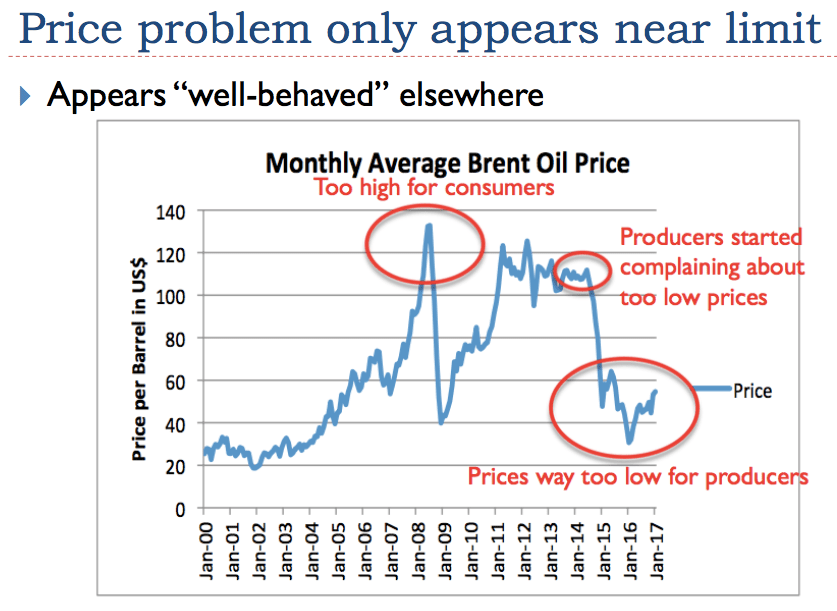
Here is the latest version of Gail Tverberg’s thesis that limits to growth are causing too low energy prices which in turn will cause a decrease in energy extraction which in turn will cause the economy to collapse.

https://ourfiniteworld.com/2017/05/05/why-we-should-be-concerned-about-low-oil-prices/

The economists’ choice of the word “demand” is confusing. A person cannot simply demand to buy a car, or demand to go on a vacation trip. The person needs some way to pay for these things.

Falling resources per capita makes it harder to earn an adequate living. Think of farmers trying to subsist on ever-smaller farms. It would become increasingly difficult for them to earn a living, unless there is a big improvement in technology.

Or think of a miner who is extracting ore that is gradually dropping from 5% metal, to 2% metal, to 1% metal content, and so on, because the best quality ore is extracted first. The miner needs to work an increasing number of hours, to produce the ore needed for 100 kilograms of the metal. The economy is becoming in some sense “worse off,” because the worker is becoming “inefficient” through no fault of his own. The resources needed to provide benefits simply are less available, due to diminishing returns. This problem is sometimes reported as “falling productivity per worker.”

Falling productivity per worker tends to lower wages. And lower wages put downward pressure on commodity prices, because of affordability problems.

We seem to have already gone though a long period of stagflation, since the 1970s. The symptoms we are seeing today look as if we are approaching a steep downslope. If we are approaching a crisis stage, our crisis stage may be much shorter than the 20 to 50 years observed historically. Earlier civilizations (from which these timeframes were observed), did not have electricity or the extensive international trade system we have today.

The big problem that occurs is that non-elite workers become too poor to afford the output of the economy. Adding robots to replace workers looks efficient, but leaves many unemployed. Unemployment is even worse than low pay.

Peak oilers recognized one important point: our use of oil products would at some point have to come to an end. But they did not understand how complex the situation is. Low prices, rather than high, would be the problem. We would see gluts rather than shortages, as we approach limits. Much of the oil that seems to be technologically extractable, will really be left in the ground, because of low prices and other problems.

Many people miss the point that economy must keep growing. (…) As the economy grows, we tend to need more energy. Growing efficiency can only slightly offset this. Thus, as a practical matter, energy per capita needs to stay at least level for an economy to grow.

The fact that energy prices can, and do, fall below the cost of production is something that has been missed by many modelers. Prices can go down, even when the cost of production plus taxes needed by governments rises!

It takes energy to have an intergovernmental organization, such as the European Union. In fact, it takes energy to operate any kind of government. When there is not enough surplus energy to go around, citizens decide that the benefits of belonging to such organizations are less than the costs involved. That is the reason for the Brexit vote, and the reason the question is coming up elsewhere.

Oil prices have been too low for producers since at least mid-2014. It is possible to hide a problem with low prices with increasing debt, for a few years, but not indefinitely. The longer the low-price scenario continues, the more likely a collapse in production is. Also, the tendency of international organizations of government to collapse (Slide 38) takes a few years to manifest itself, as does the tendency for civil unrest within oil exporters (Slide 39).

Once an incorrect understanding of our energy problem becomes firmly entrenched, it becomes very difficult for leaders to understand the real problem.

By Nate Hagens: Blindspots and Superheroes

Here is this year’s Earth Day talk by Nate Hagens.

I used to preface Nate’s talks by saying he provides the best big picture view of our predicament available anywhere.

While still true, I think Nate may now be the only person discussing these issues in public forums.

Everyone else seems to have retired to their bunkers and gone quiet.

If you only have an hour this year to devote to understanding the human predicament and what needs to be done, this may be the best way to spend it.

By Tim Morgan: The Prosperity Equation

Tim Morgan offers another fresh and intelligent insight into world affairs.

It seems a modest decrease in prosperity of about 6% may explain much of the political chaos in the world.

Imagine what may happen when our global debt bubble bursts and we have a significant drop in prosperity.

https://surplusenergyeconomics.wordpress.com/2017/04/14/93-the-prosperity-equation/

Fig. 1: Prosperity per capita, 2016 vs 2006

prosperityjpg_page1

This gets us to a definition of prosperity, something mentioned here before but so important that it bears repetition. Prosperity is “discretionary” income.

Surplus energy economics provides unique insights into prosperity because the trend cost of energy is the principle driver of non-discretionary costs. The cost of essentials is massively linked to the cost of energy. Fuel, power and light are themselves significant components of the non-discretionary spend. But energy also drives the cost of water, minerals, food and the various manufactured goods which need to be acquired and replaced over time.


That the average Chinese person saw his prosperity increase by “only” 58% over a decade remains pretty impressive. But the same adjustments, when applied to less vibrant economies, have some very adverse implications for prosperity.

In the United States, growth of 14.6% in GDP translates into a decrease of 7.0% in prosperity, which might go a long way to help explain why Donald Trump was able to wrest the White House out of the clutches of the political establishment.

In Britain, GDP growth of 12.2% translates into a slump of 13.8% in prosperity, which might likewise help explain “Brexit”. Italian prosperity fell by 9.7% between 2006 and 2016 – a worse fall than any other country except Britain – which no doubt influenced the resounding voter rejection of Matteo Renzi’s reform proposals.

More positively, personal prosperity over that decade increased by 48% in India, 18% in Russia and 12% in Poland.

It’s impossible to say whether the 6.6% ten-year deterioration in French prosperity will be enough to oust the establishment from power – but a not-dissimilar deterioration (of 7%) was followed by the election of Mr Trump, whilst Italy’s 9.7% decline was more than enough to see off Mr Renzi.

If France does elect Ms Le Pen or Mr Mélenchon, the consequences could be drastic – and not just for France herself.

By Ted Trainer: Your Oil Wake Up Call

A very nice summary of our predicament, and what should but won’t be done, because of denial.

https://damnthematrix.wordpress.com/2017/04/08/your-oil-wake-up-call/

ALMOST NO ONE has the slightest grasp of the oil crunch that will hit them, probably within a decade. When it does it will literally mean the end of the world as we know it. Here is an outline of what recent publications are telling us. Nobody will, of course, take any notice.


There is now considerable effort going into working out the relationships between these factors, ie. deteriorating energy EROI, economic stagnation, and debt. The situation is not at all clear. Some see EROI as already being the direct and major cause of a terminal economic breakdown, others think at present more important causal factors are increasing inequality, ecological costs, aging populations and slowing productivity.

Whatever the actual causal mix is, it is difficult to avoid the conclusion that within at best a decade deteriorating EROI is going to be a major cause of enormous disruption.


So, the noose tightens around the brainless, taken for granted ideology that drives consumer-capitalist society and that cannot be even thought about, let alone dealt with.

We are far beyond the levels of production and consumption that can be sustained or that all people could ever rise to. We haven’t noticed because the grossly unjust global economy delivers most of the world’s dwindling resource wealth to the few who live in rich countries. Well, the party is now getting close to being over.

You don’t much like this message? Have a go at proving that it’s mistaken. Nar, better to just ignore it as before.


If the foregoing account is more or less right, then there is only one conceivable way out. That is to face up to transition to lifestyles and systems that enable a good quality of life for all on extremely low per capita resource use rates, with no interest in getting richer or pursuing economic growth.

There is no other way to defuse the problems now threatening to eliminate us, the resource depletion, the ecological destruction, the deprivation of several billion in the Third World, the resource wars and the deterioration in our quality of life.

By Gail Tverberg: Why Energy-Economy Models Produce Overly Optimistic Indications

Gail Tverberg’s essay today provides an excellent summary of why collapse of civilization is inevitable and not too far in the future.

I remain fascinated by how almost all experts, leaders, and citizens deny what is going on.

https://ourfiniteworld.com/2017/03/29/why-energy-economy-models-produce-overly-optimistic-indications

Here are a few key ideas from the essay:

Producers and consumers of energy products are both important

  • Energy prices can be too high for consumers
  • Energy prices can be too low for producers

Both problems are equally important

  • World economy cannot operate without both being satisfied
  • Either a too low or a too high price is a problem

4-price-problem-only-appears-near-limit

We often hear about “Supply and Demand.” A better name for “demand” might be “amount affordable.”

The situation we have now is very much like a Ponzi Scheme. We need to keep adding more debt to keep wages and commodity prices high enough. At the same time, interest rates need to stay very low, to keep payments manageable, and keep the whole system from collapsing.

The balance sheets of insurance companies, banks, and pension plans include much debt. If these institutions are to make good on their promises to those with bank accounts, insurance policies, and pension plans, it is necessary for this debt to be repaid with interest. Back many years ago, debt jubilees were often given to selected debtors. These are out of the question now, because banks, insurance companies, and pension plans depend upon the future payments that this debt represents.

Growing debt is one of the waste outputs. Since we voluntarily seek out debt, we think of debt as an input. But if we think about the situation, debt is really is an adverse output. Required interest payments tend to pull funds out of the system that could otherwise be used to pay workers. Also, the rising use of debt tends to concentrate the ownership of “tools” among the already wealthy. Debt can grow for a while, but it has limits, because of the adverse impacts it creates for the economy.

Growing wage disparity occurs because of the increased specialization required by ever-rising use of tools and technology. Some people receive the benefit of advanced education and learning to use tools such as computers; others receive much less benefit. As a result, their wages lag behind. Wage disparity is another limit of the system. If a large share of the workers cannot afford to buy the output of the economy, “demand” falls too low, and commodity prices tend to fall.

Trying to run the economy on solar electricity alone (or solar plus wind plus water) is a futile exercise. One reason is that it would require massive changes to allow long-haul trucks and airplanes to operate on electricity.

Also, electricity is a high-cost energy product. Today, our economy operates on a mix of high and low cost energy products, with low cost energy products keeping the average cost down. Trying to run the economy on electricity alone is a bit like trying to run the economy using only PhDs. In theory it could be done, but it would be expensive to have PhDs waiting on tables in restaurants and delivering mail.

There is a different kind of EROEI that seems to me to be at least as likely, or more likely, to be the first limit that we will reach. That is the return that workers who are selling their labor simply as labor (without advanced education or supervisory responsibility) obtain. If these workers find that their wages drop too low, this will be a limit on the operation of the economy. Low wages will prevent these workers from buying houses and cars. If the wages of the large number of non-elite workers fall too low, commodity prices will tend to fall, and the system will tend to collapse because producers cannot make a profit at such a low price.

Biologists have been studying the return on the labor of animals for many years, because their populations tend to collapse, when animals are forced to expend too much labor in finding food. EROEI based on wages of non-elite workers would seem to be a closer parallel to the animal return on labor than fossil fuel EROEI.

We have multiple problems:

Problem 1. No dissipative structure can last forever.

Problem 2. As a dissipative structure, our economy seems to be reaching its end.

  • Partly because of slowing growth in energy consumption
  • Partly because of growing wage disparity.

Problem 3. We have ramped up recycling of debt as assets to an amazing level.

  • This debt recycling prevents debt jubilees
  • Leads to the likelihood that insurance companies, banks, and pension plans will fail, if the economy fails

Problems appear to be not far in the future:

Financial system is likely to be center of the storm

  • Most EROEI analysts miss this point

Economy cannot shrink without debt defaults

Economy doesn’t have the ability to go backward

  • Transition to using horses for transportation would be difficult

Theory says that new somewhat similar dissipative structures are likely to eventually form

  • Depends on how many can survive the coming contraction
  • Also, how depleted resources are
  • If contraction too severe, no new economy may be possible

By Tim Morgan: Chinese Whispers

china-bespoke-1-gdp-debtjpg_page1

I used to admire Chinese leadership.

Unlike our idiot lawyers and economists, the Chinese selected engineers and scientists as their leaders. I observed the Chinese tended to favor the long-term rather than the short-term, and that they made wise rather than politically correct decisions. Examples being their one child policy, low military spending, and heavy investment in hydro energy, rail, and other important infrastructure.

Now of course it is clear I was naive. The Chinese are repeating all of our mistakes, but on a larger scale. It makes no difference how leaders are educated, they will eventually succumb to the inherited behaviors common to all humans.

The main difference between us and them now is that they are “borrowing to employ” and we are “borrowing to consume”.

In his blog today Tim Morgan takes a close look at the Chinese economic miracle, or more accurately, the Chinese debt bubble.

https://surplusenergyeconomics.wordpress.com/2017/03/11/89-chinese-whispers/

Which is the world’s largest economy? Converted at market exchange rates, China ($11tn) is smaller than the United States ($18tn) but, on the PPP (purchasing power parity) basis of conversion widely regarded as superior, China (at $21tn) now takes the top spot.

In short, if the Chinese economy were to catch a cold, the world economy would be in for a bout of influenza at best, and could well face the economic equivalent of pneumonia.

The picture that emerges is quite extraordinary. Over the ten years between 2005 and 2015, GDP grew at rates of between 9% and 14% annually, not even stumbling materially during the 2009 global downturn. But debt has grown by between 17% and 35% of GDP each year, with the exception of 2009, when debt increased by 47% of GDP.

What this means is that, over a period in which reported GDP increased by RMB 40tn, debt expanded by RMB 129tn. This is a borrowing-to-growth ratio of 3.2:1, still reasonably modest by Western standards, but a far cry from past Chinese practice – back in 2005, the trailing ten-year (T10Y) ratio was only 1.67:1.

Unlike the Western economies, whose vice-of-choice is to use debt to fund consumption and inflate property markets, the Chinese bias is towards using debt for investment in capacity. In theory, capacity investment should be “self-liquidating”, because capacity increases should increase income, and thus fund the paying off of the initial debt. (This is contradistinction to consumer borrowing, which is “non-self-liquidating”).

But the self-liquidating characteristic of business investment depends on capacity expanding without depressing margins, something which happens when expansion creates major capacity surpluses. It is abundantly clear that Chinese PNFC borrowing has followed the course of excess, depressing returns in the process.

As a result, much of the Chinese business sector earns returns which appear to be well below the cost of debt capital. In this situation, an obvious remedy is to convert debt into equity. This, however, seems to have been tried, and failed, because it showed clear tendencies to crash the equity market.

The final sting in the tail of this analysis is that, if underlying GDP is a lot lower when stripped of the borrowing effect, debt ratios are correspondingly higher. On the SEEDS basis of computation, aggregate debt already stands at 385% of GDP (rather than the reported 246%), and is growing a lot more quickly than publicly available numbers indicate, adding around 43% of GDP (rather than 20%) annually.

With the export-based model faltering, and with a great deal of economic activity dependent on borrowing, China may have ceased to be the powerful engine of growth that is so customarily assumed.

By Geoffrey Chia: What you should not say in public…

Although there are no solutions to our predicament, I wrote a list of things a wise society would do here. I concluded the essay by acknowledging that our inherited denial of reality would probably prevent us from doing any of them.

Today Dr. Geoffrey Chia wrote a list of things a wise society would do and ended with a similar conclusion.

http://www.doomsteaddiner.net/blog/2017/03/01/what-you-should-not-say-in-public/

I am due to speak at the Griffith Ecocentre on 9 March and will run through the usual gamut of why things are fiendishly rotten in the state of Denmark and what to expect in the near future. “Denmark” is of course the metaphor for our besieged planetary ecosphere. It is a commentary familiar to Diners: why global warming will have consequences far worse than the mainstream population have been led to believe (but will NOT cause NTHE by 2026) and why the depletion of “easy” oil guarantees that the collapse of industrial civilisation will be complete within 20 years (a conservative estimate, based on falling EROEI and the ELM). However the fraud pervading our banks and sharemarkets will cause financial and economic collapse and the demise of our global industrial system much sooner. Not to mention all the other fun stuff ahead like mass human die-off, mass extinctions of other species, the rise of fascist extremists around the world, increasing conflicts between nations, increasing risk of global nuclear war, the possibility of pandemics etc. This is all old hat to Diners, but not to the general public. My purpose will not be misery mongering and nihilism however, but to encourage members of the audience to set up their own remote, climate resilient, off-grid homesteads to weather the coming storms. They must not look for salvation from without, but from within. Not everyone will succeed but some will.

I expect the majority will find my commentary repugnant and reject it. I expect the Q&A session will throw up the usual predictable questions such as “how can we fix these problems?” or “surely technofix A can solve problem B?” The standard answer, which Diners are familiar with, is that the issues we face are not problems for which there are solutions, but are predicaments (or conundrums) for which there are no solutions. The correct question at this late stage is not “how can we fix these problems?“, but “what can we do in anticipation of these events?“. Given the more than century long build up to these events, the sapients realise that global industrial collapse is unavoidable, as has been amply demonstrated by even the most optimistic scenarios modelled by the updated Limits to Growth analyses. We have fallen off the cliff and even though we may feel “fine” now, we will not feel so good when we inevitably and excruciatingly smash into the ground. Gravity is a bitch and there is no prospect we can invent an anti-gravity device before impact, or indeed ever.

Not satisfied with such an answer, there is usually the odd tenacious audience member who attempts to pose the same question in a different manner, such as “if you were King of the world and had unlimited policy power, what would you do to tackle these predicaments?” The unstated expectation behind such a question is that a benevolent “philosopher king / ecosystems guru” can find ways to keep 7.5 billion people alive, solve climate change, find a replacement for petroleum etc, etc. Well I ain’t no King and I ain’t no Guru, but for the sake of argument, let us play along with such fantasy based wishful thinking and imagine we can enforce the following:

  1. Abolish all nation states. Demobilise all military forces everywhere and re-employ all ex-military personnel for the refurbishment and maintenance of essential domestic infrastructure, for civil defence and for disaster relief. All nuclear weapons to be dismantled, all weapons manufacturers to be eliminated.
  2. Equitable redistribution of resources, which will require that people in the rich parts of the world give up their luxuries to allow poorer people to survive. This will also require that refugees from climate ravaged and war torn parts of the world be allowed to emigrate to more climate favoured areas.
  3. Impose a moratorium on all human reproduction for the next 30 years, following which we allow only one child per couple until the global population falls to perhaps 100 million and thereafter allow only for replacement reproduction rates. Draconian? Yes, but far preferable to chaotic die-off which could trigger nuclear war.
  4. Transform the existing predatory rapacious capitalist system to a steady state ecology based economic system which penalises polluters and “closes the loop” – to treat and use all waste as a resource.
  5. Stop all unnecessary “economic” activity which will include the cessation of all fossil fuel based tourism and the entire process of globalisation. Limit activities to essential ones such as the production and distribution of food and clean fresh water and the construction and maintenance of dwellings. Localise all economic activities, although international trade in non perishable goods can still occur by use of sailing vessels.
  6. Educate everyone that the main “solution” to our looming energy shortfall must be energy efficiency and conservation, not new whizbang technowizardry such as fusion energy. Cease all fossil fuel electricity generation and change electricity provision to decentralised renewable energy systems such as solar PV for individual dwellings or microgrids. Let the central grid rot or better still, cannibalise it for materials. Pursue research to determine whether we can manufacture and maintain renewable energy generators and batteries using only renewable energy sources.
  7. Phase out all industrial scale monocrop agriculture (which is doomed anyway as fossil fuel based fertilisers, pesticides, herbicides and the petroleum to run mass agriculture will eventually become unavailable). Reduce meat and seafood consumption by more than 90%. Food security to be achieved by the establishment of hundreds of millions of local permaculture smallholdings providing a plant based diet with abundant protein from peas, beans and nuts and supplementary protein from eggs, dairy products, aquaponics and even farmed insects.

What is the likelihood of achieving even one of the above? We are, on the whole, moving in directions away from each and every one of the measures indicated above. So get real. Even if they could all be done, the following issues will remain:

  1. Additional global warming from existing GHGs in the atmosphere is already locked in place but is yet to fully manifest and will render most of the planet uninhabitable. All existing coastal cities will eventually (perhaps in 200 years) be submerged under at least 23 metres of seawater.
  2. We have no liquid transport fuel to replace “easy” oil at scale, which means that industrial civilisation as we know it is still doomed.
  3. Enforcement of the policies outlined above can only be carried out through edict and coercion. External imposition of policies on an ignorant and resistant populace will fail to address the primary underlying reason for all our planetary travails: the possession of advanced, destructive technology in the hands of a “trumped up” (pun intended) species of ape governed by their reptile brain. Cleverness without wisdom. This means that even if all the predicaments above could magically be made to vanish and we could magically reset human society and our planetary ecosphere back to, say 1950 before overshoot began in earnest, we will merely repeat the same patterns over and over again, in the absence of restraint and wisdom. Groundhog day with no hope of redemption, no matter how many times the scenario is replayed.

Semi-sapient people must abandon childish fantasy notions of what we would like happen, grow up and accept the reality of what is going to happen.

The bottom line is this, and I have said it before: the only hope for the continuation of our benighted species is that the survivors who emerge at the other end of this genetic bottleneck are truly sapient and adopt the principles of restraint (in resource consumption and reproduction) and vigorously protect any viable ecohabitats remaining (and cultivate new ones as icebound areas of the planet melt). It is possible, although by no means certain, that the impending cull of the global population may result in just such an outcome, especially if the sapient 0.01% of the population can be encouraged to save themselves NOW. The sapients should be advised not to grieve as future events unfold and they observe, from a safe distance, the morbid spectacle of billions of clueless sheeple killing each other, egged on by the 0.1% psychopathic sheeple herders who had promised to make them great again. Such is the nature of a cull.

13-Mar-2017 addition: Here is Geoffrey Chia’s talk…


By Tim Morgan: A World Economy Snapshot

Another brilliant must read essay by Tim Morgan. There is not one economist in a thousand that understands the relationship between energy and wealth, and yet it’s the most important thing required to understand our economy today.

Think about it. How can it be that well-educated intelligent experts understand everything except obvious facts that imply bad news?  Nothing other than inherited denial can explain this powerful and destructive human behavior.

https://surplusenergyeconomics.wordpress.com/2017/02/16/87-a-world-economy-snapshot/

World trend ECoE is estimated at 7.8% in 2015 – up from 6.4% in 2010 – and is projected to rise to 10.0% by 2021. The latter corresponds to an EROEI of just 9:1 which, if you understand EROEI, spells very big trouble. ECoEs are already high enough to help explain why the world economy is now stuck in “secular stagnation”.

ECoE is best understood as an economic rent. It is a “cost”, but not in the conventional sense of that word because, of course, no money actually leaves the system. Rather, a rising ECoE compels us to spend more on energy and, therefore, less on everything else.

This shows up most obviously in household budgets as a rise in the cost of essentials, which leaves the individual or household less to spend on everything else. Again taking Britain as an example, the cost of household essentials rose by 48% between 2006 and 2016, far outstripping much smaller increases in wages (+21%) and general CPI inflation (+25%). At the level of national economies, much the same occurs, with the cost of essentials outpacing both income and broad inflation as ECoE increases.

This is one reason why seemingly-positive data on the economy as a whole increasingly clashes with individual experience – the data says the economy is growing, but the individual feels poorer, not wealthier. An increasing ECoE – and its transmission through the cost of essentials – helps explain this apparent contradiction. As neither conventional economics nor governments understand this mechanism, policymakers find themselves baffled by trends which do not seem to accord with the data available to them.

So global GDP increased by an aggregate of $20.1tn in the ten years culminating in 2015. But, as you will also see, world debt increased by far more – $76.5tn – over the same period. This means that, aggregated over a trailing ten-year (T10Y) period, $3.81 was borrowed for each $1 of reported growth in GDP.

Obviously, this trajectory is not sustainable – over ten years, economic growth of 22% was far exceeded by an increase of 45% in debt. If the projected increase of $23tn in GDP between 2015 and 2021 happens, and is accompanied by borrowing at the same ratio as the T10Y number (of $3.81 per growth dollar), debt would increase by $87tn, or 36%, over that period.

Ominously, the T10Y measure has been rising steadily – back in 2010, the T10Y ratio was only $2.84 of borrowing for each growth dollar. Even at the $3.81 multiple, however, the ratio of world debt-to-GDP would rise from 216% to 244% – and even this number requires acceptance that reported GDP numbers are an accurate reflection of underlying output.

It seems pretty clear that the enormous rate of borrowing in recent years has flattered GDP by creating “growth” that is really no more than the spending of borrowed money. This, of course, brings forward consumption at the cost of increased liabilities in the future.

On this basis, underlying world GDP in 2015 was $95tn, 17% below the reported $114tn. Just as important, trend growth is far lower when measured on an underlying basis, where world economic output is growing at about 1.2% annually.

This figure is nowhere near a consensus in the range 3-4%. That consensus rate of growth may be deliverable – but only if we carry on spending borrowed money.

A world in denial

Logically, the practice of inflating GDP by spending borrowed money cannot continue indefinitely. This is not a “new normal”, but a “new abnormal”. Most obviously, the aggregate amount of debt is rising much more rapidly than economic output, making the debt burden ever harder to support. Since the global financial crisis (GFC) of 2008, the economy has only managed to co-exist with this debt mountain at all thanks to the slashing of interest rates to near-zero levels.

ZIRP (meaning “zero interest rate policy”) has its own costs, some of which are only now gaining recognition. Savers have suffered very seriously from monetary policies designed to keep borrowers afloat, which, perhaps, is why the concept of “moral hazard” seems to have fallen out of the vocabulary. Last summer, after the most recent cut in interest rates, the deficit in British pension funds rose to £945bn, more than 50% of GDP, and evidence of pension value destruction has emerged on a worldwide basis. Ultra-cheap money keeps afloat businesses which in normal times would have gone under, creating space for new, vibrant enterprises – so the necessary process of “creative destruction” has been stymied by monetary manipulation.

In short, we are living in an unsustainable “never-never-land”, in which cheap debt both misrepresents and undermines real economic performance.

It’s Time to Get Real: Trump’s a Symptom, Not the Problem

I’ve lost patience with the widespread whining about Trump.

Trump’s a symptom, not the problem.

Unless we acknowledge and respond to reality there will be many more and worse Trumps to follow.

Lower and middle class citizens around the world are angry for good reasons:

  • Their incomes have been stagnant or falling despite governments telling them the economy is strong.
  • Their cost of living for things that matter has been rising despite governments telling them inflation is low.
  • They see the upper class getting richer and not being punished for crimes.
  • They carry a high debt load and see that interest rates have nowhere to go but up.
  • For the first time in a long time they worry that the future may be worse than the present.
  • They sense that something is broken and that leaders are not speaking the truth.

Their anger has resulted in:

  • Brexit
  • Trump
  • blame of others
  • extreme parties gaining power around the world
  • social unrest in many countries
  • war drums

The economic stresses experienced by many citizens (and by most countries) are real and have been caused by the depletion of low-cost oil.

The tricks of increasing debt and lowering interest rates have reached their limits and no longer work to mask the depletion of low-cost oil.

Governments have responded with reckless financial policies that guarantee a high-speed crash into a brick wall.

There is no solution to the depletion of low-cost oil.  It is not possible to operate our civilization as currently configured without low-cost oil. There is no substitute for oil.

We need to understand and accept that there will be much less of everything in the future.

We were lucky to witness the peak of human prosperity, and unlucky to witness the beginning of its decline.

No one is to blame. It’s reality.

We need a new story to unite us.

We need new government priorities focused on ensuring the necessities of life are available in the future.

We need to slow down as we approach the brick wall.

We need to stop wasting the precious oil that remains.

We need to get real and vote for wise people who understand what is going on.

We need to break through our inherited denial of reality.