By Richard Heinberg: Energy and Authoritarianism

Arab Spring, Greece, Brexit, Trump, Venezuela, and many more to follow.

Pay attention to what our leaders and experts say. Not one has a clue what is going on.

Hidden from view = No Clue = Denial

http://www.resilience.org/stories/2017-09-26/energy-and-authoritarianism/


It is highly likely that, as events unfold, the causal criticality of energy decline will be hidden from the view of most observers, whose attention will be fixed instead on shocking but comparatively superficial and secondary political and social events. A more widespread understanding of the role of energy in society, and of the likely limits to future energy supplies, could be extremely beneficial in helping the general populace adapt to scarcity and avoid needless scapegoating and violence. Perhaps this essay can help in some small way to deepen that understanding.


One important wild card is the role of debt: it enables us to consume now while promising to pay later. Debt can therefore push consumption forward in time and (for a while, at least) make up for declining energy productivity. It would appear that the “fracking” boom of the past decade, which probably delayed the world oil production peak by about a decade, depended on the power of debt. But when debt defaults cascade, an economy may decline much faster than would otherwise be the case (default-led financial crashes have occurred repeatedly in modern history). And debt defaults can cripple the financial and thus the economic system of a nation with plenty of energy resources (as happened in the U.S. in the 1930s).


Lunch Price Increase

Honest growth driven by low cost energy is over.

What’s left is fake growth driven by debt and money printing.

I think the illusion of growth created by debt and money printing will eventually end when something awakens the herd to the bubbles and causes it to sell assets in a panic which will harm a lot of people, including innocents without assets.

On the other hand, if I am wrong and central banks continue to succeed with their illusion, then it seems the end game will be 90+% of assets owned by the 1% elite, and 99% of citizens angry and impoverished by a destroyed currency.

It would be so much wiser and safer to accept the necessity of a decline in our standard of living, and to allow the economy to deflate with taxation policies designed to prevent the wealth gap from widening as everyone becomes poorer.

I understand that it may be impossible to orchestrate a gradual deflation without triggering a crash, however every day that we postpone reality increases the pain we will eventually experience.

There is no free lunch.

21765598_10155072425313261_5674136948384125200_o

By Tim Morgan: Why Mr. Trump can’t raise American prosperity

A must read by the brilliant Tim Morgan.

https://surplusenergyeconomics.wordpress.com/2017/09/05/104-why-mr-trump-cant-raise-american-prosperity/

Essentially, two things are happening to the average American. First, his or her income is rising less rapidly than the cost of essentials, squeezing the “discretionary” income which is the real definition of prosperity. Second, increases in income are being far exceeded by increases in debt, and also by growing shortfalls in pension provision. So the citizen feels both less prosperous and less secure.

As SEEDS measures it, per capita prosperity was 10% lower in 2016 than it was back in 2000. Neither is this trend likely to reverse – by 2025, the average American is likely to have seen his or her prosperity decline by a further 8% in comparison with 2016. At the same time, per capita debt has increased by almost $54,000, in real terms, since 2000, a problem now being compounded by a rapidly-growing systemic shortfall in pension provision.

‘Conventional’ economics cannot capture any of this. A perspective which ignores both “borrowed consumption” and the trend cost of energy is baffled by popular discontent, in America and elsewhere. Moreover, ‘conventional’ analysis tends to be misled by the apparently-buoyant values of stocks, bonds and property. These values are misleading, because they cannot be monetized – the only buyers for homes, for example, are the same people to whom they already belong.

For as long as these issues are overlooked, popular anger is likely to go on taking ‘the experts’ by surprise.


The concept of prosperity needs to be understood clearly. Prosperity is not simply the size of someone’s income. Rather, it is the sum left over after essentials have been paid for. This means that prosperity equates to “discretionary” income, which is the sum that he or she can choose how to spend.

The fundamentally energy-based nature of all output creates a natural distinction between “two economies” – the real economy of goods and services, and the financial economy of money and credit. Used properly, the financial system can deliver many benefits. Equally, though, it can be harmful, if it diverges too far from the real economy.

The potential for harm is simple. Money functions only as a “claim” on goods and services, which really makes it a claim on surplus energy. Likewise, since credit is a claim on future money, it is really a claim on future energy.

Financial “claims” – money and credit – can be manufactured out of thin air, and we can create as many of these claims as we like. But, if we create claims that exceed what the real economy can deliver, the excess cannot be honoured. Therefore, it must be destroyed. Inflation is one way of doing this, though default is another.


America is by no means unique in experiencing downwards pressure on prosperity – the same is happening in many other countries, often more severely than in the United States.

The problems posed for America are twofold. First, the deterioration in prosperity makes it impossible for the President to improve the material prosperity of the average American – in attempting to do so, he is about as powerless as was King Canute when he tried to turn back the tide.

Second, the use of cheap money to ‘manufacture’ nominal economic growth is already creating an escalating level of forward risk. Just as Americans are getting less prosperous, they are also becoming ever more indebted, and face ever greater insecurity as provision for pensions deteriorates.

The time cannot be too far off, for America as for the world more generally, where the future (represented by the collective balance sheet) overwhelms the present.

By Richard Heinberg: Are We Doomed? Let’s Have a Talk.

climate_change_is_real_is_the_doom

Richard Heinberg is one of the early voices that sounded the alarm on limits to growth. He has a wide and deep understanding of the issues, and is an excellent and prolific writer.

In earlier years he usually concluded his books and essays with some variation of “the good news is everything will be ok if we just do xyz”.

Lately he has been speaking more openly and honestly.

This latest essay is a no holds barred full-on dose of reality.

Good on him. Someone needs to speak the truth.

One quote stood out for me:

Accepting that a crash is more or less inevitable is a big step, psychologically speaking. I call this toxic knowledge: one cannot “un-know” that the current world system hangs by a thread, and this understanding can lead to depression. In some ways, the systemic crisis we face is analogous to the individual existential crisis of life and death, which we each have to confront eventually. Some willfully ignore their own mortality for as long as possible; others grasp at a belief in the afterlife.

Heinberg, apparently without awareness of Varki’s theory, is dancing around the fact that denial of reality is central to what makes us human, as it was the barrier created by awareness of mortality, and nature’s solution of evolving denial of death via a more general denial of realty mechanism, that enabled us to evolve an extended theory of mind, which we used to take over the planet, and to enter an extreme state of overshoot.


Are we doomed if we can’t maintain current and growing energy levels? And are we doomed anyway due to now-inevitable impacts of climate change?

First, the good news. With regard to energy, we should keep in mind the fact that today’s Americans use roughly twice as much per capita as their great-grandparents did in 1925. While people in that era enjoyed less mobility and fewer options for entertainment and communication than we do today, they nevertheless managed to survive and even thrive. And we now have the ability to provide many services (such as lighting) far more efficiently, so it should be possible to reduce per-capita energy usage dramatically while still maintaining a lifestyle that would be considered more than satisfactory by members of previous generations and by people in many parts of the world today. And reducing energy usage would make a whole raft of problems—climate change, resource depletion, the challenge of transitioning to renewable energy sources—much easier to solve.

The main good news with regard to climate change that I can point to (as I did in  this essay posted in June) is that economically recoverable fossil fuel reserves are consistent only with lower-emissions climate change scenarios. As BP and other credible sources for coal, oil, and natural gas reserves figures show, and as more and more researchers are pointing out, the worst-case climate scenarios associated with “business as usual” levels of carbon emissions are in fact unrealistic.

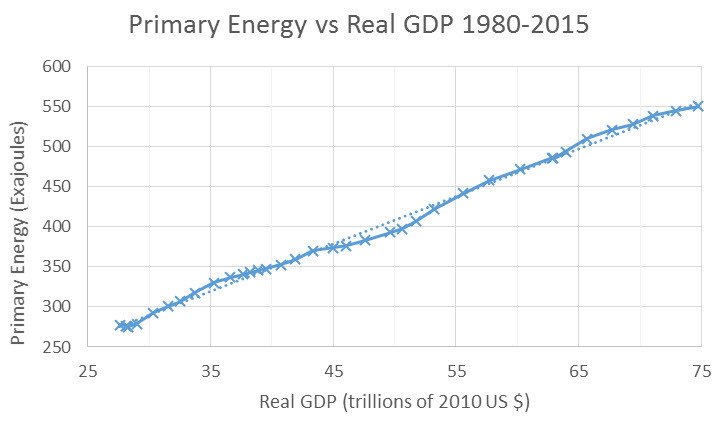
Now, the bad news. While we could live perfectly well with less energy, that’s not what the managers of our economy want. They want growth. Our entire economy is structured to require constant, compounded growth of GDP, and for all practical purposes raising the GDP means using more energy. While fringe economists and environmentalists have for years been proposing ways to back away from our growth addiction (for example, by using alternative economic indices such as Gross National Happiness), none of these proposals has been put into widespread effect. As things now stand, if growth falters the economy crashes.

There’s bad climate news as well: even with current levels of atmospheric greenhouse gases, we’re seeing unacceptable and worsening impacts—raging fires, soaring heat levels, and melting icecaps. And there are hints that self-reinforcing feedbacks maybe kicking in: an example is the release of large amounts of methane from thawing tundra and oceanic hydrates, which could lead to a short-term but steep spike in warming.  Also, no one is sure if current metrics of climate sensitivity (used to estimate the response of the global climate system to a given level of forcing) are accurate, or whether the climate is actually more sensitive than we have assumed. There’s some worrisome evidence the latter is case.

But let’s step back a bit. If we’re interested in signs of impending global crisis, there’s no need to stop with just these two global challenges. The world is losing 25 billion tons of topsoil a year due to current industrial agricultural practices; if we don’t deal with that issue, civilization still crash even if we do manage to ace our energy and climate test. Humanity is also over-using fresh water: ancient aquifers are depleting, while other water sources are being polluted. If we don’t deal with our water crisis, we still crash. Species are going extinct at a thousand times the pre-industrial rate; if we don’t deal with the biodiversity dilemma, we still crash. Then there are social and economic problems that could cause nations to crumble even if we manage to protect the environment; this threat category includes the menaces of over-reliance on debt and increasing economic inequality.

If we attack each of these problems piecemeal with technological fixes (for example, with desalination technology to solve the water crisis or geo-engineering to stabilize the climate) we may still crash because our techno-fixes are likely to have unintended consequences, as all technological interventions do. Anyway, the likelihood of successfully identifying and deploying all the needed fixes in time is vanishingly small.

Many problems are converging at once because society is a complex system, and the challenges we have been discussing are aspects of a systemic crisis.

Many problems are converging at once because society is a complex system, and the challenges we have been discussing are aspects of a systemic crisis. A useful way to frame an integrated understanding of the 21st century survival challenge is this: we humans have overshot Earth’s long-term carrying capacity for our species. We’ve been able to do this due to a temporary subsidy of cheap, bountiful energy from fossil fuels, which enabled us to stretch nature’s limits and to support a far larger overall population than would otherwise be possible. But now we are starting to see supply constraints for those fuels, just as the side effects of burning enormous amounts of coal, oil, and natural gas are also coming into view. Meanwhile, using cheap energy to expand resource-extractive and waste-generating economic processes is leading to biodiversity loss; the depletion of soil, water, and minerals; and environmental pollution of many kinds. Just decarbonizing energy, while necessary, doesn’t adequately deal with systemic overshoot. Only a reduction of population and overall resource consumption, along with a rapid reduction in our reliance on fossil fuels and a redesign of industrial systems, can do that.

Economic inequality is a systemic problem too. As we’ve grown our economy, those who were in position to invest in industrial expansion or to loan money to others have reaped the majority of the rewards, while those who got by through selling their time and labor (or whose common cultural heritage was simply appropriated by industrialists) have fallen behind. There’s no technological fix for inequality; dealing with it will require redesigning our economic system and redistributing wealth. Those in wealthy nations would, on average, have to adjust their living standards downward.

Now, can we do all of this without a crash? Probably not. Indeed, many economists would regard the medicine (population reduction, a decline in per-capita energy use, and economic redistribution) as worse than whatever aspects of the disease they are willing to acknowledge. Environmentalists and human rights advocates would disagree. Which is to say, there’s really no way out. Whether we stick with business as usual, or attempt a dramatic multi-pronged intervention, our current “normal” way of life is toast.

Accepting that a crash is more or less inevitable is a big step, psychologically speaking. I call this toxic knowledge: one cannot “un-know” that the current world system hangs by a thread, and this understanding can lead to depression. In some ways, the systemic crisis we face is analogous to the individual existential crisis of life and death, which we each have to confront eventually. Some willfully ignore their own mortality for as long as possible; others grasp at a belief in the afterlife. Still others seek to create meaning and purpose by making a positive difference in the lives of those around them with whatever time they have. Such efforts don’t alter the inevitability of death; however, contributing to one’s community appears to enhance well-being in many ways beyond that of merely prolonging life.

But is a crash the same as doom?

Not necessarily. Our best hope at this point would seem to be a controlled crash that enables partial recovery at a lower level of population and resource use, and that therefore doesn’t lead to complete and utter oblivion (human extinction or close to it). Among those who understand the systemic nature of our problems, the controlled crash option is the subject of what may be the most interesting and important conversation that’s taking place on the planet just now. But only informed people who have gotten over denial and self-delusion are part of it.

This discussion started in the 1970s, though I wasn’t part of it then; I joined a couple of decades later. There is no formal membership; the conversation takes place through and among a patchwork of small organizations and scattered individuals. They don’t all know each other and there is no secret handshake. Some have publicly adopted the stance that a global crash is inevitable; most soft-pedal that message on their organizational websites but are privately plenty worried. During the course of the conversation so far, two (not mutually exclusive) strategies have emerged.

The first strategy envisions convincing the managers and power holders of the world to invest in a no-regrets insurance plan. Some systems thinkers who understand our linked global crises are offering to come up with a back-pocket checklist for policy makers, for moments when financial or environmental crisis hits: how, under such circumstances, might the managerial elite be able to prevent, say, a stock market crash from triggering food, energy, and social crises as well? A set of back-up plans wouldn’t require detailed knowledge of when or how crisis will erupt. It wouldn’t even require much of a systemic understanding of global overshoot. It would simply require willingness on the part of societal power holders to agree that there are real or potential threats to global order, and to accept the offer of help. At the moment, those pursuing this strategy are working mostly covertly, for reasons that are not hard to discern.

The second strategy consists of working within communities to build more societal resilience from the ground up. It is easier to get traction with friends and neighbors than with global power holders, and it’s within communities that political decisions are made closest to where the impact is felt. My own organization, Post Carbon Institute, has chosen to pursue this strategy via a series of books, the Community Resilience Guides;  the “Think Resilience” video series; and our forthcoming compendium, The Community Resilience Reader.  Rob Hopkins, who originated the Transition Towns movement, has been perhaps the most public, eloquent, and upbeat proponent of the local resilience strategy, but there are countless others scattered across the globe.

Somehow, the work of resilience building (whether top-down or bottom-up) must focus not just on maintaining supplies of food, water, energy, and other basic necessities, but also on sustaining social cohesion—a culture of understanding, tolerance, and inquiry—during times of great stress. While it’s true that people tend to pull together in remarkable ways during wars and natural disasters, sustained hard times can lead to scapegoating and worse.

Most people are not party to the conversation, not aware that it is happening, and unaware even that such a conversation is warranted. Among those who are worried about the state of the world, most are content to pursue or support efforts to keep crises from occurring by working via political parties, religious organizations, or non-profit advocacy orgs on issues such as climate change, food security, and economic inequality. There is also a small but rapidly growing segment of society that feels disempowered as the era of economic growth wanes, and that views society’s power holders as evil and corrupt. These dispossessed—whether followers of ISIS or Infowars—would prefer to “shake things up,” even to the point of bringing society to destruction, rather than suffer the continuation of the status quo. Unfortunately, this last group may have the easiest path of all.

Can we succeed? It depends on how one defines “success”…

By comparison, the number of those involved in the conversation is exceedingly small, countable probably in the hundreds of thousands, certainly not millions. Can we succeed? It depends on how one defines “success”—as the ability to maintain, for a little longer, an inherently unsustainable global industrial system? Or as the practical reduction in likely suffering on the part of the survivors of the eventual crash? A related query one often hears after environmental lectures is, Are we doing enough? If “Enough” means “enough to avert a system crash,” then the answer is no: it’s unlikely that anyone can deliver that outcome now. The question should be, What can we do—not to save a way of life that is unsalvageable, but to make a difference to the people and other species in harm’s way?

This is not a conversation about the long-term trajectory of human cultural evolution, though that’s an interesting subject for speculation. Assuming there are survivors, what will human society look like following the crises ensuing from climate change and the end of fossil fuels and capitalism? David Fleming’s book, Surviving the Future, and John Michael Greer’s, The Ecotechnic Future, both  offer useful thoughts in this regard. My own view is that it’s hard for us to envision what comes next because our imaginations are bounded by the reality we have known. What awaits will likely be as far removed from from modern industrial urban life as Iron-Age agrarian empires were from hunting-and-gathering bands. We are approaching one of history’s great discontinuities. The best we can do under the circumstances is to get our priorities and values straight (protect the vulnerable, preserve the best of what we have collectively achieved, and live a life that’s worthy) and put one foot in front of the other.

The conversation I’m pointing to here is about fairly short-term actions. And it doesn’t lend itself to building a big movement. For that, you need villains to blame and promises of revived national or tribal glory. For those engaged in the conversation, there’s only hard work and the satisfaction of honestly facing our predicament with an attitude of curiosity, engagement, and compassion. For us, threats of doom or promises of utopia are distractions or cop-outs.

Only those drawn to the conversation by temperament and education are likely to take it up. Advertising may not work. But having a few more hands on deck, and a few more resources to work with, can only help.
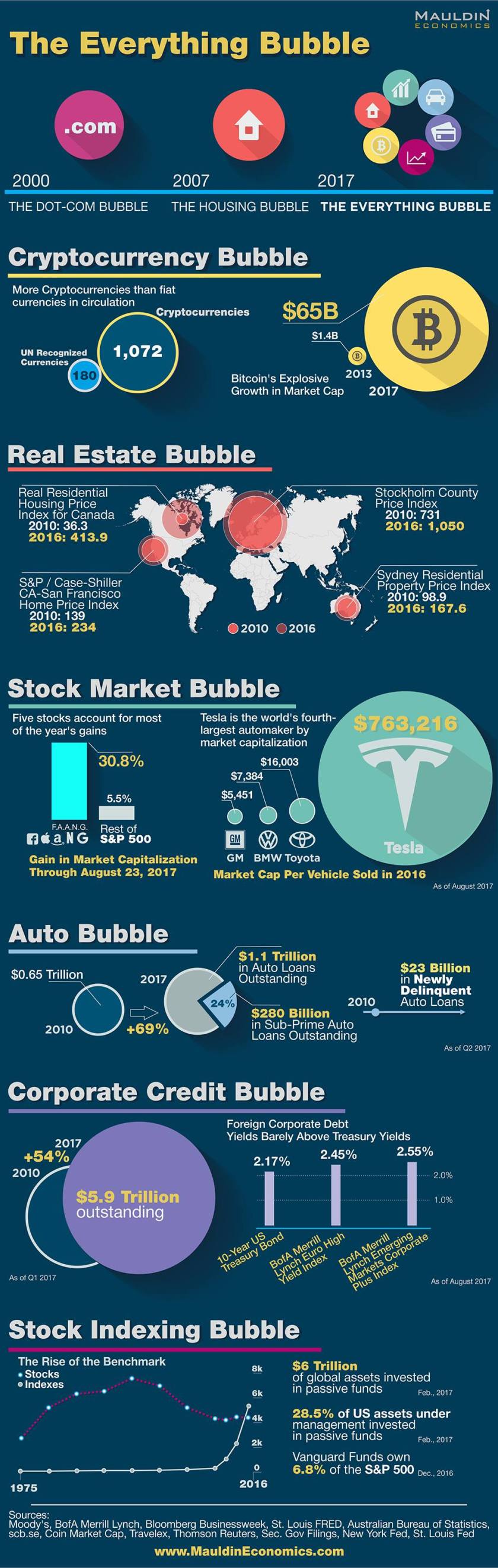
By Charles Hugh Smith: The Inevitability of DeGrowth

While there are no new ideas in this essay, I decided to post it because it is a well written primer on the intersecting issues of wealth, energy, debt, and limits to growth.

https://www.peakprosperity.com/blog/109555/inevitability-degrowth

chs-degrowth-chart1

Even though we don’t know precisely how the future will unfold, we know a few things about it:

  1. Of the 7.5 billion humans on the planet, virtually every individual wants to enjoy a high-energy consumption “middle-class” lifestyle. As a generous estimate, 1.5 billion people enjoy a high-energy consumption lifestyle today; the remaining six billion are aspirants hungry for all the goodies enjoyed by the 1.5 billion—all goodies based on affordable, abundant energy.
  2. Our dependence on debt to fuel growth—more extraction of resources, more energy, more manufacturing, more consumption and more earned income to pay for all this expansion of debt and consumption—has built-in limits: debt accrues interest and principal payments, which reduce the remaining income available to spend on consumption.  Our dependence on fast-rising debt just to maintain low rates of growth eventually limits our ability to pay for more consumption/growth. When most income is devoted to servicing debt, there isn’t enough left to buy more stuff or support additional debt.
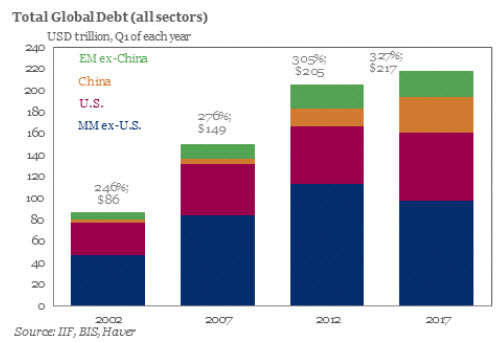
  3. The debt needed to move the growth needle is expanding at a much higher rate than the growth it generates. While growth is stagnant, debt is expanding by leaps and bounds to unprecedented levels. (Global Debt Hits A New Record High Of $217 Trillion; 327% Of GDP)
  4. Wages are stagnating for the bottom 90% of the workforce. We can quibble about the causes, but there is no plausible evidence to support a belief that this trend will magically reverse.
  5. The cost of the most valuable energy–high-density, easy to transport—will slowly but surely become more expensive as the cheap, easy-to-extract energy sources are depleted, notwithstanding the temporary boost provided by the fast-depleting wells of the fracking “miracle.”
  6. There are limits on our exploitation of resources such as fresh water and wild fisheries. Humans can print currency (money) but we can’t print fresh water, energy, wild fisheries, etc. If one unit of currency currently buys one liter of petrol, printing 10 more units of money doesn’t create 10 more liters of fuel.
  7. Creating currency out of thin air isn’t free in our system: all new currency is loaned into existence and accrues interest. As a result, all currency is a claim on future earnings. If we borrow enough from the future, and earnings remain flat or decline, eventually there’s not enough income left to support the debt service and the expanding consumption the status quo needs to keep itself glued together.

By John Weber: Furnaces of Industry (Solar Energy is Not Renewable)

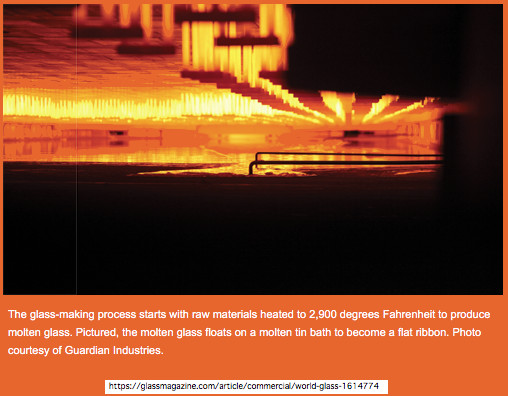
Solar panels require large quantities of glass. This excellent essay reviews the energy required to produce glass and shows that solar panels cannot be used to make more solar panels.

You need fossil energy to make solar energy.

This means solar energy is not renewable.

We are so accustomed to having access to affordable fossil energy that we forget how precious and magical our main source of energy is: oil is used to produce more oil, and unlike electricity, oil can be cheaply stored and transported.

All of the above also applies to the materials and equipment needed to produce, install, and maintain wind, hydro, geothermal, and nuclear energy.

http://sunweber.blogspot.ca/2017/07/furnaces-of-industry_14.html

furnaceglass

In the USA glass manufacturing accounted for 1% of total industrial energy use in EIA’s most recent survey of the manufacturing sector. Overall fuel use is dominated by natural gas (73%) and electricity (24%), with the remaining share (3%) from several other fuels. Natural gas use at glass manufacturing facilities in 2010 was 146 trillion Btu, about 143 billion cubic feet.

If we convert the natural gas to kWh, we get:

143 billion cubic feet Natural Gas = 41,909,163,034.63 kWh

By Chris Martenson: The Looming Energy Shock

I have a lot of time for Chris Martenson. He’s well grounded in science and has a lot of integrity. My only criticism of late is his recent campaign to blame central banks which I suspect is a marketing strategy to increase subscriptions because blaming bankers sells better than blaming thermodynamics, overshoot, and inherited denial.

Chris is predicting that within 3 years we will either have an economic collapse that temporarily masks the underlying energy problem, or we will have oil shortages and a price shock that will trigger a credit crisis like 2008 but worse. He backs these predictions with the correct data, in my opinion.

I independently came to roughly the same conclusion, although I would add a 3rd possibility given rising stresses around the world: a major war.

I think the 3 possible outcomes are roughly equal in probability, although given the deceleration in credit growth apparent from the following graph, an economic collapse has the lead by a nose.

global-debt-2017-06-29_21-27-57

energy-and-economy-10-4-2016

oil-investments-global-2017-06-29


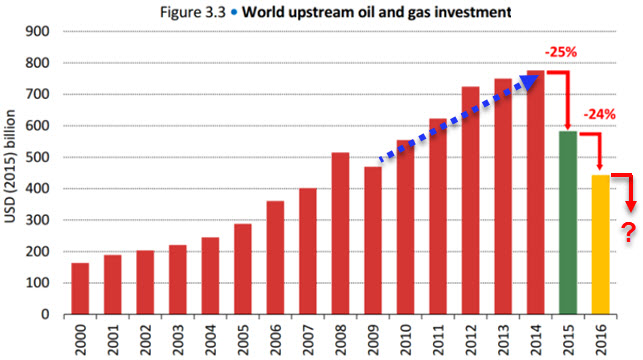
There will be an extremely painful oil supply shortfall sometime between 2018 and 2020. It will be highly disruptive to our over-leveraged global financial system, given how saddled it is with record debts and unfunded IOUs.

Due to a massive reduction in capital spending in the global oil business over 2014-2016 and continuing into 2017, the world will soon find less oil coming out of the ground beginning somewhere between 2018-2020.

Because oil is the lifeblood of today’s economy, if there’s less oil to go around, price shocks are inevitable. It’s very likely we’ll see prices climb back over $100 per barrel. Possibly well over.

The only way to avoid such a supply driven price-shock is if the world economy collapses first, dragging demand downwards.

Not exactly a great “solution” to hope for.

https://www.peakprosperity.com/blog/109505/looming-energy-shock

By Ajit Varki: Mind Over Reality Transition: The Evolution of Human Mortality Denial

Dr. Ajit Varki, one of the originators of the most important idea since Darwin, gave this talk on March 3, 2017 in which he explains the Mind Over Reality Transition (MORT) theory that he and Danny Brower developed and discussed in their book and which underpins this blog.

Dr. Varki, being a humble and cautious scientist, does not amplify the implications of his theory so I will do it for him here.

The Mind Over Reality theory explains the:

After reflecting on this list, and assuming that in time Varki’s theory is proven to be correct, you may begin to appreciate why I think Varki’s MORT theory is THE most important idea for understanding our origin, our special place in the universe, and our destructive behaviors that threaten our existence. 

A pleasant fact I learned from the talk is that despite having a solemn demeanor Dr. Varki has a killer sense of humor.

Here is the abstract for the talk:

Some aspects of human cognition and behavior appear unusual or exaggerated relative to those of other intelligent, warm-blooded, long-lived social species––including certain mammals (cetaceans, elephants and great apes) and birds (corvids and passerines). One such collection of related features is our facile ability for reality denial in the face of clear facts, a high capacity for self-deception and false beliefs, overarching optimism bias and irrational risk-taking behavior––traits that should be maladaptive when they first appear as hard-wired features in individuals of any species. Meanwhile, available data suggest that self-awareness (knowledge of one’s own personhood) and basic theory of mind (ToM, also termed mind-reading, intentionality etc.) have independently emerged several times, particularly in the same kinds of species mentioned above.  Despite a long-standing opportunity spanning tens of millions of years, only humans appear to have then evolved an extended ToM (multilevel intentionality), a trait required for optimal expression of many other unusual cognitive attributes of our species, such as advanced linguistic communication and cumulative cooperative culture. The conventional view is that extended ToM emerged gradually in human ancestors, via stepwise positive selection of multiple traits that were each beneficial. A counterintuitive alternate possibility is that establishment of extended ToM has been repeatedly obstructed in all other species with the potential to achieve it, due to a “psychological evolutionary barrier“.  This barrier is claimed to arise in isolated individuals of a given species that develop the genetic ability for extended ToM.  Such individuals would then observe deaths of others whose minds they fully understood, become aware of mortality, and translate that knowledge into an understanding of personal mortality.  The conscious realization and exaggeration of an already existing intrinsic fear of death risk would have then reduced the reproductive fitness of such isolated individuals (by favoring personal survival over reproduction).  The barrier would have persisted until hominin ancestors broke through via a rare and unlikely combination of cognitive changes, in which two intrinsically maladaptive traits (Reality Denial and Extended ToM) combined in the same individuals, to allow a “Mind over Reality Transition”. Once the barrier was broken, conventional natural selection could take over, with further evolution of beneficial aspects of the initial changes. This theory also provides a unifying evolutionary explanation for other unusual features of humans, including recent emergence as the dominant species on the planet, and replacement of all other closely related evolutionary cousins, with limited interbreeding and no hybrids. While not directly falsifiable by experiment, the theory fits with numerous facts about humans and human origins, and no known fact appears to strongly militate against it. It is also consistent with most other currently viable theories on the subject including Terror Management Theory.  Importantly, it has major implications for the human condition, as well as for many serious issues, ranging all the way from personal health responsibility to global climate change.

Varki, A. Human uniqueness and the denial of death. Nature. 460:684. 2009.

Varki, A., and Brower, D. Denial: Self-Deception, False Beliefs, and the Origins of the Human Mind. Twelve Books, New York. 2013.

Varki, A.: Thought Experiment: Dating the Origin of Us. The Scientist 27:28-29, 2013.

Varki, A.: Why are there no persisting hybrids of humans with Denisovans, Neanderthals, or anyone else? Proc Natl Acad Sci U.S.A. 113: E2354, 2016.

By Aaron Thierry: The Brutal Logic of Climate Change

A must watch. One of the best talks I’ve seen on climate change.

It’s not a future problem. We’re in the midst of an emergency. Dramatic action is required today.

Unfortunately, like almost every other climate scientist, he does not have a clue when it comes to energy and the economy and he veers off into woo-woo hopium land when discussing solutions.

We need fewer and poorer people. Also known as economic collapse. Nothing else will help.

On a positive note, fewer people improves every one of the many overshoot problems we face, not just climate change.


By Nicole Foss: The Automatic Earth Primer Guide 2017

Nicole Foss has one of my favorite minds on the planet.

She used to write prolifically on our predicament but perhaps after having said most of what she thought needed to be said, and then attending to personal preparations by leaving Canada for the much safer New Zealand, she now writes infrequently.

Today Nicole published a greatest hits summary of her and her writing partner Ilargi’s essays.

If you are seeking to understand reality then I recommend you spend some time reading her catalog.

If you prefer to learn by video, then you might enjoy this interview with Nicole.

https://www.theautomaticearth.com/2017/05/the-automatic-earth-primer-guide-2017/

Nicole Foss has completed a huge tour de force with her update of the Automatic Earth Primer Guide. The first update since 2013 is now more like a Primer Library, with close to 160 articles and videos published over the past -almost- 10 years, and Nicole’s words to guide you through it. Here’s Nicole:

The Automatic Earth (TAE) has existed for almost ten years now. That is nearly ten years of exploring and describing the biggest possible big picture of our present predicament. The intention of this post is to gather all of our most fundamental articles in one place, so that readers can access our worldview in its most comprehensive form. For new readers, this is the place to start. The articles are roughly organised into topics, although there is often considerable overlap.

We are reaching limits to growth in so many ways at the same time, but it is not enough to understand which are the limiting factors, but also what time frame each particular subset of reality operates over, and therefore which is the key driver at what time. We can think of the next century as a race of hurdles we need to clear. We need to know how to prepare for each as it approaches, as we need to clear each one in order to be able to stay in the race.

TAE is known primarily as a finance site because finance has the shortest time frame of all. So much of finance exists in a virtual world in which changes can unfold very quickly. There are those who assume that changes in a virtual system can happen without major impact, but this assumption is dangerously misguided. Finance is the global operating system – the interface between ourselves, our institutions and our resource base. When the operating system crashes, nothing much will work until the system is rebooted. The next few years will see that crash and reboot. As financial contraction is set to occur first, finance will be the primary driver to the downside for the next several years. After that, we will be dealing with energy crisis, other resource limits, limitations of carrying capacity and increasing geopolitical ramifications.

The global financial system is rapidly approaching a Minsky Moment:

“A Minsky moment is a sudden major collapse of asset values which is part of the credit cycle or business cycle. Such moments occur because long periods of prosperity and increasing value of investments lead to increasing speculation using borrowed money. The spiraling debt incurred in financing speculative investments leads to cash flow problems for investors. The cash generated by their assets is no longer sufficient to pay off the debt they took on to acquire them.

Losses on such speculative assets prompt lenders to call in their loans. This is likely to lead to a collapse of asset values. Meanwhile, the over-indebted investors are forced to sell even their less-speculative positions to make good on their loans. However, at this point no counterparty can be found to bid at the high asking prices previously quoted. This starts a major sell-off, leading to a sudden and precipitous collapse in market-clearing asset prices, a sharp drop in market liquidity, and a severe demand for cash.”

This is the inevitable result of decades of ponzi finance, as our credit bubble expanded relentlessly, leaving us today with a giant pile of intertwined human promises which cannot be kept. Bubbles create, and rely on, building stacks of IOUs ever more removed from any basis in underlying real wealth. When the bubble finally implodes, the value of those promises disappears as it becomes obvious they will not be kept. Bust follows boom, as it has done throughout human history. The ensuing Great Collateral Grab will reveal just how historically under-collateralized our supposed prosperity has become. Very few of the myriad claims to underlying real wealth can actually be met, leaving the excess claims to be exposed as empty promises. These are destined to be rapidly and messily extinguished in a deflationary implosion.

While we cannot tell you exactly when the bust will unfold in specific locations, we can see that it is already well underway in some parts of the world, notably the European periphery. Given that preparation takes time, and that one cannot be late, now is the time to prepare, whether one thinks the Great Collateral Grab will manifest close to home next month or next year. Those who are not prepared risk losing everything, very much including their freedom of action to address subsequent challenges as they arise. It would be a tragedy to fall at the first hurdle, and then be at the mercy of whatever fate has to throw at you thereafter. The Automatic Earth has been covering finance, market psychology and the consequences of excess credit and debt since our inception, providing readers with the tools to navigate a major financial accident.


The second limiting factor is likely to be energy, although this may vary with location, given that energy sources are not evenly distributed. Changes in supply and demand for energy are grounded in the real world, albeit in a highly financialized way, hence they unfold over a longer time frame than virtual finance. Over-financializing a sector of the real economy leaves it subject to the swings of boom and bust, or bubbles and their aftermath, but the changes in physical systems typically play out over months to years rather than days to weeks.

Financial crisis can be expected to deprive people of purchasing power, quickly and comprehensively, thereby depressing demand substantially (given that demand is not what one wants, but what one can pay for). Commodity prices fall under such circumstances, and they can be expected to fall more quickly than the cost of production, leaving margins squeezed and both physical and financial risk rising sharply. This would deter investment for a substantial period of time. As a financial reboot begins to deliver economic recovery some years down the line, the economy can expect to hit a hard energy supply ceiling as a result. Financial crisis initially buys us time in the coming world of hard energy limits, but at the expense of worsening the energy crisis in the longer term.

Energy is the master resource – the capacity to do work. Our modern society is the result of the enormous energy subsidy we have enjoyed in the form of fossil fuels, specifically fossil fuels with a very high energy profit ratio (EROEI). Energy surplus drove expansion, intensification, and the development of socioeconomic complexity, but now we stand on the edge of the net energy cliff. The surplus energy, beyond that which has to be reinvested in future energy production, is rapidly diminishing. We would have to greatly increase gross production to make up for reduced energy profit ratio, but production is flat to falling so this is no longer an option. As both gross production and the energy profit ratio fall, the net energy available for all society’s other purposes will fall even more quickly than gross production declines would suggest. Every society rests on a minimum energy profit ratio. The implication of falling below that minimum for industrial society, as we are now poised to do, is that society will be forced to simplify.

A plethora of energy fantasies is making the rounds at the moment. Whether based on unconventional oil and gas or renewables (that are not actually renewable), these are stories we tell ourselves in order to deny that we are facing any kind of future energy scarcity, or that supply could be in any way a concern. They are an attempt to maintain the fiction that our society can continue in its current form, or even increase in complexity. This is a vain attempt to deny the existence of non-negotiable limits to growth. The touted alternatives are not energy sources for our current society, because low EROEI energy sources cannot sustain a society complex enough to produce them.

We are poised to throw away what remains of our conventional energy inheritance chasing an impossible dream of perpetual energy riches, because doing so will be profitable for the few in the short term, and virtually no one is taking a genuine long term view. We will make the transition to a lower energy society much more difficult than it need have been. At The Automatic Earth we have covered these issues extensively, pointing particularly to the importance of net energy, or energy profit ratios, for alternative supplies. We have also addressed the intersections of energy and finance.