Baba’s got a new rap on god.
I wish he would read Varki.
His insight would go from good to great.
Baba’s got a new rap on god.
I wish he would read Varki.
His insight would go from good to great.
This lesson on wisdom is very good.
It’s rich and enjoyable enough to warrant multiple viewings and might become a go-to place for me when I’m feeling blue.
If the author were to add a comment that denial is not a defect, but is in fact what makes us human, it would be perfect.
This excellent video was produced in 2012. You can see how people in denial who viewed it then are saying to themselves today that they were right not to worry. Hell, I bought gas today for $0.88 per liter. What’s the problem?
Read some of the YouTube comments for scary insight into the views of our citizens. It’s going to be a gong show when decline begins in earnest.
These comments by the producer in the FAQ speak directly to denial:
Would you do it again if you knew how long it was going to take?
No. In the intervening years, it’s become clear that people are deeply set in their opinions, and that most of the writing/commentary/movies that are made simply reinforce existing beliefs, rather than change them. In addition, dealing with this subject is likely to have one labeled a Eugenicist/Genocidal-maniac/NWO-puppet/Illuminati/Oil-industry-shill/The AntiChrist, or worse.
It would have been wiser to create a cartoon about crime-fighting squirrels with super-powers.
Here is an overview of the film from its home site:
“This is a quick journey through the subjects of oil formation, peak oil, energy, economic growth, and resource depletion. I’ve condensed several years of reading and research into little over half an hour. The most important sequence is around the 17min mark, dealing with Growth…the real subject of the film.”
There’s No Tomorrow is a half-hour animated documentary about resource depletion, energy and the impossibility of infinite growth on a finite planet.
Inspired by the pro-capitalist cartoons of the 1940s, the film is an introduction to the energy dilemmas facing the world today.
“The average American today has available the energy equivalent of 150 slaves, working 24 hours a day. Materials that store this energy for work are called fuels. Some fuels contain more energy than others. This is called energy density.”
“Economic expansion has resulted in increases in atmospheric nitrous oxide and methane, ozone depletion, increases in great floods, damage to ocean ecosystems, including nitrogen runoff, loss of rainforest and woodland, increases in domesticated land, and species extinctions.”
“The global food supply relies heavily on fossil fuels. Before WW1, all agriculture was Organic. Following the invention of fossil fuel derived fertilisers and pesticides there were massive improvements in food production, allowing for increases in human population.The use of artificial fertilisers has fed far more people than would have been possible with organic agriculture alone.”
http://www.incubatepictures.com/notomorrow/tnt.shtml
Nate Hagens recently presented an updated version of his excellent overview of human overshoot.
I still consider Nate’s talks to be the best big picture view available anywhere.
David Wasdell published a paper and video in September 2015 titled “Climate Dynamics: Facing the Harsh Realities of Now”.
http://www.apollo-gaia.org/harsh-realities-of-now.html
Wasdell does an excellent job of showing that the models used by our leaders to craft climate change policies are grossly optimistic. He shows that we are already past 2 degrees and on a path for 10 degrees; that we must get back to less than 1 degree to be safe; and that the only way to do this is to stop using fossil energy AND remove CO2 from the air. So far so good up to page 28 of the 31 page report.
Then Wasdell gets into solutions on page 29 and falls apart with the usual lame blather about evil profitable fossil energy companies and how a transition to a solar energy economy will save us.
He does not recognize that many fossil energy companies were losing money with oil at $80, let alone today’s $30. He does not recognize the fact that the world uses about 16 T Watts of power nor the economic implications of reducing this. He demonstrates no understanding of the density, scalability, and quality limitations of solar energy. There is no discussion about shrinking the economy or reducing the population.
I’ve seen a lot of denial but this example is extreme. He’s clearly a very smart guy who understands better than most the severity of our predicament but is in total denial about what we can and/or need to do to improve the situation.
Wasdell concludes with:
“I have a dream: that humanity will break out of its state of denial and find the courage to face the harsh realities of now.”
He should start with his own denial.
The secrets to happiness:
The simple pleasures:
Here is a new video by Nick Breeze titled “1.5ºC: A New Boundary for Global Heating”.
At 3:30 Kevin Anderson, one of the climate scientists I respect, says the developed world must stop using fossil fuels by 2030-2035.
Gail Tverberg, the energy analyst with the best track record of predicting the future, says fossil energy production will be almost zero by 2035.
http://ourfiniteworld.com/2016/01/07/2016-oil-limits-and-the-end-of-the-debt-supercycle/
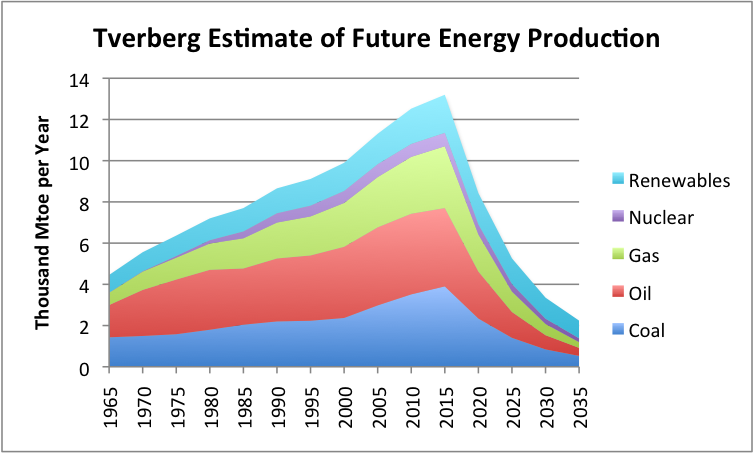
Are these predictions a coincidence? Or do they have something to do with the earth’s carbon cycle and balance?
I don’t know but I suspect the dates are dependent on each other.
Maybe the answer can be found by looking at earth’s environment when fossil energy started to accumulate. Note to self: research this.
Kevin Anderson also says that in addition to stopping fossil energy use by 2035 we must draw down existing CO2. My understanding of the technologies is that this is not feasible and/or affordable. On the other hand, the decline in CO2 emissions may be faster than Anderson predicts due to the likelihood of a fast economic collapse that Anderson does not understand.
Will the inevitable collapse of civilization caused by fossil energy depletion occur in time to prevent runaway climate change?
Is this cause for hope or despair or both?
A nice essay on overshoot.
I could give you thousands of forest disappearing, deserts expanding, rivers drying up, water tables dropping, top soil disappearing, species going extinct, ocean fish disappearing, pollution and plastic waste killing sea birds, and on and on and on. But I will start with one example that exemplifies what is happening to the entire world, the Aral Sea.
What has been happening to the world can be exemplified by this short 3 minute video on the Aral Sea:
“2015 was a banner year for doom” – RE @ Doomstead Diner”
This is one of RE’s best rants.
Lots of depth and breadth plus his usual acidic humor.
An excellent on-line book and video by the Population Institute.
Any book that starts and ends with a quote by Albert Bartlett is worth your time.
“Can you think of any problem in any area of human endeavor on any scale, from microscopic to global, whose long-term solution is in any demonstrable way aided, assisted, or advanced by further increases in population, locally, nationally, or globally?” – Albert Bartlett
Overdevelopment, Overpopulation, Overshoot (the book)
Lord Man: A Parable (the video)
 un-Denial