By Paul Chefurka: No really, how sustainable are we?

I was starting to write an essay on overpopulation exploring the solution space where a breakthrough in denial enabled a planned global birthrate reduction. My goal being to present a reasonable scenario for making the future less bad.

Then I read this paper by Paul Chefurka who is one of the wisest people on the planet and I decided to trash my paper and point to his. Paul takes a close look at the maximum size of a truly sustainable human population. His conclusion is 10 million.

The analysis seems sound to me. The obvious conclusion is that we can’t get there from here with any form of awakening or proactive action.

Paul ends by saying:

…the analysis suggests that Homo sapiens is an inherently unsustainable species.  This outcome seems virtually guaranteed by our neocortex, by the very intelligence that has enabled our rise to unprecedented dominance over our planet’s biosphere.  Is intelligence an evolutionary blind alley?

I wish Paul would read Varki’s book on denial. I suspect Paul would appreciate it because Varki presents a theory that confirms Paul’s speculation about the inherent unsustainability of humans.

In summary, the evolution of the powerful human brain required a mutation for denial of reality, and this denial prevents us from acknowledging our predicament.

Here is the full conclusion from Paul’s essay:

http://paulchefurka.ca/Sustainability.html

Conclusions

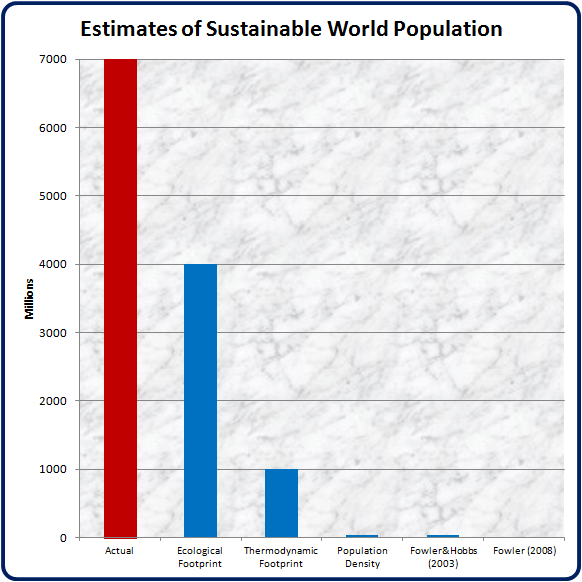
As you can see, the estimates for a sustainable human population vary widely – by a factor of 500 from the highest to the lowest.

The Ecological Footprint doesn’t really seem intended as a measure of sustainability.  Its main value is to give people with no exposure to ecology some sense that we are indeed over-exploiting our planet.  (It also has the psychological advantage of feeling achievable with just a little work.)  As a measure of sustainability, it is not helpful.

As I said above, the number suggested by the Thermodynamic Footprint or Fossil Fuel analysis isn’t very helpful either – even a population of one billion people without fossil fuels had already gone into overshoot.

That leaves us with four estimates: two at 35 million, one of 10 million, and one of 7 million.

The central number of 35 million people is confirmed by two analyses using different data and assumptions.  My conclusion is that this is probably the absolutely largest human population that could be considered sustainable.  The realistic but similarly unachievable number is probably more in line with the bottom two estimates, somewhere below 10 million.

I think the lowest two estimates (Fowler 2008, and Fowler 2009) are as unrealistically high as all the others in this case, primarily because human intelligence and problem-solving ability makes our destructive impact on biodiversity a foregone conclusion. After all, we drove other species to extinction 40,000 years ago, when our total population was estimated to be under 1 million.

So, what can we do with this information?  It’s obvious that we will not (and probably cannot) voluntarily reduce our population by 99.5% to 99.9%.  Even an involuntary reduction of this magnitude would involve enormous suffering and a very uncertain outcome.  It’s close enough to zero that if Mother Nature blinked, we’d be gone.

In fact, the analysis suggests that Homo sapiens is an inherently unsustainable species.  This outcome seems virtually guaranteed by our neocortex, by the very intelligence that has enabled our rise to unprecedented dominance over our planet’s biosphere.  Is intelligence an evolutionary blind alley?  From the singular perspective of our own species, it quite probably is. If we are to find some greater meaning or deeper future for intelligence in the universe, we may be forced to look beyond ourselves and adopt a cosmic, rather than a human, perspective.

Overpopulation Denial

Most non-domesticated life on earth is in decline and about 200 species a day are going extinct due to a wide range of environmental problems. Many humans are at risk of being harmed or killed by related problems this century.

All of the many problems are caused by the same thing: humans have used non-renewable energy to explode their population from 1 billion to 7 billion in 100 years, and now consume so large a share of the earth’s resources that almost all non-domesticated species are in decline.

Note that I use the word “resources” here in a broad context meaning land, water, minerals, photosynthetic output, biomass, and the planet’s capacity to recycle waste products.

The total quantity of resources consumed by humans equals the human population times the average consumption per person.

About 75% of the world’s population are poor and do not consume much more than is required for subsistence, although they desire and are working hard to consume more. The privileged 25% are working hard to maintain and grow their level of resource consumption and the majority are unwilling to contemplate a voluntary reduction in consumption, in part because they know that if they reduce their consumption others will consume the freed resources.

This dynamic makes it difficult to reduce the total human footprint by reducing per capita consumption.

Therefore, any progress towards solving the problems caused by human overshoot must come from a reduction in human population.

Paraphrasing Albert Bartlett, “There is no problem on earth that does not improve with fewer people”.

Establishing an effective and fair global population reduction policy will be very difficult and may be impossible for many reasons, not least of which it conflicts with what our genes want to do.

It may also be too late for a reduction in birth rate to prevent the worst consequences of overshoot. We can however say with certainty that a rising population will make things worse and a falling population will make things better. Therefore we should try to get the population down regardless of the prognosis.

Given that population reduction is the only thing that might help our predicament, why do we not even discuss it?

More to the point, why do those individuals and organizations with the best understanding of the seriousness of our predicament not speak out for population reduction? I am talking about environmental organizations, climate scientists, biologists, ecologists, deep greens, peak oilers, doomers, you name it. Almost without exception they are silent on population reduction.

I see the same dynamic in activist friends and acquaintances who deeply care about the planet and who work hard on environmental and social issues but never mention population reduction, despite the fact that population reduction is the only thing that might improve long-term environmental and social issues.

I understand that it may be impossible to gather enough political support, and that we might conclude that unintended consequences of population reduction policies are worse than the problems we are trying to solve. But at least we would have had the conversation and made a deliberate decision to not change course.

As it stands today we are racing towards a cliff without even discussing if we should slow down or change direction.

I like to think that if citizens understood that the choice was between having one child with some chance of a happy life versus having several children with no chance of a happy life, I think most people would choose a small family. Especially if they had confidence that the rules would be applied to rich and poor alike, and that cheaters would be punished. But if we don’t discuss it we’ll never find out if I am right or wrong. We’ll just blindly go off the cliff.

The fact that we do not discuss the only thing that might actually improve the future is amazing. I concluded several years ago that denial must be genetic. I later found a theory for evolved denial by Ajit Varki and Danny Brower and it is the reason this site exists.

Today, Alice Friedemann of the Energy Skeptic blog published a paper addressing this issue by Roy Beck & Leon Kolankiewicz titled “The Environmental Movement’s Retreat from Advocating U. S. Population Stabilization (1970-1998): A First Draft of History“.

It’s a long rambling paper on an important topic so I thought it worthwhile to summarize its key points here. Note that the paper has a U.S. focus with little analysis of what happened in other areas of the world.

What changed from 1970 to 2000?

  • In 1970 the need for population control was broadly understood and accepted by political leaders, business leaders, environmental organizations, universities, and the public. Strong environmental laws were passed. Earth Day had population control as a priority.
  • Thirty years later in 2000 the problems caused by population growth were still discussed but there was no discussion of the underlying population growth problem. The US population had increased by 70 million (33%) since 1970 . There was more nitrogen oxide pollution, more CO2, more endangered species, and fewer wetlands. Environmental groups no longer had population control as a priority and did not oppose laws that increased immigration. Earth Day did not mention population control.

What caused these changes from 1970 to 2000?

  • In 1970 the fertility rate of the white population fell below replacement level. All population growth after 1970 came from immigration and higher birth rates of the non-white population.
  • Environmental groups backed away from population control as a priority for fear of membership and donation loss due to potential charges of racism and the increased demographic influence of immigrants. Environmental groups competing for members and donations focused on issues that could demonstrate short-term successes rather than issues like population control that take decades to show results. It is much harder to raise funds for preventing future problems than for fixing an existing problem. In summary, protection of environmental institutions took precedence over protection of the environment.
  • Business used donations (or the lack thereof) to influence environmental groups to drop population control as a priority because they wanted the economic growth created by immigration and reduced labor costs from an expanding labor pool.
  • Politicians did not want to touch the population issue because of the increased voting power of immigrants.
  • The Catholic Church aggressively opposed any group in favor of population control, especially after abortion was legalized. It appears the Catholic Church had a large influence on government population policies but historians need to research this to confirm.
  • Women’s issues emerged as a priority which shifted the narrative from racially sensitive population control to politically correct empowerment of women.
  • A view emerged within the left that most environmental problems were caused by unfair distribution of resources and capitalism rather than overpopulation. Priorities shifted from population control to changing the economic system.
  • A view emerged that it was wrong to block immigration and to conserve resources for future generations while poor people struggled in developing countries.

The paper concludes with the following statement:

Historians need to explain how an environmental issue as fundamental as U.S. population growth could have moved from center-stage within the American environmental movement to virtual obscurity in just twenty years. For the American environment itself, the ever-growing demographic pressures ignored by the environmental establishment showed no signs of abating on their own as the nation prepared to enter the twenty-first century.

I found the paper to be a disappointment. I think it did a good job of explaining why environmental groups dropped population control as a priority. In summary they chose to give higher priority to protecting themselves than the environment. That’s no surprise.

A much more important issue that was not addressed was why did the majority of the public drop population control as a priority? Given that public sentiment shifted it is no wonder that political leaders, business leaders, universities, and environmental groups followed suit.

What really happened? I have a theory.

In 1970 economic growth was strong. The middle class was healthy and not threatened. Most white families, for whatever reason, had already decided to have 2 or fewer children. Making population control a priority did not require lifestyle changes for most. There was surplus wealth to spend on environmental protection laws and enforcement. People who understood the threat of overpopulation could form organizations and raise funds to support themselves.

By 2000, economic growth had slowed. The middle class was in decline and feeling threatened. Recent immigrants with higher birthrates became a powerful political force and resisted changes to their lifestyles or immigration reductions. Environmental groups chose survival over principles. Government deficits had replaced surpluses. Economic growth was becoming harder to achieve due to depletion of low-cost non-renewable energy. Our monetary system requires growth or else it collapses, however it will not collapse if per capita economic activity decreases as long as total economic activity increases. Therefore continued growth of the population via immigration became necessary to maintain some overall economic growth despite falling real incomes for individuals.

Today, 15 years later, the middle class is under even more pressure because low-cost non-renewable energy continues to deplete and globalization has eroded their standard of living. They see that immigration has not benefited them, seek someone to blame, and many have decided to vote for Trump.

If I am right, it is ironic that economic growth slowed due to the overpopulation related depletion of non-renewable resources which then required a further population increase to maintain some economic growth to avoid collapse. It’s analogous to the positive feedback loop of rising temperatures causing ice loss and methane release.

We have only two paths. We can find a way to break through our evolved denial and proactively act. Or we can let nature act for us.

Denial is the Only Topic Less Popular than Overshoot

I observe most people close their minds when I discuss overshoot but they don’t get upset.

It’s easy and natural for us to deny unpleasant things, as Varki’s theory predicts.

When I discuss denial I find people not only close their minds but also become agitated.

Talking about denial seems to get too close to a nerve.

I’ve yet to find a single person that shares my fascination with denial, despite denial being the most powerful and destructive force at play in our society.

We are causing the 6th great extinction. About 200 species a day are going extinct. We don’t talk about it.

The resource that created advanced civilization and 6 of our 7 billion people will be depleted within 20 years. We don’t talk about it.

Climate change is accelerating faster than most predictions and the problems are already obvious if you care to look. We don’t talk about it.

Fisheries are collapsing and the coral reefs are dying. We don’t talk about it.

Trees are in decline worldwide. We don’t talk about it.

We’ve had 8 years of zero interest rates. We don’t ask why.

Debt is so high now that we avoid talking about its implications.

40,000 climate change experts and concerned citizens met in Paris and did not even discuss the only thing that might make the future less bad.

Weaker countries are starting to fail. We avoid connecting the dots.

Leaders pretend everything is OK. Citizens seek someone to blame. No one seeks a science based understanding of what is happening.

The state of the union speech by the most powerful person in the world did not even mention any of the most important issues we face.

Denial is amazing!

By John Weber: Superman Plays With Kryptonite Dice

This fabulous essay written by John Weber in 2010 was brought to my attention by a friend.

In it Weber describes the relationship between energy and our destructive dominance as a species. This theme is central to the manifesto I wrote for this site but Weber expands on the idea and provides more color.

I’m also pleased to see Weber touches on denial but I doubt he assigns the same importance to denial as I do.

Your time will be well spent reading this.

http://sunweber.blogspot.ca/2010/05/superman-plays-with-kryptonite-dice.html


Why We Want Growth, Why We Can’t Have It, and What This Means

I want to talk a little about growth and why it is such a powerful force in society.

Growth is an interesting denial topic because it is obvious, even to a child or uneducated person, that infinite growth is not possible on a finite planet. Yet growth is a top priority for every country in the world, and most citizens. I have a hunch that most of our leaders and citizens do not understand the real reason they want growth which makes this topic even more interesting.

Albert Bartlett argued that part of the problem is that the human brain does not understand the exponential function. He has a point. I have taken about 10 university level mathematics courses and I still needed to create a little spreadsheet to satisfy myself that Bartlett was correct. Anything that grows exponentially, regardless of how small the exponent is, will eventually explode into a hockey stick. So if you want society to become more sustainable, it is not sufficient to argue that we should reduce our goal of say 4% annual growth to a smaller number. Any growth rate bigger than zero is a problem.

But even without this advanced understanding of exponential growth, it is still obvious that growth creates many problems. Why then does almost everyone want growth?

I think most people want growth because most people want the future to be better for themselves and their children. The logic being that in a growing economy there is a good chance my income and wealth will grow. There are other human behaviors that create a desire for growth such as competition for status, the maximum power principle, and our dopamine response to novelty. But I think most people mainly want the future to be better rather than worse. More is a happy thought. Less is a depressing thought.

There is in fact a much bigger reason to desire growth that few people understand and it has to do with the design of our monetary system.

We have a debt based fractional reserve monetary system. Money is not created at the same time that we create real stuff to buy. Money is created in advance of us creating real stuff to buy. In other words, money is loaned into existence on the promise of it being repaid from future earnings. The mathematics of this system requires growth to pay the interest on debt. I may write another essay to explain this in more detail but for the purposes of this essay please assume these statements as true, because they are.

The real reason growth is so important is not because growth will give us a little more next year, it is because growth gives us A LOT more today.

It’s all about debt. An example is probably the best way to explain this.

Let’s assume you are an environmentally aware person trying to live a low impact life. You need and want a place to live. A small used house will suffice. Lets say it costs $200,000. You have a modest income and you are able to save $10,000 per year. In a no-growth economy the only money available to borrow is surplus money saved by someone else. Therefore a no-growth economy has very little credit available and you would probably have to live with your parents and save for 20 years before you could buy the house. In a growing economy, you can save a down payment for 2 years and then borrow the balance of $180,000 to be repaid over the next 18 years. No other people had to save the $180,000 you borrowed. The $180,000 was created out of thin air on the promise of you repaying it with interest. Even though you only own 10% of the house, you get to enjoy 100% of the house now. You do not have to wait 20 years.

This logic applies to everything we typically purchase on credit like education, cars, furniture, appliances, and vacations. For many people struggling today, this logic also applies to necessities like groceries and gasoline.

Back to the original example. You are a green aware person. You did your best by buying a small used house. To enjoy the house now rather than waiting 20 years you needed an economy that is growing. What are the implications of an economy that is growing at say 3%? Anything that grows at 3% per year will double in size every 25 years (5% doubles in 16 years, 2% doubles in 36 years). So if you live for 75 years in an economy that is growing at 3% then the human footprint will be 8 times larger when you die than when you were born. Eight times! Think about that. Imagine you have a baby today and imagine Earth with 8 x 7=56 billion people and an economy of 8 x $108 = $864 trillion dollars when your child dies. Obviously this is not going to happen and we will destroy our home and most other life if we try to get there.

We all need some form of shelter to survive. A house with furniture and appliances and plumbing really does improve the quality of our lives. But we can’t destroy the planet to have a house. What to do?

There are no easy answers to this conundrum. There may be no answer. Perhaps in the long run we won’t be able to live in a nice house. I need to think more about this but my current belief is that if we could constrain our population to zero growth, and if we adopted policies to ensure the economy does not grow, then it probably means that multiple generations of a family need to share a house. For example, in a richer world, newly weds would move into their grandparent’s home and the grandparents would move into the space vacated by the newly weds in their child’s home. In a poorer world, all 3 generations would live in the same house.

There are many other deep implications of a no-growth world.

Most of the technology we enjoy today requires a large amount of up-front capital. For example, a television takes hundreds of people to design, billion dollar mines to extract the raw materials, billion dollar factories to produce its components, a billion dollar global supply chain of ships and trucks for transport, a many billion dollar energy infrastructure for oil and electricity, a billion dollar industry for television program content creation and fiber optic distribution. None of this is possible without a lot of debt to build and maintain the infrastructure.

It’s quite possible that we won’t be able to have advanced technology products like cars and airplanes and televisions and cell phones in a no-growth world.

A no-growth world also has huge implications for governments. Every country in the world today operates with a deficit which means they spend more than they collect in taxes by borrowing money. This in turn means that most citizens enjoy many more services like health care, education, water, sanitation, security, unemployment insurance, and old age pensions than they pay for. This is only possible when governments have access to large amounts of credit and this is only possible in a growing economy.

Politicians usually get elected by promising things to citizens that cost money. Since all countries are already running large deficits, our leaders are highly motivated to achieve more economic growth because this helps them stay in power. This dynamic also explains why government deficits tend to grow and often become dangerously high.

Banks make money by loaning money and more growth means they can loan more money. A no-growth world would have many fewer banks.

The value of a company is primarily determined by the growth rate of its profits. It’s much easier for a company to grow when the overall economy is growing. Managers are often compensated based on share price and are highly motivated to grow their company.

The concept of retiring and living on a pension depends on growth. If the value of money invested by pension funds in company shares did not grow there would not be sufficient funds for most people to live on at retirement. It may not be possible to retire in a no-growth world.

Last but not least, growth is required to maintain the value of the majority of our wealth which is in the form of debt. Without growth it is not possible to make interest payments and the debt will default and lose its value. This in turn will reduce the value of assets purchased with debt. Goodbye investment portfolios and million dollar shacks in San Francisco. Hello a much poorer world.

Clearly there are some very good reasons for growth. At the same time, growth cannot continue forever due to physical limits, and because we are already destroying the planet with our current footprint.

Today’s myriad economic problems and our weird and unprecedented responses to these problems are primarily due to the fact we have hit limits to growth.

Everything we do and make requires energy. By using external energy, in addition to our muscles, we increase our productivity and ability to create wealth. Energy extraction and consumption must increase for the economy to grow. Efficiency can help, but we have already harvested most of what is possible and are bumping up against the laws of physics for any further efficiency gains.

Most of our energy is fossil carbon which is a depleting non-renewable resource and extraction rates cannot increase without higher energy prices. Higher energy prices, above say $80 (not the current temporary $30 deflation price), are not possible because consumers and governments have already borrowed the maximum that is possible, even at zero interest rates.

Most renewable energy costs more than most non-renewable energy, and renewable energy is dependent on non-renewable energy so the price of both tend to scale together. It is therefore unlikely we could run today’s civilization on renewable energy, but even if we could, switching over would require a huge amount of up-front debt that will not be available in our growth constrained world.

It’s too late to change, and it probably never was possible to continue this lifestyle without cheap fossil energy.

Pain is on the horizon. It can’t be avoided. I think a proactive response of conservation, austerity, and population reduction measures might help by slowing us down in a more controlled manner, rather than our current high-speed trajectory towards a brick wall.

In conclusion, the end of growth is a really big issue.

We are not considering wise strategies to mitigate the problem.

We don’t even talk about it.

We deny the problem exists.
By Dermot O’Conner: There’s No Tomorrow

This excellent video was produced in 2012. You can see how people in denial who viewed it then are saying to themselves today that they were right not to worry. Hell, I bought gas today for $0.88 per liter. What’s the problem?

Read some of the YouTube comments for scary insight into the views of our citizens. It’s going to be a gong show when decline begins in earnest.

These comments by the producer in the FAQ speak directly to denial:

Would you do it again if you knew how long it was going to take?

No. In the intervening years, it’s become clear that people are deeply set in their opinions, and that most of the writing/commentary/movies that are made simply reinforce existing beliefs, rather than change them. In addition, dealing with this subject is likely to have one labeled a Eugenicist/Genocidal-maniac/NWO-puppet/Illuminati/Oil-industry-shill/The AntiChrist, or worse.

It would have been wiser to create a cartoon about crime-fighting squirrels with super-powers.

Here is an overview of the film from its home site:

“This is a quick journey through the subjects of oil formation, peak oil, energy, economic growth, and resource depletion. I’ve condensed several years of reading and research into little over half an hour. The most important sequence is around the 17min mark, dealing with Growth…the real subject of the film.”

There’s No Tomorrow is a half-hour animated documentary about resource depletion, energy and the impossibility of infinite growth on a finite planet.

Inspired by the pro-capitalist cartoons of the 1940s, the film is an introduction to the energy dilemmas facing the world today.

“The average American today has available the energy equivalent of 150 slaves, working 24 hours a day. Materials that store this energy for work are called fuels. Some fuels contain more energy than others. This is called energy density.”

“Economic expansion has resulted in increases in atmospheric nitrous oxide and methane, ozone depletion, increases in great floods, damage to ocean ecosystems, including nitrogen runoff, loss of rainforest and woodland, increases in domesticated land, and species extinctions.”

“The global food supply relies heavily on fossil fuels. Before WW1, all agriculture was Organic. Following the invention of fossil fuel derived fertilisers and pesticides there were massive improvements in food production, allowing for increases in human population.The use of artificial fertilisers has fed far more people than would have been possible with organic agriculture alone.”

http://www.incubatepictures.com/notomorrow/tnt.shtml


Cause for Hope, Despair, or Both?

Here is a new video by Nick Breeze titled “1.5ºC: A New Boundary for Global Heating”.

At 3:30 Kevin Anderson, one of the climate scientists I respect, says the developed world must stop using fossil fuels by 2030-2035.


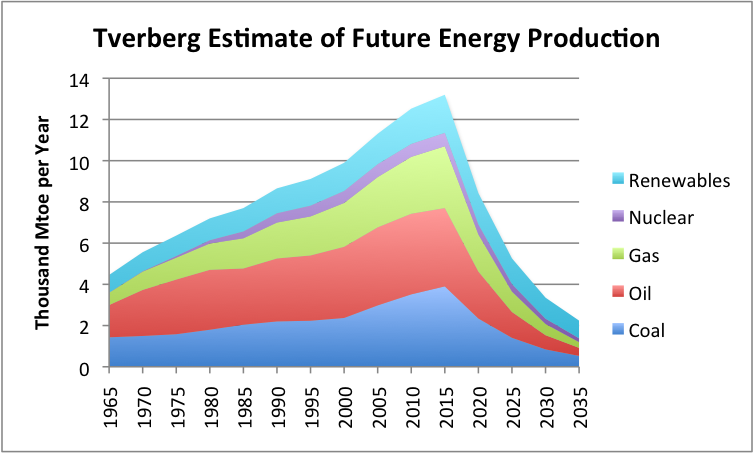
Gail Tverberg, the energy analyst with the best track record of predicting the future, says fossil energy production will be almost zero by 2035.

http://ourfiniteworld.com/2016/01/07/2016-oil-limits-and-the-end-of-the-debt-supercycle/

Figure 4. Estimate of future energy production by author. Historical data based on BP adjusted to IEA groupings.

Are these predictions a coincidence? Or do they have something to do with the earth’s carbon cycle and balance?

I don’t know but I suspect the dates are dependent on each other.

Maybe the answer can be found by looking at earth’s environment when fossil energy started to accumulate. Note to self: research this.

Kevin Anderson also says that in addition to stopping fossil energy use by 2035 we must draw down existing CO2. My understanding of the technologies is that this is not feasible and/or affordable. On the other hand, the decline in CO2 emissions may be faster than Anderson predicts due to the likelihood of a fast economic collapse that Anderson does not understand.

Will the inevitable collapse of civilization caused by fossil energy depletion occur in time to prevent runaway climate change?

Is this cause for hope or despair or both?

COP21 and Air Travel

Earlier I criticized the COP21 agreement for accomplishing nothing to reduce the climate change threat and for leading uninformed citizens to believe things are moving in a positive direction.

It gets worse. I just learned that COP21 does not require countries to reduce air travel.

Long distance travel is one of the most disgraceful things we do as humans. It consumes large quantities of non-renewable fossil energy and releases large quantities of CO2 for a discretionary luxury we call vacation.

Long distance travel is a relatively new phenomenon. Travel was rare or non-existent for most people in the 50’s, 60’s, 70’s and early 80’s. During this period the downslope of oil production and the threat of climate change were not in sight, yet we traveled very little, and were at least as happy as today. Hawaii might have been a once in a lifetime trip for a special occasion like a 25th anniversary.

Today the remaining expensive to extract oil is constraining growth which underlies our global economic problems, and climate change threatens the lives of our children, yet we travel more than ever. Most people think they are entitled to travel, and many link their happiness to a mega annual vacation.

It’s obscene.

I went to a climate change meeting of concerned citizens. I proposed we target the high schools to stop their current practice of flying the graduating class to some far away location each year. When I was in high school in the 70’s our big annual trip was to take a yellow school bus to the West Coast Trail and hike for 5 days. No one supported my proposal. “Our children have a right to travel”.

This issue is deep. I have immediate family and close friends that have some understanding of the unfolding climate change disaster yet refuse to change their lifestyles on something as simple and painless as stopping long distance travel.

This behavior might be understandable if they have rationally concluded that climate change is unstoppable and will cause human extinction regardless of what we do, which by the way is quite possibly true, however I don’t think these people have given up.

They just don’t want to make any meaningful sacrifices.

Religion Evolves (Baba Brinkman): We Need a New One

Religion is one of the most powerful forces that has shaped human history.

A new religion based on reverence for the diversity and complexity of life on earth, and on the rare privilege of having an evolved brain powerful enough to understand our place in the universe, and on how we are harming our precious home might help our predicament.

The logistics seem feasible. Christianity took over the Roman empire in a very short period of time.

The big question is, is it possible to have a popular religion that conflicts with what our genes want to do, namely maximize resource capture and reproduction, which of course is what is causing us to kill the planet.

I’m guessing not, but it’s worth a try.

Here’s an excellent new rap from Baba Brinkman titled Religion Evolves.

COP21: Doubling Down on Denial

What have we done to date?

  • We set a goal to limit temperature rise to 2 degrees, despite it being clear that the current 1 degree rise is already unsafe.
  • We did absolutely nothing to achieve the goal; we didn’t even try.
  • We emitted enough CO2 to guarantee at least 2 degrees, even if we stopped all emissions today.
  • No one knows for sure, but we may have already triggered self-reinforcing feedback loops that will increase the temperature by a civilization killing 4-6 degrees; the point being that time is of the essence.

What should we have done at COP21?

  • We should have acknowledged the severity of our predicament.
  • We should have discussed the relationship between wealth and climate change; namely that wealth is proportional to energy consumption, CO2 emissions are proportional to energy consumption, and temperature is proportional to accumulated CO2; therefore to mitigate climate change we must reduce our total wealth.
  • We should have discussed the differences between fossil energy and renewable energy, and why the latter do not have the density, quality, or scale to run our advanced civilization.
  • We should have discussed the depletion of fossil energy and why aggressive conservation now would be a really good idea for both climate change and world peace.
  • We should have acknowledged that there are no easy solutions but lifestyle changes to focus on needs rather than wants, and population reduction policies would help.
  • We should have acknowledged that rich people and countries will have to reduce consumption much more than the poor if we want to maintain peace.
  • We should have acknowledged the good news that most people in developed countries have much more than they need to have a comfortable life.
  • We should have explained all of this to the citizens of the world and asked for their cooperation.

What did we actually do at COP21?

  • We changed the already impossible goal of 2 degrees to a more impossible goal of 1.5 degrees, thus grossly misleading the citizens of the world that our leaders are doing something useful.
  • We took no actions that will reduce CO2 emissions.
  • We made the situation worse by emitting tons of CO2 to fly 40,000 people to Paris to achieve nothing, and set a bad example in the process.
  • In summary, we doubled down on denial, instead of having an adult conversation.