By Wolf Richter: What Happens When the Machines Start Selling?

This. Will. Not. End. Well.

It’s shocking what’s happened to the “free market” and invisible hand.

In the good old days not so long ago the price of a stock was determined by a company’s profit, growth potential, and balance sheet. With of course some irrational exuberance thrown in from time to time.

Today reality is irrelevant. Everything is now irrationally exuberant on steroids.

Take 5 minutes to read this if you have any investments.

http://wolfstreet.com/2017/06/15/what-happens-when-the-machines-start-selling/

The infamous FAANG stocks – Facebook, Apple, Amazon, Netflix, and Google’s parent Alphabet – along with other “tech” stocks have been getting “hammered,” to use a term that for now exaggerates their “plight.” The FAANG stocks are down between 1.7% and 2.5% at the moment and between 5.5% and 11% since their peak on June 8. Given how far these stocks have soared over the past few years, this selloff is just a barely visible dip.

But fundamental analysis has long been helpless in explaining the surge in stocks. The shares of Amazon now sport a Price-Earnings ratio of 180, when classic fundamental analyses might lose interest at a PE ratio of 18 for the profit-challenged growth company that has been around for over two decades. For them, the stock price might have to come down 90% before it makes sense.

Or Netflix, with a PE ratio of 195. Or companies like Tesla. Forget a PE ratio. There are no earnings. The company might never make any money. Its sales are so minuscule in the overall US automotive market that they get lost as a rounding error. It bought Elon Musk’s failing solar-panel company as a way to bail it out. And the battery-cell technology Tesla uses comes from Panasonic. So what should a company like this be worth? Fundamental analysis has been completely irrelevant: Tesla’s current stock price gives it a market capitalization of $61 billion.

So investors trying to sort through this mess by using fundamental analysis have been left in the dust years ago. Fundamentals no longer matter in this market. Valuations have been surgically removed from any sense of fundamental reality.

There are a lot of reasons for this, including the enormous amounts of liquidity in the markets, after the Fed, the ECB, the Bank of Japan, the Bank of England, and the Swiss National Bank have created $11 trillion out of nothing since the onset of the Financial Crisis and used that money to buy $11 trillion of securities – in the SNB’s and BOJ’s case even common stocks. They now sit on $15 trillion in assets.

Under such relentless buying pressure, fundamentals in the markets have become useless. People still truly engaged in it – rather than in churning out “fundamental” rationalizations for irrational stock prices – are being ridiculed. But algorithms have picked up the slack.

“The majority of equity investors today don’t buy or sell stocks based on stock specific fundamentals,” Marko Kolanovic, global head of quantitative and derivatives research at JPMorgan, explained in a note to clients, cited by CNBC.

“Fundamental discretionary traders” now account for only about 10% of trading volume in stocks, he said. Passive and quantitative investing account for about 60%; this share has more than doubled over the past decade.

These “big data strategies are increasingly challenging traditional fundamental investing and will be a catalyst for changes in the years to come,” he said.

Since fundamental analysis of specific stocks and companies no longer influences trading decisions, the sell-off in tech stocks can’t be the doing of those still hopelessly clinging to fundamental analysis. Instead, it was likely associated with some change in strategy by quantitative and algorithmic trading. The algorithms were reacting to something.

But these algorithms – many of them written by people who went to the same schools and learned the same things – and the vast amounts of data they churn through end up doing similar things, following similar strategies, and producing similar results. Hence, the surge of FAANG stocks and other stocks to where fundamentals are just a quaint reminder of a bygone era.

But without fundamentals, what will hold up stock prices, once the quantitative strategies shift without notice and see selling as the opportunity, and other algos react to those market data points and follow them or try to run ahead of them? No one knows.

This environment has amassed phenomenal risks. These shifts, as we have seen with the tech stocks, can occur without prior notice, without obvious trigger. They occur because an algo sets it off and other algos follow since they react to each other, and the whole machinery can suddenly go into reverse and get stuck in it.

Quant hedge funds – where trading is done by machines, not humans – now dominate stock trading.

By Aaron Thierry: The Brutal Logic of Climate Change

A must watch. One of the best talks I’ve seen on climate change.

It’s not a future problem. We’re in the midst of an emergency. Dramatic action is required today.

Unfortunately, like almost every other climate scientist, he does not have a clue when it comes to energy and the economy and he veers off into woo-woo hopium land when discussing solutions.

We need fewer and poorer people. Also known as economic collapse. Nothing else will help.

On a positive note, fewer people improves every one of the many overshoot problems we face, not just climate change.


By Joe Barry: Over-population is the Real Cause of Climate Change

population-killing-us-may-16

Thanks to JH for bringing this article to my attention.

http://churchandstate.org.uk/2016/05/over-population-is-the-real-cause-of-climate-change-its-killing-us-all-off/

…if changing the way we behave requires a reduction in our living standards, then nothing will happen.

The remarkable thing is that the real cause of global warming is rarely mentioned. It is the elephant in the room. Everyone can see it but no one wants to speak about it, presumably because this subject is a contentious one and challenges the core beliefs of many religions.

The undeniable fact is that we, the human race, are the cause of our own difficulties and unless we reduce our numbers, we will self-destruct.

When famine struck in 1985 the population of Ethiopia was 36m. That famine eventually ended and their current population is now almost 100m. In 1960, there were only 11m in the entire country.

Like all animals, humans are programmed to reproduce and increase in number but like lemmings, which periodically breed beyond the carrying capacity of their surroundings, we are facing imminent disaster unless we change our ways.

In the past, wars, famine and plagues kept world populations in check. Happily these are now rare events, but if we continue to ignore the true reason for the environmental disasters facing us, we will rapidly pass the point where we can save ourselves.


By James Hansen: March 2017 Address to Young People

James Hansen is a great man.

In this wide-ranging talk he addresses young people saying they need to lead a peaceful revolution to create a new political party that will support science and reason, a carbon tax, and renewed investment in nuclear energy.

He argues that we are at a historic low point of leadership. All parties, left and right, are clueless and ineffective. Hansen has hope for political change because he has seen young people influence elections, and because he has seen in his younger years good leaders that did the right thing, even in the absence of popular support.

Hansen sadly concludes by saying to young people, “sorry to leave you such a friggin’ mess”, but unfortunately it’s up to you to fix it.

Hansen struggles a little in the talk, perhaps because he is tired, or perhaps because despite having worked hard to warn citizens about the dangers of climate change since 1981, every indicator and action by society continues to move in the wrong direction.

As an aside, I think Hansen makes a serious error by stating that a carbon tax will be effective without damaging the economy. A carbon tax will indeed reduce CO2 emissions, but it will also reduce our standard of living, as will any effective climate change policy. He should state this clearly to avoid a dangerous backlash when the truth emerges.

With regard to nuclear energy, it really is the only option that might maintain our modern technology, and I say might because it does not replace our vital diesel. I personally think the risks are unacceptably high that nuclear can be kept safe with proper maintenance and governance as civilization becomes simpler, poorer, and chaotic due to overshoot, the depletion of affordable oil, and the end of growth. But reasonable people could disagree on this, especially people who think modern technology should be retained as a top priority.

I wrote more about Hansen here, and you can find more on the implications of a carbon tax here.

By Jeff Goodell: The Doomsday Glacier

ice-apocalypse-4b11ae6e-64bd-4797-9d53-dffd0b7ca001

http://www.rollingstone.com/politics/features/the-doomsday-glacier-w481260

“If there is going to be a climate catastrophe,” says Ohio State glaciologist Ian Howat, “it’s probably going to start at Thwaites.”

The trouble with Thwaites, which is one of the largest glaciers on the planet, is that it’s also what scientists call “a threshold system.” That means instead of melting slowly like an ice cube on a summer day, it is more like a house of cards: It’s stable until it is pushed too far, then it collapses. When a chunk of ice the size of Pennsylvania falls apart, that’s a big problem. It won’t happen overnight, but if we don’t slow the warming of the planet, it could happen within decades. And its loss will destabilize the rest of the West Antarctic ice, and that will go too. Seas will rise about 10 feet in many parts of the world; in New York and Boston, because of the way gravity pushes water around the planet, the waters will rise even higher, as much as 13 feet. “West Antarctica could do to the coastlines of the world what Hurricane Sandy did in a few hours to New York City,” explains Richard Alley, a geologist at Penn State University and arguably the most respected ice scientist in the world. “Except when the water comes in, it doesn’t go away in a few hours – it stays.”

Antarctica is the size of the United States and Mexico combined, with a permanent population of zero. Seventy percent of the Earth’s fresh water is frozen here in ice sheets that can be nearly three miles thick.

Until recently, most climate scientists didn’t worry too much about Antarctica. It is, after all, the coldest place on Earth, and except for a small part of the Antarctic Peninsula that juts north, it hasn’t been warming much. It was also thought to be isolated from the warming oceans by a current that surrounds the continent, essentially walling it off from the rest of the planet.

But in recent years, things have gotten weird in Antarctica. The first alarming event was the sudden collapse, in 2002, of the Larsen B ice shelf, a vast chunk of ice on the Antarctic Peninsula. An ice shelf is like an enormous fingernail that grows off the end of a glacier where it meets the water. The glaciers behind the Larsen B, like many glaciers in both Antarctica and Greenland, are known as “marine-terminating glaciers,” because large portions of them lie below sea level. The collapse of ice shelves does not in itself contribute to sea-level rise, since they are already floating (just like ice melting in a glass doesn’t raise the level of liquid). But they perform an important role in buttressing, or restraining, the glaciers. After the Larsen B ice shelf vanished, the glaciers that had been behind it started flowing into the sea up to eight times faster than they had before. “It was like, ‘Oh, what is going on here?’ ” says Ted Scambos, lead scientist at the National Snow and Ice Data Center in Boulder, Colorado. “It turns out glaciers are much more responsive than anyone thought.”

Someday soon – possibly even by the time you read this – a chunk of the Larsen C ice shelf will break off and float into the ocean that surrounds Antarctica. The crack in the Larsen C, which is a close cousin to the Larsen B that broke up in 2002, has been developing for several years. But in the past few months, it has increased dramatically. As I write this, the crack is more than 100 miles long. Such a collapse of ice shelves is exactly what Mercer predicted would be the first sign that disaster is imminent. When it breaks, it will likely be front-page news and cited as evidence that Antarctica is rapidly falling apart.

In the end, no one can say exactly how much longer the West Antarctica glaciers will remain stable. “We just don’t know what the upper boundary is for how fast this can happen,” Alley says, sounding a bit spooked. “We are dealing with an event that no human has ever witnessed before. We have no analogue for this.” But it is clear that thanks to our 200-year-long fossil-fuel binge, the collapse of West Antarctica is already underway, and every Miami Beach condo owner and Bangladeshi farmer is living at the mercy of ice physics right now. Alley himself would never put it this way, but in West Antarctica, scientists have discovered the engine of catastrophe.

By Nicole Foss: The Automatic Earth Primer Guide 2017

Nicole Foss has one of my favorite minds on the planet.

She used to write prolifically on our predicament but perhaps after having said most of what she thought needed to be said, and then attending to personal preparations by leaving Canada for the much safer New Zealand, she now writes infrequently.

Today Nicole published a greatest hits summary of her and her writing partner Ilargi’s essays.

If you are seeking to understand reality then I recommend you spend some time reading her catalog.

If you prefer to learn by video, then you might enjoy this interview with Nicole.

https://www.theautomaticearth.com/2017/05/the-automatic-earth-primer-guide-2017/

Nicole Foss has completed a huge tour de force with her update of the Automatic Earth Primer Guide. The first update since 2013 is now more like a Primer Library, with close to 160 articles and videos published over the past -almost- 10 years, and Nicole’s words to guide you through it. Here’s Nicole:

The Automatic Earth (TAE) has existed for almost ten years now. That is nearly ten years of exploring and describing the biggest possible big picture of our present predicament. The intention of this post is to gather all of our most fundamental articles in one place, so that readers can access our worldview in its most comprehensive form. For new readers, this is the place to start. The articles are roughly organised into topics, although there is often considerable overlap.

We are reaching limits to growth in so many ways at the same time, but it is not enough to understand which are the limiting factors, but also what time frame each particular subset of reality operates over, and therefore which is the key driver at what time. We can think of the next century as a race of hurdles we need to clear. We need to know how to prepare for each as it approaches, as we need to clear each one in order to be able to stay in the race.

TAE is known primarily as a finance site because finance has the shortest time frame of all. So much of finance exists in a virtual world in which changes can unfold very quickly. There are those who assume that changes in a virtual system can happen without major impact, but this assumption is dangerously misguided. Finance is the global operating system – the interface between ourselves, our institutions and our resource base. When the operating system crashes, nothing much will work until the system is rebooted. The next few years will see that crash and reboot. As financial contraction is set to occur first, finance will be the primary driver to the downside for the next several years. After that, we will be dealing with energy crisis, other resource limits, limitations of carrying capacity and increasing geopolitical ramifications.

The global financial system is rapidly approaching a Minsky Moment:

“A Minsky moment is a sudden major collapse of asset values which is part of the credit cycle or business cycle. Such moments occur because long periods of prosperity and increasing value of investments lead to increasing speculation using borrowed money. The spiraling debt incurred in financing speculative investments leads to cash flow problems for investors. The cash generated by their assets is no longer sufficient to pay off the debt they took on to acquire them.

Losses on such speculative assets prompt lenders to call in their loans. This is likely to lead to a collapse of asset values. Meanwhile, the over-indebted investors are forced to sell even their less-speculative positions to make good on their loans. However, at this point no counterparty can be found to bid at the high asking prices previously quoted. This starts a major sell-off, leading to a sudden and precipitous collapse in market-clearing asset prices, a sharp drop in market liquidity, and a severe demand for cash.”

This is the inevitable result of decades of ponzi finance, as our credit bubble expanded relentlessly, leaving us today with a giant pile of intertwined human promises which cannot be kept. Bubbles create, and rely on, building stacks of IOUs ever more removed from any basis in underlying real wealth. When the bubble finally implodes, the value of those promises disappears as it becomes obvious they will not be kept. Bust follows boom, as it has done throughout human history. The ensuing Great Collateral Grab will reveal just how historically under-collateralized our supposed prosperity has become. Very few of the myriad claims to underlying real wealth can actually be met, leaving the excess claims to be exposed as empty promises. These are destined to be rapidly and messily extinguished in a deflationary implosion.

While we cannot tell you exactly when the bust will unfold in specific locations, we can see that it is already well underway in some parts of the world, notably the European periphery. Given that preparation takes time, and that one cannot be late, now is the time to prepare, whether one thinks the Great Collateral Grab will manifest close to home next month or next year. Those who are not prepared risk losing everything, very much including their freedom of action to address subsequent challenges as they arise. It would be a tragedy to fall at the first hurdle, and then be at the mercy of whatever fate has to throw at you thereafter. The Automatic Earth has been covering finance, market psychology and the consequences of excess credit and debt since our inception, providing readers with the tools to navigate a major financial accident.


The second limiting factor is likely to be energy, although this may vary with location, given that energy sources are not evenly distributed. Changes in supply and demand for energy are grounded in the real world, albeit in a highly financialized way, hence they unfold over a longer time frame than virtual finance. Over-financializing a sector of the real economy leaves it subject to the swings of boom and bust, or bubbles and their aftermath, but the changes in physical systems typically play out over months to years rather than days to weeks.

Financial crisis can be expected to deprive people of purchasing power, quickly and comprehensively, thereby depressing demand substantially (given that demand is not what one wants, but what one can pay for). Commodity prices fall under such circumstances, and they can be expected to fall more quickly than the cost of production, leaving margins squeezed and both physical and financial risk rising sharply. This would deter investment for a substantial period of time. As a financial reboot begins to deliver economic recovery some years down the line, the economy can expect to hit a hard energy supply ceiling as a result. Financial crisis initially buys us time in the coming world of hard energy limits, but at the expense of worsening the energy crisis in the longer term.

Energy is the master resource – the capacity to do work. Our modern society is the result of the enormous energy subsidy we have enjoyed in the form of fossil fuels, specifically fossil fuels with a very high energy profit ratio (EROEI). Energy surplus drove expansion, intensification, and the development of socioeconomic complexity, but now we stand on the edge of the net energy cliff. The surplus energy, beyond that which has to be reinvested in future energy production, is rapidly diminishing. We would have to greatly increase gross production to make up for reduced energy profit ratio, but production is flat to falling so this is no longer an option. As both gross production and the energy profit ratio fall, the net energy available for all society’s other purposes will fall even more quickly than gross production declines would suggest. Every society rests on a minimum energy profit ratio. The implication of falling below that minimum for industrial society, as we are now poised to do, is that society will be forced to simplify.

A plethora of energy fantasies is making the rounds at the moment. Whether based on unconventional oil and gas or renewables (that are not actually renewable), these are stories we tell ourselves in order to deny that we are facing any kind of future energy scarcity, or that supply could be in any way a concern. They are an attempt to maintain the fiction that our society can continue in its current form, or even increase in complexity. This is a vain attempt to deny the existence of non-negotiable limits to growth. The touted alternatives are not energy sources for our current society, because low EROEI energy sources cannot sustain a society complex enough to produce them.

We are poised to throw away what remains of our conventional energy inheritance chasing an impossible dream of perpetual energy riches, because doing so will be profitable for the few in the short term, and virtually no one is taking a genuine long term view. We will make the transition to a lower energy society much more difficult than it need have been. At The Automatic Earth we have covered these issues extensively, pointing particularly to the importance of net energy, or energy profit ratios, for alternative supplies. We have also addressed the intersections of energy and finance.

By Erik Lindberg: Economic Growth – A Primer

growth6

Erik Lindberg thinks and writes about many of the issues I think and write about. Two differences between us are that Erik is more intelligent and is a much better writer.

Here is the impressive catalog of Lindberg’s work.

His most recent essay is a primer on economic growth and discusses:

  • relationships between the economy, energy, and environment
  • why we like and want economic growth
  • why economic growth is the greatest threat to humanity
  • the magnitude of human overshoot
  • why improvements in efficiency won’t help
  • how and why money is created
  • why the design of our system is brilliant (on an infinite planet)
  • why the design of our system requires economic growth
  • why economic growth must end
  • why the end of economic growth will be very painful
  • why the next economic depression will be different
  • why it is difficult to switch to a new economic system
  • why no one is to blame

I wrote a similar essay here, but I think Erik’s essay is the most accurate, complete, concise, unbiased, and well written treatment of the topic I’ve seen.

For anyone seeking to understand the most important issue we face, this is one of the best places to start:

http://www.resilience.org/stories/2017-02-22/economic-growth-a-primer/

The only topic that Lindberg does not discuss to my satisfaction is why, despite overwhelming evidence, do we not acknowledge or discuss, let alone attempt to act on, our predicament?

Lindberg acknowledges that denial is the reason we ignore facts, but does not explain the ubiquity and strength of denial in an otherwise intelligent species.

I remain the only person I know of that thinks Varki provides the best explanation for our collective denial of reality.

By Gail Tverberg: Elephants in the Room Regarding Energy and the Economy

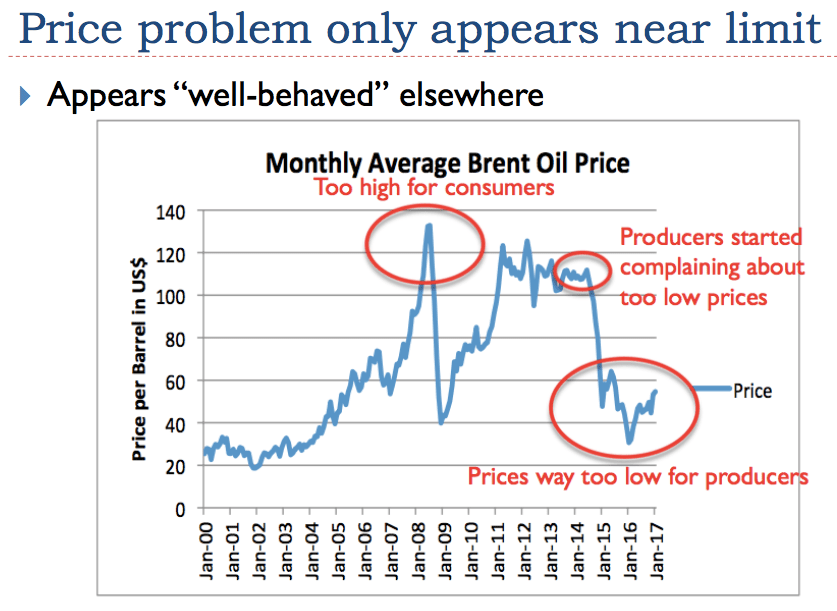
6-price-problem-appears-only-near-limit

Here is the latest version of Gail Tverberg’s thesis that limits to growth are causing too low energy prices which in turn will cause a decrease in energy extraction which in turn will cause the economy to collapse.

https://ourfiniteworld.com/2017/05/05/why-we-should-be-concerned-about-low-oil-prices/

The economists’ choice of the word “demand” is confusing. A person cannot simply demand to buy a car, or demand to go on a vacation trip. The person needs some way to pay for these things.

Falling resources per capita makes it harder to earn an adequate living. Think of farmers trying to subsist on ever-smaller farms. It would become increasingly difficult for them to earn a living, unless there is a big improvement in technology.

Or think of a miner who is extracting ore that is gradually dropping from 5% metal, to 2% metal, to 1% metal content, and so on, because the best quality ore is extracted first. The miner needs to work an increasing number of hours, to produce the ore needed for 100 kilograms of the metal. The economy is becoming in some sense “worse off,” because the worker is becoming “inefficient” through no fault of his own. The resources needed to provide benefits simply are less available, due to diminishing returns. This problem is sometimes reported as “falling productivity per worker.”

Falling productivity per worker tends to lower wages. And lower wages put downward pressure on commodity prices, because of affordability problems.

We seem to have already gone though a long period of stagflation, since the 1970s. The symptoms we are seeing today look as if we are approaching a steep downslope. If we are approaching a crisis stage, our crisis stage may be much shorter than the 20 to 50 years observed historically. Earlier civilizations (from which these timeframes were observed), did not have electricity or the extensive international trade system we have today.

The big problem that occurs is that non-elite workers become too poor to afford the output of the economy. Adding robots to replace workers looks efficient, but leaves many unemployed. Unemployment is even worse than low pay.

Peak oilers recognized one important point: our use of oil products would at some point have to come to an end. But they did not understand how complex the situation is. Low prices, rather than high, would be the problem. We would see gluts rather than shortages, as we approach limits. Much of the oil that seems to be technologically extractable, will really be left in the ground, because of low prices and other problems.

Many people miss the point that economy must keep growing. (…) As the economy grows, we tend to need more energy. Growing efficiency can only slightly offset this. Thus, as a practical matter, energy per capita needs to stay at least level for an economy to grow.

The fact that energy prices can, and do, fall below the cost of production is something that has been missed by many modelers. Prices can go down, even when the cost of production plus taxes needed by governments rises!

It takes energy to have an intergovernmental organization, such as the European Union. In fact, it takes energy to operate any kind of government. When there is not enough surplus energy to go around, citizens decide that the benefits of belonging to such organizations are less than the costs involved. That is the reason for the Brexit vote, and the reason the question is coming up elsewhere.

Oil prices have been too low for producers since at least mid-2014. It is possible to hide a problem with low prices with increasing debt, for a few years, but not indefinitely. The longer the low-price scenario continues, the more likely a collapse in production is. Also, the tendency of international organizations of government to collapse (Slide 38) takes a few years to manifest itself, as does the tendency for civil unrest within oil exporters (Slide 39).

Once an incorrect understanding of our energy problem becomes firmly entrenched, it becomes very difficult for leaders to understand the real problem.

By Nate Hagens: Blindspots and Superheroes

Here is this year’s Earth Day talk by Nate Hagens.

I used to preface Nate’s talks by saying he provides the best big picture view of our predicament available anywhere.

While still true, I think Nate may now be the only person discussing these issues in public forums.

Everyone else seems to have retired to their bunkers and gone quiet.

If you only have an hour this year to devote to understanding the human predicament and what needs to be done, this may be the best way to spend it.

By Allan Stromfeldt Chris­tensen: Book Review – When Trucks Stop Running by Alice Friedemann

when_trucks_stop_running_book_cover

I am reading but have not yet finished Alice Friedemann’s excellent book When Trucks Stop Running: Energy and the Future of Transportation.

Here are a couple interviews with the author discussing her book.

When contemplating the depletion of affordable non-renewable fossil energy it seems that transportation will be the most important casualty.

We can survive without cars, long distance vacations, and Asia manufactured clothing, housewares, and electronics, but most people cannot survive without the food produced and delivered by tractors, combines, trucks, trains, and ships.

It might be possible to revert to wind powered ships, and to electrify some of the train system, but there is no viable substitute for diesel powered trucks.

Some locales with good soil, adequate rainfall, and low population densities will be able to feed themselves with locally grown food produced with human labor. Most will not.

Today Allan Stromfeldt Chris­tensen published an excellent review of Friedemann’s book.

http://fromfilmerstofarmers.com/blog/2017/april/book-review-when-trucks-stop-running-energy-and-the-future-of-transportation/

Here are Christensen’s concluding remarks. Note that the core of his conclusion revolves around denial of reality.

Friedemann suggests in summation that rather than waste the fossil fuels we’ve got left on attempting to build out systems that won’t have much of a shelf life, we’d be much better off using that fossil energy to convert away from industrial agriculture, to build passive solar houses and buildings, maintain and upgrade domestic waterway transportation infrastructure as well as other low-energy systems.

Regardless, no PR agency, or energy lobbyist, or charlatan is going to be content with letting Friedemann get away with the last word here. For as was mentioned in the passage of hers I quoted earlier:

“W]hen scientists find [uncomfortable facts], they are ignored and called pessimists, no matter how solid their findings. For every one of their peer-reviewed papers, there are thousands of positive press releases with breakthroughs that never pan out…”

And you know what that means, right?

Elon Musk just announced the unveiling of the Tesla Semi truck!! And it’s “Seriously next level”!!

Okay, okay, I don’t mean to say that the latest MuskMobile will “never pan out”, just that Concordes generally necessitate too much energy to make them viable without significant subsidies of one sort or another. And that isn’t to say that there’s anything inherently wrong with subsidies either, just that while Friedemann also points out that “it is energy, not money, that fuels society”, it is also energy, not money, that fuels subsidies (money is after all a proxy for energy, as I’ve previously written).

In other words, using energy to subsidize energy probably isn’t much of a viable long-term plan, but it can certainly score you the starring role as the latest messiah in this age of optimism being valued over facts.