By Gail Tverberg: Elephants in the Room Regarding Energy and the Economy

6-price-problem-appears-only-near-limit

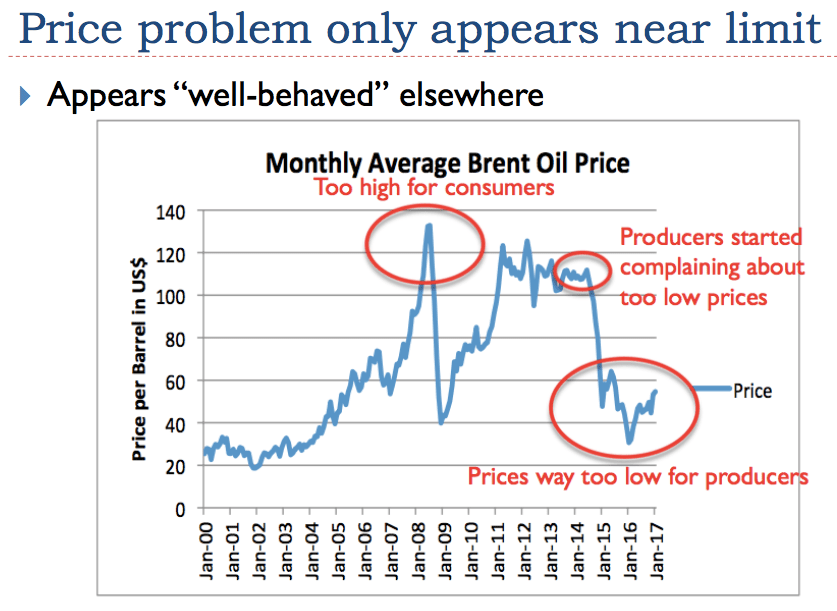
Here is the latest version of Gail Tverberg’s thesis that limits to growth are causing too low energy prices which in turn will cause a decrease in energy extraction which in turn will cause the economy to collapse.

https://ourfiniteworld.com/2017/05/05/why-we-should-be-concerned-about-low-oil-prices/

The economists’ choice of the word “demand” is confusing. A person cannot simply demand to buy a car, or demand to go on a vacation trip. The person needs some way to pay for these things.

Falling resources per capita makes it harder to earn an adequate living. Think of farmers trying to subsist on ever-smaller farms. It would become increasingly difficult for them to earn a living, unless there is a big improvement in technology.

Or think of a miner who is extracting ore that is gradually dropping from 5% metal, to 2% metal, to 1% metal content, and so on, because the best quality ore is extracted first. The miner needs to work an increasing number of hours, to produce the ore needed for 100 kilograms of the metal. The economy is becoming in some sense “worse off,” because the worker is becoming “inefficient” through no fault of his own. The resources needed to provide benefits simply are less available, due to diminishing returns. This problem is sometimes reported as “falling productivity per worker.”

Falling productivity per worker tends to lower wages. And lower wages put downward pressure on commodity prices, because of affordability problems.

We seem to have already gone though a long period of stagflation, since the 1970s. The symptoms we are seeing today look as if we are approaching a steep downslope. If we are approaching a crisis stage, our crisis stage may be much shorter than the 20 to 50 years observed historically. Earlier civilizations (from which these timeframes were observed), did not have electricity or the extensive international trade system we have today.

The big problem that occurs is that non-elite workers become too poor to afford the output of the economy. Adding robots to replace workers looks efficient, but leaves many unemployed. Unemployment is even worse than low pay.

Peak oilers recognized one important point: our use of oil products would at some point have to come to an end. But they did not understand how complex the situation is. Low prices, rather than high, would be the problem. We would see gluts rather than shortages, as we approach limits. Much of the oil that seems to be technologically extractable, will really be left in the ground, because of low prices and other problems.

Many people miss the point that economy must keep growing. (…) As the economy grows, we tend to need more energy. Growing efficiency can only slightly offset this. Thus, as a practical matter, energy per capita needs to stay at least level for an economy to grow.

The fact that energy prices can, and do, fall below the cost of production is something that has been missed by many modelers. Prices can go down, even when the cost of production plus taxes needed by governments rises!

It takes energy to have an intergovernmental organization, such as the European Union. In fact, it takes energy to operate any kind of government. When there is not enough surplus energy to go around, citizens decide that the benefits of belonging to such organizations are less than the costs involved. That is the reason for the Brexit vote, and the reason the question is coming up elsewhere.

Oil prices have been too low for producers since at least mid-2014. It is possible to hide a problem with low prices with increasing debt, for a few years, but not indefinitely. The longer the low-price scenario continues, the more likely a collapse in production is. Also, the tendency of international organizations of government to collapse (Slide 38) takes a few years to manifest itself, as does the tendency for civil unrest within oil exporters (Slide 39).

Once an incorrect understanding of our energy problem becomes firmly entrenched, it becomes very difficult for leaders to understand the real problem.

By Nate Hagens: Blindspots and Superheroes

Here is this year’s Earth Day talk by Nate Hagens.

I used to preface Nate’s talks by saying he provides the best big picture view of our predicament available anywhere.

While still true, I think Nate may now be the only person discussing these issues in public forums.

Everyone else seems to have retired to their bunkers and gone quiet.

If you only have an hour this year to devote to understanding the human predicament and what needs to be done, this may be the best way to spend it.

By Allan Stromfeldt Chris­tensen: Book Review – When Trucks Stop Running by Alice Friedemann

when_trucks_stop_running_book_cover

I am reading but have not yet finished Alice Friedemann’s excellent book When Trucks Stop Running: Energy and the Future of Transportation.

Here are a couple interviews with the author discussing her book.

When contemplating the depletion of affordable non-renewable fossil energy it seems that transportation will be the most important casualty.

We can survive without cars, long distance vacations, and Asia manufactured clothing, housewares, and electronics, but most people cannot survive without the food produced and delivered by tractors, combines, trucks, trains, and ships.

It might be possible to revert to wind powered ships, and to electrify some of the train system, but there is no viable substitute for diesel powered trucks.

Some locales with good soil, adequate rainfall, and low population densities will be able to feed themselves with locally grown food produced with human labor. Most will not.

Today Allan Stromfeldt Chris­tensen published an excellent review of Friedemann’s book.

http://fromfilmerstofarmers.com/blog/2017/april/book-review-when-trucks-stop-running-energy-and-the-future-of-transportation/

Here are Christensen’s concluding remarks. Note that the core of his conclusion revolves around denial of reality.

Friedemann suggests in summation that rather than waste the fossil fuels we’ve got left on attempting to build out systems that won’t have much of a shelf life, we’d be much better off using that fossil energy to convert away from industrial agriculture, to build passive solar houses and buildings, maintain and upgrade domestic waterway transportation infrastructure as well as other low-energy systems.

Regardless, no PR agency, or energy lobbyist, or charlatan is going to be content with letting Friedemann get away with the last word here. For as was mentioned in the passage of hers I quoted earlier:

“W]hen scientists find [uncomfortable facts], they are ignored and called pessimists, no matter how solid their findings. For every one of their peer-reviewed papers, there are thousands of positive press releases with breakthroughs that never pan out…”

And you know what that means, right?

Elon Musk just announced the unveiling of the Tesla Semi truck!! And it’s “Seriously next level”!!

Okay, okay, I don’t mean to say that the latest MuskMobile will “never pan out”, just that Concordes generally necessitate too much energy to make them viable without significant subsidies of one sort or another. And that isn’t to say that there’s anything inherently wrong with subsidies either, just that while Friedemann also points out that “it is energy, not money, that fuels society”, it is also energy, not money, that fuels subsidies (money is after all a proxy for energy, as I’ve previously written).

In other words, using energy to subsidize energy probably isn’t much of a viable long-term plan, but it can certainly score you the starring role as the latest messiah in this age of optimism being valued over facts.

On Free Will and the Great Barrier Reef

By Dahr Jamail – Great Barrier Reef Reaches “Terminal Stage” as CO2 Levels Rise at Record Rate

Dahr Jamail reports on the dying Great Barrier Reef and other recent casualties of climate change.

He concludes the article by blaming the denial of Trump and other leaders.

Jamail does not mention his own denial demonstrated by flying long distances to report on climate change.

Everyone, myself included, has a justification for their lifestyle.

Genes have evolved over billions of years to compete for finite energy so they can survive to replicate.

There are 7.5 billion humans in severe overshoot because their genes out-competed the genes of all other life by learning to dig up and burn ancient solar energy.

Having genes that make us smart enough to understand our mortality and the implications of our genes’ ability to exploit fossil energy requires genes that cause us to deny reality to avoid depression and a consequent decrease in reproductive fitness.

Our genes are in charge.

Free will is an illusion.

Enabled by denial of reality.

How could it be otherwise?

7.5 billion and rising

The world’s population just passed 7.5 billion.

http://www.worldometers.info/world-population/

Canada’s population has grown 19% since 2000.

http://www.worldometers.info/world-population/canada-population/

An informed aware optimist believes the planet can sustain up to 2 billion people when affordable fossil energy is gone around 2040.

An informed aware pessimist believes the planet can sustain up to 1 billion people when affordable fossil energy is gone around 2025.

Both understand that the maximum possible population will be much lower if we assume a current North American standard of living.

Both understand that the maximum possible population will decrease as each decade passes for the next several thousand years due to climate change impacts on human habitat and food production.

The vast majority of people, on the other hand, are uninformed and in denial, and either don’t believe 7.5 billion people, fossil energy depletion, and climate change are problems, or do not think about the issues.

It’s no surprise that not one of the four parties competing in BC’s election have population reduction as a priority.

Nor mitigation plans for fossil energy depletion.

Nor an honest discussion of what 410 ppm CO2 means.

Denial on. Party on.

By Art Berman: Oil Prices Lower Forever? Hard Times In a Failing Global Economy

Art Berman is an oil industry expert worth listening to. I missed this Forbes article he published in July 2016. Thanks to Alice Friedemann for reviving it.

This is one of the better summaries I’ve read on the history of, and relationship between, energy and the economy.

Economic growth, without unsustainable and dangerous debt, is no longer possible. I explored the implications of no growth in this essay.

Berman wisely concludes by saying our best course of action is to face the beast.

Facing the beast would require us to break through our inherited denial of reality.

I wish but I do not expect.

http://energyskeptic.com/2017/art-berman-oil-prices-lower-forever-hard-times-in-a-failing-global-economy/

oil-prices-in-2016-dollars-1950-2016-1024x694

Energy is the economy. Energy resources are the reserve account behind currency. The economy can grow as long as there is surplus affordable energy in that account. The economy stops growing when the cost of energy production becomes unaffordable. It is irrelevant that oil companies can make a profit at unaffordable prices.

Energy underlies and connects everything. We need energy to make things, transport and sell things and to transport ourselves so that we can work and spend. We need it to run our computers, our homes and our businesses. It takes energy to heat, cool, cook and communicate. In fact, it is impossible to think of anything in our lives that does not rely on energy.

When energy costs are low, the costs of doing business are correspondingly low. When energy prices are high, it is difficult to make a profit because the underlying costs of manufacture and distribution are high. This is particularly true in a global economy that requires substantial transport of raw materials, goods and services.

And this is precisely the problem with the almost universally held belief that technology will make all things possible, including making a finite resource like oil infinite. Technology has a cost that its evangelists forget to mention.

The reality is that technology allows us to extract tight oil from non-reservoir rock at almost 3 times the cost of high-quality reservoirs in the past. The truth is that we have no high-quality reservoirs left with sufficient reserves to move the needle on the high global appetite for oil. The consequence is that to keep consuming and producing as we always have will inevitably cost a lot more money. This is basic thermodynamics and not a pessimistic opinion about technology.

Renewable energy will be increasingly part of the landscape but its enthusiasts are also magical thinkers.

In 2015, renewables accounted for only 3% of U.S. primary energy consumption. No matter the costs nor determination to convert from fossil to renewable energy, a transition of this magnitude is unlikely in less than decades.

Solar PV and wind provide much lower net energy than fossil fuels and have limited application for transport–the primary use of energy– without lengthy and costly equipment replacement. The daunting investment cost becomes critically problematic in a deteriorating economy.  Although proponents of renewable energy point to falling costs, more than half of all solar panels used in the U.S. are from China where cheap manufacturing is financed by unsustainable debt.

The future for oil prices and the global economy is frightening. I don’t know what beast slouches toward Bethlehem but I am willing to bet that it does not include growth.The best path forward is to face the beast. Acknowledge the problem, stop looking for improbable solutions that allow us live like energy is still cheap, and find ways to live better with less.

On Why Things Appear (sort of) Normal

Assuming I’m not in denial (which I admit might be possible given the underlying genetic basis of denial which makes it difficult to detect denial in yourself) I like to think that I belong to a small group of people that understand what is going on in the world.

Despite this understanding I was completely wrong in predicting the global economy would collapse before today.  I think I understand why I was wrong but I do catch myself from time to time marveling at how well the wheels have stayed on since the 2008 crash.

It is wonderful reading someone like Tim Morgan who with a few words explains clearly why we have delayed the day of reckoning.

https://surplusenergyeconomics.wordpress.com/2017/04/19/94-spring-has-sprunga-leak/

…there’s a big difference between reasonable optimism and outright delusion, and the latter, it seems, has been taking a big hold over many of those whose job it is to forecast our economic weather.

In 2016, global GDP grew by 3.4%, adding $3.9tn to GDP. Where debt is concerned, we do not yet have comprehensive data for the whole of the year, but we do know that world debt increased by over $11.4tn in the first three quarters of 2016.

In that nine-month period, governments borrowed more than $5.5tn, households $2.3tn, and non-financial businesses $3.5tn. That stacks up to $3.90 of borrowing for each $1 of reported growth, even if we assume that prudence reigned supreme, such that nobody borrowed at all in the three months running up to Christmas.

To be sure, we cannot make a one-for-one comparison between borrowing and growth. But we do know that a lot of this credit expansion went into consumption expenditures, not least because that’s what governments spend most of their money on. The calculations made by SEEDS suggest that, stripped of the spending of borrowed money, reported growth of 3.4% falls to an underlying level of just 1.2% – and even that probably makes some pretty generous judgments on the validity of a very big pile of borrowing.

Nor is that all – because debt is not the only hostage that current practices are handing to posterity. Debt, though it adds to the burdens of futurity, can at least be managed, if we let inflation accelerate, essentially bilking lenders by paying them back in devalued money.

This cannot work with other forms of futurity, most obviously pensions, where the same inflation that devalues debt simultaneously increases the burden of future payments, not just of pension commitments but also of welfare. It should come as no surprise whatsoever that pension deficits are continuing to widen alarmingly.

On the B.C. Election

There is an election soon in my province.

I decided to get educated on the choices and read the platforms of all the parties.

Not one party mentions the only issue that matters: human overshoot.

By overshoot I mean the combined and interrelated threats of:

  • social unrest and war resulting from the end of economic growth and soon to burst debt and asset bubbles caused by the depletion of affordable fossil energy;
  • runaway climate change and resulting disruptions to food production and human habitat;
  • unprecedented species extinction and fisheries collapse caused by human overpopulation;
  • unsustainable consumption of almost every resource used by humans.

Not one party has population reduction as their top priority.

Not one party even mentions the critical need to reduce our population.

Not one party discusses the need to manage a necessary and unavoidable contraction to our economy.

Not one party mentions the need to live on nature’s interest rather than its capital.

I was planning to vote for the Green party but even they don’t have a clue.

Denial is amazing.

By Tim Morgan: The Prosperity Equation

Tim Morgan offers another fresh and intelligent insight into world affairs.

It seems a modest decrease in prosperity of about 6% may explain much of the political chaos in the world.

Imagine what may happen when our global debt bubble bursts and we have a significant drop in prosperity.

https://surplusenergyeconomics.wordpress.com/2017/04/14/93-the-prosperity-equation/

Fig. 1: Prosperity per capita, 2016 vs 2006

prosperityjpg_page1

This gets us to a definition of prosperity, something mentioned here before but so important that it bears repetition. Prosperity is “discretionary” income.

Surplus energy economics provides unique insights into prosperity because the trend cost of energy is the principle driver of non-discretionary costs. The cost of essentials is massively linked to the cost of energy. Fuel, power and light are themselves significant components of the non-discretionary spend. But energy also drives the cost of water, minerals, food and the various manufactured goods which need to be acquired and replaced over time.


That the average Chinese person saw his prosperity increase by “only” 58% over a decade remains pretty impressive. But the same adjustments, when applied to less vibrant economies, have some very adverse implications for prosperity.

In the United States, growth of 14.6% in GDP translates into a decrease of 7.0% in prosperity, which might go a long way to help explain why Donald Trump was able to wrest the White House out of the clutches of the political establishment.

In Britain, GDP growth of 12.2% translates into a slump of 13.8% in prosperity, which might likewise help explain “Brexit”. Italian prosperity fell by 9.7% between 2006 and 2016 – a worse fall than any other country except Britain – which no doubt influenced the resounding voter rejection of Matteo Renzi’s reform proposals.

More positively, personal prosperity over that decade increased by 48% in India, 18% in Russia and 12% in Poland.

It’s impossible to say whether the 6.6% ten-year deterioration in French prosperity will be enough to oust the establishment from power – but a not-dissimilar deterioration (of 7%) was followed by the election of Mr Trump, whilst Italy’s 9.7% decline was more than enough to see off Mr Renzi.

If France does elect Ms Le Pen or Mr Mélenchon, the consequences could be drastic – and not just for France herself.