Imagine You Are a Smart Leader

Note: I make a distinction between being wise and smart. I wrote about wise leaders and citizens here. Today I am talking about smart leaders of citizens in denial.

Imagine you are a smart leader with a good understanding of science and engineering, like many Chinese leaders, and unlike our idiot Western economists and lawyers.

You know cheap money policies have created the largest bubble in history.

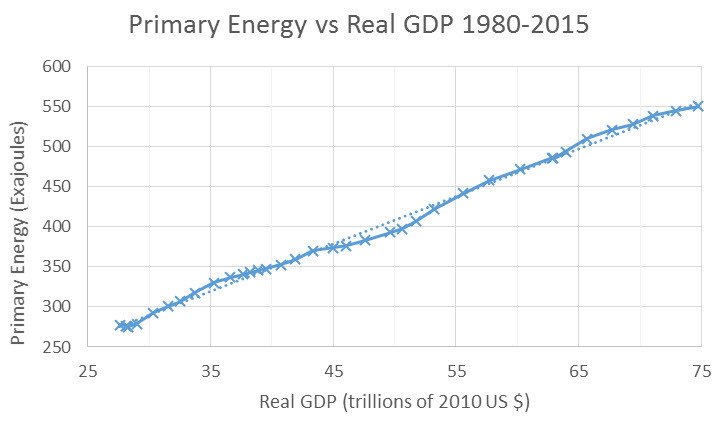
You know there is not enough affordable energy left to grow out of the problem.

You know that austerity policies will cause a depression, at best, and will cause you to lose your job.

You know that thermodynamics and mathematics guarantees an economic reset in the not too distant future.

You know that there will be much less energy and other critical resources like food available after the reset.

You know that there will be much less credit available to purchase anything with after the reset.

You know that you will not be able to feed your people, and keep your job, without access to energy, food, and other critical resources.

You know that you cannot afford a massive military build-up to forcibly secure resources, and even if you could, the future shortage of energy to power it makes a big military an unwise investment.

You know that a few cheap nuclear weapons are probably sufficient to prevent someone with a bigger military from taking your resources.

You know that fiat currencies, like those every country uses, have value because they are a claim on energy that is expected to be burned in the future.

You know that there will not be enough energy in the future to fulfill claims made by fiat currencies, and therefore they will lose most of their value after the reset and will not be useful for purchasing resources.

You know that gold’s value comes from the energy that was burned in the past to produce it, and therefore other countries may exchange energy and food for gold after the reset.

What would you do?

You would print money to purchase gold from other countries with leaders that are too stupid and/or too deeply in denial to understand what is going on.

By Steve St. Angelo: CLOSE TO NEW GOLD STANDARD? Australia Exports Record Amount Of Gold To China

australia-us-gold-mine-suppy-vs-exports

Australia and the U.S. continue to export the majority of its gold to Hong Kong and China. For example, Australia and the United States exported 121 mt of gold to Hong Kong and China during the first quarter of 2017. Australia exported 57.4 mt, while the U.S. exported 63.3 mt. Thus, Hong Kong and China received 55% of all Australian and U.S. gold exports Q1 2017.

By Raúl Ilargi Meijer: I read the news today, oh boy (On Zombies and Bubbles)

The price of money affects everything.

When you artificially suppress the price of money dangerous bubbles emerge.

No one notices or cares because of inherited denial of reality.

Until the bubbles pop and everyone is forced to care.

This time is different because of its magnitude and global nature.

And because there is no cheap energy left to push us out of a depression.

https://www.theautomaticearth.com/2017/07/i-read-the-news-today-oh-boy/

zhstockbuyers

Reading the news on America should scare everyone, and every day, but it doesn’t. We’re immune, largely.

What we’re witnessing is the demise of the American political system, in real time. We just don’t know it. Actually, we’re witnessing the downfall of the entire western system. And it turns out the media are an integral part of that system. The reason we’re seeing it happen now is that although the narratives and memes emanating from both politics and the press point to economic recovery and a future full of hope and technological solutions to all our problems, people are not buying the memes anymore. And the people are right.

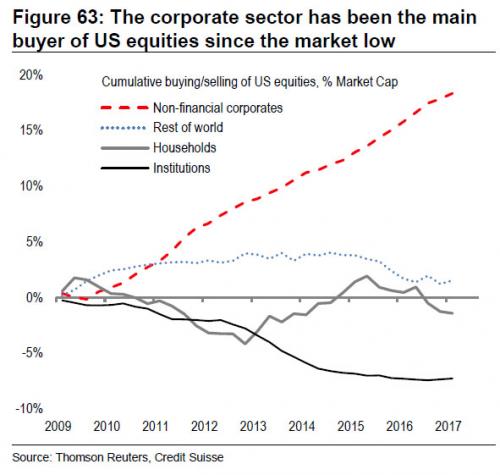
Tyler Durden ran a Credit Suisse graph overnight that should give everyone a heart attack, or something in that order. It shows that nobody’s buying stocks anymore, other than the companies who issue them. They use ultra-cheap leveraged loans to make it look like they’re doing fine. Instead of using the money/credit to invest in, well, anything, really. You can be a successful US/European company these days just by purchasing your own shares. How long for, you ask?

Why this rush by companies to buyback their own stock, and in the process artificially boost their Earning per Share? There is one very simple reason: as Reuters explained some time ago, “Stock buybacks enrich the bosses even when business sags.”

In other words, the system doesn’t only keep zombies alive, making it impossible for anyone to see who’s healthy or not, no, the system itself has become a zombie.

By Ugo Bardi: When governments operate in “cheating mode”

Problems are frequently blamed on the other 50%, or immigrants, or Russia, rather than on pollution, resource depletion, and overshoot.

I often wonder if the elites are knowingly deceitful, or if they are in denial and believe what they tell us.

I suspect the latter.

It seems to be a general observation that, when facing a serious threat, the elites of a country can reason that the best strategy for them is to cheat the people and save themselves. In the present situation, the threat of global warming seems to be driving some elites to do exactly that. They deny the threat while at the same time maneuvering to save themselves by moving to higher grounds and equipping their mansions with air conditioning. For all they care, the rest of the people can drown or roast.

But, as the threat of climate change becomes clearer, the elites may discover that nobody can survive in an uninhabitable planet. Then, they may finally decide to try to do something to save the ecosystem from which we all depend. But it may well be too late.

http://cassandralegacy.blogspot.ca/2017/07/when-governments-operate-in-cheating.html

By Chris Martenson: The Looming Energy Shock

I have a lot of time for Chris Martenson. He’s well grounded in science and has a lot of integrity. My only criticism of late is his recent campaign to blame central banks which I suspect is a marketing strategy to increase subscriptions because blaming bankers sells better than blaming thermodynamics, overshoot, and inherited denial.

Chris is predicting that within 3 years we will either have an economic collapse that temporarily masks the underlying energy problem, or we will have oil shortages and a price shock that will trigger a credit crisis like 2008 but worse. He backs these predictions with the correct data, in my opinion.

I independently came to roughly the same conclusion, although I would add a 3rd possibility given rising stresses around the world: a major war.

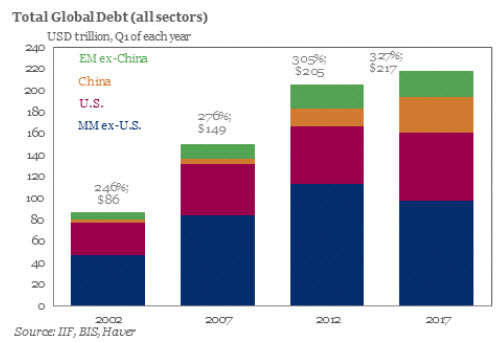
I think the 3 possible outcomes are roughly equal in probability, although given the deceleration in credit growth apparent from the following graph, an economic collapse has the lead by a nose.

global-debt-2017-06-29_21-27-57

energy-and-economy-10-4-2016

oil-investments-global-2017-06-29


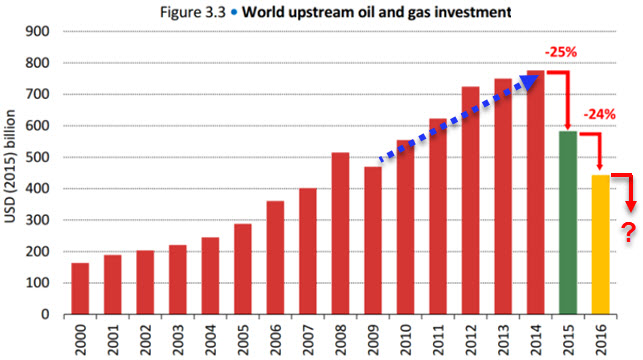
There will be an extremely painful oil supply shortfall sometime between 2018 and 2020. It will be highly disruptive to our over-leveraged global financial system, given how saddled it is with record debts and unfunded IOUs.

Due to a massive reduction in capital spending in the global oil business over 2014-2016 and continuing into 2017, the world will soon find less oil coming out of the ground beginning somewhere between 2018-2020.

Because oil is the lifeblood of today’s economy, if there’s less oil to go around, price shocks are inevitable. It’s very likely we’ll see prices climb back over $100 per barrel. Possibly well over.

The only way to avoid such a supply driven price-shock is if the world economy collapses first, dragging demand downwards.

Not exactly a great “solution” to hope for.

https://www.peakprosperity.com/blog/109505/looming-energy-shock

Bottleneck or Barrier?

Varki’s Mind Over Reality Transition theory says that awareness of mortality is a barrier to evolving an extended theory of mind and this barrier can only be crossed by simultaneously evolving denial of reality.

Only one species has crossed this barrier and it used its extended theory of mind to take over the planet, while denying the consequences of its success.

One prediction of Varki’s theory is that all 7 billion humans will have descended from the individual that managed to cross the barrier.

Here is a short video that explains why it is generally accepted that all 7 billion humans descended from one woman about 200,000 years ago.

The usual explanation is that humans experienced a bottleneck caused probably by a changing climate.

I think Varki’s barrier explanation is more consistent with the evidence.

Why my interest in denial?

why1

I’ve been aware of our overshoot predicament for a decade and have moved on from studying specific aspects of human overshoot. 

What fascinates me now is our collective denial and inability to discuss or act on overshoot, despite some threats being imminent.

I used to believe denial was caused by a lack of awareness and understanding, but having made an effort to educate many people, and observing that they almost always aggressively choose not to understand, I began to look for a different explanation.

I concluded that denial must be an inherited behavior because every country, culture, political party, and religion is in denial. And denial must be central to who we are as a species because of its depth, breadth, and aggressiveness.

A few years ago I stumbled on Varki’s Mind Over Reality Transition (MORT) theory and a light went on. Varki’s theory provides the most simple, logical, plausible, and probable answer to the big questions that demand an answer:

  1. Why has no other species achieved our brain power despite common evolutionary forces and fitness advantages? Other advantageous inventions, like the eye, evolved several times, yet our brain, which is so advantageous it enabled us to take over the planet, has evolved only once.
  2. Why did the technology and culture of hominids stall for over a million years until something happened in one small tribe in Africa about 100,000 years ago?
  3. Why did all 7 billion of us emerge from one small tribe in Africa? And why did that tribe replace the many other similar hominid species?
  4. What genetic change occurred about 100,000 years ago that must be both modest in complexity and extreme in effect to explain the explosive emergence and dominance of behaviorally modern humans?
  5. Sapiens successfully bred with both Neanderthals and Denisovans at different times and locations. Sapiens retained a few of the other’s useful genes, mainly for disease immunity, but there is no evidence of full hybrids as you would expect. Why?
  6. Why do most people deny the many obvious dimensions of human overshoot like over-population, climate change, sea level rise, peak oil, resource depletion, soil loss, aquifer depletion, nitrogen imbalance, species extinction, fisheries collapse, and ocean acidification?
  7. Why do many people deny personal health realities like smoking, poor diet, lack of exercise, and obesity?
  8. Why do many people deny scientific realities like evolution, climate change, thermodynamics, vaccine utility, and the improbability of UFOs?
  9. Why do most people deny economic realities like the impossibility of infinite growth on a finite planet, unsustainable debt, and asset bubbles?
  10. Why do many people choose to believe fake news, like the Russians are to blame?
  11. Why do many people seek to avoid all forms of reality with mind altering drugs?
  12. Why do democratic elections never discuss, or debate, or even whisper about, the issues associated with overshoot? What could be more important to vote on?
  13. Why don’t environmental political parties, like the Green party, have overshoot policies in their platforms?
  14. Why do experts commonly and aggressively ignore or deny the most important (and unpleasant) facts associated with their domain? Economics, climate change, renewable energy, and nutrition being notorious examples.
  15. Why do people who understand climate change rarely modify their lifestyles to reduce CO2 emissions?
  16. Why are humans the only species with religions?
  17. Why did religions emerge simultaneous with the behaviorally modern human brain?
  18. Why has every human group everywhere through all history had some form of religion?
  19. Why does every one of the thousands of religions think it is the only (or most) true religion?
  20. Why does every religion, including new religions like Scientology, have a life after death story? Many aspects of religion can be easily explained by their positive effect on group survival, but it is not easy to explain why every religion denies death with a life after death story. A few random religions with life after death stories might be reasonable, but not every religion, unless the need for a life after death story has a genetic basis.
  21. Why do many atheists retain some form of spirituality which usually includes a belief in some form of life after death?

A good place to go next is On Burning Carbon

By Alice Friedemann: Big Fight: 21 top scientists show why Jacobson and Delucchi’s renewable scheme is a delusional fantasy

This summary by Alice Friedemann of a dispute in the scientific community over the viability of renewable energy is excellent and worth reading in its entirety.

What really stands out for me is that the 21 scientists that criticized the absurdly optimistic renewable energy plan of Jacobson and Delucchi completely missed the most important points that require criticism.

It is amazing that otherwise intelligent experts frequently ignore THE most important things they should understand.

Other examples include:

  • economists who ignore debt and the relationship between energy and wealth;
  • climate scientists who ignore the relationship between CO2 and wealth;
  • dietary health experts who ignore the link between sugar and obesity;
  • environmentalists who ignore over-population;
  • citizens who believe in life after death and deny other unpleasant facts.

This denial behavior is so common and so powerful that it requires an explanation like Varki’s Mind Over Reality theory.

http://energyskeptic.com/2017/big-fight-21-top-scientists-show-why-jacobson-and-delucchis-renewable-scheme-is-a-delusional-fantasy/

Many authors have been writing for years about why Jacobson and Delucchi’s (J & D) plans for a 100% low-cost renewable energy is a cloud cuckoo-land fantasy (references below).  But never so many, so loudly, and in such a prestigious journal (Clack 2017).

The 21 authors of the PNAS article felt compelled to write this because J & D’s irresponsible fairy tales are starting to influence actual policy and waste money.  If cities and states set renewable goals of 100% and try to achieve them with the J & D plan, their spending will be wasted because the J & D plan leaves out biofuels, grid-scale battery storage, nuclear, and coal energy with CCS.

The most important problems with achieving a 100% renewable system are not even mentioned (Friedemann 2015c).

Renewable contraptions cannot outlast finite fossil fuels, because they are utterly dependent on fossil fuels from birth to death to mine, crush, and smelt the ore, deliver the ore to a blast furnace, fabricate 8,000 wind turbine parts at hundreds of manufacturing plants all over the world, and deliver the parts to the assembly plant.  For each turbine, dozens of trucks are needed to prepare the wind turbine site so that dozens of cement trucks can pour tons of concrete and steel rebar for the platform, deliver pieces of the huge parts of the turbine, and diesel powered cranes to lift the parts hundreds of feet into the air.

In their 2011 paper, the J & D 100% renewable system would be accomplished with 3.8 million 5-MW wind turbines (50% of power), 49,000 solar thermal plants (20%), 40,000 solar PV plants (14%), 1.7 billion rooftop PV systems (6%), 5350 geothermal plants (4%), 900 hydroelectric power plants (4%), and marine hydrokinetic devices (2%).   Their 2015 paper has somewhat different but equally unrealistic numbers.

It is questionable whether there’s enough material on earth to build all these contraptions and continue to do so every 20 years (wind) to 30 years (solar).  Fossil fuels will grow more and more scarce, which means cement, steel, rare (earth) metals, and so on will decline as well.  Keep in mind that a 2 MW turbine uses 900 tons of material: 1300 tons concrete, 295 tons steel, 48 tons iron, 24 tons fiberglass, 4 tons copper, .4 tons neodymium, .065 tons dysprosium (Guezuraga, USGS).  The enormous demand for materials would likely drive prices up, and the use of recycled metals cannot be assumed, since downcycling degrades steel, perhaps to less strength than required.

The PNAS authors propose grid-scale batteries, but the only kind of battery for which there are enough materials on earth are Sodium-sulfur NaS batteries (Barnhart 2013).  To store just one day of U.S. electricity generation (and at least 6 to 8 weeks would be needed to cope with the seasonal nature of wind and solar), you would need a 923 square mile, 450 million ton, $40.77 trillion dollar NaS battery that needs replacement every 15 years (DOE/EPRI 2013).  Lead-acid: $8.3 trillion, 271.5 square miles, 15.8 million tons.  Li-ion $11.9 trillion, 345 square miles, 74 million tons.

There are dozens of reasons why wind power will not outlast fossil fuels (Friedemann 2015b), including the scale required, the need to increase installation rates 37-fold in 13 years (Radford 2016), population increasing faster than wind turbines to provide for their needs can be built, wind is seasonal – very little in the entire U.S. in the summer, no commercial wind year round in the South East, a national grid, no commercial energy storage at utility scale in sight, plus a financial crisis or war will likely break the supply chains as companies go out of business.

Okay, drum roll.  The biggest problem is that electricity does not matter. This is a liquid transportation fuels crisis. Trucks can’t run on electricity ( http://energyskeptic.com/category/fastcrash/electric-trucks-impossible/  ).

The Achilles heel of civilization is our dependency on trucks that run on diesel because it is so energy dense. This is why diesel engines are far more powerful than steam, gasoline, electric, battery-driven or any other motive power on earth (Smil 2010).  Billions of trucks and equipment worth trillions of dollars are required to keep the supply chains going over tens of millions of miles of roads, rail, and waterways that every person and business on earth depends on.  Equally if not more important are off-road mining, agriculture, construction, logging, and other trucks.  They not only need to travel on rough ground, but meanwhile push, lift, dig and perform other tasks far from the electric grid or non-oil distribution system.

Trucks must eventually be electrified, because biomass doesn’t scale up and has negative or break-even energy return, coal and natural gas are finite, and hydrogen /hydrogen fuel cells are dependent on a non-existent distribution system and far from commercial. In my book, I show why trucks can’t run on electricity, as well as why a 100% renewable grid is impossible. 

The authors briefly point out that one way to counter wind and solar intermittency is an energy source that can be dispatched when needed.  But they neglected to mention that natural gas plays most of this role now.  But natural gas is finite, and has equally important uses of making fertilizer, feedstock and energy source to make hundreds of millions of chemicals, heating homes and buildings, and so on.  All of these roles will have to be taken on by biomass after fossils are gone, yet another reason why biomass doesn’t scale up.

J & D propose a month of hydrogen storage to power transportation.  But hydrogen boils off within a week since it is the smallest element and can escape through atomic scale imperfections. It is not an energy source, it’s an energy sink from start to finish.  First it takes a tremendous amount of energy to split hydrogen from oxygen.  That’s why 96% of hydrogen comes from finite natural gas.  And a tremendous amount more energy to compress or liquefy it to -423 F and keep it chilled.  It is so destructive of metal that expensive alloys are needed for the steel pipelines and storage containers, making a distribution system too expensive.  A $1.3 million dollar hydrogen fuel cell truck would require a very heavy and inefficient fuel cell with an overall efficiency of just 24.7%: 84% NG upstream and liquefaction * 67% H2 on-board reforming * 54% fuel cell efficiency * 84% electric motor and drivetrain efficiency * 97% aero & rolling resistance efficiency, and even less than that without an expensive 25 kWh li-ion battery to capture regenerative braking (DOE 2011, Friedemann 2016). And far less than 24.7% efficient if the hydrogen were made from water with electrolysis.

J & D propose thermal energy storage in the ground.  The only renewable that has storage are concentrated solar plants, but CSP plants provide just 0.06% of U.S. energy because each plant costs about a billion dollars each, and scaled up, would need to use stone, which is much cheaper than molten salt. A 100 MW facility would need 5.1 million tons of rock taking up 2 million cubic meters (Welle 2010). Since stone is a poor heat conductor, the thick insulating walls required might make this unaffordable (IEA 2011b). J & D never mention insulating walls, let alone the energy and cost of building them.  The PNAS paper also says that phase-change material energy storage is far from commercial and still has serious problems to solve such as poor thermal conductivity, corrosion, material degradation, thermal stress durability, and cost-effective mass production methods.

The authors suggest bioenergy, but this is not feasible. Trucks can’t burn ethanol, diesohol, or even gasoline.  Biofuels (and industrial agriculture) destroy topsoil, which in the past was a major or main reason why all past civilizations failed.  It also depletes aquifers that won’t be recharged until after the next ice age.   And biomass simply doesn’t scale up.  Burning it is far more energy efficient than the dozens of steps needed to make biofuels, each step taking energy. Yet even if we burned every plant plus and their roots in America, the energy produced would be less than the fossil fuel energy consumed that year, and we’d all have to pretend we liked living on Mars for many years after our little experiment. Friedemann (2015a) has many other examples of the scaling up issues, ecological, energy, and other issues with biofuels.

Nuclear is not an option due to peak uranium, and the findings of the National Academy of Sciences about lessons learned from Fukushima. It’s also too expensive, with 37 plants likely to shut down (Cooper 2013).  And leaving thousands of sites with nuclear waste lasting hundreds of thousands of years for our descendants to deal with after fossil fuels are gone in an industrially poisoned world is simply the most evil of all the horrible things we’re doing to the planet (Alley 2013).

The book “Our renewable future” (Heinberg & Fridley 2016) was written to show those who believe in Jacobson and Delucchi’s fairy tales how difficult, if not impossible it would be to make this happen. Though I fear many of their major points were probably ignored or forgotten, with readers deciding that 100% renewables were possible, even if difficult, since the book was too gentle and abstract. For example, they mention that there are no ways to make cement and steel with electricity, because these industries depend on huge blast furnaces that run for 4 to 10 years non-stop because any interruption would cause the brick lining to cool down and damage it.  It is not likely a 100% wind and solar electricity system to be up 24 x 7 x 365.  That’s a real  showstopper.  But the average person believes in infinite human ingenuity that can overcome the laws of physics and doesn’t worry…

J & D include wave and tidal devices, but these are far from being commercial and unlikely to ever be due to salt corrosion, storm waves, and dozens of other problems (NRC 2013).

I’m not as concerned about the incorrect J & D calculations for GHG emissions, because we are at or near peak oil and coal, and natural gas.  Many scientists have published peer-reviewed papers that based on realistic reserves of fossil fuels, rather than the unlimited amounts of fossils the IPCC assumes, there is a consensus that the worst case scenario likely to be reached is RPC 4.5 (Brecha 2008, Capellan-Perez 2016, Chiari 2011, Dale 2012, Doose 2004, Hook 2010, Hook 2013, and 10+ more).  Also, coal is finite, and carbon capture and storage technology so far from being commercial, and uses up 30 to 40% of the energy contained in the coal, that it’s unlikely to be used when blackouts start to happen more and more often (http://energyskeptic.com/category/energy/coal/carbonstorage/).

We’re running out of time.  Conventional oil peaked in 2005. That’s where 90% of our oil comes from at a Niagra Falls rate.  Tar sands and other non-conventional oil simply can’t be produced at such a high rate.  So it doesn’t matter how much there is, Niagra Falls will slow to a trickle, far less than what we use today.  And since energy is the basis of growth, not money, it is questionable if our credit/debit system can survive, since once peak oil is acknowledged, creditors will know they can’t be repaid.

Also, oil is the master resource that makes all other resources available. We don’t have enough time to  replace billions of diesel engines with something else.  There is nothing else. And 12 years after peak the public is still buying gas guzzlers.

Mind Over Reality (Limerick)

For explaining why humans are odd
To Varki and Brower we applaud
A great mystery they solved
With denial we evolved
And created the Higgs, overshoot, and God

By Ajit Varki: Mind Over Reality Transition: The Evolution of Human Mortality Denial

Dr. Ajit Varki, one of the originators of the most important idea since Darwin, gave this talk on March 3, 2017 in which he explains the Mind Over Reality Transition (MORT) theory that he and Danny Brower developed and discussed in their book and which underpins this blog.

Dr. Varki, being a humble and cautious scientist, does not amplify the implications of his theory so I will do it for him here.

The Mind Over Reality theory explains the:

After reflecting on this list, and assuming that in time Varki’s theory is proven to be correct, you may begin to appreciate why I think Varki’s MORT theory is THE most important idea for understanding our origin, our special place in the universe, and our destructive behaviors that threaten our existence. 

A pleasant fact I learned from the talk is that despite having a solemn demeanor Dr. Varki has a killer sense of humor.

Here is the abstract for the talk:

Some aspects of human cognition and behavior appear unusual or exaggerated relative to those of other intelligent, warm-blooded, long-lived social species––including certain mammals (cetaceans, elephants and great apes) and birds (corvids and passerines). One such collection of related features is our facile ability for reality denial in the face of clear facts, a high capacity for self-deception and false beliefs, overarching optimism bias and irrational risk-taking behavior––traits that should be maladaptive when they first appear as hard-wired features in individuals of any species. Meanwhile, available data suggest that self-awareness (knowledge of one’s own personhood) and basic theory of mind (ToM, also termed mind-reading, intentionality etc.) have independently emerged several times, particularly in the same kinds of species mentioned above.  Despite a long-standing opportunity spanning tens of millions of years, only humans appear to have then evolved an extended ToM (multilevel intentionality), a trait required for optimal expression of many other unusual cognitive attributes of our species, such as advanced linguistic communication and cumulative cooperative culture. The conventional view is that extended ToM emerged gradually in human ancestors, via stepwise positive selection of multiple traits that were each beneficial. A counterintuitive alternate possibility is that establishment of extended ToM has been repeatedly obstructed in all other species with the potential to achieve it, due to a “psychological evolutionary barrier“.  This barrier is claimed to arise in isolated individuals of a given species that develop the genetic ability for extended ToM.  Such individuals would then observe deaths of others whose minds they fully understood, become aware of mortality, and translate that knowledge into an understanding of personal mortality.  The conscious realization and exaggeration of an already existing intrinsic fear of death risk would have then reduced the reproductive fitness of such isolated individuals (by favoring personal survival over reproduction).  The barrier would have persisted until hominin ancestors broke through via a rare and unlikely combination of cognitive changes, in which two intrinsically maladaptive traits (Reality Denial and Extended ToM) combined in the same individuals, to allow a “Mind over Reality Transition”. Once the barrier was broken, conventional natural selection could take over, with further evolution of beneficial aspects of the initial changes. This theory also provides a unifying evolutionary explanation for other unusual features of humans, including recent emergence as the dominant species on the planet, and replacement of all other closely related evolutionary cousins, with limited interbreeding and no hybrids. While not directly falsifiable by experiment, the theory fits with numerous facts about humans and human origins, and no known fact appears to strongly militate against it. It is also consistent with most other currently viable theories on the subject including Terror Management Theory.  Importantly, it has major implications for the human condition, as well as for many serious issues, ranging all the way from personal health responsibility to global climate change.

Varki, A. Human uniqueness and the denial of death. Nature. 460:684. 2009.

Varki, A., and Brower, D. Denial: Self-Deception, False Beliefs, and the Origins of the Human Mind. Twelve Books, New York. 2013.

Varki, A.: Thought Experiment: Dating the Origin of Us. The Scientist 27:28-29, 2013.

Varki, A.: Why are there no persisting hybrids of humans with Denisovans, Neanderthals, or anyone else? Proc Natl Acad Sci U.S.A. 113: E2354, 2016.

By Wolf Richter: What Happens When the Machines Start Selling?

This. Will. Not. End. Well.

It’s shocking what’s happened to the “free market” and invisible hand.

In the good old days not so long ago the price of a stock was determined by a company’s profit, growth potential, and balance sheet. With of course some irrational exuberance thrown in from time to time.

Today reality is irrelevant. Everything is now irrationally exuberant on steroids.

Take 5 minutes to read this if you have any investments.

http://wolfstreet.com/2017/06/15/what-happens-when-the-machines-start-selling/

The infamous FAANG stocks – Facebook, Apple, Amazon, Netflix, and Google’s parent Alphabet – along with other “tech” stocks have been getting “hammered,” to use a term that for now exaggerates their “plight.” The FAANG stocks are down between 1.7% and 2.5% at the moment and between 5.5% and 11% since their peak on June 8. Given how far these stocks have soared over the past few years, this selloff is just a barely visible dip.

But fundamental analysis has long been helpless in explaining the surge in stocks. The shares of Amazon now sport a Price-Earnings ratio of 180, when classic fundamental analyses might lose interest at a PE ratio of 18 for the profit-challenged growth company that has been around for over two decades. For them, the stock price might have to come down 90% before it makes sense.

Or Netflix, with a PE ratio of 195. Or companies like Tesla. Forget a PE ratio. There are no earnings. The company might never make any money. Its sales are so minuscule in the overall US automotive market that they get lost as a rounding error. It bought Elon Musk’s failing solar-panel company as a way to bail it out. And the battery-cell technology Tesla uses comes from Panasonic. So what should a company like this be worth? Fundamental analysis has been completely irrelevant: Tesla’s current stock price gives it a market capitalization of $61 billion.

So investors trying to sort through this mess by using fundamental analysis have been left in the dust years ago. Fundamentals no longer matter in this market. Valuations have been surgically removed from any sense of fundamental reality.

There are a lot of reasons for this, including the enormous amounts of liquidity in the markets, after the Fed, the ECB, the Bank of Japan, the Bank of England, and the Swiss National Bank have created $11 trillion out of nothing since the onset of the Financial Crisis and used that money to buy $11 trillion of securities – in the SNB’s and BOJ’s case even common stocks. They now sit on $15 trillion in assets.

Under such relentless buying pressure, fundamentals in the markets have become useless. People still truly engaged in it – rather than in churning out “fundamental” rationalizations for irrational stock prices – are being ridiculed. But algorithms have picked up the slack.

“The majority of equity investors today don’t buy or sell stocks based on stock specific fundamentals,” Marko Kolanovic, global head of quantitative and derivatives research at JPMorgan, explained in a note to clients, cited by CNBC.

“Fundamental discretionary traders” now account for only about 10% of trading volume in stocks, he said. Passive and quantitative investing account for about 60%; this share has more than doubled over the past decade.

These “big data strategies are increasingly challenging traditional fundamental investing and will be a catalyst for changes in the years to come,” he said.

Since fundamental analysis of specific stocks and companies no longer influences trading decisions, the sell-off in tech stocks can’t be the doing of those still hopelessly clinging to fundamental analysis. Instead, it was likely associated with some change in strategy by quantitative and algorithmic trading. The algorithms were reacting to something.

But these algorithms – many of them written by people who went to the same schools and learned the same things – and the vast amounts of data they churn through end up doing similar things, following similar strategies, and producing similar results. Hence, the surge of FAANG stocks and other stocks to where fundamentals are just a quaint reminder of a bygone era.

But without fundamentals, what will hold up stock prices, once the quantitative strategies shift without notice and see selling as the opportunity, and other algos react to those market data points and follow them or try to run ahead of them? No one knows.

This environment has amassed phenomenal risks. These shifts, as we have seen with the tech stocks, can occur without prior notice, without obvious trigger. They occur because an algo sets it off and other algos follow since they react to each other, and the whole machinery can suddenly go into reverse and get stuck in it.

Quant hedge funds – where trading is done by machines, not humans – now dominate stock trading.