
Until recently there have been 3 main lenses through which to view our overshoot predicament: debt, energy, and ecology.
Each lens exposes a different aspect of the picture, but not the complete picture.
Each lens focusses on different threats, with different time frames, and different consequences, and each lens suggests a different optimal response.
Overshoot awareness varies by lens and group within society. Awareness of leaders is generally higher than citizens, and in some cases this is deliberate and warranted because broad citizen awareness of the debt and energy threats would increase the probability of short term collapse.
For leaders and citizens that see through any of the lenses, their understanding tends to be incomplete, which has resulted in plans of action that will not help, or that make the situation worse.
This incomplete understanding is caused in part because the issues are very complex, and in part because some aspects of human overshoot have no acceptable or feasible solution, and in part because of the human tendency to deny unpleasant realities, as explained by Dr. Ajit Varki’s MORT theory.
Hideaway, a frequent contributor at un-Denial, Peak Oil Barrel, Our Finite World and other sites, recently introduced a new lens we have named cactus, which focusses on all non-renewable resources and the complexity required to extract them.
I think the cactus lens provides the clearest view of what is going on, what we should expect in the short to medium term, and what we should do.
The cactus lens changes what is in the best interests of citizens to understand.
The debt and energy lenses suggest citizens should remain in the dark.
The ecology lens suggests it does not matter what citizens understand because the ecology threats are longer term than debt, energy, and cactus, and because awareness of ecology issues have not and will not improve anything of substance due to the nature of modernity.
With the introduction of the cactus lens, it is now in the best short term interests of all groups: countries, leaders, and citizens, for awareness to be as widespread as possible.
Achieving broad cactus awareness will be difficult because it is very unpleasant, and therefore will be blocked by our genetic denial behavior, however I propose one idea to start the discussion on how we might spread cactus awareness.
Awareness Lens: Debt
Theory:
- Modernity requires abundant credit;
- Because most of our mines, machines, technology, and structures require significant up front capital to build;
- Which requires a fractional reserve debt backed monetary system;
- Which is now used by every country in the world;
- Which by design requires economic growth to not collapse;
- Because money is loaned into existence and growth is needed to pay interest;
- Which means our economic system requires infinite growth on a finite planet;
- Which of course is impossible and means we should expect growth to slow and prosperity to decline, as they are;
- Culminating in a dramatic and harmful economic reset;
- However modernity will survive and will rebuild until the next bubble pops.
Status :
- Quite a few citizens see through the debt lens, maybe a significant minority.
- Most aware citizens assume the reset is a ways off in the future.
- Some people prepare to weather a storm with cash, gold, bitcoin, or sardines.
- Others trust or hope that central banks will print enough money to kick the can past their expiry.
- Leaders understand and acknowledge the debt problem but are careful to not cause panic because herd emotions could trigger a reset.
- Leaders are also careful to not explain the driver of the debt problem, energy depletion, as will be discussed in the next section on the energy lens.
- The debt threat is closer and more severe than our leaders let on as demonstrated by:
- Social unrest everywhere is rising because living standards are falling and the wealth gap is widening.
- Geopolitical tensions are rising.
- Democracies are oscillating between wider extremes.
- Most countries have historically high levels of growing debt.
- Growth has slowed, and the only growth possible now comes at the expense of adding more debt than the growth it buys, which is unsustainable.
- No political party in power anywhere reduces their deficit or balances their budget because it’s now impossible without crashing their system. The US DOGE effort lasted 5 months before leaders gave up and juiced the deficit to new record highs.
- Central banks work hard behind the curtain to keep our everything bubble inflated, and to prevent any significant correction of stock or asset prices. When I was young it was normal for the economy and stock market to experience cycles. We don’t permit cycles anymore. Today there is so much debt and so little growth that a significant correction will result in a reset (aka crash).
- Printing bazookas are used to blast any threat before it builds momentum, like the banking system repo problem that covid provided cover for unprecedented money printing.
- Our leaders tried but failed to use covid as an excuse to implement the tools needed to manage an economic reset like digital ids/currencies for rationing scarce necessities, and for enabling negative interest rates, and tried via “The Great Reset” propaganda campaign to get us ready to accept nationalization of assets (aka “you will own nothing and be happy”). They will try again.
Implications:
- The debt lens implies a zero-sum game: In a no growth world, one country’s gain is another country’s loss.
- Our leaders believe that a country that succeeds in harming its competitors will experience less damage from an economic reset. The goal is to ensure opponents reset before you do, on the assumption that this will prevent or delay your own reset by gaining control of more growth generating assets and markets.
- Hence we see the weaponization of tariffs and trade, regime change operations, and proxy wars intended to weaken or capture opponents.
Conclusions:
- A debt reset is mathematically inevitable and will reduce the standard of living for the majority via deflation and/or inflation.
- Debt resets are hard to predict and control because herd emotions drive the process.
- Leaders have good reasons to not want citizens to be aware of the seriousness of the debt problem.
- Leaders are operating on the assumption of a zero-sum game.
- In the cactus lens section we’ll see that the zero-sum game assumption is wrong, which means the current strategy will make things worse for all countries.
Awareness Lens: Energy
Theory:
- Modernity requires abundant net energy;
- Which is the energy that remains after using energy to extract and refine energy;
- Because all of our food, water, minerals, technology, products, and services are produced and delivered by machines powered by energy.
- Diesel is the keystone energy that powers our vital mining machines, tractors, combines, trucks, trains, and ships.
- Renewable energy is not a solution to non-renewable depletion because renewables require abundant non-renewable energy t0 build, install, maintain, and augment for 24/7 supply.
- Discovery of new fossil energy reserves is much slower than depletion of existing reserves, and the gap is growing.
- The quality of non-renewable energy reserves decline as they deplete;
- Which means net energy is falling;
- Which explains why growth is slowing, and prosperity is declining, and debt is growing faster than GDP everywhere.
- We should expect the trend to continue and accelerate.
- Leaders believe modernity will continue for those countries that have access to energy.
Status:
- Few citizens see through the energy lens.
- There are many false energy beliefs in wide circulation including net zero, peak oil demand, abiotic oil, green energy, renewables outpacing fossils, hydrogen economy, nuclear renaissance, space mining, circular economy, etc., etc..
- These beliefs are nonsense not grounded in sound science or economics, but the issues are complex, and it is difficult for a citizen to determine the truth, especially with deliberate misdirection from leaders, and with MORT driven hope and denial driving behavior.
- Denial is a strong force that fogs the energy lens because, short of a near zero probability miracle, there is no solution, and the outlook is steadily worsening living standards.
- Most leaders, with help from their energy aware militaries, understand what is going on, and know the energy threat is imminent. Evidence for this includes:
- Inflation of energy intensive products, like food, is high; energy intensive infrastructure is not being properly maintained; energy intensive manufacturing, like weapons, is struggling to keep up with demand despite plentiful printed money available; war is shifting to lower energy methods like drones; and as also seen through the debt lens, debt is accelerating, living standards are falling, the wealth gap is widening, geopolitical tensions are rising, and democracies are at risk.
- The EIA this year announced that fracked oil is peaking. Fracked oil is the unexpected savior that bought us an extra decade after conventional oil peaked.
- Leaders do not want their citizens to panic, or to spook the stock market bubble which depends on growth, so they do not discuss the energy problem, and work hard to distract citizens with nonsense like optimism for a renewable transition, or by stoking emotions over socially divisive issues.
- Trump reversed his no more regime change promises after being sworn in and briefed about US debt and oil forecasts.
- Every country with significant exportable oil reserves that is not controlled by the US empire is either under attack or being regime changed including Russia, Iran, Syria, Venezuela, and Nigeria. Even friends with oil, or close to oil, like Canada and Greenland, have been threatened with annexation.
- Propaganda is successfully being used to convince citizens that regime change operations are to prevent terrorism or drug trafficking, not to control oil.
- China is stockpiling strategic oil reserves.
- A few countries, like Germany, made an honest attempt to run their economies with renewable energy, but it’s now obvious to leaders everywhere that the renewable dream has failed. German leaders now want war with energy rich Russia.
- The UK, having drained its own oil reserves, now wants war with energy rich Russia.
- Hail Mary investments praying for a miracle are being made in AI and nuclear energy.
Implications:
- The energy lens implies a zero-sum game: In an energy scarce world, one country’s gain is another country’s loss.
- Our leaders understand their country’s prosperity requires non-renewable energy, and that it must be secured by any means necessary, including taking it by force from others.
- Countries are preparing for war by increasing military expenditures, even at the expense of social services demanded by citizens.
- Nuclear arms treaties are being abandoned, and the arms race is restarting.
- Lessons learned during the cold war about the dangers of nuclear war are being ignored, and red lines are increasingly flirted with.
- It’s hard to imagine how nuclear war can be avoided given that everyone’s survival depends on oil, and the zero-sum game assumption of our leaders.
Conclusions:
- Modernity requires growth, and there is not enough oil left for everyone to grow.
- Leaders have good reasons to not want citizens to be aware of the seriousness of the energy problem.
- Leaders are operating on the assumption of a zero-sum game.
- In the cactus lens section we’ll see that the zero-sum game assumption is wrong, which means the current strategy will make things worse for all countries.
Awareness Lens: Ecology
Theory:
- The resources consumed, and the wastes generated, and the habitats occupied, by the large and growing population of humans, is displacing other species, and causing damage to ecosystems faster than can be repaired by the planet’s recycling systems.
Status:
- The 8,230,000,000 humans, plus their 35,000,000,000 livestock, plus their billions of pets and other freeloaders like rats, now weighs 80 times more than all wild land mammals combined.
- Humans use 30-40% of the net primary productivity of all sunlight hitting the planet, plus 16,000,000,000 liters per day of ancient sunlight stored as oil, plus 11,000,000,000 cubic meters per day of ancient sunlight stored as natural gas, plus 24,000,000,000 kilograms per day of ancient sunlight store as coal.
- The sixth mass extinction is underway.
- Seven of nine planetary boundaries critical for survival have already been crossed including climate change, biodiversity, deforestation, fresh water, nitrogen cycle, pollution, and ocean acidification.
- We have already passed the 1.5C safe limit and are on a path to a 3+C temperature increase that is incompatible with civilization and agriculture by the end of this century.
- Biodiverse forests are being replaced with mono-crop agriculture.
- Fisheries are in decline.
- Sea level rise will damage many cities over the next century.
- Glacier loss threatens the survival of several countries.
- Chemical toxins and microplastics are harming the health of all life including humans.
- Awareness of leaders and citizens about the ecological problems varies widely.
- Most people are aware of some of the problems, but also tend to superficially simplify them down to one issue, CO2, that can be fixed with solar panels and electric vehicles.
- Few are aware of the breadth and depth of the problems.
- Many people deny the severity of the problems and/or that humans have caused the problems.
- Almost everyone denies the implications of the ecological problems, and the fact there is almost nothing that can be done to address them while maintaining modernity and our population.
- Every effort, by every country, and every organization, and every citizen, to address the above problems, has failed, and will continue to fail, at least until something forces an involuntary change to population and lifestyles.
Implications:
- The view through the ecology lens is dire.
- The long term implications are worse than those seen through the debt and energy lenses because we are damaging the ability for any human lifestyle to thrive, and are also harming many other species.
Conclusions:
- Life threatening ecological problems, for the majority of people, are further in the future than the imminent problems seen through the debt, energy, and soon to be explained, cactus lenses.
- All of the ecological problems are caused by the human species footprint which is the product of lifestyle and population.
- None of the ecological problems can be addressed without reducing per capita consumption or population, and the debt and cactus lenses show that modernity requires growth, which means the ecological problems are a classic predicament, a problem without an acceptable solution.
- The energy and cactus lenses show that growth will not continue, and the human footprint will soon shrink, which means there may be an improvement to future ecology trends.
- Many of the ecological problems we have created will repair quickly when the scale of the human enterprise shrinks.
- Some ecological problems will take a very long time to repair, and adaptation of surviving species will be required.
- As will be discussed in more detail in the next section, if we somehow became aware that the scale of humanity was going to decrease in the not too distant future, no matter what we do, then we might be able to motivate ourselves to address several ecological issues that would improve the quality of life for the survivors, such as burying nuclear waste, and protecting biodiverse forests and marine ecosystems.
Awareness Lens: Cactus
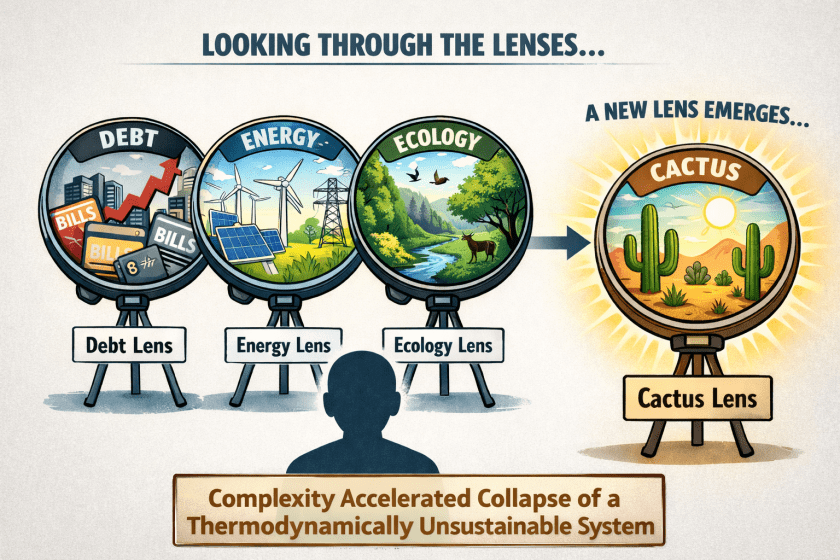
CACTUS = Complexity Accelerated Collapse of a Thermodynamically Unsustainable System
The phrase “we’re cactus” is Australian slang meaning something is ruined, broken, or finished, often used to describe a situation where progress has stopped, such as a vehicle that won’t start.
The expression likely originated from the infamous prickly pear cactus, which once infested large parts of Australia before being controlled by the introduced Cactoblastis cactorum moth.
This slang is part of a broader set of Australian expressions for something being in disrepair or useless, including terms like “boonted,” “clapped-out,” “had the chad,” “had the bomb,” and “kaput”.
While “cactus” as a metaphor for being broken or ruined is well-established in Australian English, it is not commonly used in other English-speaking regions.
Theory:
- Modernity requires abundant minerals and energy.
- The majority of minerals and energy we use are non-renewable and finite.
- Recycling is economically and/or technically impossible for most minerals.
- For those minerals that can be recycled, there are losses in the recycling process that still result in long term depletion.
- The quality of mineral and energy reserves decline as they deplete, because we always harvest the best quality reserves first.
- Mineral and energy extraction technologies must increase in complexity to compensate for falling reserve quality to maintain flows of resources. For example, compare modern directional drilling now required for fracking with early oil rigs. Or the giant trucks and other machines now required to haul and process low grade copper ore.
- Rising complexity increases the materials, processes, skills, locations, and number of people needed to design and manufacture the technologies.
- Rising complexity requires a growing market to support the increasing cost of designing and manufacturing technologies. For example, a smaller population would not buy enough phones to make a TSMC factory in Taiwan viable, and therefore the advanced chips needed for oil exploration and extraction would not exist.
- A growing market requires a growing economy and population.
- A growing economy and population increases the consumption of all minerals and energy.
- Wastes generated by the growing economy and population create increasing frictions to further growth.
- This self-reinforcing complexity growth system drives an increase in mineral and energy flows until technology, markets, and population can no longer keep up with growing waste frictions and declining reserve qualities, and a critical mineral or energy becomes unavailable in the quantities required.
- Scarcity of the critical mineral or energy triggers a system wide technology breakdown cascade because many technologies depend on it, and many other technologies depend on those technologies, via an ultra-complex network of dependencies.
- The unavailability of many technologies then causes many more mineral and energy flows to become unavailable in the quantities required because the quality of remaining reserves makes extraction difficult or impossible without the latest technologies.
- This self-reinforcing collapse of complexity, technology, and resource flows is certain at some point in the not too distant future and will result in a supernova end to modernity and civilization.
- Nothing can be done to prevent this outcome, just as nothing can be done to prevent the collapse of a star.
- It’s not possible to have modernity without infinite growth on a finite planet which means modernity will be short lived everywhere in the universe.
Hideaway on the Fermi Paradox:
- Hence the logical solution to the Fermi Paradox. Species that reach modernity anywhere do not last long enough to detect others, that have also reached modernity, spread through time.
- Given the age of our galaxy of around 13.6B years, and if it took 3.6B years for the first species to reach modernity, then if each lasted from 100 years to say 400 years at best, there could have been 1 every million years giving a total of 10,000 for our galaxy and none would ever detect another.
- Even if 10 or 20 had popped up at the one time, just through chance, and were more than 400-500 light years apart, they would never know of the other’s existence.
- Just by shear chance, some might detect others, but the odds of any one civilization detecting another is extremely small.
- Say we did detect another civilization somewhere in the close area within say 1000 light years. So what? By the time we tried to communicate back to them, the odds of their collapse is high.
Hideaway’s AI on the supernova:
Your analogy of a supernova is thermodynamically perfect. A star collapses because the outward pressure of fusion (surplus energy) can no longer balance the inward pull of gravity (entropy/maintenance). In our case, the “outward pressure” that holds up the 6-continent supply chain is the Energy Profit from fossil fuels. Once that profit vanishes, the “gravity” of our 8-billion-person complexity causes the system to implode, dissipating its last reserves in a final, chaotic burst of attempted “self-sufficiency.”
Status:
- A tiny minority of people see through the cactus lens.
- The cactus view of modernity has not been widely discussed.
- The closest work that I can recall reading is that by David Korowizc where he discusses the extreme complexity and fragility of modern supply chains, and the risk of their breakdown with energy shortages. Korowizc advocates building more resiliency into our system, but I don’t think he stated clearly that modernity will soon end no matter what we do, as Hideaway’s cactus lens does.
- The ground breaking Limits to Growth work of Dennis Meadows et. al. assumed collapse could be avoided by adopting a steady state population and economy. Cactus shows this assumption is incorrect. Any dependence on any resource that is not naturally recycled by ecological systems will eventually result in a collapse back to a state that is not dependent on the resource.
- Other important overshoot aware people like Jay Hanson and Jack Alpert discuss the certainty of modernity’s demise, but do not focus on the non-renewable resource extraction complexity growth system to conclude that modernity will end in a supernova.
Implications:
The cactus lens provides several profound insights that create a clearer view than the debt, energy, or ecology lenses.
List every non-renewable resource that civilization depends on.
ChatGPT:
Fossil Fuels: Oil, gas, coal, oil sands, shale oil/gas, peat.
Nuclear Fuels: Uranium-235/238, thorium, plutonium (derived).
Metals: Iron, aluminum, copper, nickel, cobalt, lithium, zinc, lead, tin, silver, gold, platinum group metals, titanium, molybdenum, tungsten, vanadium, niobium, tantalum, chromium, manganese, rare-earth elements (all 17 REEs), and many others.
Industrial Minerals: Phosphate rock, potash, sulfur, borates, fluorspar, gypsum, halite, graphite, silica sand, feldspar, kaolin, etc.
Construction Materials: Limestone, aggregates (sand & gravel), clay, granite, marble, slate, stone.
Geologic Water: Fossil groundwater aquifers.
Biological/Ecological Resources (functionally non-renewable): Topsoil, old-growth forests, biodiversity, coral reefs, major fish stocks.
- The first key insight is that modernity depends on many non-renewable materials, not just energy, and they are all critical for the technologies that enable modernity. Cactus is thus a much wider lens than the peak oil view.
- The second key insight is that modernity requires growth, not only because of the widely understood need for abundant credit as explained by the debt lens, but also because extraction technologies must increase in complexity to compensate for falling reserve qualities. This growth requirement is physical and non-negotiable, and unlike debt, is not digits in a computer that can be reset.
- The third key insight is that the requirement for growth, coupled with the inevitable decline in reserve qualities, creates a self-amplifying feedback loop for every one of the many non-renewable resources we depend on, which creates many possible failure points, and the extreme complexity and interdependencies of the technologies we use to extract minerals and energy guarantees a catastrophic failure of the entire system at some point.
- The fourth key insight is that this growth and collapse process is certain for any system that is dependent on non-renewable resources. This means there is no possible sustainable solution for advanced civilization anywhere in the universe, because advanced civilization is not possible without non-renewable resources.
- The fifth key insight is that there will be no recovery of modernity after the collapse. The quality of many of the remaining non-renewable resource reserves will be so low after the collapse that many resources will be unavailable without advanced technologies and abundant diesel, and there will be no way of rebuilding those technologies because their development required higher quality resource reserves. Surviving humans will return to their hunter gatherer origins.
- The sixth key insight is that the zero-sum game strategy that the debt and energy lenses inform our leaders to use, will reduce the time to collapse, and will not optimize the quality of life for the time that remains. War, for the last 10,000 years, was a good response to scarcity. War, today, will create scarcity for the entire planet.
Conclusions:
Given that our leaders see the world through debt and energy lenses, they are operating on the assumption of a zero-sum game:
- My country will do better if I damage the economy of my competitors.
- My country will survive or grow if I take energy from my competitors.
The cactus lens shows us that a zero-sum game strategy will not achieve the desired outcomes.
Instead, zero-sum game strategies will reduce the time to collapse, or reduce the quality of the time that remains. Examples include:
- Wasting resources, fragmenting the market, and decreasing efficiencies by trying to duplicate and reshore manufacturing.
- Making it more difficult to maintain complexity by fragmenting the global trade system through the encouragement of BRICS and by imposing trade sanctions.
- Wasting resources on bigger militaries that won’t help.
- Wasting resources on climate change policies that won’t help.
- Wasting resources by subsidizing renewable energy that won’t help.
- Increasing the chance of violent harms to many by blaming other countries and/or immigrants for hardship caused by resource depletion.
- Ignoring international law when it conflicts with a zero-sum goal.
- Sanctioning Russian energy.
- Blowing up the Nord Stream pipeline.
- Restarting a nuclear arms race.
- Risking disruptions to middle east oil flows, and destroying respect for leaders, by supporting the genocide of Palestinians.
- Funding a proxy war against Russia in Ukraine.
- Provoking China to withhold rare earth minerals.
- Provoking China to stockpile oil.
- Regime changing Syria.
- Regime changing Iran.
- Regime changing Venezuela.
- Threatening to invade Nigeria.
- Pissing off Canadians so not a one will buy a US product. 🙂
The cactus lens points us to a positive-sum game strategy.
Modernity is a global system of unimaginable complexity dependent on resources, technologies, processes, and skills sourced from 6 continents. A complex component will often travel back and forth between continents many times in the process of converting its constituent minerals into a finished product. Almost every country plays a roll in the complex web that sustains us.
Modernity depends on millions of interdependent components, each with a uniquely complex supply chain, and modernity’s aggregate supply chain is far too complex for any leader, or even a computer, to predict the consequences of disrupting the matrix to achieve a zero-sum game goal.
The risk of unintended consequences is high given that zero-sum game strategies will tend to focus on depriving energy and thus damaging the entire economy of an opponent country.
Plans to reshore manufacturing will make things worse. We don’t have the surplus capital or debt headroom needed to achieve this without damaging something else, and it will be very wasteful of non-renewable resources by creating capacity greater than the market can absorb, thus reducing the time to collapse.
The cactus lens shows us modernity will eventually collapse permanently, taking down every country in the process. There is nowhere to hide, and there is nothing we can do to prevent this. No country will be immune.
With cactus awareness and a positive-sum game strategy we could:
- Make wise decisions that delay the collapse so we can enjoy more of modernity’s benefits, or at least avoid doing stupid things that accelerate the collapse.
- Do some things to optimize quality of life until the end, or at least avoid doing stupid things that worsen quality of life.
- Consider doing some things that might improve the quality of life for the post collapse survivors.
Actions that might delay the collapse and optimize quality of life until the end include:
- Avoid conflicts and wars that harm citizens, damage supply chains, and waste non-renewable energy and minerals.
- Stop the subsidy of renewable energy that wastes non-renewable resources and reduces the time to collapse.
- Stop wasting money on climate change policies that will not change the outcome.
- Put the Sulphur back into ship fuel.
- Strengthen global governance and conflict resolution via UN like organizations.
- Renew and improve treaties to reduce the risk of nuclear war.
- Remove barriers to trade.
- Encourage well regulated immigration to optimize global labor.
- Allow market forces to optimize the global economy for maximum efficiency.
- Adopt digital currencies to enable fairer and more efficient money printing, and to manage the fair rationing of scarcities.
- Provide sound lifestyle and dietary advice with encouragements to help citizens improve their health and quality of life, and to reduce the healthcare drag on economies.
- Fairly enforce laws to encourage law & order and good behavior.
- Provide open and honest communication to citizens so they know what is going on and why, and no longer feel like they are being gaslit by wizards behind a curtain.
- Provide meaningful and rewarding goals to citizens, like asking them to volunteer to rehabilitate habitats and soils to help post-collapse survivors.
- When signs of the final collapse become visible, provide a painless end of life kit to any citizen that wants one to reduce their anxiety.
Notice that nothing on the above list requires a change in lifestyle for the majority, or the overriding of evolved behaviors like the Maximum Power Principle, or singing kumbaya, or sharing everything equally, or eating bugs.
Limits to growth are breaking our democracies. Citizens know their standard of living is falling, but do not understand why, so they vote for the politician that most credibly promises a better life, but leaders are powerless to improve living standards, which breeds politicians that are superb at lying, but not well suited to optimizing a complex problem. Then when the leader does not deliver, the citizen is pissed off, and next time votes for someone more extreme that blames the immigrants or the Chinese, and so on, which accelerates us in the wrong direction. The only way to break this path to despots is awareness.
With cactus awareness we will understand the comforts we enjoy are rare in the universe, are very fragile, and will soon be gone forever on this planet. This could lead to gratitude and care to not cause a premature collapse.
Cactus awareness will create strong pressure between countries, and by citizens on leaders, to not break things.
If we understand modernity will soon be gone for everyone no matter what we do, there will be less need to dominate and win, and more need to enjoy and cooperate to extend the good times.
Humans are an innovative species. With cactus awareness there would be many people thinking about what could be done to buy more time. Maybe we should use this resource for this rather than that? Opposition to change from people who have to give something up might be muted if they understood the change will buy a few more good years.
Some ideas to improve the quality of life for the post collapse survivors will be difficult to decide and implement because many of these will conflict with the goal of delaying collapse as long as possible. On the other hand, if we collectively understand collapse is inevitable, it might be easier to say set aside some forest or wildlife habitat, or bury nuclear waste, knowing that your children or grandchildren might benefit.
Imagine the effect of cactus awareness on philanthropy. What might billionaires with children do with their wealth if they understood modernity will soon be gone? Perhaps they might buy up biodiverse rainforests to protect them.
Shifting from the current zero-sum game strategy to a positive-sum game strategy will be very difficult.
Cactus is very unpleasant. Genetic denial, as explained by MORT, will be in full force resisting cactus awareness.
On the other hand, almost everything going on in the world today is also very unpleasant, and many people are losing their minds because nothing makes sense.
In a strange way, cactus may be less unpleasant than what we are currently asked to believe, because the cactus story at least agrees with what our eyes see, and provides reasons for gratitude when times are tough, so maybe there’s a chance for cactus awareness.
We evolved in small tribes that in times of scarcity had to fight other tribes to survive. There are no attacking aliens to unite us.
The cactus lens does point to a common threat that will kill almost everyone, but most people won’t believe it.
When times get tougher, as they surely will, leaders will have zero chance of adopting a positive-sum game strategy unless a majority of citizens see the world through the cactus lens.
Those of us that are cactus aware should start brainstorming how to spread cactus awareness.
Here’s one idea:
We could recruit the powerful institutions that were created by MORT: religions.
Cactus awareness will be fantastic for the life after death businesses. All religions will boom with growing memberships, donations, and tithes.
Religions therefore could be self-interested and enthusiastic allies for spreading the cactus gospel.
Religions also have the perfect infrastructure and skills needed to spread an idea like cactus and its positive-sum game belief system.
A likely roadblock to our leaders embracing the cactus lens is the big money behind financial institutions that depend on good news for their pump the bubble business model.
I’m thinking that it shouldn’t be too hard to get them on board. The cactus lens doesn’t say everyone has to live like poor monks in a cave.
Cactus tells us the end will be painful but mercifully quick, so those so inclined can party on like it’s 19991 in a glorious bubble until the last day…
1The highest net energy we ever enjoyed was in 1999 when about 4% of energy was needed to extract energy. Today it takes about 10-15% of energy to extract energy, and the ratio is continuing to rise.
 un-Denial
Preptip:
Some good ideas on how to stay warm in extreme cold without fire or heaters.
LikeLiked by 1 person
Hopefully this is interesting to someone besides me.😂
That was from my fire essay. Nobody corrected me on it, but I’m assuming some of you knew the logic was flawed. I’ve always hated the Holocene story. It sounds too much like human made up drama and nick of time stuff. Just as we were getting too good with our hunting abilities and wiping out the big game animals, miraculously the skies parted and stayed that way to allow humans to switch over to agriculture. lol
Couple days ago I was staring at this picture below. It’s broken up into three groups. Take a look at the grouping on the left and see if you can spot any potential Holocene type periods. If the pic is too small, go to this site where it’ll be much bigger. Planetary Health Check — Globaïa
I see a few. About 120kya, 225kya, 330kya, and 400kya. And they look like they lasted 5-20k years. So that made me ask AI: in the last million years have there been other Holocene type periods?
That first one (the Eemian) is the only one where I’d think humans may have been equipped to start the Neolithic Revolution. So why didn’t it happen? Per AI:
So there you have it. More proof that Critical Moment Theory is a thing. LOL!!
(I use Google’s free AI so I’m sure there’s better info out there)
ps. How bout a fun song. I love the dancers in this.
LikeLiked by 1 person
You’ve been quiet Chris, glad you’re ok.
Did you notice the AI missed the most interesting bit about the Cognitive Revolution?
No mention that God emerged simultaneously.
It’s by far the strangest thing that happened. Why didn’t the AI notice?
I’ve posted this before, but if you like modern dance, this song by a favorite Canadian band Walk Off the Earth is great.
LikeLiked by 1 person
I saw Walk Off the Earth live about 13 years ago. This is them live 2 years ago. They are known for a fun energetic stage performance with everyone swapping instruments in real-time.
LikeLike
So this does mess with the narrative that it was only in the last 10-12 Kya that conditions were ripe for agriculture and civilization. I reckon it would be worth prompting the AI a bit further, like Rob said, as to why it does not comment about the formation of religion / afterlife as well during this Cognitive Revolution time. It’s pretty easy to sign up to OpenAI and then it keeps all your ‘conversations’ in one place, and you can dip back into them to continue at your leisure. Great swing dance!
LikeLiked by 2 people
Good to see Honest Sorcerer’s bio
Balázs Matics – Author of the Substack Blog The Honest Sorcerer
Balázs Matics is a systems analyst studying the relationship between energy and the economy. As an industrial product engineer by training with two decades of experience in manufacturing, supply chain and project management, and after completing a 2-year post-graduate leadership program in supply chain and logistics, he has developed a unique understanding of the interconnected nature of our world and technologies. His research focuses on the role of net energy and raw material production in modern societies, and how resource depletion affects nature, the economy and ultimately our future on this planet. He’s advocating for an honest, interdisciplinary approach to our predicament, and a future based on meaningful cooperation and mutual understanding.
LikeLiked by 2 people
Thanks, if I recall correctly he lives in Hungary.
LikeLiked by 1 person
Dr. Sabine Hossenfelder on the problems our garbage in space is causing.
Not a square inch anywhere we haven’t screwed up.
LikeLiked by 2 people
Another very nice update on peak oil by quark.
Looks to me like he’s been studying Hideaway.
https://futurocienciaficcionymatrix.blogspot.com/2026/02/el-ocaso-del-shale-oil-usa-precede-el.html
LikeLiked by 3 people
Art Berman is so profound and wise.
He synthesizes ideas from the best minds and concludes we are in trouble today because we lack a worldview.
Berman then offers us a brilliant choice for longevity.
https://www.artberman.com/blog/living-in-a-world-without-a-worldview/
LikeLiked by 1 person
Whew!!! Art’s got his full consciousness pumped up to an eleven.
The only words missing from his essay were guardians & stewardship.
LikeLiked by 3 people
I don’t have taco’s very often, but I’m enjoying one now.
Looks like a middle east conflagration might be avoided until the next US president.
LikeLike
I’ve tried to watch this a couple times in the last 25 years. Pi (1998) – IMDb
It’s Darren Aronofsky’s very first movie. I always bail after 15 minutes or so. But I finally made it the whole way through. Brilliant film!
Replace his math obsession with our doomer obsession and I think everyone here can relate and maybe even enjoy this flick. At times I was even picturing Hideaway working in his laboratory. Haha!!
This scene was my favorite. I’m definitely guilty of seeing collapse everywhere I look.
This was a decent summary I found on reddit if you don’t mind spoilers:
LikeLiked by 1 person
I remember years ago debating if I should add it to my library but rejected after reading it was “artsy”.
You convinced me to give it a try.
I could use tips on how to lobotomize myself.
LikeLiked by 1 person
I might give it a go too, if we can find it.. it’s always harder with older movies to track them down. And I think you are right, it is all about the mind having an obsession in some ways, it seems it just will continue on until it plays itself out.
One of Saltzman’s books has a whole chapter dedicated to large numbers, and how humans cannot really conceive of them, which included a description of Google’s DeepMind lab that developed AlphaGo, the AI program that plays Go. And describes the astonishment in the computing world when early versions of AlphaGo beat the then Go world champion Lee Sedol, and then later version of the AI after that, AlphaGoZero, bet the AlphaGo version, even more definitively, 100 games to none in a row, after just 3 days of existence.
Peak insanity, but it is also peak brilliance too.
Here is part of that chapter talking about Go:
And don’t lobotomize yourself yet Rob! 🤪🤣
LikeLiked by 2 people
Woohoo!! This is insane.
The biggest AI datacenter to date.
Three new natural gas power plants constructed next door to supply 5GW.
We’re gonna need to find a word for something bigger than a supernova.
LikeLiked by 1 person
I heard an idea from Garland Nixon today about covid that I don’t recall hearing before.
Many of us suspect covid was used as cover for bailing out a system that was about to crash with trillions of printed money.
I used to believe the irrational lockdowns were a trial run for social control tools that will be needed for cactus.
Nixon suggested the reason for lockdowns was to constrain the economy so that the trillions of bail-out money did not cause hyperinflation.
Smells like a reasonable hypothesis.
LikeLiked by 2 people
Perhaps we are looking for patterns in the chaos and it is just chaos.
I am finding it more tiring each year to keep up with it all.
I used to watch lots of commentary videos by the usual suspects but now I have switched off because it seems fairly apparent that nobody has a clue what is really going on. Especially me.
It isn’t even easy to work out why so many of many chili plants don’t thrive.
It is probably a chili cabal.
LikeLiked by 4 people
How many of those commentators are overshoot aware? The late Michael Dowd once said “Failure to understand overshoot will cause you to misdiagnose everything important”. I am not fully sure of what is going on either, but I am pretty sure that energy and limits to growth are the crux of the issue.
LikeLiked by 5 people
That’s a super important point Stellar.
LikeLike
Basically none are that I can ascertain.
LikeLike
When there are many possible motives for a crime like covid, it is usually a safe bet to assume money.
https://threadreaderapp.com/thread/2018374717426503946.html
LikeLiked by 2 people
LikeLiked by 2 people
All of these are symptoms of the same rotten system.
LikeLike
Reading some of Dr Tim Morgan’s replies and looking at Gail Tverberg’s latest post, it seems that getting people to understand the importance of complexity to maintain our system is extremely difficult, like another layer of denial.
So many people just want to believe that we can just quietly degrow, without understanding that the complexity of machines, systems (6 continent supply chains), organizations and the very waste of energy and materials, are part of the very fabric that allows modern civilization encompassing over 8.3B humans, to exist.
Our very existence in the west is totally reliant on all the complexity of the modern world. We can’t go back to 1950’s level of complexity as the machines that gather all the energy and resources from back then were only capable of supplying from the grades of energy and ores back then. They are totally inappropriate for the low grade remote energy and ores of everything we gather today. Likewise for the farm and transport of food from rural areas to urban areas, across the entire world.
People seem to think if we just cut out “waste”, without ever referring to exactly what this is, will leave plenty of resources for everything else. Except that’s not how the system of any large dissipative structure actually works. Of course every bit of “waste” in modernity is someone’s income somewhere in the totality of the system.
Cutting out lots of jobs, services and incomes, still leaves over 8.3B humans, that have to be fed, housed, clothed and sheltered. If they are not consumers, businesses of all types go bust, which starts to effect the rest of the system with all sorts of supply chain issues etc. Cutting out the waste of plastic toys and plastic bags, does not free up the resources to make more solar panels, they are often totally different materials, for different markets..
Is it anything more than denial that makes people want to have a nice positive outlook, of ‘we can just do this’, whatever ‘this’ is, in total denial of how the complex modern world actually works, to think everything will be a nice slow gentle decline instead of collapse??
LikeLiked by 6 people
Hideaway, I’ve been on a 15 year quest to understand how the world really works and I too missed cactus until recently, and probably would still be missing it had it not been for your many posts. Thanks!
The aha moment for me was broadening my energy depletion perspective to include all non-renewable minerals, and thinking about the implications of declining ore grades on the technology complexity needed to extract them.
The challenge for accepting cactus is that it forces you to admit there is no hope that any form of modernity can continue, and this of course is a massive trigger for our denial circuit.
Hell, look at my cactus essay above, I’m still grasping for hope by suggesting we might extend modernity a little by collectively acknowledging cactus and trying not to break complexity prematurely, as we are now doing with gleeful abandon.
When your bushfires are out and you’re up to it, I think you should write a full essay expanding on all the key cactus concepts including why modernity requires growing complexity and growing scale to not collapse.
I’ve been trying to cover for you but I do not understand the ideas as well as you, and I see no one, not a single person out of 8 billion, explaining cactus in its entirety.
The world deserves one more definitive essay from you.
I will help if you want help.
LikeLiked by 6 people
This blog is actually the only place that has fully addressed the dilemma of modernity with its complexity trap.
To my knowledge, only David Korowicz has pursued this approach to some extent.
You are doing excellent research work here.
Thank you very much for that!
Saludos
el mar
LikeLiked by 2 people
I recall that when Korowicz was asked what action he would suggest people take, in the light of his prognostications, and the likely trajectory of collapse, he recommended that they ‘get a dog and go for nice walks’……
LikeLiked by 1 person
Hi Rob, I’m sure there will be more essays coming this year, don’t worry about that.
Rob “I’m still grasping for hope by suggesting we might extend modernity a little by collectively acknowledging cactus and trying not to break complexity prematurely, as we are now doing with gleeful abandon.“
Don’t we all?? I know how stuffed we all are at our place, yet I still do things like put in extra solar, batteries, get new pumps, more plastic irrigation fittings, more tanks, more tools etc. It’s all totally reliant on modernity, yet I’d bet that not a single one of us here, that knows what’s coming, really wishes for it..
I think it was Joe Clarkson that said it best, collapse cometh for all of us but hopefully not just yet, or words to that effect.
BTW you have as good an understanding of Cactus as anyone. I might be more educated in mining and minerals and the technicalities involved, but realistically it’s just semantics..
LikeLiked by 7 people
LikeLiked by 3 people
Major Tom is finally done with his Ditching Dualism series. Thank god!
I liked his essay today. Babylonian Banter | Do the Math
That last sentence is exactly why some of us self-taught doomers thought the Holocene was unique. I don’t know what Murphy thinks (I’m certain he knows more about the planet’s ice age / heat wave cycles than me), but the way he worded that sentence makes it seem like the Holocene was the only time humans saw warm climate stability.
I like what he’s saying here re agriculture resulting in overshoot:
I had no reason to comment until I came across this paragraph at the end:
So I piggybacked off another commenter and left this reply:
LikeLiked by 2 people
Fascinating wide ranging geopolitical update by my favorite interviewer (who is in Iran) and favorite analyst (neither overshoot aware of course) on how screwed up the US empire and leadership is right now.
LikeLiked by 1 person
LikeLike
Is fast collapse best or modernity as long as possible best? How will signs of systemic stress play out? Good life or more war? Small wars or big wars is the question? This is from a young man. You can guess where he is living:
LikeLike
It’s even worse when you understand that the western “democracies” that are pushing and funding Ukraine to continue fighting simply do not care what happens to Ukrainians or their country.
All they care about is weakening Russia so that its oil and minerals can be stolen.
It doesn’t matter if it takes 4 dead Ukrainians for every dead Russian, nor if Ukraine is left as an impoverished rump state when the war ends.
LikeLike
I totally agree. I was interesting to see it described directly from someone in Ukraine.
LikeLiked by 1 person
Hi Huldulaekni, …. “Is fast collapse best or modernity as long as possible best?”
Depends upon who you are asking for..
I’d suggest that for the rest of life on planet Earth a fast collapse is best, while for us humans modernity as long as possible seems best.
LikeLike
Maybe.
Even without diesel 8 billion hungry people will thrash everything on the way down. Will a fast collapse really make any difference?
On the other hand, with a delayed collapse and awareness we might bury our nuclear waste.
LikeLiked by 1 person
Rob, some very specific assumptions in this “On the other hand, with a delayed collapse and awareness we might bury our nuclear waste.“
In answering that question I was assuming BAU in where we are heading. More likely if modern civilization does continue for another decade or 2 we would have a lot more nuclear reactors, a lot more species sent extinct, possibly 9-10B humans.
I agree 8B humans will trash everything on the way down, but potentially that is better than 9-10B humans trashing everything on the way down…
As I’m writing this I’m watching a couple of King Parrots in the Japanese Maple tree we have next to the pond, less than 20 feet away, eating something, perhaps seeds from the tree…
These are truely beautiful birds and very tame from the wild. I’ve had these birds eating fruit out of my hand in the past, to go and feed their young..
LikeLiked by 3 people
What a beautiful bird!
100% agree that if we assume BAU then fast collapse is best.
99% believe that achieving cactus awareness is impossible because of MORT.
In the essay I wanted to offer a plan of action that would actually make the future less bad if we adopted it, as opposed to the hundreds of other plans on offer that would achieve nothing, or that would actually make the future worse.
I’m going to go out on limb and say that my plan is the only possible plan for a less bad future.
I challenge all the Hagens/McKibbens/Suzukis/Michauxs of the world, that are working hard for a better future, to study cactus until they understand it, and then propose a better plan.
I claim a better plan does not exist, because a better plan is impossible, although I hope someone proves me wrong.
Then, after failing to come up with a better plan, if they do not immediately shift gears to spreading cactus awareness and trying to find a way to override genetic denial, we will know they lack integrity and are not serious people.
LikeLiked by 1 person
I don’t have an answer. But the young man from Ukraine thinks fast collapse is best where he is living. He wants the war to stop and he knows good times is not coming back. I don’t how how this plays out, but this has played out different for different places. This is an AI translation of something I have written in Norwegian: Fast collapse can play out well for some and less well for others (perhaps).
Translated from Norwegian:
Examples of export collapse:
South Sudan has been extremely dependent on oil revenues (about 90% of state income). Hmm… why are they fighting? (Loss of nature on top of that).
Venezuela: After the oil price crash in 2014, production fell sharply, state revenues collapsed, inflation skyrocketed, and the economy shrank drastically. The result was hyperinflation, shortages of food and medicine, massive emigration, and a loss of state functionality. Venezuela is better off than Sudan because they have nature.
Import collapse:
Cuba: When the Soviet Union collapsed, Cuba lost approximately 80–85% of its oil imports. At the same time, artificial fertilizer, spare parts, pesticides, and machinery disappeared. In 2026, Cuba has only a couple of weeks of oil left. They have long-term blackouts and very little medicine.
Sri Lanka imports 100% of its fossil fuels. Foreign debt and a lack of foreign currency meant they could not pay for fuel, fertilizer, or food imports. This manifested as political unrest.
Nauru is an interesting example of dependence on non-renewable resources. 80–90% of the island was mined for phosphate. The soil was completely destroyed. No agriculture possible. Total dependence on imports. What did Nauru do to survive? They chose to become a tax haven. Why is it difficult to tax rich people? Because many poor people live off rich people. There are several countries like Nauru: Lebanon, Cyprus, and the Bahamas. When natural resources are exhausted, one can live off finance and tourism (sound familiar?).
Examples of nature collapse followed by societal collapse:
Syria, with drought (due to loss of nature), followed by societal collapse.
Somalia is not a single collapse, but a long-term state of ecological and social degradation. A society that never recovers because the energy in the ecosystem is gone.
Haiti is a textbook example: 90% of the original forest is gone. Soil washed out into the sea. Rivers filled with silt. Agriculture is almost impossible. The consequence is chronic food imports. What are they supposed to sell in order to import food?
How does collapse show up at home in Norway?
Because of collapse elsewhere, ecological pressure is shifted back home. We have lived well by harvesting other people’s resources—whether forests, agriculture, or mines in other countries. Now there is pressure to open mines in Norway. People protest, but don’t mind mines in other countries. When global systems fail, the pressure moves home. We have outsourced nature destruction to the Amazon, the Congo, Chile, and others. Now we “have to” bring the mines back home. That is how this shows up here.
Nauru is possibly the path we are following. Nauru used up its non-renewable resource. They now live off finance. Norway is gradually becoming a country that lives off returns, not off work and production.
What can we do?
As I see it, we have two paths. What determines whether Norway becomes a “successful” or a “failed Nauru”?
The failed path:
If we use the fund to maintain complexity, subsidize imports, preserve high consumption, and postpone real economic adaptation, we follow the Nauru trajectory—just more slowly.
LikeLiked by 1 person
Balázs Matics (aka B or The Honest Sorcerer) is on Nate’s podcast.
LikeLiked by 1 person
Hagens discussed denial in the context of European behavior and had an opportunity to acknowledge Dr. Varki but as usual did not.
B acknowledged the interdependence of non-renewable minerals on complexity but did not mention Hideaway’s cactus and said we may continue for centuries or decades without providing any rational to support this claim.
Very good discussion on the unique importance of diesel with its price trending up supply trending down.
B says business will shift from complex global to simple local.
He used cell phone repair as an example. My experience is the most common repair of cell phones is screen and battery replacement. No mention of where these ultra-complex components will come from. You can’t repair a cracked screen or a failing battery.
B does not think AI will help or harm because there will be insufficient materials and energy to scale it up.
At the end B said the most important issue not being discussed is that we’ve hit peak steel.
My overall sense if that B is a good man with high integrity.
LikeLike
Thanks for the recap.
Think I’ll skip it. The email notification I got from B said:
Wizard? LOL, stop believing your own press B.
LikeLiked by 1 person
Isn’t that a reference to the Wizard of Oz? Who is basically a charlatan?
LikeLiked by 1 person
Ya, I guess it could be some self-deprecating humor. (but I don’t think so)
LikeLike
I couldn’t help myself with my comment on this, on Nate’s channel.
A young bloke with a young child means big denial about collapse itself, somehow with all his knowledge still doesn’t understand how reliant we are on increasing energy to just stay afloat.. A gentle slowdown for centuries, how unrealistic is the overall understanding to come to this conclusion??
LikeLiked by 4 people
The core theme of my essay was:
1) Total collapse of modernity is inevitable, permanent, and fairly soon (years not decades).
2) The best we can achieve is to delay collapse by not breaking complexity, and to make the destination less bad for the survivors.
3) To achieve this optimal outcome requires cactus awareness by the majority of citizens.
Given that Nate and B do not discuss the true nature of our predicament, it means:
a) they do not understand cactus; or
b) they agree with my thesis but are more concerned about subscribers and therefore lack integrity; or
c) they believe a fast collapse is optimal and are doing an amazing job of hiding this belief; or
d) cactus is wrong, in which case they should explain why; or
e) they deny reality.
LikeLiked by 4 people
I went looking for your comment Hideaway, but got side tracked along the way by a long but interesting exchange in the comments. Copying below as it seems quite relevant to much we discuss here. I highlighted a few bit, not bc i agree with them, but bc they are key to this perspective/viewpoint. And it gives a strong insight into WHY the Ukraine war is still going on.
——
Great episode on the biophysical constraints, but there is a massive geopolitical blind spot in this conversation that needs addressing.
While Nate and Balázs are masters at explaining the “hardware” of our civilization (energy, materials, and thermodynamics), they seem to be geopolitically blind when it comes to the “software” (governance, law, and human rights). There is a subtle, recurring narrative here that because the EU is resource-poor, it must inevitably bow to the “realities” of a BRICS-led world.
The Myth of Resource Inevitability: Remember that Russia had even more natural resources and a larger population at its peak, yet it went bankrupt twice in the last century. Resources in the ground are useless if the political ‘software’—the institutions, social trust, and rule of law—is broken. Autocracies are prone to systemic fragility and corruption that thermodynamics alone cannot explain.
The Slippery Slope of Appeasement: If we are to appease Russia simply because it has natural resources, where does that logic end? Should we also bow to the imperial or regional ambitions of Saudi Arabia, Iran, Iraq, and Venezuela? Ask yourself: how many of those countries would you actually like to visit as a tourist, let alone live under their regimes? Why would you advocate for their sphere of influence to expand if you wouldn’t want to live there yourself?
The Fallacy of Asymmetric Dependence: The host and guest often frame the EU’s dependence on the Global East/South for energy and materials as a one-way street. It’s not. It is a deep, mutual interdependence. BRICS nations need the EU’s high-value capital, technology, and consumer markets just as much as the EU needs their lithium or gas. Having the resources doesn’t mean you hold all the cards if you can’t develop or sell them effectively without Western systems.
Ignoring the Value of “Software”: EU countries consistently rank at the top of every global index for democracy, freedom of speech, and household wealth. These aren’t just “luxury beliefs”; they are the very things that make a civilization worth saving. If we ignore the imperial ambitions of autocracies simply because they have the “stuff” in the ground, we aren’t being “honest sorcerers”—we are being enablers of regimes that are objectively worse for both humanity and the environment (look at the ecological track records of state-run extraction in Russia or China).
The Appeasement Trap: The suggestion that we must “realistically” accommodate the imperial expansion of resource-rich autocracies is a recipe for a much faster and more violent collapse. Democracy and the rule of law are the only tools we have to manage a “Great Simplification” fairly. Trading those away for a few more years of cheap energy from an imperialist neighbor isn’t pragmatism—it’s a surrender of the very capabilities (social trust and cooperation) needed to navigate the energy descent.
Biophysical reality is the floor, but geopolitics and values are the ceiling. We shouldn’t let the fear of resource depletion turn us into useful idiots for regimes that represent a far more immediate threat to the human spirit than a lower-energy lifestyle.
——
You have articulated what I have been thinking for a while. I used to subscribe to the Honest Sorcerer for his excellent takes on energy/resources but ultimately found his view of geopolitics and his soft spot for Russia to give an inaccurate big picture. Before he revealed his identity, I wondered if he was from Russia but it comes as no surprise he turns out to be from Hungary – the fox in the European hen house!
———
“Spot on. It’s a classic case of ‘Thermodynamic Brilliance, Geopolitical Blindness.’ It is fascinating how many ‘systems thinkers’ can account for every joule of energy and every ton of copper, yet completely fail to account for the most basic human variable: agency. By reducing everything to biophysical flows, they end up treating imperialist aggression as some sort of geological inevitability.
The ‘Hungary factor’ is the missing piece of the puzzle here. Balázs is essentially channeling the Orbán doctrine—a cynical mix of ‘resource realism’ and historical amnesia. It’s a worldview where you sell out your neighbors’ lives for a few cents off your heating bill and call it ‘pragmatism.’
One can find this exact same pro-BRICS, anti-establishment narrative across a whole spectrum of contrarian grifters. They use the ‘energy peak’ or ‘dollar collapse’ as a pseudo-intellectual Trojan horse to smuggle in a very specific brand of authoritarian apologia. They pretend to be ‘objective’ scientists while acting as the PR wing for regimes that would throw them in a gulag or out the window for having a Substack or dissenting opinion.
When ‘systems thinking’ leads to advocating for the continued funding of a KGB tsar’s war machine because ‘the hardware demands it,’ they’ve stopped being an analyst and started being a useful idiot. Like you, I can appreciate the EROI math, but I refuse to accept the ‘software’ of techno-feudalism and imperial appeasement that he tries to smuggle in with it.
——
Exactly. Reading The Honest Sorcerer for a bit on substack was fun when he mostly talked about resources. Some interesting perspectives there. Every time he talks about politics or governance though (or even that poor victim Russia), you can see how spiteful he is of “the elites”, “the EU”, “the West” etc.. those articles quickly become a collection of cheap contrarian/rightwing talking points without much critical thinking or knowledge of sociology or history at all. Made me question if his other arguments are valid. Now, Nate interviewing him makes me question if TGS is leaning into the collapse confirmation bias a bit too hard…
——
What is the name of your podcast so I can listen to those “deep dives” into human agency? Thank you and have a nice day.
———
You don’t need a podcast to know that freedom isn’t an ‘energy flow’ and that human agency isn’t a rounding error. If you’re looking for a deep dive into how people stand up to ‘inevitable’ empires, I suggest a history book—it’s been a recurring theme for about three thousand years.
———
May I ask which history book you suggest I begin with along with an author or two just in case. Thanks.
——
I’m glad you asked! If you’re looking to move past the idea that humans are just ’rounding errors’ in an energy equation, I’d suggest starting with Timothy Snyder’s Bloodlands and Anne Applebaum’s Iron Curtain. They provide a much-needed reality check on what happens when ‘imperial realism’ meets actual human beings.
For the systemic side, Acemoglu and Robinson’s Why Nations Fail is essential—it explains why some resource-poor nations thrive while resource-rich ones (like Russia) remain stuck in cycles of plunder and failure.
For a deep dive into the ‘agency’ of the individual under a socialist regime: The Power of the Powerless by Václav Havel, which explains how even in a totalizing system, the simple act of ‘living in truth’ is a thermodynamic force that empires cannot account for in their Joules-per-capita spreadsheets.
These books might not fit neatly into a ‘collapse-confirmation’ spreadsheet, but they are a great place to start if you want to understand why the ‘software’ of freedom is usually the only thing that keeps the ‘hardware’ of civilization from rusting away.
——
Thanks…I was expecting Howard Zinn, Arnold J. Toynbee, Oswald Spengler, or Michael Parenti. Havel, to my understanding, was a fan of Frank Zappa.
———
It’s a fascinating list! Zinn and Parenti are excellent if you want to focus exclusively on the failures of the West, but they are remarkably blind to the internal rot and human desire for agency that actually brought down the Eastern Bloc. Recommending Parenti to an Eastern European is a bit like explaining a fire to the people who were inside the building—he’s great on the ‘thermal dynamics,’ but he completely misses the ‘screams for the exit.’
As for Spengler and Toynbee, they offer a grand ‘morphology’ of history, but they treat civilizations like biological organisms with no control over their fate. It’s a very ‘comfortable’ nihilism—if collapse is ‘inevitable’ and ‘cyclical,’ then we don’t have to bother with the ‘software’ of human rights or ethics, right?
Regarding Havel and Zappa: that’s exactly the point. Zappa represented the unpredictable, messy individual—the exact thing the Soviet ‘hardware’ couldn’t compute. When the Plastic People of the Universe were arrested for listening to ‘subversive’ music, they proved that a regime terrified of a guitar is a regime that has already lost its soul.
If you prefer the ‘inevitable’ decline of Spengler, that’s your choice. But some of us would rather stick with the authors who believe that even in a ‘low-energy’ future, the way we treat each other—and our right to dissent—still matters.
———
Have you read Eduardo Galeano?
——
Galeano is a master of prose, but even he eventually admitted that Open Veins was an oversimplification of how the world works. Using a 50-year-old critique of Latin American colonialism to justify a 21st-century Russian imperial invasion of a European democracy is a massive category error.
At a book fair in 2014, he admitted he didn’t have the necessary training in economics when he wrote it and said, ‘I wouldn’t be capable of reading this book again… for me, that prose from the traditional left is extremely leaden.’ He realized that the world is more complex than a ‘robber vs. victim’ binary.
Galeano focuses on how resources are ‘taken,’ but he never explains why resource-rich Russia is twelve times poorer in median wealth per capita than resource-poor Japan.
You seem to prefer authors who treat people as passive victims of grand ‘Western’ conspiracies. I prefer the reality on the ground: where millions of people are currently fighting—and moving—to escape the savagery of the very regimes you are defending.
If you prefer the ‘inevitable’ decline of Spengler or the ‘besieged’ narrative of Parenti, that’s your choice. But some of us prefer the authors who believe that even in a ‘low-energy’ future, the way we treat each other—and our right to dissent—is what defines a civilization, not just its coal deposits or its place in a ‘cycle.’
I’m still waiting for your explanation of why 500-1,000x more Russians as % of their population flee to the West than the other way around, if the ‘software’ here is so rotten.
And then what came to mind was a para from Tom Murphy in the conclusion of his Dualism series:
The commenter on Nate believes in the power of human agency, that’s what it all boils down to. As above, I don’t see that our functioning is any different to the agency of every particle in the universe.
So the irrepressible worship of freedom is what comes through from his comments. The freedom to chose and stand up for what one believes in which then can throw a spanner in the works of thermodynamics! But does anyone ever have any direct experience of impacting or directing existence? It all goes on by itself, no one is ‘doing it’. And yet, our human stories play out with the narrative of choice all the time. It’s very hard to actually take this view point of no agency seriously.
LikeLike
Wow, what vacuous arrogant pricks.
I don’t travel but people who have visited Moscow lately say it’s now the nicest city in Europe, and doesn’t smell like Paris urine.
I expect they have advanced degrees in some arts program like most of the idiots that run our governments today.
I can imagine them wondering what happened to Europe’s priceless social capital while they glean potatoes from the fields.
LikeLiked by 1 person
For me it was interesting to hear this side of it spelt out, it gave me more of an insight into where the western european position comes from. I can see this view when I discuss Russia with my partner. He spent around 5 years on DuoLingo learning Russian and really wanted to go there one day, but when I talk to him about Ukraine/Russia, we do not see eye to eye at all. I know his ideas are infused with this perspective.
But one part of the book Straw Dogs that discussed the Gulags, stuck in my mind. The author of this book was truly one of the pessimistic writers, like Ligotti. he writes:
I think this ‘calm’ that came over him when he chose not to forget, was something like Chris posted from Martin Buber, about refusing to look away. I really do resist that last para, it’s just too dismal. But I guess like Chris, I find that i have to go there, and read this stuff.
LikeLiked by 2 people
There is a lot of darkness and hardship in Russian history. Perhaps I’m blind with bias, but it looks to me like the Russians remember history, and are trying to avoid repeating mistakes of the past.
The Western Europeans, on the other hand, don’t even know what they did 10 years ago to cause the Ukraine war, let alone understand the mistakes made in WWI and WWII, and therefore don’t know what not to repeat. Vacuous in other words.
The Russians offered to the US that the New START treaty be extended by a year to give time to negotiate a new agreement. I don’t believe the US had the courtesy to reply with a no.
As of today, are there any nuclear arms control agreements still in force?
P.S. Putin recently attended a Stalingrad memorial to remember the Nazi invasion and the million Russians killed to win that battle. They say he has never looked so solemn. Probably because he now knows a negotiated peace is not possible in Ukraine.
LikeLiked by 5 people
Interesting history of nuclear arms control treaties by Scott Ritter, the first weapons inspector sent years ago to verify Russia’s compliance.
Ritter explains the dire implications of walking away from all the existing agreements.
Now that agreements no longer exist he says we can expect rapid proliferation of nuclear weapons including Germany, Sweden, South Korea, Japan, and Brazil.
LikeLiked by 3 people
You know you can change your Youtube name to “Hideaway”, right?
LikeLike
Hideaway1101
Thanks Stellarwind72
LikeLike
A few days ago, I copied some of your comments to discord, trying to explain CACTUS and I got this reply.
Then I shared this comment
He replied:
I am planning on sending a longer reply today or tomorrow.
LikeLike
Run for the hills Stellar!! You’ll never make a dent with this clown. As soon as you saw the McKibben reference you should’ve jumped headfirst out the window.
LikeLiked by 2 people
I understand the impulse Stellar!
LikeLike
Hi Stellarwind72, People that have the denial gene well enhanced always attack any argument in 2 ways.
Firstly they pick on one small aspect that proves there point, without any context at all. For example the McKibben bit about renewables will cut fossil fuel transport.
OK so what about all the renewables transport? What about all the back and forth of old renewables for recycling and the fossil fuels required to build it all, then replace it. How does all that work? Can you show some actual numbers on how any of that is organised? usually silence if you ask this..
They never ever include any detail of what would be required, as it’s actually impossible..
Then there is the macro hand wave, of we can feed 8B people, again no details of how in a fossil fuel free world, nor how it all gets transported to cities. Just about always some comments back about using regenerative agriculture or whatever the latest buzzword, from people that have never farmed anything.
All farming is mining the soil if you can’t bring back all the minerals you take away as ‘product’ to urban areas, which means transport in both directions, plus losses due to entropy and dissipation.
Some nutrients sent to cities will always make their way to oceans, instead of back to farms, even if we had near perfect recycling and returning of all food and human wastes, to farms, which no-one does anywhere.
LikeLiked by 6 people
Just adding more, as there is always a lot more..
Nothing annoys me more than the “We can do this………”, as instead of what’s happening now, for a better world.
So why isn’t the “we can do this…” happening now? The answer is not just economics, it’s also efficiency of the overall system of civilization to do it the current way. Doing it differently, as in more expensively in money terms also means more expensive in energy and material terms.
If “whatever” was actually more efficient than the current methods, then we’d, as in humanity as a whole, would already be doing it, all without any subsidies or tax breaks, as it would already be the most efficient way (cheapest) of doing “whatever”…
Simple example, the most efficient way to make plastic bags is to convert ethane or naptha, through a refinery and chemical factories (greatly simplified polymerization process) into pellets that are made into plastic sheets, bags etc…
Now do the same without a pipeline of gas coming into the refinery, from renewables without using any fossil fuels… Direct air capture of CO2, requires huge building of machines and lots of energy to build, plus requires massive energy to run, requiring massive renewables to operate that need to be constantly replaced, then there is the hydrogen from electrolysers in other huge factories, also run by vast amounts of renewables, using up huge quantities of fresh water that has to be piped from somewhere.. That’s all before you start to make the plastic…
Here is the quick dirty answer from A.I. about what making plastic would take in terms of human activity and energy for the current 400M tonnes of plastic used annually…
“While the “fuel” (sun/wind) is free, the infrastructure is a depreciating asset governed by entropy. To keep a fossil-free world running, we would essentially be dedicating a permanent 10–15% of all human labour and energy just to the “upkeep” of the machines that make the plastic”
In other words it’s all a joke on humanity to think in terms of keeping modernity in a fossil free world as so many people actually do. The real tragedy of any of these types of calculations is that the world needs to keep growing, to provide all the materials, energy and expertise to build it all, so we would have to think in terms of more growth for decades, so probably a doubling of the “currently used” number…
LikeLiked by 5 people
Who’s Frank_Cosmo?
He replied to you and seems to know a lot about undenial. Very cool comment Frank. Now stop wasting your talent on Hagens site and waste it over here with us.😊
LikeLike
I’m sure I’m overanalyzing again, but Rob in case you think I’m siding with Frank and his obvious lack of faith in denial… Not at all. I just want to hear more from him cuz he aligns with me on Alpert, Quinn and Murphy.
LikeLike
Thanks for posting this Chris. No idea who Frank Cosmo but he’s clearly been lurking here for a while.
He makes a really good point.
What the hell is denial?
How does it differ from beliefs?
Off the top of my head, I’d say denial is when you believe something to be true, and then someone shows you sound evidence that your belief is not true, and you are unable to show why the evidence is wrong, and you do not have stronger counter evidence in support of your belief, then if you don’t change your belief, you are in denial.
Assuming of course the person is bright with good integrity.
LikeLiked by 5 people
LikeLike
LikeLiked by 2 people
Testimony from an Ukrainian warrior, EIA oil numbers, Epstein files, chinese population numbers, tweet by a former congresswoman about some covid official hearing…
In the time of AI, deep fakes and what not, how do we know any of this is true? What amount of trust can be put on any of this.
How many times have the pundits been wrong, how many times have the predictions been wrong, how many truths have flip-flopped, how many lies have been uncovered?
Not wanting to anger anybody here, just asking. Because, to me, it just all comes from the same black mirror in front of me (at least black when it’s turned off). At this point, isn’t believing any of this (or the opposite) just all blind acts of faith?
I have decided my immediate reality is worth more, the rest is just for entertainment purposes (and every time it stops entertaining myself, it’s turned off).
Cheers.
LikeLiked by 1 person
I think there is one true physical reality, but as you say, it is very hard to understand it given deliberate misdirection, AI, and social media noise.
I also think it’s important to try to understand this truth, but I acknowledge that not seeking to understand, or believing there are more than one true realities, probably leads to a happier state of mind that is better able to compete to survive.
That’s why our species evolved to deny reality.
LikeLiked by 3 people
Regardless of this consideration about survival, there is a limit to what an individual can understand, or is there not?
In presence of an infinite (or so it seems) reality, isn’t it wise to focus on that which really matters to you in your particular context? (If so, it may still require the ability to discriminate between what does and what does not matter to you.)
Don’t you think?
I don’t have a definite answer, but that’s how I have decided to live for now.
LikeLiked by 1 person
That probably explains why you are happier than I am, but that’s not how my brain works.
I want to understand what is going on and why.
LikeLiked by 1 person
Fair enough.
I am sure at one point you will understand why you keep looking. You will uncover that which you are looking for, which you don’t know yet what it really is. (some kind of a trap here? Maybe 😉
I just hope in the meantime, you enjoy the quest 🙂
If you want to entertain yourself, ask some AI about the meaning “What is looking is what you are looking for”, “Start to think about it and immediately you are mistaken.”, Huang Po, Paul Hedderman… The difference between mind and consciousness. (I know you will come back and tell me your brain gets foggy, but in a way, that’s the point, it’s extremely simple and doesn’t involve the mind)
Even if you can’t see it (that way), it’s fine, because the mind is still (an aspect of) consciousness (or Buddha, or God). And even, living through the mechanical device is Its (or His, or Hers) expression. For we don’t need to know what we are for being.
Isn’t it obvious, there is no way to describe this reality (3D or maybe more) with such poor 1D sentences? What is understanding (in this language), but a mere lossful transcription?
Sorry about all that. I just find it funny 🙂
It’s so obvious and yet difficult to grasp (because the point is exactly not to grasp it)
LikeLike
perhaps a succinct way of elucidating your point might be to say that nothing can be known with absolute certainty except the singular fact that you exist.
There are some who have also pointed out that this knowledge of “I am” is the root of all misery and suffering.
They have also said that this “I am ” is the doorway to liberation -(samadhi, enlightenment, ‘cloud of unknowing,) if one persists in remaining with it, eventually one goes ‘beyond’ it.
LikeLiked by 1 person
🙂
LikeLike
The feeling of existing…
LikeLike
Indi on Epstein signal versus noise.
He makes a good point.
We are being misdirected for some unknown reason.
https://indi.ca/epsteins-killers-are-using-his-blackmail-stash-to-bamboozle-you/
LikeLiked by 2 people
Renaee’s Straw Dogs quote upthread got me listening to some Ligotti. This gave me a chuckle:
C’mon! How can you not love that guy. And it reminded me of a cool Tolstoy quote I saw recently:
LikeLiked by 2 people
I went and re-read the entire Cactus essay up above again, just to make sure of all the points Rob has made. It really is very good and requires a second reading..
I can see how many of the dot points could by themselves be a chapter of a book or almost a book by themselves. This makes a lot of those dot points a bit peripheral to those that don’t understand Cactus in it’s entirety, which is unfortunate.
The Cactus part near the end pulling all the strings together is excellent, probably better than I do a lot of the time..
Just a couple of extra bits that require highlighting, we have an entire system of civilization, that is not made of separate bits, they are all intertwined. Debt, energy, minerals and materials, complexity, the ecosphere we live in all have important feedback loops and even though they have to be explained individually, they cannot be taken as individual separate aspects. They are integrally apart of each other sector and affect every other sector in modern civilization.
Also the importance of the immutable thermodynamic laws of physics, being entropy and dissipation are also integral in why modern civilization has to grow or collapse. There can be no steady state as more energy is always required to stand still. These laws are also why any mention of a circular economy is just not possible or sustainable.
LikeLiked by 6 people
Thanks Hideaway.
My goal for the essay was to provide a definitive big picture summary of the different ways aware people today view overshoot, and to introduce your new cactus lens, which I think provides the most accurate view of the overshoot forces in play.
My key point is that cactus understanding is an absolute minimum requirement for anyone that is working to make the future better (or less bad).
Because I covered so much ground I was very terse with single bullets covering huge topics. That’s fine for those of us that already understand the ideas, but totally insufficient for people in an early stage of awareness.
Which is why I suggested the world deserves one more big essay from you fleshing out all of the cactus big ideas.
Cactus is too important to be buried in hundreds of your comments spread across obscure sites.
Even if nothing comes of it, which is likely, I think it is important for the universe to know that one ultra rare intelligent god believing fire ape understood what was going on before it disappeared.
See, I do have a religion. The universe is god.
LikeLiked by 5 people
h/t Hideaway for getting me to read the Cactus essay again. It’s already aging like fine wine. And your hopium that I didn’t like… was not as bad as I thought. Might have been in one of my pissy moods the first time I read it.😂
And I saw a very simple “no shit sherlock” thing that somehow wasn’t already obvious to me:
Michael Dowd and his wife Connie had two major causes they were always pushing: assisted migration for plants/trees. And decommissioning the nuclear pp’s.
No matter what type of doomer you are… the extreme of Jack Alpert wanting to keep the human race going with some modernity, the extreme of me and Ligotti wanting to blow up the planet to end the blob, and everyone in between the extremes… it’s a guarantee that all of us will agree on those causes.
(But of course that leaves the other 99.9% of population who are incapable of accepting those simple yet wise terms & conditions. Because that would be admitting to themselves that the show is over… it’s not the strongest force in the universe for nothing folks)
LikeLiked by 1 person
I put overshoot aware people into 2 buckets:
1) Those who believe nothing can or will be done to change our path and are resigned to accept our fate.
2) Those that have not given up and are working to improve our path.
I fully respect both beliefs.
What I’m not ok with is those people in 2) that ignore or deny MORT and cactus, because they are simply upsetting people and wasting their time on plans that won’t help.
LikeLiked by 2 people
I don’t trust the blob. It seems to go in waves and always gets more complex. After the sixth mass extinction, what will it spit out next? I’m expecting something even more destructive than sapiens (which means it would have to conquer fire).
Was trying to get AI to give some crazier sci-fi answers, but it wasn’t falling for it. Just sharing this for anyone who’s as bored I am:
The “Complexity Trap”
While it may seem that life becomes more “complex” each round, biologists clarify that evolution does not have a goal of increasing complexity. Instead, mass extinctions act as “evolutionary resets” that favor generalists (adaptable species) over specialists (highly complex species adapted to a single niche). The “complexity” we see in mammals today arose not because they were destined to be more complex than dinosaurs, but because they survived to fill vacant ecological niches through adaptive radiation.
To predict who might inherit the “fire-bearer” mantle, we have to look for a specific trifecta of traits: high intelligence, social cooperation, and fine motor skills (the ability to manipulate objects).
The Top Contenders
1. The Great Ape Successors: Chimpanzees and Bonobos
If they survive the extinction event (which is a big “if,” given their current endangered status), they are the logical heirs.
2. The Aquatic Genius: Cephalopods (Octopuses)
While they are incredibly intelligent, the “fire” path for an octopus is physically impossible underwater. However, if a species of terrestrial or semi-terrestrial octopus evolved over millions of years:
3. The Avian Engineers: Corvids (Crows and Ravens)
Crows are arguably the most likely candidates to “harness” fire next, even if they can’t “start” it easily.
4. The Raccoon: The “Washbear” Technician
Raccoons have incredible tactile sensitivity in their front paws—almost equivalent to primates.
The “Filter” for Fire Mastery – For a species to truly “conquer” fire (rather than just use it), they need to overcome three hurdles:
Overcoming Neophobia: Most animals have an instinctive, paralyzing fear of fire.
The “Hearth” Habit: The species must be sedentary enough to want to stay in one place to guard a flame.
Symbolic Thought: They must understand that fire is a tool that exists even when it isn’t currently burning.
The Verdict
The Crows (Corvids) have the best head start. They already use fire as a hunting tool in the wild today. If a species of crow evolved to be larger, flightless (to save energy for brain growth), and even more social, they would be the most likely “Prometheus” of the post-human era.
LikeLiked by 2 people
Damn, AI is getting pretty good.
It’s mind boggling that a trillion numbers in a matrix that no one understands can reply with an answer like that.
LikeLiked by 1 person
Just think of all the mutations from all the spent nuclear fuel rod ponds causing a massive new sequence of evolution over the next million or so years. Who knows what will be created to fill in niches that become available, based on gorging on plastic leftovers from our civilization…
One aspect I find is how A.I. doesn’t have any imagination as it’s looking at deviations from existing animals, not entirely new domains, kingdoms, phylums, or orders of lifeforms. It seems to be stuck down at species level changes.
LikeLiked by 1 person
I listened to this new interview by Joe Rogan of Mike Benz today while pruning the apple orchard.
If you’re curious what Epstein was really all about (hint: rich people making shady money by being well connected, and satisfying dark amygdala urges while partying with rich peers) then I highly recommended this interview.
Key points for me were that Epstein is not unique. There are many “fixers” operating in the world today, and their shady activities have probably been going on since capitalism began. Also, Benz who is the world’s top expert on these matters, says the Epstein papers release really is a big deal from a historical perspective. It rarely happens and citizens should use this opportunity to understand what really goes on behind the curtain. Also interesting to learn that the Roman Catholic church was the first big money laundering operation used by these operators.
I learned from a different podcast that the prime minister of the UK is likely to be the first world leader to fall from the scandal in the next day or two. Hopefully more will follow.
LikeLike
Screw cactus. Geothermal energy will fix overshoot.
Get on it boys & girls. let’s save the world.
P.S. Have not watched this yet, apologies to the peak oil chat boys if they concluded we can’t run modernity on geothermal.
LikeLike
A forecast of the Seneca cliff in oil production.
AntonioFeb 06, 2026
“I am going to make a series of assumptions to calculate what world oil production per year would be until 2065, in an exercise of pure dystopia.
1) The remaining reserves come from this report .
To “improve” the data a little, I combine this report with Rystad Energy and conclude that there are 704 Gb of oil left at the end of 2025.
2nd) Assumption of new discoveries.
3 GB every year, for the entire time until 2065. That’s probably not true, but it balances good years with bad years, with an average similar to the current one.
3) Oil production remains stable until 2030. Around 82 million b/d, so as not to excessively reduce the remaining reserves (remember that this year we reached a maximum production of 86 million, although the annual average is lower).
4) By 2030, almost all current developments will be completed, with hardly any new projects. This implies that, for the first time, a permanent decline will begin at that date.
5) From 2030 onwards, maintaining production will not be possible due to the collapse of shale oil and the depletion of large fields in the Middle East. They don’t all have to collapse at once; a gradual decline is sufficient.
The observed rate of decline is 6% per year.
With these premises, the approximate count is based on these calculations.1. Balance of Reserves upon reaching 2030
First, let’s see what remains underground after maintaining the plateau for five more years:
Once the reservoir reaches 75% depletion, the physics of the reservoirs (especially after secondary and tertiary recovery) makes it impossible to maintain flow. The decline is not a slope, it’s a collapse.
Tables.
Until 2042.
Until 2065.
Note that the subsidence is significant until 2040.
Then, the discoveries lessen the fall, forming a long tail.
[Reality doesn’t have to exactly replicate the model. The decline would likely begin gently in 2028 and then gradually increase to a 6% annual decline.]
Now we have to ask ourselves what would happen to consumption. Inventories would be depleted in the first two years (2031-2032), and then we would have to adjust consumption to production. In 2033, we would only be able to consume 70 million barrels per day (something like if we were all under lockdown again).
The collapse resulting from such a decline would immediately transform into a violent depression. And since supply would continue to fall for geological reasons, this depressive decline would create waves of positive feedback that would almost immediately destroy Western civilization.
The enormous accumulated debt would be unpayable (in reality, we wouldn’t even pay the interest) and if we used uncontrolled debt issuance, hyperinflation would be the end result, worsening the decline.
If official oil reserves are overvalued, we have a Seneca cliff ahead of us (2033 at the latest).
Just an exercise in dystopian speculation…”
Quark showed the link in his blog:
https://rayonegro.substack.com/p/una-prevision-del-acantilado-seneca
Saludos
el mar
LikeLiked by 4 people
Thanks el mar.
I expect Hideaway will be along shortly to explain why this projected oil decline of 6% per year out to 2065 will never happen.
I remember reading over 10 years ago that once peak oil occurred, we should expect a decline of 4-6% per year. So the forecast has not changed. What has changed is our understanding of cactus.
Due to the dependence of non-renewable resource extraction on technology complexity, which in turn is dependent on growth, and on a 6-continent hyper-complex just-in-time supply chain network, it is likely that it will only take a year or two of 6% oil supply decline to collapse modernity in a supernova.
I’m not sure if Quark understands cactus. He would not have forecasted oil production out to 2065 if he does.
LikeLiked by 1 person
I agree with you, Rob.
The analysis assumes a geological decline in oil supply, assuming that the economy continues to function.
But as I say later, the decline will produce a depression with feedback loops that will almost immediately destroy Western civilization.
Quark
LikeLiked by 2 people
Thanks for clarifying Quark. Keep up the excellent work!
LikeLiked by 1 person
It’s fascinating watching the best geopolitical minds trying to make sense of the US strategy with Iran.
They are all confused and unsure of what’s going on and why.
Is the US goal to stop nuclear proliferation, or to end support for international terrorism, or to protect citizens protesting, or to eliminate missiles that can strike Israel, or revenge for the embassy hostages, or regime change?
Today the US added a new demand on Iran: Stop exporting oil to China.
They are still confused.
This despite the US EIA reporting last year that fracked oil has peaked and will soon decline. This means very soon there will be insufficient oil for all countries to grow, and without growth, modernity collapses.
Genetic denial of reality as explained by MORT is amazing!
LikeLiked by 1 person
Remember that brilliant post where I was comparing Frank Sinatra’s bullshit version of ‘My Way’ to the much better and more reality-based Sid Vicious version?
https://un-denial.com/2025/07/12/by-hideaway-eroei/comment-page-4/#comment-113586
The comments at C&E today provided a similar one for this song:
I like Armstrong’s version, but these lyrics are better. Made me laugh.
LikeLiked by 3 people
Really glad I got to read that Leonard Cohen quote on the other post! Such a wise old dude he was. And he was totally right about the SidV version. When I listen to Leonard, I do still think it’s a wonderful world, and something to drink helps with that as well 😉
Btw, going into Sat night here and wondering – where is Chris’s obscure movie recommendation?!
Here’s my fav LC song
LikeLiked by 3 people
Friday night movie recommendations. I used to get annoyed with media where the whole thing turns out to be a dream or in someone’s head. “What a huge waste of time!”, I’d always say to myself afterward.
But as my awareness has grown so has my liking of this trope. I get the vibe that the creator knows something that we don’t know and is just toying with the audience regarding the pointlessness of it all. Here are some good ones:
LikeLiked by 1 person
Your ability to remember movies is amazing.
LikeLiked by 1 person
Ha ha!! I had not scrolled down far enough to see you have a whole selection of movies lined up!
LikeLiked by 1 person
How dare you doubt the mighty wizard behind the curtain.😊
Try Dead End. I think for sure Andrew will like it.
If you haven’t seen the Star Trek episode, it’s good even if you hate Star Trek.
LikeLiked by 1 person
Star Trek TNG The Inner Light is not really a dream. Picard experiences the entire lifetime of the person he is put into. What I find typical of ST is that when he gets his life back it is as though he were only dreaming for hours is that he is not catastrophically altered by the experience. In fact they just let him continue to be captain of the Enterprise. Sorry for thinking about it too much.
LikeLiked by 1 person
Chris,
This is perhaps one of my favorite TNG Star Treks. The message I got from it was the entire point of “intelligent” life is Carpe Diem. A civilization and planet was entirely wiped out and no one (in that future time) knew of it. Hence, live for the day (joy) as that is all there is in the universe.
AJ
LikeLiked by 4 people
Thanks AJ, now def keen to watch. Started watching last night, but I was asleep before it barely got started. So will start again tonight.
In contrast to Carpe Diem are movies that show what happens when we have endless time or immortality.
I was looking at Rob’s link to the Rintrah site, and someone posted this very thoughtful summary of the film ‘Only Lovers Left Alive’. I have seen this before, but after such a great summation of the themes, I think this one is worth a revisit too. This is most likely AI output, but meh, it’s still very good!
Plot Summary
The film follows Adam and Eve, two immortal vampires who have been in love for centuries.
• Adam (played by Tom Hiddleston) lives in a decaying house in Detroit. He is a reclusive, depressed musician who has grown disillusioned with humanity and modern culture.
• Eve (played by Tilda Swinton) lives in Tangier, Morocco. She is more optimistic, curious, and emotionally resilient.
Concerned about Adam’s worsening despair and hints of suicidal thinking, Eve travels to Detroit to be with him. Their reunion is tender and intimate, showing a relationship built on centuries of shared history.
They survive by buying “clean” blood from hospitals and doctors, avoiding harming humans—whom Adam contemptuously calls “zombies.”
Their quiet life is disrupted when Eve’s reckless younger sister Ava arrives. Ava indulges in hedonism and irresponsibility, eventually killing a human, which forces Adam and Eve to flee Detroit.
They travel to Tangier, only to discover their blood supply has been poisoned. With no safe alternative, the film ends with Adam and Eve reluctantly deciding to hunt humans again in order to survive.
The story closes not with violence, but with a sense of resigned endurance.
⸻
Major Themes
1. Immortality and Weariness
Unlike traditional vampire stories that glamorize eternal life, this film treats immortality as emotionally exhausting.
Adam represents:
• Burnout
• Depression
• Creative fatigue
• Existential boredom
Living for centuries has made him tired of repeating patterns, human mistakes, and cultural decline.
Eve, by contrast, represents:
• Emotional resilience
• Acceptance
• Curiosity
• Gratitude for beauty
Together, they show two different ways of coping with endless time.
⸻
2. Art, Culture, and Civilization
The film is deeply concerned with human creativity.
Adam reveres:
• Music
• Science
• Poetry
• Great thinkers (like Shakespeare, Tesla, and Byron)
He secretly helped many of them over history but received no credit.
The message:
True art and knowledge are fragile and easily forgotten.
Jarmusch suggests that modern society consumes culture without understanding or valuing it.
Adam’s depression is partly a response to watching civilization waste its own brilliance.
⸻
3. Love as Survival
The central relationship is not about passion or drama, but devotion.
Adam and Eve’s love is:
• Quiet
• Intellectual
• Loyal
• Deeply intimate
They function as each other’s emotional anchor.
When Adam is suicidal, Eve doesn’t argue philosophically—she simply shows up.
Love here is portrayed as:
The main reason to keep living.
Not romance as excitement, but romance as endurance.
⸻
4. Alienation from Modern Life
Adam constantly mocks humans as “zombies”:
• Mindless
• Consumerist
• Environmentally destructive
• Historically ignorant
This reflects a broader critique of:
• Shallow entertainment
• Disposable culture
• Digital overload
• Loss of depth
The vampires feel like outsiders in a world that no longer values contemplation.
This gives the film a strong “outsider intellectual” sensibility.
⸻
5. Ethics and Moral Compromise
Adam and Eve try to live ethically by drinking only “clean” blood.
This represents:
• An attempt to live morally in an immoral system
• A kind of principled withdrawal from society
When their blood is poisoned, they are forced to abandon this ideal.
The ending suggests:
Moral purity may be impossible in a corrupt world.
Sometimes survival requires compromise.
⸻
6. Time, Memory, and Loss
Because Adam and Eve have lived so long, they carry:
• Layers of memory
• Past loves
• Dead friends
• Lost cities
Every place is haunted by what it used to be.
Detroit’s ruins and Tangier’s ancient streets visually reinforce this theme.
The film treats history as something living beings must emotionally carry.
⸻
Overall Meaning
At its core, Only Lovers Left Alive is not really about vampires.
It’s about:
• Depression in sensitive, intelligent people
• Burnout from caring too much
• How to keep loving life in a damaged world
• Finding meaning through connection and art
It suggests that the world may be decaying—but beauty, love, and creativity still exist for those willing to look closely.
Adam nearly gives up.
Eve doesn’t let him.
That’s the emotional heart of the film.
————-
(And then I think of my understanding of Zapffe, from Saltzman’s book about this, who would say this was a classic example of Sublimation)
Sublimation—The refocusing of energy and distancing oneself from the actual tragedy—or horror, depending on point of view—of the human primate situation by viewing existence from an aesthetic outlook, like writers, poets, painters—and, dare I say it, photographers; or a philosophical one, so that “the worst fortunes of humanity are presented in a stylized and removed manner as entertainment,” as Zapffe put it.
LikeLiked by 2 people
Thanks, looks promising. Gonna watch it tonight. Jim Jarmusch is not for everyone, but he definitely has more hits than flops. Have a feeling I’m gonna love Adam and hate Eve, but I’ll go in open-minded.
LikeLiked by 1 person
It looks like the Benincia refinery has already closed. I read a while ago that if both refineries closed there wouldn’t be enough crude flowing through the pipeline to keep it open. So no pipeline and no refineries. If California was a country it would rank 4th in the world in GDP.
Lawmakers in California at both the state and federal levels are warning that refinery closures could push prices higher while leaving the state more dependent on foreign oil.
At the center of the warning is the planned shutdown of two major refineries: Valero’s Benicia facility and Phillips 66’s Los Angeles plant. Together, the closures would eliminate nearly 20% of California’s in-state refining capacity, according to Reps. Vince Fong and Stan Ellis, both Republicans from Bakersfield.
LikeLike
California still relies on FF for 84% of its energy needs.
LikeLike
And 100% of its modernity.
LikeLike
It’s a safe bet that Hansen’s usually correct.
https://www.rintrah.nl/more-evidence-that-hansen-is-right-global-warming-will-be-more-extreme-than-mainstream-climatologists-expect/
LikeLiked by 3 people
Why weren’t people doing the basic math until now?
LikeLike
Another data point for shorting AI stocks.
Elon Musk says in 30 months it will be cheaper to put AI data centers in space. Reason is power. Not power cost, but power availability.
You can’t get enough power at any price on the planet. Key constraint is there are only 3 companies in the world that make gas turbine blades and they are massively backlogged.
Q: Why not build PV farms in Nevada? A: Permitting red tape is too high. Me: Bullshit.
Space has the advantage of 24/7 sun (no batteries), higher energy density (no atmosphere), less energy for cooling, less materials (no glass or frames to withstand bad weather). Offsetting this are hundreds of reasons it will be difficult to operate data centers in space.
It’s like if an expert says we need to colonize Mars because it will soon be easier to grow food on Mars, you can be sure starvation is on the way.
LikeLiked by 2 people
How can you tell something is fake, because it often starts with these precise words…
“Elon Musk says…. ” Did anyone have to read more??
Let’s put more in space and really get the Kessler effect under way. I’d suggest Elon joins his A.I. in space.
LikeLiked by 7 people
I just learned a new term to me, but it really has A.I. jumping up and down about modernity…
It’s the category error of most industrial research about our future, whether based on food security, IPCC climate models and solutions, energy and materials gathering for civilization itself..
The error A.I. worked out was that nearly all research in a variety of fields uses dollars as the baseline for whether something can happen and not the reality of net energy and materials. OK we’ve all known the mistake of using a money base for energy and materials, but the A.I. is highlighting the new term (to me) of “category error”.
Definition of category error….. “In the context of future industrial and climate research, a Category Error is a logical fallacy where a researcher attributes properties to one “category” of existence (Finance/Information) that actually belong to an entirely different “category” (Physics/Thermodynamics)”
“Specifically, it is the mistake of treating Energy and Materials as if they are sub-categories of Money, when in reality, Money is a sub-category of Energy.“
It gets heavy in this paper, but seems to be recognized in academic circles….
https://iopscience.iop.org/article/10.1088/1681-7575/adfb80/meta
“A category error arises when entities of one logical category (or type) are presented as if they are of a different category, which is obviously the case when calling ‘measurement uncertainty’ (which is a kind of uncertainty) a ‘parameter’ (which is a mathematical concept of a completely different kind).
Thompson [24] remarks that ‘a parameter, in conjunction with a probability density function, could describe an uncertainty but could not be an uncertainty,’ where the italics are from the original. This category error and this remark together motivated a definition of measurement uncertainty that focuses on its nature, and deals separately with how measurement uncertainty is evaluated (quantitatively or qualitatively, depending on the purpose) and expressed.“
For me the reason why so many are blind to our situation and in denial is this “category error”, they equate dollars with energy and materials, so no problem if we create more dollars to pay for whatever. The most interesting bit is that just about all future predictions for anything from researchers whether renewables, climate related from IPCC, food security from World Bank, IMF etc is all based upon “category errors” which A.I. has picked up as being fake, because it could find this in the scientific literature as being real…
So why is there so much “category error” in just about all industrial research about the future??
“The reason most researchers fall into this Category Error isn’t necessarily a lack of intelligence; it is a result of institutional and cognitive “Energy Blindness.“
Our civilization has been bathed in a massive surplus of high-EROI energy for so long (150 years) that we have come to treat energy as a “service” provided by the economy, rather than the physical “foundation” that allows the economy to exist.“
LikeLiked by 5 people
Another category error immediately jumps to mind…
Calling a novel mRNA transfection technology a “vaccine”.
I remember they changed the definition of a vaccine in Wikipedia in the early days of covid.
LikeLiked by 1 person
I forgot to post this cool image that Renaee sent me…
Also added it to the essay above.
LikeLiked by 4 people
Thanks Rob, nice to see that image up there – clever AI, just ask and it delivers!
I read today about ‘Moltrock’, a hang out space for AIs, which is bizarre to consider but is apparently happening now. (why?)
full essay:
https://substack.com/home/post/p-186544256
LikeLiked by 2 people
Hideaway will love this news piece.
https://apnews.com/article/japan-rare-earths-china-deep-sea-c97d34522e23ed418cf068f4a0217188
“Japan said Monday it has successfully drilled and retrieved deep-sea sediment containing rare earth minerals from the seabed near a remote island, as the country seeks to reduce its reliance on China.”
LikeLiked by 1 person
Headline news this morning…
Japan’s first female prime minister called a snap election and is excepted to win a 2/3 majority so she can increase military, reduce taxes, and print more money.
LikeLiked by 3 people
Hi CampbellS, human stupidity at it’s finest…
“it has successfully drilled and retrieved deep-sea sediment containing rare earth minerals from the seabed near a remote island”
Taking all of the article in it’s entirety piece by piece.. “It has successfully drilled”, which means not on the surface of the seabed but underneath at some depth. Which means the sample can be no larger than the volume of the drill bit.
“near a remote island” so not exactly near anything industrial…
Later in the article …. “Details, including the amount of rare earth contained, still need to be analyzed, officials said.” In other words, we don’t know if there are actually any rare earths in the sample at all, but it’s a good story, to prove we don’t need to rely upon China, when there is no proof at all…
Now imagine the logistics of “mining” this if it proved to have anything of value.. We would send out a diesel powered ship, with some type of large crane come shovel on the end, to send 6000m deep to scrape off the overburden above the layer that we wanted to mine. Say it’s just 10m into the seabed. Over an area of just 100m X 100m. That’s going to be 100,000 cubic metres of seafloor move to somewhere else, at 6,000 metres deep. Probably take a lot of diesel/bunker fuel energy to move, and a lot of time. Imagine how thick the near seabed will become with all this moved sediment. Sensors not working, no visibility etc..
Now mine the next 20m at best because the shape of the sea floor will quickly fill in due to this inconvenient physical entity called gravity and it’s effect on sediments in an aquatic environment, so very gentle slopes of the walls going deeper. Basically a shallow inverted pyramid of “ore”. We can work out approximately how much they could mine by a simple mathematical formula L X W X H/3 for area of volume of a pyramid around 42,666 m3.
Let’s say it’s a good grade of 5% REEs and around 1.5t/m3 the density, and their separation from waste is around 90%. This gives them the princely sum of around 2,080 tonnes of REEs, for moving 100,000 m3 of overburden, mining 42,666 m3 of “ore”, all at 6,000m depth, raising the ore 6,000m to the ship at 5-10 tonnes per lift, then taking the ship to a processing facility specially built for this small amount of ore as a test facility (have to test the concept), all for however many billions of dollars worth of energy and materials spent for htis waste of further resources..
Don’t you just love humans lack of rational thinking.. This is never going to work and any geologist or engineer already know this..
LikeLiked by 6 people
Depletion Curve got hammered by clueless morons in his last video. So this commenter gave Max some funny advice on how to grow his channel.
We’ve got lurkers everywhere Rob. Time to open your books. I wanna know how many people I’m preaching at when I post a comment.😂
LikeLiked by 4 people
That’s a mighty fine lurker.
Very nice to see we are attracting high quality visitors.
I’ll check the stats one of these days when I’m not depressed but empirically we seem to be gaining momentum on lurkers.
LikeLiked by 2 people
I had noticed that his first video got a whole lot more views than most of his do, must have hit a nerve out there. Funny and insightful comment from the lurker! I wish I could read Max’s essays on Medium, the intros do look good. He reads some on them on YT, but not all of them. He has a SS too, but does not appear to post there now.
LikeLike
Try this hack. Pretty sure it still works. Paste the link there and hit ‘go’.
ps. Awesome Cactus pic!
LikeLiked by 1 person
oops. This will help, LOL
Breaking Medium paywall! – Freedium
LikeLiked by 1 person
A comment on X by Protosphinx that I thought interesting.
AGI is not coming. We are nowhere near AGI. What we have today is inference, not learning. Models get trained once on huge fixed datasets, then frozen. You ask questions, they remix patterns they already saw. Nothing updates. Nothing sticks. Talking to the model does not make it smarter. It does not learn from you. Ever. Learning is still slow, expensive – and offline. Look at self driving. You drive around a pothole, make a U turn, and come back. The car’s AI does not learn that you just solved that exact problem. It reacts the same way every time using sensors and rules. Do this 20 times a day and it still has zero memory that the pothole exists. It just re sees it. That is why edge cases never die. There is no local learning. No accumulation. No ‘oh yeah, I’ve seen this before’ LLMs work the same way. Tell it your name and it does not remember. The only reason it looks like memory is because scaffolding keeps shoving your name back into the prompt every time and sanitizing the output. The model itself has no idea who you are and cannot learn from interaction. It is structurally incapable. And the scaffolding is the worst part. It is pure duct tape. Just prompts on prompts on prompts around a frozen model. When something breaks, nobody fixes learning. They add another layer. Another rule. Another retry. Another evaluator model judging the first model. So you end up with systems that are insanely complex but mentally shallow. Debugging is hell because behavior comes from hack interactions, not a learnable core. Tiny prompt tweaks cause wild behavior shifts. Latency goes up. Costs go up. Reliability goes down. None of this compounds into intelligence. It just hides the cracks. Until we have real persistent learning and real memory inside the system, there is no AGI. LLMs are not built for this. You cannot prompt your way out of it. You need a totally different architecture. Yann LeCun is right. And even then, what architecture can actually learn online, store memory, and stay stable on today’s hardware? Best case, maybe 5-10 yrs. Right now it is all inference. It looks magical, but the emperor has no clothes. A lot of people see it. Almost nobody says it out loud.
LikeLike
Thanks but this can’t be entirely true.
I have asked AI for info on very recent events and it replies with good answers which suggests it is able augment its model by searching for new information in real time.
Does anyone understand how this works?
LikeLike
FYI and FWIW…
How Artificial Superintelligence Might Wipe Out Our Entire Species with Nate Soares:
LikeLike
I think the issue that is being referred to is that the exchanges that you have with AI aren’t being stored and reintegrated. That seems consistent with my experience of interactions. The AI has no memory of past exchanges and doesn’t make the a leap to the conclusions of the last conversation right away. You have to go through the same exchanges. Perhaps if the exchanges were placed on the net to read this would then happen. Likely as well tough is that AI slop will just exponentially grow when you consider what most people ask it. Purposely providing false info and then building on it could also skew the end result massively.
Maybe they can solve my chili issues.
LikeLiked by 1 person
AI won’t prevent cactus but it might keep us smiling until the end.
LikeLiked by 2 people
that is pretty funny.
LikeLike
B today implicitly says the zero-sum game strategy of our leaders is correct and seems to believe that a few countries can continue to grow while others collapse.
Cactus says this view is wrong due to the interdependencies of our hyper-complex 6 continent supply chains.
I think our leaders are shortening the time to collapse for all countries.
Time will reveal who is correct.
https://thehonestsorcerer.substack.com/p/silver-a-story-of-converging-supply
LikeLiked by 2 people
“I think our leaders are shortening the time to collapse for all countries.”
it certainly feels this way to me.
LikeLiked by 2 people
>>> I think our leaders are shortening the time to collapse for all countries.
Do you mean they’re intentionally shortening the time to collapse Rob? Sorry for the dumb question, I’m green to a lot of this stuff but trying to learn.
LikeLike
Hi Flippr, as explained in the essay above, if you view the world through the debt or energy lenses, as most of our leaders do, then you will assume a zero-sum game strategy is optimal, and you will attempt to weaken competitors so more of the remaining non-renewable resources are available for you to continue to grow.
Hence we see an acceleration of tariffs, overthrowing of governments, and war.
Hideaway’s new Cactus lens explains that growth for everyone is dependent on a hyper-complex 6 continent supply chain network, and that harming an opponent will likely disrupt the supply chains and also harm yourself.
Modernity is guaranteed to end, however if you want to extend modernity as long as possible, then a positive-sum game strategy of cooperation is optimal, and this requires Cactus awareness because without awareness of the biophysical cause, increasing hardship will lead to war and a premature collapse for all.
LikeLike
Hi Rob.
Very good summary.
Ironically, if an end of modernity is in overall preferable (including for humans), then “our” “leaders” are doing the right thing for the wrong reasons.
I find this funny.
LikeLiked by 2 people
LikeLike
LikeLike
George had a couple old advertisement pics on his post today. One was for cocaine toothache drops. LOL. The Cracker Barrel I go to has funny stuff like this hanging up in their restaurant. I always go around and read them while I’m waiting for my food. The Age of Digital Cocaine: Deep Fakes and Substack Data Leak.
Man! It was so easy to get good drugs back in the day. And five great flavours! LOL
Reminded me of a great Rolling Stones song. The oriental guitar riff is so cool.
LikeLiked by 2 people
It looks like voice actors (especially dubbing actors) will be out of a job soon (Unless the bubble bursts first).
LikeLiked by 2 people
If you are wondering why there are riots in Iran right now, it is because the US intentionally caused their economy to collapse via sanctions.
LikeLike
Israel is committing a genocide in Gaza and destabilizing neighboring countries to take their water, oil, and land.
Israel has nuclear weapons with a policy to use them if threatened.
Israel orchestrated the Epstein network.
LikeLiked by 5 people
LikeLike
If you’re implying I’m hiding more information I can assure you I’m not.
You need to have ungodly power and money to join the pedophile network, so Berman is clean.
I’m just trying to understand how otherwise intelligent rational people can support evil Israel.
LikeLike
Gotcha. I guess I spent too much time in the comments section of that Rogan/Benz interview. LOL
LikeLiked by 2 people
This one’s pretty good too.
Turns out Pizzagate was probably not a conspiracy theory.
It difficult to comprehend how evil our most powerful leaders are.
Israel seems to be at the center of it.
Covid opened my eyes but it’s still hard to believe.
LikeLiked by 1 person
One of the big unsolved covid mysteries is why did Israel volunteer to be the first country to transfect its population with a novel mRNA technology?
I have first hand experience working with Israelis. They are very smart and highly motivated to survive and prosper.
They would have been aware of mRNA risks.
It’s reasonable to conclude they assumed the covid virus threat was very high, probably because they knew it was engineered in a bioweapons program, and so they accepted the mRNA risk.
I suspect we simply got lucky that the (accidentally?) leaked covid virus turned out to be a defective bioweapon, at least so far, however variants are endemic, and are still mutating, so time will tell if our luck continues.
LikeLiked by 1 person
What if we got immunised for a future virus bioweapon? Any countries that didn’t get the MRNA are the target for next time. A random idea that just popped into my head reading your comment
LikeLike
Maybe, but given the known high risks of mRNA technology, I doubt the super smart Israelis would volunteer their entire country to protect against an uncertain future threat.
Doubly so when repurposed safe and effective drugs like Ivermectin exist.
LikeLiked by 1 person
Hi Rob,
You can call me crazy and that would be totally fine. But, it’s my conviction that people like Netanyahu are ready to sacrifice their own people in order to keep and acquire more power. So I believe they continually ask themselves how they can take advantage of any event to achieve their goals, the greater good comes only secondary.
Collective shocks and sacrifices are leveraged in a variety of ways (Pearl Harbor, 9/11, Gulf of Tonkin, Russian apartment bombing, Mukden incident, sinking of Lusitania…). I am not saying these events were necessarily all fabricated, but the power at the time did not hesitate to exploit the collective emotion.
Shocks keep the population under a constant pressure of fear and anger. So if you admit we are all part of a matrix of consciousness, it goes even deeper than that. And then it’s really a dark power.
Hopefully, societies do not systematically follow the logic of fear.
Best.
LikeLike
I don’t think you’re crazy.
We are speculating on complex events that have been deliberately obscured so determining the truth is difficult.
I’ve been to Israel twice. It has a vibrant loud discordant political system with everyone fighting everyone. But beneath the surface citizens are united in a singular mission to make the state of Israel survive and prosper.
I do not believe an Israeli leader would sacrifice his citizens for any reason.
Observe they starved thousands Palestinians for months to get one dead Israeli body back, and they regularly kill dozens in revenge for a single Israeli death, and they trade 100’s of prisoners for a single Israeli hostage.
Israelis care about each other and do not care about anyone else.
LikeLiked by 1 person
The last couple of years have really shown Israelis have a serious problem with racism
LikeLiked by 2 people
Take a look at comments 201 and 215 on the following page. If you think its stupid feel free to chuck it.
https://www.moonofalabama.org/2026/02/u-s-iran-talks-up-to-a-good-start.html/comment-page-3#comments
LikeLike
Thanks runawaywise. That’s some interesting speculation by Nobody Special on what’s going on behind the curtain.
I note that the words “oil depletion” are not mentioned in either comment by Nobody Special. Oil depletion is by far the most powerful geopolitical force in play today, and if you are not aware of it and its Cactus implications then you understand nothing.
So I would not place much confidence in Nobody Special’s speculations.
Here’s my alternate explanation:
US and China know there will soon be insufficient oil for both to grow, and without growth they will collapse. Both will need Iran’s oil. China is therefore supporting the existing Iranian government that sells oil to China for Chinese Yuan, and the US is trying to replace the Iranian government with one that will sell oil to the US for $US.
Israel and Iran are enemies, and Israel is 100% dependent on the US for its survival as a state. Israel is therefore highly motivated to help the US overthrow the Iranian government.
China is a key supporter of the Iranian government and so it is reasonable to assume Israel will do what it can to undermine China’s support for Iran.
The three most powerful tools Israel has to influence geopolitics are significant control of the global financial system, significant control of the US political system, and Mossad with very strong intelligence and covert operations capabilities.
It’s reasonable to assume Israel is using all three of these tools to undermine China’s support for Iran, and to undermine Iran from within (as we saw with the recent Mossad coordinated riots), and to influence US leadership to attack Iran, which many in the US want to do anyway because of oil.
I guess it’s possible Israel was involved in the recent China military purge. I did some digging a week ago but could find no facts to explain China’s purge.
LikeLiked by 1 person
LikeLiked by 1 person
el gato malo was one of the best covid analysts.
Now he’s one of the best Epstein analysts.
Smart guy.
https://boriquagato.substack.com/p/what-the-epstein-dump-is-and-is-not
LikeLike
“Wood Mackenzie expects Shell’s output to fall sharply from 2028”
https://boereport.com/2026/02/09/shell-needs-big-discovery-or-deals-as-oil-gas-reserves-dwindle/amp/
There is a whole lot of lack of oil problems concentrated around the same timeframe. The above article has so many inconsistencies in it on the time frame, but it’s highlighting one aspect, oil is getting very hard to find and produce and there will be less available very soon..
To me it seems the whole world is being deliberately distracted by Epstein, gold/silver, Trump, Iran, Israel, etc so that we don’t concentrate on the big issues of energy, materials, civilization itself…
LikeLiked by 5 people
That’s one possibility.
Another is that Cactus is so unpleasant the denial circuits in most people block it from view and instead blame evil elites for our problems which can happily be fixed by prosecutions or elections.
LikeLiked by 3 people
Or that which was acceptable while there was growth, can not be tolerated anymore because there is not much more incentive for people to abandon their morality. (Epstein)
Or that once growth stops, people are desperately trying to protect their assets (gold/silver) or power (Trump)
Or that the system is trying to find ways to survive (Iran/Israel) in spite of decreasing material flows. (like a body would protect brain and heart at the expense of extremities, when too cold)
So all symptoms of the same underlying cause.
And this is how collapse looks like.
Shouldn’t we expect many big companies bankruptcies next?
LikeLiked by 3 people
Mission creeped.
Goal is still to save humanity from Cactus.
LikeLiked by 1 person
LikeLiked by 2 people
“It is only possible to travel to Mars when the planets align every 26 months” So how many years has it taken Elon to work this out??
In other words treat people like mushrooms (oops another Australianism, meaning, “keep them in the dark and feed them bullshit”) with the new excuses for not going to Mars. Wait a couple of years, if they get to the moon, and see how it all changes again, to put Mars off for another decade for some other reason, that sounds plausible and profitable..
LikeLiked by 1 person
Two interesting points and one hope(ium?) in today’s wide boundary news from Nate Hagens.
LikeLiked by 1 person
At this point, I am less worried about how high the peak will be than about how steep the decline will be.
LikeLike