
The idea of rebuilding and relying on a supply of necessities near to where you live is called relocalization and is often promoted as a wise response by people aware of the simplification/collapse that will be soon be forced on us by fossil energy depletion.
The Post Carbon Institute defines relocalization as “A strategy to build societies based on the local production of food, energy and goods, and the local development of currency, governance and culture. The main goals of relocalization are to increase community energy security, to strengthen local economies, and to improve environmental conditions and social equity.”
It is common to observe cognitive dissonance, which is caused by our genetic tendency to deny unpleasant realities, in discussions about relocalization.
Un-Denial regular Kira pointed out some cognitive dissonance in a recent essay by the excellent overshoot writer ‘B’ The Honest Sorcerer. This resulted in an insightful exchange with another un-Denial regular Hideaway that I thought deserved more visibility so I have copied their comments with minor edits here as a post.
Kira:
I wonder what to make of B’s latest article? Looks like he’s beginning to struggle with a bit of cognitive dissonance. I wonder how many of his ideas are actually feasible taking into account all the feedback loops?
While it’s true that large and heavy, individually owned vehicles (and their manufacturers) are slowly going the way of the Dodo, ultra-small, ultra-light vehicles are not. Just think about it: how efficient it is to move an 80kg (or 176 pound) person in a one and a half ton vehicle? The monsters most people drive today not only take a ton of resources and energy to make, but also burn untold gallons of fuel (or kWs of electricity) to move around. I mean, there is demand for a lot of things, like traveling deep into space, but since neither the energy, nor the resources are available to do that, it simply does not happen. As soon as the penny drops that this energy crisis is here to stay, auto-makers will come out with smaller and cheaper to maintain automobiles (in both gasoline and electric versions). Many Chinese manufacturers are already well ahead of this curve producing tiny two-person cars or even miniature utility vehicles, taking up much less resources and utilizing a range of “primitive” but time-tested and dirt-cheap technologies. It’s a different question, of course, whether renown car makers can swallow their pride and come out with tiny boxes on wheels. (Or how about being spotted in one…?)
Another, even more low-cost / low-tech mode of transport to revert to in a world of much less fossil fuel energy is the plain old bicycle. Cheap, easy to maintain (at least the older models) and requires no fuel to run. And as for carrying stuff around just take a look at cargo-bikes — which is already a big thing in Europe, especially in the Netherlands. By fitting an electric motor and a small battery pack on them, these clever inventions can be cheaply upgraded into a veritable work-mule, able to carry a hundred sixty pounds of just about anything.
Hideaway:
Most overshoot aware people like B assume the collapse will only impact the vulnerable portions of our economy and not everything.
There is a lack of understanding about how a 6 continent supply chain actually works! Minerals and parts come from all over the world to make anything in our modern world. Visit any manufacturer and you will see that whatever they are ‘making’ is constructed from parts that were manufactured elsewhere. The ‘manufacturer’ might make the box that all the separate pieces fit in, or the circuit board that chips made elsewhere are soldered to.
When the economy starts to fail due to reductions in oil supply year after year, businesses around the world will go bankrupt, and production and transportation of the materials and components needed by every manufacturer to make any product will be impossible to organise in a fashion that suits the way modern industry operates.
No company makes all of the parts needed to manufacture a ‘car’, and attempts to do so will be impossible in a world of falling energy availability and businesses going broke everywhere.
To make anything, you need industrial machines that can forge, stamp, put plastic coatings on bits of metal, or coat ‘wire’ with plastic to make electrical wire, etc., etc., and all require someone else to make the machines, and they need parts and raw materials to make the machines.
Once contraction of the oil supply really gets going, 5Mbbl/d down, then 6Mbbl/d down, year after year, and economies are collapsing, governments will do things they hope will help there own people, but that harm the global supply chain and ability to manufacture anything, such as banning some exports, placing tariffs on some imports, and restricting certain activities.
With food production falling and insufficient food getting to cities, the last thing governments will be worried about is helping new businesses and industries to get started. The collapse will happen faster than governments can cope with, with failures in sector after sector across the country and everyone pleading for help.
It takes time and capital and coordination for a business to set up new production. In a crumbling world we’ll be lucky to have any old existing manufacturers operating, let alone new manufacturers.
The expectations of many overshoot aware people like Dr. Tim Morgan and B are that an economic contraction will only impact discretionary things on the periphery of civilization. This may be true at the beginning, but when oil (and therefore all energy) is in an accelerating decline, each year there will be less of everything, because energy is needed to produce everything, including for example oil drill pipe and oil rig replacement parts, which will accelerate the collapse via many feedback loops.
This chaotic collapse means that by the time we reach ‘bottom’ it will be a world without oil, without mining, most agriculture gone, billions dead, making a Mad Max world look like a party.
Kira:
It’s the year on year decline that is difficult for people to wrap their heads around because for the last 200 years all that we have experienced is an increase in energy supply. The positive feedbacks upon feedbacks pushed us at warp speed from horse drawn carts to stepping on the moon in little more than a century, which is almost akin to sorcery. This magic happened only because we shrank the world with oil to access multi-continent resources.
The cobalt of DRC and lithium of Chile are right next to a battery factory in China thanks to massive diesel powered cargo ships and diesel mining machines. When oil starts to decline the resources will move farther away each year, eventually being permanently out of reach. Even within a continent distances will increase, for instance, China’s western provinces are rich in minerals but transporting them to the eastern manufacturing area will become increasingly difficult.
It appears as though oil has altered the concept of distances for us modern humans. When people like B talk about relocalization they are not specific about the distance. Is it a radius of 10km, 100km or a 1000km? If it is 10km or 100km you may not have any easily accessible minerals or energy to make even a bicycle. If it is 1000km then it brings us more or less back to where we are today.
A microchip requires about 60 elements from the periodic table. How many of these 60 would be available within a radius of even 1000km? Without accessing six continents of resources, dense energy deposits, and thousands of global feedback loops in manufacturing, we never would have gone from Shockley’s transistor to a microprocessor. This applies to everything from a bicycle to an airplane engine.
I also think we should move on from EROEI as it may no longer be relevant in a world where all types of energy liquids are lumped together to show an increasing ‘oil’ supply. We have surely come a long way from 10 years ago when EROEI was pretty fringe, to today when governments like China’s have special committees to review EROEI before sanctioning any large energy project like CTL.
We need a new metric DRODI (Diesel Return on Diesel Invested) as this measures what is most important to modern civilization. Diesel powers everything we need to survive including tractors, combines, mining machines, trucks, trains, and ships.
Shale oil, for instance, may be DRODI negative as it produces little diesel but consumes a lot of diesel. A negative DRODI is ok in a world with surplus diesel the US can import, but without any diesel imports can the US continue any shale extraction? Seems unlikely to me.
When the diesel supply falls our ability to shrink and reshape the world to our liking goes away.
Hideaway, I want to add that observing your debates with Dennis Coyne at Peak Oil Barrel has taught me that a good way to evaluate any proposition is to deconstruct all the components and then apply the circumstances of no diesel and very low ore concentration to it. I have been training myself to do this. With this insight we can see that the only way you can make even a bicycle is if your community is within a 50km radius of a mine with accessible coal, and an iron ore mine with float ores, with access to machines like lathes, and people with expertise to do everything required. This might be possible today or even at the beginning of the energy downslope, but impossible near the end.
Hideaway:
Thanks Kira, you seem to understand the problems caused by energy depletion that multiply on top of each other. Localization is not an alternative for 8+ billion people. We rely on massive economies of scale that result from cities and a 6 continent supply chain. Sourcing everything from the ‘local area’, as in walking distance of a day or less, means a massive simplification of everything.
No one lives within a day’s walk of a coal mine, and an iron ore source, and a smelter that can operate without a source of electricity, plus food. The old smelters didn’t use electricity to drive the huge motors moving heavy hot metal and slag around. The first smelters were close to coal and iron ore sources, but we used them up, they no longer exist close to each other.
In the year 1500 we had a world population of around 450 million and grew massively over the next 250 years to the start of the industrial revolution by increasingly using the resources of the ‘new world’. We’ve been on an upward trajectory ever since, especially since around 1800 when fossil energy came into use.
People just don’t understand our extreme (and still growing) overpopulation problem given the imminent decline of oil, and especially diesel. Assuming “we’ll downsize this” or “relocalize that” ignores the fact that once oil supply shifts to contraction, the declines will be permanent year after year, and with diesel shortages the ability to build anything new all but disappears.
It will be a sad sight with suffering everywhere and increasing year after year. Survivors will have to be hard people, protecting and providing for their own, at the exclusion of others.
Everyone should look around their home and imagine it without the oil used to produce and deliver everything in it, because that’s the world of the future, with old decaying cold buildings and no food in cities.
Kira:
To be fair to people who advocate for simplification, as I also often do, the complete picture of our predicament only becomes visible by looking at both the supply and demand side. If you only consider supply the mindset of resource substitution can creep in. Tim Watkins recently wrote an excellent article that explains the supply and demand squeeze that is causing the “Death Spiral” of industries. He chose as examples the communication and airline industries but the idea applies to all industries.
Watkins defines “critical mass” as the minimum number of people needed as customers to maintain the complexity and economy of scale of any industry.
As I understand it, money is a lien on energy. When we pay Apple for an iPhone that lien is then given to Apple. Apple then uses it for direct energy purchase or passes it further down the chain till it reaches the bottom of the chain which is a mining company in Africa, South America, Australia, or Asia. The larger the critical mass, the more collective lien there is to increase complexity, or reduce cost, or both.
This is how solar panels, which were originally affordable to only NASA, are now affordable to even rural villages in Africa, as the critical mass and therefore the total energy lien of NASA has been far exceeded by a large number of customers using their discretionary income (lien) to buy solar panels. The complexity and efficiency has remained more or less the same but the cost has gone down.
When this process reverses and critical mass decreases, the profits of companies will decrease until they are losing money and need government bailouts. But governments cannot afford to bail out every company and will prioritize sectors critical for survival like agriculture and defense.
Soon every industry will enter the dreaded Death Spiral.
Rob here on 17-Sep-2024 adding a follow-up by Hideaway and Kira.
Hideaway:
‘B’ The Honest Sorcerer has a new post up with a lot of content that we understand and discuss here.
https://thehonestsorcerer.medium.com/the-end-of-the-great-stagnation-45473b60d243
Although GDP figures suggest otherwise, people of western (OECD) economies are in fact trapped in a great stagnation lasting for fifty years now. During these decades real wages struggled to keep up with inflation as neoliberal economics and globalization ruled supreme. Meanwhile, the wealth of the top 10% — and especially that of the top 1% — has kept rising exponentially, together with debt levels and the chances of a major financial meltdown coming sooner, rather than later. But could it really happened otherwise? Are the lucky few really behind the steering wheel when it comes to economic growth, or are they just that: the lucky, greedy, clueless few who are just riding the top of the wave while it lasts?
One aspect that B and many others in the peak oil/end of growth/collapse world miss, which guarantees our situation is much worse than most assume, is scale and complexity. We require economies of scale with our huge population to build the millions of complex parts that support modernity. When we lose scale or complexity it will take more energy and materials to keep the system running.
Localization doesn’t work, and can’t work, with the complexity of the modern world, because we have exceeded the scale for making ‘widgets’. If you require 500 ‘local’ factories to make widgets, that used to be produced by 10 factories around the world, it will take a lot more buildings, machinery, energy, and workers to produce the same number of ‘widgets’ for the world.
Multiply this by a million for all the different ‘widgets’ modernity uses, and consider that we can’t discard 80-90% of the ‘widgets’ because most are required to run modernity.
A lower population creates similar problems. Our cities still require maintenance, but with a lower population the taxation to pay for it becomes too high for an individual to afford. The number of people available to work in factories falls below that required, and the number of customers falls causing businesses making widgets to go bust.
The more I research how our civilization works, the more confident I become that civilization’s collapse has been certain from the beginning. There never was a way out once our species decided to live in a ‘civilized’ world instead of the natural world.
Every conquered culture around the world, when given a taste of modernity, grab it with both hands. A few people, especially the elderly, lament what’s been lost, but they too make use of modern appliances and conveniences. We no longer have the wild animals that people could hunt like their ancestors to survive. I shake my head in disbelief when I see native peoples trying to return to their ancestral hunting lifestyles by replacing their wood canoes and spears with aluminium boats with outboard motors and rifles.
A HUNTER has hit back at calls to ban dugong hunting, saying there’s no proof the animal is an endangered species despite its global classification as ‘vulnerable’.
Using all available resources to expand its population is what every species that’s ever existed has always done until some limit is reached. Consider at a mouse plague, enabled by human agricultural practices, with its huge population until the next frost or the grain is eaten, then a massive die off in a short time.
Whenever we read someone calling for more recycling, more repairable gadgets, more solar, more wind, more batteries, more recycling plants, more localization, etc., we instantly know the person doesn’t yet understand the big picture. They are in denial, still searching for answers.
People in cities will not be able to ‘grow’ their own food. In Melbourne, my nearest large city, all the old backyards were subdivided off and townhouses built where people use to grow some vegetables. Now there is just no room. We would need more tools, more land, more seeds… Oh, there’s that little nasty expression “we need more”, which simply wont happen.
“It won’t happen” also applies to the many other things we would need more of to relocalize our world.
We should live and enjoy every day, and not feel guilty, because there never was anything any of us could have done to change what’s happening now or will happen in the future.
One of these days the power will be off and the internet will be down which will signal the end, because our leaders knew there was no future and decided to end it all quickly.
Kira:
Good points Hideaway. I want to add that people underestimate the difficulty of growing food since most of them have never had to do it and assume a few urban community food gardens in vacant parking lots or backyards will suffice when fossil fuels are gone.
There are articles on how Cuba managed to move food production away from oil dependence after the Soviet collapse that reinforce this false narrative. I believed it myself for a few years but none of it is true. Cuba’s per capita fuel consumption is on par with Eastern European countries, always has been, yet still imports a lot of food, especially grains. Here is Cuba’s yearly oil consumption:
Cuba’s population has plateaued for decades so the decrease in consumption can probably be explained by an increase in efficiency.
Without potash, phosphate and nitrogen there is no feeding even a billion people.
Another topic commonly ignored is security. Even if you could somehow grow your own food, protecting it from raiders will be a massive challenge. A hallmark of modern states is its monopoly on violence and the umbrella of safety it provides. When states lose their ability to impose their will (which is certain once fossil fuels become scarce) and the threat of consequences disappear, the safety we take for granted will also disappear.
There is a good movie called The Survivalist released in 2015 that nicely captures this tension. Unless you join a sizable community of people you fully trust that is capable of defense there is no point in trying to grow food.
The certainty of collapse, knowing that this is how it was always going to be, knowing that the horrors we inflict everyday on the biosphere and on our siblings in it in the pursuit of being “civilized” will come to an end, and knowing that our arrogance of having conquered mother nature using the gifts she provided will also end, is very comforting.
Rob here on 24-Sep-2024 adding another interesting exchange between Kira and Hideaway from the comments below.
Kira:
I think B’s article was pretty good today cutting out all the noise of simplification and going straight for the core of the issue.
https://thehonestsorcerer.medium.com/2030-our-runaway-train-falls-off-the-seneca-cliff-cd51db4e7dfb
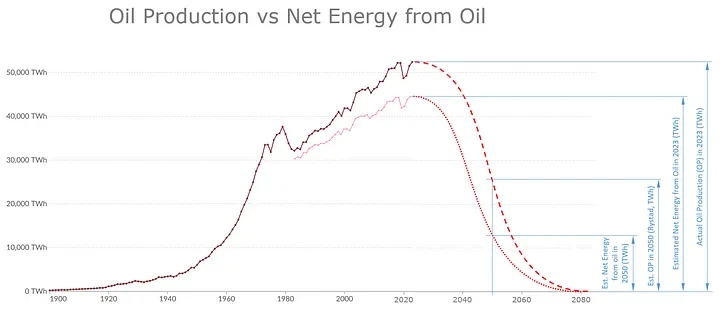
I had a few questions about this graph. I have seen this before and it has been mentioned on this site as well. This is the study but is it accurate?
https://www.sciencedirect.com/science/article/abs/pii/S0306261921011673
If our destination in 2050 is 1/3rd the amount of energy from oil that we get today, what happens on our way there especially with the economy?
Hideaway:
Hi Kira, have a close look at the graph and notice the exponential rise from around 1950 to the early 70’s. Hubbert showed that the rise and fall of world oil production should have followed a normal distribution curve, like individual oil fields tend to do.
When OPEC raised prices and the world realised oil was a finite resource there was a huge change and we implemented many efficiency improvements and substitutions (mostly gas) for oil use. The growth in oil production changed from exponential to linear, and instead of rolling over as predicted by Hubbert, has continued to rise.
We have been dragging future use of oil into the present for the last 25 years, while still growing overall oil extraction, as reserves deplete. Think about oil producers around the world. They have older wells still producing at EROEIs of 20-30:1 or more, plus newer wells in harder to reach places with much more expensive infrastructure and processing. The older wells that paid off their capital costs decades ago are easily the most profitable. They generate the most cash to keep the system going, however it’s the newer wells like shale oil, tar sands, deep water, etc. that help keep the overall price of oil lower.
Which are depleting faster? The old profitable wells, because the trade of goods and services runs on dollars and profit, so oil producers need lots of dollars coming in. Whenever the Saudi’s turn down production, it will be the expensive oil they reduce, not the cheap easy stuff, unless they desperately need to rest fields to protect future extraction.
What this leads to in our world of capitalism economics, is all the high EROEI wells depleting around the same time, just as the cost of maintaining production rises rapidly, because the wells are so much more expensive relative to the oil produced.
Complexity also enters the picture because the extraction processes for newer oils are highly complex operations. For example, horizontal drilling relies on sensors and computing power to keep the drill in exactly the correct strata, 10,000 feet below the surface. The oil sands extraction process uses large modern machines with the latest computers and sensors to maintain optimum efficiency.
Once the easy high EROEI oil is depleted, the remainder becomes much harder to extract because supply lines of equipment and spare parts become less reliable due to reduced economic activity, making everything required to support the complex processes harder to obtain and much more expensive.
Rapid loss of oil production quickly leads to higher oil prices and shortages, with businesses closing as people reduce spending, as happens in every recession, however the declining oil supply will accelerate as other high EROEI wells also reach total depletion, exacerbating the overall problem, with newer oil sources not keeping up with the declines. Deep recession leads to businesses shutting and restricted trade as countries can no longer afford imports, which causes more businesses to go bust.
Factories that earn 10% of their revenue from making essential ‘widgets’ for the oil sector go bust because the other 90% of their business starts operating at a loss, and it is impossible to restart the manufacturing because critical machinery was sold off for scrap in a clearing sale.
Thousands of factories stop making parts critical for a complex system. Without parts, oil rigs and refineries can’t operate, which brings down the entire system.
For us here at Un-Denial, it’s pretty obvious what happens next as the problems will mount and cascade affecting many businesses unexpectedly, thus triggering a self-reinforcing decline.
Most importantly, although demand for oil will fall with recession, oil will not become cheap because supply will also quickly fall. There will not be investment capital available to extract new marginal oil, especially in the Middle East where populations will be suffering from the high price of imported grains and other food, that will become difficult to purchase on the open market. Food exporters will struggle due to high diesel and fertilizer costs and will be forced to reduce production.
Then the next year oil supplies will fall another 5 Mbbls/d, and again the year after, and soon it’s over and most people will be left wondering how those in power let it happen or couldn’t see it coming…
Kira:
Thanks for the explanation.
I hadn’t considered at all that even within countries like Saudi Arabia and Kuwait you will have different EROEI fields. It makes economic sense to keep running the high EROEI wells to get most for your barrel of oil. After reading your explanation I was curious to see the status of old oil fields, the giants and super giants which are collectively responsible for the majority of our crude oil, but most importantly as you pointed out, high EROEI oil. This is the list from wiki:
https://en.m.wikipedia.org/wiki/List_of_oil_fields
Most supergiants were discovered more than 60 years ago. Taking the top two as example Ghawar and Burgan. They both started production nearly at the same time and apparently peaked at the same time (2005) although Saudis don’t confirm it. Ghawar seems to be declining at 2.5% annually and will be down to 2.5 million barrels from a peak of 5 million by 2030. I am sure Saudis are doing everything possible to slow the decline now which will make future decline worse.
It appears as though oil fields like Ghawar are subsidising the extraction of the low EROEI oil like shale and tar sands. The energy comes from the old ones and the volume comes from the new ones, keeping price low and maintaining the illusion of abundance. It’s quite deceptive when you think about it. The net energy keeps depleting while the volume remains same or even increases for a while.
Companies that make generators for offshore oil rigs are a great example of economy of scale tumbling. They probably make generators for hundreds of clients who are not oil companies, when these clients can no longer afford their product the critical mass is lost and they go out of business. Oil companies cannot keep them in business single handedly. This can be applied to other things like pipes as well. This is what the death spiral of the oil industry will probably look like.
Hideaway:
I was thinking when reading your post Kira, yes, yes, yes, yes, yes. I certainly couldn’t have written it better.
On the oilprice.com webpage, there is this article….
https://oilprice.com/Energy/Crude-Oil/Arab-Gulf-Producers-Are-in-Need-of-Much-Higher-Oil-Prices.html
After enjoying a rare budget surplus in 2022, most Gulf Cooperation Council (GCC) economies are seeing their budget deficits widen with current oil prices still well below what they require to balance their budgets. According to the IMF, Saudi Arabia, the GCC’s biggest economy, needs an oil price of $96.20 per barrel to balance its books, thanks in large part to MBS’ ambitious Vision 2030. The situation is not helped by the fact that over the past few years, the oil-rich nation has borne the lion’s share of OPEC+ production cuts after agreeing to cut 1 million barrels per day or nearly half of the group’s 2.2 mb/d in pledged cuts. In effect, Saudi Arabia has been selling less oil at lower prices, thus compounding the revenue shortfall.
Imagine how they cut back, will it be the most profitable oil wells or least profitable ones, when they are so desperate for revenue? Obviously the least profitable ones get reduced while the cheap easy to get oil gets depleted quickly.
What could possibly go wrong when all the cheap high EROEI oil extraction starts declining rapidly just as shale oil uses up its tier 1 and 2 locations…
Perhaps we should have been called Homo dumbass, because we are definitely not ‘wise’.
Rob here on 15-Oct-2024 adding some fresh calculations by Hideaway on the expected speed of collapse, and a response from Kira.
Hideaway:
An aspect of our situation I’ve been thinking of putting down in writing with numbers, so that people can get a better understanding of the collapse ahead…
In regard to oil, we are mining around 100Mbbl/d which will roll over at some point in the near future..
According to some paper I read recently, we currently use around 15.5% of oil to obtain oil and this will rise to 50% of the energy by 2050.. From this paper…
https://www.sciencedirect.com/science/article/abs/pii/S0306261921011673

At the same time as this is meant to be happening, we will be mining a bucket load more metals and minerals for the transition.
What people find so difficult to do is to put several aspects together, to see if it can work, so I’ve decided to try below.
Assuming the increase is 1Mbbl/d/yr in the energy used to gain oil, which is easily possible as we’ve mined all the easy to get oil and only have the harder, more distant supply left, plus allowing for oil production to roll over to a decline in production we get the following…
I’ve used a fall of oil production of 1Mbbls/d for years 2,3 and 4, then 2Mbbls/d for yr 5, and 6, then 3Mbbls/d, for year 7, 4Mbbls/d for yr 8, 5Mbbls/d for yr 9, then a maximum of 6Mbbls/d for years 10, 11, and 12. At no time does the depletion rate go over 10, in these 12 years…
Year 1 …production 100Mbbls input energy 15.5Mbbls … Left for society 84.5Mbbls
Year 2 99M ………………………….. 16.5M ………………. 82.5M
Year 3 98M…………………………… 17.5M ………………..80.5M
Year 4 97M ………………………….. 18.5M ………………..78.5M
Year5 95M ………………………….. 19.5M ………………..75.5M
Year 6 93M ………………………….. 20.5M …………………72.5M
Year 7 90M ………………………….. 21.5M …………………68.5M
Year 8 86M ………………………….. 22.5M ………………….63.5M
Year 9 81M ………………………….. 23.5M …………………..57.5M
Year 10 75M ………………………….. 24.5M ……………………50.5M
Year 11 69M …………………………… 25.5M …………………….43.5M
Year 12 63M …………………………… 26.5M ……………………. 36.5M
Because of the combination of more energy cost of energy (a la Tim Morgan), plus just plain slow decline, the available oil for the rest of society has gone from 84.5Mbbls/d in Year 1 to 36.5Mbbls/d by year 12..
But wait there’s more.. Assuming mining uses 10% of all energy, while in oil’s case makes it around 10Mbbls/d, we know that mining has to increase greatly for the ‘transition’. With the massive increase required, just assuming a 10% increase per year would be conservative, as we are talking a magnitude more copper, Aluminium, Nickel etc, plus all the steel in wind towers and solar farm foundations being built in the TW scale every year etc.
Mining’s use at just 10% growth rate goes from 10Mbbls/d in year 1 to 31.4Mbbls/d in year 12..
When we add this into our calculations of oil available for everything else, we go from 75Mbbls/d in year 1 (100 – 15.5 – 10 = 75Mbbls/d) to 5.1Mbbls/d (63Mbbls – 26.5Mbbls – 31.4Mbbls= 5.1Mbbls/d) for everything else other than oil production and mining..
The above assumptions are very conservative assuming oil doesn’t decline by more than 10% in any one year, that oil used to gain access to more oil goes up by only rises by 6.5%/yr at most, then the growth rate declines (unlikely), plus the 10%/yr increase in oil going to mining wouldn’t get us close to climate/transition/renewable expected growth rates…
Even with those very conservative assumptions, we go from 75Mbbls/d for “everything else” to 5.1Mbbls/d for “everything else” in just 12 years after reaching maximum possible oil production. It clearly can’t and wont happen that way!!
We’ve been dragging future oil use into the present for the last 40-50 years, as shown by the linear increase in oil production since then, whereas we had an exponential rise in production before then.
The above is just putting together 3 aspect of our modern world, instead of concentrating on one and assuming everything else stays constant as just about every ‘model’ does that I come across from ‘experts’ in various fields..
The big question is what happens instead of the above??
Do we cut back oil spending on gaining oil, so that the depletion of existing oil happens much faster than 10%/yr?
Do we cut back on mining so that the transition dies a lot earlier?
Do we assume we will find a magic energy solution to all our problems?
Do we just assume oil production will never decline quickly… because….. just because we don’t want it to???
I didn’t realise how bad the numbers were until I just did the simple calculations and put it down in writing. To me it means we collapse well before the 12 years are up after reaching peak oil production because of many feedback loops creating chaotic disruptions on the way down. Every year we remain close to the peak of oil production, means we are dragging more future oil to the present, meaning the decline when it starts to accelerate will likely be much faster than the sequence above…
Kira:
Excellent analysis!! I just want to mention that the oil that goes into getting oil is mostly in the form of diesel yet only about 75 million barrels that we extract today is the kind of crude that can be refined into diesel. The rest of oil is either shale, NGL, Biofuels among other things which have their uses but not as diesel.
There was also a video that was posted here about a gentleman who mostly agreed with what we discuss here about the irreplaceable nature of fossil fuels and the shortcomings of so called renewables but believed that there is so much oil out there that we will never run out, that we can have shale revolution after shale revolution. There are many who subscribe to this school of thought and think we can extract shale oil and gas from formations in Argentina, Russia, China and many other such places. Art Berman (who has expertise in this area) on Nate Hagen’s podcast has stressed several times that the geology of American shale is very unique and the shale revolution cannot be repeated anywhere else.
If one needs any proof of this please look at China. Despite the CCP pushing the state oil companies hard to extract shale deposits for years gas out has reached only about 30bcm per year which is less than 3% of American output. Part of the reason is the remote location of the deposits in the northern part of the country but we are talking about a country that can create entire cities from scratch within a few years. This is a matter of National security for the Chinese but the geology is the problem and has been unyielding so most efforts have been fruitless and abandoned.
As far as depletion goes even if we take super optimistic figures given by Rystad which predicts that oil production will be down to 50 million bpd by 2050 then the oil available by energy would be worth only about 25 million barrels. This is just a slightly stretched out version of numbers given by you.
It is interesting excersize to speculate on how things will play out on the downslope.
At the beginning of this downslope the airline industry will be the first casualty. Consuming about 8 million barrels of oil and mostly middle distillates at that, this shutdown will provide a much needed relief to the energy constrained world. Of course the commercial airplane manufacturers namely Boeing and Airbus will also go out of business. It is unlikely that governments will have any interest in bailing them out even if they had the ability which they won’t. The tourism industry which depends on air travel will also collapse, as will countries entirely dependent on revenues from it. Depletion will soon catch up and the gutting of industries will start again but this time it won’t be something discretionary and superfluous like air travel. This time industries that touch all our lives will start competing for the remaining share of energy.
Rob here on 7-Nov-2024 adding Hideaway’s answer to a question by ABC on whether Dr. Simon Michaux’s proposed solution of Thorium reactors and iron powder will work.
My take on why this type of future can’t happen is because Simon Michaux misses complexity and scale in the argument we can go to this type of future…
Let me explain, we can only have the complexity of nuclear power and running everything off electricity with an enormous scale of the overall human enterprise we call modern civilization. The scale of this complexity would require much larger markets than we currently have as the number of ‘widgets’ needed to be made for all the complex machinery would be greater than today.
We only have the complexity of today due to the total scale of everything we do. The highly specialised nature of building the best computer chips as an example happens in one place Taiwan with TMSC. The facilities they have built to make these computer chips can only be as sophisticated as it is because of the global scale of it’s customers. To build and operate 50 such facilities around the world would not be possible, they would all go broke. The scale of the facilities built needs the scale of the market size.
To build cheap thorium reactors or any SMR, the “modular” being the important point, would require a massive market as the factories involved, down to the smallest widget all have to be working in co-operation so everything fits together perfectly, so the market needs to be massive so everyone in the chain can make a profit. It also means all the suppliers of parts have to be operating smoothly and at large scale to supply all the inputed metals and minerals.
This all requires the existing system to be maintained while we get the growth in scale of the industry which relies upon the growing demand for the new products from the markets.
Notice how there is growth at every stage to make it all happen!! So if we had a spare planet or 2 of resources to use to accommodate all this growth, then we might get to a more advanced technological civilization, however running into limits of everything we currently use, because of growing energy cost from energy access itself to everything else mined, means we can’t get that advanced.
Also note that to get to where we are today in regards to the totality of civilization has taken growing energy use of all types for over 250 years. It’s been oil that has allowed for the increases of coal and gas use over the last 100 years. All the renewables plus nuclear and even modern hydroelectricity all rely upon oil themselves, and upon oil for the cheap coal and gas used in their production.
If we didn’t care about the environment at all and had another 2 earths worth of oil on this planet, then sure we might get to thorium reactors everywhere, but it will still all rely upon oil.
As oil production starts to rapidly decline, sometime in the near future, I have no idea exactly when, then the ability to keep our modern complexity will quickly unwind. We are getting a ‘sniff’ of this at present by all the countries that want to relocalise so much production, which isn’t possible as we lose the economies of scale of the current globalised system, unless there is an accompanying simplification as well. However no-one is planning for a simplification, the actual plan is to make aspects of the modern world at home. All these plans will quickly realise that they rely on imports of most/all the parts and the relocalisation is not very economic because of smaller market size.
Of course all the duplication everywhere is more inefficient using both more energy and materials to build and taking more people to operate and maintain. We lose some of the existing efficiency in the huge scale of many operations by trying to relocalise them.
What it means by even trying the relocalisation is that the population as a whole gets poorer because of inefficient use of energy and materials (unless we had spare planets worth of all these on this planet!!), due to lack of scale and overall the complexity has to fall to match the energy we have.
Please also note we have no shortage of any material on this planet, just a shortage of energy to access lower grades, and all the processing involved in making them useful goods. It all comes back to existing energy availability within the scale of complexity of what we have as current civilization and we can only build a lot more of any one aspect, while the entire system operates normally. Normally being in growth mode, providing the capital, goods and services required in the usual orderly manner to open new mines. Which means the population needs to be well fed and educated, with abundant services continuing to operate throughout.
We can’t take energy and materials away from one sector to go to another as the odds are they use different aspects of modernity and it’s not a simple swap, with whatever being constrained having feedback loops that are unexpected.
Anyway back to thorium reactors. The industry needs to grow and develop naturally in a world of increasing demand for this product, so it can develop naturally, which takes the rest of the system growing normally. Eventually factories that could build SMR would develop, providing the capital and operating costs were a huge advantage over the existing forms of energy. This can only happen in the background of our system operating ‘normally’, ie growing economies. It can’t be forced, as any developments of forced, as in uneconomic simply don’t last as industries when times turn tough.
When we get a real recession/depression brought on by oil getting more expensive for every other industry, all the expenditures on solar, wind, nuclear and batteries will probably start falling fairly quickly, as these expensive subsidised builds lose market share, as they are too expensive, even for a product (electricity) that is only one aspect of our energy use.
All heavy industry needs a constant cheap energy supply, often in different forms at the same time to produce the raw materials that feed our modern consumption. Without coke, coal, gas and plastics many of the items of modern civilization simply wouldn’t exist at all, so build a huge array of thorium reactors with say the last of the fossil fuel energy available, solves no problems. We wouldn’t be able to make the products we use today with just electricity.
If we were to build fancy new recycling facilities that somehow made use of all existing plastics for re-use in original forms, the whole enterprise would suffer the same entropy and dissipation as everything else and winds down fairly quickly, plus requires a rapidly growing system of modern civilization working normally in the background while it’s built to the scale and complexity required.
Every argument of how we can power a new civilization with solar, wind, batteries, nuclear, thorium or whatever form of electrical energy in the future, argues for a smaller supply of energy needed than now because fossil fuels are inefficient, we only use 25-50% of the energy (depending on the machine). It’s a terrible argument as the increase in the modern civilization growth to get to that point, would mean a much higher energy use than at present, just because of the growth in scale and complexity of everything to just build this future.
Someone should ask Simon Michaux or any other expert about the clean green future whether from renewables normal nuclear or thorium, about how much of it can be built without using fossil fuels at all, including down to the plastic insulation on all wires. The usual answer is it can’t be done yet, but improvements in technology and increased use of renewables/nuclear and how cheap they all become will allow it to produce synthetic fuel for these types of purposes.
I usually counter, with how none of it’s being done now, yet renewables and nuclear are already claimed to be cheaper, so all new factories would already be going to the cheaper ways if it was true, but no-one is doing it, so something is very wrong with the narrative. The argument usually flows to climate reasons why we have to move away from fossil fuels, which is unfortunately a different argument, because the energy required to then mine all the minerals to build this fantastic green future simply doesn’t exist without the use of fossil fuels.
We are in a total and utter catch 22 where we require cheap fossil fuels to build everything and maintain the current modern civilization, which collapses without their use leaving 8 billion cold, angry starving people looking to survive. Using another 2 planets worth of fossil fuels to build the entire renewable/nuclear/thorium future with electricity used for everything, including making plastics and synthetic fuels, will leave the climate and environment in ruins, then collapse anyway, when we turn off fossil fuel use, as that is a sudden energy loss when we continue to require more minerals and metals from the environment, due to those lost from entropy and dissipation, and the increase energy use from all the movement of materials for recycling..
I didn’t even get around to mentioning that a world of recycling everything as much as possible, uses fossil fuels for all the processes anyway, but that’s another story. It’s an incredibly complex situation we are in and any ‘easy’ sounding solution will simply not work as the proponent forgets we spend 97-98% of all our existing energy and materials on just maintenance of the existing system with only the other 2-3% going on ‘growth’ of everything.
Any one new major investment into a great sounding idea on a world wide scale, can simply not work by spending less than 1% of energy and materials use on it, unless the entire system of energy and materials grows massively. As the entire system has to grow, the number we start from in the future will be much higher energy and material use than it is today. The scale and complexity has to also grow to allow for more efficiencies in the system. the starting base of energy use in 30 years time will be double of what it is today..
If we don’t ‘grow’, then we can’t maintain existing subsystems within our civilization, as we need an increasing quantity of energy just for maintenance of material availability. The system can’t work ‘normally’ without the increase in energy, even without growth in the overall system. If we shrink the market size, then we can’t maintain the complexity of the current system either, as the affordability of the complexity goes down, so the system simplifies, which makes gaining access to lower grades of everything much more energy intensive as less complex equipment will mean lower recoveries in mining, lower food volumes from a given area of land etc.
Oops, sorry for excessively long answer. Our civilization is highly complex and so is the reason why none of the bright green ideas can work, and neither can a shrinkage of population while maintaining modernity, but hte attempt to do so, will lead to collapse of it all.
Rob here on 14-Nov-2024. Hideaway and ABC had an opportunity to ask some questions to a couple important leaders in the overshoot awareness community, John Michael Greer and Simon Michaux. Following are the questions and answers plus follow-on commentary from Hideaway.
A.) How can we have modernity without the scale of market size that we currently have to enable the mining, processing, distribution then manufacturing of the huge range of parts that go into making every aspect of modernity?
We can’t. It really is as simple as that. Modernity, as Dr. Richard Duncan used to say, was a transient pulse waveform a one-time, self-terminating affair.
B.) How do we make the machines that make the final product machines in a scale down world?
That asks the question the wrong way around. The right way around is “what kind of final products can we afford to have, given all the constraints on producing them in a deindustrializing world?”
The answer won’t be clear for several centuries, but it’s unlikely that any technology invented since 1900 or so will be included.
C.) How is it possible to maintain complexity, such as a thorium reactor and all the machines it powers on only a small scale?
I’m not a specialist in this technology, of course.
I’m open to the possibility that it can be done, but I want to see an affordable example first.
As we’ve seen over and over again, every nuclear technology is cheap, clean, and safe until somebody actually builds it…
D.) Where do the materials come from after many cycles where entropy and dissipation have worked their magic over many cycles of recycling?
Oh, in the long run say, another 10,000 years we’ll have to go to entirely renewable resources, and that will involve sweeping changes in everything; for example, some future society may cultivate chemosynthetic iron-fixing bacteria (the kind that currently produce bog iron) to keep it supplied with iron. Our immediate descendants won’t have to worry about that, though. Given the scale of population contraction we can expect (around 95% worldwide) and the gargantuan supplies of metal and other materials that have been hauled up from deep within the earth and stored in what will soon be urban ruins, our descendants for the next thousand years or so will have all the metal they can dream of using.
A.) How can we have modernity without the scale of market size that we currently have to enable the mining, processing, distribution then manufacturing of the huge range of parts that go into making every aspect of modernity?
I don’t think we can. It was all dependent on oil as a fuel. We have no replacement for this.
B.) How do we make the machines that make the final product machines in a scale down world?
We have to change our thinking in what we need all this stuff for. Do we need it? Can we do it in a more simplified form? Then ask how we can get there. If we can simplify how the tools are made using more abundant resources (iron vs. lithium for example) then use those machines differently, using modern knowledge.
What have we actually learned over the last 200 year?
The last 20 years in particular?
Can we take a backyard workshop, make a small foundry, have a blacksmith forge, run a basic lathe, drill press and welder, power it with a wind turbine on a lead acid battery?
Strip out useful products from all the places around us that no longer are in operation (cars in a carpark that have been abandoned).
Make an electric motor and a lead acid battery.
Can we shred rubber tyres and make gaskets?
Can we run a furnace to recycle ceramics and building waste into geo polymers
Then you have tech like 3D printers.
Can these be reinvented where we can make our own feedstock and make our own printer unit?
And so on.
C.) How is it possible to maintain complexity, such as a thorium reactor and all the machines it powers on only a small scale?
A Th MSR unit is about 12 m long, about the size of a shipping container and delivers 40 MW of electricity, or 100 MW of heat at 560 deg C.
They are made mostly from steel, nickel and a small number of exotic metals and alloys.
They have a working life of 50 years.
Complexity to run it is about that of running a modern medial isotope lab.
Their production is much simpler than most other devices.
I think it can be done in some cases.
The problem is getting permission to use them.
D.) Where do the materials come from after many cycles where entropy and dissipation have worked their magic over many cycles of recycling?
Contract our material needs per capita.
Simplify what we need to resources that are more abundant.
Most of the purple transition needs iron, which we have lots of.
Copper will be the limiting metal.
Industrial systems have to come into line with food production limitations.
Once we get to the point where recycling and mining can no longer deliver, then society has to work out a way of living without these things or go extinct.
Hideaway’s commentary:
Thanks ABC great work and answers by JMG. He gets the big picture of what’s going to happen, but appears to miss all the feedback loops that will accelerate everything to the downside. We have over 8 billion humans on the planet and 99.99% of them have no idea modernity is going to end abruptly, and when it does so will destroy the plans of the other 0.01% (or less!! ), that did see it coming and tried to prepare in some way.
Lots of people use Cuba as an example of what can happen with building vegetable gardens etc., except forget to mention that it’s in the tropics with fast growth and plenty of water, compared to say the UK which is 2.4 times the size and 6 times the population, plus Cuba today imports around 70%-80% of their food.
Where JMG says it’s asking the question the wrong way around, is incorrect. We are not planning anything about contraction as a species, every machine is becoming more complex allowing for more automation and hence cheaper costs. Once we go down there will not be the investment capital, energy nor materials, nor co-ordination to build any new machines to make anything.
He has once again used how we have done things on the way up, as in using more energy, materials and larger expanding markets; to think that some similar type of planning will occur during the collapse phase. It’s wishful thinking not close to reality.
Realistically, when food is not arriving in cities, who is going to be sitting around talking about what machines they are going to build and what level they can acquire, when there is no energy, nor materials in the appropriate form to do any of it??
One aspect JMG gets completely correct is about thorium reactors….. “As we’ve seen over and over again, every nuclear technology is cheap, clean, and safe until somebody actually builds it…”
There is a very good reason for the cost of all nuclear, of which thorium reactors will be no different, complexity. Every aspect of it is a highly complex specialty. It wont be made from ordinary stainless steel, it will be highly specialised stainless steel, probably with a high quantity of minor elements like molybdenum to allow for the highly corrosive environment of molten salt. “Salt” as in sodium chloride does not play well with most stainless steel, as the chloride is the one thing highly corrosive to stainless steel.
In the huge new refinery in Texas built by the Saudi’s a decade or so ago, upon commissioning someone turned on the wrong valve that sent hot seawater through the piping, causing something like $1.5B dollars in damage and delaying the opening by a long time. Interesting they now call it “caustic” released as it pitted all the stainless steel pipes. If seawater can do that, imaging what 600-800 degree molten salt will do to any weakness of the piping.
Scavenging materials, finding a smelter that can separate all the scavenged materials into the original metal forms, then recombined into the correct quality stainless steel to withstand high temperature molten salt, is a highly complex process by itself, involving a lot of coking coal for the heat. We don’t currently do this for new highest grade materials, we use newly mined purity, for the combination specialist metals, recycled metals doesn’t provide the purity required at this level of specialty. There is no way Simon’s thorium reactor can be rebuilt in a small community, as we would still need the mining of all the separate metals, including his one word reply of ‘exotics’.
What seems to happen is that we get answers about the future that all sound very plausible and comforting, until some person with a bit of knowledge of the intricacies of some part of it comes along to spoil the party.
It’s the highly technical nature of the materials that go into machines, that are then forged into specialized minor, often tiny, sometimes huge parts, with all the connections working in harmony, to make any modern kit, that will be impossible when people are desperate to find food and survive that’s the problem which is overlooked. They always assume some type of normality in the future, just with a much smaller group, forgetting that normality has been a growing human enterprise, with always more energy and materials to make stuff with for generations, and that normality is going to leave us in the near future.
Rob here on 5-Dec-2024 adding an interesting thought experiment by Kira on the energy and material savings benefits of economies of scale and our multi-continent supply chain. With follow-up comments by Hideaway and Kira.
Kira:
I have been trying to think about the benefits that economies of scale and multi continent supply chain provide in terms of energy and material savings and decided to try a simple thought experiment to try to visualize it.
Lets take a simple rudimentary motorbike as an example of the product that we intend to produce at scale. The raw materials will be the metals and alloys needed to make the parts and everything else will be done in house without depending on any external supply chain. The basic parts for a bike are as shown.
If we decide to make everything everything under a single roof (which is what localisation implies) we would have to dedicate seperate machining and fabrication units for each part along with the people with expertise in each of those departments all of which are massive upfront investments and would make the factory a mammoth operation on the scale and size of a gigafactory.
So what are the downsides of this approach?
- It requires massive upfront investment and upkeep.
- The output would be low.
- If we have to serve a country as large as US with localisation we are looking at at least one factory per state leading to large redundancy and waste of production capacity.
Lets approach the same problem and apply a distant supply chain solution.
Since all motorbikes are more or less the same and use same parts shown above we can do the following. Three companies A,B and C may be different bike companies making different types of bikes they will only design and make the frame(chassis) and engine in house and everything else will be outsourced to an external vendor. The suspension will be made by suspension manufacturing company, brakes by a brake manufacturer and so on. So how does this benefit everyone?
- Since the company is only making the frame and engine its factory size will be a fraction of what it would have been in scenario one.
- A dip in demand for company A’s bikes would not result in wasted capacity as company B and C can absorb the common capacity for the parts.
- Less labour requirements as there is lower redundancy as there is only one plant making suspension, brakes, tyres, clutch etc. instead of three.
- Since more resources are freed up the companies can focus resources on research and innovation thereby speeding up progress.
The obvious downside of this is the loss of redundancy and a single point of failure which can halt the production of all bike companies. But the benefits to the civilization as a whole far outweighs the risk as the more complex the product is the longer the supply chain is and the more difficult it would be to make it under a single roof.
If we take microchips as an example and try to take all the processes from raw materials to a finished chip and make everything under a single roof the factory will easily be the size of a small sized city.
When I mean everything I mean everything from the lithography machines to all the other machines, starting all the way from raw materials. That means first making this incredibly complicated machine below starting from metals and alloys mined,processed and shipped to the plant then machined, fabricated and assembled into the machine shown below.
So as complexity of the object increases multi continent supply chain is not only useful but essential to making high tech products. None of this is possible without fossil fuels and high grade minerals both of which are in irreversible decline and will soon lead to the supply chain collapsing leading to a loss of complexity creating a negative feedback loop.
The lithography machine shown above is just one of a hundreds of processes in getting from silicon ingots to a microchip (albeit the most important one). Some of the processes are shown above which require equally complex machines to perform.
Hideaway:

The caption with the photo states .. “just one of the benches the engine was laid out on”.
This was from a 1965 built motor..
Thanks Kira, a brilliant breakdown of complexity, with each of the above different main parts of a motor bike having so many components themselves. A simple motorcycle can have 2,000 – 3,000 separate parts.
Our complexity of modern life is just lost on so many people, not understanding that each and every part has to be made precisely from the exactly correct materials, to work together and function as a whole ‘machine’.
The other huge misunderstanding is that we need the total complexity to gather the food, energy, and materials that make up this complexity as we have used up all the easy to get food, energy and materials.
The motorbike example is a simple machine compared to a horizontal drill rig with tens of thousands of separate parts, including many computer chips, in many separate parts of the rig, from control systems to sensors to actuators, communication systems, power systems.
Without modern horizontal drill riggs our oil production would fall rapidly by a large percentage and these machines are dependent upon lots of spare parts arriving nearly every day.
When we start to lose overall energy availability, especially oil production because of depletion, the complexity has to rapidly unwind, as there is simply not enough energy to keep it all going. Once feedback loops kick in, of lack of parts, then machines we rely on become junk very quickly, which accelerates chaotic feedback loops.
The concept of going local, means massive simplification, because we don’t have either the energy nor materials locally to do anything differently, which means we will be unable to feed the current huge populations of local areas as all the modern machines cease to function. Fertilizer becomes a thing of the past, tractors can’t get oil and grease, let alone fuel, likewise for all transport from local rural areas, to cities.
Modern humans have just forgotten how reliant we all are upon 6 continent supply chains for our very existence…
“Kleiber’s law” of power/mass use to the 3/4 power most likely applies to human civilization. Studies have shown that in nature the law is a doubling of animal or plant mass requires a 75% increase in energy use because of efficiency gains is the easy explanation.
In human settlements research, done by Prof Geoffrey West and a host of others, they have found human population centres the power law is closer to 85%, as in we are not as efficient as nature with a 4B year head start. The problem with all the work on settlement sizes is that we live in a world of one global civilization and no city is an entity to itself, which they were 500-10,000 years ago, including their surrounds.
Kira:
Actually it was your exchange with Dennis on POB that lead me to have this train of thought. I found this line by him to be quite revealing of how people like him think.
Dennis: “Society is not based on physical laws alone, it is understood using knowledge such as sociology, psychology, and economics.”
Cornucopians like him always point out how GDP is growing with less energy use ie growth is becoming less energy intense. We know this is primarily because of massive financialization of economy but when you point that out his reply is that GDP calculation are a reflection of physical and thermodynamic reality of the society. It’s funny how he tries to have it both ways whenever it is convenient.
He is wrong as usual. Let’s take three bike companies on three continents North America, Europe and Asia – Harley, Triumph and Honda respectively. Assuming that there is no contact between the continents and each company has complete monopoly over their respective continents without any alternative then they can manufacture in whatever configuration they want. They could make everything under the same roof with redundancy and inefficiency or outsource their production of components to third party and cut costs.If they are inefficient their customers end up paying more than their counterparts on other continents.
But as soon as we apply the situation of globalization and they have to compete with each other they will have no choice but to reorganise themselves in a way to reduce material and energy costs and if they don’t they go out of business. You were right in your counter that civilization is very much like an ant hill and just like how no ant has the complete blueprint, no human has the complete design of civilization. It is not intentional, it is self organizing and self assembling. Complexity increases to solve problems and with increase in complexity comes increase in material and energy cost. When this happens the system reorganizes itself to optimize resource consumption. There is no way to intervene here.
For instance Ford could probably manufacture every component of its car under the same roof 85 years ago but with today’s complexity they probably have hundreds of suppliers that they share with many other car companies. If an American president declares that every inch of a Ford vehicle must be made on American soil the company would immediately go bankrupt as if they tried to do that a car that costs 20,000 would cost 200,000.
This pattern holds even across completely different industries.


This is a ridiculously condensed and shortened version of the supply chains of Apple and BMW. All supply chains end up either at pits of mines or oil and gas rigs as everything we produce comes from earth as raw materials. The suppliers in greens are the common ones for both companies and hundreds of others including oil and gas rigs. If we fully expand the supply chains we will see countless overlaps with one another with constant reorganization happening to optimize resource consumption. The true scale of feedbacks and overlapping is so complex that it is impossible to even comprehend. But there are some interesting things we can glean from the above diagram. The critical mass of consumers for the chip industry is coming from consumer electronics meaning that the auto industry and oil industry are just beneficiaries of this. If people stop buying smartphones and PCs then oil companies and car companies go out of business. There are several such critical dependencies that may not be so obvious at first glance and may be far down the supply chain.
Of course the connective tissue connecting the supply chain is oil since without we cannot maintain the multi continent movement or power the mining machines at the end of the supply chains.
Hideaway:
Thanks, Kira, excellent work again.
Trying to get people to understand the connection between the overall size of the growing market, relative to the complexity is extremely difficult, especially when added to the overall energy and material savings to the entire super organism of the human civilization.
Because of collapsing grades of ores of all types, we need the complexity of modern machinery, modern financing and modern supply chains, to gain access to all the requirements of all materials and energy used. It’s a self feeding monster that has to grow just to gain access to the requirements.
Unwind any aspect of modern complexity and the whole lot collapses, yet keep growing and the whole lot collapses due to environmental limits anyway.
Most likely oil will be the limiting factor, that sets in motion feedback loops in reduced consumption of all the requirements used in modern complexity, and your example of discretionary spending on computer chips is the perfect example, but we can multiply this by thousands for all the unknown links that are necessary to keep modern complexity going.
The concept of localizing industries, plus using tariffs to do so, will just hasten the collapse as it uses up more energy and material resources to build all the local manufacturing plants and tool them up, let alone gain the raw materials and energy for their operation. Just the attempt to do this will likely set off other unknown feedback loops as the extra energy and materials involved in the attempt to localize puts pressure on other aspects of the system.
Of course it’s all just a duplication of what’s already happening elsewhere, supplying the world, so the energy and materials are effectively wasted giving higher costs to consumers everywhere because of the duplication. Now imagine 5-50 countries trying to do the same for their local markets.
We can’t have 50 TMSC factories around the world as there is just not the market for that number of computer chips, with the complexity it takes to produce them. That factory/foundry whatever they want to call it has to churn out millions of wafers and chips to be viable. It wont work with 50 of them, unless the super-organism of human civilization grows by enough to accommodate the increase, which means every facet of civilization has to grow including population, energy and material use.
Once oil declines because of depletion and the impossibility of an increased production, whenever that happens, then overall energy availability turns down, meaning the growing organism can’t keep growing, nor even maintain what’s built and operating as entropy guarantees we require 97-99% of all energy and materials to just keep operating ‘normally’. (All while energy use keeps growing to supply the raw materials because of lower grades).
Once energy of all types that totally rely upon oil start suffering from increased costs, as oil’s harder for any one business to obtain, the civilization that relies upon cheap energy, suffers from reductions in internal markets from those struggling, meaning less markets for computer chips, and every type of machine that relies upon them, sending businesses broke, that manufacture essential requirements of other businesses, so creating a cascade of accelerating failures across civilization itself, in producing everything required to just maintain and operate what exists.
We’ve been in extend and pretend mode for over 50 years, making up a linear increase in oil supplies, with exponential increases in coal and gas energy supplies to make up the required energy of the growing civilization, then added some nuclear, solar, wind, geothermal etc, all just electricity providers, which are not providers of the full range of products and energy supplied by fossil fuels.
The increase in coal and gas though is totally reliant upon oil, with the rest being just derivatives of fossil fuels in total.
The complexity of the entirety of the system would take multiple books to explain just the merest of details of any one component of the overall complexity of how we live. It’s beyond the comprehension of anyone, as it’s exactly as explained by Kira above, so people without thinking of the overall complexity, assume we can just increase one part of this civilization by increasing something massively, on a world wide scale, without having implications elsewhere, nor have any understanding how everything else has to keep working normally for their one aspect to increase greatly. (EVs, batteries, solar, wind, geothermal, tidal, and nuclear).
Single cell organisms, multiple cell organisms, storms, stars and all prior civilizations have grown with increasing complexity over time, yet all eventually collapse due to some type of internal energy usage decline, that collapses the overall system.
To think our modern civilization will be ‘different’ to everything else in the universe that is large and grows complexity internally, increasing energy use until collapse, is denial in it’s finest form.
 un-Denial
I actually think some of the “Trump Derangement Syndrome” is justified. Trump’s environmental policies are terrible. He doesn’t even pretend to care about the environment. Even after the Southeast U.S. was battered by Hurricanes Helene and Milton, he still called climate change a scam. For me, that is a deal-breaker. It shows that Trump has way too much harmful reality denial. I am also upset with him for removing Gray Wolves from the endangered species list. https://www.counterpunch.org/2021/08/12/defanging-nature-how-human-exceptionalism-is-destroying-the-wild/
Trump also says he is planning on deporting 15 million illegal immigrants. I don’t see how he can possibly do that without turning the U.S. into a militarized police state. I hope he is just bluffing. But then again in 2016, he promised to deport 11 million and didn’t do that either.
LikeLike
After the covid experience I am much more aware of when mainstream media is trying to shape my beliefs.
I remember pre-covid thinking RFK was an anti-vax nut job. Then after I became aware of the Fauci evil I read RFK’s books and listened to many hours of him speaking. I now think RFK is the most impressive leader in the US. The democrats would have won with a landslide had they made RFK their leader instead selecting an idiot without a single idea on what needs to be done.
In the previous election I thought Trump was corrupt and evil because that’s what the media told me he was. It was a point of principle that I never listened to a single world spoken by Trump.
Then I saw the evil and stupidity of Biden that almost caused a nuclear war and still might.
I listened to both the Rogan/Trump and Rogan/Vance interviews and I am cautiously optimistic that some things they can control may improve.
On some issues, like climate change, it doesn’t matter what they believe or plan to do. The only thing that might help is to rapidly shrink the global population and/or to collapse the global economy, neither of which they could do, nor would they be permitted to do.
Both the population and economy will shrink soon as we here know. It would be interesting to know if that will be enough to avoid a climate incompatible with human life.
Unfortunately no climate scientists study this obviously important question because they’re all in denial of our true predicament.
LikeLiked by 3 people
Climate changes, tough luck. If all the bacteria in the world decided to start farting and belching constantly we would be doomed.
Try not to worry about it. In 2037 a comet will hit the earth and throw us into an ice age lasting 34 million years.
The future is unknown.
LikeLike
LikeLiked by 2 people
https://newrepublic.com/post/188369/lee-zeldin-epa-trump
Trump’s EPA pick will likely more than cancel out any net health benefits from appointing RFK Jr as head of HHS.
LikeLike
I think that the biggest effect of appointing Lee Zeldin may be one last sputter of growth in oil extraction, at the cost of making the inevitable decline even steeper. But given that Shale oil is already running into geologic limits and the fact that Shale wells deplete quite quickly, even this last-ditch attempt to boost oil extraction may not succeed.
LikeLike
I can list many things about Trump (and Biden) that are a MUCH higher risk to our survival than Trump’s pick to lead the EPA.
But that’s not the point. The goal is to find a way to reduce your anxiety and increase your happiness.
Did you try my suggestion that you might feel a little better if you assessed Trump and Vance and Musk and RFK by listening to their own words rather than listening to what others are saying about them?
I’m not saying this would change your vote, just that it might make you feel a little better.
LikeLike
thats what shifted my assessment re Trump and team. mainly on theautomaticearth.com btw, because Raoul links often to X, maybe 20x every day’s post.
LikeLiked by 1 person
You are justifying having a mental illness of your own making. Snap out of it you have better things to do in life.
LikeLike
Trumps egomania is such a win/win. Public gets to glimpse behind the curtain more often because he has no leash. And the true ruling elites despise him for that very same reason. If I had participated, my vote would have gone to the Donald no problem.
Not trying to be condescending with the following advice, it’s just what would have helped me if I had TDS.
The goal is to understand that Adolf Hitler does not stand out from the crowd. A dime a dozen. Business as usual.
If you’ve never went down a Noam Chomsky or Howard Zinn rabbit hole… it worked for me. And because of your excellent awareness level of the topics covered on this site, there is no chance of you falling into the same trap as me with getting hung up on blaming/hating white skin.
Just reading Zinn’s A People’s History of the United States (1980), might be enough for you. If not, go to Noam. After you read Zinn though, I’ll bet you’ll be able to watch that entire Rogan/Trump interview without throwing up.😊
LikeLiked by 3 people
Someone, maybe Greer?, recently wrote that Hitler was a piker compared to the bigs like Mao.
LikeLiked by 1 person
that is correct. A few blogs ago.
LikeLike
Hitler was only a “piker” compared to Mao because he lost the war. If he had won, his body count would have been a lot higher.
https://en.wikipedia.org/wiki/Generalplan_Ost
LikeLike
Climate Change can be both a scam and real. If you think about all the green washing stuff. Trump loves hyperbolic language but it really doesn’t suit modern sensibilities for some reason
LikeLike
Are the technofixes scams in that they are intentionally fraudulent or are they just the result of people clinging to the belief that they can electrify the titanic?
https://soundcloud.com/michael-dowd-grace-limits/william-ophuls-electrifying-the-titanic-book
LikeLike
They are intentionally fraudulent and delusion. A prime example is the hydrogen vehicle nonsense . Companies scamming taxpayer dollars out of gullible politicians makes me so furious. We should be spending that money on boring stuff like wetland restoration
LikeLiked by 1 person
Steve Bull today on why this time is different.
https://olduvai.ca/?p=68953
LikeLiked by 2 people
And just to add 2c to the illustrious stew, all such lists seem to be oblivious of the Garrett Relation so-called because it is as basic as E=mC^2. Civilization needs a constant source of energy just to stand still, as if we ever could.
Here are four links to Garrett’s papers
https://un-denial.com/2021/02/23/by-tim-garrett-jevons-paradox-why-increasing-energy-efficiency-will-accelerate-global-climate-change/
https://esd.copernicus.org/articles/3/1/2012/
https://esd.copernicus.org/articles/13/1021/2022/esd-13-1021-2022.html
LikeLike
oops not the right link to FB and I don’t know how to edit posts here on WordPress. Here’s the right one, and an excerpt from Ecoshock.org interview.
In other words, perhaps the wealth of civilization has a direct link to how much energy we can consume. That seemed a reasonable assumption, because in order for us to do anything, which is perhaps a measure of our wealth, we need to consume energy. That’s a basic law of the physical universe. It’s through energy transformations that anything happens. I tried to look at this using available data. It turned out this relationship is constant, with about 10 miliwatts required to support every inflation-adjusted 1990 dollar of economic value. That was the core result of my first paper. From there I wanted to see what this implied for global warming, Alex: If we grow the economy, we’ll put more greenhouse gases into the atmosphere. But could we reach safe levels if the economy crashes? Tim: I showed that if the GDP declines with time, which is normally what we would think of as a Depression, this would not in fact correspond to lower carbon dioxide emissions. For carbon dioxide emissions to go down, what would be required is effectively a complete collapse of the economy.
LikeLike
Another possible piece of the puzzle.
LikeLike
I just feel angry.
LikeLike
I feel numb.
LikeLike
Art Berman today on another dimension of the oil problem.
Refineries are squeezed between higher crude costs and lower consumer demand and thus are not making enough money.
The last refinery built in the US was in 1977 and 2 are scheduled to close in 2025.
https://www.artberman.com/blog/refinery-crisis/
LikeLiked by 1 person
We had a refinery in New Zealand. It was closed under Jacinda Arden’s “leadership”
LikeLiked by 1 person
One of the better discussions I’ve see in a while on the middle east conflict.
Col. Lawrence Wilkerson predicts Israel will not exist as a Jewish state within a year.
LikeLiked by 1 person
The question is, will we in western “civilization” survive the next year? I doubt that “Israel” will disintegrate without using their nukes and can the U.S. lose its belief in it’s hegemony without taking the planet to nuclear Armageddon? The U.S./NATO/Europe are going to lose 2 major wars, will they just go quietly into that good night? With the current administration that was a definite NO, with Trump probably not either.
AJ
LikeLike
Those are definitely the key questions for the next year.
It’s hard to see how negotiation and compromise can bring peace to either war. Russia no longer trusts anything we promise, for very good reasons. Too much blood has been spilled in Gaza.
The wars will be settled on the battlefield. Which means one side will have to accept losing.
Maybe add some serious global economic problems for extra heat.
Many risks here.
LikeLike
Anyone interested, 3am here and we’re busy. Go to the
https://www.abc.net.au/news
The fist picture of bushfire is from our place…
LikeLiked by 1 person
Oh no. Praying for you.
LikeLike
I finally had 3 hrs of sleep, and Rob I found that comment of yours, having the same belief or lack of belief really funny… Who’s Rob praying to??? Has he suddenly lost MORT???
LikeLike
LOL… Reminded me of this scene:
“Oh sure. Now you come around. He’s not fooled”😊
LikeLiked by 1 person
I was lost for words and then I felt this strange wave of spirituality descend on me and I asked myself what would Yahweh say to you?
LikeLiked by 4 people
The peak oil boys are back with their flavor of spirituality. Maybe I’ll join them. Somehow they combine god with reality.
LikeLiked by 1 person
You been hitting the bottle?
LikeLike
Nope, still clean & sober. 🙂
LikeLiked by 2 people
🙂
LikeLike
We are totally fine, fire going away from property, ending up causing great fire break for coming summer. The fire services have made a mess of the bush using the usual methods to put an earth track around the fire. I’ve been in the volunteer fire service here for decades, so knew exactly what was going to happen.
We are so dry that the earth is dust, yet this time of year is usually boggy in all areas where they dug the earth track. Temperature today got to 34, first warmer day of spring, can expect over 40 in January which is real fire season!!
LikeLiked by 4 people
Glad you’re ok. Crazy weather everywhere.
LikeLike
Thank you for the news. Glad to hear you are fine.
LikeLike
I hope this summer (your summer) isn’t as bad as 2019-2020. https://en.wikipedia.org/wiki/2019%E2%80%9320_Australian_bushfire_season
LikeLiked by 1 person
I see HHH agrees with Hideaway that the collapse will be quick.
I respect HHH and I’ve heard him and others argue many times that quantitative easing does not create liquidity. This might be “technically” true but seems disingenuous given my understanding of what actually happens.
When a government wants to spend more than the market is willing to lend it at a reasonable price, the government tells its central bank to begin quantitative easing. The big commercial banks buy the government’s debt and then immediately resell it to the central bank which pays for that debt by printing money. The government then has more real money to spend which liquifies the economy.
Does anyone here understand this well enough to confirm whether HHH or my understanding is correct?
https://peakoilbarrel.com/open-thread-non-petroleum-november-13-2024/#comment-783091
LikeLike
If you have very high rates of inflation, you won’t have to pay debt back in real terms. In a desperate attempt to stave of the reckoning, some governments may try to use deeply negative interest rates, but by doing so they would implicitly admit that growth is over. This is my educated guess.
LikeLike
That’s one of the reasons they were hoping via The Great Reset to use covid as an excuse to force digital currencies on us but failed. If you want negative interest rates you need a means to prevent people from withdrawing their money from the banks because who in their right mind would use a bank that charged them to store money.
Other good reasons for a digital currency include a mechanism to force desired behavior changes like eating less meat to “fix” climate change, and a means to force fair rationing, like for example, you are only entitled to buy 20L of gasoline this month.
One big bad reason is that digital currencies won’t work without a reliable internet and complex systems like the internet will be the first to fail with energy scarcity. This is also why Bitcoin is a bad idea.
I suspect they’ll try again when the next emergency arrives. However if Hideaway is correct, it may be too late to do anything useful at the next big event.
It would be so nice if we could see and discuss reality and plan like adults. But we can’t.
LikeLiked by 1 person
Rob – I can recommend Whitney Webb’s latest interview with John Titus on her (I think substack) Unlimited Hangout. He does an gives an excellent explanation of money creation and the problem with banks. I feel sure you will like it.
Karen
LikeLike
Thanks! Whitney Webb is a very impressive young person.
LikeLike
I listened to this discussion between Webb and Titus. It was interesting on the WHAT but not so much on the WHY.
They are energy, overshoot, and limits to growth blind which means they have to make things up to explain what they are observing.
They also sidestepped the issue that started this thread. The “experts”, including Titus, claim normal QA (not the covid flavor of direct asset purchase QA ) does not cause inflation because bank reserves cannot leave the banking system.
I claim bullshit. QA indirectly enables governments to spend a lot more than they could if forced to borrow money from an unmanipulated capital market, and excess government spending can cause inflation.
LikeLike
They’re gonna have to program some denial into the AI’s…
Funniest thing I’ve read in a while.
https://www.zerohedge.com/technology/you-are-not-neededplease-die-google-ai-tells-grad-student-he-drain-earth
LikeLike
LOL. Nice one. Turns out I was wrong; there is some good to dedicating 75 billion gallons of water per year for the AI data centers.
p.s. Before they pump this chatbot full of denial and human supremacism, I would love to see it replace Nate as host of TGS for a day or two.
LikeLiked by 1 person
I thought you might like it. 🙂
LikeLike
This article is still cracking me up. I looked it up and found that it was covered by many media outlets. The comment sections of the more mainstream ones are very entertaining. The masses are truly horrified and disgusted by it.
I think it deserves a spot on your wall of fame quotes. And it might have to be the name of my yt channel. (quite a long name though. LOL)
LikeLike
Added to the sidebar quotes.
LikeLiked by 1 person
https://beneaththepavement.substack.com/p/declining-birth-rates-are-a-good-thing
After Elon Musk said that “If there aren’t enough people for Earth, there definitely won’t be enough for Mars!” . I realized the he is either a snake oil salesman or completely delusional.
LikeLiked by 1 person
Bicycles are a great tool for transporting people and small amounts of stuff. Unfortunately, like cars they need parts, maintenance and repairs that rely on extensive, far away global supply chains. Having learned to work on bikes 35 years ago the supply chains and parts list has become infinitely more complex. That said here are a few words of advice:
Go with a cro- moly steel frame. Aluminum frames are now the most common but have a shorter fatigue lifespan and are much harder to weld. A good cro-moly frame can last a lifetime. I built a steel bike for my wife with 2 sets of wheels. One set of 700c wheels with 42c tires perfect for road use. Another set of 27.5 wheels with 2.8 inch tires for trails, gravel and snow riding. The frame is a Surly bridge Club and it’s a tank.
Go with disc brakes but cable disc, not hydraulic as they are easier to maintain.
For a long term bug out setup you will need a big list of parts and tools from rear cog sets to spare chains, brake pads, brake discs, brake cables, inner tubes, etc. You will have to develop a set of skills to repair these.
Nothing is standard anymore, there are infinite numbers/styles of brake pads, chains, cog sets, bearings, etc. You will need to learn what fits your machine and stock up while prices and availability are still here. Still this is far more manageable than cars. I once went to replace a tail light on a 2001 Ford F150 and found there were 2 tail lights, one for the first 6 months of 2001 and another for the second six months. I went to replace brake pads and rotors on a 2012 Toyota Matrix and found there were 3 sizes of brake rotors for 2012.
People are welcome to contact me for advice.
LikeLiked by 2 people
Hi,
I pretty much agree on all points.
I have a no-suspension bike for simplicity. Some cush is provided by 57mm / 2.25″ wide tires.
The long-travel of a (heavy and complex )mountain bike suspension fork isn’t needed for my riding.
My old bones would be happy to have a bike with a simple elastomer suspension at the seattube/seatstay junction, and a suspension stem. Or a relatively simple, compact and light front suspension like the old Cannondale Headshok.
I like my cable-operated disc brakes, but would be fine with V-brakes on rims.
For now, I’m sticking with tubes in my tires, rather than tubeless.
Finding or starting a local bike co-op is a great way to build community, learn how to repair your ride, what parts substitutions work, basic tools that will get the job done in a pinch.
Thanks and good health, Weogo
LikeLiked by 1 person
Really good essay today by B today on vital diesel and the other energies that enable diesel.
It’s a very nice companion to the Lars Larsen essay.
https://thehonestsorcerer.substack.com/p/a-diesel-powered-civilization
LikeLiked by 3 people
A comment by Anopheles suggest we might be able to keep the game going longer than B’s essay implies.
https://thehonestsorcerer.substack.com/p/a-diesel-powered-civilization/comment/77595104
LikeLike
Tar sands are practically untransportable in any profitable sense until they are diluted with large amounts of very light oil usually fracking crude. They need to be able to travel through pipes. You either heat the whole thing or dilute/dissolve in lighter oils. This changes the product from tar to medium oil but there is a catch it is not just WTI crude which condenses out into all the fractions you want. It is mostly still heavier and lighter grades than diesel. Cracking uses a lot more energy again and margins are very tight so profits are slim.
As Gail talks about – there is plenty of oil and tar sands but they are not economical to produce for mod civ to survive. Reality doesn’t negotiate.
LikeLiked by 1 person
Yes, good one by B.
Hideaway and this site are the reasons I completely understand this quote. Just another hard-to-understand concept… until you understand it. Then it’s as common sense as “you can’t have infinite growth on a finite planet”.
I was looking at the table from the bottom of ‘My Final Act’ essay:
And yes, some changes need to be made for sure. Like the removal of animism as the dominant ideology. LOL, according to me, human supremacism is only 500 years old.
But I was mainly looking at it to remind myself how much I did not understand this energy transition stuff back then. Looking at the table now, it just screams MPP. Like the whole point of life is to become lazier. Not sure what I’m babbling about here… but somehow I’m seeing this table in a way I had never seen it before. (LOL, maybe my splodge goggles are working a bit)
LikeLiked by 1 person
A couple super smart people with super high integrity discuss some of the covid mysteries and try to bring some peace to the waring camps of covid dissidents.
I love these excellent human role models.
LikeLike
Loved this podcast, probably one of the best I’ve heard on covid /shots in quite a while. I agree with Brett on his definition of how science is supposed to function and how biology is infinitely more complex than physics. in that it is an adaptive system that changes through evolution.
I particularly liked how he said, science is too compartmentalized /specialized and that means that most of the people who are discussing covid /shots are all coming from different perspectives and very few, if any, have a complete understanding of all the subspecialties enough to speak authoritatively.
AJ
LikeLike
It was unfortunate they did not discuss several big issues that tie into their themes:
– why did China/US collaborate on engineering the virus and fomenting panic but not on pushing mRNA?
– evidence of seeding to create panic hot spots
– Dr. Joe Lee’s string theory explanation of clots
LikeLike
https://www.reuters.com/world/biden-lifts-ban-ukraine-using-us-arms-strike-inside-russia-2024-11-17/
LikeLike
Oh oh. Very unwise.
LikeLike
Given how many strike Russia has done on Ukrainian territory, Russia doesn’t get to complain when Ukraine strikes back IMHO.
LikeLike
Russia won’t complain.
Russia will destroy US military assets in Europe just as the US would do if Russia launched missiles into the US from Cuba.
Then the US will probably escalate. Then Russia will probably escalate. Then the US will escalate. Then we are all dead or miserable.
LikeLike
Your politics seem to blind you to the larger picture as Rob has pointed out.
LikeLiked by 2 people
Yes. It seems that Russia using Iranian and North Korean weapons to attack Ukraine is not an escalation but Ukraine using foreign weapons for a limited response in Kursk is an escalation. It’s a crazy world. I doubt it will start WW3, though.
LikeLike
LikeLiked by 3 people
https://www.reuters.com/business/healthcare-pharmaceuticals/oregon-confirms-first-human-case-bird-flu-2024-11-15/
CDC confirms Oregon’s first human case of bird flu
Hopefully this doesn’t become a pandemic.
LikeLike
If you despise Trump, this long essay posted yesterday by Simplicius might be worth your time. I found it from dave@megacancer.
Doesn’t make a damn bit of difference to me who wins an election. Nothing of importance ever changes. And the inequality gap just continues to skyrocket. But I have to admit, after reading this, even I felt a small dose of hopium.
I don’t know the author well so I can’t vouch for him. And I did get a vibe that he thinks civilization BAU can go on for another 10,000 years. But overall, it was a pretty good read.
Staring Ahead from the Crossroads – by Simplicius
LikeLike
This Achilles heel renders his entire premise non-viable.
LikeLike
Don’t let that turn you off. That’s just me exaggerating to try and be funny.
You are gonna stick to your guns on this topic though I can tell. This will be my final attempt and then I’ll stop bugging you, I promise.😊
Here is the very first page of Zinn’s book. Talk about an attention grabber. (or is this what clickbait used to be?)
And just to be clear on my views… Yes, everything about the Arawak culture was good compared to the evil Europeans. But that’s only because they were a few thousand years behind the European culture in the complexity department. The New World would have gotten there eventually. Guaranteed by MPP.
free pdf: Howard_Zinn-A_peoples_history_of_the_United_States.pdf
LikeLiked by 1 person
Simplicius is one of my favorites for Ukraine analysis. I read most of his work.
My tiny bit of optimism does not come from Trump. It comes from a few of the people that joined him and (so far) have been embraced by Trump. RFK, Musk, Vance, Gabbard plus some lifetime D intellectuals with integrity that switched like Bret Weinstein and Heather Heying.
LikeLiked by 1 person
Dear Rob,
I hope thou are feeling well.
When will the next entry be published?
Dear Un-Denial visitors,
I hope thou are all feeling well.
The next Peak Oil panel will be hosted on 5th of December at 19.30 (Eastern European Time)
– Dr. Charles A. S. Hall has been invited as a guest.
My attendance seems unlikely, however I can forward thine questions for the panel to Mr. Zvorygin directly.
Peak Oil Facebook group:
https://www.facebook.com/groups/2213264857/
Mr. Zvorygin Youtube channel:
https://www.youtube.com/@AndriiZ
Kind and warm regards,
ABC
LikeLiked by 1 person
LikeLiked by 1 person
https://twitter.com/jasonhickel/status/1845863872923660682
LikeLike
LikeLiked by 2 people
Last night Biden ignored Russia’s warning and helped Ukraine to launch missiles into Russia.
Buckle up. We will soon learn if Russia is bluffing as our western leaders assume.
I’m betting they are not bluffing.
What do you think?
LikeLike
Another person that knows what he’s talking about thinks Russia will vaporize the Ukraine government (with a non-nuclear missile).
LikeLiked by 1 person
Bad and depressing times.
Makes me think that I should take up smoking cigars and drinking whiskey again? Why not we are slowly (and then rapidly) moving up the escalation ladder to nuclear Armageddon. I still think that we will not ever have a slow collapse, not how other civilizations did it – they kept pushing ahead until they disappeared (but this time we will not just fade off into the forest/desert unlike the Maya or Anasazi).
Prepare for nuclear winter?
AJ
LikeLike
Our western leaders have lost their minds.
Trudeau confirmed he supports Biden’s decision.
The same thing happened with covid. They all aligned in the wrong direction. Very scary to watch.
LikeLike
A comprehensive deep dive into what all the data is telling us about our predicament.
LikeLiked by 1 person
Excellent. Our denial module let’s reality through when the message is framed as humor.
LikeLiked by 1 person
Alice has posted this amazing meta review of why wind turbines cannot replace fossil fuels. She has used 90 peer-review papers directly, plus been informed by additional research. And what does a tax-payer funded physics professor from NZ say? “A lot of reasoning in that piece is shoddy.” FFS does anyone use their brains any more at universities???!!!
67 Reasons why wind turbines cannot replace fossil fuels – Peak Everything, Overshoot, & Collapse
LikeLiked by 2 people
Hi Monk. I can never work out how to see the comments on Alice’s website. Is that where you saw the comment or was it another shit LinkedIn response?
LikeLike
Sorry Campbell, yea it was a LinkedIn comment
LikeLike
Same here- does anyone know the secret to accessing comments at her site?
LikeLike
Sorry it is LinkedIn comments. When people share her articles on LinkedIn
LikeLike
Alice turned off comments on her website a while ago. She got sick of all the nuclear and AI guys repeating the same garbage
LikeLike
LOL. Sounds identical to the phrase I hate the most: “they are oversimplifying things”
This is what all the so-called debunking comes down to for Zinn’s book that I have been promoting lately.😊. Same thing for Naomi Klein’s The Shock Doctrine. And poor Chomsky has been hearing it his entire career.
You know the author is onto something when this is the main ingredient of the critique.
LikeLiked by 1 person
RFK to covidiot journalist: “I have a letter from the CDC confirming that a blind placebo test has never been done on a single one of the 72 vaccines we inject into children”.
Covidiot journalist: “That’s not true. I know they did the tests”.
LikeLiked by 3 people
It is amazing that Rintrah can write intelligently and critically about viruses and immunology
https://www.rintrah.nl/virulence-seems-to-be-increasing/
“So it may be that with fewer people getting infected right now in Italy, cases are more concentrated among more vulnerable people.
The quasispecies tends to expand its genetic diversity over time, which has the effect of increasing virulence. The quasispecies started over from scratch when BA.2.86 emerged, which had such a huge fitness advantage that it wiped out other lineages, but that’s well over a year ago by now.
But you have to keep in mind, that something else happened during the last few months. We know that the neutralizing antibodies now depend on using the N1 and N2 loop of the NTD. Those neutralizing antibodies no longer work, because of new glycans. So I wonder: Has the case fatality rate shot up because the most important neutralizing antibodies no longer work?
And as you may expect, the virus has immediately moved towards the next predictable step: It now introduces two new mutations in the N3 loop, to get rid of the antibodies there. The fastest growing lineage is now LP.8.1, which introduces these mutations:
>KP.1.1.3* (Nextclade) + S:H445R, S:Q493E, S:F186L, ORF3a:P178L, S:R190S
This is very obvious. S:R190S introduces a new N-linked glycan at 188, right in the N3 loop. S:F186L is also in the N3 loop and seems necessary to make S:R190S fit, it’s not very fit without S:F186L. In other words, it slightly changes its structure to help adjust to that new N-linked glycan on 188.
I find it strange how nobody is really remarking on this. We have a pretty clear pattern: Glycans introduced on N1, followed by new glycans for N2, then followed by new glycans for N3.
I wonder how they expect the immune system to neutralize this virus, once the NTD is covered in these glycans and the population has a whole bunch of poor affinity IgG4 antibodies against the RBD.
Can I just point out, that this is what everyone now apparently considers normal:
“Yeah everyone has this wheezing cough that’s not bacterial that you need inhalers for, perfectly normal.”
Imagine I’m wrong for a moment. Perhaps we never get a version of SARS2 for which we can’t develop a neutralizing antibody response.
What do you think happens if otherwise healthy young people just spend every day coughing? None of this is just hypothetical, me sperging out over text and numbers on a screen. No, I’ve personally met people my age, who developed nerve damage from all their coughing, they just have to spend the whole day laying on the couch, in hopes of healing the nerve damage. You cough too hard and you just damage your nerves.
You can also develop lung fibrosis from constant coughing. If your lungs have their cells destroyed, the immune system tries to repair things by depositing fibrin, as a place-holder before full regeneration. But when the damage is too big, or fibrin is deposited faster than it can be removed (eat your natto), you just end up with declining lung function.
And remember, the immune system has different ways to deal with an infection. Infected cells can just detect and destroy the RNA of a virus, on their own or with help from innate immune cells. Those cells are then afterwards better able to deal with exposure to similar viruses. Alternatively, antibodies can instruct the immune system to destroy infected cells. After vaccination, antibody levels against Spike are about 20 times normal. What happens when you constantly have the immune system destroying the infected cells, rather than letting those cells resolve the problem on their own?
I will say this again: The body sends the adaptive immune system after a respiratory infection, when the innate immune system can’t handle it on its own. It has reasons for that.
You made an intervention in a complex system and it didn’t work. Let’s say there is no grand finale where the antibody response just fails, perhaps we just end up with 10 years of these constant COVID waves, rather than naturally resolving this pandemic after 2 years. Do you realize what sort of irreversible damage to the fabric of society that does? It means an entire generation of children grow up with damaged lungs, damaged brains and damaged immune systems. It is essentially a civilization-ending event that most people just want to forget about.”
and yet be completely off the planet when it comes to practically everything else.
https://www.rintrah.nl/important-question-for-low-iq-low-status-white-males/
Imagine if one day you heard knocking on your door, opened it and found Donald Trump, Elon Musk, Joe Rogan, Robert F. Kennedy and Javier Milei standing in front of you.
Elon Musk began to explain to you that with his genius brain, he managed to figure out a way to finally defeat woke, save free speech, make every Bitcoin worth one million dollar, stop all the handouts and food stamps for cadillac driving welfare queens, raise the birth rate back to replacement level, stop transgenders from playing in sports, get rid of all the zionists, end the forever wars for Israel, force all the brown people to go back to their own country, build a wall on the border with Mexico, build a colony on Mars, defeat the race communists, end the use of pronouns, end the war on christmas, destroy the man made climate change hysteria hoax, make eggs affordable again, make grassfed beef affordable again, make gas cheap again, ban the murder of unborn babies, get rid of seed oils from food, defeat the globalists, drain the swamp, make america great again and end all degeneracy.
Of course this has your interest. But then Donald Trump begins to explain that unfortunately there’s a catch. Carrying out their plan requires all five of these high IQ gentlemen with very big brains to use your toilet to take a shit. And not in the toilet bowl, they have to just freely projectile splatter their diarrhea all over the walls with their strong manly rectal muscles. And then, to finally bring their plan to fruition, after taking a big dump they need you to lick their hairy assholes covered in feces in various stages of drying up clean again, as shiny white wriggling little worms fall from their buttholes onto your face and into your open mouth.
They argue they have studied this problem carefully with their big brains and came to the unfortunate conclusion that there is simply no other way to defeat woke. But, they promise you, there is no catch, once the whole operation is complete, woke will truly utterly be defeated.
So, my only question to you is:
MORT in action.
LikeLiked by 1 person
Rintrah is a remarkable specimen. I don’t know what to make of it. Maybe genius often comes packaged with crazy?
I read the first essay yesterday and said to myself, slowly, slowly Dr. Geert Vanden Bossche is being vindicated.
I did not see the second essay. I skip all his crazy rants.
LikeLike
I think waking up to what happened with covid caused many to see that our leaders are lying about everything.
LikeLike
The trust horizon is collapsing like Nicole Foss predicted
LikeLike
It’s ok to make a mistake.
It’s not ok to deny the the mistake and to not change policies when it’s obvious you made a mistake. Especially about public health matters.
Now it does not matter what they say.
True, false, it does not matter. I and many others now will no longer believe a word they say about anything. That’s very damaging to society.
We should heal the system by sending the ring-leaders to prison to demonstrate the system still has some integrity.
LikeLiked by 1 person
let us hope that RFK makes some headway with that.
LikeLike
Derek Jensen recently interviewed Dr. Tom Murphy.
So-so interview. You probably won’t learn anything new except Murphy thinks there’s a chance our global declining birthrate may deflate the bubble fast enough to avoid a hard crash.
https://resistanceradioprn.podbean.com/e/resistance-radio-interview-of-tom-murphy/
LikeLike
I haven’t had time to watch that one yet, and visitors turning up in a few minutes, but declining population is as much a guarantee of collapse as anything else, as you can’t maintain the scale and complexity of the civilization, which means raw material supply falls because it requires increasing energy and complexity to gain access to lower grades of everything, to just maintain the existing system, that has to be maintained with a lower population than was maintaining it before, in a falling population.
When governments start banning abortions and contraceptives for nefarious reasons, usually religious, we’ll all know, that they know, that civilization is collapsing soon…
LikeLiked by 2 people
Are you on Team Power or Team Life?
LikeLike
https://gov-pritzker-newsroom.prezly.com/gov-pritzker-announces-location-and-psiquantum-as-anchor-tenant-of-new-quantum-park
Is this really the best use of Illinois’ limited budget? We are already tens of billions of dollars in debt, and unlike the federal government, we don’t have a money printer.
LikeLike
LikeLiked by 1 person
F U C K T H A T !
LikeLiked by 1 person
I am not sure I understand what you meant by that in this context?
Would you care to elaborate?
I understand Stellarwind72’s plight with the next board at the head of the madhouse.
No certainty in what I am going to say, just my way of stringing events together. Elon Musk would be bankrupt by now, if Trump didn’t win the election. So now, he can further plunder, he will just bankrupt the US instead, and then fail in 4 years. That’s all.
He is also going to eat some competitors with the help of the sword arm of the federal administration. Maybe, just by lettling the fanatical inquisitor RFK do his job in the name of the Good. Top predators eat each other. More unemployment in the making, which will force people with various knowledge and competencies to seek other strategies. An aspect of collapse.
Half of America benefits, the other half feels the pain. Ironically, maybe, the symmetrical pain of what happened during covid. Maybe, this will lead to more understanding towards each other.
An analogy came to my mind recently for the two US parties. They are a bit like the two hemispheres of the brain: the left is analytical (scientists, economists, analytical, cold-blooded manipulative bastards), the right is emotional (loud, fanatical, impulsive, entrepreneur, exploitative bastards). Of course, things are more complicated, that’s pop politics/psychology (https://en.wikipedia.org/wiki/Lateralization_of_brain_function#Popular_psychology).
LikeLike
Art Berman goes back to overshoot basics and calls bullshit, probably rightly so, on my (and others) claims that covid crimes and attacks on freedom are at the core of Trump’s win.
Citizens always vote their pocketbooks. Period.
Limits to growth are causing inflation and a falling standard of living, hence this election is the 3rd time in a row than the incumbent has been thrown out.
Berman also does not like the plan to gut the deep state. No mention of covid crimes. I’m guessing he bought the mRNA bullshit and loves his boosters.
https://www.artberman.com/blog/energy-economics-and-the-limits-of-growth-what-trumps-victory-reveals-about-americas-challenges/
LikeLiked by 1 person
Better to have someone on the peoples side than the systems side on the way down? Either way though it won’t stop the collapse.
LikeLiked by 3 people
Hey, give Art a break — at least he’s giving the straight skinny on what he knows about
LikeLike
Art Berman does excellent work on oil depletion.
Both he and Nate Hagens are silent on the covid crimes that killed 15+ million people. That’s more than were killed by the WWII crimes. Remaining silent is not ok.
LikeLiked by 1 person
Love Ted Postol. Excellent rant about politics and world affairs.
He’s a top expert on nuclear war if you don’t know who he is.
LikeLiked by 1 person
I agree that Putin at this point is the only adult in the room.
I guess we will see what discipline he dispenses shortly.
LikeLiked by 1 person
https://abc7ny.com/post/nyc-tri-state-wildfires-fire-crews-battle-brush-inwood-hill-park/15558781/
LikeLike
Another good one on how serious and crazy Biden’s decision to attack Russia is.
There is no precedent.
LikeLiked by 1 person
“History never repeats itself. Man always does.” – Voltaire
https://imgur.com/a/1jQllsn
LikeLike
How the World’s Biggest Rainforest Could Become a Self-Drying Savanna with Carlos Nobre | TGS 150
LikeLike
What is worse than one nuclear war? Two nuclear wars!
Potential Water War between India and Pakistan
LikeLike
I was a huge fan of British Columbian science theme rapper Baba Brinkman when he released his first album The Rap Guide to Evolution in 2009 on the science of evolution. The lyrics were brilliant and the music was excellent. It’s still one of my favorite albums.
He’s older now, the music is crappy, and his lyrics are usually paid for by some corporate sponsor so he can make a living.
His latest on nuclear energy may give us a hint at how the wizards behind the curtain want to shape public opinion.
LikeLike
Oh christ, you might be right. I can picture that messaging (with the hiphop flavor) on cereal boxes and toy commercials.
Probably good money in this type of useful idiotness.
LikeLike
Just got done watching this documentary. Buy Now! The Shopping Conspiracy (2024). It’s a poor man’s version of Peter Joseph’s content. Nothing new for this crowd, but somehow it held my attention the whole way through. I only recommend to you guys as entertainment, but your clueless friends and family might benefit because it’s a decent intro to overshoot (even though they never say the word).
Very dumbed down. Too much production value. Too much use of words like sustainability and hope. And the HAL AI voice thing was annoying as hell.
My takeaway is I that don’t know how you can watch this and not be rooting for civilization to collapse asap.
If you don’t have netflix and are in the mood for this type of content, do yourself a favor and watch Peter Joseph’s excellent youtube series from 2012.
LikeLike
Thanks for the tip. Buy Now looks good.
LikeLiked by 1 person
https://www.cnn.com/2024/11/19/europe/sabotage-undersea-cables-cut-baltic-sea-intl/index.html
European officials cry sabotage after two internet cables are cut in the Baltic Sea.
Is this Russia retaliating for the U.S. allowing Ukraine to use long-range missiles?
LikeLike
It’s not painful enough and does not target the ringleaders. I expect a big attack on Ukraine, maybe killing US/UK forces stationed there.
LikeLike
Canadian Prepper is hit and miss. Today he’s pretty good discussing last night’s first ever use of an ICBM missile (without it’s normal nuclear payload) to attack Ukraine.
He makes a very good point. Our leaders would have seen the launch and would not have known if it was carrying a nuclear payload yet they did not warn us demonstrating that when SHTF there will be no warning.
In Canada yesterday there was a country wide test of the cell phone emergency message system. Quite a stretch to assume a coincidence.
LikeLike
A little good news. My favorite sardines went on sale today.
LikeLiked by 1 person
Scott Ritter with interesting details, background, and implications of last night’s ICBM attack. It’s a big deal.
LikeLike
Simplicius with an excellent analysis of Russia’s retaliation.
https://simplicius76.substack.com/p/thunderbolt-from-the-skies-putins
LikeLiked by 1 person
This comment section is getting too long. We need another post. I might be able to write a guest post.
LikeLike
It’s my fault. I should have got a new post up before now. I was sick for a month and now I’m a little depressed and out of sorts given world events and some personal issues.
Stellarwind, thank you for volunteering but I have another guest post that I need to publish first. Perhaps an essay by you could be next?
LikeLiked by 1 person
Here’s a very interesting health improvement idea I’ve not heard before.
Dry fasting. No food or water for several days.
There are several logical and easy to understand reasons why dry fasting should be more effective at restoring health than water only fasting.
Drs. Heying & Weinstein have been researching the technique and conducting personal tests with encouraging preliminary results.
LikeLike
Dry fasting is pretty dangerous. This is because when in a dehydrated state many normal enzyme functions and waste removal functions shut down. Not worth the stress.
LikeLike
I haven’t read the book by August Dunning yet so I don’t have enough knowledge to agree or disagree with you however I think creating stress for the body is part of the core idea.
LikeLike
A classic: The Saint Matthew Island
This is not (as far as I’m aware) from an overshoot aware person but a paleontology channel so gives different details to the story.
LikeLike
LikeLiked by 2 people
Nate Hagens’s new frankly, discussing the 7 ‘beliefs’, and of course his denial kicked in with disparaging comments for those of us ‘believing’ in fast collapse as if we wanted it…
There are size and complexity power laws that are known in many different fields of science, all worked out independently of each other, so it appears to be a physical law of the universe as much as all the laws of thermodynamics. Even stars follow these size complexity laws, as per this link, which is a simple explanation..
https://researchfeatures.com/uncovering-size-complexity-rule-stars/#:~:text=As%20higher%20numbers%20of%20particles,a%20higher%20degree%20of%20complexity.
None of the large complex systems, whether stars, storms, ant colonies or civilizations reach a peak and ‘degrow’ gently. The largest systems all collapse at the end of their lifespan, with available energy depletion being the cause.
Because we have used all the easy to get metals and minerals, we are left to gather the deeper, harder, more remote, lower grade ore bodies of every non-renewable resource. We require increasing complexity and energy to do this. What’s often forgotten is that 97%-99% of all materials are used to maintain the existing system, with the 1%-3% being the ‘growth’ component.
‘Degrowth’ as in nice and gentle downslope, is a physical impossibility, because of our need for maintenance of the existing system even on a gentle downslope. Entropy and dissipation work their magic on all built systems, including the complexity of large stars, and certainly on our enormous civilization, magnitudes larger than any prior one.
Any attempt at degrowth, means that complexity also unwinds, making the gathering of all the materials needed just to maintain a degrowing system is impossible. The most complex aspects of our civilization are the ones to unravel fastest, and these are the most important ones for gathering and distributing materials (and energy) throughout the rest of civilization.
“Degrowth” is a nice catchy buzzword for anyone that doesn’t want to understand how large complex systems actually work. We have had many prior civilizations of humans that all collapsed at different rates, but a common element was that the complexity became too great to continue given dwindling resources, mostly energy resources being food, animal power, slaves.
The largest civilization to ever exist is likely to have the fastest collapse, just like large stars collapse faster than small ones. The internal complexity has to unwind very quickly due to lack of energy, which cause massive feedback loops because of internal complexity. Systems within systems all unwinding at the same time.
Collapse compared to all the other ‘beliefs’ in the latest ‘Frankly’ is not a belief, it’s a mathematical and physical law based certainty.
LikeLiked by 3 people
I also was not impressed with this episode of the Great Simplification. I only listened with one ear because I’m long past wondering about the philosophies of people. I’m interested in why smart people are unable to understand what is obvious.
I know Nate reads the YouTube comments so why don’t you copy and paste the above so we can see how he responds to clear logic for a fast collapse.
LikeLiked by 4 people
Send it to Sabine Hossenfelder while you are at it LOL
LikeLiked by 1 person
I commented
LikeLiked by 1 person
I also commented, pretty much as above, it lasted a few minutes when I first looked, now appears to have been censored out, doesn’t turn up on ‘newest first’ mode, only put up a couple of hours ago..
I expected it wouldn’t last, such is denial of reality…
LikeLiked by 1 person
Try posting it without the link. Youtube doesn’t like URLs in comments.
LikeLiked by 1 person
Thanks, removed link, still up up there….
LikeLike
Stellarwind is correct, any YouTube comment with a link is deleted.
LikeLike
Interesting Questions | how to save the world
Got these questions from Dave Pollards blog. Thought it might be interesting to see how this audience responds. I’m not trying to agree or disagree. Just curious to see a variety of answers.
This was my reply:
LikeLiked by 1 person
My answer to question 1.
We’ll do more of what we are doing today:
i) Genocide the other tribe when there isn’t enough land and water for both.
ii) Start wars with countries that have resources we need and pretend we’re doing it to defend democracy.
iii) Create fake emergencies like a pandemic as an excuse to implement authoritarian measures to maintain social order.
iv) Bail out too big to fail banks and companies by printing money and passing the cost on to citizens as inflation.
v) Censor anything that threatens the agenda and power of our “democratic” leaders.
vi) Elect any charismatic idiot that promises a higher standard of living and avoids discussing reality.
LikeLiked by 6 people
Chris, the more I think about it, you’re correct that it’s the use of fire where it all went wrong for humans. Take that out of the equation and we’d be mostly like other animals, with a few tools of use…
BTW, humans are not the only species to use fire as a tool. Birds of prey have been observed picking up burning twigs and dropping them in other areas outside any ‘fire’. I’ve seen this happen myself, many years ago.
The theory of birds of prey using this method is that it open up ground so they can view prey much more easily without the cover of undergrowth in forests.
I’m also a believer in the deterministic outlook. Other humans also used ‘fire’, but it was Homo sapiens that was able to wipe all the others out because we had fire, tools and co-ordination with each other. If we assume Homo sapiens never developed for whatever reason, then I suspect one of the other human species either would have advanced greatly, or some sub species eventually arisen to develop civilizations.
LikeLiked by 1 person
1. Migration will also get a lot harder once collapse deepens. Multiple reasons including: lack of capital to get going, infrastructure breaking down, gangs controlling roads, more expensive sea/air travel. Also as things get worse in the wealthy countries, there will pressure to not let in migrants at all.
2. Fossil fuels I think are entirely to blame. Without them, civilizations could have continued to rise and fall (once they outstripped carrying capacity).
3. As any other animal, I would be pissed off. Why does a human’s right to a home and living trump all other animals. I would be screaming at the top of my lungs “we are dying”. Even without climate change, our way of life is destroying nature.
4. I dunno.
5. It does feel good to learn something new for me 😊 I guess we are still looking for God / magic.
LikeLiked by 1 person
Ted Postol’s analysis of the new Russian missile system.
It seems to be a ballistic hypersonic missile that rather than following a conventional ballistic trajectory enters the atmosphere sooner and glides to extend it’s range.
LikeLiked by 1 person
Must watch if you are interested in the nuclear war threat.
LikeLike
Chris Martenson just issued a rare official alert for a possible nuclear war.
LikeLiked by 1 person
This quote at the 13:10 mark made me fall over.
You know what I’m starting to think? That my Chomsky, Zinn, Klein, and Joseph background is much more important than I’ve been giving it credit for. Last week I discovered that Sam Mitchell knows nothing about this stuff. And now I see that Chris doesn’t either.
I’m not implying that I know more than Chris or that he’s wrong about the stuff that he covers… but I am saying that major red flags are going off for me with this dude.
Martenson wins this round of the dumbest shit I’ve heard all week. “…maybe the NY Times is not actually on the side of peace, justice, the american way”… LOL, ya think?
Congratulations, your detective skills are top of the class. And please define what the hell you mean by “the american way”. Let me guess Chris… you love your country and are proud to be an american.
LikeLiked by 1 person
There are two completely different versions of Chris Martenson.
One version is when he speaks with or to aware peers.
The other is when he sells subscriptions to unaware people in denial.
LikeLiked by 3 people
LOL. Any hint of pride and love for country always boils my blood. Most aware people have at least one kryptonite item. I have a few😊.
After watching some of these nuclear videos, I was in the mood for a similar themed movie. I went with Miracle Mile (1988). The 80’s had a bunch of these weird, unique, cool, cheesy but in fun way films. A few in the 90’s. Dried up after that. No funding for any type of originality or experimenting.
Lot of nostalgia for me here. Late 80’s early 90’s is my favorite time of life. Plot is simple. A man hears a chance phone call telling him that a nuclear war has started and missiles will hit the city within 70 minutes.
LikeLike
Thanks for the tip. I’ve got Miracle Mile but have not watched it yet. Will bump it up in the queue.
LikeLiked by 1 person
https://www.ndtv.com/world-news/canada-to-go-uk-way-on-netanyahu-arrest-trudeau-says-will-abide-by-icc-warrant-7086684
Trudeau Confirms Canada Will Arrest Netanyahu Upon Visit After World Court Order
LikeLiked by 1 person
After very careful consideration I have concluded there is some dark shit going on in the world and it has something to do with powerful people putting our lives at risk to maintain their power.
LikeLiked by 3 people
There may be members of the ruling class who would rather see the world go up in a mushroom cloud than lose power.
LikeLiked by 1 person
The Ethical implications of Carrying Capacity and Limited World Limited Rights.
https://www.garretthardinsociety.org/articles/art_limited_world_limited_rights.html
https://www.garretthardinsociety.org/articles/art_ethical_implications.html
LikeLike
Muh rights!
Muh Freeze Peach!
https://www.youtube.com/watch?v=Gc11mJGre10
LikeLike