The idea of rebuilding and relying on a supply of necessities near to where you live is called relocalization and is often promoted as a wise response by people aware of the simplification/collapse that will be soon be forced on us by fossil energy depletion.
The Post Carbon Institute defines relocalization as “A strategy to build societies based on the local production of food, energy and goods, and the local development of currency, governance and culture. The main goals of relocalization are to increase community energy security, to strengthen local economies, and to improve environmental conditions and social equity.”
It is common to observe cognitive dissonance, which is caused by our genetic tendency to deny unpleasant realities, in discussions about relocalization.
Un-Denial regular Kira pointed out some cognitive dissonance in a recent essay by the excellent overshoot writer ‘B’ The Honest Sorcerer. This resulted in an insightful exchange with another un-Denial regular Hideaway that I thought deserved more visibility so I have copied their comments with minor edits here as a post.
Kira:
I wonder what to make of B’s latest article? Looks like he’s beginning to struggle with a bit of cognitive dissonance. I wonder how many of his ideas are actually feasible taking into account all the feedback loops?
While it’s true that large and heavy, individually owned vehicles (and their manufacturers) are slowly going the way of the Dodo, ultra-small, ultra-light vehicles are not. Just think about it: how efficient it is to move an 80kg (or 176 pound) person in a one and a half ton vehicle? The monsters most people drive today not only take a ton of resources and energy to make, but also burn untold gallons of fuel (or kWs of electricity) to move around. I mean, there is demand for a lot of things, like traveling deep into space, but since neither the energy, nor the resources are available to do that, it simply does not happen. As soon as the penny drops that this energy crisis is here to stay, auto-makers will come out with smaller and cheaper to maintain automobiles (in both gasoline and electric versions). Many Chinese manufacturers are already well ahead of this curve producing tiny two-person cars or even miniature utility vehicles, taking up much less resources and utilizing a range of “primitive” but time-tested and dirt-cheap technologies. It’s a different question, of course, whether renown car makers can swallow their pride and come out with tiny boxes on wheels. (Or how about being spotted in one…?)
Another, even more low-cost / low-tech mode of transport to revert to in a world of much less fossil fuel energy is the plain old bicycle. Cheap, easy to maintain (at least the older models) and requires no fuel to run. And as for carrying stuff around just take a look at cargo-bikes — which is already a big thing in Europe, especially in the Netherlands. By fitting an electric motor and a small battery pack on them, these clever inventions can be cheaply upgraded into a veritable work-mule, able to carry a hundred sixty pounds of just about anything.
Hideaway:
Most overshoot aware people like B assume the collapse will only impact the vulnerable portions of our economy and not everything.
There is a lack of understanding about how a 6 continent supply chain actually works! Minerals and parts come from all over the world to make anything in our modern world. Visit any manufacturer and you will see that whatever they are ‘making’ is constructed from parts that were manufactured elsewhere. The ‘manufacturer’ might make the box that all the separate pieces fit in, or the circuit board that chips made elsewhere are soldered to.
When the economy starts to fail due to reductions in oil supply year after year, businesses around the world will go bankrupt, and production and transportation of the materials and components needed by every manufacturer to make any product will be impossible to organise in a fashion that suits the way modern industry operates.
No company makes all of the parts needed to manufacture a ‘car’, and attempts to do so will be impossible in a world of falling energy availability and businesses going broke everywhere.
To make anything, you need industrial machines that can forge, stamp, put plastic coatings on bits of metal, or coat ‘wire’ with plastic to make electrical wire, etc., etc., and all require someone else to make the machines, and they need parts and raw materials to make the machines.
Once contraction of the oil supply really gets going, 5Mbbl/d down, then 6Mbbl/d down, year after year, and economies are collapsing, governments will do things they hope will help there own people, but that harm the global supply chain and ability to manufacture anything, such as banning some exports, placing tariffs on some imports, and restricting certain activities.
With food production falling and insufficient food getting to cities, the last thing governments will be worried about is helping new businesses and industries to get started. The collapse will happen faster than governments can cope with, with failures in sector after sector across the country and everyone pleading for help.
It takes time and capital and coordination for a business to set up new production. In a crumbling world we’ll be lucky to have any old existing manufacturers operating, let alone new manufacturers.
The expectations of many overshoot aware people like Dr. Tim Morgan and B are that an economic contraction will only impact discretionary things on the periphery of civilization. This may be true at the beginning, but when oil (and therefore all energy) is in an accelerating decline, each year there will be less of everything, because energy is needed to produce everything, including for example oil drill pipe and oil rig replacement parts, which will accelerate the collapse via many feedback loops.
This chaotic collapse means that by the time we reach ‘bottom’ it will be a world without oil, without mining, most agriculture gone, billions dead, making a Mad Max world look like a party.
Kira:
It’s the year on year decline that is difficult for people to wrap their heads around because for the last 200 years all that we have experienced is an increase in energy supply. The positive feedbacks upon feedbacks pushed us at warp speed from horse drawn carts to stepping on the moon in little more than a century, which is almost akin to sorcery. This magic happened only because we shrank the world with oil to access multi-continent resources.
The cobalt of DRC and lithium of Chile are right next to a battery factory in China thanks to massive diesel powered cargo ships and diesel mining machines. When oil starts to decline the resources will move farther away each year, eventually being permanently out of reach. Even within a continent distances will increase, for instance, China’s western provinces are rich in minerals but transporting them to the eastern manufacturing area will become increasingly difficult.
It appears as though oil has altered the concept of distances for us modern humans. When people like B talk about relocalization they are not specific about the distance. Is it a radius of 10km, 100km or a 1000km? If it is 10km or 100km you may not have any easily accessible minerals or energy to make even a bicycle. If it is 1000km then it brings us more or less back to where we are today.
A microchip requires about 60 elements from the periodic table. How many of these 60 would be available within a radius of even 1000km? Without accessing six continents of resources, dense energy deposits, and thousands of global feedback loops in manufacturing, we never would have gone from Shockley’s transistor to a microprocessor. This applies to everything from a bicycle to an airplane engine.
I also think we should move on from EROEI as it may no longer be relevant in a world where all types of energy liquids are lumped together to show an increasing ‘oil’ supply. We have surely come a long way from 10 years ago when EROEI was pretty fringe, to today when governments like China’s have special committees to review EROEI before sanctioning any large energy project like CTL.
We need a new metric DRODI (Diesel Return on Diesel Invested) as this measures what is most important to modern civilization. Diesel powers everything we need to survive including tractors, combines, mining machines, trucks, trains, and ships.
Shale oil, for instance, may be DRODI negative as it produces little diesel but consumes a lot of diesel. A negative DRODI is ok in a world with surplus diesel the US can import, but without any diesel imports can the US continue any shale extraction? Seems unlikely to me.
When the diesel supply falls our ability to shrink and reshape the world to our liking goes away.
Hideaway, I want to add that observing your debates with Dennis Coyne at Peak Oil Barrel has taught me that a good way to evaluate any proposition is to deconstruct all the components and then apply the circumstances of no diesel and very low ore concentration to it. I have been training myself to do this. With this insight we can see that the only way you can make even a bicycle is if your community is within a 50km radius of a mine with accessible coal, and an iron ore mine with float ores, with access to machines like lathes, and people with expertise to do everything required. This might be possible today or even at the beginning of the energy downslope, but impossible near the end.
Hideaway:
Thanks Kira, you seem to understand the problems caused by energy depletion that multiply on top of each other. Localization is not an alternative for 8+ billion people. We rely on massive economies of scale that result from cities and a 6 continent supply chain. Sourcing everything from the ‘local area’, as in walking distance of a day or less, means a massive simplification of everything.
No one lives within a day’s walk of a coal mine, and an iron ore source, and a smelter that can operate without a source of electricity, plus food. The old smelters didn’t use electricity to drive the huge motors moving heavy hot metal and slag around. The first smelters were close to coal and iron ore sources, but we used them up, they no longer exist close to each other.
In the year 1500 we had a world population of around 450 million and grew massively over the next 250 years to the start of the industrial revolution by increasingly using the resources of the ‘new world’. We’ve been on an upward trajectory ever since, especially since around 1800 when fossil energy came into use.
People just don’t understand our extreme (and still growing) overpopulation problem given the imminent decline of oil, and especially diesel. Assuming “we’ll downsize this” or “relocalize that” ignores the fact that once oil supply shifts to contraction, the declines will be permanent year after year, and with diesel shortages the ability to build anything new all but disappears.
It will be a sad sight with suffering everywhere and increasing year after year. Survivors will have to be hard people, protecting and providing for their own, at the exclusion of others.
Everyone should look around their home and imagine it without the oil used to produce and deliver everything in it, because that’s the world of the future, with old decaying cold buildings and no food in cities.
Kira:
To be fair to people who advocate for simplification, as I also often do, the complete picture of our predicament only becomes visible by looking at both the supply and demand side. If you only consider supply the mindset of resource substitution can creep in. Tim Watkins recently wrote an excellent article that explains the supply and demand squeeze that is causing the “Death Spiral” of industries. He chose as examples the communication and airline industries but the idea applies to all industries.
Watkins defines “critical mass” as the minimum number of people needed as customers to maintain the complexity and economy of scale of any industry.
As I understand it, money is a lien on energy. When we pay Apple for an iPhone that lien is then given to Apple. Apple then uses it for direct energy purchase or passes it further down the chain till it reaches the bottom of the chain which is a mining company in Africa, South America, Australia, or Asia. The larger the critical mass, the more collective lien there is to increase complexity, or reduce cost, or both.
This is how solar panels, which were originally affordable to only NASA, are now affordable to even rural villages in Africa, as the critical mass and therefore the total energy lien of NASA has been far exceeded by a large number of customers using their discretionary income (lien) to buy solar panels. The complexity and efficiency has remained more or less the same but the cost has gone down.
When this process reverses and critical mass decreases, the profits of companies will decrease until they are losing money and need government bailouts. But governments cannot afford to bail out every company and will prioritize sectors critical for survival like agriculture and defense.
Soon every industry will enter the dreaded Death Spiral.
Rob here on 17-Sep-2024 adding a follow-up by Hideaway and Kira.
Hideaway:
‘B’ The Honest Sorcerer has a new post up with a lot of content that we understand and discuss here.
https://thehonestsorcerer.medium.com/the-end-of-the-great-stagnation-45473b60d243
Although GDP figures suggest otherwise, people of western (OECD) economies are in fact trapped in a great stagnation lasting for fifty years now. During these decades real wages struggled to keep up with inflation as neoliberal economics and globalization ruled supreme. Meanwhile, the wealth of the top 10% — and especially that of the top 1% — has kept rising exponentially, together with debt levels and the chances of a major financial meltdown coming sooner, rather than later. But could it really happened otherwise? Are the lucky few really behind the steering wheel when it comes to economic growth, or are they just that: the lucky, greedy, clueless few who are just riding the top of the wave while it lasts?
One aspect that B and many others in the peak oil/end of growth/collapse world miss, which guarantees our situation is much worse than most assume, is scale and complexity. We require economies of scale with our huge population to build the millions of complex parts that support modernity. When we lose scale or complexity it will take more energy and materials to keep the system running.
Localization doesn’t work, and can’t work, with the complexity of the modern world, because we have exceeded the scale for making ‘widgets’. If you require 500 ‘local’ factories to make widgets, that used to be produced by 10 factories around the world, it will take a lot more buildings, machinery, energy, and workers to produce the same number of ‘widgets’ for the world.
Multiply this by a million for all the different ‘widgets’ modernity uses, and consider that we can’t discard 80-90% of the ‘widgets’ because most are required to run modernity.
A lower population creates similar problems. Our cities still require maintenance, but with a lower population the taxation to pay for it becomes too high for an individual to afford. The number of people available to work in factories falls below that required, and the number of customers falls causing businesses making widgets to go bust.
The more I research how our civilization works, the more confident I become that civilization’s collapse has been certain from the beginning. There never was a way out once our species decided to live in a ‘civilized’ world instead of the natural world.
Every conquered culture around the world, when given a taste of modernity, grab it with both hands. A few people, especially the elderly, lament what’s been lost, but they too make use of modern appliances and conveniences. We no longer have the wild animals that people could hunt like their ancestors to survive. I shake my head in disbelief when I see native peoples trying to return to their ancestral hunting lifestyles by replacing their wood canoes and spears with aluminium boats with outboard motors and rifles.
A HUNTER has hit back at calls to ban dugong hunting, saying there’s no proof the animal is an endangered species despite its global classification as ‘vulnerable’.
Using all available resources to expand its population is what every species that’s ever existed has always done until some limit is reached. Consider at a mouse plague, enabled by human agricultural practices, with its huge population until the next frost or the grain is eaten, then a massive die off in a short time.
Whenever we read someone calling for more recycling, more repairable gadgets, more solar, more wind, more batteries, more recycling plants, more localization, etc., we instantly know the person doesn’t yet understand the big picture. They are in denial, still searching for answers.
People in cities will not be able to ‘grow’ their own food. In Melbourne, my nearest large city, all the old backyards were subdivided off and townhouses built where people use to grow some vegetables. Now there is just no room. We would need more tools, more land, more seeds… Oh, there’s that little nasty expression “we need more”, which simply wont happen.
“It won’t happen” also applies to the many other things we would need more of to relocalize our world.
We should live and enjoy every day, and not feel guilty, because there never was anything any of us could have done to change what’s happening now or will happen in the future.
One of these days the power will be off and the internet will be down which will signal the end, because our leaders knew there was no future and decided to end it all quickly.
Kira:
Good points Hideaway. I want to add that people underestimate the difficulty of growing food since most of them have never had to do it and assume a few urban community food gardens in vacant parking lots or backyards will suffice when fossil fuels are gone.
There are articles on how Cuba managed to move food production away from oil dependence after the Soviet collapse that reinforce this false narrative. I believed it myself for a few years but none of it is true. Cuba’s per capita fuel consumption is on par with Eastern European countries, always has been, yet still imports a lot of food, especially grains. Here is Cuba’s yearly oil consumption:
Cuba’s population has plateaued for decades so the decrease in consumption can probably be explained by an increase in efficiency.
Without potash, phosphate and nitrogen there is no feeding even a billion people.
Another topic commonly ignored is security. Even if you could somehow grow your own food, protecting it from raiders will be a massive challenge. A hallmark of modern states is its monopoly on violence and the umbrella of safety it provides. When states lose their ability to impose their will (which is certain once fossil fuels become scarce) and the threat of consequences disappear, the safety we take for granted will also disappear.
There is a good movie called The Survivalist released in 2015 that nicely captures this tension. Unless you join a sizable community of people you fully trust that is capable of defense there is no point in trying to grow food.
The certainty of collapse, knowing that this is how it was always going to be, knowing that the horrors we inflict everyday on the biosphere and on our siblings in it in the pursuit of being “civilized” will come to an end, and knowing that our arrogance of having conquered mother nature using the gifts she provided will also end, is very comforting.
Rob here on 24-Sep-2024 adding another interesting exchange between Kira and Hideaway from the comments below.
Kira:
I think B’s article was pretty good today cutting out all the noise of simplification and going straight for the core of the issue.
https://thehonestsorcerer.medium.com/2030-our-runaway-train-falls-off-the-seneca-cliff-cd51db4e7dfb
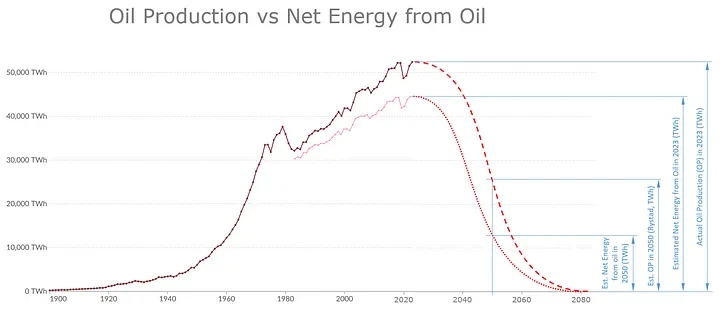
I had a few questions about this graph. I have seen this before and it has been mentioned on this site as well. This is the study but is it accurate?
https://www.sciencedirect.com/science/article/abs/pii/S0306261921011673
If our destination in 2050 is 1/3rd the amount of energy from oil that we get today, what happens on our way there especially with the economy?
Hideaway:
Hi Kira, have a close look at the graph and notice the exponential rise from around 1950 to the early 70’s. Hubbert showed that the rise and fall of world oil production should have followed a normal distribution curve, like individual oil fields tend to do.
When OPEC raised prices and the world realised oil was a finite resource there was a huge change and we implemented many efficiency improvements and substitutions (mostly gas) for oil use. The growth in oil production changed from exponential to linear, and instead of rolling over as predicted by Hubbert, has continued to rise.
We have been dragging future use of oil into the present for the last 25 years, while still growing overall oil extraction, as reserves deplete. Think about oil producers around the world. They have older wells still producing at EROEIs of 20-30:1 or more, plus newer wells in harder to reach places with much more expensive infrastructure and processing. The older wells that paid off their capital costs decades ago are easily the most profitable. They generate the most cash to keep the system going, however it’s the newer wells like shale oil, tar sands, deep water, etc. that help keep the overall price of oil lower.
Which are depleting faster? The old profitable wells, because the trade of goods and services runs on dollars and profit, so oil producers need lots of dollars coming in. Whenever the Saudi’s turn down production, it will be the expensive oil they reduce, not the cheap easy stuff, unless they desperately need to rest fields to protect future extraction.
What this leads to in our world of capitalism economics, is all the high EROEI wells depleting around the same time, just as the cost of maintaining production rises rapidly, because the wells are so much more expensive relative to the oil produced.
Complexity also enters the picture because the extraction processes for newer oils are highly complex operations. For example, horizontal drilling relies on sensors and computing power to keep the drill in exactly the correct strata, 10,000 feet below the surface. The oil sands extraction process uses large modern machines with the latest computers and sensors to maintain optimum efficiency.
Once the easy high EROEI oil is depleted, the remainder becomes much harder to extract because supply lines of equipment and spare parts become less reliable due to reduced economic activity, making everything required to support the complex processes harder to obtain and much more expensive.
Rapid loss of oil production quickly leads to higher oil prices and shortages, with businesses closing as people reduce spending, as happens in every recession, however the declining oil supply will accelerate as other high EROEI wells also reach total depletion, exacerbating the overall problem, with newer oil sources not keeping up with the declines. Deep recession leads to businesses shutting and restricted trade as countries can no longer afford imports, which causes more businesses to go bust.
Factories that earn 10% of their revenue from making essential ‘widgets’ for the oil sector go bust because the other 90% of their business starts operating at a loss, and it is impossible to restart the manufacturing because critical machinery was sold off for scrap in a clearing sale.
Thousands of factories stop making parts critical for a complex system. Without parts, oil rigs and refineries can’t operate, which brings down the entire system.
For us here at Un-Denial, it’s pretty obvious what happens next as the problems will mount and cascade affecting many businesses unexpectedly, thus triggering a self-reinforcing decline.
Most importantly, although demand for oil will fall with recession, oil will not become cheap because supply will also quickly fall. There will not be investment capital available to extract new marginal oil, especially in the Middle East where populations will be suffering from the high price of imported grains and other food, that will become difficult to purchase on the open market. Food exporters will struggle due to high diesel and fertilizer costs and will be forced to reduce production.
Then the next year oil supplies will fall another 5 Mbbls/d, and again the year after, and soon it’s over and most people will be left wondering how those in power let it happen or couldn’t see it coming…
Kira:
Thanks for the explanation.
I hadn’t considered at all that even within countries like Saudi Arabia and Kuwait you will have different EROEI fields. It makes economic sense to keep running the high EROEI wells to get most for your barrel of oil. After reading your explanation I was curious to see the status of old oil fields, the giants and super giants which are collectively responsible for the majority of our crude oil, but most importantly as you pointed out, high EROEI oil. This is the list from wiki:
https://en.m.wikipedia.org/wiki/List_of_oil_fields
Most supergiants were discovered more than 60 years ago. Taking the top two as example Ghawar and Burgan. They both started production nearly at the same time and apparently peaked at the same time (2005) although Saudis don’t confirm it. Ghawar seems to be declining at 2.5% annually and will be down to 2.5 million barrels from a peak of 5 million by 2030. I am sure Saudis are doing everything possible to slow the decline now which will make future decline worse.
It appears as though oil fields like Ghawar are subsidising the extraction of the low EROEI oil like shale and tar sands. The energy comes from the old ones and the volume comes from the new ones, keeping price low and maintaining the illusion of abundance. It’s quite deceptive when you think about it. The net energy keeps depleting while the volume remains same or even increases for a while.
Companies that make generators for offshore oil rigs are a great example of economy of scale tumbling. They probably make generators for hundreds of clients who are not oil companies, when these clients can no longer afford their product the critical mass is lost and they go out of business. Oil companies cannot keep them in business single handedly. This can be applied to other things like pipes as well. This is what the death spiral of the oil industry will probably look like.
Hideaway:
I was thinking when reading your post Kira, yes, yes, yes, yes, yes. I certainly couldn’t have written it better.
On the oilprice.com webpage, there is this article….
https://oilprice.com/Energy/Crude-Oil/Arab-Gulf-Producers-Are-in-Need-of-Much-Higher-Oil-Prices.html
After enjoying a rare budget surplus in 2022, most Gulf Cooperation Council (GCC) economies are seeing their budget deficits widen with current oil prices still well below what they require to balance their budgets. According to the IMF, Saudi Arabia, the GCC’s biggest economy, needs an oil price of $96.20 per barrel to balance its books, thanks in large part to MBS’ ambitious Vision 2030. The situation is not helped by the fact that over the past few years, the oil-rich nation has borne the lion’s share of OPEC+ production cuts after agreeing to cut 1 million barrels per day or nearly half of the group’s 2.2 mb/d in pledged cuts. In effect, Saudi Arabia has been selling less oil at lower prices, thus compounding the revenue shortfall.
Imagine how they cut back, will it be the most profitable oil wells or least profitable ones, when they are so desperate for revenue? Obviously the least profitable ones get reduced while the cheap easy to get oil gets depleted quickly.
What could possibly go wrong when all the cheap high EROEI oil extraction starts declining rapidly just as shale oil uses up its tier 1 and 2 locations…
Perhaps we should have been called Homo dumbass, because we are definitely not ‘wise’.
Rob here on 15-Oct-2024 adding some fresh calculations by Hideaway on the expected speed of collapse, and a response from Kira.
Hideaway:
An aspect of our situation I’ve been thinking of putting down in writing with numbers, so that people can get a better understanding of the collapse ahead…
In regard to oil, we are mining around 100Mbbl/d which will roll over at some point in the near future..
According to some paper I read recently, we currently use around 15.5% of oil to obtain oil and this will rise to 50% of the energy by 2050.. From this paper…
https://www.sciencedirect.com/science/article/abs/pii/S0306261921011673

At the same time as this is meant to be happening, we will be mining a bucket load more metals and minerals for the transition.
What people find so difficult to do is to put several aspects together, to see if it can work, so I’ve decided to try below.
Assuming the increase is 1Mbbl/d/yr in the energy used to gain oil, which is easily possible as we’ve mined all the easy to get oil and only have the harder, more distant supply left, plus allowing for oil production to roll over to a decline in production we get the following…
I’ve used a fall of oil production of 1Mbbls/d for years 2,3 and 4, then 2Mbbls/d for yr 5, and 6, then 3Mbbls/d, for year 7, 4Mbbls/d for yr 8, 5Mbbls/d for yr 9, then a maximum of 6Mbbls/d for years 10, 11, and 12. At no time does the depletion rate go over 10, in these 12 years…
Year 1 …production 100Mbbls input energy 15.5Mbbls … Left for society 84.5Mbbls
Year 2 99M ………………………….. 16.5M ………………. 82.5M
Year 3 98M…………………………… 17.5M ………………..80.5M
Year 4 97M ………………………….. 18.5M ………………..78.5M
Year5 95M ………………………….. 19.5M ………………..75.5M
Year 6 93M ………………………….. 20.5M …………………72.5M
Year 7 90M ………………………….. 21.5M …………………68.5M
Year 8 86M ………………………….. 22.5M ………………….63.5M
Year 9 81M ………………………….. 23.5M …………………..57.5M
Year 10 75M ………………………….. 24.5M ……………………50.5M
Year 11 69M …………………………… 25.5M …………………….43.5M
Year 12 63M …………………………… 26.5M ……………………. 36.5M
Because of the combination of more energy cost of energy (a la Tim Morgan), plus just plain slow decline, the available oil for the rest of society has gone from 84.5Mbbls/d in Year 1 to 36.5Mbbls/d by year 12..
But wait there’s more.. Assuming mining uses 10% of all energy, while in oil’s case makes it around 10Mbbls/d, we know that mining has to increase greatly for the ‘transition’. With the massive increase required, just assuming a 10% increase per year would be conservative, as we are talking a magnitude more copper, Aluminium, Nickel etc, plus all the steel in wind towers and solar farm foundations being built in the TW scale every year etc.
Mining’s use at just 10% growth rate goes from 10Mbbls/d in year 1 to 31.4Mbbls/d in year 12..
When we add this into our calculations of oil available for everything else, we go from 75Mbbls/d in year 1 (100 – 15.5 – 10 = 75Mbbls/d) to 5.1Mbbls/d (63Mbbls – 26.5Mbbls – 31.4Mbbls= 5.1Mbbls/d) for everything else other than oil production and mining..
The above assumptions are very conservative assuming oil doesn’t decline by more than 10% in any one year, that oil used to gain access to more oil goes up by only rises by 6.5%/yr at most, then the growth rate declines (unlikely), plus the 10%/yr increase in oil going to mining wouldn’t get us close to climate/transition/renewable expected growth rates…
Even with those very conservative assumptions, we go from 75Mbbls/d for “everything else” to 5.1Mbbls/d for “everything else” in just 12 years after reaching maximum possible oil production. It clearly can’t and wont happen that way!!
We’ve been dragging future oil use into the present for the last 40-50 years, as shown by the linear increase in oil production since then, whereas we had an exponential rise in production before then.
The above is just putting together 3 aspect of our modern world, instead of concentrating on one and assuming everything else stays constant as just about every ‘model’ does that I come across from ‘experts’ in various fields..
The big question is what happens instead of the above??
Do we cut back oil spending on gaining oil, so that the depletion of existing oil happens much faster than 10%/yr?
Do we cut back on mining so that the transition dies a lot earlier?
Do we assume we will find a magic energy solution to all our problems?
Do we just assume oil production will never decline quickly… because….. just because we don’t want it to???
I didn’t realise how bad the numbers were until I just did the simple calculations and put it down in writing. To me it means we collapse well before the 12 years are up after reaching peak oil production because of many feedback loops creating chaotic disruptions on the way down. Every year we remain close to the peak of oil production, means we are dragging more future oil to the present, meaning the decline when it starts to accelerate will likely be much faster than the sequence above…
Kira:
Excellent analysis!! I just want to mention that the oil that goes into getting oil is mostly in the form of diesel yet only about 75 million barrels that we extract today is the kind of crude that can be refined into diesel. The rest of oil is either shale, NGL, Biofuels among other things which have their uses but not as diesel.
There was also a video that was posted here about a gentleman who mostly agreed with what we discuss here about the irreplaceable nature of fossil fuels and the shortcomings of so called renewables but believed that there is so much oil out there that we will never run out, that we can have shale revolution after shale revolution. There are many who subscribe to this school of thought and think we can extract shale oil and gas from formations in Argentina, Russia, China and many other such places. Art Berman (who has expertise in this area) on Nate Hagen’s podcast has stressed several times that the geology of American shale is very unique and the shale revolution cannot be repeated anywhere else.
If one needs any proof of this please look at China. Despite the CCP pushing the state oil companies hard to extract shale deposits for years gas out has reached only about 30bcm per year which is less than 3% of American output. Part of the reason is the remote location of the deposits in the northern part of the country but we are talking about a country that can create entire cities from scratch within a few years. This is a matter of National security for the Chinese but the geology is the problem and has been unyielding so most efforts have been fruitless and abandoned.
As far as depletion goes even if we take super optimistic figures given by Rystad which predicts that oil production will be down to 50 million bpd by 2050 then the oil available by energy would be worth only about 25 million barrels. This is just a slightly stretched out version of numbers given by you.
It is interesting excersize to speculate on how things will play out on the downslope.
At the beginning of this downslope the airline industry will be the first casualty. Consuming about 8 million barrels of oil and mostly middle distillates at that, this shutdown will provide a much needed relief to the energy constrained world. Of course the commercial airplane manufacturers namely Boeing and Airbus will also go out of business. It is unlikely that governments will have any interest in bailing them out even if they had the ability which they won’t. The tourism industry which depends on air travel will also collapse, as will countries entirely dependent on revenues from it. Depletion will soon catch up and the gutting of industries will start again but this time it won’t be something discretionary and superfluous like air travel. This time industries that touch all our lives will start competing for the remaining share of energy.
Rob here on 7-Nov-2024 adding Hideaway’s answer to a question by ABC on whether Dr. Simon Michaux’s proposed solution of Thorium reactors and iron powder will work.
My take on why this type of future can’t happen is because Simon Michaux misses complexity and scale in the argument we can go to this type of future…
Let me explain, we can only have the complexity of nuclear power and running everything off electricity with an enormous scale of the overall human enterprise we call modern civilization. The scale of this complexity would require much larger markets than we currently have as the number of ‘widgets’ needed to be made for all the complex machinery would be greater than today.
We only have the complexity of today due to the total scale of everything we do. The highly specialised nature of building the best computer chips as an example happens in one place Taiwan with TMSC. The facilities they have built to make these computer chips can only be as sophisticated as it is because of the global scale of it’s customers. To build and operate 50 such facilities around the world would not be possible, they would all go broke. The scale of the facilities built needs the scale of the market size.
To build cheap thorium reactors or any SMR, the “modular” being the important point, would require a massive market as the factories involved, down to the smallest widget all have to be working in co-operation so everything fits together perfectly, so the market needs to be massive so everyone in the chain can make a profit. It also means all the suppliers of parts have to be operating smoothly and at large scale to supply all the inputed metals and minerals.
This all requires the existing system to be maintained while we get the growth in scale of the industry which relies upon the growing demand for the new products from the markets.
Notice how there is growth at every stage to make it all happen!! So if we had a spare planet or 2 of resources to use to accommodate all this growth, then we might get to a more advanced technological civilization, however running into limits of everything we currently use, because of growing energy cost from energy access itself to everything else mined, means we can’t get that advanced.
Also note that to get to where we are today in regards to the totality of civilization has taken growing energy use of all types for over 250 years. It’s been oil that has allowed for the increases of coal and gas use over the last 100 years. All the renewables plus nuclear and even modern hydroelectricity all rely upon oil themselves, and upon oil for the cheap coal and gas used in their production.
If we didn’t care about the environment at all and had another 2 earths worth of oil on this planet, then sure we might get to thorium reactors everywhere, but it will still all rely upon oil.
As oil production starts to rapidly decline, sometime in the near future, I have no idea exactly when, then the ability to keep our modern complexity will quickly unwind. We are getting a ‘sniff’ of this at present by all the countries that want to relocalise so much production, which isn’t possible as we lose the economies of scale of the current globalised system, unless there is an accompanying simplification as well. However no-one is planning for a simplification, the actual plan is to make aspects of the modern world at home. All these plans will quickly realise that they rely on imports of most/all the parts and the relocalisation is not very economic because of smaller market size.
Of course all the duplication everywhere is more inefficient using both more energy and materials to build and taking more people to operate and maintain. We lose some of the existing efficiency in the huge scale of many operations by trying to relocalise them.
What it means by even trying the relocalisation is that the population as a whole gets poorer because of inefficient use of energy and materials (unless we had spare planets worth of all these on this planet!!), due to lack of scale and overall the complexity has to fall to match the energy we have.
Please also note we have no shortage of any material on this planet, just a shortage of energy to access lower grades, and all the processing involved in making them useful goods. It all comes back to existing energy availability within the scale of complexity of what we have as current civilization and we can only build a lot more of any one aspect, while the entire system operates normally. Normally being in growth mode, providing the capital, goods and services required in the usual orderly manner to open new mines. Which means the population needs to be well fed and educated, with abundant services continuing to operate throughout.
We can’t take energy and materials away from one sector to go to another as the odds are they use different aspects of modernity and it’s not a simple swap, with whatever being constrained having feedback loops that are unexpected.
Anyway back to thorium reactors. The industry needs to grow and develop naturally in a world of increasing demand for this product, so it can develop naturally, which takes the rest of the system growing normally. Eventually factories that could build SMR would develop, providing the capital and operating costs were a huge advantage over the existing forms of energy. This can only happen in the background of our system operating ‘normally’, ie growing economies. It can’t be forced, as any developments of forced, as in uneconomic simply don’t last as industries when times turn tough.
When we get a real recession/depression brought on by oil getting more expensive for every other industry, all the expenditures on solar, wind, nuclear and batteries will probably start falling fairly quickly, as these expensive subsidised builds lose market share, as they are too expensive, even for a product (electricity) that is only one aspect of our energy use.
All heavy industry needs a constant cheap energy supply, often in different forms at the same time to produce the raw materials that feed our modern consumption. Without coke, coal, gas and plastics many of the items of modern civilization simply wouldn’t exist at all, so build a huge array of thorium reactors with say the last of the fossil fuel energy available, solves no problems. We wouldn’t be able to make the products we use today with just electricity.
If we were to build fancy new recycling facilities that somehow made use of all existing plastics for re-use in original forms, the whole enterprise would suffer the same entropy and dissipation as everything else and winds down fairly quickly, plus requires a rapidly growing system of modern civilization working normally in the background while it’s built to the scale and complexity required.
Every argument of how we can power a new civilization with solar, wind, batteries, nuclear, thorium or whatever form of electrical energy in the future, argues for a smaller supply of energy needed than now because fossil fuels are inefficient, we only use 25-50% of the energy (depending on the machine). It’s a terrible argument as the increase in the modern civilization growth to get to that point, would mean a much higher energy use than at present, just because of the growth in scale and complexity of everything to just build this future.
Someone should ask Simon Michaux or any other expert about the clean green future whether from renewables normal nuclear or thorium, about how much of it can be built without using fossil fuels at all, including down to the plastic insulation on all wires. The usual answer is it can’t be done yet, but improvements in technology and increased use of renewables/nuclear and how cheap they all become will allow it to produce synthetic fuel for these types of purposes.
I usually counter, with how none of it’s being done now, yet renewables and nuclear are already claimed to be cheaper, so all new factories would already be going to the cheaper ways if it was true, but no-one is doing it, so something is very wrong with the narrative. The argument usually flows to climate reasons why we have to move away from fossil fuels, which is unfortunately a different argument, because the energy required to then mine all the minerals to build this fantastic green future simply doesn’t exist without the use of fossil fuels.
We are in a total and utter catch 22 where we require cheap fossil fuels to build everything and maintain the current modern civilization, which collapses without their use leaving 8 billion cold, angry starving people looking to survive. Using another 2 planets worth of fossil fuels to build the entire renewable/nuclear/thorium future with electricity used for everything, including making plastics and synthetic fuels, will leave the climate and environment in ruins, then collapse anyway, when we turn off fossil fuel use, as that is a sudden energy loss when we continue to require more minerals and metals from the environment, due to those lost from entropy and dissipation, and the increase energy use from all the movement of materials for recycling..
I didn’t even get around to mentioning that a world of recycling everything as much as possible, uses fossil fuels for all the processes anyway, but that’s another story. It’s an incredibly complex situation we are in and any ‘easy’ sounding solution will simply not work as the proponent forgets we spend 97-98% of all our existing energy and materials on just maintenance of the existing system with only the other 2-3% going on ‘growth’ of everything.
Any one new major investment into a great sounding idea on a world wide scale, can simply not work by spending less than 1% of energy and materials use on it, unless the entire system of energy and materials grows massively. As the entire system has to grow, the number we start from in the future will be much higher energy and material use than it is today. The scale and complexity has to also grow to allow for more efficiencies in the system. the starting base of energy use in 30 years time will be double of what it is today..
If we don’t ‘grow’, then we can’t maintain existing subsystems within our civilization, as we need an increasing quantity of energy just for maintenance of material availability. The system can’t work ‘normally’ without the increase in energy, even without growth in the overall system. If we shrink the market size, then we can’t maintain the complexity of the current system either, as the affordability of the complexity goes down, so the system simplifies, which makes gaining access to lower grades of everything much more energy intensive as less complex equipment will mean lower recoveries in mining, lower food volumes from a given area of land etc.
Oops, sorry for excessively long answer. Our civilization is highly complex and so is the reason why none of the bright green ideas can work, and neither can a shrinkage of population while maintaining modernity, but hte attempt to do so, will lead to collapse of it all.
Rob here on 14-Nov-2024. Hideaway and ABC had an opportunity to ask some questions to a couple important leaders in the overshoot awareness community, John Michael Greer and Simon Michaux. Following are the questions and answers plus follow-on commentary from Hideaway.
A.) How can we have modernity without the scale of market size that we currently have to enable the mining, processing, distribution then manufacturing of the huge range of parts that go into making every aspect of modernity?
We can’t. It really is as simple as that. Modernity, as Dr. Richard Duncan used to say, was a transient pulse waveform a one-time, self-terminating affair.
B.) How do we make the machines that make the final product machines in a scale down world?
That asks the question the wrong way around. The right way around is “what kind of final products can we afford to have, given all the constraints on producing them in a deindustrializing world?”
The answer won’t be clear for several centuries, but it’s unlikely that any technology invented since 1900 or so will be included.
C.) How is it possible to maintain complexity, such as a thorium reactor and all the machines it powers on only a small scale?
I’m not a specialist in this technology, of course.
I’m open to the possibility that it can be done, but I want to see an affordable example first.
As we’ve seen over and over again, every nuclear technology is cheap, clean, and safe until somebody actually builds it…
D.) Where do the materials come from after many cycles where entropy and dissipation have worked their magic over many cycles of recycling?
Oh, in the long run say, another 10,000 years we’ll have to go to entirely renewable resources, and that will involve sweeping changes in everything; for example, some future society may cultivate chemosynthetic iron-fixing bacteria (the kind that currently produce bog iron) to keep it supplied with iron. Our immediate descendants won’t have to worry about that, though. Given the scale of population contraction we can expect (around 95% worldwide) and the gargantuan supplies of metal and other materials that have been hauled up from deep within the earth and stored in what will soon be urban ruins, our descendants for the next thousand years or so will have all the metal they can dream of using.
A.) How can we have modernity without the scale of market size that we currently have to enable the mining, processing, distribution then manufacturing of the huge range of parts that go into making every aspect of modernity?
I don’t think we can. It was all dependent on oil as a fuel. We have no replacement for this.
B.) How do we make the machines that make the final product machines in a scale down world?
We have to change our thinking in what we need all this stuff for. Do we need it? Can we do it in a more simplified form? Then ask how we can get there. If we can simplify how the tools are made using more abundant resources (iron vs. lithium for example) then use those machines differently, using modern knowledge.
What have we actually learned over the last 200 year?
The last 20 years in particular?
Can we take a backyard workshop, make a small foundry, have a blacksmith forge, run a basic lathe, drill press and welder, power it with a wind turbine on a lead acid battery?
Strip out useful products from all the places around us that no longer are in operation (cars in a carpark that have been abandoned).
Make an electric motor and a lead acid battery.
Can we shred rubber tyres and make gaskets?
Can we run a furnace to recycle ceramics and building waste into geo polymers
Then you have tech like 3D printers.
Can these be reinvented where we can make our own feedstock and make our own printer unit?
And so on.
C.) How is it possible to maintain complexity, such as a thorium reactor and all the machines it powers on only a small scale?
A Th MSR unit is about 12 m long, about the size of a shipping container and delivers 40 MW of electricity, or 100 MW of heat at 560 deg C.
They are made mostly from steel, nickel and a small number of exotic metals and alloys.
They have a working life of 50 years.
Complexity to run it is about that of running a modern medial isotope lab.
Their production is much simpler than most other devices.
I think it can be done in some cases.
The problem is getting permission to use them.
D.) Where do the materials come from after many cycles where entropy and dissipation have worked their magic over many cycles of recycling?
Contract our material needs per capita.
Simplify what we need to resources that are more abundant.
Most of the purple transition needs iron, which we have lots of.
Copper will be the limiting metal.
Industrial systems have to come into line with food production limitations.
Once we get to the point where recycling and mining can no longer deliver, then society has to work out a way of living without these things or go extinct.
Hideaway’s commentary:
Thanks ABC great work and answers by JMG. He gets the big picture of what’s going to happen, but appears to miss all the feedback loops that will accelerate everything to the downside. We have over 8 billion humans on the planet and 99.99% of them have no idea modernity is going to end abruptly, and when it does so will destroy the plans of the other 0.01% (or less!! ), that did see it coming and tried to prepare in some way.
Lots of people use Cuba as an example of what can happen with building vegetable gardens etc., except forget to mention that it’s in the tropics with fast growth and plenty of water, compared to say the UK which is 2.4 times the size and 6 times the population, plus Cuba today imports around 70%-80% of their food.
Where JMG says it’s asking the question the wrong way around, is incorrect. We are not planning anything about contraction as a species, every machine is becoming more complex allowing for more automation and hence cheaper costs. Once we go down there will not be the investment capital, energy nor materials, nor co-ordination to build any new machines to make anything.
He has once again used how we have done things on the way up, as in using more energy, materials and larger expanding markets; to think that some similar type of planning will occur during the collapse phase. It’s wishful thinking not close to reality.
Realistically, when food is not arriving in cities, who is going to be sitting around talking about what machines they are going to build and what level they can acquire, when there is no energy, nor materials in the appropriate form to do any of it??
One aspect JMG gets completely correct is about thorium reactors….. “As we’ve seen over and over again, every nuclear technology is cheap, clean, and safe until somebody actually builds it…”
There is a very good reason for the cost of all nuclear, of which thorium reactors will be no different, complexity. Every aspect of it is a highly complex specialty. It wont be made from ordinary stainless steel, it will be highly specialised stainless steel, probably with a high quantity of minor elements like molybdenum to allow for the highly corrosive environment of molten salt. “Salt” as in sodium chloride does not play well with most stainless steel, as the chloride is the one thing highly corrosive to stainless steel.
In the huge new refinery in Texas built by the Saudi’s a decade or so ago, upon commissioning someone turned on the wrong valve that sent hot seawater through the piping, causing something like $1.5B dollars in damage and delaying the opening by a long time. Interesting they now call it “caustic” released as it pitted all the stainless steel pipes. If seawater can do that, imaging what 600-800 degree molten salt will do to any weakness of the piping.
Scavenging materials, finding a smelter that can separate all the scavenged materials into the original metal forms, then recombined into the correct quality stainless steel to withstand high temperature molten salt, is a highly complex process by itself, involving a lot of coking coal for the heat. We don’t currently do this for new highest grade materials, we use newly mined purity, for the combination specialist metals, recycled metals doesn’t provide the purity required at this level of specialty. There is no way Simon’s thorium reactor can be rebuilt in a small community, as we would still need the mining of all the separate metals, including his one word reply of ‘exotics’.
What seems to happen is that we get answers about the future that all sound very plausible and comforting, until some person with a bit of knowledge of the intricacies of some part of it comes along to spoil the party.
It’s the highly technical nature of the materials that go into machines, that are then forged into specialized minor, often tiny, sometimes huge parts, with all the connections working in harmony, to make any modern kit, that will be impossible when people are desperate to find food and survive that’s the problem which is overlooked. They always assume some type of normality in the future, just with a much smaller group, forgetting that normality has been a growing human enterprise, with always more energy and materials to make stuff with for generations, and that normality is going to leave us in the near future.
Rob here on 5-Dec-2024 adding an interesting thought experiment by Kira on the energy and material savings benefits of economies of scale and our multi-continent supply chain. With follow-up comments by Hideaway and Kira.
Kira:
I have been trying to think about the benefits that economies of scale and multi continent supply chain provide in terms of energy and material savings and decided to try a simple thought experiment to try to visualize it.
Lets take a simple rudimentary motorbike as an example of the product that we intend to produce at scale. The raw materials will be the metals and alloys needed to make the parts and everything else will be done in house without depending on any external supply chain. The basic parts for a bike are as shown.
If we decide to make everything everything under a single roof (which is what localisation implies) we would have to dedicate seperate machining and fabrication units for each part along with the people with expertise in each of those departments all of which are massive upfront investments and would make the factory a mammoth operation on the scale and size of a gigafactory.
So what are the downsides of this approach?
- It requires massive upfront investment and upkeep.
- The output would be low.
- If we have to serve a country as large as US with localisation we are looking at at least one factory per state leading to large redundancy and waste of production capacity.
Lets approach the same problem and apply a distant supply chain solution.
Since all motorbikes are more or less the same and use same parts shown above we can do the following. Three companies A,B and C may be different bike companies making different types of bikes they will only design and make the frame(chassis) and engine in house and everything else will be outsourced to an external vendor. The suspension will be made by suspension manufacturing company, brakes by a brake manufacturer and so on. So how does this benefit everyone?
- Since the company is only making the frame and engine its factory size will be a fraction of what it would have been in scenario one.
- A dip in demand for company A’s bikes would not result in wasted capacity as company B and C can absorb the common capacity for the parts.
- Less labour requirements as there is lower redundancy as there is only one plant making suspension, brakes, tyres, clutch etc. instead of three.
- Since more resources are freed up the companies can focus resources on research and innovation thereby speeding up progress.
The obvious downside of this is the loss of redundancy and a single point of failure which can halt the production of all bike companies. But the benefits to the civilization as a whole far outweighs the risk as the more complex the product is the longer the supply chain is and the more difficult it would be to make it under a single roof.
If we take microchips as an example and try to take all the processes from raw materials to a finished chip and make everything under a single roof the factory will easily be the size of a small sized city.
When I mean everything I mean everything from the lithography machines to all the other machines, starting all the way from raw materials. That means first making this incredibly complicated machine below starting from metals and alloys mined,processed and shipped to the plant then machined, fabricated and assembled into the machine shown below.
So as complexity of the object increases multi continent supply chain is not only useful but essential to making high tech products. None of this is possible without fossil fuels and high grade minerals both of which are in irreversible decline and will soon lead to the supply chain collapsing leading to a loss of complexity creating a negative feedback loop.
The lithography machine shown above is just one of a hundreds of processes in getting from silicon ingots to a microchip (albeit the most important one). Some of the processes are shown above which require equally complex machines to perform.
Hideaway:

The caption with the photo states .. “just one of the benches the engine was laid out on”.
This was from a 1965 built motor..
Thanks Kira, a brilliant breakdown of complexity, with each of the above different main parts of a motor bike having so many components themselves. A simple motorcycle can have 2,000 – 3,000 separate parts.
Our complexity of modern life is just lost on so many people, not understanding that each and every part has to be made precisely from the exactly correct materials, to work together and function as a whole ‘machine’.
The other huge misunderstanding is that we need the total complexity to gather the food, energy, and materials that make up this complexity as we have used up all the easy to get food, energy and materials.
The motorbike example is a simple machine compared to a horizontal drill rig with tens of thousands of separate parts, including many computer chips, in many separate parts of the rig, from control systems to sensors to actuators, communication systems, power systems.
Without modern horizontal drill riggs our oil production would fall rapidly by a large percentage and these machines are dependent upon lots of spare parts arriving nearly every day.
When we start to lose overall energy availability, especially oil production because of depletion, the complexity has to rapidly unwind, as there is simply not enough energy to keep it all going. Once feedback loops kick in, of lack of parts, then machines we rely on become junk very quickly, which accelerates chaotic feedback loops.
The concept of going local, means massive simplification, because we don’t have either the energy nor materials locally to do anything differently, which means we will be unable to feed the current huge populations of local areas as all the modern machines cease to function. Fertilizer becomes a thing of the past, tractors can’t get oil and grease, let alone fuel, likewise for all transport from local rural areas, to cities.
Modern humans have just forgotten how reliant we all are upon 6 continent supply chains for our very existence…
“Kleiber’s law” of power/mass use to the 3/4 power most likely applies to human civilization. Studies have shown that in nature the law is a doubling of animal or plant mass requires a 75% increase in energy use because of efficiency gains is the easy explanation.
In human settlements research, done by Prof Geoffrey West and a host of others, they have found human population centres the power law is closer to 85%, as in we are not as efficient as nature with a 4B year head start. The problem with all the work on settlement sizes is that we live in a world of one global civilization and no city is an entity to itself, which they were 500-10,000 years ago, including their surrounds.
Kira:
Actually it was your exchange with Dennis on POB that lead me to have this train of thought. I found this line by him to be quite revealing of how people like him think.
Dennis: “Society is not based on physical laws alone, it is understood using knowledge such as sociology, psychology, and economics.”
Cornucopians like him always point out how GDP is growing with less energy use ie growth is becoming less energy intense. We know this is primarily because of massive financialization of economy but when you point that out his reply is that GDP calculation are a reflection of physical and thermodynamic reality of the society. It’s funny how he tries to have it both ways whenever it is convenient.
He is wrong as usual. Let’s take three bike companies on three continents North America, Europe and Asia – Harley, Triumph and Honda respectively. Assuming that there is no contact between the continents and each company has complete monopoly over their respective continents without any alternative then they can manufacture in whatever configuration they want. They could make everything under the same roof with redundancy and inefficiency or outsource their production of components to third party and cut costs.If they are inefficient their customers end up paying more than their counterparts on other continents.
But as soon as we apply the situation of globalization and they have to compete with each other they will have no choice but to reorganise themselves in a way to reduce material and energy costs and if they don’t they go out of business. You were right in your counter that civilization is very much like an ant hill and just like how no ant has the complete blueprint, no human has the complete design of civilization. It is not intentional, it is self organizing and self assembling. Complexity increases to solve problems and with increase in complexity comes increase in material and energy cost. When this happens the system reorganizes itself to optimize resource consumption. There is no way to intervene here.
For instance Ford could probably manufacture every component of its car under the same roof 85 years ago but with today’s complexity they probably have hundreds of suppliers that they share with many other car companies. If an American president declares that every inch of a Ford vehicle must be made on American soil the company would immediately go bankrupt as if they tried to do that a car that costs 20,000 would cost 200,000.
This pattern holds even across completely different industries.


This is a ridiculously condensed and shortened version of the supply chains of Apple and BMW. All supply chains end up either at pits of mines or oil and gas rigs as everything we produce comes from earth as raw materials. The suppliers in greens are the common ones for both companies and hundreds of others including oil and gas rigs. If we fully expand the supply chains we will see countless overlaps with one another with constant reorganization happening to optimize resource consumption. The true scale of feedbacks and overlapping is so complex that it is impossible to even comprehend. But there are some interesting things we can glean from the above diagram. The critical mass of consumers for the chip industry is coming from consumer electronics meaning that the auto industry and oil industry are just beneficiaries of this. If people stop buying smartphones and PCs then oil companies and car companies go out of business. There are several such critical dependencies that may not be so obvious at first glance and may be far down the supply chain.
Of course the connective tissue connecting the supply chain is oil since without we cannot maintain the multi continent movement or power the mining machines at the end of the supply chains.
Hideaway:
Thanks, Kira, excellent work again.
Trying to get people to understand the connection between the overall size of the growing market, relative to the complexity is extremely difficult, especially when added to the overall energy and material savings to the entire super organism of the human civilization.
Because of collapsing grades of ores of all types, we need the complexity of modern machinery, modern financing and modern supply chains, to gain access to all the requirements of all materials and energy used. It’s a self feeding monster that has to grow just to gain access to the requirements.
Unwind any aspect of modern complexity and the whole lot collapses, yet keep growing and the whole lot collapses due to environmental limits anyway.
Most likely oil will be the limiting factor, that sets in motion feedback loops in reduced consumption of all the requirements used in modern complexity, and your example of discretionary spending on computer chips is the perfect example, but we can multiply this by thousands for all the unknown links that are necessary to keep modern complexity going.
The concept of localizing industries, plus using tariffs to do so, will just hasten the collapse as it uses up more energy and material resources to build all the local manufacturing plants and tool them up, let alone gain the raw materials and energy for their operation. Just the attempt to do this will likely set off other unknown feedback loops as the extra energy and materials involved in the attempt to localize puts pressure on other aspects of the system.
Of course it’s all just a duplication of what’s already happening elsewhere, supplying the world, so the energy and materials are effectively wasted giving higher costs to consumers everywhere because of the duplication. Now imagine 5-50 countries trying to do the same for their local markets.
We can’t have 50 TMSC factories around the world as there is just not the market for that number of computer chips, with the complexity it takes to produce them. That factory/foundry whatever they want to call it has to churn out millions of wafers and chips to be viable. It wont work with 50 of them, unless the super-organism of human civilization grows by enough to accommodate the increase, which means every facet of civilization has to grow including population, energy and material use.
Once oil declines because of depletion and the impossibility of an increased production, whenever that happens, then overall energy availability turns down, meaning the growing organism can’t keep growing, nor even maintain what’s built and operating as entropy guarantees we require 97-99% of all energy and materials to just keep operating ‘normally’. (All while energy use keeps growing to supply the raw materials because of lower grades).
Once energy of all types that totally rely upon oil start suffering from increased costs, as oil’s harder for any one business to obtain, the civilization that relies upon cheap energy, suffers from reductions in internal markets from those struggling, meaning less markets for computer chips, and every type of machine that relies upon them, sending businesses broke, that manufacture essential requirements of other businesses, so creating a cascade of accelerating failures across civilization itself, in producing everything required to just maintain and operate what exists.
We’ve been in extend and pretend mode for over 50 years, making up a linear increase in oil supplies, with exponential increases in coal and gas energy supplies to make up the required energy of the growing civilization, then added some nuclear, solar, wind, geothermal etc, all just electricity providers, which are not providers of the full range of products and energy supplied by fossil fuels.
The increase in coal and gas though is totally reliant upon oil, with the rest being just derivatives of fossil fuels in total.
The complexity of the entirety of the system would take multiple books to explain just the merest of details of any one component of the overall complexity of how we live. It’s beyond the comprehension of anyone, as it’s exactly as explained by Kira above, so people without thinking of the overall complexity, assume we can just increase one part of this civilization by increasing something massively, on a world wide scale, without having implications elsewhere, nor have any understanding how everything else has to keep working normally for their one aspect to increase greatly. (EVs, batteries, solar, wind, geothermal, tidal, and nuclear).
Single cell organisms, multiple cell organisms, storms, stars and all prior civilizations have grown with increasing complexity over time, yet all eventually collapse due to some type of internal energy usage decline, that collapses the overall system.
To think our modern civilization will be ‘different’ to everything else in the universe that is large and grows complexity internally, increasing energy use until collapse, is denial in it’s finest form.
 un-Denial
Drives me crazy. Sam has a very firm grip on his own denial. He should be MORT’s #1 fan.
He’s impressed me on numerous occasions with it. Sometimes he even talks you through it. For example, one video had him reviewing Graham Hancock’s ‘Ancient Apocalypse’. In one of the episodes Graham debunks the overkill theory of North America 12,000 years ago.
I had to watch that episode for myself and Graham does tell a convincing story, but who cares if he’s right or wrong. The impressive thing was how Sam reacted. Sam has been a hardcore overkill believer for 15 years. He talks about how Graham is messing with his deeply held worldviews. And how he understands that it’s his denial that is making him reject Grahams story. And how he overcame the denial and now believes Graham’s theory.
Sam’s handling of it was the textbook way to confront what you don’t like. And like I said, Ive seen this multiple times from him. But then five minutes later he’ll say something idiotic like that quote you used above. Or “how come nobody but me and my fellow doomers can see this shit”.
The litmus test for being allowed to talk about collapse should be: Why are you in such a small population when it comes to understanding overshoot? (if your answer does not focus on denial or MORT, then you are not allowed on the air anymore)
p.s. Who’s Alex Smith?
LikeLike
Sorry, I meant to reply to your post above.
LikeLike
Alex Smith it the long running host of the best podcast on climate change.
I can’t find my post that went into the detail of what happened but in this interview you will hear Smith understands the significance of MORT. Then a few weeks later he completely “forgot” about it and went back to wondering in every episode why we deny climate change and why we don’t do anything to “fix” it.
LikeLiked by 1 person
More or less the same thing happened with Rachel Donald after she interviewed Varki.
MORT does not stick in most brains. Too unpleasant. Wipe those thoughts.
https://un-denial.com/2023/03/09/by-ajit-varki-why-men-are-destroying-the-planet-planet-critical-interview/
LikeLiked by 1 person
Interesting. Thanks. Interview was really good. And like you said, excellent essay by Alex Smith introducing it. I don’t get it. Alex seems like you and Varki’s #1 fan. Maybe he’s just a typical phony asshole.
Or maybe MORT really can just pump the brakes on an overshoot aware person who is wanting to explore denial. I wonder the same about former audience members that no longer buy into denial. Hard to picture. I just imagine myself one year from now after disavowing MORT. And then constantly wondering why we are denying climate change and why nobody else can see what I see. LOL!!!
This was an excited person who (just like me) was blown away by the obviousness of denial on day one of finding this site:
Rob, I’m sure you dislike Marg’s reply. Me too. Is it true though?😊 Is the denial rabbit hole only possible for the tiny few with defective genes? Did Ernest have it all figured out?
LikeLike
Alex is not an asshole. He has devoted his life to raising awareness of the climate change threat and struggles to understand and accept our collective failure. I think he’s just another example of MORT in action.
At the core of what fascinates me is the lack of interest in understanding what’s really going on.
Perhaps MORT is wrong but it is a plausible coherent science based explanation for both the existence of a very unique species and one of its genetic behaviors that is most consequential for whether or not that species prematurely extincts itself.
It seems to me people should be discussing MORT and if they disagree with some aspect then offering a better scientific explanation.
But they don’t. The most important issues are never discussed. They are denied.
LikeLiked by 2 people
ditto that on Alex Smith, definitely the real mccoy, dedicated for 20 years now to bringing the science to the public on ecoshock.org.
Another piece of the puzzle that people ignore, including Alex, is the Garrett Relation, so named by Richard Nolthenius, astronomy prof at https://www.cabrillo.edu/~rnolthenius/. Basic idea, civilization is a heat engine and needs a immutable amount of energy just to keep going, never mind to grow. This demonstrable fact along makes a final act, a denouement, to the civilization project a no-brainer, an object of denial.
LikeLiked by 2 people
Dear Paqnation,
I hope thou are feeling well.
What evidence and/or notions does Mr. Hancock provide?
In contrast, a presentation by Dr. Surovell.
Kind and warm regards,
ABC
LikeLiked by 1 person
Hello ABC. I had a feeling I wasn’t going to get away with sneaking Grahams crazy theory in that post😊.
I can’t remember the details, but the gist of it was that Graham and his team dug up the sand and discovered megafauna footprints next to human footprints from 12kya. When they dug deeper they kept seeing both type of footprints. All the way back to 23kya. They concluded that humans did not hunt them to extinction, but that the holocene was responsible.
The episode did a better job than I am doing at presenting the evidence. But I do not recommend it. Its a big budget production. Constant spooky, suspenseful music. And the rest of the bullshit that comes with reality tv. Like I’m supposed to believe that Graham and his team are looking at the results for the first time (as I’m seeing it)… so dumb.
And Graham said something like “In my experience I have never seen any evidence that humans have hunted megafauna extinct anywhere in the world.”
To Sam’s credit, he said Graham is crazy for making that statement. Sam is sure that overkill is real and happened in many areas. But he now thinks it did not happen in N.A. 12kya. Sam does say though that if the holocene had not happened, humans would have still eventually wiped out the megafauna in N.A.
Here’s the video of Sam reviewing the show in case you have any interest.
LikeLike
One thing that amazes me that is literally mort in action is seeing how the people of Gaza keep trying to live. With all the suffering, they are going through and no prospects for peace. Their optimism bias proves the theory perfectly.
LikeLiked by 1 person
It is amazing.
Genocide is happening in plain sight and our western leaders and news media ignore or rationalize or support it.
I’ve been to Israel twice and worked with many Israelis. I know they are not setup for a prolonged war, nor are they able to tolerate even modest losses.
My guess is something will break pretty soon.
LikeLike
I’ve never watched the classic movie American Psycho (2000). I know it’s a satirical, black comedy that I might enjoy. I hate gory slasher films though, so I’ve always stayed away. And it gives me strong vibes of the movie Sunshine (2007). Sunshine is one of the greatest sci-fi films ever made… until the final 30 minutes or so when it turns into a slasher film.
But I just came across this excellent clip. Sums up exactly how I feel about this red pill knowledge and what I want to do with it.
LikeLike
If rintrah ends up being right about bird flu then this could actually be the catalyst that brings the complexity crashing down.
https://www.rintrah.nl/what-nobody-wants-to-hear-about-bird-flu/
Lets hope that it will not be so bad in humans – at least for now.
LikeLike
So many serious threats today.
LikeLike
We f*cked around, now we are about to find out.
LikeLike
I read his post on the link you put up. Don’t know what to think . . . maybe he’s right? (maybe I’m in denial). My problem with the effects of the Corona Virus (and all other viruses) is that there is a lot of hubris from all the explainers/experts. Is it the effect of the virus or are we dealing with the effects of the gene therapy (mRNA shots) in a terribly unhealthy population? All of that AND the immune system function being something we still don’t fully understand/comprehend in its evolutionary complexity and interaction with the outside biological world (viruses and their evolution).
All to many questions and too many conflicting answers (from too many who think they have it right and everyone else has it wrong).
AJ
LikeLike
Yes it is hard to see the forest for the trees in this.
LikeLike
https://www.collapsemusings.com/7-reasons-theres-going-to-be-a-global-famine/
LikeLiked by 1 person
Whatever happened to Alan Urban? His first essay was in Oct ’22. His last was in March ’24. Only a 1.5 year run but this dude always had good articles.
Wonder if he went the Chefurka route… or the Ruppert route… or maybe he said everything he wanted to say and now lurks in the background.
LikeLike
I follow him on X (Twitter) and he usually posts some picture/cartoon (on climate change/overshoot) with a pithy comment almost every day.
AJ
LikeLiked by 2 people
LikeLiked by 1 person
You’ve got to admire Hideaway’s patience and persistence. I gave up on POB a long time ago.
Think about it for a moment. A rare site that exists to discuss a taboo topic in society, peak oil, denies the implications of peak oil.
There is almost no discussion of anything that matters anywhere.
https://peakoilbarrel.com/open-thread-non-petroleum-october-28-2024/#comment-782598
https://peakoilbarrel.com/open-thread-non-petroleum-october-28-2024/#comment-782689
LikeLiked by 2 people
I’m sure it’s the Aspergers or semi Autism that keeps me going from the test results above.
LikeLiked by 2 people
Nice rant today from Sabine Hossenfelder.
My interpretation is that we have hit complexity limits to what is possible to understand.
It’s not so bad, we should be proud of what we do understand which is a LOT.
And we understand a LOT more than every other species on this planet that did not evolve a tendency to deny unpleasant realities.
LikeLike
Science is like every other aspect of human civilization development, we have taken the easy pickings first and are now suffering from diminishing returns on investment.
Humans started farming on the fertile river flats where water was easy and likewise nutrition for the plants we could eat.
We started mining of high grade nuggets of metals which just needed heating to reshape, so high was the metal content of the rock..
We started trade with our close neighbours first as they were so close..
The early science was knowing which plants were the best to grow in the fertile river valleys, and the best rocks to heat up to meld into tools or trinkets to trade with the neighbours who had something we wanted, as it was less painful than fighting over the lot when we had plenty spare and so did they.
Science received a huge boost a couple of hundred years ago, when a lot of people were freed up from mundane chores to think of how to make life better for everyone, because of coal powered machines starting to do the work of people.
In the early 20th century, a lot more people were freed from manual farm labor which allowed new scientific inventions of measure to be discovered.
Is it a coincidence that science is failing from around 50 years ago when the oil exponential growth stopped?? Or was it to be expected…
LikeLike
What you say is probably true for some science disciplines and definitely true for many technologies but in the case of theoretical physics there has been plenty of investment and people working hard.
They simply have accomplished nothing in 50 years.
I view this as a glass half full because if you have a close look at what we figured out 50 years ago it is staggering and plenty enough for our species to claim as its pinnacle never to be repeated achievement before it goes extinct.
LikeLike
It’s the law of diminishing returns I was trying to get at, just because they have used lots of people and money/energy to get an outcome, doesn’t mean it’s enough. If we’d had the information coming from JWT for decades, they might have come up with more accurate theories that explain the universe better by now.
Likewise for something that can look at smaller particle size than an electron microscope or whatever can ‘see’ the smallest particles currently. The science fact comes after the instruments that can measure or ‘see’ if some theory is fact/observable.
LikeLike
Pharma got what it wanted.
By playing along with the US/China plandemic intended to reduce oil consumption, and to provide an excuse to print trillions to save the banking system, and to implement the tools necessary to maintain social order when the economy collapses due to overshoot, pharma got a new technology approved without having to pass the normal safety and effectiveness tests.
Now they are using that fraudulent approval to rush new products to market using the same dangerous mRNA platform.
They won. We lost. And nobody gives a shit.
After all, it’s shiny new innovative technology that we need more of to grow.
LikeLiked by 1 person
Liberalism is a death cult
LikeLike
Fun full-on no-holds-barred rant by Rogan and Musk today trying to out-influence the Russians on tomorrow’s election.
I loved the attacks on Fauci and pharma.
LikeLike
When pressed Musk backpedaled and offered a softer less certain forecast.
LikeLike
Civilization certainly won’t exist in its current form. The big question is not whether civilization will go bankrupt, but the question is whether the bankruptcy will be chapter 7 or a chapter 11.
For those who haven’t heard of chapter 7 and chapter 11.
https://www.bunchandbrocklaw.com/difference-between-chapter-7-11-13-bankruptcy/
LikeLiked by 1 person
Hi Stellarwind72, I don’t think civilization as a whole will go bankrupt as we know it, but individual countries on the way down will certainly go bankrupt like Sri Lanka, or Lebanon currently are.
Civilization as a whole will go energy bankrupt, where the flow of energy enabling the flow of goods seizes up, leaving people in cities throughout the world, stranded, hungry, cold and desperate.
The actual bankruptcy as in money terms will be obvious as sovereign countries with their own currencies print to hyperinflation during the collapse, but there will be no way to fix those monetary bankruptcies. You also have to remember that chapter 7 or 11 or whatever are just US terminology/rules, different rules apply all over the world..
LikeLike
In case you have not encountered him, Daniel Patrick Welch is one of my favorite geopolitical analysts on the Ukraine conflict.
LikeLiked by 1 person
Here’s a happy story to take your mind off the election.😊
A mother intentionally went over Niagara Falls with her 2 children, police say
That woman took the cowards way out. I hope that sounded ridiculous. Nothing cowardly about it. That is one hell of an exit strategy. I hear a story like this and end up obsessing for a day or two about what her planning involved. (and I know the kids being involved triggers most people, but not me)
I’ve been on the lookout for the perfect plan for most of my life. Nothing dark about it, mainly just for peace of mind. My checklist is the same as everyone else: quick, painless and easy to commit to. In other words, chickenshit.
My Grand Canyon trips always turn into reconnaissance missions. I know of a couple very secluded sweet spots to jump from. But it doesn’t meet the checklist. 4000ft (1219m) down is quick and painless. But not easy to initiate. That’s why I’ve got mad respect for this woman. And Niagra Falls is only a 170ft drop (52m).
This description of Golden Gate Bridge turned me off long ago to the jumping in water option: The deck of the bridge is about 245 feet (75m) above the water. After a fall of four seconds, jumpers hit the water at around 75 mph (120 km/h). Most of the jumpers die due to impact trauma. About 5% of the jumpers survive the initial impact but generally drown or die of hypothermia in the cold water.
How Many People Have Died in the Grand Canyon? – We’re in the Rockies
This link had some interesting info about deaths at the Grand Canyon: There have been 91 suicides (Bullshit! Way too low. Officials have been hiding suicide statistics forever), with jumping off the ledge being the most common method. But there have been 13 times when someone drove their vehicle off the ledge intentionally. (Haha!! Now that’s how you do it). Three of these occurred in one year, 1993. This came on the heels of the film Thelma & Louis, which was released in 1991 to critical acclaim.
And this one takes the cake. It conjures up an image of Leslie Nielsen from the Naked Gun movies:
LOL. Dying peacefully in your sleep is the absolute peak of good fortune.
LikeLike
Are the news anchors on mainstream channels crying yet?
LikeLike
Tonight’s shaping up to be the greatest David & Goliath comeback story in history.
In a few months we’ll have the greatest revenge story in history with my favorite chapter starring RFK Jr beating on pharma.
LikeLike
Or, this time Trump wins, so that people learn the lesson completely: no central power works in their favor at this point (because they can’t, it’s not even malevolence or conspiracy. They are mostly impotent and try to maintain the illusion they are not).
We will see 🙂
LikeLike
Agree on issues like making America great again, improved standards of living, and less war.
But we’ve got a chance with healthcare. RFK Jr. tonight confirmed he will force pharma to conduct clean, fair tests of vaccines against placebos.
None of the 70+ vaccines we inject into children today have been properly tested.
LikeLike
here’s hoping RFK can make a change.
LikeLike
Yes indeed.
I certainly hope there will also be more light on what happened during the covid madness.
LikeLike
That would be something remarkable to see, can you share a source for that? If he goes on to demand a fair look at the risks of vaccines as well as their potential rewards, I imagine the great majority of vaccines will be removed from use.
LikeLike
He’s also going to remove fluoride from the water supply.
Skip to 1:50:47.
LikeLike
Is RFK going to be the next republican candidate for president in 4 years time?
LikeLike
We can hope but I doubt it. He’s too smart and has a weird speech impediment.
Vance is pretty bright too but has that good ol’ boy demeanor Americans like.
Maybe Vance will run with RFK Jr. as VP?
LikeLike
LOL. Not yet. I think they learned their lesson from 2016.
We don’t have cable so I can’t see Rachel Maddow and those idiots. But my mom is surfing the local channels and each station has their own circus going on. Lots of charts and graphics. CGI might even be going on.
Remember when that tool Anderson Cooper became famous overnight for his Hurricane Katrina coverage. That’s the vibe I’m getting from all these no name newscasters. Just trying to use this election to catapult themselves into celebrity status.
LikeLike
Since Trump seems likely to win, Canada might see a quite a few American refugees…
LikeLike
We need stupid laborers. We’ll put them to work in our farm fields.
LikeLike
If they could get Canadian healthcare, it wouldn’t be a bad deal. The #1 cause of bankruptcies in the U.S. is medical bills.
LikeLike
The reason medical bills are so high is because most Americans are obese because they eat crap and don’t get enough exercise, and they believe their corrupt medical system which tells them to take drugs to “fix” themselves.
American children have also been damaged by improperly tested vaccines that are forced on them without full disclosure of risks and benefits.
LikeLike
Sorry, I can’t remember who told me about Georg Rockall-Schmidt’s channel but he’s made some good videos on our predicament.
Here’s a recent 3 part series on limits to growth and overshoot.
LikeLike
I’d never come across him until now. I’ve enjoyed listening to his content. He has some interesting stuff. Thanks
LikeLiked by 1 person
Dear Hideaway,
I hope thou are feeling well.
Dr. Michaux is not providing a total systems solution or full extensive civilisational analysis and EROI on how to acquire and develop iron powder etc.
Partial solutions which could be of use, if implemented wisely.
Kind and warm regards,
ABC
LikeLike
My take on why this type of future can’t happen is because Simon Michaux misses complexity and scale in the argument we can go to this type of future…
Let me explain, we can only have the complexity of nuclear power and running everything off electricity with an enormous scale of the overall human enterprise we call modern civilization. The scale of this complexity would require much larger markets than we currently have as the number of ‘widgets’ needed to be made for all the complex machinery would be greater than today.
We only have the complexity of today due to the total scale of everything we do. The highly specialised nature of building the best computer chips as an example happens in one place Taiwan with TMSC. The facilities they have built to make these computer chips can only be as sophisticated as it is because of the global scale of it’s customers. To build and operate 50 such facilities around the world would not be possible, they would all go broke. The scale of the facilities built needs the scale of the market size.
To build cheap thorium reactors or any SMR, the “modular” being the important point, would require a massive market as the factories involved, down to the smallest widget all have to be working in co-operation so everything fits together perfectly, so the market needs to be massive so everyone in the chain can make a profit. It also means all the suppliers of parts have to be operating smoothly and at large scale to supply all the inputed metals and minerals.
This all requires the existing system to be maintained while we get the growth in scale of the industry which relies upon the growing demand for the new products from the markets.
Notice how there is growth at every stage to make it all happen!! So if we had a spare planet or 2 of resources to use to accommodate all this growth, then we might get to a more advanced technological civilization, however running into limits of everything we currently use, because of growing energy cost from energy access itself to everything else mined, means we can’t get that advanced.
Also note that to get to where we are today in regards to the totality of civilization has taken growing energy use of all types for over 250 years. It’s been oil that has allowed for the increases of coal and gas use over the last 100 years. All the renewables plus nuclear and even modern hydroelectricity all rely upon oil themselves, and upon oil for the cheap coal and gas used in their production.
If we didn’t care about the environment at all and had another 2 earths worth of oil on this planet, then sure we might get to thorium reactors everywhere, but it will still all rely upon oil.
As oil production starts to rapidly decline, sometime in the near future, I have no idea exactly when, then the ability to keep our modern complexity will quickly unwind. We are getting a ‘sniff’ of this at present by all the countries that want to relocalise so much production, which isn’t possible as we lose the economies of scale of the current globalised system, unless there is an accompanying simplification as well. However no-one is planning for a simplification, the actual plan is to make aspects of the modern world at home. All these plans will quickly realise that they rely on imports of most/all the parts and the relocalisation is not very economic because of smaller market size.
Of course all the duplication everywhere is more inefficient using both more energy and materials to build and taking more people to operate and maintain. We lose some of the existing efficiency in the huge scale of many operations by trying to relocalise them.
What it means by even trying the relocalisation is that the population as a whole gets poorer because of inefficient use of energy and materials (unless we had spare planets worth of all these on this planet!!), due to lack of scale and overall the complexity has to fall to match the energy we have.
Please also note we have no shortage of any material on this planet, just a shortage of energy to access lower grades, and all the processing involved in making them useful goods. It all comes back to existing energy availability within the scale of complexity of what we have as current civilization and we can only build a lot more of any one aspect, while the entire system operates normally. Normally being in growth mode, providing the capital, goods and services required in the usual orderly manner to open new mines. Which means the population needs to be well fed and educated, with abundant services continuing to operate throughout.
We can’t take energy and materials away from one sector to go to another as the odds are they use different aspects of modernity and it’s not a simple swap, with whatever being constrained having feedback loops that are unexpected.
Anyway back to thorium reactors. The industry needs to grow and develop naturally in a world of increasing demand for this product, so it can develop naturally, which takes the rest of the system growing normally. Eventually factories that could build SMR would develop, providing the capital and operating costs were a huge advantage over the existing forms of energy. This can only happen in the background of our system operating ‘normally’, ie growing economies. It can’t be forced, as any developments of forced, as in uneconomic simply don’t last as industries when times turn tough.
When we get a real recession/depression brought on by oil getting more expensive for every other industry, all the expenditures on solar, wind, nuclear and batteries will probably start falling fairly quickly, as these expensive subsidised builds lose market share, as they are too expensive, even for a product (electricity) that is only one aspect of our energy use.
All heavy industry needs a constant cheap energy supply, often in different forms at the same time to produce the raw materials that feed our modern consumption. Without coke, coal, gas and plastics many of the items of modern civilization simply wouldn’t exist at all, so build a huge array of thorium reactors with say the last of the fossil fuel energy available, solves no problems. We wouldn’t be able to make the products we use today with just electricity.
If we were to build fancy new recycling facilities that somehow made use of all existing plastics for re-use in original forms, the whole enterprise would suffer the same entropy and dissipation as everything else and winds down fairly quickly, plus requires a rapidly growing system of modern civilization working normally in the background while it’s built to the scale and complexity required.
Every argument of how we can power a new civilization with solar, wind, batteries, nuclear, thorium or whatever form of electrical energy in the future, argues for a smaller supply of energy needed than now because fossil fuels are inefficient, we only use 25-50% of the energy (depending on the machine). It’s a terrible argument as the increase in the modern civilization growth to get to that point, would mean a much higher energy use than at present, just because of the growth in scale and complexity of everything to just build this future.
Someone should ask Simon Michaux or any other expert about the clean green future whether from renewables normal nuclear or thorium, about how much of it can be built without using fossil fuels at all, including down to the plastic insulation on all wires. The usual answer is it can’t be done yet, but improvements in technology and increased use of renewables/nuclear and how cheap they all become will allow it to produce synthetic fuel for these types of purposes.
I usually counter, with how none of it’s being done now, yet renewables and nuclear are already claimed to be cheaper, so all new factories would already be going to the cheaper ways if it was true, but no-one is doing it, so something is very wrong with the narrative. The argument usually flows to climate reasons why we have to move away from fossil fuels, which is unfortunately a different argument, because the energy required to then mine all the minerals to build this fantastic green future simply doesn’t exist without the use of fossil fuels.
We are in a total and utter catch 22 where we require cheap fossil fuels to build everything and maintain the current modern civilization, which collapses without their use leaving 8 billion cold, angry starving people looking to survive. Using another 2 planets worth of fossil fuels to build the entire renewable/nuclear/thorium future with electricity used for everything, including making plastics and synthetic fuels, will leave the climate and environment in ruins, then collapse anyway, when we turn off fossil fuel use, as that is a sudden energy loss when we continue to require more minerals and metals from the environment, due to those lost from entropy and dissipation, and the increase energy use from all the movement of materials for recycling..
I didn’t even get around to mentioning that a world of recycling everything as much as possible, uses fossil fuels for all the processes anyway, but that’s another story. It’s an incredibly complex situation we are in and any ‘easy’ sounding solution will simply not work as the proponent forgets we spend 97-98% of all our existing energy and materials on just maintenance of the existing system with only the other 2-3% going on ‘growth’ of everything.
Any one new major investment into a great sounding idea on a world wide scale, can simply not work by spending less than 1% of energy and materials use on it, unless the entire system of energy and materials grows massively. As the entire system has to grow, the number we start from in the future will be much higher energy and material use than it is today. The scale and complexity has to also grow to allow for more efficiencies in the system. the starting base of energy use in 30 years time will be double of what it is today..
If we don’t ‘grow’, then we can’t maintain existing subsystems within our civilization, as we need an increasing quantity of energy just for maintenance of material availability. The system can’t work ‘normally’ without the increase in energy, even without growth in the overall system. If we shrink the market size, then we can’t maintain the complexity of the current system either, as the affordability of the complexity goes down, so the system simplifies, which makes gaining access to lower grades of everything much more energy intensive as less complex equipment will mean lower recoveries in mining, lower food volumes from a given area of land etc.
Oops, sorry for excessively long answer. Our civilization is highly complex and so is the reason why none of the bright green ideas can work, and neither can a shrinkage of population while maintaining modernity, but hte attempt to do so, will lead to collapse of it all.
LikeLiked by 1 person
Nice. Appended to the essay above.
LikeLike
Dear Hideaway,
I appreciate thine response.
Affirmative, I am a proponent of these perspectives.
I will try to formulate these elaborations and ask Dr. Michaux, whilst avoiding any connotation of insult.
Kind and warm regards,
ABC
LikeLike
Hi ABC, I forgot you were involved in those podcasts with Andrew, Simon and Steve and sometimes John Peach when I wrote the above.
Some specific questions comments from myself and perhaps others via you might be useful, see what you think…
How can we have modernity without the scale of market size that we currently have to enable the mining, processing, distribution then manufacturing of the huge rage of parts that go into making every aspect of modernity?
How do we make the machines that make the final product machines in a scale down world?
How is it possible to maintain complexity, which is what a thorium reactor and all the machines it powers on only a small scale?
Where do the materials come from after many cycles where entropy and dissipation have worked their magic over many cycles of recycling?
You can use my nick as the source of the questions if you like, they are just for starters. I’m sure others would have many types of questions, just to see what answers come back…
I enjoy those monthly podcasts, up until the hopium kicks in…
LikeLike
Just adding a few questions and or comments to Simon’s presentation in the post above….
Strategic design…. The way everything is currently designed and manufactured is because it’s the easiest, cheapest most efficient way to make whatever product. To design for full recyclability, might preclude many products for modernity because the only way to separate some of the components is via pyrometallurgy (sometimes too expensive with minor rare earths in hard drives etc) so it gets dumped.
Without the rare earths in the products, we don’t have the product, there is not a simple way to make these complex machines. Hard drives recycling, as an example of just one of hundreds of thousands, to millions of products, that we need to recycle separately, it makes the recycling process an enormous industry by itself, then all the separating of everything to go to the correct recycling facility, needs a transport and sorting infrastructure etc…
We only get all these new large industries with growth, we can’t do everything demanded of complexity with a small population..
LikeLike
What’s even more improbable is Michaux’s vision of forming a community of a few thousand liked minded people, moving to some “empty” land, and building out a modern sustainable community driven by a Thorium reactor as a showcase to influence the other 8 billion to follow suit.
Jack Alpert’s plan of releasing a virus that makes everyone infertile except the few million that win a birth lottery and receive an antidote has a much higher probability of success.
LikeLiked by 1 person
It’s a ridiculous concept, the taking a few thousand people to some empty land to prove a concept.
They assume they are taking all sorts of machines produced by modernity with them to start with, which means it’s not possible without the back-up of modernity.
How are they going to start building any of it without modernity? How do they make the first shovel to dig the ground with, to build the first building?
What happens even if they take a huge list of modernity with them, get outside contractors to build it all, then in 1, 2 or 5 years time when something unexpected breaks, how do they repair it? say it’s the reactor develops a leak shuts down and needs repairing, do they ring the Swedish company from outside to come and repair it?
It brings to mind 3 questions…….. 1. How much will it cost to build? 2. Why will it cost anything as you are trying to prove a concept with a few thousand people? (If the answer is to buy all the ‘stuff’ needed, then Q3 quickly follows) 3. Can’t you see how it’s all just a subsystem of a civilization of 8 Billion people operating normally, which can’t for much longer?
If we can’t make this system work for 8B while we have modernity, and we don’t have the materials and energy to do it, while maintaining the existing system, then it can’t work for a subsystem that needs the 8B strong highly complex system operating in the background, as once the 8B civilization system collapses, the subsystem reliant upon it also collapses.
I agree Rob, it has less chance of working than Jack’s plan, which also can’t work for exactly the same reasons, of unwinding of complexity.
LikeLiked by 1 person
Jack’s plan might succeed if the goal is not to preserve modernity but rather to restore ecosystems so a few million humans can thrive as hunter gatherers.
LikeLike
My understanding of Jack’s plan was the 3 cities had a modernish lifestyle, and cities exclude a hunter gathering society, though I agree with you that a H&G society for a few million is the best we can hope for for long term humanity.
Jack tends to miss that we can’t have the complexity of modernity with only 3 cities and a total of 50-100m. We require the scale of 8B to have current modernity
We only get to that future though, if we don’t send all the large fauna we could hunt, to extinction on the way down, while we still have guns and bullets.
LikeLike
I was hypothetically redefining Alpert’s goals.
Your interpretation of Alpert’s goals is probably correct however I’ve never had a detailed discussion with Alpert about the technology he assumes in his 3 city states so I’m not certain what level of complexity he assumes.
LikeLike
That human life must be a kind of mistake is sufficiently clear from the fact that man is a compound of needs, which are difficult to satisfy; moreover, if they are satisfied, all he is granted is a state of painlessness, in which he can only give himself up to boredom. This is a precise proof that existence in itself has no value, since boredom is merely the feeling of the emptiness of life.
If, for instance, life, the longing for which constitutes our very being, had in itself any positive and real value, boredom could not exist; mere existence in itself would supply us with everything, and therefore satisfy us. But our existence would not be a joyous thing unless we were striving after something; distance and obstacles to be overcome then represent our aim as something that would satisfy us an illusion which vanishes when our aim has been attained; or when we are engaged in something that is of a purely intellectual nature, when, in reality, we have retired from the world, so that we may observe it from the outside, like spectators at a theatre.
Even sensual pleasure itself is nothing but a continual striving, which ceases directly its aim is attained. As soon as we are not engaged in one of these two ways, but thrown back on existence itself, we are convinced of the emptiness and worthlessness of it; and this it is we call boredom. That innate and ineradicable craving for what is out of the common proves how glad we are to have the natural and tedious course of things interrupted. Even the pomp and splendour of the rich in their stately castles is at bottom nothing but a futile attempt to escape the very essence of existence, misery.
I saved this quote years ago and it might be Schopenhauer (at least it’s arguing in the same vain) but it doesn’t matter too much. Why do I post it here in the knowledge that our kind host is not keen on pessimistic philosophy? Because I think MORT offers the reason why “this mistake” can even go on. Massive, massive amounts of denial about the nature of our existence. Almost everyone of us has the mental capacity to really understand our futile position in this universe, our mortality and so on and yet we still have to the grunt work of reducing energy gradients and producing entropy.
LikeLiked by 2 people
On a semi-related note for anyone who speaks german:
Basically it’s the year 1990 and eastern german misfits drink under a highway and listen to The Cure. What was especially interesting to me was how they described that they make their own music about how fucked up it is to know that you will die in the end and so on (from 1:44).
You might be delighted to know that they ended up as senior engineer in a large company, managing director of a company and another has served 10 years as a regular soldier with the federal government and is now in public administration so denial kicked in and they could live a normal life after all.
LikeLiked by 2 people
Perhaps this explains why German leaders today think it was ok for the US to blow up a critical pipeline necessary to maintain German industry and standards of living.
LikeLike
Saludos from Germany (“Sauerland, near Dortmund)
LikeLike
Hello there Florian and friends,
It’s your long lost Gaia here coming up for air and just wanting to let you all know I’ve been thinking of you and hoping all is going as well as can be (which it is given the relative calm after the election, Allah be praised!)
It’s been a wild month in our household but I am so relieved to report that we have finally sold my mother’s house and subsequently bought her another, all moving forward to our family’s eventual relocation to a warmer and moister clime.
I have never been more frazzled in my life as now we are literally upending everything packing up for the move, thinking it best to do it now whilst there is still transport of freight and cost will never be less even though we are not fully ready to leave Tasmania. There is still the question of when my husband will resign from his currently very financially stable University job. We are really hoping for a redundancy package which may be in the offing seeing as all universities are heavily in the red here in Australia. Soon, youngsters worldwide will be more needed in the military than in university, I reckon.
But getting back to why I’m interjecting a comment here, thank you Florian for that quote which I completely resonated with, especially in my current situation. All is vanity and excess, but that seems to be the driver of our western human existence; our lives are the product of all this senseless and eventually futile striving. I am now knee deep in the material evidence of all my prior indulgences, stuff has been pulled from every orifice of our house and whilst at once a surprising nostalgic interlude, every item haunts me now with my new understanding of the energy expended and long dissipated, never to return. Everything was once the immediate source of pleasure and desire, the means or product of an urge to own, try, learn, experience, master, conquer. So many countless hours of not only my own life spent but of all others never to be known, slaves in factory and field, shedding their energy in exchange for existence. I am physically sickened by my excess, just as one who has eaten too much. How much is enough? To recycle/give away/discard what is no longer wanted is a temporary salve, the fact remains that I brought these things into my life and the energy tally sheet needs reconciling whether or not they remain in my immediate vicinity or sent to the charity shop or rubbish tip. It is still ultimately my responsibility even though it may be out of my sight and space. This is the pill I am trying to swallow now, and it leaves a bitter aftertaste I cannot quite wash away.
I try to console myself by honouring the beauty or function of my possessions and things of my creation. Somehow my thoughts always turn to face the confirmation of my privileged life so I could have the opportunity to experience so much and so well. I cannot get away from the truth that I have so much and so many others have so little, and the very probability that it had to be so for it to have happened thus. I am tripping over box after box filled with the spoils of my membership in empire, but for me they all have strings attached and I will never escape my entanglement.
Thank you all for bringing me back to senses with the dialogue here. It is abundantly clear to me now that my dreams of simplifying are akin to those of sustainability, too little, too late, and never to have happened in this complex iteration of humanity. I am learning to live with that. But there still remains gratitude and wonder for it all, and compassion, kindness, and service can be our expression.
Namaste, friends.
LikeLiked by 2 people
There she is! And a homerun right out of the gates. Beautiful. Everything you said I was nodding my head at. And some laughing too.
My takeaway and I think most of the audience would agree is: Excellent knowledge of energy and the many other topics that come with this journey… translates to “Holy shit!!! I went too far with it”😊
Glad to hear that the moving chaos is almost over. We’ve been missing our Gaia voice of reason.
LikeLike
Gaia, welcome back, never a truer word spoken about all the ‘stuff’ we have and the seemingly pointlessness of it all when we understand the big picture.
The point though is we don’t get to choose the world we live, we live where and how we do, and even giving it all up would just make your life worse off and be meaningless in the bigger picture. If you didn’t consume, someone else would have anyway, or whatever piece of junk (keepsakes) would have ended in landfill.
The rest of society demands we are part of the system, we have no choice. We have to pay annual taxes on property to ‘own’ it, and if we tried to live a fully natural lifestyle in the local bush of forest park, would be pretty quickly arrested and chucked in gaol, or the looney bin.
All we can do is try and enjoy as much of the world while we are part of it. Hopefully your traumas are over soon, which allows you to relax wherever you end up.
LikeLike
I’m glad you’re ok Gaia and that the worst is behind you.
Prepping sometimes creates similar feelings of anxiety in me. I hate wasting and feel bad when I own things I don’t use.
It’s getting worse as I get older and wonder if I’ll be dead before I need to use some of the items I have acquired for emergency use.
My recent illness gave me a bit of scare. It wasn’t too serious but it went on too long. After 35 days and 2 tubes of horse Ivermectin I think I can finally say it’s mostly behind me.
LikeLike
Hi there Rob,
So glad to know that you’re okay, too. It’s just weird times for everything and maybe that also goes for viral illnesses that don’t quite resolve like we’re used to back in the good ol’ days. It is not unusual to hear of people being continually sick with one infection after another, or just not being able to shake off a nebulous state of not being 100%. My husband recently experienced an extended process like yours, he had respiratory symptoms and extreme fatigue for over a month, just on the heels of recovering from Covid which seemed quite mild in comparison. We think it was probably the flu that time around (and yours seems to have been either flu or RSV) and it can take weeks to fully get the viral load down and the body’s immune response to calm. We didn’t have any ivermectin but he took NAC and other antioxidants and mainly just had to rest and let time do its thing. I think we’re all just over-stressed from all quarters and there’s only so much the body can cope with, even if we’re not consciously aware of it.
Hope you can make up some of your down time with some good walks where you like best, just take it easier and keep warm. And just in case any one needs reminding, all of you living in the Northern Hemisphere above 35 degrees latitude should be supplementing with Vit D daily now.
As for all our own prepped supplies, I am considering it a community fund as much as a personal one, so there’s little chance it will go to waste once SHTF and we start receiving visitors at the door who need food. It is really shocking that most people have absolutely no idea of what it means to even have emergency supplies for a week. The mentality of thinking you can just pop around to the local supermarket nearly 24/7 and grab a bottle of milk or loaf of bread or whatever you’ve run out of is incredibly entrenched, even amongst those who have lived through times of relative scarcity, maybe even because of that. My neighbours in the subtropics are a case in point, they have every tool in their huge shed and all kinds of extra building materials left over from projects (always a good idea, you never know when you will need something) but interestingly enough, their kitchen is bare except for the weekly groceries and a pretty ordinary pantry worth of staples. I found this out because I’ve dog-sat for them several times and went looking for a tea bag and dog snacks (tea for me, the treat for the dog) and ended up opening most of the cupboards, yes you must assume that anyone in your house whilst you’re away will do a certain amount of snooping!
If someone wanted to snoop around our place they would soon find enough dried beans and grains to bury themselves in. And they’d think we’re mad but I’m thinking I’m doing this for as many that will and can use it.
I have recently invested in a good food vacuum sealer and plenty of plastic bags (yes, more stuff, pile on the guilt). However, this is the only way to practically keep the dried goods long term and divide it in reasonable portions as I have bought most of the beans and grains in 25kg sacks. It is also way easier to store hard bricks of 1kg worth of rice and lentils, and I don’t think I will ever tire of the magic of vacuum sealing (well, after sealing several sacks worth the novelty did wear off a bit).
Here I go rambling on again but it’s so good to be able to siphon off a bit of my elusive free time and share it on my favourite go-to site. Chris, I really feel quite bashful by your effusive appraisal but I am very happy to see you all here, too. What’s coming is gonna be an even wilder ride but there’s no better company to scream through the Seneca death drop with hands in the air!
Namaste, friends.
LikeLike
Thinking of preps as a community resource is a nice way to justify the excess. Except of course for that irritating neighbor across the street from me. 🙂
I have had a similar experience staying in someone’s home and discovering they have barely a few days of food on hand. There’s a lot of fragility in our modern system.
I am most interested in your vacuum sealing thoughts. I’ve considered many times to buy a sealer but have so far resisted. I don’t like tools that require expensive consumables.
For freezing meat in small single portion quantities I have an cheap system which works for me. I tightly wrap the portion in some plastic cling wrap, which I buy in jumbo size rolls and have enough for 20 years, and then put those wrapped portions in 1 gallon freezer ziploc bags, which I have a larger than necessary supply because I find the bags can be reused many times. Before fully zipping the bag closed I suck the air out with my mouth. I’ve never had any spoilage with this method.
For white rice and dried beans I assume they will keep forever in air tight buckets.
I have a supply of mylar bags and the tools necessary to seal food but have not found a reason to use them yet.
LikeLike
Hi Rob,
I so appreciate your reduce and re-use policy, and of course Hideaway can debunk the so-called virtues of recycling anytime! We, too, reuse large plastic zip bags for freezing our fruit and when they finally get holey they become a bag to line a small rubbish bin. I kept one such bag going since 2009 (as per the label which once held frozen mulberries). Alas, I only just threw out a small stash of such bags during my big clean-up, didn’t seem prudent to pack used plastic bags to be sent 3000km and most likely will never find when needed as once they’re in a box it’s pretty much like being sucked into a black hole. It’s all quite depressing to think how easy it is to go from order to disorder and how much energy it will take to put things into some semblance of organisation again. In addition to denial, I think moving house is a most potent creator and destroyer force in this universe!
I didn’t have a vacuum sealer until just this year and that was because one of the 25kg sacks of millet (or was it quinoa?) got bugs in it even though they were stored in galvanised rubbish bins, which were taking up quite a bit of space. So if you have lots of dried staples, it’s probably a convenience. You can also re-use the specialised vacuum plastic bags up to a point, as you cut close to the sealed edge and can then re-seal. I do have some food in lidded buckets but I find it difficult to prise open the lids and also hoist the buckets back to a top shelf, like I said, it’s all just convenience like the rest of our modernity trap. It’s probably one of those things you use once a year or so to process a lot of stock in one go, and then it just sits there. If only like-minded people lived closer together, this is definitely an item to share around (same with cars, mulchers, even washing machines if there’s a good roster in place) Heck, if like-minded people could live in harmony and work together in permaculture utopia, we’d all be growing and smoking hopium every day!
Namaste, friends.
PS Being a creature on a strictly plant-based diet, I did shiver thinking of you sucking the air out from a bag containing raw meat! I never had to think of re-using plastic bags that once contained animal products, but if you do, I think sunning them inside out after washing would be adequate to sterilise.
LikeLike
Thanks! I did use a borrowed vacuum sealer once for freezing some very high value fresh halibut. I like the device but don’t like it’s specialized high cost consumables.
LOL, my freezer bags stay pretty clean because the meat is wrapped tightly in cling wrap before it goes in the freezer bag. I do wash them with hot water and soap after each use. I also suspect risks from raw meat fluids are overstated. I might be wrong but I’ve never had a problem.
LikeLike
LOL. Totally agree. Reminds me of a funny Richard Pryor movie called Moving. Great clip here:
LikeLike
Tim Watkins has discovered a new law that governs our world and that seems to be grounded in MORT.
Watkins’ law: “Whenever an activist, politician or journalist uses words like ‘ought,’ ‘could,’ or ‘should,’ what they really mean is ‘can’t.’”
https://consciousnessofsheep.co.uk/2024/11/06/in-the-absence-of-capital/
LikeLiked by 3 people
https://indi.ca/white-air-supremacy/
LikeLiked by 1 person
Hideaway on Dr. Tim Morgan’s latest essay…
LikeLiked by 1 person
Efficiency will inevitably backfire:
https://economicsfromthetopdown.com/2024/05/18/a-tour-of-the-jevons-paradox-how-energy-efficiency-backfires/
Saludos
el mar
LikeLiked by 1 person
Desdemona Despair, a long running environmental news site that was introduced to me by the late great Gail Zawacki, is going dark because the American people prefer Trump over Harris.
It’s quite remarkable how reasonable people can view the same reality and draw different conclusions. People who voted Trump think the Democrats are threats to free speech and democracy. People who voted Harris think the same about Trump.
https://desdemonadespair.net/2024/11/desdemona-going-dark/
In their goodbye message they include some nice words about Gail Zawacki:
LikeLiked by 1 person
LikeLike
A thread on Reddit.
I noticed that the Reddit embeds look better on my mobile phone’s browser than on my PC.
LikeLike
Why?
LikeLiked by 1 person
People are just arseholes. It was either pissed off democrats trying to get people mad and uprising or republicans that want to scare the shit out of people or most likely a non political person just messing with people all the time. Who cares, people having been punking each other for a long time and I don’t expect it to stop now.
Probably you linking this doesn’t help and me commenting on it makes it worse.
Interesting times.
LikeLike
Dark Winter is coming!
LikeLike
Racist Israeli Football Thugs RAMPAGE In Amsterdam – And Media LIES
LikeLike
Americans Are Being Watched (and it’s getting worse)
LikeLike
Looks like Trump had a stroke recently. His right leg is dragging and using guard rails at all his rallies.
LikeLike
Maybe his dick is so big it throws his balance off.
This intensive investigation continues. Pictures at eleven.
LikeLiked by 1 person
Maybe he put his big dick into something he shouldn’t have?
LikeLiked by 1 person
Maybe that is why the democrats feel so fucked.
Anyway the future is unknown and we now have to watch it unfold.
Let’s hope that things don’t unwind too quickly.
LikeLiked by 2 people
Maybe the dems wanted him to win?
Ever consider that?
Oh well, the future is unknown. lol
LikeLike
I think that it is very hard to see who is a straight shooter, especially when everyone is firing.
Time will tell.
LikeLike
Speaking from personal experience old age sucks.
I think Vance was a wise choice and is ready to go as a superior replacement.
LikeLiked by 1 person
“Speaking from personal experience” – thought that was going to go somewhere else for a second there Rob.
😁
LikeLike
🙂
LikeLike
Just out of curiosity, did he take the shots? (not implying anything, except I can’t prevent myself from having this thought in the back of my head whenever I hear of heart/cancer problems. It has become a reflex. And it’s pretty stupid as there are multiple causes for these ailments)
LikeLike
I think he was treated with monoclonals.
LikeLike
Monoclonals, which I know nothing about, seem to be the preferred treatment for rich people like Joe Rogan.
We poor people use horse paste.
I just finished my second tube and think I have finally beat whatever has been making a home in my lungs.
LikeLike
Just had my first cough, chest complaint in a few years this week. Luckily only a few days.
I feel intermittent fasting and no / very low carbs helps.
Also I will write about cancer cure / preventative that seems to be amazing – when I have some time.
Easy to implement and no side effects.
LikeLiked by 1 person
I continue to fast 17 hours every day. I have backtracked a bit on my low carb diet but my carbs are still modest.
Please do write about cancer prevention.
LikeLike
“I continue to fast 17 hours every day”
a good strategy.
LikeLike
Thank you.
I found this: https://apnews.com/article/coronavirus-pandemic-health-donald-trump-coronavirus-vaccine-74abcd4e6833835f5df445fe2142e22b
Muddy. Who knows what’s really true?
LikeLike
Good to see Trumps picking Matt Gaetz
https://www.zerohedge.com/political/trump-picks-matt-gaetz-attorney-general
and Tulsi Gabbard for is administration. She comes across as very sincere to me.
https://www.zerohedge.com/political/trump-selects-tulsi-gabbard-lead-director-national-intelligence
I was curious about picking Rubio but as Tom Luongo points out –
“How else are you going to get RINO “Little Marco” and his really big Manila Envelope Quotient (MEQ) out of the Senate and replaced by someone who will actually work with Trump, rather than against him on the big legislation that needs to get passed in 2025?
Promote him, keep him on a short leash about reforming Foggy Bottom, and let him grandstand on CHY-Na. And if he doesn’t do what’s asked of him? “You’re Fired!””
https://tomluongo.me/2024/11/12/thats-bait-chumming-the-media-waters-doesnt-work-like-it-used-to/
LikeLike
Bernie Sanders’ BRUTAL Takedown Of Democratic Party’s Suicidal Campaign
LikeLike
Group of migrants make way to U.S. before Tump takes office
LikeLiked by 1 person
https://www.msn.com/en-us/health/other/bird-flu-begins-its-human-spread-as-health-officials-scramble-to-safeguard-people-and-livestock/ar-AA1tKNOT
Are you ready for more lockdowns? /s
LikeLike
Rintrah maybe proven correct that is will be the equivalent of mareks disease in chickens but for humans.
If it is serious we won’t have to guess because huge numbers of people will be dropping dead at a very fast pace.
People will self quarantine without being asked. It could well bring down the system by killing of essential highly specialised workers. Fingers crossed it doesn’t take hold in us and only destroys factory farming at worse/best.
LikeLike
Tim Watkins today reflects on some troubling mysteries about WWI and WWII and ponders the question that I think about a lot: Are our leaders evil or stupid?
Every morning my news feed is filled with genocide horrors in Gaza that could be stopped with one phone call from the US president.
I lean evil.
Supported by the fact they are still transfecting children with mRNA.
https://consciousnessofsheep.co.uk/2024/11/10/an-act-of-malevolence/
LikeLiked by 1 person
Indrajit Samarajiva is good today.
https://indi.ca/zombie-democracy/
LikeLiked by 1 person
In France, the left didn’t really win the elections (https://en.wikipedia.org/wiki/2024_French_legislative_election#National_results). It was more of a 1/3, 1/3, 1/3. Those who are angy with liberalism, those who are afraid of losing their past gains and those who want to prioritize the national. And I genuinely think it reflects the population distribution (except there is a 4th share, larger than any of the other ones: those who do not vote).
Yes democracies are a pale shadow of their past. It is difficult for them to operate in these times. And humans are humans. This is an inflexion point. Like an old plant, the structure is ossifying and being eaten from the inside by new life we aren’t familiar with yet.
LikeLiked by 3 people
Signs of a Russian victory are accelerating. I’m going to stick my neck out with another prediction. Russia will force a capitulation of Ukraine before Trump assumes office so the blame falls on Biden thus enabling Trump to concede a more favorable deal for Russia.
LikeLiked by 1 person
it would be interesting to know how Putin/Russia feels about trump presidency. I have the feeling it doesn’t matter because the empire is crumbling regardless of who gets in.
I also can’t see Russia agreeing to the EU ensuring the 800 mile DMZ.
LikeLike
I think the Russians are done with the US and Europe knowing now that the west cannot be trusted regardless of what is promised.
Trump might be better than Biden for worldwide peace but that could easily change for the worse again in 4 years.
LikeLiked by 1 person
Yes, my sentiments too.
LikeLike
Interesting. That would be fast.
I’d like to take note we didn’t get nuclear escalation in the zone yet. I am grateful for that.
LikeLiked by 1 person
That was fun to re-read, 13 years later: http://www.paulchefurka.ca/Peak%20Population.html
LikeLike
James @ Megacancer wrote a fresh explanation of his RNA model today in response to a comment by Paqnation.
LikeLiked by 1 person
Rintrah today with a short video explaining the bird flu threat. Key points include:
LikeLike
Always interested in what wakes people up. The flooding in Valencia was another tiny case study.
Some of those (evil or stupid) leaders made the mistake of visiting ground zero to selfishly capitalize on a photo opportunity. The King and Queen of Spain, the Prime Minister, and the regional governor. They were not treated how they have become accustomed😊. The crowd greeted them with insults and pelted them with eggs, rocks, and mud. And they smashed up the PM’s vehicle quite a bit.
Over the weekend, thousands (maybe hundreds of thousands) took to the streets of Valencia to express their anger. Couple of videos show police beating on the crowd, but it doesn’t look like it got too crazy (from what I’ve seen). I think the death toll from the flooding is around 230 so far. Which is about the same from Hurricane Helene in the US.
We comfortable, obedient americans are much less likely to ever get off the couch and into the streets. We are also incapable of the only type of effective protest: violent protest. I can’t think of a single scenario that would get me in the streets. I’m reaching for my exit kit way before I’m reaching for a molotov cocktail.
But god bless the non-americans. I’ve seen protests in France that look like there’s a hundred million people in the streets. And other cities as well. They have the potential to actually do some damage. Get that mob mentality going with millions of people and it will be like the cartoon Tazmanian devil destroying everything in its path.
Oh, stop with the fear mongering… I know😊. I just wonder what the Valencia protest’s look like if 20,000 had died instead of 200. Those are the case studies that I’m waiting for.
Horror moment riot cops clash with furious protesters hurling flares in Spain as anger grows over floods that killed 220 | The Irish Sun
Moment Spain flood survivors hurl mud at King Felipe & smash Prime Minister’s car as red rain alert sparks MORE chaos | The Irish Sun
Spain floods: Angry crowds boo and throw eggs at Spanish king as he visits flood-hit Valencia | CNN
LikeLike
I see lots of optimism in my feed these days on the potential for small scale nuclear reactors to solve our energy and climate problems.
Gail Tverberg today reviews nuclear and concludes we should be pessimistic.
Electricity generated with uranium has been on a plateau for 20 years. Russia and friends control the majority of uranium resources. New nuclear technologies will fail without subsidies. Everything depends on mining metals with diesel. Denial about everything that matters everywhere.
https://ourfiniteworld.com/2024/11/11/nuclear-electricity-generation-has-hidden-problems-dont-expect-advanced-modular-units-to-solve-them/
LikeLiked by 3 people
Hideaway shares his research on uranium…
LikeLiked by 3 people
Hopefully Christ Martenson gives this a good read
LikeLiked by 1 person
For a couple of decades, Americans got cheap electricity through the “megatons to megawatts” program under the Nunn-Lugar Cooperative Threat Reduction treaty, under which Soviet nukes were dismantled and converted into reactor fuel. Cooperation has pretty much fizzled out now, with the war in Ukraine and US-Russia relations in a deep freeze. No more Russian uranium — just in time for the AI data center “revolution”…
LikeLiked by 3 people
Interesting discussion on small scale nuclear reactors. The idea is not new. It’s been tried many times without commercial success. There are big issues grounded in physics that can’t be thunk away with AI. And there are the material availability and cost issues explained by Hideaway.
LikeLike
Complexity and scale the 2 biggest weaknesses never discussed in any of these ‘positive futures using nuclear, solar, wind, geothermal or any other energy concept.
I don’t mean the complexity and scale of the industry itself, it’s the complexity and scale of the rest of civilization that has to grow as well to accommodate the huge new growth in the specialised industry.
Providing humanity could continue to grow for the next 100 years, then we could get to a stage of many of these ideas, but reality 101 shows that the fossil fuel use would have had to grow as well to do all the mining, processing and transport of every aspect of the entire civilization to allow the highly complex technology to exist and grow.
It’s just like every pie in the sky plan, they never bother to look at the limits we are running into now with EROEI falling and ore grades of everything falling, which is making the existing size of civilization much harder to maintain, let alone grow, so at some point soon we start having a falling gross energy availability, which accelerates the falling net energy available to the entirety of civilization.
At that point any ability of fancy new XYZ tech falls to pieces as there is not enough energy to operate and maintain the existing system, let alone have growth in any part.
These experts all consider their own area in a world constantly growing, as if everything in the background operates ‘normally’, which has been growth for 200 years, of population, energy and material use.
It’s this compartmentalised thinking of every futurist which leads us to collapse, because they missed the big picture, and it’s been happening for the last 200 years…
LikeLiked by 5 people
Dave Pollard from the “How to Save the World” blog
“We don’t want to believe everything’s falling apart. That in our failing economic systems there is already no longer enough to go around, and it’s soon and inevitably going to get much worse. We don’t want to believe our political systems are so corrupted and dysfunctional that they are beyond repair, or that the rich and powerful are desperately hoarding what they have and picking over the remaining crumbs before our governments go bankrupt, or go rogue, or both, and simply cease to function. We don’t want to believe that our ecological systems are collapsing like dominos, leaving us with what will soon be a catastrophic shortage of water, energy, arable soils, and livable habitat. And, of course, we don’t want to believe that amidst all these accelerating crises, we are actively engaged in genocides and nuclear sabre-rattling that one US government advisory group estimated has a 50% chance of leading us to global nuclear war.
So we simply won’t believe that those things can or will be true, most of us. It’s too painful, and shameful, to ponder. And our refusal to believe in the possibility of collapse, massive genocide or nuclear annihilation will make absolutely no difference to anything. It is our actions (and inactions) that have (already) brought us over the edge of the precipice to collapse and to the brink of nuclear obliteration, actions and inactions that were and will continue to be entirely conditioned, no one’s ‘fault’. And there is nothing ‘we’ can do about it.”
It’s a good post on belief systems..
LikeLiked by 4 people
Nice article. Thanks Hideaway. Don’t think I’ve ever come across Mr Pollard before. Will bookmark his site for sure.
Rob, it seems like Dave is on the verge of talking about MORT here. Do you know if he has ever been introduced to Dr Varki or your site?
What We Refuse to Believe | how to save the world
LikeLike
Yes, I’m sure Pollard knows about MORT. Or at least he did at one point. I approached almost everyone in the overshoot awareness space when I started on my mission to spread Varki’s theory.
I interpreted Pollard’s essay to mean he is in the Nate Hagens camp of explaining that denial is a consequence of many evolved and cultural forces.
I think this approach ignores critical evidence and leaves many big questions answered. Like for example, why is there only one super smart species on this planet, and why is there only one species that believe in gods, and why are they the same species? And why are polymaths able to understand everything except overshoot?
LikeLiked by 1 person
Gotcha. Ya, sometimes I just hear the word denial and I start getting too excited and goofy… “OMG, he knows about MORT!!”😊
LikeLike
India: Life at 50 Degrees | ARTE.tv Documentary
@Rob Mielcarski
I remember hearing about it reaching 45° C in the Pacific Northwest a few years ago. What was it like?
@Paqnation
Are they painting roofs white in Arizona?
LikeLike
I think a lot of people were quite uncomfortable here during the heat wave. Very few homes have air conditioning. It was not too bad for me because I live next to the ocean under some trees which moderates the temperature.
I am told there was a massive die off of sea life that lives in the intertidal zones however to my eyes and memory from visiting these beaches starting in 1961 most of the sea life was already gone.
LikeLike
Hell no! Dark colors only for all roofs & houses in my city. You got me curious though, so I looked into it a bit. Some comments from this link. Why isn’t everyone painting their roofs white? : r/phoenix
“Yup. I do estimates in that area multiple times per week. Black shingle roofs everywhere. Makes no sense. I’ve asked several customers why and they say because they like the way it looks. Hey, I’m selling them several thousand dollars in solar attic fans because their house is so hot, so I’m not complaining. Keep them black roofs coming!”
“It’s actually going in reverse, at least in older parts of Phoenix, partly due to what the home improvement shows showcase. A lot of remodeled homes are being painted dark colors with dark grey and even black asphalt shingles because that is what they see on HGTV.”
“Because Phoenix likes to pretend it is south of Ohio, not in the middle of the desert. Culturally, we should be doing a LOT more to lower temperatures, create shade, save power, save water, harvest rainwater. On and on we could go, but as I was saying a few decades ago standing in a dead downtown (at the time): the culture of Phoenix is business.”
I even saw some info that white paint and white shingles are prohibited in many counties (because the reflection messes with aviation).
LikeLike
In the not-so-distant future, Mother Nature is going to shatter that delusion.
LikeLiked by 1 person
Hey, quit trying to scare me😊.
This thread reminds me of a bizarre & heated debate I got into with my mom and brother a few months ago. I want to shade our ground level A/C unit with an umbrella or awning (placed 5 feet or so above the unit, with a big hole cut out so that the airflow will be ok directly above). Yes, sun will get through the hole, but majority of the unit will be shaded.
They both disagree strongly because their research tells them that it’s a bad idea (something about air flow). Also, they cannot grasp that if you have 2 A/C’s, one in the shade all the time, and one in the sun all day…. that there is no difference in the shelf life of the two. (surely it doesn’t require a Hideaway level of energy knowledge to understand this… right?)
I had to give up because every time the subject comes up it ends badly. Insults, name calling, etc. Sucks being the only sane person in the room. If I’m wrong on this, someone please let me know. I will gladly eat crow and apologize to my mom and brother for my erroneous thinking.
LikeLiked by 1 person
oops. Kind of worded that badly about the shelf life, but you guys know what I mean: the one in the shade will always outlast the one in the sun.
LikeLike
Ed Dowd on lies about economic health and human health.
Imagine the gasket he’d blow if he was overshoot aware.
https://www.zerohedge.com/political/they-just-got-handed-fraudulent-books-ed-dowd-warns-trump-inheriting-turd-economy
LikeLiked by 1 person
Those books have probably been fraudulent since 2008 (or even earlier). This is a game of hot potato and the music is going to stop under someone’s watch. It looks like the music will stop on Trump…
LikeLiked by 1 person
Good point.
LikeLike
Yes, very good point. (but I’d say since 1776…. or 1492 for even more accuracy)
LikeLike
Well, that didn’t last long. Had a happy high going from Gaia being back. And then it was ruined by this abomination. Sam ranting about how he will no longer talk about Trump ever again. And if you refer to Trump in the comments, he’ll ban you from the channel. And with a straight face he said this is not about TDS. LOL!!! Donald broke Sam. Who would a thunk it.
You could kind of see it coming. In the last week he has said some of the stupidest things since I started listening. Todays was “Whatever shred of pride I had of being an american, I am now embarrassed to be a citizen of this shithole country that voted for Trump”. Few days ago it was something like “If Kamala got elected instead of Donald, the world might have had another five more years left”.
The pride quote stings. I’ve been putting my faith into the fact that Sam knows what’s up. But proud to be an american… ugh, sickening! That’s like 101 basic stuff right there. And I’m all for Sam not talking about Trump anymore, but c’mon get that TDS under control man.
LikeLike
Trump completely broke Gail Zawacki too. Very strange behavior for an overshoot aware person.
Sam also never discusses the covid crimes.
LikeLike
I can kind of give a pass to the females. If I was a woman I might be deathly afraid of that lunatic (and other rich powerful men). But no excuse for Sam. I hope he lurks here.
Hey Sam, your excellent channel has inspired me to start my own. Not to compete, just to give the human haters some more content to watch. There is no doubt that I cannot match your ranting ability. As well as your command of the language. And your humor and foul mouth that we all love. But I promise you one thing, my content will never be as pathetically embarrassing as yours was yesterday.
My execution of the content might be though. My video persona sucks right now. I’m working on it. So you still have time to fix your TDS. But if you don’t get that shit under control, I will be forced to dedicate some of my first show to clowning on your sorry ass😊.
LikeLiked by 1 person
John Michael Greer is a guest today on Peak Oil Chat and argues we face a slow collapse. I find Hideaway’s fast collapse argument more persuasive.
LikeLike
Dear Hideaway,
I hope thou are feeling well.
I apologize for my failure.
– I have no excuses for my shortcomings.
I was not able to entertain thine various thoughts, nor was I able to receive answers for thine inquiries.
– Dr. Michaux provided a short circular response at the end.
Kind and warm regards,
ABC
LikeLike
Initial thoughts after first 25 mins, listen to Simon from 19 min, most of this is exactly correct.
Then at the 25 min mark JMG states how a move back to the countryside from the cities can be expected to happen again. It’s the classic hand wave of a problem that is so different to the historic examples he gives. We’ll have a world of falling energy and materials, there is just no-where for the people to go in the US and places like Australia, where all the old buildings of 100 years ago have mostly gone, plus the population now is so much higher than back then..
My consistent question to anyone that does this hand wave of people returning to the country, is where does the energy, materials and tools come from to do this transition, in a world of rapidly declining resources?? Do you expect them to cut down the remaining forests to build rough shelter then burn the remaining wood to keep warm? What happens next year when they need wood for fuel and it’s all gone?
It’s lazy thinking and analysis and appears to me to be more about selling books about the way down instead of reality. Telling people to get out and start early, as in ahead of the pack, is all well and good, but those of us that have done so, end up finding we rely so much on modernity, just to pay the property taxes and insurance required in the modern world, plus existing land laws don’t allow large holdings to be broken down into smaller holdings. Large holdings are seen as ‘efficient’ where you can use 400HP tractors with 12 metre wide boom sprays and planting equipment etc. When will these ‘laws’ change, after collapse when it’s too late to provide tools, equipment, initial food and seed….
LikeLiked by 2 people
I haven’t followed Greer for many years. Can’t stand his verbose arogant nonsensical arguments.
In the video above on small nuclear reactors they talked about the high cost of providing energy to aboriginal communities in remote areas of northern Canada.
They said a telltale sign of a community when viewed from the air is square kilometers of desert.
Residents trying to reduce their heating costs cut trees and because the ecosystem is fragile it becomes a desert.
LikeLike
ABC, thanks for trying, but obviously not given anywhere near enough time as one guest liked to do all the talking as if he was the guru (not Simon).
The difficult part of giving you or anyone else the questions to ask is that you wont have the comeback questions to whatever answer is given, plus of course they didn’t give you enough time.
My immediate comeback to Simon’s blacksmithing and 3D printing involving a thorium reactor, is what happens when your 3D printer breaks down, and how do make another thorium reactor with blacksmithing??
Your existing reactor will suffer from entropy and be eventually useless, plus it runs a lot of electric machines. It’s all these machines that also break down over time and require all types of specialist parts that are way too many for a small community to make and impossible with blacksmithing. Eventually due to entropy and dissipation, the metals used will be reduced, even if your society was large enough, with many thorium reactors to have full recycling.
As I’ve listened to a lot of Simon’s work over the last decade or so, I’m fairly certain he uses his new idea of a the small thorium reactor society as a meal ticket, as in has to have an answer or he’s out of a job, so goes along with this futuristic idea until someone actually calls bullshit on it, but of course it’s what people want to hear. People pay to hear what they want to hear, they don’t pay to hear reality that that is against their desires.
With Simon’s thorium reactor, 3D printing and blacksmithing it’s a classic case of not understanding the importance of scale to reach and maintain complexity. I really should put together a full description of this, as it’s a physical law of the universe and applies to organisms, storms and stars, so no reason to think it doesn’t apply to us mere humans, that as a whole civilization look like, act like, behave like an organism in just about every detail.
LikeLiked by 4 people
Dear Hideaway,
I hope thou are feeling well.
I bring forth positive news!
Answered by Mr. Greer:
A.) How can we have modernity without the scale of market size that we currently have to enable the mining, processing, distribution then manufacturing of the huge range of parts that go into making every aspect of modernity?
B.) How do we make the machines that make the final product machines in a scale down world?
C.) How is it possible to maintain complexity, such as a thorium reactor and all the machines it powers on only a small scale?
D.) Where do the materials come from after many cycles where entropy and dissipation have worked their magic over many cycles of recycling?
Answered by Dr. Michaux:
A.) How can we have modernity without the scale of market size that we currently have to enable the mining, processing, distribution then manufacturing of the huge range of parts that go into making every aspect of modernity?
B.) How do we make the machines that make the final product machines in a scale down world?
C.) How is it possible to maintain complexity, such as a thorium reactor and all the machines it powers on only a small scale?
D.) Where do the materials come from after many cycles where entropy and dissipation have worked their magic over many cycles of recycling?
Kind and warm regards,
ABC
LikeLiked by 3 people
Nice work ABC and Hideaway.
I’ve appended this exchange to the essay above.
LikeLike
Dear Hideaway,
I appreciate thine response.
Would thou be willing to engage in a live discussion with me?
Kind and warm regards,
ABC
LikeLike
Thanks ABC great work and answers by JMG. He gets the big picture of what’s going to happen, but appears to miss all the feedback loops that will accelerate everything to the downside. We have over 8 billion humans on the planet and 99.99% of them have no idea modernity is going to end abruptly, and when it does so will destroy the plans of the other 0.01% (or less!! ), that did see it coming and tried to prepare in some way.
Lots of people use Cuba as an example of what can happen with building vegetable gardens etc, except forget to mention that it’s in the tropics with fast growth and plenty of water, compared to say the UK which is 2.4 times the size and 6 times the population, plus Cuba today imports around 70%-80% of their food.
Where JMG says it’s asking the question the wrong way around, is incorrect. We are not planning anything about contraction as a species, every machine is becoming more complex allowing for more automation and hence cheaper costs. Once we go down there will not be the investment capital, energy nor materials, nor co-ordination to build any new machines to make anything.
He has once again used how we have done things on the way up, as in using more energy, materials and larger expanding markets; to think that some similar type of planning will occur during the collapse phase. It’s wishful thinking not close to reality.
Realistically, when food is not arriving in cities, who is going to be sitting around talking about what machines they are going to build and what level they can acquire, when there is no energy, nor materials in the appropriate form to do any of it??
One aspect JMG gets completely correct is about thorium reactors….. “As we’ve seen over and over again, every nuclear technology is cheap, clean, and safe until somebody actually builds it…”
There is a very good reason for the cost of all nuclear, of which thorium reactors will be no different, complexity. Every aspect of it is a highly complex specialty. It wont be made from ordinary stainless steel, it will be highly specialised stainless steel, probably with a high quantity of minor elements like molybdenum to allow for the highly corrosive environment of molten salt. “Salt” as in sodium chloride does not play well with most stainless steel, as the chloride is the one thing highly corrosive to stainless steel.
In the huge new refinery in Texas built by the Saudi’s a decade or so ago, upon commissioning someone turned on the wrong valve that sent hot seawater through the piping, causing something like $1.5B dollars in damage and delaying the opening by a long time. Interesting they now call it “caustic” released as it pitted all the stainless steel pipes. If seawater can do that, imaging what 600-800 degree molten salt will do to any weakness of the piping.
Scavenging materials, finding a smelter that can separate all the scavenged materials into the original metal forms, then recombined into the correct quality stainless steel to withstand high temperature molten salt, is a highly complex process by itself, involving a lot of coking coal for the heat. We don’t currently do this for new highest grade materials, we use newly mined purity, for the combination specialist metals, recycled metals doesn’t provide the purity required at this level of specialty. There is no way Simon’s thorium reactor can be rebuilt in a small community, as we would still need the mining of all the separate metals, including his one word reply of ‘exotics’.
What seems to happen is that we get answers about the future that all sound very plausible and comforting, until some person with a bit of knowledge of the intricacies of some part of it comes along to spoil the party.
It’s the highly technical nature of the materials that go into machines, that are then forged into specialized minor, often tiny, sometimes huge parts, with all the connections working in harmony, to make any modern kit, that will be impossible when people are desperate to find food and survive that’s the problem which is overlooked. They always assume some type of normality in the future, just with a much smaller group, forgetting that normality has been a growing human enterprise, with always more energy and materials to make stuff with for generations, and that normality is going to leave us in the near future.
LikeLike
🤭I think that qualifies for best “wanna get away” commercial.
LikeLiked by 1 person
I certainly will be available for such things, but not just yet. I have some personal reasons why I don’t want to be public at all, until hopefully sometime next year.
If you mean a conversation via these threads sure no worries at all….
LikeLike
Hello Hideaway,
About this:
If you mean, going back to the country, as the one solution that solves it all, for every body on the planet, the same, then yes, you are right.
But, my way of seeing all these proposals is different. There is no silver bullets, only some ideas. Most of which impracticable as you rightly point out. Some of which can be implemented in some places, at some scale. It’s not a solution, just multiple mitigations.
I don’t know about the rest of the world. But in France, houses are built with harder material, and houses last longer. So there are many villages in the countryside with vacant lots. Another answer, could be to pack people more densely than they are now. It could happen, just because people need some cash: renting second floor of their houses, for instance. My grand-parents did that in their time. The country-side population is then instantaneously doubled without any new resource expanditure. It is also possible to live without heating or hot water (until maybe climate change changes all that, but that is not the case, yet).
If worse comes to worst, it may not be impossible for people to accept trailers, huts, tents…
It seems to me (no certainty here), the future will be more fine-grained: meaning that, many peole will have to work meticulously to tend to their own need, rather than relying on the industrial system.
About, the laws, these are soft constraints. They will change after collapse, that’s sure. They might change before. Yes, denial is a reality, but people are a lot less stupid than propaganda makes us think. I’d argue people in France know, and have integrated change is coming, at some level. Not necessarily, the ones sheltered, but recent times have been hard for most, one way or another. There has always been a culture of alternative, of survival in the gaps despite a very strong central power. Of course, people from different strata of society might have different end-goals. But few are the ones who really want the worst to unfold: it’s not good for business. I believe compromises will be made ahead of time.
I agree with a lot of what you say, I just don’t see the window of possible futures narrowed down to only one alternative. Not just yet. (At the other side of the spectrum, we could have a real pandemic this time 🙂
Maybe this conversation just illustrates different ways of seeing the world: analogic or binary, white and black, or shades of grey.
Sidenote while I am here: I really liked the article about the down-blend of nuclear weapons. It’s an example of two existential problems (death by nuclear annihilation, death by energy attrition) mitigating each other, for a while.
LikeLike
Very pleased with my latest electricity bill. Got it down to 832 kWh ($85) for the last 2 months.
Long underwear + toque + less frequent showers + less hot water in sink when washing dishes.
LikeLiked by 1 person
🙂
LikeLike
Hi Rob and others that might be interested in dealing with cancer or preventing it from getting a hold on you.
I have been studying cancer treatments for about 10 years now for various reasons and can finally say that it looks as though this treatment method should work for all cancers. It works for glioblastomas which are probably the most aggressive cancer you can get.
Contrary to popular scientific and medical opinion, cancer is not a genetic somatic mutation disease but rather a metabolic disorder. Essentially it evolves from dysfunction in the mitochondria which results in the cell using a fermentation metabolism rather than a respiratory metabolism. The former being metabolism occurring without oxygen (for the most part) and the latter occurring with oxygen. This environment subsequently causes somatic mutations to occur in the nucleus of the cell.
So essentially to prevent cancer cells from growing and to ultimately kill them one needs to take the approach of starving them. Due to the cancer cells fermenting glucose as an energy pathway they need about 30 times the level of glucose as a normal cell. Fermentation is very inefficient.
Unfortunately this is not as easy as one hoped it would be by just fasting to reduce glucose metabolism in the body and particularly the cancer cells. This is because it has been recently discovered that cancer cells along with glucose also metabolise glutamine to get their energy and building blocks to divide and grow.
Glutamine is the most abundant amino acid in the body and one can not just stop eating it as we will just produce our own from breaking down parts of cells during fasting. There are drugs that interfere with glutamine pathways but they are likely to have severe side effects.
Luckily though it has been discovered that there are drugs and compounds that stop glutamine being transferred into cells at a fast rate and can drastically effect glutamine availability for metabolic activity within cancer cells.
It turns out that the worming drugs mebendazole and fenbendazole do exactly this. Both drugs are are a broad-spectrum antihelminthic agent of the benzimidazole type. They are both considered very safe. Mebendazole is used here in Australia for treating worms in humans and fenbendazole is used in animals such as dogs and horses. Both compounds are near identical and have the same medical effects on worms.
There are also a few other recently discovered compounds that stop glutamine transfer. Berberine (a common chinese herb), silybinin (milk thistle herb) and capaiscin (chilli pepper extract).
There have been studies with mice and many personal stories of people using these compounds with great results.
So what is the best strategy to get the result of cancer eradication.
First one needs to get their body used to metabolising ketones instead of glucose. This is done through intermittent fasting, water fasting, ketogenic diet or carnivore diet. If someone hasn’t done any of this before it takes a while to get the body used to changing over to burning ketones rather than glucose. If they are suffering from other metabolic disorders such as diabetes then it can be a harder or at least longer process and should be done under medical supervision.
The easiest way to know if you are in ketosis is to get a glucose and ketone meter and test. The best way to get to ketosis is water fasting but that is very hard for most people so I would recommend a keto (no carb high fat) diet. This could be something like one or two fish/meat meals with salad a day. Along with this you would take mebendazole or fenbendazole mixed into oil such as mct oil taken before eating your meals. The dosage of the drugs is 100mg twice or three times a day depending on how much cancer you are eradicating. Taking berberine and milk thistle with that could also speed up the process but I would probably just stick with the wormers and use berberine and milk thistle on their own with keto as a maintenance regime.
How long one stays on this depends on the cancer level. If you have stage four cancer then I would stay on it until you get more scans showing a change in the cancers and not stop until you are all clear. The longest I know that someone stayed on mebendazole at 300mg a day was four years and they reported no side effects. They also were taking glutamine (believing it was good for their immune system and not aware of the metabolism issue) with that and eating a normal diet. Amazingly the drugs still worked and eradicated all of their stage four bone cancers throughout their body.
So I would expect that two weeks on keto and mebendazole 200 – 300mg should have a significant effect. Obviously only scans would show conclusively that tumours were going but also feeling better and pain and symptoms going would be a good sign.
If you just wanted to do some maintenance on your health then keto with 200mg mebendazole a day for a week every three to six months would be ideal.
Anyway there is plenty about this now on the web. Big pharma as usual don’t want people to know because they are all off patent drugs. One can do all of this with conventional cancer treatment as well though I would never recommend chemo or radiotherapy as they are exceedingly damaging to the body but I am not a doctor and can not give medical advice.
I hope this helps anyone reading this. Don’t forget to that you can do this for you pet if it gets cancer.
LikeLiked by 3 people
Really interesting thanks. You are maybe already aware of Mike Stasse and his keto to carnivore journey….
https://damnthematrix.wordpress.com/page/11/
Where do you get the mebendazole from other than in those terrible worming tablets?
LikeLike
I can buy it as a generic worming tablet only. It has 100mg Menbendazole and unfortunately some saccharin for sweetness as they are orange flavoured. I buy in bulk online here in Oz.
LikeLiked by 1 person
Thanks, prescription only in Canada.
If anyone finds a cheap source that ships internationally please let us know.
LikeLike
A friend uses this company to get ivermectin.
https://dir.indiamart.com/search.mp?ss=mebendazole&v=4&mcatid=&catid=&tags=res:RC3|ktp:N0|stype:attr=1|mtp:S|wc:1|qr_nm:gd|cs:8171|com-cf:nl|ptrs:na|mc:217129|cat:571|qry_typ:P|lang:en
LikeLiked by 1 person
Yes I have read Mikes bladder stories and carnivore diet. Very interesting.
This is the guy who took mebendazole for 4 years. link……..
Oh just checked the video and it has been removed from you tube. Looks like they are onto it.
It was up only a day or two ago.
LikeLiked by 1 person
Super interesting nikoB. Thanks!
I’ve heard other metabolism experts I respect like Dr. Nick Lane suggest a link between cancer and metabolism dysfunction.
Two questions both related to the fact that until they admit their covid mistakes and apologize I am done with the unethical morons in the healthcare “profession”. They are still recommending mRNA transfections for children FFS!
LikeLike
Thanks Nick. Thomas Seyfried has done a wonderful job of describing the theory of cancer as a metabolic disease. He is featured on YouTube a lot.
I pity parents of kids with cancer in this country. If you want “alternative ” treatment for your child you risk the oncologist reporting you to the authorities and having your kid taken off you. Metabolic therapy would be regarded as “alternative” and if you were stupid enough to tell the oncologist you were considering horse paste and thistle juice for you kid well…..
This is the sort of information that we risk having censored if the Australian government gets the proposed misinformation and disinformation laws through the senate on Monday.
I’ve been carnivore now for over two years.
LikeLike
What is the best book or essay on how to implement a carnivore diet?
LikeLike
I read The Carnivore Diet by Dr Shawn Baker. He’s an orthopaedic surgeon in the US. I vaguely remember mentioning it here. There’s lots of stuff on YouTube about it. Dr Shawn Baker, Dr Ken Berry, Dr Anthony chaffee, low carb down under all have great youtube channels. There are lots of others
LikeLike
Thanks. Just added the Shawn Baker book to my library.
LikeLike
Thomas has been my main source of research for about 7 years. He completed a research paper where they used mebendazole with keto on mice. The results were very good.
Yes that disinfo bill is a concern. I will probably stock up on some more pills.
LikeLike
Will watch this soon.
LikeLike
Yes a very good video.
Paper talked about in vid.
https://www.biorxiv.org/content/10.1101/2023.06.09.544252v1.full.pdf
LikeLike
Essentially the best way to diagnose cancer is to get a PET scan using fluorodeoxyglucose (FDG). FDG is a simple sugar (glucose) that has been radiolabelled. This means that it gives off energy in the body which can be seen by the scanner. Due to the fermentation process the cancer cells absorb much more glucose than regular cells and these show up in the scan. You could get that done privately and pay for it. Otherwise I would just due the treatment method every six months just to maintain health.
MEB seems to be available in Canada though it appears you need a script.
https://www.rexall.ca/article/drug/view/id/6970/
Here in Oz we don’t but I doubt that they post to Canada.
LikeLiked by 1 person
You can search for Joe Tippens and he has the protocol there on his website. I tell people to read up on it and make their decision from there.
I cured my dog’s lymphoma with fenbendazole. I also personally have been involved with three others who used it to cure their cancer. Two had late stage pancreatic cancer and one had renal cancer. One ended up in hospice before trying it. He thought it was just some crackpot internet idea until he decided he had nothing left to lose. Now he is cured but claims that he will likely die from pneumonia and not cancer since the chemo wrecked his immune system. Another refused treatments and just took fenben and is now cancer free.
I myself used it after some worrying symptoms and a positive result on a cologuard test. While I can’t say 100% that I had cancer, the symptoms are now gone. I also used keto to starve the cancer at the same time.
I buy fenbendazole on ebay as liquid sheep and goat dewormer and keep it on stock in case they decide to ban it or make it unavailable. Fenbendazole is one of several similarly named parasitics. It varies little from menbendazole in structure but is much much cheaper and is sold over the counter.
LikeLiked by 1 person
Excellent. Google gave me a bunch of nonsense when I asked it to compare fenbendazole and menbendazole.
LikeLike
I would get one for horses as they have very sensitive livers so their medicines are very pure and little preservatives.
But remember you are not a horse (you just have a big …….) 😆
LikeLike
🙂
I know some horse people. They love their animals more than their family and friends.
I am confident that the horse Ivermectin I just took is at least as good as the human stuff.
LikeLike
Thanks for you feedback. How long did you do keto and fen for?
LikeLike
Hello nikoB
This was at the beginning of 2023. I took it for about 3 months, 4 days on and then 3 off. I also took it earlier this year, along with ivermectin.
I am still doing keto today.
I think someone was inquiring about where to get Ivermectin a while back, so I’ll add this. I get 12 mg ivermectin tablets online from Global PH Plus in Vancouver where I get my other scrips filled. No prescription required but they are about one US dollar apiece by the hundred.
regards
wratfink
LikeLike
Hideaway on mining the moon for minerals.
https://ourfiniteworld.com/2024/11/11/nuclear-electricity-generation-has-hidden-problems-dont-expect-advanced-modular-units-to-solve-them/comment-page-1/#comment-472114
LikeLiked by 1 person
Had a silly fantasy pop in my head while reading this.
The moon starts having gushers (black gold, texas tea, or whatever) spouting up all over the place. The rollercoaster of hope and fear would be precious. At first, so relieved to have our energy worries taken care of… only to have that relief morph into panic as we slowly realize we can’t pull it off. (and that we wasted most of our resources to come to that realization).
And it would be extra special if whatever mineral that was gushing on the moon… was visible from earth. A dwindling population scavenging their planet for the last bits of energy all while being able to view an unlimited amount of energy… floating right above them.
LikeLike
Chris, one of the ridiculous aspects of mining the moon is the simple reality of geology. It’s different from here on earth. What they “hope” to mine are asteroids and comets that have hit the surface and likely been buried (hopefully not very deep, and hopefully having something worth mining). Notice the “hope” in it all!!
The moon itself is a 500km thick layer of basalt, just like the very early earth would have been. On earth we have had billions of years of processes that have constantly changed the nature of the rock, breaking apart the fabric of basalt into different constituents and giving us concentrations of all sorts of different rocks. Life and liquid water, wind, rain and waves have been very important aspects of the concentrations of most materials we use because of differential erosion and deposition. All processes that never happened on the moon.
No-one mines basalt for anything other than gravel here on earth and the deepest we mine with complex technology is around 3,200 metres deep for minerals and 5,000-8,000m for oil and gas. The deepest hole we’ve ever drilled is somewhere around 12,262 metres deep. The potentially ‘good stuff’ on the moon, from early concentration of heavier metals as the moon cooled, will be over 500 Km deep.
It’s all absolute nonsense, so sorry to spoil your dreams….
LikeLiked by 2 people
LikeLike
It’s not over until a lot of people go to prison.
LikeLike
LikeLike
Key clues to the mystery:
LikeLike
Must watch if figuring out the covid mystery interests you.
LikeLike
I tend not to comment on any of the covid stuff and what went wrong (or perhaps right) during the “pandemic”, mostly because I think it’s all a distraction form the really big issues.
For me it tends to indicate those in charge know what we know, and if you think what they did during the pandemic was bad, then you ain’t seen nothing yet.
I expect we will get a general weirding of everything as limits become more obvious, as greater restrictions will be placed on people for a variety of reasons, which is why living in a city is going to be bad. When the shit gets real on the downslope, does anyone in a city, or even most farms think they will be allowed to eat the food that belongs to the elite, as in all food, on the way down??
LikeLiked by 1 person
Keep muscovy ducks. They make no noise and they will eat your supply of bugs and give you eggs and meat.
LikeLike
Nice to know your covid views.
I don’t view public health as a distraction because there is nothing our leaders can do to fix the big overshoot issues like peak oil and climate change. They can however do something to improve public health and especially not make public health worse.
They also could prepare tools and policies that might be helpful in the early stages of collapse. I might respect our leaders if I saw them finding excuses to implement tools, like for example, lockdowns for energy conservation and digital currencies for rationing. We’re soon going to need tools like those to maintain social order.
However, forcing young and healthy citizens who did not need any protection to inject a fraudulently tested novel technology as part of this plan is not ok.
If one is generous and assumes good intentions and irrational optimism in a time of panic then perhaps they might be forgiven, but by not adjusting policies after harms vs. benefits data became clear means a lot of people now need to go to prison.
Ditto for ignoring and not prosecuting the people who engineered the virus.
LikeLike
Is it a distraction, or rather a symptom of the big issue?
And, contrary to a very plausible, yet still hypothetical collapse in a few years, this has had direct, quite extreme impacts in our lives. This is concrete.
I relegate part of my individual choices to central power because of some amount of trust I have in the institutions. I expect a certain level of responsibility. This is the social contract. If it goes too far, I know I live in a different kind of world than I initially thought. I take my power back, I do things differently. If everybody does that, it changes. Action/reaction.
A lot of collapse is about how we decide to live together and the changing equilibrium between powers. I’d even argue, collapse is about the rediffusion, redistribution of power (as exemplified in the ongoing western world/BRICS arm wrestling, but also in the country/city opposition, and horizontal/vertical organisation of society).
LikeLike
I noticed this:
And, in https://un-denial.com/2024/09/14/by-kira-hideaway-on-relocalization/comment-page-3/#comment-107296, this:
If I understand well what you are saying from all your posts: “expect worst than the worst, whatever you do, your circumstances, it is going to be hell. So you might as well do as you wish, seize the day whatever way suits you. No point in trying.”
Are you really consistent with your own piece of advice? What motivates you to try and convince people? If you’d believe what you say, wouldn’t you just enjoy yourself instead of debating stubborn morons (such as myself ;)?
There is a psychological puzzle for me, here.
LikeLike
Firstly Charles you are definitely NOT a moron of any kind, we have a difference of opinion on the future based on what we see, read and experience in our own piece of existence.
I see the entire system of civilization trying to hold on as long as possible, which is what we’ve been doing for around 50 years since growth in oil production ceased being exponential, which is where everything subtly started changing for the worse, as unbounded growth started to contract, as seen in world economic growth rates.
Everything is so dependent upon goods flowing right across the world, from factories over ‘there’, made from raw materials from someplace else. It all works as one organism that needs a constant supply of energy and materials to feed it.
Given just about everyone’s desire to hold on to modernity, for example, look at all of us using computers/phones and internet to just write these words to have a small community of mostly like minded people, even though we are spread across the world.
At some point when the food of the organism is not enough, internal systems start to break down. As the organism declines problems emerge all over the place with different symptoms, then at some point there is a cascade of failures within the organism and it dies, with all those cells within the organism that survived the decline, come to sudden collapse due to lack of anything reaching them. Then of course totally different organisms feast on the carcass, breaking it down to constituent molecules over time.
Charles … “Are you really consistent with your own piece of advice? What motivates you to try and convince people?”
Even though I’ve been studying limits for 5 decades now, and we moved to the country 40 years ago, I had always been of the opinion there must be some way out of the problems of overshoot and have looked for them for decades. The numbers of calculations I’ve done on trying to get solar wind and batteries to work is immense, to the point it was becoming obvious to me that it was impossible.
Then I followed the development of the Haru Oni project as a possibility for making synthetic fuel for important plastic, fertilizer, chemicals, explosive replacements for fossil fuels. It’s a complete non starter and every engineer involved with that project would know for certainty it’s as good as a scam. Many multiple processes run of wind turbines and the end efficiencies so low they would never return the energy of the workers, let alone any excess.
It was only last year I became aware of all the work Prof Geoffrey West has done over decades on scale and complexity, that put the nail in the coffin for me. All our systems are highly complex, but the high complexity relies on scale to exist. Reduce the scale of any aspect and the system collapses, just as an organism collapses and dies from a cascade of internal failures at some point.
Because of ongoing attempts to keep the entire system going, we will reach a point of cascading failures throughout, probably accelerating oil decline, that will have so many cascading failures, which will catch nearly everyone off guard, not expecting everything to fail at once, like the John Michael Greer slow collapse over time. They never account for multiple failures happening quickly as energy, materials, food, trade all break down together, as they all rely upon each other.
So why do I persist, instead of doing a Paul Churfeka (SP?) and just go quiet, is an interesting question. I think it’s because of all the work I’ve done for decades to try and find solutions which all came to nought. Surely someone should help spread the word, why waste a life time of finding out how pointless and self destroying civilization really is, for those at the end of it, without giving them whatever warning possible?
All you really have to do is go to the nearest town of 10,000 plus people, sit somewhere in or around a supermarket carpark, or any market, and watch for a day. Huge quantities of goods/food, both entering and leaving, then imagine one day when the trucks arriving just stop coming.
What are those people in that town going to do, that the system keeps encouraging to live ‘normally’ and will never believe you or me, when the trucks finally stop, even if they are ‘use’ to less and less arriving. Then think of provincial towns, cities all suffering the same problem at the same time, literally everywhere…
BTW Charles, I’ve been where you are currently at, trying to work out how we can get people to do this, that, go local, change to natural farming/living etc. People just don’t want to believe in a poor future, and governments will try to make land harder for individuals trying to feed themselves instead of providing food for the elites, which has happened historically in hard times.
The big weakness is entropy and dissipation of everything existing, the scale to get thousands and thousands of people just in your area, given the massive overpopulation of everywhere, to be coordinated without enough tools, plants, seeds, to go around while people are in shock, angry, starving and cold?
LikeLiked by 1 person
Hello Hideaway,
Thank you for taking the time to write an extensive answer. Let me tell you honestly how I read it. It’s in 3 parts. The first one, I know very well, as you often repeated it. It’s about you, what you did, what you know, how you see the world.
Then, the middle paragraph particularly stands out to me. It is the core, protected by the outer shells, the two other parts:
This paragraph expresses regret “why waste a life time”. There is disappointment in and attachment to “civilization”. A sense of responsibility and sacrifice “Surely someone should help spread the word”. I believe this is a key.
Then the last part of your text, is about how you view the other people. How they will suffer. How they can’t take care of themselves. How they are making the wrong decisions. The finale ends in a crescendo of warnings. I sense fear.
I think you are mistaken about where I am at. Yes, on the surface, that’s how it might seem and have seemed, even to myself. That is a phase I strongly embraced till December 2022. I am starting to see the hidden motives. I did all that for myself. It was my personal way to resolve the gap between the imagined and the real, to resolve the large disappointment between expectations and outcomes. And even that is a surface explanation. At a deeper level, it’s a purification process. My personal way to get rid of which is superfluous, to work through the past wounds, fear, anger and shame. To make way for That which needs to flow, be expressed.
About the global issues, I don’t necessarily refute any of what you say. You are extremely knowledgeable. I simply don’t know. My intuition, is that, you’ll be surprised. This Reality is smart, sneaky. I have faith (not in something in particular, not in the human species, not in the governments, not in god).
Even if it comes to what you describe. To be entirely honest, I know a part of me who will revel in it. Will I then let it loose, or not? I really don’t know. I just know it suffocates in this polished world of polite treacheries. (<= see how this paragraph, is that which I have to personally work on right now, trying to hide in the middle of the text 🙂
I don’t view life as you do. I don’t make assumption about what other people (as an indistiguished mass) think. I don’t know what they are here for, how they want to live their lives, what they have to resolve, how they feel. It seems each individual follows his own process, each being incredibly rich. The dynamic of the whole is certainly not under my (or anybody else’s, that would be a delusion) control. I can observe and understand some level of it, under some prism. But it is not given to me to solve the global issues, the way I personnally see it. (and that’s a good thing)
I know this answer will probably sound off the mark and certainly not rational. It is not a solution to gloabal issues in any way. That’s part of the point: why carry this burden? Is this really what we care about, what’s important to us?
Thank you for giving me the opportunity to write all this down: it makes it clearer for myself. Maybe it will speak to you at some level, maybe not. Maybe you will accept the opening, maybe not.
LikeLike
What’s the meaning of the acronym SP (just after Paul Chefurka)?
LikeLike
It means he is not certain how to spell Chefurka.
LikeLike
Thank you (replying here as we have reached the outer edge of the comments space)
LikeLike
Thank you for that.
Interesting. Isn’t it a clear hint for the incompetent vs. evil debate?
LikeLike
I hope most trans things are out. Let kids go through what they need to go through before identifying as something.
LikeLiked by 1 person
comment in wrong place …. oh well
LikeLike
Exchange between Dennis Coyne and HHH @ POB:
https://peakoilbarrel.com/open-thread-non-petroleum-november-13-2024/#comment-783057
HHH:
Dennis Coyne:
HHH:
LikeLiked by 2 people
For how triggered Sam’s TDS got me, maybe I have Sam Derangement Syndrome. SDS😊
I’m in a déjà vu like funk of when I was a big baby while my precious Native American sustainability pipe dreams were being ripped away. Except this time, I have no hopium left to give. So what is it? Maybe I’m not so pro human extinction after all. Say it aint so! Am I a big phony? Did I somehow get infected with the dreaded Nate Hagens pussification virus?😊
Not a chance! It’s something to do with my increasing understanding of MPP. And it will pass just like every other “stages of grief” moment that I’ve bounced around with. Looking on the bright side, I’ve got to be close to having no more red pills to swallow.
I’d be Darth Vader by now if it wasn’t for my tunes. Feel-good movies used to do it for me. Now it’s strictly music. (and playing with my cats and dog).
Overall, this song’s just ok, but the verse here is excellent. (link is queued up)
LikeLike
Sam’s TDS is very disappointing. I was also surprised by what Trump did to Zawacki.
I find working on my music library is a great way to switch off my mind from things that upset me. I used the time while I was sick to add some old but important artists to my collection. I have over 16,000 albums now all perfectly tagged with album info files and high quality artwork.
It’s a hobby you might enjoy.
LikeLiked by 1 person
I myself may have TDS. I detest Donald Trump and was utterly disgusted by the election results.
LikeLike
I thought you might.
Trump’s not an impressive leader but he has put a few people with integrity in positions that MIGHT make a few things better like healthcare.
There’s a chance you might feel a little better if you listen to the 3 hour interview by Rogan of Trump rather than listening to what other people are saying about Trump.
LikeLike
That Rogan show had something like 45M views in the first few days, makes me wonder how many people watched it after all the media showing nothing but gaffs etc, and actually put Trump into power, as they realised he wasn’t the fool that mainstream media makes out.
LikeLiked by 1 person
I think that and interviewing musk and vance also had an impact.
Either way I think it will be hard for Trump to make things much worse than the trajectory that the US is already on.
LikeLike
You will be fine SW72. Remember it doesn’t really matter who is steering this sinking ship.
Just let it go and do something with your life that actually pleases you.
LikeLike