
The idea of rebuilding and relying on a supply of necessities near to where you live is called relocalization and is often promoted as a wise response by people aware of the simplification/collapse that will be soon be forced on us by fossil energy depletion.
The Post Carbon Institute defines relocalization as “A strategy to build societies based on the local production of food, energy and goods, and the local development of currency, governance and culture. The main goals of relocalization are to increase community energy security, to strengthen local economies, and to improve environmental conditions and social equity.”
It is common to observe cognitive dissonance, which is caused by our genetic tendency to deny unpleasant realities, in discussions about relocalization.
Un-Denial regular Kira pointed out some cognitive dissonance in a recent essay by the excellent overshoot writer ‘B’ The Honest Sorcerer. This resulted in an insightful exchange with another un-Denial regular Hideaway that I thought deserved more visibility so I have copied their comments with minor edits here as a post.
Kira:
I wonder what to make of B’s latest article? Looks like he’s beginning to struggle with a bit of cognitive dissonance. I wonder how many of his ideas are actually feasible taking into account all the feedback loops?
While it’s true that large and heavy, individually owned vehicles (and their manufacturers) are slowly going the way of the Dodo, ultra-small, ultra-light vehicles are not. Just think about it: how efficient it is to move an 80kg (or 176 pound) person in a one and a half ton vehicle? The monsters most people drive today not only take a ton of resources and energy to make, but also burn untold gallons of fuel (or kWs of electricity) to move around. I mean, there is demand for a lot of things, like traveling deep into space, but since neither the energy, nor the resources are available to do that, it simply does not happen. As soon as the penny drops that this energy crisis is here to stay, auto-makers will come out with smaller and cheaper to maintain automobiles (in both gasoline and electric versions). Many Chinese manufacturers are already well ahead of this curve producing tiny two-person cars or even miniature utility vehicles, taking up much less resources and utilizing a range of “primitive” but time-tested and dirt-cheap technologies. It’s a different question, of course, whether renown car makers can swallow their pride and come out with tiny boxes on wheels. (Or how about being spotted in one…?)
Another, even more low-cost / low-tech mode of transport to revert to in a world of much less fossil fuel energy is the plain old bicycle. Cheap, easy to maintain (at least the older models) and requires no fuel to run. And as for carrying stuff around just take a look at cargo-bikes — which is already a big thing in Europe, especially in the Netherlands. By fitting an electric motor and a small battery pack on them, these clever inventions can be cheaply upgraded into a veritable work-mule, able to carry a hundred sixty pounds of just about anything.
Hideaway:
Most overshoot aware people like B assume the collapse will only impact the vulnerable portions of our economy and not everything.
There is a lack of understanding about how a 6 continent supply chain actually works! Minerals and parts come from all over the world to make anything in our modern world. Visit any manufacturer and you will see that whatever they are ‘making’ is constructed from parts that were manufactured elsewhere. The ‘manufacturer’ might make the box that all the separate pieces fit in, or the circuit board that chips made elsewhere are soldered to.
When the economy starts to fail due to reductions in oil supply year after year, businesses around the world will go bankrupt, and production and transportation of the materials and components needed by every manufacturer to make any product will be impossible to organise in a fashion that suits the way modern industry operates.
No company makes all of the parts needed to manufacture a ‘car’, and attempts to do so will be impossible in a world of falling energy availability and businesses going broke everywhere.
To make anything, you need industrial machines that can forge, stamp, put plastic coatings on bits of metal, or coat ‘wire’ with plastic to make electrical wire, etc., etc., and all require someone else to make the machines, and they need parts and raw materials to make the machines.
Once contraction of the oil supply really gets going, 5Mbbl/d down, then 6Mbbl/d down, year after year, and economies are collapsing, governments will do things they hope will help there own people, but that harm the global supply chain and ability to manufacture anything, such as banning some exports, placing tariffs on some imports, and restricting certain activities.
With food production falling and insufficient food getting to cities, the last thing governments will be worried about is helping new businesses and industries to get started. The collapse will happen faster than governments can cope with, with failures in sector after sector across the country and everyone pleading for help.
It takes time and capital and coordination for a business to set up new production. In a crumbling world we’ll be lucky to have any old existing manufacturers operating, let alone new manufacturers.
The expectations of many overshoot aware people like Dr. Tim Morgan and B are that an economic contraction will only impact discretionary things on the periphery of civilization. This may be true at the beginning, but when oil (and therefore all energy) is in an accelerating decline, each year there will be less of everything, because energy is needed to produce everything, including for example oil drill pipe and oil rig replacement parts, which will accelerate the collapse via many feedback loops.
This chaotic collapse means that by the time we reach ‘bottom’ it will be a world without oil, without mining, most agriculture gone, billions dead, making a Mad Max world look like a party.
Kira:
It’s the year on year decline that is difficult for people to wrap their heads around because for the last 200 years all that we have experienced is an increase in energy supply. The positive feedbacks upon feedbacks pushed us at warp speed from horse drawn carts to stepping on the moon in little more than a century, which is almost akin to sorcery. This magic happened only because we shrank the world with oil to access multi-continent resources.
The cobalt of DRC and lithium of Chile are right next to a battery factory in China thanks to massive diesel powered cargo ships and diesel mining machines. When oil starts to decline the resources will move farther away each year, eventually being permanently out of reach. Even within a continent distances will increase, for instance, China’s western provinces are rich in minerals but transporting them to the eastern manufacturing area will become increasingly difficult.
It appears as though oil has altered the concept of distances for us modern humans. When people like B talk about relocalization they are not specific about the distance. Is it a radius of 10km, 100km or a 1000km? If it is 10km or 100km you may not have any easily accessible minerals or energy to make even a bicycle. If it is 1000km then it brings us more or less back to where we are today.
A microchip requires about 60 elements from the periodic table. How many of these 60 would be available within a radius of even 1000km? Without accessing six continents of resources, dense energy deposits, and thousands of global feedback loops in manufacturing, we never would have gone from Shockley’s transistor to a microprocessor. This applies to everything from a bicycle to an airplane engine.
I also think we should move on from EROEI as it may no longer be relevant in a world where all types of energy liquids are lumped together to show an increasing ‘oil’ supply. We have surely come a long way from 10 years ago when EROEI was pretty fringe, to today when governments like China’s have special committees to review EROEI before sanctioning any large energy project like CTL.
We need a new metric DRODI (Diesel Return on Diesel Invested) as this measures what is most important to modern civilization. Diesel powers everything we need to survive including tractors, combines, mining machines, trucks, trains, and ships.
Shale oil, for instance, may be DRODI negative as it produces little diesel but consumes a lot of diesel. A negative DRODI is ok in a world with surplus diesel the US can import, but without any diesel imports can the US continue any shale extraction? Seems unlikely to me.
When the diesel supply falls our ability to shrink and reshape the world to our liking goes away.
Hideaway, I want to add that observing your debates with Dennis Coyne at Peak Oil Barrel has taught me that a good way to evaluate any proposition is to deconstruct all the components and then apply the circumstances of no diesel and very low ore concentration to it. I have been training myself to do this. With this insight we can see that the only way you can make even a bicycle is if your community is within a 50km radius of a mine with accessible coal, and an iron ore mine with float ores, with access to machines like lathes, and people with expertise to do everything required. This might be possible today or even at the beginning of the energy downslope, but impossible near the end.
Hideaway:
Thanks Kira, you seem to understand the problems caused by energy depletion that multiply on top of each other. Localization is not an alternative for 8+ billion people. We rely on massive economies of scale that result from cities and a 6 continent supply chain. Sourcing everything from the ‘local area’, as in walking distance of a day or less, means a massive simplification of everything.
No one lives within a day’s walk of a coal mine, and an iron ore source, and a smelter that can operate without a source of electricity, plus food. The old smelters didn’t use electricity to drive the huge motors moving heavy hot metal and slag around. The first smelters were close to coal and iron ore sources, but we used them up, they no longer exist close to each other.
In the year 1500 we had a world population of around 450 million and grew massively over the next 250 years to the start of the industrial revolution by increasingly using the resources of the ‘new world’. We’ve been on an upward trajectory ever since, especially since around 1800 when fossil energy came into use.
People just don’t understand our extreme (and still growing) overpopulation problem given the imminent decline of oil, and especially diesel. Assuming “we’ll downsize this” or “relocalize that” ignores the fact that once oil supply shifts to contraction, the declines will be permanent year after year, and with diesel shortages the ability to build anything new all but disappears.
It will be a sad sight with suffering everywhere and increasing year after year. Survivors will have to be hard people, protecting and providing for their own, at the exclusion of others.
Everyone should look around their home and imagine it without the oil used to produce and deliver everything in it, because that’s the world of the future, with old decaying cold buildings and no food in cities.
Kira:
To be fair to people who advocate for simplification, as I also often do, the complete picture of our predicament only becomes visible by looking at both the supply and demand side. If you only consider supply the mindset of resource substitution can creep in. Tim Watkins recently wrote an excellent article that explains the supply and demand squeeze that is causing the “Death Spiral” of industries. He chose as examples the communication and airline industries but the idea applies to all industries.
Watkins defines “critical mass” as the minimum number of people needed as customers to maintain the complexity and economy of scale of any industry.
As I understand it, money is a lien on energy. When we pay Apple for an iPhone that lien is then given to Apple. Apple then uses it for direct energy purchase or passes it further down the chain till it reaches the bottom of the chain which is a mining company in Africa, South America, Australia, or Asia. The larger the critical mass, the more collective lien there is to increase complexity, or reduce cost, or both.
This is how solar panels, which were originally affordable to only NASA, are now affordable to even rural villages in Africa, as the critical mass and therefore the total energy lien of NASA has been far exceeded by a large number of customers using their discretionary income (lien) to buy solar panels. The complexity and efficiency has remained more or less the same but the cost has gone down.
When this process reverses and critical mass decreases, the profits of companies will decrease until they are losing money and need government bailouts. But governments cannot afford to bail out every company and will prioritize sectors critical for survival like agriculture and defense.
Soon every industry will enter the dreaded Death Spiral.
Rob here on 17-Sep-2024 adding a follow-up by Hideaway and Kira.
Hideaway:
‘B’ The Honest Sorcerer has a new post up with a lot of content that we understand and discuss here.
https://thehonestsorcerer.medium.com/the-end-of-the-great-stagnation-45473b60d243
Although GDP figures suggest otherwise, people of western (OECD) economies are in fact trapped in a great stagnation lasting for fifty years now. During these decades real wages struggled to keep up with inflation as neoliberal economics and globalization ruled supreme. Meanwhile, the wealth of the top 10% — and especially that of the top 1% — has kept rising exponentially, together with debt levels and the chances of a major financial meltdown coming sooner, rather than later. But could it really happened otherwise? Are the lucky few really behind the steering wheel when it comes to economic growth, or are they just that: the lucky, greedy, clueless few who are just riding the top of the wave while it lasts?
One aspect that B and many others in the peak oil/end of growth/collapse world miss, which guarantees our situation is much worse than most assume, is scale and complexity. We require economies of scale with our huge population to build the millions of complex parts that support modernity. When we lose scale or complexity it will take more energy and materials to keep the system running.
Localization doesn’t work, and can’t work, with the complexity of the modern world, because we have exceeded the scale for making ‘widgets’. If you require 500 ‘local’ factories to make widgets, that used to be produced by 10 factories around the world, it will take a lot more buildings, machinery, energy, and workers to produce the same number of ‘widgets’ for the world.
Multiply this by a million for all the different ‘widgets’ modernity uses, and consider that we can’t discard 80-90% of the ‘widgets’ because most are required to run modernity.
A lower population creates similar problems. Our cities still require maintenance, but with a lower population the taxation to pay for it becomes too high for an individual to afford. The number of people available to work in factories falls below that required, and the number of customers falls causing businesses making widgets to go bust.
The more I research how our civilization works, the more confident I become that civilization’s collapse has been certain from the beginning. There never was a way out once our species decided to live in a ‘civilized’ world instead of the natural world.
Every conquered culture around the world, when given a taste of modernity, grab it with both hands. A few people, especially the elderly, lament what’s been lost, but they too make use of modern appliances and conveniences. We no longer have the wild animals that people could hunt like their ancestors to survive. I shake my head in disbelief when I see native peoples trying to return to their ancestral hunting lifestyles by replacing their wood canoes and spears with aluminium boats with outboard motors and rifles.
A HUNTER has hit back at calls to ban dugong hunting, saying there’s no proof the animal is an endangered species despite its global classification as ‘vulnerable’.
Using all available resources to expand its population is what every species that’s ever existed has always done until some limit is reached. Consider at a mouse plague, enabled by human agricultural practices, with its huge population until the next frost or the grain is eaten, then a massive die off in a short time.
Whenever we read someone calling for more recycling, more repairable gadgets, more solar, more wind, more batteries, more recycling plants, more localization, etc., we instantly know the person doesn’t yet understand the big picture. They are in denial, still searching for answers.
People in cities will not be able to ‘grow’ their own food. In Melbourne, my nearest large city, all the old backyards were subdivided off and townhouses built where people use to grow some vegetables. Now there is just no room. We would need more tools, more land, more seeds… Oh, there’s that little nasty expression “we need more”, which simply wont happen.
“It won’t happen” also applies to the many other things we would need more of to relocalize our world.
We should live and enjoy every day, and not feel guilty, because there never was anything any of us could have done to change what’s happening now or will happen in the future.
One of these days the power will be off and the internet will be down which will signal the end, because our leaders knew there was no future and decided to end it all quickly.
Kira:
Good points Hideaway. I want to add that people underestimate the difficulty of growing food since most of them have never had to do it and assume a few urban community food gardens in vacant parking lots or backyards will suffice when fossil fuels are gone.
There are articles on how Cuba managed to move food production away from oil dependence after the Soviet collapse that reinforce this false narrative. I believed it myself for a few years but none of it is true. Cuba’s per capita fuel consumption is on par with Eastern European countries, always has been, yet still imports a lot of food, especially grains. Here is Cuba’s yearly oil consumption:
Cuba’s population has plateaued for decades so the decrease in consumption can probably be explained by an increase in efficiency.
Without potash, phosphate and nitrogen there is no feeding even a billion people.
Another topic commonly ignored is security. Even if you could somehow grow your own food, protecting it from raiders will be a massive challenge. A hallmark of modern states is its monopoly on violence and the umbrella of safety it provides. When states lose their ability to impose their will (which is certain once fossil fuels become scarce) and the threat of consequences disappear, the safety we take for granted will also disappear.
There is a good movie called The Survivalist released in 2015 that nicely captures this tension. Unless you join a sizable community of people you fully trust that is capable of defense there is no point in trying to grow food.
The certainty of collapse, knowing that this is how it was always going to be, knowing that the horrors we inflict everyday on the biosphere and on our siblings in it in the pursuit of being “civilized” will come to an end, and knowing that our arrogance of having conquered mother nature using the gifts she provided will also end, is very comforting.
Rob here on 24-Sep-2024 adding another interesting exchange between Kira and Hideaway from the comments below.
Kira:
I think B’s article was pretty good today cutting out all the noise of simplification and going straight for the core of the issue.
https://thehonestsorcerer.medium.com/2030-our-runaway-train-falls-off-the-seneca-cliff-cd51db4e7dfb
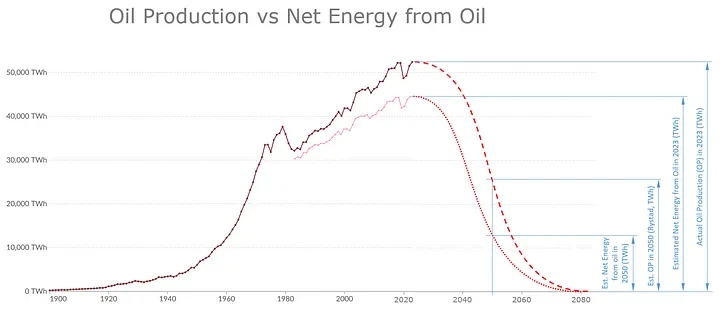
I had a few questions about this graph. I have seen this before and it has been mentioned on this site as well. This is the study but is it accurate?
https://www.sciencedirect.com/science/article/abs/pii/S0306261921011673
If our destination in 2050 is 1/3rd the amount of energy from oil that we get today, what happens on our way there especially with the economy?
Hideaway:
Hi Kira, have a close look at the graph and notice the exponential rise from around 1950 to the early 70’s. Hubbert showed that the rise and fall of world oil production should have followed a normal distribution curve, like individual oil fields tend to do.
When OPEC raised prices and the world realised oil was a finite resource there was a huge change and we implemented many efficiency improvements and substitutions (mostly gas) for oil use. The growth in oil production changed from exponential to linear, and instead of rolling over as predicted by Hubbert, has continued to rise.
We have been dragging future use of oil into the present for the last 25 years, while still growing overall oil extraction, as reserves deplete. Think about oil producers around the world. They have older wells still producing at EROEIs of 20-30:1 or more, plus newer wells in harder to reach places with much more expensive infrastructure and processing. The older wells that paid off their capital costs decades ago are easily the most profitable. They generate the most cash to keep the system going, however it’s the newer wells like shale oil, tar sands, deep water, etc. that help keep the overall price of oil lower.
Which are depleting faster? The old profitable wells, because the trade of goods and services runs on dollars and profit, so oil producers need lots of dollars coming in. Whenever the Saudi’s turn down production, it will be the expensive oil they reduce, not the cheap easy stuff, unless they desperately need to rest fields to protect future extraction.
What this leads to in our world of capitalism economics, is all the high EROEI wells depleting around the same time, just as the cost of maintaining production rises rapidly, because the wells are so much more expensive relative to the oil produced.
Complexity also enters the picture because the extraction processes for newer oils are highly complex operations. For example, horizontal drilling relies on sensors and computing power to keep the drill in exactly the correct strata, 10,000 feet below the surface. The oil sands extraction process uses large modern machines with the latest computers and sensors to maintain optimum efficiency.
Once the easy high EROEI oil is depleted, the remainder becomes much harder to extract because supply lines of equipment and spare parts become less reliable due to reduced economic activity, making everything required to support the complex processes harder to obtain and much more expensive.
Rapid loss of oil production quickly leads to higher oil prices and shortages, with businesses closing as people reduce spending, as happens in every recession, however the declining oil supply will accelerate as other high EROEI wells also reach total depletion, exacerbating the overall problem, with newer oil sources not keeping up with the declines. Deep recession leads to businesses shutting and restricted trade as countries can no longer afford imports, which causes more businesses to go bust.
Factories that earn 10% of their revenue from making essential ‘widgets’ for the oil sector go bust because the other 90% of their business starts operating at a loss, and it is impossible to restart the manufacturing because critical machinery was sold off for scrap in a clearing sale.
Thousands of factories stop making parts critical for a complex system. Without parts, oil rigs and refineries can’t operate, which brings down the entire system.
For us here at Un-Denial, it’s pretty obvious what happens next as the problems will mount and cascade affecting many businesses unexpectedly, thus triggering a self-reinforcing decline.
Most importantly, although demand for oil will fall with recession, oil will not become cheap because supply will also quickly fall. There will not be investment capital available to extract new marginal oil, especially in the Middle East where populations will be suffering from the high price of imported grains and other food, that will become difficult to purchase on the open market. Food exporters will struggle due to high diesel and fertilizer costs and will be forced to reduce production.
Then the next year oil supplies will fall another 5 Mbbls/d, and again the year after, and soon it’s over and most people will be left wondering how those in power let it happen or couldn’t see it coming…
Kira:
Thanks for the explanation.
I hadn’t considered at all that even within countries like Saudi Arabia and Kuwait you will have different EROEI fields. It makes economic sense to keep running the high EROEI wells to get most for your barrel of oil. After reading your explanation I was curious to see the status of old oil fields, the giants and super giants which are collectively responsible for the majority of our crude oil, but most importantly as you pointed out, high EROEI oil. This is the list from wiki:
https://en.m.wikipedia.org/wiki/List_of_oil_fields
Most supergiants were discovered more than 60 years ago. Taking the top two as example Ghawar and Burgan. They both started production nearly at the same time and apparently peaked at the same time (2005) although Saudis don’t confirm it. Ghawar seems to be declining at 2.5% annually and will be down to 2.5 million barrels from a peak of 5 million by 2030. I am sure Saudis are doing everything possible to slow the decline now which will make future decline worse.
It appears as though oil fields like Ghawar are subsidising the extraction of the low EROEI oil like shale and tar sands. The energy comes from the old ones and the volume comes from the new ones, keeping price low and maintaining the illusion of abundance. It’s quite deceptive when you think about it. The net energy keeps depleting while the volume remains same or even increases for a while.
Companies that make generators for offshore oil rigs are a great example of economy of scale tumbling. They probably make generators for hundreds of clients who are not oil companies, when these clients can no longer afford their product the critical mass is lost and they go out of business. Oil companies cannot keep them in business single handedly. This can be applied to other things like pipes as well. This is what the death spiral of the oil industry will probably look like.
Hideaway:
I was thinking when reading your post Kira, yes, yes, yes, yes, yes. I certainly couldn’t have written it better.
On the oilprice.com webpage, there is this article….
https://oilprice.com/Energy/Crude-Oil/Arab-Gulf-Producers-Are-in-Need-of-Much-Higher-Oil-Prices.html
After enjoying a rare budget surplus in 2022, most Gulf Cooperation Council (GCC) economies are seeing their budget deficits widen with current oil prices still well below what they require to balance their budgets. According to the IMF, Saudi Arabia, the GCC’s biggest economy, needs an oil price of $96.20 per barrel to balance its books, thanks in large part to MBS’ ambitious Vision 2030. The situation is not helped by the fact that over the past few years, the oil-rich nation has borne the lion’s share of OPEC+ production cuts after agreeing to cut 1 million barrels per day or nearly half of the group’s 2.2 mb/d in pledged cuts. In effect, Saudi Arabia has been selling less oil at lower prices, thus compounding the revenue shortfall.
Imagine how they cut back, will it be the most profitable oil wells or least profitable ones, when they are so desperate for revenue? Obviously the least profitable ones get reduced while the cheap easy to get oil gets depleted quickly.
What could possibly go wrong when all the cheap high EROEI oil extraction starts declining rapidly just as shale oil uses up its tier 1 and 2 locations…
Perhaps we should have been called Homo dumbass, because we are definitely not ‘wise’.
Rob here on 15-Oct-2024 adding some fresh calculations by Hideaway on the expected speed of collapse, and a response from Kira.
Hideaway:
An aspect of our situation I’ve been thinking of putting down in writing with numbers, so that people can get a better understanding of the collapse ahead…
In regard to oil, we are mining around 100Mbbl/d which will roll over at some point in the near future..
According to some paper I read recently, we currently use around 15.5% of oil to obtain oil and this will rise to 50% of the energy by 2050.. From this paper…
https://www.sciencedirect.com/science/article/abs/pii/S0306261921011673

At the same time as this is meant to be happening, we will be mining a bucket load more metals and minerals for the transition.
What people find so difficult to do is to put several aspects together, to see if it can work, so I’ve decided to try below.
Assuming the increase is 1Mbbl/d/yr in the energy used to gain oil, which is easily possible as we’ve mined all the easy to get oil and only have the harder, more distant supply left, plus allowing for oil production to roll over to a decline in production we get the following…
I’ve used a fall of oil production of 1Mbbls/d for years 2,3 and 4, then 2Mbbls/d for yr 5, and 6, then 3Mbbls/d, for year 7, 4Mbbls/d for yr 8, 5Mbbls/d for yr 9, then a maximum of 6Mbbls/d for years 10, 11, and 12. At no time does the depletion rate go over 10, in these 12 years…
Year 1 …production 100Mbbls input energy 15.5Mbbls … Left for society 84.5Mbbls
Year 2 99M ………………………….. 16.5M ………………. 82.5M
Year 3 98M…………………………… 17.5M ………………..80.5M
Year 4 97M ………………………….. 18.5M ………………..78.5M
Year5 95M ………………………….. 19.5M ………………..75.5M
Year 6 93M ………………………….. 20.5M …………………72.5M
Year 7 90M ………………………….. 21.5M …………………68.5M
Year 8 86M ………………………….. 22.5M ………………….63.5M
Year 9 81M ………………………….. 23.5M …………………..57.5M
Year 10 75M ………………………….. 24.5M ……………………50.5M
Year 11 69M …………………………… 25.5M …………………….43.5M
Year 12 63M …………………………… 26.5M ……………………. 36.5M
Because of the combination of more energy cost of energy (a la Tim Morgan), plus just plain slow decline, the available oil for the rest of society has gone from 84.5Mbbls/d in Year 1 to 36.5Mbbls/d by year 12..
But wait there’s more.. Assuming mining uses 10% of all energy, while in oil’s case makes it around 10Mbbls/d, we know that mining has to increase greatly for the ‘transition’. With the massive increase required, just assuming a 10% increase per year would be conservative, as we are talking a magnitude more copper, Aluminium, Nickel etc, plus all the steel in wind towers and solar farm foundations being built in the TW scale every year etc.
Mining’s use at just 10% growth rate goes from 10Mbbls/d in year 1 to 31.4Mbbls/d in year 12..
When we add this into our calculations of oil available for everything else, we go from 75Mbbls/d in year 1 (100 – 15.5 – 10 = 75Mbbls/d) to 5.1Mbbls/d (63Mbbls – 26.5Mbbls – 31.4Mbbls= 5.1Mbbls/d) for everything else other than oil production and mining..
The above assumptions are very conservative assuming oil doesn’t decline by more than 10% in any one year, that oil used to gain access to more oil goes up by only rises by 6.5%/yr at most, then the growth rate declines (unlikely), plus the 10%/yr increase in oil going to mining wouldn’t get us close to climate/transition/renewable expected growth rates…
Even with those very conservative assumptions, we go from 75Mbbls/d for “everything else” to 5.1Mbbls/d for “everything else” in just 12 years after reaching maximum possible oil production. It clearly can’t and wont happen that way!!
We’ve been dragging future oil use into the present for the last 40-50 years, as shown by the linear increase in oil production since then, whereas we had an exponential rise in production before then.
The above is just putting together 3 aspect of our modern world, instead of concentrating on one and assuming everything else stays constant as just about every ‘model’ does that I come across from ‘experts’ in various fields..
The big question is what happens instead of the above??
Do we cut back oil spending on gaining oil, so that the depletion of existing oil happens much faster than 10%/yr?
Do we cut back on mining so that the transition dies a lot earlier?
Do we assume we will find a magic energy solution to all our problems?
Do we just assume oil production will never decline quickly… because….. just because we don’t want it to???
I didn’t realise how bad the numbers were until I just did the simple calculations and put it down in writing. To me it means we collapse well before the 12 years are up after reaching peak oil production because of many feedback loops creating chaotic disruptions on the way down. Every year we remain close to the peak of oil production, means we are dragging more future oil to the present, meaning the decline when it starts to accelerate will likely be much faster than the sequence above…
Kira:
Excellent analysis!! I just want to mention that the oil that goes into getting oil is mostly in the form of diesel yet only about 75 million barrels that we extract today is the kind of crude that can be refined into diesel. The rest of oil is either shale, NGL, Biofuels among other things which have their uses but not as diesel.
There was also a video that was posted here about a gentleman who mostly agreed with what we discuss here about the irreplaceable nature of fossil fuels and the shortcomings of so called renewables but believed that there is so much oil out there that we will never run out, that we can have shale revolution after shale revolution. There are many who subscribe to this school of thought and think we can extract shale oil and gas from formations in Argentina, Russia, China and many other such places. Art Berman (who has expertise in this area) on Nate Hagen’s podcast has stressed several times that the geology of American shale is very unique and the shale revolution cannot be repeated anywhere else.
If one needs any proof of this please look at China. Despite the CCP pushing the state oil companies hard to extract shale deposits for years gas out has reached only about 30bcm per year which is less than 3% of American output. Part of the reason is the remote location of the deposits in the northern part of the country but we are talking about a country that can create entire cities from scratch within a few years. This is a matter of National security for the Chinese but the geology is the problem and has been unyielding so most efforts have been fruitless and abandoned.
As far as depletion goes even if we take super optimistic figures given by Rystad which predicts that oil production will be down to 50 million bpd by 2050 then the oil available by energy would be worth only about 25 million barrels. This is just a slightly stretched out version of numbers given by you.
It is interesting excersize to speculate on how things will play out on the downslope.
At the beginning of this downslope the airline industry will be the first casualty. Consuming about 8 million barrels of oil and mostly middle distillates at that, this shutdown will provide a much needed relief to the energy constrained world. Of course the commercial airplane manufacturers namely Boeing and Airbus will also go out of business. It is unlikely that governments will have any interest in bailing them out even if they had the ability which they won’t. The tourism industry which depends on air travel will also collapse, as will countries entirely dependent on revenues from it. Depletion will soon catch up and the gutting of industries will start again but this time it won’t be something discretionary and superfluous like air travel. This time industries that touch all our lives will start competing for the remaining share of energy.
Rob here on 7-Nov-2024 adding Hideaway’s answer to a question by ABC on whether Dr. Simon Michaux’s proposed solution of Thorium reactors and iron powder will work.
My take on why this type of future can’t happen is because Simon Michaux misses complexity and scale in the argument we can go to this type of future…
Let me explain, we can only have the complexity of nuclear power and running everything off electricity with an enormous scale of the overall human enterprise we call modern civilization. The scale of this complexity would require much larger markets than we currently have as the number of ‘widgets’ needed to be made for all the complex machinery would be greater than today.
We only have the complexity of today due to the total scale of everything we do. The highly specialised nature of building the best computer chips as an example happens in one place Taiwan with TMSC. The facilities they have built to make these computer chips can only be as sophisticated as it is because of the global scale of it’s customers. To build and operate 50 such facilities around the world would not be possible, they would all go broke. The scale of the facilities built needs the scale of the market size.
To build cheap thorium reactors or any SMR, the “modular” being the important point, would require a massive market as the factories involved, down to the smallest widget all have to be working in co-operation so everything fits together perfectly, so the market needs to be massive so everyone in the chain can make a profit. It also means all the suppliers of parts have to be operating smoothly and at large scale to supply all the inputed metals and minerals.
This all requires the existing system to be maintained while we get the growth in scale of the industry which relies upon the growing demand for the new products from the markets.
Notice how there is growth at every stage to make it all happen!! So if we had a spare planet or 2 of resources to use to accommodate all this growth, then we might get to a more advanced technological civilization, however running into limits of everything we currently use, because of growing energy cost from energy access itself to everything else mined, means we can’t get that advanced.
Also note that to get to where we are today in regards to the totality of civilization has taken growing energy use of all types for over 250 years. It’s been oil that has allowed for the increases of coal and gas use over the last 100 years. All the renewables plus nuclear and even modern hydroelectricity all rely upon oil themselves, and upon oil for the cheap coal and gas used in their production.
If we didn’t care about the environment at all and had another 2 earths worth of oil on this planet, then sure we might get to thorium reactors everywhere, but it will still all rely upon oil.
As oil production starts to rapidly decline, sometime in the near future, I have no idea exactly when, then the ability to keep our modern complexity will quickly unwind. We are getting a ‘sniff’ of this at present by all the countries that want to relocalise so much production, which isn’t possible as we lose the economies of scale of the current globalised system, unless there is an accompanying simplification as well. However no-one is planning for a simplification, the actual plan is to make aspects of the modern world at home. All these plans will quickly realise that they rely on imports of most/all the parts and the relocalisation is not very economic because of smaller market size.
Of course all the duplication everywhere is more inefficient using both more energy and materials to build and taking more people to operate and maintain. We lose some of the existing efficiency in the huge scale of many operations by trying to relocalise them.
What it means by even trying the relocalisation is that the population as a whole gets poorer because of inefficient use of energy and materials (unless we had spare planets worth of all these on this planet!!), due to lack of scale and overall the complexity has to fall to match the energy we have.
Please also note we have no shortage of any material on this planet, just a shortage of energy to access lower grades, and all the processing involved in making them useful goods. It all comes back to existing energy availability within the scale of complexity of what we have as current civilization and we can only build a lot more of any one aspect, while the entire system operates normally. Normally being in growth mode, providing the capital, goods and services required in the usual orderly manner to open new mines. Which means the population needs to be well fed and educated, with abundant services continuing to operate throughout.
We can’t take energy and materials away from one sector to go to another as the odds are they use different aspects of modernity and it’s not a simple swap, with whatever being constrained having feedback loops that are unexpected.
Anyway back to thorium reactors. The industry needs to grow and develop naturally in a world of increasing demand for this product, so it can develop naturally, which takes the rest of the system growing normally. Eventually factories that could build SMR would develop, providing the capital and operating costs were a huge advantage over the existing forms of energy. This can only happen in the background of our system operating ‘normally’, ie growing economies. It can’t be forced, as any developments of forced, as in uneconomic simply don’t last as industries when times turn tough.
When we get a real recession/depression brought on by oil getting more expensive for every other industry, all the expenditures on solar, wind, nuclear and batteries will probably start falling fairly quickly, as these expensive subsidised builds lose market share, as they are too expensive, even for a product (electricity) that is only one aspect of our energy use.
All heavy industry needs a constant cheap energy supply, often in different forms at the same time to produce the raw materials that feed our modern consumption. Without coke, coal, gas and plastics many of the items of modern civilization simply wouldn’t exist at all, so build a huge array of thorium reactors with say the last of the fossil fuel energy available, solves no problems. We wouldn’t be able to make the products we use today with just electricity.
If we were to build fancy new recycling facilities that somehow made use of all existing plastics for re-use in original forms, the whole enterprise would suffer the same entropy and dissipation as everything else and winds down fairly quickly, plus requires a rapidly growing system of modern civilization working normally in the background while it’s built to the scale and complexity required.
Every argument of how we can power a new civilization with solar, wind, batteries, nuclear, thorium or whatever form of electrical energy in the future, argues for a smaller supply of energy needed than now because fossil fuels are inefficient, we only use 25-50% of the energy (depending on the machine). It’s a terrible argument as the increase in the modern civilization growth to get to that point, would mean a much higher energy use than at present, just because of the growth in scale and complexity of everything to just build this future.
Someone should ask Simon Michaux or any other expert about the clean green future whether from renewables normal nuclear or thorium, about how much of it can be built without using fossil fuels at all, including down to the plastic insulation on all wires. The usual answer is it can’t be done yet, but improvements in technology and increased use of renewables/nuclear and how cheap they all become will allow it to produce synthetic fuel for these types of purposes.
I usually counter, with how none of it’s being done now, yet renewables and nuclear are already claimed to be cheaper, so all new factories would already be going to the cheaper ways if it was true, but no-one is doing it, so something is very wrong with the narrative. The argument usually flows to climate reasons why we have to move away from fossil fuels, which is unfortunately a different argument, because the energy required to then mine all the minerals to build this fantastic green future simply doesn’t exist without the use of fossil fuels.
We are in a total and utter catch 22 where we require cheap fossil fuels to build everything and maintain the current modern civilization, which collapses without their use leaving 8 billion cold, angry starving people looking to survive. Using another 2 planets worth of fossil fuels to build the entire renewable/nuclear/thorium future with electricity used for everything, including making plastics and synthetic fuels, will leave the climate and environment in ruins, then collapse anyway, when we turn off fossil fuel use, as that is a sudden energy loss when we continue to require more minerals and metals from the environment, due to those lost from entropy and dissipation, and the increase energy use from all the movement of materials for recycling..
I didn’t even get around to mentioning that a world of recycling everything as much as possible, uses fossil fuels for all the processes anyway, but that’s another story. It’s an incredibly complex situation we are in and any ‘easy’ sounding solution will simply not work as the proponent forgets we spend 97-98% of all our existing energy and materials on just maintenance of the existing system with only the other 2-3% going on ‘growth’ of everything.
Any one new major investment into a great sounding idea on a world wide scale, can simply not work by spending less than 1% of energy and materials use on it, unless the entire system of energy and materials grows massively. As the entire system has to grow, the number we start from in the future will be much higher energy and material use than it is today. The scale and complexity has to also grow to allow for more efficiencies in the system. the starting base of energy use in 30 years time will be double of what it is today..
If we don’t ‘grow’, then we can’t maintain existing subsystems within our civilization, as we need an increasing quantity of energy just for maintenance of material availability. The system can’t work ‘normally’ without the increase in energy, even without growth in the overall system. If we shrink the market size, then we can’t maintain the complexity of the current system either, as the affordability of the complexity goes down, so the system simplifies, which makes gaining access to lower grades of everything much more energy intensive as less complex equipment will mean lower recoveries in mining, lower food volumes from a given area of land etc.
Oops, sorry for excessively long answer. Our civilization is highly complex and so is the reason why none of the bright green ideas can work, and neither can a shrinkage of population while maintaining modernity, but hte attempt to do so, will lead to collapse of it all.
Rob here on 14-Nov-2024. Hideaway and ABC had an opportunity to ask some questions to a couple important leaders in the overshoot awareness community, John Michael Greer and Simon Michaux. Following are the questions and answers plus follow-on commentary from Hideaway.
A.) How can we have modernity without the scale of market size that we currently have to enable the mining, processing, distribution then manufacturing of the huge range of parts that go into making every aspect of modernity?
We can’t. It really is as simple as that. Modernity, as Dr. Richard Duncan used to say, was a transient pulse waveform a one-time, self-terminating affair.
B.) How do we make the machines that make the final product machines in a scale down world?
That asks the question the wrong way around. The right way around is “what kind of final products can we afford to have, given all the constraints on producing them in a deindustrializing world?”
The answer won’t be clear for several centuries, but it’s unlikely that any technology invented since 1900 or so will be included.
C.) How is it possible to maintain complexity, such as a thorium reactor and all the machines it powers on only a small scale?
I’m not a specialist in this technology, of course.
I’m open to the possibility that it can be done, but I want to see an affordable example first.
As we’ve seen over and over again, every nuclear technology is cheap, clean, and safe until somebody actually builds it…
D.) Where do the materials come from after many cycles where entropy and dissipation have worked their magic over many cycles of recycling?
Oh, in the long run say, another 10,000 years we’ll have to go to entirely renewable resources, and that will involve sweeping changes in everything; for example, some future society may cultivate chemosynthetic iron-fixing bacteria (the kind that currently produce bog iron) to keep it supplied with iron. Our immediate descendants won’t have to worry about that, though. Given the scale of population contraction we can expect (around 95% worldwide) and the gargantuan supplies of metal and other materials that have been hauled up from deep within the earth and stored in what will soon be urban ruins, our descendants for the next thousand years or so will have all the metal they can dream of using.
A.) How can we have modernity without the scale of market size that we currently have to enable the mining, processing, distribution then manufacturing of the huge range of parts that go into making every aspect of modernity?
I don’t think we can. It was all dependent on oil as a fuel. We have no replacement for this.
B.) How do we make the machines that make the final product machines in a scale down world?
We have to change our thinking in what we need all this stuff for. Do we need it? Can we do it in a more simplified form? Then ask how we can get there. If we can simplify how the tools are made using more abundant resources (iron vs. lithium for example) then use those machines differently, using modern knowledge.
What have we actually learned over the last 200 year?
The last 20 years in particular?
Can we take a backyard workshop, make a small foundry, have a blacksmith forge, run a basic lathe, drill press and welder, power it with a wind turbine on a lead acid battery?
Strip out useful products from all the places around us that no longer are in operation (cars in a carpark that have been abandoned).
Make an electric motor and a lead acid battery.
Can we shred rubber tyres and make gaskets?
Can we run a furnace to recycle ceramics and building waste into geo polymers
Then you have tech like 3D printers.
Can these be reinvented where we can make our own feedstock and make our own printer unit?
And so on.
C.) How is it possible to maintain complexity, such as a thorium reactor and all the machines it powers on only a small scale?
A Th MSR unit is about 12 m long, about the size of a shipping container and delivers 40 MW of electricity, or 100 MW of heat at 560 deg C.
They are made mostly from steel, nickel and a small number of exotic metals and alloys.
They have a working life of 50 years.
Complexity to run it is about that of running a modern medial isotope lab.
Their production is much simpler than most other devices.
I think it can be done in some cases.
The problem is getting permission to use them.
D.) Where do the materials come from after many cycles where entropy and dissipation have worked their magic over many cycles of recycling?
Contract our material needs per capita.
Simplify what we need to resources that are more abundant.
Most of the purple transition needs iron, which we have lots of.
Copper will be the limiting metal.
Industrial systems have to come into line with food production limitations.
Once we get to the point where recycling and mining can no longer deliver, then society has to work out a way of living without these things or go extinct.
Hideaway’s commentary:
Thanks ABC great work and answers by JMG. He gets the big picture of what’s going to happen, but appears to miss all the feedback loops that will accelerate everything to the downside. We have over 8 billion humans on the planet and 99.99% of them have no idea modernity is going to end abruptly, and when it does so will destroy the plans of the other 0.01% (or less!! ), that did see it coming and tried to prepare in some way.
Lots of people use Cuba as an example of what can happen with building vegetable gardens etc., except forget to mention that it’s in the tropics with fast growth and plenty of water, compared to say the UK which is 2.4 times the size and 6 times the population, plus Cuba today imports around 70%-80% of their food.
Where JMG says it’s asking the question the wrong way around, is incorrect. We are not planning anything about contraction as a species, every machine is becoming more complex allowing for more automation and hence cheaper costs. Once we go down there will not be the investment capital, energy nor materials, nor co-ordination to build any new machines to make anything.
He has once again used how we have done things on the way up, as in using more energy, materials and larger expanding markets; to think that some similar type of planning will occur during the collapse phase. It’s wishful thinking not close to reality.
Realistically, when food is not arriving in cities, who is going to be sitting around talking about what machines they are going to build and what level they can acquire, when there is no energy, nor materials in the appropriate form to do any of it??
One aspect JMG gets completely correct is about thorium reactors….. “As we’ve seen over and over again, every nuclear technology is cheap, clean, and safe until somebody actually builds it…”
There is a very good reason for the cost of all nuclear, of which thorium reactors will be no different, complexity. Every aspect of it is a highly complex specialty. It wont be made from ordinary stainless steel, it will be highly specialised stainless steel, probably with a high quantity of minor elements like molybdenum to allow for the highly corrosive environment of molten salt. “Salt” as in sodium chloride does not play well with most stainless steel, as the chloride is the one thing highly corrosive to stainless steel.
In the huge new refinery in Texas built by the Saudi’s a decade or so ago, upon commissioning someone turned on the wrong valve that sent hot seawater through the piping, causing something like $1.5B dollars in damage and delaying the opening by a long time. Interesting they now call it “caustic” released as it pitted all the stainless steel pipes. If seawater can do that, imaging what 600-800 degree molten salt will do to any weakness of the piping.
Scavenging materials, finding a smelter that can separate all the scavenged materials into the original metal forms, then recombined into the correct quality stainless steel to withstand high temperature molten salt, is a highly complex process by itself, involving a lot of coking coal for the heat. We don’t currently do this for new highest grade materials, we use newly mined purity, for the combination specialist metals, recycled metals doesn’t provide the purity required at this level of specialty. There is no way Simon’s thorium reactor can be rebuilt in a small community, as we would still need the mining of all the separate metals, including his one word reply of ‘exotics’.
What seems to happen is that we get answers about the future that all sound very plausible and comforting, until some person with a bit of knowledge of the intricacies of some part of it comes along to spoil the party.
It’s the highly technical nature of the materials that go into machines, that are then forged into specialized minor, often tiny, sometimes huge parts, with all the connections working in harmony, to make any modern kit, that will be impossible when people are desperate to find food and survive that’s the problem which is overlooked. They always assume some type of normality in the future, just with a much smaller group, forgetting that normality has been a growing human enterprise, with always more energy and materials to make stuff with for generations, and that normality is going to leave us in the near future.
Rob here on 5-Dec-2024 adding an interesting thought experiment by Kira on the energy and material savings benefits of economies of scale and our multi-continent supply chain. With follow-up comments by Hideaway and Kira.
Kira:
I have been trying to think about the benefits that economies of scale and multi continent supply chain provide in terms of energy and material savings and decided to try a simple thought experiment to try to visualize it.
Lets take a simple rudimentary motorbike as an example of the product that we intend to produce at scale. The raw materials will be the metals and alloys needed to make the parts and everything else will be done in house without depending on any external supply chain. The basic parts for a bike are as shown.
If we decide to make everything everything under a single roof (which is what localisation implies) we would have to dedicate seperate machining and fabrication units for each part along with the people with expertise in each of those departments all of which are massive upfront investments and would make the factory a mammoth operation on the scale and size of a gigafactory.
So what are the downsides of this approach?
- It requires massive upfront investment and upkeep.
- The output would be low.
- If we have to serve a country as large as US with localisation we are looking at at least one factory per state leading to large redundancy and waste of production capacity.
Lets approach the same problem and apply a distant supply chain solution.
Since all motorbikes are more or less the same and use same parts shown above we can do the following. Three companies A,B and C may be different bike companies making different types of bikes they will only design and make the frame(chassis) and engine in house and everything else will be outsourced to an external vendor. The suspension will be made by suspension manufacturing company, brakes by a brake manufacturer and so on. So how does this benefit everyone?
- Since the company is only making the frame and engine its factory size will be a fraction of what it would have been in scenario one.
- A dip in demand for company A’s bikes would not result in wasted capacity as company B and C can absorb the common capacity for the parts.
- Less labour requirements as there is lower redundancy as there is only one plant making suspension, brakes, tyres, clutch etc. instead of three.
- Since more resources are freed up the companies can focus resources on research and innovation thereby speeding up progress.
The obvious downside of this is the loss of redundancy and a single point of failure which can halt the production of all bike companies. But the benefits to the civilization as a whole far outweighs the risk as the more complex the product is the longer the supply chain is and the more difficult it would be to make it under a single roof.
If we take microchips as an example and try to take all the processes from raw materials to a finished chip and make everything under a single roof the factory will easily be the size of a small sized city.
When I mean everything I mean everything from the lithography machines to all the other machines, starting all the way from raw materials. That means first making this incredibly complicated machine below starting from metals and alloys mined,processed and shipped to the plant then machined, fabricated and assembled into the machine shown below.
So as complexity of the object increases multi continent supply chain is not only useful but essential to making high tech products. None of this is possible without fossil fuels and high grade minerals both of which are in irreversible decline and will soon lead to the supply chain collapsing leading to a loss of complexity creating a negative feedback loop.
The lithography machine shown above is just one of a hundreds of processes in getting from silicon ingots to a microchip (albeit the most important one). Some of the processes are shown above which require equally complex machines to perform.
Hideaway:

The caption with the photo states .. “just one of the benches the engine was laid out on”.
This was from a 1965 built motor..
Thanks Kira, a brilliant breakdown of complexity, with each of the above different main parts of a motor bike having so many components themselves. A simple motorcycle can have 2,000 – 3,000 separate parts.
Our complexity of modern life is just lost on so many people, not understanding that each and every part has to be made precisely from the exactly correct materials, to work together and function as a whole ‘machine’.
The other huge misunderstanding is that we need the total complexity to gather the food, energy, and materials that make up this complexity as we have used up all the easy to get food, energy and materials.
The motorbike example is a simple machine compared to a horizontal drill rig with tens of thousands of separate parts, including many computer chips, in many separate parts of the rig, from control systems to sensors to actuators, communication systems, power systems.
Without modern horizontal drill riggs our oil production would fall rapidly by a large percentage and these machines are dependent upon lots of spare parts arriving nearly every day.
When we start to lose overall energy availability, especially oil production because of depletion, the complexity has to rapidly unwind, as there is simply not enough energy to keep it all going. Once feedback loops kick in, of lack of parts, then machines we rely on become junk very quickly, which accelerates chaotic feedback loops.
The concept of going local, means massive simplification, because we don’t have either the energy nor materials locally to do anything differently, which means we will be unable to feed the current huge populations of local areas as all the modern machines cease to function. Fertilizer becomes a thing of the past, tractors can’t get oil and grease, let alone fuel, likewise for all transport from local rural areas, to cities.
Modern humans have just forgotten how reliant we all are upon 6 continent supply chains for our very existence…
“Kleiber’s law” of power/mass use to the 3/4 power most likely applies to human civilization. Studies have shown that in nature the law is a doubling of animal or plant mass requires a 75% increase in energy use because of efficiency gains is the easy explanation.
In human settlements research, done by Prof Geoffrey West and a host of others, they have found human population centres the power law is closer to 85%, as in we are not as efficient as nature with a 4B year head start. The problem with all the work on settlement sizes is that we live in a world of one global civilization and no city is an entity to itself, which they were 500-10,000 years ago, including their surrounds.
Kira:
Actually it was your exchange with Dennis on POB that lead me to have this train of thought. I found this line by him to be quite revealing of how people like him think.
Dennis: “Society is not based on physical laws alone, it is understood using knowledge such as sociology, psychology, and economics.”
Cornucopians like him always point out how GDP is growing with less energy use ie growth is becoming less energy intense. We know this is primarily because of massive financialization of economy but when you point that out his reply is that GDP calculation are a reflection of physical and thermodynamic reality of the society. It’s funny how he tries to have it both ways whenever it is convenient.
He is wrong as usual. Let’s take three bike companies on three continents North America, Europe and Asia – Harley, Triumph and Honda respectively. Assuming that there is no contact between the continents and each company has complete monopoly over their respective continents without any alternative then they can manufacture in whatever configuration they want. They could make everything under the same roof with redundancy and inefficiency or outsource their production of components to third party and cut costs.If they are inefficient their customers end up paying more than their counterparts on other continents.
But as soon as we apply the situation of globalization and they have to compete with each other they will have no choice but to reorganise themselves in a way to reduce material and energy costs and if they don’t they go out of business. You were right in your counter that civilization is very much like an ant hill and just like how no ant has the complete blueprint, no human has the complete design of civilization. It is not intentional, it is self organizing and self assembling. Complexity increases to solve problems and with increase in complexity comes increase in material and energy cost. When this happens the system reorganizes itself to optimize resource consumption. There is no way to intervene here.
For instance Ford could probably manufacture every component of its car under the same roof 85 years ago but with today’s complexity they probably have hundreds of suppliers that they share with many other car companies. If an American president declares that every inch of a Ford vehicle must be made on American soil the company would immediately go bankrupt as if they tried to do that a car that costs 20,000 would cost 200,000.
This pattern holds even across completely different industries.


This is a ridiculously condensed and shortened version of the supply chains of Apple and BMW. All supply chains end up either at pits of mines or oil and gas rigs as everything we produce comes from earth as raw materials. The suppliers in greens are the common ones for both companies and hundreds of others including oil and gas rigs. If we fully expand the supply chains we will see countless overlaps with one another with constant reorganization happening to optimize resource consumption. The true scale of feedbacks and overlapping is so complex that it is impossible to even comprehend. But there are some interesting things we can glean from the above diagram. The critical mass of consumers for the chip industry is coming from consumer electronics meaning that the auto industry and oil industry are just beneficiaries of this. If people stop buying smartphones and PCs then oil companies and car companies go out of business. There are several such critical dependencies that may not be so obvious at first glance and may be far down the supply chain.
Of course the connective tissue connecting the supply chain is oil since without we cannot maintain the multi continent movement or power the mining machines at the end of the supply chains.
Hideaway:
Thanks, Kira, excellent work again.
Trying to get people to understand the connection between the overall size of the growing market, relative to the complexity is extremely difficult, especially when added to the overall energy and material savings to the entire super organism of the human civilization.
Because of collapsing grades of ores of all types, we need the complexity of modern machinery, modern financing and modern supply chains, to gain access to all the requirements of all materials and energy used. It’s a self feeding monster that has to grow just to gain access to the requirements.
Unwind any aspect of modern complexity and the whole lot collapses, yet keep growing and the whole lot collapses due to environmental limits anyway.
Most likely oil will be the limiting factor, that sets in motion feedback loops in reduced consumption of all the requirements used in modern complexity, and your example of discretionary spending on computer chips is the perfect example, but we can multiply this by thousands for all the unknown links that are necessary to keep modern complexity going.
The concept of localizing industries, plus using tariffs to do so, will just hasten the collapse as it uses up more energy and material resources to build all the local manufacturing plants and tool them up, let alone gain the raw materials and energy for their operation. Just the attempt to do this will likely set off other unknown feedback loops as the extra energy and materials involved in the attempt to localize puts pressure on other aspects of the system.
Of course it’s all just a duplication of what’s already happening elsewhere, supplying the world, so the energy and materials are effectively wasted giving higher costs to consumers everywhere because of the duplication. Now imagine 5-50 countries trying to do the same for their local markets.
We can’t have 50 TMSC factories around the world as there is just not the market for that number of computer chips, with the complexity it takes to produce them. That factory/foundry whatever they want to call it has to churn out millions of wafers and chips to be viable. It wont work with 50 of them, unless the super-organism of human civilization grows by enough to accommodate the increase, which means every facet of civilization has to grow including population, energy and material use.
Once oil declines because of depletion and the impossibility of an increased production, whenever that happens, then overall energy availability turns down, meaning the growing organism can’t keep growing, nor even maintain what’s built and operating as entropy guarantees we require 97-99% of all energy and materials to just keep operating ‘normally’. (All while energy use keeps growing to supply the raw materials because of lower grades).
Once energy of all types that totally rely upon oil start suffering from increased costs, as oil’s harder for any one business to obtain, the civilization that relies upon cheap energy, suffers from reductions in internal markets from those struggling, meaning less markets for computer chips, and every type of machine that relies upon them, sending businesses broke, that manufacture essential requirements of other businesses, so creating a cascade of accelerating failures across civilization itself, in producing everything required to just maintain and operate what exists.
We’ve been in extend and pretend mode for over 50 years, making up a linear increase in oil supplies, with exponential increases in coal and gas energy supplies to make up the required energy of the growing civilization, then added some nuclear, solar, wind, geothermal etc, all just electricity providers, which are not providers of the full range of products and energy supplied by fossil fuels.
The increase in coal and gas though is totally reliant upon oil, with the rest being just derivatives of fossil fuels in total.
The complexity of the entirety of the system would take multiple books to explain just the merest of details of any one component of the overall complexity of how we live. It’s beyond the comprehension of anyone, as it’s exactly as explained by Kira above, so people without thinking of the overall complexity, assume we can just increase one part of this civilization by increasing something massively, on a world wide scale, without having implications elsewhere, nor have any understanding how everything else has to keep working normally for their one aspect to increase greatly. (EVs, batteries, solar, wind, geothermal, tidal, and nuclear).
Single cell organisms, multiple cell organisms, storms, stars and all prior civilizations have grown with increasing complexity over time, yet all eventually collapse due to some type of internal energy usage decline, that collapses the overall system.
To think our modern civilization will be ‘different’ to everything else in the universe that is large and grows complexity internally, increasing energy use until collapse, is denial in it’s finest form.
 un-Denial
Israel Is Liquidating Northern Gaza – And Boasting About It
LikeLiked by 2 people
I would like to propose a little competition: which emoji would you pick to show what collapse represents to you? (I will let Rob steer the alternative MORT emoji contest)
If we can’t find anything which pleases us, then we can always design and submit our own to the Unicode Consortium (https://blog.joypixels.com/how-to-submit-an-emoji-to-unicode/, https://unicode.org/emoji/emoji-proposals-status.html?ref=blog.joypixels.com).
If we do, I hope it gets accepted before collapse actually enters its accelerating phase 😁
LikeLike
This one is the first that came to mind 💩
LikeLike
LOL. That’s my vote too. If I’m not allowed to copy then I’ll go with👍
LikeLike
Ah ah ah, nice. Hadn’t thought of that at all.
I initially picked these ones: 💀or 🏚️.
LikeLike
I would rather not have images of fecal mater on this website.
LikeLiked by 1 person
I agree. I retract my suggestion 🙏
LikeLike
Boo…c’mon, that was the most perfect emoji.
But I do have to admit, Stellar makes a good point.😊
LikeLiked by 1 person
I had some more ideas.
LikeLiked by 1 person
Yes, print, extend and pretend.
Again, the kind of behavior which strongly discounts the future.
LikeLike
Als contains a comment about Faucis COVID Mask Flip-Flop.
Saludos
el mar
LikeLike
Americans are flocking to U.S. regions most threatened by climate change
https://www.cbsnews.com/news/hurricane-milton-americans-moving-tampa-asheville-climate-change/
LikeLike
Wildlife populations plunge 73% since 1970: WWF
https://www.france24.com/en/live-news/20241010-wildlife-populations-plunge-73-since-1970-wwf
LikeLiked by 2 people
That one always gets me because 1970 was my birth year. Seeing that stat in 2018 was a key reason for me to quit the corporate life. The 2018 report was data to 2014 and the number was 60% for the populations studied.
LikeLiked by 1 person
For humans living in megacities, the most easily accessible and most abundant large animals are other humans…
I don’t approve of cannibalism, but some of it is probably inevitable on the downslope of the carbon pulse.
LikeLike
You don’t approve? What’s wrong with you Stellar.😊
Ya when the cannibalism starts its gonna get weird. I can imagine running low on food and being very hungry. Start looking around at the cat, dog, and the most annoying roommate. If I haven’t opted out of life yet, humans will be going in my belly way before cats and dogs do. I guarantee it.
Eating human flesh does not gross me out at all. It’s the same thing as steak or chicken. Prior to my awareness level of human supremacy, it definitely grossed me out. I thought of it as the holy grail for things that should never happen. But now I’m totally ok with it. Easier said than done for sure.
LikeLiked by 1 person
I don’t approve of cannibalism when other food is available. If no other food is available then you have a moral dilemma. But you do raise a good point: Is cannibalism any worse than eating pork or beef?
LikeLiked by 1 person
In my humble opinion, the argument made here by Hideaway, and by me elsewhere, is THE core reason anyone who’s still fighting to make the future less bad should focus on MORT awareness.
https://peakoilbarrel.com/open-thread-non-petroleum-october-4-2024/#comment-781947
LikeLiked by 5 people
https://peakoilbarrel.com/open-thread-non-petroleum-october-4-2024/#comment-781956
LikeLike
Want to have an income in post-collapse? Look to the industries that mad
In the Middle Ages, several industries stood out for their wealth and economic impact (thanks AI for the list):
LikeLiked by 1 person
Remember, it was the 2019 banking repo crisis that caused US and China to collaborate on releasing a mild virus they engineered together to kill unproductive eaters, and then to execute a plan to foment panic in both countries so they could lockdown to conserve oil and have an excuse to print trillions to save the banking system.
The US lost its way and got pharma to play along by giving them a free ride on their wet dream mRNA that had failed all previous trials and would never pass normal testing protocols.
China is not beholden to their pharma industry so wisely avoided the fatally flawed mRNA technology.
I’ve been hearing reports that another repo crisis is brewing. This latest analysis is unfortunately behind a paywall.
https://www.zerohedge.com/markets/former-fed-trader-warns-we-are-close-another-repo-crisis
What will they do this time?
Don’t think another pandemic will work. War will make things worse. Interest rates now constrain extreme printing.
How about kill a presidential candidate to provide an excuse to cancel the election and to lock down to prevent civil war? They already tried this twice, will they try a third time? Maybe not, given that there is now a competent VP candidate that could do serious damage to the deep state with RFK Jr. as wing man. Or maybe they’re all in on the plan and the election is kabuki theater?
Any other ideas what their next trick will be?
LikeLiked by 1 person
What happens if our leaders let the banking repo crisis run its course?
LikeLiked by 1 person
Also what it your line of reasoning to the Banking Repo crisis being the trigger for our leaders? Why not oil peaking in 2018?
LikeLike
I didn’t understand that, dear Rob. What will change in the circumstances and the repro crisis if the election is canceled? It won’t save any oil, will it?
They could introduce a differentiated tax system that makes oil that is not needed for the needs at the bottom of Maslow’s pyramid extremely expensive. The military and state security would be exempt from this regulation.
Saludos
el mar
LikeLike
Oil would be saved if you cancelled the election and locked everyone down with martial law to prevent civil war.
Your idea might help except governments that raise taxes get voted out because citizens don’t care about the dangers of high public debt.
LikeLike
Do you think they are going to try to do that?
LikeLike
There are about 6 camps of covid dissidents that have gone deep into one dimension of the pandemic, and each has concluded that the official covid story does not make sense.
Sadly, these camps are at war with each other rather than uniting to bring justice to the criminals.
They are also overshoot blind which explains in part why they have been unable to connect the dots into a coherent story.
I believe the leaders of these dissident groups are intelligent with integrity and that each of their observations are probably true.
My story above is the first explanation (so far) that integrates overshoot awareness with the assumption that each of the dissident groups is correct.
Which means (I think) my story has the highest probability (so far) of explaining what actually happened.
LikeLiked by 3 people
encouraging horizontal violence is a very effective tactic the powers that be use to prevent people from attacking the real villains
LikeLiked by 1 person
What about covid just being some research iteration of some biologocal weapon leaking inadvertently in the environment? An accident, just like Tchernobyl before USSR collapse.
And then, various actors exploited this opportunity to various ends.
Or a real time test of the system: a way to see at which point, the central power loses its grip. Now “the leaders” know oil production can fall as low as 70M barrels per day, before some drastic change has to occur.
I don’t know, just throwing some hypotheses around.
I agree that we don’t yet understand what happened back then. The only thing clear to me is that peak oil was 2018 and that the fall that was slightly delayed is now back with a vengeance.
LikeLike
The data suggests it was seeded and panic stoked in a few locations rather than following the pattern of a normal spreading contagion. Best example is the NYC panic with ventilator shortages and freezer trucks, yet zero deaths in the next door communities.
LikeLike
Yes. That’s right. I now remember that. Thank you.
LikeLike
Here is the latest Frankly from Nate Hagens, with my comment highlighted.
LikeLiked by 1 person
Nate Hagens wrote his Sasquatch poem while hiking the Elk River trail in 2004.
This is the same trail my friend and I attempted (and failed) for our 60th birthdays in 2018.
LikeLiked by 1 person
Yesterday I complained no one is connecting geopolitical dots to overshoot. Today Chris Martenson released a pretty good video, although he concludes (as usual) by blaming corrupt bankers which I think over simplifies our predicament and the political constraints central banks face.
LikeLiked by 1 person
At about 41:00 in the video, Chris Martenson says we have enough thorium to provide electricity for 10,000 years? Does he have any sources for that, or is it just hopium.
LikeLiked by 1 person
I’m sure it’s true. Here’s a good quote from Hideaway last month:
Hideaway made me shift my thinking on this stuff when he said that. But I don’t like framing it this way because when clueless fu#king morons read that sentence, all they see is “unlimited resources”.
LikeLiked by 1 person
Chris, that’s how I see it as well. Every cornucopian sees it the way of unlimited resources, without ever thinking of the energy used to mine it, so assume it’s all possible, no calculations needed.
Whether it’s Thorium reactors, or Solar, Wind and Batteries or just normal Uranium reactors makes no difference, they are all built with fossil fuels and require fossil fuel products throughout the many processes and materials to build them.
Inevitably when I bring up the need for plastics, to insulate wires in every machine we make, there is the hand wave of, ‘we’ll make that from synthetic fuel’, ‘or use biomass’, or some such nonsense. Never, ever do they calculate what that would involve.
LikeLiked by 4 people
Here is Alice Friedemann’s take on thorium reactors.
https://energyskeptic.com/2014/thorium-wonder-fuel-that-wasnt/
https://energyskeptic.com/2020/nuclear-waste-will-last-much-longer-than-climate-change/
https://energyskeptic.com/2018/india-wants-to-build-dangerous-fast-breeder-reactors/
LikeLiked by 1 person
If I think something is bad, I just have to go and read what Alice’s research comes up with, and sure enough it’s worse. That lady knows the future as well as any of us here.
I watched Chris Martenson’s presentation, then paid attention to all the Q&A, which gives a picture of what people are really thinking.
Despite his presentation showing the clear trajectory of the economy with oil use, and likewise every economies GDP correlated to energy use, everyone comes up with their favorite new energy, as in lots of oil offshore, or Alaska, or Thorium etc, etc.
It’s always couched in terms of “they” are keeping it from us for various nefarious purposes. The concept of We’ve used too much, too quickly and in massive overshoot, just doesn’t penetrate the thinking. Every single question was about getting more, More, MORE, and to hell with the environment and everyone else in the process.
LikeLiked by 6 people
Chris Martenson and Jim Kunstler used to be a lot better. They seem to play to the hopium in people these days to keep their viewer ship higher. People on Kunstler’s comments use “doomer” as an insult. It’s audience pandering with these two lately, just to keep an income.
LikeLiked by 2 people
And it doesn’t matter what material is used, thorium has most of the same problems as nuclear, as I outlined in my Why Not Nuclear post. Even peak sand to make the concrete is an issue. https://un-denial.com/2023/01/28/by-monk-why-not-nuclear/comment-page-1/
LikeLiked by 1 person
Just got back from my usual routine of getting gas and filling up water. Even though I’m anti-prepper, it dawned on me that I do have some prepping habits. I am obsessed about filling up my gas tank (even if it just needs a couple bucks worth). Same with water. We have 9 five-gallon bottles. When there are three empties, I have to go fill them up.
I did not have these habits prior to being collapse aware. Gas was always on empty, and I only had 2 water bottles back then and they were both empty all the time. Not sure exactly when I became OCD about it, but probably in the last year and half. I guess I think when SHTF, a full tank of gas and at least 6 full water bottles are gonna keep me alive longer than everyone else.😊
Does anyone have any OCD things they do? (because of collapse awareness)
LikeLike
https://truthout.org/video/israels-evacuation-order-to-gaza-hospital-is-death-sentence-for-starving-kids/
LikeLike
This one-word clip goes hand in hand with MegaCancer’s great post this month titled “Not Worth the Effort”
Been in a weeklong funk with severely hating humans. That clip snapped me back out of it for some reason. When I’m in the good zone, its not a hateful or even discriminatory vibe at all. Because I understand that every life form in the universe would go down this same path if capable. Don’t know why I still veer off into the toxic hate zone. Gotta get that shit under control man.
I know the goal is to appreciate and be in awe of this ultra rare Peak of Homo Colossus. But it aint happening for me. And my motivation for getting others to see overshoot has turned into this comment from collapse chronicles:
But for the already overshoot aware crowd, I am still genuinely trying to help:
The combination of being awake to overshoot, denial, energy, MPP, human supremacy, etc. which then produces the symptom of being so collapse certain “it’s gonna happen any year now”… very dangerous combo. And it’s a heck of an easy trap to fall into because the info is so 100% legit… Funny, you think your all done with that red pill stuff from your overshoot indoctrination. But there are many more to swallow.
LikeLiked by 2 people
“I won’t let the panic orchestra squeeze me against the wall anymore. Not even by soloists.”
el mar
LikeLike
Scott Ritter explains how close we are to nuclear war.
Ritter just read Annie Jacobsen’s book Nuclear War: A Scenario and highly recommends it. I also read her book and can confirm it is excellent.
LikeLike
HHH is another voice of sanity on POB.
https://peakoilbarrel.com/us-july-oil-production-falls/#comment-781987
LikeLiked by 3 people
US meteorologists face death threats as hurricane conspiracies surge
https://www.theguardian.com/us-news/2024/oct/11/meteorologists-death-threats-hurricane-conspiracies-misinformation
Have people completely lost their minds?
LikeLiked by 2 people
Yes.
There are also stories from people I trust that not only is FEMA doing nothing to help they are blocking the delivery of private aid.
LikeLiked by 2 people
Why would FEMA block the delivery of private aid? Do they think the private aid is unsafe?
LikeLike
I don’t know. The US government is still recommending babies be injected with mRNA so it clearly does not care about its citizens.
LikeLike
In New Zealand private help is not allowed during disasters for H&S reasons. You can even get prosecuted for saving lives if you broke a stupid rule or didn’t follow a police instruction. Basically the authorities want to have full control over a response so they can manage it safely and ensure the best response. Except the only issue is they absolutely suck.
LikeLike
Great old interview. George Carlin was a talented comedian from day one. But something happened around 1990 that catapulted him to genius status. He talks about what that “something” was in this interview. Even if you aren’t a fan, the first four minutes is worth watching. He breaks it down brilliantly.
Impressive that George somewhat “figured it out” while being blind to overshoot & energy. His sharp interpretation and observational skills probably gave him the ability to see the overwhelming denial & human supremacy.
George Carlin Gets Dark | Charlie Rose Interview 1996 (youtube.com)
LikeLiked by 2 people
If he was still alive today, he would be cancelled. That’s how dumb our society has gotten
LikeLiked by 1 person
He was that ahead that they cancelled him in advance.
LikeLiked by 2 people
https://scaledown.substack.com/p/environmental-impacts-of-human-migration
LikeLiked by 3 people
Thank you. Interesting.
LikeLike
Hello everyone. Since it’s usually slow here on Sundays, I thought I would share this. My first letter to my inner circle after I became overshoot aware. It’s from Dec 2022. I was about one year into my journey with Michael Dowd (and some Nate Hagens).
I love all the people who taught me this stuff, but man, you can clearly see what happens to an overshoot journey if there’s no heavy focus on denial & MPP. Maybe some of my sources talked about MPP and I just blocked it out all the time. I doubt it. And obviously none of them focused on denial.
I definitely miss being this spiritual, but my awareness level then compared to now is embarrassing. I had a blast reading it again though. Reminded me of how hungry for knowledge I was back then (Not hungry anymore. Journey is complete. I know everything there is to know🤭).
Anyone stuck in this mode (which is probably 90% of the overshoot community) will continue to be guilty of “changing the subject when the conclusions become too dark”. They’ll never get to un-Denial’s level. Whether its understanding why nobody can see this obvious stuff. Or why civilization is guaranteed to collapse hard and fast. Or that there is no such thing as humans purposefully living in right relationship with nature (maybe there are a few exceptions, but overall… no!). Or truly understanding why humans need to go away… Impossible to get near the top of Mount Collapse without a firm grip on both denial & MPP.
The rest of this post is my letter. Hopefully it has some entertainment value:
Has it always been like this?
I’m sure most people have given some thought to this question in their lifetime. Nowadays its very popular to say something like “people know deep down in their hearts that something is wrong, they just dont know what”. I’m 46 and have had some type of that feeling for about 20 years now. It slowly started when I began working full time at mundane, soul sucking jobs like sales, telemarketing, and anything that involved me sitting in a cubicle. I would often wonder “what is so precious and sacred about this thing we call life?” From there it was easy to assume that money is the key to happiness. If I have more money, then I don’t have to work all day doing mindless stuff, and I’ll be happy and maybe life will actually be precious and sacred. Well, fast forward to the present and unfortunately, I was never able to achieve my dream of having enough money to be happy.
Surely this is not what our creator had in mind. No way. Not with all this misery all around us. I’ve always associated misery with money. Homelessness, starvation, the outrageous inequality, animals/insects/trees/plants dying off because humans destroy their habitat, war/violence, and humans intentionally poisoning their land, air, food, and water. Look close and it always boils down to money. If indeed it has always been like this, then the whole “life is precious” thing is complete bullshit and always has been.
I have been actively seeking out the answer to this. Reading books/articles, listening to lectures/podcasts, and anything that I think will give me information to help make sense of it all. I am going to try and put this down on paper now. Keep in mind that the complexity runs insanely deep and there are a billion externalities. This will be a very simplistic summary of what I have learned so far.
A couple definitions to know:
We belong to the land
Humans have been around for a couple million years. But if you prefer to use homo sapiens (anatomically modern humans, in other words, exactly what we are today) as the starting point, then we are a couple hundred thousand years old. The only way to live was to be a hunter-gatherer. They lived in temporary settlements and moved around regularly to and from the same areas. Their group size tended to be 20-80 people. With 150 being the magic number where it starts to fall apart. They did not have permanent leaders. They tend to be egalitarian with a strong emphasis on social equality. People worked 15-20 hours per week. Mostly, the women doing the gathering and men doing the hunting. Everyone knew each other’s stories, as well as their parents and grandparents’ stories.
There was a self-governing already built in. Think of it as reputational damage. If you commit an unspeakable act, everyone knows about it and you are shamed by the entire tribe. And if the act warrants you getting kicked out of the tribe, well that’s basically a death sentence. But because the tribe also relies on you, this is an absolute last resort for everyone. Reputation was vital. They lived in Right Relationship with each other and nature. Very animistic and ecocentric. The hunter-gatherer lifestyle forces you to be in tune 100% with nature. It’s not optional.
The land belongs to us
12,000 years ago hunter gatherer tribes started to transition to a lifestyle of agriculture and permanent settlement, and soon thereafter, most of the world had been converted by the agricultural revolution. There is no definitive consensus on why this happened and why now. The theory that this is the timeframe where earth’s climate warmed and stabilized makes the most sense for me. They were now farmers because of this new climate. Domestication of plants and animals begins. They are finally able to build up a surplus of food. Which then creates dramatic increase in population.
Your tribe is no longer 20-80 people. It’s now a society in the many hundreds and soon thousands, living in built up villages and towns. You no longer know the stories of everyone because there are too many damn people! Your reputation is much more meaningless. The concept of personal property starts here. Tyranny, sexism, police, armies, war and inequality as well. There is now a shift away from animism and ecocentrism. It’s becoming a “Man, conqueror of nature” world. Let the anthropocentric era begin!!!
This world view shift from ecocentrism to anthropocentrism is the fundamental point where it all started to go wrong. It’s very complex and I am still soaking up knowledge to try and make more sense of it. But here is a story that sums it up well that I heard recently on a podcast:
Human ingenuity
The biggest moment came about 500 years ago when Europe accidentally found the New World. This coincides with Europe and others starting to get very thin on resources. What luck! It was like finding another Earth. But there was one big problem. There were people already living on this New World. Luckily for Europe, these indigenous people had not turned anthropocentric yet. They were still very much animistic and ecocentric. Their technology and worldviews were no match for the Europeans. The genocide was under way. The Europeans now had all the resources they could ever dream of. This New World discovery laid the foundation to why & how we have come to our current worldview of “no limits”.
While building up the New World (via kidnap and torture – aka slavery) there was one more step till we could officially go all-in with our insane notion of infinite growth on a finite planet. About 250 years ago fossil fuels are discovered. This is the beginning of the Industrial revolution. It takes tens to hundreds of millions of years for fossil fuels to be formed (think about that. we use it 100 million times faster than it takes to create). Instead of being in awe and conservative of this one-time gift, we created a story where this has all emerged because of our ingenuity.
The agricultural revolution can’t hold a candle to what the industrial revolution did to increase our numbers. World population never came close to hitting one billion for all of human history. In the last 200 years we have skyrocketed from one billion to eight billion. We are energy addicts. And the digital age technology has essentially killed off whatever little bit we had left as far as right relationships. We have become isolated consuming machines. Economic growth is our religion.
Silver lining
So I guess by now, you have come to the same obvious conclusion as me regarding “has it always been like this”. Hell no!!! Given the choice, I think most of us, deep down in our hearts, would choose the hunter-gatherer lifestyle. Lack of hierarchy, equity in the group, more leisure time, living for today, a sense of timelessness (resulting in low stress). There is plenty of evidence that shows hunter-gatherers had better overall nutrition and health than the farmers that replaced them. Same thing for brain size & physical size.
Put another way, which day in the life sounds better: 2-3 hours of meaningful work. Lots of time to play with your kids (in nature). Having deep bonded relationships with your tribe as well as nature. Grateful and thankful for dinner (easy to be grateful when you hunted, gathered, cleaned, and cooked it). And then under the stars, storytelling around the fire… or… 8-10 hours of meaningless work. Little bit of time to play with your kids (video games). Having a friend or two to call (or text). Dinner time, delivery or takeout. And maybe an occasional movie night where the family is altogether but too distracted with their damn phones.
I know it seems like I’m exaggerating in order to make my point, but there really is no exaggeration there. The reason it’s so easy to think it has always been like this is because this is all we’ve ever known. But we are living in the most abnormal moment (and nothing like it to even compare) in human history. We lived as hunter gatherers for over 99.5% of human history (95% of homo sapien history). Mind blowing and laughable at the same time.
In hindsight, it does seem obvious that the move from hunter-gathering to farming was the biggest mistake in human history. It kickstarted our inevitable collapse, but fossil energy has ramped that up at warp speed. A great quote on the matter is “Forests precede civilizations, and deserts follow them”. Another important moment is when religion shifted from god being Mother Earth to god being some other worldly figure outside of our biosphere. Maybe that’s when it was officially game over. The indigenous cultures of the past seemed to have a sense of this and acted accordingly. Having their gods attached to Mother Earth helped them with honoring and respecting the land.
And like every anthropocentric civilization before us (with no exceptions), we are going to collapse because of ecological overshoot. Conservative reports predict we will be out of energy by the year 2100. And still, nobody talks about energy limits! Add in the climate change factor (just one of the many symptoms of overshoot) and I doubt we make it to 2050. The silver lining is that this civilization needs to collapse and go away. When the planet finally heals from humanity’s destructive ways, the next batch of life will be able to thrive again. (until millions of years from now when some species stumbles upon the next batch of fossil fuels)
This journey has also given me a better understanding on the almighty question “what is the purpose of life”. It’s kind of like when you find out how a magician did his magic trick. Except its not a letdown. The purpose of life is for life to thrive! Period. Pretty simple. Not some complicated grand scheme or the very human notion of “what’s my purpose here”. No, its just about life living and thriving. Not just humans, but all life. And to accomplish this, it’s all about living in Right Relationship.
One final thought. Maybe some form of civilization can be sustainable if we make it through the bottleneck of collapse. Best bet would be to mirror some of the Native American cultures. Deeply grounded in ecocentrism and animism, but stronger than a religion or belief. To the extent where there is not even a word for it. It’s just The Way. None or very limited electricity, no private property, and no type of money system. The main occupation for everyone would be farmer/hunter. Max population of two billion. With the correct thinking, values, education, ethics, support systems, etc…. who knows? But just like the plow invention, a trap (disguised as progress) will always be lurking around the corner.
Most of everything I have written here was from these great people:
LikeLiked by 2 people
https://www.mirror.co.uk/news/weird-news/huge-alien-announcement-could-happen-33862768
My bet is that it’s not what they think but interesting……
LikeLiked by 1 person
LikeLike
I think everything that we discuss here on this site also answers the Fermi’s paradox.
The reason that intelligent life is undetectable is because the lifespan of an advanced civilization on any planet capable of supporting complex life and harbouring resources necessary for the aforementioned civilization would be so fleeting that the probability of achieving interstellar travel within that constraint of time and resources would be extremely unlikely.
But it does raise an interesting question. If we could extend the life of our civilization by a few more centuries would we be capable of reaching for the stars?
I think that our current understanding of physics simply does not allow for interstellar travel because of absurd amount of energy needed for the required speeds. All of the sci fi fantasy nonsense on the internet about generation ships only goes up to proxima centauri which is only four light years away. Our galaxy is about 100,000 light years in diameter with about 100 billion stars. The nearest sun like main sequence star is 10 light years away which might be the best chance of hosting an earth like planet.
If we wish to achieve true interstellar travel there has to be major breakthrough in physics that fundamentally alters our understanding of the universe including dark matter, dark energy, gravity among others. Is this possible even if the civilization could last a few more hundred years? I am not sure.
LikeLiked by 2 people
There was a time when I would have gotten excited by this article.
My waste of time following Dr Steven Greer was not all for nothing though. I still expect to see a false flag alien attack in my lifetime. Will probably be one last desperate attempt to unite the world under one government.
Every time you see some UAP expert (like Luis Elizondo) being interviewed and yelling “the american people have a right to know what’s flying around in their skies!”… it is so obvious that they are just trying to plant the seed that aliens will be a threat to humans.
Maybe a fake alien invasion will end up being our Peak moment of insanity.
LikeLike
The fascination with aliens irritates me.
Of course there’s other life in the universe. How could there not be given that life emerged as soon as this planet cooled down and never once winked out despite many opportunities to do so. And there are trillions and trillions of other planets in the universe.
But the distances are too great between us. We’ll never visit them and they’ll never visit us.
Also the chance of an overlap is low because lifetimes of advanced civilizations will be short due to dependence on non-renewable resources, MPP, and MORT.
We already have aliens on this planet and instead of studying and protecting them, we’re wiping them out. I’m thinking of other intelligent life with completely different brains like the octopus.
LikeLiked by 2 people
The mirror.co.uk is hardly a reputable news source and some would find the article laughable. It did stir a sense of wonder in me though.
Speaking of non human intelligence I came across painting elephants on the Web a few weeks ago. Turns out there are animals that can draw better than I can
https://au.pinterest.com/pin/innocence-animals-nature–488781365789463797/
It actually blew my mind away to be honest
LikeLiked by 1 person
You’ve probably already seen it, but just in case, there’s a great doc on netflix called My Octopus Teacher. IIRC, it made me cry like a baby.
LikeLike
My immediate reaction, was so what. As a former ‘enamoured by aliens’ person, I no longer have much reaction as I suspect there are many planets with life on them, of which some will be intelligent. As for civilizations, as we know it to be, probably some, but a lot less than life itself.
Of the civilizations even if there was one of these at BLC-1 which is a planet around Alpha Centuri our closest star, we will never get there and they never get here, as we will both hit resource limits before civilization lasts too long, which would end signals from one or the other.
Making the huge assumption we could contact them and them us, it wouldn’t be much of a conversation with any message sent taking 9 years for a reply (4.5years each way). Imagine trying to have a conversation with another civilization at Tabby’s star if one existed there, 1,468 years each way for a single message, probably meaning both civilizations over before first message was received…
LikeLiked by 2 people
Has anyone else seen this 3 part series on Limits to Growth, how we’re tracking against the original models and how collapse due to resource depletion may play out?
I’ve not watched it yet but looks good.
LikeLike
Yes, I saw a recommendation on Friday to “at the very least watch part 3”. So I did and was not impressed. Bored the hell out of me. Maybe I was in a pissy mood though.
LikeLike
Ok. A friend sent it who also hadn’t watched it. Maybe more a beginners video 😉
LikeLiked by 1 person
Yeah I started watching it and fell asleep after 5 minutes. 😴
LikeLike
LOL. Funny, because I tried part one today just to make sure I wasn’t wrong. Made it five minutes. Annoyed me again. Seems like ok info, but I can’t stand the creator/narrator.
Ugghh, being good on video is too hard😊.
LikeLiked by 1 person
—-https://interestingengineering.com/innovation/l-mul-algorithm-ai-energy-consumption
https://arxiv.org/pdf/2410.00907
What could possibly go wrong if AI becomes 90% more energy efficient?
LikeLike
Gail Tverberg retells her scarcity story today. I did not detect any new insights.
https://ourfiniteworld.com/2024/10/14/oil-shortages-lead-to-hidden-conflicts-even-war/
LikeLike
Which do you think is more likely, a 2nd stone age, or extinction?
https://thehonestsorcerer.substack.com/p/will-there-be-a-second-stone-age
LikeLike
Entertaining article. The comments were better (in their diversity) than the post. Thank you.
LikeLike
https://www.democracynow.org/2024/10/14/headlines/israel_bombs_tent_encampment_at_gaza_hospital_school_shelter_in_latest_massacres
LikeLike
Overshoot awareness leaders can be placed into 2 camps. Those that publicly acknowledge the covid crimes (Tverberg, Martenson, etc.) and those that remain silent (Hagens, Murphy, etc.). No one publicly denies the crimes.
https://ourfiniteworld.com/2024/10/14/oil-shortages-lead-to-hidden-conflicts-even-war/comment-page-1/#comment-469984
LikeLike
Sam Mitchell has become my favorite thing to watch. He’s convinced me to drop my aspirations of doing the substack route and instead focus on getting a youtube channel going. For me, watching someone rant about the doomer lifestyle we live is so much more enjoyable & relatable than reading it. And helps me more with not feeling so alone.
His videos average 500-1000 views. And he does at least one per day. Compared to my favorite site (un-Denial) how many views does a good post or essay here get in a day. My guess is 50. And over on my 2nd favorite site (megacancer) it seems more like 5 views per day.
Video format is the lower hanging fruit, obviously. And it’s not like that’s gonna change anytime soon. Not in this idiocracy world. But my god, it’s so much harder. I’m guessing 80% of doomers can write adequately about collapse. But probably only 5-10% can pull it off on video.
My target audience will be the pro human-extinction crowd. My goal will be to provide entertainment and helping people to not feel so alone. And I’ll always be looking to recruit overshoot aware Daniel Quinn types. As well as non-overshoot aware people that correctly hate humanity, but for the wrong reasons.
LOL. Sorry, just thinking out loud. The whole point of this post was to say Sam had a good video yesterday about the double life that doomers live. And he is so right on with the whole “embrace the hypocrisy” and “no reason to feel guilty”.
I’m much better about it now, but a couple years ago I would blow up at friends and family about their wasteful energy consumption habits. Leaving the water on too long, getting too many amazon.com deliveries, etc. And all it was, was a projection on my part regarding the guilt of me knowing all this info yet still participating in it. As well as the entitlement guilt of being an Empire Baby.
LikeLiked by 1 person
I don’t frequent Sam’s channel very often because I don’t find it valuable listening to someone read someone else’s work.
It would be much better if his videos were carefully considered summaries and critiques of things he’s read.
Take a many thousand word essay and distill it down to it’s essence using a few hundred words and then point out where it was strong and where it was weak.
That’s adding value.
LikeLiked by 1 person
I know what you mean Rob. I stayed away from him for two reasons. Did not like his schtick (rather just read the article myself). 2nd reason, he was too dark. LOL, that sounds funny now, but also he reminds me of my dad.
The last time I gave him a try was the first time you mentioned Gail’s interview to me. Probably back in March. Still did not like his style (but also, I was not at my current level of awareness yet. Maybe MORT was blocking me).
But this time I caught him just at the right time. At the beginning of his suicidal break down. He seems better now. Sometimes I even get a vibe that he’s playing it up for the camera. But it was enough to reel me in and now I’m hooked. And I even look forward to his reading me a story😊. But he’s at his best when he goes off script (which he does a lot).
LikeLiked by 1 person
If I ever do a YouTube channel Rob, I would like to do critiques like that
LikeLiked by 1 person
Art Berman today revisits what we know about peak oil.
One point stood out for me. The covid plandemic succeeded in driving down oil demand. Not discussed, covid probably also saved the banking system.
https://www.artberman.com/blog/this-is-how-oil-ends/
LikeLiked by 1 person
PLANETARY OVERSHOOT and THE THREAT OF FASCISM
https://newptc75.medium.com/planetary-overshoot-and-the-threat-of-fascism-6ce2c8fca6f8
Humanity is past peak prosperity and there’s no going back. Human history suggests a likely future scenario.
LikeLiked by 1 person
Last section of essay:
WHAT CAN WE DO?
The answer — if there is one — lies in ending complacency. That means:
Chris here. I’m worried that the author’s solutions are too vague. I’m just gonna tweak it a little to help him out.
WHAT CAN WE DO?
The answer — if there is one — lies in ending the hopium once and for all. That means:
Pedal to the medal baby!
LikeLike
I think the fascism is already here, especially if you accept left-wing parties can do fascism just as well as the right-wring ones.
LikeLike
What are examples of left-wing parties doing fascism? Fascism is more of a right-wing than a left-wing ideology.
LikeLike
I don’t think it is anymore. Left wing parties are going full hog on propaganda, political suppression, and state-business corruption. The only they don’t have is the nationalism. We could probably even make the argument that left and right are becoming more and more meaningless as they both suppress the population. Just look at what the Dems are doing is Israel 😦
LikeLiked by 1 person
Nationalism is a key element in Fascism. I don’t know much about New Zealand politics, but in the U.S. there are differences between the left and the right, mostly on culture war issues, but still on some economic policy as well. Note that many republicans still deny climate change.
LikeLike
It’s becoming more common in NZ too (sadly). The growing chasm between “left” and “right” is disturbing and benefits the powers that be by getting the common people fighting each other. It also is hurting communities that should be organising together (for the shit future), but instead are fighting.
I am not a left/right fan as I find it a real hinderance to good analysis, often bigoted, and historically inaccurate (because what is left and right changes dramatically and quickly over time). For example, it is the left suppressing free speech at the moment, where prior to the 90s it was the right. Most of the lockdown madness was done by left parties having very fascist overtones – right down the obsession with hygiene that reminded me so much of the nazis.
So yea I see lot of political suppression, propaganda, and speech suppression is done by the left, so I don’t think we are safe from fascism regardless of who we vote for. What I hope for is that as collapse quickens, it will just become energetically more difficult for the state to terrorize its people. I am also expecting a massive right wing resurgence soon for a few reasons, mainly demographic and war. The left have made a lot of legal changes that are terrible and I think will be utilized by a much worse right in the future (e.g., Hate Speech legislation).
I myself am a political orphan who doesn’t belong anywhere 😦
LikeLiked by 2 people
Hell Labour in New Zealand went full fascist during the covid days LOL – they loved it the psychos
LikeLike
An aspect of our situation I’ve been thinking of putting down in writing with numbers, so that people can get a better understanding of the collapse ahead…
In regard to oil, we are mining around 100Mbbl/d which will roll over at some point in the near future..
According to some paper I read recently, we currently use around 15.5% of oil to obtain oil and this will rise to 50% of the energy by 2050.. From this paper…
https://www.sciencedirect.com/science/article/abs/pii/S0306261921011673
At the same time as this is meant to be happening, we will be mining a bucket load more metals and minerals for the transition.
What people find so difficult to do is to put several aspects together, to see if it can work, so I’ve decided to try below.
Assuming the increase is 1Mbbl/d/yr in the energy used to gain oil, which is easily possible as we’ve mined all the easy to get oil and only have the harder, more distant supply left, plus allowing for oil production to roll over to a decline in production we get the following…
I’ve used a fall of oil production of 1Mbbls/d for years 2,3 and 4, then 2Mbbls/d for yr 5, and 6, then 3Mbbls/d, for year 7, 4Mbbls/d for yr 8, 5Mbbls/d for yr 9, then a maximum of 6Mbbls/d for years 10, 11, and 12. At no time does the depletion rate go over 10, in these 12 years…
Year 1 …production 100Mbbls input energy 15.5Mbbls … Left for society 84.5Mbbls
Year 2 99M ………………………….. 16.5M ………………. 82.5M
Year 3 98M…………………………… 17.5M ………………..80.5M
Year 4 97M ………………………….. 18.5M ………………..78.5M
Year5 95M ………………………….. 19.5M ………………..75.5M
Year 6 93M ………………………….. 20.5M …………………72.5M
Year 7 90M ………………………….. 21.5M …………………68.5M
Year 8 86M ………………………….. 22.5M ………………….63.5M
Year 9 81M ………………………….. 23.5M …………………..57.5M
Year 10 75M ………………………….. 24.5M ……………………50.5M
Year 11 69M …………………………… 25.5M …………………….43.5M
Year 12 63M …………………………… 26.5M ……………………. 36.5M
Because of the combination of more energy cost of energy (a la Tim Morgan), plus just plain slow decline, the available oil for the rest of society has gone from 84.5Mbbls/d in Year 1 to 36.5Mbbls/d by year 12..
But wait there’s more.. Assuming mining uses 10% of all energy, while in oil’s case makes it around 10Mbbls/d, we know that mining has to increase greatly for the ‘transition’. With the massive increase required, just assuming a 10% increase per year would be conservative, as we are talking a magnitude more copper, Aluminium, Nickel etc, plus all the steel in wind towers and solar farm foundations being built in the TW scale every year etc.
Mining’s use at just 10% growth rate goes from 10Mbbls/d in year 1 to 31.4Mbbls/d in year 12..
When we add this into our calculations of oil available for everything else, we go from 75Mbbls/d in year 1 (100 – 15.5 – 10 = 75Mbbls/d) to 5.1Mbbls/d (63Mbbls – 26.5Mbbls – 31.4Mbbls= 5.1Mbbls/d) for everything else other than oil production and mining..
The above assumptions are very conservative assuming oil doesn’t decline by more than 10% in any one year, that oil used to gain access to more oil goes up by only rises by 6.5%/yr at most, then the growth rate declines (unlikely), plus the 10%/yr increase in oil going to mining wouldn’t get us close to climate/transition/renewable expected growth rates…
Even with those very conservative assumptions, we go from 75Mbbls/d for “everything else” to 5.1Mbbls/d for “everything else” in just 12 years after reaching maximum possible oil production. It clearly can’t and wont happen that way!!
We’ve been dragging future oil use into the present for the last 40-50 years, as shown by the linear increase in oil production since then, whereas we had an exponential rise in production before then.
The above is just putting together 3 aspect of our modern world, instead of concentrating on one and assuming everything else stays constant as just about every ‘model’ does that I come across from ‘experts’ in various fields..
The big question is what happens instead of the above??
Do we cut back oil spending on gaining oil, so that the depletion of existing oil happens much faster than 10%/yr?
Do we cut back on mining so that the transition dies a lot earlier?
Do we assume we will find a magic energy solution to all our problems?
Do we just assume oil production will never decline quickly… because….. just because we don’t want it to???
I didn’t realise how bad the numbers were until I just did the simple calculations and put it down in writing. To me it means we collapse well before the 12 years are up after reaching peak oil production because of many feedback loops creating chaotic disruptions on the way down. Every year we remain close to the peak of oil production, means we are dragging more future oil to the present, meaning the decline when it starts to accelerate will likely be much faster than the sequence above…
Thoughts?? Any questions??
LikeLiked by 4 people
Good work Hideaway. I did not spot anything obviously wrong. I can think of things that might make reality worse than you calculate including the export land model, declining diesel content, a broken banking system, and war with Iran.
I appended your comment to the essay above.
I struggle to visualize 100Mbbl/d every time I see that number. It’s a big volume. Think of the biomass required to produce that oil!
LikeLiked by 1 person
The size of oil is easy, just think of an olympic sized swimming pool, 50m long 25m wide and 2m deep. Now think of 6,360 of them lined up end to end, going 318km (or 197.6 Miles) in length. That’s how much we use every day…..
Or perhaps a visualisation, like a straight road from Vancouver to Calgary, 672km long, 82m wide and 2m deep of oil, used every week, or perhaps a cubic km of oil used every 9 weeks.
Actually this is fun, imagine a straight line from Vancouver to Calgary, 8 metres deep, 1,000 metres wide full of oil for all 672km of that distance, is the quantity of oil the world uses in 1 year.
We either get to depletion soon or we cook the planet.
LikeLiked by 2 people
Very good. Thank you.
I was wondering about the assumption that mining uses 10% of all energy. Is this assumption based on some data or is it just a guess?
I’d be interested to know if there is data which shows the repartition of energy use per economic sectors. In order to get an idea of the relative scales.
Since, I am particularly interested in food. I’d like to know which energy proportion the food system really represents and in which year it starts to break down. I also wonder which strategy could make it last the longest. In the same way, the body spares as long as possible muscle tissues, heart and brain when starving, I am pretty convinced society will not sacrifice the vital activities and infrastructures to the superfluous. The all electric transition is dead before it started.
Do you expect year 1 in your simulation to be 2027?
We are finding out what the post-growth dynamic looks like.
LikeLike
Hi Charles, what I find is I get different numbers all over the place. This one form the world bank gives a range of 2-11% of total energy, while others claim less than 1%.
https://pubdocs.worldbank.org/en/961711588875536384/minerals-for-climate-action-the-mineral-intensity-of-the-clean-energy-transition.pdf
They can have really low numbers by only considering the types of energy use they claim for solar panels production as an example, as in only the fuel or power used by the machines when they are turned on, but nothing for the machines themselves, the workers etc, nothing for transport and smelting then refining etc.
What about exploration for minerals? We need geologists to search for ore bodies before they can be mined, then long drill programs, often in isolated locations, then engineering firms have to do feasibility studies to see if the deposit of whatever is worthwhile mining, as in economically viable. Then after the metal or mineral is mined and concentrated at the processing plant, it has to be transported to the smelters, which then send the metals to refineries to be refined into pure metals. We need it all, including all the factories making the mining trucks, loaders, excavators, conveyor belts etc…
As the world mines around 20M tonnes of copper a year at an average grade of around 0.5%, that’s 4,000,000,000 tonnes of ore that needs to be dug up, moved, then crushed and ground into a fine powder, to run through mostly floatation circuits, with pumps, tanks, machines operating all over the place.
Then you think of all the lime mined and moved then heated for cement production, all the sand and gravel mined and moved throughout the world, we are talking a lot!!
The actual line drawn for any part of the system is very arbitrary as we need the entire system operating not bits of it, which is one reason why i clearly stated it couldn’t and wouldn’t happen like the above, we will just be out of energy very early on in the downslope to keep the entire system of civilization operating ‘normally’.
I have no idea when year 1 might be, it could have been a few years ago as we haven’t passed the 2018 peak in oil production yet, or it could be another 3-5 years away if Saudi Arabia have plenty of ‘spare capacity’…
LikeLike
Yes. A very complex system and not much reliable data.
Even if year 1 starts in 5 years (which I consider unlikely), this can be considered as happening now (compared to the dynamic of demography).
The next few years will be a humbling experience 🙂
Thank you.
LikeLike
Nice one Hideaway! Gets me to really visualize it. I love that you went real conservative with it. Shows me how unlikely a best-case scenario is to succeed. When we add in climate change and a bunch of other likely headaches (including what Rob mentioned above), we can kiss that 12th year goodbye because we’ll be long gone by then.
Just one example:
In case it wasn’t obvious, I added the last line to that quote from an article at weather.com. Looks like a pattern forming to me. Just imagine when we have 4-8 of those beast’s touching down on land every year. The cleanup, rescue, restoration, ect has got to be a noticeable drain on energy each time at that point.
I’m still cheering for Lars to be right about 2027. But your great article here is helping to affirm my belief in a very soon, and very brutal collapse.
p.s. Hideaway, I always picture you in the stereotypical white lab coat in the basement laboratory toying around with your genius. And in fits of rage breaking your glass beakers, chalkboards and other scientist stuff because your math is always leading you to the same doomy conclusions.😊
These lyrics from a great song by Tool conjure up that image of you for me (link is qued up):
There was a time that the pieces fit, but I watched them fall away
Mildewed and smoldering, strangled by our coveting
I’ve done the math enough to know the dangers of our second guessing
Doomed to crumble unless we grow and strengthen our communication
LikeLiked by 1 person
Excellent analysis!! I just want to mention that the oil that goes into getting oil is mostly in the form of diesel yet only about 75 million barrels that we extract today is the kind of crude that can be refined into diesel. The rest of oil is either shale, NGL, Biofuels among other things which have their uses but not as diesel.
There was also a video that was posted here about a gentleman who mostly agreed with what we discuss here about the irreplaceable nature of fossil fuels and the shortcomings of so called renewables but believed that there is so much oil out there that we will never run out, that we can have shale revolution after shale revolution. There are many who subscribe to this school of thought and think we can extract shale oil and gas from formations in Argentina, Russia, China and many other such places. Art Berman (who has expertise in this area) on Nate Hagen’s podcast has stressed several times that the geology of American shale is very unique and the shale revolution cannot be repeated anywhere else.
If one needs any proof of this please look at China. Despite the CCP pushing the state oil companies hard to extract shale deposits for years gas out has reached only about 30bcm per year which is less than 3% of American output. Part of the reason is the remote location of the deposits in the northern part of the country but we are talking about a country that can create entire cities from scratch within a few years. This is a matter of National security for the Chinese but the geology is the problem and has been unyielding so most efforts have been fruitless and abandoned.
https://www.reuters.com/article/markets/currencies/chinese-majors-to-struggle-to-extend-shale-gas-boom-beyond-2025-idUSKBN29V0ZD/
As far as depletion goes even if we take super optimistic figures given by Rystad which predicts that oil production will be down to 50 million bpd by 2050 then the oil available by energy would be worth only about 25 million barrels. This is just a slightly stretched out version of numbers given by you.
It is interesting excersize to speculate on how things will play out on the downslope.
At the beginning of this downslope the airline industry will be the first casualty. Consuming about 8 million barrels of oil and mostly middle distillates at that, this shutdown will provide a much needed relief to the energy constrained world. Of course the commercial airplane manufacturers namely Boeing and Airbus will also go out of business. It is unlikely that governments will have any interest in bailing them out even if they had the ability which they won’t. The tourism industry which depends on air travel will also collapse, as will countries entirely dependent on revenues from it. Depletion will soon catch up and the gutting of industries will start again but this time it won’t be something discretionary and superfluous like air travel. This time industries that touch all our lives will start competing for the remaining share of energy.
LikeLiked by 3 people
Appended to the above essay.
LikeLike
Thanks, I think Hideaway’s calculations of energy needed for mining adds a new dimension to the shrinking energy provided by oil. Also mining exclusively uses diesel as primary fuel source to run those gigantic machines. I recall reading somewhere that mining consumes about 4 percent of total diesel consumption. It’s important to keep in mind that we mine phosphates without which agriculture is practically impossible and coal without which reliable electricity becomes untenable.
LikeLike
What is left for “rest of society” – the non-energy production part of society – is I think much less than you show here. To be useful, oil has to be converted to diesel, gasoline and kerosene that are burned in internal combustion engines. Roughly, 3.5billion ICEs on the planet. Internal combustion engines only convert 30-40% of the energy of fuels refined from oil into useful mechanical work. The balance of the energy is lost to waste heat and engine and road friction. (Also, only ~85% of a barrel of oil is converted to fuel for ICEs. The ~15% balance goes to petroleum coke, still gas, naphtha, lubricants, waxes, asphalt and road oil, and petrochemical feedstocks.)
My rough calculations: At 15% EROI, 85% of oil barrel to fuels, ~33% ICE efficiency, you are spending (Energy Invested) 851,425 BTUs from a barrel of oil to get a 1,373,196 BTUs for mechanical work. That leaves a net of 521,771 BTUs which is only 9% of the original energy content of the barrel. At 20% EROI, you are spending 1,167,060 BTUs to get 1,283,766 BTUs for mechanical work, leaving a net of 116,706 BTUs, or only 2% of the original energy content of a barrel of oil.
These are very rough calculations. There is great variation in oil types, ICE efficiencies, refining process. This point is just to show conceptually that there is a refined fuels/ICE “system” and that in the aggregate and on average globally, at some point in time, that system has a “dead state” where the cost of producing the oil/refined fuels exceeds the energy released from that process to perform useful mechanical work. I think we are close to that point now, and the current system is breaking down. Time will tell.
LikeLike
Just came across this interview of Lyle Lewis from back in Feb. Anyone ever read his book – Racing to Extinction: Why Humanity Will Soon Vanish.
Good interview. Always love to hear from someone who “gets it”. Putting his book on my must-read list. I have a question though. At the 27:54 mark he says:
A decent description of MORT theory, but there is no chance Lyle knows about MORT because he does not mention it (and I don’t think I heard the word “denial” even once in the entire interview). Is he just talking about plain old regular evolution?
Rob, you’ve probably seen this quite a few times over the years where someone is describing MORT, yet they don’t even know or realize it.
LikeLike
For sure. The emergence of behaviorally modern humans is a big bang black hole in biology, just like the emergence of the eukaryotic cell. Both are improbable events with profound implications.
Never heard of Lyle Lewis. Thanks for the link.
LikeLike
“The emergence of behaviorally modern humans is a big bang black hole in biology.”
I’m betting you’ve written that in prior essays and comments. I’ve probably seen it on this site, or maybe you’ve even said it directly to me, but it didn’t click. Funny because a while back, when I was writing my fire essay, I was trying to find out what the common theory is if you don’t believe in MORT.
Regular slow progression of evolution, I figured. But when I started to research it, I came up empty. I had thought that extended Theory of Mind was widely accepted (and was not a product of Varki/Brower). But I couldn’t even find info about eToM.
I guess I was too embarrassed to ask you about it. So then I just assumed Varki/Brower coined both MORT and eToM, and everyone who didn’t buy into it went with the slow progressive evolution route. In your experience, for people who don’t believe MORT theory, what do they believe? (other than slow evolution).
And I’m more interested in the eToM part of it. Do they not believe it was an overnight (not literally) thing that gave us these superpowers of intelligence.
I might be making no sense at all, so let me try one last time. Average IQ score today is 100. In my head, one million years ago avg IQ was 5… 700kya it was 9… 400kya it was 13… 200kya it was up to 17… And 100kya the overnight sensation of MORT/eToM kicked in and avg IQ exploded to 100.
Do non-believers of MORT think it was a slow gradual increase with no “big increase moment”? Or is it widely accepted that sapiens had a “big increase moment”.
p.s. Must be clearly evident by now that I don’t get bogged down in the details. MORT makes sense to me, so I just roll with it. But after this post, you might have to ban me from your site for this hatchet job of understanding things.😊😊
LikeLike
MORT is definitely not about a sudden jump in IQ.
It’s about unlocking something in the brain that enabled our species to rapidly progress from having a theory of mind (ToM) that many species have evolved, to an extended theory of mind that makes our species unique.
I have in the past called it a jump in CPU power because I think of it as another layer of abstraction that the brain can model, but that’s not how Varki describes it. Nor how psychologists would describe it.
This chapter from Varki’s book is a good place to start:
See also Wikipedia:
https://en.wikipedia.org/wiki/Theory_of_mind
And Varki’s most important paper:
https://link.springer.com/chapter/10.1007/978-3-030-25466-7_6
LikeLike
Ugghhh, you always assign me homework. C’mon man, I need that shit spoon fed.😊
Thanks for the links. I did most of the homework (still have a little bit to go for Varki’s most important paper & the wiki ToM). Definitely helping with my understanding.
Really like this quote: A being who knows that he will die arose from ancestors who did not know. —Theodosius Dobzhansky
And no doubt my brain is more in agreement with this comment from Rob (not you): I’m a big fan of the idea of denial, without being hung up on the evolutionary details.
You should create a MORT IQ test and post the results so we can see where each of us are at with our knowledge level. (hopefully I’m not dead last)
The sad thing is I’m almost certain I’ve read this stuff already. Closer to when I was new here. Probably means I’ll be asking you the same questions in a year or so.😊
LikeLike
I like the theory that ETOM comes from hunting and especially tracking. Tracking requires one to think in the past and in the future. Communicating a hunting plan with other humans requires one to understand another one’s mind.
LikeLike
Israel Is Routinely Shooting Children in the Head in Gaza: U.S. Surgeon & Palestinian Nurse
LikeLiked by 1 person
Ya, that was a rough one. Ever since finding Rob’s site, I pride myself on my denial control. Something comes up and I don’t want to face it or whatever. I’ll say something under my breath like “get out of the way MORT”, and then tackle whatever it is that I was hesitant about (not trying to be funny, I really do that).
But Stellar you might have me beat. I sometimes can’t make it through your videos. Bouncing around from anger, disgust and sadness (especially when that great woman Rajaa Musleh came on. I could barely finish her segment).
And you just keep posting em no problem. I applaud that level of quality denial control. I really do. I’ll bet that you can even watch that nightmare factory farming stuff that most people cannot. (which is pretty much the ultimate MORT control challenge, IMO… much more than accepting humans going extinct, that’s easy peasy compared to watching something like Dominion 2018)
LikeLiked by 1 person
LikeLiked by 1 person
It is sad that the far right party in Germany AfD has a more sensible approach to the situation in Gaza than the center-left ruling party.
https://www.dailysabah.com/world/europe/far-right-afd-slams-german-chancellor-for-mil-support-to-israel
LikeLike
The next installment from Rewiring Aotearoa. Apparently we’re saved by electrification and the circular economy.
https://www.rewiring.nz/watt-now/closing-the-loop
“An electrified economy is a more circular economy.
This might sound counterintuitive to some. Electrification involves replacing millions of fossil machines with electrical equivalents, like solar panels and batteries, which eventually reach end-of-life too. Surely, this poses major challenges for waste management?
It doesn’t have to be this way, because an electrified energy system is actually full of opportunities for redesign, reuse, recovery and recycling. There are opportunities for innovators and entrepreneurs to generate value across the lifespan of every energy asset, not least the return of its components to the manufacturing cycle.”
LikeLiked by 1 person
LOL. And the 2 minute video was a good laugh.
We’re not in the desperate phase yet. Still in that delusional phase. Insanity level increasing year by year though.
LikeLiked by 1 person
Hi Campbell, these people don’t seem to understand their own arguments. This bit always amazes me…..
“In New Zealand, we estimate that the electrification of our private vehicle fleet will involve importing about 760,000 tonnes of battery-related materials, including 100,000 tonnes of aluminium, 150,000 tonnes of nickel, 75,000 tonnes of copper, 45,000 tonnes of manganese, and 35,000 tonnes each of cobalt and lithium.”
NZ can have a circular economy provided we import all these materials, then send them overseas (in bunker fueled ships), to be remade into goods for us. Then proceed to tell everyone how the circular economy can operate by recycling only 90% of some things, like EVs.
They also never pick up on the not so minor detail, that a lot of ‘recycling’ is for lower purposes, not original purposes. We’d need 100% of recycling for original purposes to be a fully circular economy, and no-one is talking building all the facilities and factories in NZ to recycle everything, they assume that it all happens ‘over there’, so the NZers can claim to be clean and green.
Providing ‘over there’ continues to mine and process another 760.000 tonnes of material for us, and build all the processing plants and recycling facilities for us, in their country, we can have a circular economy..
BTW, all the recycling processes that turn metals, minerals and fossil fuel products back into ‘original use’ forms involve either pyrometallurgy and/or hydrometallurgy involving heat and chemicals, that all comes from fossil fuels, but no-one want to know about that….
LikeLiked by 2 people
https://www.google.com/amp/s/www.bbc.com/news/articles/c748gn94k95o.amp
At first I thought this must be a satirical article but no, this is real. It’s not just google all big tech companies are jumping on this bandwagon. I guess those solar panels and wind turbines work well only on PR releases and not when you need reliable uninterrupted supply.
To enable some better search query and generation of images so that people can spend even more time on screens and buy things they don’t need and further rot their already addicted brains these companies are going to leave behind waste that will last tens of thousands of years. This makes me wonder what these all powerful corporations will do when the energy supply becomes scarce. There is no way they just accept the inevitable.
LikeLiked by 3 people
Not satirical at all. The Three Mile Island reactor is being restarted to power a Microsoft AI data center to be located next to it. The “data center alley” in Northern Virginia is going crazy, trying to get power for all the data centers, AI and otherwise, that are being built.
LikeLike
As Chris Martenson said, It seems like they don’t care about the environment anymore now they have shiny AIs.
LikeLiked by 2 people
The unpleasant fact is that stupid people are outbreeding smart people by a large margin, and there are two choices:
Do nothing, and the stupid eventually become a supermajority resulting in the earth being destroyed by them; or
They can be culled before that happens and humanity can proceed onwards.
Cold-blooded? Certainly. Psychopathic? Not necessarily.
LikeLiked by 1 person
Sadly, most people would respond to that by screaming “That’s Eugenics!”
LikeLike
The earth has two choices get raped and pillaged by dumb people or raped and pillaged by smart people.
Please choose carefully.
LikeLiked by 3 people
Good comments going on over at Sarah’s newest article.
https://www.collapse2050.com/overshoot-is-overpopulation-really-the-issue/
LikeLike
One of the better songs about death/collapse. At age 71, for his last album, Johnny Cash wanted to include his version of Trent Reznor’s ‘Hurt’. I like this story from Trent:
After 50 years of recording music and many mega hits, most people (me included) consider this his masterpiece. Hell of a way to go out. The video clearly shows he knew he was at the end. It was filmed in Feb 2003. Within seven months both Johnny and his wife June Carter (in the video 2:36) were no longer with us.
LikeLiked by 1 person
Who Killed the Colorado River?
LikeLike
Found this rumble link from a comment by Daval on collapse2050. It’s of Mike Yeadon, a former scientific researcher and vice president of Pfizer. Spoiler alert: mistakes were not made.
Former Pfizer Vice President – Mike Yeadon – The truth about COVID
This stuff always reminds me of an excellent movie ‘The Insider’ (1999). About a research chemist who comes under personal and professional attack when he decides to appear in a 60 Minutes exposé on Big Tobacco. Russell Crowe & Al Pacino are at their best here. Full movie here:
LikeLike
I just got curious and wanted to read some comments from the Yeadon clip. Expected to see a bunch. There are none (I’m not familiar with Rumble so maybe that’s a normal thing with no comments). The clip was uploaded yesterday… Have a feeling it’s an old video. If so, my bad.
LikeLike
Here is a comment by u/Busy-Support4047
LikeLiked by 1 person
Stellar I guess we will finally solve the obesity crisis! Sorry I can’t help myself from being facetious
LikeLike
LikeLiked by 1 person
https://www.theguardian.com/environment/2024/oct/16/global-water-crisis-food-production-at-risk?CMP=Share_iOSApp_Other
LikeLike
https://www.theguardian.com/environment/2024/oct/14/nature-carbon-sink-collapse-global-heating-models-emissions-targets-evidence-aoe
LikeLike
wow creepy
LikeLike
Not that the claim that Russia has “unlimited” is true but I do wonder if Russia and China would be able to work towards a closed system to keep their civilisation going for a considerable time longer than the entire globe. Identify all of the necessary tech, resources and knowhow and ensure all supply chains exist within the two states.
I would imagine they are seriously working towards this now.
https://swentr.site/russia/605954-putin-unlimited-energy-resources/
LikeLiked by 1 person
Update by David Korowicz:
https://www.korowiczhumansystems.com/writing/2024/10/10/the-irish-election-in-a-time-of-escalating-systemic-risk
Saludos
el mar
LikeLike
I find it very disconcerting that Mr. Korowitz advocates vaccination uncritically!
Saludos
LikeLike
I recall Dr. Bill Rees also disparaged mRNA skeptics.
It’s too much to expect someone to be right on everything but the technology unpinning mRNA is so poorly understood and tested, the reasons to expect problems so great, and the actual safety and effectiveness data so overwhelmingly bad, that supporting it destroys one’s integrity and credibility.
Perhaps Korowicz is trying to make a living selling risk management services to the government?
LikeLiked by 1 person
Or, for really smart and aware people like Korowicz, I suppose supporting mRNA could be another example of MORT in action given that he probably transfected himself and his family.
LikeLike
Nice, Dr. Malcolm Kendrick won round one of his fight to speak the truth about statins.
https://drmalcolmkendrick.org/2024/10/21/a-win/
LikeLike
B’s denial genes are inactive today.
https://thehonestsorcerer.substack.com/p/time-travel-will-surely-save-us
LikeLiked by 3 people