The idea of rebuilding and relying on a supply of necessities near to where you live is called relocalization and is often promoted as a wise response by people aware of the simplification/collapse that will be soon be forced on us by fossil energy depletion.
The Post Carbon Institute defines relocalization as “A strategy to build societies based on the local production of food, energy and goods, and the local development of currency, governance and culture. The main goals of relocalization are to increase community energy security, to strengthen local economies, and to improve environmental conditions and social equity.”
It is common to observe cognitive dissonance, which is caused by our genetic tendency to deny unpleasant realities, in discussions about relocalization.
Un-Denial regular Kira pointed out some cognitive dissonance in a recent essay by the excellent overshoot writer ‘B’ The Honest Sorcerer. This resulted in an insightful exchange with another un-Denial regular Hideaway that I thought deserved more visibility so I have copied their comments with minor edits here as a post.
Kira:
I wonder what to make of B’s latest article? Looks like he’s beginning to struggle with a bit of cognitive dissonance. I wonder how many of his ideas are actually feasible taking into account all the feedback loops?
While it’s true that large and heavy, individually owned vehicles (and their manufacturers) are slowly going the way of the Dodo, ultra-small, ultra-light vehicles are not. Just think about it: how efficient it is to move an 80kg (or 176 pound) person in a one and a half ton vehicle? The monsters most people drive today not only take a ton of resources and energy to make, but also burn untold gallons of fuel (or kWs of electricity) to move around. I mean, there is demand for a lot of things, like traveling deep into space, but since neither the energy, nor the resources are available to do that, it simply does not happen. As soon as the penny drops that this energy crisis is here to stay, auto-makers will come out with smaller and cheaper to maintain automobiles (in both gasoline and electric versions). Many Chinese manufacturers are already well ahead of this curve producing tiny two-person cars or even miniature utility vehicles, taking up much less resources and utilizing a range of “primitive” but time-tested and dirt-cheap technologies. It’s a different question, of course, whether renown car makers can swallow their pride and come out with tiny boxes on wheels. (Or how about being spotted in one…?)
Another, even more low-cost / low-tech mode of transport to revert to in a world of much less fossil fuel energy is the plain old bicycle. Cheap, easy to maintain (at least the older models) and requires no fuel to run. And as for carrying stuff around just take a look at cargo-bikes — which is already a big thing in Europe, especially in the Netherlands. By fitting an electric motor and a small battery pack on them, these clever inventions can be cheaply upgraded into a veritable work-mule, able to carry a hundred sixty pounds of just about anything.
Hideaway:
Most overshoot aware people like B assume the collapse will only impact the vulnerable portions of our economy and not everything.
There is a lack of understanding about how a 6 continent supply chain actually works! Minerals and parts come from all over the world to make anything in our modern world. Visit any manufacturer and you will see that whatever they are ‘making’ is constructed from parts that were manufactured elsewhere. The ‘manufacturer’ might make the box that all the separate pieces fit in, or the circuit board that chips made elsewhere are soldered to.
When the economy starts to fail due to reductions in oil supply year after year, businesses around the world will go bankrupt, and production and transportation of the materials and components needed by every manufacturer to make any product will be impossible to organise in a fashion that suits the way modern industry operates.
No company makes all of the parts needed to manufacture a ‘car’, and attempts to do so will be impossible in a world of falling energy availability and businesses going broke everywhere.
To make anything, you need industrial machines that can forge, stamp, put plastic coatings on bits of metal, or coat ‘wire’ with plastic to make electrical wire, etc., etc., and all require someone else to make the machines, and they need parts and raw materials to make the machines.
Once contraction of the oil supply really gets going, 5Mbbl/d down, then 6Mbbl/d down, year after year, and economies are collapsing, governments will do things they hope will help there own people, but that harm the global supply chain and ability to manufacture anything, such as banning some exports, placing tariffs on some imports, and restricting certain activities.
With food production falling and insufficient food getting to cities, the last thing governments will be worried about is helping new businesses and industries to get started. The collapse will happen faster than governments can cope with, with failures in sector after sector across the country and everyone pleading for help.
It takes time and capital and coordination for a business to set up new production. In a crumbling world we’ll be lucky to have any old existing manufacturers operating, let alone new manufacturers.
The expectations of many overshoot aware people like Dr. Tim Morgan and B are that an economic contraction will only impact discretionary things on the periphery of civilization. This may be true at the beginning, but when oil (and therefore all energy) is in an accelerating decline, each year there will be less of everything, because energy is needed to produce everything, including for example oil drill pipe and oil rig replacement parts, which will accelerate the collapse via many feedback loops.
This chaotic collapse means that by the time we reach ‘bottom’ it will be a world without oil, without mining, most agriculture gone, billions dead, making a Mad Max world look like a party.
Kira:
It’s the year on year decline that is difficult for people to wrap their heads around because for the last 200 years all that we have experienced is an increase in energy supply. The positive feedbacks upon feedbacks pushed us at warp speed from horse drawn carts to stepping on the moon in little more than a century, which is almost akin to sorcery. This magic happened only because we shrank the world with oil to access multi-continent resources.
The cobalt of DRC and lithium of Chile are right next to a battery factory in China thanks to massive diesel powered cargo ships and diesel mining machines. When oil starts to decline the resources will move farther away each year, eventually being permanently out of reach. Even within a continent distances will increase, for instance, China’s western provinces are rich in minerals but transporting them to the eastern manufacturing area will become increasingly difficult.
It appears as though oil has altered the concept of distances for us modern humans. When people like B talk about relocalization they are not specific about the distance. Is it a radius of 10km, 100km or a 1000km? If it is 10km or 100km you may not have any easily accessible minerals or energy to make even a bicycle. If it is 1000km then it brings us more or less back to where we are today.
A microchip requires about 60 elements from the periodic table. How many of these 60 would be available within a radius of even 1000km? Without accessing six continents of resources, dense energy deposits, and thousands of global feedback loops in manufacturing, we never would have gone from Shockley’s transistor to a microprocessor. This applies to everything from a bicycle to an airplane engine.
I also think we should move on from EROEI as it may no longer be relevant in a world where all types of energy liquids are lumped together to show an increasing ‘oil’ supply. We have surely come a long way from 10 years ago when EROEI was pretty fringe, to today when governments like China’s have special committees to review EROEI before sanctioning any large energy project like CTL.
We need a new metric DRODI (Diesel Return on Diesel Invested) as this measures what is most important to modern civilization. Diesel powers everything we need to survive including tractors, combines, mining machines, trucks, trains, and ships.
Shale oil, for instance, may be DRODI negative as it produces little diesel but consumes a lot of diesel. A negative DRODI is ok in a world with surplus diesel the US can import, but without any diesel imports can the US continue any shale extraction? Seems unlikely to me.
When the diesel supply falls our ability to shrink and reshape the world to our liking goes away.
Hideaway, I want to add that observing your debates with Dennis Coyne at Peak Oil Barrel has taught me that a good way to evaluate any proposition is to deconstruct all the components and then apply the circumstances of no diesel and very low ore concentration to it. I have been training myself to do this. With this insight we can see that the only way you can make even a bicycle is if your community is within a 50km radius of a mine with accessible coal, and an iron ore mine with float ores, with access to machines like lathes, and people with expertise to do everything required. This might be possible today or even at the beginning of the energy downslope, but impossible near the end.
Hideaway:
Thanks Kira, you seem to understand the problems caused by energy depletion that multiply on top of each other. Localization is not an alternative for 8+ billion people. We rely on massive economies of scale that result from cities and a 6 continent supply chain. Sourcing everything from the ‘local area’, as in walking distance of a day or less, means a massive simplification of everything.
No one lives within a day’s walk of a coal mine, and an iron ore source, and a smelter that can operate without a source of electricity, plus food. The old smelters didn’t use electricity to drive the huge motors moving heavy hot metal and slag around. The first smelters were close to coal and iron ore sources, but we used them up, they no longer exist close to each other.
In the year 1500 we had a world population of around 450 million and grew massively over the next 250 years to the start of the industrial revolution by increasingly using the resources of the ‘new world’. We’ve been on an upward trajectory ever since, especially since around 1800 when fossil energy came into use.
People just don’t understand our extreme (and still growing) overpopulation problem given the imminent decline of oil, and especially diesel. Assuming “we’ll downsize this” or “relocalize that” ignores the fact that once oil supply shifts to contraction, the declines will be permanent year after year, and with diesel shortages the ability to build anything new all but disappears.
It will be a sad sight with suffering everywhere and increasing year after year. Survivors will have to be hard people, protecting and providing for their own, at the exclusion of others.
Everyone should look around their home and imagine it without the oil used to produce and deliver everything in it, because that’s the world of the future, with old decaying cold buildings and no food in cities.
Kira:
To be fair to people who advocate for simplification, as I also often do, the complete picture of our predicament only becomes visible by looking at both the supply and demand side. If you only consider supply the mindset of resource substitution can creep in. Tim Watkins recently wrote an excellent article that explains the supply and demand squeeze that is causing the “Death Spiral” of industries. He chose as examples the communication and airline industries but the idea applies to all industries.
Watkins defines “critical mass” as the minimum number of people needed as customers to maintain the complexity and economy of scale of any industry.
As I understand it, money is a lien on energy. When we pay Apple for an iPhone that lien is then given to Apple. Apple then uses it for direct energy purchase or passes it further down the chain till it reaches the bottom of the chain which is a mining company in Africa, South America, Australia, or Asia. The larger the critical mass, the more collective lien there is to increase complexity, or reduce cost, or both.
This is how solar panels, which were originally affordable to only NASA, are now affordable to even rural villages in Africa, as the critical mass and therefore the total energy lien of NASA has been far exceeded by a large number of customers using their discretionary income (lien) to buy solar panels. The complexity and efficiency has remained more or less the same but the cost has gone down.
When this process reverses and critical mass decreases, the profits of companies will decrease until they are losing money and need government bailouts. But governments cannot afford to bail out every company and will prioritize sectors critical for survival like agriculture and defense.
Soon every industry will enter the dreaded Death Spiral.
Rob here on 17-Sep-2024 adding a follow-up by Hideaway and Kira.
Hideaway:
‘B’ The Honest Sorcerer has a new post up with a lot of content that we understand and discuss here.
https://thehonestsorcerer.medium.com/the-end-of-the-great-stagnation-45473b60d243
Although GDP figures suggest otherwise, people of western (OECD) economies are in fact trapped in a great stagnation lasting for fifty years now. During these decades real wages struggled to keep up with inflation as neoliberal economics and globalization ruled supreme. Meanwhile, the wealth of the top 10% — and especially that of the top 1% — has kept rising exponentially, together with debt levels and the chances of a major financial meltdown coming sooner, rather than later. But could it really happened otherwise? Are the lucky few really behind the steering wheel when it comes to economic growth, or are they just that: the lucky, greedy, clueless few who are just riding the top of the wave while it lasts?
One aspect that B and many others in the peak oil/end of growth/collapse world miss, which guarantees our situation is much worse than most assume, is scale and complexity. We require economies of scale with our huge population to build the millions of complex parts that support modernity. When we lose scale or complexity it will take more energy and materials to keep the system running.
Localization doesn’t work, and can’t work, with the complexity of the modern world, because we have exceeded the scale for making ‘widgets’. If you require 500 ‘local’ factories to make widgets, that used to be produced by 10 factories around the world, it will take a lot more buildings, machinery, energy, and workers to produce the same number of ‘widgets’ for the world.
Multiply this by a million for all the different ‘widgets’ modernity uses, and consider that we can’t discard 80-90% of the ‘widgets’ because most are required to run modernity.
A lower population creates similar problems. Our cities still require maintenance, but with a lower population the taxation to pay for it becomes too high for an individual to afford. The number of people available to work in factories falls below that required, and the number of customers falls causing businesses making widgets to go bust.
The more I research how our civilization works, the more confident I become that civilization’s collapse has been certain from the beginning. There never was a way out once our species decided to live in a ‘civilized’ world instead of the natural world.
Every conquered culture around the world, when given a taste of modernity, grab it with both hands. A few people, especially the elderly, lament what’s been lost, but they too make use of modern appliances and conveniences. We no longer have the wild animals that people could hunt like their ancestors to survive. I shake my head in disbelief when I see native peoples trying to return to their ancestral hunting lifestyles by replacing their wood canoes and spears with aluminium boats with outboard motors and rifles.
A HUNTER has hit back at calls to ban dugong hunting, saying there’s no proof the animal is an endangered species despite its global classification as ‘vulnerable’.
Using all available resources to expand its population is what every species that’s ever existed has always done until some limit is reached. Consider at a mouse plague, enabled by human agricultural practices, with its huge population until the next frost or the grain is eaten, then a massive die off in a short time.
Whenever we read someone calling for more recycling, more repairable gadgets, more solar, more wind, more batteries, more recycling plants, more localization, etc., we instantly know the person doesn’t yet understand the big picture. They are in denial, still searching for answers.
People in cities will not be able to ‘grow’ their own food. In Melbourne, my nearest large city, all the old backyards were subdivided off and townhouses built where people use to grow some vegetables. Now there is just no room. We would need more tools, more land, more seeds… Oh, there’s that little nasty expression “we need more”, which simply wont happen.
“It won’t happen” also applies to the many other things we would need more of to relocalize our world.
We should live and enjoy every day, and not feel guilty, because there never was anything any of us could have done to change what’s happening now or will happen in the future.
One of these days the power will be off and the internet will be down which will signal the end, because our leaders knew there was no future and decided to end it all quickly.
Kira:
Good points Hideaway. I want to add that people underestimate the difficulty of growing food since most of them have never had to do it and assume a few urban community food gardens in vacant parking lots or backyards will suffice when fossil fuels are gone.
There are articles on how Cuba managed to move food production away from oil dependence after the Soviet collapse that reinforce this false narrative. I believed it myself for a few years but none of it is true. Cuba’s per capita fuel consumption is on par with Eastern European countries, always has been, yet still imports a lot of food, especially grains. Here is Cuba’s yearly oil consumption:
Cuba’s population has plateaued for decades so the decrease in consumption can probably be explained by an increase in efficiency.
Without potash, phosphate and nitrogen there is no feeding even a billion people.
Another topic commonly ignored is security. Even if you could somehow grow your own food, protecting it from raiders will be a massive challenge. A hallmark of modern states is its monopoly on violence and the umbrella of safety it provides. When states lose their ability to impose their will (which is certain once fossil fuels become scarce) and the threat of consequences disappear, the safety we take for granted will also disappear.
There is a good movie called The Survivalist released in 2015 that nicely captures this tension. Unless you join a sizable community of people you fully trust that is capable of defense there is no point in trying to grow food.
The certainty of collapse, knowing that this is how it was always going to be, knowing that the horrors we inflict everyday on the biosphere and on our siblings in it in the pursuit of being “civilized” will come to an end, and knowing that our arrogance of having conquered mother nature using the gifts she provided will also end, is very comforting.
Rob here on 24-Sep-2024 adding another interesting exchange between Kira and Hideaway from the comments below.
Kira:
I think B’s article was pretty good today cutting out all the noise of simplification and going straight for the core of the issue.
https://thehonestsorcerer.medium.com/2030-our-runaway-train-falls-off-the-seneca-cliff-cd51db4e7dfb
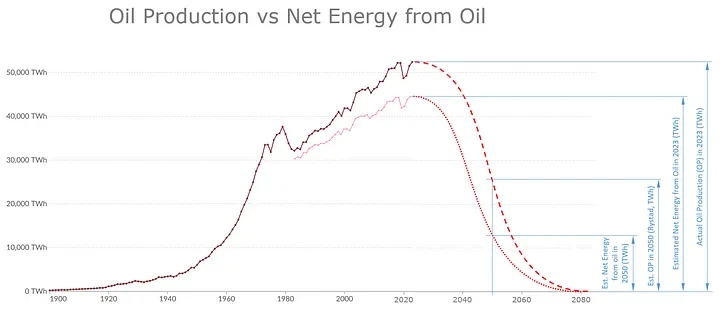
I had a few questions about this graph. I have seen this before and it has been mentioned on this site as well. This is the study but is it accurate?
https://www.sciencedirect.com/science/article/abs/pii/S0306261921011673
If our destination in 2050 is 1/3rd the amount of energy from oil that we get today, what happens on our way there especially with the economy?
Hideaway:
Hi Kira, have a close look at the graph and notice the exponential rise from around 1950 to the early 70’s. Hubbert showed that the rise and fall of world oil production should have followed a normal distribution curve, like individual oil fields tend to do.
When OPEC raised prices and the world realised oil was a finite resource there was a huge change and we implemented many efficiency improvements and substitutions (mostly gas) for oil use. The growth in oil production changed from exponential to linear, and instead of rolling over as predicted by Hubbert, has continued to rise.
We have been dragging future use of oil into the present for the last 25 years, while still growing overall oil extraction, as reserves deplete. Think about oil producers around the world. They have older wells still producing at EROEIs of 20-30:1 or more, plus newer wells in harder to reach places with much more expensive infrastructure and processing. The older wells that paid off their capital costs decades ago are easily the most profitable. They generate the most cash to keep the system going, however it’s the newer wells like shale oil, tar sands, deep water, etc. that help keep the overall price of oil lower.
Which are depleting faster? The old profitable wells, because the trade of goods and services runs on dollars and profit, so oil producers need lots of dollars coming in. Whenever the Saudi’s turn down production, it will be the expensive oil they reduce, not the cheap easy stuff, unless they desperately need to rest fields to protect future extraction.
What this leads to in our world of capitalism economics, is all the high EROEI wells depleting around the same time, just as the cost of maintaining production rises rapidly, because the wells are so much more expensive relative to the oil produced.
Complexity also enters the picture because the extraction processes for newer oils are highly complex operations. For example, horizontal drilling relies on sensors and computing power to keep the drill in exactly the correct strata, 10,000 feet below the surface. The oil sands extraction process uses large modern machines with the latest computers and sensors to maintain optimum efficiency.
Once the easy high EROEI oil is depleted, the remainder becomes much harder to extract because supply lines of equipment and spare parts become less reliable due to reduced economic activity, making everything required to support the complex processes harder to obtain and much more expensive.
Rapid loss of oil production quickly leads to higher oil prices and shortages, with businesses closing as people reduce spending, as happens in every recession, however the declining oil supply will accelerate as other high EROEI wells also reach total depletion, exacerbating the overall problem, with newer oil sources not keeping up with the declines. Deep recession leads to businesses shutting and restricted trade as countries can no longer afford imports, which causes more businesses to go bust.
Factories that earn 10% of their revenue from making essential ‘widgets’ for the oil sector go bust because the other 90% of their business starts operating at a loss, and it is impossible to restart the manufacturing because critical machinery was sold off for scrap in a clearing sale.
Thousands of factories stop making parts critical for a complex system. Without parts, oil rigs and refineries can’t operate, which brings down the entire system.
For us here at Un-Denial, it’s pretty obvious what happens next as the problems will mount and cascade affecting many businesses unexpectedly, thus triggering a self-reinforcing decline.
Most importantly, although demand for oil will fall with recession, oil will not become cheap because supply will also quickly fall. There will not be investment capital available to extract new marginal oil, especially in the Middle East where populations will be suffering from the high price of imported grains and other food, that will become difficult to purchase on the open market. Food exporters will struggle due to high diesel and fertilizer costs and will be forced to reduce production.
Then the next year oil supplies will fall another 5 Mbbls/d, and again the year after, and soon it’s over and most people will be left wondering how those in power let it happen or couldn’t see it coming…
Kira:
Thanks for the explanation.
I hadn’t considered at all that even within countries like Saudi Arabia and Kuwait you will have different EROEI fields. It makes economic sense to keep running the high EROEI wells to get most for your barrel of oil. After reading your explanation I was curious to see the status of old oil fields, the giants and super giants which are collectively responsible for the majority of our crude oil, but most importantly as you pointed out, high EROEI oil. This is the list from wiki:
https://en.m.wikipedia.org/wiki/List_of_oil_fields
Most supergiants were discovered more than 60 years ago. Taking the top two as example Ghawar and Burgan. They both started production nearly at the same time and apparently peaked at the same time (2005) although Saudis don’t confirm it. Ghawar seems to be declining at 2.5% annually and will be down to 2.5 million barrels from a peak of 5 million by 2030. I am sure Saudis are doing everything possible to slow the decline now which will make future decline worse.
It appears as though oil fields like Ghawar are subsidising the extraction of the low EROEI oil like shale and tar sands. The energy comes from the old ones and the volume comes from the new ones, keeping price low and maintaining the illusion of abundance. It’s quite deceptive when you think about it. The net energy keeps depleting while the volume remains same or even increases for a while.
Companies that make generators for offshore oil rigs are a great example of economy of scale tumbling. They probably make generators for hundreds of clients who are not oil companies, when these clients can no longer afford their product the critical mass is lost and they go out of business. Oil companies cannot keep them in business single handedly. This can be applied to other things like pipes as well. This is what the death spiral of the oil industry will probably look like.
Hideaway:
I was thinking when reading your post Kira, yes, yes, yes, yes, yes. I certainly couldn’t have written it better.
On the oilprice.com webpage, there is this article….
https://oilprice.com/Energy/Crude-Oil/Arab-Gulf-Producers-Are-in-Need-of-Much-Higher-Oil-Prices.html
After enjoying a rare budget surplus in 2022, most Gulf Cooperation Council (GCC) economies are seeing their budget deficits widen with current oil prices still well below what they require to balance their budgets. According to the IMF, Saudi Arabia, the GCC’s biggest economy, needs an oil price of $96.20 per barrel to balance its books, thanks in large part to MBS’ ambitious Vision 2030. The situation is not helped by the fact that over the past few years, the oil-rich nation has borne the lion’s share of OPEC+ production cuts after agreeing to cut 1 million barrels per day or nearly half of the group’s 2.2 mb/d in pledged cuts. In effect, Saudi Arabia has been selling less oil at lower prices, thus compounding the revenue shortfall.
Imagine how they cut back, will it be the most profitable oil wells or least profitable ones, when they are so desperate for revenue? Obviously the least profitable ones get reduced while the cheap easy to get oil gets depleted quickly.
What could possibly go wrong when all the cheap high EROEI oil extraction starts declining rapidly just as shale oil uses up its tier 1 and 2 locations…
Perhaps we should have been called Homo dumbass, because we are definitely not ‘wise’.
Rob here on 15-Oct-2024 adding some fresh calculations by Hideaway on the expected speed of collapse, and a response from Kira.
Hideaway:
An aspect of our situation I’ve been thinking of putting down in writing with numbers, so that people can get a better understanding of the collapse ahead…
In regard to oil, we are mining around 100Mbbl/d which will roll over at some point in the near future..
According to some paper I read recently, we currently use around 15.5% of oil to obtain oil and this will rise to 50% of the energy by 2050.. From this paper…
https://www.sciencedirect.com/science/article/abs/pii/S0306261921011673

At the same time as this is meant to be happening, we will be mining a bucket load more metals and minerals for the transition.
What people find so difficult to do is to put several aspects together, to see if it can work, so I’ve decided to try below.
Assuming the increase is 1Mbbl/d/yr in the energy used to gain oil, which is easily possible as we’ve mined all the easy to get oil and only have the harder, more distant supply left, plus allowing for oil production to roll over to a decline in production we get the following…
I’ve used a fall of oil production of 1Mbbls/d for years 2,3 and 4, then 2Mbbls/d for yr 5, and 6, then 3Mbbls/d, for year 7, 4Mbbls/d for yr 8, 5Mbbls/d for yr 9, then a maximum of 6Mbbls/d for years 10, 11, and 12. At no time does the depletion rate go over 10, in these 12 years…
Year 1 …production 100Mbbls input energy 15.5Mbbls … Left for society 84.5Mbbls
Year 2 99M ………………………….. 16.5M ………………. 82.5M
Year 3 98M…………………………… 17.5M ………………..80.5M
Year 4 97M ………………………….. 18.5M ………………..78.5M
Year5 95M ………………………….. 19.5M ………………..75.5M
Year 6 93M ………………………….. 20.5M …………………72.5M
Year 7 90M ………………………….. 21.5M …………………68.5M
Year 8 86M ………………………….. 22.5M ………………….63.5M
Year 9 81M ………………………….. 23.5M …………………..57.5M
Year 10 75M ………………………….. 24.5M ……………………50.5M
Year 11 69M …………………………… 25.5M …………………….43.5M
Year 12 63M …………………………… 26.5M ……………………. 36.5M
Because of the combination of more energy cost of energy (a la Tim Morgan), plus just plain slow decline, the available oil for the rest of society has gone from 84.5Mbbls/d in Year 1 to 36.5Mbbls/d by year 12..
But wait there’s more.. Assuming mining uses 10% of all energy, while in oil’s case makes it around 10Mbbls/d, we know that mining has to increase greatly for the ‘transition’. With the massive increase required, just assuming a 10% increase per year would be conservative, as we are talking a magnitude more copper, Aluminium, Nickel etc, plus all the steel in wind towers and solar farm foundations being built in the TW scale every year etc.
Mining’s use at just 10% growth rate goes from 10Mbbls/d in year 1 to 31.4Mbbls/d in year 12..
When we add this into our calculations of oil available for everything else, we go from 75Mbbls/d in year 1 (100 – 15.5 – 10 = 75Mbbls/d) to 5.1Mbbls/d (63Mbbls – 26.5Mbbls – 31.4Mbbls= 5.1Mbbls/d) for everything else other than oil production and mining..
The above assumptions are very conservative assuming oil doesn’t decline by more than 10% in any one year, that oil used to gain access to more oil goes up by only rises by 6.5%/yr at most, then the growth rate declines (unlikely), plus the 10%/yr increase in oil going to mining wouldn’t get us close to climate/transition/renewable expected growth rates…
Even with those very conservative assumptions, we go from 75Mbbls/d for “everything else” to 5.1Mbbls/d for “everything else” in just 12 years after reaching maximum possible oil production. It clearly can’t and wont happen that way!!
We’ve been dragging future oil use into the present for the last 40-50 years, as shown by the linear increase in oil production since then, whereas we had an exponential rise in production before then.
The above is just putting together 3 aspect of our modern world, instead of concentrating on one and assuming everything else stays constant as just about every ‘model’ does that I come across from ‘experts’ in various fields..
The big question is what happens instead of the above??
Do we cut back oil spending on gaining oil, so that the depletion of existing oil happens much faster than 10%/yr?
Do we cut back on mining so that the transition dies a lot earlier?
Do we assume we will find a magic energy solution to all our problems?
Do we just assume oil production will never decline quickly… because….. just because we don’t want it to???
I didn’t realise how bad the numbers were until I just did the simple calculations and put it down in writing. To me it means we collapse well before the 12 years are up after reaching peak oil production because of many feedback loops creating chaotic disruptions on the way down. Every year we remain close to the peak of oil production, means we are dragging more future oil to the present, meaning the decline when it starts to accelerate will likely be much faster than the sequence above…
Kira:
Excellent analysis!! I just want to mention that the oil that goes into getting oil is mostly in the form of diesel yet only about 75 million barrels that we extract today is the kind of crude that can be refined into diesel. The rest of oil is either shale, NGL, Biofuels among other things which have their uses but not as diesel.
There was also a video that was posted here about a gentleman who mostly agreed with what we discuss here about the irreplaceable nature of fossil fuels and the shortcomings of so called renewables but believed that there is so much oil out there that we will never run out, that we can have shale revolution after shale revolution. There are many who subscribe to this school of thought and think we can extract shale oil and gas from formations in Argentina, Russia, China and many other such places. Art Berman (who has expertise in this area) on Nate Hagen’s podcast has stressed several times that the geology of American shale is very unique and the shale revolution cannot be repeated anywhere else.
If one needs any proof of this please look at China. Despite the CCP pushing the state oil companies hard to extract shale deposits for years gas out has reached only about 30bcm per year which is less than 3% of American output. Part of the reason is the remote location of the deposits in the northern part of the country but we are talking about a country that can create entire cities from scratch within a few years. This is a matter of National security for the Chinese but the geology is the problem and has been unyielding so most efforts have been fruitless and abandoned.
As far as depletion goes even if we take super optimistic figures given by Rystad which predicts that oil production will be down to 50 million bpd by 2050 then the oil available by energy would be worth only about 25 million barrels. This is just a slightly stretched out version of numbers given by you.
It is interesting excersize to speculate on how things will play out on the downslope.
At the beginning of this downslope the airline industry will be the first casualty. Consuming about 8 million barrels of oil and mostly middle distillates at that, this shutdown will provide a much needed relief to the energy constrained world. Of course the commercial airplane manufacturers namely Boeing and Airbus will also go out of business. It is unlikely that governments will have any interest in bailing them out even if they had the ability which they won’t. The tourism industry which depends on air travel will also collapse, as will countries entirely dependent on revenues from it. Depletion will soon catch up and the gutting of industries will start again but this time it won’t be something discretionary and superfluous like air travel. This time industries that touch all our lives will start competing for the remaining share of energy.
Rob here on 7-Nov-2024 adding Hideaway’s answer to a question by ABC on whether Dr. Simon Michaux’s proposed solution of Thorium reactors and iron powder will work.
My take on why this type of future can’t happen is because Simon Michaux misses complexity and scale in the argument we can go to this type of future…
Let me explain, we can only have the complexity of nuclear power and running everything off electricity with an enormous scale of the overall human enterprise we call modern civilization. The scale of this complexity would require much larger markets than we currently have as the number of ‘widgets’ needed to be made for all the complex machinery would be greater than today.
We only have the complexity of today due to the total scale of everything we do. The highly specialised nature of building the best computer chips as an example happens in one place Taiwan with TMSC. The facilities they have built to make these computer chips can only be as sophisticated as it is because of the global scale of it’s customers. To build and operate 50 such facilities around the world would not be possible, they would all go broke. The scale of the facilities built needs the scale of the market size.
To build cheap thorium reactors or any SMR, the “modular” being the important point, would require a massive market as the factories involved, down to the smallest widget all have to be working in co-operation so everything fits together perfectly, so the market needs to be massive so everyone in the chain can make a profit. It also means all the suppliers of parts have to be operating smoothly and at large scale to supply all the inputed metals and minerals.
This all requires the existing system to be maintained while we get the growth in scale of the industry which relies upon the growing demand for the new products from the markets.
Notice how there is growth at every stage to make it all happen!! So if we had a spare planet or 2 of resources to use to accommodate all this growth, then we might get to a more advanced technological civilization, however running into limits of everything we currently use, because of growing energy cost from energy access itself to everything else mined, means we can’t get that advanced.
Also note that to get to where we are today in regards to the totality of civilization has taken growing energy use of all types for over 250 years. It’s been oil that has allowed for the increases of coal and gas use over the last 100 years. All the renewables plus nuclear and even modern hydroelectricity all rely upon oil themselves, and upon oil for the cheap coal and gas used in their production.
If we didn’t care about the environment at all and had another 2 earths worth of oil on this planet, then sure we might get to thorium reactors everywhere, but it will still all rely upon oil.
As oil production starts to rapidly decline, sometime in the near future, I have no idea exactly when, then the ability to keep our modern complexity will quickly unwind. We are getting a ‘sniff’ of this at present by all the countries that want to relocalise so much production, which isn’t possible as we lose the economies of scale of the current globalised system, unless there is an accompanying simplification as well. However no-one is planning for a simplification, the actual plan is to make aspects of the modern world at home. All these plans will quickly realise that they rely on imports of most/all the parts and the relocalisation is not very economic because of smaller market size.
Of course all the duplication everywhere is more inefficient using both more energy and materials to build and taking more people to operate and maintain. We lose some of the existing efficiency in the huge scale of many operations by trying to relocalise them.
What it means by even trying the relocalisation is that the population as a whole gets poorer because of inefficient use of energy and materials (unless we had spare planets worth of all these on this planet!!), due to lack of scale and overall the complexity has to fall to match the energy we have.
Please also note we have no shortage of any material on this planet, just a shortage of energy to access lower grades, and all the processing involved in making them useful goods. It all comes back to existing energy availability within the scale of complexity of what we have as current civilization and we can only build a lot more of any one aspect, while the entire system operates normally. Normally being in growth mode, providing the capital, goods and services required in the usual orderly manner to open new mines. Which means the population needs to be well fed and educated, with abundant services continuing to operate throughout.
We can’t take energy and materials away from one sector to go to another as the odds are they use different aspects of modernity and it’s not a simple swap, with whatever being constrained having feedback loops that are unexpected.
Anyway back to thorium reactors. The industry needs to grow and develop naturally in a world of increasing demand for this product, so it can develop naturally, which takes the rest of the system growing normally. Eventually factories that could build SMR would develop, providing the capital and operating costs were a huge advantage over the existing forms of energy. This can only happen in the background of our system operating ‘normally’, ie growing economies. It can’t be forced, as any developments of forced, as in uneconomic simply don’t last as industries when times turn tough.
When we get a real recession/depression brought on by oil getting more expensive for every other industry, all the expenditures on solar, wind, nuclear and batteries will probably start falling fairly quickly, as these expensive subsidised builds lose market share, as they are too expensive, even for a product (electricity) that is only one aspect of our energy use.
All heavy industry needs a constant cheap energy supply, often in different forms at the same time to produce the raw materials that feed our modern consumption. Without coke, coal, gas and plastics many of the items of modern civilization simply wouldn’t exist at all, so build a huge array of thorium reactors with say the last of the fossil fuel energy available, solves no problems. We wouldn’t be able to make the products we use today with just electricity.
If we were to build fancy new recycling facilities that somehow made use of all existing plastics for re-use in original forms, the whole enterprise would suffer the same entropy and dissipation as everything else and winds down fairly quickly, plus requires a rapidly growing system of modern civilization working normally in the background while it’s built to the scale and complexity required.
Every argument of how we can power a new civilization with solar, wind, batteries, nuclear, thorium or whatever form of electrical energy in the future, argues for a smaller supply of energy needed than now because fossil fuels are inefficient, we only use 25-50% of the energy (depending on the machine). It’s a terrible argument as the increase in the modern civilization growth to get to that point, would mean a much higher energy use than at present, just because of the growth in scale and complexity of everything to just build this future.
Someone should ask Simon Michaux or any other expert about the clean green future whether from renewables normal nuclear or thorium, about how much of it can be built without using fossil fuels at all, including down to the plastic insulation on all wires. The usual answer is it can’t be done yet, but improvements in technology and increased use of renewables/nuclear and how cheap they all become will allow it to produce synthetic fuel for these types of purposes.
I usually counter, with how none of it’s being done now, yet renewables and nuclear are already claimed to be cheaper, so all new factories would already be going to the cheaper ways if it was true, but no-one is doing it, so something is very wrong with the narrative. The argument usually flows to climate reasons why we have to move away from fossil fuels, which is unfortunately a different argument, because the energy required to then mine all the minerals to build this fantastic green future simply doesn’t exist without the use of fossil fuels.
We are in a total and utter catch 22 where we require cheap fossil fuels to build everything and maintain the current modern civilization, which collapses without their use leaving 8 billion cold, angry starving people looking to survive. Using another 2 planets worth of fossil fuels to build the entire renewable/nuclear/thorium future with electricity used for everything, including making plastics and synthetic fuels, will leave the climate and environment in ruins, then collapse anyway, when we turn off fossil fuel use, as that is a sudden energy loss when we continue to require more minerals and metals from the environment, due to those lost from entropy and dissipation, and the increase energy use from all the movement of materials for recycling..
I didn’t even get around to mentioning that a world of recycling everything as much as possible, uses fossil fuels for all the processes anyway, but that’s another story. It’s an incredibly complex situation we are in and any ‘easy’ sounding solution will simply not work as the proponent forgets we spend 97-98% of all our existing energy and materials on just maintenance of the existing system with only the other 2-3% going on ‘growth’ of everything.
Any one new major investment into a great sounding idea on a world wide scale, can simply not work by spending less than 1% of energy and materials use on it, unless the entire system of energy and materials grows massively. As the entire system has to grow, the number we start from in the future will be much higher energy and material use than it is today. The scale and complexity has to also grow to allow for more efficiencies in the system. the starting base of energy use in 30 years time will be double of what it is today..
If we don’t ‘grow’, then we can’t maintain existing subsystems within our civilization, as we need an increasing quantity of energy just for maintenance of material availability. The system can’t work ‘normally’ without the increase in energy, even without growth in the overall system. If we shrink the market size, then we can’t maintain the complexity of the current system either, as the affordability of the complexity goes down, so the system simplifies, which makes gaining access to lower grades of everything much more energy intensive as less complex equipment will mean lower recoveries in mining, lower food volumes from a given area of land etc.
Oops, sorry for excessively long answer. Our civilization is highly complex and so is the reason why none of the bright green ideas can work, and neither can a shrinkage of population while maintaining modernity, but hte attempt to do so, will lead to collapse of it all.
Rob here on 14-Nov-2024. Hideaway and ABC had an opportunity to ask some questions to a couple important leaders in the overshoot awareness community, John Michael Greer and Simon Michaux. Following are the questions and answers plus follow-on commentary from Hideaway.
A.) How can we have modernity without the scale of market size that we currently have to enable the mining, processing, distribution then manufacturing of the huge range of parts that go into making every aspect of modernity?
We can’t. It really is as simple as that. Modernity, as Dr. Richard Duncan used to say, was a transient pulse waveform a one-time, self-terminating affair.
B.) How do we make the machines that make the final product machines in a scale down world?
That asks the question the wrong way around. The right way around is “what kind of final products can we afford to have, given all the constraints on producing them in a deindustrializing world?”
The answer won’t be clear for several centuries, but it’s unlikely that any technology invented since 1900 or so will be included.
C.) How is it possible to maintain complexity, such as a thorium reactor and all the machines it powers on only a small scale?
I’m not a specialist in this technology, of course.
I’m open to the possibility that it can be done, but I want to see an affordable example first.
As we’ve seen over and over again, every nuclear technology is cheap, clean, and safe until somebody actually builds it…
D.) Where do the materials come from after many cycles where entropy and dissipation have worked their magic over many cycles of recycling?
Oh, in the long run say, another 10,000 years we’ll have to go to entirely renewable resources, and that will involve sweeping changes in everything; for example, some future society may cultivate chemosynthetic iron-fixing bacteria (the kind that currently produce bog iron) to keep it supplied with iron. Our immediate descendants won’t have to worry about that, though. Given the scale of population contraction we can expect (around 95% worldwide) and the gargantuan supplies of metal and other materials that have been hauled up from deep within the earth and stored in what will soon be urban ruins, our descendants for the next thousand years or so will have all the metal they can dream of using.
A.) How can we have modernity without the scale of market size that we currently have to enable the mining, processing, distribution then manufacturing of the huge range of parts that go into making every aspect of modernity?
I don’t think we can. It was all dependent on oil as a fuel. We have no replacement for this.
B.) How do we make the machines that make the final product machines in a scale down world?
We have to change our thinking in what we need all this stuff for. Do we need it? Can we do it in a more simplified form? Then ask how we can get there. If we can simplify how the tools are made using more abundant resources (iron vs. lithium for example) then use those machines differently, using modern knowledge.
What have we actually learned over the last 200 year?
The last 20 years in particular?
Can we take a backyard workshop, make a small foundry, have a blacksmith forge, run a basic lathe, drill press and welder, power it with a wind turbine on a lead acid battery?
Strip out useful products from all the places around us that no longer are in operation (cars in a carpark that have been abandoned).
Make an electric motor and a lead acid battery.
Can we shred rubber tyres and make gaskets?
Can we run a furnace to recycle ceramics and building waste into geo polymers
Then you have tech like 3D printers.
Can these be reinvented where we can make our own feedstock and make our own printer unit?
And so on.
C.) How is it possible to maintain complexity, such as a thorium reactor and all the machines it powers on only a small scale?
A Th MSR unit is about 12 m long, about the size of a shipping container and delivers 40 MW of electricity, or 100 MW of heat at 560 deg C.
They are made mostly from steel, nickel and a small number of exotic metals and alloys.
They have a working life of 50 years.
Complexity to run it is about that of running a modern medial isotope lab.
Their production is much simpler than most other devices.
I think it can be done in some cases.
The problem is getting permission to use them.
D.) Where do the materials come from after many cycles where entropy and dissipation have worked their magic over many cycles of recycling?
Contract our material needs per capita.
Simplify what we need to resources that are more abundant.
Most of the purple transition needs iron, which we have lots of.
Copper will be the limiting metal.
Industrial systems have to come into line with food production limitations.
Once we get to the point where recycling and mining can no longer deliver, then society has to work out a way of living without these things or go extinct.
Hideaway’s commentary:
Thanks ABC great work and answers by JMG. He gets the big picture of what’s going to happen, but appears to miss all the feedback loops that will accelerate everything to the downside. We have over 8 billion humans on the planet and 99.99% of them have no idea modernity is going to end abruptly, and when it does so will destroy the plans of the other 0.01% (or less!! ), that did see it coming and tried to prepare in some way.
Lots of people use Cuba as an example of what can happen with building vegetable gardens etc., except forget to mention that it’s in the tropics with fast growth and plenty of water, compared to say the UK which is 2.4 times the size and 6 times the population, plus Cuba today imports around 70%-80% of their food.
Where JMG says it’s asking the question the wrong way around, is incorrect. We are not planning anything about contraction as a species, every machine is becoming more complex allowing for more automation and hence cheaper costs. Once we go down there will not be the investment capital, energy nor materials, nor co-ordination to build any new machines to make anything.
He has once again used how we have done things on the way up, as in using more energy, materials and larger expanding markets; to think that some similar type of planning will occur during the collapse phase. It’s wishful thinking not close to reality.
Realistically, when food is not arriving in cities, who is going to be sitting around talking about what machines they are going to build and what level they can acquire, when there is no energy, nor materials in the appropriate form to do any of it??
One aspect JMG gets completely correct is about thorium reactors….. “As we’ve seen over and over again, every nuclear technology is cheap, clean, and safe until somebody actually builds it…”
There is a very good reason for the cost of all nuclear, of which thorium reactors will be no different, complexity. Every aspect of it is a highly complex specialty. It wont be made from ordinary stainless steel, it will be highly specialised stainless steel, probably with a high quantity of minor elements like molybdenum to allow for the highly corrosive environment of molten salt. “Salt” as in sodium chloride does not play well with most stainless steel, as the chloride is the one thing highly corrosive to stainless steel.
In the huge new refinery in Texas built by the Saudi’s a decade or so ago, upon commissioning someone turned on the wrong valve that sent hot seawater through the piping, causing something like $1.5B dollars in damage and delaying the opening by a long time. Interesting they now call it “caustic” released as it pitted all the stainless steel pipes. If seawater can do that, imaging what 600-800 degree molten salt will do to any weakness of the piping.
Scavenging materials, finding a smelter that can separate all the scavenged materials into the original metal forms, then recombined into the correct quality stainless steel to withstand high temperature molten salt, is a highly complex process by itself, involving a lot of coking coal for the heat. We don’t currently do this for new highest grade materials, we use newly mined purity, for the combination specialist metals, recycled metals doesn’t provide the purity required at this level of specialty. There is no way Simon’s thorium reactor can be rebuilt in a small community, as we would still need the mining of all the separate metals, including his one word reply of ‘exotics’.
What seems to happen is that we get answers about the future that all sound very plausible and comforting, until some person with a bit of knowledge of the intricacies of some part of it comes along to spoil the party.
It’s the highly technical nature of the materials that go into machines, that are then forged into specialized minor, often tiny, sometimes huge parts, with all the connections working in harmony, to make any modern kit, that will be impossible when people are desperate to find food and survive that’s the problem which is overlooked. They always assume some type of normality in the future, just with a much smaller group, forgetting that normality has been a growing human enterprise, with always more energy and materials to make stuff with for generations, and that normality is going to leave us in the near future.
Rob here on 5-Dec-2024 adding an interesting thought experiment by Kira on the energy and material savings benefits of economies of scale and our multi-continent supply chain. With follow-up comments by Hideaway and Kira.
Kira:
I have been trying to think about the benefits that economies of scale and multi continent supply chain provide in terms of energy and material savings and decided to try a simple thought experiment to try to visualize it.
Lets take a simple rudimentary motorbike as an example of the product that we intend to produce at scale. The raw materials will be the metals and alloys needed to make the parts and everything else will be done in house without depending on any external supply chain. The basic parts for a bike are as shown.
If we decide to make everything everything under a single roof (which is what localisation implies) we would have to dedicate seperate machining and fabrication units for each part along with the people with expertise in each of those departments all of which are massive upfront investments and would make the factory a mammoth operation on the scale and size of a gigafactory.
So what are the downsides of this approach?
- It requires massive upfront investment and upkeep.
- The output would be low.
- If we have to serve a country as large as US with localisation we are looking at at least one factory per state leading to large redundancy and waste of production capacity.
Lets approach the same problem and apply a distant supply chain solution.
Since all motorbikes are more or less the same and use same parts shown above we can do the following. Three companies A,B and C may be different bike companies making different types of bikes they will only design and make the frame(chassis) and engine in house and everything else will be outsourced to an external vendor. The suspension will be made by suspension manufacturing company, brakes by a brake manufacturer and so on. So how does this benefit everyone?
- Since the company is only making the frame and engine its factory size will be a fraction of what it would have been in scenario one.
- A dip in demand for company A’s bikes would not result in wasted capacity as company B and C can absorb the common capacity for the parts.
- Less labour requirements as there is lower redundancy as there is only one plant making suspension, brakes, tyres, clutch etc. instead of three.
- Since more resources are freed up the companies can focus resources on research and innovation thereby speeding up progress.
The obvious downside of this is the loss of redundancy and a single point of failure which can halt the production of all bike companies. But the benefits to the civilization as a whole far outweighs the risk as the more complex the product is the longer the supply chain is and the more difficult it would be to make it under a single roof.
If we take microchips as an example and try to take all the processes from raw materials to a finished chip and make everything under a single roof the factory will easily be the size of a small sized city.
When I mean everything I mean everything from the lithography machines to all the other machines, starting all the way from raw materials. That means first making this incredibly complicated machine below starting from metals and alloys mined,processed and shipped to the plant then machined, fabricated and assembled into the machine shown below.
So as complexity of the object increases multi continent supply chain is not only useful but essential to making high tech products. None of this is possible without fossil fuels and high grade minerals both of which are in irreversible decline and will soon lead to the supply chain collapsing leading to a loss of complexity creating a negative feedback loop.
The lithography machine shown above is just one of a hundreds of processes in getting from silicon ingots to a microchip (albeit the most important one). Some of the processes are shown above which require equally complex machines to perform.
Hideaway:

The caption with the photo states .. “just one of the benches the engine was laid out on”.
This was from a 1965 built motor..
Thanks Kira, a brilliant breakdown of complexity, with each of the above different main parts of a motor bike having so many components themselves. A simple motorcycle can have 2,000 – 3,000 separate parts.
Our complexity of modern life is just lost on so many people, not understanding that each and every part has to be made precisely from the exactly correct materials, to work together and function as a whole ‘machine’.
The other huge misunderstanding is that we need the total complexity to gather the food, energy, and materials that make up this complexity as we have used up all the easy to get food, energy and materials.
The motorbike example is a simple machine compared to a horizontal drill rig with tens of thousands of separate parts, including many computer chips, in many separate parts of the rig, from control systems to sensors to actuators, communication systems, power systems.
Without modern horizontal drill riggs our oil production would fall rapidly by a large percentage and these machines are dependent upon lots of spare parts arriving nearly every day.
When we start to lose overall energy availability, especially oil production because of depletion, the complexity has to rapidly unwind, as there is simply not enough energy to keep it all going. Once feedback loops kick in, of lack of parts, then machines we rely on become junk very quickly, which accelerates chaotic feedback loops.
The concept of going local, means massive simplification, because we don’t have either the energy nor materials locally to do anything differently, which means we will be unable to feed the current huge populations of local areas as all the modern machines cease to function. Fertilizer becomes a thing of the past, tractors can’t get oil and grease, let alone fuel, likewise for all transport from local rural areas, to cities.
Modern humans have just forgotten how reliant we all are upon 6 continent supply chains for our very existence…
“Kleiber’s law” of power/mass use to the 3/4 power most likely applies to human civilization. Studies have shown that in nature the law is a doubling of animal or plant mass requires a 75% increase in energy use because of efficiency gains is the easy explanation.
In human settlements research, done by Prof Geoffrey West and a host of others, they have found human population centres the power law is closer to 85%, as in we are not as efficient as nature with a 4B year head start. The problem with all the work on settlement sizes is that we live in a world of one global civilization and no city is an entity to itself, which they were 500-10,000 years ago, including their surrounds.
Kira:
Actually it was your exchange with Dennis on POB that lead me to have this train of thought. I found this line by him to be quite revealing of how people like him think.
Dennis: “Society is not based on physical laws alone, it is understood using knowledge such as sociology, psychology, and economics.”
Cornucopians like him always point out how GDP is growing with less energy use ie growth is becoming less energy intense. We know this is primarily because of massive financialization of economy but when you point that out his reply is that GDP calculation are a reflection of physical and thermodynamic reality of the society. It’s funny how he tries to have it both ways whenever it is convenient.
He is wrong as usual. Let’s take three bike companies on three continents North America, Europe and Asia – Harley, Triumph and Honda respectively. Assuming that there is no contact between the continents and each company has complete monopoly over their respective continents without any alternative then they can manufacture in whatever configuration they want. They could make everything under the same roof with redundancy and inefficiency or outsource their production of components to third party and cut costs.If they are inefficient their customers end up paying more than their counterparts on other continents.
But as soon as we apply the situation of globalization and they have to compete with each other they will have no choice but to reorganise themselves in a way to reduce material and energy costs and if they don’t they go out of business. You were right in your counter that civilization is very much like an ant hill and just like how no ant has the complete blueprint, no human has the complete design of civilization. It is not intentional, it is self organizing and self assembling. Complexity increases to solve problems and with increase in complexity comes increase in material and energy cost. When this happens the system reorganizes itself to optimize resource consumption. There is no way to intervene here.
For instance Ford could probably manufacture every component of its car under the same roof 85 years ago but with today’s complexity they probably have hundreds of suppliers that they share with many other car companies. If an American president declares that every inch of a Ford vehicle must be made on American soil the company would immediately go bankrupt as if they tried to do that a car that costs 20,000 would cost 200,000.
This pattern holds even across completely different industries.


This is a ridiculously condensed and shortened version of the supply chains of Apple and BMW. All supply chains end up either at pits of mines or oil and gas rigs as everything we produce comes from earth as raw materials. The suppliers in greens are the common ones for both companies and hundreds of others including oil and gas rigs. If we fully expand the supply chains we will see countless overlaps with one another with constant reorganization happening to optimize resource consumption. The true scale of feedbacks and overlapping is so complex that it is impossible to even comprehend. But there are some interesting things we can glean from the above diagram. The critical mass of consumers for the chip industry is coming from consumer electronics meaning that the auto industry and oil industry are just beneficiaries of this. If people stop buying smartphones and PCs then oil companies and car companies go out of business. There are several such critical dependencies that may not be so obvious at first glance and may be far down the supply chain.
Of course the connective tissue connecting the supply chain is oil since without we cannot maintain the multi continent movement or power the mining machines at the end of the supply chains.
Hideaway:
Thanks, Kira, excellent work again.
Trying to get people to understand the connection between the overall size of the growing market, relative to the complexity is extremely difficult, especially when added to the overall energy and material savings to the entire super organism of the human civilization.
Because of collapsing grades of ores of all types, we need the complexity of modern machinery, modern financing and modern supply chains, to gain access to all the requirements of all materials and energy used. It’s a self feeding monster that has to grow just to gain access to the requirements.
Unwind any aspect of modern complexity and the whole lot collapses, yet keep growing and the whole lot collapses due to environmental limits anyway.
Most likely oil will be the limiting factor, that sets in motion feedback loops in reduced consumption of all the requirements used in modern complexity, and your example of discretionary spending on computer chips is the perfect example, but we can multiply this by thousands for all the unknown links that are necessary to keep modern complexity going.
The concept of localizing industries, plus using tariffs to do so, will just hasten the collapse as it uses up more energy and material resources to build all the local manufacturing plants and tool them up, let alone gain the raw materials and energy for their operation. Just the attempt to do this will likely set off other unknown feedback loops as the extra energy and materials involved in the attempt to localize puts pressure on other aspects of the system.
Of course it’s all just a duplication of what’s already happening elsewhere, supplying the world, so the energy and materials are effectively wasted giving higher costs to consumers everywhere because of the duplication. Now imagine 5-50 countries trying to do the same for their local markets.
We can’t have 50 TMSC factories around the world as there is just not the market for that number of computer chips, with the complexity it takes to produce them. That factory/foundry whatever they want to call it has to churn out millions of wafers and chips to be viable. It wont work with 50 of them, unless the super-organism of human civilization grows by enough to accommodate the increase, which means every facet of civilization has to grow including population, energy and material use.
Once oil declines because of depletion and the impossibility of an increased production, whenever that happens, then overall energy availability turns down, meaning the growing organism can’t keep growing, nor even maintain what’s built and operating as entropy guarantees we require 97-99% of all energy and materials to just keep operating ‘normally’. (All while energy use keeps growing to supply the raw materials because of lower grades).
Once energy of all types that totally rely upon oil start suffering from increased costs, as oil’s harder for any one business to obtain, the civilization that relies upon cheap energy, suffers from reductions in internal markets from those struggling, meaning less markets for computer chips, and every type of machine that relies upon them, sending businesses broke, that manufacture essential requirements of other businesses, so creating a cascade of accelerating failures across civilization itself, in producing everything required to just maintain and operate what exists.
We’ve been in extend and pretend mode for over 50 years, making up a linear increase in oil supplies, with exponential increases in coal and gas energy supplies to make up the required energy of the growing civilization, then added some nuclear, solar, wind, geothermal etc, all just electricity providers, which are not providers of the full range of products and energy supplied by fossil fuels.
The increase in coal and gas though is totally reliant upon oil, with the rest being just derivatives of fossil fuels in total.
The complexity of the entirety of the system would take multiple books to explain just the merest of details of any one component of the overall complexity of how we live. It’s beyond the comprehension of anyone, as it’s exactly as explained by Kira above, so people without thinking of the overall complexity, assume we can just increase one part of this civilization by increasing something massively, on a world wide scale, without having implications elsewhere, nor have any understanding how everything else has to keep working normally for their one aspect to increase greatly. (EVs, batteries, solar, wind, geothermal, tidal, and nuclear).
Single cell organisms, multiple cell organisms, storms, stars and all prior civilizations have grown with increasing complexity over time, yet all eventually collapse due to some type of internal energy usage decline, that collapses the overall system.
To think our modern civilization will be ‘different’ to everything else in the universe that is large and grows complexity internally, increasing energy use until collapse, is denial in it’s finest form.
 un-Denial
Art Berman today does a very nice job of explaining why climate change is not a hoax.
Unfortunately he does not discuss the more interesting questions: How is it possible that the majority of climate scientists, many with PhD and physics backgrounds, do not discuss the honest implications of their research, and believe in “solutions” that obviously will not work, and are silent on what we should be doing?
https://www.artberman.com/blog/the-numbers-dont-lie-why-climate-denial-is-no-longer-possible/
LikeLiked by 1 person
I enjoyed Art and Tom Murphy’s newest essays. But there is something off with both. Too similar to a round Earther debating a flat Earther. Like why even entertain it.
I like your comment on Tom’s site. James (is that the guy from megacancer) replied to you:
I would argue that Varki is not overcomplicating things, if anything he’s oversimplifying it. Which is what drew me towards MORT in the first place. Kind of like how I used to tease you when I first came on the scene. “MORT is such a cop out. Why wont we do this or that… because of MORT”.
But even if James is correct, looking at it from Varki’s way is going to lead oneself to understanding how monumentally important denial is (which will help you get a grip on your own denial). And that is a critical key component if you want to keep climbing Mount Collapse. Will also lead you to never thinking or saying something like this ever again:
I doubt any of us un-Denialists spend a fair bit of time wondering if we are the crazy one. That shit starts to disappear on day one of your MORT training.
p.s. Tom triggered me in the comments section when he said this:
I know, what a hypocrite I am. I’d have agreed or said the same thing 9 months ago. But Varki’s MORT theory (and un-Denial) has correctly beaten that flaw out of me. Now when I see it my knee jerk reaction is “STFU!”😠
And this famous clip goes well with Art’s essay:
LikeLiked by 1 person
Thanks. That does not sound like the MegaCancer James. He does not write that way and we tend to be more respectful of each other’s perspective even when we disagree.
I replied to James, and Tom, and Mike on that thread.
LikeLiked by 2 people
He got absolutely attacked on LinkedIn after posting it. All the geologists nit picking and semantics discussion – kinda proved his point
LikeLiked by 2 people
That’s very sad.
Also sad, I had Tom Murphy today arguing that Varki is wrong because awareness of mortality could motivate some people to make more babies rather than be depressed. And Mike Roberts arguing that MORT is wrong because humans are animals and animals behave as they evolved to do, which is true, but provides the same insight as saying water flows because it is a liquid.
LikeLiked by 2 people
Wrong or not might not be the question. Varki tries to make a hype out of “Denial”, but as s.o. said: Hype can come back and bite you.
LikeLike
What hype are you talking about?
Varki wrote 1 book, 2 papers, gave 1 talk, and maybe 4 interviews over 10 years. That’s it. Varki has a significant accomplished career in a different field of science. I’m the only person on the planet that promotes his MORT theory. Everyone ignores MORT despite that fact that it provides a scientific explanation for why every “green” initiative has failed, why polymaths can understand everything except the obvious reality and implications of our severe overshoot, and why only one species on this planet believes in gods.
LikeLiked by 1 person
Iran hit Israel today and I responded by cooking Gaia’s rice & beans for lunch.
LikeLiked by 2 people
LikeLike
This one looks a lot worse to me, than the prior tit for tat responses then nothing, when everyone was expecting further ‘retaliation’. Israel have possibly pushed the situation too far this time.
All the people of power involved in the Middle East are just so psychologically damaged that they look like there can be no outcome other than all out war, which means it wont stop until there are different people in power who can work out some type of peace.
LikeLike
Yeh, lots of red flags on this one. Could easily get out of control and disrupt a lot of the world’s oil.
There are too many people and not enough good land and water in that area of the world.
Imagine the stresses with oil scarcity.
LikeLiked by 2 people
I really like the analyses of Simplicius the Thinker. He’s very knowledgeable and very level headed.
He thinks there’s a good chance Israel/Iran will de-escalate.
https://simplicius76.substack.com/p/operation-true-promise-2-iran-strikes
LikeLike
Hi Rob,
That’s a small comfort to me that you would choose to eat rice and beans at this catastrophic time. A week or so ago, I sent to your email some photos of my coffee making experiment with a play by play description (Gaia style)–I wonder if you got it or perhaps it went to your junk folder as the image files were rather large (I recently got a new computer and being only passably literate I haven’t yet figured out how to re-size the photos before sending). Anyway, this latest crisis prompted me to think that you would also have enjoyed an extra cup of joe today to go along with the beans and rice. It’s crazy making to know we’re on the brink and whatever will be will be.
Just happens that we finally got my mother’s house to contract, settlement at the end of this month but what is money and real estate transactions at a time like this? I’ve been head down bum up planting as many food crops as I can, just getting something into the ground, it seems all I can and want to do. Campbell will be happy to know that I’ve put in more taro and cassava, hopefully to be a main starch food. It takes nearly a year for the tubers to come up to size, don’t let anyone tell you that things just magically spring out of the soil like mushrooms (which actually take quite a lot of time to develop as the mushrooms we eat are the fruiting bodies of the fungi). At this point, I have also ordered more fruit trees from nurseries as they are selling out of stock fast, people are cottoning onto the novel concept that growing some of your own food is a pretty good idea.
I trust all are well and keeping going as best you can. Somedays it’s better to just step back and be an observer of it all, as if you’re watching the most vivid movie ever. And taking every day as a bonus day, having “died” and lived one’s life already is another perspective that gives me peace and keeps the day purposeful.
And of course, being part of this fellowship here has been a most grounding and uplifting experience without which I cannot imagine to what depths of despair I would have fallen if I didn’t have others to share the wonderment and angst with. We’ve had a lot of fun here, too. I am so grateful for life, all of it.
Namaste, friends.
LikeLiked by 3 people
Good news on your mother’s home! It’s such a beautiful place, I’m surprised it was slow to sell.
I’ve been working on strimming and pruning the blueberries in preparation for putting down fresh sawdust mulch.
I found your email, thanks, and hope to work on it soon.
LikeLike
Thank you Rob. I’ve learned first hand that it’s location, location, location for real estate, but very soon now I think people will reverse their current preference of cafe-infested suburbia near capital cities to rural villages near a water source and arable land. Our buyers are leaving the Brisbane area for life in the country; I am hoping for their sake (and everyone else’s) that they will have a chance settle into the community and enjoy the peaceful surrounds before things get worser and worser. At this point, I can’t guarantee that we will make settlement date without wider worldwide conflict breaking out so it’s hard to really qualify this as good news just yet. But at least there’s a prospect and we may count ourselves lucky to be mortgage free by WW3!
Good to hear you’re keeping active on the farm, thank you for your efforts in helping to bring food to people all these years. If only people had even the slightest clue of what that really takes. I know all the gardeners here would agree (with the exception of Charles!) that it is by the sweat of one’s brow that we can eke food from the earth. Let’s just imagine trying to feed 8 billion without fossil fuels, then it would take blood and tears as well.
No hurry at all for posting the images, in fact, you really needn’t worry about it as there’s so much truly pressing information to share at this time. My pictorial contribution would only be a shabby diversion from the core issues of the day and I will certainly not be processing my own coffee again. My advice to you is seconding your intention to stock up more on what you absolutely can’t live without, and I know coffee is definitely up there for you!
LikeLiked by 2 people
💖
LikeLike
Headsup! There is a X 7.15 flare building on the sun. Still waiting to see if it has a CME with it, but it will be facing the earth. It’s not the biggest flare ever, but it is in the potentially disruptive zone
https://blogs.nasa.gov/solarcycle25/2024/10/01/strong-solar-flare-erupts-from-sun-22/
LikeLiked by 1 person
Please come back a later date. My crisis queue is all full up today. 🙂 🙂
I’m debating if I should execute my next level of prepping plans which is basically more of things I expect will be hard to source when SHTF.
LikeLiked by 2 people
If you take the jab % and subtract from total population. You are left with nearly the exact population % that would be within the carrying capacity of each country.
Examples:
UK 92% jabbed so around 10% population = carrying capacity
USA 70% jabbed so around 30% = carrying capacity.
Do the math!
LikeLike
I’m still refining my theory of what happened and why during covid. It’s tricky to come up with a plausible theory that explains all of the facts.
So many troubling questions. Here’s a few:
1) Why did China and US collaborate on GOF research in Wuhan?
2) Why did China and US collaborate on covering up the virus creation instead of accusing each other as would be expected of 2 adversaries?
3) Why did China and US collaborate on creating covid panic?
4) Why did the US put its military in overall charge of covid?
5) Why did US put Fauci, who created the virus, in charge of “fixing” the problem?
6) Why did the west use mRNA and the non-west use traditional vaccines?
7) Why did regulators suppress effective treatments?
8) Why did they push mRNA risks into children who did not need protection?
9) Why is there no political opposition in any country on covid?
10) Why has no one been held to account for anything?
LikeLiked by 1 person
Why did the US and China work together?
This is just my own opinion.
I think China and the USA are close friends behind the scenes because other countries look up to them for leadership (and rightly so).
And China has the most people, and the USA has the most people who consume the most. So, it makes sense to have them lead this global shift.
And why have the military in control?
Perhaps, only they are tough enough to handle overshoot issues and our elected leaders are not. And that’s not to be mean or say our elected leaders aren’t sincere. It’s just a really dirty job now that is out of their realm.
Just my .02 cents
LikeLike
So your theory is that China and US are collaborating to address overshoot by killing people with injections claimed to protect them.
Why did China and US use different injection technologies for the same virus that they collaborated on creating?
Is there any data that suggests the Chinese substance is as effective at killing people as mRNA?
LikeLike
I would object to the term “killing” and instead “euthanizing”.
And would frame it as .
US and China are likely working together for a medical intervention for the majority of the world. To prevent the collapse of global societies.
And as I stated above, this is pure speculation. So big pinch of salt
LikeLike
I think it is improbable that your theory is true. If the US wanted its population to go down they would not have opened their border to millions of immigrants. If you discover any evidence to support your theory, please let us know.
I think it is more likely that China and US collaborated on engineering a virus that is dangerous mainly to society’s expensive eaters, like the elderly and sick, and they seeded it in a few hot spots (which explains the data that shows no normal pandemic spread) and fomented panic (spraying foam on streets, freezer trucks, PCR tests dialed up to 11) to provide a reason for trial lockdowns to conserve oil, and to provide an excuse to print a gazillion dollars to save their banking systems, and to implement social control tools (CBDCs, movement passports, media censorship) that will be needed in the future when oil supply begins its inevitable decline. Fast tracked mRNA approval, ignoring of safety and effectiveness data, and blocking safe and effective off-patent treatments, were bribes to pharma (that needs the failed mRNA platform to grow their businesses) to get them to play along with the scheme. China didn’t need to bribe their pharma so used a safer vaccine technology. The reason for forcing mRNA into children that have zero risk from the disease is a quirk of the US legal system that provides immunity from harms to manufacturers of vaccines approved for use in children. They put the military in charge, with a figurehead (Fauci) that both funded the virus engineering and executed the mRNA response, because that was the only way to keep the scheme secret, and because it was a matter of national security. There is no political opposition, no investigation of what happened, and no attempt to hold anyone accountable including the scientists that engineered the virus, because it is a top secret national security plan, agreed by most rich countries, and anyone that speaks will be locked up for treason.
LikeLike
I like this comment even though I suspect your name is mocking me and my catchphrase.😊
And I like Sam Mitchells math even more: the carrying capacity for the # of humans on this planet is zero.
God bless The Great Reset.
LikeLike
Energy transition is a myth. We are experiencing a symbiotic expansion of all energy.
For example, more wood was required to mine and transport coal. More coal was required to make steel to extract oil and transport oil.
Did not finish this, so fyi only, not a recommendation.
LikeLiked by 1 person
LikeLike
Hi Folks,
I’m just outside Asheville, NC.
Today’s the first day I’ve been able to access the internet, see some news.
Mostly phone says no service, occasionally I get two bars.
We got a lot of rain – One spot in Haywood County got 19.98″. One spot in Yancey County, where my brother is, got 31.33″. Still haven’t seen a number for Buncombe County, where Asheville is, but the color shaded maps say well over 20″. Average annual rainfall for Buncombe is 42″.
Where my wife is in Buncombe the state road bridge was washed away. This is the only road up in to a small mountain cove. A volunteer crew from a less-damaged area came 30 miles and built a pedestrian bridge on Monday. They dragged downed trees across the chasm where the bridge had been and decked it with scrounged boards. This allowed supplies to be carried in without having to go down in the creek and back up.
10″ water in the always-dry basement. Other neighbors had 5′ of water in their house. Other houses just gone. Much of the backyard eaten away by the creek. One house burned to the ground – no fire service access.
The Swannanoa River in Buncombe crested at 26.1′, more than five feet higher than the previous record. Several other rivers are similar.
For most, no power, no well pump, no internet, occasional text-only cell service.
Took me a day and a half to get in to my wife’s place.
There was a lot of wind. Tornadoes touched down in several locations, including where my wife is. One neighbor hit and badly cut by a piece of flying metal. Neighbors carried him out on a ladder, across a creek that was moving fast and very high, got him to the rural fire station who got him to the hospital which found he also had a broken neck. He lives.
Wife’s house lost shingles and tar paper, took on a good bit of water. Luckily no trees on the house.
Some areas lost very few trees, but most of our big trees came down.
Amazing neighbors were out before the rain stopped with chainsaws clearing roads and checking on everybody. Community came together with potluck meals and meetings, teams for medical, water, food, communications, checking on elderly/those in need, tree sawing, road re-building, ATV, bicycles, etc.
Asheville is worse – no water. The main water line down from the reservoir is broken, maybe in multiple places. Multiple broken feeder lines. Helicopters and then tanker trucks carrying water started trickling in I think on Sunday. Today might be the first day where most people are getting enough safe water to drink.
Much of the city still without power, internet, minimal cell service. Very long lines for gas at the few open stations.
There’s talk of portable cell towers, but not instant deployment.
First food store open was the French Broad Food Co-op. Hooray for community-minded people!
So far 61 confirmed deaths in Buncombe County. The national toll is 160.
Some outlying areas are still being checked on by helicopters. Roads and bridges are gone, landslides and trees are blocking access.
I know of a roofing company out repairing roofs for free, a tree company cutting trees for free.
Lots of very generous people all over.
Today was the first sunny day to start drying out!
Thanks and good health, Weogo
LikeLiked by 1 person
Thanks for checking in Weogo. Glad you are not hurt. It’s hard to imagine for those us that live with tamer weather. Sounds like you have a great community, I hope it recovers quickly.
LikeLike
Here is a video of the Asheville devastation.
https://www.cbc.ca/player/play/video/9.6523128
LikeLiked by 1 person
Yet, Donald Trump still calls climate change “a scam”
https://www.independent.co.uk/news/world/americas/us-politics/trump-climate-change-scam-hurricane-helene-georgia-b2621271.html
Neither will JD Vance acknowledge it either.
https://thehill.com/policy/energy-environment/4910800-vance-debate-climate-change-scientific-consensus-skepticism/
Both Trump and Vance have harmful levels of reality denial and are unsuited to be president and vice president respectively.
Maybe we should put this proposal into practice.
https://un-denial.com/2017/10/30/reality-denial-harm-prevention-a-proposal-for-screening-and-licensing/
LikeLike
I like that screening proposal but I have not succeeded at recruiting a single influential voice to help push the importance of MORT so it will never happen.
In addition, both parties support the Gaza genocide, and neither is calling for an investigation to hold accountable those who killed millions during covid.
There is no one to vote for.
LikeLiked by 1 person
Good to hear you and wife are ok.
Was watching some crazy youtube videos showing the damage at Lake Lure.
Asheville was one of the top ranked cities where you’ll be safe from climate change… so everyone is shocked about this one. Sam did a video on it.
LikeLike
That’s a really sobering account, Weogo, and highlights just how fragile our modern world is in face of escalating climate emergencies. Once again, you have confirmed that these trying times encourages many of our species to be more community minded and rise to the occasion with their generous spirit. How did the bike shed fare? I hope that those with two wheels will be able to get about soon, even if it takes a bit longer for the four-wheeled ones. Those pictures of the karate chopped up roads are incredible. Stay safe, high and dry!
Namaste.
LikeLike
Canadian Prepper says he’s more uptight than he’s ever been in his life. He predicts a massive retaliation by Israel against Iran in an attempt to take out their leadership and then Iran will escalate in response causing the US to enter the war.
I’ve got a bad feeling too. Spent most of the day buying more supplies.
LikeLiked by 1 person
not really concerned yet.
LikeLike
My level of concern has also dropped as reported in our media, that Iran have claimed their response to the attacks on Hezbollah have now finished, plus they did warn the US they were doing the missile strike again.
It appears that Iran at least are playing within certain rules, and so is Israel by warning civilians to flee an area before they attack it.
After watching various videos, it’s obvious a lot of missiles got through the ‘iron dome’ and hit air force bases, but the planes were airborne because of the warnings..
It’s gone back to looking like they are still playing their tit for tat game and giving the media something to focus on. So if they want us to focus on the Middle East war, what’s happening elsewhere they don’t want us looking at??
LikeLike
How about debt rising too fast and the economy growing too slow? I’m thinking serious austerity will be required soon. But I’ve thought that for a long time and have been wrong so far.
LikeLiked by 1 person
Gosh you’re up early, or is this your usual first check-in time of the day? I’ve also been on edge even more than usual, everything seems to hinge upon just one more wrong decision and those are far more likely than anything done right.
Following up on Hideaway’s remarks, I don’t think that playing by the rules at least for now (and remember, all is fair in love and war) means anything, that could be part of the subterfuge when suddenly one decides to do something when it’s least expected. And besides, it is a far cry from fair play what Israel has been at all this time, last I checked open genocide isn’t a widely approved game play but yet seems a strategy our species turns to again and again. I don’t think the mock courtesy of telling the Gazans and now Lebanese, both who have nowhere to go, to get out before we reduce your neighbourhood to rubble earns many bonus points, either. It was shock and awe that Iran rained down on Israel, and for the rest of the world to see in full pyrotechnic display. It should be a punctuated reminder that other countries have a right to exist and the time for our dominance is ending. I can’t see this ending well if it’s going to be an “us or them” ideology, in fact, the answer might end up being “neither”.
Well, you get on with your bonus day and I’ll try to calm down to turn in so I can officially conclude another one to add to my fortuitous life. I can smell your coffee brewing just thinking about it!
LikeLike
I’ve been trying to go to bed earlier and it sometimes causes me to wake up very early in the morning.
LikeLiked by 1 person
Why o why do I bother commenting on Linkedin haha? I’ve triggered people by suggesting GDP and wellbeing are correlated.
LikeLiked by 1 person
I saw that. I’ve been trolling high profile sustainability folk on there. Most ignore me but I upset a circular economy disciple when I called some of her case studies greenwashing and she blocked me 😀
LikeLiked by 1 person
I know nothing about LinkedIn. How does it differ from X or Facebook?
LikeLike
It is a bit like the old days of Youtube where you can have a really good back and forward argument. There is a lot of self-promotion and marketing that pretends to be saving the planet type stuff. And there a lot of people who are incredibly well-meaning (like NGO people, scientists, etc) who have zero awareness of how the real world actually works. When you point our problems in their argument, they just assume your are a racist-reagan-capitalist.
Rob LinkedIn is a really great place to see un-denial in action. Because these normally quite smart individual really struggle haha. People like Art Berman and Dr Mike Joy regularly get blasted with mean comments for just describing reality.
LikeLiked by 3 people
haha good job LOL. They’re easily triggered. It was me on the anonymous, accidently commented from a different browser
LikeLiked by 1 person
A couple of topical songs from one of my all time favourite NZ artists from the 80s. Nuclear war (“We’re teasing at war like children” my favourite line) and the Kennedys are the theme. Some truly moving words from JFK included.
“We will not prematurely or unnecessarily
Risk the course of worldwide nuclear war
In which even the fruits of victory
Would be ashes in our mouth”
I though you might appreciate these Rob.
LikeLiked by 3 people
Thanks!
You can credit electrical engineers for that distinct 80’s sound enabled by the new invention of a synthesizer.
LikeLiked by 1 person
All hail the great electrical engineers for their never-ending gifts to humankind! The 80s were my music hey day (Campbell and I are of the same vintage) so yes, I am very much partial to that synthesizer sound, so nostalgic to my ears now. I know each generation feels so about their music, if only we could go back to those days.
It looks like we live to die another day, all’s relatively quiet today, (if you can call the incessant killing by Israel quiet), even Biden said nuffin’s gonna happen on Thursday. I see that our Sun has thrown off another X 9 flare to follow up the X 7, and the effects are due to reach earth right before the October 7th anniversary. Gee this is an exciting time to be alive and try to stay alive.
LikeLiked by 1 person
Spent the day pruning black currants. The farm gave me 5L of apple cider from their apples and a bunch of my favorite Sieglinde potatoes. Still riding my motorcycle but it’s getting cool now.
LikeLiked by 1 person
That sounds like a very fulfilling day, thank you for sharing. I am happy to know you are well and taking pleasure in so many aspects of life that are open to us, and may the simple joys always be our comfort. I looked up Sieglinde variety of potato and I think it would be a favourite for me, too, then again, I haven’t really met a potato I didn’t like! In Tasmania, we are famous for a variety called Pink Eye (because the eyes are pinkish purplish), it also has very thin skin and a yellowish, creamy flesh and best for steaming/boiling/mashing I think. Another variety I like for baking is Kennebec, a white fleshed potato that roasts up beautifully, crispy crust and the flesh just dry enough and fluffy. I think a perfect meal can be just potatoes, but interestingly, occasionally when I eat a potato, could be certain varieties, I get a slight nausea feeling, it could be the solanine content that my body is giving me warning for. Then I know I should only eat a few more and that’s enough. As you already know, you’re not to eat green potatoes and even if you peel the green away, the solanine content will be higher. Solanine toxicity from potatoes can present with abdominal pain, vomiting, diarrhea, and in extreme cases neurological symptoms like delirium, but you’d probably have to eat lots of green potatoes and by the time you ingest enough, you’d probably already be sick (throwing up) and not taking any more. OF course, if one is hungry, even a greenish potato could be better than nothing.
Have another excellent day tomorrow, friends. It is a good life, after all.
Namaste.
LikeLike
I eat potatoes with a bit of green and don’t experience any ill effects. Sieglinde potatoes are not great roasted but boiled skin on and eaten whole or mashed they can’t be beat. A different farm I worked for about 8 years ago was the first to grown Sieglinde in this area. Now several farms grow them.
LikeLike
Imagine what would happen if a U.S. president in the State of the Union address openly said that we are facing limits to economic growth.
https://en.wikipedia.org/wiki/State_of_the_Union
LikeLike
The French president said it about a year ago and nothing happened. Denial in action? I don’t know, maybe it’s obvious in Europe that growth is over and no one needs to say it.
LikeLiked by 1 person
I suspect that quite a few Americans also know that growth is over, but don’t want to admit it. It is the elephant in the room at this point. If only our politicians had the guts to tell the truth about the situation.
LikeLike
Yes, it would be so nice for once to have a public discussion about something that actually matters.
LikeLike
It’s pretty accurate what Tim Morgan has written about how govts can’t tell the truth on this, especially in a democracy. Wasn’t it Regan that stated Carter’s energy policies were wrong and we lived in a world of plenty so promptly was voted into office?
You tell the truth, you’re out of office at the next election. You plan for the truth without stating it, you’re out of office come next election.
There is only one way this can end, once we are clearly running out of energy/materials, then the plan will be to take from others who do not deserve their energy/materials, because they are bad people (wrong god, wrong living style, eat children and batteries, whatever).
I’m wondering if the next ‘distraction’ from reality is war with the bad people, meaning we have to have great austerity within our borders, to fight for the good cause, and then a long never ending war (back to the story of the book 1984?). All without too much fighting as both sides are using the same tactics as the excuse for austerity within. (OK, just a possible concept…)
LikeLiked by 2 people
I don’t see why this should happen, at least as much and at the scale that most westerners seem to believe. It doesn’t make economic sense. There is not much positive returns in modern wars. Are the people making these decisions really idiots or just incredibly smart people pretending? Do they care for the overall well-being or not? Are they somewhat constrained to care in risk of losing their power? Isn’t there a delicate balance of power?
Yes. That’s a possible strategy, somewhat revealed by the current events in the in middle east. For those who are not willing to face reality, this could work.
There is another way. But it requires to let go of the old ways of framing reality: the necessity of modernity, the idea that this is a race of all against all. Those who can let these ideas enter their psyche will understand.
Instead of thinking from the current state and going down smoothly, start from the bottom up. What is the bottom? (of course only talking at the material level here)
What are the energy requirements of the human body compared to a plane, a car, this computer I am typing on, a mobile phone, a fridge, a washing machine, a light bulb and all the infrastructure needed for these machines? Is any of this stuff needed at all? The myth of modernity and the idea that all must die once resources cease to be available do not make sense at all. Insanity. Reality is much more subtle.
We don’t need modernity to bring food to cities. People can move to the country side, people can reduce their natality, people can die. All of this is already happening.
We don’t need to build new housing in the country side to house people. The extent of built villages is already more than 50 years ago, with greatly less population.
We can densify and extend the area planted with food producing plants. We can diversify the food we eat. We can reduce meat. Soil can be improved, skills can be learned…
We don’t know how the group reacts, what is possible, once people start to switch their aspirations.
There is still quite a lot of buffers.
This can be viewed as a continuously adaptative system, within which each of us exercises, to some extent, free will.
Imagine a scenario where all of this is deployed starting now and show me it doesn’t work.
Don’t get me wrong: I am not saying all will turn out well. (Nuclear exchange, health armageddon, climate change havoc, mass cruelty or mass apathy are just all possible). Just saying the range of options is large, and I don’t really buy into anybody’s prediction, not even mine.
LikeLike
Charles, you live in a very different world to me….
“We don’t need modernity to bring food to cities.”
Actually we do. Where I live around 150km from the nearest large city, most of the food grown here is sent to the city via modern means. Take away fuel and fertilizer and the food doesn’t get grown nor transported to the city. There are people farming at 3 times this distance and that food goes mostly to the same city, all via modern means.
“We don’t need to build new housing in the country side to house people. The extent of built villages is already more than 50 years ago, with greatly less population.”
That might be your area, but certainly nowhere near mine. All the old country housing has been demolished. They were old wood houses. The nearest villages to me, use to have populations in the many hundreds, each one of them, now around a couple of hundred spread among the lot, with all housing currently being used. It’s the same situation throughout Australia.
This use to be a land of around 500k population that the land supported for thousands of years (even though they killed off most of the megafauna), now 27 million, with most in large towns and cities. There is no hope of them being settled in rural areas as that takes a lot more energy and materials to do than them just staying put. When there is not the energy available to take food to them, sure many will try to leave the cities. However to think that they can just start farming and build themselves shelter on other people’s land is naivety in the extreme.
“We can densify and extend the area planted with food producing plants.”
You think more destruction of the little that remains of the natural world is an answer? I expect more destruction to happen as people cut trees down in an effort to keep warm, but to take virgin forests to productive intense plantings is not a fast process without modern machinery and probably livestock (which will all get eaten by starving hordes).
“Imagine a scenario where all of this is deployed starting now and show me it doesn’t work.”
The world as a whole is still urbanising. The percentage of the still growing population that resides in cities is still rising, so it’s only imagination that people are moving to the country in droves out of cities while we still have more of everything.
Part of my overall thesis is that existing trends continue until they can’t, until people realise they have been sold a lie about sustainable modernity, which is still clearly happening today. No-one is changing rules so that farms can be subdivided into smaller lots here. If anything it’s all going in the opposite direction. Going back 40 years farmers were allowed to subdivide off small allotments, but govt rules have stopped that so that farms remain viable. Now most farm zoned land cannot be subdivided to less than 100-200 acres depending upon the area, with lots more rules governing what you can or can’t do on the farm. This will only change well after TSHTF, when there is no govt, but by then there will not be the energy nor materials to build for those scattering from cities..
Are farmers in your area allowed to sub divide farms into smaller and smaller allotments that people can build on and start living off at present??
People everywhere totally underestimate how much they rely upon modernity to survive from one day to the next and every effort is being made to keep it going for as long as possible, otherwise we would have changed course as much as possible many decades ago when the first warnings about limits on planet Earth came out. Instead it’s been a world of more, more, more ever since with lies about sustainability of renewables.
Human nature is what it is and expecting it to change, for the good of all or whatever metric is again very naive. Every past human civilization has collapsed, none tried to go back to basics of a sustainable way of life, because humans enjoyed the benefits of civilization while it lasted. I expect no different when the modern world starts to fall to pieces..
LikeLike
Hello Hideaway,
Yes, we probably do 🙂
Sorry, I didn’t express myself clearly. I meant we don’t need for food to come to the cities, we can have people spread out to the country side.
That’s a problem of property rights and wealth repartition. Of course, this is difficult to change while things still seem rosy. But it can change before things get too chaotic. In many different ways.
Of course you are right: if we don’t allow ourselves to change anything, then nothing can work out during changing conditions.
No. Maybe again I didn’t express myself clearly. I think a lot of paved locations can be turned into food production, a lot of 2D food production can be turned into 3D food production, dead soil can be turned around and human intervention doesn’t necessarily have to be destructive. This is not the vision of man on one side and nature on the other. It’s man as part of living.
I am not really sure what we are debating: I agree with you about collapse. I agree many (but not all) people won’t change while they believe they are in a better situation.
I just disagree with collapse being necessarily nightmarish, because I see so many options in different directions. (and I can’t even imagine still other options)
I don’t think there are any rules against division of land in smaller lots. There are rules against building in farming and natural zones. Tiny houses, trailers and tents are still allowed as long as they are not permanent.
(BTW, there are many laws in France, not all of them can be enforced everywhere.)
And precisely more and more people are already starting to see their situation in the modern world is not ideal. They are trying various strategies out. Some will fail, some will work out.
In France, many people are “aware”. Even though it was not necessarily mainstream, there has been a lot of thinking and experiments around degrowth. Were it not for immigration, the population would already be decreasing thanks to fertility rates decreasing rapidly. And many are angry against immigrants/immigration. Many in the younger generation are trying to leave the biggest cities and find work in middle size cities, thus spreading across the country. Of course, there is sort of a wrestling match, love/hate relationship between globalism and localism, baby boomers and younger generation.
This has been changing rapidly and could all shift even more. Etc…
Is that even true? If I remember correctly, in many cases, collapse extended over long durations of times and was inequal. At some point, wasn’t it the case that for many, being taken over by barbarians meant translated in better lives?
Australia is then probably in a worst situation than France. What percentage of it’s food does the country import?
LikeLike
Forgot to say that invoking the mythical “human nature” does not amount to much. Humans are very versatile and malleable.
To a great extent, selfinesh is allowed by modern living conditions, and encouraged by a consumerist society. This changes when people need each other or even are just bored without the myriad distractions.
That is true. Humans have learned to survive in this society, they will learn to survive when conditions change.
Reminds me of Alexander Grothendieck “survive and live” (https://en.wikipedia.org/wiki/Survivre_et_vivre)
These are ideas whose time has come.
LikeLike
Hello Hideaway,
Hope you and your family are well. I just wanted to say that I completely concur with your assessment above, despite lingering sniffs of hopium that Charles’ vision of how our new humanity may unfold is still a metaphysical possibility in a universe of possibilities.
For 25 years, my husband and I have expended every ounce of physical, financial, mental energy available in trying to create that world Charles is willing forth, having made the decision to move from city life to rural life (migrating from the US to Australia in order to do so). All the while we are still depending on a high intensity paying job and staying well entrenched in the system (mortgage to fund the initial property purchases and continual redraws for improvements) in order to make and continue with this transition to a supposedly simplified life surrounding ourselves with food and other survival plants that will sustain us, a family of only 3 adults. In the process, we have consumed more resources than ever imaginable and still are far from the goal of being even nominally sufficient in our nutritional needs. All the management of our trees and land still require 6 continent supply chain inputs, otherwise we physically do not have the energy or time to do it by hand, and even then we rely on tools we no longer can make or repair. Every weekend and holiday time is spent on the land, most disposable income has gone into building up the homesteads (remember we are trying this in two climate zones, as it happens) and countless hours have been spent in picking and processing (mainly fruits). Not once in this time have we changed anyone we know to take on this lifestyle, nor has anyone who lives in the city even offered to spend a day with us to help with anything (you would think even picking fruit would be an enjoyable activity, especially if they can take some home, but no, it’s just easier to let us to pick and give some to them when they happen to stop by for a visit). People think country life quaint and a lovely weekend escape, but they have no clue what it takes to make a life from it to the level we need to survive. Why do such physical labour, season after season, year after year? I know many of my city friends think us crazy and expecting our own imminent collapse from exhaustion. Why not just go to Woolies (one of two major supermarket chains here) and buy whatever one needs? People like us doing what we do may generate the words “inspiring” and “admirable” but in my experience, not much real change in others’ actions, at least not to date. More than once we have been told we are fortunate, which is very true in all respects, but the way it was said implied that everything just sprung out of the ground by magic, not back-breaking work. And whether the cafe society stops all of a sudden or gradually as it is now, we have no recourse for another way of survival for the majority of our species, certainly not in the immediate term.
I will always remember what Hideaway said earlier here, way back when we had a discussion of organic vs conventional methods, permaculture or biodynamics, whatever system of the day–you said it doesn’t matter what we do, nothing will change the ultimate course, so just grow what you want, however you can and want, and be glad for it. I do understand that more fully now. In hindsight, we would not change a thing of our intention and choices because in the end analysis our aim has never been really survival (for how can anyone survive as an island) but we live our lives because it is the experience we wish and choose to have. Having planted hundreds of trees and growing older with them over this quarter century gives my life incredible meaning and joy, and I am so gladdened to know that many others here also share that. I know your dedication and effort and salute you!
Namaste, friends.
LikeLiked by 1 person
Thank you Gaia for sharing and for your honesty.
LikeLike
Thanks Gaia.
With your 2 properties, you must be well aware of the growing taxes and obligations you have for occupying those areas of land, which forces everyone who ‘owns’ land, to be part of the system by earning money somehow to pay the taxes.
I actually include insurance as a tax on owning land, because if your house burns down, govt’s here in Australia will not let you live on your land without one, approved by them of course. No bush shanty’s here in modern Australia…
Going back decades, I was the state secretary for the major organic certifying body at the time, which has since been superseded by a different certifying body with less strict criteria and lower fees, that made most ‘organic’ people gravitate towards it..
There are lots of new names for ‘organic’ farming these days in sustainable agriculture, syntrophic farming, bio-dynamic farming, permaculture, agro-ecology, eco-farming and a whole host of others whose names I’ve probably forgotten or never heard of.
The aspect everyone in all these different ‘names’ tend to forget is that farming isn’t natural, in any shape or form. Taking plants that these days often never existed in nature in the first place, Broccoli being a simple example, and expecting to live off the land AND produce surplus, for lots of people in cities is ridiculous without all the modern inputs of tools, extra water, and replacement seeds and fertilizer.
Without modernity, 8B+ people is not close to possible, which we all know, and it ends ‘soon’.
I expect the pressure on ‘land owners’ to grow as we go down the energy curve in the lead up to collapse, with govts and corporate interests taking land off people that try to opt out of the system, using higher taxes, insurance costs, compulsory member organisation fees etc to grow, making it harder and harder to keep a small rural plot of land.
As you would well know Gaia, trying to provide a range of foods to be self sufficient on a small holding, without any trappings of modernity, is not just near impossible, it is impossible because of the other factors taxing you. Then once modernity has gone, obtaining everything you need to be self sufficient becomes impossible anyway.
All the foods we try to grow come from multiple locations around the world in totally different climate and soil environments to what we have in any one location. As we are in the process of radically changing the climate anyway, to think we can keep growing, what use to grow in our local area, as climate change does it’s thing in the centuries to come, is just more human hubris.
This bit, that you probably state much better than I ever could….” it doesn’t matter what we do, nothing will change the ultimate course, so just grow what you want, however you can and want, and be glad for it.”…. is something I believe in more and more as every day passes.
What I notice about most people is they don’t want to know what’s going to happen in the future, unless it’s the sci-fi future predicted, then they are all ears. Facts don’t change people’s beliefs, and comfortable beliefs are preferable to reality.
I’m also very glad that Rob has this site for us to enjoy while modernity (or Rob) lasts.
Finding like minded people is so difficult in the real world unless you conform to group think, which was the precise goal of religions, to have everyone conform to group think. Our modern world doesn’t have as many gods, for group think, but it does have the god of technology for people’s beliefs to turn to..
LikeLiked by 2 people
I, for one, sure hope Rob lasts longer than modernity rather than the other way around! Although either way, we lose this gathering space, so let’s seize every comment that we can!
LikeLike
There is a funny thing about these arguments: we may each live through collapse in a state which will confirm our respective views.
Whatever harsh the conditions, I will always end up finding pleasing experiences.
And whatever lucky the events, you will always end up finding reasons to despair.
I am grateful every day that it’s working out.
Good luck to you. Live and see.
LikeLike
Hello Charles,
I am always glad to hear your cheer-filled voice of possibility. I trust you and your family are well. I thought I would clarify in case you assume that I am living a dour, fear-filled existence but let me assure you that I do embrace the joy, see beauty, and find meaning every day. It is not despair that leads me to communicate as I do, but realism and acceptance of what is so, and realisation of my responsibility in it. It is precisely because fate and luck has placed me in the golden billion that I feel for the misfortune of the billions given harsh conditions as their cards in life. I choose the view that others should have an opportunity for less despair and more pleasing experiences, such as I have enjoyed, and no matter how I try to live and see, I cannot reconcile this injustice of time, place, and status of birth. I’ve had more than my share of good luck, and I am grateful for how my life has worked out. If collapse of humankind’s modernity may turn the tables and relieve suffering whilst ushering the planet into a new balance, then I join you in greeting the outcome with the joie de vivre as you express.
Namaste, friend.
LikeLike
Hello Gaia gardener.
Thank you for the explanation. I understand.
If you want, ask Rob my email, there is something I do not wish to write here.
Take care.
LikeLike
Hey you two. No passing notes in class. If I catch you again, I’m gonna share your note with the entire classroom.🤭😊🤭
LikeLike
🙂
LikeLike
To me, that’s the worst of Hideaway.
When fast collapse hit, people will do everything they can to kick the can (actually that’s already what people are doing, that’s what we basically do).
So, from an anthropocentric viewpoint, if there is a time to learn how to live without modernity, it’s now.
From a more holistic viewpoint, if there is a time to learn how to live as a partner of life, it’s now.
LikeLike
Hello Charles,
Thank you for reaching out, I want to engage a bit more with these thoughts. Isn’t everything one does being a partner of life? Given that the universe is the ultimate repository of possibilities as you trust it to be? In the end analysis, who (or what?) is to judge whether or not this particular course this planet has taken has been the correct one, or whether or not it successfully fulfilled its place in the universe of possibilities? In our anthropocentric view (and this is the only view we can truly own, try as we might to see things from any other perspective), our journey through to current modernity is the only path that happened from all the earliest possibilities, and in time, that too will change (as you always graciously remind us) and so be it. There’s no need to worry or hurry, as you say. It is our resistance to one and expectation of other that brings disharmony, and no doubt you can agree there has been much anthropocentric suffering, and our perceptions of other forms of suffering, in our story.
I believe that Hideaway and certainly I are not wallowing in doom and despair, but just trying to tell the story with the facts as we perceive them to be. There should be 8 billion + humancentric views on the planet now, and that is all one can ultimately say.
So, in my view, (and since those were my words paraphrasing Hideaway, I should be painted with the same brush as the “worst of Gaia”) that statement is a positive affirmation of our situation here now.
It doesn’t matter what we do–This is a very freeing concept for me as we have pressured ourselves so much that there is a right or better choice, and each choice leads to another consequence that I will tend to judge and react to. As long as I am aware there are consequences and am able to accept and not resist them, learning and taking what I can from each experience, then that guides me through my choices and relieves the burden somewhat of having to make the right decision every time. In mastery, one just is and living becomes spontaneous and truest to self, as every creature other than H. sapiens seems to know and be. That’s the level of it doesn’t matter that I would aspire to.
Nothing will change the ultimate course–What will be will be, it is what is, all is encompassed in, by, and through the universe. Isn’t this the ultimate comfort? Between these two statements, we have the freedom to experience all that we can, and to create and destroy that which serves us, or not. We are living proof of this truth, as life continues, individually and collectively until it doesn’t, and still there is.
So just grow what you want–Metaphysically, this is what we all do, it is another way of saying just live. Whatever it is that we feed with our intention, be it a physical goal, emotional desire, or spiritual quest, that is what will take root and grow in our lives. We can only grow what we chose to, but it may not be conscious to many that is what we have power to do.
however you can, and want–Despite the ultimate possibilities in a metaphysical sense, having coalesced into physical form on this finite planet, there are limits to ability and this defines experience with realistic boundaries following the laws of nature. This is the main manifestation we here at un-denial are choosing to experience and dialogue, the physical limits to our growth and how that adds new chapters to our humancentric story. There is a universe of difference between what we can and want, and in living through it is the choice and experience of however. Hideaway has been an amazing spokes-sapiens of this, although facts can be interpreted differently that does not affect the ultimate course, replete with consequences of all our choices, whatever that will be.
and be glad for it–now Charles, this is your theme! Grasp the joy and beauty and whatever is your declaration to life in every day, nothing can change our innate ability to do so. I do wholeheartedly share this attitude, the realism of collapse does not preclude that life is precious and worthy of our devotion, it crystalises it. It is also my theme that so many on this home planet of ours have fewer possibilities of easily deriving delight and pleasure as I have and can and it is my choice to keep that on the forefront of my thoughts which focusses all other perceptions and choices. A small example, if I am bitten by a horse fly (and currently they are out in force here!) instead of thinking “stupid, horrible, nasty thing and how terrible it is to have a painful welt on my arm” I am quickly guided to thinking how others have to deal with thousand times worse such as working under the blazing sun in fields where they cannot keep from getting bitten from myriad of biting, stinging creatures (also trying to live), and then the compassion and wishing for their better circumstances helps me see that my meager experience is something I can accept and even embrace as a gift to keep me humble and grateful. I am glad for my overwhelming blessings but more so, it is important to me that they might overflow onto others who struggle so to find theirs.
Thank you for your kindness in taking on board these offerings from my heart. I do believe we are trying to grow the same fruit, but just with different methods and that is proof that all is as it should be.
Namaste, friend.
And thank you Chris, for monitoring the note passing. You are so faithful in reading and commenting on all our out-pourings here, and adding your own, whatever the genre, and I want to say again how I appreciate your presence here.
LikeLiked by 1 person
Wow! Ah ah ah.
That’s certainly a good sign for you to be having this burst of mental flood.
But, sorry, that was too much for me in one go. And I am lost. And so I did not really understand the point(s) you want to make. Sorry.
I know there is a difference in every situation between what my heart tells me (that’s an expression which tries to convey a particular deep state of being the existence of which I used to be unaware of) and what reason tells me.
There is right and wrong. It does not come from society, what other humans tell me or the mental verbiage. It’s deeper and more “physical”. I don’t have the words to describe. In this state, I know, there is no doubt whatsoever.
That’s all.
To try and say things differently: I see the difference between a lifeless block of clay and living soil. I like to mix elements together with time and go from clay to soil. Maybe that’s only me. I don’t know. I am just sharing the joy.
I know humanity deserves better than this psychopathic culture and the pain and the wounds. But we have to shake ourselves out of slumber instead of mechanistically following its programming.
🙂
Yes, you are free.
LikeLike
Hello again Gaia gardener.
Today, I took the time to reread your answer carefully, three times. To try to understand. But this is still giving me a hard time.
I think the main reason is that the objective and the subjective, the general and the personal are skillfully meshed.
I think there is something very personal underlying the apparently detached and general philosophy.
I won’t bother you anymore (even though something in me, is telling me I should, difficult to resist, but it’s not the right setting)
I truly wish you the best, for you to uncover what needs to be and allow all the aspects of your personnality to freely express themselves.
LikeLike
Hello Charles,
It really touches me that you have dedicated so much of your precious time and energy to my philosophical musings, thank you for your open-heartedness and honesty in striving for connection. You are correct that sometimes what comes from my head/heart/fingers has both a direct and esoteric meaning, of which I often find difficult to express in words but like you, feel the rightness of it so deeply. It has been revelationary to find spiritual as well as knowledge seekers here and you and I both agree those realms are ultimately one.
My time and energy will be consumed with trying to move house for the foreseeable future so I regret that I would not have the desired time to give our dialogue the attention it is due, but just knowing you are willing to connect further is a great encouragement for me and I look forward to doing so when we can and will. It is well in my soul to know everyone in this tribe are here. Let us take strength from each other to grow our gardens, with both inner and outer creations reaching for the light.
All the best to you and your family.
LikeLike
🫶
LikeLike
Good hypothesis. Especially since something seems to be bubbling in the banking repo system just as it did prior to covid being unleashed on us.
LikeLike
Another great presentation by Dr. Ted Postol this time comparing the Cuban missile crisis with the US plan to put nuclear missiles in Germany.
Skip to 42:29.
LikeLiked by 1 person
Good one today by Hideaway on quantity vs. quality when SHTF.
LikeLiked by 2 people
And another on entropy.
https://peakoilbarrel.com/open-thread-non-petroleum-september-27-2024/#comment-781687
LikeLiked by 1 person
Interesting explanation by Chuck Watkins (nuclear war expert whose day job is storm monitoring) on why hurricane Helene was so destructive.
https://enkiops.org/2024/10/04/why-helene-flooding-in-nc-was-so-badatlantic-notes-coastal-ga-river-update/
LikeLike
Tim Watkins on Helene and collapse.
https://consciousnessofsheep.co.uk/2024/10/04/why-is-anyone-surprised/
LikeLiked by 3 people
US actions explained.
LikeLiked by 1 person
Art Berman does a nice job of responding to all the people that attacked him for saying climate change is not a hoax.
https://www.artberman.com/blog/think-climate-change-is-a-hoax-try-betting-on-it/
LikeLiked by 1 person
Here’s my prediction on what happens next.
Assumptions:
Prediction:
Let’s check in 12 months to see if I am correct.
Please reply if you have a different prediction.
LikeLiked by 1 person
Everybody is walking on eggshells, so I am not sure the middle east war will escalate (unless some players are really desperate).
But yes, interesting and rough times ahead.
LikeLike
We’ll see.
My logic is that Iran with nukes is viewed as an existential threat by Israel that it will not permit. Just as Russia will not permit Ukraine to join NATO.
Iran and Russia both now know that the US cannot be trusted regardless of what they say or agree to. Only force will provide security.
LikeLike
Buckle up.
About half the people I follow predict Israel will strike back softly not to escalate.
The other half agree with my view that Israel won’t back down and will hit hard.
LikeLike
Anyone really expect Israel to do any major striking of oil infrastructure of Iran before, I don’t know, I’ll pick a non random date of say, November 6th??
I think we have another month at least before anything major happens if it happens at all…
LikeLike
Have not heard anyone argue oil hits by Israel are imminent. My guess is US would not permit Israel to do that given impact on global economy. More likely is attack on nuclear facilities + leadership decapitation. To which Iran will escalate with help from Russia. Oil might then be collateral damage.
LikeLike
Rob, this is in our current news cycle…
https://www.abc.net.au/news/2024-10-05/kharg-island-iran-oil-terminal-israeli-target/104435510
LikeLike
China will be pissed. F**king censored AI’s won’t say how much oil China imports from Iran but say it is a lot.
LikeLike
In today’s Frankly, Nate touches on moments of woo and serendipity (when you think about someone or something and then all of a sudden it happens). Was waiting for it to trigger my anger, but I ended up loving this video. I’m gonna go out on a limb and make a bold prediction: Charles will like it, and Hideaway will not.😊
Reminded me of an example I had of this phenomenon on un-Denial. Since January when I found this site there has only been one time where somebody revealed their real name. (I’m not counting Campbell because he didn’t post it. He provided a link that revealed it)
I have never given one thought to anyone’s real name here except for one day a couple months ago. I stumbled onto something and started playing detective. All that means is I asked Rob to confirm. Rest easy everyone, he guards our info like the Gestapo. So then I got bored with it and was done.
Two hours later and completely out of the blue, Gaia posted her real name. Unfortunately she was not the one I was inquiring about otherwise this would have been a really trippy story. But it was still a heck of a coincidence.
One time in ten months and it happened to be the one and only day where I was thinking about someone’s real name a couple of hours prior. (feels like me and Gaia were briefly in the zone together from AZ to AU😊)
LikeLiked by 2 people
Were it not for your prediction (self-fulfilling prophecy), I wouldn’t have listened to this: you owe me 17 minutes of sleep (just kidding 😉
Yes, you are right. That was great to see Nate wander into these realms. And he even talked about the human body magnetic field which I was thinking (chakras and all, yes 🙂 at the beginning of this week because of other (eerie) reasons.
LikeLike
😊😊
LikeLike
Actually I did like this video after initially thinking I wouldn’t, but watched it anyway and ended up liking it and agreeing with parts of it. I also have experienced similar occurrences of ‘woo’.
Because it’s unexplained (so far), many perhaps even most attribute it to the supernatural, or a god and become highly religious in some way, treating it as if it was an outside influence.
IMHO just because we don’t have a rational explanation for something, is no reason to think it’s some type of outside ‘special force’. All it is is unexplained by science so far.
Have you ever stood and watched someone from afar, and had a little bet with yourself that they will do xxxxx next and sure enough they do exactly that? I have. However equally I’ve observed someone, expected them to do xxxxx, yet they did yyyyy instead, so I say to myself I got that wrong and quickly forget about it, while I tend to remember the times when correct as it’s ‘spooky’.
For me, part of it is having expectations from my own experiences, and transferring my experience to the person in pretty much the same situation, so I expect them to do xxxxx as I would usually in the same situation. Of course when the person does do it, because we are all people and tend to react in very similar ways to similar situations, we can attribute it to ourselves, as our ability to predict, or some special power that a god gave us or whatever.
Chris, your experience of names and Gaia posting her name, is likely because you both saw some type of trigger in a post about the anonymity of people written by someone else, or some other trigger that tended to activate you.
An example for me was how I was certain the stock market was going to crash in February 2020 as the Covid saga spread. I shorted the market in early Feb, but was stopped out as it kept rising. A week later I shorted it again as I was still certain, but again it went to new highs and I was stopped out. The third time I shorted it, was the day of the high, before the market crashed 40% in a couple of weeks. (I didn’t pick the bottom correctly).
That was the first and only time I have ever shorted the stock market. So how did my ‘woo’ senses know for certain it was going to happen?? Lots and lots of experience in market behavior which is just human behavior combined, to firstly reject a bad outcome, then eventually panic, often because they are left with no other choice as they were unprepared for a worse outcome than they expected, all at once as the worse outcome came about, which in this case was lockdowns, restrictions, and supply lines drying up. BTW I was buying extra supplies of toilet paper in January well before the ‘rush’ and shortage of supplies, for exactly the same reasoning.
It all comes back to why I’m so certain that when we get to the stage of accelerating decline in oil production is when the big collapse happens, while all the usual worries we’ve had for decades wont do it (like too much debt).
Everyone, as in not here at un-denial, (though we have some skeptical people here as well), is not prepared for the breakdowns that will happen with this decline in energy/materials and when they all wake up at once, go into panic. Unlike market declines where central banks, governments can just print cash to seemingly solve the issue, they can’t print useful energy, nor replacements. After the GFC we had huge extra oil that was totally uneconomic, provide the extra energy civilization needed to continue. It was cheaper to subsidise that activity with billions, than to have oil prices go too high again.
I suspect the huge effort to go renewables/EVs etc, is another attempt at going around the problem, or been seen to try and go around the problem, of oil decline when it happens, but TPTB must have worked out what I and many, many others have, of how it’s all totally reliant on oil. They just don’t say that bit out loud.
Sure we’ll get stock market declines, and recessions all over the place, all very unevenly as oil production rolls over and inflation happens, but the continued accelerating decline will break globalised networked systems all over the place, at a rate way beyond what governments can control, leading to panic in populations of city bound people that can’t get the food they need. Then it’s all over as blind panic happens, without a possible solution.
Sorry, back to ‘woo’. Just because we don’t understand something is no reason to attribute it to anything special or out of the ordinary. It happens, perhaps more to some people that pay attention to it more, who knows, but it’s a part of life. The unexplained just means our science isn’t good enough to explain it, yet. My understanding and belief is that it’s triggered by our experiences in life and might be triggered by something our unconscious mind picked up, so that our ‘rational’ brain can’t explain, some of the time….
LikeLiked by 3 people
Hello Hideaway. Well, I would have lost that bet big time😊.
Some woo occurrences are impactful enough to make a person change their life or go spiritual instantly (for me it was an NDE). But most woo experiences are gonna be forgotten in a day or two or just odd enough to make you dwell on it for a couple weeks.
And I agree with you about how we remember the spooky stuff, but not the million other times where nothing strange happened. It reminds me of my poker days. In the mid 2000’s I played poker online 14 hours a day. It was a grind, but I was able eke out a living for almost two years. During this time, I was just like every other poker player in the world… I could recite to you in great detail every bad beat I ever took… but I could not tell you any details about the times where I dished out the bad beat. (and it probably happened about the same 50/50 rate).
P.S. I like Richard Heinberg. I think this site does too. Sam did a rant about his latest essay titled “What Would a Real Energy Transition Look Like?”. He thinks Richard is slipping into the bright green hopium despair.
I didn’t want to be too influenced by Sam, so I stopped watching and read the essay. I got the sense that Richard understands the complexity. But I also got the sense that he does not understand Rob’s quote here:
No way Richard doesn’t understand that quote… Right? Maybe it’s just another example where you are required to offer some hopium if you want to make a living. 1st link is the essay. 2nd is Sam’s video.
go.ind.media/webmail/546932/1539650394/37fe2e51f16e0e16c33bd2ffc0eceb1409604fabfbd15f982c8092685091087a
Richard Heinberg: “The [Renewable Energy] Transition… Will Fail to Avert a Climate Catastrophe” (youtube.com)
LikeLike
Your comment reminded me of the day, when I was walking in one of the plots on the country side. Suddenly, I had a vision of a snake, and remember telling myself: “That’s strange, in all these years, I have never seen any snakes in this plot, although it’s very damp and gets flooded once every two years”.
Then, less than 5 minutes later, I was face to face with a snake.
In my case, I explain these kinds of events by the picking up of the “voice of animals”. Even though, they do not speak our language, at some lower level, there is a lingua franca. And maybe it’s the reception of bodies’ electro-magnetic fields (probably not only, because with these phenomenons, distances and time do not seem to always really matter). I can be receptive when I am not enthralled by the ruminations of the dual mind. Being in the zone, if you will.
But this is all only an after the fact story, a rationalisation. So probably unecessary bullshit. The reality of the experience remains. One thing is sure: the more one opens up to these things, the more one receives. The more one stiffens up, the less it happens.
Reality is what it is and doesn’t need explaining. Explaining is a detour in the world of the verb.
It could well be the case, that understanding with the (dual) mind prevents experience of the supernatural (=that which the mind has declared can not be). Different paths if you will. The mind acts as a veil or a cage.
Please, don’t conclude from this comment that I am anti-science or in search of loopholes because of fear: I spend a lot of time critically examining and balancing out the various aspects of myself. Because a strong part in me wants to understand everything in a rational way and doesn’t want to let go. But I can’t reject the reality of the multiple experiences, encounters and real life stories I am increasingly being told by individuals, some I have known for long and trust.
So there is a shift from the bulimic acquisition of knowledge, to the entertaining participation in the flow of knowledgeable information: it comes and goes and changes.
Frankly ;), it seems to me that “our science” (the “our” is funny) explains only such a small fragment of what is. Often, I get the impression many people (in this culture) think that science is almost there, that there is only like 3% of unknown which needs to be discovered yet, that if it doesn’t explain everything yet, it will some day soon…
LikeLiked by 3 people
I hadn’t thought about how few people use their real names here.
There is one person that used to post here with their real name and that person was also the only person that consistently argued covid was not a multi-dimension crime, and that MORT is false.
I guess it’s ok to use a real name as long as you don’t agree with ideas outside the Overton window.
LikeLike
Many people who post on sites such as yours have livelihoods that depend on The Man — the panopticon national-security surveillance state has ways of tracking down their online activities. That’s why they use monikers, not their real name.
LikeLiked by 3 people
Discussing the science of overshoot and our genetic tendency to deny it is a security threat?
LikeLike
Of course it is. Anything that threatens the money of the ruling elite is a security threat. If the content on this site were to miraculously go partial mainstream overnight, the chaos factor would be outrageous. But the major crime would be that a bunch of people stopped buying and consuming junk. You and Hideaway (maybe all of us) would be in danger of “disappearing”.
Perhaps I’ve seen too many movies and my paranoia is cranked up too high, but at the very least I don’t want my real name out there because of how batshit-crazy people are nowadays. Some of my friends have received death threats (and swatting) just for winning in a video game. That same psycho is gonna show up at my house if I’m the one responsible for flipping his worldviews upside down.
And I’m sure any tech guru could figure out our names in one second, but it still feels like a layer of protection.
LikeLiked by 1 person
Ok, this confirms it for me, I’m going to change my online name via WordPress settings. Not so much for my own sake, but for my other half and his job.
LikeLike
Renaee,
FYI, it’s very rare that people post comments on old threads. You’re welcome to keep doing it but there’s a good chance no one will see it and if it triggers a conversation it would be better for it to happen on the current post.
If you’re not wanting to engage and simply want to record an opinion then post wherever you prefer.
LikeLiked by 1 person
Oh you wuss! LOL, just kidding.
LikeLike
🤣 🤣🤣 – it’s done.
LikeLiked by 1 person
I got in trouble at work just for posting factual information about the WHO during the pandemic. LOL
LikeLike
I use my real name. (Although I don’t comment that much).
LikeLiked by 1 person
Mine is a shortened version of my real name, people could figure out who I am if they really cared to. But noone will because who cares about overshoot and mineral depletion
LikeLike
Well, I did a guest post with my real name. I’m retired, so there is that, but in general, this is a pretty quite corner of the internet ( no offense:)) but I don’t care either.
LikeLiked by 1 person
My dear Chris,
I wanted to respond to this earlier but I have been distracted and overcome with events (not to say you are not important, just further down the list!) Why of course we are connected, didn’t we already agree we’re braceface bro/sis? I have moments of woo regularly, and I believe the reason is because I am receptive to them and try to see everything that gives me a spark of emotional response as a message or lesson. It sure makes life interesting, if not also somewhat exhausting! Of course, there is the too true quote of Francis Bacon “The root of all superstition is that men observe when a thing hits, but not when it misses.” Notice he did say men, so maybe women see everything.
One of the most bizarre and delightful woo incident I experienced recently (there are a few but for today’s story time I’ll share this one) involves my 22 year old hippy van which I have described before as colorfully painted (but not by me, it was once owned by a youth hostel). It has the old mechanical odometer, and lo and behold, one day it stopped, both the 3 digit trip and the total. The trip odometer stopped at 666 and together with the total odometer reading, exactly every number in our home landline phone number is represented, including area code, not a number missing or extra. The interesting thing is that our home number only has 4 unique numbers (including zero) and it is just these numbers that showed up on the odometer at the time of stoppage. It’s not in the correct order but still, kinda cool I thought! Of course how to interpret the so-called devil’s number frozen on my dashboard is another matter, I have decided it was a confirmatory sign that we are definitely in the Biblical end-times, TEOTWAWKI here we come! (I think I knew this already) Exactly when and how is the subject of our happy tribe here and I am thrilled to be in this connection with everyone.
If you’re interested, I can share another even more outrageous woo story, but one per guest posting heading is probably the limit at Rob’s site.
If you start looking for serendipitous occurrences in your life, you will probably start to find them! For me it’s part of the fun in life, I just take it as they come and enjoy the spontaneity of it all. No harm done, it’s like having a conversation with oneself and keeping a running commentary on things that inspire awe and wonder. We certainly could use some enchanting distractions from the all the “boo” in our world.
Namaste, friends.
LikeLike
Hi Gaia. That odometer story is great. And the 666 part had me laughing. I can imagine you and hubby wigging out about that one. And hell yes, I want more woo stories. I love this stuff (and I guarantee the majority here do to, even if they won’t admit it😊)
That Francis Bacon quote is good. Any ya, you gotta love his omission of women. Seems like the only thing that can touch our human supremacy is our gender supremacy. Back when I was interested in human history, I loved stories that revolved around the transition from a matriarchal society to a patriarchal one. And the way the number of gods/goddess’s ratio flipped from 10/90% to 90/10. As well as stories of how married women lived with their parents (without the husband), but when that changed to her living with husband only… let the nightmare begin.
Fascinating and always makes me think about what a better world today would be if women had always been in charge. On the other hand, MPP screams at me that this is just another Daniel Quinn fairytale and there is no civilization in the universe that was able to get this aspect right. (hopefully there is at least one bizzaro planet out there where women are bigger/stronger than men)
Talk to you later my braceface partner in crime.
LikeLiked by 1 person
https://www.axios.com/2024/10/03/hurricane-helene-fema-funding-mayorkas
LikeLike
LikeLiked by 4 people
Mike Stasse today on deindustrialization.
LikeLiked by 1 person
The farm I assist leased some land to a young person that farmed it this year. Despite the advantages of free access to fencing, irrigation, greenhouse, power tools, walk-in cooler, wash station, grass cutting, and maintenance of everything she was unable to earn enough income and will not be coming back next year.
Hideaway had a related post today.
LikeLiked by 4 people
Hideaway refines and condenses his main story…
https://peakoilbarrel.com/open-thread-non-petroleum-october-4-2024/#comment-781722
LikeLiked by 3 people
It’s not just healthcare. The integrity of physics is also dead.
Excellent rant by Dr. Sabine Hossenfelder.
LikeLike
Hi, everyone!
Preston (MPP) Howard here with a quick note to call out Eliot Jacobson’s Bluesky post earlier today that links to Ajit and Danny’s MORT book. No discussion, just a link to Amazon where one can purchase the book.
Ummm… no telling the feedback if folk who follow Eliot read the book and (perhaps start to) understand.
LikeLiked by 2 people
Thanks! Jacobsen must be wondering why super smart people with advanced relevant educations are unable to see what is obvious. Even when you shine a light on the elephants in the room, they still can’t see them.
LikeLiked by 2 people
This should give you the creeps.
LikeLike
The latest from Nate Hagens is a very good conversation with a couple wise and accomplished overshoot experts however no new insights for those of us here.
LikeLiked by 1 person
I notice that people like Tom Murphy especially, are getting closer and closer to saying out loud about how it will all end in collapse. They keep tip toeing around the edges, but it has to be getting more obvious to them that there is no way out.
Our entire economic system is based on growth or collapse, and it’s all re-enforced by greater use and quantity of very complex technology, so no growth means collapse with a ‘lag’. It’s getting harder and for these people to not clearly identify the collapse coming.
I keep getting hints from Nate he is well aware of the worst type of collapse with little side comments he makes, like being scared for the rest of the biosphere during the great simplification, he stated at one point. I still think they don’t say what they really think out loud as it will scare too much of the audience and lower viewing, or perhaps upset the mainstream you-tube sensors and get them banned..
LikeLiked by 3 people
Hagens is fond of the “I’ll lay down my life for two brothers, eight cousins etc.” meme. But that only works if you can be certain of your neighbour’s parentage. Hunter gatherer humans were built for adultery: relatively large penises, no overt signals of oestrus, primary and secondary sexual organs always on display in upright, hairless bodies, females switching tribes to find mates, lots of downtime around the camp fire providing ample opportunities to slip away into the woods. Hence a hodge-podge of mixed genes and the males therefore hedge their bets and often co-operate at the tribal level. So instead of inclusive fitness you get group selection of the tribe on top of individual selection within the tribe.
LikeLike
A good watch if one wants to understand the complexity involved in today’s oil extraction. It’s hard to even contemplate how many companies are involved all over the world in the supply chains to make this behemoth possible from mining to finished product. Hundreds, possibly even thousands of them. If even a few of them go out of business it would be impossible to build these, and we have to keep building these regularly to maintain our supply of oil. This is what Hideaway means when he is talking about a cascading collapse after oil starts declining and feedback loops kick in the reverse.
Even something as relatively simple as a car will not be possible to make as there are several companies involved in the supply chain from transmission to brake pads to clutch plate. For instance Ford might be able to setup a plant to make their own transmission system today but they can’t do so when oil is declining year on year and everybody is competing for a slice of the shrinking pie.
LikeLiked by 3 people
Super interesting and amazing. Thanks!
LikeLike
I forgot to add that the rig only produces 100,000 barrels of oil per day.
This is what gave us 100,000 barrels per day a century ago. This is what built our civilization.
LikeLiked by 1 person
Nice one.
You actually gave me some hopium. All we need is 1,000 of these billion-dollar offshore platforms and we can continue with our addiction of using 100 million barrels per day.😉
LikeLike
Thanks Kira, showing the 2 oil wells from different eras, close together is a masterful thinking. The complexity of the Russian offshore oil rig is amazing and can only be built with the complexity and scale of a globalised system of civilization.
Once energy is in an accelerating decline, the bit most people can’t come to grips with is those Russian monster machines will not be able to be built and the existing ones wont last long due to lack of parts, ability to fly there or perhaps provide food their for the crews.
However we can’t go back to the simple ones either, as those easy to get oil fields no longer exist. We used them all up.
It’s exactly the same on every mine around the world, very complicated machinery and systems to gather copper stained rock and turn it into a concentrate, that a smelter can use. The whole lot falls to pieces as complexity unravels.
We will be leaving vast quantities of oil, gas, coal, copper, nickel, zinc, etc, etc, that we know about, in the ground, as it will be our ability to gain access to it that fails when the globalised highly complex system fails..
LikeLike
If anyone ever comes across a video explaining how one fixed platform can drill 48 different wells, with each well steered to a desired location, I would love to see it.
LikeLike
Hideaway today…
https://peakoilbarrel.com/open-thread-non-petroleum-october-4-2024/#comment-781749
LikeLiked by 2 people
LOL. Goddamn Hideaway! Your story is getting stronger & tighter every week. Keep it up.
LikeLiked by 2 people
Excellent, except, as usual:
You can’t have it both: if there is no possibility for people to move out of cities (since you keep telling me, people can not spread around the country side), then there is no possibilities for them to burn every tree either.
LikeLike
Charles, there is not the energy and materials for people to leave the cities to take up residence in the country areas, then learn to grow their own food. Nor is there the space for 8 billion people to do it on existing farmland.
Australia is a large exporter of grains, all mostly grown on huge farms in semi desert areas of 10″ to 20″ annual rainfall. It’s only possible with large modern machinery, fuel and fertilizer. None of these areas would be habitable by people living off subsistence farming as there are often droughts (getting worse over last 50 years), lasting several years in a row. There would be no water without modern machinery, plastics and metals to hold the water. The indigenous population were very sparce in these areas, mostly travelling huge distances for food and water, knowing where the few waterholes existed, handed down by word of mouth from generation to generation.
—–
Once people realise their next meal is not available in the cities they will try to survive, trying to move to wherever the food is, eating whatever they can find and yes burning whatever to stay warm in the process.
None of TPTB are ever going to acknowledge the system is failing, so they will never get the truth of our reality out to the masses of people living in cities, so the people are encouraged to move to rural areas.
In fact I’d suggest they will do the opposite and keep telling everyone, through all media, that everything is fine, it’s a temporary glitch until people panic as they work out they have been lied to.
Collapse is a process, and yes I’d also argue we have been undergoing the initial stages for decades. It will accelerate as time goes by, but laws of the land will be upheld for as long as possible by governments everywhere, meaning you have to abide by the laws of the land, including stupid ones like the minimum size ‘they’ will let you subdivide or build on. (not allowed to build on less than 100 acres in the ‘farm zone’ where I am, but minimum size is 200 acres 40 km away).
By the time people go into panic mode about their food, there will not be the time nor energy or resources to get people into the countryside in a coordinated peaceful manner. Plus of course most people don’t want to believe they even need to get out of cities, they mostly believe in the bright green tech future…
LikeLiked by 1 person
Hello Hideaway.
Thank you for the detailed explanation. All very plausible.
If it unfolds like you say, then it means it will not be possible for people to damage the environment much except around the cities. So it’s all good for life on the island.
It’s really interesting. In several places, humanity has cornered itself in a very difficult set of constraints. Maybe, there is a reason, permaculture was founded in Australia.
You may call me a dreamer: I am convinced that fully planted with trees, water would come back, even in the middle of the island. Now, whether that’s the path which will be followed. I don’t know.
We will see what happens next (maybe not me, because I live really far from Australia).
LikeLiked by 1 person
By the way, you might like that: https://warfarehistorynetwork.com/article/exhausted-caravan/
LikeLike
One commenter said:
LikeLiked by 3 people
I made the mistake of watching the clip. The saddest thing about it is that this toolbag has over 8 million subscribers on yt.
LikeLiked by 1 person
https://www.businessinsider.com/eric-schmidt-google-ai-data-centers-energy-climate-goals-2024-10
Former Google CEO Eric Schmidt says we should go all in on building AI data centers because ‘we are never going to meet our climate goals anyway’
LikeLiked by 1 person
End of the world Aussie movie recommendation: These Final Hours (2013). The film takes place in Perth and begins ten minutes after an asteroid has collided with earth in the North Atlantic, leaving approximately twelve hours until the subsequent global firestorm reaches Western Australia.
One of my favorites in the apocalyptic genre is the Canadian masterpiece ‘Last Night’ (1998). I think I recommended it a while back. ‘These Final Hours’ has a similar vibe. There is just something different about these two movies that make them stand out for me.
Free on tubi and roku. And don’t worry, the main character does not talk like Mick Dundee. 😊
LikeLiked by 2 people
Gail Zawacki also recommended These Final Hour but I haven’t watched it yet.
I watched Last Night and rated it 6/10 meaning for me it was ok but I’m unlikely to watch it again.
LikeLike
I’m betting you’ll end up rating this one an 8 or higher. The pacing is not nearly as slow as “Last Night”.
LikeLike
LikeLiked by 1 person
A tolerant person (I’m not) might forgive our leaders for errors made in the early days of covid due to irrational herd panic behavior common to our species.
Today there’s no excuse for not adjusting policies to reflect the data, and for not prosecuting those who engineered the virus.
Now it’s murder.
LikeLike
Having read the article it seems that in this case the poor fella had undiagnosed and well developed atherosclerosis, ie clogged arteries. Is this related to mrna vaccine damage? Who knows. Can Mrna Therapy lead to rapid development of atherosclerosis? Who knows. It’s probably the sort of thing they should have tested for in trials.
My bet is that his arteries were well and truly on the path to becoming blocked 10 years ago. This could have been for any number reasons leading to inflammation and consequent damage of the arterial wall – stress, mould, poor sleep, undiagnosed type 2 diabetes etc.
I know what didn’t cause his heart disease. High cholesterol! A fact that the article lists as associated with a greater risk of a heart attack. The great cholesterol con keeps getting regurgitated….
LikeLiked by 1 person
I would also add, I have a friend who is a nurse at a cardiac ward. She mostly works with people who have congenital heart problems. These are people born with something wrong mechanically in their heart. Many don’t find out until their 30s or 40s. And most of them die. I even had a family friend who dropped dead at school from a congenital heart problem no one knew about (pre-covid). All that is to say, not every heart issue is from vaccines.
LikeLike
What you said is true but by not also acknowledging the increase in health problems since mRNA transfections began, and the reasons to expect that mRNA should cause problems, and the fact that mRNA is a brand new technology fundamentally different than conventional vaccines, and the fact that mRNA does not prevent transmission or illness, and the fact that mRNA is recommended for children who have zero risk from the disease, and the fact that our leaders have not made public the data that would definitively end this discussion, and the fact that our leaders ignore troubling all-cause mortality analyses on data that is publicly available, a person who has not spent a lot of time studying the issues may go away believing that our leaders are doing nothing wrong.
LikeLiked by 2 people
I agree with you Rob 100 percent. The problem that I have is that when somebody uses an article such as the above as their “proof” that Mrna vaccines are associated or causative, most people will do what I just did (in this case it probably/possibly wasn’t associated) and dismiss the argument out of hand. I sort of feel that citing such evidence or articles is in a way counter-productive.
If course it is not out of the question that Mrna therapy does in fact cause rapid progression of atherosclerosis. But given that most people don’t understand how heart disease progression even works (it’s high cholesterol stupid -not!) my bets are on the fact that there will never be enough public outrage to bring those that brought this outrage upon us to account.
I’d love for that not to be true.
LikeLike
I did not read the article.
I assumed Stellarwind72 would not have posted it without checking it. I assumed they were talking about myocarditis for which I understand the reason we should expect mRNA to cause it.
I will be more careful.
LikeLike
You don’t need to be more careful and I’m not knocking stellarwind in any way. I’d love to know a way in which as an individual I could contribute bringing those that brought this injustice upon us to account. (I just have this feeling that citing “evidence” isn’t the way).
LikeLike
Thanks. If I had the means and could get away with punishing the people responsible in a most unpleasant way I would do it. Unfortunately we’ll probably have to wait for a modern Robespierre to emerge. Trump’s not the guy. He seems intent on covering up his own mistakes and not exposing the people that advised him. Trump has teamed up with RFK Jr. who has the knowledge and chops to do the job so maybe if Trump provides slack on his leash we might see some justice. I’m not optimistic because my current best guess as to what happened is that it was a national security plan executed jointly with China. Anyone that discusses it will be disappeared or charged with treason.
LikeLike
One main reason why they have not changed policy is that our leaders have already invested enormous amounts of political capital in mRNA vaccines, so rather than admit that mRNA vaccines don’t work very well, they double down on them. So basically, it is a deadly version of the Concorde fallacy. https://en.wikipedia.org/wiki/Sunk_cost (I’m not trying to justify their behavior, but I’m trying to understand why they did what they did).
I would have replied earlier, but I was busy all day.
LikeLiked by 1 person
Also see https://en.wikipedia.org/wiki/Escalation_of_commitment
LikeLike
I don’t think the Concorde fallacy or Escalation of Commitment explains what we see.
This is a perfect opportunity for a rogue opposition party to leak what happened and to crucify the governing party.
Imagine the headlines:
“Your government permanently damaged your baby for no reason.”
“Your government killed grandma with a ventilator because they prevented doctors from using safe and effective Ivermectin and antibiotics.”
“Your government permanently scarred your son’s heart for no good reason.”
“Your government locked the economy down instead of recommending vitamin D for all and protecting the few that were vulnerable.”
Yet every opposition party in every country is silent.
In addition, China is not attacking the US for its role in the disaster. The US is not attacking China for its role in the disaster. Nothing is being investigated. Data that would definitively end speculation has not been released.
I think some powerful force is keeping everyone silent. And that force also coordinated the G7+ countries which acted as one during covid despite brain-dead stupid policies that contradicted 100 years of pandemic science.
What force is strong enough to keep opposition parties from using something guaranteed to overthrow the government?
I think the only force strong enough to explain what we see is a top secret national security plan and the threat of being charged with treason.
Since it was joint US-China plan, this explains why powerful countries not in the collective west, like Russia, also remain silent instead of making hay to discredit their enemies.
LikeLike
There is also the possibility of microplastics causing the plaque in this guy. Just to add to all the not so good news, this is a pretty good summary of microplastics, not sure if anyone posted it already, but to make Rachel speechless at times, means it’s worse than we all thought…
https://youtu.be/1rCb4L1t9e4?t=6
LikeLike
Dr. Leon Simms is the scientist that collaborated with Dr. James Hansen to show that shipping sulphur reduction policies are a significant driver of recent accelerated warming. Many climate scientists have attacked their work but I put my money on Hansen because he’s been attacked in the past for unpopular predictions and then subsequently been shown to be correct.
LikeLiked by 1 person
I remember Alex interviewed a scientist whose research showed that as we as we get warming, hurricanes will push further inland. All the troofers on the internet think it’s the powers that be who are making the storms. FFS – as Canadian Prepper says, if that were true, why not make storms over Russia, China, and Iran?
LikeLiked by 1 person
One possible explanation for the delay in attacking Iran…
CENTCOM headquarters, which is responsible for US military activities in the middle east, is located in Tampa, and will soon be hit by a cat 5 hurricane.
Hell of a good time for Iran to launch a surprise pre-emptive attack.
LikeLiked by 1 person
From independent NZ media plus read the comments https://centrist.co.nz/major-rise-in-heart-attacks-among-young-healthy-adults/
LikeLike
I noticed that none of the comments explain how mRNA damages the heart.
To explain the heart damage you need nothing more than a basic understanding of how mRNA works, plus awareness that they lied about two of the key pillars required for mRNA safety: localization and short lifetime.
LikeLiked by 2 people
Back on October 4 Rob posted some writing attributed to one Chuck Watkins. You may recall that this was presented as an explanation for why hurricane Helene was so destructive. I would like to take exception with the following sentence in that article: “The metric system of force is the Newton (N) which is the amount of force required to move a mass of one kilogram (2.2 lbs) one meter.”
Using Newton’s Second Law of Motion ( F = ma, with “m” being the mass of the object and “a” being its acceleration) we can see that the force, F, is one N when a mass of 1 kg is given an acceleration of 1 m/s/s (i.e. 1 meter per second squared). Nowhere is the distance moved a factor in determing the force.
Consider this example: at the Earth’ surface you drop a 1 kg mass. Experiments show that it accelerates downward at approximately 9.81 m/s/s. Thus the force which is acting is equal to (1kg)*(9.81 m/s/s) = 9.81 N.
But, you say, if I place that same 1 kg mass on a table top is has NO accelration so why isn’t the force acting equal to (1 kg)( 0 m/s/s) = 0 N? The answer to that question is that the NET force acting on the mass is zero. Gravity is pulling down with a force of 9.81 N but the table (assuming it doesn’t collapse) is pushing upward with the exact same force. Thus, the net force is zero.
Going back to the original sentece quoted from the article, the amount of force needed to move a 1 kg mass a distance of 1 meter only depends on the strength of the opposing force. Pushing a 1 kg block of something across a concrete floor will be quite different from pushing it across an “air” table. And, finally, I should add that taking the product of the applied force, F, and this distance through which the force acts, yields the “work” done. In the metric system the unit of work is the Joule (J).
LikeLiked by 1 person
Good catch. I checked and no one caught the error in the comments of his post.
LikeLike
Dennis is a poster child for Varki’s MORT.
https://peakoilbarrel.com/open-thread-non-petroleum-october-4-2024/#comment-781825
LikeLiked by 2 people
https://www.reuters.com/article/business/hydro-powered-smelters-charge-premium-prices-for-green-aluminium-idUSKBN1AI1VV/
This article is quite useful in understanding the plans of large mineral companies like Rio Tinto. It’s true that there seems to be a push (a foolish one) to move towards “green aluminum”, the only energy even being considered is hydropower and that too only in countries where there is an excess of it. Nowhere is it even mentioned that they would use solar panels or batteries and rightfully so because it is laughably stupid.
If this is pointed out the crowd at POB just moves on to some other idiotic idea like electric semi gaining traction and about to displace diesel or mining dump trucks being electrified. Of course they have “evidence” to back it up which is usually a PR article sent out by the company and published by outlets looking to get clicks and views.
Dennis is almost impervious to reason,evidence, logic and commonsense. He posted this just a few comments below in the same thread to prove we are producing more and more energy with less fossil fuels and well on our way to decarbonisation.
I recall Hideaway exposing the misleading data generated by using the “substitution method” which assumes that solar and wind electricity is more efficient than energy from fossil fuels and hence must be divided by 0.4 to account for that. He still seems to be peddling this falsehood.
LikeLiked by 2 people
This video on population collapse will annoy the shit out of anyone. But the comments are chef’s kiss! So many sensible people understand why we can’t have population growth
LikeLiked by 1 person
LikeLiked by 1 person
Whoops! It’s something I learnt on Tiktok 🙂
LikeLike
You’re right, comments were surprisingly good. They seem to fall equally into two categories. Those who have an actual clue. And those who probably don’t have a clue but are so miserable that they have that misplaced anger where they hate humanity.
I sense a lot of potential un-Denialists in that crowd. So I wanted to leave some recruiting comments. Tried 3 times and used different wording each time and none of them went through. And I had no links or foul language in my comments. YT sucks.
LikeLiked by 1 person
Thanks for trying. In case you’re not aware, any comment with a link is blocked by YouTube.
LikeLiked by 2 people
Dr. Tom Murphy discusses which population trajectories are possible and which one we should work to achieve.
https://dothemath.ucsd.edu/2024/10/your-order-please/
LikeLiked by 3 people
Must watch if you’re interested in the Israel/Iran war.
Huge debate going on in US leadership on whether they should help attack Iran. On the one hand, Israel may cease to exist if US does not help. On other hand, if US enters conflict it will be trapped in a 10 year war that the US will eventually lose.
LikeLiked by 1 person
I’ve been sick for 2 days. Feels exactly (I think) like the flu I had 5 years ago.
Aching all over, running nose, minor congestion. Tylenol helps.
Is there a simple way to self-diagnose flu vs. covid? Please don’t recommend a test. I don’t do covid tests.
LikeLiked by 1 person
I got a sore back (kidney area) the first two times I got covid. I could still function though. When I got the flu I literally couldn’t get out of bed I was that sick.
LikeLike
Hi there Perran,
Funny we both responded to Rob about the same time! Hope you’re going well back home in the Huon Valley ( I will always considered that home even though we’re now actively trying to re-locate to Far North QLD) and the weather is steadying (not till after Show Day, I know). The grass in the paddocks must be green and growing, hope it will be a good season for your cattle.
I would still very much like to meet up with you when I’m back (I’m returning to Tassie next week after 6 months away) but it might have to wait a bit after we settle on the sale of my mother’s house at the end of this month.
All the best to you and your family.
LikeLike
Thanks Perran, nothing specific to my kidney area. Just modest aching all over. It feels this morning like the worst may be over.
LikeLike
Hello Rob,
Sorry to hear you’re feeling unwell. Hang in there a few more days and you’ll turn the corner, the body has its own timing for these kind of things. Your symptoms sound very much like the ones I had when I got Covid in August. For almost 4 years I thought I had evaded it but definitely got exposed during a visit to a nursing home and my immune system apparently decided to engage with this new virus. Not necessarily a bad thing at all, as sooner or later we need to establish natural immunity. I did several Covid Rapid Antigen tests because it was related to a nursing home outbreak, and it returned a faint line until about 10 days after the first test.
The first couple days the aching all over was a significant symptom, not much congestion, and a slight sore throat. The first night I think I had a significant fever as well, and then felt better for it the next day but the main symptom and one that I think separates Covid from the flu was the extreme exhaustion that lasted over a week. It’s not the bed-ridden exhaustion from severe flu where you don’t even have energy to get up, but rather, you think you’re strong enough to do some physical work because you don’t really feel all that bad, but after a few minutes of physical exertion, you’re just totally buggered, there’s no juice left in the tank. And this continued, not really improving, for a week. Also, I lost all appetite, I could still smell and taste but had absolutely no interest in food. Only a slight cough, not productive, no real breathing issues, thankfully. The respiratory symptoms were mildish all in all. In addition, I had some mild bowel symptoms in the earlier days, a bit looser stool and frequency. Then because I didn’t feel like eating much for a week, this quickly stopped.
Another viral thing going around is RSV, and it can also present with muscle aches, but much more congestion, and thick mucus, persistent sore throat and cough. Severe fatigue is also common as well as loss of appetite.
Viruses sure can knock one around (or I should say, our body’s response to viruses).
Hope you’re resting as you can, keep up the fluids, stay warm, and don’t worry about not eating if you don’t feel like it, that’s actually one of your body’s ways of conserving energy (digestion takes a lot of effort) and putting it towards quelling the viral load.
If you want, supplement with Quercetin and N-acetyl cysteine both 500mg/day (NAC) as well as Zinc (50mg/day) or best yet, try to eat as much fruit (berries are great, do you have any frozen blueberries from the farm?) as you can, blend a mix of them in smoothies so you can get more in, especially if you don’t feel like eating, it’s easier to drink it down. Also taking some extra B12 and other B vitamins may help with the energy levels.
As always, fresh air, sunshine, and sleep are your best medicine.
Let me know how you go in the next couple days, hoping you’ll be feeling better soon but don’t despair if it takes a bit longer and you’re still quite tired.
All the best, Rob.
LikeLiked by 1 person
Thank you Dr. Gaia, very helpful. I’m not exhausted and I still have an appetite. I woke up feeling a little better so fingers crossed the worst is over of whatever it was.
LikeLike
Thank you for your update, patient Rob. So glad you’re feeling better and so quickly. It doesn’t sound like full-blown Covid but could be any number of other viruses that triggered your mild immune response. You are very healthy and robust, after all! I would still rest a few more days to put money in the bank so to speak in terms of giving your body energy to finish cleaning up, and then you should be good to go.
LikeLike
I’ll follow your orders doc. Thanks.
LikeLike
An archaeologist was on Lex’s show recently. I used to enjoy the hell out of these discussions. My changing worldview about humans has correlated with a loss of interest in it. I listened to most of this interview though, and it was ok, but I don’t recommend.
Ed makes an unforgivable mistake (in my opinion). He says humans had to switch from h&g to agriculture because the warmer climate from the Holocene killed off all the megafauna and all of a sudden we had no food. He also frames it in a way that looks like one day we were h&g and then we looked around and saw no more big animal game so we decided to become farmers overnight. Ed’s version reminds me of the Daniel Quinn version of sustainability.
I much prefer the version where it’s not so much because of the change in climate, but because of how good humans were getting at h&g. We hunted all the megafauna to extinction. Also, the transition was not a black & white simple crossover. Many tribes trying and failing with agriculture then going back to h&g and then back to agr and so on. And many hybrid versions of doing all three simultaneously (hunting, gathering, farming). As well as being both sedentary and nomadic throughout the year. That version sounds more like the un-Denial way to look at it.
David Wengrow is one of my favorites for this topic. If anyone knows of any other good people to listen to, let me know. I’d like to try and get back into this stuff.
LikeLike
Last essay by Gail Zawacki: Humans not only wiped out the megafauna, we also wiped out competing cousins.
https://witsendnj.blogspot.com/2019/11/well-well-well-i-can-hang-up-my-hat.html
Gail used to like an obscure eclectic site that researched the myth of sustainable H&G cultures. I checked her site and hundreds of my own links but can’t find it. I’ll post it if I find it some day.
LikeLike
Thanks for the link. That was good. And if you ever find that obscure site, please let me know.
LikeLiked by 1 person
You gotta give ‘m credit, Hideaway doesn’t give up. I would have checked out on the POB knuckleheads a long time ago.
https://peakoilbarrel.com/open-thread-non-petroleum-october-4-2024/#comment-781863
LikeLiked by 3 people
Great stuff as usual. Love the big/little star vs civilization comparison. But he finally said something that I hated and do not agree with:
Did John Michael Greer write that line for you Hideaway? 😊
LikeLike
Another hurricane is headed toward Florida.
https://apnews.com/article/hurricane-milton-florida-tampa-7678939c52fdf00da748937d22df1fac
LikeLiked by 1 person
What do you think of the idea of creating memorials to species we’ve driven extinct?
Victims of the Anthropocene might be a good name.
LikeLike
At the nucleus of all urgent issues to the planet is overpopulation and human behavior. Everything else is electrons revolving around and being driven by the core. The increase and magnitude, number, and frequency of planetary issues mirrors human population growth. Examining each of these topics independently is a distraction and results in consistently underestimating or even ignoring their collective effects. These factors are intertwined and defy an accurate assessment when looked at in isolation.
As population increases, the competition for available resources intensifies. It is the biological equivalent of the economic theory of supply and demand. Exponential growth may happen for a while, but when the number of individuals gets large enough, resources start to get used up. Competiton for decreasing natural resources by a rapidly growing human population and the buildup of wastes and toxins are now issues playing out in a wide variety of ways. Nations compete with other countries for limited resources. Individuals within countries do the same.
Humanity has been ingenious about making more resources available through migration, agriculture, medical advances, and communication. All these actions have pushed back against our natural environmental sideboards, making it possible for us to exceed our natural carrying capacity. The long-term effect of this short-term success will precipitate a population crash, rather than a decline.
Our rapid population growth and the proliferation of wastes and toxins make it highly likely the inevitable population crash will be sudden and intense.”
– Racing to Extinction, (Lewis, 2024)
LikeLiked by 5 people
Hey Rob, I wondered if you ever encountered Rene Girard’s theory of Mimesis? There may be a connection there in relation to MORT.
LikeLike
Yes I have. I’ve listened to this excellent CBC Ideas series several times.
https://www.cbc.ca/ideas/episodes/2011/02/28/the-scapgoat-rene-girards-anthropology-of-violence-and-religion/
I think Girard’s Mimesis theory is important but I don’t think it’s relevant to our evolved behavior of denying mortality (and as a side effect, denying everything that is unpleasant).
Do you see a connection that I missed?
LikeLike
Dearest visitors of Un-Denial,
I trust thou art in good health and high spirits.
It is with great joy that I present the latest and most curious panel on Peak Oil.
Kind and warm regards,
ABC
LikeLike
Thanks! I finished it just before you posted and will watch it a second time later today.
These guys always discuss interesting peak oil facts and insightful collapse predictions, with occasional entertaining eclectic nonsense.
LikeLike
Hello ABC (or should I say Milo). Good interview. That was really cool to see you on there with them. I checked some other videos on that channel and you are on some of them also.
Why didn’t you tell us that you’re famous😊. Are you friends with Andrii?
I don’t know why I get so giddy when I see undenialist’s in other places… but I do.
LikeLiked by 1 person
Nevermind, I know why I get so giddy. Because this is my tribe.
This excellent song sums it up best: “This is my family. My one crazy family. The ones who understand me”
LikeLiked by 1 person
Dearest Chris,
I hope this missive finds thee in good health.
I rejoice that thou didst find pleasure in our discourse; it was indeed most diverting and enlightening.
Concerning mine own presence, I did assume such trivial matters bore little weight, for I am but a minor nuisance and an insignificant observer at best.
I sent forth a humble plea to Mr. Zvorygin, who graciously granted me the privilege;
yet no further ties bind us.
It is highly likely that he would become an acquaintance whom I would cherish as a friend.
I can only hope that one day I might greet him in person, alongside those remarkable minds who have deepened our grasp of this predicament
This sentiment extends to all of you, who have proven invaluable in your tireless quest to bring clarity in these direst of times.
The gentlemen engaged in the panels are all spectacularly brilliant; by all accounts, they are truly commendable in their noble fields of expertise.
I could never hope to attain such feats, for I am naught but a mere product of fortune’s whimsical hand.
Alas, as pertains to mine own perspective, I firmly stand with Thucydides and his unvarnished words, spoken more than two millennia hence:
“Right, as the world goes, is only in question between equals in power, while the strong do what they can and the weak suffer what they must.”
A great many minds do dread such a state of affairs, for it is indeed a cruel notion.
It does not escape my notice, even in such exquisite company.
Yet, I find it most natural, for I am nothing more nor less than a creature of nature herself,
a rapacious primate among its kin.
With kind and warm regards,
ABC
LikeLiked by 2 people
I would never have guessed we have a famous social media influencer in our ranks.
Well done ABC. I’ll watch for you on my second viewing.
LikeLike
I think the most important thing said in this episode was:
We know printing will also eventually kill the system.
This might mean all we have to monitor is the interest rate. When it starts to increase significantly we will know the end is near.
LikeLiked by 2 people
I also watched this and also think it’s very good. however they get to the discussion about how oil could decline by 15% a year and how bad this would be, even mentioning collapse, but tend to skirt around how bad a collapse will be and quickly move on to other memes.
It’s like they don’t want to have a full discussion on what a 15% decline in oil production year after year would mean. Of course it’s all based on the Exxon report showing without investment we decline by 70% by 2030.
The assumption of course is that there will be investment, so not so bad, but they miss the point that when economies turn down because of high interest rates and probably high oil prices coming soon, the investment dollars for everything will dry up.
It’s the growing production of profitable energy, that gives the excess energy needed for civilization to grow by printing more money, that can be invested for more production. Less energy squeezes out investment spending very early on, in the process of contraction, meaning there just wont be the investment in future energy once we are in energy contraction and economies suffering. Printing more money without more energy just causes inflation, making the energy and materials needed for ‘investment’ more expensive.
Tim Morgan covers this in his Surplus Energy Economics, but fails to realise that lack of investment spending in a declining energy environment just collapses all the economies.
Steve St Angelo also raises the important point about net exports declining much faster than oil production decline, accelerating the downward spiral.
Then John Peach ends a brief discussion after acknowledging Exxon’s slide stating 30% unemployment and no investment dollars for ‘discovery’, with “We’re all in trouble”, before moving on to other questions….
That’s the bit no-one wants to discuss, but is coming. Even enlightened people like these, don’ want to touch how bad it will get, by following feedback loops after feedback loops in a discussion…
——–
There is no way out of the coming collapse, yet no-one want to discuss it fully, so that they could bring up possibilities of making the collapse less bad. It’s denial everywhere we look, and deliberate non discussion of how bad collapse will be, by even those aware…
LikeLiked by 1 person
Good observations. I’ve watched every one their monthly episodes and they usually change the subject when the conclusions become too dark.
Had a chuckle when Steve explained that high tech would be first to collapse due to it’s complexity and energy requirements. Then Zvorygin reinforced this by discussing the single source of sand for chips (which is true as I learned from Conway’s Material World book) but then offered that a different silicon technology would save the day. Sigh.
It was interesting to see Steve discuss the same topic as the Lars Larsen book. Namely that China and India will soon consume all of the oil available to import.
I watch a lot of alternate news trying to make sense of Ukraine and Middle East, and covid before them. There’s a huge vacuum that needs to be filled in the news analysis space. That is, explaining world affairs in the context of oil scarcity and financial collapse. No one does it on a regular basis. Not Hagens, Martenson, Watkins, Tverberg, etc., no one that I can think of.
For example, it appears the US is behaving irrationally and unethically in Ukraine and Middle East unless you understand that the US’s fracking good fortune will soon end and if it does not control the oil of Russia and Iran, then China will, and whoever wins may enjoy a good life a little longer than the loser.
This might be a fresh and useful direction to steer un-Denial comments and guest posts towards.
LikeLike
I totally agree with you about THE core reason to focus on MORT. But my new slogan I stole from Sam Mitchell (and I think he stole it from Bill Rees) is AGH. Aint Gonna Happen.
As collapse becomes more obvious, and more people begin to wake up, your quote is only gonna get worse. I’ve been looking for and paying more and more attention to these type of moments in interviews. When you notice it, it’s actually hilarious. Peter Brannen had one of these in his discussion on Planet Critical and it damn near derailed the rest of the interview.
You want to just scream “timeout” to the interviewer. Don’t let your guest say WASF and then just move onto another question or topic. Put them on the spot and make them walk us through the scary stuff and their thought process which would end up getting us all to a more truthful place. But that would require the host and guest being able to confront their denial. AGH!!
Our lack of being able to confront denial is no doubt gonna guarantee a brutal collapse. Frustrating as hell and I’m fairly new to denial, so I can’t imagine how frustrating it is for you Rob.
The silver lining of course is that humans do not deserve to have their collapse softened or less bad. We deserve the most hellish nightmare collapse imaginable. Payback’s a bitch.
I can already hear it (not from you Rob, just in general) “Oh Chris, stop being so mean and hateful”. I will when humanity confronts their denial. A good place to start would be with our tortuous factory farming as well as our disastrous addiction to internet porn. When those two subjects can be openly talked about in the mainstream, I will stop hating on humans.
Until then, I’ll stick with my mantra:
LikeLiked by 1 person
https://www.artberman.com/blog/a-tipping-point-for-global-population-and-economic-growth-what-it-means-for-oil/
LikeLike