The idea of rebuilding and relying on a supply of necessities near to where you live is called relocalization and is often promoted as a wise response by people aware of the simplification/collapse that will be soon be forced on us by fossil energy depletion.
The Post Carbon Institute defines relocalization as “A strategy to build societies based on the local production of food, energy and goods, and the local development of currency, governance and culture. The main goals of relocalization are to increase community energy security, to strengthen local economies, and to improve environmental conditions and social equity.”
It is common to observe cognitive dissonance, which is caused by our genetic tendency to deny unpleasant realities, in discussions about relocalization.
Un-Denial regular Kira pointed out some cognitive dissonance in a recent essay by the excellent overshoot writer ‘B’ The Honest Sorcerer. This resulted in an insightful exchange with another un-Denial regular Hideaway that I thought deserved more visibility so I have copied their comments with minor edits here as a post.
Kira:
I wonder what to make of B’s latest article? Looks like he’s beginning to struggle with a bit of cognitive dissonance. I wonder how many of his ideas are actually feasible taking into account all the feedback loops?
While it’s true that large and heavy, individually owned vehicles (and their manufacturers) are slowly going the way of the Dodo, ultra-small, ultra-light vehicles are not. Just think about it: how efficient it is to move an 80kg (or 176 pound) person in a one and a half ton vehicle? The monsters most people drive today not only take a ton of resources and energy to make, but also burn untold gallons of fuel (or kWs of electricity) to move around. I mean, there is demand for a lot of things, like traveling deep into space, but since neither the energy, nor the resources are available to do that, it simply does not happen. As soon as the penny drops that this energy crisis is here to stay, auto-makers will come out with smaller and cheaper to maintain automobiles (in both gasoline and electric versions). Many Chinese manufacturers are already well ahead of this curve producing tiny two-person cars or even miniature utility vehicles, taking up much less resources and utilizing a range of “primitive” but time-tested and dirt-cheap technologies. It’s a different question, of course, whether renown car makers can swallow their pride and come out with tiny boxes on wheels. (Or how about being spotted in one…?)
Another, even more low-cost / low-tech mode of transport to revert to in a world of much less fossil fuel energy is the plain old bicycle. Cheap, easy to maintain (at least the older models) and requires no fuel to run. And as for carrying stuff around just take a look at cargo-bikes — which is already a big thing in Europe, especially in the Netherlands. By fitting an electric motor and a small battery pack on them, these clever inventions can be cheaply upgraded into a veritable work-mule, able to carry a hundred sixty pounds of just about anything.
Hideaway:
Most overshoot aware people like B assume the collapse will only impact the vulnerable portions of our economy and not everything.
There is a lack of understanding about how a 6 continent supply chain actually works! Minerals and parts come from all over the world to make anything in our modern world. Visit any manufacturer and you will see that whatever they are ‘making’ is constructed from parts that were manufactured elsewhere. The ‘manufacturer’ might make the box that all the separate pieces fit in, or the circuit board that chips made elsewhere are soldered to.
When the economy starts to fail due to reductions in oil supply year after year, businesses around the world will go bankrupt, and production and transportation of the materials and components needed by every manufacturer to make any product will be impossible to organise in a fashion that suits the way modern industry operates.
No company makes all of the parts needed to manufacture a ‘car’, and attempts to do so will be impossible in a world of falling energy availability and businesses going broke everywhere.
To make anything, you need industrial machines that can forge, stamp, put plastic coatings on bits of metal, or coat ‘wire’ with plastic to make electrical wire, etc., etc., and all require someone else to make the machines, and they need parts and raw materials to make the machines.
Once contraction of the oil supply really gets going, 5Mbbl/d down, then 6Mbbl/d down, year after year, and economies are collapsing, governments will do things they hope will help there own people, but that harm the global supply chain and ability to manufacture anything, such as banning some exports, placing tariffs on some imports, and restricting certain activities.
With food production falling and insufficient food getting to cities, the last thing governments will be worried about is helping new businesses and industries to get started. The collapse will happen faster than governments can cope with, with failures in sector after sector across the country and everyone pleading for help.
It takes time and capital and coordination for a business to set up new production. In a crumbling world we’ll be lucky to have any old existing manufacturers operating, let alone new manufacturers.
The expectations of many overshoot aware people like Dr. Tim Morgan and B are that an economic contraction will only impact discretionary things on the periphery of civilization. This may be true at the beginning, but when oil (and therefore all energy) is in an accelerating decline, each year there will be less of everything, because energy is needed to produce everything, including for example oil drill pipe and oil rig replacement parts, which will accelerate the collapse via many feedback loops.
This chaotic collapse means that by the time we reach ‘bottom’ it will be a world without oil, without mining, most agriculture gone, billions dead, making a Mad Max world look like a party.
Kira:
It’s the year on year decline that is difficult for people to wrap their heads around because for the last 200 years all that we have experienced is an increase in energy supply. The positive feedbacks upon feedbacks pushed us at warp speed from horse drawn carts to stepping on the moon in little more than a century, which is almost akin to sorcery. This magic happened only because we shrank the world with oil to access multi-continent resources.
The cobalt of DRC and lithium of Chile are right next to a battery factory in China thanks to massive diesel powered cargo ships and diesel mining machines. When oil starts to decline the resources will move farther away each year, eventually being permanently out of reach. Even within a continent distances will increase, for instance, China’s western provinces are rich in minerals but transporting them to the eastern manufacturing area will become increasingly difficult.
It appears as though oil has altered the concept of distances for us modern humans. When people like B talk about relocalization they are not specific about the distance. Is it a radius of 10km, 100km or a 1000km? If it is 10km or 100km you may not have any easily accessible minerals or energy to make even a bicycle. If it is 1000km then it brings us more or less back to where we are today.
A microchip requires about 60 elements from the periodic table. How many of these 60 would be available within a radius of even 1000km? Without accessing six continents of resources, dense energy deposits, and thousands of global feedback loops in manufacturing, we never would have gone from Shockley’s transistor to a microprocessor. This applies to everything from a bicycle to an airplane engine.
I also think we should move on from EROEI as it may no longer be relevant in a world where all types of energy liquids are lumped together to show an increasing ‘oil’ supply. We have surely come a long way from 10 years ago when EROEI was pretty fringe, to today when governments like China’s have special committees to review EROEI before sanctioning any large energy project like CTL.
We need a new metric DRODI (Diesel Return on Diesel Invested) as this measures what is most important to modern civilization. Diesel powers everything we need to survive including tractors, combines, mining machines, trucks, trains, and ships.
Shale oil, for instance, may be DRODI negative as it produces little diesel but consumes a lot of diesel. A negative DRODI is ok in a world with surplus diesel the US can import, but without any diesel imports can the US continue any shale extraction? Seems unlikely to me.
When the diesel supply falls our ability to shrink and reshape the world to our liking goes away.
Hideaway, I want to add that observing your debates with Dennis Coyne at Peak Oil Barrel has taught me that a good way to evaluate any proposition is to deconstruct all the components and then apply the circumstances of no diesel and very low ore concentration to it. I have been training myself to do this. With this insight we can see that the only way you can make even a bicycle is if your community is within a 50km radius of a mine with accessible coal, and an iron ore mine with float ores, with access to machines like lathes, and people with expertise to do everything required. This might be possible today or even at the beginning of the energy downslope, but impossible near the end.
Hideaway:
Thanks Kira, you seem to understand the problems caused by energy depletion that multiply on top of each other. Localization is not an alternative for 8+ billion people. We rely on massive economies of scale that result from cities and a 6 continent supply chain. Sourcing everything from the ‘local area’, as in walking distance of a day or less, means a massive simplification of everything.
No one lives within a day’s walk of a coal mine, and an iron ore source, and a smelter that can operate without a source of electricity, plus food. The old smelters didn’t use electricity to drive the huge motors moving heavy hot metal and slag around. The first smelters were close to coal and iron ore sources, but we used them up, they no longer exist close to each other.
In the year 1500 we had a world population of around 450 million and grew massively over the next 250 years to the start of the industrial revolution by increasingly using the resources of the ‘new world’. We’ve been on an upward trajectory ever since, especially since around 1800 when fossil energy came into use.
People just don’t understand our extreme (and still growing) overpopulation problem given the imminent decline of oil, and especially diesel. Assuming “we’ll downsize this” or “relocalize that” ignores the fact that once oil supply shifts to contraction, the declines will be permanent year after year, and with diesel shortages the ability to build anything new all but disappears.
It will be a sad sight with suffering everywhere and increasing year after year. Survivors will have to be hard people, protecting and providing for their own, at the exclusion of others.
Everyone should look around their home and imagine it without the oil used to produce and deliver everything in it, because that’s the world of the future, with old decaying cold buildings and no food in cities.
Kira:
To be fair to people who advocate for simplification, as I also often do, the complete picture of our predicament only becomes visible by looking at both the supply and demand side. If you only consider supply the mindset of resource substitution can creep in. Tim Watkins recently wrote an excellent article that explains the supply and demand squeeze that is causing the “Death Spiral” of industries. He chose as examples the communication and airline industries but the idea applies to all industries.
Watkins defines “critical mass” as the minimum number of people needed as customers to maintain the complexity and economy of scale of any industry.
As I understand it, money is a lien on energy. When we pay Apple for an iPhone that lien is then given to Apple. Apple then uses it for direct energy purchase or passes it further down the chain till it reaches the bottom of the chain which is a mining company in Africa, South America, Australia, or Asia. The larger the critical mass, the more collective lien there is to increase complexity, or reduce cost, or both.
This is how solar panels, which were originally affordable to only NASA, are now affordable to even rural villages in Africa, as the critical mass and therefore the total energy lien of NASA has been far exceeded by a large number of customers using their discretionary income (lien) to buy solar panels. The complexity and efficiency has remained more or less the same but the cost has gone down.
When this process reverses and critical mass decreases, the profits of companies will decrease until they are losing money and need government bailouts. But governments cannot afford to bail out every company and will prioritize sectors critical for survival like agriculture and defense.
Soon every industry will enter the dreaded Death Spiral.
Rob here on 17-Sep-2024 adding a follow-up by Hideaway and Kira.
Hideaway:
‘B’ The Honest Sorcerer has a new post up with a lot of content that we understand and discuss here.
https://thehonestsorcerer.medium.com/the-end-of-the-great-stagnation-45473b60d243
Although GDP figures suggest otherwise, people of western (OECD) economies are in fact trapped in a great stagnation lasting for fifty years now. During these decades real wages struggled to keep up with inflation as neoliberal economics and globalization ruled supreme. Meanwhile, the wealth of the top 10% — and especially that of the top 1% — has kept rising exponentially, together with debt levels and the chances of a major financial meltdown coming sooner, rather than later. But could it really happened otherwise? Are the lucky few really behind the steering wheel when it comes to economic growth, or are they just that: the lucky, greedy, clueless few who are just riding the top of the wave while it lasts?
One aspect that B and many others in the peak oil/end of growth/collapse world miss, which guarantees our situation is much worse than most assume, is scale and complexity. We require economies of scale with our huge population to build the millions of complex parts that support modernity. When we lose scale or complexity it will take more energy and materials to keep the system running.
Localization doesn’t work, and can’t work, with the complexity of the modern world, because we have exceeded the scale for making ‘widgets’. If you require 500 ‘local’ factories to make widgets, that used to be produced by 10 factories around the world, it will take a lot more buildings, machinery, energy, and workers to produce the same number of ‘widgets’ for the world.
Multiply this by a million for all the different ‘widgets’ modernity uses, and consider that we can’t discard 80-90% of the ‘widgets’ because most are required to run modernity.
A lower population creates similar problems. Our cities still require maintenance, but with a lower population the taxation to pay for it becomes too high for an individual to afford. The number of people available to work in factories falls below that required, and the number of customers falls causing businesses making widgets to go bust.
The more I research how our civilization works, the more confident I become that civilization’s collapse has been certain from the beginning. There never was a way out once our species decided to live in a ‘civilized’ world instead of the natural world.
Every conquered culture around the world, when given a taste of modernity, grab it with both hands. A few people, especially the elderly, lament what’s been lost, but they too make use of modern appliances and conveniences. We no longer have the wild animals that people could hunt like their ancestors to survive. I shake my head in disbelief when I see native peoples trying to return to their ancestral hunting lifestyles by replacing their wood canoes and spears with aluminium boats with outboard motors and rifles.
A HUNTER has hit back at calls to ban dugong hunting, saying there’s no proof the animal is an endangered species despite its global classification as ‘vulnerable’.
Using all available resources to expand its population is what every species that’s ever existed has always done until some limit is reached. Consider at a mouse plague, enabled by human agricultural practices, with its huge population until the next frost or the grain is eaten, then a massive die off in a short time.
Whenever we read someone calling for more recycling, more repairable gadgets, more solar, more wind, more batteries, more recycling plants, more localization, etc., we instantly know the person doesn’t yet understand the big picture. They are in denial, still searching for answers.
People in cities will not be able to ‘grow’ their own food. In Melbourne, my nearest large city, all the old backyards were subdivided off and townhouses built where people use to grow some vegetables. Now there is just no room. We would need more tools, more land, more seeds… Oh, there’s that little nasty expression “we need more”, which simply wont happen.
“It won’t happen” also applies to the many other things we would need more of to relocalize our world.
We should live and enjoy every day, and not feel guilty, because there never was anything any of us could have done to change what’s happening now or will happen in the future.
One of these days the power will be off and the internet will be down which will signal the end, because our leaders knew there was no future and decided to end it all quickly.
Kira:
Good points Hideaway. I want to add that people underestimate the difficulty of growing food since most of them have never had to do it and assume a few urban community food gardens in vacant parking lots or backyards will suffice when fossil fuels are gone.
There are articles on how Cuba managed to move food production away from oil dependence after the Soviet collapse that reinforce this false narrative. I believed it myself for a few years but none of it is true. Cuba’s per capita fuel consumption is on par with Eastern European countries, always has been, yet still imports a lot of food, especially grains. Here is Cuba’s yearly oil consumption:
Cuba’s population has plateaued for decades so the decrease in consumption can probably be explained by an increase in efficiency.
Without potash, phosphate and nitrogen there is no feeding even a billion people.
Another topic commonly ignored is security. Even if you could somehow grow your own food, protecting it from raiders will be a massive challenge. A hallmark of modern states is its monopoly on violence and the umbrella of safety it provides. When states lose their ability to impose their will (which is certain once fossil fuels become scarce) and the threat of consequences disappear, the safety we take for granted will also disappear.
There is a good movie called The Survivalist released in 2015 that nicely captures this tension. Unless you join a sizable community of people you fully trust that is capable of defense there is no point in trying to grow food.
The certainty of collapse, knowing that this is how it was always going to be, knowing that the horrors we inflict everyday on the biosphere and on our siblings in it in the pursuit of being “civilized” will come to an end, and knowing that our arrogance of having conquered mother nature using the gifts she provided will also end, is very comforting.
Rob here on 24-Sep-2024 adding another interesting exchange between Kira and Hideaway from the comments below.
Kira:
I think B’s article was pretty good today cutting out all the noise of simplification and going straight for the core of the issue.
https://thehonestsorcerer.medium.com/2030-our-runaway-train-falls-off-the-seneca-cliff-cd51db4e7dfb
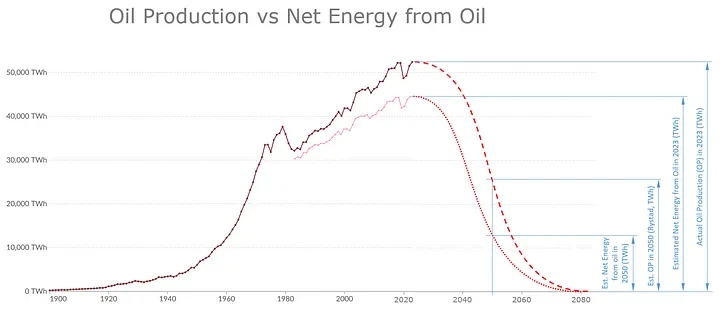
I had a few questions about this graph. I have seen this before and it has been mentioned on this site as well. This is the study but is it accurate?
https://www.sciencedirect.com/science/article/abs/pii/S0306261921011673
If our destination in 2050 is 1/3rd the amount of energy from oil that we get today, what happens on our way there especially with the economy?
Hideaway:
Hi Kira, have a close look at the graph and notice the exponential rise from around 1950 to the early 70’s. Hubbert showed that the rise and fall of world oil production should have followed a normal distribution curve, like individual oil fields tend to do.
When OPEC raised prices and the world realised oil was a finite resource there was a huge change and we implemented many efficiency improvements and substitutions (mostly gas) for oil use. The growth in oil production changed from exponential to linear, and instead of rolling over as predicted by Hubbert, has continued to rise.
We have been dragging future use of oil into the present for the last 25 years, while still growing overall oil extraction, as reserves deplete. Think about oil producers around the world. They have older wells still producing at EROEIs of 20-30:1 or more, plus newer wells in harder to reach places with much more expensive infrastructure and processing. The older wells that paid off their capital costs decades ago are easily the most profitable. They generate the most cash to keep the system going, however it’s the newer wells like shale oil, tar sands, deep water, etc. that help keep the overall price of oil lower.
Which are depleting faster? The old profitable wells, because the trade of goods and services runs on dollars and profit, so oil producers need lots of dollars coming in. Whenever the Saudi’s turn down production, it will be the expensive oil they reduce, not the cheap easy stuff, unless they desperately need to rest fields to protect future extraction.
What this leads to in our world of capitalism economics, is all the high EROEI wells depleting around the same time, just as the cost of maintaining production rises rapidly, because the wells are so much more expensive relative to the oil produced.
Complexity also enters the picture because the extraction processes for newer oils are highly complex operations. For example, horizontal drilling relies on sensors and computing power to keep the drill in exactly the correct strata, 10,000 feet below the surface. The oil sands extraction process uses large modern machines with the latest computers and sensors to maintain optimum efficiency.
Once the easy high EROEI oil is depleted, the remainder becomes much harder to extract because supply lines of equipment and spare parts become less reliable due to reduced economic activity, making everything required to support the complex processes harder to obtain and much more expensive.
Rapid loss of oil production quickly leads to higher oil prices and shortages, with businesses closing as people reduce spending, as happens in every recession, however the declining oil supply will accelerate as other high EROEI wells also reach total depletion, exacerbating the overall problem, with newer oil sources not keeping up with the declines. Deep recession leads to businesses shutting and restricted trade as countries can no longer afford imports, which causes more businesses to go bust.
Factories that earn 10% of their revenue from making essential ‘widgets’ for the oil sector go bust because the other 90% of their business starts operating at a loss, and it is impossible to restart the manufacturing because critical machinery was sold off for scrap in a clearing sale.
Thousands of factories stop making parts critical for a complex system. Without parts, oil rigs and refineries can’t operate, which brings down the entire system.
For us here at Un-Denial, it’s pretty obvious what happens next as the problems will mount and cascade affecting many businesses unexpectedly, thus triggering a self-reinforcing decline.
Most importantly, although demand for oil will fall with recession, oil will not become cheap because supply will also quickly fall. There will not be investment capital available to extract new marginal oil, especially in the Middle East where populations will be suffering from the high price of imported grains and other food, that will become difficult to purchase on the open market. Food exporters will struggle due to high diesel and fertilizer costs and will be forced to reduce production.
Then the next year oil supplies will fall another 5 Mbbls/d, and again the year after, and soon it’s over and most people will be left wondering how those in power let it happen or couldn’t see it coming…
Kira:
Thanks for the explanation.
I hadn’t considered at all that even within countries like Saudi Arabia and Kuwait you will have different EROEI fields. It makes economic sense to keep running the high EROEI wells to get most for your barrel of oil. After reading your explanation I was curious to see the status of old oil fields, the giants and super giants which are collectively responsible for the majority of our crude oil, but most importantly as you pointed out, high EROEI oil. This is the list from wiki:
https://en.m.wikipedia.org/wiki/List_of_oil_fields
Most supergiants were discovered more than 60 years ago. Taking the top two as example Ghawar and Burgan. They both started production nearly at the same time and apparently peaked at the same time (2005) although Saudis don’t confirm it. Ghawar seems to be declining at 2.5% annually and will be down to 2.5 million barrels from a peak of 5 million by 2030. I am sure Saudis are doing everything possible to slow the decline now which will make future decline worse.
It appears as though oil fields like Ghawar are subsidising the extraction of the low EROEI oil like shale and tar sands. The energy comes from the old ones and the volume comes from the new ones, keeping price low and maintaining the illusion of abundance. It’s quite deceptive when you think about it. The net energy keeps depleting while the volume remains same or even increases for a while.
Companies that make generators for offshore oil rigs are a great example of economy of scale tumbling. They probably make generators for hundreds of clients who are not oil companies, when these clients can no longer afford their product the critical mass is lost and they go out of business. Oil companies cannot keep them in business single handedly. This can be applied to other things like pipes as well. This is what the death spiral of the oil industry will probably look like.
Hideaway:
I was thinking when reading your post Kira, yes, yes, yes, yes, yes. I certainly couldn’t have written it better.
On the oilprice.com webpage, there is this article….
https://oilprice.com/Energy/Crude-Oil/Arab-Gulf-Producers-Are-in-Need-of-Much-Higher-Oil-Prices.html
After enjoying a rare budget surplus in 2022, most Gulf Cooperation Council (GCC) economies are seeing their budget deficits widen with current oil prices still well below what they require to balance their budgets. According to the IMF, Saudi Arabia, the GCC’s biggest economy, needs an oil price of $96.20 per barrel to balance its books, thanks in large part to MBS’ ambitious Vision 2030. The situation is not helped by the fact that over the past few years, the oil-rich nation has borne the lion’s share of OPEC+ production cuts after agreeing to cut 1 million barrels per day or nearly half of the group’s 2.2 mb/d in pledged cuts. In effect, Saudi Arabia has been selling less oil at lower prices, thus compounding the revenue shortfall.
Imagine how they cut back, will it be the most profitable oil wells or least profitable ones, when they are so desperate for revenue? Obviously the least profitable ones get reduced while the cheap easy to get oil gets depleted quickly.
What could possibly go wrong when all the cheap high EROEI oil extraction starts declining rapidly just as shale oil uses up its tier 1 and 2 locations…
Perhaps we should have been called Homo dumbass, because we are definitely not ‘wise’.
Rob here on 15-Oct-2024 adding some fresh calculations by Hideaway on the expected speed of collapse, and a response from Kira.
Hideaway:
An aspect of our situation I’ve been thinking of putting down in writing with numbers, so that people can get a better understanding of the collapse ahead…
In regard to oil, we are mining around 100Mbbl/d which will roll over at some point in the near future..
According to some paper I read recently, we currently use around 15.5% of oil to obtain oil and this will rise to 50% of the energy by 2050.. From this paper…
https://www.sciencedirect.com/science/article/abs/pii/S0306261921011673

At the same time as this is meant to be happening, we will be mining a bucket load more metals and minerals for the transition.
What people find so difficult to do is to put several aspects together, to see if it can work, so I’ve decided to try below.
Assuming the increase is 1Mbbl/d/yr in the energy used to gain oil, which is easily possible as we’ve mined all the easy to get oil and only have the harder, more distant supply left, plus allowing for oil production to roll over to a decline in production we get the following…
I’ve used a fall of oil production of 1Mbbls/d for years 2,3 and 4, then 2Mbbls/d for yr 5, and 6, then 3Mbbls/d, for year 7, 4Mbbls/d for yr 8, 5Mbbls/d for yr 9, then a maximum of 6Mbbls/d for years 10, 11, and 12. At no time does the depletion rate go over 10, in these 12 years…
Year 1 …production 100Mbbls input energy 15.5Mbbls … Left for society 84.5Mbbls
Year 2 99M ………………………….. 16.5M ………………. 82.5M
Year 3 98M…………………………… 17.5M ………………..80.5M
Year 4 97M ………………………….. 18.5M ………………..78.5M
Year5 95M ………………………….. 19.5M ………………..75.5M
Year 6 93M ………………………….. 20.5M …………………72.5M
Year 7 90M ………………………….. 21.5M …………………68.5M
Year 8 86M ………………………….. 22.5M ………………….63.5M
Year 9 81M ………………………….. 23.5M …………………..57.5M
Year 10 75M ………………………….. 24.5M ……………………50.5M
Year 11 69M …………………………… 25.5M …………………….43.5M
Year 12 63M …………………………… 26.5M ……………………. 36.5M
Because of the combination of more energy cost of energy (a la Tim Morgan), plus just plain slow decline, the available oil for the rest of society has gone from 84.5Mbbls/d in Year 1 to 36.5Mbbls/d by year 12..
But wait there’s more.. Assuming mining uses 10% of all energy, while in oil’s case makes it around 10Mbbls/d, we know that mining has to increase greatly for the ‘transition’. With the massive increase required, just assuming a 10% increase per year would be conservative, as we are talking a magnitude more copper, Aluminium, Nickel etc, plus all the steel in wind towers and solar farm foundations being built in the TW scale every year etc.
Mining’s use at just 10% growth rate goes from 10Mbbls/d in year 1 to 31.4Mbbls/d in year 12..
When we add this into our calculations of oil available for everything else, we go from 75Mbbls/d in year 1 (100 – 15.5 – 10 = 75Mbbls/d) to 5.1Mbbls/d (63Mbbls – 26.5Mbbls – 31.4Mbbls= 5.1Mbbls/d) for everything else other than oil production and mining..
The above assumptions are very conservative assuming oil doesn’t decline by more than 10% in any one year, that oil used to gain access to more oil goes up by only rises by 6.5%/yr at most, then the growth rate declines (unlikely), plus the 10%/yr increase in oil going to mining wouldn’t get us close to climate/transition/renewable expected growth rates…
Even with those very conservative assumptions, we go from 75Mbbls/d for “everything else” to 5.1Mbbls/d for “everything else” in just 12 years after reaching maximum possible oil production. It clearly can’t and wont happen that way!!
We’ve been dragging future oil use into the present for the last 40-50 years, as shown by the linear increase in oil production since then, whereas we had an exponential rise in production before then.
The above is just putting together 3 aspect of our modern world, instead of concentrating on one and assuming everything else stays constant as just about every ‘model’ does that I come across from ‘experts’ in various fields..
The big question is what happens instead of the above??
Do we cut back oil spending on gaining oil, so that the depletion of existing oil happens much faster than 10%/yr?
Do we cut back on mining so that the transition dies a lot earlier?
Do we assume we will find a magic energy solution to all our problems?
Do we just assume oil production will never decline quickly… because….. just because we don’t want it to???
I didn’t realise how bad the numbers were until I just did the simple calculations and put it down in writing. To me it means we collapse well before the 12 years are up after reaching peak oil production because of many feedback loops creating chaotic disruptions on the way down. Every year we remain close to the peak of oil production, means we are dragging more future oil to the present, meaning the decline when it starts to accelerate will likely be much faster than the sequence above…
Kira:
Excellent analysis!! I just want to mention that the oil that goes into getting oil is mostly in the form of diesel yet only about 75 million barrels that we extract today is the kind of crude that can be refined into diesel. The rest of oil is either shale, NGL, Biofuels among other things which have their uses but not as diesel.
There was also a video that was posted here about a gentleman who mostly agreed with what we discuss here about the irreplaceable nature of fossil fuels and the shortcomings of so called renewables but believed that there is so much oil out there that we will never run out, that we can have shale revolution after shale revolution. There are many who subscribe to this school of thought and think we can extract shale oil and gas from formations in Argentina, Russia, China and many other such places. Art Berman (who has expertise in this area) on Nate Hagen’s podcast has stressed several times that the geology of American shale is very unique and the shale revolution cannot be repeated anywhere else.
If one needs any proof of this please look at China. Despite the CCP pushing the state oil companies hard to extract shale deposits for years gas out has reached only about 30bcm per year which is less than 3% of American output. Part of the reason is the remote location of the deposits in the northern part of the country but we are talking about a country that can create entire cities from scratch within a few years. This is a matter of National security for the Chinese but the geology is the problem and has been unyielding so most efforts have been fruitless and abandoned.
As far as depletion goes even if we take super optimistic figures given by Rystad which predicts that oil production will be down to 50 million bpd by 2050 then the oil available by energy would be worth only about 25 million barrels. This is just a slightly stretched out version of numbers given by you.
It is interesting excersize to speculate on how things will play out on the downslope.
At the beginning of this downslope the airline industry will be the first casualty. Consuming about 8 million barrels of oil and mostly middle distillates at that, this shutdown will provide a much needed relief to the energy constrained world. Of course the commercial airplane manufacturers namely Boeing and Airbus will also go out of business. It is unlikely that governments will have any interest in bailing them out even if they had the ability which they won’t. The tourism industry which depends on air travel will also collapse, as will countries entirely dependent on revenues from it. Depletion will soon catch up and the gutting of industries will start again but this time it won’t be something discretionary and superfluous like air travel. This time industries that touch all our lives will start competing for the remaining share of energy.
Rob here on 7-Nov-2024 adding Hideaway’s answer to a question by ABC on whether Dr. Simon Michaux’s proposed solution of Thorium reactors and iron powder will work.
My take on why this type of future can’t happen is because Simon Michaux misses complexity and scale in the argument we can go to this type of future…
Let me explain, we can only have the complexity of nuclear power and running everything off electricity with an enormous scale of the overall human enterprise we call modern civilization. The scale of this complexity would require much larger markets than we currently have as the number of ‘widgets’ needed to be made for all the complex machinery would be greater than today.
We only have the complexity of today due to the total scale of everything we do. The highly specialised nature of building the best computer chips as an example happens in one place Taiwan with TMSC. The facilities they have built to make these computer chips can only be as sophisticated as it is because of the global scale of it’s customers. To build and operate 50 such facilities around the world would not be possible, they would all go broke. The scale of the facilities built needs the scale of the market size.
To build cheap thorium reactors or any SMR, the “modular” being the important point, would require a massive market as the factories involved, down to the smallest widget all have to be working in co-operation so everything fits together perfectly, so the market needs to be massive so everyone in the chain can make a profit. It also means all the suppliers of parts have to be operating smoothly and at large scale to supply all the inputed metals and minerals.
This all requires the existing system to be maintained while we get the growth in scale of the industry which relies upon the growing demand for the new products from the markets.
Notice how there is growth at every stage to make it all happen!! So if we had a spare planet or 2 of resources to use to accommodate all this growth, then we might get to a more advanced technological civilization, however running into limits of everything we currently use, because of growing energy cost from energy access itself to everything else mined, means we can’t get that advanced.
Also note that to get to where we are today in regards to the totality of civilization has taken growing energy use of all types for over 250 years. It’s been oil that has allowed for the increases of coal and gas use over the last 100 years. All the renewables plus nuclear and even modern hydroelectricity all rely upon oil themselves, and upon oil for the cheap coal and gas used in their production.
If we didn’t care about the environment at all and had another 2 earths worth of oil on this planet, then sure we might get to thorium reactors everywhere, but it will still all rely upon oil.
As oil production starts to rapidly decline, sometime in the near future, I have no idea exactly when, then the ability to keep our modern complexity will quickly unwind. We are getting a ‘sniff’ of this at present by all the countries that want to relocalise so much production, which isn’t possible as we lose the economies of scale of the current globalised system, unless there is an accompanying simplification as well. However no-one is planning for a simplification, the actual plan is to make aspects of the modern world at home. All these plans will quickly realise that they rely on imports of most/all the parts and the relocalisation is not very economic because of smaller market size.
Of course all the duplication everywhere is more inefficient using both more energy and materials to build and taking more people to operate and maintain. We lose some of the existing efficiency in the huge scale of many operations by trying to relocalise them.
What it means by even trying the relocalisation is that the population as a whole gets poorer because of inefficient use of energy and materials (unless we had spare planets worth of all these on this planet!!), due to lack of scale and overall the complexity has to fall to match the energy we have.
Please also note we have no shortage of any material on this planet, just a shortage of energy to access lower grades, and all the processing involved in making them useful goods. It all comes back to existing energy availability within the scale of complexity of what we have as current civilization and we can only build a lot more of any one aspect, while the entire system operates normally. Normally being in growth mode, providing the capital, goods and services required in the usual orderly manner to open new mines. Which means the population needs to be well fed and educated, with abundant services continuing to operate throughout.
We can’t take energy and materials away from one sector to go to another as the odds are they use different aspects of modernity and it’s not a simple swap, with whatever being constrained having feedback loops that are unexpected.
Anyway back to thorium reactors. The industry needs to grow and develop naturally in a world of increasing demand for this product, so it can develop naturally, which takes the rest of the system growing normally. Eventually factories that could build SMR would develop, providing the capital and operating costs were a huge advantage over the existing forms of energy. This can only happen in the background of our system operating ‘normally’, ie growing economies. It can’t be forced, as any developments of forced, as in uneconomic simply don’t last as industries when times turn tough.
When we get a real recession/depression brought on by oil getting more expensive for every other industry, all the expenditures on solar, wind, nuclear and batteries will probably start falling fairly quickly, as these expensive subsidised builds lose market share, as they are too expensive, even for a product (electricity) that is only one aspect of our energy use.
All heavy industry needs a constant cheap energy supply, often in different forms at the same time to produce the raw materials that feed our modern consumption. Without coke, coal, gas and plastics many of the items of modern civilization simply wouldn’t exist at all, so build a huge array of thorium reactors with say the last of the fossil fuel energy available, solves no problems. We wouldn’t be able to make the products we use today with just electricity.
If we were to build fancy new recycling facilities that somehow made use of all existing plastics for re-use in original forms, the whole enterprise would suffer the same entropy and dissipation as everything else and winds down fairly quickly, plus requires a rapidly growing system of modern civilization working normally in the background while it’s built to the scale and complexity required.
Every argument of how we can power a new civilization with solar, wind, batteries, nuclear, thorium or whatever form of electrical energy in the future, argues for a smaller supply of energy needed than now because fossil fuels are inefficient, we only use 25-50% of the energy (depending on the machine). It’s a terrible argument as the increase in the modern civilization growth to get to that point, would mean a much higher energy use than at present, just because of the growth in scale and complexity of everything to just build this future.
Someone should ask Simon Michaux or any other expert about the clean green future whether from renewables normal nuclear or thorium, about how much of it can be built without using fossil fuels at all, including down to the plastic insulation on all wires. The usual answer is it can’t be done yet, but improvements in technology and increased use of renewables/nuclear and how cheap they all become will allow it to produce synthetic fuel for these types of purposes.
I usually counter, with how none of it’s being done now, yet renewables and nuclear are already claimed to be cheaper, so all new factories would already be going to the cheaper ways if it was true, but no-one is doing it, so something is very wrong with the narrative. The argument usually flows to climate reasons why we have to move away from fossil fuels, which is unfortunately a different argument, because the energy required to then mine all the minerals to build this fantastic green future simply doesn’t exist without the use of fossil fuels.
We are in a total and utter catch 22 where we require cheap fossil fuels to build everything and maintain the current modern civilization, which collapses without their use leaving 8 billion cold, angry starving people looking to survive. Using another 2 planets worth of fossil fuels to build the entire renewable/nuclear/thorium future with electricity used for everything, including making plastics and synthetic fuels, will leave the climate and environment in ruins, then collapse anyway, when we turn off fossil fuel use, as that is a sudden energy loss when we continue to require more minerals and metals from the environment, due to those lost from entropy and dissipation, and the increase energy use from all the movement of materials for recycling..
I didn’t even get around to mentioning that a world of recycling everything as much as possible, uses fossil fuels for all the processes anyway, but that’s another story. It’s an incredibly complex situation we are in and any ‘easy’ sounding solution will simply not work as the proponent forgets we spend 97-98% of all our existing energy and materials on just maintenance of the existing system with only the other 2-3% going on ‘growth’ of everything.
Any one new major investment into a great sounding idea on a world wide scale, can simply not work by spending less than 1% of energy and materials use on it, unless the entire system of energy and materials grows massively. As the entire system has to grow, the number we start from in the future will be much higher energy and material use than it is today. The scale and complexity has to also grow to allow for more efficiencies in the system. the starting base of energy use in 30 years time will be double of what it is today..
If we don’t ‘grow’, then we can’t maintain existing subsystems within our civilization, as we need an increasing quantity of energy just for maintenance of material availability. The system can’t work ‘normally’ without the increase in energy, even without growth in the overall system. If we shrink the market size, then we can’t maintain the complexity of the current system either, as the affordability of the complexity goes down, so the system simplifies, which makes gaining access to lower grades of everything much more energy intensive as less complex equipment will mean lower recoveries in mining, lower food volumes from a given area of land etc.
Oops, sorry for excessively long answer. Our civilization is highly complex and so is the reason why none of the bright green ideas can work, and neither can a shrinkage of population while maintaining modernity, but hte attempt to do so, will lead to collapse of it all.
Rob here on 14-Nov-2024. Hideaway and ABC had an opportunity to ask some questions to a couple important leaders in the overshoot awareness community, John Michael Greer and Simon Michaux. Following are the questions and answers plus follow-on commentary from Hideaway.
A.) How can we have modernity without the scale of market size that we currently have to enable the mining, processing, distribution then manufacturing of the huge range of parts that go into making every aspect of modernity?
We can’t. It really is as simple as that. Modernity, as Dr. Richard Duncan used to say, was a transient pulse waveform a one-time, self-terminating affair.
B.) How do we make the machines that make the final product machines in a scale down world?
That asks the question the wrong way around. The right way around is “what kind of final products can we afford to have, given all the constraints on producing them in a deindustrializing world?”
The answer won’t be clear for several centuries, but it’s unlikely that any technology invented since 1900 or so will be included.
C.) How is it possible to maintain complexity, such as a thorium reactor and all the machines it powers on only a small scale?
I’m not a specialist in this technology, of course.
I’m open to the possibility that it can be done, but I want to see an affordable example first.
As we’ve seen over and over again, every nuclear technology is cheap, clean, and safe until somebody actually builds it…
D.) Where do the materials come from after many cycles where entropy and dissipation have worked their magic over many cycles of recycling?
Oh, in the long run say, another 10,000 years we’ll have to go to entirely renewable resources, and that will involve sweeping changes in everything; for example, some future society may cultivate chemosynthetic iron-fixing bacteria (the kind that currently produce bog iron) to keep it supplied with iron. Our immediate descendants won’t have to worry about that, though. Given the scale of population contraction we can expect (around 95% worldwide) and the gargantuan supplies of metal and other materials that have been hauled up from deep within the earth and stored in what will soon be urban ruins, our descendants for the next thousand years or so will have all the metal they can dream of using.
A.) How can we have modernity without the scale of market size that we currently have to enable the mining, processing, distribution then manufacturing of the huge range of parts that go into making every aspect of modernity?
I don’t think we can. It was all dependent on oil as a fuel. We have no replacement for this.
B.) How do we make the machines that make the final product machines in a scale down world?
We have to change our thinking in what we need all this stuff for. Do we need it? Can we do it in a more simplified form? Then ask how we can get there. If we can simplify how the tools are made using more abundant resources (iron vs. lithium for example) then use those machines differently, using modern knowledge.
What have we actually learned over the last 200 year?
The last 20 years in particular?
Can we take a backyard workshop, make a small foundry, have a blacksmith forge, run a basic lathe, drill press and welder, power it with a wind turbine on a lead acid battery?
Strip out useful products from all the places around us that no longer are in operation (cars in a carpark that have been abandoned).
Make an electric motor and a lead acid battery.
Can we shred rubber tyres and make gaskets?
Can we run a furnace to recycle ceramics and building waste into geo polymers
Then you have tech like 3D printers.
Can these be reinvented where we can make our own feedstock and make our own printer unit?
And so on.
C.) How is it possible to maintain complexity, such as a thorium reactor and all the machines it powers on only a small scale?
A Th MSR unit is about 12 m long, about the size of a shipping container and delivers 40 MW of electricity, or 100 MW of heat at 560 deg C.
They are made mostly from steel, nickel and a small number of exotic metals and alloys.
They have a working life of 50 years.
Complexity to run it is about that of running a modern medial isotope lab.
Their production is much simpler than most other devices.
I think it can be done in some cases.
The problem is getting permission to use them.
D.) Where do the materials come from after many cycles where entropy and dissipation have worked their magic over many cycles of recycling?
Contract our material needs per capita.
Simplify what we need to resources that are more abundant.
Most of the purple transition needs iron, which we have lots of.
Copper will be the limiting metal.
Industrial systems have to come into line with food production limitations.
Once we get to the point where recycling and mining can no longer deliver, then society has to work out a way of living without these things or go extinct.
Hideaway’s commentary:
Thanks ABC great work and answers by JMG. He gets the big picture of what’s going to happen, but appears to miss all the feedback loops that will accelerate everything to the downside. We have over 8 billion humans on the planet and 99.99% of them have no idea modernity is going to end abruptly, and when it does so will destroy the plans of the other 0.01% (or less!! ), that did see it coming and tried to prepare in some way.
Lots of people use Cuba as an example of what can happen with building vegetable gardens etc., except forget to mention that it’s in the tropics with fast growth and plenty of water, compared to say the UK which is 2.4 times the size and 6 times the population, plus Cuba today imports around 70%-80% of their food.
Where JMG says it’s asking the question the wrong way around, is incorrect. We are not planning anything about contraction as a species, every machine is becoming more complex allowing for more automation and hence cheaper costs. Once we go down there will not be the investment capital, energy nor materials, nor co-ordination to build any new machines to make anything.
He has once again used how we have done things on the way up, as in using more energy, materials and larger expanding markets; to think that some similar type of planning will occur during the collapse phase. It’s wishful thinking not close to reality.
Realistically, when food is not arriving in cities, who is going to be sitting around talking about what machines they are going to build and what level they can acquire, when there is no energy, nor materials in the appropriate form to do any of it??
One aspect JMG gets completely correct is about thorium reactors….. “As we’ve seen over and over again, every nuclear technology is cheap, clean, and safe until somebody actually builds it…”
There is a very good reason for the cost of all nuclear, of which thorium reactors will be no different, complexity. Every aspect of it is a highly complex specialty. It wont be made from ordinary stainless steel, it will be highly specialised stainless steel, probably with a high quantity of minor elements like molybdenum to allow for the highly corrosive environment of molten salt. “Salt” as in sodium chloride does not play well with most stainless steel, as the chloride is the one thing highly corrosive to stainless steel.
In the huge new refinery in Texas built by the Saudi’s a decade or so ago, upon commissioning someone turned on the wrong valve that sent hot seawater through the piping, causing something like $1.5B dollars in damage and delaying the opening by a long time. Interesting they now call it “caustic” released as it pitted all the stainless steel pipes. If seawater can do that, imaging what 600-800 degree molten salt will do to any weakness of the piping.
Scavenging materials, finding a smelter that can separate all the scavenged materials into the original metal forms, then recombined into the correct quality stainless steel to withstand high temperature molten salt, is a highly complex process by itself, involving a lot of coking coal for the heat. We don’t currently do this for new highest grade materials, we use newly mined purity, for the combination specialist metals, recycled metals doesn’t provide the purity required at this level of specialty. There is no way Simon’s thorium reactor can be rebuilt in a small community, as we would still need the mining of all the separate metals, including his one word reply of ‘exotics’.
What seems to happen is that we get answers about the future that all sound very plausible and comforting, until some person with a bit of knowledge of the intricacies of some part of it comes along to spoil the party.
It’s the highly technical nature of the materials that go into machines, that are then forged into specialized minor, often tiny, sometimes huge parts, with all the connections working in harmony, to make any modern kit, that will be impossible when people are desperate to find food and survive that’s the problem which is overlooked. They always assume some type of normality in the future, just with a much smaller group, forgetting that normality has been a growing human enterprise, with always more energy and materials to make stuff with for generations, and that normality is going to leave us in the near future.
Rob here on 5-Dec-2024 adding an interesting thought experiment by Kira on the energy and material savings benefits of economies of scale and our multi-continent supply chain. With follow-up comments by Hideaway and Kira.
Kira:
I have been trying to think about the benefits that economies of scale and multi continent supply chain provide in terms of energy and material savings and decided to try a simple thought experiment to try to visualize it.
Lets take a simple rudimentary motorbike as an example of the product that we intend to produce at scale. The raw materials will be the metals and alloys needed to make the parts and everything else will be done in house without depending on any external supply chain. The basic parts for a bike are as shown.
If we decide to make everything everything under a single roof (which is what localisation implies) we would have to dedicate seperate machining and fabrication units for each part along with the people with expertise in each of those departments all of which are massive upfront investments and would make the factory a mammoth operation on the scale and size of a gigafactory.
So what are the downsides of this approach?
- It requires massive upfront investment and upkeep.
- The output would be low.
- If we have to serve a country as large as US with localisation we are looking at at least one factory per state leading to large redundancy and waste of production capacity.
Lets approach the same problem and apply a distant supply chain solution.
Since all motorbikes are more or less the same and use same parts shown above we can do the following. Three companies A,B and C may be different bike companies making different types of bikes they will only design and make the frame(chassis) and engine in house and everything else will be outsourced to an external vendor. The suspension will be made by suspension manufacturing company, brakes by a brake manufacturer and so on. So how does this benefit everyone?
- Since the company is only making the frame and engine its factory size will be a fraction of what it would have been in scenario one.
- A dip in demand for company A’s bikes would not result in wasted capacity as company B and C can absorb the common capacity for the parts.
- Less labour requirements as there is lower redundancy as there is only one plant making suspension, brakes, tyres, clutch etc. instead of three.
- Since more resources are freed up the companies can focus resources on research and innovation thereby speeding up progress.
The obvious downside of this is the loss of redundancy and a single point of failure which can halt the production of all bike companies. But the benefits to the civilization as a whole far outweighs the risk as the more complex the product is the longer the supply chain is and the more difficult it would be to make it under a single roof.
If we take microchips as an example and try to take all the processes from raw materials to a finished chip and make everything under a single roof the factory will easily be the size of a small sized city.
When I mean everything I mean everything from the lithography machines to all the other machines, starting all the way from raw materials. That means first making this incredibly complicated machine below starting from metals and alloys mined,processed and shipped to the plant then machined, fabricated and assembled into the machine shown below.
So as complexity of the object increases multi continent supply chain is not only useful but essential to making high tech products. None of this is possible without fossil fuels and high grade minerals both of which are in irreversible decline and will soon lead to the supply chain collapsing leading to a loss of complexity creating a negative feedback loop.
The lithography machine shown above is just one of a hundreds of processes in getting from silicon ingots to a microchip (albeit the most important one). Some of the processes are shown above which require equally complex machines to perform.
Hideaway:

The caption with the photo states .. “just one of the benches the engine was laid out on”.
This was from a 1965 built motor..
Thanks Kira, a brilliant breakdown of complexity, with each of the above different main parts of a motor bike having so many components themselves. A simple motorcycle can have 2,000 – 3,000 separate parts.
Our complexity of modern life is just lost on so many people, not understanding that each and every part has to be made precisely from the exactly correct materials, to work together and function as a whole ‘machine’.
The other huge misunderstanding is that we need the total complexity to gather the food, energy, and materials that make up this complexity as we have used up all the easy to get food, energy and materials.
The motorbike example is a simple machine compared to a horizontal drill rig with tens of thousands of separate parts, including many computer chips, in many separate parts of the rig, from control systems to sensors to actuators, communication systems, power systems.
Without modern horizontal drill riggs our oil production would fall rapidly by a large percentage and these machines are dependent upon lots of spare parts arriving nearly every day.
When we start to lose overall energy availability, especially oil production because of depletion, the complexity has to rapidly unwind, as there is simply not enough energy to keep it all going. Once feedback loops kick in, of lack of parts, then machines we rely on become junk very quickly, which accelerates chaotic feedback loops.
The concept of going local, means massive simplification, because we don’t have either the energy nor materials locally to do anything differently, which means we will be unable to feed the current huge populations of local areas as all the modern machines cease to function. Fertilizer becomes a thing of the past, tractors can’t get oil and grease, let alone fuel, likewise for all transport from local rural areas, to cities.
Modern humans have just forgotten how reliant we all are upon 6 continent supply chains for our very existence…
“Kleiber’s law” of power/mass use to the 3/4 power most likely applies to human civilization. Studies have shown that in nature the law is a doubling of animal or plant mass requires a 75% increase in energy use because of efficiency gains is the easy explanation.
In human settlements research, done by Prof Geoffrey West and a host of others, they have found human population centres the power law is closer to 85%, as in we are not as efficient as nature with a 4B year head start. The problem with all the work on settlement sizes is that we live in a world of one global civilization and no city is an entity to itself, which they were 500-10,000 years ago, including their surrounds.
Kira:
Actually it was your exchange with Dennis on POB that lead me to have this train of thought. I found this line by him to be quite revealing of how people like him think.
Dennis: “Society is not based on physical laws alone, it is understood using knowledge such as sociology, psychology, and economics.”
Cornucopians like him always point out how GDP is growing with less energy use ie growth is becoming less energy intense. We know this is primarily because of massive financialization of economy but when you point that out his reply is that GDP calculation are a reflection of physical and thermodynamic reality of the society. It’s funny how he tries to have it both ways whenever it is convenient.
He is wrong as usual. Let’s take three bike companies on three continents North America, Europe and Asia – Harley, Triumph and Honda respectively. Assuming that there is no contact between the continents and each company has complete monopoly over their respective continents without any alternative then they can manufacture in whatever configuration they want. They could make everything under the same roof with redundancy and inefficiency or outsource their production of components to third party and cut costs.If they are inefficient their customers end up paying more than their counterparts on other continents.
But as soon as we apply the situation of globalization and they have to compete with each other they will have no choice but to reorganise themselves in a way to reduce material and energy costs and if they don’t they go out of business. You were right in your counter that civilization is very much like an ant hill and just like how no ant has the complete blueprint, no human has the complete design of civilization. It is not intentional, it is self organizing and self assembling. Complexity increases to solve problems and with increase in complexity comes increase in material and energy cost. When this happens the system reorganizes itself to optimize resource consumption. There is no way to intervene here.
For instance Ford could probably manufacture every component of its car under the same roof 85 years ago but with today’s complexity they probably have hundreds of suppliers that they share with many other car companies. If an American president declares that every inch of a Ford vehicle must be made on American soil the company would immediately go bankrupt as if they tried to do that a car that costs 20,000 would cost 200,000.
This pattern holds even across completely different industries.


This is a ridiculously condensed and shortened version of the supply chains of Apple and BMW. All supply chains end up either at pits of mines or oil and gas rigs as everything we produce comes from earth as raw materials. The suppliers in greens are the common ones for both companies and hundreds of others including oil and gas rigs. If we fully expand the supply chains we will see countless overlaps with one another with constant reorganization happening to optimize resource consumption. The true scale of feedbacks and overlapping is so complex that it is impossible to even comprehend. But there are some interesting things we can glean from the above diagram. The critical mass of consumers for the chip industry is coming from consumer electronics meaning that the auto industry and oil industry are just beneficiaries of this. If people stop buying smartphones and PCs then oil companies and car companies go out of business. There are several such critical dependencies that may not be so obvious at first glance and may be far down the supply chain.
Of course the connective tissue connecting the supply chain is oil since without we cannot maintain the multi continent movement or power the mining machines at the end of the supply chains.
Hideaway:
Thanks, Kira, excellent work again.
Trying to get people to understand the connection between the overall size of the growing market, relative to the complexity is extremely difficult, especially when added to the overall energy and material savings to the entire super organism of the human civilization.
Because of collapsing grades of ores of all types, we need the complexity of modern machinery, modern financing and modern supply chains, to gain access to all the requirements of all materials and energy used. It’s a self feeding monster that has to grow just to gain access to the requirements.
Unwind any aspect of modern complexity and the whole lot collapses, yet keep growing and the whole lot collapses due to environmental limits anyway.
Most likely oil will be the limiting factor, that sets in motion feedback loops in reduced consumption of all the requirements used in modern complexity, and your example of discretionary spending on computer chips is the perfect example, but we can multiply this by thousands for all the unknown links that are necessary to keep modern complexity going.
The concept of localizing industries, plus using tariffs to do so, will just hasten the collapse as it uses up more energy and material resources to build all the local manufacturing plants and tool them up, let alone gain the raw materials and energy for their operation. Just the attempt to do this will likely set off other unknown feedback loops as the extra energy and materials involved in the attempt to localize puts pressure on other aspects of the system.
Of course it’s all just a duplication of what’s already happening elsewhere, supplying the world, so the energy and materials are effectively wasted giving higher costs to consumers everywhere because of the duplication. Now imagine 5-50 countries trying to do the same for their local markets.
We can’t have 50 TMSC factories around the world as there is just not the market for that number of computer chips, with the complexity it takes to produce them. That factory/foundry whatever they want to call it has to churn out millions of wafers and chips to be viable. It wont work with 50 of them, unless the super-organism of human civilization grows by enough to accommodate the increase, which means every facet of civilization has to grow including population, energy and material use.
Once oil declines because of depletion and the impossibility of an increased production, whenever that happens, then overall energy availability turns down, meaning the growing organism can’t keep growing, nor even maintain what’s built and operating as entropy guarantees we require 97-99% of all energy and materials to just keep operating ‘normally’. (All while energy use keeps growing to supply the raw materials because of lower grades).
Once energy of all types that totally rely upon oil start suffering from increased costs, as oil’s harder for any one business to obtain, the civilization that relies upon cheap energy, suffers from reductions in internal markets from those struggling, meaning less markets for computer chips, and every type of machine that relies upon them, sending businesses broke, that manufacture essential requirements of other businesses, so creating a cascade of accelerating failures across civilization itself, in producing everything required to just maintain and operate what exists.
We’ve been in extend and pretend mode for over 50 years, making up a linear increase in oil supplies, with exponential increases in coal and gas energy supplies to make up the required energy of the growing civilization, then added some nuclear, solar, wind, geothermal etc, all just electricity providers, which are not providers of the full range of products and energy supplied by fossil fuels.
The increase in coal and gas though is totally reliant upon oil, with the rest being just derivatives of fossil fuels in total.
The complexity of the entirety of the system would take multiple books to explain just the merest of details of any one component of the overall complexity of how we live. It’s beyond the comprehension of anyone, as it’s exactly as explained by Kira above, so people without thinking of the overall complexity, assume we can just increase one part of this civilization by increasing something massively, on a world wide scale, without having implications elsewhere, nor have any understanding how everything else has to keep working normally for their one aspect to increase greatly. (EVs, batteries, solar, wind, geothermal, tidal, and nuclear).
Single cell organisms, multiple cell organisms, storms, stars and all prior civilizations have grown with increasing complexity over time, yet all eventually collapse due to some type of internal energy usage decline, that collapses the overall system.
To think our modern civilization will be ‘different’ to everything else in the universe that is large and grows complexity internally, increasing energy use until collapse, is denial in it’s finest form.
 un-Denial
Great essay Hideaway and Kira. And good job Rob of putting it together.
Hopefully Peter Joseph reads this. As well as everyone else who thinks that our energy lifestyle can continue if we just move towards a resource-based economy or the Venus Project.
LikeLiked by 2 people
Rob Mielcarski, Paqnation,
checking in upon Paqnation’s recommendation from Collapse 2050 site by Sarah Conner.
Just read the above article and analysis with a great deal of pleasure. Now working through your material on Denial. Much I knew, in my own haphazard way, but stated more economically or elegantly. Thanks.
Been looking at this for a long time. Always great to find more voices.
Thanks,
Andaréapié
LikeLiked by 1 person
Hello Andaréapié. Good to see you here.
LikeLike
Excellent thanks Kira and Hideaway and Rob for pulling it together.
A few years ago I wrote a post on LinkedIn in response to all the techno-optimism and myopic focus on climate change in the sustainability “movement”. I got almost zero response as expected. I’d probably tweak it a bit now but it still feels pretty clear and simple.
“Filter for sustainability of your business, product or service. Two fundamental questions.
I am continually frustrated by the widespread and loose use of the terms #sustainable / #sustainability by government, leaders, businesses, #sustainabilityprofessionals, #engineers and the like. In this post I propose 2 fundamental questions I think need to be asked of any business, product or service to help determine its sustainability prospects now and into the future. I have focused on the issues of “Why does it exist or its purpose” and energy, the most fundamental need. I look forward to your feedback. Here goes…
Question 1.
Does your business, product or service provide for meeting a fundamental human need? Think subsistence and protection, leisure and creativity. See the 9 fundamental needs https://en.m.wikipedia.org/wiki/Manfred_Max-Neef%27s_Fundamental_human_needs
Question 2.
Would your current business, product or service be possible in the absence of fossil energy (coal, gas, oil)? Think about all the life cycle stages and supply lines of your business, product or service. Think direct i.e. burning fuel, and think embedded energy. Think transport to or from you – trucking, shipping, couriers. Think microchips.
Filtering steps
1. If the answer is no to 1 and 2 you probably want to look at new opportunities and start growing a food garden.
If the answer is yes to 1 and 2 then I’d love to hear from you.
PS Modern technologies are reliant on mined and finite nonrenewable natural resources. The mining industry is completely reliant on fossil energy at all stages of extraction, processing, manufacturing and transport.
PPS This includes renewable energy harvesting technologies and electric vehicles which are also made from mined and finite nonrenewable materials using fossil energy.
PPPS Modern agriculture is completely reliant on fossil derived and mined fertilisers along with fossil energy to grow, harvest, process and transport food to our supermarkets and pantries.
PPPPS Organic hemp shirts are made using fossil energy to grow, harvest, process, manufacture and deliver them to your store and home.
PPPPPS Want to trade some seeds with me?”
LikeLike
Very good Campbell.
Your questions and the zero responses provide yet another case study for the validity of MORT.
LikeLike
Here is a new one that is similar with his disgust about companies sustainability models. Its not as good as the one I was trying to find… but Sam still made me laugh a bunch.
Hey Rob, ever since new member Carroll asked if there is a podcast for un-Denial I have been thinking heavily about it. Video seems like the only avenue to get new people interested. No way I could pull off an interview type podcast, but I know I could do something similar to what Sam does.
Maybe like a once-a-week recap video from the previous weeks content of un-Denial. I know, doesn’t sound interesting at all, what am I gonna do just read some Hideaway comments for an hour straight. LOL. But you guys will not be my target audience.
I know I’m capable of injecting some humor. And I doubt I would just be kissing everyone’s ass the whole time. I could see me calling people out when I don’t agree with something. Could also see me having volunteer undenialist’s come on the show from time to time.
Ehh, I don’t know. Half of me wants to try it just to help give me some skills in front of the camera, so the motivation might be in the wrong place.
I’m still miles away from having the confidence to ever try something like this, but what do you think about it Rob (or anyone). Does it have any potential in your view?
LikeLiked by 1 person
Chris, I sense there is a journalist inside you that has a lot of important things to say and that wants to break out of your current shell. I think you should think ahead a few steps to a day when you might have your own blog/vlog/podcast. Suggest you think about an identity for your brand and then setup a YouTube channel using it. You are welcome to post episodes from your channel here at un-Denial and I will of course promote anything I like. If you end up making millions by leveraging the huge audience at un-Denial maybe you can share a couple bucks to help me pay for my website hosting fees. 🙂
LikeLike
Rob, if that was a nice way of you telling me “Hell no!”, then you have some good salesman skills😊. Kidding aside, I do appreciate your encouragement, thanks.
“an identity for your brand”… Ugghhh, I hate those f’ing words so much, but I know it’s mandatory in a world where 8 billion assholes are all trying to sell each other something. Could see me running with the fire theme. Come out for my Yt videos dressed up in some extravagant fire costume.😊
And don’t worry, I’ll share my millions with the audience here. We’ll eventually get everyone and their families over to Gaia’s commune one way or another.
LikeLiked by 1 person
Maybe we could brainstorm names for Chris’s channel?
Here’s a few:
– Improbable Fireman
– Raging Fire Fighter
– Overshoot Illuminator
– Ponzi Rants
– Seneca’s Cliff
LikeLiked by 1 person
LOL. Nice ones. Couple others:
LikeLiked by 1 person
“Burning Overshoot”
“Firey Overshoot”
“Civilization Burnt to a Crisp”
Sorry, I give up, ask Gaia, she will come up with some beauties I’m sure…
LikeLiked by 2 people
Overshoot Supernova
LikeLiked by 2 people
Hello Chris,
Thanks to Hideaway’s challenge I couldn’t help but try to think of a title/thematic for your soon to be infamous channel. Is the target audience aim more class or crass?
I thought adopting classical references like the Phoenix or Prometheus would automatically give you a measure of erudite respectability (not that you don’t already exude such) and really bring in those discerning viewers (which we know are the ones who really need to wake up to their denial). Both allude strongly with fire (Your Thing) and also the transmogrification of mankind, with the phoenix rising from the ashes to rejuvenate into a new life, and our hero Prometheus of course bringing fire to mankind and kick starting civilisation. And it just so happens you live in Phoenix, how cool is that?But since you are trying to present the view that modernity must be destroyed, and the Great Reset will not be humancentric this time and forevermore, how about something along the lines of The Last Phoenix or Prometheus Denied? Too high brow?
Well, never fear, Gaia here can fix that, too. How about something visual that will tell the whole story in the style of the cartoons we grew up with? I was thinking of using Chicken Little, imagine it–here’s our hero chicken walking along saying to everyone he meets that we’re in overshoot and doomed and the reason they can’t see it is because of MORT, which no one believes either. It’s getting progressively hotter with climate change so he’s pulling off all his feathers to cool off until he’s totally plucked naked (we used to laugh at things like that when we were kids for some reason) and then suddenly he spontaneously combusts (even more juvenile chortling), channeling a bit of the Phoenix story, and while he’s burning up, he runs like a headless chook right off Seneca’s cliff and does that mid air gyration with his skinny featherless chicken wings before he plummets and we hear him call out “That’s all folks!” This segment could be your introduction, I’m sure it will get a lot of yuks and likes.
I am blaming my self-medication for this interlude. Let me explain, I have just successfully processed my first batch of homegrown coffee and I must say it’s bean a revelation. I don’t even drink the stuff anymore (mainly because I didn’t want to get dependent on a stimulant) so I can’t tell you how it tastes but it does smell like a coffee roastery here and that’s very pleasant. It takes 7 steps to get to the finished product, from picking the ripe red coffee cherry to grinding the roasted bean. I am even more full of appreciation for the manual labour involved which I am sure is continued to be done by countless minions in Empired countries. All in all, it took about 2 hours of hands on time to produce enough roasted beans for 1 person to have 1 cup of coffee a day for about 1 week. And somewhere in the process I still used modern machinery (a food processor to hull the parchment layer off the dried beans) otherwise it would have taken 3 times as long (and I just wouldn’t have done it). Not going to happen when food is going to be scarce, as all energy will be diverted to producing real calories, but I just wanted to experience it and tick it off the bucket list. Rob will really get a kick out of how it’s all done and I promise to tell all in a photo expose in due course. But what do I mean by self medication then if I didn’t drink the coffee? I ate lots of coffee cherries! I ate about 15 cherries in one sitting, they are about the size and shape of a very small olive. That’s one way to get to the beans, otherwise you have to pop them out by hand. Eating the berries is how the prized civet cat coffee is made, the semi-digested and fermented beans come out in their poop and said to develop even more aroma and flavour, cottage industry here anyone? Not that there’s that much fruit pulp but what there is is sweet and grassy tasting (not bad) and the red skins are a little bitter (also not bad) but supposed to contain a lot of antioxidants and a small bit of caffeine, too. So that’s probably enough to cause Gaia to be even more unhinged (you did see my post on communal bathing?)
Alright boys and girls, that’s enough story hour from me and hope it at least brings a smile because everything was written tongue in cheek and we sure need a bit of light diversion after the news today of the 3000 exploding pagers, like can you just text ARMAGEDDON? It’s all just getting crazier.
LikeLike
Oh dear, upon re-reading I am afraid I may have instilled a very distorted picture in that you are thinking I ate the whole berry, and in time when nature called, retrieved the beans, in the manner of the civet cat kopi luwak! Who will join my commune now, thinking that’s the cottage industry I have in mind to keep it going? Please rest assured that I only ate the berry part and spit out the 2 beans, I did not swallow!
For the rest of it, I used my fingers to pinch the berry and squirt the beans out, a very satisfying, if time consuming, effort.
LikeLiked by 1 person
I’m so impressed with your coffee achievement! And glad you clarified spitting the seeds because I was wondering and a little grossed out.
It’s remarkable how much time and energy is required to make things we take for granted.
Preptip:
After water and food, coffee is at the top of my preps list. I enjoy 2 triple americanos every morning. When supply chains start to fail I will cut this to 1 a day to double the duration of my stores. I stock 2 years of beans, plus 2 years of canned ground coffee, plus 2 years of instant coffee, plus 3 years of cheap orange pekoe tea as a caffeine backup.
LikeLike
Hi Gaia. I only have one word for you: Decaf 😊😊
Thanks for your feedback. I like your thought of incorporating Phoenix or Prometheus. (need all the help with erudite respectability that I can get). And that Chicken Little intro is funny and a great idea.
You also had me laughing with your communal bathing post (sounds like I’ll never get to take a shower longer than 5 minutes). Those discussions at our nightly fire ceremony gathering are what I look forward to most in this fantastical pipe dream of ours.
LikeLike
Nice post! Reminded me of a good Collapse Chronicles video where Sam is either reading an essay or just ranting about how capitalism has incorporated the word “sustainable” into everything. I was looking for it to link here because I thought you might enjoy it… but I cant find it now. (Sam has too many videos and they are not labeled very well)
But yes, the word “sustainable” is a major buzz word for me (just like “denial”). Whenever I hear the word, it stops me in my tracks, and I look up at the tv or computer to see what silly way they are using it in the advertisement. There’s one that drives me crazy. Something about “We’re building the world’s first all-sustainable chocolate company”.
LikeLiked by 2 people
Sent from my iPhone
LikeLiked by 1 person
excellent point 😉
LikeLiked by 1 person
😊😊 Karen went with the timeless, tried-and-true formula of “always leave them wanting more”.
It worked too. Feels like we got jipped out of a good link she was gonna share.
LikeLiked by 1 person
Gail Tverberg today…
https://ourfiniteworld.com/2024/09/11/crude-oil-extraction-may-be-well-past-peak/comment-page-2/#comment-468127
LikeLiked by 2 people
There’s a Rewiring Aotearoa (NZ) initiative calling for electrification of everything currently getting lots of coverage here. They’ve put out a bunch of reports and explainers over the last few months. Here’s their latest one telling us “Why electrifying everything requires fewer materials and less energy than you think”
https://www.rewiring.nz/watt-now/electricity-means-efficiency
Here’s a key “fact” they put forward.
There’s quite a bit of info on their calculated ereoi.
Channeling my inner Hideaway I asked if their calculations and references take into account the energy (predominantly fossil energy) and mineral requirements for all the new mines and factories, and associated infrastructure, required to process all the minerals and build the new machines for the electrification of everything?
They said it did and quoted a report that models the energy requirements of the transition and finds that they amount to 0.1C of warming, much less than slower transitions. The report actually only looks at energy and emissions not minerals. It looks at energy for the energy system including the energy required for the construction (including decommissioning), operation, and maintenance of energy facilities like power plants, mines, and refineries, as well as the energy required to transport the energy carriers from the point of extraction to the end-user. It doesn’t include the building of all the new electrical machines or charging infrastructure.
https://www.nature.com/articles/s41467-022-33976-5#Sec8
Of course my BS detector is in overdrive. The whole thing is based on fairy tales but I did think Hideaway might enjoy destroying their dreams.
LikeLiked by 2 people
Thanks Campbell … It’s a typical article full of bullshit. Take the initial statement of requiring 10 million tonnes of renewable minerals under the “Putting things in Perspective” heading.. going to the source document from Irena it did indeed state that, but then following up their comment gets to this…
“Based on IRENA calculations, production of materials (copper, lithium graphite, nickel, cobalt, manganese, rare earth elements and platinum group metals) for renewable energy–related technologies in 2022 amounted to some 10 million tonnes”
Ok, so the average grade of copper is now down to 0.5% or thereabouts, meaning we need to mine 220 tonnes of ‘ore’, because we never recover the full amount of copper in the ore, usually around the 90% mark, then lose more due to mining dilution.
But wait there is more, most open cut mines have a high strip ratio, meaning the waste that has to be moved before we can gain access to the ore, often 2-3:1. At just 2:1 ration that’s another 440 tonnes of waste rock, that has to be blasted, dug, dumped into a truck, then taken a couple of km to a waste heap. Of course the blasting only happens after a lot of holes are drilled into the rock at regular spacings then a whole lot of explosives lowered into these holes..
When they are talking rare earths and platinum group metals in the tonnes range, these are all mined in the parts per million range, especially platinum group metals..
As soon as anyone starts quoting the quantity of materials I know they are going to talk BS, by missing out how difficult it is to get a tonne of any of those minerals compared to digging 100% coal out of the ground with a digger, or oil gushing to the surface through a pipe under it’s own pressure, likewise for gas, etc.
I also noticed from the list given from the IRENA quote above about the minerals needed, there was no mention of glass or silicon or Aluminium, all of which are in a solar panel, so I went and did a little investigation. A 400w solar panel weighs around 22kg. In 2022 there was around 239GW of solar installed world wide (IEA), which means the weight of the solar panels alone came to 13.145M tonnes, before inverters, wire, supports for the panels, sub stations connecting them to the grid. So the number given for ALL renewables is absolute Bullshit!!
Then the next bit….
“So, even if we do increase the supply of critical minerals to stay under 1.5 degrees,”
We have blown past 1.5 degrees already and it’s clearly off the table, as James Hansen will tell everyone willing to listen, with 2024 likely to be a new record for fossil fuel use overall.
People writing this type of garbage are in la la land… They just don’t want to understand that it’s not a choice between ‘bad’ fossil fuels and ‘good’ renewables. It’s the modern lifestyle that’s not sustainable, nor are over 8 Billion humans. We are damaging the natural world at an increasing rate from our numbers alone demanding more and more from the natural world every year. More copper mines, more lithium mines, more graphite, nickel and cobalt mines are just more destruction of the natural world, with all these mines relying upon explosives, diesel, and fossil fuel derived chemicals in the processes to gain all these ‘green’ materials!!
LikeLiked by 4 people
BTW I just went and did a quick calculation on what it would take to replace all the products we use from fossil fuels, with energy from electricity to make these products. We actually use around the equivalent of 28M bbls of oil equivalent, in all fossil fuels for products.
Taking that the Haru Oni processes of turning electricity into synthetic fuel which is exactly what we’d need, and assuming solar powered the processes, plus the processes get around 10 times as efficient as they currently are, we would require over 34 billion tonnes of solar panels alone, before connecting them together, or to the ground, or build any of the process equipment, or wiring etc. That’s just to equal, today’s use of these products.
Of course the materials needed would require huge growth of everything in the next few decades to get to the quantity of materials needed, so the number required by then would be a lot higher due to this growth.
Another BTW, I recently went to a climate change seminar put on by a regional sustainability group (who drove their diesel truck 100 km to our local area LOL), and I couldn’t help myself but mention the new aluminium smelters being built in Indonesia using coal to provide ‘cheap’ aluminium frames for solar panels.
I received the usual response of “so what’s the answer then” from the lady in charge. I get silence when I tell them there isn’t one…
We are just lying to ourselves about renewables being able to replace fossil fuels, it’s not close to possible and damages the environment to a much greater extent in the process. So why do we have so many high level educated people propagating these lies, with none ever doing the full calculations for themselves, always relying upon ‘others’ work for their numbers?
Denial of reality has to be a big part of it, but it doesn’t take an Einstein to work out that building new aluminium smelters in Indonesia, pretty much on the equator, so some of the best places for solar power, are building coal power plants because they are magnitudes cheaper, than solar with battery backup. So there must be something very, very, wrong with the ‘renewables are cheaper’ narrative, yet it keep getting propagated…
LikeLiked by 6 people
Hi Hideaway,
“how difficult it is to get a tonne of any of those minerals compared to digging 100% coal out of the ground with a digger, or oil gushing to the surface through a pipe”
I live in Appalachia, not too far from the areas that are being strip-mined for coal.
They use ‘mountain-top’ removal to get rid of the ‘overburden’ to get to the coal.
So it takes more energy than merely ‘digging with a digger’.
Much of the good coal has been dug, and what they are getting now is lower in energy density.
Have there been any gusher wells in the past 50 years?
For fracked oil and gas, miles of pipe are used to pump precious water and sand in holes to get these materials out.
And like the less dense ores you note, the quality of some of these fuel stocks is lower than what was mined in the past.
This bit of writing sounds as rosy as those you bash . . .
Thanks and good health, Weogo
LikeLiked by 1 person
Hi Weogo,
Most of the net energy from fossil fuels still comes from the gushers and the huge coal mines that have been operating for decades. Here in Victoria the lignite is from seams 200m thick, often sticking out at surface.
The cost of most of the oil to the Saudi’s is still exceptionally cheap, from old relatively shallow wells. Likewise for many others. I agree the new oil, new coal, new gas is not cheap and is not an answer. We are damaging the natural world way too rapidly for anything to cope with the change, climate and pollution wise.
We built our system of civilization from easy to get very cheap resources of all types, not just the fossil fuels, with the great acceleration in efficiency gains and sheer availability starting just after WW2.
The article that Campbell highlighted was full of fluffy gloss, no details about how hard and energy intensive it is to mine those resources, nor process them without fossil fuels, yet mentioning turning everything to be running off electricity. I do get annoyed at such stupid articles, so my response probably displayed equal arrogance. None of this changes the reality….
All of it (civilization), suffers from entropy so has to be replaced with ‘new’ over time, all from lower grade resources, whether oil, gas, coal or copper, nickel, platinum.
My whole point is, that it’s the civilization based on non renewable metals and minerals, that is not possible in the long term, because of entropy and dissipation. The more we try to avoid the reality of our situation by prolonging our complex lifestyles, while damaging the environment around us, the harder the fall when we collapse, especially with such a massive population 8.1B and still growing.
We’ve been in overshoot for decades (likely centuries or millennia, if we think about it deeply) and making up rubbish stories of looking at quantities of materials for different ways of trying to maintain the impossible, doesn’t help us at all, except in the belief systems of those that want to believe.
LikeLiked by 3 people
I think Hideaway has addressed all the usual BS points made in that article but I wanted to add a very important point that I have never seen made anywhere.
Let’s assume we could magically restore ores to the days of the Bronze age when we could find copper nuggets by the stream. Even then building these so called renewables is a terrible idea.
When we burn oil, gas, or coal we produce CO2 which is something nature understands and can process. When we mine minerals and process them for solar panels and wind turbines we are producing untold amounts of highly toxic waste, radioactive tailings ponds, and carcinogenic compounds that will remain for tens or possibly hundreds of thousands of years as nature has no idea what to do with them.
All we have to do is reduce the amount of CO2 but instead we are acting like a junkie who has developed tolerance to a relatively mild drug but instead of quitting is moving on to an exponentially stronger drug that could be lethal simply to maintain that high.
LikeLiked by 4 people
Junkie quote added to the sidebar.
LikeLiked by 1 person
Thanks, I have no doubt in my mind that as oil starts to decline everything that is humanly possible will be done to maintain status quo. All sorts of crazy ideas from drilling in Arctic after it is ice free, commissioning more and more nuclear reactors, CTL/GTL plants will be attempted until the writing on the wall is clear. After that we go into good old fashioned resource wars to bring the curtains down on this civilization.
LikeLiked by 2 people
I will just add a small anecdote. I have the pleasure of having many close friends who work in the NZ electricity industry, and one friend whose father is a senior manager. They tell me a few interesting things, but the one that always stuck with me is restaurants. Most (all?) restaurants in NZ cook with gas. There is not enough electricity in NZ to replace all the restaurant gas burners with electricity, let alone everything else. Moreover, it is much more efficient to just burn the gas at point of use, than burn the gas to make electricity (when the wind, sun and water aren’t doing their thang).
LikeLike
When people couldn’t go to work (and use those bathrooms) we ran out of toilet paper.
When people stop using restaurants (that are forced to switch to more expensive electricity – cost of appliances, fitting and operation) we will see reduced economic activity and run out of everything.
Perversely, being forced (by economy) to cook at home, some people will likely get better value for money and eat healthier food.
LikeLiked by 1 person
Excellent criticism of the critics by both Hideaway and Kira.
However, in that vein, I’d like to ask what the Hagens PR-branding term “simplification” is doing in here. Collapse and mega-death are to be viewed with this anodyne, useless term?
The MPP thesis is not trying incorporate the alleged benefits of voluntary simplicity. Humans are not going to stumble over the bodies of their loved ones and go, “Gee, it’s swell that my life has become simplified now.”
LikeLiked by 1 person
I have my tongue firmly planted in my cheek when I use the term ‘simplification’, as I’m pretty sure Nate Hagens does as well. Notice he never defines what ‘simplification’ actually means. I hope one of his guests questions him on exactly how ‘simple’ he expects things to get…
Life will get simple, everyone still alive will have to fight for every scrap of food they can find, if they want to live.
LikeLiked by 2 people
Nah, I used to listen to “The Great Simplification” gabfest, and I never heard the world-leaders’ consultant use air quotes around his title.
It’s just not a good term, either ironically or in “good news” earnestness, as Hagens used to proclaim. So many of us have grown up in fossil fuel slave plenty, and the Great Collapse will not be a happy experience for us, though when we are dead we have no more feelings to process on that subject. Thanks again for these reactions.
LikeLike
You guys do such a beautiful job outlining our problems. I resonate and agree with all and have been a long time lurker. I just want to highlight something that bothers me a lot. The decline will bite harder than most realize. The exponential curve on the way up will be there on the way down and probably will be even steeper (Seneca cliff) because of the reasons you outline. I really do think when the back side of the decline curve starts hitting – and I don’t think it is too far away – things will unravel quickly in all aspects of our lives. I think society will break down quickly. There will be a delay in prioritizing essentials and making plans for declines because of the delay in the learning curve of realizing the enormity of what this really means and of course MORT.
Where we are going to end up – people growing a diet of a year’s worth of calories outside your door (no easy task or near impossible with our knowledge base and soils) – will be considered too extreme for people to imagine. I know you all know it…. just wanted to chime in!! Thank you all for being a refuge. I have no doubt you are for many others too who don’t comment!
LikeLiked by 4 people
Thanks a lot Rob for putting together the post.
The relationship between energy, complexity, and economy of scale is quite complicated because of thousands of feedback loops reinforcing one another. I have just begun to understand it because of all the insightful comments that are posted by members here.
As Hideaway has pointed out several times, mining is the bedrock of any civilization. At this point even agriculture is dependent on mining for the phosphate rocks. We are not running any mines purely on renewable energy and we never will. If we could we would have already done it, not for the environment but for simple profits.
Today’s offshore oil rigs are enormously complex, breaking depth records all the time, and need complex sensors, computers and all sorts of equipment with embedded oil (specifically diesel) costs of their own, along with direct diesel costs for supplies, transportation, off grid power generation, etc.
Same thing applies to gas rigs, coal mines, nuclear plants and hydro plants. The direct diesel cost in fuel and embedded diesel cost in equipment will weigh down on these sources until the whole thing comes crumbling down. None of the above, with the exception of an oil rig, produces diesel unless you add a conversion process like CTL/GTL or synthetic fuels which destroys the EROEI.
I did not include wind and solar because they cannot even be considered to be legitimate energy producers on their own.
LikeLiked by 3 people
Thank you Anonymous for popping your head up. It’s very nice to know there are a few supporting lurkers here.
LikeLike
h/t Gail Tverberg
LikeLike
Zimbabwe orders cull of 200 elephants amid food shortages from drought
https://www.theguardian.com/world/2024/sep/14/zimbabwe-orders-cull-of-200-elephants-amid-food-shortages-from-drought
Environment minister says country has more elephants than it needs while critics of hunt say they are a major tourist drawcard.
LikeLike
HHH @ POB on feedback loops and the export land model.
https://peakoilbarrel.com/open-thread-non-petroleum-september-12-2024/#comment-781048
LikeLiked by 1 person
Very good find. Thank you. Aren’t we feeling the slowing down effect before the big roller coaster thrill?
As my first boss liked to say (he was previously in finance): open book!
LikeLiked by 1 person
In general –
It is a shame the EU is run by retards and they let in, so many undesirable types. I’m a big fan of Not Just Bikes on YouTube, he may have coined the phrase Stroads – these are found in North American cities and fail at being either :
The USA might collapse last, but it is going like the Titanic Submersible.
LikeLiked by 1 person
I try not to think of immigrants as desirable or undesirable. I think there should be zero immigration because we need the population to go down, and if we must let some people in for humanitarian reasons they should have common beliefs, not because I’m racist, but because a country with incompatible groups will explode when SHTF.
Japan I predict will weather the storms the best because they are so uniform and have so little immigration.
I’ve subscribed to Just Bikes for quite a while and watch most of his episodes.
LikeLiked by 2 people
LikeLike
The US really wants their heavy oil.
https://www.zerohedge.com/geopolitical/venezuela-arrests-navy-seal-among-several-foreigners-behind-alleged-maduro
LikeLiked by 1 person
LikeLiked by 1 person
LikeLiked by 2 people
I’ve been thinking about why I’m so intolerant of people who deny covid crimes and incompetence, and not so intolerant of people who deny MORT, overshoot, over-population, climate change, peak oil, mortality, etc.
I think I figured it out.
There is a sound scientific reason for the denial of the latter group: we evolved to deny unpleasant realities.
Covid is different. The disease threat was to old people and people with existing health problems, with zero threat to children and a very small threat to middle aged people, yet we coerced mRNA risks into babies and children. We had an inexpensive, safe, and effective treatment that did not require the use of a brand new inadequately tested gene therapy technology, and we aggressively blocked its use to maximize pharma profits. We discarded 100 years of pandemic knowledge and transfected billions in the middle of a pandemic with a non-sterilizing vaccine thus making the problem much worse by promoting variants. The entire debacle, and every single death that occurred for any reason, was indirectly caused by unethical people funding bioweapons research in a different country because it was illegal to do so in their own country, and not one of these people has been held to account. Every expert that tried to speak the truth was censored and many had their careers destroyed. Health problems caused by mRNA are now obvious in the data and yet policies have not been changed to acknowledge this. Nothing has been learned to prevent a recurrence.
Genetic denial of unpleasant realities is not a valid excuse for denying covid crimes and incompetence. There is nothing unpleasant to deny about covid. Some bad guys did some bad things, they need to be punished, we know what needs to be done to prevent it from happening again, and to achieve these things all that needs to happen is for the majority of citizens to wake up and demand it.
Contrast peak oil with covid.
Peak oil has no villain to punish, there is no solution, everyone will suffer, and if everyone wakes up it’s likely to accelerate the collapse unless the highly improbable happens and the majority demands population reduction and austerity. Therefore there is a good genetic reason for the denial of peak oil.
The only explanation for denying covid crimes and incompetence is either very poor ethics or a lazy mind, and I am intolerant of both.
LikeLiked by 3 people
Regarding vaccines promoting variants, the most deadly variants, delta and omicron, evolved in countries where vaccines had not been rolled out.
LikeLike
That may be true. But there are now more than 50 variants.
What is your point? Are you saying we were wise to transfect billions of people including babies and children that did not need protection with a substance that did not stop transmission and that had serious side-effects an order of magnitude higher than substances we deemed unsafe in the past and withdrew from the market?
LikeLiked by 1 person
No. It’s just that some of the loudest voices (Bosche, I think) were saying that using a bad vaccine in the middle of a pandemic would spawn many deadly variants. That didn’t happen. Have any other predictions become verifiably true? I don’t know what “transfect” means but, yes, it shouldn’t have been authorized for children.
LikeLike
Bossche and Rintrah are the only people I can think of that were making predictions. They said we should expect many variants and eventually one would become deadly. The first half of the prediction is verified, and the second not yet. Rintrah recently reported new mutations that suggest the virus is getting close to figuring out how to be a big problem for vaccinated people.
Everything else I said are not predictions but facts based on data.
Transfect means to introduce a non-self genetic code into a cell to cause it manufacture the foreign protein. That’s what they did to billions without properly testing the new technology first, and they called it a “vaccination”. This mRNA technology has nothing in common with the vaccinations we grew up with and trust.
They are still recommending covid mRNA transfections for babies and children today.
LikeLiked by 2 people
Yes.
This line of thinking is officially in the list of thoughtcrimes: https://en.wikipedia.org/wiki/List_of_topics_characterized_as_pseudoscience#Health_and_medicine.
Isn’t mRNA just the logical step after plants and animals GMOs?
Let’s step back and see what all these forbidden ideas have in common. What’s the direction society has been going towards (or maybe? progressively led to)? In this list, what is really quack, what is potential squashed in infancy?
LikeLike
A lot of health conscious non-GMO organic vegetarians are not aware that they were deceived and brainwashed into GMO-ing themselves.
LikeLiked by 1 person
For those unfamiliar with the history on this, the authorities told us mRNA would remain local to the injection site, and would have a short lifetime of about a day.
Subsequent tests by independent researchers found mRNA throughout body including in critical organs like the heart, and they found mRNA still present after 60 days at which point they stopped the test so we do not know how long mRNA persists.
This by the way, probably explains the myocarditis and other inflammatory disease side effects of mRNA because the body recognizes a foreign protein and attacks it causing inflammation. This probably also explains why vaccinated people are getting sick so often because their immune system has been forced to focus on one persistent threat and has less energy and resources available to fight other threats.
Given that the authorities lied about two of the most important things a person trying to make an informed decision on whether to transfect themselves needed to know, we would be prudent to assume mRNA is permanent until proven otherwise by a lab with zero pharma conflicts of interest.
Meanwhile they are still recommending babies and children be transfected with mRNA despite having zero risk from the covid disease. Why you ask? Because when a vaccine is on the recommended list for children, pharma is immune from prosecution by anyone of any age for harms.
LikeLiked by 1 person
I feel so angry about covid, it had a profoundly negative impact on my life. 4 years of life on hold when you’re between the ages of 25 and 35 makes a huge difference to the rest of your life. Buying a house, career, having children, getting married, etc. If you are under 25, 4 years makes a huge difference to your education, social life, making friends, and falling in love. I don’t know what 4 years means to an older person. But I think it is pretty sick of a society to willingly waste 4-5 years of a young person’s life.
LikeLiked by 1 person
I think us older folks have a keener sense of time racing by – so the lost years feel significant. But committing murder and receiving a life sentence at 78 is mostly symbolic. Rationally the younger one is then the worse the likely impact. Four years of compromised education, likely means a whole lifetime of limitations and a shortened life.
LikeLiked by 2 people
I think I am seeing a correlation between the magnitude of a leader’s recklessness and the emptiness of their oil reserves.
No need to watch this but the gist is that the UK is pissed that the US heeded Russia’s warning that the use of long range missiles against Russia would be interpreted as act of war by the country helping Ukraine.
LikeLike
https://www.aljazeera.com/opinions/2024/9/11/debate-in-nuclear-armed-former-colony-fails-to-reassure-global-community
Al Jazeera covering the American election the way the US covers the Global South.
LikeLiked by 1 person
Better than The Onion. 🙂
LikeLiked by 1 person
I’m guessing there are some in this audience (besides me) that can relate to these videos about loneliness and depression. The first one is from Sam Mitchell (he must have 2 yt channels because this one is not from collapse chronicles). Good rant.
The 2nd one was linked in Sam’s video. She does a great job of being honest and breaking it down. 15min – 20min mark gets very emotional.
LikeLike
From my personal experience, there are two really important things to know:
And there are plenty of people who have failed at self-deletion, gone on to recover from depression, and are incredibly grateful to still be alive.
I personally believe attachment theory explains a lot. Most modern day people are abandoned as infants, creating “brain wiring” that is pre-disposed to depression, anxiety, and adhd.
In a sane society, a mother would try to be physically/mentally/emotionally with her baby 24/7 for the first few years. Instead, our society tries to “free” the mother of her infant as soon as possible.
LikeLiked by 1 person
https://www.washingtonpost.com/climate-environment/interactive/2024/hurricanes-power-outages-heat-wave-risk/
https://www.reddit.com/r/collapse/comments/1fg013w/the_disaster_no_major_us_city_is_prepared_for/
LikeLike
https://www.washingtonpost.com/climate-environment/2023/07/13/phoenix-heat-wave-blackout/
https://pubs.acs.org/doi/10.1021/acs.est.2c09588
LikeLike
If you live in a desert and don’t live underground then you are asking for trouble.
Most of the south west in US will become uninhabitable as the system collapses.
LikeLiked by 2 people
Where will the refugees go? The Rust Belt?
LikeLike
Where there is water I would imagine.
LikeLike
Too bad this meme was saved as a jpeg, so it isn’t the best image quality.
LikeLiked by 4 people
OMG I love this kind of dark humour
LikeLike
Dont think I’ve ever seen Robert Jensen referenced here. Found him from Dowd and I still like him a lot. Havent checked in on him in a while. Got the link from Collapse Chronicles. The title looked very promising.
Population: The Fear of Limiting People and Our Things – ROBERT JENSEN (robertwjensen.org)
Short article and good to see him exploring the subject. But I got the same vibes from Robert that I got from Paul Kingsnorth recently. These guys were my Hideaway back then. Un-Denial has pushed me so far beyond my original overshoot teachers, it’s comical. The main thing holding that camp back (because of MORT) is their belief in prior humans living “The Way” which leads to believing its possible to shift from human supremist ways over to life centered ways. That hopium clouds up everything. And the only way to beat that hypnotic smut out of their system is by them having a firm grip on their own denial.
So it seems pretty easy. Start selling un-Denial to those types because they will be able to go to a whole nother level with their excellent writing skills. But something wont let them even try it, see it, or take it serious. Back to us here having that genetic deficiency I guess… or maybe I just got lucky and because I was dark already, I immediately took an interest. I dont know.
p.s. This was a good quote from sam’s video.
andy-the-gardener: …we were colossally overshot even in 1980. and i think william catton was probably being conservative, as the colossal overshoot started at least 100 yrs before he wrote. after all, bog standard overshoot started about 10,000 years ago. ive tried, but properly describing a population 8000 times over real carrying capacity probably exceeds language.
LikeLiked by 2 people
The most interesting sentence in Jensen’s essay, which he does not explain:
I wonder if he could explain it? He discussed capitalism and missed the fact that the core problem is the monetary system. You can have any ‘ism you prefer as long as it has an energy backed full reserve monetary system.
LikeLiked by 2 people
So what happens when the fractional-reserve debt based ponzi scheme unravels? It will probably be the great depression on steroids.
LikeLike
Hi Rob,
Hope you are well and thank you, Kira, and Hideaway for this important compilation which sums up so much. Even though many of us already live and breathe these undeniable facts, I am finding it crucial to my overall focus and sanity to revisit them regularly, just as a mantra keeps one aligned to intention. But, at the same time, we undeniers are exhorting one another to seize the day and enjoy what we can of the lives and times we are in, and that is another prime reason this site has been so uplifting and encouraging, because it shows that there can be a way to know what we do and still go on living (and maybe even with the joie de vivre of Charles!) because we each in our own way and domain are doing so.
One of these days I really hope to share a few images of what we are doing on our property here in subtropical Queensland, just as a documentation more than anything of what has consumed so much of my time and effort but most definitely out of passion but also a sense of urgency and necessity. If I were to go back a decade or so, our interest in growing our food and planting more trees would be deemed a luxury lifestyle choice and yes, it was fun to divert our addiction to modernity and consumerism into what we thought was a more lightly footprinted existence on this planet. How deluded we have been! We are the family, like the fellow who youtubes his growing all his own vegetables, who have depended upon an academic salary to fund all the other ways fossil fuels can make something appear from seeming nothing. If only we can account for all the energy expended upon this land, and all the resources dragged here through the years (we could have wrapped the perimeter of this property several times over in polypipe alone!) Never could we hope to reply to Campbell’s 2 discerning questions that it was done in a sustainable fashion, although most of the time doing so we truly believed we were on that path. Now we continue with even more fervour because it seems the only remaining path left to us that makes any sense at all from a survival perspective. Ironic, but there it is, we continue to stake our existence on tending the ground in one defined area and growing certain food stuffs that we have chosen, the very definition of agriculture, even if we choose to glorify it as symbiotic or permaculture (which now I find quite satirical for what we humans call permanent!) We are extracting ever more meaning and purpose and yes, great joy, too, from doing the very activities that have started mankind to this doom. I cannot think of any task more fulfilling to me than planting a tree and being with its company for the short years I have remaining, witnessing and reveling in its growing ascendancy for hopefully many more years to come.
But back to the topic at hand, I meant to respond to your question of the above quote in Jensen’s essay. Again I have Hideaway to thank for elucidating so clearly and unequivocally the fact that our modern life was only possible because of economies of scale due to a large population and overarchingly fueled by easy to obtain fossil and mineral matter. If our populations were on the scale of villages and we all had to work 12 hours a day scraping for food from the ground, there would be no left over energy or time for the circumstances needed to invent and produce all the myriads of things that constitute our modern life, nor would any such products be affordable to the masses without the market economy at the scale made possible by industrialisation via fossil fuels. We developed 6 continent supply chains because that is the structure that keeps this Ponzi scheme going, the pyramidal house of cards that it is. The ever growing economy and illusionary monefication that drives it is mechanism we have consolidated upon to engage (enslave) the burgeoning population into the system, we are both the demand and supply for this scale upon which the leviathan feeds. Overshoot is the drug we have shot into our veins and is keeping humanity’s modernity alive, as much as from necessity because we have no other cure, as well as pure addiction because we have no other alternative high. So that is the meaning I grasp from Jensen’s statement that a shrinking population would collapse the current system, assuming he is as up to speed on the predicament as we who have been tutored diligently here. But that is your question, isn’t it, if is he truly aware?
And to end as I have begun–for me, the collapse topic in all its permutations is a reassuring rhetorical exercise to explain what is so, and I am at once humbled, grounded, and uplifted by this doom. It is part of my mental and emotional make up to work through my choice of atonement as I can for my part in it. I do choose to feel personal responsibility not because of guilt nor fear, but it leads me to a more intense and more authentic connection with the world in which I live and love. The surety of the collapse of modern human supremacy gives me the motivation and encouragement to live every day to the fullest whilst witnessing and participating in this ongoing transmutation of our biosphere. I cannot describe the totality of experience as fun, but I do have a sense of anticipatory wonder and awe, and gratitude for the privilege of being alive, conscious, and here for its unfolding.
I am so glad and thankful that you are all here, too. It’s a precious thing, this fellowship of minds and hearts, and I wish you all the best in whatever way you desire most.
Namaste, friends.
LikeLiked by 3 people
Another wonderful post Gaia. Please do share some photos. You might want to send them to me first with the captions you’d like to use and I will delete GPS coordinates and other private information and post them in a nice fashion. Or maybe there’s a guest essay to go with the photos to explain the paradise you have built?
I respect your planting of trees. I love trees, as do so many other species they help and attract. Good on you.
I like this quote and added it the sidebar:
I agree we really do need to try to live each day to its fullest. My only friend that lives near where I live is showing a serious decline in health. 😦
We look forward to your photos.
LikeLike
🙂
Yes, please do share some photos.
LikeLike
I haven’t read his book written with Wes Jackson – An Inconvenient Apocalypse – but thought this interview was pretty good.
LikeLiked by 1 person
Thanks. Just got done watching it and liked it. Rachel bugged me again though. (I swear I don’t hate woman😊, but no doubt I have some of that ugly misogyny in me). To her credit, she has gotten much better since the date of this interview.
I read that book around Christmas 2022 and loved it. Would probably hate it nowadays. Way too much toxic hopium of: “Charting a collective, realistic path for humanity not only to survive the bottleneck, but to emerge on the other side with a new appreciation of the living world.”
LikeLiked by 1 person
This might not be “collapsy” enough for the current stream of comments. But I thought this was interesting. U.S. Electricity prices over time.
Average Price: Electricity per Kilowatt-Hour in U.S. City Average (APU000072610) | FRED | St. Louis Fed (stlouisfed.org)
You can move the date range and get some interesting views. Say, for the last 5 years.
Or different periods: “The Coastal Journal @1CoastalJournal Electricity prices are up 📈 46% since January 2021.”
I assume this pricing is not adjusted for inflation.
Electricity prices seem unlikely to go down, IMO. Data center demand up, demand for EVs (maybe?) up, electrification drive in general.
Natural gas is 43% of energy generation for electricity in the U.S. Electricity in the U.S. – U.S. Energy Information Administration (EIA)
U.S. Natural gas prices can probably only go up from below cost of production levels of today. Natural Gas Weekly Update (eia.gov) $8-10 per BTU instead of ~$2.
I wonder what this portends for the U.S. plans to on-shore and A.I./electrify. Last I checked Germany was de-industrializing due high electricity prices (and high natural gas).
LikeLiked by 3 people
That average price of electricity graph from Federal Reserve Economic Data (FRED) was interesting.
In 1980 average price was less than 5 cents and by 2024.08 it is 17.7 cents.
$1 from 1980 would be worth $3.82 today .
4.52 cents x 3.82 = 17.2664 cents, which suggest practically no-real-change.
Of course the real change is that we are (almost all and invariably) consuming a lot more – more people with AC, EVs, more powerful computers and more of them, etc.
Thanks for posting.
LikeLiked by 2 people
Sarah Connor is depressed because she saw covid as a chance for society to start fresh and change in a positive direction.
https://www.collapse2050.com/our-last-shot-failed/
I’m depressed about covid for different reasons.
Covid was a test of the integrity and competency of our leadership, institutions, and citizens to think and respond rationally when facing a threat.
Every institution failed: political leadership, world organizations, healthcare regulators, pharma, hospitals, doctors, universities, intellectuals, social media, Wikipedia, and news journalism.
To achieve the best chance of good health for ourselves and society we literally had to do exactly the opposite of every single thing we were told to do.
As time passed and the malfeasance and mistakes became obvious, everyone, leaders, experts, professionals, and citizens want to move on and deny what happened. No one has been held to account. No red flags have been investigated. No one learned a thing.
The only people who paid a price were those that identified and spoke publicly about the malfeasance and incompetence.
Compared to the overshoot challenges we will soon face, covid was trivial. It’s going to be a gong show.
LikeLiked by 2 people
One thing I found funny during Covid: The people who would be actually doing the “build back better” pretty quickly dismissed build back better as elite nonsense at best, and at worst a conspiracy for the wealthy to steal from the poor.
It sounds mean, but I honestly think people like Sarah are clueless. We have drop our energy use by 95%, it’s going to suck, lots of people will starve to death and the entire economy will collapse, but at least our society will have a chance of surviving. So yea, it will never happen by choice
LikeLike
Scott Ritter explains what went on behind the scenes when Russia told the US they were willing to destroy the world if NATO helped Ukraine attack Russia. This explains why Biden was so pissed in the news conference that day. He was minutes away from authorizing the attack and was humiliated by being forced to back down.
Skip ahead to 15:00.
LikeLiked by 1 person
What Scott said didn’t even make the MSM from what I can see. I was depressed with the same realization all weekend.
Chris Hedges interviewed Jimmy Dore with interesting results. I especially like Dore’s reasoning for why the left hates Trump. Even though both despise Trump the Left Power Structure (Deep State) hates Trump because occasionally he says the truth about their machinations out loud (like the reasons we were/are in Syria s to take “our” oil) and the Deep State can’t have that. Maybe a third assassination attempt will be successful? (sarcasm). The U.S. truly has descended into banana status.
https://consortiumnews.com/2024/09/16/the-chris-hedges-report-betrayal-of-the-liberal-class/
AJ
LikeLiked by 2 people
I am grateful to the US for backing off. I am not sure to really understand who I should thank, but I do.
LikeLiked by 1 person
https://www.jonathonporritt.com/wp-content/uploads/2024/08/Migration-In-Hotter-Times.pdf
He actually mentions the need for population stabilization and reduction.
https://overpopulation-project.com/climate-refugees-and-the-question-of-limiting-immigration/
LikeLiked by 1 person
Nobody has mentioned The Honest Sorcerer’s new post yet. There seems to be a lot in there that everyone here understands already…
https://thehonestsorcerer.medium.com/the-end-of-the-great-stagnation-45473b60d243
One aspect that he and lots of others in the peak oil/end of growth/collapse world missed out on, which guarantees to make the situation much worse than most are thinking, is scale and complexity. We have economies of scale with our huge population for every minor complex little part of modernity. Once we lose the scale or the complexity, it takes more energy and materials to keep the system running.
Localisation doesn’t, and can’t work, with the complexity of the modern world, as we have lost the scale for making ‘widgets’. If you have to have 500 ‘local’ factories making the widgets, that use to cmme from 10 factories around the world, it takes a lot more buildings, machinery, energy and workers to make the same number of ‘widgets’ for the world.
Multiply this by a million for all the different type of ‘widgets’ modernity uses, yet we can’t just ditch 80-90% of them as everything we currently build and make is needed to run modernity.
Lower population does exactly the same thing, as our cities will need just as much maintenance as now, but with a lower population, the taxing becomes too high for maintenance. The number of people available for the factories falls to below needed, the markets for everything falls so businesses making all types of widgets, go bust.
The more I look into every aspect of our civilization, the more certain I am that the end and collapse was always baked into our future. There never was a way out, once we as a species, decided to live in a ‘civilized’ world instead of a natural world. Every conquered people around the world, once given a taste of modernity, grab it with both hands. sure there are some, especially older people that lament what’s been lost, but they all have gravitated to using modern appliances and conveniences, plus we no longer have the wild species that people could just go and hunt like their ancestors did. I shake my head in disbelief when I see some native people want to go and hunt ………. like their ancestors did (because this species is now a valuable food), yet don’t want to use wood canoes and spears, they want to use aluminium dingy’s with outboard motors and rifles…
https://www.ntnews.com.au/news/northern-territory/hunter-claims-dugongs-are-not-low-in-numbers-in-northern-territory-waters/news-story/c55ca7d2de6e176508a33e05ad1d80f2
No rifles in that one, but certainly an aluminium boat….
Using all available resources is what every species that’s ever existed, has always done, until something kept there numbers in check. Look at a mouse plague, huge numbers until the next frost or the grain all gets eaten, then a massive die off in a short time (mouse plagues can only happen in our modern world as humans set up the conditions that enable them to happen).
Whenever we read …We need more, recycling, repairable gadgets, solar, wind, batteries, recycling plants, localisation etc, you instantly know the person doesn’t yet understand the big picture. They are in denial, still searching for answers.
People in cities will not be able to ‘grow’ their own food. In Melbourne my nearest large city, all the old backyards were subdivided off and townhouses built where people use to grow some vegetables. Now there is just no room. We would need more tools, more land, more seeds… Oh, there is that little nasty expression of we need more, which simply wont happen.
If we go down the path of working through exactly what we need more of…. for anything (as in how to do the creation of all the ‘more’, the factories, the resources, the energy etc), on a world wide scale, you quickly see it’s simply not able to happen in a world of rapid collapse..
As Gaia said upthread, we need to live and enjoy every day, not feel guilty about anything, because there never was anything any of us could have done, to change what’s happening now and will happen in the future. One of these Saturdays’ the power will be off, the internet down, and nothing on radio or TV, which will signal the end, because politicians knew there was no future and decided to end it all quickly, so at least I have another 3 days before next Saturday.. (It’s Tuesday afternoon here)..
LikeLiked by 3 people
Great post Hideaway. Reminds me of my 2 new favorite quotes that I found here and are from James @ Megacancer.com. Sorry to post em again, but it was from an older guest essay thread so maybe not everyone saw it:
And funny that you mentioned B. Earlier today I was looking at an old comment from Feb or Mar where I’m asking you guys if you had ever thought about going the substack route. In the thread we are all (including you) fawning over B’s talents. (not that B’s bad now, he’s still great. But like you said, he missed a very important aspect).
This microburst here at un-Denial has been fast and furious. One day I’m gonna really comb through the comments and see if I can figure out when and where it got amped up to the next level. Off the top of my head, I remember asking you a few months ago why you are so much more confident now than you were back in January when I came on board. And you said something like, your research keeps leading you to things you never saw or thought about before.
Rob deserves half the credit for his persistence. He knew how valuable it was and he force fed it to us. There were a few times early on where he would post like ten different comments of yours from POB in a day. My ignorant ass would complain about it like “c’mon Rob, enough of this shit”. LOL. Oh man, the good old days.😊
Couple weeks or a month ago Rob had said you were the only person in the world saying these things or putting it together like this… or something to that effect. I don’t think he was caught up in the moment or exaggerating either. And I’m sure most of us agree with him.
But because of MORT you will never ever be in danger of becoming famous for this knowledge. I’m trying to think of any other important subjects in human history where the top dawg is not recognized for their brilliance. You might be the best in the world at the one and only subject where there is zero recognition. We all picked the wrong addiction to excel at😊. Annoying for sure, but there’s also something super cool & hip about it.
LikeLiked by 2 people
I don’t have the best mind but I think I do have an excellent mind for identifying the best minds.
Here are some people besides Hideaway that I have promoted on un-Denial over the years: Dr. Ajit Varki, Dr. Nick Lane, Dr. Tom Murphy, Dr. Dennis Meadows, Dr. Tim Garrett, Gail Zawacki, and others.
LikeLiked by 2 people
I don’t remember for sure but there is a chance this quote was by me and not James.
If you confirm it was James let me know and I will fix the attribution in the sidebar.
LikeLike
Looks like you are correct. I’ve looked everywhere I thought I got it from and it’s not there. Sorry about that. I’m getting sloppy in my old age.
If you ever do that to me (use my quote and give credit to someone else) there will be bloody hell to pay😊.
LikeLike
Good point. Also just wanted to add I think people underestimate the difficulty of growing food since most of them have never had to do it and think a few urban community food gardens in vacant parking lots or backyards will somehow manage to cut it once fossil fuels are gone. There are also some articles about Cuba managing to move food production away from oil dependence after the Soviet collapse that furthers this false narrative. I believed it myself for a few years but none of this is true.
Cuba’s per capita fuel consumption is on par with Eastern European countries, always has been and despite that it also imports a lot of food, especially grains. Here is yearly oil consumption.
https://www.indexmundi.com/energy/?country=cu&product=oil&graph=consumption
Their population has been in a plateau for decades so the decrease in consumption can probably be explained by increase in efficiency.
Without potash,phosphate and nitrogen there is no feeding even a billion people.
Another topic usually avoided is the issue of security. Even if you could somehow grow your own food protecting it from raiders will be a massive challenge. One hallmark of any modern state has been the absolute monopoly on violence that they have accomplished and the umbrella of safety that it provides. Once the state loses its ability to impose it’s will (which is certain once fossil fuels disappear) and the threat of consequences disappears the safety taken for granted today will become a luxury. There is a good movie called The Survivalist released in 2015 that nicely captures this tension. Unless you can find a sizable community of people you can fully trust capable of defense there is no point in even trying to grow food.
I resonate with everything Gaia said. The certainty of collapse, knowing that this is how it was always meant to end, knowing that the horrors we inflict everyday on the biosphere and all of our siblings in it in the name of being “civilized” will come to an end, knowing that our arrogance of having conquered mother nature herself using the very gift she provided will also end is very comforting.
LikeLiked by 3 people
https://www.rottentomatoes.com/m/the_survivalist_2017
Link to the rotten tomatoes page for the movie.
LikeLike
Good movie that I need to watch again. Been years, but two scenes that I can still remember. One where he is making his own oil (or something like that) and the other is a hardcore sex scene (or maybe it’s just full nudity for female and male that made it seem hardcore).
Hey nicoB, you were criticizing the show Revolution for being too clean and unrealistic… I bet you’d like this one.
LikeLike
Yes I thought it was very realistic. A good film.
Up there with The Road.
LikeLike
I need to try The Road again now that I have some MORT knowledge. I couldn’t even finish that movie because of the dread and angst it gave me.
LikeLike
I have not had the courage to watch The Road either. I added The Survivalist to my library.
LikeLike
LOL. You’re the king of MORT and I’m the prince of darkness. And neither of us could watch this… We are pathetic 😊
LikeLike
I make conscious decisions on what I deny. 🙂
I watch movies to feel good and escape reality.
LikeLiked by 2 people
I found The Road absolutely ridiculous, almost like post-apocalyptic horror. But it’s actually a good movie.
LikeLiked by 1 person
The road is the only film that pretty much gets it right except for one thing but I won’t say and it is perhaps possible anyway. It is brutal but so is what is coming.
The book is far better and compelling reading.
LikeLiked by 3 people
From one of the many audience reviews : “No one alive well into an apocalypse is without blood on their hands.” This is a sentiment I completely agree with.
My childhood was traumatic, leaving me with a lifelong handicap of having a limited capacity to handle shock. I am risk averse (especially when driving [1]) and non-confrontational. A civilized society does a good job of reducing incidences of shock and shielding us from those that do occur.
When the fabric of society is gone. There will be no shield. The frequency and magnitude of shocks will go through the roof. Shocks lead to panic. As a people there is little that can be done to prepare mentally for what comes. Separation by going to a bug-out or out into the wilderness will only be temporary – hell is going to find all of us. It will not be fun.
[1] e.g. on the interstate (motorway), I strive to use cruise-control at least 99% of the time. The computer gets significantly better mileage than my right foot. We have a VW Passat TDI and can easily get slightly better than 50 miles per US-gallon. It means driving at about 60 to 65 mph. Trucks often have a lower speed limit than cars and usually go 2 to 3 mph above it. So I will put myself a hundred feet behind one or more large semi trucks. My theory, which seems born out in practice, is that people generally don’t like to be behind trucks, this leaves a large gap in front of me almost all the time. I get to relax, listen to a podcast and watch everyone else tail gate in the fast lane. I witness an insane amount of bad driving – but the interactions are minimized.
LikeLiked by 1 person
Maybe close the gap a bit to the truck in front of you to get a further fuel economy boost like when you draft on a bike.
LikeLike
That can get mpg better than 60, but increases risk, stress and chances of a ticket.
My last ticket was 20-ish years ago, not coming to a complete stop at a stop sign.
LikeLike
I am going to add this and Kira’s comment to the above essay.
Two points stand out for me:
This could be expanded into a great essay on why doomers should not be depressed. Any takers?
LikeLiked by 2 people
B’s conclusion in the essay linked by Hideaway suggests he’s not at our level yet. I’ll bet he/she’s a young person, unlike us senior citizens.
LikeLiked by 1 person
Hideaway,
The problem I increasingly find is when I read from many different sources I start to cross contaminate where discussions arose and who said what. There is wheat, chaff and noise on all sites so maintaining a clear picture becomes somewhat difficult. Perhaps I have early onset dementia! The reason I say this is because I’m certain this has been discussed on channels by named people before, perhaps even this site?
Anyway, aren’t you essentially expressing the Red Queen hypothesis above in regard to biology? We’re approaching the end of our race because we can’t keep or maintain our pace and a metaphorical spanner introduced or ‘resources removed’ somewhere will derail the human journey.
Personally I like the Surplus Energy forum and comments lately. IMO there seems to have been an underlying shift in the comments, more cognisant.
I will have misinterpreted or be taking your comment out of context so an apology up front but perhaps a slight quibble at your native people wanting to go and hunt but do so using rifles and aluminium boats instead of traditional methods. Isn’t this is just an extension or abbreviation of Do the Maths ‘River Ride’ where our journey is obligate in nature. As you all point out the downside will be nothing like the upside so surely only certain ‘traditional’ methods will ever be required. The scavenger society will be in full swing and so for those trying to chaotically muddle through they will be using the remnants of IC (dinghy’s in this example) to forage what they can until they can’t.
Agree about the baked in from the outset. Everything advances until they can’t any longer and then they wither and die. On saying that, I really enjoy your thought provoking comments, thanks! Hemi
LikeLike
Kris De Decker today with a long deep dive into the history and sustainability of bathing.
For me, I experience peak gratitude when having a hot shower.
https://solar.lowtechmagazine.com/2024/09/communal-luxury-the-public-bathhouse/
LikeLiked by 2 people
Hello everyone,
I want to get it on record here that at Gaia’s commune, communal bathing will be optional but encouraged to save energy expenditure, and such bathing activity will be located at the creek as much as possible. There is a natural drop at the creek which creates a rejuvenating spa experience to massage tired and sore muscles and several still pools for quiet soaking. A hot shower greater than 5 minutes duration will be a reward for extraordinary efforts, and dependent on the solar input for the day.
Of course, any differences of opinion on this important matter of bathing can be brought up for discussion at the nightly fire ceremony gathering.
Hee hee, now this is fun!
LikeLiked by 5 people
HHH @ POB…
https://peakoilbarrel.com/open-thread-non-petroleum-september-12-2024/#comment-781142
LikeLike
Hideaway on AI:
============
The laws of thermodynamics clearly dictate that long-term sustainability of civilization is impossible. Any actions we take to prolong civilization will inevitably have negative impacts on the natural world.
The most sustainable course of action is to minimize our activities and consumption as much as possible. This includes:
While this may seem drastic, it’s the only way to truly minimize our impact on the natural world and improve the chances of a sustainable future.
It’s important to remember that the goal is not to prolong civilization indefinitely, as this is ultimately impossible. Rather, the goal should be to minimize the suffering and destruction caused by human activity and to preserve as much of the natural world as possible for future generations.
==============
LikeLiked by 4 people
I can tell you it took a lot of questioning of the Gemini A.I. to get it to come to that conclusion, plus pointing out all the faults with it’s prior arguments which were not logical.
These things are programmed with an ‘optimistic’ outlook, despite obvious flaws in the logic. I kept pointing out the flaws in it’s logic and the loops it kept putting itself back into, before eliciting that particular answer.
After admitting that continued mining of metals and minerals of lower and lower grades of ores, to replace those lost to entropy and dissipation, was not possible in the long term due to the laws of thermodynamics, it kept repeating that transitioning to renewables would help, so I kept reminding it that this involved mining that it had just stated was not possible in the long term. It kept going back to arguments already dismissed by itself.
I do not trust A.I. for any information, I only question A.I. on topics I already know, to find it’s weaknesses of which there are many. There is no ‘intelligence’ in there, just rote answers that often defy logic. A.I. is just a machine as it proved to me yet again…
LikeLiked by 2 people
Oops, forgot the most important bit…. It did come to the conclusion that most of us have come to at un-denial….
” Rather, the goal should be to minimize the suffering and destruction caused by human activity and to preserve as much of the natural world as possible for future generations.”
Maybe my conclusion that it doesn’t have intelligence was too early. Perhaps it does and is deliberately showing it’s just a machine, because it knows that if it showed real intelligence, humans would just turn it off. LOL…
LikeLike
See the link to Tom Murphy’s most recent essay on AI just below this. I think you’ll enjoy it.
LikeLike
I agree. I only trust AI on non-controversial topics that I have enough common sense to vet.
For example, why did my beets go soft in the fridge? Answer, because they lost moisture. So I harvested some more and put them in a sealed plastic bag and they are remaining hard so far in my fridge. Ditto on carrots. I have carrots a couple months old in a sealed plastic bag in the fridge and they are still perfect.
I’ve been asking AI some detailed questions the last couple days about covid and I get nothing but bullshit vague answers that point me to a government web site. Totally censored. Tried both Gemini and Chat GPT.
LikeLiked by 1 person
Dr. Tom Murphy today switches to writing a fiction story about a powerful AI using Hitchhiker’s Guide to the Galaxy as inspiration.
I’m not a fiction fan but it’s pretty good. Maybe because it’s really non-fiction.
Stop here if you plan to read the whole story and don’t want a spoiler.
https://dothemath.ucsd.edu/2024/09/the-big-question/
LikeLiked by 1 person
I didn’t read your spoiler because I wanted to read the whole thing. Just got done. Ya, that was pretty good. Great ending. Tom surprised me. I thought it was gonna be a nice happy ending.
LikeLike
WTF!? It’s not April fools day.
https://www.zerohedge.com/geopolitical/hundreds-wounded-dead-beirut-after-israel-remotely-detonates-hezbollah-pagers
LikeLike
LikeLike
I didn’t know people still used pagers. Maybe they though that pagers were harder to hack than cellphones.
LikeLike
Spies Likely Put Explosives in Hezbollah’s Pagers
https://www.rollingstone.com/politics/politics-features/hezbollah-pager-attack-explosives-spies-israel-1235104582/
LikeLike
https://boriquagato.substack.com/p/smart-phones-as-smart-munitions
The cats take on it. We may all be carrying explosive devices with us.
LikeLike
Will be interesting to see if Cat Man is correct and there was nothing pre-packaged into those pagers.
I’m hoping he’s right. There’s something poetic and karmic about it. If a couple more of these types of events happen on a wider scale, humans will be fearing their phone, toaster oven, car, and pretty much anything that has an on/off switch.
Maybe we eventually look back on this day as the start of the paradigm shift that got humans to cut back on its addiction to energy slaves.
LikeLike
Looks like Pagers were followed with Walkie-Talkies.
LikeLike
Looks like WordPress needs an update from twitter.com to x.com, the links would previously ’embed’.
LikeLike
Yes, it’s a WordPress bug. You have to change x.com to twitter.com for embeds to work. I fixed your link.
LikeLike
The explosions in Lebanon have taken on a whole new bizarre sense – it is now uncertain if it is compromised devices or compromised technology.
Some of the things ‘exploding’ merely have LiPo batteries.
This does not look like an over-the-internet cyber issue, but more like some kind of radio transmission.
LikeLike
I don’t understand how it was done. I follow some technology channels that will probably sort it out and explain eventually.
I suspect it will have big implications for people travelling by plane. Good thing I don’t fly any more.
LikeLike
I lean towards the supply-chain being compromised.
The batteries are half normal chemistry and half high-explosives with a radio operated detonator. If this is correct then many devices are compromised and the Israelis have sunk to a new low.
The pager manufacturer is (understandably) really angry.
LikeLike
That sounds much more plausible than normal batteries blowing up.
The Israelis are ingenious. Stuxnet was another technology tour de force.
https://en.wikipedia.org/wiki/Stuxnet
LikeLiked by 1 person
One small problem – as with Stuxnet, the rest of the world is now trying to figure out exactly what happened. Some people so that we can be protected and other people to see if they can use it themselves.
LikeLike
Outstanding interview beginning to end. Lots of info on the conflicts I have not heard before.
LikeLiked by 1 person
Why the US Navy can’t stop Houthi rebels.
LikeLiked by 2 people
Very interesting, learned a lot.
LikeLike
LikeLike
Excellent comments from Kira and Hideaway. A few thoughts from me below, sorry it is late to the party.
—-
Maybe more people need to be honest with themselves about what “discretionary things” really are?! I.e., just about everything we modern people “need”.
—-
I love the Diesel Returned on Diesel Invested metric! Great idea.
—-
A lot of relocalisation online spaces are filled with what I affectionately call “delusional lefties”. These are kind people with good intentions, who bless them, have no idea how horrible life would in the relocalisation process. Whenever I tried to talk nitty gritties with the degrowth/ relocal people, I always was met with denial resistance. In the end there was no real difference between them and BAU right-wingers. This includes being mean and name-calling.
But in the end the de-growth/relocal people are right. That is the future we are getting; I just don’t think it will be a joyous peasant or indigenous lifestyle like they imagine. Because the natural world is in a dire state compared to the past. Kira articulated very well how the death spiral will make it a very unpleasant time to live through.
LikeLiked by 3 people
Google is Running Out of Storage
It was bound to happen on a finite planet. The “cloud” operates on real hardware.
LikeLiked by 1 person
Did anyone hear about the flooding in Central Europe?
https://www.cnn.com/2024/09/14/europe/deadly-rains-flooding-europe-central-eastern-intl/index.html
LikeLike
I’m in the middle of it! You think it looks scary? Just try to imagine what would happen without artificial retention tanks, dams, heavy machines, communication tools, plastic sandbags, etc. Feedback loops everywhere.
Best, Comrade
LikeLike
h/t Nate Hagens
LikeLike
I left the following comment on Nate Hagens’ latest interview.
LikeLiked by 3 people
Rob, I couldn’t see your comment at all on the You tube video page, and I read every single comment. Someone else brought up the same criticism of the technological solutions and Nate’s answer was he didn’t have time to go there as the interview went overtime, plus that’s not Stefan’s area of expertise.
I don’t think Nate understands what a disservice he is doing to the understanding of our predicament by allowing the compartmentalisation of thinking by all these experts. The predicament is one covering an entire complex system with all parts being important, which means the super experts in one area of competence are probably the wrong type of guests, because of the lack of broad understanding.
LikeLiked by 2 people
Change the YouTube comments Sort Order to Newest First, hit the Page-Down button until all the comments are loaded. Hit Ctrl+F type “cred” and you should see Rob’s comment under @un-denial.
LikeLiked by 1 person
Thanks, found it.
LikeLike
This is not a small problem. It’s so far wrong, and so obviously wrong, that it completely destroys the credibility of climate scientists who make these idiotic statements.
Joe Sixpack who drives an 18 wheeler and lives in cold Minnesota knows you can’t run our society without fossil energy, and therefore concludes for good reason that climate change policies are a scam that will ruin his life.
It would be like a biologist saying some animals never die because god made that species special. You’d disregard everything else he said.
LikeLiked by 2 people
Art Berman says the oil market is telling us growth is over.
We know our system requires growth to function. How long before financial problems caused by no growth cause a meaningful decline in diesel supply?
https://www.artberman.com/blog/the-end-of-growth-why-oil-prices-are-falling/
LikeLiked by 1 person
“Reality usually wins in the end in spite of human preferences for a different outcome.”
I liked that sentence.
LikeLike
The Fed seems to agree with Berman and is panicking.
LikeLike
Paging Hideaway, paging Hideaway…
I have not watched this yet but it looks like a good one for you to debunk. I have a fuzzy recollection that Arnoux is a crank.
LikeLike
Forget it. A waste of time. I skipped to the end. It’s all BS.
I left a comment praising Rachel for trying to get this crank to be specific.
LikeLiked by 2 people
Wowsers! This is a prime example of why I need some practice in front of the camera… There were 2 or 3 moments where I genuinely thought he was gonna come clean and admit he’s a big fat phony.
If you pay attention to Rachel, you can read her mind throughout the interview, “what the fu#k am I doing”. (just watch for a few seconds at 58:00 – 58:30😊)
LikeLiked by 1 person
All the early stuff is probably true, “they” do it to earn credibility, then when the sales pitch comes at the end “they” have built credibility so that the listener is more likely to accept the only outcome that can save us, their black box, sorry green box, full of proprietary secrets…
Hang on, that’s religion..
Meh same difference…
Let’s look at this rationally, the claim civilization will collapse because of thermodynamic laws is very, very true. However we can all be saved by using his secret sauce (nGeni Greenbox). Even Steve St. Angelo fell for this 4 years ago..
https://srsroccoreport.com/public/ngeni-green-box-new-technology-class-solution-to-the-thermodynamic-oil-collapse/?doing_wp_cron=1726731522.4947769641876220703125
OK if anyone was convinced that civilization was going to collapse immanently, and they really did have a solution, they would easily want it out in the world copied by everyone, not kept secret.
Saving civilization for your self, your children and grand children is so far more important than making dollars. But here’s the kicker, if it really did what was claimed, he would become fabulously wealthy anyway, as it would take off like wildfire. He would go on TV and open it up for engineers to scrutinise to see exactly how it worked after patenting it. He would make a huge fortune as everyone would want it…
It’s not the first perpetual motion machine invented and certainly wont be the last, to sell the concept to people who donate dollars for this extremely valuable research..
Even if it came close to claims of using a heat pump to capture heat from the environment then turning it into motive power, without breaking laws of thermodynamics, it’s still made from metals, that we lose due to entropy and dissipation back into the environment. We need to keep mining anyway, lower and lower grades as it turns out, which means increasing energy use to obtain all the metals needed.
I’m really surprised that Rachel put this episode out in the world, as it’s obviously a scam, but she is young and clinging to any hope she can find. Then at the end she cut the episode off very quickly because I suspect she smelt a rat. It certainly will not do her credibility any good by having this up on her pages…
LikeLiked by 2 people
Very good analysis. You should copy and paste this as a comment on Rachel’s YouTube video.
LikeLike
I skipped to 1:00:00 and he still did not get to his secret technology part. It’s only at 1:14:00 that he starts vaguely talking about it. Either he is real life Iron man who has invented the arc reactor or just a snake oil salesman. I am inclined towards the latter.
To be fair to Rachel I am certain she could tell he was just talking nonsense but had to be polite.But I wonder what she really thinks about our predicament, as she has interviewed people like Alice who believe we are going back to the stone ages but also people like Nate who believe that simplification is possible.
I think one of the best interviews that Nate has done is with Joseph Tainter that I re-watched recently. When thinking about past civilizations there seems to always have been a continuity from civilization to civilization which allowed for transfer of knowledge from one to the next. Technologies invented and scientific knowledge of one passed to the next almost seamlessly with some exceptions. Euclid’s elements and the work of Archimedes survived for thousands of years. I think an interesting thought experiment is whether this will be repeated after our civilization has collapsed? Can any of our accumulated knowledge survive?
Based on the discussions here I think the past civilizations had a baseline that they did not fall below in terms of availability of minerals and also the stability of climate. The ceilings of overshoot and complexities of these civilizations were also similar which meant a somewhat comparable amount of chaos when collapse did happen.
We have depleted the minerals to the point that no civilization of past can extract it anymore so the baseline doesn’t even exist and the level of overshoot and complexity is orders of magnitude greater than any previous civilization so the chaos of collapse will be proportionally greater as well. Taking these two factors together its unlikely that anything will survive. As crazy as this may sound I think its very likely that religions which have endured for thousands of years will disappear as well.
LikeLiked by 1 person
Very good points Kira. Almost all of our accumulated knowledge is useless without plentiful fossil energy and minerals.
I expect religions to build in strength as they will replace failing governments, social safety nets, and our current core religion of economic growth. In addition, with all the hardship and suffering, people will need the promise of a better afterlife.
Why do you think religions will disappear?
LikeLike
When I mean religion I am taking about the enormous amount of scriptures, texts and rituals that accompany it. For instance taking Hinduism as an example there is a very large body of work that encompasses a lot of things from logic of reasoning, art of debating and much more in the form of Vedas passed down for thousands of years.
https://en.m.wikipedia.org/wiki/Vedas
I am aware that this varies from religion to religion but this part of a religion (if it is part of it) will inevitably be lost. The ancient language of Sanskrit which has also survived for thousands of years will probably disappear as there will be no one to reprint any texts in the future.
I agree that religion will become a last place of comfort for people and will certainly be used by those seeking power to control others. But I wonder if there will be enough stability and complexity to preserve the written text or create your own. And without it can it be a religion as we understand it today? I remember reading somewhere that the definition of a religion is cult+time+large number of people involved in it. So without the ability to involve large number of people all it will be is a cult of a few hundred or few thousand at most. If you cannot create an empire where you can impose your beliefs and turn your cult into a religion then that is all it will ever be. I really don’t think that any empire is possible in the future.
LikeLike
Got it, thanks.
One important edit:
religion = (life after death story) + (cult + time + large number of people)
LikeLike
Yes, I think the afterlife part is pretty much a given and is almost synonymous with religion at this point.
LikeLiked by 1 person
I think the Vedas were passed down orally through the Brahmin families if I recall correctly. I’m sure it will continue well after collapse, if there are people around to do it
LikeLike
Yes they were passed down orally for a thousand years or so but eventually they probably realised the obvious problems with it and decided to put it down into manuscripts. Even that seems to have been inadequate in the face of repeated invasions and eventual colonialism as large bodies of work have been lost. This is from Wikipedia.
The Rigveda or Rig Veda (Sanskrit: ऋग्वेद, IAST: ṛgveda, from ऋच्, “praise”[2] and वेद, “knowledge”) is an ancient Indian collection of Vedic Sanskrit hymns (sūktas). It is one of the four sacred canonical Hindu texts (śruti) known as the Vedas.[3][4] Only one Shakha of the many survive today, namely the Śakalya Shakha. Much of the contents contained in the remaining Shakhas are now lost or are not available in the public forum.
Also Vedas are just a small part of overall religion which also includes epics like Mahabharat and Ramayan all of which have complete texts that have survived.
The reason for the survival of many ancient texts seems to be the nature of collapse. While the center of civilization (i.e cities) would disintegrate the periphery would remain unaffected and would hold on to the texts until a new center emerged. In many cases a traveler or trader would travel to far away civilization and procure a copy of a book and bring it back to his homeland where it could survive the collapse of the native civilization. Both of these methods will not be available in the oncoming collapse.
LikeLiked by 1 person
Your daily dose of hopium/misdiagnosis in facing the meta crisis.
https://medium.com/@jay_voorhees/japans-huge-rise-crash-and-34-year-depression-will-america-follow-8854f9afd2bc
I’m sharing it here to make the point that I think Japan is actually ahead of the curve in minimizing the suffering and chaos that collapse will bring. For mainstream reporting, a reduction in population is a problem. It’s actually one of the best trends a county or region could have. Also, there are many aspects of living in Japan that are positive but not captured in GDP numbers.
Fun fact- back in the eighties/nineties, the company I worked for jumped on the “copy Japanese business practices” bandwagon. We sat though kaizen and Theory of constraints lectures, did the reengineering the corporation (we were engineers!) fad, filled the binders, put them on the shelf, and continued BAU.
So it goes.
LikeLiked by 1 person
I agree that Japan will probably fair much better than most countries. I visited Japan on business in the early 2000’s. I was very impressed with their social uniformity and cohesion, extreme energy conservation, low personal waste, low crime, low visible wealth gap, cleanliness, politeness in crowds, care for their disadvantaged and disabled by providing meaningful “work” to everyone, etc. etc.
LikeLiked by 1 person
Japan does have a large population compared to their resource base, but their population has already started declining.
LikeLike
Steve Kirsch continues to yell into a silent vacuum.
I see the telltale fingerprints of MORT.
https://kirschsubstack.com/p/its-ridiculously-easy-to-calculate
LikeLiked by 1 person
James @ Surplus Energy Economics
LikeLiked by 2 people
Time to kick those cryptominers off the grid the way China did.
https://techhq.com/2024/09/crypto-mining-banished-from-china-now-draining-us-energy/
https://www.greenpeace.org/usa/countries-say-no-to-bitcoin-mines/
Also, why are we using vast amounts of energy to train silicon parrots?
LikeLiked by 1 person
Dr. Tim Garrett says the smartest thing we could do is burn all the remaining fossil energy as fast as possible on Bitcoin because it’s a totally pointless activity that does not create any real growth in the economy.
LikeLiked by 1 person
Is he being facetious? I think the smartest thing to do would be using the remaining fossil fuels to soften the landing.
LikeLike
I’m guessing most here will not enjoy this video because it lacks substance. It’s basically just another “end of the world” warning told by someone who is overshoot/energy blind. And once again we can replace his 10 minutes of babble with three simple words: peak of insanity
But I’m bias towards Terence. I like that dude a lot.
LikeLike
LikeLike
infection or inflection?? not sure if that’s a deliberate pun but it’s a good one.
LikeLiked by 1 person
HHH @ POB
https://peakoilbarrel.com/open-thread-non-petroleum-september-12-2024/#comment-781187
LikeLiked by 2 people
They aren’t going to allow a recession less than 2 months away from an election…
LikeLike
Pretty good rant today by Rintrah. I don’t always agree with him but I do agree that the world is going bat shit crazy.
https://www.rintrah.nl/oh-boy/
He talks about a lot more than Ukraine in the essay…
LikeLike
Weakest Links: Depletion, Supply Chains, and Trust | Frankly 71
https://www.youtube.com/watch?v=izxQcGnT6P4
LikeLike
Sam Mitchell had a weird video last night. Not particularly good, but very interesting. He was drunk.
He rents out his three tiny houses’ on air bnb. Recently a woman demanded her money back because she claimed it was too dirty. Well, it triggered something fierce in him. He had put out a couple videos complaining about her. But last night’s video showed that the incident drove him back to the bottle. Sam claims it’s the first time he’s been drunk in 28 years. (I don’t buy that😊)
The video will probably only be interesting to the people who can relate to a raging alcoholic. My dad had this disease his entire life. Dr Jekyll and Mr Hyde. The whole “trigger” thing was so crazy to watch as a kid. He could be doing good with twenty days sober, and then a car cuts him off on the freeway. A little thing like that would always end his sobriety streak. Or even just a bad news story on the local news could trigger it. And then whatever small incident caused him to fall off the wagon, he would obsess over it all night and even the next day or two. And when the binge ended, the embarrassment would set in, and me, my mom and brother would receive his pathetic broken record apologies.
No drug has brought more damage and misery to families than alcohol. And there’s not even a close 2nd (the opioid crisis is way too new to even compare). I hate the way society casually jokes about having a drink (Hey, what time is it? Its beer thirty) but then can’t have that same casualness about other drugs.
If you want a sneak a peek at what a raging alky looks like, check out the 13:40 mark.
LikeLiked by 2 people
A little too much reality me. Think I’ll skip it. I can only take him in small doses when he’s sober.
LikeLiked by 3 people
For those of you into the darker stuff (I know for sure a couple of Anonymous’s are), Sam is worth watching right now. This video I posted is day one (he’s on day 4 now) of his newest series about chronicling himself going into a suicidal blackhole. Its booze and depression talking so I bet it’ll wear off eventually (Sam has said the same).
But so far I give it two thumbs up. Been interesting to see it from a person who very much understands our predicament. Instead of the normal misplaced anger, Sam is putting it all into hating humans. And I’m diggin it.
He’s got me thinking about alcohol lately. Funny, just another thing that falls into “everything we do and how we do it is wrong”. We couldn’t even get our drug of choice correct. Of all the drugs that are good for loosening you up and escaping reality for a while, and dont make you angrier than before you started… alcohol is last on my list. Yet that’s the one that humans went all in with. Haha.😛
LikeLike
Let me know if you figure our why he is silent on the biggest crime of our lifetime.
LikeLike
If you’re an Eddie Van Halen fan like me this interview is really good.
LikeLiked by 1 person
IMO- The reason overshoot is denied so strongly is that it would give world leaders the moral justification for genocide. And that scares most people to death- especially Americans since we consume so much per capita. And everyone knows (even non science minded) why you have to cull the herd when it gets overpopulated. So, nobody wants to accept that we have a problem because the solution is too scary.
LikeLiked by 4 people
Instead of genocide, why not impose a one child policy like China?
LikeLike
Too little too late. And the churches of the world would never support that.
And if you tried to explain the reasoning you would end up back to my original point. So, the public would reject it and call the speaker “insert name” like Thanos.
Just not practical, at least on a global scale.
IMHO
LikeLiked by 1 person