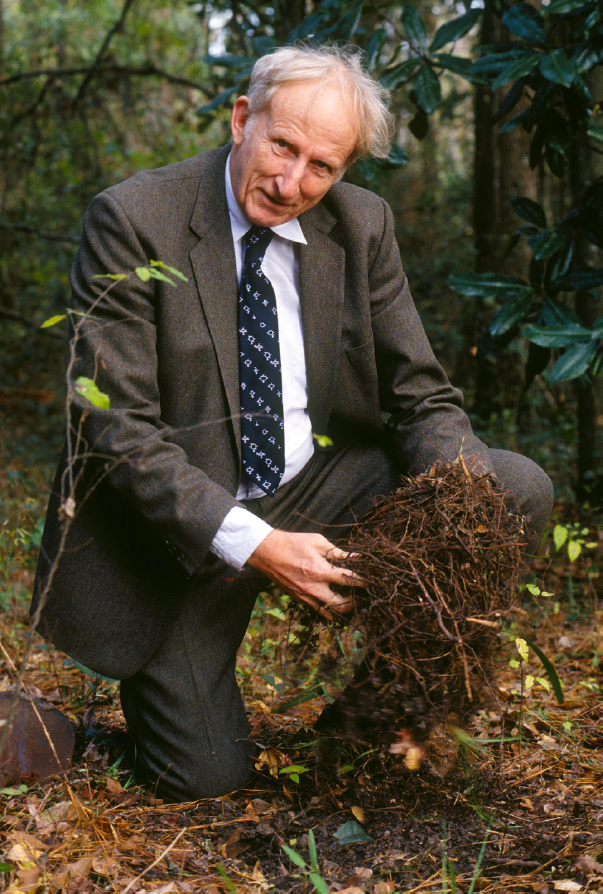
Today’s guest post by Preston Howard discusses an issue central to our overshoot predicament that is often ignored: The Maximum Power Principle (MPP). The MPP states that life optimizes for maximize power, not maximum efficiency, and implies that life does not look forward in time to consider the consequences of maximizing power today.
While preparing an initial report for Florida’s first Area of Critical State Concern1 in 1972, I had the immense good fortune to spend time with Howard T. Odum, an environmental engineering scientist who directed the Wetlands Center at the University of Florida. The area of state concern was the Big Cypress Preserve adjacent to the Florida Everglades. Dr Odum and several of his graduate students had ongoing studies in the area. In informal conversations, Dr Odum explained the Maximum Power Principle as described below. I believe it presents Humanity’s current situation better than anything I have seen about global warming, overshoot, or climate collapse. However, to my knowledge no one has mentioned it in any serious article except Gail Tverberg in her articles about resource consumption.
To understand the Maximum Power Principle2, let us imagine a square island, barren of any vegetation. As happened many times in Florida, suppose our island was created by fill where a shipping channel had been deepened. Situated close to the seaport, someone intended to build something on the new island, but permitting requirements and other administrative delays where taking “forever.” (These details provide a “context” for the discussion.)
The barren island does not remain barren for long, as plants soon begin to grow on it. The solar energy that bathes the island provides abundant energy for the early pioneer plants. Seeds blow in on the wind. Some may wash ashore. Birds drop some. Those initial plants found a world filled with more (solar) energy than they could use. In this bounty they made their best efforts to use as much as they could and to grow as fast as possible, even at the expense of wasting energy by not using it efficiently.
Point 1: The Maximum Power Principle states when energy is abundant, those organisms survive best that maximize their use of energy, even if they are wasteful in how they use it (because the supply of available energy is “infinite” in a relative sense).
Weeds grow quickly, and they soon cover most of our imaginary island. The fact that weeds are wasteful in how they use available energy does not matter, because there is plenty of solar energy for all the plants.
Slower growing, but more efficient, plants also germinate, but they compete poorly because higher foliage from the faster growing weeds blocks energy-rich sunlight from the young trees and shrubs. Perhaps by chance some of these seeds fall on a higher elevation where weeds cannot easily block them from the sun. Or, perhaps they are near the shoreline, where the water provides weed-free access to adequate solar energy along the water’s edge. If these more efficient shrubs and tree seedlings find niches to assist their growth, they can survive even though they cannot compete well against the weeds directly.
In time, vegetation covers our imaginary island. Now the situation changes dramatically concerning the Maximum Power Principle.
Point 2: When the energy supply is limited, those organisms compete best that maximize the efficient use of the energy available to them.
Now every plant on our island has neighbors nearby, pushing leafy branches where a plant wants its own leaves to collect sunlight. Plants no longer have access to unlimited energy where growth is maximized even if excess energy is wasted. Soon there is no energy to waste. Plants find it difficult to obtain all the energy they desire, and the increasing competition with other plants for available energy adversely affects their growth.
In this new environment the struggling tree seedlings and shrubs have an advantage because they use available energy more efficiently than the weeds. Over time these changes allow shrubs to win out against the inefficient weeds, just as the trees will — in time — overpower the shrubs.
Examples of the Maximum Power Principle
As a general rule, all biological life embraces the Maximum Power Principle. If a life form confronts an energy source it can use, it succeeds best if it uses it as the Maximum Power Principle indicates. To understand the Maximum Power Principle as it impacts the real world, let’s look at a few examples.
Example 1: Paramecium in petri dish3. Paramecium are single-cell organisms that live in water and consume a variety of foods, including yeast. Here, we examine where we put several paramecium in a petri dish with an abundance of yeast. The buffet has been served, and the paramecium begin to consume the yeast. The paramecium flourish, reproducing more and more paramecium as the yeast is slowly consumed. Until… until there is no more yeast to consume, at which time the (now many) paramecium all die of starvation. Unfortunately, there is no natural system to suggest to the paramecium problems they may encounter if they eat all the yeast as fast as they can.
Sometimes events occur that regulate unrestrained growth that otherwise harms an organism in the long run. For example, if yeast gets down to 10% of the initial amount, suppose a lab assistant regularly restores it to 25% of the initial amount. In this situation the paramecium population fluctuates with the availability of yeast.
Example 2: Deer on the Kaibab Plateau4. The Kaibab Plateau is a relatively inaccessible area on the north side of the Grand Canyon comprised of approximately 700,000 acres. In 1907 there were an estimated 4,000 deer resident on the plateau, in addition to pumas and wolves, which were predators of the deer. The predators and the prey maintained a relative balance with one another. Between 1907 and 1923 a successful effort removed most of the predators, allowing the deer population to increase. By 1925 the deer population grew to more than 100,000, which was far in excess of the carrying capacity of the vegetation available on the plateau. All vegetation was consumed. Over 40% of the herd died in two successive winters, and the deer population plummeted to around 10,000. There it stabilized because of the significantly compromised vegetation available for food. (Earlier estimates suggested the Plateau could originally support 30,000 deer).
Example 3: Deer on St Matthew Island5. St Matthew Island is a remote island in the Bering Sea, north of the Aleutian Island chain in Alaska. During World War 2, the United States needed to know whether or not Japan attacked the island. The US Coast Guard established a radio navigational system on the island. It was understood that the 19-member team on St Matthew could never defend the island, but before capture the team could alert HQ by radio in the event it was invaded by Japanese soldiers. Because the island is so remote, the military was unsure whether it could provide regular supplies. As a backup food source, the US relocated 29 reindeer to the island so the radio team would not starve. For the deer, the buffet had just been served! St Matthew is 32 miles long and 4 miles wide, and it was covered with lichen, a favorite food of reindeer.
When World War 2 ended, the radio team left the island, but the reindeer remained. In 1957 Dr David Klein, (then) a professor at the University of Alaska Fairbanks, visited the island with a graduate student. They determined that the 29 original reindeer had grown to a population of 1,300. When Dr Klein returned a second time, in 1963, the reindeer population had grown to 6,000, or almost 50 reindeer per square mile. Just like the paramecium, this did not look good for the reindeer. Due to overconsumption, lichen was increasingly scarce. The winter of 1963-64 was one of the worst on record for that part of Alaska. In 1966 Dr Klein returned to St Matthew Island to find just 42 reindeer, including only one male. It had deformed antlers and probably could not reproduce. All the St Matthew Island deer perished during the next decade.
The Maximum Power Principle lesson: If resources allow, the organism should use the resources to grow as the tried-and-true way to survive best over the long run. Ecologically, there were no checks and balances to suggest that 600 reindeer could live on St Matthew Island, but 6,000 could not. This is important.
How Humanity Embraced the Maximum Power Principle
No animate life form is exempt from the Maximum Power Principle, not even Humans. Starting in the 1700s, Humans began using coal to power an increasingly industrialized Western society, starting primarily in Great Britain. Around 1850 oil was discovered in open ponds in Pennsylvania. Humanity soon found oil worked as well, and perhaps better, than coal. For the next 175 years Humanity (at least parts of it) had access to these energy-rich resources. And, just as the Maximum Power Principle dictates, Humanity used as much of these resources as it could get. Simply put, in 300 years Humanity harnessed the power of lightning and taught sand (silicon) to think6. Humanity electronically connected most of its 8 billion inhabitants and extended its presence into outer space. Humanity has no predator to threaten its dominance in any corner of the globe.
One might think Humanity’s success is guaranteed, except for a few things: First, the increasing scarcity of oil and coal and natural gas suddenly threatens to remove the punch-bowl from which Humanity has been feeding. Second, the carrying capacity of the Earth is far less than 8 billion humans unless we continue to supplement with increasingly scarce resources. And, last, our centuries-long party has now broken the Earth in ways Humanity cannot repair.
All the King’s horses and all the Queen’s men, will never restore this spherical jewel, regardless of what we do. We have transitioned from a “grow as much as you can quickly” environment to a “use remaining energy resources as efficiently as possible” environment, but we refuse to notice. As increasing numbers suffer because we do not adapt, those with power and authority choose to continue as before because it enriches them. Except in small, cosmetic steps, we do not even try to save one another. Instead countries say to one another, “you go first,” and “no, you go first.” But, that’s how money talks in the United States, where corporations are declared to be people under law. The job of corporate citizens is to enrich their shareholders, not to act in concert with environmental constraints.
Humanity’s Future Foretold
Nonetheless, one can take heart. Humanity is right where it is supposed to be. We will continue to use energy that remains available to us to build electric cars and windmills and nuclear weapons as we now increasingly compete against one another. And, just like the deer and the paramecium, we are certain to collapse as critical resources dwindle. The Maximum Power Principle is deeply embedded in all life, and — like it or not — we are no exception.
We are foolish if we think we can escape7 the Maximum Power Principle. As fast as scientists tell us of the need to address looming dangers (starting with global population concerns in the 1960s), and as fast as people far and wide demand global change, and as carefully as the United Nations forces all countries to accept the need for step-by-step remediation, it will never happen. We will continue to burn more coal when oil is scarce. And we will continue to drill for increasingly hard-to-extract oil until our electronic interconnected house of cards crumbles around us. This behavior is hard-wired at the cellular level, allowing us little choice concerning whether or not to embrace the Maximum Power Principle.
One might ask when this catastrophe will occur. Don’t look now, but it is occurring before your very eyes. Regardless of whatever we do at this point, we have broken the World, and we cannot fix it. Our actions cause extinction of hundreds of living organisms8 every month. Human activity warmed the globe to the point that arable land is less available, decreasing the global food supply. Actions with unintended effects melt polar and glacial ice, and yet have not kept seawater temperatures from increasing. We now discover fish cannot live in the warmer ocean water. Rising ocean water and weather extremes adversely impact Human settlement across every corner of the globe. Unfortunately the Maximum Power Principle does not allow do-overs.
The Earth suffers from a runaway infestation of Humanity. Just like the paramecium, as necessary resources increasingly become unavailable Homo sapiens will join the long list of extinct flora and fauna previously unable to survive a changing world. But the Earth will not die. After Humanity’s demise, the Earth will heal itself. This could happen quickly. Perhaps in less than an eon (2250 years), a “blink of the eye” in planetary time. It would be nice to think Humanity might recognize its bleak future, and would attempt to facilitate the successful transition of whatever life manifests itself after Humanity’s exit. That, however, is not likely because of the Maximum Power Principle.
If I knew today was Humanity’s final day to exist, I would most want to plant a tree.9
Addendum
I would be remiss not to call attention to the single situation I know where Humanity acted contrary to the Maximum Power Principle and instead chose to minimize present energy use in return for greater resource bounty in the future. American “First Peoples” — at least some of them — chose to plant corn from larger husks while instead eating only corn from the smaller husks. Over time, this gave them a larger harvest.
While this may seem “obvious” to someone today, it embraces action directly contrary to that expected by the Maximum Power Principle. Somewhere in their historic past someone in those tribes stood before others and suggested they eat less now in return for the promise of more food in the future. I expect whoever it was, she probably convinced the other women (who tended the plants) and never mentioned it to the men who were perhaps out hunting.
Sources and Notes
1Howard, P. (1974) “The use of vegetation in the design of regulations pertaining to coastal development of the Big Cypress critical area.” Proceedings of the First Annual Conference on Restoration of Coastal Vegetation in Florida (Tampa, Florida: p. 16).
2Odum, H. T. and Odum, E. C., (1976) Energy Basis for Man and Nature. New York: McGraw-Hill Book Company (pp. 39-40). [Co-author E. C. Odum was Howard Odum’s wife and research partner. Not to be confused with Eugene Odum, below.]
also
2Lotka, A. J. (1956) Elements of mathematical biology. New York: Dover Publications, Inc. (p. 357). [Here described as the Law of Evolution.]
3Lotka, A. J. (1956) again. [Here described using bacteria, while noting, “… a man, for example, may be regarded as a population of cells.” (Lotka’s emphasis.)]
4Odum, E. P. (1959) Fundamentals of Ecology. Philadelphia: W. B. Saunders Company (pp. 239-240). [This was the first college-level textbook to include the word “Ecology” in its title. Eugene Odum wrote this book “with” Howard Odum, who provided an energy basis for nature.]
5Klein, D. R. (1968) “The introduction, increase, and crash of reindeer on St. Matthew Island. J. Wildlife Management 32: 350-367. Source: https://www.geo.arizona.edu/Antevs/nats104/00lect21reindeer.html on 28-Jul-2023. [Retrieved on 28-Jul-2023.]
6Lesser, H. G. (1984) “Microprocessor pioneer and industry mover.” Computer Accessories and Peripherals, 1:5 (p. 69+) [Quoting Harold Lee: “One good way to look at our (computer) industry is that, literally, within the last three hundred years, we’ve harnessed lightning and used it to teach sand how to think.”]
7Schalatek, L. (2021) “Broken Promises – Developed countries fail to keep their 100 billion dollar climate pledge.” Source: https://us.boell.org/en/2021/10/25/broken-promises-developed-countries-fail-keep-their-100-billion-dollar-climate-pledge. [Retrieved on 7-Aug-2023, as just one example of many available.]
8Pope, K. (2020) “Plant and animal species at risk of extinction.” Source: https://yaleclimateconnections.org/2020/03/plant-and-animal-species-at-risk-of-extinction/ [Retrieved on: 8-Aug-2023, although many references address this issue.]
9Merwin, W. S. (quote) “On the last day of the world I would want to plant a tree.” [Apologies to Merwin (1927-2019), a Pulitzer Prize winner and United States poet laureate, for my alteration.]
About the Author
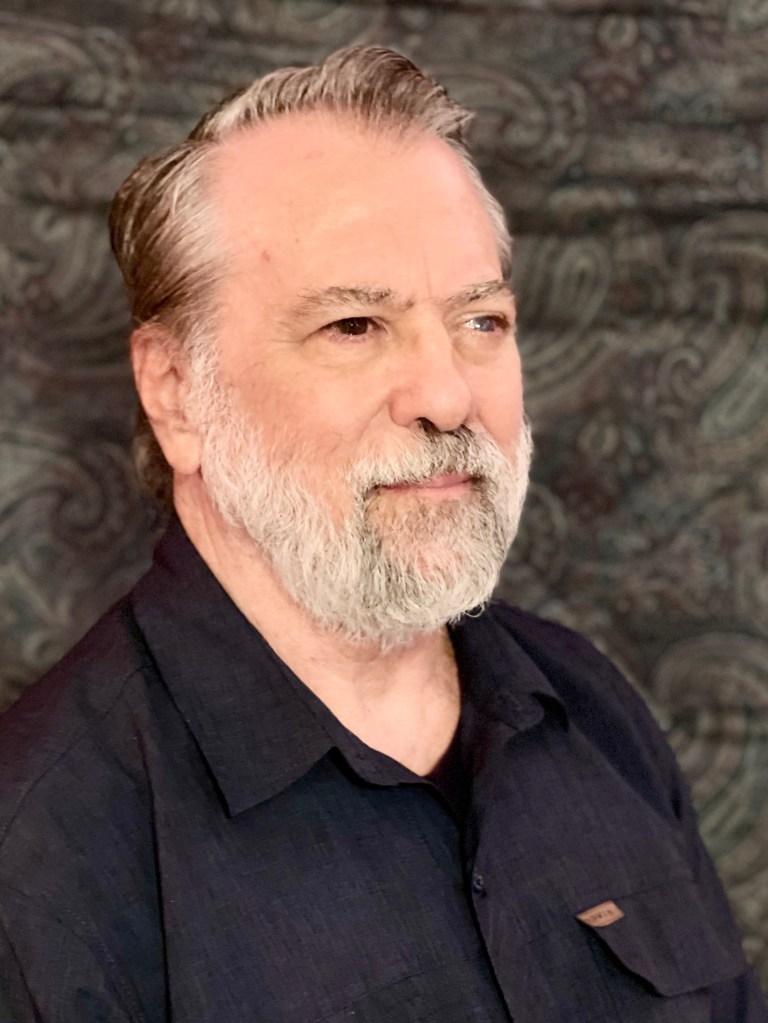
Preston Howard has a Masters degree is in geography and retired in 2011 after a wide-ranging career in data management. In 1972 he developed a simulation of seaport growth, the first of his many national and international publications and presentations. Today he lives in a log cabin in one of the more successful intentional communities in the United States.
Rob here again.
I do not know what Preston thinks of Dr. Ajit Varki’s Mind Over Reality Transition (MORT) theory however I believe that the MPP and MORT theories are both true and together are the primary cause of human overshoot.
The MPP governs biology just as the laws of thermodynamics govern the universe. Nothing in the universe may violate the laws of thermodynamics and no life may violate the MPP. How could it be otherwise given that life at its core is chemical replicators evolving to compete for finite energy and resources?
Assuming that the MPP governs all life and cannot be overridden, how is it possible for an intelligence to exist in the universe that is smart enough to understand that behaving in accordance with the MPP will destroy itself and all that it cares about?
A solution that evolution discovered on this planet, and perhaps the only solution possible on any planet, is to prevent high intelligence from emerging unless it simultaneously evolves a tendency to deny unpleasant realities, like for example, the fact that it is in overshoot. Otherwise the intelligence might override the MPP to reduce suffering and possible extinction, and the replicators that created the intelligence won’t permit that.
Apparently it’s quite improbable and/or difficult to simultaneously evolve high intelligence with denial because it has occurred only once on this planet, despite the obvious fitness advantages of high intelligence.
The MPP and MORT together explain why we seem to have no free will to do anything wise about overshoot. They also explain why an honest assessment of our responses to overshoot symptoms would conclude we are doing the opposite of what a wise intelligent species with free will should do.
Despite this bleak assessment I’ll continue to push awareness of MORT and population reduction, just in case I’m wrong and there is a way to override denial and MPP, because our existence on this planet is so rare and precious, and because there is much suffering coming soon that could be reduced.
It’s possible that Preston disagrees with my opinions on MORT. That’s OK because even if I’m wrong, Preston’s points about the MPP are still probably correct.
 un-Denial
Chuck Watkins sticks to hurricane monitoring and stays away from geopolitics despite being an expert on nuclear war risks after he was attacked for speaking out on the nuclear risks of western policies in Ukraine.
So on the super rare occasion when he says anything, I listen. It seems he thinks the middle east nuclear war risks are much higher than Ukraine.
LikeLiked by 1 person
ZeroHedge says fill up your gas tanks.
https://www.zerohedge.com/geopolitical/foreigners-missing-after-terrifying-red-dawn-moment-israeli-rave
LikeLiked by 1 person
This maybe the moment when an aircraft carrier is sunk.
Stay tuned to the insanity channel.
LikeLike
I like today’s essay by Simplicius the Thinker because he outlines some of the possible explanations for what’s going on, which shows how complex geopolitics is, and concludes he doesn’t know what’s true yet.
https://simplicius76.substack.com/p/israel-flashpoint-localized-skirmish
LikeLike
Me? I’m going to listen to my Canadian government and then assume the opposite is true. This worked perfectly for covid.
LikeLiked by 3 people
smart
LikeLike
Maybe it’s my COVID fatigue but I can’t help but feel this attack was very convenient timing for Netanyahu.
Also how bad are music festivals lately?! Must be one of the first things to collapse in a declining world.
I feel incredibly bad for the victims on both sides who have been let down by useless leaders for decades.
LikeLike
The people I follow and respect say it is unlikely Netanyahu deliberately allowed this to happen. More likely he was too occupied with internal political battles. Also likely that Hamas has improved it’s fighting capabilities and ability to fool surveillance. Also likely Netanyahu will lose his job over this when the dust settles.
LikeLiked by 1 person
I thought Chris Hedges had a good take on the Israel/Palestine war. I have always thought that the Jews in Israel went from being the victims to being Fascist victimizers. They surely run an apartheid state now.
Hedges is a must read:
https://consortiumnews.com/2023/10/09/chris-hedges-palestinians-speak-israels-language/
AJ
LikeLiked by 1 person
Thanks. Excellent essay by Hedges with lots of historic context.
There’s much evil in our species.
LikeLike
Even more ominous is Black Mountain Analysis (Alek), who is a Serb and usually writes about the
U.S./NATO debacle in Ukraine.
In the attached link he discusses the Israel/Palestine war and how it could easily be the start of WWIII with the U.S. potentially losing big time or going nuclear (that’s me reading between the lines.
https://bmanalysis.substack.com/p/israel
AJ
LikeLiked by 1 person
Very good.
I’m expecting another shoe to drop soon. Perhaps China will do something with Taiwan? Or maybe another 9/11 type attack within the US? The people who hate the US empire smell blood.
LikeLiked by 1 person
They say that in the early days of WWI and WWII participants did not know they were in a world war.
LikeLiked by 1 person
From discussions I’ve had most people can’t conceive of 5G warfare. They are still stuck in nation vs nation war with bombs mentality.
LikeLiked by 1 person
I’m ignorant on 5G warfare. Can you explain?
LikeLiked by 1 person
5th generation warfare is using new technologies like micro drones, microwave emitters, biologicals like covid and even CBDC’s and social credit scores as weapons against populations to control them. Now the fight is not necessarily nation against nation but government against its population. Where it goes from here is so unpredictable. It really feels as though major components of modern civilisation are at risk. For example how hard/easy is it to drone attack refineries anywhere in the world. Take out a few of them and we are on a faster road to collapse. Same with critical grid infrastructure. Let us hope that saner heads prevail.
LikeLiked by 1 person
Thanks!
I guess it’s obvious to you but I’ve been trying to understand why my Canadian government has been acting so un-Canadian, for example, calling truckers who protested unscientific and unethical covid policies Nazis, and now celebrating real Nazis who fought our Russian allies.
I think it may have to do with overshoot and limits to growth. It is impossible to both “fix” our problems and retain power in a democratic country. Our cornered leaders are shifting to authoritarian rule.
LikeLiked by 2 people
I think to overall strategy is to undermine peoples sense of reality and certainly. The more chaos that ensues to more people will demand an authority to fix the situation. I think we have moved into the part of the game where speaking out now gets you removed form the game early. Tread carefully everyone.
LikeLiked by 1 person
I can’t really fault you for hoping that civilisation continues; I do also. But is it a matter of not wanting civilisation to collapse whilst you’re alive (my hope) or thinking it is somehow possible to keep it going indefinitely?
Green resistance groups would love to take out a few refineries, and a few dams, to speed civilisation’s collapse. I have a lot of sympathy for that position, even though I selfishly don’t want to cope with it.
LikeLiked by 1 person
Kunstler can turn a phrase…
https://kunstler.com/clusterfuck-nation/here-we-go-loop-de-loop/
LikeLiked by 1 person
Karl Denninger today confirms what I believe to be true. Central banks do not control the interest rate. Inflation caused by governments printing money and growing spending faster than the real economy causes the interest rate to rise.
https://market-ticker.org/akcs-www?post=249846
Denninger also explains what the US must do to avoid collapse, starting immediately:
Not going to happen. Collapse it is then.
LikeLiked by 1 person
Denninger has many insights that are very valuable. He is a pragmatist and sees collapse as a possibility. Even though he is republican/libertarian he thinks Trump was/is as bad as Biden. My only problem is that he is in denial about climate change (reminds me of Dave Collum) mostly because he see the “Green Agenda” of renewable electrification as a fraud (which it is).
I hope he is wrong only because he see a Mad Max collapse.
AJ
LikeLiked by 1 person
A lot of covid crime aware people also deny climate change. My theory is that they deny climate change because everything our leaders say we need to do to prevent climate change is a lie and won’t work. They accurately detect these lies and then incorrectly extrapolate that climate change itself must also be a lie.
LikeLiked by 1 person
Most people can’t can’t grasp that climate change is a symptom of overshoot and a lifestyle that is totally unsustainable. In essence a metabolic shift for the planet. There is nothing that can be done to stop CC. How bad it will be depends on how fast we collapse or voluntarily reduce our lifestyles down to that of hunter gatherers and how fast our populations reduce. Personally I see massive waves of death coming due to our own stupidity and our tendency to not share outside of the tribe in hard times.
I often wonder how it would be to sit around with many of you discussing these topics over a glass of wine and and a fine meal. Thanks to all for the online meal.
Niko
LikeLiked by 4 people
I wish I had an aware friend like you in my local community. I have a small number of friends here but none are aware.
LikeLiked by 1 person
Unfortunately we are few and far between. That said, I lost most of my entire social group through the covid reactions but I am happy to report that I ended up finding a bunch of new people to hang out with that are actually switched on to what is going on. Also I managed to resurrect a lost friendship with a bit of work and a definite boundary to some discussions.
Maybe we can organise a virtual hangout sometime, you seem like an interesting person to chat to Rob. As do so many of the other regulars here. I wish I had more time to comment than I do. Best wishes to you all.
Niko
LikeLiked by 3 people
I would love that! 🙂
LikeLike
To me it seems too much like black and white thinking when you say “deny climate change”. I think the truth, as always, is somewhere in between.
As you mentioned above, you often think exactly the opposite of what the government is telling you is true. So why do all governments tell us that CO2 is the ultimate evil and and eliminating it is the panacea to finally get climate change under control? Right – because it’s bullshit. It just gives them a means to tax the air you breathe and ban you from doing things you enjoy, especially if it requires fossil fuels (because they know they are running out), nothing more. I think the impact of CO2 is significantly overestimated.
Also, I don’t think there is such a thing as a stable climate at all, and there have always been fluctuations throughout the history of the earth – mainly due to solar cycles*
But that doesn’t mean I deny a human influence on the climate. Because I too am convinced that what we are doing to the planet is not good for it. Our influence will cause a faster change to unfavorable conditions and make it uninhabitable in the long run – as nikoB wrote, all of these are symptoms of overshoot, triggered by civilization (industrial agriculture with pesitzides and water shortage, albedo and urban overheating, ocean pollution, overfertilization, desertification, erosion by clearing, drought,…). And the so called green energies even accelerate this bad influences.
So, would you still call me a climate change denier?
*refer to this link for more information:
https://ibdst.blogspot.com/2023/07/fact-check-truth-about-global-warming.html
LikeLiked by 1 person
It’s not governments that are telling us about the effect of CO2 and other gases on climate change, it’s the scientists. Before I started to take notice of the actual science on this, I didn’t think humans could possible have much impact on our environment, including clime. But now it’s clear to me. It’s also clear to me that humans are responsible for probably all of the warming in the last 50 years (only some of it before then).
When we talk of a stable climate, we don’t mean “not changing” but changing within a fairly tight range. This allowed (unfortunately) the rise of civilisations. Happily, at least that will be going away for a while.
LikeLiked by 1 person
I unterstand your critique and I also believe in scientific methods. But scientists are also humans and may err. And many of them are funded by governments – whose bread they eat, those song they sing… You surely know about the real mathematics behind the “97% of all scientists” who agree on climate change?
If you are really open to scientific thinking, please read the link and build your own opinion. And please do not use the killer phrase “The Science”. Otherwise it is more a sign, that you believe in “The Science”™ that is not allowed to be doubted. It clearly acts as a replacement religion these days.
As I said: I don’t doubt the negative influence of civilization on our planet. This may include rising temperatures – but do you know definitely, that it results from the CO2 or maybe just of all the energy we released? After all, all energy becomes heat in the end – right? I know, that I don’t know.
P.S. Your statement “It’s clear to me” sounds dangerous to me: Don’t be afraid of someone seeking the truth. Be afraid of those, who mean they have found it.
LikeLiked by 1 person
I skimmed your link. They make a lot of claims. Too much work for me to fact check each one but perhaps you could reply with the single most compelling fact you believe to be true? I’ll try to check it.
LikeLiked by 1 person
There is a brochure by 4 German scientists, called „Can mankind save the climate?“ that has a lot of well described and referenced information. (ISBN 978-3-00-066383-3, unfortunately available only in German). Some of the graphs are the same as in the link I posted earlier.
They share the following argument that seems most compelling to me:
The Arrhenius equation is not the whole truth, a further increase in CO2 will not increase the temperature accordingly. The reason for this lies in the spectral distribution of the absorption – Arrhenius could not know this, because he had no spectrometer.
When we look at the absorption spectrum of sunlight and the reflection spectrum of the earth, we see that water vapor is the most climate effective gas. It absorbs most of the infrared emission. It leaves only small windows for other gases to absorb the remaining wavelengths of infrared radiation to be converted into heat. There are mainly 2 wavelengths that can be absorbed by CO2 to be be converted into heat (4.3 and 14.7 µm). Since there is no relevant reflection in the 4.3 µm band, this can be neglected. And for the 14.7 µm band, most of it is also absorbed by water vapor. So there is only a small bandgap in the shorter wavelength end of the 14.7 µm band, that is really relevant for greenhouse effectiveness of CO2. Therefore the amount of CO2 in the atmosphere influences the total transparency or total absorption of infrared only in this small band.
When you apply the Lambert-Beer-Law for the dependency of intensity-reduction of radiation by absorption on its way through the atmosphere, you get the result that with the current CO2 concentration in the atmosphere almost all radiation is absorbed after 40 m above surface. This means, the absorption effect of CO2 is already saturated – no radiation reaches the higher atmosphere, let alone space. A further increase in CO2 therefore would not significantly increase the greenhouse effect.
Reference Picture: https://tinyurl.com/3xc4w354
LikeLike
Thanks. A lot of this went over my head but I’m trying to understand the essence of the claim.
The last sentence may be what I’m looking for:
Are they saying that mainstream climate science has been correct up to the current 440ppm CO2 but any further increase in CO2 will not worsen the additional 1C of warming that is already locked in?
If not, please clarify what the essence of the claim is.
LikeLike
I will try to read that link but fully considering it will take tangential research on my part and I’ve probably done that dozens of times for the same arguments. I wish I could save all of that work without having to redo it. But I will try to find time.
As far as I can tell, CO2 is one of a number of gases that traps some of the outgoing infra-red and re-radiates part of that back into the atmosphere. From increasing those so-called greenhouse gases (Sagan said it’s not really the same as a greenhouse but used the term for simplicity) it is “clear to me” that the earth would warm up (compared to having none of those GHGs in the atmosphere). Increasing those gases in the atmosphere enhances the warming, until the outgoing radiation from earth equals the energy coming in. So warming definitely results from CO2 (and other gases).
There is much made by skeptics of the 97% of published papers supporting AGW, and much of it is nonsense (even to the point of claiming the data actually shows only a few percent have such support) but you’d be hard pressed to find a publishing climate scientist who doesn’t think CO2 warms the planet (though a few might question the magnitude of that effect). As I’ve mentioned, I used to be hugely skeptical until I started looking at the science with as open a mind as I could muster. It completely changed my stance. I use the term “clear to me” because I wouldn’t have an opinion on something if that opinion were not clear to me. Would you?
LikeLike
Sabine Hossenfelder recently explained that the greenhouse effect does not work the way most people assume.
It is very complex and very subtle but I have a feeling that she explains why marraomai incorrectly believes that more CO2 will not cause further warming. This would be an easy and forgivable error to make.
I’d have to watch this several more times to be sure of what I just said. Maybe someone smarter than me can confirm.
LikeLiked by 1 person
Hello Rob,
I’ve watched the video and I understood the main point so far:
With increasing CO2 concentration, the edges of the absorbtion bands get wider, which increases the radiation back to earth. So there is a temperature rise effect on the ground, which due to the overall engergy leads to aa temperature gradient and a temperature decrease in the stratosphere. Others have already calculated this influence and came to a mathematical result of 0.7°C temperature increase of ground temperature, if the amount of CO2 is doubled – sounds not that dramatic as the proclamated 4/5/6 or whatever degree. Other effects like the water vapor feedback loop, that are used in the climate models, have not been verified. Let alone the reasoning for any other “corrective” factors (like Einstein and his cosmologic constant, which he added to make the result look right).
In the end all IPCC models neither got the current projection right, nor were they able to correctly replay what has happened in the past.
So all in all, climate is such a complex thing, no one can really calculate or predict it – or put all the blame on one single factor in a chaotic, complex feedback, multi-variable, differential equation system (or whatever this is called…). Anyone stating else is an imposter in my eyes, “Science” is not almighty – otherwise it would be a religion.
So with my critique, I just wanted to raise awareness, that when government, “The Science” and “The Majority” tell you, CO2 is the main driver, this should make one suspicious. Call it a feeling. Just like with Covid, which by the way also was supported by “The majority of scienctists”, if you know what I mean…
In the German Democratic Republic, there was only one party to vote for. They always had resulsts of 97..99% and everyone knew it was fake. But dare to say something else and the StaSi came for “Clarification of a matter”. So much about the majority…
But I say it once more: I am, like all of you, convinced, that civilization has a very negative impact on the planet, which surely in some way influences the climate and even more the environment, which is our foundation for living. We have almost sawn through the branch, on which we sit.
LikeLike
I took time to go through most of that undiepundit post. I took some notes but really don’t have time to edit them into a proper comment, so am just copy and pasting them here.
So not convincing at all, to me.
LikeLiked by 1 person
Denninger is a smart guy but still can’t grasp overshoot and that the party is over no matter what we do. He still sees a road back to growth not realising that all of it is a cancer and that getting back to growth is the last thing we want or can even achieve without killing ourselves faster. Interesting times have certainly just got more interesting.
LikeLiked by 4 people
OK, so unsustainable tech is bad, and way too much exponential growth of consumption and overpopulation is all bad. I=PAT and infinite growth on a finite planet is bad. I get it. Been there, run the Richard Heinberg tour of Australia (in 2005), shown the “End of Suburbia” in NSW Parliament house, I got permission of the producers to make a half-hour cut and distribute DVD’s to every Federal politician in Australia and every one of my State pollies as well. Been there, worn the T-Shirt.
But what if the T in I=PAT becomes a divider of harm to the point where we can feed and clothe 10 billion of us by 2050 and NOT kill the planet? What if we can meet their needs, still have nature thrive, and then watch first world economics cause a WorldWide Demographic Transition that will slowly reduce the population? https://en.wikipedia.org/wiki/Demographic_transition
Remember the old example of bacteria in a Petri dish. Assume you know it doubles every minute, and the dish will be full in an hour. When is the dish half full? In 59 minutes! The bacteria has been almost invisible for 50 minutes then in the last 10 minutes goes from a tiny blotch to an eighth, then a quarter, then a half, and suddenly the dish is full!
In this metaphor – renewables are just becoming visible as a smudge on the side of the petri dish. But because they are now so cheap, they are about to explode out exponentially. South Australia has the world’s highest penetration of intermittent wind and solar renewables – and there are a few teething problems. But generally, it’s working! Check out other signs of growth.
In 2025 so many solar factories will open they’ll have FOUR TIMES the capacity of all the solar built in 2022 – nearly a terawatt per year. 5.8% from 2025 basically ALL THE WORLD’S power in 17 years, so from 2025 that’s 2042. Oh yeah – and the reference for this also includes an interview with Dr David Murphy – the founder of the whole EROEI concept – and he says solar is fine!
https://xenetwork.org/ets/episodes/episode-184-eroi-of-re/
By 2030 America will have up to 15 TIMES the EV battery capacity – meaning almost 100% of cars could be EV. (This is just a comparison for illustration purposes. It’s NOT an assertion that America will stop importing cars and build 100% EV’s themselves. These batteries will of course be split between EV, household, business, and grid utility sectors.) Oh yeah, and a LOT of these will be sodium – and some may be bold new chemistries like aluminium sulphur or aluminium silicon etc which are in the lab but showing promise.
https://www.cnbc.com/2023/01/05/map-which-states-will-build-the-most-ev-batteries-in-2030.html
Even trucking is going electric. Tesla have their 40 ton Semi, but Janus Australia even have a 100 ton electric ROAD TRAIN that runs on a giant battery-swap system! https://youtu.be/9eYLtPSf7PY
Electric mining trucks are being experimented with. https://www.caterpillar.com/en/news/corporate-press-releases/h/caterpillar-succesfully-demonstrates-first-battery-electric-large-mining-truck.html
Electric arc furnaces, hydrogen to replace coking coal as reductant, and so many other innovations are coming to mining. Lithium from seawater is nearly economical – and there’s a million years of lithium in the ocean. But sodium batteries are superior for grid storage as they are less fire prone, less toxic, and less expensive.
Clean tech and EV’s are all growing SO FAST that the head of the International Energy Agency predicts that oil DEMAND will peak by 2026 and decline from there. https://www.iea.org/news/growth-in-global-oil-demand-is-set-to-slow-significantly-by-2028
Experts think demand for ALL FOSSIL FUELS will peak soon, and phased out WELL before 2050!
http://theconversation.com/theres-a-huge-surge-in-solar-production-under-way-and-australia-could-show-the-world-how-to-use-it-190241 Basically, people are going to be shocked at how fast things change across the next 10 years, let alone 20.
I’m not saying we WILL make it. They could always reelect Trump, or the next guy that’s nuts. Plenty of crazy to go around. But I’m saying the real engineers out there have this. There’s no ‘inevitable energy descent’ the peakniks go on about. That’s all a lie.
LikeLike
Renewables require fossil fuels in their construction, operation and dismantling. Without a fossil fuel industry, there is no renewables industry. And, per Nate Hagen’s recent video, oil production would not need to drop too far for there to be a shortage of many needed refined fractions of crude oil. Interestingly, crude oil production peaked in November 2018.
I recommend Bright Green Lies for an exhaustive examination of all aspects of so-called renewables.
LikeLike
If we’ve learned anything from the last few years – especially the 2008 GFC – it’s that society has an awful lot of energy ‘fat’ it can cut. Personally I side with the head of the IEA who says oil DEMAND will peak in a few years. That’s way before the actual geological limits of peak oil kick in. It’s just the math of the inevitable rise of EV’s. They’re still scaling, prices are still dropping. BIG industries around the world are starting to do the math on buying their own solar farm and running their own mine on electricity.
“In Ireland, decarbonisation systems company Cool Planet Group has signed a €50m deal with a “leading global mining company” to retrofit 8,500 diesel mining trucks into electric vehicles over the next three years. This retrofit, though, could be just the tip of the iceberg.
Crowley told the Irish Times: “As many as 1 million diesel mining vehicles will need to be retrofitted to electric by 2030. We’re working with five or six of the largest mining companies in the world and we’ve developed a bunch of vehicles that are electric, don’t emit diesel particulate matter, but also they are much safer. They have collision avoidance systems so they can’t run people over.” “ https://www.mining-technology.com/features/mining-vehicle-electrification
The best bit? Some are charged from overhead pantographs (like tram wires) as they drive up hill. These huge trucks are carrying 240 tonnes. But they do DOUBLE the speed of their old diesel cousins going up hill while charging! Just watch 60 seconds here. (Or go back to the beginning and watch all 11 minutes – it’s a good episode.) https://youtu.be/6TxMeHRq1mk?t=213
LikeLike
PS: As for “Refined fractions”
A barrel of oil is used for so many things. Let’s look at how much of a barrel does what – and what might replace it over the next few decades of the energy transition. Some of these are already underway and accelerating – a few have passed R&D and are just being trailed. Percentages of oil use can be found here: https://www.visualcapitalist.com/whats-made-barrel-of-oil/
PETROL AND DIESEL is 70%: Electric Vehicles can EASILY replace 70% of the oil barrel. EV’s are doing it, and even trucks can be replaced now the Tesla Semi and Janus Australia are here. Janus use a forklift to drive a battery-swap system for big “Road Trains” carry 100 tons. They go 400 km or more then just pull in and swap the batteries in a minute. This means the batteries don’t have to fast charge – which is less stress on the grid and batteries. They estimate they can run 10 trucks just from the warehouse roof! https://www.januselectric.com.au/
HEAVY FUEL 5%: for international shipping. As we Overbuild the renewable grid to get through winter, the 9 or 10 non-winter months of the year will have maybe 5 or 6 multiples of their national grid. Super-cheap excess power. This could be when nations manufacture heaps of synthetic fuel for airlines or shipping.
The other option could be Last Energy’s ‘nuclear batteries’ – factory manufactured 20 MW block reactors. Last Energy just entered into agreements with Poland to sell 10 and the EU to sell 34 (US $19 billion) so they’re up and away! https://en.wikipedia.org/wiki/Last_Energy There are 55,000 cargo ships but as 40% of that is fossil fuels, as the world turns to a mix of renewable and nuclear energy we’ll get down to 33,000 ships. Make them nuclear they’ll go 30% faster and so cut another 30% of the ships – down to 22,000 ships.
ASPHALT 4%: Replace with concrete. It is 30-40% more expensive, but as I’m a New Urbanist and want us to live on a fraction of the land, we can afford premium for vastly less of the stuff. All the young people in my world are over cars and traffic jams and accidents and tire pollution etc. They want a walking distance, intimate, attractive town square with a Metro. They’re sick of driving and wasting time in traffic jams and accidents and pollution.
Concrete might be offset by “Fossilisation” of non-recyclable plastic wastes etc from rubbish tips and household waste. https://youtu.be/_DOssohdBi0
They’re is also Gasification of household waste which might become economic when we Overbuild renewables. This turns household waste into half the stuff to build the next house, such as plastics and paints and roof tiles and pavers. https://eclipsenow.wordpress.com/gasification/
LIGHT FUEL 3%: mainly for heating. Replace with heat pumps. Or if in a New Urban district with central heating pipes, use a community thermal battery. Heating these giant thermos-flasks of hot gravel or aluminium-laced bricks is another place to dump excess summer power for long cold winters. https://eclipsenow.wordpress.com/thermal-batteries/
OTHER 12%: Cooking fuels and some petroleum plastics etc. Synfuel can replace some of it. If we need chemical inputs, there’s lots of coal left. (As long as we have a MOSTLY circular economy, I’m fine with a few top-ups of raw materials here and there.) Again – Gasification can replace a lot of this material. Anything else can probably be supplemented by biomass schemes like Marine Permaculture Arrays that will grow vast amounts of seaweed and shellfish – enough that even powdered seaweed food additives could feed the world all the protein we need!
JET FUEL 6%: Jet fuel is probably the hardest. Alternatives currently cost more. Local carriers under 900 km can go battery electric. But the big international flights will be either going hydrogen or synfuel. Hydrogen needs bigger tanks, displacing paying passengers, and so would cost more. Synfuel can fly the same plane – but costs more – unless again the Overbuild is so dramatic it REALLY brings the price down. Maybe flying is just going to cost more? Maybe that’s the way it should be.
LikeLike
The point was that you can’t just extract the fraction you want from the oil reservoir. You have to extract the crude oil and then refine to all fractions, to get the fractions you want. Hence oil extraction will always be higher than we’d like. And you can bet those other fractions will get used.
LikeLike
I get the point. But the real point here is that as we start to use less and less gasoline and diesel, we’ll start to figure out where there are excesses. Activists will point out what’s going on. Big oil will kick and scream that they have to, as that’s how refining works! Eventually the marketplace or governments will get it and move in the other directions listed above – and a thousand others I haven’t listed or thought of. Legislation will be passed. Stuff will happen. When they figure it out. In fact – many of the startups above are already going into business and starting to make product. It could scale as the EU and other concerned nations figure out what’s going on and create incentives for alternatives. Indeed, there are SO MANY things going on that even a fanboi like myself can’t read a fraction of the Executive Summaries as to how many changes there are in energy materials and alternatives to oil product. The above was a only a very rudimentary introduction.
LikeLike
Must watch interview with Jeffrey Sachs on the risks of global war due to the incompetence and false beliefs (aka denial) of our leaders.
LikeLiked by 1 person
LikeLiked by 1 person
A global debt crisis is coming.
LikeLiked by 1 person
What’s China up to? Anyone monitoring them?
LikeLiked by 1 person
Sad news. I just learned Michael Dowd died 3 days ago.
If you don’t know Michael he has a large body of work at https://postdoom.com/ related to overshoot and collapse delivered with a unique spiritual perspective that I’m sure many found comforting.
I wrote about Michael here:
Here is the announcement I found on Reddit:
This seems to be the official location of the announcement with information on a planned celebration of life.
https://jordanperry.substack.com/p/michael-dowd
LikeLiked by 2 people
In case you’re wondering, I do not know what his views on mRNA were.
LikeLiked by 1 person
Really sorry to hear that.
LikeLiked by 1 person
That’s very sad news indeed Rob. I listened to and watched a lot of his work over the last few years. His love of life and people always shone through. I wish his family all the best without him.
LikeLiked by 1 person
I had been thinking a lot about Michael today and the vocal work that he did. I spent many hours listening to his soothing voice articulate JMG and many others writings. It saddens me to hear that he has passed. I had no idea.
LikeLiked by 2 people
Yes, Michael did a very good thing as a volunteer by narrating important books like William Catton’s Overshoot into audiobook format.
LikeLiked by 2 people
Yeah, I agree wholeheartedly. I listened to his Catton Overshoot audiobook while working on a tiny house project. I had read the book a few years ago and listening was a great refresher. If there is any lesson in Dowd’s untimely death is that those of us who are older (he was only 65) and have a fall/get a head injury should always go to the ER as concussions (speculating that is what Dowd had) can be deadly.
He will be missed.
AJ
LikeLiked by 2 people
That’s how I read (listened to) Overshoot, Myth of Progress and many others too. I still have copies.
LikeLike
He will be dearly missed, what a wonderful giving man. My thoughts go out to Connie and their children and grandchildren.
LikeLiked by 1 person
Interesting post from Tom Murphy, as part of his rail against human supremicism. He puts up a hypothetical situation:
He thinks the humans should pay the price but is not so certain that he’d make that choice if he were one of the drivers. I probably wouldn’t either and can rationalise that choice outside of actually having to make it.
I’ve only read occasional posts by Tom but have done so more regularly recently. Does he seem to be veering into the doomosphere? In this post I get the feeling he doesn’t yet completely come to terms with the notion of humans just being another species. He seems to think that humans can act rationally, outside of their inert drives as a species, if we could only choose to do so. But humans, like other species, don’t really have free will, as Sapolsky argued in his Hagens interview.
LikeLiked by 1 person
Have not read the post but I suspect there may be two things going on with Dr. Murphy:
1) He has come to realize how severe our overshoot collapse will be, and that his life’s work will be lost.
2) He, like me, thinks our gig on this planet is very special, and he’s having a tough time accepting that a species with such a powerful intelligence can’t use it to avoid the disaster he see’s coming. After all, he was able to figure out what needs to be done and has changed his personal like. Why can’t the other 8 billion do the same?
I think he’d be a little more at peace if he understood MORT.
LikeLiked by 2 people
Gail Tverberg today….
ourfiniteworld.com/2023/09/25/can-india-come-out-ahead-in-an-energy-squeeze/comment-page-10/#comment-439396
LikeLike
If you believe covid is a plan by the elites to address overshoot by reducing the population, or as Luke Gromen recently said, “an energy productivity miracle”, then today’s essay by Endurance does a nice job of assembling evidence that points in that direction.
The problem is Endurance denies overshoot and thinks, for example, that Dennis Meadows’ Limits to Growth report was an evil plot, which of course discredits him.
Nevertheless he does pull together a lot of evidence.
I left this question in the comments:
Do you have any evidence that elites avoided mRNA injections?
https://endurancea71.substack.com/p/connecting-the-dots
LikeLiked by 1 person
LOL, Joe Rogan’s become a doomer.
LikeLiked by 1 person
Excellent interview by Dr. Bret Weinstein of Efrat Fenigson on things that don’t make sense in the Israel-Palestine conflict.
LikeLiked by 1 person
Very good conversation. My spidey senses are tingling like theirs. Very informative to hear from an ex soldier.
LikeLike
https://energyskeptic.com/2023/sodium-batteries/
LikeLike
Very good big picture review of oil situation today by Nate Hagens and Art Berman.
Many important issues discussed but what stood out for me is how incompetent our western leaders are.
LikeLiked by 2 people
Interesting. A couple of points come to mind.
Firstly, Art seems to think we can go back to the lifestyles of 50 years ago. Of course, he’s referring to those in developed nations, but that might be a useful first step. It would still not be sustainable but I suppose the per capita resource consumption of that period might enable us to have a fairly modern lifestyle for quite a while longer as we continue to figure out how to move to a nearly sustainable way of life. I suppose a conscious step down like that would mean we are trying to be realistic. (OK, I understand that such a move is impossible since we’re a species, but, just maybe …)
Secondly, I’d like to see some round tables on Art’s suggesting of a future discussion about what is realistic, though I’d hope it goes further than just energy sources. What is realistic about living arrangements on a finite planet. This would, of course, be hypothetical because are not interested in what is realistic for the future, only what they can do today. Still, it would be an interesting discussion.
LikeLiked by 2 people
There is a serious flaw in this logic that we can just go back to 60s level of consumption and things might get better. In 1960 population of U.S was 160-170 million and the oil consumption was about 10 million barrels, which means on a per capita basis it was essentially the same as today. The difference was that the rest of the world – with the exception of some European countries – were barely consuming any oil at all.
Countries like China and India were still agrarian societies with hardly any industrialization compared to the U.S.
The only way that this logic works is if U.S can get the rest of the world to go back to their consumption levels in 1960s which is absolutely impossible since most of these countries are still consuming a fraction of resources compared even to America in 1960s.
LikeLiked by 3 people
Yes. I’m thinking the insanity we’re observing around the world has to be related to what you say.
No one is willing to voluntarily make do with less.
For those countries with big debt loads, making do with less is probably not be possible without crashing their economies.
LikeLiked by 1 person
True. Maybe Art was more referring to the relative simplicity of life then. Perhaps with the technology we have today, such simple living might have a lower per capita energy consumption. It will never happen voluntarily, of course. And, as Rob mentions, it would collapse economies.
LikeLiked by 1 person
Wonderful nuanced intelligent discussion of tribal tensions and complexities in both Israel/Palestine and Ukraine/Russia.
I would say this weekly discussion by Alastair Crooke, Glenn Diesen, and Alexander Mercouris is the best geopolitics content I know of.
LikeLike
I have read a lot on the issues and history of the Israel /Palestinian problem and the Ukraine/Russia problem. This podcast even gave me more information and insight. The only problem I see, is that all these people, both the commentators here and the leaders such as Putin, Netanyahu, Zelinsky are collapse unaware (or appear to be so).
AJ
LikeLike
Exactly.
How would geopolitics change if Israel/Palestine was framed without denial as too many people for the available land and water on the cusp of getting much worse as oil depletes and the climate warms, rather than two religions that hate each other?
Without denial, religions would realize they are deeply united with a common purpose to deny mortality.
LikeLike
Armageddon Days Are Here (Again)
Song from The The
Are you right here Jesus? Ah
Buddha? Yeah
Muhammad? Okay
But all right friends, lets go
They’re 5 miles high as the crow flies
Leavin’ vapor trails against a blood red sky
Movin’ in from the east toward the west
With balaclava helmets over their heads, yes
But if you think that Jesus Christ is coming
Honey you’ve got another thing coming
If he ever finds out who’s hijacked his name
He’ll cut out his heart and turn in his grave
Islam is rising, the Christians mobilizing
The world is on its elbows and knees
It’s forgotten the message and worships the creeds
It’s war, she cried, it’s war, she cried, this is war
Drop your possessions, all you simple folk
You will fight them on the beaches in your underclothes
You will thank the good Lord for raising the union jack
You’ll watch the ships sail out of harbor
And the bodies come floating back
Watch the ships sail out of harbor
And the bodies come floating back
But if you think that Jesus Christ is coming
Honey you’ve got another thing coming
If he ever finds out who’s hijacked his name
He’ll cut out his heart and turn in his grave
Islam is rising, the Christians mobilizing
The world is on its elbows and knees
It’s forgotten the message and worships the creeds
If the real Jesus Christ were to stand up today
He’d be gunned down cold by the C.I.A
Oh, the lights that now burn brightest behind stained glass
Will cast the darkest shadows upon the human heart
But God didn’t build himself that throne
God doesn’t live in Israel or Rome
God doesn’t belong to the Yankee dollar
God doesn’t plant the bombs for Hezbollah
God doesn’t even go to church
And God won’t send us down to Allah to burn
No, God will remind us what we already know
That the human race is about to reap what it’s sown
Islam is rising, the Christians mobilizing
The world is on its elbows and knees
It’s forgotten the message and worships the creeds
The world is on its elbows and knees
It’s forgotten the message and worships the creeds
The world is on its elbows and knees
It’s forgotten the message and worships the creeds
The world is on its elbows and knees
It’s forgotten the message and worships the creeds
Armageddon days are here again
Armageddon days are here again
Armageddon days are here again
Armageddon days are here
LikeLiked by 1 person
Saludos
el mar
LikeLike
Well that felt good. Just went through my Twitter feed and unfollowed anyone that was adding heat to the Israel/Palestine tragedy.
LikeLike
Nate Hagens on the situation in the Middle East.
LikeLiked by 1 person
Thanks.
LikeLike
Couldn’t agree with him (or you) more. My only problem is that everyone around me DENIES the storm we are in. It is so aggravating . . . it almost makes me want to drink;)
AJ
LikeLike
I quite drinking many years ago but I’ve got a little stash for trading or self-medication if a day comes when the next day does not matter.
LikeLiked by 1 person
Chuck Watkins today…
LikeLiked by 1 person
Tim Watkins today….
https://consciousnessofsheep.co.uk/2023/10/13/why-energy-prices-are-deflationary/
LikeLike
A little good news in a sea of bad.
Maybe the criminals will avoid jail but at least their gravy train is drying up.
LikeLike
Burn in hell you murdering motherf**kers.
https://www.zerohedge.com/markets/pfizer-crashes-after-slashing-profit-guidance-more-half-collapsing-demand-covid-meds
LikeLike
LikeLike
Dr. Weinstein is a good man, and is the only voice approaching this tragedy from an evolutionary basis. He was early and correct on covid, and he’s early and correct again on Israel/Palestine.
LikeLike
Hi Rob and everyone taking refuge in this oasis of sanity,
Hope you’re all traveling along in the best possible way. Just wanted to share this gobsmacking post in the Guardian this morning.
US state department diplomats warned not to call for ‘ceasefire’ or ‘end to violence’ – report
The US state department has sent emails to diplomats advising them against making public statements that suggest the US wants to see less violence amid the ongoing bombardment of Gaza, according to a HuffPost report.
High-level officials do not want press materials to include three specific phrases: “de-escalation/ceasefire,” “end to violence/bloodshed” and “restoring calm”, the report says.
The emails were sent hours after Israel issued mass evacuation orders to the more than one million residents of northern Gaza ahead of an expected ground invasion of the region.
It seems clear that the West (US) does not want to solve this situation in a fair, peaceful or permanent way, in fact the exact opposite. We all know reasons for this stance but the blatancy of it is still astounding.
Also reported was another troublingly suspicious piece of hearsay intel that suggested that “top secret” documents were found on several Hamas terrorists bodies that instructed them to target elementary schools, youth centres, and kibbutz villages with women and children. Whilst I do not doubt that this indeed was the aim of the Hamas attack, I am left to question if the Hamas militants really did have on their persons such documents that are now revealed to be more incendiary justification for the all-out response of Israel.
Here it is as it appeared on the Guardian website:
Hamas created detailed plans to target elementary schools and a youth center to “kill as many people as possible”, seize hostages and quickly move them into the Gaza Strip, according to “top secret” plans obtained by NBC News.
The documents were found on the bodies of Hamas terrorists by Israeli first responders and shared with the news outlet.
They appeared to be orders for two Hamas units to surround and infiltrate villages and target places where civilians, including children, gathered in the Israeli kibbutz of Kfar Sa’ad, the report said.
Israeli officials told the outlet that the documents show that Hamas had been systematically gathering intelligence on each kibbutz bordering Gaza and creating specific plans of attack for each village that included the intentional targeting of women and children.
We are really entering unchartered yet roiling waters that seem to steer us ever towards the chasm. Sending to all beacons of fortitude to guide our way forward.
Namaste.
LikeLike
I think all of the conflicts are about securing resources and citizens subconsciously know it while overtly denying it and sometimes dressing it up as a moral conflict, which explains why the majority support the wars in US, Russia, Ukraine, Europe, Israel, Palestine, etc.
President Bush in 1992 said the quiet bit out loud:
LikeLike
He is right in one sense of the word. No amount of negotiation will allow it to continue indefinitely. (I think this quote originally came from John Michael Greer)
LikeLiked by 1 person
If you like specific plausible predictions of how the economic system will collapse, and you don’t believe the story we are being told about Israel/Palestine, and you’re able to ignore things that you might disagree with, then this interview by Canadian Prepper of Rafi Farber is interesting.
He says we’ve got maybe another 5 months. Financial collapse discussion begins at 48:10.
LikeLiked by 1 person
Comment by Hickory @ POB on Gaza overshoot.
https://peakoilbarrel.com/open-thread-non-petroleum-oct-12-2023/#comment-764738
LikeLike
Nice review of China’s real estate debt bubble. In summary, it’s huge and the ability to kick the can may be coming to an end.
LikeLike
The mysterious Paul Arbair (polar bear??) today with an overshoot aware analysis of the Israel/Palestine conflict.
It’s hard not to agree with Jay Hanson that nuclear war is inevitable.
LikeLike
LikeLike
LikeLiked by 1 person
What is your opinion on Richard Duncan’s Olduvai theory?
LikeLike
I disagree with it. It will take much less than 1000 years to return to hunter-gatherer lifestyles.
https://en.wikipedia.org/wiki/Olduvai_theory
LikeLike
Why do you think it will take <1000 years? This article states that the climate will be to unstable to support settled grain based agriculture. https://www.sciencedirect.com/science/article/pii/S0016328719303507.
This article from medium all but explicitly says that metallurgy will die out in 1000 years. https://medium.com/data-driven-fiction/what-future-for-civilization-760b9257edb3
LikeLike
I’m not following you. I think the situation is worse than Olduvai predicts. Your articles seem to agree with me.
LikeLike
I just wanted to hear your current reasoning for that conclusion (I fear that it is correct). A return to a hunter gatherer lifestyle implies a 99% reduction in population though.
LikeLike
Now that I think about, a return to a hunter gatherer lifestyle wouldn’t be such a bad thing. https://www.discovermagazine.com/planet-earth/the-worst-mistake-in-the-history-of-the-human-race
LikeLike
Got it, I misunderstood. Agriculture requires a stable climate. I think we’re losing climate stability and so it is likely large scale agriculture will end long before a thousand years from now. With no oil and no large scale agriculture that leaves hunting and gathering as the only way of life possible for our species. It will be very hard in the early years because we’ve done so much damage to ecosystems and wild life. The carrying capacity will be very low.
LikeLike
A return to Hunter gatherer would result in a 99.99 percent reduction from current levels. ie. when the population has been reduced by 99 percent it will still require a 99 percent reduction from that point to get it down to a sustainable level.
LikeLike
Does that take into account the enormous reduction in wildlife, during the modern era?
LikeLiked by 1 person
I re-listened to the recent Art Berman/Nate Hagens interview linked above on my walk today.
1) Art recently re-calculated that the aggregate decline rate for all oil wells in the US is 36% per year. This means if we enter an economic depression and oil becomes unaffordable for many causing the price to fall due to lack of demand to say $20 per barrel, thus causing all drilling to stop because it would be unprofitable, then oil supply would fall year on year with 100 representing today as follows: 100, 64, 41, 26, 17, 11, 7, 4, 3, 2, 1
Meaning worst case in 10 years we’re down to zero and living like the Romans, at best.
This explains why the US appears ready to do anything to retain control of the Middle East and to defeat Russia.
2) Later in the interview Art Berman said peak oil is nothing to worry about because although we will have to make do with less, we are headed back to a lifestyle of the 60’s and 70’s which was still pretty good. This does not square with 1) above and suggests to me denial is in play.
3) Nate asked Art, given the overwhelming evidence for near term non-voluntary supply decline, why do so many leaders and smart scientists communicate there is no problem? Are they saying what they think people want to hear? Art, who interacts with many people, answered he thinks they genuinely believe there is no problem. Neither Nate nor Art saw the obvious connection to Varki’s MORT. Sigh.
LikeLike
Dear Rob,
Reading your comment made me viscerally realise something which might seem obvious to those who understand we are social creatures first. Although I am not sure what I am going to say is true, because that is not the way I personally function.
It occurred to me that maybe many people outsource their beliefs completely, rather than try to build them by reasoning from observations. What I mean by that, is that most adopt their group’s view of the world uncritically. It makes sense at the group level. It’s a kind of optimisation, division of labour. (because building a coherent world-view from scratch requires lots of time and energy). In a way, we all do that at some level, since at some point we have to accept some premises (or alternatively choose to live extremely simple/humble lives outside the world of ideas. By the way an entirely valid strategy :). I wonder what proportion of the population just blindly accepts the conclusion, the last layer, the end-product (as delivered by their group, which is, I guess, mostly media today).
Now that I think about it, it seems to me group dynamic exerts an enormous force on every individuals. Once society has settled for a certain way of viewing things, it tends to eliminate all ideas going against it.
And so, in a way, it’s maybe easier to be a themist/doomer in France: we have a culture which used to accept pessimism and even celebrated melancholy (Baudelaire spleen: https://fleursdumal.org/poem/161)
American culture, which has from the 90s gradually permeated our society, feels to me as incredibly/foolishly positive. So much so, that it has become impolite to expand on some subjects such as hardships, illnesses, death… I find most romantic gothic darker creatures (like myself some days 🙂 have (partially) learned to automatically censor themselves, in order to avoid being outcasts.
So maybe Art is in polite automatic self-censorship/denial mode, in order to stay accepted. He doesn’t want to go too far. He is being “nice”.
I’d like to propose a test to check whether this is denial or not (it requires face to face interaction though):
1. first try to explain the inconsistency that is displayed in somebody’s discourse
2. if the person does not want to listen, then it is denial
3. if the person listens, seems to understand, but then refuses the conclusion without any based counter-argument, then it is denial
4. if the person, listens, understands, accepts the reasoning and then recognizes the inconsistency, then it is not denial. The person can now tell why the inconsistency (it could be just difficult to say only true things, it could be politeness, caring for the listener’s emotional load, or manipulation so that the message is better accepted, or just fatigue…).
5. if the person, listens, understands, accepts the reasoning and then proposes a counter-argument, a generalization, another way of framing things, then it is not denial, and we can reverse the roles (we are now the ones who need to do the homework of trying to understand 🙂
Some final notes…
Maybe the genetic individual denial tilt is not that extreme, but the larger the group, the larger the reinforcing loop. Or maybe, on the opposite, we are all individually crazy and the group creates a sort of accepted kind of valid averaged reality.
LikeLike
I think your insights are good Charles about the power of group consensus. I can easily accept our leaders being nice and going with the flow on the millions of minor issues and beliefs we swim in.
But not the big issues like whether you should be coerced into injecting a substance that the data clearly shows has more risks than benefits. Or whether we should conserve a critical depleting resource and reduce our population in preparation for being soon forced to make do with much less.
Nate has chosen to be “nice” on both of these big issues and I think much less of him because of it.
LikeLike
I understand and I agree.
At some point, “nice” is doing a disservice.
Now, I frame this as part of the ongoing dissolution of hierarchy and erosion of institutions…
For me, it is time to mourn the current global scale civilisation and participate in much more modest and local endeavours. I believe, new leaders will emerge only at this level.
LikeLike
George Kaplan @ POB.
https://peakoilbarrel.com/open-thread-non-petroleum-oct-12-2023/#comment-764775
Mike Roberts will like this one.
Me? I’d point out that “the thing that clicked in our brains and culturally about 50,000 years ago” was an extended theory of mind enabled by a mutation to deny mortality.
LikeLiked by 1 person
Yup, he pretty much nailed it. Regarding extended theory of mind, a theory can’t affect anything, it can only explain things.
LikeLiked by 1 person
You’re right. I seem to be abnormal. The question I care most about is Why?
LikeLike
I don’t know 🙂
But it is nevertheless nice to have you sustain this place…
While it lasts:
This winter France is going to test power reduction for 200K households (https://bnn.network/world/france/french-minister-confirms-electricity-networks-winter-capacity-amidst-potential-power-cut-tests/). A sign of the times, while at the same time, 20% of new cars sold are electric (https://insideevs.com/news/691408/france-plugin-car-sales-september2023/)…
A grain of cognitive dissonance…
LikeLike
I was under the impression that France was the country in Europe with the best electricity security having built a fleet of nuclear plants that produce more than France needs and therefore exports surplus electricity.
Is this wrong?
LikeLike
I don’t know the details. You may have to ask other more informed readers. But it is not all as rosy as it may seem from afar.
In the past, electric heating was encouraged. Probably, not a great idea… I guess when you have a lot, you waste a lot.
So winter peak consumption was an issue last year, which is going to be recurring from now on.
Our nuclear facilities are aging, there was some maintenance issues last year. As you know, the availability of natural gas was not granted either. We had to import electricity at times. Coal fired power plants were fired up. At some point we were lucky the weather was only mildly cold.
We will see how it goes this year (I am not overly worried, but time plays against us)
To me, it feels like we are bumping against the limits, even in this area in France. Either that, or maybe we are just an exceptionally cautious and forward-looking people 😉
LikeLike
Thanks!
LikeLike
I just wanted to add something about nuclear power in France: I am largely more worried by the medium term prospect. In that the power plants were initially planned to last for 40 years. As shown on this graph (https://en.wikipedia.org/wiki/Nuclear_power_in_France#/media/File:Histogramme_des_%C3%A2ges_des_r%C3%A9acteurs_nucl%C3%A9aires_fran%C3%A7ais_en_service_en_2020.svg), they were already 34 years of average age 3 years ago.
And now, there are talks about extending their lifetimes up to 80 years. Maybe that’s feasible, but still seems a bit ludicrous to me. I hope we won’t have huge risks of accidents 10 to 20 years down the road. Maintenance will be more difficult then (with no access or largely more expensive diesel and everything else). The company in charge of nuclear power plants is already largely indebted.
And there are also some new constraints: increased security issues, lack of water, heat and the impact on stream life in summer…
As shown on this list https://en.wikipedia.org/wiki/List_of_commercial_nuclear_reactors#France, most power plants were built together in the 70/80s. No new nuclear power plant has been completed since 2002. Only one is being currently built, Flamanville, which already experienced lots of delays. Furthermore, according to this page https://en.wikipedia.org/wiki/Flamanville_Nuclear_Power_Plant, “EDF estimated the cost at €3.3 billion and stated it would start commercial operations in 2012 […] The latest cost estimate (July 2020) is at €19.1 billion, with commissioning planned tentatively at the end of 2022”. As of today, it is not online yet.
There are talks of 14 new power plants up to 2050. Do we still have the know-how?
Frankly, I secretly wish we lose access to the fuel to chinese or russian, so that we have to shut the power plants down gradually earlier: I fear forced sobriety less than nuclear radiations.
From this graph (https://en.wikipedia.org/wiki/Nuclear_power_in_France#/media/File:Electricity_in_France.svg), it seems to me electricity generation in France is on a plateau, and nuclear is slightly decreasing.
More here https://www.reuters.com/graphics/EUROPE-ENERGY/NUCLEARPOWER/gdvzwweqkpw/ and here https://en.wikipedia.org/wiki/Nuclear_power_in_France.
LikeLike
This can be also tied to the fact that Europe has currently no more space launchers. Ariane 5 last launch was in July, Ariane 6 first flight is planned in April 2024.
Sorry French engineering turns out to be a disappointment these days. The golden age is clearly behind. Meet us now on the avant-garde of deindustrialisation and neo-primitivism 😉
LikeLike
Wow, nothing new built for 20 years and the single new project is 600+% over budget! It seems the end of real growth was many years ago.
I agree with you about the risks of nuclear being unacceptable as we collapse.
If we put off decommissioning them for too long then at some point we may not be able to afford, or have access to the necessary diesel and materials, to do any form of safe shutdown.
LikeLike
Very good comment.
But it got me somewhat angry 🙂
Because, I am not sure to understand what is really meant by “The first people to show concern for the wider world will be the first ones to have their gene lines snuffed out, and with them any propensity to “rein it in””
I would take issue with it, if it means that the various strategies which consist on agreeing on quotas, restoring land, turning deserts into forests, … is “showing concern for the wider world”.
I am well aware none of this will be sufficient to avoid collapse of the industrial civilisation or human population. But, it will definitely be easier for a tribe to survive in a forest than in a desert.
Survival of the fittest (individual) in a wolf eat wolf world of rat race where time is money is all part of the current exploitative culture. To me, it is mainly a myth. It is not the whole story. It is not a recipe for survival. Cooperations survive, simply because a group is stronger than an individual. When I say group, I don’t mean group of humans only. I believe, the most powerful associations are between complementary forces (respiration/photosynthesis, synthesis/digestion, stillness/movement). So is it really species that are selected? Or rather systems? Holobiont, ecosystems, etc… Nature is very, very, very complex and thus beautiful.
To me, blind enthusiasm about growth and absolute hopelesness of any kind of actions are both coins of the same culture. They are both just encouraging the status quo.
I respect those who would like to adopt these two extreme views. I just think they shouldn’t be the only stories around and shouldn’t even monopolize speech. Because, ultimately, they add very little value.
Well, that’s just me, these days 🙂
LikeLike
I missed this 3 year old investigation showing how the Chinese manipulated global covid data to make risks appear higher than they were.
LikeLike
Waiting for my ex-friends to send me this letter.
LikeLike
Really good debate happening now at POB. Here’s one post by Hickory that I agree with but there are many others taking more optimistic positions.
https://peakoilbarrel.com/open-thread-non-petroleum-oct-12-2023/#comment-764819
LikeLike
HHH @ POB…
https://peakoilbarrel.com/june-non-opec-and-world-oil-production/#comment-764769
LikeLiked by 1 person
Tribute to Michael Dowd.
LikeLiked by 2 people
LikeLiked by 1 person
LikeLike
I think this is my new all-time favorite discussion on the covid insanity. Must watch if you’re still trying to understand what happened and is still happening.
Here we have a deep dive into the paper that claimed mRNA saved millions of lives and which the Nobel prize committee leaned on when it awarded the prize for covid mRNA.
The analysis is complete nonsense and the claims are clearly false.
Everyone in the following chain has no scientific skills and/or integrity:
– authors of the paper
– peer reviewers of the paper
– journal that published it
– Nobel prize committee that relied on it
– recipients that accepted the Nobel prize without correcting the error
– journalists that uncritically echoed the claims
Also a shocking discussion on all-cause mortality. There was no change in all-cause mortality, anywhere, anytime, except all-cause mortality increased everywhere, whenever mRNA injection campaigns started.
It reminds me of the Nobel peace prize awarded to Obama BEFORE they knew his terrible war record. This time they awarded the Nobel prize AFTER they knew that mRNA kills rather than saves people.
LikeLike
Did some digging on fellow Canadian Denis Rancourt and confirmed he is not overshoot aware and therefore probably draws incorrect conclusions about government motives. He also denies some elements of the climate change “consensus”. Haven’t dug deep enough to know if he’s correct on those climate bits or in denial.
LikeLike
James @ Megacancer gives his explanation for why humans believe in life after death.
I don’t buy it because it’s too complicated and too cosmic, and because it does not explain why only one species on this planet believes in life after death, nor why that species invented god simultaneous with it evolving an extended theory of mind.
LikeLike
Well he starts out with this:
“Humans have a fear of life and death that results in compensating behaviors and beliefs often taking the form of a religion whose focus is the worship of an all powerful deity often occurring at a church or temple under the guidance of a priestly class.”
and that is just wrong. Maybe actually look at the full range of spiritual beliefs among humans before making such crude assumptions. It is like saying all organisms are hairy bipeds.
And what evidence do you have that gods were invented instead of discovered (or revealed?) ?
I understand that it flows from and is consistent with your basic materialist world view, but that is different from having evidence that they were invented instead of discovered.
LikeLike
The evidence that persuades me that gods were invented is 1) they emerged simultaneous with a mutation to deny mortality 2) no other species believes in them 3) they violate the laws of physics.
LikeLiked by 2 people
LOL
1) There is no evidence that a mutation is causing people to deny mortality. Nor have you given an explanation on how a slight change in a biopolymer causes a change in belief about mortality.
2) How do you know what other species believe?
3) Do ideas violate the laws of physics? For example show me 7. not an example of 7 things but the concept of 7 itself.
And what laws of physics do you think are being violated?
jim
LikeLike
https://link.springer.com/chapter/10.1007/978-3-030-25466-7_6
LikeLiked by 1 person
I have a good piece of evidence having studied anthropology and history – the gods change over time and reflect the society that creates them. Ancient Egypt is a very good example of this. Another example is ancient Greek cities thinking it was cool to have a patron god or demi-god. So hilariously jut invented new ones so they could have one. Pretty easy to do when Zeus goes around raping everyone.
Gods are cultural artifacts
LikeLiked by 2 people
Want to keep expanding beyond your limits? Why you need a god that tells you to, “go forth and multiply”. (yahweh)
Need to protect the forest on your island from over-harvesting? Why you need a god that grants permission to fell a tree and smites those who take from him. (Tāne Mahuta)
Want to make sure peasants don’t eat their cow in a terrible famine, so that they can have a new calf next year? How about make the cow sacred and associate her with the gods.
Etc.etc.
LikeLiked by 3 people
I always wondered why cows are sacred in India. I thought maybe dairy has a better EROEI than meat. Or maybe their vegetables depended on manure.
LikeLiked by 1 person
Milk is used to make ghee, a shelf-stable, long-lasting nutrient dense cooking fat
LikeLike
Yes, I got curious about ghee and studied it a few years ago.
I love peasant wisdom. No refrigeration for butter? No problem. Just boil the water off from butter to make near pure fat and it will last forever at room temperature.
I made a batch. It’s easy. Tastes much better and is more healthy than seed oils.
Costco sells it in 3 Kg buckets now.
LikeLiked by 1 person
That’s what really scares me about going back to a no-oil world. There’s so much we no longer know 😦 as modern peoples
LikeLike
Me too. It’s going to be a gong show.
LikeLiked by 1 person
I see that every day when I go into my garden/pasture/forest to work. I think that even my parents and especially my grandparents knew much more about being self sufficient on the land than I can ever learn now.
AJ
LikeLiked by 2 people
I was watchin a house tour in France and they were showing an alcove where they used to keep the salt in the old days. Of course that was turned into an aesthetic feature. But I started wondering about why salt was kept in an alcove.. no idea LOL WASTF
LikeLike
Or alternatively, the universe is filled with a wide variety of gods and other spiritual beings, and people have had relationships with different ones at different times.
LikeLike
Some people like string theory because it makes anything possible and no ideas are testable.
LikeLiked by 1 person
I first heard about string theory on a PBS documentary called Nova : The Elegant Universe. I was actually quite young when I first watched that documentary (I was in Elementary School). https://www.pbs.org/wgbh/nova/series/the-elegant-universe/
LikeLike
String theory was quite the rage for a while. Universities loved it because you didn’t need to spend gazillions on labs to do research. A blackboard with chalk was all you needed. My take on string theory is that if you introduce sufficient variables into a model you can make it look like anything. Unfortunately it predicted nothing new that has been verified to be true. Which means a lot of people wasted a lot of time.
LikeLike
occam’s razor – which explanation seems the most plausible? yours or mine?
LikeLiked by 1 person
Interesting and horrifying deep dive into South Africa’s ongoing collapse.
Too much to summarize but here is one illustrative feedback loop accelerating the collapse:
– blackouts make it easier for thieves to steal un-energized wires
– replacing stolen wires makes it harder for the power company to operate with a profit and increases blackouts
– more blackouts increases poverty creating more thieves
LikeLiked by 1 person
The SA govt is about as stupid and arrogant as they come. They’ve made the power situation way worse by trying to micro-manage everything and refusing to let private companies do their own thing.
LikeLiked by 1 person
Interesting tidbit.
One carrier can fight for 24 hours before having to re-arm and re-fuel. Two carriers can fight for 48-96 hours. Three carriers can fight continuously.
To understand US intentions, watch how many carriers they send.
LikeLiked by 2 people
Gaza hospital destroyed. Better send 4 aircraft carriers tout suite.
LikeLike
LikeLike
Whoa…
Gonna be difficult to put the toothpaste back in the tube.
LikeLike
I loved this super intelligent discussion on how bad US foreign policy is. They don’t say it, but the conclusion I draw is that nuclear war is inevitable, and it will be the fault of the US.
LikeLike
The most depressing news I heard last week was that Robert F. Kennedy Jr.’s own siblings do not support his run for president.
I have for a long time wondered why Fauci never lost his job when he funded creation of the the virus, and then completely screwed up the response to it.
If this claim by RFK, Jr is true, then perhaps we now know the answer.
LikeLike
New 3 part podcast on the Limits to Growth study looks promising.
https://tippingpoint-podcast.com/
LikeLiked by 1 person
New episode from Michael Shermer discussing free will with Dr. Robert Sapolsky.
Have not listened to it yet.
https://www.skeptic.com/michael-shermer-show/robert-sapolsky-on-free-will-determinism/
LikeLike
indi.ca is very uninteresting in the last few days sadly. “We need to break the rules, and tear this wicked White Empire down.” is nothing I will take serious, sorry. I left the following comment:
“If we look at this rationally, humans will be culled given our state of overshoot. Raised ethnic tensions just come with the territory. Basic stuff. And that is why I’m sorry to say that I’m slightly disappointment in our host. Essays in the style of a oversocialized college leftist is not why I came to this site. But I have hope that our valued Indrajit will catch himself again and realize that team sports are fun and games but we are done for no matter what since unsustainable resource depletion began 10,000 years ago (http://theoildrum.com/node/4628).”
LikeLiked by 2 people
LOL Rob I read the theory you linked to., and here is the critical part that is pure bullshit:
“Such individuals would observe deaths of conspecifics whose minds they fully understood, become aware of mortality, and translate that knowledge into mortality salience (understanding of personal mortality). The resulting conscious realization and exaggeration of an already existing intrinsic fear of death risk would have then reduced the reproductive fitness of such isolated individuals”
It is a completely ridiculous assumption, let me put it in plain English :
if you understand you will die it means that you will not have sex or babies.
It is kind of like this : “If i know that a meal will come to an end, why bother eating at all?”
Look at pre industrial societies, death was something that happens all the time, not just to the old in a separate place. And they have no problem reproducing.
I guess MORT would say they don’t really understand death, they really don’t get the true existential dread that a real understand of death would bring, they are in denial. LOL It is a new version of a catch 22.
LikeLike
Are you saying that a person who is depressed does not lose the will to compete and procreate?
Speaking personally, I know that to be untrue. My life changed permanently when I became overshoot aware. I would not have had a child if I knew then what I know now. Nor would I have made it to a senior VP position in a large company.
A casual look at the behavior of homeless people confirms my personal experience.
On death awareness, of course we all know we die. The key point you seem to be missing is that the vast majority believe there is some form of life after death. This belief is reinforced by every one of the thousands of religions we have invented since we emerged as behaviorally modern humans.
I’m not religious, but I once had a friend who is say to me, how can you live knowing there is nothing after death?
LikeLiked by 1 person
Shouldn’t he have said: “I’m not religious, but I once had a friend who is say to me, how can you live assuming there is nothing after death?”
😉
I think that if we suddenly were to regularly witness “paranormal/miraculous” events, they would quickly be rationalized and normalized away.
Isn’t it the state we are in? Experiencing a continuous miracle, and finding it totally normal.
Which is sad in a way: the inability to feel the sacred, in what simply is.
Automatically mapping every live experience into inert concepts. Constant killing.
🙂
Living in the fabricated mirror of existence. The curse of nominal consciousness.
🙂
LikeLike
I know what you’re saying is probably important but my brain fogs in when I read your words. Maybe someone else has something intelligent to say about your ideas.
LikeLike
Thank you Rob 🙂 No problem. Sorry for not being able to communicate it more clearly.
LikeLike
And you are missing my point, why be depressed about dying?
In the last year i have buried my dad and mom, their deaths were not a tragedy. They both lived a long good life and death took away their rather intense daily suffering and pain. Yea sometimes death is a tragedy but often times it is a blessing.
For myself, knowing that i will die gives meaning to the choices i make about how to live.
And not having kids because you think we are deep into ecological overshoot is a totally different thing than not having kids because you know you will die.
It looks like MORT is just some atheist intellectualization of our societies death phobia.
LikeLike
There are many good reasons for religions to exist such as providing a set of rules to help a community cooperate with each other, social service safety net, law and order, music entertainment, etc. etc.
But no good reason that I can see for every religion to have some form of life after death story. Yet they do. Why?
LikeLike
People are curious about death.
and experiences like the one this guy had are fairly common.
https://www.huffpost.com/entry/medium-reading-dad-ghost_n_6176c898e4b03072d6f9f7e9
LikeLike
You are not debating this with intellectual integrity.
LikeLike
Probably has a well-functioning denial gene 😉
LikeLike
baloney
You asked why religions talk about death.
I gave you a perfectly reasonable response : people are curious about death.
I also gave you a first person account about people who believe they have been contacted by a dead loved one. And it turns out that having a visitation by a dead loved one is not an uncommon experience. But of course you reject that because you know the TRUTH.
You believe you know the TRUTH about what happens when you die and everyone else is in denial.
you are the one without intellectual integrity in this argument.
LikeLike
Thank you for providing excellent evidence in support of Dr. Ajit Varki’s MORT theory. Our species exists because it evolved a tendency to deny mortality. Denial of death is central to who we are. Questioning this belief thus generates emotion rather than logic.
LikeLike
No Rob.
I think Anonymous/Jim? is genuinely trying to explain something very basic.
I will speak first person, because consciousness is experienced subjectively (and it is only an assumption that others experience it similarly as myself). I think he is simply saying: “I can’t know what will happen at death. I just know what happens to the body of others. That’s all. That’s the only thing that I ever witnessed.”
So really, the experience of death is an unknown.
Saying there is nothing after death is a claim, an assumption. It is not the “TRUTH” 🙂
I think Anonymous is not being emotional at all.
To him (and myself), he sees your certainty about what happens to consciousness after death as a belief.
To you, there is no doubt death means cessation of consciousness and saying otherwise (either admitting that we can’t know, or being convinced that there may be something happening that we can’t comprehend) is denial.
How do we decide what’s true? I guess that’s one of the things we just have to wait and see 🙂
Maybe when you will read my message it won’t make sense to you. And likewise, I won’t understand why it is not obvious to you. Maybe we simply function on different tracks and can’t understand each other about this. That would be an interesting conclusion on its own.
That would be ok with me. Yet, I will stand firm about the fact that admitting we can’t know is not the same as denial.
I will add that it seems obvious to me there are many things we can’t know, that are not knowable. We are limited beings.
I will go as far as to say that pretending otherwise is arrogant 🙂
LikeLike
Sorry, when I said “there are many things we can’t know, that are not knowable. We are limited beings.”, I really meant there are things we can’t know through logic/reason/by following the scientific method. Because, I don’t know if we truly are limited beings 🙂
I know that with this addendum I risk to discredit the rest of my argument to your rational eyes. But I prefer being precise…
LikeLike
Personally, I wouldn’t dare claim every religion has some form of life after death story. That’s how it may seem from the standpoint of the current culture. But that’s maybe not how it is experienced from the inside.
As I see it, different religions try to explain/frame reality in different ways.
I am oversimplifying here, but as I understand it, we have currently settled to interpret reality with ideas such as self, living self, dead self, sum of all living selves=human species, sum of dead selves=losers according to the rules of the game set by Darwin, sum of all ideas=reality.
Don’t other religions/cultures interpret reality starting from different concepts such as the “original Force flowing through every being”, or “the One being experiencing its multiplicity throughout individuals”, or “the Soul travelling from reincarnation to reincarnation through the ages” or the “Lineage passing down its privilege”? So that the question of “life after death” doesn’t really apply in the terms of the “self”. It is not that there is a self, death and a life after death. It is rather that there is eternity, and then temporary assemblies of eternity doing their thing for a while.
When a toaster breaks down, there is still electricity in the network. Did the “self” of the toaster die and will live again in another toaster (only same model, same brand)? Or did electricity remain eternal? Or was the toaster unique to never come back again (despite being built in a factory identical to others)? Or all these statements are true at the same time? Or the toaster can’t ever understand electricity? Or no statements will ever be true and the toaster should just have faith in electricity?
But, wait, it is said the self is an illusion! Ah ah ah.
Sorry I love clouding the issue. I don’t think we can cast reality/our experience into a 100% logical rational framework. That’s too tight.
And, once we have settled for a belief, are we still able to notice what is outside of our belief?
LikeLike
https://en.wikipedia.org/wiki/Afterlife
LikeLike
Whatever the beliefs of various people, we seem to find that, by and large, they collectively act just like other species. Individually, some religious adherents might seem to live their lives the way their belief in what their creator wants them to, though an individual’s interpretation of that might vary from person to person.
Religion is an irrelevance. It has no bearing on how humans act, collectively. Even when most people might have claimed to be religious, they were still wrecking the planet’s ecosystems and having scant regard for other species. They were still a species.
An afterlife seems something to hold out hope for, especially when this life is so messy. However, belief in an afterlife for humans (and, for some, other species) seems to fly in the face of what we’ve learned about or world, about life and about physics. But we still keep accumulating that knowledge. It beats me why some scientists are still religious and even claim that there is no conflict between science and religion. Isn’t this the ultimate example of denial?
LikeLike
Well, if I were to interpret what you just said from the outside, I would say that you are a believer in life after death, or rather of eternal life. Since the species outlives the individual.
In a way that would be true, in a way that would be a misrepresentation of your words.
I think that’s exactly what is being done with other beliefs in this page “https://en.wikipedia.org/wiki/Afterlife”.
It’s a bit like a page of the gospels describing the stupid beliefs the heretics adhere to.
To say the “individual” continues into some form after the death of the body is an interpretation, grounded on some elements of truth, evidences.
To say the “individual” disappears completely after the death of the body is likewise an interpretation, grounded on some elements of truth, evidences.
To say the “individual” is a fleeting actualisation, a proof of something bigger than the body is another interpretation.
To say there is no “individual”, but a larger concept fooling itself to experience multiplicity yet another.
Ad nauseam…
This is all saying more about what we currently believe in, what we mean by “individual” (which is an abstract concept), rather than anything about the nature of reality.
Today, we cast reality in notions such as the “species”. Do we really understand the concept of “species” in the way the high priest of our religion (the scientist) understand it? Aren’t we misusing a concept from a model which had a specific purpose to answer unanswerable questions? Tomorrow, the unit of thought will change. Maybe ecosystems, maybe holobionts, maybe Gaïa… It will be no less or more “faithful to reality”.
Personally, I have no problem with the fact that things have a dynamic of their own at their level (be it the species, or any other notion). This doesn’t prevent me from doing my thing.
At my level, I can say for sure, the way I interpret reality deeply impacts my actions. To give a concrete example, in the community garden, I am not growing/tending for individual plants, I am not waging war against pests, diseases, and the soil, I have no problem with pruning, I keep the seeds, I harvest continuously (it’s never empty), I sow randomly and let some plants complete their cycle. That’s because I do not see the individuals, or the species. I do not see the deadline of the next season, time has no meaning. I see and care for the overall strength and continuation of the coexisting various streams of life. I do not see good or evil, weeds vs. edible. I also have no problem pruning excess life, simply I try to feel the point of equilibrium.
LikeLike
It’s self evident that a species outlives individuals of that species. Other than that, I have no idea what you are trying to say here.
LikeLike
Sorry, I wasn’t clear.
I am just trying to say, that I don’t think this statement is true “An afterlife seems something to hold out hope for, especially when this life is so messy.”
I rather think religions are ways to make sense of reality from different angles. They are talking about something bigger than individuals. From which the individual originates and to which he will go back to. Or of which individuals are either made of or are components of.
And so it goes the same with the species. Individuals make up the species. Individuals are combination of successful genes sets. Genes are passed down. So it’s also a kind of life after death story.
The case could be made, that belief in the species and survival of the fittest would encourage people to procreate even though knowing about their own mortality.
So to me evolution is a story not so dissimilar to other beliefs. It has the exact same overall structure.
I hope I was able to express myself better. If not, then it’s no big deal 🙂
To say things a little bit differently.
I guess I do not believe in the myth of progress, or in the fact that we understand reality better today than we used to. To me, we just frame it differently. Scientific or religious, these are just all stories. Nice ones, useful ones, true ones (or rather in concordance with some elements of reality) but stories nevertheless.
I guess it is natural the stories of the current time are seen as the apex of understanding…
LikeLike
This site exists because I believe MORT is an important theory that explains many things about our species, the most important being why our uniquely intelligent species exists, and why we deny overshoot.
The debate I want to have on this site is whether MORT is true or not.
If MORT is true, then we know why anonymous, and the majority of all behaviorally modern humans since we evolved about 100,000 years ago, believes there is life after death.
If MORT is false, then I will shut this site down, and people can debate whether life after death is true on a different site. I personally give priority to physics, but I don’t care if someone prefers to give priority to something else. I care about trying to understand why our species is committing suicide.
Here are some of the questions that I think are central to whether MORT is true or false, and for which MORT provides a scientific answer.
Perhaps others can think of additional questions.
1) Why is there only one species with an extended theory of mind?
2) Why is there only one species with sufficient intelligence to understand physics?
3) Why did the technology and culture of hominids stall for over a million years until something happened in one small tribe in Africa about 100,000 years ago?
4) Why did all 8 billion of us emerge from one small tribe in Africa? And why did that tribe replace the many other similar hominid species?
5) What genetic change occurred about 100,000 years ago that must be both modest in complexity and extreme in effect to explain the explosive emergence and dominance of behaviorally modern humans?
6) Sapiens successfully bred with both Neanderthals and Denisovans at different times and locations. Sapiens retained a few of the other’s useful genes, mainly for disease immunity, but there is no evidence of full hybrids as you would expect. Why?
7) Why does only one species have religions?
8) Why did religions emerge simultaneous with behaviorally modern humans?
9) Why has every human tribe, in every geography, through all of time, had a religion?
10) Why does every one of the thousands of religions think it is the only (or most) true religion?
11) Why does every religion have a life after death story?
12) Why are the thousands of life after death stories all different?
13) Why do many atheists retain some form of spirituality which usually includes a belief in some form of life after death?
14) Why does a species with plenty of intelligence to know better aggressively deny it’s own overshoot?
LikeLike
I understand that our Homo sapiens sapiens species emerged over 200,000 years ago, possibly 300,000 years ago. So I’m not sure why you use 100,000 years. Anything about human life and thought prior to some kind of documentation (e..g. cave drawings) can only be guesses and most of the period where there might be some kind of documentation is still just informed guesswork.
So your questions mostly make assumptions — “why x y z” assumes “x y z” is true. I’d agree with most of those assumptions but we can only hazard a guess as to why.
I was a bit surprised that you think many atheists have some kind of belief in a form of life after death. Are there any examples?
As you know, I see MORT as more of a recognisable feature of being a species than some specific trait that emerged in humans at some point in the past. I think being a species explains everything about our behaviour. It’s a bit depressing, really.
LikeLike
I’m ok with saying behaviorally modern humans emerged somewhere between 100-300K years ago. The date is not agreed yet. Most use the range 100-200K. The uncertainty does not undermine MORT.
MORT provides a scientifically coherent explanation for why each of those statements is true. Showing that one or more of those statements is false would undermine MORT. For example, find another species that has an extended theory of mind but does not believe in gods. Or find another species that believes in gods but does not have an extended theory of mind. Of find a religion that does not believe in life after death. Or find two religions from different geographies and times that have the same life after death story. Etc. etc.
My comment about spiritual atheists was based on my personal observations. Here’s what the Bing AI says:
I don’t understand your last statement. Let’s boil MORT down to its essence: “An extended theory of mind requires denial of mortality”. Now explain what you mean by “feature” rather than “trait”.
LikeLike
I meant that humans being a species means that they will behave in a way that appears to be denial of reality, rather that there being some distinct genetic change which started the denial. Other species may not be as aware of their environment or of their ultimate fate as humans are but, if any are, they would also appear to deny that reality. The species would become extinct if it weren’t for that denial (because they would stop having children, for example). So we only see species that act in that way.
Some of the statements above are neither provable nor disprovable (particularly those about other species or of beliefs in prehistory). As I say, most of them seem reasonable assumptions but not provable ones.
LikeLike
Thanks. So you believe the emergence of behaviorally modern humans was gradual and did not occur as a bang from one small group?
LikeLike
No, I think any species has always had its characteristic behaviour from the time the species emerged (obviously, there must be a woolly period around the beginning of a species but putting that aside). That behaviour was probably very similar to that of the species from which Homo sapiens emerged.
LikeLike
This may be the core of our disagreement. I think the archeological record shows homo sapiens’ behavior changed significantly in a very short period of time when behaviorally modern humans emerged. I don’t feel like assembling all the evidence to convince you but I refer you to Varki’s book and papers as a starting point if you want to check what I’m saying is true. It’s analogous to the emergence of the eukaryotic cell. An improbable evolutionary event occurred that changed everything.
LikeLike
If Sapolsky is right, our descisions are not from free will. The only factors that influence how we behave are genes and environment (epigenetics covers both). A species is characterised by its behaviours, which are determined by genes, ultimately. So it’s hard to see how a species can change its behaviour without altering its genes significantly, becoming another species. If you’re referring to social behaviours then they will vary from group to group as their environment develops. There may even be minor genetic changes which improve the prospects of the owner of that change in a different environment (e.g. skin colour, superficial facial features).
If there were a slight genetic change which allowed our ancestors to deny certain aspects of our condition, that implies that awareness of that condition must have also evolved in a similar time frame. However, the latter, without the former would have been deleterious to our prospects (because, without denial, why would we not have given up?) but if it was deleterious, then the gene would not have propagated in the species and so no denial gene would have been needed.
Of course, I’m just babbling here and may be totally off the mark but I don’t see how a denial gene (that didn’t previously exist in all species) would be needed, to be successful as a species. It certainly appears that we have a denial gene but I contend that it’s just a common property of being a species.
I’ll try to do more research on this though I guess specific behaviours are difficult to determine, the further we go back. One thing I found was that human brains are now the smallest they have ever been (up to 150cc less than when our species emerged), with most of that decrease in the last 6,000 years. I don’t know if this is a factor in our collective stupidity.
LikeLike
Thanks. I’m not arguing we can change our behavior, although I’d like us to try as we did, for example, by using our understanding of science to stop burning witches.
For me mostly now it is a desire to go to my grave knowing I figured out why such a smart species committed suicide without even trying to avoid it.
LikeLike
It’s true we’ll need to find the mutation, probably in the amygdala, that is responsible for denial and that emerged simultaneous with our extended theory of mind. As far as I know no one is looking for it since I’m pretty much the only person on the planet that thinks MORT is important.
In the meantime, what you say about the evidence being circumstantial and not definitive for proof or disproof is true. Nevertheless I’ve tried to make it easy for people to shut this site down because I will accept circumstantial evidence that MORT is wrong. Find me religions that do not believe in life after death. Find me two geographically/temporally different religions with the same life after death story. Find me an elephant/crow/dolphin that exhibits behavior consistent with a belief in life after death (not just mourning which is known to exist).
We had one commenter make the bold claim there were countless religions that do not believe in life after death but when challenged was unable to provide the name of a single one.
LikeLike
Yeah, difficult to prove either way. I’m fairly sure that there are some pagan religions that don’t have life after death as a tenet but, so far have been unable to find specifics, despite some general descriptions of pagan religions which say something vague like “most” pagan religions have some notion of life after death – implying that there are a few which don’t.
LikeLike
Name one and I’ll try to check it.
LikeLike
No luck so far, though Unitarian Universalism doesn’t actually teach that there is anything after death. However, it doesn’t rule out that there is.
LikeLike
I don’t think you’ll find one. We’re like fish that can’t see water.
“God” is denial of death. “Religions” are denial of death.
LikeLike
Hi Rob,
I would like to offer a an alternate point of view.
See my comment just below next Mike Roberts’ answer. I misplaced it because we have reached the edge…
LikeLike
Science can never be 100% certain of anything. All it takes is a repeatable experiment which shows some theory to be wrong, for a rethink to occur. But, for now, any theory which has support of experimental or observational evidence, and has no experimental or observational evidence which counters it, is taken to be an accurate explanation of reality. Science is not really a belief in any meaningful sense.
Any religious belief that I know of has no experimental or observational evidence. So I can dismiss them personally but despair that others exhibit those beliefs and even, usually haphazardly, apply those beliefs to their own lives and try to impose them on others.
That almost nothing can be known for certain is irrelevant to our daily lives.
I also think progress is a myth. Progress first requires a goal that one can make progress towards. There is no common agreed goal for our civilisation.
LikeLike
Hi Rob,
Precisely, I am trying to argue against the fact that “all religion offer a life after death story”.
To me, it seems more subtle than that. As an example, I will take Hinduism from the wiki page you linked to (https://en.wikipedia.org/wiki/Afterlife). First let me copy what’s said on this page:
To me this does not really mean there is life after death per se (at least not in the same form). It reads like a description of what the people of the time thought we were made of. There are 3 components. One component dies, two remain.
It reads the same as the following (which is not “religious” according to today’s standards): our body is made of matter (atoms), is powered by energy and its behaviour programmed by genes. At death, the body atoms are redistributed, energy flows continuously through us so that’s somehow eternal and genes may have been passed on to children. So yeah, this story too could be interpreted as a “life after death story”. But fundamentally it is not. It is a story about our understanding of reality. It is a story about some things bigger than the body that will outlast the body…
There are many things which outlives our bodies in which we put value. It may be our genes (or the species), the memories others will have of us, a working system (like a company), knowledge which was transmitted to pupils, … any kind of legacy really.
I admit that anything which implies an involvement of the individual into something larger than himself could be interpreted as denial of death. But that’s not how I understand it.
I guess my difficulty with MORT is the “denial” part. I don’t see our individual involvement in things bigger than us as denial of death. I see it as an acceptance that we will die but some things/aspects/impacts will outlast us. Some things we cherish.
So it could equally be argued that knowledge of our own death is a further motivation towards action instead of necessarily putting ourselves into a depressive state which would work against survival of our gene. (Isn’t this precisely the motivation of people fighting to preserve some landscape for instance?)
Something like: “time is fleeting better get things done”, or abnegation, gift of oneself, etc… (truly many diverse emotions, fear and denial being only one among several)
My goal is not necessarily to kill MORT or contradict you. Maybe some work is needed around the “denial” step of the reasoning?
I hope I could express my thoughts in a way which makes sense to you. I hope it was rational enough for your standard. Tell me what you think 🙂
Side-note: how would you compare MORT with it’s sister theory TMT https://en.wikipedia.org/wiki/Terror_management_theory?
LikeLike
Nate’s starting to lose it. He’s been reporting on the coming apocalypse for a long time but now that it’s real and imminent he seems to be having trouble accepting it.
I thought prepping was supposed to make you calm. 🙂
LikeLiked by 1 person
I love his videos. He’s clearly a very smart man! But yea I think he thought we would end up in some AI techno-fascist situation, rather than a full scale collapse of everything. The nuclear threat is more scary if you’re in the northern hemisphere too…
LikeLike
Yeah LOL. Most doomers love to fantasize about low probability asteroid impacts and Carrington events. Near certain collapse due to overshoot, not so much.
LikeLiked by 1 person
Must watch. Tucker Carlson nails what I think is going on. It’s all about hanging on to power in the next election.
LikeLiked by 1 person
USA has Australia as well as Western Europe
LikeLiked by 1 person
And Canada. 😦
LikeLiked by 1 person
true!! Mean old tucker forgetting about us all
LikeLike
https://kirschsubstack.com/p/the-died-suddenly-vax-vs-unvaxxed
LikeLiked by 1 person
https://kirschsubstack.com/p/ok-you-were-right-we-admit-vaccine
LikeLike
Dr. Robert Sapolsky in the interview with Shermer linked above:
This is totally consistent with and supports Varki’s MORT theory.
LikeLiked by 1 person
What does covid have to do with MORT you ask?
Well, after overshoot, covid is the biggest, baddest, most in-your-face example of how the majority of citizens deny unpleasant realities.
Parents denied obvious evidence and harmed their children for zero benefit FFS. And now they deny that they did it. And our leaders and “health professionals” deny that they screwed up.
Covid is MORT on steroids!
LikeLike
Indeed. Denial on such a grand-scale.
I interpret it as the last heroic act of resistance in an ongoing process of death of the current dominant cultural paradigm. (which does not stand any more in the face of reality)
LikeLike