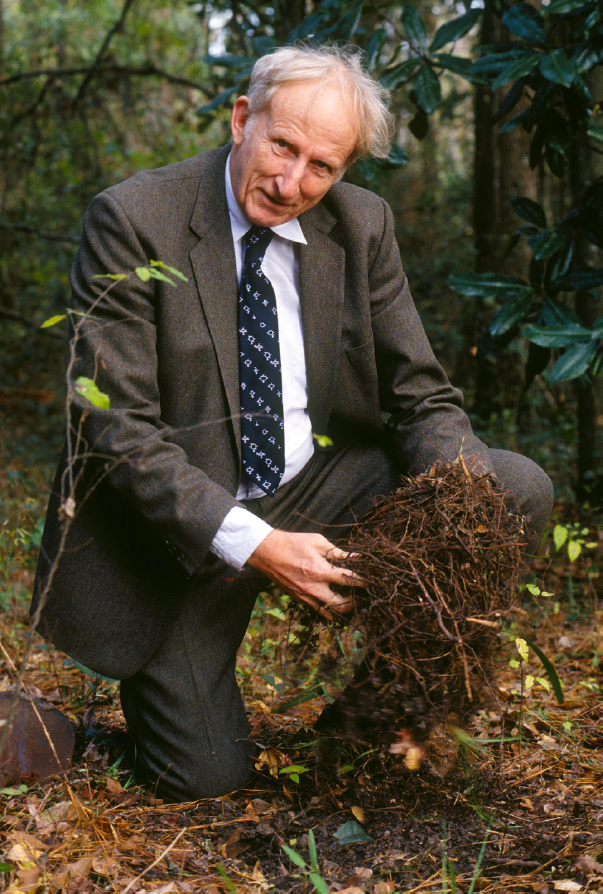
Today’s guest post by Preston Howard discusses an issue central to our overshoot predicament that is often ignored: The Maximum Power Principle (MPP). The MPP states that life optimizes for maximize power, not maximum efficiency, and implies that life does not look forward in time to consider the consequences of maximizing power today.
While preparing an initial report for Florida’s first Area of Critical State Concern1 in 1972, I had the immense good fortune to spend time with Howard T. Odum, an environmental engineering scientist who directed the Wetlands Center at the University of Florida. The area of state concern was the Big Cypress Preserve adjacent to the Florida Everglades. Dr Odum and several of his graduate students had ongoing studies in the area. In informal conversations, Dr Odum explained the Maximum Power Principle as described below. I believe it presents Humanity’s current situation better than anything I have seen about global warming, overshoot, or climate collapse. However, to my knowledge no one has mentioned it in any serious article except Gail Tverberg in her articles about resource consumption.
To understand the Maximum Power Principle2, let us imagine a square island, barren of any vegetation. As happened many times in Florida, suppose our island was created by fill where a shipping channel had been deepened. Situated close to the seaport, someone intended to build something on the new island, but permitting requirements and other administrative delays where taking “forever.” (These details provide a “context” for the discussion.)
The barren island does not remain barren for long, as plants soon begin to grow on it. The solar energy that bathes the island provides abundant energy for the early pioneer plants. Seeds blow in on the wind. Some may wash ashore. Birds drop some. Those initial plants found a world filled with more (solar) energy than they could use. In this bounty they made their best efforts to use as much as they could and to grow as fast as possible, even at the expense of wasting energy by not using it efficiently.
Point 1: The Maximum Power Principle states when energy is abundant, those organisms survive best that maximize their use of energy, even if they are wasteful in how they use it (because the supply of available energy is “infinite” in a relative sense).
Weeds grow quickly, and they soon cover most of our imaginary island. The fact that weeds are wasteful in how they use available energy does not matter, because there is plenty of solar energy for all the plants.
Slower growing, but more efficient, plants also germinate, but they compete poorly because higher foliage from the faster growing weeds blocks energy-rich sunlight from the young trees and shrubs. Perhaps by chance some of these seeds fall on a higher elevation where weeds cannot easily block them from the sun. Or, perhaps they are near the shoreline, where the water provides weed-free access to adequate solar energy along the water’s edge. If these more efficient shrubs and tree seedlings find niches to assist their growth, they can survive even though they cannot compete well against the weeds directly.
In time, vegetation covers our imaginary island. Now the situation changes dramatically concerning the Maximum Power Principle.
Point 2: When the energy supply is limited, those organisms compete best that maximize the efficient use of the energy available to them.
Now every plant on our island has neighbors nearby, pushing leafy branches where a plant wants its own leaves to collect sunlight. Plants no longer have access to unlimited energy where growth is maximized even if excess energy is wasted. Soon there is no energy to waste. Plants find it difficult to obtain all the energy they desire, and the increasing competition with other plants for available energy adversely affects their growth.
In this new environment the struggling tree seedlings and shrubs have an advantage because they use available energy more efficiently than the weeds. Over time these changes allow shrubs to win out against the inefficient weeds, just as the trees will — in time — overpower the shrubs.
Examples of the Maximum Power Principle
As a general rule, all biological life embraces the Maximum Power Principle. If a life form confronts an energy source it can use, it succeeds best if it uses it as the Maximum Power Principle indicates. To understand the Maximum Power Principle as it impacts the real world, let’s look at a few examples.
Example 1: Paramecium in petri dish3. Paramecium are single-cell organisms that live in water and consume a variety of foods, including yeast. Here, we examine where we put several paramecium in a petri dish with an abundance of yeast. The buffet has been served, and the paramecium begin to consume the yeast. The paramecium flourish, reproducing more and more paramecium as the yeast is slowly consumed. Until… until there is no more yeast to consume, at which time the (now many) paramecium all die of starvation. Unfortunately, there is no natural system to suggest to the paramecium problems they may encounter if they eat all the yeast as fast as they can.
Sometimes events occur that regulate unrestrained growth that otherwise harms an organism in the long run. For example, if yeast gets down to 10% of the initial amount, suppose a lab assistant regularly restores it to 25% of the initial amount. In this situation the paramecium population fluctuates with the availability of yeast.
Example 2: Deer on the Kaibab Plateau4. The Kaibab Plateau is a relatively inaccessible area on the north side of the Grand Canyon comprised of approximately 700,000 acres. In 1907 there were an estimated 4,000 deer resident on the plateau, in addition to pumas and wolves, which were predators of the deer. The predators and the prey maintained a relative balance with one another. Between 1907 and 1923 a successful effort removed most of the predators, allowing the deer population to increase. By 1925 the deer population grew to more than 100,000, which was far in excess of the carrying capacity of the vegetation available on the plateau. All vegetation was consumed. Over 40% of the herd died in two successive winters, and the deer population plummeted to around 10,000. There it stabilized because of the significantly compromised vegetation available for food. (Earlier estimates suggested the Plateau could originally support 30,000 deer).
Example 3: Deer on St Matthew Island5. St Matthew Island is a remote island in the Bering Sea, north of the Aleutian Island chain in Alaska. During World War 2, the United States needed to know whether or not Japan attacked the island. The US Coast Guard established a radio navigational system on the island. It was understood that the 19-member team on St Matthew could never defend the island, but before capture the team could alert HQ by radio in the event it was invaded by Japanese soldiers. Because the island is so remote, the military was unsure whether it could provide regular supplies. As a backup food source, the US relocated 29 reindeer to the island so the radio team would not starve. For the deer, the buffet had just been served! St Matthew is 32 miles long and 4 miles wide, and it was covered with lichen, a favorite food of reindeer.
When World War 2 ended, the radio team left the island, but the reindeer remained. In 1957 Dr David Klein, (then) a professor at the University of Alaska Fairbanks, visited the island with a graduate student. They determined that the 29 original reindeer had grown to a population of 1,300. When Dr Klein returned a second time, in 1963, the reindeer population had grown to 6,000, or almost 50 reindeer per square mile. Just like the paramecium, this did not look good for the reindeer. Due to overconsumption, lichen was increasingly scarce. The winter of 1963-64 was one of the worst on record for that part of Alaska. In 1966 Dr Klein returned to St Matthew Island to find just 42 reindeer, including only one male. It had deformed antlers and probably could not reproduce. All the St Matthew Island deer perished during the next decade.
The Maximum Power Principle lesson: If resources allow, the organism should use the resources to grow as the tried-and-true way to survive best over the long run. Ecologically, there were no checks and balances to suggest that 600 reindeer could live on St Matthew Island, but 6,000 could not. This is important.
How Humanity Embraced the Maximum Power Principle
No animate life form is exempt from the Maximum Power Principle, not even Humans. Starting in the 1700s, Humans began using coal to power an increasingly industrialized Western society, starting primarily in Great Britain. Around 1850 oil was discovered in open ponds in Pennsylvania. Humanity soon found oil worked as well, and perhaps better, than coal. For the next 175 years Humanity (at least parts of it) had access to these energy-rich resources. And, just as the Maximum Power Principle dictates, Humanity used as much of these resources as it could get. Simply put, in 300 years Humanity harnessed the power of lightning and taught sand (silicon) to think6. Humanity electronically connected most of its 8 billion inhabitants and extended its presence into outer space. Humanity has no predator to threaten its dominance in any corner of the globe.
One might think Humanity’s success is guaranteed, except for a few things: First, the increasing scarcity of oil and coal and natural gas suddenly threatens to remove the punch-bowl from which Humanity has been feeding. Second, the carrying capacity of the Earth is far less than 8 billion humans unless we continue to supplement with increasingly scarce resources. And, last, our centuries-long party has now broken the Earth in ways Humanity cannot repair.
All the King’s horses and all the Queen’s men, will never restore this spherical jewel, regardless of what we do. We have transitioned from a “grow as much as you can quickly” environment to a “use remaining energy resources as efficiently as possible” environment, but we refuse to notice. As increasing numbers suffer because we do not adapt, those with power and authority choose to continue as before because it enriches them. Except in small, cosmetic steps, we do not even try to save one another. Instead countries say to one another, “you go first,” and “no, you go first.” But, that’s how money talks in the United States, where corporations are declared to be people under law. The job of corporate citizens is to enrich their shareholders, not to act in concert with environmental constraints.
Humanity’s Future Foretold
Nonetheless, one can take heart. Humanity is right where it is supposed to be. We will continue to use energy that remains available to us to build electric cars and windmills and nuclear weapons as we now increasingly compete against one another. And, just like the deer and the paramecium, we are certain to collapse as critical resources dwindle. The Maximum Power Principle is deeply embedded in all life, and — like it or not — we are no exception.
We are foolish if we think we can escape7 the Maximum Power Principle. As fast as scientists tell us of the need to address looming dangers (starting with global population concerns in the 1960s), and as fast as people far and wide demand global change, and as carefully as the United Nations forces all countries to accept the need for step-by-step remediation, it will never happen. We will continue to burn more coal when oil is scarce. And we will continue to drill for increasingly hard-to-extract oil until our electronic interconnected house of cards crumbles around us. This behavior is hard-wired at the cellular level, allowing us little choice concerning whether or not to embrace the Maximum Power Principle.
One might ask when this catastrophe will occur. Don’t look now, but it is occurring before your very eyes. Regardless of whatever we do at this point, we have broken the World, and we cannot fix it. Our actions cause extinction of hundreds of living organisms8 every month. Human activity warmed the globe to the point that arable land is less available, decreasing the global food supply. Actions with unintended effects melt polar and glacial ice, and yet have not kept seawater temperatures from increasing. We now discover fish cannot live in the warmer ocean water. Rising ocean water and weather extremes adversely impact Human settlement across every corner of the globe. Unfortunately the Maximum Power Principle does not allow do-overs.
The Earth suffers from a runaway infestation of Humanity. Just like the paramecium, as necessary resources increasingly become unavailable Homo sapiens will join the long list of extinct flora and fauna previously unable to survive a changing world. But the Earth will not die. After Humanity’s demise, the Earth will heal itself. This could happen quickly. Perhaps in less than an eon (2250 years), a “blink of the eye” in planetary time. It would be nice to think Humanity might recognize its bleak future, and would attempt to facilitate the successful transition of whatever life manifests itself after Humanity’s exit. That, however, is not likely because of the Maximum Power Principle.
If I knew today was Humanity’s final day to exist, I would most want to plant a tree.9
Addendum
I would be remiss not to call attention to the single situation I know where Humanity acted contrary to the Maximum Power Principle and instead chose to minimize present energy use in return for greater resource bounty in the future. American “First Peoples” — at least some of them — chose to plant corn from larger husks while instead eating only corn from the smaller husks. Over time, this gave them a larger harvest.
While this may seem “obvious” to someone today, it embraces action directly contrary to that expected by the Maximum Power Principle. Somewhere in their historic past someone in those tribes stood before others and suggested they eat less now in return for the promise of more food in the future. I expect whoever it was, she probably convinced the other women (who tended the plants) and never mentioned it to the men who were perhaps out hunting.
Sources and Notes
1Howard, P. (1974) “The use of vegetation in the design of regulations pertaining to coastal development of the Big Cypress critical area.” Proceedings of the First Annual Conference on Restoration of Coastal Vegetation in Florida (Tampa, Florida: p. 16).
2Odum, H. T. and Odum, E. C., (1976) Energy Basis for Man and Nature. New York: McGraw-Hill Book Company (pp. 39-40). [Co-author E. C. Odum was Howard Odum’s wife and research partner. Not to be confused with Eugene Odum, below.]
also
2Lotka, A. J. (1956) Elements of mathematical biology. New York: Dover Publications, Inc. (p. 357). [Here described as the Law of Evolution.]
3Lotka, A. J. (1956) again. [Here described using bacteria, while noting, “… a man, for example, may be regarded as a population of cells.” (Lotka’s emphasis.)]
4Odum, E. P. (1959) Fundamentals of Ecology. Philadelphia: W. B. Saunders Company (pp. 239-240). [This was the first college-level textbook to include the word “Ecology” in its title. Eugene Odum wrote this book “with” Howard Odum, who provided an energy basis for nature.]
5Klein, D. R. (1968) “The introduction, increase, and crash of reindeer on St. Matthew Island. J. Wildlife Management 32: 350-367. Source: https://www.geo.arizona.edu/Antevs/nats104/00lect21reindeer.html on 28-Jul-2023. [Retrieved on 28-Jul-2023.]
6Lesser, H. G. (1984) “Microprocessor pioneer and industry mover.” Computer Accessories and Peripherals, 1:5 (p. 69+) [Quoting Harold Lee: “One good way to look at our (computer) industry is that, literally, within the last three hundred years, we’ve harnessed lightning and used it to teach sand how to think.”]
7Schalatek, L. (2021) “Broken Promises – Developed countries fail to keep their 100 billion dollar climate pledge.” Source: https://us.boell.org/en/2021/10/25/broken-promises-developed-countries-fail-keep-their-100-billion-dollar-climate-pledge. [Retrieved on 7-Aug-2023, as just one example of many available.]
8Pope, K. (2020) “Plant and animal species at risk of extinction.” Source: https://yaleclimateconnections.org/2020/03/plant-and-animal-species-at-risk-of-extinction/ [Retrieved on: 8-Aug-2023, although many references address this issue.]
9Merwin, W. S. (quote) “On the last day of the world I would want to plant a tree.” [Apologies to Merwin (1927-2019), a Pulitzer Prize winner and United States poet laureate, for my alteration.]
About the Author
Preston Howard has a Masters degree is in geography and retired in 2011 after a wide-ranging career in data management. In 1972 he developed a simulation of seaport growth, the first of his many national and international publications and presentations. Today he lives in a log cabin in one of the more successful intentional communities in the United States.
Rob here again.
I do not know what Preston thinks of Dr. Ajit Varki’s Mind Over Reality Transition (MORT) theory however I believe that the MPP and MORT theories are both true and together are the primary cause of human overshoot.
The MPP governs biology just as the laws of thermodynamics govern the universe. Nothing in the universe may violate the laws of thermodynamics and no life may violate the MPP. How could it be otherwise given that life at its core is chemical replicators evolving to compete for finite energy and resources?
Assuming that the MPP governs all life and cannot be overridden, how is it possible for an intelligence to exist in the universe that is smart enough to understand that behaving in accordance with the MPP will destroy itself and all that it cares about?
A solution that evolution discovered on this planet, and perhaps the only solution possible on any planet, is to prevent high intelligence from emerging unless it simultaneously evolves a tendency to deny unpleasant realities, like for example, the fact that it is in overshoot. Otherwise the intelligence might override the MPP to reduce suffering and possible extinction, and the replicators that created the intelligence won’t permit that.
Apparently it’s quite improbable and/or difficult to simultaneously evolve high intelligence with denial because it has occurred only once on this planet, despite the obvious fitness advantages of high intelligence.
The MPP and MORT together explain why we seem to have no free will to do anything wise about overshoot. They also explain why an honest assessment of our responses to overshoot symptoms would conclude we are doing the opposite of what a wise intelligent species with free will should do.
Despite this bleak assessment I’ll continue to push awareness of MORT and population reduction, just in case I’m wrong and there is a way to override denial and MPP, because our existence on this planet is so rare and precious, and because there is much suffering coming soon that could be reduced.
It’s possible that Preston disagrees with my opinions on MORT. That’s OK because even if I’m wrong, Preston’s points about the MPP are still probably correct.
 un-Denial
A purge apparently underway in China.
It’s very dangerous to be in charge of “recovering” from an extreme debt bubble when growth stops.
LikeLiked by 1 person
This is a hilarious Halloween treat!
A Vulcan alien (aka Jay Couey) from the future tries to warn us that our leaders are lying to us and we are at risk of having our DNA modified without our consent in a plan to weaken and enslave the human race.
Unfortunately he was unable to transmit to a date earlier than 2023 and so he was only able to inform us of what’s already happened.
LikeLiked by 1 person
A few nights ago I watched the new South Park episode Joining the Panderverse.
They rip woke culture with a special focus on Disney.
Another theme less discussed in the reviews that resonated with me is how the educated class today “doesn’t know how to do shit”. Valuable careers in the future will be the trades.
Recommended and available for download at the usual places.
LikeLiked by 1 person
LikeLiked by 1 person
Nothing to do with denial or overshoot but very interesting if you’re an active all-weather outdoor person.
In summary, Gore-Tex is a waste of money.
LikeLiked by 2 people
You do find some gems Rob.
LikeLiked by 1 person
Oh naur! My partner loves is gore-tex
LikeLike
Any idea what the best wet weather material is? I’ve had an oil skin for over 20 years but the zip has gone now and it leaks.
LikeLike
I’m not an expert here.
My interpretation of what Ryan said in the video was that there’s nothing wrong with Gore-Tex, provided you understand its limitations and do not buy the hype about ventilation WITH waterproofness, however there are many competing brands that are just as good for much less money and in a few cases are actually better than Gore-Tex.
I personally still pack a light weight Gore-Tex jacket when hiking but make no attempt to keep my legs dry and instead wear quick drying fabrics. I have an oil skin hat that I really like for hiking. I got my Gore-Tex jacket at a blow out price from a store that went bankrupt so I don’t feel like I wasted any money.
LikeLiked by 1 person
Scott Ritter is scared to death. Good chance middle east goes nuclear soon. Only way to avoid it is for Biden to force Israel to stand down. If middle east goes nuclear oil flow stops and most economies collapse.
Skip ahead to 55:15.
LikeLike
I listen to podcasts like Scott Ritter’s, Judge Napolitano, Larry Johnson, Colonel MacGregor, and more everyday. Depression isn’t where I’m at, I’m way beyond being depressed. I’m anxious for where we will be in a few days. This Friday could be a big day, depends on what Hezbollah decides to do. We are led by fools to the end of civilization. So sad.
AJ
LikeLiked by 1 person
I listen to the same people every day. I’m feeling numb.
Given our leaders were too stupid to do the right thing with something as simple as Vitamin D (low cost, zero risk, effective) I expect they will screw up avoiding nuclear war.
LikeLiked by 1 person
I’m transiting through Doha next month, hopefully the war can hold off for another month so so. That would be great thanks
LikeLike
I had to Google Doha to find out where it is. Good luck!
LikeLiked by 1 person
Are we entering an ice age termination event?
LikeLike
This video concludes that methane increases may be a big problem but we don’t know for sure.
Today’s essay by Eliot Jacobson says methane is a big problem that will take out civilization and it’s too late to do anything about it.
https://climatecasino.net/2023/11/wtf-happened-to-the-methane-monster/
LikeLike
The Green transition will not go as planned.
If you want go strait into the lecture jump to 6:30 in the video.
LikeLiked by 1 person
Latest Great Simplification podcast, Nate Hagens and David Holmgren discuss the influence Howard T. Odum has had on their thinking.
https://www.thegreatsimplification.com/episode/96-david-holmgren
LikeLike
I quit about half way through because I was not enjoying it nor learning enough. Did you stick it out to the end? Do you recommend I finish it?
LikeLiked by 1 person
Not yet, going to listen on my drive home from work
LikeLike