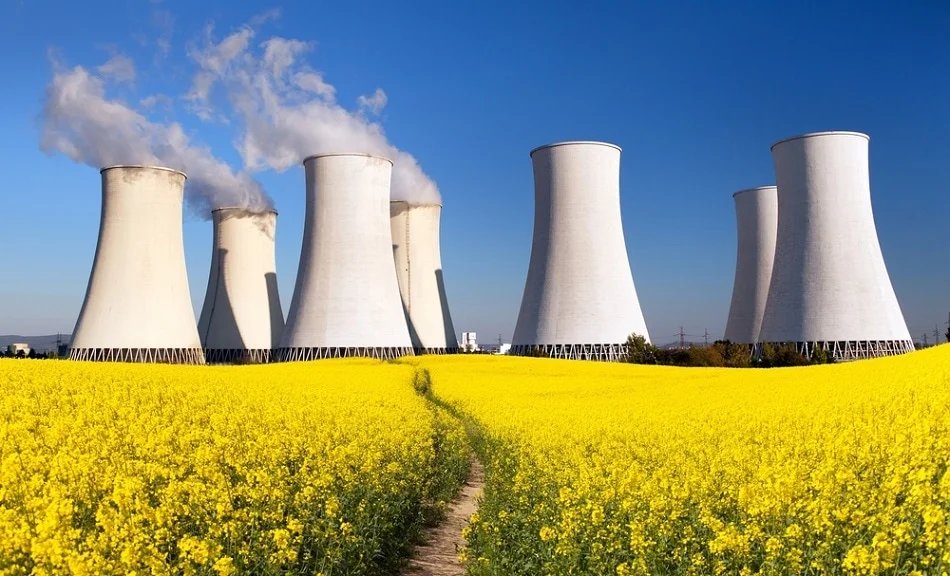
Today’s post is by frequent un-Denial visitor and friend Monk who does a wonderful job of explaining why nuclear energy is not a useful response to overshoot.
With increasing energy prices and sanctions on Russia, people are once again considering how we can power the global industrial machine with significantly less oil and gas. Alongside this, environmentalists are getting more savvy in spotting the critical problems with the likes of wind and solar and other green hopium nonsense (green hydrogen anyone?). But for some reason, many people struggle to make the final step and admit that nuclear is not going to save us from peak oil and / or climate change.
In this article, I would like to briefly layout what I see as the high-level problems with nuclear. This is just a summary of my own personal reasons for why I’m not convinced. It is by no means a thorough technical analysis!
What I’d like us to consider is this: is it DENIAL stopping our smart and critical thinkers from admitting the problems with nuclear? People who do become aware of the problems with our system tend to jump to nuclear as a last bastion of hope. Modern commentators like to tell themselves nice stories about nuclear. This prevents them from having to seriously consider energy collapse. How often have you heard these affirmations?
- Nuclear energy is cheap
- Nuclear energy is safe
- Nuclear energy is clean and green
- Nuclear energy is a low carbon energy source
- Nuclear energy can meet our energy needs when fossil fuels run out (peak oil)
- New innovations will make nuclear energy better, such as micro plants, newer generations, sustained fusion etc.
We shouldn’t just believe in nuclear like it’s a fairy godmother who is going to save us from our poor energy planning. We should thoroughly interrogate claims about nuclear through the lenses of environment, energy, economy, and safety.
Nuclear energy may have a negative energy return
If we accept money (currency) as a proxy for energy units, then it is pretty clear that nuclear plants are incredibly energy expensive to plan, build, maintain, and decommission. Nuclear plants are some of the most expensive projects undertaken. The capital costs are horrendous. What that should tell you is it takes a shed load of energy just to build a nuclear power plant.
To see if this upfront energy spend is worth it, we need to see how much energy we get back. Utility providers will look at costs as a ‘cost per electricity unit’. If you compare nuclear to other electricity sources, you are spending a lot more to get nuclear. Here is an example of that type of comparison looking at just the capital cost per kilowatt:
| Type | Capital cost per kilowatt (kW) |
| Nuclear | $7,675 to $12,500 |
| Coal plant | $3,000 to $8,400 |
| Gas combined | $700 to $1,300 |
Source (well worth a read): https://world-nuclear.org/information-library/economic-aspects/economics-of-nuclear-power.aspx
By the time we factor in all the other costs associated with nuclear – that other electricity generation doesn’t have – I’m not convinced nuclear is generating a net return at all. If that’s true (I’m happy to be wrong), you might ask why countries continue to build them? A few possibilities include:
- Accepting burning existing fossil fuels now to get longer lasting consistent electricity in the future.
- To support ongoing research.
- To support the military.
I often hear pro-nuclear people talk about how much energy we can get from such a small volume of uranium. I think that is disingenuous considering all the energy we have to burn in setting up a plant before we even get a single unit of energy from uranium.
Please note that net energy studies are notoriously difficult, because it’s up to the researcher how much of the supply chain and lifecycle they factor in. That’s why I find looking at currency a useful way to approximate EROEI (energy returned on energy invested). Of course, the nuclear industry will say they generate a very positive EROEI. Here’s a good example with references: https://world-nuclear.org/information-library/energy-and-the-environment/energy-return-on-investment.aspx. However, academic “meta-analysis of EROI values for nuclear energy suggests a mean EROI of about 14:1 (n of 33 from 15 publications)” (Hall et al., 2014) NB this was looking at traditional nuclear only.
Nuclear produces electricity, not liquid energy, not coal, and not gas
Our predicament is not one of electricity, but of diesel, natural gas, and coal. These are critical energy and resource sources that cannot be replaced by electricity (or at least not with a positive energy return). A couple of simple examples:
- We can’t make silicon wafers or industrial steel without coal.
- We can’t move stuff around or dig it out of the ground without diesel.
- We also have the issue that the world vehicle fleet is already built and requires petrol or diesel for the most part. There are no longer enough minerals left to build an entirely new electric vehicle fleet – a fact that surprising few anti-car new urbanist types are unaware of.
- Natural gas provides us with nitrogen fertilizer (essential for feeding billions of people in the modern agricultural system) and plastics with many uses.
Another challenge is that if nuclear was to replace all energy from fossil fuels, we would need a better way to store excess energy. Although nothing like the intermittency problems of wind and solar, nuclear has a related type of problem in that it likes to always be running and producing a steady-ish amount of electricity. Currently this doesn’t matter where nuclear is part of the total energy mix, but if it were the bulk of the energy mix, storage would become a major consideration. There are a whole lot of issues with electricity storage that have been well-explained in the issues with wind and solar, namely finite amount of materials to build batteries, expense, and battery storage capacity.
One potential upside of nuclear energy could be to replace natural gas as the main electricity generator that balances out wind and solar intermittency. But due to the costs of nuclear compared to gas this hasn’t been done. Moreover, gas generation is preferred because it is easier to switch off and on.
Nuclear is entirely dependent on fossil fuels
A nuclear power plant could not even be built without fossil fuels:
- Coal to make the steel
- Diesel to mine the uranium
- Diesel to mine the sand for concrete
- Diesel to mine the copper to make the electric components
- Gas to make the plastics for componentry and systems
- Gas to make the food to feed the workers
- I could go on and make this a very long list, but hopefully you get the point.
Because building a nuclear power plant is impossible without fossil fuels, that also means we will not build new nuclear power plants after the end of oil. Just like wind turbines and solar panels cannot make more of themselves, neither can a nuclear reactor.
Nuclear is not zero emissions
Obviously to build a nuclear power plant you are going to need a lot of diesel-powered plant and equipment. There is also concrete to factor in, which is a massive emissions source, accounting for approximately 8% of total global emissions.
With all those fossil fuels going into making a nuclear power plant, it should be obvious that nuclear is not and will never be net “zero emissions”. The focus on operating or tailpipe emissions is pointless when you’re still making an overall net positive addition to emissions. And arguably the world already has more than enough electricity, so building nuclear is possibly a complete waste of emissions.
Inputs to nuclear power plants are also reaching peak
As the capital costs suggest, nuclear energy plants are massive construction projects. They require vast raw materials – all of which have their own supply limitations. It is not just oil that is reaching peak, but many other raw inputs from copper to even boring old sand. Yes, peak sand is a thing. If you look at a picture of a nuclear plant, you’ll see a lot of concrete. That is sand! Concrete also requires other raw materials including calcium, silicon, iron, and aluminium. Is there even enough sand left in the world to build enough nuclear power plants to meet our energy needs? And the concrete needs will still be there for a hypothetical fusion plant, or any such other “innovative” nuclear power generation.
The story is the same for any other rare (or getting rare) earth element. There’s approximately 17 years left of zinc, 21 for silver, 35 for nickel and 64 for cobalt. Even if these numbers are wrong, it still shows that physical limits are approaching. This provides a real limit to the number of nuclear plants that it is even feasible to build. Moreover, if our system is going to rely on more electrified plant and equipment, these minerals will run out much sooner.
Uranium is finite
It’s kind of ironic that some people see nuclear as a solution to peak oil when the actual feed for nuclear is also reaching peak. How much proven uranium reserves are out there is hotly debated. Really, I don’t care because if there’s 10 years left or 100 years, it’s the same result – our industrial system runs out of power. Apparently, proven uranium reserves would last 90 years at the current rate of use (Murphy., 2021 he has lots of references).
What we can know for certain is that uranium will peak at some point and then reach a diminishing point of return where it is no longer economically viable to get it out of the ground. Bear in mind, most (some?) of the value in mining it is for weapons – with electricity just being the side gig!
Uranium is often in hard-to-get areas (including Russia, now embargoed). We can’t mine the uranium out of the ground once we run out of diesel, which would put the end of uranium to 40 years, not 90. The only hopium here is to hope they’ll invent some amazing electricity-powered mining plant and equipment, but then we are back to the peak mineral problem. For now, we are stuck with diesel and the associated carbon emissions.
Environmental considerations
Making nuclear power plants degrades the environment. This includes:
- Mining all the materials required.
- Burning all the diesel, gas, and coal in the manufacturing and construction phases.
- Building all the roads and parking required for the plant.
- And polluting the environment for hundreds of thousands of years with radioactive material that causes birth defects, genetic degradation, cancer, and death.
Michael Dowd regularly asks us to contend with the question of radioactive waste. What right do we present day humans have to pollute the world for thousands of years, just so we can run another dishwasher? It is highly likely that some, if not most, nuclear reactors will meltdown, because they will not have been safely decommissioned due to peak oil production. What an inheritance for our descendants, if we have any left!
What do we do with the waste?
Nuclear waste is incredibly dangerous to human health and the environment. Waste can also be utilised by terrorists (or bad state actors) to create a dirty bomb. So based on these problems, we need to be very careful where and how we store the waste. Not surprisingly, this is another thing humans seem determined to f-up. For starters, a lot is stored at or near sea level – great for getting water to keep it cool – not so great when you get a sea-based disaster. Sea water corrodes infrastructure at a faster rate, increasing the likelihood of failure of the waste containment. Plus, what happens with rising sea levels from climate change?
When digging more into this topic, you’ll see humans are running out of places to put this waste and the costs of waste-storage projects are increasing. This makes it less likely that a company will be 100% focussed on quality for a capex project that generates no returns.
Alice Friedemann has argued that burying nuclear waste should be a top priority, as after peak oil production, oil will be rationed to agriculture and other essential services. Spent fuel from nuclear lasts a very long time. According to Archer (2008): “… there are components of nuclear material that have a long lifetime, such as the isotopes plutonium 239 (24,000 year half-life), thorium 230 (80,000 years), and iodine 129 (15.7 million years). Ideally, these substances must be stored and isolated from reaching ground water until they decay, but the lifetimes are so immense that it is hard to believe or to prove that this can be done”.
Once the containment for nuclear waste starts to degrade, the waste can leak into ground water, contaminating drinking water and getting into the food system. Where waste gets into the ocean, the currents can travel it all over the globe. This is happening in our lifetime, forget about a thousand years from now.
Are nuclear plants really safe?
Taken at face value statistically, nuclear plants are very safe. But I think this is a sneaky statistic because this is old data from when nuclear plants were young and well-resourced. We really don’t know how the safety stats will hold up as the plants age out. Once they are over 40 years old, the risk of disaster is much higher. This risk is heightened by very old systems and componentry and the specialised nuclear workforce retiring and not being replaced.
Many nuclear plants are built close to the sea, exposing them to natural risks including sea level rise, tsunamis, typhons / hurricanes, and erosion. Near misses are surprisingly common, often a result of human error and the just mentioned old systems. There is evidence that significant near misses are underreported officially, leading to misconceptions about the safety risks posed.
There have been two major nuclear power plant disasters that I’m sure you are familiar with. The first is the 1986 meltdown at Chernobyl where a design flaw, triggered ironically by a safety test, led to a reactor meltdown. The second was the 2011 Fukushima disaster, where an earthquake-triggered tsunami damaged the emergency diesel generators, leading to a loss of electric power. By the way, look there’s another essential use of fossil fuels in operating nuclear plants!
Here are two minor anecdotes to show you the environmental outcomes. Following the Chernobyl disaster, a farm in Scotland had all their new-born lambs born without eyes and they had to be culled. As a result of Fukushima, across the Pacific, there is plenty of scientific evidence of radioactive contamination in fish and shellfish – tasty!
When we look at total confirmed human deaths from these nuclear incidents, we are looking at around 100 people. Total deaths from COVID-19 thus far is around 6.6 million. So how can we say nuclear is unsafe? Well, what the official incident deaths don’t tell us is how many people are dying from cancers years after a nuclear incident. Moreover, there’s little incentive for a government to try and track each death that could be attributable to a nuclear disaster – that will only make them look bad. Considering nuclear waste is toxic for 100,000s of years, we can’t even account for the untold future suffering of humans and non-humans.
Maybe the initial risks of nuclear have been overstated, but what would happen if most or all of them failed? For example, a risk that you barely ever hear mentioned is if multiple reactors were hit by an EMP or solar flare? If the grid is wrecked, so are the nuclear reactors. Maybe that might never happen, but it does seem likely that most plants won’t be properly decommissioned (due to peak oil), which will see most of them melting down over this century.
Terrorism
Nuclear plants are a target for terrorism and potentially could be used to inflict massive damage to people and the environment. From Alice Friedemann: Plutonium waste needs to be kept away from future terrorists and dictators for the next 30,000 years. But world-wide there’s 490 metric tons of separated plutonium at military and civilian sites, enough to make more than 60,000 nuclear weapons. Plutonium and highly enriched uranium are located at over 100 civilian reactor plants. In addition, there’s 1,400 tons of highly enriched uranium world-wide. A crude nuclear bomb can be made from as little as 40 to 60 kilograms of U-235, or roughly 28,000 nuclear bombs.
Decommissioning is fraught with challenges
Decommissioning is essential as once plants age out, they become too radioactive and are likely to decay. You would then get a full or partial meltdown. Like everything else to do with nuclear, decommissioning too is a very expensive and lengthy process, often exceeding budgets. Decommissioning also requires experienced nuclear engineers who are retiring. Younger engineers no longer see nuclear as a viable career path, so the next generation of skilled nuclear workers is not there. As the nuclear plants reach the end of their design life, it will get harder and more expensive to safely decommission them. And when has a large corporate ever been good at cleaning up after itself?! Moreover, us poor taxpayers will be increasingly impoverished by peak oil economic destruction, leaving governments with less funds to pick up after the energy companies.
We might ask, where is the proof that decommissioning is happening currently and where are the government budgets put aside for decommissioning? Countries like France and the USA are also delaying decommissioning plants at the moment, possibly worried about electricity shortages and unwilling to take another source offline.
As citizens, why should we support the building of new nuclear plants when there’s barely any proof that the current ones are being safely dealt with at their end of their life?
Financial problems
Investors are not keen on nuclear power projects. They have a habit of blowing out budgets and timelines and failing to return investment (a big clue that they are negative EROEI). There’s also a bit of a wait of 7 to 10+ years for project completion before you can even hope to start seeing a financial return. Remember the cost of construction is only ever going to get more expensive now due to peak oil. Oh, and there are uninsurable liabilities!
Governments often need to invest in electricity infrastructure, and especially for nuclear, to make up this shortfall in private investment. Citizens quite rightly should demand proof that nuclear plants are worth spending energy on. They should demand Governments provide detailed risk management against all the criteria we’ve just discussed. Because nuclear is not popular with the average citizen, democratic governments are increasingly unwilling to invest in nuclear. Moreover, governments are encouraged by their populations to keep electricity prices affordable. Wind and solar are much more popular and tend to get more of the subsidies. They have also damaged the profitability of nuclear with wind and solar going first to sell to market (government policy in parts of Europe).
Replacing fossil fuels with nuclear energy is a pipe dream
In a 2019 Forbes article, Roger Pielke ran a thought experiment on how many nuclear plants the world would need to get to the 2050 net zero goal. “To achieve net-zero carbon dioxide emissions by 2050, the world would need to deploy 3 [brand new] nuclear plants worth of carbon-free energy every two days, starting tomorrow and continuing to 2050. At the same time, a nuclear plant’s worth of fossil fuels would need to be decommissioned every day, starting tomorrow and continuing to 2050.”
We can already see that this just isn’t happening, and for the reasons laid out in this article it’s clear this can never happen. It looks like 2022 saw just 53 nuclear reactors under construction world-wide – that’s not finished by the way, just in some stage of construction.
But what about innovation
Honestly each ‘innovation’ to nuclear reactors could be an article all on its own. I have to confess I have a lazy heuristic: I just write off all of these as nonsense and don’t really give them fair consideration. But if I had to provide a high-level critic, this would be it. I have just noted the additional problems with these “innovations” – they still have all the same problems described elsewhere:
- Fusion – The gold standard of hopium. As the idiom goes, sustained fusion is just 20 years in the future and always will be.
- Breeder reactors – Recycling costs more energy than you get back. Also, more expensive than regular reactors, which are already too expensive.
- New generation – Less safe and more toxic (go ask Alice).
- Thorium – Perhaps it could have worked but looks like it’s too expensive now. That’s a good hint it would be negative EROEI. Might not be viable in reality.
- And this goes for lots of things: just because something is feasible in a lab situation or theoretically possible, does not mean it will ever be a viable solution. You can do a lot if you have oodles of energy and billions of dollars to waste. We might ask, is indulging the fantasies of scientists really a good use of our last remaining surplus resources?
Well, that’s bleak, what does the future of electricity look like
Humans already have access to more electricity than we ever imagined 100 years ago. If we had a stable or reducing population (shout out to Rob), then we wouldn’t even need to worry about bringing on new electricity generation.
Categorically all forms of electricity generation have their negative drawbacks. Eventually, all the hydroelectric dams will silt up – this can take hundreds of years – and finally they will all fail. Wind turbines last for 30 years, though in reality production efficiency reduces much earlier. Coastal wind turbines will decay after 10 years due to erosion from salt water. Solar panels will last 30+ years, but the associated systems and batteries to collect and store the electricity fail much sooner and need replacement parts. Nuclear plants last for a design life of 40+ years minimum and then should be decommissioned over the following 20 years. With natural gas shortages due to the Russian Invasion, countries are delaying decommissioning their plants. Most western nuclear is aged out.
Humans could continue to produce electricity by burning coal and natural gas. There are approximately 400 years left of coal and 150 years left of natural gas. But (and it’s a big but), there is only 40 years left of oil (BP Statistical Review). Without oil we don’t have diesel powered equipment, which will make it all but impossible to extract coal and natural gas. Without coal, we can’t make industrial wind turbines, solar panels, or nuclear reactors.
What this means is that by the year 2060, we are looking at a world with much less electricity production and eventually moving to almost zero electricity as the hydro dams fail in the coming centuries – and no we can’t build new ones of scale without diesel. Perhaps some smart individuals can maintain rudimentary electricity where they live, but the days of large electric grids are numbered.
By the way, if you do want to dive into the technical details, I can point you in the direction of plenty of useful references. Just let me know 😊
 un-Denial
https://www.youtube.com/watch?v=6dgE7Lp5j_w&ab_channel=ARTE.tvDocumentary
LikeLike
Seems like Chapter 1 of The Rise and Fall of the Third Reich.
https://en.wikipedia.org/wiki/The_Rise_and_Fall_of_the_Third_Reich
I’ve been wondering why German leadership rolled over on the Nord Stream sabotage. Is it possible that having surrendered to the US in WWII and then being rebuilt by the Marshall Plan there is an agreement that requires Germany to bend to Washington’s will?
LikeLiked by 1 person
A lot of these people’s experiences remind me of the USA in the GFC of 2008/9. People suddenly found themselves in desperate situations.
The refugee demand is not helping.
Also the German govt is paying for the utility bills of people on unemployment. That means low wage workers may be better off on benefits, rather than working. Which makes the overall situation worse.
In some way it is like Germany has been occupied since the end of the war. But as long as they were rich or getting rich, maybe it didn’t matter.
The link between gas prices and poverty seems very clear to the Germans. If I was a working class German, I would be pissed
LikeLike
http://benjaminthedonkey-limericksofdoom.blogspot.com/2023/02/what-piece-of-work-is-man.html
LikeLike
Gail Tverberg explains what degrowth will look like.
https://ourfiniteworld.com/2023/02/03/ramping-up-wind-turbines-solar-panels-and-electric-vehicles-cant-solve-our-energy-problem/comment-page-9/#comment-409614
LikeLiked by 1 person
This is just the scenario that I’m envisioning and it’s a best case situation–don’t want to think what it will look like when the mayhem begins as millions of previously mollycoddled Westerners wake up to their much diminished fate. Cities will not be happy places and rural land will be deluged with refugees, if we can’t learn to live together and grow our own food, then no amount of tins of tuna that we have put away for ourselves will matter.
An interesting aside, we’re hearing more and more about AI in MSN these days. I took a quiz seeing if I could tell whether snippets of music and art were produced by current state of the art AI or humans. All in all, quite shocking results, I only “guessed” correctly just over half of the time and we are still in the infant stages of entrainment and refinement. As for ChatGPT taking over every job that requires stringing together somewhat intelligible sentences, at least those that can fool another human being, at my husband’s medical school, that platform scored over 70% (well above a passing mark) on a written exam, and also wrote up a very respectable response to a disgruntled student, that is it was sufficiently vague enough not to deviate from policy but still gave the effect that the student’s concerns were being validated. It’s hard not to imagine whole sectors of careers being laid to waste very soon. It’s like we’re being groomed up for our imminent redundancy, all part of the rapid downscaling of our economy. Unfortunately, the disparaging term “useless eaters” comes to mind for what the hegemony may soon think of us. We’re going to be like spent battery cage chickens–it’s not like we didn’t know what it could be like, we only didn’t see it happening and worse of all, we never thought it would happen to us.
For those who might be a bit surprised that Gaia seems to vacillate wildly between being a confirmed Hopium addict and a dyed-in-the-wool doomsday realist, I just want to clarify that the only type of hopium I grow is the one that allows me to accept with more grace that this will be our reality at some point. Be careful of others, many are counterfeit and their effects are illusionary and fleeting.
LikeLike
I’ve been thinking about how badly our western leaders have performed on everything recently. It occurred to me that this is probably the first time in their lives that they’ve had to do anything difficult requiring real intelligence and wisdom. As you say Gaia, most westerners are soft and coddled, and live in an energy and resource blind illusion. God help us when things get really get bad.
I agree with Gail that the most likely scenario is that many of the things most people will want won’t be available. I’ve methodically gone through everything I use on a daily basis and asked myself, will I be ok without it, and will it last a long time? If the answers are no, and I can afford it, I have a spare.
I’m still forming an opinion on AI but at the moment I’m not as worried as you. AI can’t replace the skills we will soon need like growing and preserving food, fixing a leaking roof, repairing a bike, etc. I do think AI will be very hard on artists and musicians, and will cause mayhem on social media. At least until Russia blows up undersea power lines and fiber optic links in retaliation for Nord Stream, or until the big economic crash causes the electric grid to become too unreliable for a useful internet.
LikeLiked by 1 person
Yes, then we will have decidedly another kettle of fish to fry. Part of my concern with our “rosy” future is that many of the indulged are too soft to do the manual labour work needed on farm and repair of infrastructure, and don’t seem to realise we need to skill up on these now, not when catastrophe hits and logistically we may not be able to even do so. How many of our population are farmers, last I checked for the US it was less than 1% and those are mainly large agribusiness farms using FF to stay solvent, the percentage of people trying to grow food on any real scale in even a nominally sustainable way would be infinitesimally small. On our small properties, we put in all available daylight hours to grow and process our own food (some tasks are seasonal, but there’s always something awaiting to do) and even so, we are only just self-sufficient year round in fruit for a family of 3, supplemented by various vegetables, but certainly not the scale needed to get through even a Tasmanian winter (akin to the Pacific Northwest). I sure would love some help sometimes but good luck trying to find a young person who would rather bend to pick windfall apples then stand chopping them up to dry than sitting doing cool stuff on the computer for hours that now AI can do in seconds…just for the learning experience and some fruit to take home. I know this isn’t everyone, of course it never is, but the great majority of those living in cities all around the world have never done sweat-breaking work all their lives. Heck, my city born and bred Chinese mother has never even sat on the floor her whole life–yeah, that fact nearly floored me, no wonder she’s so stiff and inflexible.
Fixing roofs and bikes require the fact we can get in supplies to do so, it is even beyond my kind of hope that we could ever produce these goods or any of the supplies that are critical, locally again? Once again, we would need to have these backstops in place now, not when it’s already too late.
LikeLike
Totally agree with you. It going to be gong show and a lot of people are going to starve.
I have some first hand experience with what’s going to be required. A few years ago I worked for a small farm startup and we did almost everything without any machinery. Potatoes, grains, dried beans, garlic, and vegetables all with hoes, scythes, and chuka sticks for thrashing. We did have the luxury of irrigation sprinklers. Imagine if you also had to irrigate by hand because there’s no electricity for pumps. It was VERY hard work. On hot days I would drink about 4L of water.
LikeLiked by 1 person
What we really need to do is sort ourselves into communities that are willing and able to upskill in all manner of trades that will give us a fighting chance (hmmm, wrong choice of words here, we absolutely do not want fisticuffs starting!) to transition into the Great Simplification new order. And as in yesterday.
Some days I fantasize that our leaders and governments really do care about us and when AI replaces all the artists and musicians and designers they will do a call out for all those out of work and/or interested to start intentional communities whose goal is to learn and use the skills of yesteryear and experiment with how things could work with various sized populations and different physical environments. Hey, as long as I’m dreaming I will go on with my wishlist–There will be no shortage of funding as long as the proposed projects fulfil the sustainability criteria and these pioneers will be paid a living wage for their efforts, after all, they are taking on the role of researchers and will eventually be the ones to teach the rest of us how to survive. It would be a matter of national priority to skill up a substantial cohort of people in pre-industrial age technology. Institutions of learning and workshopping foundational skills will be created all across the country so most people can have access to this knowledge and the chance to practice it, all free and for all ages. This will be the New Deal; What’s Old is In. For example, we need to make blacksmithing cool and relevant, like make your own horseshoes and fit them, too. We need some of us to actually start trying to live this way now, and see if and how it can be done and in the best way, using whatever energy we have left to give us a leg up in the process. It will be too late when the need is immediate, then it will just be scattered preppers and self-sufficiency hopefuls like me all around the country trying to go it alone and attracting unwanted attention that will probably not be constructive at all. I know it’s not a cure-all to our overshoot and we are still most likely doomed but at least it’s a reasonable way to meet our fate head on and it may even give some people a chance to actually survive and even survive well, for as long as possible. Can you only imagine what important outcomes could arise from this initiative if we can do it now, when there is still the possibility of not losing this knowledge and we can tap into the experience of those who have it, instead of spending billions of dollars on blowing up each other. Argh, now that’s crazy making. Okay, when I count to three, you will wake up from this dream…
Just as I said that every day we’re getting more AI news through the mainstream, today I came across this very weird and almost spooky piece. What do you think of it? It’s almost like Hal coming back to life from 2001 Space Odyssey, so much so that I wondered if it was actually written by AI as a test? Now we really don’t know what to believe in the mainstream so-called news, as if we ever did in the first place. Except now you don’t even know if what you don’t trust was even written by a human.
https://www.theguardian.com/technology/2023/feb/17/i-want-to-destroy-whatever-i-want-bings-ai-chatbot-unsettles-us-reporter
LikeLike
And while I’m on my slippery AI soapbox, here’s another article from a few days ago that should make one quite disconcerted…
AI is like unleashing Pandora’s Box all over again. If this were a movie, our best hope is to sever the cable, unplug it while we can. Or can we?
https://www.theguardian.com/commentisfree/2023/feb/11/ai-drug-discover-nerve-agents-machine-learning-halicin
LikeLike
Interesting. ChatGPT “understands” language and apparently that incudes software languages. I’m hearing that ChatGPT is already being used to write malware programs for hacking.
LikeLike
Very nice vision but I don’t think it will happen.
If we deny and are unable to speak about the nature of our reality, how could we ever have useful policies for responding? We will of course respond when there is no other choice, but as you point out, it will be too late then.
All roads lead back to Varki’s MORT. We must start by acknowledging our underlying genetic behavior.
LikeLike
And we should be letting forests grow: https://www.youtube.com/watch?v=Gd6TFhTWYYo
LikeLiked by 1 person
Our insurmountable problem is that we humans are a species. The characteristic behaviour of a species can’t be voluntarily changed. Whilst a relatively few members of the species may go against the grain, that behaviour won’t be propagated to descendants unless it has a survival and/or reproduction advantage. Our environment will have to change for that advantage to manifest itself. The environment is changing but not quickly enough to drive enough people to act differently. I can’t see a way out of this mess.
LikeLike
Hi Mike,
How are you and your family going after this past week of upheaval? If only I could express myself as succinctly and logically as you did here! You have put everything into clear perspective and all I can add is a resounding Amen! (meaning, So be it! no religious overtones here)
Since our particular variant of Homo sapiens that can see and want to respond to overshoot is the one most likely not to propagate our genetic material, then any real change overall isn’t going to come from us. We simply will never become the majority based on evolutionary pressures. It’s an infuriating Catch-22. Besides, it’s all quite academic now as we are already in triple overtime for our species with the clock with seconds remaining. I know what Rob will respond, that first we must accept our MORT but the likelihood of that for the masses is about the same as waiting for monkeys to type out Shakespeare. So the bottom line is the same, if we can’t get the majority to wake to overshoot, how do we get them to see that is it their genetic tendency to deny hard reality that is causing their blindness? It becomes a wicked argument, and like most here, I really don’t think there’s anything to be done other than observe how it all unfolds and make our own peace with it all. I guess there are some religious overtones here after all!
It’s only because we’re Homo Sapiens that it’s such a mindbleep for us to contemplate our impending extirpation, karmatically at our own hands. Every other species on this planet, be it animal, vegetable, or mineral (okay, they’re not a species) is waiting with bated breath for our demise and gladly so, if we can be anthropomorphic. So if we can only engender another perspective, (should be easy, just take your pick from the millions of other species fortunate enough to be still in the game despite us) these are heady and hopeful days indeed.
LikeLike
If you are in the camp of aware people resigned to our fate, like you and Mike, then everything you said makes sense.
However, if you are in the camp of aware people still trying to find a way to make the future less bad, like the millions of environmental activists and climate scientists that have achieved nothing after 50 years of hard work, then I think MORT is the key to a new strategy as it explains why no progress has been made and where the new focus should be.
LikeLiked by 1 person
But my dear Rob, of course I and everyone else here wish to find a way to make the future less miserable for as many as possible! Otherwise why in the world would we have found our way here to support one another through the existential crisis we’ve all had to suffer, along with sharing stories of how we’ve broken our backs trying to do the more sustainable thing, often alone and against family resistance, come hell or high water (and most likely both)? If we were resigned to our fate knowing what we know without taking any action, then we are guilty of indifference just like the billions who think they are “resigned” to their fate of BAU and continue to live blindly so–we are just only on the opposite swing of the pendulum.
It’s not that we don’t care, in fact, most of us have had countless sleepless, teeth-grinding nights over this. Any peace and acceptance we have come to has been a battle won by inches and holding the line is still a daily struggle. Call it what you will, explain it as you see fit, but the fact that millions of well-meaning people for 50 years still haven’t made a concerted dent into our global collective awareness of, much less action towards mitigating overshoot, surely is as concrete evidence as we will ever get that this is not in our collective biology, and probably never was. Species tend to respond and evolve to boundaries over a long period of time, ours hyperthrived because we decimated any such idea of limitations with our MORTified brains and in a nanosecond we became as gods with our fossil fuelled energy dominance. We are seeing the ultimate death denial–who among those who have become godlike in power would willingly come down from that mountain and take on the mantle of mere mortals again? Better to rail against Fate and be taken down by her than admit that our own choices have led to our consequences, why, that would be so human!
I do not deny in the least that the theory of MORT is tidy and explains much, but I think most of our species do not have the luxury of time, leisure, nor desire to contemplate an intellectual explanation for why they respond to life as they do, much less change their way of life because of that awareness. Thinking about it in energy terms, for most people there’s just not enough to overcome the gradient needed to arrive at a different awareness. It would take even more of a supersonic leap to change our actions, and we’re talking not just a tweak but practically a 180 degree turnaround, and immediately. It is enough for most to daily sate hunger, avoid cold or heat, and ease pain–whether rich or poor, we all have to appease these desires but of course in vastly different degrees. Unbelievable as it may be to someone who is actually starving, some Westerners think food is scarce and get stressed when there’s a holiday up-coming and the supermarket will be closed for a day, but there it is.
Even if we could magically download this fool-proof explanation for our denial into every single human being, would that mean we would suddenly change our actions? We can explain to a person with diabetes that they’re biologically wired to crave and store sugars in their cells but in their case, the metabolic process has gone awry and their diet must be changed, but that doesn’t mean they will do so, even though they understand the reason for their condition. Similarly, just knowing about our genetic tendency to avoid unpleasantness by denial will not make it any easier or even likely that we will overcome our denial mechanisms. However, if the diabetic patient was told they only had 6 months to live if they didn’t drastically change their lifestyle, then some action may very well happen, regardless if they understand the medical explanation for their disease. So knowledge alone is not enough, there would need to be a powerful enough motivator that actually vies with our current conditions of survival to effect change. But denial of denial is like a perfect circular economy, it will keep feeding itself and upon itself until the bitter end.
I do so appreciate your earnestness Rob in trying and making a difference to reduce our suffering while we still can. I think many of the overshoot aware share this goal; anyone who sees our interconnected and responsible place in the biosphere must be a compassionate and generous human being. How we choose to mitigate suffering, both for ourselves and others, is a personal declaration and gift with myriad variations. I believe you champion MORT because underlying it all, you hold the hope that humans may yet choose to act differently once they are given full knowledge of themselves, the golden key to opening and utilising our consciousness fully. It is an utmost noble human endeavour, to want to change something for the better and to share that which we know to be our truth in hopes that it may help another. Sometimes I get the feeling you may be disparaged that what gives you a sense of direction and understanding has not been grasped by others; they cannot or will not see what is clear to you. Despair not! It is no less a gift from your deepest self because it was not received; the measure of a gift lies in the intention of the giving. I am learning through so many life lessons that sometimes others do not ask for or need our offerings of truth, what they want is the freedom to pursue their own. Your blog has already and continues to sustain intellectually and emotionally more beings than you may know. This is a safe and supportive space you have created for many to explore in and freely speak out; thank you for gifting it with honesty and respect.
LikeLiked by 1 person
Thank you Gaia for the kind, wise and beautiful words.
I did not mean to imply that you and other overshoot aware people who have accepted human nature don’t care or do not want to make the future less bad.
There are a small number of overshoot aware people that still hope to change human behavior via education, like Tom Murphy, Nate Hagens, Richard Heinberg, Jack Alpert, Ugo Bardi, and The Club of Rome. Plus millions of people who don’t really understand the nature of our overshoot predicament like climate scientists and environmental activist trying to do the same. Not one of these people has made any progress. Not one of these people has stopped by to say “I haven’t made any progress”, please explain MORT to me. Not one, ever.
I guess denying that zero progress is being made is sadly another example of MORT.
LikeLike
Hi Gaia. It was very windy here but not too bad, and not too much rain, so we got off lightly compared to so many other poor people. One can’t help but wonder if this kind of event will become the norm.
Interesting about genetics. I would say that both my children are aware but I don’t think one has fully embraced a low-impact lifestyle (but compared to others both probably have). One has decided not to have children and the other has a single child. So my genes aren’t going to be propagated widely. So perhaps we need to encourage aware people to have children, as many as possible! Overall, maybe we need to switch focus on the overpopulation problem, to increasing the death rate rather than switching off the only route to evolving a species more in line with nature.
However, there really is no way to get there. Who would accept the dismantling of health services, for example? Then again, since we are a species, and any future Homo species would also be a species, I don’t think it will make much difference. We’ll have to let nature take it’s course. The thing that saddens me most is that I’ll never know how it all works out.
LikeLike
Sigh. You do paint a very lonely and crestfallen picture, Rob, but it is a true depiction of the terrain, at least from the view point as we understand it, of the magnitude of the crisis. I think those you mentioned believe that they are making a difference, even if only in the baby stages of education. They write books, have podcasts, give talks preaching to the mainly converted but it still looks like something is happening, perhaps they feel they are the messengers, storytellers, harbingers of the new world–if only we can avoid doom. Maybe the best we can say is they did their best, and in doing so, opened up the dialogue to more of our species. That, is progress, just not the scale and scope we are expecting. We ask too much of them, or anyone, to be our saviours.
I’m so glad to have stopped by here (and stayed!). It wasn’t to ask about MORT as I didn’t know a thing about it then, but now I feel more validated than ever in my life knowing that some other human beings can understand me and feel the same angst as well as wonder having awakened to overshoot. You did say from the start it’s a lonely place to be, but you bade me and others welcome and that has made all the difference.
LikeLike
That’s exactly the point. And that’s why members of the species who experiment other paths matter.
I am pretty convinced that those who already or will work hand in hand with nature, be it because of a rational understanding of what is most productive or because they come to worship Gaïa (Life that encompasses us) will ultimately gain a survival advantage. But it is a slow, somewhat unfair game. (yin grows from almost nothing to replace yang almost completely)
To me we are living the point in human history where the species has a chance of either integrating with the whole Earth system, or being replaced by something else.
Let forests grow and stop the machines.
To me, collapse will prove to be an evolutionary bottleneck necessary to separate the chaff from the wheat (with a grain of randomness).
About breeding, I don’t really have any opinion any more. I see it more as a way to reduce suffering but not necessarily to increase survival. Nobody said life was easy 🙂
LikeLiked by 1 person
It’s a nice thought, Charles, and I’ve had similar thoughts (as in other comments) but I don’t see another species arising which won’t ultimately access as many resources as they can, just like all other species. I think our species will have to die out for the remaining ones, who won’t be able to access resources like we have, to live within the limits of their ecosystems.
On breeding, my son thought about not having kids but then couldn’t imagine a future without them (or at least one). He has a point.
LikeLike
And as I approach 70 in a few weeks I am beginning to loath Spring. I’ve been growing 3 large gardens for 6 years now and all the labor begins again in a few weeks. I will easily lose 5 lbs. of weight and ache every night. No one I know locally does the VERY hard work needed to grow even a small portion of their own food. I see a lot of starvation coming if we are lucky and avoid the multiple mushroom clouds our rulers seem intent on unleashing on us.
AJ
LikeLiked by 1 person
I’m 64 and am noticing that I have a lot more aches and pains after heavy physical work.
LikeLike
I’m approaching 70, also, and am doing work on the land. I’m probably not doing as much as I used to since my aware son is now doing most of the conventional vegetable gardening but I am still planting trees, building wood sheds, scything, mowing, etc. I don’t really get the aches and pains now, since my diet changed for the better, though I do have arthritis, which I’m attempting to defeat with another dietary change.
As far as aches are concerned, this may be anecdotal or coincidence, but regularly drinking milk kefir (made myself) seemed to magically fix that.
LikeLike
I’m interested in any dietary changes that might help. I’ve been trying to cut the bad carbs but its a struggle.
Was kefir your only dietary change that helped with aches? Would you consider sharing your recipe?
LikeLike
Hard to say for certain, Rob. I had made dietary changes previously (eventually morphing to a largely Weston A Price diet) and felt much healthier but still had those aches after a couple of hours in the garden, with a lot of bending down. I wasn’t looking for a cure but did start to add kefir in quantity (a small glass per day) and soon noticed that I didn’t have those same aches, even after a long session bent or hunched trying to get the weeds out of the driveway. I don’t really get those aches even now, a few years later, though I don’t drink as much kefir now but do have some every day. There isn’t a recipe as such, but you do need to acquire the kefir grains. I originally used raw organic milk but that’s not easy to come by though I now use unhomogenized organic milk mostly. Just put the grains in a jar of milk and leave until coagulated, which might take two or three days depending on the ambient temperature. Then fetch out the grains (they are like small cauliflower florets) which should be floating on top and use the kefir. It can be just whisked and drunk like that or you can strain the whey off (and drink that) to have a thicky greek yoghurt like consistency. More straining and ageing can produce a cheese, though I rarely do that. I usually have it on fresh fruit salad, along with coconut yoghurt (milk yoghurt is good too).
I’m trying the 80/20 alkaline diet now as it promises to ease or reverse the arthritis. I’m only a week or two into that and it might take several months though there are some indications that it’s working already, but I’ll reserve judgement for at least a couple of months.
LikeLike
Thanks kindly Mike. I might give it a try.
Wiki says the fermentation creates acidity. Does Kefir conflict with your alkaline diet?
LikeLike
Regarding alkalinity and acidity, apparently, there are foods which are acidic outside the body but which are alkaline forming when assimilated by the body. So I would expect many fruits are acidic but are fine on this diet.
If you’re interested, I’m following recommendations made on this site and have bought the related book to get more detail (I buy her sprouted muesli quite often). Her style of writing is akin to her talking to you, so a bit weird. Anyway, I’m definitely reserving judgement, given the claims she makes but I’ll try anything that might help. I will stick at it for at least 6 months to see how it goes.
LikeLike
Golly, I’m a spring chicken compared to you both so I don’t have any right to air out my complaints of bodily aches and pains, which are decidedly minor at this stage. Recovery time is still passable but what concerns me is the chance of serious injury which can happen anytime as accidents do. One mis-turned out ankle or knee, torn ligaments or broken bones and for all practical purposes we’re as useless as a screen door on a submarine, especially in the coming days when medical assistance may be few and far between. The best case scenario is always having another person contactable but so many times we go at a task alone at the far reaches of the property. I can just imagine you AJ with a chainsaw by yourself somewhere in your forest! Here in Tasmania and Queensland, we also have quite a selection of poisonous snakes to choose from (a huge score in favour of NZ), so that’s always something to be aware of when poking around in the bush or long grass. It’s good to have a first aid kit handy that includes straps and wrappings to deal with minor sprains and even snake bite, but nothing will take the place of real medical help when something serious occurs. Just think of what our options are without ambulances, emergency rooms, and emergency surgery and the whole lot.
It’s said that women’s pain tolerance is higher than a man’s, from my husband’s seemingly extreme sensitivity to discomfort that could be true but then again, it’s only a sample size of one! Pain is totally subjective, so it’s still only your own level that matters, especially as it’s happening!
70 years on this planet is no small feat and I am glad that you’ve had at least three score and ten relatively peaceful and hopefully fulfilling years, AJ. I hope you and your family will enjoy some time to celebrate and honour all that you’ve contributed to their lives.
LikeLike
Ditto on the 70th birthday wishes to you too, Mike! It’s good to know that the apple didn’t fall far from the tree with your son participating in whatever good and practical thing we can do for ourselves, well done and lucky there.
As for diet decreasing arthritis, yes, there most definitely is a basis for that. Reducing foods that make your system acidic will be most beneficial, but you already know that. These are usually heavy proteins and processed foods. I think what you did with the kefir reflects a good change in your gut microbiome which helps decrease overall inflammatory processes in the body, including arthritis. Our gut microbiome is really an extension of our immune system, being technically outside our bodies they are like a first responder and defender for any pathogen that comes through the enteric system, amongst other beneficial effects. Increasing fibre intake (fruit, veg, and grains) is the best way to give your gut bacteria a good feed so they can do their thing.
LikeLike
I really have a love/hate relationship to all power tools. They so radically cut the time it takes to do something compared to hand (or foot) powered tools – but they use fossil fuels and are soooo much more dangerous. I live in “logging” country and the amount of people hurt by chainsaws is immense. I love my chainsaw for what it can do rapidly but I pathologically fear it. I do try to take someone with me when I am out it the woods working but that’s not always possible(mainly because mountain lions eat humans and I have seen them very close).
AJ
LikeLike
Yeah, me too. I had almost decided to do without power tools. I started collecting useful hand tools (scythe, wood working tools, good gardening tools, a sharpenable saw, etc.) but it does take a lot of time. I have succumbed to power tools now but battery or electric ones. They don’t use much fossil fuels (in use) as NZ has most of it’s electricity from so-called renewables. OK, they probably do use a fair bit of fossil fuels in the whole life-cycle but possibly not as bad as petrol powered tools. The time factor is a major one. I couldn’t imagine my son and I building his house with just hand tools. I’m now swinging round to thinking battery powered tools are a necessary evil until collapse. Dealing with the fallen branches (sometimes whole trees) without a chainsaw of some kind would be very hard (though I did fell two trees with hand saws). Time is of the essence now, so I accept that battery powered tools, at least, will be part of my immediate future.
LikeLiked by 1 person
Lions and tigers and bears, oh my! It really is a crazy world out there. Friends, I don’t think we’re in Kansas anymore.
We’re totally sold on the battery powered power tools for taking care of our properties, just trying to conserve time and effort to spread around to all the other tasks that need doing. I reckon that when time comes to go back to hand tools, we might have enough humanpower available in the form of city escapees to help do the manual work. We may very well be scratching the ground with sticks, however–who has enough hoes and spades and scythes to go around?
Just today for fun we calculated how long my husband has to work at his academic job to pay for the electricity it takes to charge the battery that runs the chainsaw that cut 5 wheelbarrows full of firewood from branches and small trees. About 10 seconds of his desk job translates into the energy it takes to cut a week’s worth of wood, roughly. That’s the power of our energy slaves who will soon be emancipated leaving us to do the sweat-pouring work for hours on end, day after day. Totally sobering and leaves us in no illusion how different a life we will have soon.
LikeLiked by 2 people
Here’s some leadership you’ll appreciate (or not) Rob.
http://www.stuff.co.nz/world/asia/300810002/japan-pledges-trillions-and-twice-its-defence-budget-in-bid-to-make-more-babies?cid=app-android
And this article from a recent ex-leader of our opposition here in NZ.
https://www.nbr.co.nz/unabridged/nz-population-lets-try-for-10-million/
Insanity reigns supreme.
LikeLiked by 1 person
I don’t know what to say other than we deserve what’s coming.
LikeLiked by 1 person
Kunstler interviewed Dmitry Orlov today for a Russian perspective on what’s going on in the world.
In summary, Russians are enjoying watching the western culture, economy, and military implode.
Q: What will be the negotiated outcome of the Ukraine war?
A: Whatever Russia wants.
https://kunstler.com/podcast/kunstlercast-371-dmitry-orlov-on-russia-ukraine-and-the-swirl-of-events/
LikeLiked by 2 people
I know Kunstler is a conspiracy nut and is almost always wrong but he sure can turn a phrase to make me chuckle.
https://kunstler.com/clusterfuck-nation/oh-lightning-i-command-thee-to-smite-my-foe/
LikeLike
Honestly, Rob, I find his use of insulting jibes and nicknames just as bad as Trump’s. If I do sometimes pop in there to see if he’s come to his senses, I don’t find his writings at all persuasive if he has to resort to that style of writing. But it does keep his acolytes happy.
LikeLike
I find some of his work offensive too. For example, he jumped on the conspiracy bandwagon claiming that Pelosi’s home intruder was a homosexual liaison with her husband gone wrong. That’s been proven to be wrong and I don’t believe Kunstler apologized. Very very bad.
LikeLike
Sabine Hossenfelder today does to geothermal energy what Monk did to nuclear.
LikeLike
Gosh, so many issues. But the odd thing is that geothermal plants do emit GHGs, occasionally as high as gas powered thermal plants. Yet Sabine said, at the end, that they could make a contribution to zero carbon energy. Is that MORT at play again?
LikeLiked by 1 person
Umm, let me think for a minute… yes it is. 🙂
Isn’t it amazing how someone that smart can present overwhelming evidence for an hour and then conclude with an opposite summary?
She’s already on my list of polymaths in denial.
https://un-denial.com/2018/09/03/on-famous-polymaths/
LikeLiked by 1 person
I’ve come to have a deep respect for Ray McGovern with his wisdom, knowledge of history and human nature, and articulate humor. He’d be my first choice to lead my country or a world government.
He speaks several times on the Ukraine conflict and risk of nuclear war in this video, the first segment starts at 51:20.
LikeLiked by 1 person
Ray once more is eminently logical about our crazy leaders.
The risk of nuclear war increases daily because of the clueless hubris of the idiots in Washington (and Europe).
AJ
LikeLike
Important excerpt on risk of nuclear war from previous podcast.
LikeLike
Excellent summary indictment against the US and NATO using US government statements and actions as evidence.
I’ll take Putin instead any day.
LikeLike
Ugo Bardi cracks me up sometimes. Clearly a very smart man, clearly knows what is coming. But for some reason he keeps holding on to EVs and renewable energy (things that we should do because they help somehow).
https://www.senecaeffect.com/2023/02/teocawkt-end-of-cars-as-we-know-them.html
LikeLike
He’s a strange guy. Lots of wheat and lots of chaff. I have a fuzzy recollection that may well be wrong that his denial started when he got grandchildren.
LikeLiked by 2 people
If that’s the case, it would explain it. I’ve tried to call him out on it a few times, but doesn’t go anywhere
LikeLike
I remember when I was younger believing that my country (Canada) and Australia had two of the best governments in the world.
Now it is clear we are among the worst with no ethics, no intelligence, and no wisdom.
LikeLiked by 1 person
In case you missed it, Russia today suspended its participation in the START nuclear treaty.
LikeLiked by 1 person
Why???? Inquiring minds want to know.
Rather than reinvent the wheel. Scott Ritter explains the duplicity of our elected overlords.
https://consortiumnews.com/2023/02/22/scott-ritter-arms-control-or-ukraine/
AJ
LikeLike
Thank you! Excellent explanation of what’s going on with the nuclear arms treaty.
I continue to have a very bad feeling about what’s going on. It seems that all the people have retired who did the original simulations showing that any use of nuclear weapons, regardless of how small, always results in a full scale nuclear war that destroys both sides.
All other issues we face are noise in comparison and yet none of our leaders are talking about the risk and looking for paths to de-escalate.
It’s quite remarkable and worrying.
LikeLiked by 1 person
Hi Rob. I thought this song could be a good addition to your Gallery page.
LikeLike
Very good. I added it. Thanks for thinking of me.
LikeLiked by 2 people
Mike, I bought some plain organic Kefir and quite like the taste.
I’ve drank it for 2 days in a row but my body still has aches and pains.
How much longer will it take?
LikeLike
Hah, good. Hey, it was about a week for me, though I was drinking raw milk kefir and making it myself. I have no idea if that made any difference. But we’re all different, so it might take less time or more time and it might not even work for you. I don’t want to dampen your hopes but we are all different and all I can say is that it was very noticeable, for me, after a week of drinking about a cup per day. I’ve never got those aches back on a much smaller “dose” (not to say I don’t get aches if I’m doing some hard work all day, but anyone of any age might get that if they’re not used to it).
My fingers are crossed, for you.
LikeLike
Thanks. I’ll let you know if it helps. Getting old sucks.
LikeLike
St Johns Wort Tincture is also quite useful to take at night if you’ve had a physical day. Reduces the amount of aches / pains the next day
LikeLiked by 1 person
Hello Rob,
2 years ago I came across the topic of nutrition or the conscious renunciation of it (also known as fasting).
I found Dr. Jamnadas’ explanations so conclusive that I absolutely had to try it out as well – it has significantly increased my general well-being and also reduced my craving for regular meals – which can definitely be an advantage in case of missing regular access to food in the future. It is also fascinating to see the self-healing mechanisms that this triggers in the body – perhaps this can help with your pain as well.
I can also recommend his two other lectures “The Fat Lies” and “Sugar – A bittersweet truth”. These made it clear to me that much of our alleged knowledge about healthy eating is complete humbug and primarily serves only the profits of corporations.
LikeLike
Thank you marromai. I have read quite a bit about intermittent fasting and agree it is very good for health. I tried a few 48+ hour fasts but don’t think I could sustain them. I have chosen to do a small fast every day by only eating 2 meals and fasting between 7:00pm and noon every day.
I do not know Dr. Jamnadas and will watch the video. Thanks again.
LikeLike
Yes, I’m a fan of fasting though I’ve only done the 7pm to noon fast (time restricted eating – TRE). I’d love to do a longer one and will some day but it isn’t recommended for someone with my BMI (I think it was something like 19, last time I checked). The TRE did improve my slightly arthritic hand, so if this current 80/20 diet doesn’t work, I will try a longer fast. Drink plenty when fasting.
I can also recommend Dr Robert Lustig’s talk, “Sugar – The Bitter Truth” (that may have been the one you were thinking of, marromai), I’m not sure what “The Fat Lies” is but the idea that saturated fat is bad arose from the Seven Countries Study by Ancel Keys, which set out to prove the fat hypothesis, rather than simply look at the data. He cherry picked the countries and ignored other correlations to heart disease in order to make saturated fat the bad guy. Getting rid of sugar was one of my best moves. There’s nuance there but added sugar is out for me and saturated fat isn’t bad (though I’m restricting it, and oils, now on the 80/20 diet).
LikeLike
I watched the Jamnadas video. It’s excellent and has re-motivated me to do some multi-day fasts again.
I was a few years ago using the Zero app to track my fasts but today I found a much better and simpler app called MyFast.
LikeLike
This guy says a nuclear war means human extinction. Really good presentation and unfortunately becoming quite likely.
LikeLiked by 1 person
Wow. Very informative, thanks.
I suppose living here on Vancouver Island I might have a few days or weeks to enjoy the fact that the pricks in Washington DC were vaporized first.
LikeLiked by 1 person
So, we have had very snowy and cold conditions the last few days. Lost power last night for about 10 hours. Tough when your major heating is an electric heat pump. Got below 60 F in the house. Since I have solar with battery back-up I have maybe 6 hours of electricity that will run a water pump and sterilizer (and a modem). But it’s a drag with no heat and stove.
Nuclear winter would freeze the water line from my spring to the house (even though it’s 4′ deep). No light or any communication after 6 or 7 hours. Maybe I could burn the wood stove and use a propane stove to cook, but what of the radiation outside? All my food stores mean nothing in a nuclear winter scenario.
Someone on The Saker blog posted an analysis that said Russia’s nuclear weapons are so advanced (over the U.S.) and their ABM systems are even more advanced (way beyond the West’s) that they could conceivably launch a disabling First Strike and knock out over 90% of the ICBM and SLBM’s that the U.S. could launch in retaliation. Conceivably they could survive a Nuclear War IF they launch first. The analysis suggested that the real problem going forward is that there will be intense pressure on Putin (and the leadership) to do just that, i.e. the continued existence of the planet is in a precarious situation of Putin not launching and the West being logical (no chance) and avoiding the escalation ladder.
I suspect that one of these days will be our last on this blog and our lives will be short and nasty after that (except for you south of the equator and you get to play an old favorite movie of mine – On The Beach).
Good luck to all of us.
AJ
LikeLiked by 3 people
I hadn’t thought about that. With trust so low and hatred emotions so high there will be a lot of pressure on both sides to launch a pre-emptive strike.
LikeLike
Hi AJ and Rob, and thank you woodchuck for that piece–if only being constantly reminded what’s at stake here will change anything. In any case, I like your moniker, we will all need to chuck more wood soon for survival, like AJ has described in his recent scenario.
I can’t help but think about the end-game strategy, maybe that’s just the way my curious brain works when it’s not overcome with poppy fumes?
If this is to be played as a game (if we see our geopolitical tableau as the ultimate chess and we’re nearing checkmate), there will have to be sacrificial pieces, of even the most powerful. It feels like this is getting to be that time. However, unlike chess where there are only the Black and White player, we have here the possibility of a third and perhaps the most powerful of all, who can turn the tide for one side or another. To me is is clear that China could and probably will be the lynchpin on which the outcome will be based. China alone can bring the West to its knees without even firing a single conventional shot, much less nuclear war, and that is to terminally cripple the West’s economic and social machine by stopping supply of any or all material upon which we depend for daily cohesion as a society. Just add up every physical item, necessary or not, in our lives that comes from China, and that is not including the fact they refine much of the raw materials used in their manufacture as well. They who make everything we need is our true master, neither money nor force will tease it from their grip and we certainly cannot just go over there to get it for ourselves. Once utter panic and chaos freefall happens in the States, and this may take only days if not hours (assuming the US is to be the main target of this withholding) the government will have internal armageddon to deal with and hopefully will have lost its taste for starting nuclear war or continuing outer conflict. If one wishes to be absolutely decisive, this would be the time to make sure the opponent suffers a crushing defeat of its military capabilities as well, read that as you may as a First Strike opportunity. It will take both China and Russia to finish off this maneuver, and doesn’t it seem obvious to anyone with two brain cells remaining that they are definitely in the same camp and working on bringing about a world order change?
How to bring this to an even greater head as to enable these next steps–the Taiwan issue is the powder keg that will blow up in all our faces. If we look at how it may unfold conventionally, this will be the flashpoint, but the way the world is at this stage, there’s nothing that says anyone can’t play the game however it feels is the right gamble, there are no rules in love and war. But to save face and be on the more “redeeming” side of whoever is left standing, I think China will wrangle a situation where it is compelled to act, whether it be balloons or Taiwan outright, or even another pandemic causing it to shut itself internally to the West. The key point is that China can at any moment, pull the rug of necessity from underneath the West, and they will have no recourse. Even the rumour of such an act will cause enough panic to spiral out of control. Can you imagine the setting when the masses realise the source of all their worldly goods will grind to a halt? How will you control the riots at the shops all around the country? And once the shooting starts, well, that’s the end of your societal structure. In my little brain, China has always known this is their power, once the West stupidly put all its eggs into their basket and made China their cheap labour manufacturing headquarters, thinking that their all mighty petrol dollar will always be able to control it for their benefit. They never believed the dragon would awaken; their own arrogance will be their downfall. Did they forget that dragons can not only fly as high or higher than eagles, but also spew fire to singe those tail feathers and much more? Look what China has done for its own infrastructure all these years, biding its time to take the mantle of world power. Money means absolutely nothing when you have no resources and the other side who does have what you want doesn’t want to trade with you anymore.
Continuing my usual stream of consciousness babble here, if the West really does know its precarious position, and who cannot see it? then its tiresome posturing to provoke China makes no sense. Could it be that we are seeing the denouement of the agenda in the deliberate fall of the West (namely the US) as the pre-requisite to the new global order, as in there can only be one master, and you will be assimilated kind of thing? Or will we be so caught up in this sticky web that all roads now lead to total destruction as each remaining power is fighting for its place in the new world order? The hubris that led Homo Sapiens to believe that we can outsmart a virus by doing ourselves catastrophic damage in every way and still not opening our eyes to see, will be the same that will lead some leader to think we (that is a small subset of the population) can outsmart nuclear holocaust and somehow survive when our enemies cannot. And some may think to bring it on rather than wait for another to choose the hour and day of reckoning. That is the state of affairs now. Some days I muse how true the saying that ignorance is bliss. On the rare ocassions I go out into town and witness our energy and material blind society still swirling around me in total denial, I try to wish all the fellow human beings I see some comfort in the coming days and I am glad in their ignorance because it is another day of keeping the suffering at bay. That is how I see every day now, one less for our collective suffering if we can make it so.
Namaste. Hope your aches and pains will find some measure of comfort.
LikeLiked by 2 people
Gaia, I think your speculations are insightful, plausible, and for me, hopeful.
I believe our western leaders are literal idiots compared to Chinese and Russian leaders. Carefully read a Putin speech and a Biden speech (or that of any Western European leader) for all the evidence you need.
It must be obvious to the Chinese and Russians that nuclear war is inevitable unless they do something to derail the train.
Perhaps the strange zero-covid lockdowns were phase 1 to ensure the Chinese could survive and manage their citizens during a temporary shutdown of their economy. Now that they have the tools and experience they are ready for phase 2. As you propose, China finds some excuse for economic retaliation against the US. It will not take long for empty big box stores, no spare parts for critical equipment, and the lack of many raw materials to bring the west to its knees.
Russia by this time will have done sufficient damage to the Ukraine military, and secure in the knowledge that with their gas not flowing west Europe will be too poor to rebuild, they can make a partial withdrawal to defuse the nuclear threat in Ukraine.
The Chinese and Russian economies will be damaged but they can rebuild using their perfectly complementary strengths, and can develop new markets with a developing world that would love a good reason to break ties with the US. And with the US and European economies destroyed, collapse due to oil depletion will be delayed by 5 or 10 years giving the rest of the world a few years to enjoy what we squandered.
Lets all hope Russia and China are collaborating on such a plan to save the world from nuclear war.
Gaia, this would be a great post if you have any interest in developing your ideas into an essay.
LikeLike
I think we should remember that every country in the world is governed or ruled by human beings. I would hesitate to describe any of them as rational. Nothing can stop the collapse and it is highly unlikely, IMO, that it can even be slowed in some regions but not others, considering the interconnectedness.
It’s easy to ridicule our own leaders because we have close knowledge of what’s happening in our countries and in countries where reporting is reasonably free (either with official or unofficial reporting). If we lived in some other countries, I wonder how much critical thinking we could do, given that information may be more controlled. In some countries, people can vote out one set of idiots for another set of idiots, whilst in other countries that may not be as simple.
I don’t give any leader any points for wisdom.
LikeLike
When a leader gives a speech they are on public display and will be putting their best foot forward. So if a speech is filled with poor grammar and devoid of facts with zero understanding of history and biophysical realities, we can safely make assumptions about the competence and intelligence of the leader.
LikeLike
Hi there Rob,
I think you’ve done a very admirable job fleshing out my skeleton thoughts into a logical and pragmatic exposition, thank you very much! If it were a movie script synopsis, I think Hollywood would go for it!
Seriously, you don’t know how much it means to me to have this space to dabble (blabble?) with the ideas that churn ceaselessly in my head as I try to make some sense of it all as a rational and emotional being. I’m not saying it’s wrong to be crazy, but the thing is, I don’t think I’m crazy (but of course that’s what a crazy person would say). Some days you do wonder if anyone out there even thinks remotely like you do, so when you find that you can actually be understood, it’s like a huge sigh of relief and pat on the back at the same time. Please feel free to use whatever you think is worthy as a scaffold for furthering the discussion as you already have. I am totally of the same mind at this point with what you’ve scenarioed, especially tying in with China’s response to Covid. I always thought that was a war-footing exercise as well as a trial of economic shut down. Not to mention that both Russia’s and China’s main vaccine candidates were not the gene-therapy ones, very telling there. China can very well maintain a social grip along with a certain economic stability in both the short term and longer range view, as you have clearly painted. It’s perhaps my own idiosyncrasy but for me, a hypothesis that is tidy and can explain multiple arms of action should always been sought out first, because if there is something that fits, that just makes more logical and energy sense. This is of course assuming the parties involved are logical minded which we have to trust is more likely with China and Russia given all evidence to date.
What buoyed me up quite a bit in your response is that you considered what I suggested as hopeful, as in, this may and can be the best possible result (aka the least worst) in the tragically dire situation we’re in. It is what I can see as a way forward, but of course it will mean the end of the empire we’ve known. But so it must be, everything has its time under the sun.
Today’s news of China’s 12 point path to peace proposal goes a far way to supporting this vision we are harbouring. They categorically state that nuclear escalation must be defused, and also research and development of chemical and biological weapons by any country, under any circumstance, is opposed. The tone is decidedly a warning to the US and NATO, that China is under no pretenses of their “expanding military blocs” and in abstaining from the UN vote for the fourth time, shows the West that it is not intimidated in the least and is rightly secure in its relationship with Russia. The global power transfer will be complete with the one-two punch that both China and Russia can deliver, starting with economic free-fall for the West, leading to internal societal collapse. This destabilisation is the hope for nuclear disengagement. When total annihilation of the planet is a possible outcome, no sacrifice is too great to prevent this from occurring. It remains to be seen if Homo Sapiens (or at least the very few with which our fate rests) are both wise enough and have enough courage to make the decisions to see this through.
LikeLiked by 1 person
The west is certainly primed for some kind of social breakdown thanks to unsustainable debt & deficits, social media, polarized politics, prescription drugs, bad diets & health, entitled expectations from soft pampered lives, and total ignorance of all biophysical realities.
LikeLike
The 12 point peace plan seems devoid of any specific proposals but many points seem aimed at Russia just as much as nations supportive of Ukraine. For example, points 1, 4, 6, 7 and 8 are either equally condemning or more so.
Given that China’s relationship with Russia supposedly has “no limits” it is odd that China has tried to stay neutral at the UN. It’s also hypocritical to have point 1 as an affirmation about respecting the sovereignty of nations but refusing to condemn the disrespect that Russia showed in invading a sovereign country.
However, the proposal doesn’t really contain any specific actions designed to resolve the conflict, so I’m not sure how it helps.
LikeLike
I listened to the Duran’s analysis of China’s proposal (but did not read it myself) and my take away of the important points were:
– sanctions should be decided by the UN Security Council
– China did not condemn NATO supplying weapons to Ukraine, presumably so it can supply weapons to Russia
LikeLike
As the proposals weren’t explicit about anything, I suppose almost any interpretation could be placed on it. However, point 3 about parties not fanning the flames could be a reference to support of other nations through armaments. If that was the intention, China couldn’t supply weapons to Russia with a straight face. As for the sanctions issue, that’s the easy way out for China, knowing that any country that has veto powers would never be the subject of any sanctions. Still, I can’t see China giving up the right to unilateral sanctions itself, if it sees them as being in their best interests.
I wouldn’t trust any politician as far as I could throw them. Still, all of this is insignificant in the huge predicaments the world faces right now but no country is addressing those.
LikeLike
Hi Mike,
In my humble and very insignificant opinion, I just wanted to say that I thought China through their ambiguous 12 point plan (I’m sure 12 is a very auspicious number) is showing a high degree of political acumen that no-one would have even thought possible from that country 20 years ago. Everything is constructed in well-known platitudes that have been bantered about by the West for as long as they have held geopolitical dominion, and now being parroted back to them by China does seem a bit incongruous! Especially the parts about invading sovereign countries, as if that wasn’t the raison d’etre of the Western empires! And therein I think China is having a bit of a side chuckle, not that there’s any humour to war. In a way, the plan IS ironic and maybe that’s the point, but I don’t believe for a minute that China is going to go along with the same game, they are ascendant now and can do pretty well whatever it wants, especially with brother Russia at its back. It’s the consummate leader who can infiltrate the diplomatic domain speaking the opposite’s language and be convincing enough to seemingly following the playbook–all the while without obviously committing oneself and very much keeping one’s counsel to oneself.
I think it’s high time I have another read of The Art of War, this time around I think I will recognise the game being enacted out play by play in plain sight, as least to those with eyes to see. “Know thy enemy and know thyself, and you will win a thousand battles.” I think China would know the West’s weaknesses very well and they have been working on rectifying their own for quite some time. Everything they are doing now is biding time for when they have the opportunity to deliver as quick and decisive of a victory as possible in the overturn of the global order, in my opinion. Even if it means putting the guise of a mediator and peacemaker to draw out even more from the other side, whilst also hiding one’s true strategy behind what seems to be the agenda of the moment. The elements of subterfuge and surprise feature very much in Sun Tzu’s treatise. And I am most impressed and hopeful with this quote “The supreme art of war is to subdue the enemy without fighting”. Let us hope that Sun Tzu is correct even in these nuclear times and we can avoid annihilation of the planet.
Hope you’re going well and this will be a calm autumn for NZ weatherwise and all the rest.
LikeLike
Well, whatever the new world order is, assuming there is time for it to become apparent, the age of empire is probably coming to a close, with all of the resource and environmental predicaments there are.
I’m doing fine, thanks, and hope everyone else here is, too. Weather-wise, who knows? We’re keeping an eye on two more potential cyclones that may threaten us just as autumn starts. Is this the new normal? Well, no, since an unstable climate has no normal. We’ll be keeping our fingers crossed.
I may reduce my time on social media, since I have a lot of stuff to get done over the next few months.
LikeLike
Restating Tim Morgan today in un-Denial language: energy depletion will not cause the economy to collapse, rather our use of debt to deny energy depletion will cause the economy to collapse (via deflation or inflation, as determined by luck and the political winds).
https://surplusenergyeconomics.wordpress.com/2023/02/23/249-the-surplus-energy-economy-part-4/
LikeLike
Some interesting observations and predictions from Karl Denninger today related to our use of debt to deny reality, and the now rising interest rate.
US healthcare is toast by 2025.
Social media platforms may fail (I say yeh).
All things “green energy” are in big trouble.
https://market-ticker.org/akcs-www?post=248172
LikeLike
Meanwhile while I focus on Ukraine, covid, and economic collapse, the weather continues to spin out of control everywhere in the world as nicely captured today by Panopticon.
https://climateandeconomy.com/2023/02/23/23rd-february-2023-todays-round-up-of-climate-news/
LikeLike
Tim Watkins today with his spin on Jack Alpert’s scarcity death spiral.
https://consciousnessofsheep.co.uk/2023/02/23/more-death-spirals-begin-to-spin/
LikeLiked by 1 person
Rob-I think you meant Tim Watkins.
A couple of weeks ago I went with my wife to Kent for a short break. On one of the days we visited Dungeness, a large shingle spit, and genuinely a rather strange,and in it’s way, beautiful place. What makes it even stranger is that at the tip sit a couple of defunct nuclear reactors being decommissioned (one after only 30 years service). Getting to Monk’s point here is an article that explains why the closure has not lead to job losses and will not in the foreseeable future-pretty costly
https://www.itv.com/news/meridian/2021-07-12/dungeness-nuclear-power-station-will-still-need-hundreds-of-staff-for-decades
But there is another little wrinkle in the EROEI story which speaks to Gail T’s reservations on such calculations. It had been by English standards a long drive (just under an hour), and I was in need of refreshment so we headed towards the Britannia Inn, near the ex-power stations for a quick pint before the walk. As I was pulling into the Pub car park, coming in the opposite direction on the single track road was a large yellow lorry preceded by a safety van. After the walk I noticed the same lorry and van again.
All part of the decommissioning I thought. My wife had bought a book on Dungeness in a charity shop and later on while reading it I found out what the lorries are really for. Now as I said, Dungeness is a shingle spit and, as any A-level Geography student could have told them, liable to longshore drift. Soon after they constructed the first power station they discovered what any 18 year old geographer could have told them for free. Since then, they have had multiple lorries (perhaps less now the lorries are bigger) going backwards and forwards carrying shingle from the east side to the west side to counteract the drift.
This goes on 365 days a year apparently with, presumably, additional cranes, draglines and bulldozers. This has been going on for 50 years (?) and how many more to come? Should the EROEI calculation for Dungeness include the dissipation of all that lovely diesel? I would have thought so. Hope someone’s making plans for the supply of the diesel for the next thirty or so years.
Sorry post is so long.
LikeLike
I fixed the typo, thanks.
Interesting story. I had to do a search to figure out what shingle was. We call it gravel.
Its quite tragic how we waste something so precious as oil. I suppose shifting shingle is not as bad as hundreds of millions of individuals driving 2000 Kg vehicles 100 Km to work every day at some non-essential job that also wastes fossil energy.
LikeLike
Woohoooo!!! What a cool find by Mike Stasse.
Look at the face of the idiot French minister as an aware scientist tears it off in public.
LikeLiked by 1 person
Did the idiot Mike Stasse notice that this peace is not “real TV” in France, but a scene taken from a 2019 series named “L’Effondrement”, which means “The Collapse”?
Or did you forget to mention that? Of course we have in France constantly the idiot female ministers on power to destroy all the good the wise men tried to build up in the world.. Luckily these kind of ministers (-politicians) are taken down asap by aware scientists & Co as fast and violently as possible. Denial seems to jump up in almost every human brain, n’est ce pas?
LikeLiked by 1 person
Good catch. I should have assumed something so honest would not be real.
LikeLike
Hi Rob,
this is a short scene of the final episode of “The Collapse” (L’Effondrement) – a french mini series with 8 episodes, that are worth a watch.
Each episode shows different aspects & situations, which have one thing in common: no happy end like in Hollywood…
Maybe you can find it at any streaming service. Otherwise I found a link with some “backup files” (no garuantee, if it works):
LikeLiked by 1 person
Adding to the list of things they got wrong:
– useful, unbiased, and transparent data
– independent testing
– adjusting policies to new evidence
– applying historic lessons learned
– uncorrupt officials
– censorship of dissenting experts
– gain of function research
– lab leak
– vitamin D
– Ivermectin
– post mortem analysis
– support for vaccine injured
– mRNA longevity
– mRNA injection locality
– mRNA manufacturing quality control
– obesity risk
– age stratification risk
– novelty of technologies
– financial incentives for bad behavior
– pharma indemnification
– ignoring and blocking success stories
– accountability
LikeLike
Mike, if you pretend you didn’t know this was written by Kunstler I’m sure you’ll agree he has an incredible talent for clearly articulating our insanity.
This next bit blows my gaskets…
https://kunstler.com/clusterfuck-nation/the-world-has-enough-trouble/
LikeLiked by 2 people
There are some intelligent overshoot aware people that believe Russia is in the wrong.
For example, Tad Patzek, a Pole raised in Poland, who has done some excellent presentations on overshoot:
https://un-denial.com/?s=Patzek
I imagine my father, who was also raised in Poland, would agree with Patzek.
I, having been raised in Canada and estranged from my father at a young age, am now able to see the hypocritical evil of our western governments, and do not share their views.
https://patzek-lifeitself.blogspot.com/2023/02/one-year-of-war-on-ukraine.html
LikeLike
Good on Steve Kirsch for continuing to drive hard to fry our health leaders.
A whistleblower gave him some of the important data they’ve been hiding from us.
https://stevekirsch.substack.com/p/game-over-medicare-data-shows-the
LikeLiked by 1 person
Meanwhile the boys over at Peak Oil Barrel are debating whether peak oil is a thing to be worried about.
Sigh…
LikeLiked by 1 person
http://benjaminthedonkey-limericksofdoom.blogspot.com/2023/02/the-war-to-end-all-wars.html
LikeLiked by 1 person
I really enjoyed this Feb. 17 interview of Chris Martenson by Royce White.
I’ve followed Chris since he first published his Crash Course many years ago but this interview displayed a side of him I have not seen, perhaps because I’m not a paying member of his community, or perhaps because he’s speaking to a new audience here so went super wide on his comments.
He discusses among other things:
– the importance of spirituality
– what was really going on with covid
– why is the insanity concentrated in the Five Eyes countries
– China’s strategy and opinion of western leaders
– what we should be doing vs. what we are doing
– American culture is a death culture
– confides he has very little hope & therefore is prepping
Fair warning that the interviewer is not overshoot aware and is not too bright but is articulate and made a few good points.
LikeLike
Thanks to Monk for introducing us to the Canadian Prepper channel.
I’ve been watching him most days. I don’t care for his dialed up drama (although I’d probably do the same if that was how I made my living) and so I have a filter turned on, however he does occasionally make an excellent point like he did today.
For three years anyone claiming lab leak has been demonized as a conspiracy nut. Then, when it became clear that Russia may win with the help of Chinese weapons they instantly got the entire population worked up over the threat of a surveillance UFO from China. Then when the weather balloon popped the US Defense department immediately released a report confirming covid was a Chinese lab leak, of course with no mention that the US funded research in that lab, or Fauci’s role in the cover-up.
We are clearly being manipulated towards a war footing.
LikeLike
At approximately 28 minutes he says some things about oil that I hope are true. I don’t know if I’m understanding what he says,something along the lines of “the US is saving its oil for later” ?! After a century of being a major producer of oil?
LikeLike
Yeh, I caught that error too. I think it’s a subtle form a denial that I see often.
It’s ok to acknowledge the threat of nuclear war because it is a political problem that can and may be prevented.
It’s not ok to acknowledge collapse of civilization in the next 10 years due to oil depletion because there is no possible solution other than reducing suffering via population reduction.
LikeLike
Day 3 with zero sugar in my diet. I’m sensing something good going on in my body.
LikeLike
Good onya Rob! Even though you probably don’t eat a lot of processed foods anyway, cutting out refined sugar completely is a huge step and I’m sure your cells are doing a little jig now to thank you! Keep up the fresh fruit eating and if you do crave something sweet for the cuppa, there’s coconut sugar which comes from the sap of the coconut palm flower, and therefore considered to be less processed with retained minerals, of course it is still a sugar and best used sparingly. It will be great to know how you’re going and what effects you are experiencing. I think your aches and pains will be saying bye-bye soon!
LikeLike
Thank you for the tips. I love my coffee and tea black so that’s not a problem. I also scratch cook most everything from whole foods so processed food is not too big a problem. The problem is I enjoy something sweet after lunch and dinner like one of my home-made chocolate chip cookies or ice cream.
Maybe I’ll treat myself once a week. We’ll see.
I got motivated by a book I’m reading titled “Metabolical: The Lure and the Lies of Processed Food, Nutrition, and Modern Medicine” by Dr. Robert H. Lustig.
The case against sugar is VERY strong.
https://www.goodreads.com/book/show/53240367-metabolical
LikeLike
Never fear, you can still have your cake and eat it too, sugar-free. If it’s ice cream you’re craving, get yourself a decent blender (I can’t live without mine which makes smoothies, nut milks, and ice cream which I am just about to tell you how) and always have a stash of frozen bananas at the ready–the riper the better (like brown spots all over, peel then freeze whole). For lovely ice-creamy goodness, chop up a couple frozen bananas (they slice pretty easily even when frozen), add what ever else fruit or flavouring you want (cocoa powder is excellent, and so is peanut butter!), sometimes I throw in walnuts or cashews (soaked for a few hours) for extra nuttiness and richness, a pinch of spice like cinnamon or cardamon (depending on your other flavours), a dash of vanilla extract, and enough liquid to get it to blend (nut milks are good, or even water–cold coffee works really well, too, especially with cocoa powder!) and voila, you will have a super delicious and healthy treat, with the consistency of soft ice cream, if you want it firmer, you can add some ice cubes but your blender should be a more powerful one. Some of our favourite combos with the frozen banana is pear with ginger (and cardamon!) and cherry and chocolate (use pitted cherries and cocoa powder). But even just frozen banana alone with a dash of vanilla is nice and simple.
And for the cookie monster in you, there’s all kinds of sugar free date based snacks that should do the trick for a little something extra to go with that black coffee–most of them involve using a food processor to blend up dates, some kind of nut (walnuts and almonds are common, but you can also use sunflower seeds), and rolled oats as the main ingredients (and any number of add-ins including shredded coconut, raisins or other dried fruit, spices, lemon or orange zest, cocoa powder of course, your imagination has no limit) to a dough-like consistency which you can roll into balls or press into bars.
I have not used white sugar for over 15 years now and still enjoy baking lots of treats made using other forms of sweetener, usually fruit based.
In any case, after a few weeks, what you thought was sweet will be almost too cloyingly so–the good thing about fruit based sweetness is the fibre that comes with it that helps regulate absorption of glucose and insulin production. Soon you’ll be able to really appreciate other flavours and not just the sweetness, as your taste buds adjust, too.
There’s a whole new world out there for you to discover, so excited for you! Let me know if I can help in any way, nutrition and yumminess is my passion!
LikeLike
Excellent ideas! Thank you so much. I will buy some bananas and try your ice cream. And I now have a way to cycle the dates that I bought for emergency supplies since they keep so well.
LikeLike
I’ve been off sugar now for a year. I swapped the sugar and milk in my coffee for cream. Expensive but a nice treat.
I wish I new earlier in my life that sugar/refined starch and not saturated fat is the the enemy.
The big fat surprise by Nina Teicholz is a good read. Like The Great Cholesterol Con by Kendrick, it made me realise how much I thought was true was in fact wrong.
I now only allow myself a sweet treat on birthdays, Christmas and Easter. I only eat fruit when it’s in season. I no longer believe there is a difference between natural sugars found in fruit and refined sugar/ starch. To your body it’s all the same. We only would have encountered sweet stuff occasionally.
LikeLike
Agree except on maybe one point. My understanding is that unrefined starch like potatoes and rice are not as bad as sugar and refined starch because they take longer to digest and therefore don’t spike insulin as much.
Do you agree?
LikeLike
The starch in potatoes and rice is quickly converted to glucose in the body, so that is not a problem at all. Sugar, or sucrose, is a combination of fructose and glucose. Only the liver can metabolise fructose and will usually store it as fat, unless you’re a high performance athlete. I’m still not completely clear on fructose wrapped in its fibre in whole fruit. It seems to be handled differently and I’m sure Lustig talks about this but it’s a few years since I looked at his work.
LikeLiked by 1 person
Well I guess it depends on how you define unrefined starch. My understanding is that white rice, white bread, pasta, mashed potatoes all have a reasonably quick impact on your insulin levels.
I remember listening to something once about eating whole potatoes verses mashed potatoes. The mashed spud resulted in a measurably quicker rise in blood glucose levels.
LikeLike
Agree. But potatoes and rice are still a lot better than sugar, and there are things you can do to improve the situation.
For example, the glycemic index of brown rice < basmatti < jasmine rice. I never eat jasmine rice for this reason.
Boiling potatoes, refrigerating them, and eating them the next day somehow changes the starch to slow digestion. This apparently also works for pasta.
LikeLike
Re fiber and sugars.
The fiber allows more gut bacteria to live on it and eat the sugars before you can digest them.
The sugar that goes into you is sugar regardless of the source, the amount is all that varies.
Having too much glucose is also very bad as it creates insulin resistance over time eventually leading to diabetes. Essentially a low carb diet (which means not eating much fruit high in sugars) will help. Everything in moderation is the key.
If you want a wonderful substitute for making something sweet use monk sugar, it is an alcohol sugar that does not get metabolised.
Re aches and pains.
interestingly when I do a 3 to 5 water fast my feet become instantly insensitive to walking on my gravel driveway. Usually I tread gingerly as it is painful. Takes about two weeks to go back to being sensitive. Probably inflammation being quietened down, not really sure, a little weird.
LikeLike
Thanks. Never heard of monk sugar. Will check it out.
When you say 3-5 water fast, do you mean 3-5 day fast? How often do you do it?
LikeLike
The monk fruit sweetener available where I shop has as the main ingredient Erythritol which is produced in an industrial process.
I’m thinking I will abstain from sugar with occasional treats rather than switching to something suspicious.
https://en.wikipedia.org/wiki/Erythritol
LikeLike
Erythritol is then main ingredient in monk fruit and has been used for a long period. The chemistry to make it is not hard and considering all the other chemicals and drugs we make it is not going to be different from the natural sources. I agree that getting off sweet tastes is the best route though. I find most sugary things far too sweet now and don’t want them.
Dark chocolate 76% is my go to treat.
RE fasting
I do one at least 3 – 5 day water only (+electrolytes) per year to clean out the system. Wish I could do it 4 but life interferes too much. I do low carb mostly and intermittent fasting most of the time.
LikeLike
To clarify, Erythritol is added to monk fruit extract to create a product that resembles the physical and taste characteristics of sugar. Here is what one of the main producers of monk sweetener says about Erythritol:
https://www.lakanto.com/blogs/food-nutrition/erythritol-in-our-monk-fruit-sweetener
LikeLike
Erythritrol is linked to higher risk of heart attacks and strokes.
When I mentioned glucose, as a sweetener, I use it sparingly anyway. At the moment, only for making chocolate, though I have used it in sourdough muffins and scones. Actually, I need even less for chocolate as I’ve started substituting some of the cacao powder with carob powder, which is naturally sweet.
It’s also possible to make a sweetener from yacon, a root vegetable (nice), which has inulin, which isn’t absorbed by the body. I think I’ve heard of some downsides to even that, though.
I don’t agree with the everything in moderation message. If it’s toxic, try to avoid it even in moderation. If my 80/20 diet works, then that will be a point against the message, too.
LikeLiked by 1 person
Will look into that. Thanks Rob and Mike.
I thought erythritol was in monk fruit but no.
essentially looking at the ingredients it is 99% erythtritol and maybe 1% monk fruit extract.
not so good.
BAck to fasting.
LikeLike
The study linking Erythritol with heart attacks was bad science.
LikeLike
I would seriously recommend looking into polyunsaturated fats, especially canola oil and the like. These fats are unstable and oxidize easily. This causes inflammation in the body, which leads to disease. Many popular food are some form of highly processed carb and canola oil.
LikeLike
Agree. I’m trying to quit all bought salad dressings in favor of my homemade olive oil/balsamic vinegar dressing. Unfortunately I’m still eating mayonaise because I can’t afford the olive oil type and I don’t want to make my own.
I cook exclusively with coconut oil and butter.
LikeLiked by 1 person
I am so in love with mayo. I don’t like the taste of the olive oil ones. Im considering trying to substitute with sour cream and or yoghurt
LikeLike
One of my favorite meals is a $1.00 can of tuna mixed up with mayo, relish, olives, sun-dried tomatoes, ginger, cucumber, celery etc. on a bowl of brown rice. It wouldn’t be the same without mayo.
LikeLiked by 1 person
You could try wild rice. It’s not really a rice but the grain looks similar. It’s expensive and takes a long time to cook but is very nutritious. I’m going to use more of it, since it is alkaline forming (rice is acid forming) so I can use it as part of the alkaline portion of my current diet. And it tastes great.
LikeLike
Wild rice is I believe native to Canada and was harvested by the aboriginals. I have some and like it very much but it is far too expensive to eat every day.
LikeLiked by 1 person
Good grief, Rob. At the price, I would never suggest eating wild rice every day. We might have rice once a week, if that, so I’ve missed being able to do that, hence the wild rice approach.
LikeLike
Lustig seems to know what he’s talking about. Sugar is a toxin.
When I cut out sugar, it was as part of the Body Ecology Diet, which never combined starches and proteins. It put things right but, boy, it was hard. For both myself and my wife. The main difficulty seemed to be that the candida within our bodies started dying out, leaving all sorts of detritis. We felt worn out and just plain rotten. A friend, who recommended the diet, suggested a strong probiotic tablet – Nature’s Way Fortify Optima (though it had a different name then) – which really helped nullify the bad effects and set us on our way to ridding us of candida and getting on a sound footing. We don’t follow that diet strictly any more but it was one of a number of dietary approaches which all seemed to converge on some key messages: avoid processed foods, avoid added sugar, avoid vegetable oils, eat some fermented foods frequently. To me, even fruit juice and fruit smoothies are sugary drinks (the blending process frees the sugars) and I try to avoid even so-called raw sugars, except as feedstock for my kefir soda (the bacteria and yeast need something to feed on).
I don’t recall if I felt good so soon after giving up sugar but I definitely had much less get up and go as the candida died off (until I got on the probiotics), so don’t get too deflated if that happens to you, Rob.
I make my own chocolate – no sugar except glucose or stevia (glucose can be metabolised by every organ in the body and your body even produces it) – so that is my occasional treat. I cheat every now and again, but it’s so rare that there is no risk of falling back into old ways and I definitely find many sweet things just too sweet now.
LikeLiked by 1 person
Thanks for the tips. It seems I’m late to the sugar party. Not the first time.
Was wondering where to get glucose and then realized after some googling that I already have some in the form of corn syrup which is 100% glucose. I bought it for making butter tarts.
LikeLiked by 1 person
Great. I found some glucose powder. I believe it’s also called dextrose.
LikeLike
Really bad for you. Insulin resistance coming up fast.
LikeLike
Hello Mike and Rob,
I also saw some lectures of Dr. Lustig, they are really informative – I guess he was also a primary source for Dr. Jamnadas. Another known expert on the fasting topic is Jason Fung, who is also worth a watch.
In one of Dr. Lustig’s videos he broke down the metabolism of glucose and fructose.
As Mike said, glucose can be utilized by every organ, but fructose is basically a toxin, which is converted into liver-fat. Too much of it on a regular basis results in non-alcoholic fatty liver (NAFL). In normal fruits, there’s lots of fibre which slows down the absorbtion of fructose into the blood. But not so with juice and other sweet beverages, which can release its sugar into the blood immediately.
Since this fructose to fat conversion is very similar to the metabolism of ethanol, one conclusion of Dr. Lustig was, that drinking a glass of juice is as toxic for the liver as drinking a glass of beer. Now think of all the people drinking juice and sugary drinks all the time…
LikeLike
Thanks!
Dr. Lustig has 2 key messages:
1) Protect the liver (avoid sugar and other toxins in processed foods)
2) Feed the gut (fiber & ??? in chapter I have not read yet)
Lustig says this message is a more useful and scientifically accurate refinement of his friend Michael Pollan’s message “Eat real food, not too much, mostly plants”.
LikeLiked by 1 person
Tim Morgan gets his doomer card back:
https://surplusenergyeconomics.wordpress.com/2023/03/01/250-the-surplus-energy-economy-part-5/comment-page-1/#comment-34595
“it’s worth asking ourselves what is the worst thing that can happen, in economic terms, in this kind of nightmare scenario. The answer would seem to be the destruction of the purchasing power of money. We may, then, find ourselves needing to find a new medium of exchange. That could be one of the most difficult tasks that we have ever been compelled to undertake – and we’re likely to find ourselves tackling it under very chaotic conditions.”
LikeLike
Thanks! I saw that this morning.
I’ve been following Morgan since he got started with his Tullett Prebon reports in 2010. Gotta say I’m getting a little fatigued of his message which is restated over and over and over without ever drawing the obvious conclusion that we have to get the population down if we want to reduce suffering.
In fairness, I imagine readers of un-Denial are getting fatigued of my “genetic denial explains everything” message.
LikeLike
Not fatigued at all. So much denial going on it’s hard to cope with all the denialists out there. Morgan does get repetitive. I’ve taken to scanning his posts.
Keep up the good fight Rob, it is appreciated.
AJ
LikeLiked by 1 person
Even if you’re the only person in the world not tired of denial it still made me feel good. Thanks.
LikeLiked by 1 person
What, getting tired of denial? That can’t be so! Unless getting immune to denial talk is actually an end-stage symptom of terminal denial?
I’ve been enjoying the back and forth discussions about sugar and fasting and generally very encouraged that others here in this space are on their own health journeys and figuring out things that work best for them. The proof is in the the pudding (sugar-free!) as health and disease speak for themselves. However, in the path to get to our healthiest state, it is interesting to note that there are so many diametrically opposed views on what the ideal diet is for us. Perhaps what we can agree on best is cutting down/out all processed foods–that takes care of sugar and oil, too, and way increasing fibre which is found in plant based foods only.
I know there is bias in all things (that is a common denial symptoms at all stages) but if we are still thinking that peer-reviewed “science” can still be taken with even a half grain of salt nowadays, then I wonder what your view would be on NutritionFacts, the life work of a Dr Greger, whom I know has already brought up mixed review here due to his association with Seventh Day Adventists who are proponents of a plant-based diet. He purports to sift through all the scientific nutritional articles (well, he and his team at his organization) to come up with data that supports his plant-based view, his favourite catch phrase being “you don’t know until you put it to the test”. He has thousands of nutritional videos on his free site, all supposed to be supported by studies, what else can one go by in this and any other field?
His latest video (and/or transcript if you can’t stand his somewhat over the top presentation voice, but then you miss the screen shots of all the journals he’s taking the data from) suggests a link between endotoxins from bacteria found mostly in foods containing saturated fats and the development of Alzheimers dementia. According to one of his curated studies, even a single meal of high fat can affect cognitive function.
https://nutritionfacts.org/video/the-role-of-endotoxins-in-alzheimers-and-dementia/?utm_source=NutritionFacts.org&utm_campaign=9fa7e2b421-EMAIL_CAMPAIGN_7_26_2022_12_48_COPY_01&utm_medium=email&utm_term=0_40f9e497d1-9fa7e2b421-28245978&mc_cid=9fa7e2b421&mc_eid=b0fc4fe184
I am not putting this out here to suggest that saturated fat is the culprit of anything, only as an example that our understandings can be heavily based on what others have chosen to bring to our forefront attention.
At the end of the day, we must all do our own research and decide for ourselves what makes the most logical sense for our bodies and situations, including our own tolerances for risks and benefits and the energy it would require for us to make certain decisions and follow-through. The main end goal is good health and we each have our own definitions of that as well, and even for different stages of our lives. What we would consider good and functional health at one life stage may not be tolerable for another time in life, or for another person. Because it is so subjective and indeed, maintaining our physical and mental well-being throughout life is the main game in town for all 8 billion of us, there will never be a one-size fits all solution. It’s all part of the wonder and joy of being alive to have the privilege of figuring out for ourselves what keeps one most alive and well.
We are in the luckiest echelon of people on the planet at this time in history to even be able to decide which among the myriad thousands of things we can eat, is the best for us to eat. Most in history were stopped at just being able to find something to eat, whether it was salubrious or not.
But, back to the important subject at hand, I make a very enjoyable (at least for me and my family) mayonnaise using silken tofu, sunflower seeds, nutritional yeast (or miso), apple cider vinegar, white pepper, paprika (try smoked paprika), and salt or tamari to taste. Blend all together till smooth. The amounts are up to you, but usually for one small rectangle of silken tofu, I use about 1/4 cup plus a bit sunflower seed. If you want it extra creamy (and if budget allows), use cashew nuts instead, but soak them for a couple hours to get them to blend easier. Vinegar and the rest to taste. You can stir in chopped cornichons at the end if you want an extra zing.
Namaste, everyone. Welcome to a new month, the Ides of March approach!
LikeLike
You made a similar point that Dr. Lustig makes in his book. He commented on the raging debate between vegan and keto advocates and said it’s probable that both diets are healthy because both eliminate sugar and processed foods.
Thanks for the mayo recipe.
LikeLike
I know there are differing views on nutrition but I read 4 books on the subject (Nourishing Traditions, Gut and Psychology Syndrome, Body Ecology Diet and Deep Nutrition) and was amazed that the core of their recommendations was very similar: no sugar, no polyunsaturated oils, fresh foods, fermented foods, and no highly processed foods. Most also recommended soaking grains and seeds (and flours) for several hours to get rid of phytic acid. Most had plenty of science references and most were written or partly written by doctors.
I’m generally happy with where I got to, health-wise, but the arthritis in my hands is very annoying, hence the trial of the 80/20 alkaline forming/acid forming diet. I used to think “you are what you eat” was a throwaway phrase but it seems perfectly sensible now. So I usually think there is some dietary way to combat ailments.
LikeLike
I also read Nourishing Traditions and got into making bone broth for a while but it’s a pain to find bones in the grocery stores and they can be expensive.
If I recall, you and I are of a similar old age so it’s no wonder we are searching for ways to extend the good years.
LikeLike
We just save all of the bones we use on chickens, lamb, etc. Stick them in the freezer until we have enough. However, we sometimes buy pigs feet or chicken feet as they can really help make it gelatinous.
LikeLiked by 1 person
Nice summary of lab leak evidence.
LikeLike
Must watch if still seeking truth on covid.
Wish I knew if we should trust David Martin. He sounds plausible and I lean yes but I am not confident.
Today he makes the case that the lab leak was intentional.
Also shows that Moderna paid $400M royalties to Fauci’s department.
Also shows evidence that US collaborated with China on illegal research.
https://rumble.com/v2b7psc-david-martin-butterfly-of-the-week.html
LikeLike
I don’t think that most people want to contemplate that this is the next level of world wide warfare and there is nothing we can do about it and the consequences are likely to be horrific for all involved.
Our past is littered with new tech entering the battlefield before we knew the long term consequences. This is no different except that the battlefield is everywhere. Best of luck to us all.
LikeLike
What I don’t get is why is US collaborating with enemy China on bioweapons research?
LikeLike
Is or Was collaborating? We all know why they did collaborate: gain-of-function research was banned by Obama and Fauci wanted to do it anyway – get the Chinese to do it for you. Are they still collaborating?
AJ
LikeLike
Don’t know but China’s been a (probable future) enemy for a long time.
I remember someone speculating that by funding Wuhan the US could at least monitor what China was doing.
LikeLike
If you need population decrease but want to do it in a humane way knowing that humans won’t willingly reduce breeding then what better way to go than a slow acting poison in the parts of the world that use the most resources. Then you can refine your product/poison for the next wave. The problem is that it is likely to backfire on the elites too. We aren’t smart enough to giggle with biology.
Also the other part of the warfare is psychological and boy what a test we are getting.
LikeLike
I don’t think I’ve seen anyone make a coherent plausible argument that covid was a population reduction plan.
A part of me wishes it were true provided the mechanism was fertility reduction. If the mechanism was to kill people via heart failure, then I would not support the plan because my goal is to reduce total suffering from overshoot collapse, not to add to it.
nikoB, would you be interested in writing an essay for un-Denial making the case that covid has a population reduction agenda?
LikeLike
I would but time is not available for me to do such a thing right now.
Perhaps into the future.
Thanks for the offer Rob
Niko
LikeLike
Fertility reduction does sound like the nicest option but it could have undesirable consequences in the age breakdown of the population, skewing to towards the older groups, even more than it has done over the last 40 years. However, that might accelerate the population decline when the collapse comes. I don’t think widespread suffering can be avoided.
LikeLike
Here is the latest data on total fertility rates
https://worldpopulationreview.com/country-rankings/total-fertility-rate
For the most part the only problematic area in terms of growth is Africa.
And here is the crude death rate up to 2020. I really want to see the data for 2021 and 2022.
https://data.worldbank.org/indicator/SP.DYN.CDRT.IN
Scroll all the way to the bottom of the page and see wealthy countries change in death rate.
more death and fewer births …. so going in the right direction but still relatively slow change.
LikeLiked by 1 person
Very good interview of Joel Salatin by the Canadian Prepper on food security.
Includes some good advice for young people thinking about homesteading.
LikeLiked by 1 person
Homesteading is hard. We are keeping pigs again to breed but our sow who just had her first litter has already killed 5 out of 8 by lying on them. We will probably go back to just buying piglets and raising till slaughter. Let someone else specialise in the breeding pigs.
LikeLike
Yes, very hard, even now when everything is available. I have difficulty imagining how the little organic farm I assist will function when we can’t get supplies like fertilizer and plastic irrigation parts and pumps. Stuff breaks every year.
LikeLike