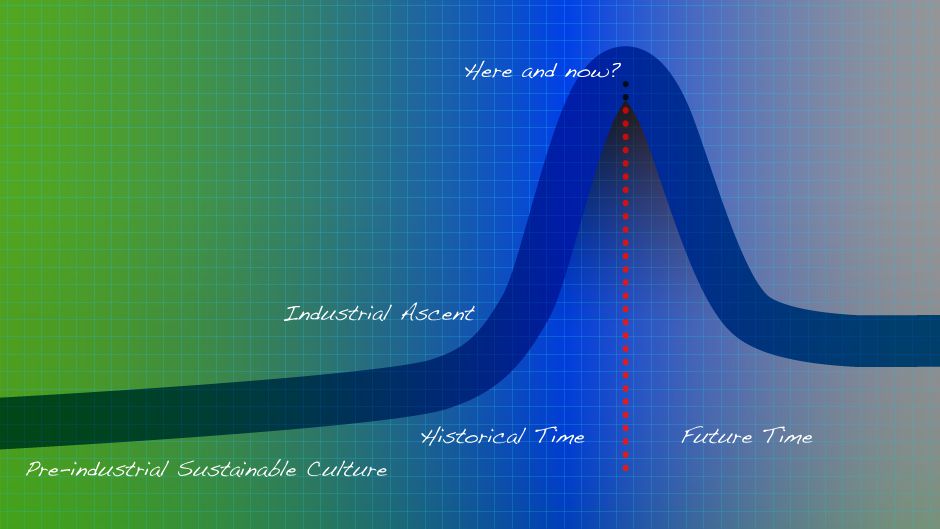
Dr. Berndt Warm’s Perspective
Thanks to Marromai for finding this new paper by physicist Dr. Berndt Warm.
Dr. Warm uses 5 different methods, 4 relying on economics, and 1 on thermodynamics, to predict when the end of oil production and motor vehicle production will occur. All 5 methods roughly converge on 2030 as the year when modern lifestyles end.
The essay was written in German and translated to English which explains any awkward phrasing.
Warm’s conclusion agrees with my 15 years of study of many different sources which converge on oil production being down by about 50% in 2030. Because our current system requires growth not to collapse, it is plausible that predicting a 50% decline is the same as predicting a 100% decline.
Our world is of course far too complex to make precise predictions, and unexpected events like a pandemic or nuclear war can dramatically change the outcome, however for planning purposes it seems reasonable to assume we have about 5 years left to prepare for a new way of life.
Abstract
Evaluation of five data sets concerning car production, oil prices converted in energy values gives lifespan approximations for the car industry and the oil industry. The result is that the car industry will last only until 2027 and the oil industry some years more.
Here are a few excerpts from the paper:
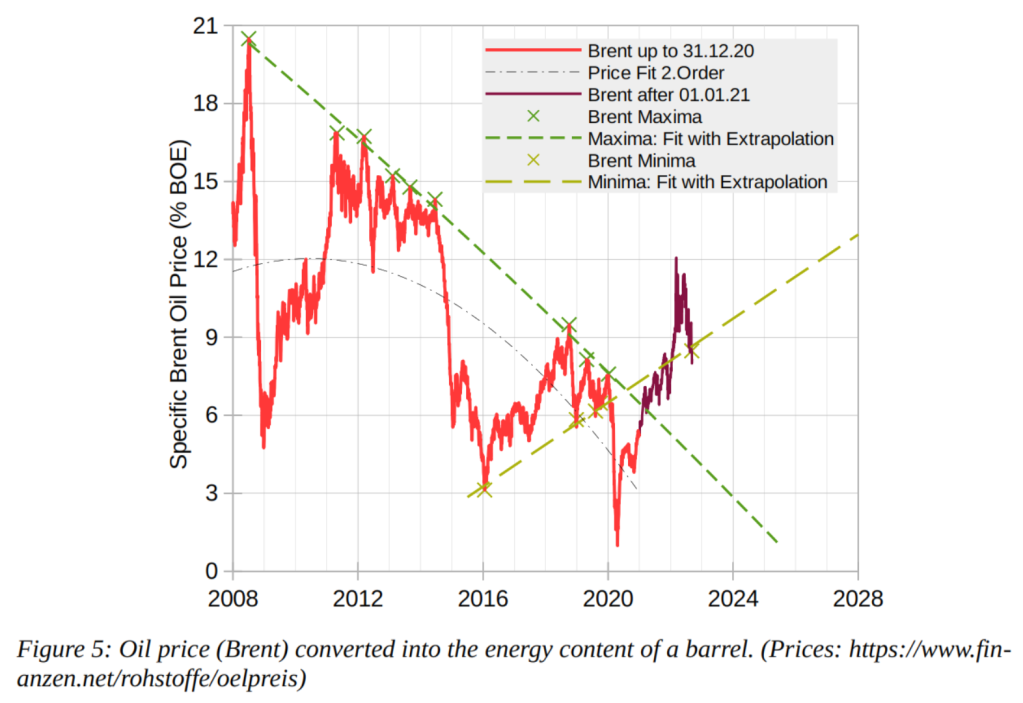
The author interprets the line of maxima as the oil price that the industrialized countries can afford to the maximum while maintaining their lifestyle. He interprets the line of minima as the price of oil that the producing countries need to keep their economies running. In mid-2019, the author noticed this crossroads and expected a crisis in 2020, although he was completely unclear what kind of crisis it would be. He didn’t expect Corona.
The inhabitants of the industrialized countries are now realizing that their lifestyle is at risk. The line of the maxima will reach the zero line (0%BOE) around mid-2027. From then on, the inhabitants of the industrialized countries can no longer afford oil without giving up many things of daily life. The demand of the oil producers is then 13-14 %BOE. These two values are incompatible.
Result: The extrapolation of oil prices shows that from 2022 the lifestyle in the industrialized countries will degrade, and that after 2027 the inhabitants of the industrialized countries will hardly be able to pay for oil or its products.
The fall in the price of crude oil from 2008 to 2020 with the extreme price increase since 2021 is an absolute alarm signal! Soon there will be no more crude oil affordable, no matter for which economy in the world!
Summary
Procedures 1, 2 and 4 are extrapolations of economic data of the past. Method 3 is a link between oil prices and car production. Method 5 is a calculation based on a law of physics.
The five calculation methods result in:
- End of world motor vehicle production between 2031 and 2034.
- End of oil production in 2027.
- End of worldwide sales of motor vehicles in 2027.
- End of German vehicle production in 2027.
- End of oil production in 2029.
The results are not the same, but in the end the same thing comes out. All five procedures show that vehicle production and oil production will continue to collapse in the coming years. Vehicle production will disappear first. Oil production later, as the world’s existing fleet will continue to consume crude oil, even if no new vehicles are added. It is to be expected, that the crude oil production will decrease slowly until 2027, and after that very fast.
And: Oil will be extremely expensive by 2027 at the latest!
Dr. Simon Michaux’s Perspective
For those still hoping that a transition to non-fossil energy will extend our modern lifestyles, I point you to the following recent work of mining engineer Dr. Simon Michaux which shows our planet has insufficient affordable resources to implement an energy transition plan that maintains our current lifestyles.
The quantity of metal required to make just one generation of renewable tech units to replace fossil fuels, is much larger than first thought. Current mining production of these metals is not even close to meeting demand. Current reported mineral reserves are also not enough in size. Most concerning is copper as one of the flagged shortfalls. Exploration for more at required volumes will be difficult, with this seminar addressing these issues.
Simon Michaux is an Associate Professor of Geometallurgy at the Geological Survey of Finland in the Circular Economy Solutions Unit. Holding a Bachelor of Applied Science degree in Physics and Geology and a PhD in Mining Engineering from the University of Queensland, Simon has extensive experience in mining research and development, circular economic principles, industrial recycling, and mineral intelligence. Through his recent publications, Simon has outlined the many challenges facing the global industrial ecosystem. He notes our world is currently energy and minerals blind and transitioning to renewable energies is not as straightforward as it appears.
We’ve been growing without care to planetary limits for too long and change is coming, whether we like it or not. We need a completely new energy paradigm to address the challenges ahead, and as Simon says, it all starts with a conversation. We cover a lot of ground in this one, so grab a notebook and strap in for an important conversation – this is one you’ll want to listen to more than once.
On this episode, we meet with Associate Professor of Geometallurgy at the Geological Survey of Finland, Dr. Simon Michaux. Why do humans ignore important mineral and material limits that will affect human futures? Dr. Michaux reveals how we are “minerals blind” — and the consequences of this myopia. To shed light on the effects of our minerals blindness, Dr. Michaux explores the disconnect between experts in renewable energy and economic and government leaders. Dr. Michaux offers individual strategies for us to overcome our energy and minerals blindness. How can we learn to adapt in order to overcome the coming challenges?
Dr. Simon Michaux is an Associate Professor of Geometallurgy at the Geological Survey of Finland. He has a PhD in mining engineering. Dr. Michaux’s long-term work is on societal transformation toward a circular economy.
BenjaminTheDonkey’s Perspective
BenjaminTheDonkey today nicely captures a common theme I observe everywhere in the world today: We are collectively losing our minds; perhaps because unpleasant realities are overwhelming the denial circuit in our brains?
Alarmist?


The powers that be won’t admit

We’re heading straight to our obit;

So it isn’t strange we

Can already see

People are losing their shit.


What is its cause at the root?

Whom might we persecute?

From an objective view,

It’s logically true

The reason is just overshoot.

 un-Denial
US Col. Richard Black on the high risk of nuclear war.
LikeLiked by 2 people
Modern cars have already become insanely expensive. Used car prices are equally insane. I cannot find a mechanic with a labour rate under $100/hr. Young people earning lower wages will park their cars after they face an expensive repair. Newer vehicles are full of sensors and complex parts that we may not even be able to produce in the future. Fuel prices aside even a new Nissan Leaf is $42k before taxes with an ideal range of 350km.
Oil prices are currently too low for new exploration and production. Oil companies do not want to invest in new refineries. Higher prices lead to demand destruction which leads to lower prices and lower production. Prices go down, demand increases, prices go back up. Volatility is the name of the game now.
Predicting a 50% decrease in production in 8 years? Who knows. Will the numbers be accurately reported? Maybe the coming credit crunch will reset our standard of living by 50%. The future is the end of more but having an accurate prediction seems impossible right now.
LikeLiked by 1 person
Nice summary. Our global system is so complex and so dependent on affordable energy and economic growth (aka credit) that anything can happen anytime now.
LikeLiked by 1 person
A few years ago, I was thinking about buying a new car. The only car in GM’s lineup that interested me was a small 3-cylinder model with a manual transmission, roll-up windows, and zero fancy accessories. They discontinued it before I could make a decision.
LikeLiked by 1 person
I talked to a sales manager for GM last summer. He was telling me the new Hummer EV weighs
12500lbs. They had to order a new hoist to work on them. Then in the same discussion he told me about their new Cadillac Escalade with a 600hp twin turbo V8. In a few years these should make good shelters for the homeless.
LikeLiked by 2 people
I don’t find Dr. Berndt Warm’s calculations particularly convincing. There is much cherry picking, as far as I can see. For example, car production seemed to go down for several years in the 50s but he chooses to consider the recent peak as critical. Also, there are many more peaks in method 2 but those don’t fit the line he wants to draw. And so on. I didn’t really understand method 5, but it seems bizarre.
Still, 2030 is as good a prediction as any. I feel that the collapse will have clearly set in by then but no-one knows what the future holds, as far as a detailed timeline goes.
LikeLike
This reminds me of the famous saying: “Forecasts are difficult. Especially when they concern the future.”
Although you mention valid points to critizise Dr. Warm’s extrapolations, at least he guesses the more likely direction we’re heading to. Unlike all the mainstream economists who always see growth in the future…
LikeLiked by 1 person
I don’t think there is much doubt about the direction we are heading in. Dr Warm’s calculations just don’t really give us an idea of the timeline, not that any calculations would, though Simon Michaux’s guess seems as good as any.
LikeLike
I have not followed Dr. Warm so cannot vouch for him. I didn’t pay much attention to the automobile arguments but his take on Steve Ludlum’s triangle of doom seems unassailable in principle to me, although the timing can be debated.
The issue I think most about these days is that our system requires growth to not break and so it may not take much of a drop in oil production for everything to unravel. Just look at the damage (and pent-up future damage via debt) an oil plateau has inflicted on economies.
LikeLike
Sheldon Yakiwchuk today on the recent Canadian inquiry into use of the Emergency Act to end the trucker protest against covid mandates.
In summary, there will be no accountability in Canada for our idiot/evil leaders.
The most interesting observation for me is that the opposition party is silent. This I think suggests that the real problem is that the majority of citizens are frightened and incapable of rational independent thought.
God help us when there is a real problem like a shortage of food and energy.
https://sheldonyakiwchuk.substack.com/p/emergency-act-inquiry-is-overcanadians
LikeLike
I wonder if part of our collective sanity is that there are just way too many people around. Animals do tend to go a bit bonkers in over-crowded conditions.
LikeLiked by 1 person
The Monkeysphere strikes again perhaps.
https://www.cracked.com/article_14990_what-monkeysphere.html
“You’ll see that all of the random ass-headed cruelty of the world will suddenly make perfect sense once we go Inside the Monkeysphere.”
LikeLiked by 2 people
thanks, that was funny
LikeLiked by 1 person
So five years at most before the mega-death begins. Time to get my affairs in order. I noticed Simon Michaux at the end of the Nate Hagens interview said he just wants to have hope for his 3 daughters. Despite obviously knowing what is about to happen he still couldn’t resist breeding beyond replacement level. At least Nate never bred, although I’m sure he’s been given plenty of opportunities.
LikeLike
I hope the internet makes it all the way to 2030, just so I can annoy people about their failed predictions. Especially those people who said we’d all be dead in 10 years from climate change
LikeLike
Richard Heinberg posted a good essay today with his take on energy and material depletion.
https://richardheinberg.com/museletter-356-the-final-doubling
LikeLiked by 1 person
A less complex lifestyle must be nearby. All the aware thinkers are producing new content with a common theme.
Today Sid Smith released chapter 4 “Why Civilizations Die” of his excellent “How to Enjoy the End of the World” (HTETEOTW) series.
LikeLiked by 2 people
Good intelligent rational calm discussion on the high risk of nuclear war from an expert who thinks Russia was provoked and is doing poorly in Ukraine.
LikeLike
Wow,
Don’t know how to respond to this.
Mearsheimer and his host are arguable rational, however intelligent they are not.
I have seen Mearsheimer talk before and I guess in comparison to the neocons that dominate the U.S. government and NATO he is rational (kinda like Trump is rational compared to Alex Jones?). He and his host have taken in almost all of the West’s propaganda as their premises. Such as: 1: Russia is not a peer power compared to NATO (actually they have superior arms), 2. Russia is losing to Ukraine (just as the U.S.S.R. lost to Nazi Germany), 3. NATO could easily defeat Russia (right just like NATO defeated the Taliban, Iraq, Syria, Libya, etc.).
However, I will give Mearsheimer credit that when a country feels like it is losing they might resort to nuclear weapons – that is what should be feared from the U.S./NATO. He is also right about the lead up to the war being because of the U.S. reneging on promises not to expand NATO. But he is categorically wrong about Russia’s conduct in the war and the current status of the combatants. Russia only went into Ukraine because of the abject failure of the West to live up to the Minsk accords and Ukraine’s ramping up it’s aggression against the Luhansk and Donbass. In intervening in Ukraine, Russia committed far less troops than the “aggressor” needs to prevail against the defender. They appear to have done this so as to get Ukraine to the bargaining table (and that worked until the U.S. told Ukraine not to negotiate). Additionally, Russia is concerned with losing troops and so in the usual Russian strategic maneuvers they trade land for lives. Ukraine has squandered its troop while Russia conserved theirs.
Mearsheimer conflates Russia’s military might with that of the U.S.S.R./Russia of 15 years ago. Russian air defense is the premier in the world at the moment, so are Russian missiles, tanks, fighter aircraft, etc. Almost all of the U.S./NATO military hardware is second rate junk at premium cost.
Shortly, when the ground has frozen Russia will most likely eviscerate Ukraine and had another defeat to the great NATO. My fear is that the U.S. can’t stand another defeat and will go nuclear to avoid it.
It would be far better to post info from the guys at The Duran, Larry Johnson, Scott Ritter, Andrei Martyanov, Bernard, The Saker as they are far more rational and aware of reality (rather than living in a propaganda dreamland).
AJ
LikeLike
I agree with most of your points. There was a lot of chaff with his wheat. Thought I made that clear in my intro when I said he thought Russia was losing. I focused on his disrespect for current US leadership for provoking Russia and for boxing themselves into a path that may lead to nuclear war.
LikeLiked by 1 person
Sorry,
I thought you were endorsing his obviously flawed take on the current situation, i.e. that Russia was losing. I also
didn’t like his take one the Chinese situation. He is probably right that China represents a threat to U.S. interests but that is only because the U.S. has outsourced all our manufacturing to Tiawan and China (so Wall Street could screw the U.S. working class). However, as numerous parties point out, China is only a little way from Tiawan and U.S. aircraft carrier fleets are now sitting ducks to be destroyed in this era of hypersonic weapons (of which the U.S./NATO is 10 years behind Russia and China).
The thing I dislike about all these conversations (both pro and anti Russia), is that no one seems to take into account that Western Civilization is in dramatic overshoot of all resources and is bound to crash with the probability of taking down all others with them.
It seems each proponent of an idea is in denial about some other problem we face.
AJ
LikeLike
I agree. I have a filter that assumes no one except a tiny number of people with defective denial genes understand what’s going on. I try to use this filter to extract a few bits of truth and insight from each source. If I didn’t do this there would be no sources to learn from.
For example, I listen to the Duran every day and I respect them however they do not have a clue about overshoot and energy depletion, so we have to interpret what they say.
LikeLike
To me, it seems obvious that Russia is losing on the battlefield and so has to resort to trying to terrorise the population into submission by targeting civilian infrastructure. If that means they’re wining, that might turn out to be correct, but the Ukrainians seem determined, at the moment, to stick it out. Good luck to them.
Can’t see Nato being the first to use nuclear weapons in this war.
LikeLike
Let us not forget that you also thought that taking vaccines to just get along was a good idea.
Perhaps it is time for you to review your thinking Mike. Russia is not losing they are being extremely strategic.
My bet is that in another 6 months we can look back and see that you made another majorly incorrect assessment.
LikeLike
I was hoping for better commenting here but it seems the ridiculous Trump-like repetition of lies from OFW has spilled over here.
However, my opinions on other subjects are irrelevant.
If your opinion is that Russia is winning (remember we’re 9 months in and Russia has no regional capital occupied now, that wasn’t occupied before the war) that’s up to you. There’s no doubt it has greater resources than Ukraine, currently, so you may end up being right. But it looks like its population is even turning against the war. So I think it’s all up in the air. Certainly, although I guess anything goes in war, Russia’s actions are reprehensible, as far as I’m concerned. Do you think everything they’ve done is sweet?
LikeLike
Nothing is sweet Mike, just saying that time will once again prove you wrong like your vaccine stance. Let us revisit in 6 months I could be wrong.
LikeLike
You did it again, Niko: “once again” shows that you persist in rehashing lies about what I’ve written. Even if I had claimed what you erroneously state I claimed, that could never be proved to be right or wrong. Regarding the war, you appear to think you can foresee the future (“will … prove you wrong”). Your opinion, like mine, can only be a guess. In any case, all I’ve said is that Russia appears to be losing (it failed in its attempt to capture Kyiv and lost control of Kharkiv and Kherson), so that can’t be proved wrong. I even said you could be right, in the long term.
I’m sure it’s possible to have a civil discussion about any topic without simply trying to denigrate those who hold a different opinion.
LikeLike
Who said that Russia wants Kyiv?
Russia seems quite restrained in this war so far. Just a slow grind.
I comment on your comments occassionaly when you spout msm narratives that are fairly easy to see are BS. You seem intelligent so i wonder why you think they are valid.
Again time will tell. My position is that the west is failing drastically in this war and this will be the first be big step down in the catabolic collapse that is unfolding.
LikeLike
Couldn’t have said it better myself. Russia only went toward Kiev as a faint to tie down a majority of the Ukrainian army so that they would have the ability to go into the Donbass with generally fewer troops than would normally be necessary to secure that area. This is a 1500 mile long line of “fighting”, so some withdrawals by Russia along that line makes sense in maneuver a warfare. I too get tired of the repetition of MSM talking points.
AJ
LikeLike
Well, it seems that some here think they know all the ins and outs of Russia’s tactics and so see any apparent failures as a trick to enable the Russians to focus on something else. That doesn’t seem to be working out so far. The trouble with the MSM haters is that they think everything published in all MSM outlets (regardless of whether some are mutually exclusive) must be wrong and so anyone taking a line that is similar to an MSM story must also be wrong.
Of course time will tell; that’s a truism. The difference between you and I is that I’m not claiming anything about outcomes in this war. So only you can be proved wrong. However, catabolic collapse is possible though I now tend towards a rapid collapse of at least some parts of this global civilisation. I don’t think John Michael Greer took enough account of the interconnectedness of the global economy and their attached societies, plus a just in time approach being common. Some part of the collapse might be catabolic but I think there will be some rapid declines (which is really what a collapse is).
LikeLike
Mike, I agree with your assessment of JMG theory lacking consideration of interconnected complexity.
I don’t think all msm is BS, just certain things that definitely have a narrative being forced out everywhere.
I also am not a supporter of Russia in this war but i am also not a supporter of UKR. Things are playing out due to past decisions and so far most of what the msm says is happening in UKR has been wrong and if you followed there predictions Russia would already be back in its cave licking its wounds.
Winter should prove interesting.
LikeLike
Thanks. Well, I don’t know about most of what’s reported about the war has been wrong. Could you give a couple of examples of major stories? Which would be the best source for information on the war, and why?
LikeLike
A good example of it was the Azov regiment holed up in the steel mill. MSM here in OZ portrayed them as virtuous fighters that would defeat russian forced encircling them.
Then it went to they will be slaughtered by Russians.
Turned out they were mostly captured and the footage of their capture showed a large number of these men sporting nazi tattoos.
There are plenty of places to seek out both sides and then the best we can do is make an educated guess. I think the video below with Ray McGovern, Alexander Mercouris & Glenn Diesen is full of good info.
LikeLike
I agree that was bad reporting but it wasn’t generally reported like that. To me, it seemed to be just a rump of a regiment and quite a few civilians holed up for quite a long time, resisting an invader. Even Zelenskiy said they should surrender, long before they did.
LikeLike
Tim Watkins covers denial a bit in this essay. I enjoyed it
https://consciousnessofsheep.co.uk/2022/11/29/collapse-through-five-stages/
LikeLiked by 1 person
Thanks. I sometimes wonder if Watkins lurks here for essay ideas. More likely what I write about is obvious once you see our imminent overshoot collapse and ponder why so few people discuss something so important and in-your-face obvious.
LikeLiked by 1 person
http://benjaminthedonkey-limericksofdoom.blogspot.com/2022/11/doom-and-consensus-trance-now-our.html
LikeLike
https://odysee.com/@voicesforfreedom:6/FREEDOM-TV-SPECIAL-GUEST-DR-BYRAM-BRIDLE:f
Long but worth the listen if you have time
LikeLiked by 1 person
Thank you, very good.
The money quote: “As someone who design vaccines for a living, I can tell you there is nothing they are doing with these (Covid) vaccines that is logical.”
It makes me crazy. I can’t find the bottom of the stupidity and evil of our leaders. Every interview with a genuine expert discloses more things they did wrong.
LikeLiked by 1 person
Tim has advised on Facebook, he’s going to be doing more videos on his YouTube channel. Very excited for this.
LikeLiked by 1 person
Thanks. I’ve read and respected Tim Watkins for years. It’s nice to put a face to his ideas.
LikeLiked by 1 person
Nate Hagens today discusses the fact that the majority of his audience lives in New Zealand and Australia. I left the following comment.
LikeLiked by 2 people
Always ends up in the same place. We need to change human psychology. Create new ways of thinking and behaving. There will never be acceptance that the software for all of us can’t be updated in any relevant time frame therefore dooming us to the consequences of our behaviour.
I like Nate, infact he was the person that really introduced me to peak oil etc… but he just can’t face that we are royally screwed and there is not a thing we can do about it other than suit up and enjoy the ride.
Maybe that is why so many Aussie’s like me what this stuff, we know we are living on the edge.
LikeLiked by 2 people
I think Nate does know we are screwed. It’s just in order to make money and maintain his network of friends and contacts he needs to come across as finding ways to create “better outcomes” .
I like Nate too. We met about 15 years ago when he was here in Vermont getting his PhD. He came and met with a local peak oil group I had formed. I had the mindset then of trying to produce better outcomes myself.
LikeLiked by 1 person
It’s really simply. We need to get the population down. It’s the only path with a better outcome. And I didn’t say good outcome, I said better.
It angers me that all the big names trying to do something about overshoot avoid population reduction. It’s a tell that they really don’t get it or that they care more about their reputations and income.
Population is a toxic topic because we make it toxic topic.
LikeLiked by 1 person
Certainly number of people times consumption does mean less people less overall consumption but, though that’s a simple equation, it’s not simple to come up with an acceptable method to reduce the population quickly enough to slow the destruction. For example, removing health care would probably have a rapid impact but no-one would go for that (even though that’s our future). Penalties for having more than one child would start to have an impact reasonably quickly but no-one would go for that either. If there is a simple, acceptable, way to get it down quickly, I haven’t heard of it.
LikeLike
With 5 minutes thought I can think of a dozen simple things we could do that would probably cause people to have fewer or no children. But it all starts with aware people saying, “duh, of course we must get the population down, because nothing else will reduce the horrendous suffering that is coming soon.”
Instead, most aware people like you say it won’t work before you even engage to try.
That is one of the first roadblocks that must be overcome.
LikeLiked by 1 person
If it needs aware people, then it’s not a solution. So what would bring the population down reasonably quickly and would be acceptable to most?
LikeLike
I’d like to hear you say, “duh, of course we must get the population down, because nothing else will reduce the horrendous suffering that is coming soon.”
Once you accept this fact the ideas will flow.
LikeLike
Well, I can write that. Of course the human population must be reduced. I’ve known that for a long time but I still can’t think of an acceptable way to do it. I suspect that the horrendous suffering will do it
LikeLike
You should only say it if you believe it, and if you believe it then we succeed if we prevent one birth, and we succeed more if we prevent two births., etc.
Here’s one idea that will succeed without any corrosion. Simply require every grade 12 class to set aside 4 hours to watch the courses by Sid Smith, Nate Hagen’s, Jack Alpert, and Chris Martenson.
Some will decide not to have kids after watching those.
LikeLike
I do believe it but I also think that it would take more than that for success. And I know that success would not be persuading all women to have no, or no more, children. There is some middle ground that would be success but I don’t know how to get there, though I do know that “success” will come.
LikeLike
right on Mike, great example of root cause thinking. (see Jack Harich at https://www.thwink.org/index.htm.
LikeLike
Truth literacy would be great. I think of it as critical thinking.
On the topic, although population growth may seem like a root cause, it’s possible that it’s not. As Tim Garrett pointed out, explosive population growth coincided with our mastery of fossil fuels and, later, the green revolution (or, more generally, access to abundant energy sources). There is an argument that the root cause is just that, and all other “causes” are actually symptoms of the ability to extract and use all fossil fuels but particularly oil.
LikeLike
New Zealand is made up of people who decided to leave where they were from, often for good reasons. From the collapsing societies of the pacific to poverty from Europe’s growth; New Zealand is made of select individuals from particular parts of the world who left home and decided to never return. A lot of people will give it a go living in New Zealand, but most don’t stay. That was true a hundred years ago and still true today-ish (I need to look at the recent stats).
LikeLike
Where would one find data about how many of those who emigrated to New Zealand stayed? Presumably you formed your opinion from data? The only data I could find is net migration but that only shows the result of subtracting those emigrating from those immigrating. The NZ Stats page is here: https://www.stats.govt.nz/news/net-migration-lowest-in-nine-years which seems to show that, overall, there is a gain to NZ through migration, recently, despite ups and downs over the years. However, I couldn’t find any information on how many of those who immigrate actually stay. Anecdotally, I only know of two people who immigrated here (to NZ) but didn’t stay, but know far more who did stay. Of course, until those who stayed die here, it’s always possible some may choose to return to their country of origin.
LikeLike
I wasn’t really thinking of recent years. During colonial times most people left New Zealand. It was quite surprising too me which is why I remembered it. It’s been 12 years my history degree so got to dust of the brain cobwebs LOL
LikeLike
LikeLiked by 1 person
https://www.leftbrainwave.com/2022/11/the-coming-european-economic-apocalypse.html#TOC2
A good one about european collapse!
Saludos
el mar
LikeLike
Very interesting, thank you. Europe seems to be committing suicide.
Something very strange is going on. People everywhere are going crazy.
LikeLike
George Webb says it all nets down to doing whatever it takes to secure future oil and gas, mainly from the ‘pipelinestans’. EU is caught in the cross fire of US and RU oligarchs. See interview today on https://maajidnawaz.substack.com/
LikeLike
Tom Murphy returns to math today with a fresh look at overshoot by modeling the impact of a non-renewable population booster.
https://dothemath.ucsd.edu/2022/12/finite-feeding-frenzy/
LikeLiked by 2 people
I think about redundancy a lot. That spreadsheet I told you about has a category called “spare”.
https://market-ticker.org/akcs-www?post=247554
LikeLike
This was one of his better columns. Anyone could be moving across the U.S. southern border and the effect they could bring about on the grid could be apocalyptic. I always worry that one day I will wake up and everything will change (no internet, no power, anarchy). I will miss this group, perhaps the only one’s who see things most clearly – with the least denial.
AJ
LikeLiked by 3 people
I’ll miss you too. It’s been nice to hang out with a few aware people.
LikeLiked by 1 person
Aw, AJ and friends, that’s so sweet. I’m hopiuming that the party continues a bit longer; it’s early summer in Tasmania (to where I have returned) and it sure would be nice to harvest another crop of cherries, blueberries, and mulberries before the fat lady sings. I’m sure each of us has some thing or two that we’re not quite ready to say sayonara to.
Meanwhile, we’ve been hit with another interest rate rise, the 8th in a row and told there will be more as these measures are not subduing the inflation fast enough. We’ve also been warned that the Australian economy will tank next year so that’s when things will finally get cheaper for those who lost their jobs and houses, phew. You see, the means justifies the end after all!
On a more serious note relating to means justifying the ends, I would like to add here that I agree with both Rob and Mike that our population needs to be seriously curtailed and also their relative positions on how it can be accomplished or not. It will be done, one way or another. I personally think it can only be done in a concerted manner on a great scale if the masses are not aware of what is happening, but instead attribute the attrition to “natural” causes or just the way of things on a planet with lots of problems which they can’t do anything about. Every one of the usual suspects of famine, plague, war, economic collapse can be “encouraged” along their paths to bring about the desired outcome of greater deaths and less births. If we brainstorm even briefly on how this could look like, it may not look too different from what we’re experiencing now. The Covid debacle may have had an insidious aim which must have been protected at all costs. I affirm that I can believe that the inoculation of the young and especially pressing on the college age cohort (ie those closest to reproductive reality) has an ulterior motive of fertility control, the mechanism of which we will see soon enough in the coming years. This is not meant to be conspiracy quacktalk, this is stratagem and probability. What other options do you propose which will have the maximal uptake, efficacy, and immediacy? Financial incentives, and certainly not without authoritarian control to back it, will not curtail biological urge consistently to be effective, the only sure method for wide scale procreative control will involve disabling the biological means for reproduction, one way or another. That is why we neuter dogs and cats and cattle. They don’t have a voice in it, and perhaps neither will we.
I’m not saying at all this is a good thing, only that this is a pathway towards what we all agree is a necessary thing. Namaste and go well, everyone. Nothing can take away the awe and wonder of being alive and here now.
LikeLiked by 2 people
As if on cue, here is the latest bad cat’s assessment on declining Swedish birth rates after mRNA vaccines:
https://boriquagato.substack.com/p/swedish-birthrate-data-september?utm_source=substack&utm_medium=email
curiouser and curiouser
LikeLiked by 1 person
Many distinct signals from many independent sources that something is seriously wrong and our leaders don’t even investigate.
Public health is clearly not their priority.
Apparently they don’t even care about their own health or their children.
It’s all too strange for my mind to comprehend.
LikeLike
Kunstler today interviewed Dr. Stephanie Seneff on infertility and many other troubling signals our leaders are ignoring.
Never heard of her but she seems knowledgeable and gets credits from me for helping to blow the whistle on glyphosate.
https://kunstler.com/podcast/kunstlercast-367-chatting-with-stephanie-seneff-of-mit-about-covid-19-and-other-modern-health-fiascos/
LikeLike
Infertility would be a good thing, though So why would it be troubling to her?
LikeLike
I don’t know but I assume because she’s in denial of human overshoot. I can’t think of a single person who has publicly stated that a fall in fertility due to covid vaccines is a good thing. I would if the vaccines were not causing other serious health harms.
LikeLike
Damn, I love Ray McGovern. He proves that a few good men still exist.
LikeLike
Easily one of the best posts on the Ukraine situation that I’ve seen lately. Ray McGovern is not fooled by Stupid governments, Stupid leaders, or Stupid talking heads on the media. My only criticism, and it’s a minor one, is that they are completely collapse unaware. Other than that it was well worth the time spent and you are right, Ray McGovern is a honest, rational person.
AJ
LikeLike
McGovern et. al. thinks the incorrect and dangerous policies of NATO countries are caused by the corrupting influence of money from profit seeking corporations that produce weapons.
I wonder what they would say if they understood that we are in a severe state of overshoot and that it is no longer possible for all the citizens of the world to improve their standard of livings and that we now live in a zero sum world where for US citizens to keep their cars etc. the Russians and Chinese need to give up theirs.
Is it possible western leaders are not corrupt but are doing what they think necessary to look after their own citizens?
LikeLiked by 1 person
Nah, I don’t think our leaders are that smart or caring. The simplest explanation is that they are stupid and greedy (and maybe not even corrupt? Nah, that too)(just a little sarcasm;)). Everyone on top makes out (or so they think) in the Military Industrial Complex (adding the think tanks and government – as Ray and group did).
AJ
LikeLike
I agree that they are greedy and corrupt. They are smart when trying to further their own agenda and line the pockets of themselves and friends. I feel that they do actually believe that, in some way, they are also looking after their own citizens because, for the democratic leader, they have to project policies that can get them back into power. But they are all short term thinkers, like all humans, so don’t see that a lot of their policies don’t benefit their citizens in the long term.
LikeLiked by 1 person
Coming back to the original car issue, auto manufacturers are still experiencing supply chain issues, battery metals are particularly short for hybrids and many EV’s are sold out. Used cars 2-3 years old are selling for the same price as new. A reliable 10 year old small car is running $10,000 and $80 to $100 for a fill up. Younger people filling our service sector jobs can’t afford these costs. So yes car ownership has peaked and is in terminal decline. New cars are also way more complex, more material intensive (computer chips, rare earth elements). This is another way of increasing inequality within our society. Home ownership is the next chip to fall. Life for the next generation will look nothing like the last 20 years.
LikeLiked by 2 people
Chris Martenson today with the latest science on what is known about new and unusual blood clots that the fact checkers are so confident are nothing to worry about that our leaders have decided to continue funding fact checkers rather than investigating what is going on.
I just don’t get it. I’m sure a few of our leaders have children they care about.
Shame.
LikeLiked by 1 person
My internet, cablevision, and phone went out for 4 hours night before last. First time I can remember that’s happened. Looked outside for a mushroom cloud. 🙂
Last night my power went out in a big storm that brought to an end an unusual cold snap with a lot of snow for early December.
Having no electricity focusses the mind on priorities. My priority is food in my freezer and fridge. Power came back before I needed to fire up my little gas generator to run the fridge.
LikeLike
I often think about food storage. I’d love to dig a root cellar but I’ll probably have to settle for a root box, of some sort. I understand that the subsoil doesn’t really get above 15 degrees (celcius), which might be good enough for some short term storage. Drying and fermenting are other possibilities, if one can’t grow/raise something all year. Luckily, we probably will be able to do that, if we put our minds to it.
LikeLike
I know where you’re at ! My power goes out at least bi-weekly. Usually for a few minutes but occasionally for half a day or more. I have a battery backup that kicks in right away, but it only runs essentials (frig, freezer, water, modem) for a day or so. I always worry when both power and internet go out (then I check the battery radio). I fear that it might be the big one too!
AJ
LikeLike
This thread by Visa Visa Siekkinen (who appears to be an economist) is a long critique of Simon Michaux’s work on minerals blindness. Far too long to wade through in anything other than a week but I thought I’d place a reference for others.
LikeLike
I tried reading the thread but do not like how his brain thinks so I quit. He seems more intent on proving he is clever and showing we have nothing to worry about than understanding reality and explaining in clear language why we are not in overshoot. Looks like classic genetic denial to me.
If someone has the patience to figure out his thesis please give us a summary.
LikeLiked by 1 person
I too tried to read this crap on Twitter. Too much work. That the person is an economist is a big strike against them as it’s not a real science (more like a cult belief system).
AJ
LikeLiked by 2 people
I tried looking at some of the thread. It has a distinct air of cherry picking about it. For example, in trying to debunk Michaux’s claim about the needed increase in lithium mining, he uses the IEA NZE scenario (though I haven’t been able to verify the number used for that) whereas another IEA scenario, SDS, sees lithium mining needing to increase far more, and not too far from Michaux’s calculation. I also didn’t notice anything about overburden and the decreasing quality of ore for copper and other minerals.
LikeLiked by 2 people
Aussie Mike Stasse today with some interesting recommendations on YouTube health videos (especially for old farts).
https://damnthematrix.wordpress.com/2022/12/09/musings-on-dr-youtube/
LikeLike
I’ve watched everyone of his YouTube links over the past 6 months. I would really recommend reading one of his links
https://carmineleo.com/blog/food-serious-as-a-heart-attack/
I’m currently reading the big fat surprise by Nina Teicholz. It’s heavy going but well worth the read.
LikeLike
Here is the thing about population.
80% of the population has been living on $10 a day. They are not flying, not driving, not vacationing, not ordering stuff online, basically they only are able to consume what they need to survive. It is the other 20% and really just the top 10% that have colossal carbon footprint and waste stream.
Over the last many years the 10% have been losing their ability to keep the 90% from consuming and the last couple years have seen dozens and dozens of countries striking out, defying imperialism and going on a growth and development splurge. China has been funding and building out much of the infrastructure around the world to promote this while Russia has made it clear that they will not allow empire to rape and pillage unchecked as it has been doing.
It is not the sheer numbers that are the issue so much as the start of basic consumption from those numbers. They all, some 6+ billion people want a real structure to live in, heating when it is cold and AC where it is hot, a car, nicer cloths and food, medical care, electricity, running water, sanitation, etc.
The amount of finite natural resources needed to accomplish this eve at the most moderate levels is simply not there and the biosphere could never handle the waste stream.
When the greenies talk about “transitioning” they are talking about making life for themselves, the 20% who have everything already, all groovy. People like Simon Michaux use current energy production and consumption figures to calculate “renewable energy” requirements. What about the other 80% who do not have any or very little energy consumption yet but are rapidly demanding it?
LikeLike
I am so fortunate to have been born in a rich country like Canada. The gap between my comfort and those living hand to mouth in the poor countries has nothing to do with my abilities. It was pure luck.
LikeLiked by 1 person
i often think similarly, Rob. i watched this traveblog about south sudan recently and realised it afresh, in spades.
LikeLiked by 2 people
Everyone around me thinks their “smarts” got them where they are when they don’t realize that it was all the luck of where they were born.
AJ
LikeLiked by 2 people
Luck of where we are born, to whom we are born, the age in which we are born, and the 500 billion energy slaves at our beck and call because of these conditions. Fate is an unfair taskmaster and not a day goes by that I don’t wonder why my particular life is so charmed and not another’s. It is a welcome penance to keep me honest, grateful and hopefully above all, humble.
But as much as we like to say we think for the other 80% who have not, we really don’t have the first clue of how their lives truly are and frankly, we’re not interested. We like our “multicultural” world just the way it is–with everything and everyone staying how and where it is so that our lives as the dominant culture continues the way we are used to. Our slice of the pie is always the biggest piece and we also choose first. Until we somehow get to a new perspective that we are all truly connected as part of the same biosphere and humanity, we will be doomed to repeating this same cycle of injustice and inequity, only the pie will shrink so very soon there will be none at all for even greater numbers of our species, not even counting all other life forms. Does it have to be this way? So perhaps our main issue for ultimate survival and reduction of suffering is not how to become overshoot aware but somehow overcoming our biology (and therefore MORT) to encompass all life on this planet as an integral part of ourselves. First culture peoples have come closest to this understanding, and for some, religion has given glimpses of this enlightenment. So it is possible, albeit not probable, for a major world/cosmic view change. Maybe it does take a calamity of unimaginable magnitude to cause such a shift in thinking, that or actual re-programming of our thinking through other means.
The later the hours in the day it seems the more philosophical I tend to be. It is very late in our collective Homo Sapiens period of dominion, what have we learned from it all?
LikeLiked by 2 people
Woah.. too much truth for one day! 😉
LikeLike
LikeLike
LikeLiked by 1 person
LikeLike
LikeLiked by 2 people
LikeLike
LikeLike
Well I’m not so sure about this – I don’t think he’s prepared to admit he was bamboozled on the WMD issue by people who know what is really important.
We’ve have lots of charity shops in my area of London that have a really good selection of books at cheap prices so I buy a lot of books I wouldn’t normally buy at full price. One such book was The Age of Turbulence by Alan Greenspan because I noticed that it had a chapter on “The Long Term Energy Squeeze”
He’s no surplus energy man but he does realise energies importance to the economy. Towards the very end of the chapter he writes
“I am saddened that it is politically inconvenient to acknowledge what everyone knows: the Iraq war is largely about oil”
The book was published in 2007.
If only old Dick knew about the Export Land Model he wouldn’t feel so bad about falling for the WMD con.
Things must be getting really bad though as the USA seems to be moving towards a full spectrum Export/Import Land model on this side of the Atlantic. If Volkswagen are saying production in Europe can’t go on into the future at current energy prices, even with the help of an undervalued Euro, then I think we are all in trouble.
LikeLiked by 1 person
When contemplating Cheney’s motives for the Iraq war it’s important to remember that at that time conventional oil was peaking, fracking was not yet a thing, and Iraq had the last best under-developed oil reserves.
LikeLike
Hi Rob, Simon’s latest is well worth a listen too – quite positive towards the end:
LikeLike
Thanks, a very good interview. Two observations:
How is it possible for someone like Michaux to have such a deep understanding of our predicament and not even mention population reduction as THE top priority for any rational response?
How is it possible that an intelligent interviewer who understands what Michaux is saying can jump to the question “what are the best investments for making money given this knowledge?”
Answer: Our species exists because it evolved to deny unpleasant realities.
P.S. Michaux now shifting his focus to looking for solutions from Tesla suggests that having such a deep understanding of reality makes one crazy, as some of us at un-Denial know well.
LikeLiked by 2 people
Thanks Rob, those are good observations and I’m aware of your opinion about population reduction which I think is very much subjective, depending on where one lives. There are underpopulated countries and overpopulated ones. It seems Finland is rather low on the list of countries with dense populations and so is Australia, the two countries he hails from, so perhaps that is not an obvious problem from his perspective.
My view is that as soon as we look at problems through a global lens it seems that the same problem exists equally everywhere, while if we look at problems within the context of each nation state, then we see that problems fo not exist equally everywhere, whether we speak of resources or population or climate – for example there are micro-climates and continental climates. I am personally not convinced ‘the world’ (which is not one country, but many) has a population problem – many countries would be much more self-sufficient were it not for the BAU of globalisation.
I don’t agree with all Michaux says – he’s seems to be comitted to ‘the circular economy’ even though he is speaking out about the limits to achieve it. Nevertheless his work is excellenet when it comes to resource, especially mineral and mining analyeses.
J.J.
LikeLiked by 1 person
Once the world can no longer produce enough natural gas to make fertilizer, we will then have a population problem.
There’s also a moral question of how much of the planet should be for humans? We have been able to grow our population at the expense of others. Humans and our animals now make up most of the on-land animal mass now. One might decide they’re not concerned about that, but then we are increasing the risk of severe eco-system collapse which would impact us. Such as losing all our food sources that are pollinated by insects.
The process of overshoot and population collapse is so well-studied in biology that you can make reliable predictions on future population based on current growth rate. Tom Murphy has a whole section on it in his textbook Energy and Human Ambitions on a Finite Planet. See chapter 3 for the maths on population. Also a graph for fun:
LikeLiked by 1 person
Your are looking at everything from a global view, but ‘the world’ is not one country, or one nation, or one locality. This is a typical (illogical) extrapolation made by people based in first world countries … Your analysis applies a first-world-template on the rest of the world.
If ‘the world’ would run out of natural gas … now, let’s think about that for a moment; what are the chances that the entire world would run out of this resource to produc fertilizer? (pretty slim in reality, right?). And since when have there been no local substitues for natural gas (to make fertiler?). What came first, fertizer or compost?
LikeLike
The chances are close to 100% of running out of synthetic fert. No diesel – can’t produce natural gas. Phosphorus is finite, only good supply left is in Morocco and it will run out – varying estimates. The world’s poor rely on a diet high in staple grains. They also rely of fossil fuel powered transport to get those grains to them.
By the way, if I look at things from a country view, I can see that New Zealanders will absolutely fine as far as food goes. Where as countries in the middle east, europe and parts of asia should be extremely worried about their population compared to food production
LikeLike
Yes, agreed – as soon as we look at the situation from a country-by-country perspective we see a variety of different pictures depending on the countries we are looking at. It is true of course that synthetic fertilzier has lead to higher global food yield and by extenstion higher population growth, but things should stabalize naturally once synthetic solutions become limited in their supply. It will just be a return to a more natual order.
LikeLiked by 1 person
Before modern times, it was normal for families to lose babies and children, sometimes to hunger, but often to disease. So sad to think of that being the norm again 😦
LikeLiked by 1 person
On the moral problem that you mentions – in your view, who should be in charge of making the moral decisision of limiting or reducing the world’s popuation? People in First World nations who consumed the most resources and caused the most emissions? Or, people who live frugally in poor nations? Why should any nation have any say over the populations of ant other nation? (This is the big question).
Does – for example – the overpolutated (in my opinion) nation of India dictate to the USA or UK or Germany or France about their consumption habits? (No). Yet, people in developed first-world countries are very concerned about the overpopulation in India. My poing there is that moral concerns are subjective, depending on where you are based regionally and locally in the world.
J.J.
LikeLike
What you’ve done is misinterpret what I’ve said. I am saying clearly that I think the globe is over-populated. You are saying I have an unfair policy to reduce the global population. But I never said anything about reducing the global population did I? I simply disagreed with you, I think the world the is over-populated. I presented some evidence to back up my point, and rather that reviewing and responding to that, you present an entirely different argument – whether or not there should be a global policy for overpopulation. So are you agreeing the world is overpopulated or not?
I’m not arguing for any policy, especially not a global one. Though I do wish more leaders took on the types of initiatives that Rob suggests.
As it is, I think future events will play out as they have tended to throughout history – the poorest people will suffer the most through energy decline. Elites will be overthrown for their decadence, and replaced with new elites who are guilty of the same greed.
I do expect that as we get over the energy peak, trends that have been increasing will start decreasing. For example, centralization will cease and de-centralization will become the trend. If I’m correct on this instinct, that means there will never be successful global policy for anything; therefore it is a complete waste of time and energy to put our focus on that.
I don’t think anyone should be in charge of the globe – that’s my personal opinion and I have good reasoning for that.
Moral views are personal right? I don’t think most people would even question the moral position of humans v. the non-human world. My personal view is it is wrong to grow our population at the expense of all other life, but I know most people don’t agree with me and I accept that. It won’t stop me arguing for the non-human world though 😉
LikeLiked by 1 person
Ok, so I was not responding to your personal point of view but to a more general perspective that eminates strongly and palpably from the most developep Western nations; the idea that the world is over populated. (I’m Western too btw, but born and based in the ‘developing world’/in a ‘second world’ region). My point is that in Asia or Africa this concept of gobal over-population is not so common or popular or prominent, yet some of their regions are very densely populated.
The problem with an ‘obsession’ with global overpopulation (which I’m not saying you personally have) is that it destracts from regiomal and local realities and solutions. Is your local area and general region over-populated? If not, why should you be concerned about overpopulated places (from your subjective perspective) very far away? Perhaps they have found ways of being densely populated and surving meagerly (but somehow ‘happily’/contently) for a long time. Is it really your concern?
To your question: No, I do not agree that the entire world is overpopulated. Some countries are overpopulated, but one would have to analyse each country according to its local food production capacity vs its poplation density, etc. You might then find that some fo the richest (less-populated) nations are living way beyond their means compared to (over-populated) poorer nations were citizens have a lower quality of life per capita: that would constitute a serious analysis.
I do agree with your preditions though – the already well-off nations will suffer less at first, while the poorer nations will take a bigger hit initally as their resources will be gutted even more than usual to make up for the rapidly declining quality of life in the richer nations. I also agree with your prognosis that dedentralization will be the natural and eventual outcome – and my belief is that this is inevetable.
One of the issues with regards to moral positions on population growth is that in some regions or on some continents there are culture-groups who believe that having large families and many children is a display of wealth and status; and such beliefs go back centuries. I live on such a continent, even though my Western backgtound and culture do not agree with that, I know that it would be futile to try and convince people that their culture is ‘wrong’ …
LikeLiked by 1 person
Thank you for your detailed response. I think we are pretty much on the same page with being fair to each country, but probably would disagree to what extent most countries have exceeded their carrying capacity – I would say most have.
As far as I know there is only one country left on the planet where it’s still desired to have lots of kids, and that is Nigeria. Most countries are now averaging 1-2 children per woman.
It is very interesting how much birth rates have reduced. And anecdotally, I’m early 30s, have no kids, none of my siblings have children, most of my friends don’t have children. Most by choice are childless. Quite a astonishing really.
By the by, have you read Daniel Quinn’s thoughts on population? It’s very depressing but I think accurate.
LikeLiked by 1 person
It’s a pleasure having a quality discussion. I would say that many countries have exceeded their carrying capacity because of globalization – they may not have exceed it without globalization artificially leading to that inevetable. In that sense one could say that centralization and globalization are the main drivers of overshoot – and globalization has been driven all alng by rich nations. In light of that, how fair is it really to blame poorer nations for going beyond their carrying capacity of globalization was imposed upon them? (again we are dealing with subjective moral perspectives, it just depends on the angle you are looking from).
I’m based in South Africa. The previous president of this country (he is still active in politics) has five wives and many children. Completely standard and normal in his cultural group – even today. Personally I think the drop in fertility rates has more to do with a cyclic phenomeon than with cultural shifts, unlike the Western nations which have slowly lost all family-oriented traditional values.
If you visit South or Central America tomorrow, whether Argentina, Peru or Guatemala (or virtually every other Latin American country) you will find very strong family values, although it’s true that the families are smalledrthan before. I would venture that there is some kind of self-organizing principle active in the universe (perhaps it’s cyclic) that causes the drop in fertility globally when global peak-population and global overshoot is about to be reached (bit that’s purely speculative).
J.J.
LikeLiked by 1 person
I’ve not read Daniel Quinn’s work yet, but will look into it – here is a link to an article published two months ago in a South Africa: some interesting graphs in there showing severe population reduction:
https://dailyfriend.co.za/2022/09/30/the-population-implosion/
LikeLiked by 1 person
I just had another random thought. Devil’s Advocate here (but I think this come from Daniel Quinn maybe): some countries are happy to go along being overpopulated, but the consequences of that effect other countries – via migrants and refugees. These overpopulated countries force their failed policies on others. Here’s a good example, England failed to do sensible population planning in the 1700s and 1800s, and then exported all those people (problems) elsewhere to cause a lot of suffering for other people – like the Maori in New Zealand and Abos in Australia.
LikeLiked by 1 person
Canada’s population would be falling rather that being one of the fastest growing if we stopped immigration. Nevertheless we should lead the way on population reduction because we consume so much per capita.
At the peak of covid, my government ran an expensive professionally produced ad about twice an hour on every Canadian television channel telling us to be good citizens by being injected with a completely safe and effective novel substance.
They could do the same type of campaign for overshoot awareness and the suffering that children born today can expect over their lifetime. Unlike their covid campaign, the overshoot campaign should of course point to a government website with data and evidence to support all of the claims.
The world is so connected now that citizens in other countries will see the refreshingly honest Canadian government message and we will achieve a global discussion and impact with no need for official global cooperation.
LikeLike
Having too many old people is like a ponzi scheme. You always need more young people to work and take care of the old people, but then that means even more old people in the future. So countries like Canada, NZ, Germany etc. want to take a lot of immigrants because it helps us look after our oldies
LikeLike
That’s true but it’s the same as saying the economy will collapse unless we continue to grow while knowing that more growth will increase the total magnitude of the eventual suffering.
We need to grow up, act like adults, and tell the old farts to get themselves in better physical shape so they can look after themselves longer. And we need to make Nembutal available over the counter instead of making it harder to get than heroin.
LikeLiked by 1 person
Suggest we not worry yet about who is in charge, or who will go first, or what the laws will be, or how they will be enforced.
Let’s start with an information campaign that simply explains the reality of our overshoot predicament and that the majority of all children born now will have horrible lives and most will die prematurely from famine, war, or disease.
Suggest we spend about what we spent telling people that covid vaccines are safe and effective because clearly that was enough to influence beliefs.
With this information many people will choose to have fewer or no children.
Over time we can build support for democratic laws to constrain births to further reduce future suffering.
LikeLiked by 1 person
I agree Rob, I do think you are very wise 🙂
LikeLike
See latest substack by Robert Malone on 5GW (5th gen warfare) which his sources identify as what has been going on with the comms campaign to get universal vaccination with an experimental gene therapy. He writes : the concept of [silent] war was developed by Kautilya, as explained by Boesche. Aligned with best 5GW practices, the objective is to win the war to advance a new centralized, command economy-based world order which you have not voted to endorse, one in which the very concept of autonomous sovereign nation-states is considered obsolete, and to do so without your even being aware of what is being done.
https://open.substack.com/pub/rwmalonemd/p/welcome-to-fifth-gen-information?r=b00qh&utm_campaign=post&utm_medium=email
LikeLike
Prior to nitrogen fertilizers animal manure was what we had and it was available locally because of mixed farms. Today with CAFO’S manure has to be shipped long distances. In rural areas people could still grow vegetables, raise chickens and goats, etc and supply their own fertilizer. Cities, on the other hand will be screwed.
LikeLike
Michaux’s optimism seems bizarre given his knowledge that the supposed way out of a climate forced collapse is not possible. Yet he seems to think we can work it out because there are a few of the 8 billion who get it and this is a fantastic time for thinking about the way forward. He doesn’t seem to acknowledge that all civilisations collapse but thinks we can somehow shift sideways to save it all. I was totally suprised at his support of ideas like zero-point energy (the lowest energy state) and vertically integrated companies that do it all from resource mining to product, with an an example of a “really important” product like an electric motor (his second example was food).
To me, it just goes to show that someone having a rational approach to one subject doesn’t necessarily have useful opinions on other subjects.
LikeLiked by 2 people
Exactly my thoughts too Mike.
Liked the shout out to Gail t and Chris M.
LikeLiked by 1 person
Yeah, those shoutouts were nice, even though I think both of those have lowered their previous high standards recently. I was a little surprised at the fulsome praise for Gail. In her focus subjects on her web site, she’s very good and deserves respect for her grasp of many difficult aspects of what she writes about. However, she seems determined to downplay climate change and often comes across as a kind of denier (of the “climate has always changed” type), which pleases many of her readers. She is also often injecting religious references which don’t enhance her articles at all (some might say the reverse), with oblique mentions of some grand plan by some greater power.
LikeLiked by 1 person
I think Gail’s position on climate change is simply that nothing can be done that won’t actually result in something far worse for humans immediately than what climate change may cause in the distant future. Pick between two bad outcomes. I think most will choose to delay it.
Re religion, I am not religious but I respect that she is so I don’t comment on it, she deserves that I feel.
LikeLike
I think Gail’s position is much deeper than that. From her comments on the subject and her misrepresentation of climate modelling, she either doesn’t think humans are having much impact on the climate or, if they are, she doesn’t think the effects will be too bad, nothing to do with how far ahead the impacts are (though we are seeing impacts now).
Most have already chosen to delay any real action, so you’re right there. Just like all the environmental crises we have, most people will choose to do nothing until one of the crises hits them in the face.
On religion, I do sometimes question the relevance and the juxtaposition of, on the one hand, explaining some of the bad decisions our leaders have made and, on the other hand, telling us there may be a higher power with a grand plan (which makes decisions pointless anyway).
LikeLike
In a recent comment, Gail actually stated that climate change is part of a natural cycle and implied that those who accept that the earth is warming must have a belief that it is warming. There can now be no doubt that Gail is a climate change denier. I think there are some here who are of the same mind but at least most do seem to accept the science on this.
LikeLike
In Gail’s defense, it is possible to interpret her comment a different way. The cycle she may be referring to is when biomass was sequestered underground 60? million years ago thus removing CO2 from the carbon cycle and changing the climate. Now we are digging it up and returning the CO2 and climate to it’s prior state. Gail probably believes that a species with our evolved abilities and behaviors has no option but to exploit the buried carbon and we are simply playing a part in one of nature’s grand cycles.
On the other hand, maybe Gail does deny climate change. I don’t know anyone that isn’t wrong about something. One of my many big errors no doubt is believing (hoping) that an awareness of MORT might make a difference.
MORT is a classic Catch-22 because MORT predicts that MORT will be denied and therefore if MORT is correct then MORT will never be acknowledged.
I still value MORT because it keeps me sane by explaining why so many are so blind to so much that is so obvious.
LikeLiked by 2 people
https://i.stuff.co.nz/sport/americas-cup/130732198/team-nz-smash-world-land-speed-record
Who says you need fossil fuels to drive fast. I’ll be damned that’s pretty amazing.
LikeLiked by 1 person
Sam Mitchell says this is one of the funniest videos he’s seen.
LikeLike
Sam also recommends this David Attenborough documentary which I’ve seen before and I think is already in the un-Denial gallery.
LikeLiked by 1 person
The universe is built dissipatively. Eat and be eaten.
The right of the strongest. Even big stars (black holes) eat small stars.
Survival of the fittest. As in the big, so in the small:
The behavior of dissipative structures can be predicted:
Higher, faster, further to the end.
The highest status has people, who process the most raw materials to the garbage
“My mansion, my yacht, my horse groom”.
This is even enshrined in the American Constitution. “The pursuit of happiness”.
“The American (western) way of life is not negotiable.”
Imagine on an island, where there are also some mice, a wheat freighter gets stranded. The mice henceforth live in a frenzy of joy and multiply explosively.
Something similar happened when humans gained access to fossil fuels. Look at all the exponential curves.
Everything, the entire infrastructure, is built on hydrocarbons. There is no substitute for them. Even the so-called renewables need the fossil fuel base, which is uniquely available.
We eat (burn) our way through it, like mice on an island. A party, like a one-time table fireworks.
Who is responsible (except perhaps a creator)?
Nobody! Dissipative structures behave according to their nature. They consume energy gradients, as fast as possible. (see megacancer.com).
The “strong” try to snatch all supplies under the nail. The winner takes it all: so far with success, e.g. in the Middle East. “How does our oil get into your sand”?
This works well until they meet someone who is also strong (Russia) and won’t put up with it: Bang!
Now the party is running out of stuff. A world war is just around the corner. I see that like Nereus. Because a fiat debt money system, which is subject to grow for ever, regulates all material flows, the system now goes down, far before all supplies are used up.
Translated with http://www.DeepL.com/Translator (free version)
Saludos
el mar
LikeLiked by 1 person
Your example with the mice reminds me of the famous Calhoun experiment.
Frightening parallels of our present society to the mouse paradise:
– Few males (alpha) become more aggressive, keep a harem and have to defend it.
– Many males (beta) spend more time for themselves, have no more interest in females and reproduction.
– Females become more aggressive, partly take over male roles
– Psychological and behavioral problems in all mice increase strongly: either aggression or apathy
– General reproductive capacity decreases
– “Society” breaks down
Apparently abundance has negative effects even before resources are depleted – perhaps a biological protection mechanism against abundance?
But “The science”™ of course knows that a mouse experiment cannot be transferred to so much more intelligent beings like humans after all…
LikeLiked by 1 person
“Every cell dreams of being two cells.”
LikeLiked by 1 person
Either that or being an omnipotent stem cell that never undergoes apoptosis, bwaaahhh!
If I were just one cell, I think I would be happy just to find a quiet corner in the petri dish and contemplate my navel a while (oh wait, cells don’t have them)
LikeLiked by 1 person
And then there is the ancient Yuga cycle that shows that this Darwinian obsession – extreme materialism, extreme violence, extreme dominance, etc – is mainly limited to the bottom half of the overall 26,000-year Yuga cyle. The reason why ‘we’ reason this way is because ‘we’ are primitives with the consiousness of primititives who have no understanding of the bigger picture of organic evoltion of consciousness.
LikeLiked by 1 person
Thanks to el_mar, I found my way to un-denial.com by one of his posts in the Yellow Forum (A German discussion board about economy, monetary theory and politics – but not in a mainstream kind of view).
One of the posts there was like a trigger for me on my journey of getting a “doomer”. There was an answer of another user to one of el_mars questions 12 years ago. Back then the question was if the Euro crisis could be the start of the collapse.
I had already linked the final conclusion from that post in my guest article https://un-denial.com/2022/10/21/by-marromai-a-purpose-in-life/ but I think, all of it is interesting for the English-speaking readers here.
Quote:
(> Previous writer’s text <)
This is not possible.
Where are the tools of the 16th century?
Where are the robust (but low-yielding) seeds of the 16th century?
Where are the cows of the 16th century? Small-framed, robust, calving unassisted because the offspring are not uterus-bursting high-yielding cattle?
All this is no longer there.
Instead, corn rootworm, fire blight, Colorado potato beetle and other pests that were not known in the 16th century.
Where are the 30 people per square kilometer of the 16th century?
How many do we have today? Around 250.
No one is going to push some humus aside and pickaxe coal or ores anymore.
These resources are gone, no longer extractable without large-scale industrial material and energy input.
Recovery of the economy by the way, goes the same way as energy consumption: No energy, no recovery.
Nobody will found a city at the sea anymore and reach a population density of 100 persons/square kilometer thanks to fishing to build up a new civilization like in the antiquity. The shoals of fish for this are also gone and will be for our lifetime.
Even if we still hurriedly forge everything possible to plows: Where are the oxen?
Even if we plow the fields with human power: Where is the non-F1 hybrid seed for next year’s harvest?
(> Previous writer’s text <)
Well then let’s see it constructive:
What does a human need to survive?
A human dies after:
3 minutes without air
3 days without water
3 weeks without food
3 hours without shelter (in a snowstorm without special equipment)
Air:
We have plenty of it, but what about this in the event of a crisis?
When solvents, detergents and chemical products of all kinds are stored in countless tanks and facilities as a result of an economic crash and these merrily rust away.
What about the decay ponds of nuclear power plants when the water supply fails and the freshly burned fuel rods ignite themselves after a few weeks? Not possible to be extinguished and with consequences in the dimension of Chernobyl.
Where is the fire department in the collapse when whole areas full of low-energy Styrofoam pressboard wood façade houses are in flames for whatever reason? Or the parched meadow of farmer Horst in midsummer bursts into flames due to a discarded glass bottle?
Water:
We have plenty. But is it drinkable?
In many areas, even if one should succeed in reactivating one of the wells, which have to become deeper and deeper due to the falling water levels, the groundwater is no longer drinkable.
Be it because of agriculture, be it because bomb craters of WWII, which were filled up with waste oil drums, paint cans and similar debris and today no politician dares to tear away the corporation (and major employer of the region) that was built upon it, in order to clean up the contaminated site.
Not to speak of the dozens of “pits” and embankments in every community, which were used as garbage dumps, whose positions are well known thanks to measuring helicopters, but no one dares to touch them, because otherwise the communities would be immediately broke.
Streams and rivers? Full of sewage from overflowing house pits, failing municipal sewage treatment plants, unmaintained oil separators from gas stations.
Food:
Huge problem in the worst case.
Today, 10 calories of oil are in every calorie of food. Without oil, there is no food.
We don’t even need to run out of oil. It is enough if we can no longer afford it or if the oil-producing countries simply do not want to or can no longer supply it. Or the transport routes fail, the farmers go broke, the freighters stop running, the JIT logistics fail, etc.
The greatest danger: On one hand, hunger does not kill immediately (so the hungry person goes in search) and on the other hand, the stomach takes control of its evolutionary-biological protuberance (aka. brain).
This offers plenty of room for scenarios, nature shows how little squeamish hungry people without stockpiling deal with each other.
The only consolation is that if we are going to have an abundance of one resource in the crisis, it will be “long pig”.
Shelter:
The small cottage with a garden in the wasteland, in it the swedish stove, roaring away. A sign of civilization in a dehumanized world, a source of warmth and life energy, the small dream of every serious “prepper” and “survivalist”. On it delicious chicken soup from their own chickens…
In short, a gigantic target, visible from afar thanks to the smoke pillar and smellable for miles in the wasteland, attracts uninvited guests like flies and they will usually outnumber you and most likely be better armed.
The owner of the oven could well end up as “long pig” on just that oven.
As you can see, I’m just bubbling over with constructiveness.
If you don’t have any obligations, you might want to get a shotgun ready, one shot is enough.
This time we will get Game Over… but really and not only monetarily.
The main problem is a caloric one, we can print money like hay… but no hay, no potato, not a single drop of oil.
Translated with http://www.DeepL.com/Translator (free version) – with manual corrections by me.
LikeLiked by 1 person
All excellent points, thanks.
It seems to me that all of the above suggests global nuclear war is inevitable. What alternative will a failing country have when its citizens are starving?
Which is why it makes me crazy that more overshoot aware people don’t discuss population reduction. Nothing else will help our predicament. It’s going to happen anyway, just not in a humane and civil manner.
LikeLiked by 1 person
Masses lose their minds in mice and humans!
LikeLiked by 3 people
I feel SO much better after seeing the headline in the news today: a fusion breakthrough has been achieved!! We’re saved!
LikeLiked by 1 person
This hopium was published yesterday. Cheerleaders never contemplate the consequences of a fire ape that denies reality having unlimited energy.
LikeLiked by 1 person
I realise the ending is meant to give us hope but if that film represents hope then there really is no hope. However, no-one can see the future; maybe some company will figure this out. Sadly, if the do, then that would definitely be the death-knell for the planet.
As and aside, I notice that the narrator pretended that getting fusion right would “solve” the climate crisis. I guess he doesn’t understand the climate crisis and what “solutions” really are.
LikeLiked by 1 person
Energy Secretary Jennifer Granholm is going to make an announcement about the “breakthrough” Tuesday. Looks like limitless, carbon-free electricity is just around the corner – in a decade or so. But according to the Reuters story today,
“the process consumes vast amounts of energy and the trick has been to make the process self sustaining and to get more energy out than goes in and to do so continuously instead of brief moments.”
A few kinks to work out, but no problem, the scientists will save our bacon in the nick of time, just like in the movies.
LikeLiked by 1 person
https://www.theguardian.com/environment/2022/dec/12/breakthrough-in-nuclear-fusion-could-mean-near-limitless-energy
Apparently, they got 0.3 MJ out of the reaction. However, “the positive energy gain reported ignores the 500MJ of energy that was put into the lasers themselves.”
LikeLike
I wanted to make an observation that saying someone lacks empathy is not an argument. More and more I have been encountering rebuttals to logical arguments using this ‘call to empathy’. It has been levied at me, which makes me laugh because I’m the sort of person who rescues worms from puddles and feels sad pulling up weeds. You can make a logical argument to back-up your empathetic feelings. But you can’t assume when someone presents a differing viewpoint that they lack empathy. If you’re truly empathetic you know that you don’t know, if you know what I mean 😉
Why I think this empathy-logic thing is a problem, is that it often comes up when I am describing reality. As it is! And I get told I’m a bad person or I’m arguing for people to suffer. Describing reality (which is shit for most people) is not the same thing as wanting people to suffer. We have to be able to talk about and describe reality if we are to have any hope of making sensible decisions.
And I do hate to be political, but most of the people using this empathy fallacy are wealthy left-leaning types. They go around accusing realists of having no empathy for poor people. Meanwhile I know damn well some of them have no freaking clue what it’s actually like to be dirt poor (e.g., if it’s someone I know personally or know their background).
LikeLiked by 2 people
I saw an email from Nate Hagens announcing his interview with Dr. Ajit Varki on genetic denial.
I’m too scared to listen to it.
Can someone please provide a summary and tell me if I need to close down un-Denial.com because Nate presented a fact that slays MORT?
LikeLiked by 1 person
Can’t find anything about that. Presumably it’s upcoming or hasn’t been published yet.
LikeLike
Oooh, it’s adorable when you go all melodramatic (which is vanishing rare, unlike yours truly)! Of course the un-denial site will go on, and it must until the bitter end, just think of all our lives at stake! Besides, never fear, even if Nate somehow finds a thread to pick apart we will naturally attribute his error to his fated destiny of denial tendency, thereby providing even more proof for MORT. After all, if he were really in the know, then why isn’t he a regular card-carrying member of this site, the only one that matters in all our known universe?
LikeLiked by 3 people
It’s been a LONG time since someone called me adorable. 🙂
There are many ways that MORT could be proven to be false. For example, all we have to do is find one out of the thousands of religions that does not believe in some form of life after death. Or find another animal that believes in God. Or find another animal that understands General Relativity. Or find another animal with an extended theory of mind that does not believe in life after death. Or find a politician elected on a platform of reducing suffering from overshoot.
This site exists because I think MORT is a keystone for any strategy that has a chance of reducing the coming suffering caused by overshoot.
If MORT is proven to be false, then I will have no credibility and this site will have no reason to exist.
The interview is taking place today. I do not know when it will be released but I expect soon.
LikeLiked by 1 person
you should look up Bunny the dog. She uses those dog buttons and asks really creepy questions
LikeLike
Shit’s getting real.
LikeLiked by 1 person
Either Musk doesn’t understand what a pronoun is or prosecute wants us to refer to him as fauci.
LikeLiked by 1 person
Musk has lost one of his children to the gender cult, he probably understands it better than most
LikeLike
LikeLiked by 2 people
People often used to wonder “when will collapse happen”, which really meant “when will in start to affect the rich countries?” I think we have our answer: https://www.nbcnews.com/news/world/britain-poverty-cost-of-living-food-crisis-rcna57630
LikeLiked by 1 person
This will make you happy Rob https://www.rebelnews.com/twitter_restores_accounts_of_doctors_robert_malone_and_peter_mccullough
LikeLiked by 1 person
Woo hoo!!
Both Malone and McCullough are heroes. Fauci should be publicly hanged and left strung up on display for a few weeks to send a message to his conspirators.
LikeLiked by 2 people
This is a fascinating deep dive into one of the toxic side effects of covid lockdowns and allowing corporate money to influence governments.
Americans are becoming online gambling addicts.
The only country will a bigger gambling problem is Australia.
Full disclosure: Once in the 80’s on a business trip to Las Vegas I placed a $5 bet on blackjack, won $12, and then quit to retain my winnings. That was the first and only time I gambled and I’ve never bought a lottery ticket in my life.
LikeLiked by 1 person
Online sports betting became legal in Maryland on November 23. In late November I received a flyer in the mail from DraftKings, promoting their betting app, minimum deposit $500. They must have had that mailing ready to go out the day Maryland legalized it. What a bunch of leeches –
LikeLike
I’m trying an experiment to further reduce my energy consumption.
I have dropped the thermostat another degree to 16C and now wear long underwear tops and bottoms all the time. No problem at all. I may go to 15C.
I also bought on sale at Costco for $40 a small electric throw (aka blanket). I measured it’s power consumption to be about 25 watts. Seems to be working well so far. I may be able to turn the room heat off and let the temp fall to 8-10C while I’m sitting at my computer.
I expect a fairly quick payback from propane savings on my small space heater and electric baseboard heating.
P.S. In case you don’t know the science behind lowering the thermostat, the rate of energy flow is proportional to the temperature difference between the hot side and the cold side.
LikeLiked by 1 person
Electric blankets are really nice for staying warm in a cold house. I use to enjoy going into the office in winter because it was so warm but now that I work from home I keep an electric throw on my desk chair, sit on it, and have another blanket on my lap. Fingerless gloves are also great for doing computer work. Have one on the sofa too. I’ve experimented with how low I could go with heating and 13c is too cold. At that temperature my core body temperature starts to drop but on the plus side 16c feels comfy with some acclimation to it. Without a source of heat/energy I would not survive the winter even with adequate food I’d still have to find additional sources of energy, likely burning biomass, to stay warm/heat food. I’m in a very wooded area but when I find pictures from the 1890s there’s almost no trees. cleaned bare. I could see that being the case again someday soon.
LikeLiked by 1 person
A new interview by Nate Hagens of Simon Michaux focusing on overshoot “solutions” that doesn’t sit right with me. I’m thinking we may be witnessing here the power of genetic reality denial as explained by Dr. Ajit Varki’s MORT theory.
Michaux is super smart, has done the math, and should know the implications of our overshoot predicament. Instead of simply concluding that billions will soon suffer and die and therefore we must focus on getting our population down to reduce the inevitable suffering, his brain is doing wacky backflips trying to avoid this unpleasant reality.
LikeLiked by 1 person
Agreed. On some level this whole discussion seemed delusional to me. I kept asking; How can we go from fossil fuel/mineral scarcity with complexity to sustainable non-fossil fuel/mineral scarcity with complexity (Simon’s thesis) and feed 8 billion without complete collapse during or prior to a transition? His solutions sound plausible if there wasn’t a fiendishly complex society on the downslope of a Senaca curve where all the current “leadership” is in complete denial of overshoot and willing to star wars to carve out their share of resources and let everyone else die. Simon (more than Nate) seems in complete denial of how late in the game we are. Nate appears to go along with him to facilitate the interview. A good interviewer would have more pushback.
AJ
LikeLike
Well said.
If it’s not MORT then we need a really big and powerful explanation to explain the Jekyll & Hyde of Michaux’s brain.
One minute he’s brilliant, aware and rational. The next he’s idiotic, in denial, and crazy. Notice it’s the former when discussing the problem, and the latter when discussing the “solution”.
I just don’t get the big deal about population reduction. We care about and protect and manage our pet and livestock populations better than our own species.
Any rational brain not in denial should immediately see the benefit of population reduction over all other possible responses.
LikeLike
Steve Kurtz explained to you why population reduction is so damn difficult. The economic system requires population growth to function. The business lobby and property developers pressure governments to ensure that the population increases. As an example, Australia had a below-replacement fertility rate, so the then treasurer introduced a “baby bonus” to increase the birth rate, and we also have a large immigration quota imposed on us, which is supported by the three principal parties here, so in effect there is no democratic choice. Polling shows that the large majority of Australians are in favour of a low immigration rate, yet there is no possibility of that being implemented.
The other significant factor in some countries is cultural, mainly religious, customs which encourage a high fertility rate.
This has been known for decades. We’re not going to change the economic system or change cultural customs or have property developers and the business lobby change, before the natural world does the population reduction.
LikeLike
Sorry, I don’t remember the Steve Kurtz discussion.
Everything you said is true but it is in the context of all of those players being unaware or in denial of our overshoot reality.
If we had an honest discussion about the data which shows is it probable that 3 out of 4 children born now will suffer and die prematurely, their positions would likely change.
If it turned out that their genetic denial was so strong that their positions did not change regardless of the evidence, then the act of having the public discussion would motivate many people to have fewer or no children, which is still a worthwhile success when the goal is simply to reduce suffering.
LikeLike
Well,there have been several “Scientists warnings to Humanity” telling us the current course is leading to disaster, and it hasn’t done much to raise awareness, has it ? The last one was signed by 15,000 scientists. The “Limits to Growth ”
report was subject to a coordinated campaign to discredit it ,led by a Nobel-prize winning economist, William Nordhaus. He received the Nobel after that campaign, so we can see how appreciative of his efforts his colleagues were Do all you want, but forgive me if after 67 years I have reached the conclusion that most people are more distressed when their football team loses than they are about the destruction of the biosphere.
LikeLike
I’ve had slightly longer to reach the same conclusion, David. Eventually, there’ll be a scramble to do something, when one of the predicaments we face finally impacts on enough people’s lives.
LikeLike
I’m familiar with that depressing history. The Scientist’s Warning to Humanity and Limits to Growth never said “We recommended you not have any kids because most will have horrible lives and die early.” Instead, most of the 15,000 scientists that signed the recent letter think the solution is to buy EV’s and build more windmills.
It sure would be refreshing to meet an aware person that said, “I agree we should focus on population reduction because it’s the only thing that will reduce suffering and we’ve never tried making it our sole focus with a blunt message backed with data on what must be done and why.”
Instead, everyone has a reason not to try the only good path.
WASF on our current path.
LikeLike
The point I was making in my first comment was that even when we had a fertility rate that was below replacement level, the embedded institutions overwhelmed that positive (from an environmental and suffering perspective ) trend. The second comment was meant to stress how difficult changing the dominant institutional momentum is. I doubt in the time remaining any significant progress will occur, until as Mike mentions, it is so bleeding obvious even the football fans notice.
LikeLike
The Ancient Greeks knew stuff especially about denial.
Aeschylus’s tragedy “The Oresteia” ended with the chorus’s summation
“The truth has to be melted out of our stubborn lives by suffering. Nothing speaks the truth, nothing tells how things really are, nothing forces us to know what we do not want to know except pain. And this is how the Gods declare their love. Truth comes with pain.”
Written in the 5th century BC.
On the other hand it’s not pleasant staring into the Abyss every day, as Simon and Nate do, which is why we have Mort to protect them.
LikeLiked by 1 person
Thanks for this summation of Aeschylus’s tragedy “The Oresteia”. I might have to use it in one of my essays to bring through this very point. People hate the truth – that’s the truth. Humanity is bound to collapse because it’s willful denial of a multitide of realities and it will have to crawl it’s way up from that collapse by having learned that the only way to evolve is to actually deal with real truth, i.e. harsh reality.
LikeLiked by 1 person
Until we get “leaders” who are actively pursuing policies of degrowth, we won’t see them pushing people to have fewer children, and stick with that. Whilst they continue to push growth, they need more people to fuel that growth and, perhaps, to fund pensions. Of course, fewer people consuming less stuff is desperately needed but I just don’t see it happening by design. Even Michaux has the common mindset that health services is something to be preserved (with his example of a local energy grid focused on a hospital), which increases population beyond what it otherwise would be. So, whilst one less suffering is to be applauded, I don’t see population reduction getting a focus.
LikeLike
A little gift for you, even though it’s 3 years old:
Some, not even scientists, still tried…
LikeLike
Thanks! Notice that Iverson thinks the main threat is climate change. No awareness that energy depletion will kill the kids long before climate change.
LikeLike
“It’s science, it’s hard to understand”
Really?
LikeLike
“I think the media needs to do a better job of explaining it”
Really?
Just take a look at the last few years of fires and floods. Put your cell phone away, go for a walk in the forest and look at all the drought stressed trees.
LikeLike
Trees are sick and dying worldwide, even in areas without drought, because of rising ground level ozone that is a byproduct of industrial combustion. Almost no one except my recently deceased friend Gail Zawacki researched and discussed this issue.
https://un-denial.com/?s=Zawacki
LikeLike
There is no humane solution to the overshoot problem. Discouraging births would help alleviate the suffering but China tried that and have had to back off because they have too many old people and not enough workers to care for them. The pandemic/vaccine strategy worked a little. It reduced energy consumption and raised the death rate and lowered the birth rate without panicking the masses. Now it appears the Fed is trying to gradually implode the economy by raising interest rates. I hope they are successful. An uncontrolled collapse would be horrible.
Humans hate to die. Anything that would actually reduce the population would cause a panic that would bring on the uncontrolled collapse we all fear.
LikeLiked by 2 people
Are you sure the reason China backed off was care for elderly? I suspect public pressure fueled by growing prosperity caused the policy reversal. I’ve been meaning to read a book on China’s one-child policy to try to understand what really happened.
WRT your second point, actually, most humans deny death. That’s the driver behind Varki’s MORT theory which explains the explosive emergence of behaviorally modern humans with our unique extended theory of mind, high intelligence, and a strong tendency to deny everything that is unpleasant, including death. MORT explains why humans are the only species that believes in God which is just a dressed up euphemism for denial of death.
To be clear, I’m not talking about culling existing people. We should make it easier for people who want to voluntarily exit, and we should put limits on how much we’re willing to spend to extend life, which we’re going to have to do anyway because we’ll soon be too poor to do otherwise.
I’m talking about reducing births to prevent future suffering.
LikeLike
I found this video interesting to understand better why some might rationally consider population decline as a bad thing:
Seemingly insane thinking can sometimes be explained by seeing the part of reality which is being kept out of the underlying mental model. In everyone’s defense I would argue that it is simply impossible to factor everything in one’s mind. To my knowledge, even astrophysicist are far from a theory of everything, if such thing should ever exist. (we keep trying because we like playing God, don’t we?) So this may be not so much denial, but rather the intrinsic physical limitation of the mind.
LikeLike
Thank you. I watched 10 minutes and quit. If my summary is wrong, please correct me.
They make the usual arguments that our civilization, as currently configured, needs growth, which is true, however as usual they miss the vital points:
1) Limits to growth due to resource depletion and ecosystem damage now prevent growth, with or without population gains.
2) The main reason our civilization needs growth is its dependence on abundant credit which is only possible with growth. Without abundant credit, most of our economy breaks.
3) Given 1) & 2) billions will suffer and die prematurely regardless of what we do, and there is a significant probability that nuclear war will make the outcome much worse.
Given the above, any intelligent rational person not in denial wanting to reduce future suffering must focus on:
1) Population reduction.
2) How to reconfigure critical sectors of our economy to make do with less credit.
LikeLike
That’s what I felt, too; delusional. To be fair, I think Michaux did see a simplified economy (e.g. more manual labour in food), but he seems, to me, to be in a bargaining stage where he thinks our fairly sophisticated technological society can go on. One of his primary arguments is that our species will evolve to a different way of behaving. This is pure delusion, to me.
He also started off with how great Finland is, including “[Finland] can actually run an industrial sector without fossil fuels right now” because some industrial companies run day to day operations on electricity (80% of which comes from so-called renewables). This is despite knowing that no company can operate without inputs.
Although he puts himself and Nate in the Arcadians group, he seems to be in the Cornucopians group. Nate also joined in the delusion with “Iceland is going to be a very wealthy nation in the future, I expect” because of the resources they have.
It’s depressing when you find some people who really seem to understand the situation but, deep down, seem to be just as stuck as the rest of us.
LikeLiked by 2 people
Col. Richard Black thinks Ukraine is losing badly and worries how the US might respond with its rogue policy of permitting first use of nuclear weapons.
LikeLike
Closer to a nuclear war ever, even than in the Cuban missile crisis? No one I know is even concerned or is even aware of this because the MSM (and from the Twitter files we know that this is just the government propaganda machine) does not even cover this, and nothing they say is truthful. MSM is all Ukraine, “rah, rah, rah”, they are winning, Russia is losing, but we will send them more money and useless equipment. Striking Russia is one of the red lines for Putin. Now we have to wait and see if he can deescalate the situation while he destroys Ukraine, but with the U.S. having a first strike posture we can only hope.
AJ
LikeLiked by 1 person
They’re getting us ready. This morning on the BBC the headline story was Russia committing war crimes by shooting civilians who had there arms up in surrender.
LikeLiked by 1 person
Nuclear power plant project delayed in the US because it depends on a sole source of nuclear fuel from Russia.
LikeLiked by 1 person
On Biden’s reversal of the no first use policy and the threat of nuclear war.
LikeLike
The LaRouche people have long been regarded as lunatic-fringe crazies, but they’re looking saner by the minute. Why, even that evil booger Henry Kissinger came to realize that NATO expansion wasn’t such a hot idea. I find it hard to believe that I’m in agreement with Kissinger about something…
LikeLike