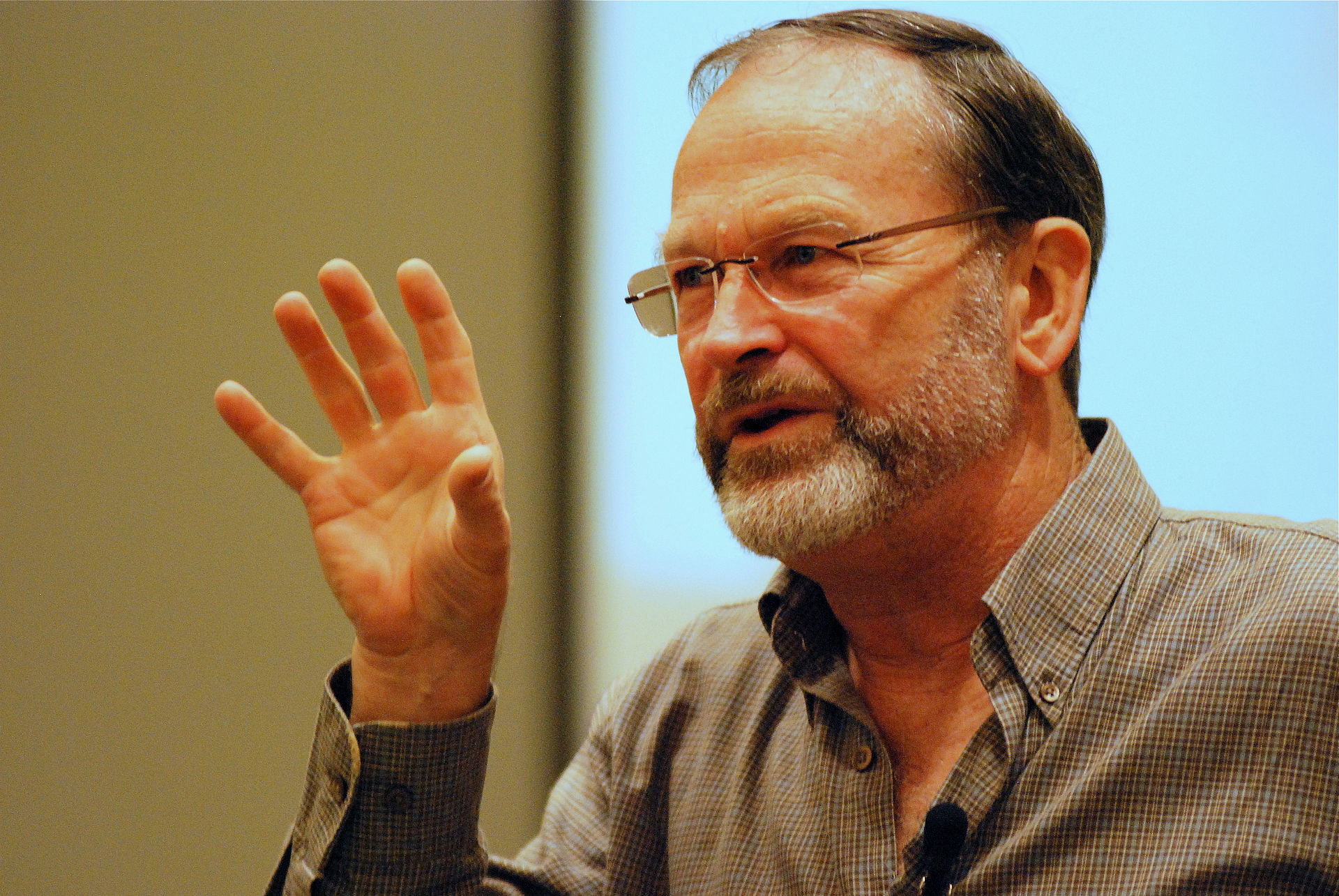
Dr. Bill Rees, Professor Emeritus from the University of British Columbia, gave a presentation on our overshoot predicament earlier this month to a zoom meeting of the Canadian Association for the Club of Rome (CACOR).
I’m a longtime fan of Dr. Rees and consider him to be one of the most aware and knowledgeable people on the planet.
This is, I believe, the best talk I’ve seen by Dr. Rees and he covers all of the important issues, including topics like overpopulation that most of his peers avoid.
Presentations like this will probably not change our trajectory but nevertheless I find some comfort knowing there are a few other people thinking about the same issues. This can be a very lonely space.
The Q&A is also very good. I found it interesting to hear how much effort Dr. Rees has made to educate our leaders about what we should be doing to reduce future suffering. He was frank that no one to date, including the Green party, is open to his message. Not surprising, but sad. Also inspiring that someone of his stature is at least trying.
Summary
Climate-change and other environmental organizations urge governments to act decisively/rapidly to decarbonize the economy and halt further development of fossil fuel reserves. These demands arguably betray:
– ignorance of the role of energy in the modern economy;
– ill-justified confidence in society’s ability to transition to 100% green renewable energy;
– no appreciation of the ecological consequences of attempting to do so and;
– little understanding of the social implications.
Without questioning the need to abandon fossil fuels, I will argue that the dream of a smooth energy transition is little more than a comforting shared illusion. Moreover, even if it were possible it would not solve climate change and would exacerbate the real existential threat facing society, namely overshoot.
I then explore some of the consequences and implications of (the necessary) abandonment of fossil fuels in the absence of adequate substitutes, and how governments and MTI society should be responding to these unspoken biophysical realities.
Biography
Dr. William Rees is a population ecologist, ecological economist, Professor Emeritus, and former Director of the University of British Columbia’s School of Community and Regional Planning.
His academic research focuses on the biophysical prerequisites for sustainability. This focus led to co-development (with his graduate students) of ecological footprint analysis, a quantitative tool that shows definitively that the human enterprise is in dysfunctional overshoot. (We would need five Earth-like planets to support just the present world population sustainably with existing technologies at North American material standards.)
Frustrated by political unresponsiveness to worsening indicators, Dr. Rees also studies the biological and psycho-cognitive barriers to environmentally rational behavior and policies. He has authored hundreds of peer reviewed and popular articles on these topics. Dr. Rees is a Fellow of Royal Society of Canada and also a Fellow of the Post-Carbon Institute; a founding member and former President of the Canadian Society for Ecological Economics; a founding Director of the OneEarth Initiative; and a Director of The Real Green New Deal. He was a full member of the Club of Rome from 2013 until 2018. His international awards include the Boulding Memorial Award in Ecological Economics, the Herman Daly Award in Ecological Economics and a Blue Planet Prize (jointly with his former student, Dr. Mathis Wackernagel).
I left the following comment on YouTube:
I’m a fellow British Columbian and longtime admirer of Dr. Rees. Thank you for the excellent presentation.
I agree with Dr. Rees’ prescription for what needs to be done but I think there’s a step that must precede his first step of acknowledging our overshoot predicament.
Given the magnitude and many dimensions of our predicament an obvious question is why do so few people see it?
I found a theory by Dr. Ajit Varki that provides a plausible explanation, and answers other important questions about our unique species.
The Mind Over Reality Transition (MORT) theory posits that the human species with its uniquely powerful intelligence exists because it evolved to deny unpleasant realities.
If true, this implies that the first step to any positive meaningful change must be to acknowledge our tendency to deny unpleasant realities.
Varki explains his theory here:
https://link.springer.com/chapter/10.1007%2F978-3-030-25466-7_6
A nice video summary by Varki is here:
https://www.youtube.com/watch?v=dqgYqW2Kgkg
My interpretations of the theory are here:
https://un-denial.com/denial-2/theory-short/https://un-denial.com/2015/11/12/undenial-manifesto-energy-and-denial/
 un-Denial
I remember talking to a neighbour once and I commented how it will be impossible to run the fish farms without diesel. When diesel gets scarce the fish farms will go out of business. I was immediately told that we would find alternative solutions. I very much doubt it.
I became aware of peak oil in 2006. For quite a few years I deluded myself that we would find solutions. Since about 2015 I’ve come to the conclusion that there is no alternative solutions. I don’t think there is such thing as a sustainable civilisation. All civilisations are dependant on agriculture and any society that is dependant on agriculture for its sustenance is ultimately doomed. This is because agriculture is essentially a mining operation. Sure you can delay the depletion of soil nutrients but you can’t stop it altogether and eventually soil becomes depleted of nutrients and the gig is up. Even Jack Albert’s plan would be doomed because of this.
We’re headed back to the stone age in my view and denial will be an vital ingredient for good mental health in such an world.
LikeLiked by 3 people
I believe Jack Alpert has acknowledged that his plan still requires a technology breakthrough like fusion because the hydro dams his small modern population depends on will silt in after a couple hundred years. I can’t remember what Jack’s plan was for food but I imagine you could create ammonia fertilizer with abundant hydro electricity, or maybe he assumes some natural gas use will continue.
Perran, even though you’re probably right in the long term I still think a wise species would proactively reduce it’s populaiton to reduce suffering and to buy time and options.
But we’re not wise and we deny our situation.
LikeLiked by 3 people
Your right about getting the population down. In many respects it’s not the inevitability of collapse that gets me down. It’s what 8 billion hungry humans are going to do to the biosphere in the process. There simply won’t be a tree left standing in many areas. I hate to think what is going to happen to the countryside surrounding Australia’s largest cities once we’ve burnt through the last of the coal and natural gas.
This is a very long read but well researched. Made me mad
https://joomi.substack.com/p/i-was-deceived-about-covid-vaccine?s=r
LikeLiked by 2 people
Yes, the impact of 8 billion desperate hungry humans on other species will be brutal.
That article is an excellent compilation of the covid issues.
Of late the focus of my anger has been shifting away from our leaders towards the majority of citizens who support bad covid polices. I’m thinking our leaders are just alpha versions of idiot citizens.
LikeLike
What do you think of his approach (Ernst Gotsch) : https://www.youtube.com/watch?v=_ST9NyHf09M ?
And him (Masanobu Fukuoka) : https://www.youtube.com/watch?v=2goMfMEf6TY ?
Shouldn’t we try, at least ? (feeding ourselves while being of use to other life on the planet. Simple, morally sound life, for a change.)
Being even more radical, it is also the possibility of recognizing that despair is only possible through the lens of our identification (with the human body, human kind, etc…) But, one can identify with the whole planet, or more. Aren’t we as much a part of the system as the system itself ? (aka, a golden necklace is still gold, a wave is also in a way the ocean, a flower is a flowering of the field)
Because denial, is only denial for a mind identified with humanity. Don’t you think ?
Isn’t this the opportunity for a galilean revolution : instead of seeing the world as revolving around humanity, to recognize there is much more to it than just that. The end of anthropocentrism (rather than the end of the anthropocene)
Ultimately, I believe humans can’t understand a thing. And it’s not really denial. It’s just that humans are so limited. So little things. We are not meant for understanding the world. We are meant for experiencing it (as humans) for a little while.
Sorry for packing so many things in a comment. For a rational mind like yours, this will be probably dismissed as “pseudo-spiritual claptrap”. If you see it that way, that’s fine with me. I guess this is all just an invitation of looking at the world from a different (but still sensical) standpoint.
Enjoy.
LikeLike
Hi Charles,
It’s Gaia Gardener here wanting to say I see and hear you and share your viewpoint. I completely understand what you mean when you say we’re at once infinitesimally insignificant and yet part of the whole at the same time. Just having consciousness to appreciate this does my mind in, like staring up at the night sky and just losing oneself to the incomprehensible vastness. In my humble and so limited human experience, I have come to the conclusion that I find the most joy and meaning in the simple things which allows me to find connection and share kindness in each aware moment. It took a while to come up with my moniker but I am most at home with calling myself a caretaker of this earth, as best as I can wherever I am planted. I’ve read Fukuoka’s One Straw Revolution, now there’s an inspiring manifesto of how to tread softly on our earth and finding our place upon it. I trust you and your family are well, tending your inner and outer garden and reaping the bounty of your labours.
LikeLike
Yes. I am glad you sense it too. This is all really so beautiful… I am in everlasting awe.
LikeLike
Hi Charles, Fukuoka is inspiring. I also find David Holmgren and Wendell Berry inspiring.
Let’s hope that those who remain after our population drops to a sustainable level are able to live like that.
LikeLike
Agreed to all that.
Just out of intellectual curiosity, what would be the sustainable world population? 1 billion as in before the industrial revolution? Less because of the various damages to the planet since? Or more, because of yet another agricultural revolution in the doing, of which natural farming, regenerative agriculture, agroforestry, syntropic agriculture, insect farming, algae farming, synthetic food are all various premises (or to summary by diminishing the energy losses in farming or reducing our trophic height)?
LikeLike
The sustainable population level is probably unknowable give the complexity of the system, and it will definitely be dependent on lifestyle and consumption.
I’d guess maybe 50 million living as middle class Canadians or 1 billion living as poor peasants.
LikeLike
Thank you. Great answer. Indeed lifestyle is a crucial factor.
Just to get an idea of the scale of change you envision: how long do you think will it take us to get to the 50 million/1 billion range?
10 years from now, as in a brutally fast crash? Or not before 2100? It makes a world of difference, don’t you think?
I don’t want to influence your answer, but I personally believe this is going to be very fast (something like less than 20 years starting from around 2025). Phase transitions occur rapidly and we did everything to postpone the inevitable (in my eyes, the Seneca effect appears to be a valid model).
LikeLike
I don’t know but I lean to a fairly quick collapse. Everything we have done to extend and pretend growth and business as usual will result in a steeper downslope.
For example:
– instead of gradually shrinking government expenditures to align with what we can afford we have created a dangerous debt bubble that will do much damage when it pops
– instead of gradually making do with less oil as conventional reserves deplete we force them to produce at a high rate with water injection causing a eventual abrupt end
– instead of adjusting our agriculture to align with sustainable resources we draw down non-renewable aquifers until they’re gone
– instead of reducing the complexity of the infrastructure and products we depend on to survive we have increased the complexity and fragility of everything
– instead of reducing the wealth gap in preparation for scarcity we have increased the wealth gap which guarantees dangerous social unrest
– instead of building trust in the institutions that lead us in preparation for difficult decisions we have permitted special interests and corruption to destroy trust
– etc.
LikeLike
Interesting and so true. I was however expecting a rather more pessimistic answer.
Because this seems to leave room for a less dire scenario. That of a two speed collapse. We would lose the industrial civilization pretty quickly, but still retain the ability to feed most (at least for a while).
As I see it, our modern economy is largely inefficient and not integrated: parts of the system are working against other parts of the system. We could lose transport and yet the population could disperse across the countryside. We could lose large scale agriculture, and have everybody work intensively, in small-scale food production units, rather than pushing virtual papers around an electronic world to loot state funds backed by debt. Of course, we would also lose big pharma and this would have consequences (both negative and positive for human health as we have seen lately :). We would lose the ability to produce computers and high tech weapon system, airplanes, space launches, networks, water treatment, aquifer extraction. And so really what? Cities are doomed. OK.
Yet we would also lose the associated pollution, our ability to impact the environment on a massive scale rapidly (cutting trees manually is a whole different work than using the chainsaw)
These last two years, I have sensed increasingly fast changes from the people (of course our government and institutions are rotten to the bones and mostly counter-productive). But people are moving away from the cities. Seeds and plants businesses have never been so flourishing. Young people have less babies or delayed. Community gardens have incredible success. Permaculture and trees are trending. Alternative medicines (plant based, or chinese traditional) are gaining traction. etc…
And as some have demonstrated, even deserts can change into forests in less than a generation (<30 years).
We won’t have much positive action from the top. That’s for sure. That’s where most of the denial lies. Probably because this part of the population profits the most from the existing system and fears change.
How probable a two speed collapse would seem to you? How integrated does the modern economy seem to you (I mean would losing a part of the system necessarily mean losing everything at once)? Does it largely depend from country to country on the current demography and geography. Or does it all boil down to belief (according to which, we can collectively either choose to create deserts or forests)?
Do you see the same kind of change in your part of the world?
Interesting time, isn’t it? Full of opportunities 🙂
LikeLike
Hi Charles,
I really appreciated your positively cheerful, nearly buoyant summary of much of what I have been trying to practise for some years now, not originally as a reaction to the overshoot (because until relatively recently, say in the past 5 years, I didn’t truly get the full picture of it and the finer points with MORT and MPP have only been elucidated since finding Rob’s erudite site with all generous-minded company included) but because we sought purposely to live an examined and more self-reliant and simplified life. We chose to leave the city to make a new start in a rural environment, trying to get back to the land as sanctuary and sustainment for body, mind and spirit. We have been experimenting with different ways to provide our immediate physical needs of shelter, warmth, water, and food (and oh boy, does it take an awful lot of resources to even begin to attempt self-sufficiency, an ironic oxymoron if there ever was!) We’ve learned that every tree planted needs Fort Knox caging from wildlife, composting toilets have their serious drawbacks which shouldn’t be mentioned in polite company (but amongst our secret-handshake club here, I’m most happy to elaborate if anyone is curious), and the threat of bushfire is constant and catastrophic. It has been back-breaking, relentless work in all seasons and weather, whilst one of us still has to maintain a full-time job outside the homestead, necessitating travel of 100km return and almost 2 hours of commuting daily (we get some brownie points for taking the bus). I’m totally into alternative medicine, after renouncing allegiance to allopathic medicine in which I was trained. Along the way, we have chosen not to have children and since we are both only-children, it seems like a fitting way to collapse our family tree and make some more room for other humans and fellow creatures. But 23 years on, the fruit trees are more than mature and have given back thousand-fold, we have been able to contribute to our community which adopted us, and we get to sleep totally exhausted but fulfilled every night under a starry sky. I am gobsmackingly grateful that we have been the luckiest devils (actually Tasmanian, no less) to have had an opportunity to experience this self-directed journey earlyish in our adult lives and in relative peace, prosperity and security for so long, but now the piper must be paid by all of us. I have a conscience which reminds me every day that the fact I have all these boons (and mostly just because of accident of birth, era and place of birth) does not give me equanimity nor contentment if most of my fellow human earthlings have not this chance nor ability to make different choices for their own well-being. And in the final analysis and reckoning, those of us who have more and have perhaps prepared a few steps ahead of the teeming masses, will be asked to be as generous of spirit to our fellow neighbours as the sun has been to all of us in giving light and life, asking nothing in return. For when the collapse inevitably comes, whether like a thief in the night or with an almighty crash and bang, do you not suppose that all the panicked and impotent masses will flee the cities when the lights turn off and sewers overflow to come to our doors, bidden or not, and ask for shelter, warmth, water and food? Properties in the countryside will be the destination of the throngs jumping like rats from a sinking ship, even without petrol it will only be a matter of walking a few days to reach our perceived idylls. And how can we turn another human being in need away, knowing that their suffering and doom is also our own, and kindness is the last vestige of our humanity we can save. Even if I may not live to see this eventuality, I feel it is my responsibility all the same to prepare for it. If I can help another to survive another day, that is the same as my own survival, in the universe’s evolutionary perspective, which at this stage of the game, is probably the only realistic perspective to aim for.
Speaking for me, at least, continuing to live every day to the fullest now includes trying to expand my awareness and attitudes to encompass the needs of others not in my immediate circle and how that will be in reality. I exercise these kind of mind thoughts: Being a person who guards her solitude, can I share our small house with several other families? (Ugh, that means more compost toilet woes!) The more food I have stashed, the more I will be compelled to share, will I do so happily and how far will it last? Will we be able to work together on the land in a cooperative and democratic fashion, even if the skill sets are so variable? And the ultimate test question, even if my life or my family’s is forfeit through violence, can I accept that possibility and fate with detachment for any particular outcome? Whew! Who knew overshoot, or more precisely, the undenial of, would require so much inner as well as outer readjustments? I am loving the intellectual foray encouraged by this congenially scrappy band, and I am ever more motivated to make an action to balance all the theoretical side which has us irrevocably pointed down the Seneca cliff face. For the past few years now, I have put away as much of our food as I can, saved seeds for a community level farm, invested in more sets of critical hand tools, added extra water tanks, collected books on permaculture and self-sufficiency, not just trying to secure a bit of a future for ourselves, but in the case of our demise, whoever finds these will be able to possibly benefit, even if for a little while longer. In the days we have remaining to us, I find great solace and purpose in these small but defining intentions. If there be a collective invisible hand that binds all of us, but distributes the largesse so unevenly, this is a small portion of the bounty I have received to offer back, and with all my heart.
It’s lovely to meet kindred spirits thus, once again, so much gratitude to Rob for opening this door.
All the best to everyone, and may we find courage, wisdom and compassion in equal measure as we need it.
LikeLike
Alice Friedemann wrote a summary of the book Inside North Korea’s Environmental Collapse. It explains what North Koreans did to their landscape. When there was famine, they basically ate everything https://energyskeptic.com/2014/inside-north-koreas-environmental-collapse/
LikeLiked by 2 people
Hello Monk, how are things on your side of the Tasman? That was sobering, thank you for sharing what our agricultural experiment might lead to if we don’t stop taking nutrients and organic matter out of the soil and returning chemicals instead. It’s basically desertification which is synonymous with starvation. It looks like North Korea is a modern reprise of Easter Island, one is staggered to wonder what the inhabitants were thinking when the last tree on the island was felled, their soil eroded beyond repair, and therefore their long term survival prospect was doomed. I came across a good definition of modern agriculture–the use of land to convert petroleum into food. Well, we know where that will lead! In our little permaculture experiment here in Tasmania, we’re trying to use compost to keep up fertility and a more wilderness garden approach to grow food, which we are grudgingly but surely sharing with all manner of wildlife. It’s a learning curve for sure, but there’s nothing more satisfying and frustrating at the same time.
LikeLiked by 2 people
I find that if I “share” my garden, the wildlife (deer, moles, jays, and slugs) will not share. They insist on eating everything and letting me starve.
AJ
LikeLike
LOL. The wireworms here are particularly greedy because they kill much more than they eat, and they laugh at us because our organic status prevents us from retaliating with chemicals.
LikeLike
I really feel for the people of North Korea and am amazed they somehow maintain such a huge population with such terrible living conditions.
I moved out to a small country property last year, trying to get prepared for the ‘living of the land future’ that awaits us. I’m loving it but lots of hard work. I’ve got a lot of weedy problems to tackle and very tempted to get out the glyphosate(!) My soil is very fertile though which is a plus 🙂 Every day I feel so thankful to live in Aotearoa, as I’m sure you do for living in Tassie!
LikeLike
Congratulations on your getting back to the land; what a fulfilling life mission you’ve embarked. I wish you all the best in your journey, may abundance be yours and your family’s in every way. 23 years ago we city folk left San Francisco to settle in a 4 acre property in a village of 300 people in Tassie, not even knowing how to start a fire in the woodstove–apparently locals were punting that we would give up and leave after 6 months and now we’re considered nearly locals! I think reading as much as possible from those who have worked out what works would be one piece of advice I would have heeded sooner, but then again, gaining one’s own experience from learning opportunities (mistakes) can’t be beat, it just may take a few more seasons! What’s growing in your garden now? As our climates are probably similar (we’re 43 degrees south), we’re expecting our first frost any night now which means the end of tomatoes in the hot house. It was super dry here this summer, but having a spring-fed dam is a boon! According to permaculture principles, reasonable access to the property is criteria number one, and having reliable water is second. If there is any way to manage it, having your dam at the top of your property (if you are lucky to have a slight slope) so water can be gravity fed down the entire course would be ideal. Enjoy every moment on the land, it’s really all our birthright.
LikeLiked by 1 person
Thank you so much! Very similar climate here to Tasmania, but a bit warmer where I am. We have a bore well, so lots of good water. I was fortunate to grow up on a farm and off grid, so hoping I can fire up those old skills and learn some new ones. Good skills in the one form of wealth no one can take away from you
LikeLike
Interview (recorded just before Ukraine invasion) of Dennis Meadows by Hate Hagens.
https://www.thegreatsimplification.com/episode/12-dennis-meadows
LikeLike
I did not detect any new insights from Meadows who I deeply respect other than he thinks we should not be selfish and should share our covid vaccines with poor countries so they can also enjoy their glorious benefits. 😦
LikeLiked by 1 person
Speaking of “benefits” of these experimental genetic therapy injections (I refuse to call them vaccines even though the definition has changed to include them), doesn’t it seem that it’s every other week that you hear of someone who has a serious reaction to these shots, most likely the booster by now? Or that any time someone you know has some new health problem suddenly crop up, your thoughts turn to “uh oh, I wonder if it’s related to the shot?” Personally, I know of: one person who got a severe case of shingles affecting the facial nerve in the inner ear so she endured unrelenting vertigo for 7 months, still not totally resolved; two people with heart symptoms of palpitations and irregular rhythms leading to chest pain, shortness of breath and anxiety, requiring full cardiac work-up, also unresolved; one person with hospital diagnosed Guillain-Barre, still needing ambulatory support after 6 months, two people with cancers in remission returning, and 3 elderly friends who fell off the perch rather suddenly, if not totally unexpectedly. All of these occurred within 2-4 weeks after getting the shot/booster (the cancers somewhat later). Nothing can be confirmed of course, but the congruity cannot be dismissed out of hand. And of course lots of friends with various symptoms immediately after the shot ranging from splitting headaches to prostrating fatigue, seemingly worse sequelae than the Omicron infection which, of course, it looks like we’ll get at some point, anyway. And yet they’re advocating a fourth and even fifth shot of the same! But today, for the first time, I read on MSM (the NYT) that there is doubt about the efficacy of the second booster (this sounds better than 4th failed shot) but this was immediately followed by conflicted advice that we should get it anyway if you’re over 65 and just try to time it so the peak protection period of 2 months before it wanes into oblivion coincides with your up-coming summer holiday. You just can’t make this up, or are we just witnessing total denial that it really is just all made up?
LikeLike
Thanks for sharing your personal observations. I probably have fewer friends and thus a smaller sample size but one of my friends about my age recently died unexpectedly while watching television. He was vaccinated and in reasonable health. No autopsy so we’ll never know the cause. My other data point is that the few people I know who got and recovered from covid were all vaccinated.
My current small ray of hope on covid is that insurance companies may soon force awareness of covid reality, just as they did with climate change, by raising rates.
LikeLiked by 1 person
Fascinating. Two really smart brothers, one of them a poster child for polymaths in denial, the other a leading spokesperson against corrupt covid policies, are arguing today over the effectiveness of Ivermectin.
LikeLiked by 1 person
LikeLike
The co author is a Dr Craig Rayner. He is vice president of Certara. Don’t tell me that this is not a conflict of interest. He is publicly saying that all ivermectin trials should be halted as it world be unethical. Fancy that. Fuckhead!
https://www.certara.com/services/
LikeLike
And here’s a press release from the flccc with more damning allegations regarding the together trial.
https://covid19criticalcare.com/press-releases/
This just makes me so mad. What makes doubly mad is that the average jo is going to read the hit pieces in the new York times or Sydney morning herald and believe them to be true.
I sometimes wonder what the fuck is wrong with me. Why can I see this and nobody else can.
LikeLike
It makes me crazy too. The evil is out in the open, and the majority simply don’t see it as evil AND support it.
LikeLike
I really like Karl Denninger’s spin on our inflation trap today. He reinforces my belief that central banks are now powerless and the only effective tool is to reduce government spending.
https://market-ticker.org/akcs-www?post=245537
LikeLiked by 1 person
It’s interesting that Denninger does not consider reduced military spending to be an option. That’s where I would start.
LikeLike
For what it’s worth, when I read that Medicare and Medicaid must be cut off to plug up the gaping deficit, in a way, perhaps it’s going to be. The excess deaths of the older population and those financially vulnerable in these past two years has yet to be fully realized but they are the beneficiaries of M and M and now there is less demand as that cohort seriously contracts. My mother, who lives with us, receives Social Security and this year her benefit was increased a whopping 6%, simply unheard of as prior year’s cost of living increases weren’t even enough to buy an extra magazine a month. Could it be that they had to spread the SS budget over the remaining beneficiaries?
I’m afraid that cutting the defence budget has never been on the cards and never will be now that we’re perpetually in WW3. But isn’t the national debt all an illusion anyway as long as we agree that the concept of infinity allows us to keep adding more zeros. The party is over when societal breakdown reveals that no-one will exchange necessities like food and fuel for those zeros in the ether.
LikeLiked by 2 people
Astute comment from Norman Pagett today.
https://ourfiniteworld.com/2022/03/28/no-one-will-win-in-the-russia-ukraine-conflict/comment-page-3/#comment-358184
LikeLiked by 2 people
Chris Martenson is a good man, and a wise man. Today was his first live interview.
It’s a long interview and nothing new or profound is revealed but it’s calm and pleasant and makes for a nice background while doing some other task.
LikeLike
Regard for their own interest also explains why an unproven new drug technology with sketchy effectiveness and safety data can be injected in billions with tax dollars providing both the profit and immunity from liability.
LikeLike
Jane @ OFW did a nice job a summarizing Putin’s announcement.
LikeLike
Perfectly logical.
BUT, the west is the ruler of the world and gets to change the terms at any time (always to its advantage) and you little Russia must comply. The hubris of the west (especially the U.S.) knows no bounds. There are going to be an awful lot of unemployed Europeans (especially Germans). Or they will find rubles to pay. Seems fair.
AJ
LikeLiked by 1 person
Rob, any update on the book, The real Anthony Fauci? Worth buying on kindle?
LikeLike
No, sorry I’m stuck at about a third of the way in. I do all of my reading via audiobooks while walking or working outside. It’s well researched and well written but I find it very upsetting/depressing to read so I avoid it like going to the dentist.
How is it possible that someone so corrupt and evil can hold a position of power and be supported by so many citizens and leaders?
How is it possible that news journalists are not all over the book either confirming and publishing dirt, or providing evidence to discredit the book?
Maybe I missed it but I hear silence.
Send me a message if you want help getting a copy of the ebook or audiobook.
LikeLike
Hi Perran, hope everyone in your house is totally over Covid, literally! From reading your past comments, I am of the opinion that it’s probably best for your blood pressure and general health that you don’t read The Real AF! Funnily enough, like Rob, I also only got a third of the way through before my focus turned to other things (like Ukraine and harvesting pears). It’s just too confronting to have all one’s worst suspicions laid out in no uncertain terms. I have some prior experience with the medic0-pharma incestuous relationship and I just couldn’t bear to relive it.
But, if you’re really keen to get your blood boiling, I found it here in pdf form:
Click to access kennedy_the_real_anthony_fauci.pdf
Cheers, and hope you got your paddock seeded.
LikeLiked by 1 person