
This post was inspired by a comment from reader Kira. She asked if denying climate change was the same as denying death. I answered as follows:
“I suspect there are 2 main groups of people:
One group is the 95% of the population that doesn’t really understand the science or the severity of the problem. They see bad things happening with the weather, but they also hear on the news that countries have signed an agreement to prevent the temperature from rising more than 2 degrees, and they see neighbors buying solar panels and electric cars, which they’re told by experts are solutions to climate change, so their optimism bias that comes from genetic reality denial leads them to conclude that the climate problem is being addressed, and they put it out of mind.
The other group is the 5% that does understand the science and the severity of climate change. These people have enough intelligence and education to conclude that we are already screwed regardless of what we do, and that any effective mitigation effort must involve a rapid decrease in population and/or per capita consumption. It is within this group that genetic denial of unpleasant realities is operating in full force. Most of these experts genuinely believe that climate change can be safely constrained, and economic growth can continue, by replacing fossil energy with solar/wind energy and by using machines to remove CO2 from the atmosphere. These beliefs are so absurd, and so contrary to basic high school level science, that there can be no other explanation than genetic realty denial. In this group, maybe it is death that is the main thing being denied.”
Kira said she agreed and then suggested it might be better to let people, and especially young people, remain in blissful ignorance so that they do not become depressed and lose a sense of purpose.
I thought about it and created the following decision tree of possible paths to answer her question.
- Humans are in serious trouble
- Disagree (I believe in God or Steven Pinker)
- path: Carry on and oppose anything that threatens your beliefs and lifestyle
- Agree (I believe my eyes)
- It’s too late to do anything useful (nature’s forces now dominate human forces)
- Agree (a reasonable position given the data, but only if you think other species don’t matter, and 8 billion suffering humans is no worse than 8 billion minus 1 suffering humans)
- path: Try not to think about it and enjoy the good days that remain and/or do some prepping to extend your good days
- Disagree (there’s still time to make the future less bad, even if all we do is reduce harm to other species and/or total human suffering)
- Humans can’t or won’t change their behavior in time
- Agree (most of history says we only change when forced, and the coming debt/energy/climate collapse will be too severe for any good to come of it)
- path: Try not to think about it and enjoy the good days that remain and/or do some prepping to extend your good days
- Disagree (I believe Sapolsky that behavior is plastic and we have enough energy left to build a softer landing zone)
- Genetic reality denial blocks any useful change
- Disagree (I deny that I deny reality)
- path: Make yourself feel good by recycling your garbage, shopping with reusable bags, buying an electric car, and voting Green
- Agree (it’s not possible to act optimally without understanding reality)
- Awareness of genetic realty denial will increase awareness of reality
- Disagree (most people just want to pay their bills and watch TV)
- path: Try not to think about it and enjoy the good days that remain and/or do some prepping to extend your good days
- Agree (most people want to learn)
- Awareness of reality will cause positive behavior changes
- Disagree (if the majority understood reality it would be Mad Max)
- path: Try not to think about it and enjoy the good days that remain and/or do some prepping to extend your good days
- Agree (most people want to do the right thing, especially if pain is shared fairly)
- path: Spread the word on Varki’s MORT theory and what we should be doing
- Disagree (if the majority understood reality it would be Mad Max)
- Awareness of reality will cause positive behavior changes
- Disagree (most people just want to pay their bills and watch TV)
- Awareness of genetic realty denial will increase awareness of reality
- Disagree (I deny that I deny reality)
- Genetic reality denial blocks any useful change
- Agree (most of history says we only change when forced, and the coming debt/energy/climate collapse will be too severe for any good to come of it)
- Humans can’t or won’t change their behavior in time
- Agree (a reasonable position given the data, but only if you think other species don’t matter, and 8 billion suffering humans is no worse than 8 billion minus 1 suffering humans)
- It’s too late to do anything useful (nature’s forces now dominate human forces)
- Disagree (I believe in God or Steven Pinker)
This tree of (usually subconscious) decisions a person must make to decide which path to take about human overshoot results in 7 possible paths.
Six of the paths do not improve the outcome. One of the paths might improve the outcome, but has a very low probability of success because it’s currently occupied by a single old uncharismatic antisocial engineer.
Most people who really understand our overshoot predicament would probably discard my complicated decision tree and focus on a single issue: humans can’t or won’t change.
This view was recently voiced by reader Apneaman in a comment:
But can’t/wont. Have not.
Why? Like Sabine says…………
“Now, some have tried to define free will by the “ability to have done otherwise”. But that’s just empty words. If you did one thing, there is no evidence you could have done something else because, well, you didn’t. Really there is always only your fantasy of having done otherwise.“
No plan, no matter how spiffy & technically feasible, or logical argument can convince me that the humans are capable of collective change. I’ll need to see it to believe it. Same as God. Only Jesus floating down from the firmament & performing 10 miracles that are so spectacular they would make illusionist David Copperfield blush could convince me of the supernatural.
While true that it’s difficult to cause people to collectively do things they find unpleasant, or that conflict with the MPP objectives of their genes, it’s not impossible and not without precedent. I gave the following examples:
When the Canadian government says to its citizens:
- Everyone must pay about 50% of their income as tax to operate the country.
- Most citizens comply, and those that don’t are usually caught and forced to pay an extra penalty.
- Germany has attacked our friend and we need our young men to risk their lives by fighting a war on a different continent.
- Most eligible young men volunteered.
- A virus threatens to overrun our healthcare system and we need citizens to stay at home except for essential activities which must be conducted with a mask.
- Most citizens will comply.
Now if the Canadian government said to its citizens the combined threats of climate change and diesel depletion threaten our food security within 10 years, so we are putting in place incentives to encourage local food production and processing, and to decrease food imports, I think most citizens would support the plan.
If then after a couple years of further study and communication on the threat, the government said we don’t think there will be enough food to support our population in 10 years so we are stopping immigration and requiring families to have no more than one child, I think most citizens would comply.
The issue of course is that the Canadian government is not going to acknowledge or act on our overshoot threat in this manner.
Why?
I think it’s due to our genetic tendency to deny unpleasant realities, whenever we can get away with it.
Taxes, war, and viruses are very unpleasant, but they’re in your face and impossible to deny.
Food shortages 10 years out are easy to deny.
How do we change this?
It has to start with discussing and trying to understand our genetic tendency to deny unpleasant realities. Hence the path I’ve personally chosen in the above tree.

Dear Rob,
you advocate for population reduction, which I very much agree with, but would like to know how this should be done. The common solutions I come across are the education of woman, smaller families and the rising of living standards. While one of them is simply absurd in the face of our predicament the other two are long shots at best and ignore cultural complexities. Given that they even work, do you think we have the time for these soft measures to take effect? Again, if you would be so kind, please elaborate on your ideal solutions to the population question.
I think the common solutions are too slow given the severity of our overshoot predicament. In addition, there isn’t sufficient affordable fossil energy left to raise the standard of living of 8 billion people. The standard of living for most people has already peaked and is now in a permanent downward trend.
My preferred solution is a democratically supported birth lottery in which any woman wanting a child must apply for a permit. Permits will be randomly allocated in a transparent and totally fair manner, and may not be sold or transferred. I haven’t done the math to confirm the exact numbers but I think about 1 in 200 women will receive a permit for 2 generations, after which the lottery can be abandoned.
A couple generations need to make a big sacrifice so future generations can have a decent reasonably modern lifestyle. The alternative is that future generations will experience a lot of suffering with medieval lifestyles, at best.
Kurt Cobb on mutant minks.
http://resourceinsights.blogspot.com/2020/11/is-denmark-about-to-export-more.html
Very nice primer today from Tim Watkins on the history of oil and the consequences we are experiencing of having depleted the low cost reserves of oil. It’s a must read for people trying to understand how the world actually works.
Watkins is a very good writer. It’s a lot of work to write a brief but comprehensive essay like this. Good on him. Few do it, or do it as well.
Watkins proposes an interesting new twist on the core cause of the 2008 financial crisis that I’ve not seen before:
https://consciousnessofsheep.co.uk/2020/11/06/the-narrative-problem-after-peak-oil/
An important take-away from this is that the people who run our world are basically idiots in nice suits. Don’t be fooled by their smooth confident talk. They don’t have a fucking clue. Trust your own judgement and trust the laws of physics. Watkins also concludes with this advice but uses a more politically correct tone:
I wasn’t the only one who thought Watkins’ essay was good. Zero Hedge published it today.
https://www.zerohedge.com/energy/narrative-problem-after-peak-oil
Check out the comments section for some golden evidence of reality denial. Not one person acknowledges the reality or implications of energy depletion.
It’s amazing!
Nate Hagens with a new essay published on November 2, just before the election.
https://www.energyandourfuture.org/2020/11/02/no-matter-who-wins/
Nate does not see any merit in Varki’s MORT theory, and yet most of his essay is about reality denial:
Nate now thinks complexity may prove to be our most significant risk. I agree. I frequently think about things that make my life pleasant, like for example a light bulb, and how many links in a long chain are required for me to walk into Costco and buy a light bulb at a reasonable price.
Nate explains that energy remains the biggest issue that almost everyone denies:
Nice. I’ve added this to my sidebar of favorite quotes:
This data confirms my belief that our decline, once it gets going in earnest, will be quick, meaning any personal preparations must be completed beforehand. <– hint
Nate concludes with a nice analogy:
Unfortunately there’s no mention, again, of the need for democratically supported rapid population reduction policies.
You talk about your “Costco” moment. Some 6 months ago I was driving with my wife and adult daughter down the highway in rural forested Oregon. I said to them, “. . . when you think of it everything you see around us is oil . . .”. I tried to explain to them that everything in our modern civilization, even the trees in the forest represent the fossil fuels we have used to grow, harvest, feed, manufacture, transport and run that civilization. They are both extremely well educated people and they were silent in response. With my wife most is denial, with my daughter it is willful blindness because she has heard me talk about our bleak future. Without rapid population reduction, this civilization, and probably the human species is gone.
AJ
Alice Friedemann today reviewed Tom Nichols book “The Death of Expertise”. Skipping over her partisan crap, I like the quotes she summarized from the book. They make a lot more sense when you understand that denial is proportional to the unpleasantness of the reality.
https://un-denial.com/2020/02/27/denial-is-proportional-to-the-unpleasantness-of-the-reality/
http://energyskeptic.com/2020/book-review-of-the-death-of-expertise-the-campaign-against-established-knowledge-and-why-it-matters/
Martenson’s coverage today of the election that should have been is mostly good.
caveat: I’m not sure about his demonization of central bank monetary policy. It feels like he has picked an easy target to grow subscriptions. Martenson knows credit must grow or our system collapses by design. So if not into financial assets, then where?
Adding Lex Fridman to my list of famous polymaths in denial. He’s worried about many threats to civilization except the ones that are devastating and certain.
Also adding Dan Carlin to the list because he thinks Tesla is fixing climate change.
https://un-denial.com/2018/09/03/on-famous-polymaths/
Lex Fridman has interviewed Sheldon Solomon who talks at great length about Death Anxiety and Death Denial and the extraordinary measures we take to avoid thinking about it. He seemed to agree with everything Solomon told him. Does that make sense to you?
Many people throughout history, including Solomon, have observed the powerful human tendency to deny death.
Ajit Varki expands on this common observation to explain the underlying evolutionary mechanism that causes humans to deny all unpleasant realities, not just death, and how this enabled the emergence of unique intelligence.
So to answer your question, a person can acknowledge denial of death and completely miss what is important.
I guess what I am trying to ask is that acknowledging or accepting the denial of death seems to have no effect on a person’s behavior and their way of life, so what is the point of acknowledging it other than to may be momentarily reflect on your life and panic a little? As soon as you return to the world of supernormal stimuli, you will forget all about it even if you have accepted it.
For me there is no point to accepting that death is final, other than perhaps some religions that block population reduction policies might go away.
The bigger issue is that we deny everything that is unpleasant, and it is very important that we acknowledge this behavior because it is making our overshoot predicament much worse than it needs to be.
If the end result that is desirable is that people must acknowledge the overshoot predicament then I don’t think that acceptance of mortality is an absolute requirement since I know many people who understand issues like resource depletion, climate change and other pertinent issues and have altered their lifestyle with meaningful changes not just superficial ones. Many have also decided to not have children and have instead opted for adoption.
Tim Morgan today explains that continuing to borrow $5 to achieve $1 of growth will no longer work.
https://surplusenergyeconomics.wordpress.com/2020/11/02/183-a-new-stark-clarity/
Canadian science rapper Baba Brinkman with a new video on the history of climate change science.
I tried unsuccessfully a few years ago to educate Baba on the thermodynamics of the economy and why we must focus on population reduction. He didn’t want to hear it.
Just another reason I don’t follow the usual “experts” within whatever this community is . . . Martenson, father of three, despite professing deep knowledge concerning Alfred Bartlett’s work before the kids were even born, ha ha!
Quote from Rodster on OFW:
Hooray, Chris Martenson has finally spoken that Covid 19 is a bunch of BS. This is the same Chris Martenson who was getting all lathered up when Covid 19 started and hyping the situation. Now he’s admitting that Covid 19 is just an excuse to bring about “The Great Reset”. It’s a damn good article Too bad it took Chris nearly 9 months to figure it out.
https://www.peakprosperity.com/we-are-pawns-in-a-bigger-game-than-we-realize/
Whoops! I meant ALBERT Bartlett.
Yes thanks, Martenson’s essay 2 days ago is very good. I focused on a different issue he discussed that interests me.
In addition, I will not forget:
– the World Health Organization being criminally incompetent and lying
– China not doing the right thing to protect the rest of the world
– my government not closing the airports months after it was clear they should be closed
– my government telling me not to wear a mask and then changing its mind without explanation
Martenson completely loses the plot in that rant. He says:
Nature didn’t do that to the population, consumerist propaganda did, via relentless repetition of the same basic underlying lies. This corrupts a population, and quite deliberately, to subdue the masses and make them follow imposed desires that are actually not possible to satisfy.
The people are dumb because the system wants them dumb, so that they consume and carry debt, rather than having them understand the system of power that stands over them and exploits them. If they were to escape the Matrix en masse, revolution would quickly bring the system of power down.
It seems that on this aspect of consumerism at least, Martensen is himself in denial. He puts a conspiracy theory first, and a realistic view of reality second. I guess every single one of us is capable of being duped, and not just by ourselves, but by the system of power.
Bill, Rodster’s reading compression leaves much to be desired. American?
Nowhere does Martenson say covid is BS or, as dumb typical American Rodster implies, it’s a plandemic.
If Martenson thought covid was BS then why would he be discussing medications & supplements to prevent or shorten the illness and not die?
If you’re quoting an idiot as ‘proof’ of something, what does that make you?
Amerisplaing. Americans are so certain. They know the truth of everything. If that was true how did America end up going from 1st to worse is a great many categories in under 2 generations?
Why should anyone listen to Americans? Americans have lost all creditability, nay ceded it and joined various crisis cults.
America the basket case shit-hole teetering on the edge of collapse & they are the last people anyone should be listening to.
If it was up to me, I’d block a shitload of American media, social media & blogs from Canadians because it’s fucking poison.
Wonderful essay Rob, I have been sharing it. Apologies if you are already familiar, but I thought you might enjoy reading this from George Tsakraklides – https://tsakraklides.com/2020/10/30/the-great-debate-are-humans-evil-or-simply-stupid/ and also along those themes and just to annoy you is a poem, you might recognize it:
I wish you would come back to our facebook group.
Hi Gail, nice of you to stop by with kind words that mean a lot because you’re such a good writer.
Thanks for the poem. I’m sure it’s a good one but you know me and poetry. I liked the pictures but struggled to understand what he’s saying. Something (I think) about wishing wolverines would strike back at us before we destroy all of nature. A good editor could remove 90% of the words in that poem and much improve the clarity of his message. 🙂
Tsakraklides is good on the what but weak on the why:
Apollo 11 proves that we are extraordinarily intelligent. The key question is, how is it possible that our extreme intelligence is not able to override our gene’s desire to execute the Maximum Power Principle? The answer as explained by Varki’s MORT theory is that our unique intelligence emerged because it co-evolved with a tendency to deny unpleasant realities. I think it’s likely that high intelligence cannot exist in the universe without reality denial.
I enjoyed participating in your Facebook group but I feel pretty good since I quit social media 16 months ago. If you ever move your group to a platform that doesn’t profit from manipulating it’s members I’d like to rejoin.
You should watch the Netflix documentary “The Social Dilemma”. Social media is really fucking up society.
About those machines that remove CO2 from the atmosphere. Peter Wadhams says that direct CO2 capture from the atmosphere must be carried out on a massive scale and that other “solutions” even in combination will be insufficient.
https://extinctionradio.net/episode-104-3rd-october-2020-peter-wadhams/
My quick reality check on DAC is as follows.
The minimum energy required by the the second law of thermodynamics is around 500 kJ/kg for CO2 separated from ambient air. We’re putting 42 billion tons of CO2 into the atmosphere per year. Taking the same amount out by DAC would require a theoretical minimum of 21 EJ of energy per year.
However, scientists writing in 2011 at https://www.pnas.org/content/108/51/20428
assume a second-law efficiency of 5% for air capture systems. Thus around 420 EJ of carbon-free energy per year is required for DAC. But because we want to remove net CO2 from the atmosphere, we need more energy. World primary power production is 650 EJ/year, of which I think perhaps 100 EJ/year is carbon-free. In the unlikely case that I did the maths right, DAC doesn’t seem feasible unless its energy efficiency is much improved.
Thank you. CO2 capture by machines is crazy talk rooted in desperation. Storing more carbon in soils as Brandon suggests is a good idea, just not sufficient.
Rob, could you please elaborate why CO2 capture by machines is in your opinion crazy. Is my maths correct? I don’t see a mistake. Those magnificent men with their carbon capturing machines would require about 420 EJ/year of carbon-free energy which is several times more than we are producing today with nuclear/hydroelectric/wind/solar and would amount to two thirds of the current total primary power production. Then there is the obvious problem with logistics: we would have incredible amounts of carbon near those energy-hungry machines.
LMAO, I think you answered your own question.
The interesting questions are, how is it possible that so many intelligent people with impressive educations consider this carbon capture lunacy to be a serious option, and why don’t they focus on the obvious thing we should do, rapidly reduce our population?
I think Varki’s MORT theory provides the answer: humans evolved to deny unpleasant realities.
It is sort of fun and sad at the same time to sit back and watch what happens here. I am coming to a view that this site is a metaphorical ship of the dead.
You guys are shit scared and powerless, and you use doomer humour as a coping mechanism. You give up on the world, and huddle here in shared misery, like a bunch of bar flies in a run down corner of town.
You are fed a constant stream of reasons to be fearful, reinforcing the habituated presumption that there is nothing we can do as a collective – even as a tiny minority – to change our fate. Constructive comments are as unwelcome as an outside intruder into that dark and dingy hideaway, the door opening and allowing bright sunlight to highlight the decrepitude of the place.
I can see directly that not all of those paying attention here are totally convinced that nothing constructive can be done. I see the numbers of people in the statistics on my site that many have at least explored the constructive resources on offer.
Let me suggest a theme song:
Crank it up …
Show me how to make a solar panel, a wind turbine, and a nuclear reactor without any fossil fuel and I will believe in consumption forever
I love our rare gig on this planet and am horrified about our situation. I went deep into the science of every action we might take and concluded there is only one good action: population reduction.
Rapidly reducing our numbers improves every threat we face, and for those threats that can’t be fixed, will reduce suffering and create a better life for those that remain.
You can’t even say the words “rapid population reduction” preferring to promote some green fantasies that will not help.
The fact you cannot accept population reduction as a focus reinforces my belief that Varki’s MORT theory is correct and you are the one that is scared.
Whenever I begin to doubt our future I just watch this guy and know everything is going to be all right.
Funny stuff … thanks
Living in the USA, I can attest to what Apneaman has to say about us. The fact that 62 million people voted for Trump the first time around and a similar number will again says a lot about the mental state of the nation. The main problem with both parties and just about everyone else is that they don’t have a clue about the issues discussed on your website. Instead they’re mostly concerned about day to day living and are pulled along by the internal momentum of what Nate Hagens called the “super organism”. I’ve considered myself an aware person, having read the Population bomb, The Limits to Growth, and many more when I was young. It’s only since I stopped working 14 years ago that I’ve taken the time to immerse myself in systems thinking. The problem is that this is hard work mentally. It’s a lot to take in. There’s always more to learn. The overwhelming majority aren’t suddenly going to do their homework and realize that we are living in overshoot and that we better change direction. The bottom line is that we are all along for the ride wherever it takes us.
Everything’s normal, let’s deny reality and remember it’s Christmas time, (sarcastic) the season of love, happiness and spending like there’s no tomorrow (because there isn’t!!).
AJ
It’s October 30. I heard Christmas carols in Home Depot today.
I think the symptoms of overshoot, like declining standards of living, a widening wealth gap, rising debt, impossible to deny climate change, etc., are at the root of why civilization is going crazy simultaneously everywhere on the planet.
In the second must watch interview by Joe Rogan this week, his guest Tristan Harris makes an excellent case that social media amplifies and accelerates inherent human lunacy, and in some cases, is at the root of the lunacy.
Social media is a big amplifier, but history is filled with societies under big pressure losing their shit. 1930’s Germany had no internet & look at all the the myths & cultish horse shit they gladly adopted & used to justify their aggression & slaughter. They were culturally & technologically sophisticated. As good as any others, yet they lost their shit big time.
The ideology, religion & scapegoating are pretextes. The humans need to rationalize their hate & blame so as to justify rubbing out the other tribes….which they’ll do anyway. It’s about power & survival. When overshoot consequences & the fear they produce are wide spread their dark side comes out. Not a word need be spoken.
How many bourgeoisie American boomer doomers have you seen lose their shit & objectivity & jump on one or the other tribal band wagons and spew the dogma with all the hate & passion typical of new converts. Kuntsler & Cohen are standouts. All that research on energy decline, past collapses, anthropology, evolution, thermodynamics, complex systems, etc — out the fucking window. Now their fear has reduced them to barking out dumb American canned MAGA slogans. now the only explanation is it’s the libtards & super vague Deep States fault. Fuck them. Primitive terrified chimps. Contradicting 15-20 years of studious collapse analyse – books, blogs, interviews. Their tribing up is endemic & was 100% predicted in Jay Hansons overshoot loop because Jay knew our history.
Ever wonder why conspiracies are Americas #1 manufactured product? Because only people who truely think they are exceptional could attempt that level of self flattery.
I’m so fucking special that 20 million operatives from multiple evil cabals have dedicated their entire lives to try & fool me-N-steal my freedom(imaginary). They all wake up at 4am to get the jump on me, but I see all…………………….I have youtube.
Me me me…I’m American look at me me me….I’m so fucking exceptional & important…me me me give me more attention. Me & my sub-tribe are 100% innocent. It’s the other sub-tribe & this super long list___________________of foreign countries & secret organizations who are to blame for America going from 1st to worst in under 2 generations.
When there’s almost no one left who has not fallen prey to fear – that’s pretty much social collapse.
Save me….. from BLM, Proudboys, Antifa, MAGA-tards & the rest of the Meth Lab nutters. 54 years of listening to those cunts endless LOUD babble. I’m blacking out for a month. I’m tired of their clown show & meaningless political theatre. If they have another civil war, text me when it’s over.
Amen brother.
I’ve been clean and sober of social media for 16 months and I feel GREAT!
Enjoy your blackout.
Hi Folks,
“Rich soils exponentially increase the capture of water and carbon.”
This is accurate, to a point.
That point being when soils are saturated with Carbon they will no longer be a sink.
we need to take 200 billion tons of Carbon out of the atmosphere.
With best farm, forest and wetlands management practices,
we could sequester in soils a net one billion tons of Carbon per year, or
30 billion tons by 2050.
Soil IS part of the Carbon sequestering solution, but many billions of tons will have to come from other efforts.
drawdown.org
REAL money goes to farmers and others for effective sequestration efforts.
I saw this as a simple, reasonable effort to lowering my footprint on Earth.
My understanding is population reduction is going to happen, and
I would like to see this as a conscious process rather than
just letting nature take its course.
For millemnia farmers/ranchers have understood the concept of
sustainable stocking density on a bounded, finite piece of land.
Humans need to understand this on the scale of our finite planet, and that
we will only live healthy lives when biodiversity is healthy, meaning we leave
significant amounts of land and ocean for other animals and plants.
Thanks and good heath, Weogo
Thanks.
The scale of our overshoot predicament is the issue: 30 billion tons out of the required 200 is a rounding error. Even if we magically capture 200 billion tons the Arctic won’t re-freeze. We’re going to have to adapt which will be much easier with fewer people.
A meaningful carbon tax will reduce emissions by shrinking the economy, but it will be sold as neutral or positive for the economy, which will cause a public backlash. Much better to be honest and simply tell people we must shrink the economy and the population.
Raising the interest rate would accomplish the same thing as a carbon tax but is much simpler.
Nate Hagens here provides additional reasons a carbon tax is a bad idea:
https://un-denial.com/2015/10/27/by-nate-hagens-carbon-fee-and-dividend-it-wont-work/
The Hansen proposal is a half solution.
For it to be a full fee and dividend solution, the dividends must be paid out for carbon sinking, otherwise there is no driver of the switch to regenerative agriculture, and no driver to protect and restore natural carbon sinks.
Using the dividend for any purpose other than carbon sinking only addresses one side of the ledger. It will exploit the power of pricing signals to reduce the volume of emissions created by the industrial system, but completely fail to recognise and exploit nature’s enormous power to sink carbon.
Both Hansen and Hagens need to be made aware of the full argument for carbon fee and dividend, because there is no point debating a half measure. I would like to debate and improve the argument for the full carbon sinking solution that I have proposed before putting it Hansen and Hagens, but you have made it clear that you don’t want me to do that here, because it would expose truth that violates your existing beliefs.
So, in the spirit of wanting to be constructive, or to at least appear to be constructive, if you can’t get Hansen and Hagens to come and debate the full solution here, you could at least point me towards whichever forum you think might be most open to free and fair debate. It would be tedious for me to have to make the case from scratch on say 15 to 20 different blogs.
https://www.zerohedge.com/markets/exxon-firing-15-its-workers-keep-dividend
I hope this post is okay, I’m a very bad writer. I don’t see how Brandon’s well meaning plan could possibly work. I like Jack Alpert’s plan but it is way too unpopular; we won’t do it and hydroelectricity has its problems too. Jean-Marc Jancovici (a well-known French consulting engineer and teacher in energy and climate) supports nuclear energy, despite its problems. My on-line translated summary of his 2020 interviews (at https://jancovici.com) is as follows.
The industrial revolution has consisted in abandoning renewable energies for fossil fuels. If renewable energies were equal or superior to fossil energies, there would have been no reason to switch from windmills to oil. Oil is extremely energy dense, it is easy to transport and store; behind it, a few other energies are not far behind: coal, gas and nuclear power.
Intermittent and diffuse energies (wind and sun) have been abandoned to build our civilization of controllable machines. Today, wind turbines are inexpensive because we have fossil fuels and globalized chains! Their masts are made with coal, their studs with cement made with gas, inside there is copper made with coal, all this is transported from the other side of the world with oil… The low price of wind turbines and solar panels is based on fossil fuels. When these fuels are no longer there at all, the price of anything and everything will become much higher, including wind and solar collection devices…
Back in 1500 the world was 100% renewable. An “all renewable” world is the only one that our species has known between its appearance, 20,000 years ago, and … the beginning of the industrial revolution. So there is no physical problem to go back to it. What is not possible is to return to it with 500 million inhabitants in Europe, and 35,000 euros of GDP per person per year, and paid pensions until the age of 85.
The industrial revolution is to have added to men, thanks to fossil fuels, the ever-growing strength of an ever-growing fleet of machines, which process matter instead of our arms and legs, and which now do everything in our place: crops, clothing, housing, roads and bridges, transportation, and the billion different products that can be found in the world.
Continuing to power the same over-powerful machinery with just renewable energies will not be possible. A 100% renewables world is therefore a world where the number of machines that can be added per person will be considerably smaller, and the economic translation of the business is a much smaller GDP per person as well. This is what politics has not understood, or pretends not to understand (it’s hard to know!): a 100% renewables world is a world where purchasing power has decreased a lot. I’m not saying that we shouldn’t do it, I’m just saying that it’s lying to promise it without a strong contraction of consumption…
Let’s now compare nuclear power to hydroelectricity, a renewable energy. It is necessary to drown sometimes impressive surfaces to create the reservoir. For example, the lake of the Guri dam in Venezuela has an area of 4500 km2 (as much as a French department) for a power of 6 EPR, which would require 2000 to 3000 times less space for the same power. Hydropower is also much more deadly than nuclear power. According to the UN, the deadliest nuclear accident in history is that of Chernobyl. There were a few dozen deaths at the time of the accident, there will be a few hundred cases of premature deaths among children at the time of the accident who developed thyroid cancer, and finally there are the premature deaths due to evacuation, resulting from the stress that increases risky behavior such as alcohol or tobacco (the figures are hard to find, say a few thousand in order of magnitude). On the other hand, the world’s deadliest dam accident in China in the seventies caused between 20,000 and 100,000 deaths. In Europe, the rupture of the Vajont-Longarone dam (Italy) in 1963 caused 2,000 deaths and destroyed many villages in the valley downstream. And the evacuation for the Three Gorges Dam, perfectly renewable, affected one million people, six times more than at Chernobyl!
Then let’s take the criterion of waste: nuclear power produces it, like all forms of energy (there is no energy without waste), but, since very small quantities of material have been used to power the plants, at the end of the day there are very small quantities of waste. They are dangerous, but in very small quantities. All of the truly hazardous waste that the French nuclear power plants have produced since they began operating is in a pool at La Hague. It is certainly junk, but it is managed, whereas the “junk” of fossil fuels is dispersed in the atmosphere, and for “modern” renewables (wind and solar), the multiplication of mines and upstream industry also generates waste.
“I don’t see how Brandon’s well meaning plan could possibly work.”
Fair enough. Why not? What are the obstacles you see?
Maybe your doubts are justified, and I will need to consider how to adjust my argument once I am made aware of those obstacles. Or maybe your doubts are the result of miscommunication, and I can eliminate them with better explanations, and answers to more detailed questions.
I am happy with either outcome, because both represent opportunities to improve the argument for positive change.
Or maybe you are wrong and should shift your focus to population reduction.
Extraordinary claims require extraordinary evidence. Provide evidence, not arguments.
Provide evidence of what? That carbon prices work? No rational mind could conclude that they don’t. There are lots of resources linked or mentioned here to explore and ponder:
https://en.wikipedia.org/wiki/Carbon_price
I think it is pretty clear that if you were willing to debate my argument you would find the weakest point and challenge it.
Never mind, there are plenty of other bloggers on the list. It was always going to be a huge challenge to maintain a debate with people who have invested part of their identity in the brotherhood of doomers, but I am up to that challenge if you change your mind and decide to debate the argument, rather than dismiss the conclusions without reason. Cheers.
Thanks X, good quote. I have huge respect for Jean-Marc Jancovici. He’s a rare individual that speaks clearly and accurately without denying reality.
This is a very good talk by Jancovici:
Jancovici, born in 1962:
[Wikipedia] He is married and has two daughters.
He eats little meat, uses public transport, has no cellphone and avoids air travel whenever possible.
——————
His efforts are better than nothing, I suppose, since he obviously didn’t take the concept of overpopulation seriously.
Or maybe he came to understand our predicament later in life after having a family.
I rather doubt he was that poorly educated, Rob. As with most of these experts, he probably complied in order to keep the spouse happy.
I like this cranky comment from Gene K. on YouTube concerning another expert with three kids:
“So if I don’t have a kid, I can make 36 round trip flights to Europe every year? Well, I never had any kids but I’ll be satisfied with one round trip a year, OK? I knew when I was 13 years old that the Earth was overpopulated and that was in 1963. I had read Silent Spring and some of Aldous Huxley’s essays on the subject. So I don’t want to hear the excuse “I had kids before I was aware of environmental problems”. Just don’t ever lecture me if you’ve had kids.”
I subscribe to the theory that most people deny reality. In my case, I was highly educated but in complete denial for the first 50 years of my life, until a sabbatical from the matrix allowed me to think about the depletion of non-renewable resources, and then the flood gates of awareness opened.
I’m poorly educated by society’s standards. ‘Dropped out’ after grade 9 (15 years old). Started drinking & smoking weed & cigarettes two weeks into grade 8. Was not to attentive those last two years, but I passed.
6-7 years later I studied for 2 week then took & passed the GED so I could attend trade school at BCIT. I also attended free maths tutoring classes for enrolled students at BCIT in the evenings for a few months to catch up on 8-12 maths. Had to pass a mature student entrance exam to get in computer tech school.
Most everything I’ve learned about history, science, finance, Overshoot, etc is from reading, free lectures (mostly internet) & listening to y’all high dollar educated folks ideas & doing the recommended reading. I’ve been turned onto the most interesting stuff with the greatest explanatory power from little blogs like this one, megacancer & many more. Both the blog owners & the commenters. I’ve been a super curious reading fool since grade 2-3 & pestered my folks with endless why? why? questions. My folks went to university & we had plenty of reference books – encyclopedias, atlases, dictionaries, War chronologies, etc. This is long before the internet. I’d say, ‘Dad, what’s the capital of Sweden? Dad – ‘look it up’. Dad, what’s another word for “angry” Dad -‘look it up’…’in the thesauruses’. I knew a bunch, but doomer folks pointed out connections I never thought of or had ever come across in reading. I still learn ever day. It’s obsessive like. It’s connected our survival drive. Some men accumulate money, some pump iron or buy gunz & some arm themselves with knowledge.
Higher Ed & denial are hitched. Same for anything status & authority related. Big investment – degree, years of ladder climbing, mortgage, marriage, kids, etc. Indoctrinated at every level & trapped by your responsibilities. I’m guessing highly vocal doomers get that ‘talking to’ at work & either zip it or go bye bye.
I agree. I think denial is a prerequisite for success in today’s economy. You cannot be aware and function normally in the matrix.
Today? History is riddled with dead, banished, black mailed & imprisoned critical thinkers & truth speakers.
Educated white people like to brag (cherry pick) how western society & democracy are (cue dramatic music) rooted in the glorious past of the noble & wise ancient Greeks.
Indeed
The public’s hatred of Socrates
Part of the fascination of Plato’s Apology consists in the fact that it presents a man who takes extraordinary steps throughout his life to be of the greatest possible value to his community but whose efforts, far from earning him the gratitude and honour he thinks he deserves, lead to his condemnation and death at the hands of the very people he seeks to serve. Socrates is painfully aware that he is a hated figure and that this is what has led to the accusations against him. He has little money and no political savvy or influence, and he has paid little attention to his family and household—all in order to serve the public that now reviles him. What went wrong?
https://www.britannica.com/biography/Socrates/The-publics-hatred-of-Socrates
They also avoid mentioning socially acceptable pederasty in Ancient Greece or that many great (true) Greek warriors were openly bi sexual. Spartans, Alexander the Great – liked to fuck each other on those cold nights while on campaign.
Thousands of schools adopt The Spartans as their athletic teams symbol. Think they tell them? No, but only because we must protect the children. From what? The truth. Denial is baked into chimp civilization. The higher one climbs the ladder the more sophisticated pretending they must do. Hell we have even medialized those who, through no fault of their own, lack the game playing software – autistic.
You’re the only doomer/site creator, Rob, who welcomes discussion about human overpopulation, with the exception of Sam Mitchell, whom I find unwatchable. Everyone else is too personally defensive to allow much conversation, so kudos to you.
Here is an Aldous Huxley interview from 1958, ignored by the herd, as usual:
[Quote from article] Overpopulation, manipulative politics, imbalances of societal power, addictive drugs, even more addictive technologies: these and other developments have pushed not just democracy but civilization itself to the brink.
http://www.openculture.com/2018/04/aldous-huxley-tells-mike-wallace-what-will-destroy-democracy-overpopulation-drugs-insidious-technology-1958.html
Summary of Art Berman interview today:
– diesel consumption is the best barometer of the economy and it’s down 30%
– the recovery has stalled
– situation today is much worse than the 2008 GFC
– it took 5 years to recover from 2008, it’ll take longer this time because we fixed the 2008 debt problem with more debt
– even if the virus goes away, the economy is toast for a long time
– money is a claim on energy, debt is a lien on future energy
– the world is a bank risk because we don’t have the oil to repay our debt
– the system must reset (or collapse)
– the endgame will be deflationary
– we won WWII because Germany and Japan didn’t have enough oil
– it will become painfully obvious that replacing fossil energy with renewables results in a world we’re not willing to accept
– the only reason we have 7.5B people on the planet is because of fertilizer that is 100% reliant on fossil energy
– if the world standard of living drops even 10%, billions will starve
– there will be another phase change back towards support for fossil energy
– politicians are only motivated to keep their jobs
– our leaders are energy morons
Must watch interview with Glenn Greenwald.
Arctic Ocean: why winter sea ice has stalled, and what it means for the rest of the world
“In the last 40 years, multi-year ice has shrunk by about half. At some time in the next few decades, scientists expect the world will see an ice-free Arctic Ocean throughout the summer, with worrying consequences for the rest of the climate system. That prospect got much closer in 2020, due in part to the exceptional summer heatwave that roiled the Russian Arctic.”
https://theconversation.com/arctic-ocean-why-winter-sea-ice-has-stalled-and-what-it-means-for-the-rest-of-the-world-148753
‘Sleeping giant’ Arctic methane deposits starting to release, scientists find
Exclusive: expedition discovers new source of greenhouse gas off East Siberian coast has been triggered
“Scientists have found evidence that frozen methane deposits in the Arctic Ocean – known as the “sleeping giants of the carbon cycle” – have started to be released over a large area of the continental slope off the East Siberian coast, the Guardian can reveal.
High levels of the potent greenhouse gas have been detected down to a depth of 350 metres in the Laptev Sea near Russia, prompting concern among researchers that a new climate feedback loop may have been triggered that could accelerate the pace of global heating.
The slope sediments in the Arctic contain a huge quantity of frozen methane and other gases – known as hydrates. Methane has a warming effect 80 times stronger than carbon dioxide over 20 years. The United States Geological Survey has previously listed Arctic hydrate destabilisation as one of four most serious scenarios for abrupt climate change.
The international team onboard the Russian research ship R/V Akademik Keldysh said most of the bubbles were currently dissolving in the water but methane levels at the surface were four to eight times what would normally be expected and this was venting into the atmosphere.”
https://www.theguardian.com/science/2020/oct/27/sleeping-giant-arctic-methane-deposits-starting-to-release-scientists-find
Finally, a physicist brings some clarity to the muddled thinking of health experts.
I thought maybe my essay on Eric Weinstein as a case study in denial might of shamed him off the internet since he stopped publishing podcasts shortly thereafter, but he’s back with a new 5 hour podcast in which he thrashes around trying to explain why all of our institutions have gone crazy, without ever once mentioning the word overshoot.
https://un-denial.com/2020/08/08/eric-weinstein-a-case-study-in-denial/
He’s not an idiot, so it must be genetic reality denial.
https://art19.com/shows/the-portal/episodes/1b4a34fc-8ee2-489a-af6a-0a996b89d27b
One of my favorite hobbies is cooking and I like to understand the history and science behind recipes. The bible for cooking science is Harold McGee’s book but for YouTube video you can’t beat Adam Ragusea. His video today on the history of pork is very interesting.
On another forum Brandon Young ends his post this way: “Capitalism can easily solve the problem of climate change, without intervention by governments, as long as market outcomes are controlled with incentives on the global scale to produce the optimal mix of economic activities.” Hallelujah! So John Lennon didn’t have a clue and all you need isn’t love. It’s capitalism!
Please read all about the human condition at
https://graalin.blogspot.com/
The problem with assuming that a price on carbon will solve climate change is that it assumes there is a non-carbon source of energy that can keep 8 billion people alive, let alone comfortable. Such an energy source does not exist. So we are forced back to the only solution, population reduction, which is “ism” agnostic.
“The problem with assuming that a price on carbon will solve climate change is that it assumes there is a non-carbon source of energy that can keep 8 billion people alive, let alone comfortable.”
The problem with that argument is that it doesn’t account for the fact that much of the energy is used to fuel the massively excessive overconsumption of goods and services, primarily in the most consumerised societies.
The presumption that we need to replace fossil fuel based energy with another source, and do it unit for unit, simply has to go. It does not stand up to even a simple look at how the world would change with a significant price on carbon, especially one that is used to fund carbon sinking in a frenetic global race to negative emissions targets.
An adequate price on carbon emissions would end the excessive overconsumption of goods and services in the most consumerised societies. It would dramatically reduce both the emissions intensity and the energy intensity of all goods and services, and all business processes, and all production techniques, and all choices that people make as to what to consume.
A carbon price large enough to solve climate change is an absolute brake on energy waste. It would trigger the greatest wave of innovation in human history, demanding that every market participant dramatically improve energy efficiency.
We may not be able to predict the overall volume of energy that will be required to power a negative emissions economy, but it doesn’t really matter. As long as the carbon price is dynamic, and can rise to whatever level is necessary to drive emissions negative, the mix and volume of energy sources will be continuously tested and determined by the market, changing with each wave of innovation and competition.
Most of what the global economy currently produces is waste. It is consumer products that are designed to be thrown into landfill. It is garbage manufactured food. It is all sorts of toxic chemicals used for personal and household products that people don’t actually need and that systematically drive disease like cancer. It is the consumption of goods and services that people don’t need in reality to be safe or happy, but they consume anyway, because they have been conditioned by consumerism to crave things they don’t need, to impress people they don’t know, financed by money they don’t have.
A significant price on carbon can cut away maybe 80% of the consumption in consumerised societies without making a dent in the quality of life. In fact, it would dramatically improve the quality of life, as consumer crap is replaced by more expensive but more durable, more serviceable, and more carefully produced goods.
With a significant price on carbon, energy becomes precious, and will be optimised by markets. Those businesses that do this best will survive and prosper, and those that don’t will disappear. The overall volume of energy consumption will be dramatically reduced.
The higher the price on carbon, the more circular the economy becomes. Products will necessarily be designed to be recyclable, over and over again, because of the energy costs involved in all of the resources used in the product. Every single thing produced by the industrial system will have the value of the energy used to create it as embedded value.
The presumption that the amount of energy that we need is the volume of energy that we currently consume is dead wrong. The higher the price on carbon grows, the less energy the industrial system will use, and the smaller the fraction of energy coming from fossil fuels will become.
All of this is just on one side of the net carbon emissions ledger. On the other side is the power of nature to sink vast volumes of carbon in natural carbon sinks and agricultural soils, both of which will expand profoundly under a carbon sinking reward price. This is very important, because the more that nature sinks carbon, the less the industrial system needs to cut its net emissions. It is estimated that a 5% increase in green plant growth across the planet will be enough remove the excess heat building up in the Earth-atmosphere system, and that a 10% increase in green plant growth would be enough to reverse climate change and bring atmospheric carbon concentrations back to sustainable levels.
Even if these estimates are way off the mark, under a dynamic global carbon price, one which is fully distributed to accelerate carbon sinking, the markets will ultimately determine how much negative net emissions are driven by increases in nature’s carbon sinking power, and how much is driven by reductions and efficiencies in energy consumption by the industrial system.
The energy we currently use is far greater than the energy we need to use. It is just that we have been conditioned to presume or believe that energy comes from a well that will never run dry. But as soon as we put a dynamic price on energy that is significant enough to control how much carbon we add to the atmosphere, that presumption goes straight out the window.
The estimates of our ability to exploit nature’s power to sequester carbon come from this long but enlightening and hopefully fascinating article:
https://www.fixingthesystem.net.au/2018/07/06/boosting-natures-cooling-system/
I agree with you that the developed world consumes much more than we need to survive and that deep cuts are possible. But it won’t be painless because a good chunk of the excess consumption creates income for poor people that they depend on to survive.
To retain a climate compatible with civilization the IPCC says we need to reduce CO2 to 50% from 2010 levels by 2030 and 100% by 2050. The real targets are much more aggressive because:
1) emissions have gone up, not down, since 2010
2) the IPCC ignores many factors that worsen climate change
We should not count on carbon sinks. Oceans lose their ability to absorb CO2 as they warm. Forests are being cleared for agriculture, or are sick and burning. Agricultural changes to sink more carbon are possible but are slow and will increase food prices creating other problems. Machines to suck carbon out of the atmosphere are bad science fiction.
A human economy with net zero emissions by 2050 means we are extinct. It’s not going to happen regardless of the incentives.
A telling example is that the virus provided perfect cover for us to do something meaningful about emissions by letting many high carbon emitters like airlines and cruise ships go bankrupt but instead we chose to bail them out.
Rapid population reduction is the only good path. It improve every single problem we face and we only need to focus on one thing worldwide.
In addition, if we don’t succeed in reducing the population quickly enough to outrun the coming collapse, we’ll still have reduced total suffering and maybe saved a few other species, which is a worthy accomplishment.
“But it won’t be painless because a good chunk of the excess consumption creates income for poor people”
True. There will certainly be a need to a redistribution of employment in an economy that consumes a lot less throwaway crap. The beauty of a market based solution is that different jurisdictions can try different public policy measures, and whichever mix of policies proves most effective and best value can be adopted by others. It might include things like a 3 day work week, or a universal basic income, or other ideas yet to be imagined.
But overall employment might increase rapidly under a carbon price that is distributed for carbon sinking. All of the natural sinks that have been badly depleted will need armies of workers to go in and restore them, so that governments can reap the enormous rewards. All of the farmers that make the transition to regenerative agriculture will need expert guidance at least, and if they want to do it in a single growing season they will need lots of extra labour. Renewable energy sources are far more labour intensive than fossil fuels. There are almost endless opportunities for growing employment under a negative emissions economy.
“the IPCC ignores many factors that worsen climate change”
Yes, the IPCC is ultimately a political organisation, and is not at the leading edge of science or technology. It took decades for it to even acknowledge the carbon captured into agricultural soils, or the role that soil plays in generating the heat fluxes that remove heat from the system.
“Oceans lose their ability to absorb CO2 as they warm.”
Yes, oceans are going to be a complex source of emissions for the foreseeable future. Even the hydrologists are unwilling to speculate how much balancing there will be when global emissions are driven negative. For every ton of carbon sequestered by nature on land, there might be half a ton released from the oceans, as the system tries to rebalance.
“Forests are being cleared for agriculture, or are sick and burning.”
Because they are not valued for the carbon sinking capacity. Once there is a reward for this global good, the revenues generated will be enormous, and the process will be reversed.
“Agricultural changes to sink more carbon are possible but are slow and will increase food prices creating other problems.”
Regenerative practices can be adopted within a single growing season, and the benefits to soil and the amount of carbon captured can play out over 10 to 15 years, until the capacity to grow the soil is limited by other factors. One thing is certain, if a carbon price was used to reward carbon sinking, the reward price for sinking in the beginning will be substantial, but it will slowly come down over time as the volume of carbon being sequestered increases. There will be great urgency to be first in the queue, and to take advantage of those bigger returns. The bankers would actually be out there on farms pleading with farmers to get it done.
Food prices will rise for meat, because of the high embedded carbon footprint in industrial practices, which are probably the dumbest and most destructive thing we humans are currently allowing. They are burning down the Amazon to produce meat for export. If meat were to cost even 10 times what it does now, the world would be just fine, but even if prices doubled it wouldn’t do any harm. Meat prices for pasture fed animals within regenerative farming might rise a little, or fall a little, depending on the volume and speed of the shift to sustainable practices.
Food prices for products grown under regenerative agriculture will actually fall, because regenerative practices are far more productive and profitable than the old destructive chemical based systems. In most cases farmers will save about 80% of their input costs on chemicals alone, and as a result carry a lot less debt.
“Machines to suck carbon out of the atmosphere are bad science fiction.” Agreed, depending on how we define things. Healthy ecosystems are nature’s perfect machines for sequestering carbon.
“A human economy with net zero emissions by 2050 means we are extinct.”
Not necessarily, although the debate on climate needs to be much broader and better informed for this truth to rise to prominence. The excess heat building up in the Earth-atmosphere system amounts to about 3 W/m2 of surface area, or about 1% of incident solar radiation. That same amount of heat can be expelled from the system with a 5% increase in green plant growth. Obviously, the switch to regenerative agriculture generates enormous volumes of green plant growth. One of the basic tenets is to never have bare ground, and always have cover crops. This simple change would be enough at scale to address the imbalance.
Sure, the problem we face is monumental, but so is Nature’s capacity to solve it, if we choose to guide it wisely, rather than continuing to treat it with contempt.
A key to your plan is to dramatically increase the carbon stored in agricultural soils.
I’ve taken a 1 year course on small scale farming. I’ve studied permaculture. I had summer jobs on large industrial farms when I was younger, and for the last 10 years have worked part time on small organic farms. I think you are being wildly optimistic about what is possible.
Do you have any farming experience?
Population reduction is much simpler and improves all of our many overshoot problems, not just climate change.
BTW, some of what you think needs to happen with farms will happen anyway later this century when diesel and Haber-Bosch nitrogen fertilizer are no longer available and farms are forced to return to livestock for labor and fertilizer.
If you read the post I have been quoting figures from (and it is quite comprehensive), you will see that the argument is not just about soils and farming. It is about the water and carbon cycles that operate at all scales, from the chemicals in the rocks, the microbes in the soil, the vast complexity of organisms in the soil, and plants and animals above the soil, to the global phenomena like Hadley Cells which redistribute heat and water around the planet.
It is a systems understanding of the web of these various systems and the cause and effect that operate between them. It is a systems understanding of the world that we humans inherited, a systems understanding of what we have done to and why, and a systems understanding of what we can and should do to repair it.
Most importantly, it is about the most powerful thing in the climate system that we humans can control, which is the volume of healthy soils and the volume of green plant growth that it can sustain. That, believe it or not, is the best weapon humanity has to fight climate change.
There is a giant soil-carbon sponge beneath all of the productive land on Earth, and it is what drives the planetary heat dynamics and climate stabilisation, at least until we came along and starting corrupting the atmospheric chemistry. We can decide how much we let it be depleted allowing the climate to become essentially unregulated, or how much we restore it, so that the natural climate regulating processes can again dominate and stabilise the system.
It is our choice, but me just writing this is not going to persuade anyone of anything. People may or may not be fascinated by the details, but I would be surprised if anyone who truly absorbed the whole understanding of the way that the life, soil and climate system evolved and operates did not have at least one light bulb moment of sudden realisation of deeper connections.
Climate change is ultimately a symptom of the damage we have done to the soil-carbon sponge, the thing that retains vast volumes of water and drives the daily heat and water transfer cycles. It should not really surprise anyone that fixing climate change requires repairing some of that damage.
I am going to test if the formatting code that works on my site works here too …
Fixing Climate Change – Boosting Nature’s Cooling System
I’m assuming no answer means no farming experience.
Farming’s a lot harder in real life than TED Talks suggest.
“And one day when the oil barons have all dripped dry
And the nights are seen to draw colder
They’ll beg for your strength, your gentle power
Your noble grace and your bearing
And you’ll strain once again to the sound of the gulls
In the wake of the deep plough, sharing”
You’ve opened my eyes to Jethro Tull. I never cared for the music so never paid any attention to the lyrics. He’s quite aware and poetic.
I did a little reading on regenerative agriculture. It’s the same stuff I was reading 10 years ago by the same people, dressed up with a new name, still without hard evidence to support the claims.
Here is a nice paper debunking the claims. There’s good discussion and more links to papers in the comments section.
http://csanr.wsu.edu/regen-ag-solid-principles-extraordinary-claims/
Here’s another good review of regenerative agriculture by Chris Smaje discussing in detail each of it’s claims…
https://smallfarmfuture.org.uk/2018/03/waiting-on-amber-a-note-on-regenerative-agriculture-and-carbon-farming/
What I get from that is Andrew McGuire has not got his head around the exponential growth of organic soil matter. As roots and fungus spread out the microbes get ever increasing access to the nutrients locked into particles in the ground. An excerpt from soil microbiologist and hydrologist Walter Jehne:
McGuire hasn’t debunked anything, in fact he has had a good and honest crack at figuring it out, and admits he is impressed with the numbers, even if he can’t prove or disprove them.
To answer your question elsewhere, I have no farming experience, but I have a good understanding of the whole system, as will anyone who absorbs the whole argument. And, yes of course it is harder to do in practice than on a TED talk, which is why most of the farmers looking to make the switch reach out to the thousands of regenerative agriculture organisations around the world. It can be the wild west in terms of how some commercial interests operate, but that is how every emergent sector operates in the beginning.
I have also seen and read countless case studies of successful regenerative agriculture projects. Landline is a great television program on Australian agriculture and often reports on what the most innovative farmers have been able to achieve. By the way, I am not asserting that there is anything especially new about regenerative agriculture, as some advocates do – in a way it is returning to older methods that were used before fossil fuel based chemicals and energy became available, and it is definitely about working with nature rather than against it.
I am working through the comments and the experts are saying what I said. The poor bugger McGuire just has to cop it sweet, and accept that he is not completely up to speed with the latest science, knowledge and evidence.
It may already be obvious enough to some readers, but I just want to emphasise a single point, whether this discussion is already over or not.
We humans now have the science, the knowledge, and the evidence needed to exponentially increase the volume of carbon sequestered into agricultural soils.
That is one hell of a powerful tool to solve climate change, and it doesn’t cost a thing.
In fact it saves a lot of money on imported toxic chemicals and comes with a list of great benefits, including increased agricultural production, cooler landscapes that produce more rain, far less pollution of natural environments, and food that has much greater density of nutrients.
We would be very unwise to ignore it or dismiss it.
I can’t remember where I wrote that. Can you add a link please?
In the absence of proper context, it might be constructive to be careful with wording, and to distinguish between two very different models of capitalism.
The old capitalism has uncontrolled markets. Sure it has regulation of sorts, but these are almost never properly enforced, and are usually so complex that workarounds and loopholes abound. This is the form of capitalism that is driving the natural world and human civilisation towards catastrophic collapse.
In contrast, the new capitalism has clever markets, which are designed to deliver an explicit set of system goals. The set of goals can grow and change over time, but the mechanism to deliver them is always the same, a penalty price on the activities that move outcomes away from the goals, funding a reward price on activities that contribute to delivering the goals. The outcome is that everything in the system pushes in the direction of the goals. The politics and economics are no longer at odds, because what is most profitable is also what delivers the outcomes we seek. The dynamic nature of the pricing signals (meaning they increase when the market response is too slow, and decrease when the market response is too fast) forces the market outcome along a very specific desired trajectory for each goal.
This new clever market capitalism is probably the only thing that can return stability to the natural world and human civilisation. We must not be foolish enough to dismiss it without genuine consideration, and engagement. I am here to answer all questions and doubts, or on my site, so let’s have them.
Brandon, since you ask, you recently wrote at the damnthematrix blog that climate change is easy to solve by new (sic! really?) clever market capitalism. Emperor’s new clothes, anyone?
https://damnthematrix.wordpress.com/2020/09/17/the-raw-materials-challenge-of-the-green-energy-transition/#comments
I disagree and in my opinion (I’ve always been the underdog, the lone wolf, the one with Asperger’s syndrome) climate change is difficult to solve. Physicists say that it’s difficult to solve, economists say that it’s easy to solve. Let’s pray that economists know better.
There is no “solution” to climate change due to self-reinforcing feedback loops and system inertia.
If we’re lucky we might still be able to prevent bad from becoming worse. But that will require awareness that human civilization is totally dependent on burning carbon, and that our low cost carbon reserves are depleted, so we must reduce our population.
https://un-denial.com/2018/02/08/on-burning-carbon/
With a smaller population we will reduce harm to other species, reduce total human suffering, and increase the chances of a reasonable life for the remaining people, many of whom will have to relocate due to climate change and sea level rise.
We should also do what Brandon is proposing because industrial farming practices are harming soils and are totally dependent on diesel for machinery and nitrogen fertilizer made from natural gas. Some of the old farming practices we will be forced to re-adopt in the future, like fallowing fields and growing feed for plough animals, will reduce total food production, which is another good reason to reduce the population.
“fallowing fields and growing feed for plough animals”
Fallowing fields is definitely out. All that does is bake the soil and starve the ecosystem within it.
I think there is no chance we will return to using beasts of burden in farming. I think we either solve climate change and restabilise nature’s climate regulation processes, not necessarily to 100% of the stability that we inherited, or we end up with a scenario very much like in the film The Road, where all plant and animal life has been destroyed, so the only currency is violence, and the only thing left to eat is other humans.
Without the regulation of the climate via the soil-carbon sponge, life on land will not be viable, and the land masses will return to nothing but rock.
I have asserted that we can solve climate change, by using pricing signals to achieve several goals: (1) to drive a transition to regenerative agriculture, (2) to preserve and restore natural carbon sinks, (3) to dramatically improve the emissions efficiency and energy efficiency of all activities of the industrial system, and (4) to dramatically reduce the total volume of energy consumed.
So far, not a single argument has been presented to directly refute any of these assertions. Sure people express a feeling that things cannot be done the way I assert, fine, but a feeling is not an argument. There must be someone looking on here, or drifting by in the near future, who is actually prepared to deconstruct and refute my argument or the underlying resources which support it: here and here.
We face 2 primary problems: climate change and the depletion of affordable fossil energy, plus many other lesser problems caused by human overshoot such as species extinction, deforestation, mineral depletion, aquifer depletion, fisheries collapse, nitrogen cycle imbalance, etc. etc.
Fallowing means giving the soil a rest by planting a nitrogen fixing cover crop. It does not bake out the soil. Farmers will be forced to used this technique again later this century when industrial fertilizers made from fossil energy are no longer available.
Ditto on using animals instead of tractors when diesel is unaffordable and/or unavailable.
It actually turns out that you are more optimistic than I am, because I don’t think we will actually reach “later this century.” I can’t see how civilisation can remain stable if we don’t at least take the first step now, which is a global agreement on solving climate change with a simple and infinitely powerful pair of pricing signals. Once the model of control over market outcomes is proven, we can add other goals to address some of the crises you list with exactly the same mechanism.
The reason I think the collapse is far closer than most are willing to admit or contemplate, is because the unravelling is already underway on so many fronts. I wanted to link the classic Capra Plan B map of the interconnected and interdependent systemic crises and the processes of our great undoing, but it seems to have been removed from the public domain.
We will have to make do with this crappy set of images, zooming, squinting, and scrolling to see the cause and effect flowing around and driving the unravelling of civilisation.
https://bsahely.com/2017/03/29/interconnectedness-of-world-problems-a-conceptual-map-by-fritjof-capra-based-on-plan-b-3-0-by-lester-brown/
For each label on the map we can see degrees of decline in global systems or parts of the world where the crisis is already playing out.
We have to reverse or dramatically reduce all of those flows of destructive cause and effect, and if we don’t make a start on fixing climate change immediately, and demonstrate a powerful model that can solve the other crises too, then tipping points into collapse will be passed in some parts of the system, and will almost certainly result in cascading collapse throughout the entire system, because of the high degrees of interconnectedness and interdependence.
Add to that background the cov19 pandemic and inevitable global depression and financial crisis and we may already be in freefall, just not aware of it yet.
Thanks Brandon. Now I understand where you are coming from.
Reasonable people can disagree on these matters because we live in a complex system and it’s impossible to predict exactly how things will unfold, so I respect your opinion but I have a different view.
I think there is no “fix” to climate change and we face other serious problems, one of them, peak cheap energy, is and will do more damage in the short term than climate change.
The only action we can take that reduces the threat and harm of every single problem we face is to rapidly reduce our population.
Let’s end the discussion now. We understand each other and neither will change the mind of the other.
OK, happy enough to leave it at that.
For next time though, I would like clarification on one point. You say “I think there is no “fix” to climate change,” so my question would be how is my proposal not a fix to climate change?
You have questioned the volume of carbon that could be sunk into soils, and the time that it would take to do it, but I think that simply comes down to the same unwillingness or inability to perceive the exponential growth of organic soil carbon that we covered earlier.
I would not like to presume that your reluctance is based on illogical circular reasoning, that because you have decided that there is no fix to climate change, then every possible fix to climate change that comes along is necessarily not a fix to climate change.
Anyhow, I appreciate the opportunity to engage here. Thanks.
Thanks for the link. Yes new market capitalism, something never seen before, where system goals are delivered with precision guided market signals.
You have made it clear that you reject the conclusion, which is fair enough, but now you need to say why, and for that you need the context of the whole comment:
Tim Watkins’ essay today on energy and other non-renewable resources is superb. Perhaps his best ever and a great primer for anyone trying to understand our overshoot predicament.
The whole essay is essentially an argument for why our top priority, and perhaps our only priority, must be rapid population reduction, which interestingly Watkins does not mention, and so his essay is also a good example of reality denial.
I wanted to paste the whole essay here but it’s too long so you should go to his site and read it.
https://consciousnessofsheep.co.uk/2020/10/26/lets-talk-croci/
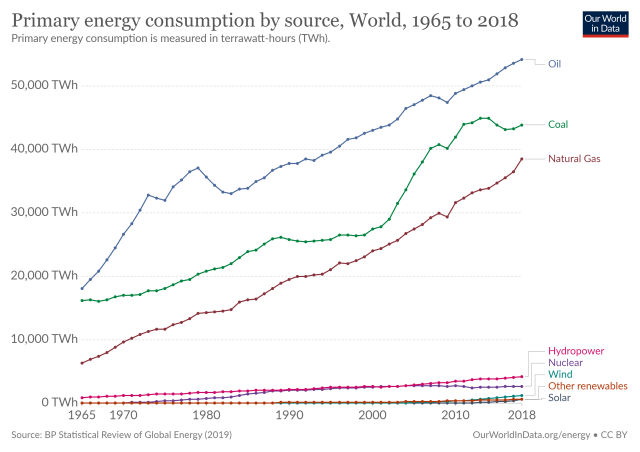
One of the rare videos where population challenge is acknowledged..
Thanks! That was a very good interview. I’m not familiar with either Ian Hutchinson or Lex Fridman so I’ve got 2 more interesting people to follow.
I went back and listened to the whole interview with Hutchinson. He’s a Christian that believes the evidence for Jesus becoming un-dead is compelling.
Here’s a link to a John Mayall song from 1970, Nature’s Disappearing. The information was out there in the 70s but the powers that be were completely wedded to the idea of endless growth.
Very good music and lyrics.
The real reason we want growth is not because it makes us a little richer tomorrow, it’s because it allows us to live a much richer life today via plentiful credit.
https://un-denial.com/2016/01/30/why-we-want-growth-why-we-cant-have-it-and-what-this-means/
Nehemiah says the same thing in a different way.
https://ourfiniteworld.com/2020/10/15/fossil-fuel-production-is-reaching-limits-in-a-strange-way/comment-page-19/#comment-265539
“Everyone wants to put off the unpleasant consequences of aggregate debt reduction for as long as possible.”
The problem is that the banking system depends on exponential growth of private debt for its own stability. In normal times, when debt growth slows, financial crisis begins. Nicole Foss puts it like this:
“Credit is now of the order of 99% of the money supply, which means that 99% of the money supply is excess claims to underlying real wealth. We took a small amount of collateral, and we backed an enormous number of loans with it, so we now have a crisis of under-collateralisation. This means we are all playing a giant game of musical chairs, there is about one chair for every hundred people playing the game, and as long as we are all up and dancing to the music and enjoying ourselves, we don’t really notice how few chairs there actually are, and not all of us entirely understand the rules of the game we are playing either. But, when the music stops, the people best positioned to understand the rules of the game are going to grab a chair as quickly as they possibly can. The great collateral grab will be on, and everybody else’s excess claims to underlying real wealth will be rapidly and messily extinguished. This is deflation, by definition, and that is what we stand on the verge of today. So, the expansion phase lasts quite a long time, but the contraction phase can actually be quite rapid, and that is what we stand on the verge of, globally.”
https://www.fixingthesystem.net.au/2018/05/15/nicole-foss-on-money-and-financial-crises/#financialcollapse
Of course we are not in normal times, and there seems to be no limit yet on how much money governments are willing to pump into the system, so who knows how long the charade may last. I think if markets get the sense that the world will never return to the growth trajectory that it was on pre-covid19, then the music will stop.
People are generally very reluctant to speak up about the absurd model of finance. I think a good portion struggle to get their head around the idea that the banks create money out of thin air when they make loans, and another good portion simply loses interest when they learn that governments do not have any control over the money supply, and that the banking system ultimately rules the roost.
It has definitely lasted a lot longer than I thought possible. I try to watch energy consumption now and ignore everything else as noise. Energy tells the real story.
“Getting to a no growth, steady state economy is like coexisting with the consequences of austerity forever, austerity as the norm of human existence.”
I think there is a better way to put it than as a simple choice between growth and austerity. If we can learn to differentiate between constructive and destructive economic activities, then the overall strategy becomes very obvious: grow the constructive activities while letting destructive activities wither and die.
Constructive activities would be those that push outcomes towards system goals, and destructive activities would be those than harm system goals. And if the system has no explicit goals, and no differentiation between constructive and destructive activities, the only goal is growth at all costs, and the only possible outcome is the continuing depletion and inevitable destruction of the natural world, and the end of the industrialised human civilisation that depends on it.
If we do get it right, and set some specific goals for markets to deliver, and the mechanisms to make it happen, then it wouldn’t really matter whether GDP was growing or shrinking overall, presuming we would also transition to a sane model of finance with sovereign control of the money supply, in accordance with the actual needs of the real sector of the economy.
People would not need to worry about austerity, because it would be the market players competing vigorously to make their activities more constructive and thereby more profitable. With a price on carbon to deliver the first and most important goal of zero net emissions, a lot of excessive consumption will be eliminated, as people learn to live with ‘enough’ rather than always wanting ‘more’, as Martensen frames it in his crash course.
So rather than austerity versus growth, I think the clear choice is between ‘prosperity and sustainability’ versus ‘growth and collapse’.
Can you give some examples of constructive activities that do not rely on resource extraction?
I volunteer on a small organic farm and am shocked how dependent it is on plastic, diesel, and steel.
I’ve mostly tuned out on the virus these days. Everyone has an agenda. Don’t know who to believe. I’ve simply decided to do my best not to get it so I’m prepped and being careful.
I’m not a regular reader of Charles Hugh Smith because he’s a little too much a for profit doomer for my taste, but his essay today spoke to me.
http://charleshughsmith.blogspot.com/2020/10/next-up-global-depression.html
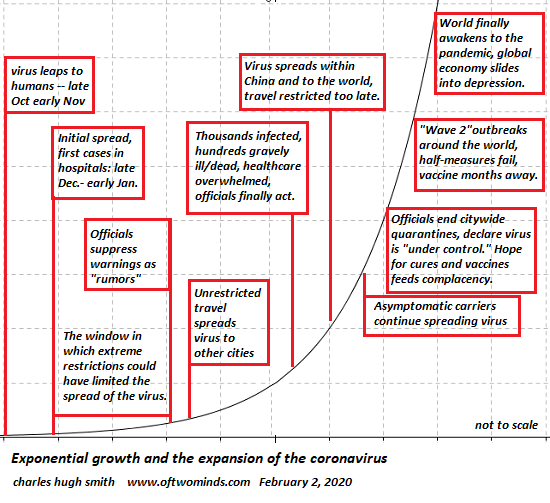
Mac10 compares the 2000 Y2K bubble to today’s tech bubble.
https://zensecondlife.blogspot.com/2020/10/artificial-intelligence-to-very-end.html
Gail Zawacki is a friend and now mostly retired blogger who focuses on the global decline of tree health due to rising ground level ozone that results from industrial combustion. It’s a problem that almost no one discusses because it’s very depressing, and there is no solution except to make modern civilization much smaller. I originally thought Gail was a whack job until I started to pay attention to tree health in my local area, and to more carefully read the research she’s compiled.
There are some new visitors to un-Denial.com so I want to bring to your attention some of the excellent work by Gail that I’ve posted in the past:
https://un-denial.com/?s=Zawacki%3A
If you prefer to watch than read, here is a nice video Gail produced 5 years ago:
It is certainly a powerful and beautiful video. It is really important that people understand just how crucial healthy forests are to creating rainfall, especially here in Australia where we have decimated the forests and suffer great droughts and fires as a consequence.
I am not sure what your preferences and rules are here for posting links and making off topic comments, but I will paste an excerpt from one of my posts to try to get people interested in a deeper appreciation for the role of forests in stabilizing climate and making agricultural lands sustainable and productive:
More green growth means more bacteria and more rain
We need more than cloud, because we need rain to feed the soil-carbon sponge. It takes about 1 million of the cloud micro-droplets to form a raindrop, because it has to coalesce together to make a raindrop that is big enough and heavy enough to fall out under gravity. There are three things that can lead to the formation of rain drops, and these are called precipitation nuclei.
The first is ice crystals, which are very important at high latitudes where water vapor gets colder and colder and eventually forms ice. The second is salt, which accumulates over the oceans and sucks up water, because it is hydroscopic. Salt is also what we use for artificial cloud seeding, where we use silver iodide to increase rainfall from certain types of cloud by a consistent 20 to 30%.
But by far the most important source of precipitation, particularly in inland, tropical and warmer areas, is bacteria. Bacteria is by orders of magnitude the most effective means of nucleating clouds into raindrops. These bacteria are produced in nature. Forests are not just transpiring water vapor, they are also putting up bacteria.
From radio isotope studies, half the rain in the Amazon is precipitated by the bacteria transpiring upwards every day, and each afternoon it comes back down in a thunderstorm. Everyday you have this hydrological cycle, taking heat from the surface, dissipating it upstairs, and returning rain back to the sponge. Five times more water falls as rain over the Amazon each day than flows out from the Amazon River into the ocean, which demonstrates the sheer volume of the process of cycling water to and from the atmosphere on a daily basis.
Vast areas of forest have been cleared, and we have already mentioned the 8 billion hectares of primary forest that we have reduced by 6.3 billion hectares of clearing, so what have we done with our rain?
By regenerating landscapes, we can actually start restoring these hydrological dynamics, especially the bacteria that rise from forests to seed rain, which is critical to replenishing the soil-carbon sponge. It all comes down to cooling, more cooling, rain, and more cooling. These are powerful, natural, simple, and safe processes to cool regions and the planet.
https://www.fixingthesystem.net.au/2018/07/06/boosting-natures-cooling-system/#morebacteria
Everyone is welcome to discuss and link to anything here provided it’s not woo-woo, partisan politics, or racial.
I did not know that bacteria plays a role in rain formation, very interesting.
The thesis of un-Denial.com is that genetic denial of reality blocks positive behavioral change.
I was poking around in some of my old essays and forgot I wrote a counter argument.
Maybe we do see reality and don’t care.
https://un-denial.com/2018/12/14/what-if-were-denying-something-else/
Another golden nugget that I haven’t recycled for a while.
It’s the exploding consequences that are new. Getting so obvious even Usain Bolt, the fastest denier on the planet, can’t outrun them.
It’s a social chimp peculiarity that our greatest truth tellers have always been musicians & other artists.
Today we have the likes of Baba Brinkman & “Alex da Kid” pointing out that it’s happening. 48 years ago (1972), Ian Anderson wrote one predicting it will happen.
1972 the year ‘Limits To Growth’ was published. Hmmm
This one always sends shivers up my spine.
Steve Pinker’s Mom played this song 3 times a day, everyday, while pregnant with Steve.
It’d make a fine theme song for un-denial.com
Excellent, added to the un-Denial Gallery.
https://un-denial.com/gallery/
not good
The “Canada Brand”: Violence and Canadian Mining Companies in Latin America
What we found about the degree of violence and criminalization from 2000-2015
This Report documents incidents that are corroborated by at least two independent sources. We found:
In addition, our research shows that Canadian companies that are listed on the Toronto Stock Exchange do not include reports of violence in their mandatory reports on company performance. Between 2000-2015:
publicly listed companies reported 24.2% of the deaths and 12.3% of the injuries listed in this report; and
larger companies tended to report incidents in general terms, using blanket statements, whereas smaller companies tended to report in more detail
What is significant about this study?
This report on violence and criminalization associated with the Canadian mining industry in Latin America is the first to:
The incidents documented in this report appear to be the tip of the iceberg
https://justice-project.org/the-canada-brand-violence-and-canadian-mining-companies-in-latin-america/
Canadians don’t care. Pensioners don’t read their pension fund prospectus. I browsed my mom’s work pension prospectus in 2011 -‘ Altria Group Inc’ which owns Marlboro tobacco (cancer).
Canadians don’t care. Gimme my fucking cheque!
It’ll never change. I just hate the ceaseless lying-pretending-denial.
But we make up for being no better than any other rich country by saying thank you a lot.
I just pray our American Sisters & Brothers in Doom take all necessary safety precautions on their national election day.

That movie’s in my queue. Available as of yesterday at the usual places.
https://www.imdb.com/title/tt13143964/
America Has No Allies, Only Hostages
https://consortiumnews.com/2020/10/21/america-has-no-allies-only-hostages/
Here is a textbook example of reality denial by a smart guy who takes a detailed look at the challenges Tesla faces in scaling up lithium-ion battery production to solve climate change.
Count the number of times he mentions diesel depletion and falling consumer discretionary income.
“We Will Coup Whoever We Want” Elon Musk (lithium) on twitter regarding the US empire orchestrated right-wing coup Of Bolivia’s democratically elected government.
Musk is a parasitic piece of shit. An imperialist.
Elon & all the fake Greens will have to pay full price for Bolivian lithium now. Ba ha.
The fake 1st world greens & their spawn can burn for all I care. Fuck em. No free will, but they still deserve to burn.
A big part of our white 1st world lives has & still is predicated on the oppression, enslavement of others & much more resources will be needed for green dreams which won’t work.
November 15 2019, — The Coup That Ousted Bolivia’s Evo Morales Is Another Setback for Latin American Socialism
A socialist president from Bolivia is sent into exile as another member of the Latin American left is freed from prison in Brazil.
https://theintercept.com/2019/11/15/bolivia-evo-morales-coup-brazil-intercepted/
Bolivians Return Evo Morales’s Party to Power One Year After a U.S.-Applauded Coup
Right-wing forces cheered by the U.S. tried to destroy one of Latin America’s most vibrant democracies. Voters just restored it.
https://theintercept.com/2020/10/19/bolivia-returns-evo-morales-party-to-power-one-year-after-a-u-s-applauded-coup/
Very strange that the queen of physics reality, Sabine Hossenfelder, would address the accuracy of climate change predictions without mentioning the severity of the threat. Perhaps we all have unique manifestations of reality denial. Mine is probably that awareness of MORT will make a difference, but I don’t care, I find MORT fascinating.
http://backreaction.blogspot.com/2020/10/how-can-climate-be-predictable-if.html
Never heard of Sabine Hossenfelder until you featured her.
There’s many well understood reasons why people deny or minimize climate change.

My responses to the decision tree come to an abrupt halt after three steps.
Humans are in serious trouble – Agree
It’s too late to do anything useful – Disagree
Humans can’t or won’t change their behavior in time – Agree …
… BUT the reality is that we don’t need to change the behaviour of the humans, we just need to change the behaviour of the system, and it can change rapidly.
There is no third option at this point in the decision tree that acknowledges this reality, so I think the decision tree can and should be improved. In fact, an evolving decision tree that changes as new and better arguments are proposed is a very good potential model for a new type of media, one that can distinguish between good and bad arguments for supporting various world views.
But back to just needing to change the behaviour of the industrial system, rather than the behaviour of humans:
Sure, we still face the mammoth task of persuading enough humans that any particular proposal to significantly change the behaviour of the system has considerable merit and should be supported, but that is really just a question of marketing … not an obstacle to engineering effective systemic solutions.
So just because people have yet to see a well marketed systems solution, one that is powerful enough to change the behaviour of the industrial system quickly enough to avert the collapse of industrialised human civilisation, does not mean that no effective solutions exist.
Take just climate change for a significant example. The world’s most powerful solution would be a global agreement that includes a price on carbon emissions to create an enormous pool of funds to be paid out for carbon sinking. This would drive profound change in market behaviour, and would mean that governments, businesses and other organisations would no longer benefit from ignoring the effects of their carbon emissions on the planet; instead their very survival would depend absolutely on them doing everything within their power to reduce their emissions footprint, and to drive it negative where possible.
Think about this for a moment. What would happen if carbon sinking was the most lucrative industry on the planet, as it would become with even a small initial emissions price under the model I propose?
Governments would be falling all over themselves trying to protect and restore their natural carbon sinks like rainforests, mangrove systems, forests and wetlands, in desperation to get a bigger share of massive global revenue streams for carbon sinking. They would rapidly reshape public policy so that the domestic industrial system would have frantic innovation and competition to serve exactly that national goal to maximise carbon sinking revenues.
Governments would also be falling all over themselves trying to drive a rapid shift to regenerative agriculture, which sinks vast amounts of carbon into soils while dramatically improving productivity, profitability and drought and fire resistance of farmlands. Industrial methods of agriculture generally deplete soils, use great volumes of fossil fuel based chemicals that pollute farms, landscapes and ecosystems, and generate nutrient poor food products, but regenerative systems retain vast quantities of water in rich healthy soils, and build up rich ecological systems that increase agricultural productivity while sequestering vast amounts of carbon.
These two things, the restoration of carbon sinks and the switch to regenerative agriculture, have the potential in themselves to remove from somewhere between half and all of the necessary carbon from the atmosphere in order to reverse climate change. Again pause and think, a simple carbon pricing and reward for sinking system could rapidly change the market dynamics so that the problem of climate change is eliminated or halved by a single publicly supported innovation.
And this is before you even consider the other impacts on the other sectors of the industrial system of the scheme, where a simple price on carbon emissions would ensure that all market players are obliged to minimise the emissions intensity of all their goods, services, operations, and processes. Energy efficiency would be aligned with increased profitability and reduced costs, and where innovation can be achieved, competition will ensure that those who manage those increased efficiencies are rewarded with increased profitability and market share, and those who can’t find better emissions intensity will start to disappear.
This simple scheme would automatically create a ferocious global race to solve climate change, by dramatically increasing carbon sinking via natural systems and agricultural soils, while at the same time and with the same incentives driving the industrial system to dramatically decrease its emissions inefficient inputs and processes, and in the process profoundly changing the impacts industrialised human civilisation has on climate stability, from a net negative to a net positive.
This is not complicated. It is just simply eliminating perverse market incentives, by using pricing signals to align market profitability with our collective goals.
The very same simple approach can be used for any of the crises plaguing humanity that is caused or exacerbated by perverse market incentives. The solutions enabled by this pricing signal approach do not need any individual human individual to change their habitual behaviour or thinking.
They just need to be awoken momentarily so that they can see the potential such solutions have to make governments and the businesses and organisations that make up the industrial system actually want to serve the needs of the people and the planet, and then endorse the particular model of system reform. The usually uninterested or otherwise disengaged consumers can then go back to their careless and unwitting consumption that previously led to the destruction of the real world, and be totally ignorant to the frantic innovation and competition in markets and geopolitics to exploit the new market incentives, inadvertently solving the world’s crises as they do so.
Hopefully, readers will be open to the point that we don’t have to change human behaviour, just system behaviour, and that simply requires some clever marketing of the best possible systemic solutions, which can rapidly lead to the building of political will for the necessary system reform.
I’m glad you’re engaged and thinking. We need more people like you.
I can’t see how to change the system as you propose without having more people see reality. It’s very hard to make fundamental changes to our economic system. One person’s incentive is another person’s cost.
I note that you do not mention the need for rapid population reduction policies. This must be the top priority for any mitigation effort as the essay above your comment explains.
“Having more people see reality” is exactly the point of my comment about The Century of the Self here:
https://un-denial.com/2020/10/10/sabine-hossenfelder-on-free-will/comment-page-2/#comment-25534
“One person’s incentive is another person’s cost.”
This perception is overcome by the setting of collective goals. Once we have agreed on the outcomes we collectively want to see, the costs of the necessary change are justified, and market players will need to innovate and compete in order to avoid those extra costs, and to take advantage of the new opportunities created. The last thing we want to do is protect “business-as-usual.” Instead we can reinvigorate markets to drive the necessary change.
Global population could be controlled in exactly the same way as net carbon emissions. Put a penalty price on nations for increasing their birth rates, and use the revenues to reward nations for reducing their birth rates. The pricing signals can change up and down according to how well global population is following the desired and agreed trajectory.
I suspect that the low hanging fruit in controlling population growth would be the education of women and the availability of contraceptives in ‘developing’ countries, but ultimately we do not need to know in advance which changes in public policy will prove most effective. We just need to set the market incentives in line with our goals, and the natural pursuit of efficiency and profitability by market players will deliver the optimal mix of changes.
So, a simple global agreement using pricing signals can solve climate change, and a simple global agreement on population growth can bring that under control too. These are now given truths, so as I said, the problem is not a lack of effective solutions, but a question of successfully marketing the message, with the singular goal of creating the necessary global agreements.
But, but, but…….humans ARE the system. And if you can’t change humans, you can’t change the system.
“humans ARE the system”
That is the very first presumption that needs to be reconsidered and overcome. Systems are famously “more than the sum of their parts.”
Systems have emergent properties and behaviours, things that do not exist within individual elements.
The global economic and political system is itself composed of many complex systems, like multinational corporations, powerful global banks and other financial organisations, political parties in government that are compromised by ideology or vested interests, and so on. The behaviour of this vast and complex system is not driven by what humans do as individuals, but by what markets do as a collective, under the influence of a great variety of powerful players with various goals and self interests.
In order to change the outcomes the system produces, we have no choice but to change the forces acting on the system, and this necessarily means changing the financial incentives and disincentives that drive the behaviour of all market participants. If we align those incentives with our collective goals, in cases where we can actually negotiate collectively agreed global objectives, then markets will automatically achieve those goals, whether individual humans, or individual businesses, or individual governments want to achieve those goals or not.
Pricing signals to drive market change are the greatest power humans have to decide the outcomes the system generates. They are our greatest agency … our power to change the way the world works.
Anyone who struggles to grasp the concept that systems are more than the sum of their parts, or the reality that we only need to change the system, not human behaviour, might do well to Google the phrase “systems thinking” and read everything you can find. Better still perhaps is to read “The Systems View of Life” by Capra & Luisi, the all encompassing text on systems.
It’s just a hunch but I’m guessing that you are young and recently graduated from an engineering discipline. I remember those heady days for me back in 1979. They taught us how to solve hard problems and we believed we could tackle any issue.
For me at that time I read Ayn Rand and Murray Rothbard and thought Libertarianism was the obvious solution to the world’s problems. It seems you have discovered a very important idea that we live in a system and you trying to find ways to influence the system. Good on you, but you’re talking to a pretty seasoned crowd here so maybe a little less lecturing and a little more inquiry might be in line.
For example, you could ask what do you think about educating and improving the standard of living of all poor women in the world as a means of lowering the birth rate? I would reply, excellent idea, it will probably work, but we don’t have enough low cost oil left to generate the required wealth, and it’s probably too slow give the urgency of our predicament.
Actually, I am a retired systems engineer, and I built a career and business out of engineering simple solutions to complex problems.
Like I said, there is no need for emotional elements like optimism, not when you have pragmatism and proper insights into the systemic cause and effect at work. When you zoom out and see how the global political and economic system actually operates, and find the root cause driving system dysfunction, the solutions practically reveal themselves.
Apologies if the tone seems a little like lecturing, it is not meant to, but can appear that way when simple truths are not dressed up in niceties. I can’t promise the tone will improve, but I will try. The reason I am pleased to have recently discovered this blog is precisely because of the well informed and articulate contributors here, so there is at least potential for real intelligent engagement on world changing ideas.
There is no pecking order in my mind, and never is.
Nice to meet a fellow retired engineer and welcome!
Brandon; I agree with some of what you say, but what I see are emergent behaviors that are unpredictable, often malignant, and beyond our control. I’m afraid that the MPP is an underlying driver that is hard to subvert with tweaks to incentives. I hold up the U.N. efforts through the IPCC lo these 32 years as an example of attempts to create system incentives that has still not done anything to change behavior.
Doing something meaningful to reduce CO2 emissions is remarkably simple and can be implemented by one person at a keyboard:
Raise the interest rate.
When was the last time you heard an expert even mention this as an option?
Market incentives work regardless of individual people, businesses or governments that might be “unpredictable, often malignant, and beyond our control.”
Market incentives work at the aggregate level. Some market players might be big and powerful enough to defy the incentives and disincentives, and to pursue other agendas. But overall, self interest rules, and the majority of market players serve only one purpose, to maximise their own profits.
Under the model I advocate, the market incentives are free to rise to any level needed to drive outcomes along the desired trajectory, so those who defy the incentives to serve other priorities will not survive.
The UN is probably the best example of what not to do. The veto powers make it a useless organisation with no real control over anything. Humanity would be profoundly better off without it.
Rob,
Here’s a link to Ugo Bardi’s blog with an very interesting guest post.
https://cassandralegacy.blogspot.com/2020/10/taboos-and-illusions-in-environmental.html#comment-form
Excellent find. That’s a very good essay. I’ve extracted some of it here.
I’ve been criticized by friend and very smart guy Nate Hagens for being alarmist about climate change. He thinks depletion of fossil energy will prevent worst case climate scenarios. I observe that Lukas Fierz makes his case without even mentioning fossil energy emission continuance or growth.
Ron, I have followed the work of Nate Hagens and he believes that as soon as oil production starts declining people ( I think he means the people who matter and make decisions) will realize what is happening because decline will be irreversible. I like the work Nate is doing but on this point I disagree with him. This is the likely scenario.
First the net energy from oil begins to decline (some would argue it has already begun).
Then after a few years the total amount produced will begin to decline as well. Fortunately (or unfortunately) we have a lot of gas and coal (relative to oil at least) which can be converted into oil or used to generate electricity.
Furthermore oil can be displaced by electrifying light vehicles like personal automobile which will require enormous amounts of lithium, cobalt and other rare earth metals.
I should add that diesel engines are fiendishly difficult to electrify because of energy density.
All that the above exercises do is shift our Achilles heel from oil to minerals, natural gas and coal which also happen to be finite. This will definitely buy us a few decades just like fracking has, but when these begin to inevitably decline it will be a very hard crash as climate change will have become much worse and the planet would have been completely trashed.
This is when the global economic and trade system which has prevented another world war by facilitating open markets for all resources (especially energy) will collapse, opening the path to resource wars.
I think Nate underestimates the power of human greed and how far we would go to maintain status quo. We will do everything thermodynamically possible to maintain our present way of life.
I also expect people will burn anything necessary to survive.
I have not seen Nate call for rapid population reduction policies. Have you?
I have not seen or read every material Nate has put out so I cannot say definitively what his views are on population reduction but from what I have seen he leans in the direction of providing women with contraceptives and education to reduce fertility rate in developing countries.
Another strategy he suggests is reducing consumption in developed countries. For instance if an average American reduces his/her consumption by 80-90% he/she would still be able to enjoy all the benefits of modern civilization like education, modern healthcare and nutritious diet, but will not have access to things like smartphone, personal automobile and other energy guzzling stuff which are mostly unnecessary. On paper this sounds doable, actually it is very much possible at least physically and thermodynamically. Problem is that Americans would rather nuke the world than give up all these things. So it becomes a behavioral problem and not purely physical one and impossible to reach a conclusion on where things will head.
So Lukas Fierz is arguing that positive feed back mechanisms alone can take the climate beyond 4 degrees C? 3 or 4 degrees Celsius will end civilisation and many species will go extinct. While this would be catastrophic there will still be places of refuge. Beyond 4 degrees and things start to become more dire than just catastrophic. With 7 or 8 degrees of warming I doubt there would be any places of refuge. It will be end of nearly all life. A total apocalypse.
I am surprised you did not mention the worst part of climate change crisis – how it is used by different power centers for their own purposes.
CC excuse has been used by US to try to force China to join unfair trade agreements. Big banks used the same excuse to extract even more wealth from the regular people ( carbon credits).
Even your examples – electric cars and solar panels have nothing to do with solving the CC crisis. It’s all about increasing consumption in a society saturated with useless products.
Is it any surprise then that some people reach the conclusion that it’s all a hoax?
That is why the only way to deal with CC is at the individual level, in other words -cultivate your garden (Voltaire). You never know if one insect or bat species might survive because of that.
I have first hand family knowledge of climate scientists getting multiple lovely trips around the world every year to important meetings where important issues are discussed.
There’s some partisan crap in here, sorry please ignore, the non-partisan stuff is pretty good.
Here’s a link on how to lower the risk of dementia (and maintain reality) for cranky, old engineers and anybody else for that matter. This is not the first time I’ve come across somebody saying the famous food pyramid is not just plain wrong but in fact bad for your health.
Tried intermittent fasting early this year. Did it for a month or so but lost motivation. Now I just skip breakfast many days. I know refined carbs are bad but I really don’t want to quit ice cream. I’m one of the family home care givers for an uncle with early dementia. It sucks but seems to be harder on the family than the individual.
Bottom of the first chart
Do you think underwear can be magical?
Only if I’m wearing it.
There needs to be another decision point near the bottom right: “Do you like to rape little boys and/or to protect those who do?”.
It’s not hard to visualize the layout.
Sorry for reposting my comment on this new thread but I felt this is better for having a conversation.
I agree with you and I suspect that Manning’s last comment is meant for the latter 5% because the other 95% won’t even make it till there.
The comment referred to is in this video at 51:35
That raises another important issue which has to do with whether it is right to pull someone from blissful ignorance and bring them into the doomer group, especially if they are in their 20s. This could push them into depression as they realize that everything they have been told about the world is essentially just a cultural construct detached from reality of physics and thermodynamics. It would cause them to lose a sense of purpose. It seems almost cruel to inflict this on someone. For someone who is in their 60s or 70s it would be a little easier.
I’m in my 70’s and it’s definitely a lot easier for me. I can’t even begin to think how I’d cope with the understanding I have now, if I were in my 20’s. However I think young people need to be made aware of what is coming. Some will fold up under the stress, but there are some who will find the energy and committment to do something towards positive change. Ending denial is a prerequisite.
Hey, no fair! You need a 1% category, even if just to include that single old uncharismatic antisocial engineer. There are others like him y’ know. I’m with Apneaman….I’ll believe it when I see it.
LOL
“There are others like him y’ know.” Please provide a link to anyone else on the planet that thinks awareness of MORT is a prerequisite for meaningful positive change (aka rapid population reduction). I’ve been watching now for several years and found no one. Very strange. I’m pretty sure I’m right. Or perhaps crazy? 🙂
Varki, the respected scientist who co-discovered MORT, thinks our only hope is legitimate fear mongering to motivate change. This means, I think, governments would need to scare the shit out of their citizens with the hard truth. I don’t see how that would work given that governments are as deeply in denial as their citizens.
https://un-denial.com/2019/10/22/ajit-varki-our-only-hope-is-legitimate-fear-mongering/