On GMO

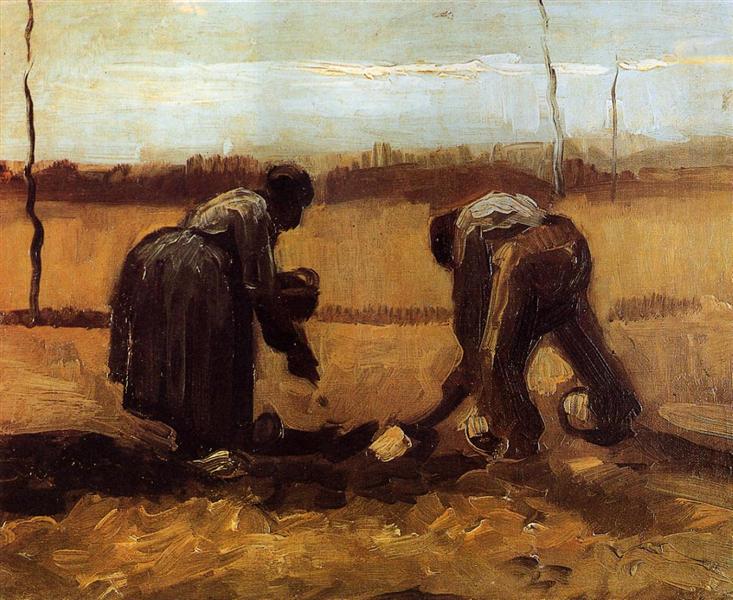
Peasant Man and Woman Planting Potatoes by Vincent van Gogh


Felt like yelling at the TV tonight.

Watched a documentary on the GMO debate.

Both sides passionate and entrenched.

One side not trusting corporate science and worried about health risks.

The other side wanting peer-reviewed science to inform decisions.

Neither side seeing or discussing the real risks.

When oil depletion collapses the economy we’ll need seeds that are not dependent on a high technology global supply chain.

And we’ll need seeds adapted to a rapidly changing local climate.

And food will be mostly organic, regardless of preference, because there won’t be pesticides, or herbicides, or Haber-Bosch factory fertilizer available.

And we’ll be grateful for calories regardless of what they are, or how they’re grown.

And we’ll marvel at the energy we wasted on irrelevant issues as we go to bed early with sore muscles from working all day in the fields.


By xraymike79: The Inconvenient Truth of Modern Civilization’s Inevitable Collapse

Ways to Reduce Your CO2 Emissions

Xraymike79 doesn’t write very much anymore, but when he does, he’s awesome.

Here are a few excerpts from today’s essay that stood out for me, but the whole thing is worth your time.

https://collapseofindustrialcivilization.com/2019/02/19/the-inconvenient-truth-of-modern-civilizations-inevitable-collapse/

Today’s global consumption of fossil fuels now stands at roughly five times what it was in the 1950s, and one-and-half times that of the 1980s when the science of global warming had already been confirmed and accepted by governments with the implication that there was an urgent need to act. Tomes of scientific studies have been logged in the last several decades documenting the deteriorating biospheric health, yet nothing substantive has been done to curtail it. More CO2 has been emitted since the inception of the UN Climate Change Convention in 1992 than in all of human history. CO2 emissions are 55% higher today than in 1990. Despite 20 international conferences on fossil fuel use reduction and an international treaty that entered into force in 1994, manmade greenhouse gases have risen inexorably. If it has not dawned on you by now, our economic and political systems are ill-equipped to deal with this existential threat. Existing international agreements are toothless because they have no verification or enforcement and do not require anything remotely close to what is needed to avoid catastrophe. The 20 warmest years on record have been in the past 22 years, with the top four in the past four years, according to the World Meteorological Organization (WMO). Ice loss from Antarctica has sextupled since the 1970s and Greenland’s pace of ice loss has increased fourfold since 2003. The Arctic ocean has lost 95% of its old ice and total volume of ice in September, the lowest ice month of the year, has declined by 78% between 1979 and 2012. With grim implications for the future, Earth’s air conditioner —the cryosphere— is melting away.


Douglas Theobald, in his study at Brandeis University, calculated that there is less than a 1 in  102,860 chance that all life did not arise from a common ancestor. In other words, humans are related to all life on Earth and share much of their DNA with other organisms. Despite earning the title of ‘superpredator‘, humans are dependent on intact and functioning ecosystems. Our chances for long-term survival are ultimately tied to the health of the planet, yet we are carrying out ecocide on a planetary scale. Being a mere 0.01% of all life on Earth, humans have managed to destroy 50% of wild animals in just the last fifty years and 83% since the dawn of civilization around 3,000 B.C.. Who knows how many plant species have gone extinct:

Hawaii is losing plant species at the rate of one per year, when it should be roughly one every 10,000 years. “We have a term called ‘plant-blindness’… People simply don’t see them; they view greenery as an indistinguishable mass, rather than as thousands of genetically separate and fragile individuals…”

The bedrock of our food, clean water and energy is biodiversity, but its loss now rivals the impacts of climate change. Without biodiversity, our food sources, both plants and animals, will succumb to diseases. Microbes and hundreds of different life forms interact to make soils fertile. Without them, soils will be barren and unable to support life. Monocultures can only be held together through artificial means(fossil fuels, inorganic fertilizer and toxic pesticides) and are highly vulnerable to diseases, yet industrial monoculture farming continues to dominate the globe. Most Worrisome are the recent studies indicating that biodiversity loss raises the risk of ‘extinction cascades’. Insect numbers, the base of the terrestrial food chain, are in steep decline and starfish, a common keystone species in coastal ecosystems, are facing extinction due to some sort of wasting disease likely caused by climate change:

“Many of these outbreaks are heat sensitive. In the lab, sea stars got sick sooner and died faster in warmer water… A warming ocean could increase the impact of infectious diseases like this one…We could be watching the extinction of what was a common species just 5 years ago.”

These disturbing headlines indicate to me that the Sixth Mass Extinction is gathering pace and the real stock market underlying our very existence and survival is crashing before our eyes!!!


Humans recognized decades ago the threats they are now facing, yet nothing was done due to political inaction and industry malfeasance which continues to this very day. The scientists who wrote The Limits to Growth decades ago were expecting our political institutions to take action back in the 1970s, but they were met with ridicule and now we stand at the doorstep of modern civilization’s collapse. Political inaction and regulatory capture by the fossil fuel industry appear to be intractable barriers that have condemned the human race to a hellish future. Anyone waiting for some sort of seminal climate change event that is going to galvanize the world’s leaders into action will be tragically disappointed. If seeing the world’s coral reefs dying, its glaciers disappearing, permafrost melting, and the steady uptick in extreme weather events does not spur them to action, it is much too late to hope that any single event will ever do so. The time to act would have been before we were seeing all these environmental degradations and tipping points, not afterward. There is no way to put the CO2 genie back in the bottle. A myth that many uninformed people hold is that biospheric health will quickly bounce back after we humans get our act together. Nothing could be further from the truth. Much of the damage we are already seeing is irreversible on human time scales. Positive feedbacks were already occurring at less than 1°C of warming. Many carbon sinks are on the verge of becoming or have already become carbon sources. As we race toward a nightmarish future with no realistic way to stop, we leave behind a “forever legacy” that will haunt mankind for the rest of eternity.


One Strange Rock: A Must Watch

One Strange Rock 2018

One Strange Rock is a 10 part, 8 hour documentary produced in 2018 by Darren Aronofsky and hosted by Will Smith and 8 space station astronauts.

I’ve watched a lot of nature/science documentaries in my life, and I’ve probably seen most of the good ones, but I say without hesitation that One Strange Rock is the best.

The producers and writers found a magical blend of spectacular settings on and off the planet, fabulous photography, inspirational multi-cultural stories, solid yet easy to understand science, and an important ecological message that is neither depressing nor ignorant of our peril.

With regard to the history and science of Earth’s life, they hit most of the important points everyone should know, got none of them wrong, and missed only a few key points (not least of which the significance of reality denial 🙂 ).

The only segment I did not like was the bit on why we must and will colonize other planets. That’s wishful thinking (aka denial) and is not going to happen, but understandable because that’s their gig. Otherwise very well done!

With regard to beauty and inspiration, they hit a home run, without being sickly sweet. If you don’t feel some joyous emotion watching this, you’re not alive.

This should be mandatory viewing for every student on the planet.

If I ever meet someone in the future who doesn’t understand why they should care, I will point them to One Strange Rock.

If anyone would like to view this documentary but can’t find it, send me a message on Facebook and I will help you.


From award-winning filmmaker Darren Aronofsky comes a mind-bending, thrilling journey that explores the fragility and wonder of planet Earth—one of the most peculiar, unique places in the universe.

One Strange Rock is the extraordinary story of Earth – our curiously calibrated, interconnected planet – and why it is special and uniquely brimming with life among a largely unknown but harsh cosmic arena. Anchoring the series is an elite group of astronauts who see Earth’s bigger picture; they provide unique perspectives and relate personal memoirs of our planet seen from space.

Hosted by Will Smith, One Strange Rock reveals the twists of fate that allow life to thrive on Earth.

Part 1: Gasp

For those privileged few who have seen Earth from space, the very first thing they notice is the thin blue line of atmosphere that clings to our planet and sustains life. How our planet creates and regulates that oxygen is a mind-blowing story involving a flying river, a global dust storm, collapsing glaciers and the most important creature you’ve never heard of. It’s an incredible chain of connections that reveal just how truly wondrous our home is. Everything connects, so life and planet breathe together. Astronaut host – Chris Hadfield

Part 2: Storm

Ever wonder how our planet got here? It was born in a cosmic storm and shaped by violence. Earth is a very lucky planet. We’re only here because of random collisions in a dangerous cosmos. They could have destroyed us, but instead, that violence constructed a planet from the rubble of the early solar system; gave us oceans in a bombardment from the heavens; and brought order to our world. Astronaut host – Nicole Stott.

Part 3: Shield

It’s a David and Goliath story — Earth’s relationship with its greatest threat: our seemingly benign sun. Hurling devastating particles and deadly radiation at us, the sun is the big violent boss of the solar system. Without several shields, one generated by our unique planetary core, another by our atmosphere, and a third by our interconnected weather systems, life on Earth never would have survived. Astronaut host – Jeff Hoffman.

Part 4: Genesis

Our rock is special; it’s alive. Though the building blocks of life are common across the universe, life is rare. What is it about Earth that sets it apart? This is the story of dynamic forces and crazy coincidences that took a bunch of dead ingredients and transformed them into something as wondrously intricate as life. And if it happened here, could it happen elsewhere? Astronaut host – Mae Jemison.

Part 5: Survival

Without the cycle of death and sacrifice, from cellular to planetary, life would not be here. From the deaths of stars to planetary scale mass extinctions and the sacrifice of individuals for a greater genetic good, this is the story of how life evolved hand in hand with death. Death drives evolution. It’s hardwired; from our cells to our landscapes, our colorful living planet is only possible thanks to it. Death leads to opportunity and biodiversity, which ironically ensures life on the planet is never wiped out. It’s not enough for our planet to be habitable; it also has to be lethal. Astronaut host – Jerry Linenger.

Part 6: Escape

Is it possible for intelligent life to escape destruction either from the planet or ourselves? Or are we destined for extinction like 99.9 percent of all species before us? Our best chance of survival may be to escape Earth and build another colony somewhere else. But there are real barriers: space radiation, microgravity and the bacteria inside us. And our DNA is coded for the conditions here on Earth, so if we ever manage to colonize another planet, those who are born there might evolve into another species. Astronaut host – Chris Hadfield.

Part 7: Terraform

Ever since life emerged, microbes, plants and animals have all sculpted the planet’s surface and atmosphere in the strangest of ways: fish poop creates islands; dead animals create mountains; and plants help create continents. From rocks to rivers, life has crafted everything that makes our planet so special. But this power of change brings with it profound dangers. Life doesn’t just create. It can also destroy. Astronaut host – Mike Massimino.

Part 8: Alien

All life on Earth started as single-cell bacteria and stayed like that for two billion years. So even if we do find alien life out there, what are the chances of that life being complex like us? On our strange rock, it’s all down to a freak event, which accidentally happened when one cell ate another to create a kind of power pack for life. This almost miraculous event transforms Earth into a complex interconnected web based on a competition for food. And at the top of the pyramid sit we humans. Astronaut host – Mae Jemison.

Part 9: Awakening

Of all life on Earth, how come we’re the only ones with the smarts to leave our planet? For three billion years, nothing had a brain. Even today, over 90 percent of life doesn’t need a brain to survive. So, what happened? How did our planet set in motion the chain of nearly impossible events that gave us our unique intelligence? The greatest mystery of all may be right between your ears. Astronaut host – Leland Melvin.

Part 10: Home

After 665 weightless days in space, NASA’s most experienced astronaut, Peggy Whitson, smashes through the atmosphere on her last journey home to planet Earth. With unprecedented filming on board the ISS during Peggy’s final mission and with the support of our other featured astronauts, we reveal how their time in space transforms their understanding of our planet’s wonders, insights that will change our perspective, too. There is no place like home. Or is there? Just how strange is our rock, and is it really unique in the universe? Astronaut host – Peggy Whitson.


By Tim Morgan: Primed to Detonate (O O Canada)

Maple Leaf Falling

Today’s essay by Tim Morgan is a must read.

https://surplusenergyeconomics.wordpress.com/2019/02/18/147-primed-to-detonate/

Morgan has developed new metrics for measuring the health of economies that are grounded in an understanding of the energy that drives our civilization.

Here he considers 4 risk factors:

  1. Debt: Instead of using the conventional debt to GDP ratio Morgan backs out the portion of GDP created by the spending of borrowed money to obtain a ratio of debt to prosperity that better represents the actual debt risk.
  2. Credit Dependency: This is the ratio of incremental debt to incremental growth and represents the “ponziness” of an economy.
  3. Systemic Exposure: This metric takes a broader view of risk by considering an economy’s dependence on its financial sector and is calculated as the ratio of financial assets to prosperity.
  4. Acquiescence Risk: This metric represents the change in discretionary prosperity and is a good measure of expected social unrest when the next financial crisis occurs.

Morgan compares these risk factors for various countries and concludes that Canada is among the top 6 riskiest countries on the planet.

SEEDS risk matrix, end-2018

Other observations include:

  • China is a ponzi bomb waiting to detonate.
  • Ireland, Holland, Britain, Japan and China are accidents waiting to happen.
  • Ireland is the craziest country on the planet.
  • France has the highest social unrest today for good reason.

The Canadian Weasel: A Whiny Species

Canadian Forest


So many Canadian trees are dying that on balance our forests emit more carbon than they sequester. The Canadian government is trying to weasel out of our CO2 reduction commitments by claiming that CO2 from our trees should not be counted because they are dying due to forest fires and insect infestations, which are not human caused.

This is just plain wrong, for two reasons.

First, climate change doesn’t care where the CO2 came from. The IPCC, in their most recent report, said we must reduce our emissions by 50% within 12 years or civilization will collapse. Soak that in while pondering the fact that the IPCC has a track record of being much too optimistic. Canada is one of the wealthiest countries on the planet which means our citizens can make do with a lot less of everything and still be better off than most people in other countries. Instead of trying to weasel out of our fair share we should be standing up and setting an example by reducing far more per capita than other countries.

Second, our trees are burning and being killed by insects because they’re sick, and they’re sick because ground level ozone, which is toxic to all plants, is rising. Ground level ozone is a byproduct of the fossil fuels our civilization burns. The trees are not sequestering carbon, like healthy trees are supposed to do, because of our population and lifestyles. Which is yet another good reason to cut more CO2 rather than whining like babies and trying to weasel out of doing the right thing.

Shame on us!  I used to be proud to be a Canadian.

For more on how ground level ozone is killing trees, see the work of Gail Zawacki.

https://www.cbc.ca/news/canada/calgary/canada-forests-carbon-sink-or-source-1.5011490

Canada’s forests actually emit more carbon than they absorb — despite what you’ve heard on Facebook.

Our managed forest land hasn’t been a net carbon sink since 2001.

You might have heard that Canada’s forests are an immense carbon sink, sucking up all sorts of CO2 — more than we produce — so we don’t have to worry about our greenhouse gas emissions.

This claim has been circulated on social media and repeated by pundits and politicians.

This would be convenient for our country, if it were real. Hitting our emissions-reduction targets would be a breeze. But, like most things that sound too good to be true, this one is false.

That’s because trees don’t just absorb carbon when they grow, they emit it when they die and decompose, or burn.

When you add up both the absorption and emission, Canada’s forests haven’t been a net carbon sink since 2001. Due largely to forest fires and insect infestations, the trees have actually added to our country’s greenhouse gas emissions for each of the past 15 years on record.

Not surprisingly, then, Canada has historically excluded its forests when accounting for its total greenhouse emissions to the rest of the world. We had that option, under international agreements, and it was in our interest to leave the trees out of the total tabulation, since they would have boosted our overall emissions.

But, just in the past couple of years, we have taken a different approach. We are now making the case to the United Nations that things like forest fires and pine beetle infestations shouldn’t count against us, and that only human-related changes to our forests should be included when doing the calculations that matter to our emission-reduction targets.


By Tad Patzek: On Human Overshoot

Tad Patzek

Tad Patzek, a professor of petroleum engineering and physicist, gave a talk on January 16, 2019 at the King Abdullah University of Science and Technology (KAUST) in Saudi Arabia.

His talk is titled “How Can We Salvage Our Global Civilization?” however Patzek does not answer his own question. Instead he reviews the brief history of humans and shows that we are in a severe state of overshoot with a population that exceeds the carrying capacity of the planet by about 30 times thanks to fossil energy, which he predicts will soon rapidly decline due to depletion. In the Q&A that follows the talk, Patzek advocates for population reduction policies. Also in the Q&A, Patzek gets quite aggressive with audience members who argue that technology will save us. He concludes that we will probably use nuclear war to correct overshoot. I wonder if he’ll be invited back next year? 🙂

You can find other work I’ve posted by Patzek here.

Thanks to Nate Hagens for bringing this talk to my attention.


Here are some notes I took while viewing the talk:

  • Continued exponential growth of human population is suicidal and will stop one way or another.
  • Humans have only one chance of survival by drastically limiting population and consumption.
  • Patzek quotes from Ronald Wright’s A Short History of Progress, my all-time favorite lecture series, to make the point that humans, the fire apes, have been setting fires continuously from our origin until today when many of the world’s tropical forests are being burned to make way for agriculture and plantations.
  • Patzek does a nice job of explaining that humans have existed for an extremely short period in the context of geologic time. For example, if we call January 1 the start of the Silurian period 444 million years ago when multicellular life first appeared on land, then behaviorally modern humans emerged 70 minutes before midnight on December 31, our first civilization began 9 minutes before midnight, and the industrial civilization we currently enjoy began 20 seconds before midnight. The explosion of human population to 8 billion began 7 seconds before midnight on December 31, and was enabled by the Haber Bosch industrial process that converts natural gas into nitrogen fertilizer.
  • At 3 seconds before midnight on December 31, half of the US’s top soil had been washed into the sea, having taken only 9 seconds to accomplish this feat.
  • For an example of what 10,000 years of agriculture does to the earth, look at Iraq with its complete environmental devastation.
  • We only have one shot at the global civilization, and it shall never be repeated again.
  • Sending colonies to Mars is complete nonsense because there are not enough resources to send them.
  • None of our overshoot issues are captured by our economic models.
  • Our planet can support a maximum of 8 million humans making a living as hunter gatherers.
  • The earth might support 2.5 billion people assuming an 1800’s equivalent life expectancy (32 years) , lifestyle, slavery, and conflict. If we assume today’s life expectancy (71 years) the maximum drops to 1.1 billion people. Adjusting for our increased standard of living decreases the maximum to 500 million people. If we assume a peaceful life without wars the maximum sustainable population drops to 250 million people. This means we have overshot by the 30 times the carrying capacity of the planet by using fossil fuel subsidies.
  • Later in the Q&A, Patzek clarifies that if we assume an American or German lifestyle, the maximum sustainable population is 90 million without fossil energy.
  • I note that Patzek’s estimate of the maximum sustainable population aligns nicely with Jack Alpert’s plan to preserve our modern civilization with rapid population reduction.
  • Patzek shows that population is proportional to power production. Recall that Tim Garrett has also shown that wealth is proportional to power production. Energy is therefore central to our predicament as Nate Hagens elaborates in his video course.

By Nate Hagens: Reality 101: What every student (and citizen) should know

Nate Hagens

Nate Hagens just released a new video course titled “Reality 101” that he produced for honors freshman at the University of Minnesota where he teaches.

The course is backed by 15 years of research by Nate into our overshoot predicament created by the interaction of human behavior, energy, economy, and ecology, and distills his 45 hour university course of the same name into 4 hours of video.

I’ve followed Nate for many years and have posted some of his work here.  Nate is a rare multidisciplinary dot connector, and has one of the best big picture understandings of our predicament.

Nate differs from others doing similar research in that he retains hope and offers positive advice to young people for how they might help make the future a more desirable place to live.

I suspect this new video course will become a go-to resource for people seeking enlightenment on vitally important topics that are usually ignored, and when occasionally broached, are almost always misunderstood or denied by most educators, leaders, and news sources.

Nate can be found on both Twitter and Facebook.

Nate’s Facebook announcement of the video course:

I’ll be putting the entire Reality 101 course content (two 500 page books co-written w DJ White plus related content and videos) online for free this spring. In the meantime, the Honors Program at U of Minnesota asked for a ‘hologram’ of that material that could be watched in 4-5 hours (instead of ~150 hours of the course) for the Nexus One experience for all freshmen. They’ll watch this in 3 pieces: 1) Brain/behavior 2) Energy/economy and 3) Ecology/Earth systems/what to do/how to live during these times. The Energy videos (link below) are ‘finished’ (with a bunch of small errors to fix when I get time), The 12 videos are 1 hour 45 minutes total – as usual both too long for most peoples attn spans but too short to really get into some important nuances. Our culture is energy blind. This new choreography outlines the story of humans, growth, energy and the future in the most comprehensive way I could envision for a short(ish) summary. (thanks to Katie Fischer and Keegan L Robinson for tireless help and suggestions and to Katie for doing great work on the tech side)

Reality 101 full course description:

How is the economy like a hurricane? Where does money come from? Will economic growth last forever? What is wealth? How many hours would it take you to generate the same amount of energy in a gallon of gasoline? Why are you so confident in your own beliefs? Why do you spend so much time on social media? Why do we want “more” than our neighbors? What do all of these questions have to do with the environment? With your future? And what if our most popular societal beliefs about these issues turn out to be myths?

Reality 101 will delve into these questions and unify them as they apply to the major challenges humanity faces this century, among them: slow economic growth, poverty, inequality, addiction, pollution, ocean acidification, biodiversity loss, and war. The seminar will provide students with broad exposure to the foundational principles central to addressing these interrelated issues. The readings and lectures will cover literature in systems ecology, energy and natural resources, thermodynamics, history, anthropology, human behavior, neuroscience, environmental science, sociology, economics, globalization/trade, and finance/debt with an overarching goal to give students a general understanding of how our human ecosystem functions as a whole. Such a systems overview is necessary to view the opportunities and constraints relevant to our future from a realistic starting point. Though the hard science relating to sustainability will be surveyed, few answers will be presented and it is hoped that creativity and group dialogue will lead to emergent ideas on how these big themes fit together. While the class material is daunting and intense (reflecting our world situation), the course itself will be enlightening and deeply informative, with an open, engaging, and entertaining class atmosphere.

Dr. Nathan John Hagens worked on Wall Street at Lehman Brothers and Salomon Brothers and closed his own hedge fund in 2003 to pursue interdisciplinary knowledge about the bigger picture of modern society. Nate was the lead editor of the online web portal theoildrum.com, and is currently President of the Bottleneck Foundation and on the Boards of the Post Carbon Institute, Institute for Energy and Our Future, and IIER.


 Section 1 – Brain & Behavior

Click here to play all 10 parts in sequence.

Part 1: Evolution, Natural Selection, and the Agenda of the Gene


Part 2: Sexual Selection and Social Status


Part 3: Dopamine, Supernormal Stimuli and Consumerism, Part 1


Part 4: Dopamine, Supernormal Stimuli and Consumerism, Part 2


Part 5: Our Social Natures, Part 1 (Groups and Tribes)


Part 6: Our Social Natures, Part 2 (The Superorganism and Culture)


Part 7: Self-Blindness, Part 1 (Cognitive Biases)


Part 8: Self-Blindness, Part 2 (Cognitive Biases)


Part 9: Time Biases


Part 10: From Self Blindness to Self Awareness


Section 2 – Energy & Economy

Click here to play all 16 parts in sequence.

Part 1: Energy Blindness


Part 2: Energy Surplus


3 – Energy Benefits


Part 4: Energy Scale


Part 5: Energy Impacts


Part 6: Energy Primacy, Part 1


Part 7: Energy Primacy, Part 2


Part 8: Energy Primacy, Part 3


Part 9: Energy Primacy, Part 4


Part 10: Energy Primacy, Part 5


Part 11: Energy Remoteness


Part 12: Energy Depletion


Part 13: Energy Fungibility


Part 14: Energy Transitions


Part 15: Energy and Happiness


Part 16: Energy and Our Future


Section 3 – The Big Picture

Click here to play all 8 parts in sequence.

Part 1: Intro


Part 2: Ecology and Systems


Part 3: Externalities, Part 1: Intro


Part 4: Externalities, Part 2: Heating and Oceans


Part 5: Externalities, Part 3: The Web of Life


Part 6: The Superorganism (short version)


Part 7: 8 Great Questions for our Time


Part 8: What to Do? (short list)