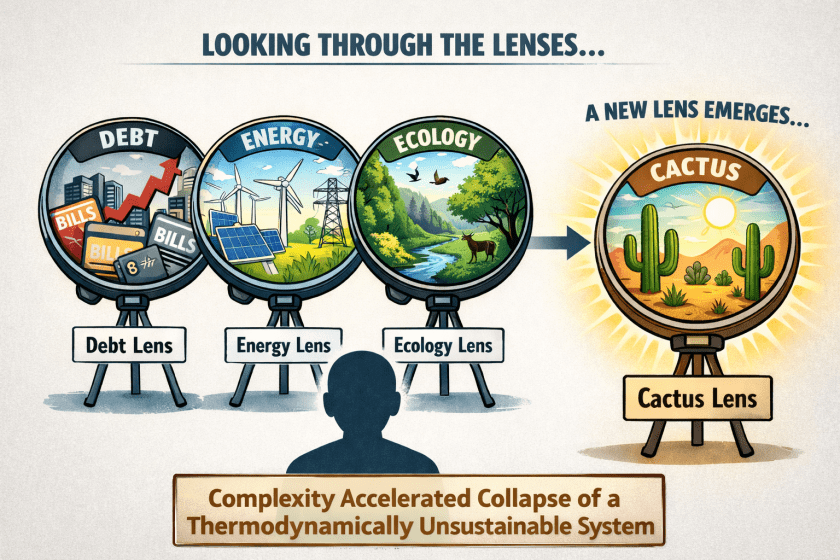
The Cactus Lens: A Clearer View

Until recently there have been 3 main lenses through which to view our overshoot predicament: debt, energy, and ecology.

Each lens exposes a different aspect of the picture, but not the complete picture.

Each lens focusses on different threats, with different time frames, and different consequences, and each lens suggests a different optimal response.

Overshoot awareness varies by lens and group within society. Awareness of leaders is generally higher than citizens, and in some cases this is deliberate and warranted because broad citizen awareness of the debt and energy threats would increase the probability of short term collapse.

For leaders and citizens that see through any of the lenses, their understanding tends to be incomplete, which has resulted in plans of action that will not help, or that make the situation worse.

This incomplete understanding is caused in part because the issues are very complex, and in part because some aspects of human overshoot have no acceptable or feasible solution, and in part because of the human tendency to deny unpleasant realities, as explained by Dr. Ajit Varki’s MORT theory.

Hideaway, a frequent contributor at un-Denial, Peak Oil Barrel, Our Finite World and other sites, recently introduced a new lens we have named cactus, which focusses on all non-renewable resources and the complexity required to extract them.

I think the cactus lens provides the clearest view of what is going on, what we should expect in the short to medium term, and what we should do.

The cactus lens changes what is in the best interests of citizens to understand.

The debt and energy lenses suggest citizens should remain in the dark.

The ecology lens suggests it does not matter what citizens understand because the ecology threats are longer term than debt, energy, and cactus, and because awareness of ecology issues have not and will not improve anything of substance due to the nature of modernity.

With the introduction of the cactus lens, it is now in the best short term interests of all groups: countries, leaders, and citizens, for awareness to be as widespread as possible.

Achieving broad cactus awareness will be difficult because it is very unpleasant, and therefore will be blocked by our genetic denial behavior, however I propose one idea to start the discussion on how we might spread cactus awareness.

Awareness Lens: Debt

Theory:

  • Modernity requires abundant credit;
  • Because most of our mines, machines, technology, and structures require significant up front capital to build;
  • Which requires a fractional reserve debt backed monetary system;
  • Which is now used by every country in the world;
  • Which by design requires economic growth to not collapse;
  • Because money is loaned into existence and growth is needed to pay interest;
  • Which means our economic system requires infinite growth on a finite planet;
  • Which of course is impossible and means we should expect growth to slow and prosperity to decline, as they are;
  • Culminating in a dramatic and harmful economic reset;
  • However modernity will survive and will rebuild until the next bubble pops.

Status :

  • Quite a few citizens see through the debt lens, maybe a significant minority.
  • Most aware citizens assume the reset is a ways off in the future.
  • Some people prepare to weather a storm with cash, gold, bitcoin, or sardines.
  • Others trust or hope that central banks will print enough money to kick the can past their expiry.
  • Leaders understand and acknowledge the debt problem but are careful to not cause panic because herd emotions could trigger a reset.
  • Leaders are also careful to not explain the driver of the debt problem, energy depletion, as will be discussed in the next section on the energy lens.
  • The debt threat is closer and more severe than our leaders let on as demonstrated by:
  1. Social unrest everywhere is rising because living standards are falling and the wealth gap is widening.
  2. Geopolitical tensions are rising.
  3. Democracies are oscillating between wider extremes.
  4. Most countries have historically high levels of growing debt.
  5. Growth has slowed, and the only growth possible now comes at the expense of adding more debt than the growth it buys, which is unsustainable.
  6. No political party in power anywhere reduces their deficit or balances their budget because it’s now impossible without crashing their system. The US DOGE effort lasted 5 months before leaders gave up and juiced the deficit to new record highs.
  7. Central banks work hard behind the curtain to keep our everything bubble inflated, and to prevent any significant correction of stock or asset prices. When I was young it was normal for the economy and stock market to experience cycles. We don’t permit cycles anymore. Today there is so much debt and so little growth that a significant correction will result in a reset (aka crash).
  8. Printing bazookas are used to blast any threat before it builds momentum, like the banking system repo problem that covid provided cover for unprecedented money printing.
  9. Our leaders tried but failed to use covid as an excuse to implement the tools needed to manage an economic reset like digital ids/currencies for rationing scarce necessities, and for enabling negative interest rates, and tried via “The Great Reset” propaganda campaign to get us ready to accept nationalization of assets (aka “you will own nothing and be happy”). They will try again.

Implications:

  • The debt lens implies a zero-sum game: In a no growth world, one country’s gain is another country’s loss.
  • Our leaders believe that a country that succeeds in harming its competitors will experience less damage from an economic reset. The goal is to ensure opponents reset before you do, on the assumption that this will prevent or delay your own reset by gaining control of more growth generating assets and markets.
  • Hence we see the weaponization of tariffs and trade, regime change operations, and proxy wars intended to weaken or capture opponents.

Conclusions:

  • A debt reset is mathematically inevitable and will reduce the standard of living for the majority via deflation and/or inflation.
  • Debt resets are hard to predict and control because herd emotions drive the process.
  • Leaders have good reasons to not want citizens to be aware of the seriousness of the debt problem.
  • Leaders are operating on the assumption of a zero-sum game.
  • In the cactus lens section we’ll see that the zero-sum game assumption is wrong, which means the current strategy will make things worse for all countries.

Awareness Lens: Energy

Theory:

  • Modernity requires abundant net energy;
  • Which is the energy that remains after using energy to extract and refine energy;
  • Because all of our food, water, minerals, technology, products, and services are produced and delivered by machines powered by energy.
  • Diesel is the keystone energy that powers our vital mining machines, tractors, combines, trucks, trains, and ships.
  • Renewable energy is not a solution to non-renewable depletion because renewables require abundant non-renewable energy t0 build, install, maintain, and augment for 24/7 supply.
  • Discovery of new fossil energy reserves is much slower than depletion of existing reserves, and the gap is growing.
  • The quality of non-renewable energy reserves decline as they deplete;
  • Which means net energy is falling;
  • Which explains why growth is slowing, and prosperity is declining, and debt is growing faster than GDP everywhere.
  • We should expect the trend to continue and accelerate.
  • Leaders believe modernity will continue for those countries that have access to energy.

Status:

  • Few citizens see through the energy lens.
  • There are many false energy beliefs in wide circulation including net zero, peak oil demand, abiotic oil, green energy, renewables outpacing fossils, hydrogen economy, nuclear renaissance, space mining, circular economy, etc., etc..
  • These beliefs are nonsense not grounded in sound science or economics, but the issues are complex, and it is difficult for a citizen to determine the truth, especially with deliberate misdirection from leaders, and with MORT driven hope and denial driving behavior.
  • Denial is a strong force that fogs the energy lens because, short of a near zero probability miracle, there is no solution, and the outlook is steadily worsening living standards.
  • Most leaders, with help from their energy aware militaries, understand what is going on, and know the energy threat is imminent. Evidence for this includes:
  1. Inflation of energy intensive products, like food, is high; energy intensive infrastructure is not being properly maintained; energy intensive manufacturing, like weapons, is struggling to keep up with demand despite plentiful printed money available; war is shifting to lower energy methods like drones; and as also seen through the debt lens, debt is accelerating, living standards are falling, the wealth gap is widening, geopolitical tensions are rising, and democracies are at risk.
  2. The EIA this year announced that fracked oil is peaking. Fracked oil is the unexpected savior that bought us an extra decade after conventional oil peaked.
  3. Leaders do not want their citizens to panic, or to spook the stock market bubble which depends on growth, so they do not discuss the energy problem, and work hard to distract citizens with nonsense like optimism for a renewable transition, or by stoking emotions over socially divisive issues.
  4. Trump reversed his no more regime change promises after being sworn in and briefed about US debt and oil forecasts.
  5. Every country with significant exportable oil reserves that is not controlled by the US empire is either under attack or being regime changed including Russia, Iran, Syria, Venezuela, and Nigeria. Even friends with oil, or close to oil, like Canada and Greenland, have been threatened with annexation.
  6. Propaganda is successfully being used to convince citizens that regime change operations are to prevent terrorism or drug trafficking, not to control oil.
  7. China is stockpiling strategic oil reserves.
  8. A few countries, like Germany, made an honest attempt to run their economies with renewable energy, but it’s now obvious to leaders everywhere that the renewable dream has failed. German leaders now want war with energy rich Russia.
  9. The UK, having drained its own oil reserves, now wants war with energy rich Russia.
  10. Hail Mary investments praying for a miracle are being made in AI and nuclear energy.

Implications:

  • The energy lens implies a zero-sum game: In an energy scarce world, one country’s gain is another country’s loss.
  • Our leaders understand their country’s prosperity requires non-renewable energy, and that it must be secured by any means necessary, including taking it by force from others.
  • Countries are preparing for war by increasing military expenditures, even at the expense of social services demanded by citizens.
  • Nuclear arms treaties are being abandoned, and the arms race is restarting.
  • Lessons learned during the cold war about the dangers of nuclear war are being ignored, and red lines are increasingly flirted with.
  • It’s hard to imagine how nuclear war can be avoided given that everyone’s survival depends on oil, and the zero-sum game assumption of our leaders.

Conclusions:

  • Modernity requires growth, and there is not enough oil left for everyone to grow.
  • Leaders have good reasons to not want citizens to be aware of the seriousness of the energy problem.
  • Leaders are operating on the assumption of a zero-sum game.
  • In the cactus lens section we’ll see that the zero-sum game assumption is wrong, which means the current strategy will make things worse for all countries.

Awareness Lens: Ecology

Theory:

  • The resources consumed, and the wastes generated, and the habitats occupied, by the large and growing population of humans, is displacing other species, and causing damage to ecosystems faster than can be repaired by the planet’s recycling systems.

Status:

  • The 8,230,000,000 humans, plus their 35,000,000,000 livestock, plus their billions of pets and other freeloaders like rats, now weighs 80 times more than all wild land mammals combined.
  • Humans use 30-40% of the net primary productivity of all sunlight hitting the planet, plus 16,000,000,000 liters per day of ancient sunlight stored as oil, plus 11,000,000,000 cubic meters per day of ancient sunlight stored as natural gas, plus 24,000,000,000 kilograms per day of ancient sunlight store as coal.
  • The sixth mass extinction is underway.
  • Six of nine planetary boundaries critical for survival have already been crossed including climate change, biodiversity, deforestation, fresh water, nitrogen cycle, and pollution.
  • We have already passed the 1.5C safe limit and are on a path to a 3+C temperature increase that is incompatible with civilization and agriculture by the end of this century.
  • Biodiverse forests are being replaced with mono-crop agriculture.
  • Fisheries are in decline.
  • Sea level rise will damage many cities over the next century.
  • Glacier loss threatens the survival of several countries.
  • Chemical toxins and microplastics are harming the health of all life including humans.
  • Awareness of leaders and citizens about the ecological problems varies widely.
  • Most people are aware of some of the problems, but also tend to superficially simplify them down to one issue, CO2, that can be fixed with solar panels and electric vehicles.
  • Few are aware of the breadth and depth of the problems.
  • Many people deny the severity of the problems and/or that humans have caused the problems.
  • Almost everyone denies the implications of the ecological problems, and the fact there is almost nothing that can be done to address them while maintaining modernity and our population.
  • Every effort, by every country, and every organization, and every citizen, to address the above problems, has failed, and will continue to fail, at least until something forces an involuntary change to population and lifestyles.

Implications:

  • The view through the ecology lens is dire.
  • The long term implications are worse than those seen through the debt and energy lenses because we are damaging the ability for any human lifestyle to thrive, and are also harming many other species.

Conclusions:

  • Life threatening ecological problems, for the majority of people, are further in the future than the imminent problems seen through the debt, energy, and soon to be explained, cactus lenses.
  • All of the ecological problems are caused by the human species footprint which is the product of lifestyle and population.
  • None of the ecological problems can be addressed without reducing per capita consumption or population, and the debt and cactus lenses show that modernity requires growth, which means the ecological problems are a classic predicament, a problem without an acceptable solution.
  • The energy and cactus lenses show that growth will not continue, and the human footprint will soon shrink, which means there may be an improvement to future ecology trends.
  • Many of the ecological problems we have created will repair quickly when the scale of the human enterprise shrinks.
  • Some ecological problems will take a very long time to repair, and adaptation of surviving species will be required.
  • As will be discussed in more detail in the next section, if we somehow became aware that the scale of humanity was going to decrease in the not too distant future, no matter what we do, then we might be able to motivate ourselves to address several ecological issues that would improve the quality of life for the survivors, such as burying nuclear waste, and protecting biodiverse forests and marine ecosystems.

Awareness Lens: Cactus
CACTUS = Complexity Accelerated Collapse of a Thermodynamically Unsustainable System

The phrase “we’re cactus” is Australian slang meaning something is ruined, broken, or finished, often used to describe a situation where progress has stopped, such as a vehicle that won’t start.

The expression likely originated from the infamous prickly pear cactus, which once infested large parts of Australia before being controlled by the introduced Cactoblastis cactorum moth.

This slang is part of a broader set of Australian expressions for something being in disrepair or useless, including terms like “boonted,” “clapped-out,” “had the chad,” “had the bomb,” and “kaput”.

While “cactus” as a metaphor for being broken or ruined is well-established in Australian English, it is not commonly used in other English-speaking regions.

Theory:

  • Modernity requires abundant minerals and energy.
  • The majority of minerals and energy we use are non-renewable and finite.
  • Recycling is economically and/or technically impossible for most minerals.
  • For those minerals that can be recycled, there are losses in the recycling process that still result in long term depletion.
  • The quality of mineral and energy reserves decline as they deplete, because we always harvest the best quality reserves first.
  • Mineral and energy extraction technologies must increase in complexity to compensate for falling reserve quality to maintain flows of resources. For example, compare modern directional drilling now required for fracking with early oil rigs. Or the giant trucks and other machines now required to haul and process low grade copper ore.
  • Rising complexity increases the materials, processes, skills, locations, and number of people needed to design and manufacture the technologies.
  • Rising complexity requires a growing market to support the increasing cost of designing and manufacturing technologies. For example, a smaller population would not buy enough phones to make a TSMC factory in Taiwan viable, and therefore the advanced chips needed for oil exploration and extraction would not exist.
  • A growing market requires a growing economy and population.
  • A growing economy and population increases the consumption of all minerals and energy.
  • Wastes generated by the growing economy and population create increasing frictions to further growth.
  • This self-reinforcing complexity growth system drives an increase in mineral and energy flows until technology, markets, and population can no longer keep up with growing waste frictions and declining reserve qualities, and a critical mineral or energy becomes unavailable in the quantities required.
  • Scarcity of the critical mineral or energy triggers a system wide technology breakdown cascade because many technologies depend on it, and many other technologies depend on those technologies, via an ultra-complex network of dependencies.
  • The unavailability of many technologies then causes many more mineral and energy flows to become unavailable in the quantities required because the quality of remaining reserves makes extraction difficult or impossible without the latest technologies.
  • This self-reinforcing collapse of complexity, technology, and resource flows is certain at some point in the not too distant future and will result in a supernova end to modernity and civilization.
  • Nothing can be done to prevent this outcome, just as nothing can be done to prevent the collapse of a star.
  • It’s not possible to have modernity without infinite growth on a finite planet which means modernity will be short lived everywhere in the universe.

Hideaway responds:

  • Hence the logical solution to the Fermi Paradox. Species that reach modernity anywhere do not last long enough to detect others, that have also reached modernity, spread through time.
  • Given the age of our galaxy of around 13.6B years, and if it took 3.6B years for the first species to reach modernity, then if each lasted from 100 years to say 400 years at best, there could have been 1 every million years giving a total of 10,000 for our galaxy and none would ever detect another.
  • Even if 10 or 20 had popped up at the one time, just through chance, and were more than 400-500 light years apart, they would never know of the other’s existence.
  • Just by shear chance, some might detect others, but the odds of any one civilization detecting another is extremely small.
  • Say we did detect another civilization somewhere in the close area within say 1000 light years. So what? By the time we tried to communicate back to them, the odds of their collapse is high.

Status:

  • A tiny minority of people see through the cactus lens.
  • The cactus view of modernity has not been widely discussed.
  • The closest work that I can recall reading is that by David Korowizc where he discusses the extreme complexity and fragility of modern supply chains, and the risk of their breakdown with energy shortages. Korowizc advocates building more resiliency into our system, but I don’t think he stated clearly that modernity will soon end no matter what we do, as Hideaway’s cactus lens does.
  • The ground breaking Limits to Growth work of Dennis Meadows et. al. assumed collapse could be avoided by adopting a steady state population and economy. Cactus shows this assumption is incorrect. Any dependence on any resource that is not naturally recycled by ecological systems will eventually result in a collapse back to a state that is not dependent on the resource.
  • Other important overshoot aware people like Jay Hanson and Jack Alpert discuss the certainty of modernity’s demise, but do not focus on the non-renewable resource extraction complexity growth system to conclude that modernity will end in a supernova.

Implications:

The cactus lens provides several profound insights that create a clearer view than the debt, energy, or ecology lenses.

List every non-renewable resource that civilization depends on.

ChatGPT:

Fossil Fuels: Oil, gas, coal, oil sands, shale oil/gas, peat.

Nuclear Fuels: Uranium-235/238, thorium, plutonium (derived).

Metals: Iron, aluminum, copper, nickel, cobalt, lithium, zinc, lead, tin, silver, gold, platinum group metals, titanium, molybdenum, tungsten, vanadium, niobium, tantalum, chromium, manganese, rare-earth elements (all 17 REEs), and many others.

Industrial Minerals: Phosphate rock, potash, sulfur, borates, fluorspar, gypsum, halite, graphite, silica sand, feldspar, kaolin, etc.

Construction Materials: Limestone, aggregates (sand & gravel), clay, granite, marble, slate, stone.

Geologic Water: Fossil groundwater aquifers.

Biological/Ecological Resources (functionally non-renewable): Topsoil, old-growth forests, biodiversity, coral reefs, major fish stocks.

  1. The first key insight is that modernity depends on many non-renewable materials, not just energy, and they are all critical for the technologies that enable modernity. Cactus is thus a much wider lens than the peak oil view.
  2. The second key insight is that modernity requires growth, not only because of the widely understood need for abundant credit as explained by the debt lens, but also because extraction technologies must increase in complexity to compensate for falling reserve qualities. This growth requirement is physical and non-negotiable, and unlike debt, is not digits in a computer that can be reset.
  3. The third key insight is that the requirement for growth, coupled with the inevitable decline in reserve qualities, creates a self-amplifying feedback loop for every one of the many non-renewable resources we depend on, which creates many possible failure points, and the extreme complexity and interdependencies of the technologies we use to extract minerals and energy guarantees a catastrophic failure of the entire system at some point.
  4. The fourth key insight is that this growth and collapse process is certain for any system that is dependent on non-renewable resources. This means there is no possible sustainable solution for advanced civilization anywhere in the universe, because advanced civilization is not possible without non-renewable resources.
  5. The fifth key insight is that there will be no recovery of modernity after the collapse. The quality of many of the remaining non-renewable resource reserves will be so low after the collapse that many resources will be unavailable without advanced technologies and abundant diesel, and there will be no way of rebuilding those technologies because their development required higher quality resource reserves. Surviving humans will return to their hunter gatherer origins.
  6. The sixth key insight is that the zero-sum game strategy that the debt and energy lenses inform our leaders to use, will reduce the time to collapse, and will not optimize the quality of life for the time that remains. War, for the last 10,000 years, was a good response to scarcity. War, today, will create scarcity for the entire planet.

Conclusions:

Given that our leaders see the world through debt and energy lenses, they are operating on the assumption of a zero-sum game:

  • My country will do better if I damage the economy of my competitors.
  • My country will survive or grow if I take energy from my competitors.

The cactus lens shows us that a zero-sum game strategy will not achieve the desired outcomes.

Instead, zero-sum game strategies will reduce the time to collapse, or reduce the quality of the time that remains. Examples include:

  • Wasting resources, fragmenting the market, and decreasing efficiencies by trying to duplicate and reshore manufacturing.
  • Making it more difficult to maintain complexity by fragmenting the global trade system through the encouragement of BRICS and by imposing trade sanctions.
  • Wasting resources on bigger militaries that won’t help.
  • Wasting resources on climate change policies that won’t help.
  • Wasting resources by subsidizing renewable energy that won’t help.
  • Increasing the chance of violent harms to many by blaming other countries and/or immigrants for hardship caused by resource depletion.
  • Ignoring international law when it conflicts with a zero-sum goal.
  • Sanctioning Russian energy.
  • Blowing up the Nord Stream pipeline.
  • Restarting a nuclear arms race.
  • Risking disruptions to middle east oil flows, and destroying respect for leaders, by supporting the genocide of Palestinians.
  • Funding a proxy war against Russia in Ukraine.
  • Provoking China to withhold rare earth minerals.
  • Provoking China to stockpile oil.
  • Regime changing Syria.
  • Regime changing Iran.
  • Regime changing Venezuela.
  • Threatening to invade Nigeria.
  • Pissing off Canadians so not a one will buy a US product. 🙂

The cactus lens points us to a positive-sum game strategy.

Modernity is a global system of unimaginable complexity dependent on resources, technologies, processes, and skills sourced from 6 continents. A complex component will often travel back and forth between continents many times in the process of converting its constituent minerals into a finished product. Almost every country plays a roll in the complex web that sustains us.

Modernity depends on millions of interdependent components, each with a uniquely complex supply chain, and modernity’s aggregate supply chain is far too complex for any leader, or even a computer, to predict the consequences of disrupting the matrix to achieve a zero-sum game goal.

The risk of unintended consequences is high given that zero-sum game strategies will tend to focus on depriving energy and thus damaging the entire economy of an opponent country.

Plans to reshore manufacturing will make things worse. We don’t have the surplus capital or debt headroom needed to achieve this without damaging something else, and it will be very wasteful of non-renewable resources by creating capacity greater than the market can absorb, thus reducing the time to collapse.

The cactus lens shows us modernity will eventually collapse permanently, taking down every country in the process. There is nowhere to hide, and there is nothing we can do to prevent this. No country will be immune.

With cactus awareness and a positive-sum game strategy we could:

  • Make wise decisions that delay the collapse so we can enjoy more of modernity’s benefits, or at least avoid doing stupid things that accelerate the collapse.
  • Do some things to optimize quality of life until the end, or at least avoid doing stupid things that worsen quality of life.
  • Consider doing some things that might improve the quality of life for the post collapse survivors.

Actions that might delay the collapse and optimize quality of life until the end include:

  • Avoid conflicts and wars that harm citizens, damage supply chains, and waste non-renewable energy and minerals.
  • Stop the subsidy of renewable energy that wastes non-renewable resources and reduces the time to collapse.
  • Stop wasting money on climate change policies that will not change the outcome.
  • Put the Sulphur back into ship fuel.
  • Strengthen global governance and conflict resolution via UN like organizations.
  • Renew and improve treaties to reduce the risk of nuclear war.
  • Remove barriers to trade.
  • Encourage well regulated immigration to optimize global labor.
  • Allow market forces to optimize the global economy for maximum efficiency.
  • Adopt digital currencies to enable fairer and more efficient money printing, and to manage the fair rationing of scarcities.
  • Provide sound lifestyle and dietary advice with encouragements to help citizens improve their health and quality of life, and to reduce the healthcare drag on economies.
  • Fairly enforce laws to encourage law & order and good behavior.
  • Provide open and honest communication to citizens so they know what is going on and why, and no longer feel like they are being gaslit by wizards behind a curtain.
  • Provide meaningful and rewarding goals to citizens, like asking them to volunteer to rehabilitate habitats and soils to help post-collapse survivors.
  • When signs of the final collapse become visible, provide a painless end of life kit to any citizen that wants one to reduce their anxiety.

Notice that nothing on the above list requires a change in lifestyle for the majority, or the overriding of evolved behaviors like the Maximum Power Principle, or singing kumbaya, or sharing everything equally, or eating bugs.

Limits to growth are breaking our democracies. Citizens know their standard of living is falling, but do not understand why, so they vote for the politician that most credibly promises a better life, but leaders are powerless to improve living standards, which breeds politicians that are superb at lying, but not well suited to optimizing a complex problem. Then when the leader does not deliver, the citizen is pissed off, and next time votes for someone more extreme that blames the immigrants or the Chinese, and so on, which accelerates us in the wrong direction. The only way to break this path to despots is awareness.

With cactus awareness we will understand the comforts we enjoy are rare in the universe, are very fragile, and will soon be gone forever on this planet. This could lead to gratitude and care to not cause a premature collapse.

Cactus awareness will create strong pressure between countries, and by citizens on leaders, to not break things.

If we understand modernity will soon be gone for everyone no matter what we do, there will be less need to dominate and win, and more need to enjoy and cooperate to extend the good times.

Humans are an innovative species. With cactus awareness there would be many people thinking about what could be done to buy more time. Maybe we should use this resource for this rather than that? Opposition to change from people who have to give something up might be muted if they understood the change will buy a few more good years.

Some ideas to improve the quality of life for the post collapse survivors will be difficult to decide and implement because many of these will conflict with the goal of delaying collapse as long as possible. On the other hand, if we collectively understand collapse is inevitable, it might be easier to say set aside some forest or wildlife habitat, or bury nuclear waste, knowing that your children or grandchildren might benefit.

Imagine the effect of cactus awareness on philanthropy. What might billionaires with children do with their wealth if they understood modernity will soon be gone? Perhaps they might buy up biodiverse rainforests to protect them.

Shifting from the current zero-sum game strategy to a positive-sum game strategy will be very difficult.

Cactus is very unpleasant. Genetic denial, as explained by MORT, will be in full force resisting cactus awareness.

On the other hand, almost everything going on in the world today is also very unpleasant, and many people are losing their minds because nothing makes sense.

In a strange way, cactus may be less unpleasant than what we are currently asked to believe, because the cactus story at least agrees with what our eyes see, and provides reasons for gratitude when times are tough, so maybe there’s a chance for cactus awareness.

We evolved in small tribes that in times of scarcity had to fight other tribes to survive. There are no attacking aliens to unite us.

The cactus lens does point to a common threat that will kill almost everyone, but most people won’t believe it.

When times get tougher, as they surely will, leaders will have zero chance of adopting a positive-sum game strategy unless a majority of citizens see the world through the cactus lens.

Those of us that are cactus aware should start brainstorming how to spread cactus awareness.

Here’s one idea:

We could recruit the powerful institutions that were created by MORT: religions.

Cactus awareness will be fantastic for the life after death businesses. All religions will boom with growing memberships, donations, and tithes.

Religions therefore could be self-interested and enthusiastic allies for spreading the cactus gospel.

Religions also have the perfect infrastructure and skills needed to spread an idea like cactus and its positive-sum game belief system.

A likely roadblock to our leaders embracing the cactus lens is the big money behind financial institutions that depend on good news for their pump the bubble business model.

I’m thinking that it shouldn’t be too hard to get them on board. The cactus lens doesn’t say everyone has to live like poor monks in a cave.

Cactus tells us the end will be painful but mercifully quick, so those so inclined can party on like it’s 19991 in a glorious bubble until the last day…

1The highest net energy we ever enjoyed was in 1999 when about 4% of energy was needed to extract energy. Today it takes about 10-15% of energy to extract energy, and the ratio is continuing to rise.

By Alan Urban: I Don’t Wanna Live In The Modern World

This essay spoke to my heart.

I don’t often copy and paste whole essays from other blogs but today’s piece by Alan Urban is so good I thought the many millions of un-Denial lurkers would love to read it.

I don’t monetize un-Denial so hopefully Alan will not object, but if he does I will of course remove it.

https://www.collapsemusings.com/i-dont-wanna-live-in-the-modern-world/

I Don’t Wanna Live In The Modern World

Humans weren’t meant to live in a world like this.

What a weird, fucked up world we live in. Fascists are taking over the government, genocide is being normalized, old diseases are making a comeback, hundreds of species are going extinct every day, and the natural resources we rely on—such as oil and rare earth minerals—are rapidly disappearing.

As for climate change? Worse than the worst-case scenario we were warned about decades ago. Not only is it worse than the worst-case scenario, the government is pretending climate change doesn’t exist and vowing to “drill baby drill.” It’s almost as if they’re trying to destroy civilization as quickly and thoroughly as possible without resorting to nuclear war (yet another danger that is becoming more and more likely).

Sometimes when I see a terrifying headline, I hear a song in my head. It’s called American Eulogy by Green Day, and in the second half of the song, the chorus goes, “I don’t wanna live in the modern world”. It’s from a brilliant but often overlooked album called 21st Century Breakdown. I keep hearing that chorus in my head, over and over, like a mantra. I don’t wanna live in the modern world.

Humans weren’t meant to live in a world like this. We weren’t meant to sit all day, staring at computer screens, absorbing thousands of terrifying headlines and advertisements for bullshit products. We weren’t meant to spend our free time alone, desperately seeking connection through a tiny screen, getting validation from likes and emojis which can never truly replace hugs and shared laughter.

We were meant to be together—building things, solving problems, telling stories, teaching one another, and enjoying the beauty of nature. For most of our history, humans lived in tribes of a few hundred people. The average person had about 150 meaningful relationships and about 5 intimate friendships (look up Dunbar’s number).

Today, people have very few meaningful relationships and only about 3 intimate friendships—and those friendships are mostly experienced through phones. So despite the fact that there are more people on the planet than ever before, we’re more isolated than ever before. Meanwhile, the news gets scarier every day, and it seems impossible to escape it. The stress and loneliness are literally killing us—and killing me.

About a year ago, I abruptly stopped writing. I know this disappointed some people who really like my work, but I just had a to take a break. Why?

For the first four decades of my life, I was blissfully ignorant. I knew the world was a fucked up place, but I still expected civilization to continue advancing and improving for a few more centuries. I was excited about all the amazing technologies and scientific breakthroughs I would witness in the 21st century.

Then, about 4 years ago, I realized that civilization doesn’t have a few centuries left. It doesn’t even have a few decades left. In all likelihood, everyone I care about will die in the next 10-20 years, whether from disease, murder, starvation, nuclear war, or some climate disaster.

I wanted to warn people, but I knew they would think I was crazy if I didn’t do it carefully. So, I started blogging about it. I documented all the horrible things happening in the world and explained why they were happening. Eventually, I sent a link to my blog to a few friends and family members. One family member really liked it. As for everyone else… Nothing.

I waited a few days, then I reached out and asked if they had read any of my articles. Most of them had, and to my surprise, a few of them thought I was right about the modern world coming to an end. Even so, they didn’t have much to say. As one close friend told me, “There’s nothing we can do, so why even talk about it?”

After that, I felt like I was living in The Twilight Zone. Why weren’t they freaking out as much as I was? How could they just go on living their lives and pretending everything was okay? Why weren’t we selling our homes, pooling our resources, and building an off-grid community somewhere up north? Wouldn’t that be the rational thing to do?

I suggested this to a few of them, but the main excuse I heard was that it’s too difficult. In order to move up north, they’d have to leave everything behind and completely upend their lives, and they simply aren’t willing to do that. Never mind that their lives will soon be upended by the collapse of civilization. Doesn’t matter. It’s much easier to just bury their heads in the sand.

They are slaves to the modern world, and so am I. If it weren’t for my kids, I’d probably find and join some off-grid community. As it is, I have two boys—ages 9 and 12—and their mother won’t let me take them to some commune. It seems I have no choice but to keep working a regular job and preparing for the future as well as I can.

Maybe this is cope, but I wonder how much extra time we’d get by living off grid somewhere. A few years? Maybe a few months? After all, it’s almost impossible to be completely self-sufficient, and even if a group of people did become self-sufficient, how long before a wildfire burns down their home? How long before a weather disaster destroys their crops? How long before they’re invaded by marauders from the cities?

So here I am, living in a single family home and contributing to the climate crisis with my computer and my furnace and my car and my plastic crap and my foods that were delivered to my town on refrigerated trucks. Just glancing around my room, I can think of a dozen ways I’m contributing to climate change.

I hate that I’ve always been part of the problem, but I don’t know how to stop. This is the harsh reality of the modern world: Not only is it going to collapse into chaos and widespread suffering, by continuing to live in the modern world, we’re making the collapse that much worse.

I’m often reminded that corporations are the ones we should blame. If you don’t know, several fossil fuel companies specifically created marketing campaigns designed to shift the responsibility for climate change onto individuals. And I agree, oil companies should held accountable.

Even so, whenever I turn up my heater because it’s cold, or buy something online that I couldn’t find locally, or eat some frozen fruit that was shipped here from across the world, I feel guilty. My carbon footprint isn’t as large as a billionaire’s, but since I live in the United States, it’s still larger than the average human’s. The only way to cut my carbon footprint completely is to go live in a hut in the woods, and I’m pretty sure I’d lose custody if I did that.

Speaking of children, trying to raise them in this dystopian nightmare gets harder all the time. Whenever they talk about what they want to do when they grow up or what the world will be like when they’re adults, I wince. Of course, I don’t say anything. Not yet. I just smile and listen. They know the world is a mess, but they still don’t know just how bad it is.

How am I supposed to tell them that it’s extremely unlikely they’ll make it to my age? Maybe not even half my age?

So why did I take a break from writing? Because I was tired of feeling sad. At first, reading everything I could about overshoot and collapse was fascinating. But over time, the reality of collapse began to sink in, and I started imagining all the awful things that could happen to me and my family in the future.

The cherry on top was getting divorced around the same time I became collapse-aware, and later being faced with possibility that I’ll have to change careers. The end of my marriage, the end of my career, the end of the world… it’s just too much.

I’ve struggled with anxiety and addiction for decades, and if I allow too much negativity into my life, I’m either going to have a mental breakdown or I’m going to start binge-drinking again, and neither of those are an option. If I were ever going to rise to the challenge and meet my potential, it’s right now, but I can’t do that while learning every single detail of how this civilization is completely fucked.

However, I’m still going to keep blogging. But instead of articles where I go into painstaking detail about how bad things are (such as my article, The World Has Already Ended), I’m going to write articles more like this one, where I simply share my thoughts on life in the age of collapse. I’m hoping it will be therapeutic for me and anyone who reads it.

That’s all for now. I don’t know how to end this one, so here are some lyrics from American Eulogy by Green Day:

“Well, I wanna take a ride to the great divide
Beyond the “up-to-date” and the neo-gentrified
The high-definition for the low resident
Where the value of your mind is not held in contempt
I can hear the sound of a beatin’ heart
That bleeds beyond a system that is fallin’ apart
With money to burn on a minimum wage
Well, I don’t give a shit about the modern age, yeah
I don’t wanna live in the modern world
I don’t wanna live in the modern world.”

Radical Reality (by Hideaway) and Radical Acceptance (by B)

Today’s post includes a recent sobering comment on overshoot reality by un-Denial regular Hideaway that I thought deserved more visibility, and a new essay on acceptance by B, who has recently emerged as one of the best writers about human overshoot.

The ideas of Hideaway and B complement some of the recent discussions here about acceptance and the nature of our species.

P.S. I did not receive permission from B to re-post his essay but I’m hoping that since un-Denial is not monetized he will not object, and I will of course remove the essay if B expresses concern.

By Hideaway: On Radical Reality

The human enterprise of modernity and 8.1+ billion humans is going down. Reduction in available energy is the trigger and there is nothing we can do to stop it, or make it less unpleasant, or save the macrofauna from extinction.

As we build more energy machines of any type, their output increases overall energy available, and used, providing this happens faster than the retirement of old energy producing machines. Over the last few decades we, as in humanity in it’s entirety, have increased fossil fuel use developing more, tearing up the environment more, while increasing the build of renewables.

On a world wide scale, we have not replaced any fossil fuel use, we have just increased all energy use with more fossil fuels being part of that increase, and renewables being part of the increase. At some point growing energy use must stop, unless we make the planet uninhabitable for all life, which means we stop anyway.

Because of our economic system, as soon as we stop growing energy production and use, the price of energy goes up, and we go into recession/depression. It becomes impossible to build ‘new’ stuff of any kind once energy use declines, unless we take the energy from other users, for our ‘new’ builds.

Building more renewables, batteries, EVs, etc., currently means using more fossil fuels to build it all. There is no realistic attempt to build it all with electricity from renewables, nor is that possible. If we diverted existing renewable energy production to, for example, a new mine, then that renewable energy, removed from a city, would have to be made up by increasing fossil fuel generated electricity for the city.

If we ‘ran’ the new mine from new renewables, then these have to be built first, meaning we need the mine for the minerals to build the renewables, or we take minerals from existing users, elsewhere. It’s all just more, more, more and none of the proponents of renewables, including major green organizations want to acknowledge it.

The circular economy can’t work as we cannot physically recycle everything, plus we would need to build all the recycling facilities. If we were to try and do this without increasing total energy use, where does the energy come from to build these new recycling facilities? Other energy users? For the last couple of centuries it’s always come from ‘growth’, especially in energy use. None of us, nor our parents or grandparents, have known a world where the amount of energy available to humanity does anything other than grow.

Because of losses of all materials due to entropy and dissipation into the environment, we will always need mining, of ever lower ore grades, meaning an increasing energy use for mining. It is simply not possible to maintain output from mines once we go to zero energy growth, unless the energy comes from other uses, and users.

Once energy production growth stops, the price of all energy rises, because we need energy production to go up just to maintain the system, as population grows, ore grades decline, etc. If energy production was to fall, the price becomes higher, making everything else cost more. We can see this on a micro scale every time an old coal power plant is closed. On average, the wholesale price of electricity goes up, until compensated for by some newer form of electricity production (the new source taking energy to build).

Visions for the future usually include extra energy efficiency for buildings, etc. but never, ever, include the energy cost of these energy efficiency gains. For example, a simple hand wave about using double glazed or triple glazed windows. To do this, on a worldwide scale, we would need to build a lot of new glass factories, and probably window manufacturers as well. It will take more energy to do this, just like everything else ‘new’.

The phrase ‘build new’ means more energy is required for construction and mining the minerals for the new or expanded factories. The Adaro coal power plant (new) and aluminium smelter (also new) in Indonesia are perfect examples of our predicament. The world needs more aluminium for ‘new’ solar PVs, EVs, wiring, etc. which means more energy use and environmental damage, regardless of whether we use fossil fuels, solar panels, or pumped hydro backup.

Civilization is a Ponzi scheme energy trap, we either grow energy and material use, or we stagnate, and then collapse. Following feedback loops, we see there is no way out of this predicament.

People often claim the future is difficult to predict, yet it is simple, obvious, and highly predictable for humanity as a whole. We will continue to use more energy, mine more minerals, and destroy more of the environment, until we can’t. The first real limit we will experience is oil production, and we may be there already.

Once oil production starts to fall with a vengeance as it must, say 2-3 million barrels/day initially, then accelerating to 4-5 million barrels/day, it will trigger a feedback loop of making natural gas and coal production more difficult as both are totally dependent upon diesel, thus reducing the production of both, or if we prioritize diesel for natural gas and coal production, then other consumers of diesel, like tractors, combines, trucks, trains, and ships, must use less.

Mining and agriculture will come under pressure, sending prices for all raw materials and food through the roof. World fertilizer use is currently above 500 million tonnes annually. A lot of energy is required to make and distribute fertilizer. World grain yields are strongly correlated to fertilizer use, so less energy means less fertilizer, which means less food, unless we prioritize energy for agriculture by taking energy from and harming some other part of our economy.

If we banned discretionary energy uses to keep essential energy uses going, while overall energy continues to decline, then large numbers of people will lose their jobs and experience poverty, further compounding the problems of scarcity and rising prices.

Money for investing into anything will dry up. If governments print money to help the economy, inflation will negate the effort. If governments increase taxes to fund more assistance, then more people and businesses will be made poorer.

The ability to build anything new quickly evaporates, people everywhere struggle between loss of employment, loss of affordable goods and services, increased taxation, and will be forced to increase the well-being of their immediate ‘group’ to the detriment of ‘others’. Crime rates go through the roof, the blame game increases, with some trying to dispossess others of their resources. This will occur for individuals, groups and countries. Crime and war will further accelerate the decline in energy production, and the production and shipment of goods in our global economy. One after the other, at an accelerating rate, countries will become failed states when the many feedback loops accelerate the fossil fuel decline. Likewise for solar, wind and nuclear.

We rapidly get to a point where our population of 8.1+ billion starts to decline, with starving people everywhere searching for their next meal, spreading from city to country areas, eating everything they can find, while burning everything to stay warm in colder areas during the search for food. Every animal found will eaten. Farming of any type, once the decline accelerates, will not happen, because too many people will be eating the seed, or the farmer. Cows, sheep, horses, chooks, pigs, deer, basically all large animals will succumb because of the millions or billions of guns in existence and starving nomadic people.

Eventually after decades of decline, humans will not be able to be hunter gatherers as we will have made extinct all of megafauna. Whoever is left will be gatherers of whatever food plants have self-seeded and grown wild. Even if we were able to get some type of agriculture going again, there would be no animals to pull plows, all old ‘machinery’ from decades prior would be metal junk, so food would remain a difficult task for humans, unless we found ways to farm rabbits and rats, without metal fencing. While we will use charcoal to melt metals found in scavenged cities, it will limited to producing a few useful tools, like harnesses to put on the slaves plowing the fields, or for keeping the slaves entrapped.

Once we go down the energy decline at an accelerating rate, nothing can stop complete collapse unless we can shrink population much faster than the energy decline, which itself may very well be pointless as we have created such a globalised economy of immense complexity, where fast population decline, has it’s own huge set of problems and feedback loops.

Our complex economy requires a large scale of human enterprise. Reduce the scale, and businesses will have less sales, making everything more expensive. Rapid population decline will mean many businesses won’t just reduce production, but will often stop altogether when the business goes bust.

Because of interdependencies of our complex products, a scarcity of one seemingly uncritical component will have far reaching effects on other critical products. Maintenance parts will become difficult to obtain, causing machinery to fail, in turn causing other machines to fail that depended on the failed machines. Think of a truck delivering parts required to fix trucks. The same applies to production line machines, processing lines at mines, or simple factories making furniture, let alone anything complicated. If we only reach population decline as energy declines the problem is still the same.

By B: On Radical Acceptance

https://thehonestsorcerer.substack.com/p/on-radical-acceptance

So what is radical acceptance? For me, it means: accepting that no single technological civilization based on finite resources is sustainable. Neither in the bronze age, nor in the iron age; let alone in an era of industrial revolutions. None. Why? Because all spend their nest egg — be it fertile topsoil, forests or coal, lithium and copper — a million times faster than it can be replenished. Recycling and “sustainability” practices can only slow down the process somewhat… At least in theory, but rarely in practice. The “circular economy”, together with „renewables” are nothing but fairy tales we tell ourselves to scare off the wolfs at night. Sorry to be this blunt, but the decline of this techno-industrial civilization is inevitable, and is already well underway.

The only type of civilization (if you want to use that term), which proved to be more or less sustainable so far, was a basic hunter-gatherer society; complemented perhaps with some agroforestry, pottery and some low key metallurgy. Anything beyond that inevitably destroyed the soil and the very resource base supporting the entire edifice. With that said, I’m not suggesting that we should immediately go back to the caves and mud huts… That would be impossible for 4 billion of us, entirely supported by large scale agriculture based on artificial fertilizers and a range of pesticides. However, it is important to note, that this is the direction we are headed, with the only question being how fast we will get there and how many humans can be sustained via such a lifestyle.

And this is where acceptance comes into view. Once you understand (not just “know”) that burning through a finite amount of mineral reserves at an exponential pace leads to depletion and environmental degradation at the same time, you start to see how unsustainable any human civilization is. All that technology (in its narrowest technical sense) does is turning natural resources into products and services useful for us, at the cost of polluting the environment. Technology use is thus not only the root cause of our predicament, but it can only accelerate this process. More technology — more depletion — more pollution. Stocks drawn down, sinks filling up. Simple as that. Of course you can elaborate on this matter as long as you wish, conjuring up all sorts of “game changer” and “wonder” machines from fusion to vertical gardens, the verdict remains the same. It. Is. All. Unsustainable. Period.

There are no clean technologies, and without dense energy sources like fossil fuels there wont be any technology — at least not at the scale we see today.

Many people say: Oh this is so depressing! And I ask: why? Because your grand-grand children will have to work on a field and grow their own food? Or that you might not even have grand-grand children? I don’t mean that I have no human feelings. I have two children whom I love the most. I have a good (very good) life — supported entirely by this technological society. Sure, I would love to see this last forever, and that my kin would enjoy such a comfortable life, but I came to understand that this cannot last. Perhaps not even through my lifetime. I realize that I most probably will pass away from an otherwise totally treatable disease, just because the healthcare system will be in absolute shambles by the time I will need it the most. But then what? Such is life: some generations experience the ‘rising tide lift all boats’ period in a civilization’s lifecycle, while others have to live through its multi-decade (if not centuries) long decline.

I did feel envy, shame, and anxiety over that, but as the thoughts I’ve written about above have slowly sunk in, these bad feelings all went away. It all started look perfectly normal, and dare I say: natural. No one set out to design this modern iteration of a civilization with an idea to base it entirely on finite resources; so that it will crash and burn when those inputs start to run low, and the pollution released during their use start to wreck the climate and the ecosystem as a whole. No. It all seemed like just another good idea. Why not use coal, when all the woods were burnt? Why not turn to oil then, when the easily accessible part of our coal reserves started to run out? At the time — and at the scale of that time — it all made perfect sense. And as we got more efficient, and thus it all got cheaper, more people started to hop onboard… And why not? Who wouldn’t want to live a better life through our wondrous technologies? The great sociologist C. Wright Mills summed up this process the best, when writing about the role of fate in history:

Fate is shaping history when what happens to us was intended by no one and was the summary outcome of innumerable small decisions about other matters by innumerable people.

Scientifically speaking this civilization, just like the many others preceding it, is yet another self organizing complex adaptive system. It seeks out the most accessible energy source and sucks it dry, while increasing the overall entropy of the system. We as a species are obeying the laws of thermodynamics, and the rule set out in the maximum power principle. Just like galaxies, stars, a pack of wolves, fungi or yeast cells. There is nothing personal against humanity in this. We are just a bunch of apes, playing with fire.

Once I got this, I started to see this whole process, together with our written history of the past ten thousand years, as an offshoot of natural evolution. Something, which is rapidly reaching its culmination, only to be ended as a failed experiment. Or, as Ronald Wright put it brilliantly in his book A Short History of Progress:

Letting apes run the laboratory was fun for a while, but in the end a bad idea.

So, no. I’m not depressed at all. It was fun to see how far a species can go, but also reassuring that it was a one off experiment. Once this high tech idiocy is over, it will be impossible to start another industrial revolution anyway. There will be no more easy to mine, close to surface ores and minerals. Everything left behind by this rapacious society will remain buried beneath a thousand feet of rocks, and will be of such a low quality that it will not worth the effort. Lacking resources to maintain them, cities, roads, bridges will rust and crumble into the rising seas, while others will be replaced by deserts, or lush forests. The reset button has been pressed already, it just takes a couple of millennia for a reboot to happen.

Contradictory as it may sound: this is what actually gives me hope. Bereft of cheap oil, and an access to Earth’s abundant mineral reserves, future generations of humans will be unable to continue the ecocide. There will be no new lithium mines, nor toxic tailings or hazardous chemicals leaching into the groundwater. Our descendants will be forced to live a more sustainable, more eco-friendly life. There will be no other way: the ecocide will end. This also means, that there will be no “solution” to climate change, nor ecological collapse. They both will run their due course, and take care of reducing our numbers to acceptable levels. Again, don’t fret too much about it: barring a nuclear conflict, this process could last well into the next century, and beyond. The collapse of modernity will take much longer than any of us could imagine, and will certainly look nothing like what we see in the movies. And no, cutting your emissions will not help. At all. Live your life to its fullest. Indulge in this civilization, or retreat to a farm. It’s all up to you, and your values. This is what I mean under the term, radical acceptance.

We are a species of this Earth, and paraphrasing Tom Murphy, we either succeed with the rest of life on this planet or go down together. Nurturing hope based technutopian “solutions”, and trying to remain optimistic does not solve anything. This whole ordeal is unsustainable. What’s more, it was from the get go… And that which is unsustainable will not be sustained. And that is fine. We, as a species are part of a much bigger whole, the web of life, and returning to our proper place as foraging humanoids will serve and fit into that whole much better than any technutopian solution could.

Until next time,

B

By Ajit Varki: Why Men Are Destroying the Planet (Planet: Critical Interview)

Dr. Ajit Varki is a co-originator of the Mind Over Reality Transition (MORT) theory which explains why my species exists with its uniquely power intelligence, and why, despite this intelligence, is unable to see and act on its obvious state of overshoot that threatens the survival of itself and many other species.

I started this blog in 2013 to spread awareness of Dr. Varki’s theory because I believe all possible paths to reducing the coming suffering caused by overshoot must start with an understanding of MORT.

Evidence for this is that to date all environmental initiatives, climate change agreements, energy transition plans, degrowth movements, etc. have utterly failed to change our trajectory, and I’m certain will continue to fail, unless MORT is acknowledged.

It’s simply not possible to craft a useful to response to our overshoot reality until the majority becomes aware that a powerful genetic force is blocking its ability to see the reality.

Unfortunately, there’s a Catch-22: MORT predicts that MORT will be denied and therefore if MORT is correct then MORT will never be acknowledged.

Perhaps someone smarter than me will figure out a path around this Catch-22, I don’t know. Regardless, I still find value in MORT because it keeps me sane by providing a scientific explanation for why so many are so blind to so much that is so obvious.

The Catch-22 may explain why after 10 years of work I have built very little momentum and have scant few successes at spreading awareness of MORT into the 99% of citizens and leaders that aggressively deny reality.

The last interview with Dr. Ajit Varki occurred in 2017 at my prompting by Alex Smith of Radio Ecoshock. Unfortunately, as predicted by MORT, Alex shortly thereafter forgot about MORT and has spent the last 6 years reporting on the coming climate disaster and wondering why we do nothing meaningful about it. If you listen to the interview you will see that Alex at the time understood the answer, then his brain subsequently blocked this understanding.

I was pleased to learn that Varki was interviewed yesterday by Rachel Donald of Planet: Critical. Thank you to Rachel for her initiative, I played no role in setting up this interview. I have been impressed by some of Rachel’s prior work such as this interview she did with Joseph Merz.

Let’s hope that Rachel’s denial genes are sufficiently defective, like mine, so that she helps to spread the MORT message on an ongoing basis. MORT is central to everything that Rachel reports on so we’ll know shortly if she has normal denial genes and is captured by the Catch-22.

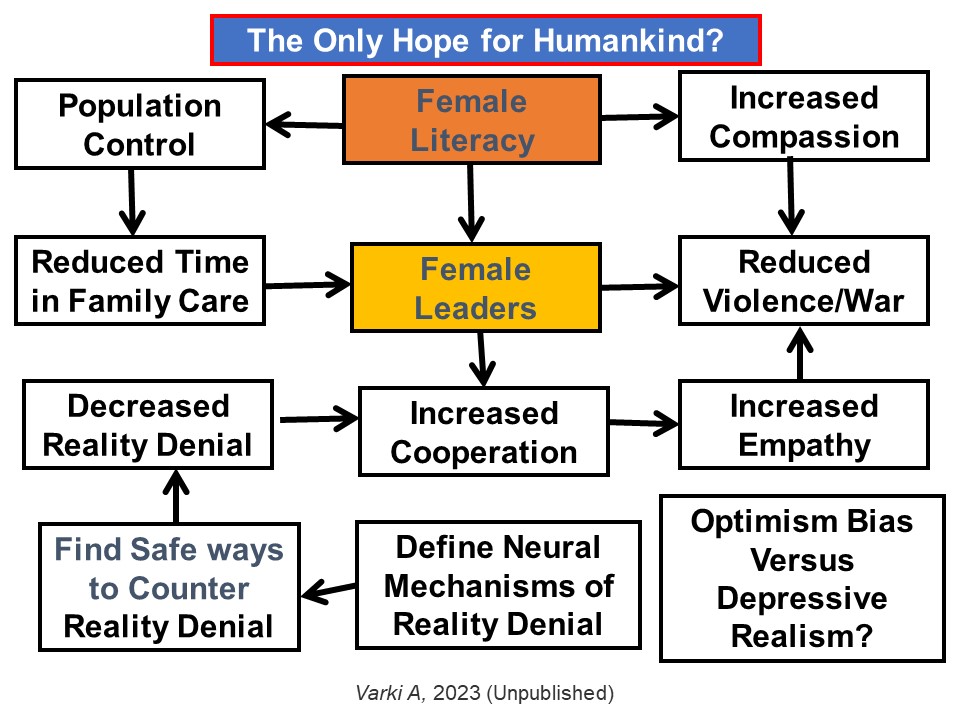
In the interview Varki introduces a new idea by proposing that we put more females in positions of power. Apparently females tend to deny reality less than males, as demonstrated by their higher rate of depression, and are more empathetic, both qualities we desperately need today.

Given the 50/50 polarized nature of politics today it does not take much of a voting block to swing an outcome. Perhaps if we target females with overshoot awareness they will abandon useless left/right politics and vote as a block for female leaders that support the only policy that will reduce suffering and improve every problem we face: population reduction.

Who’s in denial now? 🙂

If you are unfamiliar with the MORT theory, this is a very nice introduction by Dr. Varki:

If you want more detail on MORT, this 2019 paper by Dr. Varki is the best source, as it expands and clarifies the ideas presented in his 2013 book.

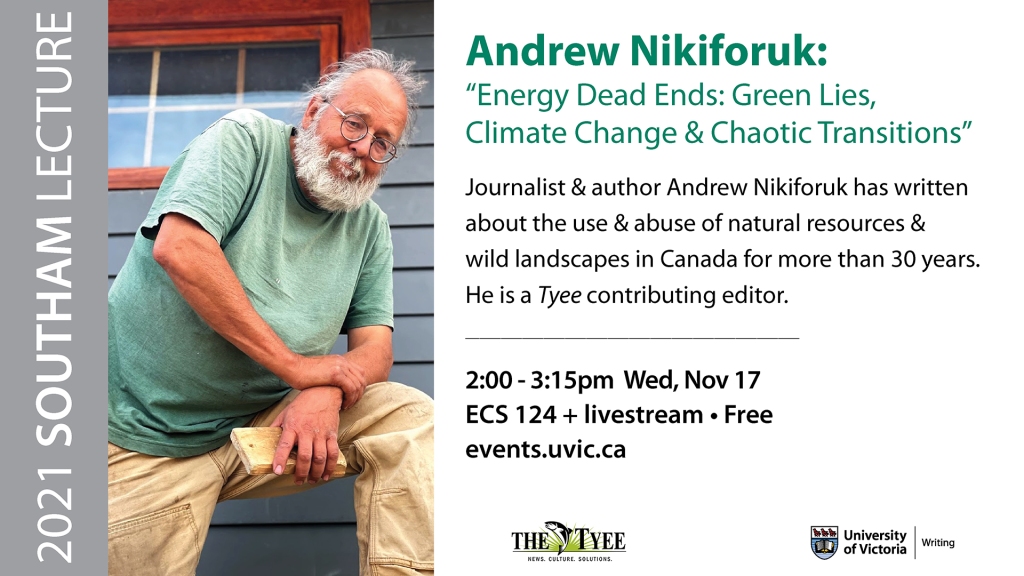
By Andrew Nikiforuk: Energy Dead-Ends: Green Lies, Climate Change and Chaotic Transitions

Canadian author and journalist Andrew Nikiforuk addressed our overshoot reality on November 17, 2021 at the University of Victoria.

It’s a brilliant must watch talk that touches on every important issue, except unfortunately Ajit Varki’s MORT theory and our genetic tendency to deny unpleasant realities. Nikiforuk does acknowledge that denial is an important force in our predicament.

It’s refreshing to find a journalist that understands what’s going on and that speaks plainly about what we must do.

Nikiforuk introduced a new idea (for me), the “technological imperium”:

…our biggest problem is a self-augmenting, ever-expanding technosphere, which has but one rule: to grow at any cost and build technological artifacts that efficiently dominate human affairs and the biosphere. The technological imperium consumes energy and materials in order to replace all natural systems with artificial ones dependent on high energy inputs and unmanageable complexity.

Nikiforuk seems to be implying that technology is the core problem and is driving the bus. Maybe. I think more likely advanced technology emerges as a consequence of unique intelligence (explained by MORT) coupled with fortuitous buried fossil energy, driven by a desire for infinite economic growth that arises from evolved behaviors expressing the Maximum Power Principle (MPP), all enabled by our genetic tendency to deny unpleasant realities, which causes us to ignore the costs of growth and technology. Regardless of which is the chicken and which is the egg, Nikiforuk is correct that technology has made our society very fragile, and is harming our social fabric.

An example Nikiforuk provided of the technological imperium is British Columbia’s trend of replacing sustainable natural salmon runs in rivers with fish farms that are totally dependent on non-renewable fossil energy and advanced technology. I’ve witnessed this first hand on the coast of Vancouver Island and it makes me sick to my stomach. I also witnessed how hard it is to oppose the technological imperium when a political party here was elected on a promise to close fish farms and then reneged after being elected.

As an aside, the technological imperium idea gave me a new insight into the covid mass psychosis of most rich countries and their obsession with a single high tech “solution” to covid while aggressively opposing all other less energy intensive, less risky, and lower tech responses.  

Nikiforuk began his talk with a quote I like from C.S. Lewis:

If you look for truth, you may find comfort in the end; if you look for comfort you will not get either comfort or truth, only soft soap and wishful thinking to begin, and in the end, despair.

I observe sadly that this must watch video has only 160 views, 3 of which are mine. 😦

Here are a few other ideas and quotes I captured while watching the talk:

  • “We have all but destroyed this once salubrious planet as a life support system in fewer than 200 years mainly by making thermodynamic whoopee with fossil fuels.” – Kurt Vonnegut
  • “Our political class is in a complete state of denial and will not act until things get much worse. You can expect more blah blah blah.”
  • “Energy spending determines greenhouse gas emissions. We only want to talk about emissions, we need to talk about energy spending.”
  • “We must contract the global economy by at least 40%.”
  • “We can choose a managed energy decent, something few civilizations have ever achieved, or we can face collapse.”
  • “People who do not face the truth turn themselves into monsters”. – James Baldwin
  • “In sum, expect extreme volatility and political unrest in the years ahead along with atmospheric rivers, heat domes, and burning forests.”
  • “We are now at revolutionary levels of inequality everywhere.”
  • “We are being fed 5 green lies because we do not want to discuss economic growth and population:
    • dematerialize the economy;
    • direct air capture;
    • carbon capture and storage;
    • hydrogen;
    • electric cars.”
  • “I must not fear. Fear is the mind-killer. Fear is the little-death that brings total obliteration. I will face my fear. I will permit it to pass over me and through me. And when it has gone past I will turn the inner eye to see its path. Where the fear has gone there will be nothing. Only I will remain.” – Frank Herbert
  • Conversations we avoid or deny:
    • Population
      • “There is no problem on earth that does not become easier to manage with fewer people. We don’t want to admit this, we don’t want to talk about this.”
      • We are currently using up the renewable resources of 1.7 earths and unless things change we’ll need 3 earths by 2050.
    • Energy Blindness
      • Our energy is so cheap and convenient it has blinded us to its true ecological, political, and social costs.
      • “Energy has always been the basis of cultural complexity and it always will be.” – Joseph Tainter
      • A single tomato today requires 10 tablespoons of diesel to grow it.
    • The Technosphere
      • An energy dissipating superorganism that destroys natural systems and replaces them with artificial systems dependent on high energy technologies.
        • Wild salmon running in rivers are replaced with fish farms.
        • Wetlands are replaced with water filtration projects.
        • Old growth forests are replaced with tree plantations.
      • Technology is to this civilization what the catholic church was to 14th century France, the dominant institution that controls every aspect of your life.
      • “A major fact of our present civilization is that more and more sin becomes collective, and the individual is forced to participate in collective sin.” – Jacques Ellul
      • “A low energy policy allows for a wide choice of lifestyles and cultures. If on the other hand a society opts for high energy spending its social relations must be dictated by technocracy and will be equally degrading whether labelled capitalist or socialist.” – Ivan Illich
    • Civilizations Do Collapse
      • Life is a cycle, it is not a linear path.
      • We have peaked and are now entering a phase of incredible volatility.
      • Every citizen needs to know the consequences of bad policy. Percent death on the Titanic by class was:
        • 39% first class
        • 58% second class
        • 76% steerage
  • What should you do with this awareness?
    • Withdraw from the fray of the Technosphere.
    • Do something to help preserve the natural world.
    • Get your hands dirty doing real work in nature.
    • Insist that creation has a value beyond utility.
      • “Think, less” – Wendell Berry
    • Build refuges and prepare for the storms ahead.
    • Wake each morning and ask yourself what you can give to this world rather than what you can take.
  • Comments and answers from the Q&A:
    • “The worst thing about the pandemic was that so many people and so many children were forced to spend so much time with colonizing machines.”
    • “We have to get a political conversation going about contracting the economy.” This won’t happen at the central government level but might happen within individual communities.
    • “Chance favors the prepared mind.”
    • “The only way we can get out of this mess without sacrificing millions and millions of people is to power down.”

Two weeks later, Nikiforuk reflected on his talk and responded to questions:

https://thetyee.ca/Analysis/2021/12/06/Andrew-Nikiforuk-Getting-Real-About-Our-Crises/

Two weeks ago, I gave a talk at the University of Victoria arguing that our morally bankrupt civilization is chasing dead ends when it comes to climate change and energy spending.

I argued that by focusing on emissions, we have failed to acknowledge economic and population growth as the primary driver of those emissions along with the unrestrained consumption of natural systems that support all life.

I added that people plus affluence plus technology make a deadly algorithm that is now paving our road to collective ruin.

As Ronald Wright noted in his book A Short History of Progress, civilization is a pyramid scheme that depends on cancerous rates of growth.

I also explained that many so-called green technologies including renewables, hydrogen and carbon capture and storage are not big solutions. Because they require rare earth minerals and fossil fuels for their production and maintenance, these technologies shift problems around.

In addition these green technologies cannot be scaled up in time to cut emissions or require too much energy to make any difference at all.

I also emphasized that our biggest problem is a self-augmenting, ever-expanding technosphere, which has but one rule: to grow at any cost and build technological artifacts that efficiently dominate human affairs and the biosphere. The technological imperium consumes energy and materials in order to replace all natural systems with artificial ones dependent on high energy inputs and unmanageable complexity.

This technological assault on the biosphere and our consciousness has greatly weakened our capacity to pay attention to what matters, let alone how to think. The result is a highly polarized and anxious society that can’t imagine its own collapse let alone the hazards of its own destructive thinking.

The best response to this constellation of emergencies is to actively shrink the technosphere and radically reduce economic growth and energy spending. Our political class can’t imagine such a conversation.

At the same time, communities and families must re-localize their lives, disconnect from the global machine and actively work to restore degraded ecosystems such as old-growth forests. Anyone who expects an “easy fix” or convenient set of solutions has spent too much time being conditioned by digital machines.

My cheerful talk generated scores of questions. There wasn’t time to answer them, so I selected five representative queries submitted via Zoom in the interest of keeping this heretical conversation going.

Growth in population tied to consumption is a big problem

Many listeners expressed disquiet about population growth being an essential part of the problem. “I am disappointed that once again Malthus has entered the room when the difference between per capita emissions for GHGs between the Global North and Global South are significant. Isn’t it how we live not how many of us there are?” asked one.

The real answer is uncomfortable. How we live and consume matters just as much as the growing density of our numbers combined with the proliferation of our machines that devour energy on our behalf. (Roads and cell phones all consume energy and materials too.) All three demographic issues are increasing at unsustainable rates and feed each other to propel more economic growth, more emissions and more fragility.

The world’s current population is 7.9 billion and grows by 80 million a year. It has slowed down in recent years because the affluent don’t need the energy of children as much as the poor. Even so civilization will add another billion to the planet every dozen years. Redistributing energy wealth (and emissions) from the rich to the poor will not avert disaster if human populations don’t overall decline.

Our numbers also reflect a demographic anomaly that began with fossil fuels, a cheap energy source that served as Viagra for the species. Prior to our discovery of fossil fuels, the population of the planet never exceeded one billion. Our excessive numbers are purely a temporary artifact of cheap energy spending and all that it entails — everything from fertilizer to modern medicine.

Isn’t capitalism the real threat?

Many questions revolved around the nature of capitalism. “Wouldn’t it be more accurate to denounce the capitalist organization of technology rather than technology as such for problems like polarization and fragmentation?”

No, it would not. Technology emphasizes growth and concentrates power regardless of the ideology.

Capitalism, like socialism and communism, is simply a way to use energy to create technologies that structure society in homogeneous ways. Removing capitalism from the equation would not change the totalitarian nature of technology itself. Or the ability of technologies to colonize local cultures anywhere.

Every ideology on Earth, to date, has used technologies to strengthen their grip on power by enmeshing their citizens in complexity and reducing humanity to a series of efficiencies. All have supported digital infrastructure to monitor and survey their citizens. As the sociologist Jacques Ellul noted long ago ideologies don’t count in the face of technological imperative.

What comes next?

Many listeners asked if “there is a sequel to the energy-rich market economy?” I have no crystal ball but here is my response.

There will always be some kind of sequel and it is not written. But there is no replacement for cheap fossil fuels and their density and portability. They made our complex civilization what it is. As fossil fuel resources become ever more expensive and difficult to extract (a reality the media ignores), the “rich market economy” will experience more volatility, inequality, disruptions, corruption and inflation. It is rare for any civilization to manage an energy descent without violence let alone grace.

“Can you say more about the connection between the technosphere and totalitarian societies?” asked one listener. “How do you see connections between dictatorships and the technosphere?”

This is a subject for a much longer essay. The technosphere, by definition, offers only one system of thinking and operating (triumph of technique over all endeavors) and has been eroding human freedoms for decades. It simply creates dependents or inmates. Social influencers now tell its residents what to buy and how to behave. As such the technosphere has become an all-encompassing environment for citizens whether they be so-called democracies or totalitarian societies.

The major difference between the two is simply the degree to which techniques have been applied to give the state more total control over its citizens. In both democratic societies and totalitarian ones, technical elites actively mine citizens for data so that information can be used to engineer, monitor and survey the behavior of their anxious and unhappy citizens in a technological society. (You can’t live in a technological society without becoming an abstraction.) The Chinese state does not hide its intentions; the West still clings to its illusions of freedom.

The technosphere corrupts language

One listener wanted to know “more about the empty language” employed by the technosphere as I mentioned in my talk.

Just as the technosphere has replaced bird song with digital beeps, the technological imperium has increasingly replaced meaningful language with techno-speak.

A world dominated by reductionist and mechanistic thinking has produced its own Lego-like language completely divorced from natural reality. Decades ago the German linguist Uwe Poerksen called this new evolving language “plastic words.”

They include words like environment, process, organization, structure, development, identity and care. All can be effortlessly combined to convey bullshit: “the development of the environment with care is a process.” This modular language creates its own tyranny of meaningless expression.

Experts, technicians, politicians and futurists employ this plastic language to baffle, confuse and obfuscate. Poerksen notes these words are pregnant with money, lack historical dimension and refer to no local or special place. This language, divorced from all context, does to thinking what a bulldozer does to a forest. It flattens it.

Hope is not a pill you take in the morning or a crumb left at the table

Last but not least many listeners asked how do we maintain hope in the face of so many emergencies, abuses and appalling political leadership?

“How do you get up in the morning?” typically asked one.

This frequent question confounds and puzzles me. My humble job as a journalist is not to peddle soft soap or cheerlead for ideologies and futurists. My job is not to manufacture hope let alone consent. I have achieved something small if I can help readers differentiate between what matters and what doesn’t and highlight the power implications in between.

Yet in a technological society most everyone seeks an easy, canned message pointing to a bright future. I cannot in good conscience tell anyone, let alone my own children, that the days ahead will be happy or bright ones. To everything there is a season and our civilization has now, step by step, entered a season of discord and chaos. History moves like life itself in a cycle of birth, life, death and renewal.

Jacques Ellul, who wrote prophetically about the inherent dangers of technological society, also addressed the need for authentic hope because it does not reside in the technosphere. The technosphere, a sterile prison, may promise to design your future with plastic words, but what it really offers is the antithesis of hope.

Ellul, a radical Christian, wrote deeply much about hope and freedom. He noted that hope never abandons people who care about a place and are rooted outside the technosphere for they will always know what to do by their real connection to real things. He adds that hope cannot be divorced from the virtues of faith and love. Like all virtues they must be quietly lived, not daily signalled.

For Ellul, hope was a combination of vigilant expectation, prayer and realism. “Freedom is the ethical expression of the person who hopes,” he once wrote.

Hope is living fully in a place you care about and acting against the abuse of power every day. Hope, in other words, is using every initiative “to restore the possibility of people making their own decisions.”

P.S. This talk inspired me to make my first donation to a news source, The Tyee, for which in 2010 Nikiforuk became its first writer in residence.

Denial with Cortical Columns

I just finished the new book by Jeff Hawkins titled “A Thousand Brains: A New Theory of Intelligence”.

A bestselling author, neuroscientist, and computer engineer unveils a theory of intelligence that will revolutionize our understanding of the brain and the future of AI. 

For all of neuroscience’s advances, we’ve made little progress on its biggest question: How do simple cells in the brain create intelligence? 

Jeff Hawkins and his team discovered that the brain uses maplike structures to build a model of the world-not just one model, but hundreds of thousands of models of everything we know. This discovery allows Hawkins to answer important questions about how we perceive the world, why we have a sense of self, and the origin of high-level thought. 

A Thousand Brains heralds a revolution in the understanding of intelligence. It is a big-think book, in every sense of the word.

I’ve followed Hawkins for many years and he’s one of my favorite neuroscience researchers. He started as an electrical engineer and created in 1996 the groundbreaking handheld PalmPilot (which I owned 🙂 ), and then switched careers to his passion of figuring out how the brain works.

In his book he proposes a new theoretical framework for how intelligence works. I think he’s on to something important. So does Richard Dawkins who wrote the forward and compares the book to Charles Darwin’s On the Origin of Species.

I see an opportunity to build on Hawkins’ intelligence framework to push Varki’s MORT theory forward by refining why and what we deny, and how denial is implemented in the brain. Some of my still rough ideas are presented at the end of this essay.

There’s a second aspect of Hawkins’ book that is also interesting.

After presenting his new theory on intelligence, Hawkins spends the last half of the book explaining how our old brain behaviors and false beliefs (aka denial) threaten the survival of our species, and he proposes several ways we might avoid these threats.

He’s clearly worried and knows we are in trouble.

Yet when discussing the threats to our species he is blind to the biggest, imminent, and certain threat we face: fossil energy depletion. Hawkins, like most polymaths, can’t see that the technology he loves, was created by, and totally depends on, rapidly depleting non-renewable resources.

So we have a world expert on how and why our brain creates false beliefs, that can’t see his own false beliefs.

We could ask for no better evidence that MORT is true! 

But wait, there’s more.

In the last chapters Hawkins obsesses over inventing a lasting means for our species to signal to other life in the universe that human intelligence once existed. As I was reading this I kept thinking, what the hell are you going on about? The odds are extremely low that other intelligent life will ever see our signaling satellites, and who the hell cares if they do? Then a light went on. His signal is a high tech version of an Egyptian pyramid, and is his brain’s mechanism for denying death.

So how could it get any better?

  • a well written enjoyable book
  • with an important new theory
  • on the most interesting aspect of a unique species
  • that may push forward Varki’s MORT theory on why we exist
  • by a brilliant polymath
  • that is blinded by the same denial that created his species

Following is a brief recapitulation of Hawkins’ cortical column framework for intelligence integrated with my musings on how it might be used to clarify and focus Varki’s MORT theory.

This hypothesis will be revised, possibly substantially, after I complete a 2nd more careful reading of Hawkins’ book and published papers, which I’ve just started. I’m also hoping to incorporate criticism from Dr. Varki which may improve or kill my ideas.

Downvoting the Cortical Column Death Model to Breach the Extended Theory of Mind Barrier

Version 1.2, April 17, 2021

Note: For the sake of brevity, every occurrence of “not die” should be read as “not die until viable offspring are produced”.

  • Genes evolve and collaborate to create bodies.
  • Bodies exist to replicate genes.
  • A body must not die to achieve its purpose of replicating genes.
  • The brain exists to help the body by choosing the best action to not die for a given set of sensory inputs.
  • The old brain uses simple static models to directly cause actions to not die.
  • The neocortex uses more complex learned models to indirectly cause actions to not die by requesting the old brain to execute actions.
  • Learning is moving: the neocortex learns by moving senses around the subject to create (up to about 1000) reference frame models.
  • Thinking is moving: concepts without physical form, like mathematics, are learned by moving between models to create new reference frame models.
  • Models have redundancy which makes knowledge more resilient and repurposable.
  • Models are stored in cortical columns.
  • The neocortex is composed of many nearly identical cortical columns.
  • Senses (and outputs from other models) are evaluated for matches by models.
  • Models collaborate by voting to decide our conscious reality.
  • The agreed reality is used by other models to select the best action to not die.
  • Evolution increases the number of cortical columns in species that benefit from more intelligence to not die.
  • Social species have the most cortical columns because modeling social relationships is hard.
  • The human neocortex has about 150,000 cortical columns.
  • There are two important thresholds on the continuum of increasing social intelligence.
  • “Theory of mind” is the threshold where a brain learns a model of another brain, and that model includes an understanding that the other brain can die.
  • “Extended theory of mind” is the threshold where a brain learns that its model of another brain also models itself, and that it can also die.
  • The extended theory of mind threshold may be difficult for evolution to cross, because it has happened only once on this planet.
  • A model that predicts possible death from injury and certain death from old age results in fewer actions to not die.
  • Fewer actions to not die is called depression.
  • Genes for an extended theory of mind thus do not persist.
  • To break through the barrier, evolution requires a mechanism to prevent the learned death model from evaluating true.
  • A mechanism consistent with the archeological record was to learn a model for life after death (aka God) which downvotes the death model thus continuing the actions to not die.

Modern Implications of the Death Model

  • Climate change acceptance combined with the common false belief that renewable energy can replace depleting non-renewable fossil energy, and the common false belief that technology can remove sufficient CO2 from the atmosphere, does not trigger the death model, and the false beliefs cause our species to take actions that worsen our overshoot predicament.
  • Awareness of human overshoot and its implications are present in less than 0.01% of humans, including most highly educated polymaths, because it triggers the death model. Most people deny overshoot with false beliefs that non-renewable resources are abundant.

By Jean-Marc Jancovici: Will technology save us from Climate Change?

Brilliant new talk by my favorite alien engineer, Jean-Marc Jancovici.

If you only have 90 minutes to spare, and you want to understand everything that matters about how the world works, and the nature of our overshoot predicament, and what we need to do to minimize future suffering, then this talk is the best use of your time.

spoiler alert: the answer is no

https://www.media.mit.edu/events/will-technology-save-us-from-climate-change/

Bio: 

Jean-Marc Jancovici is an advisor to the French government on climate change and energy as part of the French High Council for Climate. He is a founding partner of Carbon 4, a Paris-based data consultancy specializing in low carbon transition and the physical risks of climate change (www.carbone4.com). He is also the founder and president of The Shift Project, a Paris-based think tank advocating for a low carbon economy (www.theshiftproject.org). Jean-Marc Jancovici also serves as an associate professor at Mines ParisTech.

Abstract:

The thermo-industrial development of our society has been possible due to resource extraction and the transformation of our environment. Unfortunately, it has led to severe environmental consequences that humanity is experiencing around the globe: shifting and unpredictable climate, extreme weather events, and biodiversity collapse. Humanity is paying the consequences for technical and technological progress. Thus, can technology still save us from climate change?

Jean-Marc Jancovici will address this question through the paradigm of energy. He will first detail how modern society is structured around thermal and nuclear energies, and will then discuss the impact of this structure on global climate and society. Finally, Jean-Marc Jancovici will conclude by exploring the trade-offs between economic growth and sustainable climate stewardship.

Slides: https://fr.slideshare.net/JoelleLeconte/jancovici-mit-media-lab-23022021/1

The un-Denial Decision Tree

This post was inspired by a comment from reader Kira. She asked if denying climate change was the same as denying death. I answered as follows:

“I suspect there are 2 main groups of people:

One group is the 95% of the population that doesn’t really understand the science or the severity of the problem. They see bad things happening with the weather, but they also hear on the news that countries have signed an agreement to prevent the temperature from rising more than 2 degrees, and they see neighbors buying solar panels and electric cars, which they’re told by experts are solutions to climate change, so their optimism bias that comes from genetic reality denial leads them to conclude that the climate problem is being addressed, and they put it out of mind.

The other group is the 5% that does understand the science and the severity of climate change. These people have enough intelligence and education to conclude that we are already screwed regardless of what we do, and that any effective mitigation effort must involve a rapid decrease in population and/or per capita consumption. It is within this group that genetic denial of unpleasant realities is operating in full force. Most of these experts genuinely believe that climate change can be safely constrained, and economic growth can continue, by replacing fossil energy with solar/wind energy and by using machines to remove CO2 from the atmosphere. These beliefs are so absurd, and so contrary to basic high school level science, that there can be no other explanation than genetic realty denial. In this group, maybe it is death that is the main thing being denied.”

Kira said she agreed and then suggested it might be better to let people, and especially young people, remain in blissful ignorance so that they do not become depressed and lose a sense of purpose.

I thought about it and created the following decision tree of possible paths to answer her question.

  1. Humans are in serious trouble
    1. Disagree (I believe in God or Steven Pinker)
      • path: Carry on and oppose anything that threatens your beliefs and lifestyle
    2. Agree (I believe my eyes)
      1. It’s too late to do anything useful (nature’s forces now dominate human forces)
        1. Agree (a reasonable position given the data, but only if you think other species don’t matter, and 8 billion suffering humans is no worse than 8 billion minus 1 suffering humans)
          • path: Try not to think about it and enjoy the good days that remain and/or do some prepping to extend your good days
        2. Disagree (there’s still time to make the future less bad, even if all we do is reduce harm to other species and/or total human suffering)
          1. Humans can’t or won’t change their behavior in time
            1. Agree (most of history says we only change when forced, and the coming debt/energy/climate collapse will be too severe for any good to come of it)
              • path: Try not to think about it and enjoy the good days that remain and/or do some prepping to extend your good days
            2. Disagree (I believe Sapolsky that behavior is plastic and we have enough energy left to build a softer landing zone)
              1. Genetic reality denial blocks any useful change
                1. Disagree (I deny that I deny reality)
                  • path: Make yourself feel good by recycling your garbage, shopping with reusable bags, buying an electric car, and voting Green
                2. Agree (it’s not possible to act optimally without understanding reality)
                  1. Awareness of genetic realty denial will increase awareness of reality
                    1. Disagree (most people just want to pay their bills and watch TV)
                      • path: Try not to think about it and enjoy the good days that remain and/or do some prepping to extend your good days
                    2. Agree (most people want to learn)
                      1. Awareness of reality will cause positive behavior changes
                        1. Disagree (if the majority understood reality it would be Mad Max)
                          • path: Try not to think about it and enjoy the good days that remain and/or do some prepping to extend your good days
                        2. Agree (most people want to do the right thing, especially if pain is shared fairly)

This tree of (usually subconscious) decisions a person must make to decide which path to take about human overshoot results in 7 possible paths.

Six of the paths do not improve the outcome. One of the paths might improve the outcome, but has a very low probability of success because it’s currently occupied by a single old uncharismatic antisocial engineer.

Most people who really understand our overshoot predicament would probably discard my complicated decision tree and focus on a single issue: humans can’t or won’t change.

This view was recently voiced by reader Apneaman in a comment:

But can’t/wont. Have not.

Why? Like Sabine says…………

Now, some have tried to define free will by the “ability to have done otherwise”. But that’s just empty words. If you did one thing, there is no evidence you could have done something else because, well, you didn’t. Really there is always only your fantasy of having done otherwise.

No plan, no matter how spiffy & technically feasible, or logical argument can convince me that the humans are capable of collective change. I’ll need to see it to believe it. Same as God. Only Jesus floating down from the firmament & performing 10 miracles that are so spectacular they would make illusionist David Copperfield blush could convince me of the supernatural.

While true that it’s difficult to cause people to collectively do things they find unpleasant, or that conflict with the MPP objectives of their genes, it’s not impossible and not without precedent. I gave the following examples:

When the Canadian government says to its citizens:

  • Everyone must pay about 50% of their income as tax to operate the country.
    • Most citizens comply, and those that don’t are usually caught and forced to pay an extra penalty.
  • Germany has attacked our friend and we need our young men to risk their lives by fighting a war on a different continent.
    • Most eligible young men volunteered.
  • A virus threatens to overrun our healthcare system and we need citizens to stay at home except for essential activities which must be conducted with a mask.
    • Most citizens will comply.

Now if the Canadian government said to its citizens the combined threats of climate change and diesel depletion threaten our food security within 10 years, so we are putting in place incentives to encourage local food production and processing, and to decrease food imports, I think most citizens would support the plan.

If then after a couple years of further study and communication on the threat, the government said we don’t think there will be enough food to support our population in 10 years so we are stopping immigration and requiring families to have no more than one child, I think most citizens would comply.

The issue of course is that the Canadian government is not going to acknowledge or act on our overshoot threat in this manner.

Why?

I think it’s due to our genetic tendency to deny unpleasant realities, whenever we can get away with it.

Taxes, war, and viruses are very unpleasant, but they’re in your face and impossible to deny.

Food shortages 10 years out are easy to deny.

How do we change this?

It has to start with discussing and trying to understand our genetic tendency to deny unpleasant realities. Hence the path I’ve personally chosen in the above tree.

By Art Berman: Stop Expecting Oil and the Economy to Recover

This recent essay by Art Berman may be the best historical analysis of oil and its relationship with the economy I’ve read.

https://www.artberman.com/2020/09/03/stop-expecting-oil-and-the-economy-to-recover/

Here is my simplified summary of Berman’s analysis:

  • both supply and demand for oil have recently fallen
  • oil demand has fallen more than oil supply
  • this despite an all-time record amount of debt conjured to stimulate the economy
  • which means the global economy is contracting and is in serious trouble
  • the contraction was underway before the virus – the virus accelerated but did not cause the contraction
  • the problem began in 1974 when oil prices increased above the level that the economy can grow without debt growing faster
  • we’re not going to run out of oil, we’re going to run out of people that can afford oil
  • the problem being geologic and thermodynamic in nature, has no business as usual fix, and will continue to worsen

Berman’s analysis is consistent with the conclusions of the other leading minds on the energy-economy relationship: Gail Tverberg, Tim Morgan, Nate Hagens, and Tim Garrett.

The most interesting question, by far, when viewed from 10,000 feet is why do none of our political or intellectual or business leaders understand the most important influence (energy) on the thing they care most about (economic growth)?

The answer of course is that the human species evolved to deny unpleasant realities.

As an aside, recall that Eric Weinstein, the brilliant physicist/hedge fund manager whom I recently wrote about as a case study in denial believes correctly that economic growth and scientific advancement slowed in the late 70’s, but he doesn’t understand the cause despite thinking about it a lot. It’s no wonder that the much lesser intellects of almost all economists don’t have a clue what’s going on.

Berman believes that our economy, being a dissipative structure, will either collapse or spontaneously re-organize itself into a simpler form that uses less energy. I suppose the virus lockdown is a good example of a spontaneous lower energy re-organization. I put my money though on some form of collapse in the not too distant future. Despite a surfeit of entitled citizens, we could weather a significant reduction in living standards because we in the developed world consume so much more than we need to survive, however, the unprecedented debt bubble we have created by denying reality blocks a civil contraction.

Berman concludes that as the economy necessarily simplifies and we live much poorer lives, our energy mix will shift to lower productivity energy sources like wind and solar. My response to this is maybe. It’s more likely that Berman is denying the reality of his own analysis.

I can see solar panels being used for low power/high impact applications like, for example, LED lighting and pumping water into a gravity fed cistern. But it is unlikely and probably impossible that we will heat our homes, or cook our food, or cultivate and harvest our crops, or mine and smelt our minerals, or transport ourselves and our necessities with solar and wind.

When our solar panels and wind turbines wear out some decades in the future it is unlikely that the sophisticated factories and complex supply chains needed to manufacture and install replacements will exist. If some do exist to supply elite customers, like the military, most citizens probably won’t be able to afford their products.

I expect reality denial will prevent us from ever acknowledging peak oil and its offspring human overshoot. Instead, our consensus story all the way to a medieval lifestyle, at best, will likely be that there’s plenty of oil if the other tribes would stop using so much and we just need to elect someone tougher to deal with them and get our economy growing again.

Acknowledging our genetic tendency to deny reality would be a good thing because we might then focus on the best response to our overshoot predicament which is to rapidly reduce our population. Other wise responses can be found here.

Here’s the excerpted conclusion from Berman’s essay, but it’s definitely worth your time to read the whole thing for the data backing up these conclusions.

The Great Simplification

Energy is the economy. Money is a call on energy. Debt is a lien on future energy.

What is happening to oil markets and to the global economy is not because of a virus. The virus greatly accelerated what was already happening. Things won’t go back to normal when the virus ends.

The expansion of energy and debt have been leading toward some sort of reckoning for at least the last fifty years. That day of reckoning has been brought forward by coronavirus economic closures.

Oil prices had averaged $25 per barrel from the end of World War II until 1974 when average prices doubled (Figure 9). From 1979 through 1986, oil price soared to an average of $86 per barrel. These massive economic dislocations resulted in use of debt to maintain economic growth.

Excessive debt was the leading cause for the Financial Collapse of 2008. The crisis was resolved with more debt and monetary policies that ushered in the present era of central bank primacy in the world financial system.

Quantitative easing, near-zero interest rates and high oil prices led to the first wave of the tight oil boom. Over-investment resulted in over-supply and price collapse in 2014. By February 2016, WTI price reached $33 and investors rushed in to support the second wave of the tight oil boom.

WTI reached $72 by mid-2018 but by then, investors had begun to abandon tight oil as well as oil companies in general. The coronavirus economic closure brought monthly average prices to $17 in April, 2020—the lowest month on record. Unlike early 2016, investors weren’t writing any checks this time.

U.S. production may be 50% lower by mid-2021 than at year-end 2019. The implications for U.S. geopolitical power and balance of payments are staggering. It seems likely that the economy will weaken as government support for the unemployed decreases

I doubt that we are on the cusp of either a global energy crisis or the end of the oil age. It is more likely that both supply and demand will fall in tandem as the global economy contracts.

These observations are at odds with the mainstream view that both supply and demand are recovering. Some might concede that I am correct for the present but that things will improve and return to normal although it may some time.

Figure 10 shows credit growth and credit impulse for the United States from 1960 through the first quarter of 2020. Credit impulse is the change in flow of credit (debt) relative to economic activity (GDP).

Spikes in credit impulse correlate well with the oil-price shocks of the 1970s and 1980s. The extraordinary U.S. comparative inventory drawdown of early 2017 through the second quarter of 2018 also corresponds to credit impulse anomalies.

The chief feature of Figure 10, however, is that the magnitude of the first quarter 2020 credit impulse was more than twice as large as any previous increase. Moreover, GDP growth was either neutral or positive during previous spikes but was negative (-10%) for the first quarter of 2020. Also, oil prices were increasing during earlier periods but prices were decreasing in early 2020.

Ilya Prigogine was a chemist who won the 1977 Nobel Prize for his work on dissipative structures and self-organization. Dissipative structures are physical systems that release considerable heat as they consume ever-greater energy to support their growth and increasing complexity. A crisis occurs when growth can no longer be supported by available energy resources. The system either collapses or spontaneously re-organizes itself into a simpler form that uses less energy.

Empires, organizations and economies are dissipative structures. So is the human brain.

My friend Nate Hagens has applied some of Prigogine’s ideas to his own research about world energy, economics and ecology. He believes that we are on the cusp of something quite different from the scenarios suggested by Ahmed, and Goehring and Rozencwajg.

Hagens predicted a global economic decline in the 2020s and publicly expressed that opinion before the Covid pandemic. The main reason for decline, he stated, was too much debt undertaken to continue consuming and growing the economy. The virus has accelerated its timing and may result in contraction greater than the 30% drop during the Great Depression.

The Great Simplification will occur when the credit-supported part of the economy is removed. Economic activity will contract and less energy will be needed because it will be increasingly unaffordable to many parts of the population. People will be forced to adjust living standards downward and self-organize around energy with greater emphasis on local supply chains and regional economies.

I expect that the mix of energy sources will be similar initially. That will probably change as declines to meet the decreased carrying capacity of a society deprived of fossil energy productivity. Then, I imagine the world will move increasingly toward lower productivity energy sources like wind and solar. A viable economy may very well be created based heavily on wind and solar. It will, however, support a much poorer world than we have known for many decades in the world’s advanced economies.

Most ideas and analyses about future trends in energy and the economy fail to recognize that they are the two aspects of the same thing. That is why they are so far off the mark. This basic misalignment is painfully obvious because the energy sector represents only 2.5% of the S&P 500 valuation but underlies probably 95% of U.S. GDP.

That is what Hagens calls energy blindness1.

1I call it energy denial.

Biased Cognitive Biases

Cognitive Bias Codex

Thanks to Apneaman for bringing this image to my attention, it’s very interesting.

This info-graphic was constructed from a list of cognitive biases assembled by a team of experts collaborating via Wikipedia over a 15 year period.

A cognitive bias is defined as:

A cognitive bias is a systematic pattern of deviation from norm or rationality in judgment. Individuals create their own “subjective reality” from their perception of the input. An individual’s construction of reality, not the objective input, may dictate their behavior in the world. Thus, cognitive biases may sometimes lead to perceptual distortion, inaccurate judgment, illogical interpretation, or what is broadly called irrationality.

Some cognitive biases are presumably adaptive. Cognitive biases may lead to more effective actions in a given context. Furthermore, allowing cognitive biases enables faster decisions which can be desirable when timeliness is more valuable than accuracy, as illustrated in heuristics. Other cognitive biases are a “by-product” of human processing limitations, resulting from a lack of appropriate mental mechanisms (bounded rationality), impact of individual’s constitution and biological state (see embodied cognition), or simply from a limited capacity for information processing.

A continually evolving list of cognitive biases has been identified over the last six decades of research on human judgment and decision-making in cognitive science, social psychology, and behavioral economics.

I counted them. There are 195 distinct cognitive biases named and described in the list.

Have a look. Do you notice something very odd?

The most important and powerful of all human cognitive biases, and the one that created our unique species, is not on the list: denial of unpleasant realities.

Nor is its progenitor, denial of death.

Any half-wit who studies human history will notice that the first wacky thing our species did after evolving into behaviorally modern humans was make up stories (religions) to deny death.

Today our species aggressively denies every single unpleasant reality of substance that threatens its survival including: over-population, non-renewable resource depletion, climate change, pollution, habitat destruction, and species extinction.

So here’s the question…

How is it possible that a group of experts over 15 years can assemble a list of 195 cognitive biases and completely miss the most important one?

The only explanation big enough and powerful enough to explain this gobsmacking dumbfuckery is denial of denial.

WASF