By Ian Dunlop & David Spratt – Disaster Alley: Climate Conflict & Risk

Here is a new report on the extreme risks of climate change.

A theme of the report is that a “failure of imagination” has prevented us from acknowledging and acting on the climate threat.

What the authors are actually discussing, without being aware of it, is inherited denial of reality.

If you substitute “inherited denial of reality” for “failure of imagination” the report makes much more sense.

The authors conclude the report by calling for an emergency initiative to decarbonize the economy, without demonstrating that they understand the implications of such an initiative, which demonstrates that the authors are as deeply in denial as the governments they criticize.

https://www.breakthroughonline.org.au/disasteralley
bt_infographic_dafb

Climate change is an existential risk that could abruptly end human civilisation because of a catastrophic “failure of imagination” by global leaders to understand and act on the science and evidence before them.

At the London School of Economics in 2008, Queen Elizabeth questioned: “Why did no one foresee the timing, extent and severity of the Global Financial Crisis?” The British Academy answered a year later: “A psychology of denial gripped the financial and corporate world… [it was] the failure of the collective imagination of many bright people… to understand the risks to the system as a whole” (Stewart 2009).

A “failure of imagination” has also been identified as one of the reasons for the breakdown in US intelligence around the 9/11 attacks in 2001.

A similar failure is occurring with climate change today.

The problem is widespread at the senior levels of government and global corporations. A 2016 report, Thinking the Unthinkable , based on interviews with top leaders around the world, found that: “A proliferation of ‘unthinkable’ events… has revealed a new fragility at the highest levels of corporate and public service leaderships. Their ability to spot, identify and handle unexpected, non-normative events is… perilously inadequate at critical moments… Remarkably, there remains a deep reluctance, or what might be called ‘executive myopia’, to see and contemplate even the possibility that ‘unthinkables’ might happen, let alone how to handle them.” (Gowing and Langdon 2016)

Such failures are manifested in two ways in climate policy. At the political, bureaucratic and business level in underplaying the high-end risks and in failing to recognise that the existential risk of climate change is totally different from other risk categories. And at the research level in underestimating the rate of climate change impact and costs, along with an under-emphasis on, and poor communication of, those high-end risks.

Existential risks are not amenable to the reactive (learn from failure) approach of conventional risk management, and we cannot necessarily rely on the institutions, moral norms, or social attitudes developed from our experience with managing other sorts of risks. Because the consequences are so severe – perhaps the end of human global civilisation as we know it – “even for an honest, truth-seeking, and well-intentioned investigator it is difficult to think and act rationally in regard to… existential risks” (Bostrom and Cirkovic 2008).

Yet the evidence is clear that climate change already poses an existential risk to global stability and to human civilisation that requires an emergency response. Temperature rises that are now in prospect could reduce the global human population by 80% or 90%. But this conversation is taboo, and the few who speak out are admonished as being overly alarmist.

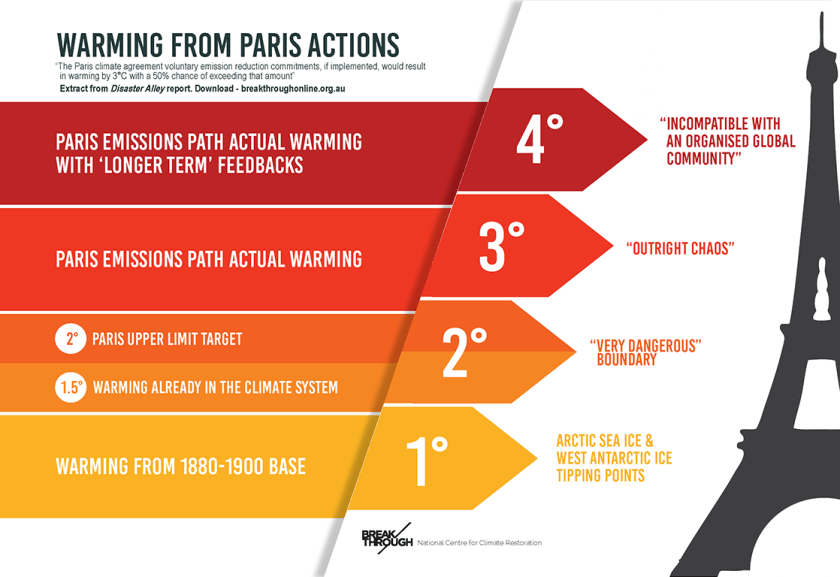
Prof. Kevin Anderson considers that “a 4°C future [relative to pre-industrial levels] is incompatible with an organized global community, is likely to be beyond ‘adaptation’, is devastating to the majority of ecosystems, and has a high probability of not being stable” (Anderson 2011). He says: “If you have got a population of nine billion by 2050 and you hit 4°C, 5°C or 6°C, you might have half a billion people surviving” (Fyall 2009).

Asked at a 2011 conference in Melbourne about the difference between a 2°C world and a 4°C world, Prof. Hans Joachim Schellnhuber replied in two words: “Human civilisation”. The World Bank reports: “There is no certainty that adaptation to a 4°C world is possible” (World Bank 2012). Amongst other impacts, a 4°C warming would trigger the loss of both polar ice caps, eventually resulting, at equilibrium, in a 70-metre rise in sea level.

The present path of greenhouse gas emissions commits us to a 4–5°C temperature increase relative to pre-industrial levels. Even at 3°C of warming we could face “outright chaos” and “nuclear war is possible”, according to the 2007 Age of
Consequences report by two US think tanks (see page 10).

Yet this is the world we are now entering. The Paris climate agreement voluntary emission reduction commitments, if implemented, would result in the planet warming by 3°C, with a 50% chance of exceeding that amount.

This does not take into account “longer-term” carbon-cycle feedbacks – such as permafrost thaw and declining efficiency of ocean and terrestrial carbon sinks, which are now becoming relevant. If these are considered, the Paris emissions
path has more than a 50% chance of exceeding 4°C warming. (Technically, accounting for these feedbacks means using a higher figure for the system’s “climate sensitivity” – which is a measure of the temperature increase resulting from a doubling of the level of greenhouse gases – to calculate the warming.

A median figure often used for climate sensitivity is ~3°C, but research from MIT shows that with a higher climate sensitivity figure of 4.5°C, which would account for feedbacks, the Paris path would lead to around 5°C of warming (Reilly et al. 2015).)

So we are looking at a greater than one-in-two chance of either annihilating intelligent life, or permanently and drastically curtailing its potential development. Clearly these end-of-civilisation scenarios are not being considered even by risk-conscious leaders in politics and business, which is an epic failure of imagination.

The world hopes to do a great deal better than Paris, but it may do far worse. A recent survey of 656 participants involved in international climate policy-making showed only half considered the Paris climate negotiations were useful, and 70% did not expect that the majority of countries would fulfil their promises (Dannenberg et al. 2017).

Human civilisation faces unacceptably high chances of being brought undone by climate change’s existential risks yet, extraordinarily, this conversation is rarely heard. The Global Challenges Foundation (GCF) says that despite scientific evidence that risks associated with tipping points “increase disproportionately as temperature increases from 1°C to 2°C, and become high above 3°C”, political negotiations have consistently disregarded the high-end scenarios that could lead to abrupt or irreversible climate change. In its Global Catastrophic Risks 2017 report, it concludes that “the world is currently completely unprepared to envisage, and even less deal with, the consequences of catastrophic climate change”. (GCF 2017)

In 2007, The Age of Consequences reported:

“Our group found that, generally speaking, most scientific predictions in the overall arena of climate change over the last two decades, when compared with ultimate outcomes, have been consistently below what has actually transpired. There are perhaps many reasons for this tendency—an innate scientific caution, an incomplete data set, a tendency for scientists to steer away from controversy, persistent efforts by some to discredit climate “alarmists,” to name but a few…”(Campbell et al. 2007)

For many critical components of the climate system, we can identify just how fast our understanding is changing. Successive IPCC reports have been reticent on key climate system issues:

• Antarctica: In 2001, the IPCC projected no significant ice mass loss by 2100 and, in the 2014 report, said the contribution to sea level rise would “not exceed several tenths of a meter” by 2100. In reality, the Amundsen Sea sector of the West Antarctic Ice Sheet has been destabilised and ice retreat is unstoppable for the current climate state. It is likely that no further acceleration in climate change is necessary to trigger the collapse of the rest of the ice sheet, with suggestions of a 3–5 metre sea-level rise within two centuries from West Antarctic melting. (Spratt 2017)

• Sea levels: In the 2007 IPCC report, sea levels were projected to rise up to 0.59 metre by 2100. The figure was widely derided by researchers, including the head of NASA’s climate research (Hansen 2007) as being far too conservative. By 2014, the IPCC’s figure was in the range 0.55 to 0.82 metre, but they included the caveat that “levels above the likely range cannot be reliably evaluated.” In reality, most scientists project a metre or more. The US Department of Defence uses scenarios of 1 and 2 metres for risk assessments, and the US National Oceanic and Atmospheric Administration provides an “extreme” scenario of 2.5 metres sea level rise by 2100 (NOAA 2017).

• Arctic sea ice: In 2007, the IPCC reported that summer sea-ice was “projected to disappear almost completely towards the end of the 21st century”, even as it was collapsing that year. In 2014, the IPCC had ice-free projections to 2100 for only the highest of four emissions scenarios. In reality, Arctic sea ice has already lost 70% of summer volume compared to just thirty years ago, and expectations are of sea-ice-free summer within a decade or two.

• Coral reefs: Just a decade or two ago, the general view in the literature was that the survival of coral systems would be threatened by 2°C warming. In 2009, research was published suggesting that preserving more than 10% of coral reefs worldwide would require limiting warming to below 1.5°C (Frieler et al. 2009). The coral bleaching events of the last two years at just 1–1.2°C of warming indicate that coral reefs are now sliding into global-warming-driven terminal decline. Three-quarters of the Great Barrier Reef has been lost in the last three decades, with climate change a significant cause.

Climate change is now a wicked problem. Very rapid cuts in emissions are required, but are considered unachievable within the prevailing economic orthodoxy.

The 2015 Paris climate conference declared its aim was “to hold the increase in global average temperature to well below 2°C, and to pursue efforts to limit the temperature increase to 1.5°C”, yet it agreed upon measures that would instead result in warming of 3–5°C (see page 5).

Warming of 2°C is now widely considered a boundary between “dangerous” and “very dangerous” climate change. Former NASA climate science director, James Hansen, says it is “well understood by the scientific community” that goals to limit human-made warming to 2°C are “prescriptions for disaster”, because “we know that the prior interglacial period about 120,000 years ago was less than 2°C warmer than pre-industrial conditions” and sea level was at least five to nine metres higher (Hansen et al. 2015; ABC 2015).

The scale of the challenge is reflected in a recent “carbon law” articulated by a group of leading scientists (Rockström et al. 2017). They demonstrated that for a 66% chance of holding warming to 2°C and a 50% chance of holding warming to 1.5°C (with overshoot), their “carbon law” requires:

• Halving of global emissions every decade from 2020 to 2050;
• Reducing carbon dioxide emissions from land use to zero by 2050; and
• Establishing carbon drawdown capacity of 5 gigatonnes of carbon dioxide per year by 2050.

Lead author Johan Rockström says: ”It’s way more than adding solar or wind… It’s rapid decarbonization, plus a revolution in food production, plus a sustainability revolution, plus a massive engineering scale-up [for carbon removal].” In other words, an emergency-scale effort.

As noted on page 21, the world has passed some disturbing climate milestones at the current level of 1°C of warming, so the goal must be the restoration of a safe climate well under that figure, if multi-metre sea-level rises are not to occur. The “carbon law” does not describe a safe-climate path. Such a path would include:

• A large scale transition to a safe-climate economy that delivers zero emissions and large-scale carbon drawdown as fast as humanly possible;
• All known safe solutions implemented at maximum scale now; and
• Critical research and development of solutions to close the gap between what is needed for effective protection and what is currently possible.

By Charles Hugh Smith: The Inevitability of DeGrowth

While there are no new ideas in this essay, I decided to post it because it is a well written primer on the intersecting issues of wealth, energy, debt, and limits to growth.

https://www.peakprosperity.com/blog/109555/inevitability-degrowth

chs-degrowth-chart1

Even though we don’t know precisely how the future will unfold, we know a few things about it:

  1. Of the 7.5 billion humans on the planet, virtually every individual wants to enjoy a high-energy consumption “middle-class” lifestyle. As a generous estimate, 1.5 billion people enjoy a high-energy consumption lifestyle today; the remaining six billion are aspirants hungry for all the goodies enjoyed by the 1.5 billion—all goodies based on affordable, abundant energy.
  2. Our dependence on debt to fuel growth—more extraction of resources, more energy, more manufacturing, more consumption and more earned income to pay for all this expansion of debt and consumption—has built-in limits: debt accrues interest and principal payments, which reduce the remaining income available to spend on consumption.  Our dependence on fast-rising debt just to maintain low rates of growth eventually limits our ability to pay for more consumption/growth. When most income is devoted to servicing debt, there isn’t enough left to buy more stuff or support additional debt.
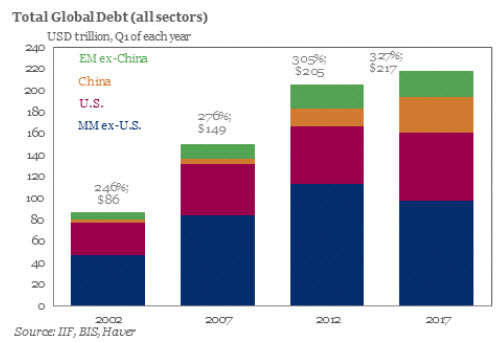
  3. The debt needed to move the growth needle is expanding at a much higher rate than the growth it generates. While growth is stagnant, debt is expanding by leaps and bounds to unprecedented levels. (Global Debt Hits A New Record High Of $217 Trillion; 327% Of GDP)
  4. Wages are stagnating for the bottom 90% of the workforce. We can quibble about the causes, but there is no plausible evidence to support a belief that this trend will magically reverse.
  5. The cost of the most valuable energy–high-density, easy to transport—will slowly but surely become more expensive as the cheap, easy-to-extract energy sources are depleted, notwithstanding the temporary boost provided by the fast-depleting wells of the fracking “miracle.”
  6. There are limits on our exploitation of resources such as fresh water and wild fisheries. Humans can print currency (money) but we can’t print fresh water, energy, wild fisheries, etc. If one unit of currency currently buys one liter of petrol, printing 10 more units of money doesn’t create 10 more liters of fuel.
  7. Creating currency out of thin air isn’t free in our system: all new currency is loaned into existence and accrues interest. As a result, all currency is a claim on future earnings. If we borrow enough from the future, and earnings remain flat or decline, eventually there’s not enough income left to support the debt service and the expanding consumption the status quo needs to keep itself glued together.

By Ugo Bardi: The Three Phases of the Reaction to Existential Threats: Action, Deception, and Desperation

Denial is so ubiquitous in our society that we are like fish that cannot see water.

Here we have an excellent essay on inherited denial of reality, without the author being aware of the main topic.

http://cassandralegacy.blogspot.ca/2017/07/the-three-phases-of-reaction-to.html

peakoiltrends

I have been always fascinated by how people’s consciousness of collective threats blurs and disappears as the threat gets closer. Look, here, at the concept of “peak oil” as it appears on “Google Trends.” You see how it dwindled to almost zero interest after having been popular at the beginning of the 21st century.

There are many more examples, a classic one is how the 1972 study “The Limits to Growth” was forgotten as the threat it described became closer in time. So, if you think about this, it is maddening: the earth is becoming more warm and people worry less about that?  The same about oil; the more we use, the less there is; how come that people worry less and less about the problem? Maddening, indeed.

By John Weber: Furnaces of Industry (Solar Energy is Not Renewable)

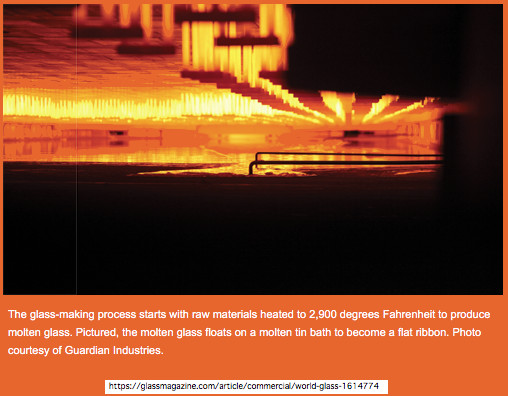
Solar panels require large quantities of glass. This excellent essay reviews the energy required to produce glass and shows that solar panels cannot be used to make more solar panels.

You need fossil energy to make solar energy.

This means solar energy is not renewable.

We are so accustomed to having access to affordable fossil energy that we forget how precious and magical our main source of energy is: oil is used to produce more oil, and unlike electricity, oil can be cheaply stored and transported.

All of the above also applies to the materials and equipment needed to produce, install, and maintain wind, hydro, geothermal, and nuclear energy.

http://sunweber.blogspot.ca/2017/07/furnaces-of-industry_14.html

furnaceglass

In the USA glass manufacturing accounted for 1% of total industrial energy use in EIA’s most recent survey of the manufacturing sector. Overall fuel use is dominated by natural gas (73%) and electricity (24%), with the remaining share (3%) from several other fuels. Natural gas use at glass manufacturing facilities in 2010 was 146 trillion Btu, about 143 billion cubic feet.

If we convert the natural gas to kWh, we get:

143 billion cubic feet Natural Gas = 41,909,163,034.63 kWh

By Ron Patterson: Africa in Peril

africa-1

http://peakoilbarrel.com/africa-in-peril/

The wildlife decline in most of the world is terrible, but in Africa it is catastrophic. By 2100 there will be no megafauna whatsoever in Africa. All elephants, giraffes, rhinoceroses, lions, gorillas, chimpanzees, and even zebras and wildebeest will be totally extinct. And the culprit in this huge animal extinction is Africa’s massive overpopulation problem. It is terrible today but is about to get a whole lot worse.

The population of Africa, in 2016, was 1.22 billion. The UN estimates that in 2100 the population of Africa will be about 4.45 billion. Notice that is an increase of about 300 million from their estimate just five years ago. But their 2100 population estimate has doubled since their 1998 estimate.

In 2100 one African country, Nigeria will have a larger population than all of Europe combined.

The reason for this Sub-Sahara African population explosion is the decline in infant mortality rates along with their very high fertility rate. With the exception of South Africa, Sub-Sahara African women have 5.5 children (average) during their life. This rate has been slowly decreasing but not enough to decrease the population growth significantly.

The top 15 fertility rates in the world are all in Africa. The Sub-Saharan population is increasing at the rate of 2.5 percent annually. This is double the rate of both Asia and Latin America.

By 2100 there will be no megafauna whatsoever left in Africa except for humans and their domestic animals. Elephants, giraffes, rhinos, and even zebras and wildebeest will all be gone. And of course, all the big cats like lions and cheetahs will be gone as well. Even the hyenas will disappear because there will be no prey for the prey animals to feed on. However, a few wild dogs may remain as there will likely still be a few small ground animals for them to feed on.

Many will say that Europe is even more overpopulated than Africa. And this is true at this point in time. But that will definitely not be the case in the future. And remember that the wildlife in Europe is already gone except for small animals like rabbits and squirrels and a few foxes that prey on them. The wild European megafauna disappeared decades or even centuries ago. Okay, a few mountain goats, lynx other such animals still thrive high in the Alps. But wherever in Europe it is possible for humans to settle and farm, the megafauna has been driven out, usually to extinction. And that will soon be the case for Africa as well. The last habitat for megafauna, in Africa, Asia, and the Americas, is disappearing fast. It will soon be gone.

Extinction is permanent! If civilization survives another million years the elephants, giraffes, lions and all the other megafauna will still be gone. If you don’t think this earth has a very serious human overpopulation problem, then you are stone blind to the peril of our wildlife.

By Raúl Ilargi Meijer: I read the news today, oh boy (On Zombies and Bubbles)

The price of money affects everything.

When you artificially suppress the price of money dangerous bubbles emerge.

No one notices or cares because of inherited denial of reality.

Until the bubbles pop and everyone is forced to care.

This time is different because of its magnitude and global nature.

And because there is no cheap energy left to push us out of a depression.

https://www.theautomaticearth.com/2017/07/i-read-the-news-today-oh-boy/

zhstockbuyers

Reading the news on America should scare everyone, and every day, but it doesn’t. We’re immune, largely.

What we’re witnessing is the demise of the American political system, in real time. We just don’t know it. Actually, we’re witnessing the downfall of the entire western system. And it turns out the media are an integral part of that system. The reason we’re seeing it happen now is that although the narratives and memes emanating from both politics and the press point to economic recovery and a future full of hope and technological solutions to all our problems, people are not buying the memes anymore. And the people are right.

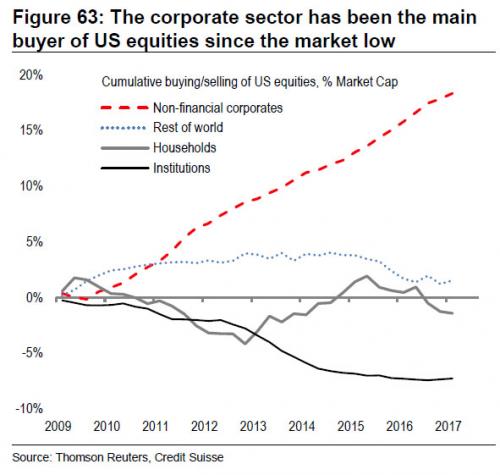
Tyler Durden ran a Credit Suisse graph overnight that should give everyone a heart attack, or something in that order. It shows that nobody’s buying stocks anymore, other than the companies who issue them. They use ultra-cheap leveraged loans to make it look like they’re doing fine. Instead of using the money/credit to invest in, well, anything, really. You can be a successful US/European company these days just by purchasing your own shares. How long for, you ask?

Why this rush by companies to buyback their own stock, and in the process artificially boost their Earning per Share? There is one very simple reason: as Reuters explained some time ago, “Stock buybacks enrich the bosses even when business sags.”

In other words, the system doesn’t only keep zombies alive, making it impossible for anyone to see who’s healthy or not, no, the system itself has become a zombie.

By Ugo Bardi: When governments operate in “cheating mode”

Problems are frequently blamed on the other 50%, or immigrants, or Russia, rather than on pollution, resource depletion, and overshoot.

I often wonder if the elites are knowingly deceitful, or if they are in denial and believe what they tell us.

I suspect the latter.

It seems to be a general observation that, when facing a serious threat, the elites of a country can reason that the best strategy for them is to cheat the people and save themselves. In the present situation, the threat of global warming seems to be driving some elites to do exactly that. They deny the threat while at the same time maneuvering to save themselves by moving to higher grounds and equipping their mansions with air conditioning. For all they care, the rest of the people can drown or roast.

But, as the threat of climate change becomes clearer, the elites may discover that nobody can survive in an uninhabitable planet. Then, they may finally decide to try to do something to save the ecosystem from which we all depend. But it may well be too late.

http://cassandralegacy.blogspot.ca/2017/07/when-governments-operate-in-cheating.html

By Chris Martenson: The Looming Energy Shock

I have a lot of time for Chris Martenson. He’s well grounded in science and has a lot of integrity. My only criticism of late is his recent campaign to blame central banks which I suspect is a marketing strategy to increase subscriptions because blaming bankers sells better than blaming thermodynamics, overshoot, and inherited denial.

Chris is predicting that within 3 years we will either have an economic collapse that temporarily masks the underlying energy problem, or we will have oil shortages and a price shock that will trigger a credit crisis like 2008 but worse. He backs these predictions with the correct data, in my opinion.

I independently came to roughly the same conclusion, although I would add a 3rd possibility given rising stresses around the world: a major war.

I think the 3 possible outcomes are roughly equal in probability, although given the deceleration in credit growth apparent from the following graph, an economic collapse has the lead by a nose.

global-debt-2017-06-29_21-27-57

energy-and-economy-10-4-2016

oil-investments-global-2017-06-29


There will be an extremely painful oil supply shortfall sometime between 2018 and 2020. It will be highly disruptive to our over-leveraged global financial system, given how saddled it is with record debts and unfunded IOUs.

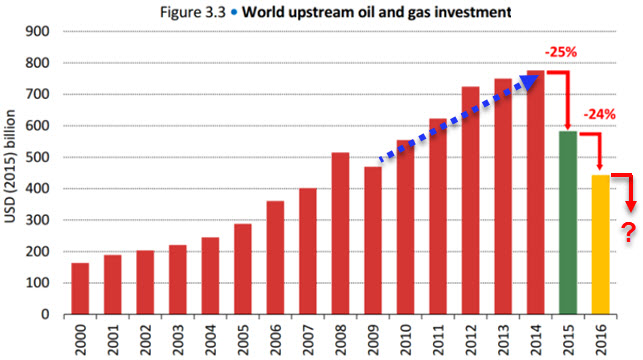
Due to a massive reduction in capital spending in the global oil business over 2014-2016 and continuing into 2017, the world will soon find less oil coming out of the ground beginning somewhere between 2018-2020.

Because oil is the lifeblood of today’s economy, if there’s less oil to go around, price shocks are inevitable. It’s very likely we’ll see prices climb back over $100 per barrel. Possibly well over.

The only way to avoid such a supply driven price-shock is if the world economy collapses first, dragging demand downwards.

Not exactly a great “solution” to hope for.

https://www.peakprosperity.com/blog/109505/looming-energy-shock

By Alice Friedemann: Big Fight: 21 top scientists show why Jacobson and Delucchi’s renewable scheme is a delusional fantasy

This summary by Alice Friedemann of a dispute in the scientific community over the viability of renewable energy is excellent and worth reading in its entirety.

What really stands out for me is that the 21 scientists that criticized the absurdly optimistic renewable energy plan of Jacobson and Delucchi completely missed the most important points that require criticism.

It is amazing that otherwise intelligent experts frequently ignore THE most important things they should understand.

Other examples include:

  • economists who ignore debt and the relationship between energy and wealth;
  • climate scientists who ignore the relationship between CO2 and wealth;
  • dietary health experts who ignore the link between sugar and obesity;
  • environmentalists who ignore over-population;
  • citizens who believe in life after death and deny other unpleasant facts.

This denial behavior is so common and so powerful that it requires an explanation like Varki’s Mind Over Reality theory.

http://energyskeptic.com/2017/big-fight-21-top-scientists-show-why-jacobson-and-delucchis-renewable-scheme-is-a-delusional-fantasy/

Many authors have been writing for years about why Jacobson and Delucchi’s (J & D) plans for a 100% low-cost renewable energy is a cloud cuckoo-land fantasy (references below).  But never so many, so loudly, and in such a prestigious journal (Clack 2017).

The 21 authors of the PNAS article felt compelled to write this because J & D’s irresponsible fairy tales are starting to influence actual policy and waste money.  If cities and states set renewable goals of 100% and try to achieve them with the J & D plan, their spending will be wasted because the J & D plan leaves out biofuels, grid-scale battery storage, nuclear, and coal energy with CCS.

The most important problems with achieving a 100% renewable system are not even mentioned (Friedemann 2015c).

Renewable contraptions cannot outlast finite fossil fuels, because they are utterly dependent on fossil fuels from birth to death to mine, crush, and smelt the ore, deliver the ore to a blast furnace, fabricate 8,000 wind turbine parts at hundreds of manufacturing plants all over the world, and deliver the parts to the assembly plant.  For each turbine, dozens of trucks are needed to prepare the wind turbine site so that dozens of cement trucks can pour tons of concrete and steel rebar for the platform, deliver pieces of the huge parts of the turbine, and diesel powered cranes to lift the parts hundreds of feet into the air.

In their 2011 paper, the J & D 100% renewable system would be accomplished with 3.8 million 5-MW wind turbines (50% of power), 49,000 solar thermal plants (20%), 40,000 solar PV plants (14%), 1.7 billion rooftop PV systems (6%), 5350 geothermal plants (4%), 900 hydroelectric power plants (4%), and marine hydrokinetic devices (2%).   Their 2015 paper has somewhat different but equally unrealistic numbers.

It is questionable whether there’s enough material on earth to build all these contraptions and continue to do so every 20 years (wind) to 30 years (solar).  Fossil fuels will grow more and more scarce, which means cement, steel, rare (earth) metals, and so on will decline as well.  Keep in mind that a 2 MW turbine uses 900 tons of material: 1300 tons concrete, 295 tons steel, 48 tons iron, 24 tons fiberglass, 4 tons copper, .4 tons neodymium, .065 tons dysprosium (Guezuraga, USGS).  The enormous demand for materials would likely drive prices up, and the use of recycled metals cannot be assumed, since downcycling degrades steel, perhaps to less strength than required.

The PNAS authors propose grid-scale batteries, but the only kind of battery for which there are enough materials on earth are Sodium-sulfur NaS batteries (Barnhart 2013).  To store just one day of U.S. electricity generation (and at least 6 to 8 weeks would be needed to cope with the seasonal nature of wind and solar), you would need a 923 square mile, 450 million ton, $40.77 trillion dollar NaS battery that needs replacement every 15 years (DOE/EPRI 2013).  Lead-acid: $8.3 trillion, 271.5 square miles, 15.8 million tons.  Li-ion $11.9 trillion, 345 square miles, 74 million tons.

There are dozens of reasons why wind power will not outlast fossil fuels (Friedemann 2015b), including the scale required, the need to increase installation rates 37-fold in 13 years (Radford 2016), population increasing faster than wind turbines to provide for their needs can be built, wind is seasonal – very little in the entire U.S. in the summer, no commercial wind year round in the South East, a national grid, no commercial energy storage at utility scale in sight, plus a financial crisis or war will likely break the supply chains as companies go out of business.

Okay, drum roll.  The biggest problem is that electricity does not matter. This is a liquid transportation fuels crisis. Trucks can’t run on electricity ( http://energyskeptic.com/category/fastcrash/electric-trucks-impossible/  ).

The Achilles heel of civilization is our dependency on trucks that run on diesel because it is so energy dense. This is why diesel engines are far more powerful than steam, gasoline, electric, battery-driven or any other motive power on earth (Smil 2010).  Billions of trucks and equipment worth trillions of dollars are required to keep the supply chains going over tens of millions of miles of roads, rail, and waterways that every person and business on earth depends on.  Equally if not more important are off-road mining, agriculture, construction, logging, and other trucks.  They not only need to travel on rough ground, but meanwhile push, lift, dig and perform other tasks far from the electric grid or non-oil distribution system.

Trucks must eventually be electrified, because biomass doesn’t scale up and has negative or break-even energy return, coal and natural gas are finite, and hydrogen /hydrogen fuel cells are dependent on a non-existent distribution system and far from commercial. In my book, I show why trucks can’t run on electricity, as well as why a 100% renewable grid is impossible. 

The authors briefly point out that one way to counter wind and solar intermittency is an energy source that can be dispatched when needed.  But they neglected to mention that natural gas plays most of this role now.  But natural gas is finite, and has equally important uses of making fertilizer, feedstock and energy source to make hundreds of millions of chemicals, heating homes and buildings, and so on.  All of these roles will have to be taken on by biomass after fossils are gone, yet another reason why biomass doesn’t scale up.

J & D propose a month of hydrogen storage to power transportation.  But hydrogen boils off within a week since it is the smallest element and can escape through atomic scale imperfections. It is not an energy source, it’s an energy sink from start to finish.  First it takes a tremendous amount of energy to split hydrogen from oxygen.  That’s why 96% of hydrogen comes from finite natural gas.  And a tremendous amount more energy to compress or liquefy it to -423 F and keep it chilled.  It is so destructive of metal that expensive alloys are needed for the steel pipelines and storage containers, making a distribution system too expensive.  A $1.3 million dollar hydrogen fuel cell truck would require a very heavy and inefficient fuel cell with an overall efficiency of just 24.7%: 84% NG upstream and liquefaction * 67% H2 on-board reforming * 54% fuel cell efficiency * 84% electric motor and drivetrain efficiency * 97% aero & rolling resistance efficiency, and even less than that without an expensive 25 kWh li-ion battery to capture regenerative braking (DOE 2011, Friedemann 2016). And far less than 24.7% efficient if the hydrogen were made from water with electrolysis.

J & D propose thermal energy storage in the ground.  The only renewable that has storage are concentrated solar plants, but CSP plants provide just 0.06% of U.S. energy because each plant costs about a billion dollars each, and scaled up, would need to use stone, which is much cheaper than molten salt. A 100 MW facility would need 5.1 million tons of rock taking up 2 million cubic meters (Welle 2010). Since stone is a poor heat conductor, the thick insulating walls required might make this unaffordable (IEA 2011b). J & D never mention insulating walls, let alone the energy and cost of building them.  The PNAS paper also says that phase-change material energy storage is far from commercial and still has serious problems to solve such as poor thermal conductivity, corrosion, material degradation, thermal stress durability, and cost-effective mass production methods.

The authors suggest bioenergy, but this is not feasible. Trucks can’t burn ethanol, diesohol, or even gasoline.  Biofuels (and industrial agriculture) destroy topsoil, which in the past was a major or main reason why all past civilizations failed.  It also depletes aquifers that won’t be recharged until after the next ice age.   And biomass simply doesn’t scale up.  Burning it is far more energy efficient than the dozens of steps needed to make biofuels, each step taking energy. Yet even if we burned every plant plus and their roots in America, the energy produced would be less than the fossil fuel energy consumed that year, and we’d all have to pretend we liked living on Mars for many years after our little experiment. Friedemann (2015a) has many other examples of the scaling up issues, ecological, energy, and other issues with biofuels.

Nuclear is not an option due to peak uranium, and the findings of the National Academy of Sciences about lessons learned from Fukushima. It’s also too expensive, with 37 plants likely to shut down (Cooper 2013).  And leaving thousands of sites with nuclear waste lasting hundreds of thousands of years for our descendants to deal with after fossil fuels are gone in an industrially poisoned world is simply the most evil of all the horrible things we’re doing to the planet (Alley 2013).

The book “Our renewable future” (Heinberg & Fridley 2016) was written to show those who believe in Jacobson and Delucchi’s fairy tales how difficult, if not impossible it would be to make this happen. Though I fear many of their major points were probably ignored or forgotten, with readers deciding that 100% renewables were possible, even if difficult, since the book was too gentle and abstract. For example, they mention that there are no ways to make cement and steel with electricity, because these industries depend on huge blast furnaces that run for 4 to 10 years non-stop because any interruption would cause the brick lining to cool down and damage it.  It is not likely a 100% wind and solar electricity system to be up 24 x 7 x 365.  That’s a real  showstopper.  But the average person believes in infinite human ingenuity that can overcome the laws of physics and doesn’t worry…

J & D include wave and tidal devices, but these are far from being commercial and unlikely to ever be due to salt corrosion, storm waves, and dozens of other problems (NRC 2013).

I’m not as concerned about the incorrect J & D calculations for GHG emissions, because we are at or near peak oil and coal, and natural gas.  Many scientists have published peer-reviewed papers that based on realistic reserves of fossil fuels, rather than the unlimited amounts of fossils the IPCC assumes, there is a consensus that the worst case scenario likely to be reached is RPC 4.5 (Brecha 2008, Capellan-Perez 2016, Chiari 2011, Dale 2012, Doose 2004, Hook 2010, Hook 2013, and 10+ more).  Also, coal is finite, and carbon capture and storage technology so far from being commercial, and uses up 30 to 40% of the energy contained in the coal, that it’s unlikely to be used when blackouts start to happen more and more often (http://energyskeptic.com/category/energy/coal/carbonstorage/).

We’re running out of time.  Conventional oil peaked in 2005. That’s where 90% of our oil comes from at a Niagra Falls rate.  Tar sands and other non-conventional oil simply can’t be produced at such a high rate.  So it doesn’t matter how much there is, Niagra Falls will slow to a trickle, far less than what we use today.  And since energy is the basis of growth, not money, it is questionable if our credit/debit system can survive, since once peak oil is acknowledged, creditors will know they can’t be repaid.

Also, oil is the master resource that makes all other resources available. We don’t have enough time to  replace billions of diesel engines with something else.  There is nothing else. And 12 years after peak the public is still buying gas guzzlers.

By Ajit Varki: Mind Over Reality Transition: The Evolution of Human Mortality Denial

Dr. Ajit Varki, one of the originators of the most important idea since Darwin, gave this talk on March 3, 2017 in which he explains the Mind Over Reality Transition (MORT) theory that he and Danny Brower developed and discussed in their book and which underpins this blog.

Dr. Varki, being a humble and cautious scientist, does not amplify the implications of his theory so I will do it for him here.

The Mind Over Reality theory explains the:

After reflecting on this list, and assuming that in time Varki’s theory is proven to be correct, you may begin to appreciate why I think Varki’s MORT theory is THE most important idea for understanding our origin, our special place in the universe, and our destructive behaviors that threaten our existence. 

A pleasant fact I learned from the talk is that despite having a solemn demeanor Dr. Varki has a killer sense of humor.

Here is the abstract for the talk:

Some aspects of human cognition and behavior appear unusual or exaggerated relative to those of other intelligent, warm-blooded, long-lived social species––including certain mammals (cetaceans, elephants and great apes) and birds (corvids and passerines). One such collection of related features is our facile ability for reality denial in the face of clear facts, a high capacity for self-deception and false beliefs, overarching optimism bias and irrational risk-taking behavior––traits that should be maladaptive when they first appear as hard-wired features in individuals of any species. Meanwhile, available data suggest that self-awareness (knowledge of one’s own personhood) and basic theory of mind (ToM, also termed mind-reading, intentionality etc.) have independently emerged several times, particularly in the same kinds of species mentioned above.  Despite a long-standing opportunity spanning tens of millions of years, only humans appear to have then evolved an extended ToM (multilevel intentionality), a trait required for optimal expression of many other unusual cognitive attributes of our species, such as advanced linguistic communication and cumulative cooperative culture. The conventional view is that extended ToM emerged gradually in human ancestors, via stepwise positive selection of multiple traits that were each beneficial. A counterintuitive alternate possibility is that establishment of extended ToM has been repeatedly obstructed in all other species with the potential to achieve it, due to a “psychological evolutionary barrier“.  This barrier is claimed to arise in isolated individuals of a given species that develop the genetic ability for extended ToM.  Such individuals would then observe deaths of others whose minds they fully understood, become aware of mortality, and translate that knowledge into an understanding of personal mortality.  The conscious realization and exaggeration of an already existing intrinsic fear of death risk would have then reduced the reproductive fitness of such isolated individuals (by favoring personal survival over reproduction).  The barrier would have persisted until hominin ancestors broke through via a rare and unlikely combination of cognitive changes, in which two intrinsically maladaptive traits (Reality Denial and Extended ToM) combined in the same individuals, to allow a “Mind over Reality Transition”. Once the barrier was broken, conventional natural selection could take over, with further evolution of beneficial aspects of the initial changes. This theory also provides a unifying evolutionary explanation for other unusual features of humans, including recent emergence as the dominant species on the planet, and replacement of all other closely related evolutionary cousins, with limited interbreeding and no hybrids. While not directly falsifiable by experiment, the theory fits with numerous facts about humans and human origins, and no known fact appears to strongly militate against it. It is also consistent with most other currently viable theories on the subject including Terror Management Theory.  Importantly, it has major implications for the human condition, as well as for many serious issues, ranging all the way from personal health responsibility to global climate change.

Varki, A. Human uniqueness and the denial of death. Nature. 460:684. 2009.

Varki, A., and Brower, D. Denial: Self-Deception, False Beliefs, and the Origins of the Human Mind. Twelve Books, New York. 2013.

Varki, A.: Thought Experiment: Dating the Origin of Us. The Scientist 27:28-29, 2013.

Varki, A.: Why are there no persisting hybrids of humans with Denisovans, Neanderthals, or anyone else? Proc Natl Acad Sci U.S.A. 113: E2354, 2016.