The number of climate records broken in the last few years is stunning. But here’s a new measure of misery: Not only did we just experience the hottest April in 137 years of record keeping, but it was the 12th consecutive month to set a new record.
It’s been relentless. May 2015 was the hottest May in records dating back to 1880. That was followed by the hottest June. Then came a record July, August, September, October, November, December, January, February, March—and, we learned from the National Oceanic and Atmospheric Administration on Wednesday—the hottest April. In an age of rising temperatures, monthly heat records have become all too common. Still, a string of 12 of them is without precedent.
Perhaps even more remarkable is the magnitude of the new records. The extremes of recent months are such that we’re only four months into 2016 and already there’s a greater than 99 percent likelihood that this year will be the hottest on record, according to Gavin Schmidt, who directs NASA’s Goddard Institute for Space Studies.
Author: Rob Mielcarski
By Sam Carana: Arctic Sea Ice gone by September 2016?

http://arctic-news.blogspot.ca/2016/05/arctic-sea-ice-gone-by-september-2016.html
Given the above, chances are that the sea ice will be largely gone by September 2016.
The situation is dire and calls for comprehensive and effective action, as described in the Climate Plan.
The climate changes we see in our community are amplified in the arctic.
The loss of arctic ice is a really big deal.
What’s our response?
We don’t even discuss things we could do to make the future less bad.
Instead we send donations to Fort McMurray to help them rebuild.
By The New York Times: Venezuela Drifts Into New Territory: Hunger, Blackouts and Government Shutdown
The collapse of Venezuela continues.
“The economic situation of this country is collapse,” Pablo Parada, a law student, who was participating last week in a hunger strike in front of the O.A.S. office in Caracas. “There are people who go hungry now.”
Notice that this New York Times article has no clue about the underlying causes of Venezuela’s problem. It does not even mention that their population has grown by more than 6 times since 1950.
We observe problems, deny overshoot, and blame something easy like corrupt politicians that doesn’t require us to make lifestyle changes.
Rinse and repeat to the bottom.
I wrote more about this here.
By John House, MD: A Superb Summary of Our Predicament
Here is a must read 4 part series by John House, MD that was published in the Eureka Springs Independent newspaper.
Part 1: The next decade could bring chaos
The ‘60s and ‘70s were an exciting time to be young. So much was changing; everywhere a person looked there were new technologies, new discoveries – even other planets were no longer off limits.
Like many people raised in the industrialized world during the 20th century, I was taught – directly and indirectly – that humans would experience non-stop progress; each generation would build on the successes of the last taking the human race to ever higher levels. There had been setbacks along the way, but that wasn’t something we had to worry about any more. The internal combustion engine, plumbing, electricity, modern medicine, computers, all of these advancements and more would prevent us from having to worry about the collapse of civilization ever again. At least that was the overarching message I received from my education and from society at large. Indeed, there are many who are preaching that message even today.
As amazing as the 20th century was with all the wonders it brought, the 21st century has been equally amazing in how little progress has been made. With the accelerating pace of advancements we saw in the 100 years from 1900 to 1999, it seems astonishing that so little has been accomplished in the last 16.
There are numerous reasons humanity hasn’t progressed at the same pace in recent years. Beginning in this article and continuing in ones to follow, I’m going to examine three of the biggest challenges that will dominate events in the next decade and help us understand why progress has stalled.
They are: 1) decline in net energy 2) explosion in debt as the primary engine for economic growth and 3) climate change.
Decline in Net Energy
Net energy is a simple concept: It is the amount of energy left over after expending energy to produce that energy. For example, if I want to build a fire to cook my food, I have to spend my body’s energy to gather the wood and create a spark to start the fire. The fire gives me more energy than I had to start with, so there is a net energy gain. If a rainstorm puts out my fire before I can cook my food, then there is a decline in net energy since I get very little energy from the fire but still had to spend energy to begin with.
Since the beginning of the human experience, humans have had to use manual labor to accomplish every task. From finding food, to making clothing, to building shelter, humans had only the energy gleaned from plants and animals to get the job done. There was very little excess energy left over for other activities.
With the discovery of petroleum – oil – and how to use it efficiently, humans had something that they had never had before: excess energy. With the incredible stored energy in oil, humans now could do all sorts of work without manual labor.
Fossil fuels are incredible batteries. They hold lots of stored solar energy per kilogram. For example, it would take a fit human adult laboring more than 10 years to equal the energy in one barrel of oil!
Looked at a different way, a barrel of oil has the energy equivalent of 1,700 kilowatt hours of electricity. To get that much energy from a typical 2’x4’ solar panel in an hour you would need almost 19,000 panels! That’s for just one barrel. The world uses 90,000,000 barrels a day!
Fossil fuels led to a paradigm shift in human activity. This advancement, more than anything else, has been responsible for technological achievements, increases in food production, excess leisure time, labor saving devices, and other conveniences that we think of as “the modern world.”
So to define this in terms of net energy, before fossil fuels, humans used virtually the energy they took in via food, simply to gather more energy (grow or hunt food). For all practical purposes, there was almost no excess net energy available.
With fossil fuels, suddenly there was so much excess energy available that humans could achieve almost anything!
But. (There’s always a “but.”) Those incredible solar energy batteries of fossil fuels take millions of years to charge. Once we figured out how to use them, we started burning through them at astronomical rates.
We pumped the easy-to-reach oil first and, since fossil fuels are a finite resource and aren’t replenished, when the easy stuff was gone, we started working on the hard-to-get stuff. Every increase in the difficulty of extraction results in spending more energy to get the energy from the oil. The more energy we spend, the less excess net energy there is.
From about 1825 to 1979 the amount of net excess energy per capita was growing almost exponentially. From 1979 through 2003, however, net energy per capita stopped growing. Since 2003, net energy per capita has been declining.
At first glance, this might not seem to be a big deal. But, it’s actually an incredibly huge problem. Remember, all that excess net energy is what has made every aspect of our modern world possible. What happens when there is less of that very thing?
Actually, we are starting to get just a glimpse of the answer to that question since net energy per capita has been declining for the last 12 or 13 years.
If you think about what excess net energy allows us to do – travel, buy non-essential items, have leisure time, etc., – then it follows that with a decline in net energy, we will have less travel, less leisure time, we’ll buy less non-essential stuff. In other words, we’ll have a recession, perhaps worse.
There is a clear relationship between oil and the economy. In fact, there have been multiple recessions since WWII and all but one have been preceded by a spike in the price of oil. When the price of oil goes too high, it leads to an economic downturn.
Many believe we entered a global recession after the oil price spike of mid-2014, even if we aren’t technically in a recession here in the U.S., and now the world is awash in cheap oil. We won’t be awash in oil long, however, as most of the hard-to-reach petroleum costs more to produce than the current market price. Very soon, supply will dwindle. And that’s how this time is different. In the past, we’ve been able to grow our way out of recessions by pumping more oil thereby creating more excess energy. Now, we can’t. Now we have a decline in net energy.
Since developing an oil-based economy, we’ve never had to face a decline in net energy. This has enormous implications to our way of life.
The modern economy is dependent on growth. With a decline in net energy, substantive growth is no longer possible. I mentioned earlier that there has been a decline in net energy since the early part of this century. So, how is it possible that we’ve had economic growth since then?
In a word, debt.
Combined with a dramatic increase in debt, a decline in net energy is an explosive combination that risks destroying the world as we know it today. In the next installment, I’ll explain what I mean by that.
Part 2: Increase of debt and decrease of net energy – what we need to know
In the first part of this series, I mentioned that economic growth and energy have been intimately connected since the beginning of the Industrial Revolution. The more energy available to society, the more the economy grows. Now that we have entered into an era of decreasing net excess energy, economies are shrinking instead of growing.
Debt, too, plays an integral part in powering economic growth. In fact, the modern economy can’t function without it. In recent years, debt has been substituted for excess net energy as the fuel for economic growth. The results have been less than stellar and are likely creating a situation that guarantees economic collapse.
In the loosest sense of the word, our economy is debt. Today, there is more debt than there has been in the history of humankind. Without excess net energy, that debt couldn’t be repaid.
Debt has been part of the human experience for thousands of years. It has taken, and continues to take, many forms. At its most basic, debt is the promise to pay in the future for some good or service provided now.
Another way to look at debt is as an advance of future earnings. A person takes out a loan from a bank to buy a house or car, promising to repay that loan plus interest using income that will be earned in the future. Even in such a simple scenario, a healthy economy is required for a loan to be repaid; if the borrower loses his job because a factory closes due to economic decline, for example, he can’t repay the loan.
Since debt permeates every part of our economy, growth is required in order for debt to be repaid or, at the very least, serviced. Everything talked about with respect to the economy revolves around growth. If the economy isn’t growing, it’s bad. And debt is the reason.
The banking system the average person interacts with is designed around a concept known as fractional reserve banking. That means banks are only required to have on hand – on reserve – a fraction of the money that has been placed on deposit in their bank. The rest they lend out, thereby creating money “out of thin air” while also creating enormous amounts of debt requiring a constant flow of new money being put into the system, i.e. economic growth. On its face, this is good for the economy as it spurs development, creates jobs, increases wealth, etc. If the amount of debt grows too large, or the economy slows, a serious problem develops as the debt can no longer be serviced.
Today, the debt system has grown incredibly complex with debt instruments that are convoluted and almost impossible for the layperson to understand. Most of this debt has nothing to do with “Main Street” but it, too, requires that our economy grow indefinitely and without interruption or the whole scheme collapses.
Since everything in our economy is dependent on energy, a decline in net excess energy means the economy can’t grow, leading to debt default. If the amount of debt default is large it can be devastating to the system. Since even the slightest hint of widespread default would elicit panic in the stock and financial markets, wiping out trillions of dollars overnight, it’s no wonder government and industry agencies are less than honest about the decline in net energy and the impossibility of ever paying off mountains of debt that have been created trying to stimulate the economy. The whole financial system is the very definition of a house of cards.
The financial crisis of 2008-9 brought the global financial system to the very brink of collapse. If it had not been for Herculean efforts of central banks around the world at that time, collapse would have been inevitable. That crisis was one of too much debt that couldn’t be repaid. Ironically, the central banks saved the system by creating more debt. Enormous amounts of it, in fact.
The amount of conventional debt today is estimated to be $100 trillion globally. When the derivatives market is included, the amount of global debt surges to the absurdly high number of $1.3 quadrillion. Since declining net energy is preventing the economy from having the energy it needs to grow, it seems very likely there will be massive debt defaults in the near future. When there is widespread debt, default commerce shuts down.
When commerce shuts down, there is economic collapse and many, many people suffer. Very similar events are happening right now in Venezuela, Greece, Syria, Puerto Rico, and other countries.
With decline in net energy affecting every person on the planet, and with global debt already at unsustainable levels and climbing higher every day, there is widespread agreement among financial experts that central banks will be unable to save the system next time. When that happens, every country – including the U.S. – will experience economic disaster.
We are facing some frightening challenges over the next decade. Next time I’ll explore the most serious of them all: climate change.
Part 3: Climate Change
Climate change is, by far, the most worrisome of the major challenges we face as a species. We can live without debt and a modern economy, and maybe a few of us can survive on the energy levels utilized by our ancestors, but not a single one of us can survive without a livable climate.
Over the last 20 years there has been lots of debate about global warming with respect to its causes, how fast it will happen, how severe it will be, etc. The one salient fact that in recent years has become indisputable, however, is that the climate is changing now and happening much more rapidly than almost anyone has predicted.
On a steady basis, new studies are published that demonstrate this rapid change. Sea levels are rising faster, storms are becoming increasingly intense and more common, droughts are more severe and widespread, forest fires are raging more fiercely and over greater areas, and the oceans are dying. All because CO2 and other greenhouse gases are rising faster than ever before.
It’s important to understand that there is a time lag of about 30 years in the effects of greenhouse gases in our atmosphere. So the warming temperatures and climate chaos we see today are from the CO2 emitted in the 1980s.
The amount of carbon we are pumping into the atmosphere today is far greater than that of 30 years ago. This means that even if we were to stop absolutely all CO2 emissions right now, temperatures will keep climbing for another 30 years! Since it takes at least 1,000 years for CO2 to work itself out of the atmosphere, that likely unlivable temperature would be the new normal for a very long time.
Is it even possible to stop all CO2 emissions? Think about what that means: no cars, no electricity, no stores, no air conditioning, no burning fires for heat or cooking, no food except what you grow yourself by hand, no refrigeration, no medicines, no hospitals or clinics, no Internet, no phone, no TV… in other words, literally everything in our world would have to stop.
There are now more than 7.4 billion people on the planet. Almost every one of us depends entirely on food grown using fossil fuels. If we stop all CO2 emissions, almost every one of us starves to death in just a few months.
What are the odds of stopping all CO2 emissions anytime soon? It should be obvious that the chance of that happening willingly is zero.
A few years ago, politicians decided arbitrarily that Earth can adjust to a 2°C rise in average temperature without too much problem. That seems to be highly suspect, however, as we haven’t yet crossed the 1°C mark (on an annualized basis) and are already having huge problems related to climate change. What’s more, almost every model developed that keeps temperatures to 2°C warmer requires a dramatic reduction in CO2 emissions. Immediately. The longer we delay, the higher the temperature goes in those same projections.
With “business as usual” emissions, the global average temperature is projected to climb to 10° or 20°C above the historical level. Human beings cannot survive those kinds of temperatures. Even if we could, livestock, grains, fruits, and vegetables on which we all rely, can’t survive. We’d have no food.
Already there are places on the planet that are experiencing enormous amounts of suffering related to climate change. Every day one billion people go hungry due to crop failures related to drought and flood. What will it be like at 2°C?
Since it seems clear that we can’t stop CO2 emissions entirely, is it possible that we can reduce greenhouse gas emissions?
Think back to the previous part of this series. Debt requires growth in order to be repaid. All economic growth comes – ultimately – from utilizing energy. The only way to reduce CO2 in any meaningful way requires a significant reduction in economic activity. That leads to debt default and likely economic depression. What politician is going to vote to do anything that’s going to cause a severe economic downturn? What’s more, this is a global problem. One country deciding to reduce carbon emissions isn’t enough – it has to be all of us. As the recent climate accord in Paris demonstrates, no one is willing to take any meaningful action.
Sadly, switching to solar energy isn’t the solution many hope for. Solar panels, while very nice to have when the power goes out, can’t begin to replace the energy density of fossil fuels and are simply unable to provide adequate power to run our economy at anywhere near its current level.
With respect to climate change, it turns out that solar panels, due to the enormous amounts of energy used in the mining and manufacturing processes, actually produce more CO2 per kilowatt of electricity generated than a coal-burning power plant.
Our climate is changing now. There seems to be no viable solution to stop it that doesn’t result in the loss of billions of human lives. And yet, the more Earth warms, the more likely humans will be unable to survive.
When rapidly changing climate is combined with net energy decline and an economic system dependent on unsustainable debt, it’s clear that humanity is facing the biggest challenge of its existence. In the fourth and final installment of this series, I’ll outline what we can expect over the next ten years and what each of us can do to prepare for these changes.
Part 4: Coming Chaos
Decline in net energy, unsustainable mountains of debt, and climate change are just a few of the enormous problems that humanity faces. I believe, that over the next ten years, each of us will feel tangible disruptions in our daily lives related to these challenges.
Throughout the next decade there is likely to be enormous political upheaval, intermittent shortages of energy – both gasoline and electricity – and disruptions in government services, particularly Social Security and Medicare payments. There is a good chance we could see serious food shortages secondary to climate chaos and collapse of the financial system, as well as reduced availability of medications and healthcare services. I also expect to see a dramatic increase in domestic (U.S.) climate refugees as drought, fire, and flooding continue to take their toll.
I make no claim of being a fortuneteller, so I can’t say with certainty when an event will occur or even that it will happen at all. But I do know that if I hold a lit match to a piece of paper, there’s a real good chance the paper will start burning. The same can be said about the issues I’ve raised. A series of events is underway and they have a logical, expected outcome.
I began to develop an awareness of these problems more than five years ago and I’ve been educating myself and watching developments closely since then. So far, events have deteriorated at a pace consistent with my concerns.
I know that I’ve laid out a pretty depressing, “doom and gloom” picture. My intention isn’t to depress you, but to inform you. Knowing what’s coming is the best way to make provision for the future.
The core challenges humanity faces aren’t really that much different than the challenges we’ve always faced: ensuring adequate food, water, and shelter. What’s different now is that there are many, many more people on the planet, we have extracted most of the easy-to-reach non-renewable resources, and we have a climate that isn’t going to be working in our favor.
It’s too late to do anything to stop the processes that have been put into motion; the match has already lit the paper on fire. But there are some things we can do to ensure that we – and those we love – are as prepared as possible for what’s headed our way.
As you consider the short list I’ve compiled, keep in mind that no matter what happens, making these changes won’t be a waste of time as they will benefit your health and your state of mind.
I encourage you to look at every aspect of your life and find a way to meet your needs locally. Think about how the founders of Eureka Springs lived in the late 19th century and it will give you a good model to follow for your own preparations.
Start growing as much of your food as possible, or partner with some of our local growers. Most of them usually need extra help and, I suspect, would welcome the opportunity to share some of what they know and grow in exchange for a little labor. I also recommend learning how to can foods, putting away as much as possible to ensure you have enough for you and your family to eat through the winter months.
If you have a yard, get a few chickens. They are a lot of fun to care for and can provide both meat and eggs. If you have a few acres, then you might want to try your hand at raising goats. Goat’s milk is delicious and nutritious and there’s nothing quite so fun as a goat kid.
In the event that water supply is disrupted, don’t expect to get your water from bottles at the store. If you have a well powered by electricity, you may want to invest in a solar powered system. If you rely on city water, having a large storage tank is a good idea.
An adequate heat supply can be vital during an ice storm or other electricity outage. If you don’t have a wood-burning fireplace, you may want to consider having a woodstove installed.
If you’re dependent on daily medications, discuss the issue with your doctor to see if there are any you can live without. For the rest, you may want to start stockpiling those medicines to help you weather any short-term disruptions. Having a good first aid kid is always a good idea as well.
There are several good books available that provide step-by-step instructions on living a simple, self-sufficient life, describing how to garden, store your harvest, raise livestock, work with bees, make simple repairs, and more. The purchase of one or two of these books (a printed version, not electronic) can be an excellent investment.
Whether we are facing hardship or joy, the most important thing any of us can do is to live every day as if it is our last, making preparations just in case it’s not. I encourage you to be kind to those around you – human and non-human alike. As the stress of our daily existence increases over the coming years, kindness and forgiveness will make everyone’s life a little more bearable.
[Eds. Note: Dr. House responds to mining and manufacturing of solar panels producing more CO2 per kw of generated electricity than coal-burning plants, ESI May 18: The manufacture of solar panels is highly energy intensive including the cost of mining the raw materials, turning those materials into a photovoltaic cell, assembling the solar panels themselves, the packaging to protect them from breaking in shipping (usually large amounts of Styrofoam™), fuel to transport from the East to the West and then to the assembly site, the energy used to build the support structure for the panels, etc. Any number of studies can be used to support a debate one way or the other, but ultimately, the fact remains that the only way to stop catastrophic global warming is to stop all CO2 emissions right now. Since solar panels generate large amounts of CO2 in their manufacture and it would take millions of square meters of solar panels to power our world, it’s clear that solar panels do not offer a meaningful solution to the problems at hand. Don’t misunderstand me, though, fossil fuels don’t solve our problems either.]
By Chris Martenson: Chaos and Volatility On the Rise
http://www.peakprosperity.com/blog/98186/chaos-volatility-rise
The economy no longer spins off enough surplus for the elites to take what they consider their share with enough left over for everyone else. So the wealth gap grows unchecked into politically and socially destabilizing levels.
The oceans are rapidly dying off: with corals bleaching, tide pools acidifying, and phytoplankton disappearing. Weather weirdness is now so entrenched that all of the 50, 100 and 500-year events that happen each week are mainly reported on locally and garner little national and international attention.
Financial markets are increasingly volatile and dominated by an unruly universe of computer algorithms that now mainly play against each other, having driven off all the humans.
Politically, we’re seeing the former fringes of both parties increasingly come into power as they appeal to increasingly disenfranchised and disappointed electorates.
All of these are signs that the status quo has failed and continues to fail us. But the form of power expressed by our so-called ‘leaders’ today seems nearly incapable of healthy introspection coupled to correct action; preferring instead to do more of the same things that got us into this mess in the first place.
By Eric Lindberg: 21 Stories of Transition and the Great Imagining: Why Transition Matters
I’m slowing working my way through the catalog of Eric Lindberg who I recently discovered and who is a wonderful thinker and writer.
The excerpt is one of the best descriptions I’ve read on why we’ve made zero progress towards mitigating climate change…
It is easy—perhaps too easy—to fault our official leaders with cowardice and inaction. But when we send national representatives to an international global warming summit, they are sent with an impossible mandate: protect our national privilege (or increase it), preserve our way of life and our every expectations for increased material acquisition, maintain the economic growth required to keep national banking systems intact—oh yeah, and cut domestic carbon emissions (but not more than others nations are willing to cut theirs).
We blame our leaders for their shortsighted calculations. But part of the reason these climate agreements fail to make meaningful change is simpler than is generally acknowledged, and lives, hidden and unseen, in both the hearts and homes of nearly every citizen of advanced economies and industrialized democracies. It is about what we want, expect, and demand. It is not possible to maintain our way of life, maintain economic growth, and cut carbon emissions. Nor is it possible to engage in competitive statecraft and reduce the burning of fossil fuels.
There is, then, a crucial nugget of truth, largely ignored in the mainstream press, in what we have gotten from Rio, Kyoto, Copenhagen, and probably Paris: a sustainable future requires a contracting economy, a slowing down of production, and a broad curtailment of individual consumption. If our leaders presented us with this, they’d be hung by their heels in the village square. We want our leaders to cut global carbon emissions; but we also want a way of life that only fossil fuels can deliver. Until we understand the contradiction and begin to untangle the complexities of a transition to a low energy way of life, we should not expect too much from our elected governments.
Consider, as a sort of mental exercise, what would happen if we were to switch off the fossil fuels and run on available renewables as of today: as it turns out, we’d have to reduce our consumption by about 90%. That means getting rid of 90% of what you have and 90% of what you do and where you go. Develop these renewables at a plausible rate, on the one hand, and reduce our atmospheric carbon emissions at a meaningful rate (the one at which we and other large mammals may survive at a robust level), on the other, and we’re looking at a 75% reduction in economic activity over the long and permanent run. We might quibble about the exact figures; but there is no question of running our current, competitive, growth-dependent, and leisure-based way of life without the use of fossil fuels—those same fossil fuels that will kill us off if we cannot kick these habits of competition, growth, and, leisure in the form, mainly, of consumption.[ii]
Sure, we hear the promises of “sustainable development” and “green growth.” The abiding faith—or is it the lack of any plausible alternatives?—is that we can take our current systems of production and distribution and plug them into a new (sustainable and consequence-free) fuel source with only minimum disruptions. But, at the same time, international carbon-cutting agreements are rejected for one, and only one, reason: that they will hurt our economies, slow down the rate at which we make, buy, and sell goods. These agreements will force compliant nations to lose their competitive advantage to nations that don’t comply.
We may like the idea of an international climate agreement, but we probably wouldn’t like consequences of a meaningful one. And so our leaders give us a watered-down and face-saving compromise. Our way of life and our national power and prestige, it turns out, is fossil fuel based. We can’t have it both ways. “Your money or your life,” Barbara Kingsolver once quipped, “is not supposed to be a rhetorical question.” But that, in effect, is the decision we have to make, but have been unwilling to accept.
And this excerpt is an excellent description of why both conservatives and liberals are contributing to the lack of action…
Social psychologists have wondered at the resistance of many conservatives in the Anglo Saxon world to the science of global climate change. What force of denial could lead to the dismissal of undisputed science? The conclusions of this psychological research tell us something very important about belief and social and political change in general. The greatest source of conservative denial is not, as some would have it, based on their inability to accept the scientific evidence. Rather, it has to do with a more general picture about how the world works and should work that conservatives hold dear. As Naomi Klein has suggested, if conservatives “admit that climate change is real, they will lose the central ideological battle of our time—whether we need to plan and manage our societies to reflect our goals and values, or whether that task can be left to the magic of the market.”[iv]
Liberals, in contrast, have (as conservatives like to point out) been arguing for decades that we need to manage our economy more vigorously. The idea of an international agreement whereby governments cap carbon emissions and invest public money in renewable energy is not only acceptable to many liberals, it actually represents a form of progress that liberals have been hoping for all along, with liberal economists like Paul Krugman naively arguing that a renewable energy revolution is just what we need to spark our economy and ignite another century of economic growth. To put this another way, using another term from social psychology, while liberals tend to like the solutions (as they conceive them) to climate change, conservatives have a distinct case of solution aversion, which is strong enough to taint any associated scientific evidence. So repugnant is a solution that threatens the sanctity of the market that they can’t bring themselves to accept that there is a problem in the first place.
This same dynamic can, surprisingly, be seen in the same liberals who are celebrating the idea of international climate agreements. Although they are jubilant at the prospect of investing public money in clean energy or fashioning a “New Deal” based on energy transformation, their disposition turns sour—and even downright nasty—when these same anti-denialists are confronted with the possibility that wind turbines and solar panels will not be able to replace the power (and the economic growth) we have enjoyed from fossil fuels. Regardless of the data and mathematical evidence, these same critics of conservative climate deniers often reject any notion of the limits of renewable energy on the very face of it, supposing (I can attest first hand) that anyone who even suggests such a possibility must be an enemy of humanity itself.
Part of this incredulity has to do with the liberal faith in continued progress, the power of human inventiveness, and the overriding hope that all people might one day be freed from kinds of difficulties and indignities that the middle class European and American lifestyle seems to afford. Part of it has to do with most middle-class people’s dislike of a solution in which middle class comforts and privileges and white-collar skillsets play a decreasingly central role. That we might become more agrarian and less automated or more interdependent and less autonomous, that traditional inhibitions on the freedom of consumption might have some sense to them after all, that Silicon Valley might be turned someday into pasture—all this strikes many a progressive as the height of defeat or regression into a dark past. Progress has always (or for a few hundred years, at least) meant the transition from agriculture to industry, and from industry to some largely imaginary global technological post-industrialism. Few are prepared to embrace an international climate agreement that threatens this trajectory—which, it turns out, a meaningful limit on carbon emissions would, in fact, do.
I am tempted to say that liberals, like conservatives, are suffering from solution aversion; but I think we are dealing with something even more fundamental than that. It is not so much that they (like just about everyone else in industrial society, liberal and conservatives alike) would not accept a solution that involves the powering down of industrial society; rather, for most, this is simply unimaginable. If we can’t live with current levels of comfort, convenience, choice, mobility, and leisure, we may just as well give up. Only a plan that promises increased industrial development and lower carbon emissions is, according to this view, conceivably acceptable. No such plan exists, nor can it. Industrial development and sustainability are incompatible, the liberal faith in green growth notwithstanding.
On Noam Chomsky and Requiem for the American Dream
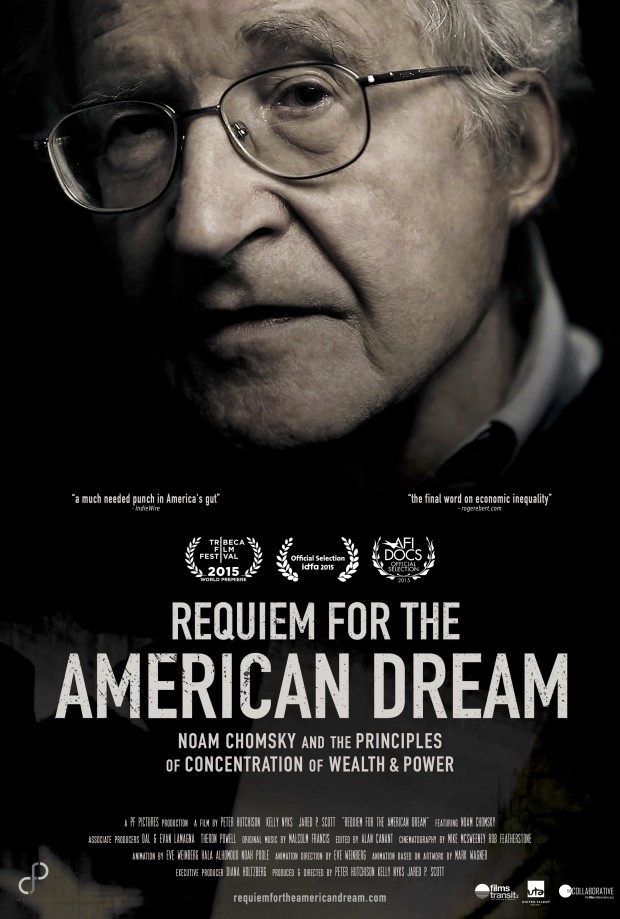
In my younger years I was a fan of Noam Chomsky. It’s been quite a while since I reviewed any of his work so tonight I watched the 2015 documentary Requiem for an American Dream. This is apparently Chomsky’s last documentary and is a compilation of interviews filmed over the last 4 years.
Chomsky has a brilliant mind with an encyclopedic memory for history.
He discussed some of the problems facing society including falling incomes for the lower and middle classes, a growing wealth gap between the 0.5% super rich and everyone else, the influence of wealth on elections and public policy, the financialization of the economy, loss of manufacturing jobs, and the decline of social programs.
His message in summary was that the lower classes do not have enough money and power, and the upper classes have too much money and power.
Chomsky is an excellent example of how someone who lacks an understanding of the relationship between energy and wealth, energy and complex systems, the mathematics of our debt based monetary system, and evolved human behavior will draw incorrect conclusions about the cause of problems and what should be done in response.
All of the problems he is concerned about are an expected outcome of economic growth fueled by depleting non-renewable energy. No one is to blame.
Chomsky thinks we should redistribute wealth from the rich to the poor. If he had a good understanding of overshoot he would know that this solution will make things worse. It’s true that we should reduce the gap between rich and poor to avoid social unrest, but the correct way to accomplish this is to confiscate wealth from the rich and bury it.
Chomsky did not mention any of the problems resulting from human overshoot such as species extinction, resource depletion, pollution, climate change, ocean acidification, or tree die-off.
My respect for Chomsky has dropped a lot.
The UK: A State of unDenial?

A book titled Limits to Growth was published in 1972 by a group of respected scientists including two of my favorite thinkers, Dennis Meadows and Donella Meadows. They modeled a variety of scenarios and showed that industrial civilization would collapse some time before 2100 unless we proactively limited one or more aspects of human population and economic growth.
Limits to Growth generated a lot of passionate criticism. Sadly, most critics did not read or understand the book. There was, and still is, little or no rational discussion by citizens or their leaders about overshoot.
A 30 year update by the authors and several recent independent reviews have shown that we are tracking to one of the Limits to Growth scenarios called the standard model. The evidence is that the Limits to Growth predictions were accurate and we are probably on a path to collapse.
One compelling piece of evidence in support of Varki’s denial theory is that no country in the world, regardless of political or religious belief, is having a meaningful discussion about human overshoot, let alone taking steps to mitigate overshoot, despite overwhelming evidence that we are in serious trouble.
The UK may be a country trying to achieve a state of unDenial.
An all-party parliamentary group (APPG Limits to Growth) has been set up to encourage dialogue on limits to growth.
To seed the discussion APPG commissioned a report published in April 2016 titled “Limits Revisited: A Review of the Limits to Growth Debate”
The report is a quick read and other writers such as Nafeez Ahmed have already summarized it so I won’t repeat the details here. Instead I’ll comment on a few things I thought were important.
The authors are clearly concerned about creating a “happy story”.
Visions for prosperity which provide the capabilities for everyone to flourish, while society as a whole remains within the safe operating space of the planet, are clearly at a premium here. A number of such visions already exist. Developing and operationalising them is vital.
I suppose this is the reality of trying to influence two generations that have not known hardship. Time is short. I think we need more forthright honesty and less spin.
The authors understand the climate change threat but I saw no evidence that they understand how difficult it will be to reduce carbon emissions.
The authors understand that economic growth may be ending however I saw no evidence that they understand the implications of no-growth for our debt based monetary system.
The APPG has good intentions and they are breaking important new ground.
It will be interesting to see if they achieve anything.
By Gail Tverberg: Debt: The Key Factor Connecting Energy and the Economy
Another insightful essay by Gail Tverberg…
There are many who believe that the use of energy is critical to the growth of the economy. In fact, I am among these people. The thing that is not as apparent is that growth in energy consumption is dependent on the growth of debt. Both energy and debt have characteristics that are close to “magic,” with respect to the growth of the economy. Economic growth can only take place when growing debt (or a very close substitute, such as company stock) is available to enable the use of energy products.
The reason why debt is important is because energy products enable the creation of many kinds of capital goods, and these goods are often bought with debt. Commercial examples would include metal tools, factories, refineries, pipelines, electricity generation plants, electricity transmission lines, schools, hospitals, roads, gold coins, and commercial vehicles. Consumers also benefit because energy products allow the production of houses and apartments, automobiles, busses, and passenger trains. In a sense, the creation of these capital goods is one form of “energy profit” that is obtained from the consumption of energy.
The reason debt is needed is because while energy products can indeed produce a large “energy profit,” this energy profit is spread over many years in the future. In order to actually be able to obtain the benefit of this energy profit in a timeframe where the economy can use it, the financial system needs to “bring forward some or all of the energy profit to an earlier timeframe. It is only when businesses can do this, that they have money to pay workers. This time shifting also allows businesses to earn a financial profit themselves. Governments indirectly benefit as well, because they can then tax the higher wages of workers and businesses, so that governmental services can be provided, including paved roads and good schools.
Gail argues that growth in energy consumption is dependent on growth in debt.
I agree this is true today, but I think a dependency in the opposite direction existed in the past, namely that growth in debt was dependent on growth in energy consumption.
It seems that when Energy Returned on Energy Invested (EROEI) is high, debt growth depends on energy growth, and when EROEI is low, energy growth depends on debt growth.
Tim Garrett showed that economic growth requires energy growth.
We can therefore restate this as when EROEI is high, debt growth depends on economic growth, and when EROEI is low, economic growth depends on debt growth.
There is a maximum limit to the ratio of debt to income, even at near zero interest rates.
This means we could not have built industrial civilization if the cost to extract fossil energy started out at today’s high level.
It also means that industrial civilization will collapse.
Another way to think of this is to recognize that debt is a claim on future energy. When total debt becomes larger than the available income can service, the debt defaults and becomes worthless. Which means the energy we expected in the future will not exist.
Interest(ing) Denial: 0% for 90 Months
Interest rates have been zero for 90 months.
This is not normal. Something fundamental has changed.
It’s fascinating how rarely we discuss the root cause of zero interest rates.
David Stockman is one of the financial commentators I occasionally read because he has a good understanding of the widespread and un-prosecuted fraud that took place leading up to the 2008 crisis, and because he understands the dangers of excessive debt.
Today Stockman wrote an article on zero interest rates.
The Cult of Central Banking is Dead in the Water
Stockman understands something is seriously wrong…
There has never been a time in financial history when anything close to this happened, including the 1930s. Nor was interest-free money for eight years running ever even imagined in the entire history of monetary thought.
He understands that the symptom is insufficient growth and that more cash and credit won’t cure it…
There is a structural growth problem, of course. But it has absolutely nothing to do with monetary policy; and it can’t be fixed with cheap money and more debt, anyway.
He understands that the medicine we’ve taken is not working…
Since the year 2000 when monetary repression began in earnest, the balance sheet of the Fed has risen by 800%, while the amount of labor hours used in the US economy has increased by 2%.
At a ratio of 400:1 you can’t even try to argue the counterfactual. That is, there is no amount of money printing that could have ameliorated the “no growth” economy symbolized by flat-lining labor hours.
He understands that our response has been fraudulent, at least in an ethical sense, for future generations…
In essence, during the last 15 years the Fed has gifted the US economy with a $4 trillion free lunch. Uncle Sam bought $4 trillion worth of weapons, highways, government salaries and contractual services but did not pay for them by extracting an equal amount of financing from taxes or tapping the private savings pool, and thereby “crowding out” other investments.
He understands that zero interest rates are no longer helping household incomes because the private sector reached Peak Debt in 2007 and is now slowly reducing its debt…

He understands that cheap credit has created new problems waiting to explode…
Likewise, total US business borrowings have increased from $11 trillion to $13 trillion since the fall of 2007, but it has not lead to additional investment spending. Instead, the Fed fueled inflation of financial assets has induced businesses to cycle virtually 100% of their incremental borrowings into financial engineering. That is, stock repurchases and M&A deals.
Indeed, as we demonstrated in a post earlier this week—–precisely 100% of the entire increase in corporate borrowing since the turn of the century has been pumped back into the casino in the form of stock repurchases.
The world is drowning in excess production capacity owing to the massive worldwide credit inflation and repression of capital costs during the last two decades. That was the effect of total global credit growth from $40 trillion in the mid-1990s to upwards of $225 trillion today—-an $185 trillion expansion that exceeded the growth of global GDP by nearly 4X during the same period.
So far so good, then we get to Stockman’s diagnosis and prescription…
In fact, tepid growth of labor hours, productivity and output is a supply side problem. In that respect, replacing the current burdensome 16% payroll tax on America’s high cost labor with a consumption tax on the nation’s heavily imported goods would do more for supply side growth than central bankers could ever accomplish in a month of Sundays.
In a word it is this. Fire the Fed. Attend to supply side policy. Let market capitalism do the rest.
Stockman’s diagnosis is that growth is stalled because US labor costs are not competitive. His solution is to stimulate growth by shifting taxation from payroll to import duties.
His logic is obviously flawed. If uncompetitive labor costs are the cause of low growth, why is the entire world struggling to grow?
Stockman believes productivity originates from…
… work, exertion, sweat, discipline, enterprise, innovation, invention, sacrifice and savings.
He completely misses the vital role of energy in our economy.
Here is what is actually going on…
A growing economy means that total income is increasing. Income equals productivity (what is produced) plus the change in debt.
Productivity results from combining effort (labor), capital (machines and credit), knowledge (technology), raw materials (stuff), and energy (90+% non-renewable fossil) in an efficient manner (efficiency).
We have no shortage of labor (plenty of unemployed), no shortage of capital (plenty of idle machines and low-cost credit), no shortage of knowledge (plenty of new graduates), and no shortage of raw materials (yet). Our efficiency is pretty good and is approaching engineering limits for improvement.
Our productivity growth has stalled because our energy use growth has stalled because the cost of extracting fossil energy now exceeds what we can afford to pay while growing.
The cost of extracting fossil energy has been increasing at a compounded rate of about 17% per year because it is a finite resource and we chose for obvious reasons to burn the easy to get and inexpensive energy first. What remains is expensive and will get progressively more expensive to extract.
The trick we have used since about 1980 to hide this inconvenient energy reality is to increase our debt faster than our productivity.
When we borrow more money than we repay in a given year, the difference (credit) looks and behaves like earned income (productivity). It makes no difference to our lifestyle if we pay with a $20 bill or our MasterCard.
Eventually we reach a limit to the amount of debt we can service with our income. This limit can be extended by reducing interest rates, which we’ve done, but even at extremely low rates there is still a maximum amount of debt that can be supported by a given income.
Citizens reached their debt limit in 2007 which precipitated the 2008 crisis.
Since 2008 we have been masking our energy reality by increasing public debt which, unlike private debt, is not limited in the short-term by income because governments can print money to service their debt.
There are several ways to print money. The method we have used so far is called quantitative easing (QE) which is the government borrowing money from itself and us winking at each other and telling ourselves that we intend to repay the debt someday. Any honest assessment of our ability to repay our government debt from taxes would show that the debt cannot and will not be repaid.
Another type of money printing, which we may soon try, is to print and hand out money directly to citizens. The main difference from QE is that we will stop winking at each other.
The implication of printing money is that we have chosen to reduce the value of future money to maintain our current lifestyle. Put another way, we are living beyond our means and the difference between what we are spending and what we are earning will be subtracted from our future standard of living. This means we are making the future much worse than it needs to be.
The thing that’s sustaining our standard of living (public debt) is growing faster than the thing needed to sustain the public debt (our productivity). This is one definition of a bubble.
We are living in a giant, global, and unprecedented debt bubble.
All bubbles, by definition, must burst.
When bubbles burst they always revert through their mean. The bigger the bubble, the greater the unnecessary future pain we create.
When bubbles burst they never deflate slowing in a controlled manner. We will not experience a smooth transition from our current standard of living to a new lower standard of living. It will be a bumpy and probably unfair process where those least deserving of pain are hit the hardest.
When our bubble bursts it will create real hardship with little or no time to adjust, and will create the conditions necessary for social unrest, crime, despots, and war. The worst of history will likely repeat but on a much larger scale because our situation is unprecedented.
The relationship between the economy and energy is clear yet even the better commentators, like Stockman, are in denial and choose not to look.
Growth is over. De-growth is coming soon.
Most will say “no one could have seen this coming”.
The facts are clear for anyone that chooses to look.
We could have reduced our population and lifestyles in a safe, civil, and fair manner, with the added benefit of less damage to the environment, which we’ll desperately need when the oil is gone, but chose not to because of evolved denial.
 un-Denial