By Jay Hanson: Reality Report Interview (November 3, 2008)

dieoff.org

For you old-timers this should be a memory lane treat, and for you young’uns this will be an introduction to the one who started it all: Jay Hanson.

Jay Hanson hosted the first online discussion bulletin board for overshoot issues like peak oil and climate change. He devoted a large portion of his life to researching the genetic human behaviors that have caused our severe state of overshoot. Here is a nice overview of his work by Kurt Cobb.

Ten years ago Jason Bradford hosted a weekly interview format radio program on overshoot issues called the Reality Report. I still consider the Reality Report to be the most intelligent show of its type to this day. Today Jason Bradford manages a progressive investment company called Farmland LP that restores depleted conventional farmland into healthy sustainable organic production.

This 10-year-old interview, is to my recollection, the only audio interview done with Jay Hanson. A superficial look at Hanson’s website might lead you to conclude he is a nut job, but the fact is Hanson is extremely intelligent and well read, which this interview helps to reinforce by showcasing the voice behind the radical writings.

I drug this 2008 chestnut out now because the steadily increasing war drums we hear in the media reminded me of a specific prediction Hanson made in this interview that there would be a nuclear war in 10 to 14 years, meaning we are now in the window.

right click save as to download

As an aside, a few years ago I tried to introduce Hanson to Varki’s Mind Over Reality Transition (MORT) theory but was saddened when Hanson aggressively and unscientifically rejected the theory before understanding it. Perhaps even the most open-minded of us will deny unpleasant realities, especially when that reality might undermine a lifetime of work. By undermine, I do not mean invalidate, but rather I think MORT provides an umbrella theory to explain the numerous specific behaviors identified by Hanson and others that have contributed to our predicament.

By Ajit Varki: Why are there no persisting hybrids of humans with Denisovans, Neanderthals, or anyone else?

Denisovan Family Tree

Ajit Varki wrote a letter to PNAS in April 2016 asking a question that is supportive of his Mind Over Reality Transition (MORT) theory.

http://www.pnas.org/content/113/17/E2354

Here is my crude attempt to paraphrase Varki’s letter in simpler language:

Behaviorally modern humans successfully bred, in more than one geographic location, with our close relatives the Denisovans and Neanderthals. All of our cousins subsequently went extinct and we, the 7.6 billion offspring from interbreeding, have retained a relatively small number of genes from our cousins, mostly related, if I recall correctly, to disease immunity. The interesting fact is that no full hybrid species persisted.

This strongly suggests that there was some unique and complex combination of genes that gave behaviorally modern humans a strong cognitive advantage over their cousins.

Here is the original text:

The tour-de-force report of Sawyer et al. (1) on genomes of two Denisovans and the accompanying editorial and figure (2) support the notion of “a web of now-extinct populations linked by limited, but intermittent…gene flow” (3): involving multiple hominin lineages for thousands of years, before the mysterious disappearance of all taxa other than us “behaviorally modern humans” (BMHs). Although attention focuses on rare introgressions of non-BMH alleles facilitating adaptation of invading BMHs to ecological challenges, there is a bigger elephant in the room.

Current genomic and archaeological data indicate that BMHs arose in Africa ∼100,000–200,000 y ago and spread across the planet (including the rest of Africa), encountering other extant hominins like Neanderthals, Denisovans, archaic African hominins, and possibly other lineages from earlier diasporas of Homo erectus. Although genomic evidence indicates interbreeding, the number of functional genes incorporated is limited, resulting in a “leaky replacement” (3), without persistence of true hybrids. Thus, our single BMH (sub)species was the “winner” in every contact/replacement event, spanning tens of thousands of years. I cannot find any other example wherein a single (sub)species from one geographic origin completely replaced all extant cross-fertile (sub)species in every planetary location, with limited introgression of functional genetic material from replaced taxa, and leaving no hybrid species. Typically, one instead finds multiple cross-fertile (sub)species, with hybrid zones in between.

Although this apparent one-of-a-kind phenomenon could have occurred by chance, the singularity allows one to posit a uniquely complex genetic/biological/cultural transition of BMHs. As Pääbo suggested (3), adaptive accumulation of an “explosive constellation” of genetic variants (alleles) could have endowed BMHs with an unparalleled combination of cognitive features, guaranteeing success at every subsequent encounter with other hominins.

Why did hybrid species not persist, at least at the geographical extremes of BMH expansion? Assuming that hundreds of new alleles comprised the BMH genotype, F1hybrids with other hominins would likely lack the complete cognitive package required to compete for mating within BMH groups. Tellingly, 10 of 10 non-BMH mitochondrial sequences are outside the current BMH range (1), suggesting that mating of BMH males with non-BMH females generated progeny that were not included within BMH groups. In contrast, progeny of female BMHs and non-BMH males may have had the opportunity to survive within BMH groups, with sufficient mating success rates to allow transmissions of a few alleles valuable to the newcomers, but related to ecological adaptation, not cognition.

Such “human exceptionalism” is currently frowned upon, as are extraordinary explanations of evolutionary events. However, unless there are other clear examples of such complete replacement of all related taxa by one single (sub)species, BMHs may indeed be a rare exception. Although environmental factors such as climate or infectious disease (4) could have generated the initial African bottleneck, the critical BMH phenotype was likely cognitive. This fits ecocultural models predicting Neanderthal extinction through competition with modern humans (5) and suggests an improbable BMH transition through a long-standing “psychological evolutionary barrier”––possibly involving initially maladaptive features such as reality denial and mortality salience, which conspired to generate the winning combination (6).


Note: Ajit Varki sent me this letter when he published it but I thank reader Derek Peter Carne for reminding me about it.

By Tim Garrett: Linking Wealth, Energy Demand, CO2 and Climate Change

Tim Garrett

Tim Garrett is the scientist with the best understanding of the relationship between energy and the economy, which means he has the best understanding of what can and cannot be done to mitigate the climate change threat.

Don’t take my word for this, read his papers and explore his site.

As far as I can tell, Garrett is ignored by all other climate scientists, and everyone that formulates climate change policies.

Think about that for a moment. Our experts ignore the one person they should not ignore.

Now you know why I am so fascinated by the human tendency to deny any reality we do not like. This tendency afflicts almost everyone, including our best and brightest.

I missed this excellent interview with Garrett when it was first broadcast in October 2017 although I have read and listened to almost everything previous he has done.

http://environmentalprofessionalspostulating.libsyn.com/ep-012-a-discussion-with-professor-tim-garrett

Paraphrasing a few quotes from the interview:

It is now generally accepted that a 5 degree rise in temperature will collapse civilization. At our current economic growth rate we can expect 5 degrees in 50 or 60 years from now. The only way to avoid this is to collapse civilization now.


I doubt there are solutions but if there are solutions we won’t get at them by imagining fairy tales like improved efficiency and renewable energy.


We need to start thinking now about the most humane way to deal with a collapsing civilization because we know from history that our tendency is to not behave well in such situations.


Interviewer: Why is your work so unknown?

Garrett: Humans have a deep-seated need for optimism and a belief that solutions exist.

Me: aka denial


By xraymike79: Evolutionary Dead-Ends

37009944474_1d0be6f93d_b

Xraymike79 doesn’t write very often anymore, but when he does it’s always worth your time because he’s one of the best, if not the best, big-picture chroniclers of human overshoot.

Here are a few excerpts from his latest essay but I recommend you read the whole thing:

https://collapseofindustrialcivilization.com/2018/03/19/evolutionary-dead-ends/

“It may seem impossible to imagine that a technologically advanced society could choose, in essence, to destroy itself, but that is what we are now in the process of doing.” ~ Elizabeth Kolbert

Have things improved since I wrote my last essay a year ago for this blog? Have we miraculously transformed our entire energy system into one that does not poison and degrade the natural world? Have we slowed the onslaught of plastic pollution choking the planet’s rivers, lakes, and oceans? Have we done anything meaningful to halt the deterioration of the planet’s biodiversity toward mass extinction? Has this global, hi-tech civilization done anything significant to avert its own demise? Despite a constant flow of warnings from the scientific community and even a letter signed by more than 20,000 scientists, the simple answer is no. We have failed to address the complexity of our rising population and a degrading environment. Yes, we are self-conscious and thus able to recognize the fact that we are destroying the only home we have, but will the end result differ much from a population overshoot of bacteria in a Petri dish? Dependent on a continuous stream of finite resources imported from across the globe, modern megacities contain the seeds of their own destruction and that of all other life forms upon which humanity depends for its survival. The exponential growth of modern civilization ensures that one of the next doubling times will produce an absolute increase in overshoot that tips the world into unavoidable collapse. Enough damage may well have already been done; we’re just waiting for inertia to catch up to the impacts.


2017 set a global record for the most skyscrapers built in a single year and 2018 is predicted to eclipse it. The fossil fuel energy spent to construct those concrete and steel buildings translates into a melting cryosphere. Not to mention the fact that the carbon footprint of some of the world’s biggest cities is 60% bigger than previously estimated. “Renewable energy” still only comprises a tiny fraction of global energy consumption and plans for a total transition will take decades, if it’s even possible. Any growth in ‘renewable energy’ has been offset by increased consumption of fossil fuels in the developing world. 2017 marked a new record high in CO2 emissions with 2018 set to break that record. Global CO2 emissions have yet to peak, and the UN has warned that we are on course for a 3C world. It doesn’t help that the current U.S. administration plans to cut funding for alternative energy R&D, with the Energy Department expecting no drop in the U.S. carbon footprint through 2050. Having embedded itself in the U.S. government over a century ago, the fossil fuel industry has consistently worked to block climate change action and undermine environmental laws. A UK shipping executive recently admitted his industry is guilty of doing the same to protect their bottom line. The utilities companies knew the dangers as well. Like most corporations, the viability of their business model depends on perpetuating an unsustainable way of life. With warnings ignored since the late 1800s starting with the work of Svante Arrhenius, it should be obvious by now that intelligence without sapience has produced deadly results. A new study finds “the most accurate climate change models predict the most alarming consequences.” The recently released U.S. National Climate Assessment has similar findings:

While climate models incorporate important climate processes that can be well quantified, they do not include all of the processes that can contribute to feedbacks (Ch. 2), compound extreme events, and abrupt and/or irreversible changes. For this reason, future changes outside the range projected by climate models cannot be ruled out (very high confidence). Moreover, the systematic tendency of climate models to underestimate temperature change during warm paleoclimates suggests that climate models are more likely to underestimate than to overestimate the amount of long-term future change (medium confidence). (Ch. 15)

In a new ominous research finding, the evil twin of climate change(ocean acidification) is threatening the base of the marine food chain by disrupting the production of phytoplankton. This is yet another positive feedback loop increasing the rate of global warming. Climate feedback loops and ice sheet modeling are two weak areas of climate science, which means many unpleasant surprises. This is why researchers are constantly astonished. Adaptation is not a luxury most organisms have at the present rates of change. Techno-fixes are but a pipe dream.


Humans share two behavioral traits with all other species that are critically important to (un)sustainability. Numerous experiments show that unless or until constrained by negative feedback (e.g., disease, starvation, self-pollution) the populations of all species:

• Expand to occupy all accessible habitats.

• Use all available resources.

Like mindless bacteria bent on their own success, humans are victims of their own DNA and ingenuity. Any civilization that develops energy harvesting technologies allowing for rapid population growth will generate entropy which will in turn almost certainly have strong feedback effects on the planet’s habitability. Our exponentially growing economy is on a collision course with an immovable ecosphere.

The end of the world is coming for the naked ape, not by a cabal of bankers or any sort of cockamamie conspiracy tale like chemtrails, but by us –the entire human race– and the economic system we have developed. We have become hostages to complex structures, and ever more intricate specialization, to exploit diminishing resources. Pollution and waste are of little concern for capitalism until they become a significant drain on overall profitability and new frontiers to exploit are exhausted. When profitability on a global scale is finally threatened by climate change, it will be far too late. The response will be militarized and authoritarian.


The crisis of civilization is planet-wide this time. We’ve turned a utopian world of plenty into a dystopian world of fascist-leaning governments, industrial disasters, collapsing ecosystems, and technological addiction. We have a Commander in Chief who tweets bizarre debunked conspiracies at 3 am, gets his intel briefings from right-wing TV shows, dismantles any remaining hindrances to unbridled capitalism, and doesn’t know the difference between weather and climate. Public discourse has been dumbed down to the level of Fox news talking points and tribal groupthink. Those who can discern actual ‘fake news’ from scientific fact are left to watch in horror as mainstream scientific projections continue to prove overly optimistic. Not only are regulations being cut left and right, they are not being enforced. Government science advisors are being purged and replaced with mouthpieces for industrial polluters. In fact, this administrations is actively working to delegitimize and destroy government institutions. A sizable population of low information voters supports such actions, but it’s only to their own detriment. Of course, both major parties are under the sway of corporate power, but Trump and company represent an exceptionally predatory class of people. The Union of Concerned Scientists is monitoring the current administration’s war on science and public health; their latest report is here:

The administration’s one-year record shows an unprecedented level of stalled and disbanded scientific advisory committees, cancelled meetings, and dismissed experts. The consequences for the health and safety of millions of Americans could be profound.


We live in an age of unparalleled technological advancement, while at the same time we turn a blind eye to the disintegrating natural world that gave birth to us, having forgotten that our destiny lies in our relationship with the earth. Like Icarus who, in his exuberance, ignored his father’s warnings and flew too close to the sun, modern man with his technology has ascended to great heights without heeding sound advice.

“We’ve arranged a civilization in which most crucial elements profoundly depend on science and technology. We have also arranged things so that almost no one understands science and technology. This is a prescription for disaster.” ~ Carl Sagan

By Tim Morgan: The need for new ideas

20180222_170822


This latest post by Tim Morgan may be my new all-time favorite essay because it discusses the topics that are near and dear to my heart:

  1. Growth is over due to surplus energy depletion.
  2. We are denying 1. with debt.
  3. Viable debt requires growth.
  4. We are denying 3. with printed money and low interest rates.
  5. We are denying the dangerous implications of 4.
  6. We should be acting to minimize harm, instead we are maximizing harm.
  7. We can’t address 6. until we confront our genetic denial.

I don’t think Morgan is aware of Varki’s MORT theory, but denial is central to the essay and reinforces my belief that the first step to developing a rational response to our predicament must be broader awareness of our genetic tendency to deny unpleasant realities.

I’ve extracted a few noteworthy paragraphs below but the whole essay is worth your time to read carefully. There is nothing more important for citizens to understand, except of course denial.

https://surplusenergyeconomics.wordpress.com/2018/02/23/120-the-need-for-new-ideas/


This article explores an issue that is always at or near the centre of where the economy is going. Worldwide, the long years of growing prosperity are over, and this change fundamentally invalidates many things that government, business and the public have always taken for granted.

The reason why growth is over, of course, is that we no longer have access to cheap energy. Where geographical expansion and economies of scale once drove down the cost of accessing energy, the driving factor now is depletion, which is pushing costs upward, and is doing so in an exponential way.


Thus far, and in spite of all the accumulating evidence, we haven’t recognised that growth in prosperity is over. Rather, we’ve tried to delude ourselves, by using cheap and easy debt, and latterly ultra-cheap money as well, to pretend that perpetual growth remains alive and well.


But prosperity in the developed West, already in decline, is set to deteriorate steadily. Comparing 2030 with 2016, prosperity is likely to be 7% lower in the United States, for example, and 10% lower in Britain. These projected declines are in addition to the deterioration that has already happened – prosperity has already peaked in the US, Canada, Australia and most European countries.


Worldwide, we’re subsidising an illusory present by cannibalising an already-uncertain future. We’re doing this by creating debt that we can’t repay, and by making ourselves pension promises that we can’t honour. So acute is this problem that our chances of getting to 2030 without some kind of financial crash are becoming almost vanishingly small.

Finally, any ‘business as usual’ scenario suggests that we’re not going to succeed in tackling climate change. This is an issue that we examined recently. Basically, each unit of net energy that we use is requiring access to more gross energy, because the energy consumed in the process of accessing energy (ECoE) is rising. This effect is cancelling out our efforts to use surplus(net-of-cost) energy more frugally.

The exponential nature of the rise in ECoEs is loading the equation ever more strongly against us. This is why “sustainable development” is a myth, founded not on fact but on wishful thinking.


The lure of denial

These considerations present us with a conundrum. With prosperity declining, do we, like Pollyanna, try to ignore it, whistling a happy tune until we collide with harsh reality? Or do we recognise where things are heading, and plan accordingly?

There are some big complications in this conundrum. Most seriously, if we continue with the myth of perpetual growth, we’re not only making things worse, but we may be throwing away our capability to adapt.

You can liken this to an ocean liner, where passengers are beginning to suspect that the ship has sprung a leak. The captain, wishing to avoid panic, might justifiably put on a brave face, reassuring the passengers that everything is fine. But he’d be going too far if he underlined this assurance by burning the lifeboats.


We know that supplies of petroleum are tightening, that the trend in costs is against us, and that burning oil in cars isn’t a good idea in climate terms. Faced with this, the powers-that-be could do one of two things. They could start to wean us off cars, by changing work and habitation patterns, and investing in public transport. Alternatively, they can promise us electric vehicles, conveniently ignoring the fact that we don’t, and won’t, have enough electricity generating capacity to make this plan viable, and that we’d certainly need to burn in power stations at least as much oil as we’d take out of fuel tanks. At the moment, every indication is that they’re going to opt for the easy answer – not the right one.

This is just one example, amongst many, of our tendency to avoid unpalatable issues until they are forced upon us. The classic instance of this, perhaps, is the attitude of the democracies during the 1930s, who must have known that appeasement was worse than a cop-out, because it enabled Germany, Italy and Japan to build up their armed forces, becoming a bigger threat with every passing month. Hitler came to power in 1933, and could probably have been squashed like a bug at any time up to 1936. By 1938, though, German rearmament reduced us to buying ourselves time.

Burying one’s head in the sand is actually a very much older phenomenon than that. The English happily paid Danegeld without, it seems, realising that each such bribe made the invaders stronger. It’s quite possible that the French court could have defused the risk of revolution by granting the masses a better deal well before 1789. The Tsars compounded this mistake when they started a reform process and then slammed it into reverse. History never repeats itself, but human beings do repeat the same mistakes, and then repeat their surprise at how things turn out.


Needed – vision and planning

The aim here is simple. There is an overwhelming case for preparation.  With this established, readers can then discuss what might constitute a sensible plan, and try to work out how any plan at all is going to be formulated in a context of ignorance, denial and wishful thinking.


As the cost of energy rises, economic growth gets harder. We’ve come up against this constraint since about 2000, and our response to it, thus far, has been gravely mistaken, almost to the point of childish petulance. We seem incapable of thinking or planning in any terms that aren’t predicated on perpetual growth. We resort to self-delusion instead.


Since the global financial crisis (GFC), we’ve added monetary adventurism to the mix. In the process, we’ve crushed returns on investment, crippling our ability to provide pensions. We’ve accepted the bizarre idea that we can run a “capitalist” economic system without returns on capital. We’ve also accepted value dilution, increasingly resorting to selling each other services that are priced locally, that add little value, and that, in reality, are residuals of the borrowed money that we’ve been pouring into the economy.

We seem oblivious of the obvious, which is that money, having no intrinsic worth, commands value only as a claim on the output of a real economy driven by energy. When someone hands in his hat and coat at a reception, he receives a receipt which enables him to reclaim them later. But the receipt itself won’t keep him warm and dry. For that, he needs to exchange the receipt for the hat and coat. Money is analogous to that receipt.


The first imperative, then, is recognition that the economy is an energy system, not a financial one, in which money plays a proxy role as a claim on output. In this sense, money is like a map of the territory, whereas energy is the territory itself – and geographical features can’t be changed by altering lines on a map.

It’s fair to assume that the reality of this relationship will gain recognition in due course, the only question being how many mistakes and how much damage has to happen before we get there. No amount of orthodoxy can defy this reality, just as no amount of orthodoxy could turn flat earth theories into the truth.

With the energy dynamic recognised, we’ll need to come to terms with the fact that growth cannot continue indefinitely. Rather, growth has been a chapter, made possible by the bounty of fossil fuels, and that bounty is losing its largesse as the relationship between energy value and the cost of access tilts against us.

In one sense, it’s almost a good thing that this is happening. If we suddenly discovered vast oil reserves on the scale of another Saudi Arabia, we would probably use them to destroy the environment.


Meanwhile, the invalidation of the growth assumption will have profound implications for debt, and may indeed make the whole concept unworkable. If borrowing and lending ceased to be a viable activity, the consequences would be profound.

To understand this, we need to recognise that debt only works when prosperity is growing. For A to borrow from B today, and at a future date repay both capital and interest, A’s income must have increased over that period. Without that growth, debt cannot be repaid.

There are two routes to the repayment of capital and the payment of interest, and both depend on growth. First, if A has put borrowed capital to work, the return on that investment both pays the interest, and also, hopefully, leaves A with a profit. Alternatively, if A has spent the borrowed money on consumption, A’s income has to increase by at least enough to for him to repay the debt, and pay interest on it.

In an ex-growth situation, both routes break down. Invested debt isn’t going to yield a sufficient return, because purchases by consumers have ceased to expand. A’s income, on the other hand, won’t have increased, because prosperity has stopped growing.

This scenario – in which repayment of debt becomes impossible – isn’t a future prediction, but a current reality, and a reality that is already in plain sight.

We need to be clear that the slashing of rates to almost zero happened because earning enough on capital to be able to pay real rates of interest has become impossible.

Businesses which aren’t growing cannot – ever – pay off their debts, and neither can individuals whose prosperity is deteriorating.


Financial exercises in denial (including escalating debt, ultra-cheap money and the impairment of pension provision) have already created a stark division between “haves” and “have-nots”. Essentially, the “haves” are those who already owned assets before the value of those assets was driven upwards by monetary policy. The “have-nots” are almost everyone else, especially the young.


A logical conclusion, then, is that we need a new form of politics, just as much as we need a new understanding of economics, new models for business and a new role for finance. Co-operative systems might succeed where corporatism – both the state-controlled and the privately-owned variants – have failed.

All of these new ideas need to be grounded in reality, not in wishful thinking, denial or ideological myopia. But reality becomes a hard sell when it challenges preconceived notions – and no such notion is more rooted in our psyche than perpetual growth.

On Burning Carbon: The Case for Renaming GDP to GDB

Burning Carbon

Following is a single sentence description of our predicament that includes a simple proposal for how we might increase awareness and shift behavior in a positive direction.

Given near perfect historic correlation,

and sound physics to expect causation,

between energy consumption and wealth,

more specifically US$1 (1990) = 10 mW;

and given over 85% of energy comes from burning carbon,

including ancient (oil, coal, gas), old (wood), and recent (biomass),

and the remaining 15% of energy requires burning carbon

for materials, construction, maintenance, and energy distribution,

for example, cement from natural gas, steel from coal, and diesel

machines to mine and transport the concrete, steel, and uranium,

required to build and operate hydroelectric dams and nuclear plants;

and given wind and solar can’t scale up to replace 18 TW of burning carbon,

which, for comparison, is 300 billion 60 watt bulbs, about 40 per person,

because of low power density, intermittency, and high storage cost,

and because wind and solar requires burning carbon

for materials, construction, maintenance, and energy distribution,

for example, concrete, steel, copper, glass, silicon, and composites,

and diesel trucks to transport, install, and maintain the equipment,

and diesel machines to build and maintain the access roads,

and because wind and solar equipment wears out and must be replaced

after 25 years, when there will be little remaining oil to do so;

and given that most do not understand the tight dependencies between:

burning carbon to create the wealth we enjoy and want more of, nor

burning carbon to make the nitrogen fertilizer our food requires, nor

burning carbon to pump the water we drink and irrigate crops with, nor

burning carbon for tractors and combines that permit us to specialize, nor

burning carbon to transport everything we depend on to survive, nor

burning carbon to make the concrete, steel, and glass we live in, nor

burning carbon for the vacations, recreation, and internet we enjoy, nor

burning carbon and population growth from 1 to 8 billion, nor

burning carbon and climate change that threatens our children, nor

burning carbon and sea level rise that threatens many cities, nor

burning carbon and aerosols that mask 0.5+C additional warming, nor

burning carbon and ocean acidification that is killing coral reefs etc., nor

burning carbon and the sixth great extinction, nor

burning carbon and the collapse of fisheries, nor

burning carbon and rising ground level ozone that is killing trees;

and given that most are not aware of, or preparing for,

the coming shitstorm, caused by

an energy price high enough to cover extraction costs,

that are rising 10+% per year due to depleting low-cost reserves,

is an energy price too high to permit economic growth,

and without growth, debt defaults causing a depression;

so we conjure growth with new money,

created out of thin air by increasing debt,

which is a useful trick when real growth is possible,

but a deadly trick when there are limits to growth,

because it is equivalent to eating seed corn;

and this debt is exploding to unprecedented levels worldwide,

because it now takes more than $3 of debt for $1 of growth,

with total debt about US$300 trillion, triple that in 2000,

forcing central banks to print money to keep interest rates low,

0% interest is not normal, as all grown-ups know;

and this free money has created an illusion of oil abundance,

because fracking companies can operate despite losing money,

meaning much oil will disappear when interest rates rise;

and this free money has created bubbles of unprecedented size,

in stocks, bonds, real estate, education, healthcare, etc.,

that must eventually burst and revert through their mean,

hurting even the innocents who did not participate;

thus printing money will someday cause suffering and social unrest,

via a deflationary or hyperinflationary monetary collapse,

depending on how politicians respond,

from a much higher and harmful elevation than it needed to be,

because there is no such thing as a free lunch,

and we chose not to acknowledge limits and to live within our means,

despite being warned of the dangers since at least 1972,

even though our means compared to most of history are excellent,

for example, a poor Canadian lives better than a pharaoh;

with our real wealth of net energy per person falling,

so falls our productivity,

because everything we do uses energy,

for example, 1 barrel of oil does 4.5 years of manual labor,

so $80 of oil replaces $120,000 of minimum wages,

and we burn about 33 billion barrels of oil per year,

meaning each of our 7 billion is helped by 20 energy slaves,

plus a similar number from coal, gas, hydro, and nuclear;

and because we’ve already captured most efficiencies,

so falls our real incomes,

for all except the upper 1%, which profit from money printing;

and in addition to using debt,

we further masked declining real incomes,

by lowering the cost and price of manufactured items,

by consolidating shopping at Walmart and Amazon,

and by moving good paying manufacturing jobs to poorer countries,

which made us more vulnerable to supply chain disruptions,

because everything we need is now made elsewhere,

and because trucks, trains, and ships all burn diesel oil,

and cannot practically be made to run on anything else;

and this loss of good jobs further lowered incomes,

making citizens angry, for example, Brexit and Trump;

and if citizens continue to not understand the cause of decline,

nor the plentiful reasons to be thankful,

they may someday support a despot, like Hitler,

who was supported because of harm from Weimar money printing,

and who blamed other tribes and promised war for gain;

but unlike past wars that rewarded victors with booty,

for example, the US empire and its reserve currency,

the next war will return few rewards to the victor,

because we’ve already burned most of the good booty,

and we’ll burn a lot more waging war,

and we’ll risk annihilation with nuclear weapons,

that a desperate country without oil and hope may use;

so it’s therefore a really good idea for citizens to understand,

that geology, biology, and thermodynamics caused our predicament;

so citizens can’t be persuaded to blame another person or tribe;

and so citizens see the blessing for their children of burning less carbon,

because a 1C rise caused the climate problems we’ve already experienced,

and another 1C rise is baked in no matter what we do,

because CO2 passed 400 ppm, and is still rising,

meaning our great, great, great, great, grandchildren

already have to contend with at least 10 meters of sea level rise,

and we’re on a catastrophic path to another 2C rise, or more,

meaning most humans in a few generations will not survive,

unless we soon mostly stop burning carbon,

which depletion will force anyway, unfortunately too late;

and so citizens see the wisdom of using some remaining carbon wealth,

to build a softer landing zone,

in preparation for a world with local food and local economies,

and much less energy, wealth, complexity, and population;

and given that our culture, leaders, and news,

focus almost exclusively on GDP growth,

which, as we’ve seen, is actually growth in burning carbon;

and given our need for constant reinforcement,

to fight our human tendency to deny unpleasant realities,

which blocks awareness, discussion, and action,

on every issue that matters, for example,

climate change, peak oil, and over-population,

all symptoms of overshoot,

which the Green Party doesn’t even mention;

we should seize a simple public education opportunity,

by renaming

GDP (Gross Domestic Product)

to

GDB¹ (Gross Domestic Burn);

so every time we discuss the economy we worship,

we are reminded how fortunate we are to be alive,

on an extraordinarily rare and beautiful planet,

with extraordinarily rare and beautiful eukaryotic life,

with an extraordinarily rare and intelligent brain,

during the brief 100 year period, out of 4 billion,

with abundant burning carbon,

and the many reasons for

thankfulness and temperance².


¹I first heard the term “GDB” in a presentation by Nate Hagens.

²tem·per·ance /ˈtemp(ə)rəns/ (noun): moderation or self-restraint in action, consumption, statement, etc.

A good place to go next is You know you are in trouble when…

 

Learn Not to Burn


Or, if you prefer to read as a paragraph…

Given near perfect historic correlation, and sound physics to expect causation, between energy consumption and wealth, more specifically US$1 (1990) = 10 mW; and given over 85% of energy comes from burning carbon, including ancient (oil, coal, gas), old (wood), and recent (biomass), and the remaining 15% of energy requires burning carbon for materials, construction, maintenance, and energy distribution, for example, cement from natural gas, steel from coal, and diesel machines to mine and transport the concrete, steel, and uranium, required to build and operate hydroelectric dams and nuclear plants; and given wind and solar can’t scale up to replace 18 TW of burning carbon, which, for comparison, is 300 billion 60 watt bulbs, about 40 per person, because of low power density, intermittency, and high storage cost, and because wind and solar requires burning carbon for materials, construction, maintenance, and energy distribution, for example, concrete, steel, copper, glass, silicon, and composites, and diesel trucks to transport, install, and maintain the equipment, and diesel machines to build and maintain the access roads, and because wind and solar equipment wears out and must be replaced after 25 years, when there will be little remaining oil to do so; and given that most do not understand the tight dependencies between: burning carbon to create the wealth we enjoy and want more of, nor burning carbon to make the nitrogen fertilizer our food requires, nor burning carbon to pump the water we drink and irrigate crops with, nor burning carbon for tractors and combines that permit us to specialize, nor burning carbon to transport everything we depend on to survive, nor burning carbon to make the concrete, steel, and glass we live in, nor burning carbon for the vacations, recreation, and internet we enjoy, nor burning carbon and population growth from 1 to 8 billion, nor burning carbon and climate change that threatens our children, nor burning carbon and sea level rise that threatens many cities, nor burning carbon and aerosols that mask 0.5+C additional warming, nor burning carbon and ocean acidification that is killing coral reefs etc., nor burning carbon and the sixth great extinction, nor burning carbon and the collapse of fisheries, nor burning carbon and rising ground level ozone that is killing trees; and given that most are not aware of, or preparing for, the coming shitstorm, caused by an energy price high enough to cover extraction costs, that are rising 10+% per year due to depleting low-cost reserves, is an energy price too high to permit economic growth, and without growth, debt defaults causing a depression; so we conjure growth with new money, created out of thin air by increasing debt, which is a useful trick when real growth is possible, but a deadly trick when there are limits to growth, because it is equivalent to eating seed corn; and this debt is exploding to unprecedented levels worldwide, because it now takes more than $3 of debt for $1 of growth, with total debt about US$300 trillion, triple that in 2000, forcing central banks to print money to keep interest rates low, 0% interest is not normal, as all grown-ups know; and this free money has created an illusion of oil abundance, because fracking companies can operate despite losing money, meaning much oil will disappear when interest rates rise; and this free money has created bubbles of unprecedented size, in stocks, bonds, real estate, education, healthcare, etc., that must eventually burst and revert through their mean, hurting even the innocents who did not participate; thus printing money will someday cause suffering and social unrest, via a deflationary or hyperinflationary monetary collapse, depending on how politicians respond, from a much higher and harmful elevation than it needed to be, because there is no such thing as a free lunch, and we chose not to acknowledge limits and to live within our means, despite being warned of the dangers since at least 1972, even though our means compared to most of history are excellent, for example, a poor Canadian lives better than a pharaoh; with our real wealth of net energy per person falling, so falls our productivity, because everything we do uses energy, for example, 1 barrel of oil does 4.5 years of manual labor, so $80 of oil replaces $120,000 of minimum wages, and we burn about 33 billion barrels of oil per year, meaning each of our 7 billion is helped by 20 energy slaves, plus a similar number from coal, gas, hydro, and nuclear; and because we’ve already captured most efficiencies, so falls our real incomes, for all except the upper 1%, which profit from money printing; and in addition to using debt, we further masked declining real incomes, by lowering the cost and price of manufactured items, by consolidating shopping at Walmart and Amazon, and by moving good paying manufacturing jobs to poorer countries, which made us more vulnerable to supply chain disruptions, because everything we need is now made elsewhere, and because trucks, trains, and ships all burn diesel oil, and cannot practically be made to run on anything else; and this loss of good jobs further lowered incomes, making citizens angry, for example, Brexit and Trump; and if citizens continue to not understand the cause of decline, nor the plentiful reasons to be thankful, they may someday support a despot, like Hitler, who was supported because of harm from Weimar money printing, and who blamed other tribes and promised war for gain; but unlike past wars that rewarded victors with booty, for example, the US empire and its reserve currency, the next war will return few rewards to the victor, because we’ve already burned most of the good booty, and we’ll burn a lot more waging war, and we’ll risk annihilation with nuclear weapons, that a desperate country without oil and hope may use; so it’s therefore a really good idea for citizens to understand, that geology, biology, and thermodynamics caused our predicament; so citizens can’t be persuaded to blame another person or tribe; and so citizens see the blessing for their children of burning less carbon, because a 1C rise caused the climate problems we’ve already experienced, and another 1C rise is baked in no matter what we do, because CO2 passed 400 ppm, and is still rising, meaning our great, great, great, great, grandchildren already have to contend with at least 10 meters of sea level rise, and we’re on a catastrophic path to another 2C rise, or more, meaning most humans in a few generations will not survive, unless we soon mostly stop burning carbon, which depletion will force anyway, unfortunately too late; and so citizens see the wisdom of using some remaining carbon wealth, to build a softer landing zone, in preparation for a world with local food and local economies, and much less energy, wealth, complexity, and population; and given that our culture, leaders, and news, focus almost exclusively on GDP growth, which, as we’ve seen, is actually growth in burning carbon; and given our need for constant reinforcement, to fight our human tendency to deny unpleasant realities, which blocks awareness, discussion, and action, on every issue that matters, for example, climate change, peak oil, and over-population, all symptoms of overshoot, which the Green Party doesn’t even mention; we should seize a simple public education opportunity, by renaming GDP (Gross Domestic Product) to GDB¹ (Gross Domestic Burn); so every time we discuss the economy we worship, we are reminded how fortunate we are to be alive, on an extraordinarily rare and beautiful planet, with extraordinarily rare and beautiful eukaryotic life, with an extraordinarily rare and intelligent brain, during the brief 100 year period, out of 4 billion, with abundant burning carbon, and the many reasons for thankfulness and temperance².

 

By Tim Morgan: Good idea, bad idea

1f2528a112166b993d853a40151f9f98

Here is the latest essay by Tim Morgan in which he makes the case for wind and solar energy, and the case against electric vehicles.

https://surplusenergyeconomics.wordpress.com/2018/02/02/118-good-idea-bad-idea/

The key points Morgan makes are:

  • The energy cost of extracting fossil energy (ECoE) is rising, due to depletion of our best quality reserves, and this trend will continue, forever.
  • Therefore, the surplus fossil energy that remains to run civilization will soon begin to decline, forever.
  • To protect our civilization, which runs on energy, we must transition to the best alternatives, which are solar and wind.
  • Given the scale of the project, and our limited surplus capital, it will be a serious challenge to build sufficient solar and wind to keep pace with declining fossil energy.
  • Adding new electricity requirements for electric vehicles will make an already difficult task impossible.
  • We need to change our expectations and lifestyles to make do with fewer and smaller fossil energy vehicles, and abandon our dreams of electric vehicles.

So far, so good. All valid points, except I wonder about the feasibility of Morgan’s key conclusion that we must substitute fossil with renewable energy.

Here and elsewhere Morgan presents data that shows increasing ECoE for fossil energy will prevent civilization from continuing as usual. He did not present here ECoE data to show that solar and wind have an advantage over fossil energy.

My expectation is that solar and wind ECoE will be worse than fossil energy because, as he points out, they are deeply dependent on fossil energy for construction and maintenance, and because solar and wind have inherently lower power densities and higher storage costs.

I also think we should view renewables as a flow rather than a stock, that must be replaced every 25 years or so when the equipment wears out, with materials that require fossil energy to produce and install.

What is the wisdom of spending all of our precious remaining surplus energy capital on a solution that will work at best for 25-50 years? Moving to solar and wind could actually worsen our predicament.

We might be wiser to invest our remaining surplus energy capital in building out a softer landing zone. For example local water systems that do not require high energy inputs, local food production, community food storage and preservation facilities, public and shared transportation, home energy efficiency, solar hot water systems, and support for small scale local manufacturing.

Choosing the correct strategy requires accurate data. I hope Morgan is able to present the full life cycle ECoE for solar and wind in a future essay.


In short, whilst the case for maximising renewables seems irrefutable, the logic supposedly backing conversion to EVs is hopelessly flawed. We need to start by looking at why renewable energy is such a good idea, before turning to why EVs are such a bad one.

The case for maximising the development of renewables (such as solar and wind power) is wholly compelling. Failure to do this would condemn the world economy to stagnation in the near-term, with prosperity deteriorating steadily in the developed world whilst making little progress in the emerging economies. In the longer term, continued reliance on fossil fuels would be a recipe for economic disaster.

Put at its simplest, investing in solar and wind power is imperative, and is one of the most important issues that society needs to address. It ranks in importance alongside tackling climate change, and raising living standards in emerging economies.

Renewables are vital because they offer the only plausible way of escaping the economic trap posed by the rising energy costs of fossil fuels. We’re not about to “run out of” oil, gas or coal, but the value that these energy sources contribute to prosperity is already coming under severe pressure.

In per capita terms, the implications of these trends are stark. Comparing 2030 with 2016, gross access to fossil fuels per person is projected to have declined by 14%. Higher ECOEs, of course, will exacerbate this problem at the net level – fossil energy per person, available for all purposes other than energy supply, is likely to be 19% lower by 2030 than it was in 2016.

A more fundamental reason for caution about the rate at which renewables output can grow is that these technologies are derivatives of fossil fuels. Building wind turbines and solar panels requires the use of materials which can be accessed only by courtesy of existing fuel sources, most importantly oil. Everything from humble steel and copper to many of the more sophisticated components relies on fossil fuel energy, all the way from extraction and processing to manufacture and delivery.

This consideration reinforces the case for developing renewables as rapidly as possible, because we need to use our dwindling legacy resources of net energy to create the alternative sources of the future. But it also adds to the bottlenecks likely to be encountered in the development process.

A further twist here is that, to the extent that they are derivatives of a fossil fuel set whose ECoEs are rising, there is likely to be upwards pressure on the ECoEs of renewables themselves. Thanks to two main factors – early-stage technical improvement (“low hanging fruit”), and economies of scale – we have become accustomed to declining unit costs in the development of renewables. Costs are likely to continue to fall, but at a decelerating rate, as the scope for ‘easy’ technical improvement diminishes, economies of scale benefits reach plateau, and the ECoE of inputs rises.

Finally, on this score, we need to note that, by 2030, renewables supply would need to multiply, not by the 3.5x projected here, but by 5.5x, just to keep the fossil fuel requirement for power generation constant at current levels. Delivering enough additional power from renewables to start reducing hydrocarbon-based generation looks extraordinarily difficult – and that’s even before we start adding to electricity demand by switching to EVs.

At this point, we need to note a number of mistaken assumptions which are sometimes made in creating a false relationship between EVs and renewables.

First, and as we have noted, EVs are not an essential driver for investment in renewables – this investment will (and must) happen anyway, even if EVs prove a blind alley.

Second, expansionary investment in renewables is not going to make EVs an appropriate strategy. Just like nuclear in an earlier era, renewables are not going to supply energy in such abundance that it will be “too cheap to meter”. We are going to need every KWH of renewable output just to keep up with growth in the baseload (non-EV) need for electricity.

Third, and unlike renewables, EVs are not going to make a positive contribution, let alone a major one, to stemming climate change. The fossil fuel currently burned in IC-powered transport will simply be displaced from vehicle engines to power stations. Battery technologies raise their own pollution and emissions issues, and some of today’s ultra-optimistic expectations for the life efficiency of batteries are already starting to look somewhat questionable.

Beyond the human fascination with the new, the shiny and the technological, the reasons why we are likely to invest huge sums of our scarce energy-legacy capital into pursuing the chimaera of EVs are simple enough.

First, leadership in government and business still fails to recognise the challenge posed by the mounting cost pressures jeopardising the energy (and hence) economic future.

Second, EVs are a form of denial over the really pressing need, which is to readdress and redesign patterns of travel and habitation that are being rendered unsustainable by energy pressures.

This implies that the push for all-out conversion to EVs is an exercise in denial, along much the same lines as the economic denial implicit in debt proliferation, pensions destruction and monetary adventurism.

We may not – yet, anyway – need to adopt a ‘one car per household’ strategy along the lines of China’s “one child” policy. But, at the very least, we need to be rethinking housing and transport patterns, and investing in incremental automotive technologies.

Leaner-burning engines, tighter (and strongly-enforced) emissions restrictions, hybrids, the increased use of engineering plastics and the imposition of a limit of, perhaps, 1.5 litres on engine sizes might be a better idea than building a new generation of heavyweight vehicles designed to harness an abundance of electricity which simply isn’t going to happen.

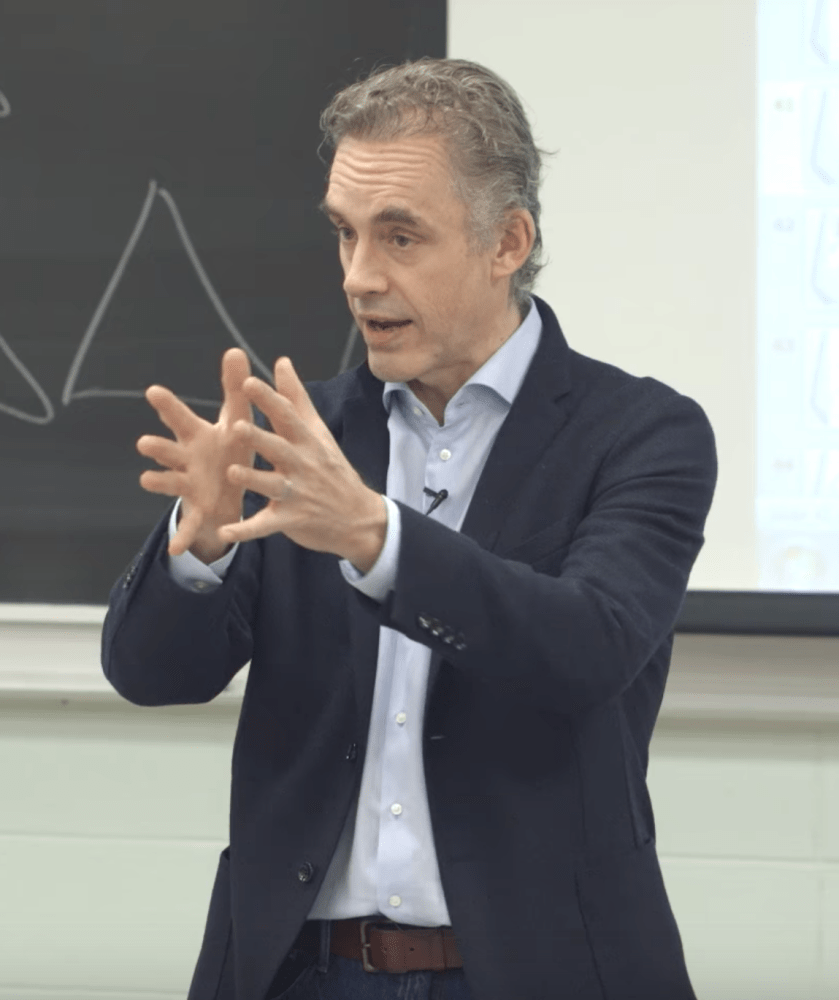
On Jordan Peterson

peterson_lecture_283352270114629

I recently started paying attention to Jordan Peterson.

This Canadian professor of psychology has built a huge international following, and his YouTube videos have millions of views.

Peterson is filling a hole in our culture about the importance of individuals taking personal responsibility for living an ethical life, and how this is the only path to a fulfilling life, and a healthy society, despite the reality that life is filled with malevolence and suffering.

Although Peterson is highly intelligent and well read, he appears unaware of overshoot and its many imminent threats.

Peterson also appears unaware of Varki’s MORT theory, which I suspect he would find interesting because Peterson is a dot connector and seeker of deep truth.

Nevertheless, Peterson offers fresh, inspiring, and wise advice useful for people, and especially young people, trying to navigate the coming storms.

I am reading Peterson’s new book, “12 Rules for Life: An Antidote to Chaos“, and may have more to say when done.

I so wish wise intellectual leaders like Jordan Peterson, Sam Harris, Lawrence Krauss, Steven Pinker, Richard Dawkins, Nick Lane, and Noam Chomsky were overshoot aware. Their intellect and influence could then be applied to the issues that matter.

The fact that most of the smartest people in the world are not overshoot aware, despite obvious elephants in the room, provides strong support in favor of Varki’s MORT theory.

This recent interview with Peterson is an excellent introduction to his work.


By Nate Hagens: Energy, Money and Technology: From the Lens of the Superorganism

Nate Hagens gives the best big picture talks, hands down.

What differentiates Nate is his wide and deep understanding of the economy, energy, ecology, and human behavior that he weaves into a coherent realty based description of our predicament.

Nate also does an admirable job of illuminating positive aspects of, and constructive personal responses to, the coming much smaller and less complex world we will all experience in the not too distant future.

Here is his latest talk, a keynote give January 23, 2018, at the King Abdullah University of Science and Technology in Saudi Arabia.

This talk is a refinement of similar talks by Nate I have previously posted. In addition to being more succinct and polished, this version benefits from high quality professional recording.

I’m looking forward to reading Nate’s new book which he said here will be published and made available for free in the next month or two.

Here are some comments Nate posted on his Facebook page.

Back from Saudi Arabia -was a short and great trip – the new King Abdullah University for Science and Technology is one of the richest schools in the world (something approaching $40 billion in endowment and as of yet only 1,000 students). My first trip to Middle East reasserted my belief that people the world over are pretty much the same (duh – we come from same place) – there are crazies and assholes in every country but most people are kind, warm, and pro-social. I had great conversations with taxi drivers, students, janitors, store clerks etc. I met a guy from Tunisia at airport and we laughed about all the world problems and what a time it was to be alive. Most humans just want to spend quality time w family and friends, tell stories and listen to music, play with their dog, do meaningful interesting work, and be free. It gives me hope that despite being African, Asian, European or American, despite being Christian, Buddhist, Muslim or Atheist, there is a growing group that transcends these tribal boundaries towards thinking about and working on the future transition. (another of a handful of silver linings facing some serious global storm clouds)

Below is the video of the keynote I gave – I finally condensed the relevant aspects of what we face into less than an hour, but had to speak pretty fast to do it. If you haven’t watched one of my talks for a while this would be the best one to watch (plus their technology was amazing, 5 cameras, etc.) (the 2nd talk The 40 Flawed Assumptions Underpinning Modern Civilization, was in a different venue and not filmed)


An interview with Nate was also recorded at the conference. I really like the thoughtful questions and responses, as well as it’s unhurried pace.

By Raúl Ilargi Meijer: 10 Years Automatic Earth

central-bank-balance-sheet
Chart by Charles Hugh Smith @ https://www.oftwominds.com/blogjan18/CB-conflict1-18.html

Here is a nice 10 year recap on the work of Nicole Foss and Raúl Ilargi Meijer, with a refresher on where we are today, and why almost everything you read in the popular media today is pure fantasy.

Note that belief in fantasy is yet another way to describe denial of reality.

The 20 trillion (that’s 20 thousand billion) dollars Meijer refers to is the amount of new debt (aka. printed money) that central banks worldwide have created since we “recovered” from the 2008 financial crisis. That’s a really really big number that should worry anyone with a functioning brain.  And it’s also a pretty good proxy for how much we’ve increased human overshoot since 2008.

https://www.theautomaticearth.com/2018/01/10-years-automatic-earth/

What has changed, and increased, a lot over the past decade is the media. They have moved, more than before, into a kind of la la land where narratives are invented and presented with the express intention of keeping people feeling good about themselves in the face of all the distortion and disasters they face.

The big move in energy is not so much peak oil, but a meme of moving away from oil. ‘Renewable energy’ is all the fad, and it works, because it holds the promise that we can maintain our levels of energy consumption, and our lifestyles in general, pretty much up to some undefined moment in the future. For all you know, a seamless transition.

It’s a nonsense narrative, which originates not just in wishful thinking, but much more than that in widespread ignorance about what energy actually is and does, and what qualities oil and gas bring to the table that no other energy source can.

We must have written a hundred articles about such themes as energy return on energy invested (EROEI), and that the EROEI on renewables doesn’t allow for our present complex societies to continue as they are. Renewables are not useless by any means, but switching to them from oil will mean a huge simplification from our present lives. More than anything, probably, we have to ask if that would be such a bad thing.

But that is a question we avoid at all costs, because it is a threatening one. It implies we may have to do with less, and that’s not what we’re hardwired to do. Like any other species, we always want more. This is so ingrained in our world that our economies depend squarely on a perpetual need to strive for more tomorrow than we have today. Not as individuals, perhaps, but certainly as a group.

More trinkets, more gadgets, more energy. And for a -relatively- long time, more people. Relatively, because population growth is a recent phenomenon. It started at the very moment we began to have sources of ‘free’ or ‘surplus’ energy. Give any species a source of ‘surplus’ energy, and it will use it up as fast as it can, and proliferate to achieve that, until the surplus is gone. We are no different.

Of course, as the 2nd Law of Thermodynamics holds, the use of energy produces waste. More energy use produces more waste. One source may be slightly less polluting than another, but it’s thermodynamics that dictates the limits here. No energy source is fully renewable, and clean energy is just an advertizing term. And with an energy return too low to run complex societies on, those are hard limits. The only way out is to use less energy, but our economic models are geared towards the opposite, as are our brains.

Meanwhile, we’re saddling our children with the consequences of our prolific use of energy. Species extinction runs a hundred or a thousand times faster than is ‘natural’, ever more of our arable land is too polluted or wasted to produce food, and the grand mass of plastics in our oceans exceeds that of the living creatures that fed us for a very long time, taking the numbers of these creatures down so fast our grandchildren will have to eat jellyfish.

Ironically (and there’s lots of irony in the story of our tragic species), we produce more food per capita today than ever before, but its distribution is so warped that one group of us throw away more than we consume, while another goes hungry. And to top it off, much of what we eat lacks nutrition, and is often even downright toxic for us; it makes us fat and it makes us sick.

Then again, our entire environment is also fast becoming toxic. We’re a bloated, obese, asthmatic, allergic and cancer-riddled species, and yet we call ourselves a success. It’s all about the narrative.

But as Nicole and I said 10 years ago, and still do, it’s finance that will be the first crisis to hit. It will hit so hard it’ll make any other crises, environment and energy, feel like an afterthought. Pension plans across the board will prove to be a Ponzi, housing will collapse, shares will crumble, scores of people will lose all their savings and their jobs, their homes.

This is because, in an ostensible effort to ‘save’ our societies and economies, our -central- bankers and politicians decided to put everything on red, and loaded another $20 trillion into the upper shelf of the financial world, the very shelf that was most rotten to begin with in more than one sense of the word. And they’re not the ones paying the heftiest price for this stupidest bet of all times, you are.

All in all, the only possible conclusion we can draw is that in the past 10 years, things have indeed changed. Thing is, they have changed for the worse. Much worse. And the recovery narrative can’t and won’t hold. Question is who realizes this, and what they are planning to do with the knowledge.