Un-denial regulars Charles & Chris (aka paqnation) collaborated on this essay exploring the psyche of doomers.
They discuss in detail characteristics common to the doomers they know. I have not observed the same common characteristics in the overshoot aware people I follow, and I elaborate a bit on this at the end of the essay.
It will be interesting to hear from others in the comments what they observe about doomers.
Introduction
Today, we are exploring a topic, which is rarely addressed in the doomosphere. We are not going to describe material limits and extraction trends, evaluate which DEFCON level is currently on, uncover the early and now increasingly advanced signs of collapse, speculate on the origin, mechanism or inevitability of our collective demise, attempt to predict the exact date of societal breakdown, lament over denial, wonder if Good(TM) and nature will prevail, or debate in which exquisite torments the human species will go extinct. But rather, for once, we focus on the personal: we observe the observer.
This is a topic Charles had wanted to explore for quite a long time but didn’t know how to. Following recent comments at un-Denial, Chris privately inquired if he was detecting some bargaining or desperation. This led to an interesting observation: we both recognize how precarious this fleeting moment is in human experience. However, we arrived at different accepting states: Charles tenaciously follows his heart, at his small scale, with faith, whatever the outcome, whereas Chris lives with kindness, relieved to witness the demise of this destructive species. So what would be the common characteristics of doomers? How does this impact their personal life, in particular in their social interactions? And what are some of the strategies that they can deploy to balance their nature?
Disclaimer: we are not trained psychologists. So, although we drew from our personal experiences and observations, there is no claim of any general validity. We still hope this may be of some use, especially, for those, increasingly numerous, who are just starting their journey down doomers’ lane: beware since this is a bumpy route. If not, then just read this piece lightly, on the beach as you would a summer article from Vogue magazine.
Birth and Discovery
Our study starts from the second best resource for any serious contemporary heavily funded research project: Wikipedia (the first one being some AI-powered scam-selling chatbot).
The page on doomers states that they “are people who are extremely pessimistic or fatalistic about global problems”. Well, that’s clearly the description of doomers from the external point of view of a normie. While it is true doomers think most exclusively at the global scale, they would disagree about having a pessimistic perspective. For them, the rest of society suffers from optimism bias, even denial. They would readily argue, some even ferociously, their outlook is realistic, if not the only possible outcome. There is a story behind this stance.
Nobody is born a doomer. Even if there may be some psychological predisposition, anyone can become a doomer. The typical doomer didn’t even willingly decide to become one, in the same way he would start tennis. This is a condition one develops when bitten by a radioactive spider: maybe he read some piece in a newspaper about the end of oil, or was shaken by some internet news about deforestation trends. With the impacts of climate change starting to be tangible, these animals can be encountered in the wild a lot more easily than they used to be. Most of, if not all of, these articles end on a positive note: how some substitutes are being worked on, or some politicians are about to regulate, or how anybody can participate in harm reduction by behaving as a responsible consumer. The soon to become doomer finds himself unknowingly at a turning point, he stands just before the gate which will eventually shake his world upside-down: he can accept the convenient conclusions at face value and forget, or start asking questions.
If he takes the red pill, a series of discoveries and shocks about the “true” nature of his world awaits him. This is the start of a long learning phase, a period of gradual uncovering and revelations. Unrolling the wool ball, teaches him rudiments in fields as diverse as mathematics, history, ecology, system dynamic, physics, evolutionary biology, geology, political science, sociology (and maybe even linguistics), psychology… Every day, he spends multiple hours reading books, listening to experts, skimming the internet in search for obscure blogs, hidden gems of knowledge. And gradually, piece by piece, he patiently assembles a small holistic inner “model of everything”, a mini-world comparable to a computer simulation. With this model, he hopes to understand the world, in its entirety, not only in its current state, but also its origins and future dynamic. He constantly refines the model, incorporates new findings. And he always comes up with the same, disappointing, but inescapable answer: 42. Scratch… Rewind… Sorry, wrong story… The Soon to Be All Ending Catastrophe.
Growth and Action
Once he is completely convinced of the folly of conventional wisdom, the doomer starts to act. In doing so, note that he is still following a very conventional cultural pattern: identify a problem then act in order to reach a solution.
His motivations vary according to his nature: inflect the global dynamic, avert the crash, if only for his group, lessen the blow, or deal with personal guilt or anger. He acts differently according to who he is and what he values: he may become an activist, teach other, learn to live thriftily, disconnect from the machine, travel, even follow a spiritual path. He tries to spread the word, finds his tribe. He may be learning new skills: growing food, doing preserves, managing a stock of perishable goods, metal-work, carpentry, communication, horticulture, bushcraft, homesteading, cooking, knitting, hunting… In some cases, this may go as far as to change him into an accomplished survivalist, a hermit, or even a pagan druid. He is forward-looking, cautious. He likes to stay on the safe side, keep margins of errors. Simultaneously, he is innovating, willing to take risks to explore non-conventional paths. He perceives the unexpected and plans for it. The doomer walks the talk, he is ready to step out of his comfort zone, experiment with activities he doesn’t necessarily (initially) enjoy. This all proves his tenacity, and that he is willing to make genuine sacrifices for the greater good. He is resilient, independent, autonomous. He does not need to rely and may even be defiant towards authority, central power.
This is a time of radical changes: the slow intellectual maturation process of the preceding phase is brought to fruition. This is also a constructive phase in the trajectory of the doomer. He has impacts, some he is unaware of. He can shock other people who may initially reject his perspective, but won’t forget. He rings the alarm bell, plays the societal role of the canary, shows alternative ways of living, out of the norm. Overall, he is able to nudge the collective perception of reality, instill doubt in the official narrative. But until it is the right time, this will not, this cannot scale up.
He thinks global, he expects to see global changes. So he eventually takes notice of the great gap between his efforts and expectations.
Stagnation and Isolation
At this point, he can feel pretty down. The beverage from the doomer’s chalice is about to turn sour. He may have paid, a sometimes pretty heavy, price for following this trail: maybe he lost all interest in his work and was fired, or he was abandoned by friends after repetitive bouts of anger, divorced his wife who couldn’t bear his constant mulling. Seeing the normies still going on with it, his life may not feel as enjoyable: the tasteless military canned food, the cold showers, the lack of finance, the crazy entourage, the aging and aching body, the absence of children’ laughter. Sometimes it feels all he achieved was only to travel down the social ladder and preemptively self-destruct. He may regret his sacrifices. All for nothing.
It seems the doomer is particularly vulnerable and obnoxious in his social interactions. Traveling for so long outside of the societal norm, having to constantly battle one’s beliefs in opposition to the group, is corrosive. It has forged his identity in a way that few can appreciate his company. The doomer is eternally focused on future and grandiose issues, to the point he may disregard immediate concerns or current concrete people’s suffering. This can easily and rightfully be felt as selfishness. It seems he eternally postpones the time he will allow himself to live, to be happy, to be. Instead, it is constant high alert: prepare, anticipate, protect, hide…
More importantly even, he feels he is not being listened to. If only they would follow his plan. If only they would all behave reasonably like himself. However, he never really acknowledges the other party either. He has only one channel of communication: verbal mental logic, within his own little “model of everything” at that. Maybe, he doesn’t understand the other modes of communication, doesn’t know they exist. He will invariably steer discussions towards collapse, like a reliable magnet. He feels it is his duty of explaining the world to other. So he often ends up sounding like a patronizing self-righteous bastard preaching from his ivory tower, a clear know-it-all. He stubbornly offers depressing tales of defeats without any room for breathing. He will not tolerate any difference of opinion or alternative views, about something which is, after all, to a large degree unknown and unknowable. It is never enough, no “solution” can work. No amount of preparation will do, no effort matters, it is never enough. Doesn’t it seem like the opposite, and very similar, side of the growth mentality? And then he rambles about his preferred course of action: the ultimate solution in a long list of solutions which all try to solve problems brought about previous solutions. Some kind of “final solution” of a new kind. Sounds totally reasonable to him. He has lost touch with society. He is now entirely engulfed in a handmade world of his own making, his precious.
If he can control it, a doomer with children can certainly not allow himself to dive, in their presence, that far within the depths of his dark psyche. This would be a sure way to crush them and repeat the curse down the next generation (in the small probability, there is a next generation ;). Are we seeing here a hint of what lies behind many doomer’s mask of cold-hearted objective thinking?
So he avoids social interactions, hides far away to protect oneself and others. His experience of the now, forever tainted by the future imagined catastrophe. A continuous mourning over that which has not yet happened.
Hitting diminishing returns, the doomer’s dynamic has gradually entirely morphed into a nihilistic descent, a downward spiral. The tryptic of fear, anger and sadness overwhelms him. Depression can hit. His activity, fueled by a now sterile obsession, turns compulsive. He keeps on beating the dead horse, eventually becoming a lone addict, fulfilling the prophecy before its time, a potent curse.
Elements of Doomer’s Psychology
Let us pause here for a moment. Being a doomer implies the bondage to a process of both light and darkness: it arises, grows inward, expresses outwards and decays. Why are some people more prone to become doomers than others? Is there some root cause, or is just fluke? And, more importantly maybe, is there life after death (of the arc of doom ;)? Before we attempt to answer these questions, let us recapitulate the psychological traits that seem common to most doomers.
Doomers have an unusual relation with spatial and temporal scales. They see far ahead. This makes them very patient when they need to reach any far-fetched objective. But they need some effort to be present to integrate what’s in their vicinity. They will easily switch off and ruin their immediate experience whenever they are enthralled in thoughts: they can miss many bright aspects of life, the multiple hints of love around them. Especially, since they tend to automatically filter everything which does not interest them. That which does not constitute a threat. They rarely stand still but always run “one step ahead”, thinking about the next move, making predictions. Paradoxically, they can be extremely sensitive to early warning signals, which for them, stand out amidst flows of data. At times, they experience information overload and that may be the real reason they need to isolate themselves. They will integrate in their mental models small details which may have large implications and be able to draw surprisingly accurate conclusions or sometimes turn out radically wrong.
Doomers are very cerebral: they think incessantly. Their inner monologue slithers unabated like a powerful tireless snake. They easily end up caught in obsessive mental loops. This grants them an exceptionally strong will, on the fringe of stubbornness. Otherwise, they wouldn’t be able to live in constant antagonism with most of society. Otherwise, they wouldn’t persevere in things they do not particularly enjoy just to prepare for a potential negative outcome sometimes in the far future (less far now).
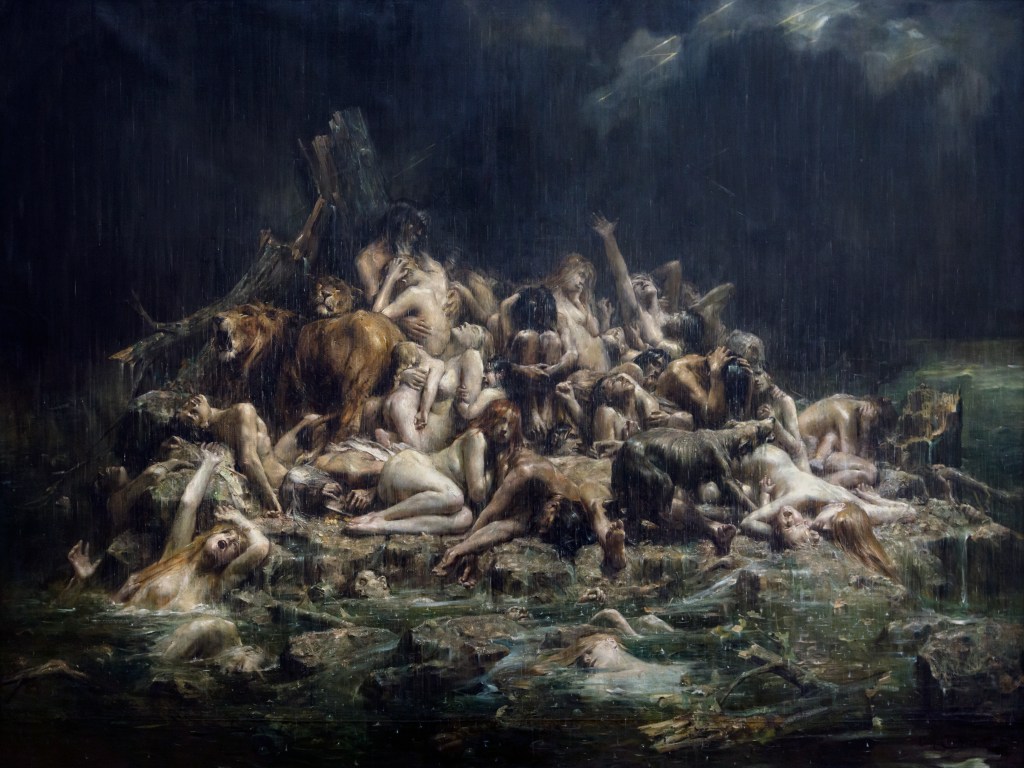
Here the figure of Noah, building the gigantic ark on its own, with the help of God only instead of fossil fuels, may come to mind.
And they often excel at thinking: they are rational, logical, uncompromising, independent intellects, who do not trust nor rely blindly on figures of authority. Naturally, they respect people of high integrity, and are particularly skilled at detecting scammers, which they despise with a passion. Even if, sometimes, only the Trickster can allow irreconcilable demands of society to unfold, for better or worse. They work ceaselessly on an impossible project: their intellect wants to encompass even that which cannot, cage absolutely everything in the box of the mind. This is the ultimate quest for total knowledge, the final conquest of light over darkness. Their perfectionist control freak inner voice shouts: “Let them all be statistics, cells in excel sheets! I will make their life perfect. I have a plan.” In combination with their obsessive nature, this makes them inflexible figures easily drawn to dogmatism. Never face a doomer in a confrontational argument on his preferred topic.
Unfortunately for them, this rigidity affects them equally (You shall love your neighbor as yourself): they won’t easily allow themselves to live spontaneously, free from any clear pre-set goal. In that, they ironically have totally internalized the very core of industrial productivism. They have difficulties dealing with their emotions, sometimes even completely severed from them. This may be the key of one of their contradiction: the desire to protect an abstract entity, the whole species, while not noticing the immediate needs of the actual person just in front of them.
The next item on the list may be a consequence of their mental fixation, or just a characteristic prevailing in most dwellers of the modern world. Most doomers seem to have issues with their image of self. It might be incorrectly calibrated: either under or over-valued. Since they believe living conditions are about to become dramatically harsher than they already are, they feel natural to deploy more efforts and expect less rewards than the rest of the pack. Ironically this makes them an ideal target for ruthless practitioners of growth. You may hear them profess implacable credos of flamboyant macho bravado. Are these genuine expressions of their resilience or hints of a lack of confidence, of an underlying fear? “Hard times don’t last, hard people do” can be read in the doomer’s entry of Wikipedia. How much of a doomer’s rational rhetoric hides a self aggrandizing fantasy?
At the opposite end of the spectrum, some doomers display the arrogance of humanism dialed up to the end of the gauge. Isn’t the idea that the collective behavior ought to be controlled, the trajectory of the species planned in order to maximize survivability or minimize suffering, a delusion completely devoid of any humility?
Many doomers identify with a collective: the group of all humans or the whole living planet as a unique organism, Gaïa. Otherwise, how could the consequences of the activities of the whole species be a reason for personal shame? It can be suspected that some doomers have an even more unconventional notion of self: either setting only fuzzy boundaries, or simply considering it as an arbitrary construct of the mind. Who can say what’s what? Holobionts come to mind.
This is all surprising, isn’t it? We would have expected meeting a Cassandra-like creature instead, it’s the Carl Jung archetype of Apollo which seems to be emerging. According to Wikipedia the Apollo archetype:
“personifies the aspect of the personality that wants clear definitions, is drawn to master a skill, values order and harmony. The Apollo archetype favors thinking over feeling, distance over closeness, objective assessment over subjective intuition.”
Apollo, the bearer of light. The enlightenment. The statue of liberty. The Apollo space program. The template of a now bygone era. All his creations turned into a gigantic farce: advanced mathematics powered AI to generate pornographic images of lascivious beings endowed with cat or androgynous attributes (no, this sentence was not generated by a chatbot); extravagant expenditure of engineering, fuel and other resources only to send a few tons of metal into space at 0.00015% the distance to Mars; feats of programming, automation, slavery, life stripping exploitation to publish these words into the great silicon web of matter-less opinions, to reach you…
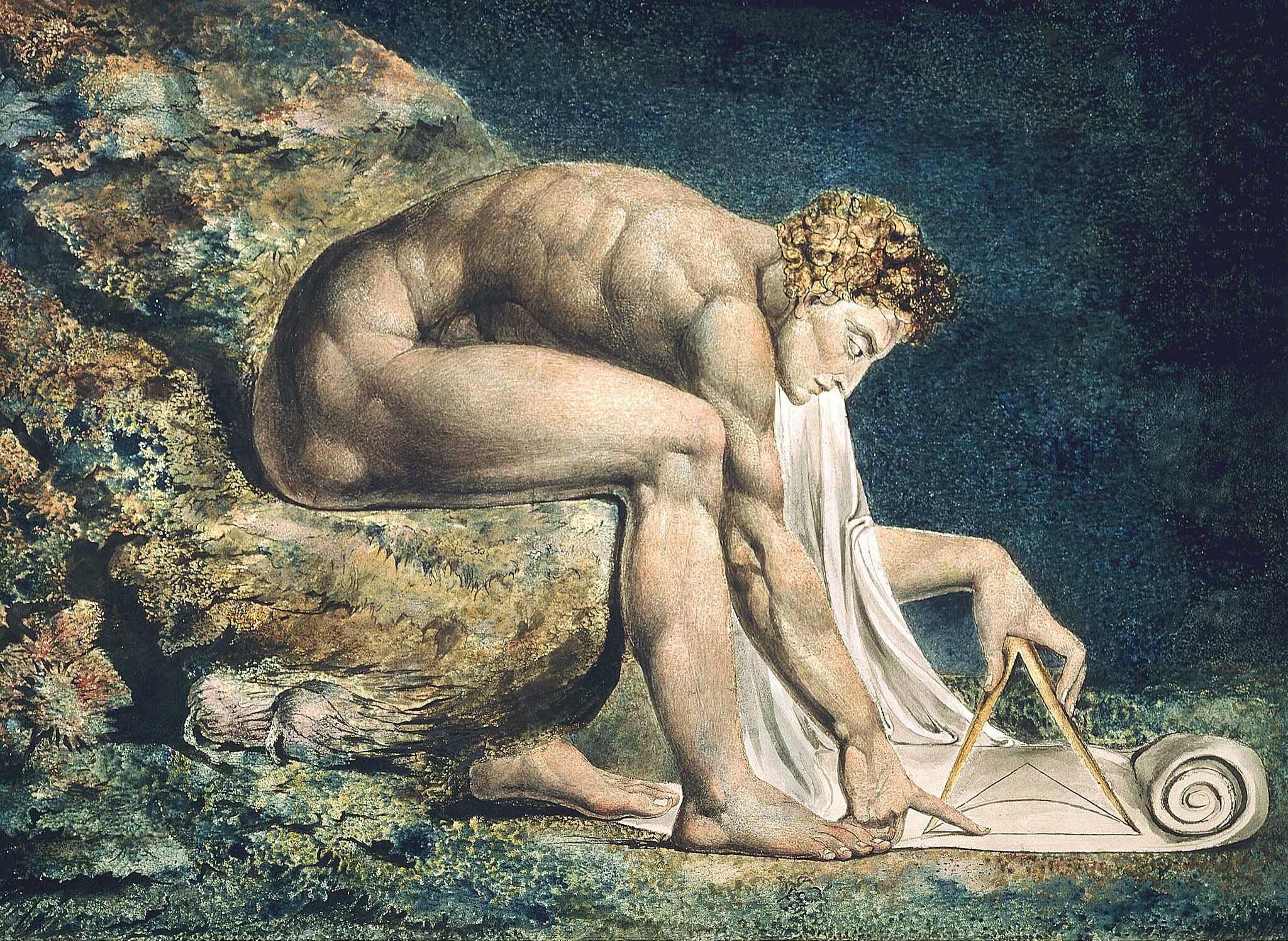
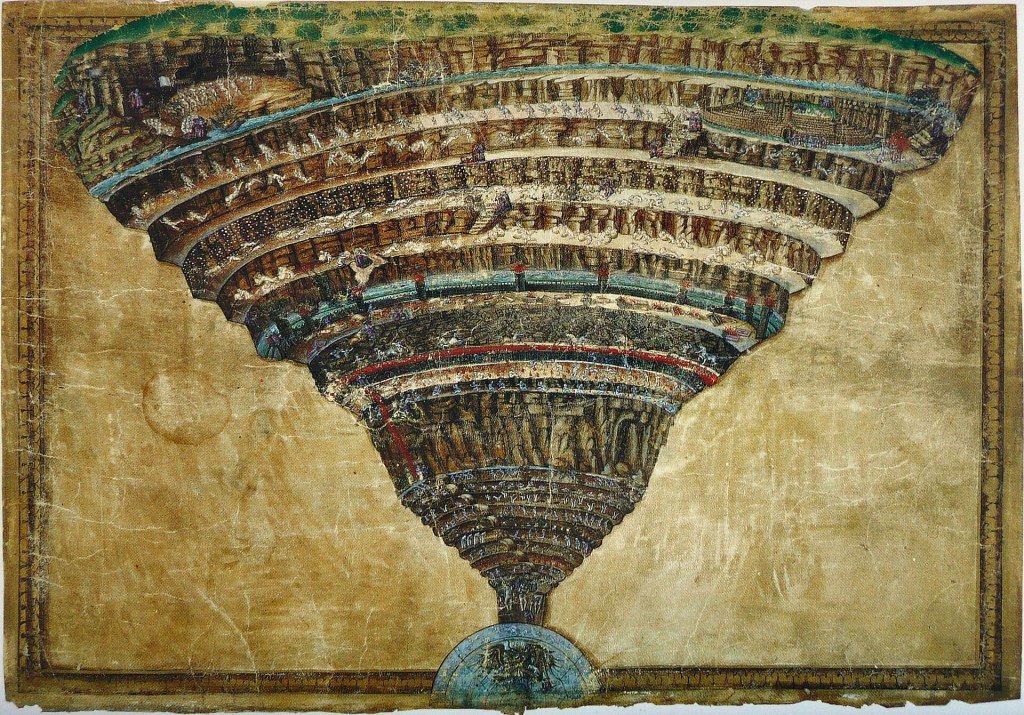
We can now better understand the doomers’ fascination with derelict places, decay, the morbid. His thoughts are crystallized on the edge of the observable, the end of his light. The fixation aimed at some imagined brief moment in the future: a turning point, a tipping point, the end times, the apocalypse, total annihilation, extinction. Before this point, the dumb masses rule. After, it the doomer won’t need to struggle anymore because all will be over. He is proven right, it’s a victory, a Pyrrhic victory, at last, just before the closing curtain. More importantly maybe, everybody will then experience the same discomfort he finds himself in right now.
Tentative Explanation: Unconscious Root Motivation
This section will be more hypothetical: it’s an attempt at finding some plausible root causes of the doomer’s dynamic.
On the surface, doomers seem to be disappointed idealists. Humanists who are not accepting the failed (in comparison to their own standard) experiment that either the species or this specific culture proves daily to be. They long for a world of reason, beauty or harmony. They simply can’t really get over the large gap between their expectations and reality.
But, really, maybe, idealism was born out of the necessity to compensate an even deeper issue, a trauma, in some form or another. Doomers are in a state of shock. It would explain the fear. It would explain the challenges with the self.
It would explain the addictive behavior. It would explain the propensity for seclusion. It would explain the dissociation from emotions. It would explain the tendency to preemptively put oneself in conditions harsher than needs to be. It would explain the elitism of placing oneself above and untouched, as a neutral observer. It would explain the constant assessment of danger. These are all habits and defense mechanisms adopted during past stressful circumstances. Doomers have been hard-wired, psychologically trained in tough times. What they imagine of the future, is a reflection of their past, now buried in the unconscious. In a way, they are optimized for survival in extreme situations and wither during lax times.
Let us not dwell too long on that, as this is highly circumstantial. Everyone will judge for himself the validity of this hypothesis. Let us just stress the fact that trauma comes in various degrees and does not correspond only to a one-time brutal event but may also be activated by a continuous feeling of danger during childhood.
Family history could play an important role here. We are almost all offsprings of horrors: genocides (Native American, holocausts), slavery, wars; killers, rapists, survivors. There have been so many tragedies in relatively recent human history, that almost no-one is psychologically untouched. So maybe it’s just the normality of life.
In contrast, the western middle class is materially extravagantly sheltered, while totally dependent on an overarching, psychologically oppressive system: replete with propaganda, disheveled morality, betrayals, tricks and manipulations of the mind. This fosters wild imaginations, delusions, various degrees of psychosis. A bit like industrial farm chickens on steroids (which they are not), many haven’t had the opportunity to grow up fully in balance. Diminished humans. Living in this unnatural, bullying society, considering the prospect of shortages, observing from afar, through the distorting lens of the media, the implacable destruction of multiple life forms on the planet is, in itself, enough for trauma. And we are back to a circular argument.
Maturation Out of the Loop of Doom
Are there happy doomers, content with their mental state? Probably.
But doomerism is usually a heavy load to carry. So one might reasonably want to mature past this state, grow out of the addiction and self-destruction. If doomerism is really a consequence of a form of trauma, then it is only natural, this will take some time to resolve. Hopefully, there are many strategies, which, in time, can bear their fruits. These strategies are not a rejection of the rational conclusion of the doomer about the state of the world. That’s one thing. It’s rather a movement of further expansion. It is about the recognition of other aspects, which can coexist with the certainty of collapse:
- recognition of the destructive effect of doomerism on oneself,
- recognition of the limits of individual power, to understand and control,
- recognition of the bounded responsibility of oneself in global issues,
- recognition of the load that one carries,
- recognition of the diversity: of forms and beings, down to the way of seeing the world,
- recognition of the emotions, past and current: anxiety, pessimism, shame, despair, fear, anger, sadness,
- recognition of that which lies in one’s shadow,
- recognition of all the things that are going fine, right now, the love around.
Habits and multiple rationalizations of the mind will naturally present themselves and prevent change. They protect the stability of the psychic equilibrium achieved in reaction to past circumstances. This equilibrium has served its purpose and has now become counterproductive. To break the deadlock, there are multiple small practices, which progressively, gently rectify our stance. There is a lot of activities we may choose from, here are a few non-exhaustive examples:
- breathe, relax, meditate,
- practice compassion, to others, to yourself,
- treat yourself, care for yourself, listen to your needs,
- focus on the small things you have control over, you can handle,
- congratulate yourself, smile to yourself, pat yourself on the back,
- cultivate gratefulness: note the things that go well,
- appreciate the word “enough”,
- find a safe zone, find your tribe,
- express yourself,
- perform service to others,
- confront your fears by overcoming real world hardships, travel the world, gain confidence,
- observe events, without tainting, without trying to anticipate,
- study your thoughts: see their origins, differentiate between the group’s and yours, observe the repetitions, the patterns, the tricks of the mind,
- keep a log of your predictions: write them down as precisely as possible and then compare with actual events,
- study your emotions, dive in the darkness of the forbidden ones, do not block them, let them unfold, run their full course,
- listen to other people’s viewpoints without jumping to conclusion, pause whenever you feel the urge to react automatically, compare with your viewpoint,
- study family history,
- bring things back to the concrete, root yourself, limit the habit of thinking in generalities,
- consider therapy, follow some form of spiritual practice,
- take the leap of faith, rely on higher intervention, a higher force, abandon control, let life be.
In a way, this is nothing new, already in 2012, Paul Chefurka talked about the inner path and the outer path. This all boils down to experimenting the “outside” while listening to the “inside” until there is no more friction.
Conclusion
Being a doomer is a bit like being an alcoholic. Some are able to drink a few drinks and stop. Other will start with only half a drink and find 13 years of their life has passed by without notice. Although, it is most probably some form of escapism, like Bovarysme, doomerism is grounded in legitimate concerns.
Now, these concerns are reaching gigantic proportion. Everybody can see collapse at their doorstep. Everybody will soon have to deal with the consequences, envisioned by doomers. There are no easy answers, doomers can simply share their journey.
Chris
I was hesitant to team up with Charles for this experiment. I joke about him being my spiritual advisor, but him and I have been going in opposite directions for a while now. I guess my hesitancy was in thinking that this would be too pro human or too spiritual for my taste. I was relieved when he sent me his first draft. I was on board with everything he was saying. IMHO, his analysis about the typical doomer is spot on.
Now I also think we could flip the script and make this piece about the overshoot aware Spiritual person instead. Dive in to see what makes him/her tick. Try to see how they believe what they believe in the face of no evidence whatsoever. And yet they are very well versed to reality and our predicament. Have a feeling that story would sound very similar to the doomer. But that’s a different essay for someone else to tackle.
During this process of back-and-forth notes with Charles, a pattern was emerging. It was clear to me that he was worried about offending the doomer crowd. It was also clear to me that because of his experience of being one himself, he would be able to draw heavily on that, and rather than being offensive, it would be respectful.
On occasion I try to rattle Charles by sending him a shock jock belief of mine or a quote like this one from James at Megacancer. “The story of life: The quest for profit and growth will continue as it has since the first organic cell fissioned. The End.”
Nothing fazes him. In fact, most of the time he ends up liking what I said, or it gives him ideas to come back at me with something better. I guess what I’m trying to say is that Charles is tolerant to pretty much anything. And if you ever have a chance to interact with him outside of un-Denial, do it! He’s much more comfortable with one on one email.
Charles
Writing this piece, I didn’t want to gaslight the doomer: overshoot and collapse are real. Still, I also think, there is a psychological basis, an interplay between the macro and the micro, a link between individual psyches and collective dynamic. I believe material collapse will happen in synchronicity of a mass regulatory psychological event. I hope so: although extremely alluring, this culture is insane. It’s been hard to maintain integrity.
I have been a doomer, a part of me will always remain one. I slowly am retiring. Contemplating, as much as it is granted to me, life peacefully, joyfully, in awe.
I enjoyed very much working with Chris on this piece. More than anything else, I especially appreciate his accepting, encouraging presence, true to his first name as the carrier of Christ.
Rob here with a few thoughts.
I have followed quite a few overshoot aware people over the last 15 years including Gail Zawacki, Nicole Foss, Gail Tverberg, Alice Friedemann, Jay Hanson, Nate Hagens, Dennis Meadows, William Rees, David Korowicz, Jean-Marc Jancovici, Tim Watkins, Jack Alpert, Michael Dowd, Tim Morgan, David J.C. McKay, Tom Murphy, Tim Garrett, William Rees, Charles Hall, Paul Chefurka, Sam Mitchell, Jason Bradford, Andril Zvorygin, Steve St. Angelo, Simon Michaux, Hideaway, xraymike79, James, B, Mike Stasse, Irv Mills, and a few others.
I have not observed in these people many of the characteristics that Charles & Chris think are universal. I do lack visibility into the personal lives of most of these people so perhaps Charles & Chris have access to insights I do not have, or perhaps they follow different people. Hopefully examples of people with the common characteristics that Charles & Chris observe will be provided in the follow-up comments.
What I observe is that the majority (say 80%) of the tiny minority (say 1000 out of 8,000,000,000) people who have become deeply aware of our overshoot predicament tend to become obsessed with the topic and spend a lot of time discussing it. Very rarely an individual, like Paul Chefurka or Nicole Foss, breaks free of the obsession and retreats to live the balance of their life thinking about other things, but this is the exception rather than the norm.
Speaking for myself, I am unable to unsee a cliff we are accelerating towards, and I am fascinated why 8 billion minus maybe 1000 brains of an otherwise extraordinarily intelligent species are unable to understand the obvious, nor to take any actions to minimize the coming suffering of their beloved children and grandchildren.
I also do not think any normal person can easily become a doomer as claimed in the essay above. My personal experience has been that the majority of people are unable to understand the information necessary to become a doomer, regardless of their intelligence or education, or how simply and thoroughly the information is fed to them. In other words, no amount of data or logic is sufficient to explain the reality of overshoot to most people.
I think Dr. Ajit Varki discovered the answer to this mystery with his MORT theory, which also explains why only one super-intelligent species evolved on this planet despite the obvious fitness advantages of high intelligence, and why that species is also the only species that believes in gods.
Perhaps there is a better explanation than MORT for what we observe, but I have not yet found it.
 un-Denial
James today with a new spin on his civilization is like RNA model.
Not discussed is why is there only one species out of millions with brains that believes in gods?
LikeLiked by 2 people
An important interview. Have not finished it yet.
Lex Fridman is apparently going to interview Putin soon.
Death cannot come soon enough to mainstream news.
LikeLike
So far I’m disappointed. There is only one issue worth discussing. I’ve been skipping around trying to find it without success.
NATO may not place weapons in Ukraine, just as Russia may not place weapons in Canada, even if Ukraine and Canada want them.
All of the bloodshed could have been avoided had NATO respected this common sense rule.
LikeLike
Sabine Hossenfelder says green hydrogen energy initiatives are rapidly dying and explains the technical reasons this was inevitable.
LikeLike
Good takedown. I vote for lobbyists bankrolled by the petrochemical industry as behind the push for hydrogen.
The whole hydrogen concept is right in their technical wheelhouse, and they tap into the societal hopium addiction, and get to play with things they are familiar with on investor’s dime.
I’ve watched the change in the Oil and Gas Journal over the years, and they now have a section called energy transition, but it takes on a very niche meaning there, simple desperate hanging on to a business model with a short future. You’ll see hydrogen, CCS, CTL, biodiesel, all manner of half hearted smoke screens for maintaining BAU.
Back in the late seventies, early eighties, oil shale was a thing (NOT shale oil- that’s different, despite the confusing names) The U.S. has lots of theoretical reserves. Millions were spent, but in the end, all the projects were mothballed. Bad EROEI. I was actually on one of the projects in western Colorado when “Black Sunday” happened.
If the U.S. renews the oil shale effort, you’ll know we’ve reached full desperation.
LikeLiked by 1 person
Thanks, I learned something new.
LikeLiked by 1 person
Hi Chris and Charles. Great work on the essay. It is so interesting trying to figure out what enables doomers to “get it”. Maybe if we understood that we could help expand knowledge to the non-doomers?
Anyway, did either of you happen to read this by Tom Murphy? He surveyed his audience and found a signifcant skew to IN personality types in the Myers Briggs system.
https://dothemath.ucsd.edu/2015/04/programmed-to-ignore/
Introvert/Extravert
The first field is either an I or E depending on whether a person tends to feel depleted or energized by social interaction.
Sensing/iNtuiting
The second field is S or N. Does a person rely mostly on direct sensory input for their information, or does it come more from a synthesized, abstract, intuitive read of a larger set of inputs? Think of this one as concrete vs. abstract tendencies. Someone who holds a snowball in front of Congress to argue against climate change is a hard-over S-type. The S/N dichotomy is perhaps the most important attribute when it comes to whether an individual would entertain Do the Math views.
Intuitives pay attention to their intuition, instinct, and ability to draw meaning from seemingly disconnected facts. They are good at reading between the lines and recognizing connections between random groups of facts. People with this preference are abstract and theoretical. They worry about the future more than the present, and plan to change the world rather than simply live in it.
I would guess that Doomers are for the most part, introverted and intuitive. The most common types at Do the Math were INTJ, INTP and INFJ. These have the archetype names: Architect, Logician, Advocate respectively. https://www.16personalities.com/personality-types
As to why there may be more male doomers, I believe that INTJ and INTPs are much more likely to be males (2/3). And these are rare types to begin with.
LikeLiked by 1 person
Hi monk. Thanks for the links. I took the test. I’m an Architect INTJ-T (not sure what the T stands for).
And after reading Tom Murphys 10-year-old post, it sounds like half the audience at un-Denial will be INTJ. Of the 958 respondents from Tom’s survey, “INTJ represented 44% of the survey respondents, while only constituting 2–3% of the population.”
ps. Took less than 5 min for that test and you don’t have to give email or anything to see basic results.
LikeLiked by 1 person
I remember we discussed this in some detail at un-denial a while ago and lots of us were in the IN camp 🙂 I am INFJ
LikeLike
Hmm, don’t remember that. But that’s exactly why I like to look at old comments here… so much good, forgotten stuff buried away.
LikeLiked by 1 person
We discussed Myers Briggs in the comments of this post:
https://un-denial.com/2023/03/09/by-ajit-varki-why-men-are-destroying-the-planet-planet-critical-interview/comment-page-1/#comment-81295
LikeLike
Thanks. Good thread from almost two years ago. I had deja vu while reading so I must have seen it before. Rest of comments worth reading too.
Different time back then. LOL. The panic factor was almost nonexistent. I can’t wait to see how comfortable our comments in the present-day, seem two years from now.
Feels like ever since covid, the phrase “two years ago” universally translates to “the good old days”. That’s only gonna get exponentially crazier with each passing year.
LikeLiked by 2 people
INTJ over here!
LikeLiked by 1 person
Gail Tverberg’s predictions for 2025.
https://ourfiniteworld.com/2025/01/05/an-energy-and-the-economy-forecast-for-2025/
LikeLiked by 2 people
Charles, I wonder if Gail shares a similar vision to you on how things might play out?
LikeLike
Yes, maybe 🙂 Not enough information from this sentence for me to say.
Is your question an indirect way to invite me to describe more precisely what I intuitively foresee?
If I have one thing to say which feels important, it would be that the answers that matter to you are already in you. Only, the mental noise is hiding them from you.
LikeLiked by 1 person
I am not surprised by Gail, she has made vague references to religious belief for some time.
What really shocked me is I follow a blog by William Schryver (imetatronink.substack.com), who I think is one of the most insightful commentators on Russia/Ukraine. He published a very good analysis of where the conflict is going for 2025 . . . but he capped it off by saying that it would not go to nuclear war . . . because God is in charge and then he threw in all sorts of Revelations biblical quotes. Very disappointing except I knew he lived in southern Utah (gee Morman country;) ). But still a disappointment.
AJ
LikeLike
I’m not so disappointed anymore. I think I understand what’s going on. God is simply a synonym for life after death and hope. The majority of people need this hope to function normally. They were born that way. It’s no reason to think less of them.
LikeLiked by 1 person
That’s a good outlook to have. I’m very much expecting an explosion in the “resorting to religion” phenomenon.
Trying to prepare myself for when I see the real shockers like James@megacancer, Hideaway and Sam Mitchell types coming out of the closet with their religious beliefs. LOL
LikeLiked by 1 person
It’s ok. If religion provides some happiness to their lives, let them be. I hate seeing someone like Sam being so desperately unhappy.
LikeLiked by 1 person
https://wolfstreet.com/2025/01/05/status-of-us-dollar-as-global-reserve-currency-usd-share-drops-to-30-year-low-central-banks-pile-on-other-currencies-gold/
LikeLike
Looks like Trudeau might be gone tomorrow.
LikeLiked by 1 person
LikeLike
LikeLiked by 1 person
Yes!
LikeLike
Hello!
In a somewhat similar vein to Tom Murphy’s blog post about the types of personalities that engage with his content, https://dothemath.ucsd.edu/2015/04/programmed-to-ignore/ and the following discussions, I recently came across an intriguing concept called “monotropism.”
from my (admittedly brief) understanding is that Monotropism is a theory about how people allocate and manage their attention. It suggests that some individuals have a “monotropic” attentional style, meaning they focus deeply on one or a few interests or tasks at a time, rather than spreading their attention across multiple areas (a “polytropic” style).
Here’s a questionnaire https://dlcincluded.github.io/MQ/ that provides a score and a bell curve using data from an initial validation study. I scored just over 200, meaning I’m highly monotropic in how I think. It would be fascinating to see what others score!
As I completed the questionnaire, I realised how relevant monotropism might be to understanding why certain people get “hooked” on the overshoot topic (or any topic). While on the other hand many can understand the issue of overshoot and “get it” to some degree, but they often don’t seem as interested, affected, or engaged with it over time.
It’s also intriguing to think about how this ties into denial.
Cheers,
Ben
LikeLiked by 3 people
This reminds me of autistic people having their special interests, which I can definitely relate to. My score is 160 / 235
LikeLike
Monotropism Score: 157 / 235
Your Average: 3.34
This score suggests that you are more Monotropic than about 1% of autistic people and about 61% of allistic people based on data from the initial validation study.
LikeLiked by 1 person
Dr. Tim Morgan says there’s no need for 2025 predictions because the future is now certain.
A big economic crisis is imminent however his modeling says we can continue to provide the essentials for life until the 2040’s.
LikeLiked by 3 people
If they had not used QE, ZIRP and NIRP, the whole debt-based fractional-reserve Ponzi scheme may well have collapsed. Central banks are holding a wolf by the ear: We can’t safely remain in this situation, but we can’t safely exit either.
LikeLike
That may be true but when the base of the cliff your are climbing is crumbling it is safer to climb down (or even jump down) than it is to keep climbing higher.
LikeLiked by 1 person
Rob how are Canadians acting to the resignation of Justin Trudeau? He is so similar to Jacinda Ardern, resigning before he can be defeated. Feels like the ending of the covid era. I guess he will be knighted by the King soon enough
LikeLike
Oh I just checked, apparently Canadians don’t get knighthoods anymore
LikeLike
I don’t know. I’m a loner and not well plugged in. If I had to guess the left half of the country will be sad and the right half of the country will be happy. Neither will be focused on the core issue of coercing inherently dangerous mRNA transfections into children who are at zero risk from covid, and not prosecuting those responsible, regardless if it was faked or a lab leak, which makes Trudeau et al complicit in all 7+ million deaths, regardless of cause.
LikeLiked by 2 people
@Rob
Theoretically, do you think that William Rees would make a good prime minister?
LikeLiked by 1 person
Dr. Rees is a good and aware man. The problem is citizens are not ready to accept what must be done to minimize suffering and therefore he would not be supported.
LikeLike
I may have to take back what I said about Dr. Rees. I recall an interview with him in the early days of covid in which he derided anti-vaxxers and compared them to people who denied climate change.
Does anyone know if Dr. Rees has since publicly apologized for being bamboozled about the safety and effectiveness of mRNA transfections?
An adult is free to inject anything they want into themselves but is an evil unethical person if they support coercing dangerous injections into others.
LikeLike
LikeLiked by 2 people
If Canada and the U.S. merge, the combined entity should keep the Canadian healthcare system rather than the American system.
LikeLiked by 2 people
Nice thought but it won’t happen due to big money corruption of US system. I no longer care because unless I’m near death I will not use the Canadian healthcare system until they admit their covid sins and punish everyone that pushed mRNA transfections into children and blocked safe treatments.
LikeLike
Hideaway with some prepping advice.
I’d start with protein, fat, and energy. Then start thinking about spares for complex things you cannot or do not want to live without.
LikeLiked by 1 person
Bravo, bravo! Love that comment Hideaway.
It wasn’t there when I looked at that site earlier today. When I saw the OP’s (Bartlomiej) question, I got intrigued to see some prep tips. I immediately did a double take when I saw Tim & Tom’s reply. I then got annoyed and said something to myself like, “My god! These vile creatures can only see things one way. It’s all about the fucking money!”
Glad to see I was on the same page as you.
And Joe Clarkson’s comment has some good advice: Immiseration and death are coming. My “investment“ advice – get out of the city while you still can and learn to self-provision without using money.
LikeLiked by 1 person
Joe Clarkson is very much aware of our predicament. I’ve mentioned to him before about visiting this site where he’ll find like minded people, but unless he’s using a different ‘nic’, no show yet that I’ve seen.
LikeLiked by 1 person
Joe Clarkson was active here for one brief period commenting many times on this 2023 post:
LikeLike
Ya, Joe definitely knows his shit. My OCD for the old comments won’t let me stop till I get through every single one. And it ends up taking hours because of the random links. I was watching Mr Rodgers teaching me how to tie knots and it was excellent. And now I’m watching a great youtube presentation titled: Lierre Keith on Bright Green Lies
There’s a ton of gold buried away here. And ya sometimes you have to go panhandling for a while, but sometimes the entire thing (essay and most comments) are just perfect to my liking.
There’s gotta be a way to do something with this buried treasure. Books, presentations, audio readings, songs, a movie… Uh-oh I’m gettin money hungry now like those two whores Tim & Tom. I better chill out😊
LikeLiked by 2 people
Another good comment by Joe Clarkson on that thread:
LikeLiked by 1 person
Looks like unprosecuted gang rapes of young white girls by Pakistani immigrants is rapidly overtaking mRNA transfections coerced into children as the force powerful enough to take down the UK government.
Exposing unprosecuted rapes has the edge because it makes you a “far-right extremist” whereas opposing mRNA transfections only makes you an “anti-vaxxer”.
In case you’re not paying attention, Elon Musk is all in posting several tweets an hour intended to take down the UK government. It’s hilarious watching the lame responses from UK and European leaders.
LikeLiked by 1 person
https://en.wikipedia.org/wiki/Rotherham_child_sexual_exploitation_scandal
This is still going on?
LikeLike
But then again I don’t trust anything coming from Elon Musk’s mouth.
LikeLike
I saw a graph of rapes vs. year in the UK and they are still at a near all time high.
Without Musk we would have no free speech today, and he’s helping to take down governments that coerced mRNA transfections into children. He might be doing it for different reasons but I don’t care as long as they burn.
LikeLiked by 1 person
Despite all the joy that the deep state is now being targeted, I fear that Trump and Musk are controlled by the same “complex”.
LikeLike
Yes, quite possible, I have no idea if Trump will make any meaningful changes on war or health. I’m kind of assuming no change so that I’m not disappointed.
It’s back to the issue of whether anyone’s driving the bus. The MIC and Pharma are so big with so much momentum maybe they steer themselves.
Anyway we got rid of Biden last month, Trudeau today, and maybe Starmer, Macron, and Schultz soon. So there’s that.
LikeLiked by 1 person
Yes, and I believe this is orchestreated!
Saludos
el mar
LikeLiked by 1 person
About the cicles of power!
by “nereus”. https://www.dasgelbeforum.net/index.php?id=666194
“(The book) X! 1 , Freemasons demystifies the tendency of conspiracy literature and some contemporary media to exchange causes for effects, or perhaps to focus on secondary and subordinate causes, such as national-regional, continental or globalist para-Masonic associations (useful from a Masonic point of view, especially as a “screen of convenience”; apparently very reticent entities, but which in the end are often and willingly used as visible and precious “scarecrows” designed to cover and conceal less tangible and perceptible “meeting points” by non-experts), instead of penetrating behind the many veils and thus being able to see the unmistakable profile of the so-called supranational Ur-Lodges before him.
..
Nothing, according to Magaldi and his mysterious brothers, is born and decided outside the Masonic workshops, and everything, from philosophy to contemporary politics, emerges under the starry vaults of their temples.
It begins with the great revolutionary season of the seventeenth century in Britain, France and America – “deeply imbued with Masonic principles, ideals and developments” and led by brothers in progressive fronts – and reaches the great wave of resurrection of the nineteenth century, and then even further, to the Russian Revolution, fascism and Nazism, the result of real “laboratory experiments” developed by a reactionary back office that wanted to restore the power of the oligarchy.
..
It becomes complicated when we realize that Churchill and Roosevelt, in order to declare war on the Nazi fascists, had to first overcome a very fierce resistance among their brothers: and it was precisely these conservative Freemasons (among whom, paradoxically, there were some Jews) who did business with the Nazi fascists, which was very lucrative and who opposed intervention in Europe
Let’s complicate the picture even more.
During those same years, the conservative brothers also did business with the USSR, another theoretical enemy, thanks to their lodge links with the communist establishment that emerged from the revolutions of 1917.
Financing revolutions, they assured the Freemasons, of the same lineage of the original lodges, that they would officially make the fight against communism one of the cornerstones of their international action during the subsequent Cold War.
The Freemasons have always been very good at playing at more than one table.
Both on this side and the other side of the Iron Curtain.
That should be enough.![[[home]]](https://www.dasgelbeforum.net/images/smilies/hae.gif)
We have two teams, and individuals can switch sides if necessary.
And not all team members always play for the success of their own team.
Reconciliation lodges work in between.
Who is supposed to keep track of all this?
The lodges – including the original lodges that have not been seen until now – are nothing more than circles of power, fighting for the best place at the feeding trough.
But it seems that you can’t escape these circles if you really want to make decisions and play along.
Membership therefore does not always mean complicity, and real heroes can also be seen in the photo with real criminals.
Presumably it is because life is not a one-way street and that is why this was kept so nebulous in the book, because rats like to abandon sinking ships, among other things.
The elites are often just as narrow-minded as the people they despise when it comes to their own interests.
They just don’t like to admit it and I would gladly assign many of these characters six months of service in old people’s care and/or in city cleaning to sharpen their lofty perspective.
A four-week deployment in Gaza would certainly have a healing effect on getting a clear head again.
What is astonishing is that the progressive brothers and sisters (at least that is how they call themselves) seem to want to re-nationalize, in contrast to the aristocratic members who would have liked to have sealed the deal via a world government.
But – see above – people like to play across the board and at several tables.
And when the characters change their clothes, characterization and future vision are a very difficult undertaking.
So we will have to continue to wait and see what is still to come.”
mfG
nereus
x1 https://www.amazon.it/Massoni-responsabilit%C3%A0-illimitata-scoperta-Ur-Lodges/dp/8832961571
Saludos
el mar
LikeLiked by 1 person
https://boosty.to/cluborlov/posts/3e0547a3-61b3-4501-932b-aa656df51de9
Dimitry Orlov
“This, then, is my conclusion. Trump’s billionaires are wild with fear that the fiscal cliff will happen some time soon — during Trump’s term. To avoid losing it all, they want to be in a position to take desperate, completely illegal, blatantly self-serving and ultimately self-destructive steps. It may involve jamming the works in a way that will simply stop the US government from spending money. It may involve some other wildly unpopular steps, being sure that there will never be any more elections at which the citizens could register their displeasure. It may involve creating crises in an effort to light backfires that might limit the scope of the coming financial conflagration. Perhaps they already have an emergency plan of some sort, or perhaps they just want to be in a position to execute on it once they have formulated it.”
Saludos
el mar
LikeLike
I’m not as cynical about the motives of Musk et al as Dmitry Orlov. Any aware person knows there’s a good chance the mega-bubble will pop soon.
A political leader has two choices when it pops: inflation (lots of worthless money) or deflation (very little money).
I prefer deflation because I think it’s less socially destructive. We all know we have to make do with a lot less soon. With deflation there is less but a least the value of money does not go to zero and thrift and saving are rewarded. Plus all the people that made stupid decisions in crypto and the stock market are punished as they should be.
I suspect rich people also prefer deflation. Hence Musk’s (and the next probable Canadian prime minister’s) focus on cutting government spending.
LikeLiked by 2 people
Yes.
LikeLike
If Musk wanted to replace our current leaders with wise, ethical, competent leaders, that would be one thing. But that isn’t what is doing. He wants to replace our current leaders with far-right demagogues.
Trump is too corrupt to make any meaningful changes on health. I suspect, that if RFK Jr starts affecting the profits of big pharma or big ag, he will get the boot.
LikeLike
I don’t do left-right. I do smart-stupid and ethical-corrupt. Every leader, left or right, that pushed mRNA transfections needs to burn.
LikeLike
I think my point still stands. The people who Musk is promoting are not wise, competent and ethical leaders. They are demagogues.
For me, response to overshoot and its symptoms outweighs their stance on mRNA, for a simple reason. Our leaders response to overshoot will have impacts lasting for millennia at least and will impact many species. Our leaders response to mRNA won’t last nearly as long and will only impact one species.
LikeLike
I understand and respect your view on this.
I differ because what needs to be done about overshoot won’t be done. Not one leader from any party has any useful overshoot policy.
Whereas with sufficient pressure from citizens we can fry every person that pushed mRNA transfections.
LikeLike
I suspect you may be right about RFK. If he is too aggressive (and takes the spotlight away from Trump) he will be gone when Trump connected donors get hurt. However, if he only hurts the rich that aren’t aligned with Trump he might do some good.
There isn’t a person in a position of power on the “left” that has shown any concern for the failures of the last 4 years that would be any better than Trump. After all the DEI, wars, open borders and Covid mandates I am done being a democrat (I’m registered as an Independant now). IF someone cared about the majority that has been abandoned by the democrats (and probably will be abandoned by Trump) I might vote for them.
I don’t believe Musk is that powerful. No rich person is, because they all individually are only in politics (and business) for themselves. As a group the oligarchy wants everything to stay the same . . . to bad for them we are heading for collapse and most if not all of them will get wiped too.
AJ
LikeLiked by 2 people
Good discussion on the UK unprosecuted gang rape issue.
LikeLike
LikeLiked by 3 people
Hi Rob,
Burkina Faso is where I lived in 1982 and where my name comes from.
At the time, Burkina had a sharing culture, where if somebody was hungry, you fed them.
Our village had a new well courtesy of US-AID.
The well was 90′ deep and had a nice cap and heavy-duty pump.
Clean water that didn’t need to be treated was a joy!
The 90′ well replaced an old hand-dug well of less than half that depth.
Lowering your water table is not sustainable…
Current numbers are about 1 acre of arable land per person in Burkina, and 1.2 acres in USA.
From this site:
https://www.macrotrends.net
Long-term, what locations will have arable land, reasonable access to water and a stable enough climate for growing?
A telling part of the second chart is that over 70% of Burkinabes today know and have the physique for manual farming, while in the USA the number is closer to 1%.
Thanks and good health, Weogo
LikeLiked by 2 people
Hi Weogo, yes I believe the peasants in poor countries will do much better than people in cities in rich countries.
LikeLiked by 1 person
The absence of scientific integrity and good ethics by the healthcare system on mRNA transfections has caused many people, myself included, to question our assumption that they are telling the truth about conventional vaccines.
Dr. Pierre Kory is one of those experts that has flipped due to the mRNA lies. Here he points to a paper that summarizes the evidence that conventional vaccines cause autism.
LikeLike
Excellent interesting analysis of Europe natural gas situation by Ed Conway, the author of the book Material World, that I think everyone here should read.
LikeLike
LikeLiked by 1 person
Surgeon General Urges Americans to ‘Rethink How We’re Living Our Lives’ in Closing Letter to the Country (Exclusive)
LOL, I must be really bored today to be reading this crap. Here’s a recap:
This guy’s got it all figured out, LOL. And of the over 3k comments, most are in awe and admiration of this letter.
LikeLiked by 1 person
What is the US Surgeon General’s recommendation for protecting children from covid?
LikeLiked by 1 person
LOL. Nice one. That was the perfect addon to this dipshit’s letter.
LikeLike
Frequency of UK ambulance calls for cardiac arrests in 2024 are double what they were pre-pandemic in 2019. Authorities are not discussing this, are doing what they can to obscure the trend, and are not providing transfected vs. non-transfected data to help us understand the cause.
LikeLike
I’m just connecting a few different threads from above, firstly the appointments and changes of govts mentioned upthread and all the discussion on the medical/covid/vaccination threads.
Our human civilization has just over 8 billion humans, yet acts like one superorganism with multiple networks and feedback loops affecting every activity we do. If counted as one organism over time, we take in food, and have waste using energy from our surrounds to exist.
It’s not that different form a single human body in macro terms, except the adult human body has 30-40 trillion separate cells that have multiple networks and feedback loops. The human body also takes in food and has wastes using energy from our surrounds to exist..
No single human can fully understand all the interactions that we have in civilization of 8 billion, there is just way too much information to understand it all, especially all the interactions.
A human body though has, nearly 4 orders of magnitude more separate cells, so the expected interactions would be orders of magnitude larger than for civilization, so it’s can only be human hubris that can think if we change ‘A’ in the body we will get ‘B’ as the result, which applies to every ‘medical’ or ‘diet’ change.
Humans, through billions of years of evolutionary biology, our lives are based on the foods, waters and interactions of the animals and plants of where we came from, the rift valley area of East Africa. We have varied our food habits as we spread across the world, then later changed to a mostly grain based diet, totally different from what our initial DNA was based upon, yet we have the hubris to think we know that changing ‘A’ to something different, because a base study showed improvement in ‘B’, is good enough research to make change.
I’ve rapidly come to the conclusion that every complex system that grows in size and complexity undergoes the same physical processes of it’s ‘lifespan’. Whether it’s a storm, a single of multicell organism, a star, an ecosystem, or a civilization, they undergo a growth phase, a maximum use of energy phase, then a decline and death phase, all with countless interactions and feedback loops affecting every aspect of the existence. When there in not enough energy in whatever form the system uses, the entire system collapses, which for organisms we call death.
None of our medical interventions can stop death, while the only way for stars, especially very large stars to avoid collapse into supernova is by gaining material and energy from another celestial body, but it only prolongs the ‘time’ of existence, it doesn’t prevent death/collapse. Likewise for civilizations from the past, they continued to grow by taking energy and materials from others in conquest to keep their civilization going longer, still all prior civilizations to the current one have failed.
It’s our simple understanding of highly complex systems, which is why we can’t prevent death in humans from simple changes, yet keep trying until we find ‘bad’ or ‘poor’ feedback loops, then change to another simple solution because we don’t understand the full implications of any one change. Think of bloodletting a few hundred years ago, and place most modern medicines into the same category.
Likewise for civilization itself, we don’t understand that trying to change from ‘A’ to ‘B’ will have unintended consequences from all the different feedback loops. If the collapse of our civilization is as fast and complete as some of us expect, then our understanding, or not, of stars, medical interventions and ecosystems is all for nothing, as none of it will be retained in future generations assuming some humans survive.
I still contend that nearly everything going wrong in the world around us, from climate change, to species extinction, to pollution, or medical malpractice and politicians and economists making poor/bad decisions, all taking our time and attention, is nothing more than a distraction from the big picture of where we are headed, which means a lot less people understand our predicament as they are so consumed by the distractions.
LikeLiked by 3 people
Well said.
I’m guilty of focusing on the mRNA transfection distraction.
I know we can’t do anything about energy and mineral depletion or climate change, but there was no need for us to worsen public health, and if it was an honest mistake, to not then admit and correct our error, or if it was deliberate, to not hold anyone to account.
LikeLiked by 1 person
Its commonly mentioned that the biggest shortcoming of our species is the inability to understand exponential growth or see across space and time. I think we have enough evidence to add that another major shortcoming of our species is the hubris that complex systems can be controlled by tweaking a few things here and there while keeping everything else the same. It’s a highly simplistic view of thinking that again emerges from our days in the savannas where we never had to deal with complexity and solved simple problems.
LikeLiked by 4 people
I started watching a documentary called: Buy Now, The Shopping Conspiracy.
It just highlights how much waste there is in our economic system and I started thinking that we might actually be able to weather a significant decline in oil extraction without a significant decrease in living standards for most people. Any thoughts?
LikeLike
All the waste is someone’s income, and has a place in our modern complex civilization. Just because we perceive it to be ‘waste’ at first glance, doesn’t mean we understand the interactions with the rest of all the feedback loops.
As I keep asking Brandon on the Surpluseconomics web pages of Tim Morgan, explain exactly what our modern civilization can do without, yet I never get a basic list.
Let’s take the example of plastic do dads that are sold in $2 dollar shops (we don’t have $1 shops here). Is there any guarantee that those plastics could be used for other purposes, or would they just be waste anyway while getting diesel, gas and jet fuel?
It’s like asking an ecosystem to do without bacteria as the fungi do most/all the breakdown of organic matter that we can tell, so the bacteria are just wasting resources that could have a better use, we just don’t understand the significance in the system. Maybe consider mosquitos in an ecosystem, we can do without them, but can the natural system, or do they serve a purpose we just don’t understand?
Anyway I’m off to waste a lot of diesel driving 200km to sell some farm produce, so I can pay the taxes, insurance, and rates on our property to keep it, but it’s all waste energy going out for no real purpose other than what we place on it.
LikeLiked by 2 people
Too much debt that must be defaulted on has a similar story. One person’s debt is another person’s asset. If it cannot be repaid then someone has to eat the losses.
LikeLiked by 2 people
If we got rid of planned obsolescence, what would we lose? Such profligate business models only make sense when you have huge amounts of cheap oil.
LikeLiked by 1 person
Getting rid of planned obsolescence is like every other aspect of trying to control the self organising complex system of civilization.
How do we do it?
Say it’s a new world wide ‘law’.
Every manufacturer of every product has to work out how they comply with the new law. How long do a pair of shoes have to last to comply? On average, whether a pair of shoes or a TV, the materials will have to be better quality, with more precision to last. This will take more engineering and more materials for literally everything covered by the new laws, which will take an entire new department of govt in every country to make sure manufacturers are complying.
As manufacturers find loopholes in the new laws, newer rules have to be drawn up, plus manufacturers will fight against the laws in the courts, claiming they are following the new rules when they are not, hence more lawyers, more court time as well.
In other words it’s an increase in complexity, energy and materials to get the new rules operating, which means a larger system and less efficiency as we’ve imposed more rules on the self organising system.
It can only happen with an increase on energy inputs into the system or the system will break in unexpected ways. Any system cannot have more draws on it’s energy and material use unless it either grows, or changes in some chaotic way, with something else ‘giving’ in the system.
Most of these types of solutions come back to what Joseph Tainter was talking about in his book “The Collapse of Complex Societies” where problems are solved by solutions that increase complexity of the system. As more problems arise from the solutions, more are being solved, which creates more problems, the cycle works while the system is growing, to accommodate the new higher complexity.
Once the system is shrinking from any cause, the old ways of trying to solve problems with more complex solutions are continued, as that’s what ‘worked’ in the past, and they don’t/can’t work, because there is less energy and materials available to make it work.
LikeLiked by 1 person
“we might actually be able to weather a significant decline in oil extraction without a significant decrease in living standards…”
Of course! The US economic system excels at offering flat-screen TVs, Xboxes, salad shooters and apparel made in Asia – but housing / groceries / energy / medical care? Not so much… I’ve read that one out of every ten households in the U.S. rents a self-storage unit. There’s no shortage of consumer goods to be spread around – our system is not very good at supplying needs versus wants.
LikeLiked by 1 person
I’ve followed Steve Gibson for 30ish years and respect him as a good judge of technology.
He was skeptical of AI and recently took a deep dive to figure out how AI works and to assess it’s capabilities.
He is impressed and says it is the fastest moving target he has experienced in his 70 years of life.
AI is not far from being better than humans at general problem solving.
Maybe we will go out with a bang using up our remaining surplus energy as heat radiated from GPU’s.
His report begins at 2:02:30
Steve also recommended this video on a recent AI breakthrough.
LikeLike
A new quote for the side.
-William Patrick Ophuls
LikeLiked by 3 people
That is a brilliant quote from William Ophuls and i agree with every word. I’ve called civilization a ponzi scheme myself on numerous occasions, yet most just don’t want understand it.
LikeLike
Did anyone hear about the fires in Los Angeles?
LikeLike
Yes, quite amazing for January.
LikeLike
Apparently, Los Angeles has received barely any rain in the past 8 months. They didn’t mention that in any of the news reports I’ve seen.
https://phys.org/news/2025-01-negligible-months-southern-california-drought.html
LikeLiked by 1 person
A pre-emptive pardon for what crimes?
What Fauci was told to do by the DoD.
LikeLike
Hideaway on subsidies.
https://peakoilbarrel.com/open-thread-non-petroleum-january-3-2025/#comment-784690
LikeLiked by 3 people
LikeLiked by 1 person
Andril Zvorygin’s peak oil model, which permits you to play with what-if assumptions, is available here:
https://lyis.ca/peak-oil/
He’s not quite as pessimistic as my 50% down by 2030 guess but he’s close.
The above graph is his optimistic case which assumes the decline starts in 2025 which gives us some oil until 2054. If he delays the start of decline to 2028 then it declines faster and we run out in 2042.
When oil begins its rapid decline Andril says we can expect a 30% increase in food prices every year.
LikeLiked by 2 people
So you think we will have more of a Seneca cliff than a Hubbert curve.
😱
LikeLike
Something to add to the comment above: if food prices increase by 30% per year on average, what will poor (and even rich) countries dependent on food imports do? Countries that are currently food exporters will prioritize their own citizen over citizens of other countries. I also imagine that most food aid will dry up. When the aforementioned is combined with climate change, limits to arable land, and other symptoms of overshoot, it becomes quite obvious that we are headed for a real “food crunch”.
https://insight.cumbria.ac.uk/id/eprint/6927/
LikeLiked by 2 people
Now you understand why I stockpile sardines and volunteer at a local farm.
LikeLiked by 2 people
I’ve been saying since I started this blog that it’s a REALLY bad idea that we have so aggressively kicked the can every time the economy has tried to correct. Instead of ratcheting down to live within our declining means, we have added more explosives to our eventual reckoning with reality.
LikeLiked by 3 people
Exactly correct Rob.. I look at it in terms of how we have examples on a much smaller scale all around us of collapse of complex systems, yet tend to ignore them as a one off and go about our business.
For example anyone that follows markets/corporations, sees collapses of different businesses all the time. These are often complex operations involving many moving parts, but there is a common set of happenings within these collapsed companies. First they have sales declines and try to advertise more (increased cost), then cut funding in different areas, then often get more funds from shareholders for some type of ‘efficiency gain’ or new process, or new development (outside areas of expertise) etc.
None of these stops the overall decline, so debts get ‘hidden’ by management to make the company books look better as internals continue to decline. Eventually they can’t pay bills and it gets known by word of mouth they are in trouble, then the whole house of cards collapses as no-one is willing to sell them anything without up front payment as the reputation is shot, banks stop lending etc, etc.
The whole company is found to have been running fraudulently for years. The bigger they are, the longer they have really been operating under funded, and the faster they collapse at the end. Think Enron, Worldcom, Lehman Brothers, Pan Am, Blockbuster, etc.
What we are doing as a species in kicking the can can down the road is becoming internally more fraudulent with all the debt accumulating that can’t be paid back. You are entirely accurate that all we are doing is making the collapse worse when it happens as we basically fall from a greater height, with less to hold onto on the way down.
However I believe it was never possible to degrow or decline within our means, as the basis of our underlying civilization is in energy, minerals and materials of much lower grades than we can gain access to with simple tools/machines. We could only access high grade energy, minerals and materials with simple tools/machines. In other words it was not possible to have civilization as we know it, without kicking the can down the road.
All paths lead to the same destination of collapse. The only path possible to reduce suffering was to deliberately lower population starting many decades ago. However so many people would deny, and continue to deny, the reality of how and why any civilization based upon metals, minerals and energy coming out of the ground, in decreasing grades is unsustainable.
As civilization itself is a self organising complex system, it’s taken the only path possible in the big picture, totally overcoming every human structure that was set up differently (as in all minor less ‘civilised’ cultures).
As an aside…have a look at any indigenous peoples that have been forced to join modernity, even if they are still mostly isolated in small communities. None (as in the whole community) want to live exactly like they did prior to modernity. They all want ‘some’ modern conveniences, like houses, dental, medical, money and food from shops etc, but demand to have their cultural land rights etc. Some demand to be able to hunt near extinct species, as their ancestors did, now decimated by modernity, but instead of using ancestral weapons, like to use rifles and modern boats if on water etc.
Because we have pseudo democracies, where good stories of the future always get elected over poor performance of existing leaders, and every political party/group knows this, I don’t think a different direction was ever possible, than the destructive collapse path we are on.
Civilization itself was/is a complete concept, we can’t just have the good bits, we get the lot including growth of the complex system until it ends in total collapse, just like every other self organising complex system, and the bigger they are, the faster they collapse at the end.
LikeLiked by 5 people
I understand and agree with your points. I like to think we could have avoided some suffering, and maybe made it possible for a few to continue with decent lives, had we allowed nature to take its course with economic corrections, because at a minimum it would have sent a strong signal for people to have fewer babies, and ratcheted down our ability to fight wars.
But it wasn’t politically possible, and maybe not possible from a game theory perspective.
This could well explain why some elites like Soros and Gates have been trying to steer us to a non-democratic global government, and why they hate powerful hold-outs like Russia so much.
LikeLiked by 1 person
Hideaway,
I too like your explanation. It is also why I think that all the talk about alien tech and UFO’s is so preposterously illogical. Any alien “society” would have to be organized around the same principles of MPP and utilizing the best/easiest resources first AND hence would not have the societal cohesion/longevity to design that tech and travel the unimaginable distances to get here (just when we happen to have a high tech civilization).
IMHO
AJ
LikeLiked by 2 people
I did a bit of astronomy in my tertiary education days, many moons ago and the Fermi Paradox always confused me until I understood the full reality of our situation a couple of years ago.
The physical universe, that would allow an intelligent species to use the metals and minerals of whatever planet is the same everywhere. Any species able to use metals, has to have discovered and used fire on their planet in an oxygen rich atmosphere, with fuel available to heat the ores and separate metals and minerals.
It clearly means that any civilization on other worlds will have gone through very similar processes of development as us, and also had the same type of constraints as we do, as in energy and materials available.
Once they have grown, as every complex system does, with the resources available to it, then they will eventually gained simple use of radio waves as we did for communication. This level of complexity in their civilization means the ability to access a lot more of the planet’s resources fairly quickly, over a couple of centuries at best, from that point, until they run into energy/material constraints and the complexity collapses, taking the population down drastically and quickly.
Therefore any civilization out there will only be ‘broadcasting’ radio or TV signals for a century or 2/3 at best. Given the difficulty of all the ‘right’ conditions for life, advanced life forming on any planet, in the ‘goldilocks’ zone, then the galaxy would have only a few civilizations at best in any 1,000 year period, plus the size of the galaxy means that signals getting from one to another are highly unlikely, but not impossible.
We might just find ‘other’ signals in our galaxy, but likely from many thousands of light years away, which means by the time their signal gets to us, they have most likely collapsed, plus our signals getting to anyone else, we will have collapsed back to the stone age or extinction by the time they receive our signals.
I no longer believe in aliens landing on Earth in spaceships, for exactly the same reasons we will never travel to the stars, nor colonise (as in permanent self sufficient colony) the Moon, Mars or even Antarctica…
LikeLiked by 2 people
Nice one. LOL, I’m telling you, we know too much! With each layer we peel back… the meaningless/pointlessness of life and the universe gets even more clear. It’s why I’ve been gravitating towards this nihilism and pessimism stuff lately.
But your comment brings me back to my question: What’s really going on with Elon and Mars? But maybe I’m using too much logic… and severely underestimating the power of denial. Is there really a chance that Elon genuinely thinks it will work?
p.s. Was listening to this song and it made me think of you… can’t figure out why😊
LikeLike
Excellent post Hideaway. And you gave me more to think about in regard to humans being complete phonies. Kind of like Sid Smith’s observation:
LikeLiked by 1 person
Putting on my Hideaway hat on for a minute and accounting for complexity wouldn’t the decline be even steeper because, for example, people won’t be able to afford gaming computers so chip production will be unaffordable so with no computer chips to help run stuff oil production is f#@ked.
Glad I’ve got land and food production underway. Need to stockpile more hacksaw blades to help cut up all those abandoned 4x4s to make more spades to give to the hungry friends who turn up that didn’t listen to my warning about growing food 😀
LikeLiked by 3 people
Campbell … ” Need to stockpile more hacksaw blades to help cut up all those abandoned 4x4s to make more spades to give to the hungry friends who turn up that didn’t listen to my warning about growing food.”
It’s an uncontrollable factor, the number of people we have all been talking to about the coming collapse. Every conversation ends with an “if you’re correct then we know where to go”, from the other person/people.
It’s something we can’t counter when it’s obvious there is a collapse happening, people that know we are growing a variety of foods will all turn up, plus the people they have talked to without our knowledge, about us. These will all be desperate, hungry, angry people that turn up on our doorsteps. They are going to take food whether we have enough or not, when desperate enough.
LikeLiked by 1 person
I’m so disgusted with the poor ethics of my Canadian government that I hope Trump takes us over so we can have guns to protect our vegetable plots.
LikeLiked by 2 people
That’s exactly what they say. Hence more hacksaw blades 😕
Nikki just suggested we make a list of things / tools / skills we request friends start collecting / acquiring / bring with them.
Suggestions?
I know this is a bit of hopium and assumes they would make the move early before they are starving. But worth the exercise I think.
Cheers
LikeLike
Shovel, rake, broadfork, digging hoe, diamond hoe, harvest knife, large watering can, scythe, axe, swede saw, splitting maul, wheelbarrow, tarps, rope, guns, ammo.
LikeLiked by 1 person
Nice list thanks Rob.
LikeLike
Campbell, how do you stop too many people from turning up to your place during the collapse?
Your property can only sustain a certain population. If you are in a community of fairly like minded people, then each of the other properties is also likely to have too many people showing up, from all their family and ‘friends’ as well. It’s the nature of our vastly overpopulated world and the very easy communication we all have.
Plus of course, it takes time time to grow more food to cater for a lot of extras, so how do we stop a hoard of people turning up eating everything too quickly?
My suspicion is that Fast Eddy (on OFW) is correct, and unless you are so isolated, without telling anyone what your doing, then prepping for collapse is just inviting trouble when the collapse happens.
LikeLiked by 2 people
Good point, I added guns and ammo to the list.
LikeLike
I understand all that but growing food and ‘homesteading’ is my happy place so I am playing the game while not being too attached to how it will all eventually play out.
If it all plays out on a worst case scenario and all us humans disappear then at least they’ll be stuff for any birds, insects, microbes, plants and fungi that survive to gnaw on 😉
LikeLiked by 1 person
Campbell, I can certainly ‘dig’ (sorry farmer/gardener joke) where you are coming from, in lifestyle of homesteading.
I’ve given up on expecting too much from the future in terms of survival. One of my daughters has told me that when the collapse happens they, her and partner, plan to be some of the first to go, why hang around? It does make me sad, but she has a point…
Life is for living and enjoying what we do. We are among the luckiest humans to ever live on this planet enjoying modernity, foods from around the world and gadgets that make our life easier. So we enjoy it the best we can.
LikeLiked by 1 person
I’m definitely on the same page with your daughter and her partner.
And I can’t help myself from tweaking your last paragraph a bit:
Life is for dissipative structures to increase the energy gradients (sorry if that’s wrong phrasing… I still don’t know how to use those words😊). We are among the weakest & worthless humans to ever live on this planet because of modernity, foods from around the world and gadgets that make our life easier. And the sick thing is, I think deep down we know we’re not fooling anyone. I think we know we’re living a lie. An agreed-upon mass delusion to help us ignore and keep ignoring how awful we really are. So we enjoy it the best we can.
LikeLike
Seeds, blankets/warm clothes (Rob posted a vid a year or 2 ago about what goes in to making e.g. a pair of trousers if done manually, and it’s an insane amount of work), water filtration equipment, musical instruments/ability, backgammon set!
Simon
LikeLiked by 1 person
I dropped my thermostat to 15C this year and have a wide open window with no heat in my bedroom. I’ve adjusted but you definitely need a lifetime supply of long underwear. In case you haven’t seen them, Paradox makes long underwear with a polyester/merino wool blend that I really like. They are also excellent for hiking and outdoor work in cold weather. Costco puts them on sale once a year.
The unbelievable low cost of fabric is something that will not last with energy depletion. I have purchased enough spare jeans on sale to last until I die.
LikeLiked by 1 person
Thanks Simon. I also have sturdy workboots on the list. I think Rob chooses Salomon brand. I like good quaility leather and steel capped. I actually have paired down to very minimal clothing in my collection. I spend almost the entire year in shorts and t-shirt here and put on a wooly hat, jacket and socks on a cold day / night. Might start stocking up on those a bit more as I go through them pretty quick doing a lot of manual labour on the land.
LikeLiked by 1 person
One aspect almost never considered is that the URR can fall just like it has risen. It’s risen because of ‘technology’ that allows us to gain access to lower grades of oil, or deeper oil, or oil stuck in rocks etc. But as we lose technology with a simplification of the overall system, then more oil that is considered resource or reserve now, will become unobtainable.
Realistically, the slope has to be an increasingly steep one as we lose technology in feedback loops that come from less energy, and therefore an accelerating decline in the materials to make our machines that enable us to grab the lower grade oil.
It doesn’t matter if we have a million or a billion slaves to do the work, we can’t gain access to deep sea oil without the machines.
LikeLiked by 2 people
Agreed! My guess is this will be the dominant force in our collapse. As things break there will be no ability to fix anything due to the complexity.
LikeLike
Exactly!! Oil and gas are becoming energy, material and most importantly technology and complexity intensive to extract. We can cut corners on energy and material but technology and complexity is pretty much a binary. You either have the advanced sensors and processors to carry out the operations or you don’t, there is no middle ground. And this technology and complexity requires the entire civilization to maintain the status quo more or less.
The URR makes a purely mathematical assumption that after the decline has stabilized at 15,20 or 25 million bpd it will continue at that rate for decades on end. This may have been possible for individual gushers of early 20th century but impossible for today’s offshore rigs. Once civilization complexity dips below a threshold oil production will crater to near zero levels and no way to bring it up without restarting the civilization.
LikeLiked by 1 person
Steve St. Angelo presented a slide showing that Musk’s Starship takes 150 tankers of LNG per launch. Musk wants to build 1000 Starships and have 3 launches per day. Steve thinks Musk started by supporting Democrats to get his EV business going (to create the wealth needed to get to Mars) and has switched to Republicans to get the fossil fuel needed for his Starship.
I’m pretty sure Musk is aware of the peak oil timeline and is genuinely trying to get to Mars before we wipe ourselves out fighting over the remaining oil.
Pay attention to his body language and tone of voice in this short clip.
LikeLiked by 1 person
Just like drill baby drill! — Mars Mars Mars! Whatever it takes to end this drug fueled most abnormal moment in history.
I’m liking this dude more and more. Elon is the cult leader for the voluntary human extinction movement… and he doesn’t even know it. And I love what Steve said about him conning both parties. Straight out of the Crazy Eddy playbook😊.
For that clip, I sensed him stressed out and in a rush. LOL. You would be too if you were aware that when it’s all said and done, you’re gonna be the lone man responsible for cutting industrial civilizations lifespan in half. God bless Elon.
LikeLiked by 1 person
Not following why you think Elon has cut our lifespan in half?
LikeLike
Not our lifespan, global ind civ’s lifespan. Like we would have had 20 years till the lights went off for good, but all the resources wasted on Operation Mars brought it down to 10 yrs. (you got me doubting myself though. Am I missing something?)
LikeLike
I think you saw something I did not intend to say.
There was no discussion about the Mars expedition accelerating our collapse. I was trying to make the point that Musk knows collapse is coming soon and that’s why he’s working so hard to get to Mars despite knowing the probability of success is very low. He thinks it’s worth trying because if he fails humans will cease to exist.
LikeLike
Sorry, ya I totally misread that. I guess too many dumb sci-fi movies have it locked in my head that building some type of bubble city on Mars is a 30-year operation.
And so silly that I made a distinction between our lifespan and Industrial civ’s lifespan. Same thing.
But ya, what’s the real plan here Elon? Someone needs to put tracking devices on all of these rockets. There probably leaving the atmosphere and then turning around and coming right back to some remote island in the pacific that he’s turning into Fort Knox.
LikeLiked by 1 person
How would reaching Mars change that though? It’s not exactly paradise or am I not getting something?
LikeLike
I’m certain Mars colonization will never happen. Imagine trying to set up a self-sufficient commune in the most inhospitable spot on the earth, like say under the Antarctic ice sheet, or bottom of the deepest ocean, then imagine no supplies from the outside world, then multiply the challenges by 1000 and you have Mars.
Biosphere 2 was an enclosed self-sufficient commune experiment setup in ideal conditions for human life that included air, water, soil, sunlight, a comfortable temperature, and occasional cheats from the outside world, and it failed.
https://en.wikipedia.org/wiki/Biosphere_2
LikeLiked by 3 people
Rob …. “Biosphere 2 was an enclosed self-sufficient commune experiment setup in ideal conditions for human life that included air, water, soil, sunlight, a comfortable temperature,….”
It was never self sufficient, it was human limited thinking that it could be self sufficient, just like it’s human hubris thinking a Mars colony can work, or Simon Michaux’s isolated Venus project can work. (I noticed Simon mentioned a maintenance cycle every 5 years by the company providing the Thorium reactor, so hardly self sufficient!!)
We only have part of the story of what it takes to be self sufficient, and fail to recognise so many aspects of an ecosystem that are vitally important to the maintenance of the whole.
We have farms all over the world claiming to be self sufficient, as in regenerative farms, or food forests, or permaculture farms etc, but every one of them has to pay property taxes to the outside world to exist, so must sell nutrients (food) to the outside to just exist and stay in place. In the longer term Leibig’s law of the minimum has to come into play, unless the property replaces all nutrients lost. This takes energy to move nutrients.
Of course it’s human hubris to not expect the climate and weather patterns to change on our plot of land over the long term. We are clearly leaving the Holocene, so any form of agriculture, a man made invention, not considering the entirety of the surrounding ecosystem, is possibly obsolete anyway..
LikeLiked by 3 people
Why does Musk believe that humans will cease to exist if we don’t make it to Mars (I know that the sun will become a red giant a few billion years from now)?
LikeLike
See above oil depletion chart. Countries with nukes are not going to quietly allow their citizens to starve.
LikeLike
Why does he believe colonizing mars could improve the situation?
LikeLike
If humans on earth kill themselves, need Mars to keep our species going.
If humans on earth don’t kill themselves, need resources of Mars to keep growth going.
LikeLiked by 1 person
Ok Rob, if I’m reading you correctly, I think you just solved my confusion about Mars.
I’ve been thinking it’s all about escaping earth to live on mars (which we all know is absolutely impossible… to the point where it’s embarrassing to even say it out loud). But maybe it’s all about bringing resources from mars back to earth. (still impossible, but at least it makes some sense to me now)
Let me know if I’m still lost in the sauce😊.
LikeLike
Just because he states it is important doesn’t mean he really believes it. Though I could be wrong about that.
However with all the hype about going to Mars, paid for by the govt/NASA of course, the first part might be building a large space station in low Earth orbit, with plenty of fuel, oxygen CO2 scrubbers, food for years and every other type of supplies for all the voyages to Mars.
Of course at the outbreak of WW3 or just before, Musk and entourage, could just happen to make a dash for the space station, to keep everything in working order of course, then wait out a few years before returning to Earth. It all assumes Russia/China don’t blow it out of the sky of course…
LikeLike
Yes, that’s possible.
Others think Mars is a smokescreen for a US space based weapons system, and another grift for Elon to get more rich.
I’ve been listening to Elon for a while and I think he is genuine (and crazy) about his Mars plans. I will change my mind if I see different evidence.
LikeLike
Ahh, now I’m seeing the light.😊
Who would have known that Mars was such a hot topic around here. LOL
So far Hideaways space station theory above makes the most sense to me.
LikeLike
Expand humanity into space? It won’t work! Putting people on Mars is like throwing fish on land.
To even think about it is completely crazy.
How are we supposed to save our civilization if resources are wasted on such stupid things?
Our maximum power party is on its last legs.
2030 is a good forecast.
Saludos
el mar
LikeLiked by 4 people
I’ve always said to myself the best warning signal will be rising interest rates. They are going up despite the fed cutting and everyone still thinks the fed is in control. No one is driving the bus.
LikeLike
Could you expand on why rising interest rates are the best warning signal? Thanks!
LikeLike
The design of the debt-backed fractional reserve monetary systems that underpin every economy in the world require growth in the money supply to not collapse. This is because money is loaned into existence and extra money from growth is required to pay the interest.
In a healthy economy the physical stuff we purchase grows at about the same rate as the money supply. Economies have hit limits to growth which slows the growth in physical stuff and organic money supply, because there are fewer profitable opportunities that warrant new debt to keep the money supply growing.
To keep the money supply growing, and to stimulate new physical stuff with extra demand, governments have been growing deficits much faster than their underlying economies. This works for a while but eventually with money supply growing much faster than physical stuff you cause inflation, and with inflation, interest rates must rise because lenders demand to be compensated for being repaid with devalued money.
Rising interest rates eventually prevent governments from growing their deficits, and the house of cards collapses.
Therefore rising rates in times of low physical growth are a warning signal.
LikeLiked by 1 person
This is the best summary of what caused the Ukraine war I have ever seen. I am not surprised by the US’s actions, however I am beyond disappointed in my Canadian government’s support of this evil.
LikeLiked by 2 people
That’s disgusting really isn’t it!
LikeLiked by 2 people
All our media throughout our lives has been basically USA good, any opposition to the USA bad, no matter what goes on around the world.
It applies to Australia, NZ, Europe, UK, Canada and probably many other places. In reality the USA has been the bully on the international scene since the 1940’s, imposing their will on anyone that didn’t fully comply with their wishes, no matter how bad for the local population.
LikeLiked by 3 people
LikeLike
Musk is making EU heads explode. Now he’s helping Germany’s AfD leader, Alice Weidel, form the next government.
For a “far-right extremist” she sounds pretty reasonable to me. <edit> Scratch that. After listening to the whole thing I think she’s excellent! Smart, articulate, ethical, witty, and good common sense. We are being force fed incorrect information about the “extreme-right” by current leaders. I applaud Musk for helping us to get rid of all our current idiot unethical leaders.
Then she rattled off a bunch of data to show wind is very inefficient with land and materials.
Then she joked about how stupid current leaders are using as an example closing the last nuclear plant after cutting off cheap Russian gas.
Good discussion on what Hitler actually believed, and on the insanity of the Ukraine war, and on the complexity of the middle east (she doesn’t see a solution).
Best of all, she discussed the dangers of mRNA transfections. Sweet Jesus there’s still hope!
Sure looks to me like Musk sees the same 2030-40 deadline that we here at un-Denial see.
I think he’s saying that Earth humans will kill themselves or return to primitive life after a nuclear war, and that the Martians will come back to restore the Earth’s population, science, and technology.
LikeLiked by 2 people
Pretty clear Musk has defective denial genes.
I put Elon Musk in the same bucket as Jack Alpert in that they both have technically feasible plans with super low probabilities of success, but at least they’re trying to do something that theoretically could work, which is a lot more than the rest of us aware people are doing.
LikeLike
Elon Musk claimed without evidence that the earth could support 80 billion people. His denial genes seem to be working just fine.
https://www.unilad.com/news/elon-musk-believes-earth-could-hold-80-billion-people-799394-20231031
LikeLike
I remember him saying that. He’s concerned about the aging population and young people having fewer than replacement kids. He understands the necessity of growth for our system to function. I believe he has several wives in several houses each with a bunch of kids he’s fathered to set a good example. His brain may be playing games on him telling him he is saving the world when in fact he just likes lots of sex with different partners. That’s total speculation, I do not know the truth.
LikeLike
Why doesn’t he recognize the fact that growth can’t continue? Maybe he is just a manwhore who needs justifications for his actions.
LikeLike
Musk knows growth can’t continue on Earth which is why he’s trying to get to Mars before we have a nuclear war fighting over the remaining resources.
LikeLike
But If he knows that growth can’t continue on Earth, why is so concerned about low birthrates? Instead of constantly shrieking about low birthrates, why not at least advocate for systemic change? (I suspect it is because, as a billionaire, he benefits greatly from the status quo). His belief that Mars can solve our resource problems shows that even intelligent people engage in magical thinking.
LikeLike
Hey Stellar, you seem to be wondering the same thing as me: How in the world does Musk have any type of credibility?
The only positive thing I hear about him in the collapse community is the twitter thing. I never understood the praise, just seems like another Mark Zuckerberg/Peter Thiel type making gobs of money by doing nothing productive. But what I do hear, are pretty big claims. Things like, Elon saved free speech! and Elon saved the world! So I assume the twitter thing must have been a huge deal, but I choose to remain ignorant about it because of my disdain of billionaires.
In your link, there was this line that gave me some info about his awareness level:
You probably can’t think like that unless you have a good amount of overshoot knowledge under your belt. And if that’s the point in your journey where you got off the train, then your denial genes are working just fine.
I dont know, this dude is a mystery… If he’s as intelligent and collapse aware as he seems to be, then Mars feels like bullshit and there’s some devious plan going on. But if Mars is genuinely a real possibility for him, then he is severely lacking awareness in energy, science, or something… The more I think about it; no way he believes it!! He’s got access to the top minds of the world on these subjects and surely they are advising him of the impossibility of Mars.
I’ll go with my default position for all billionaires; he’s a con man and nothing out of his mouth can be trusted. All he cares about is maintaining the status quo.
LikeLiked by 1 person
Musk confirmed he’s autistic which probably explains his weirdness. I continue to think his Mars objective is genuine. He knows the probability of success is very low but he thinks it’s worth trying anyway.
If I had the financial means I might try something too. We have a very rare and special gig on this planet. Shame to see it disappear in a puff of carbon.
I had hopes that my spreading the word on MORT would wake up the millions of good people with good intentions trying to make the future better and help them understand why ALL of them are failing.
I failed just like them.
Musk will probably fail too.
LikeLiked by 1 person
This might give you some insight into what makes Musk tick.
LikeLike
How much of what Musk says is written by an AI and a carefully picked group of PR experts? Just to please his support base (people like you, for the moment).
Is he really achieving this goal by building more machines taylored to control: social control (X), brain control (chip in monkeys), orders distributed all over the world (starlink), all micro-managed by centrally controlled robotic intelligence (AI)… ?
And then there is this giant phallic endeavour, called starship.
How does he define “good”?
He is a strange mix between Niander Wallace (https://villains.fandom.com/wiki/Niander_Wallace,_Jr.), Norman Osborn (https://villains.fandom.com/wiki/Norman_Osborn_(Marvel)) and maybe some executives of the OCP corporation (https://robocop.fandom.com/wiki/Omni_Consumer_Products)
He is at the head (if he is not just a face) of a totalitarian transhumanist conglomerate. He embodies the cyberpunk aspect of our society.
In a similar way to previous state dictatorships, he is making a cult out of himself.
This is a very dangerous man to influence state politics.
Actions speak louder than words. We will see what comes out of it. I predict more stealing of public money, more brutal policies towards many (public servants, his employees, state laws, bystanders, “externalities”…), with not much to show for all this pain. Except rapid degrowth (I mean by that, that he will both eat competitors and reduce the size of the federal administration). I guess it has to unravel some way. Once he will have done his ugly job, he will then fail dramatically (we will see the true Musk, once he fails. My guess is he will go apeshit and sacrifice all his entourage before admitting defeat).
My guess is, if humanity can not stand the test of time on Earth, there is no way it can in space. We don’t comprehend the nature of this reality enough to say space has to be traveled the dumb way (physically going there by burning vast amounts of fuel).
All this sense of urgency, these types of people continuously instill are just a way to manipulate. They are offering “solutions”, which are no solutions at all. They just serve their personal agenda instead of de-escalating the situation for each of us. Urgency, fear => lizard brain decision. Currently, the task of many is to de-indoctrinate of these kinds of reflexes. Also, forget the saviors. I am my own savior. It’s my task. For, who knows, better than myself, what my true needs are?
LikeLiked by 2 people
Musk is trying to overthrow every government that pushed mRNA transfections into children, and he broke government censorship of social media. That’s good enough for me. I will also vote for the nastiest person on offer, regardless of political persuasion, until Fauci is hung for murdering over 7 million people.
LikeLiked by 1 person
Yes. I see your point.
Maybe I am a weak idealist: I can’t get myself to cheer for anyone’s hanging, though. I’d rather have the cycle of violence come to an end.
LikeLike
Hi Charles. I knew you’d have something to say about that clip😊.
Oh, these poor confused fire apes desperately trying to make sense of their curse of consciousness. By assigning meaning to anything and everything… whatever it takes to distract from the pointlessness of it all.
You might like this post from James@megacancer. It’s from an old 1936 movie but it echoes what Elon is saying. Humans will remain trapped in this way of thinking until they go extinct:
__________________________
This H.G. Wells movie was pretty good. Progress to infinity and beyond. The hell with being an animal like all the others. The homozyme seems to wish its own transformation into something else. This is the end of movie dialogue:
I get the feeling it’s going to be nothingness.
LikeLike
Oops, thought I queued up the video. The dialogue starts around the 1:31:00 mark
LikeLike
I’m not transfected, was never tested, and wasn’t sick for the last 8 years, until 2 months ago when I got what felt like a standard flu, which then morphed into a “heaviness” problem in my lungs.
After 28 days of no improvement I took Ivermectin following the FLCCC protocol and I was healthy in 8 days.
I’m seeing a lot of reports that Ivermectin is also effective with cancer.
LikeLike
it is the fenbendazole or mebendazole that does it. Stops both glucose and glutamine energy pathways in cancer cells. Starves them to death. I take mebendazole regularly.
LikeLike
Interesting. Does the ivermectin serve any purpose?
LikeLike
Ivermectin has shown in studies to interfere with some cancers growing though I am not aware at this point of the mechanism. The f and M zoles show that they disrupt the metabolic pathways.
Mebendazole is an off patent drug available in many places in the world such as UK and OZ.
Fenbendazole is used for animals and is available in north America. Both drugs are nearly identical save a sulphur atom verses an oxygen. Both have shown major successes.
LikeLiked by 1 person
How do you get Mebendazol?
Saludos
el mar
LikeLike
Tim Watkins today with one of his trademark “history of energy” essays.
When I wrote the un-Denial manifesto ten years ago it cost about $3 of new debt to buy $1 of GDP growth. Watkins says it costs $10 today. That’s the bomb I’m worried about.
https://consciousnessofsheep.co.uk/2025/01/10/when-was-growth/
LikeLiked by 3 people
Art Berman reviews the brain dead energy policies of our leaders around the world.
https://www.artberman.com/blog/the-energy-march-of-folly/
LikeLiked by 1 person
LikeLike
Thousands of doctors urge Senate to block RFK Jr. as health secretary for Trump administration
For my 2025 predictions, I should’ve stayed away from assassination and instead went with something like the title of this article indicates.
A while back I shared a video from Jessica Wildfire’s site where some jackass guy is telling us why Kennedy is such a monster, “RFK becoming the head of HHS means that vaccinations may be disrupted. So get your flu and covid shot now, before it’s too late”
This article has that same type of ridiculousness…. and once again, the criticisms of RFK are the exact selling points for why you should be in favor of him.
LikeLiked by 1 person
If true, best news of 2025.
LikeLiked by 1 person
LikeLike
He made me laugh with that road rage comment. I watched most of the interview last night. Mel Gibson is crazy as fu#k. LOL. But he’s in that rare category of people who can actually pull it off. (Jessie Ventura had it. Lot of musicians too. I’d even say Crazy Eddy has a touch of this)
Mel is one of my all-time favorite actors. Thought it was pure bullshit the way cancel culture got him.
LikeLike
I like his movies too. Didn’t know he was cancelled. Looked it up and it was for antisemitic remarks. I guess that was before the Gaza genocide and the international court issuing an arrest warrant for Israel’s leader. If he made those remarks today he’d expand his fan base.
LikeLike
LOL. Ya such a joke. Getting pulled over for drunk driving and then having a little tyrade about jews, and your celebrity ticket is over that quick. With some of my drunken episodes, I’d have seen the electric chair. Clint Eastwood has a great story about cancel culture and technology. About the hardcore “sex, drugs, rock n roll” lifestyle of his prime and how he and his friends would’ve never survived in this pussified internet world. Can’t remember where I saw it, maybe an old Howard Stern interview.
But ya, Gibson’s downfall kind of woke me up to this jewish fetish the USA has. He still does movies, and he’s still great. But his days of being the big budget movie star are long gone. Sucks because he was one of the few who could have kept pumping out great blockbuster hits. (way better than Tom Cruise). I hate sequels and franchises, but I want to be able to watch Lethal Weapon part 12.
LikeLiked by 1 person
LikeLike
Did you see this post Rob? Made me smile.
https://x.com/VigilantFox/status/1877859348128600138?t=OYSOFfsrogH78KgXnSXZtA&s=19
LikeLike
I didn’t see that one but I have been reading a lot of opinions that Zuckerberg is not making changes for the right reasons. I lean to Mike Benz’s view that Zuckerberg had no choice at the time because the pressure for censorship was overwhelming from both political parties. And I might add from most citizens including people I know. Our whole society lost its mind because of the panic Fauci et al created.
LikeLiked by 3 people
The amount of pearl clutching over removing the fact checkers has me genuinely shocked
LikeLiked by 1 person
LikeLiked by 2 people
There are a lot of unprecedented events these days.
We at un-Denial understand and expect nothing but unprecedented events going forward now.
It’s calming to be aware.
China is on the brink. A $60 trillion asset class has lost 35% of its value. US will follow because it has a similar debt problem.
LikeLiked by 1 person
This would be bad for Australia and New Zealand as we do A LOT of trade with China. Trading with China also insulated from the 2009/9 Global Financial Crisis.
I saw some people joking on Twitter/X about forming an EU alternative with UK, Canada, US, Aus, and NZ. Apparently South Africa is gone from the group LOLz
LikeLiked by 1 person
Stocking up on more canned chicken, canned tuna, beef, cheese, and olive oil tomorrow.
LikeLiked by 2 people
I live in a really small house and don’t have a garage, attic, or basement. I don’t really want to store a lot of food because I have no room. It’s a challenge just storing my one big bag of flour for bread.
Does anyone have any tips to store a lot of calories with minimal space. All I really have is my garden and animals…
As soon as I get some garage / shed space, I am storing food.
LikeLike
Fat is the most calorie-dense substance, so if your goal is just to store as many calories as possible in as small a space as possible, olive oil or coconut oil would be my choice. 1 liter is about 8000 calories. 1kg flour has about half as many calories.
Storage-wise, you can fit quite a lot under a bed.
Simon.
LikeLiked by 3 people
Based on what has happened in the past, fat and protein (and probably coffee) will be the first items to disappear when scarcity starts.
LikeLiked by 1 person
Preptip:
I live in a tiny space too, about 500 sq ft. I use every square inch of cupboard, closet, fridge, and freezer space by packing supplies tightly and vertically. I also put shelves on every free wall space and inside closets. I find plastic milk crates are a great way to organize and stack heavy canned goods. I use green painter’s tape and a Sharpie to label everything (it’s cheap and the tape easily removes).
Tight packing has the risk of making it hard to turn over old stock. I solved this with a detailed inventory spreadsheet so I know exactly what I have, where it is, the purchase date, price, and the best-by date for every item, without having to pull everything out for inspection. I keep track of when I open something, and when I finish it, so that over time I build up good awareness of my consumption rate for each item, which helps with planning how much to buy of something when it goes on sale. I also track actual shelf-life of items so I know when I can ignore the best-by date. I also track prices over time so I know when I should buy a bunch of something because it has high inflation.
I also rent a 10’x10′ storage locker with good security for some off-site diversification. I bought a bunch of 48″W x 18″D x 72″H metal shelves on wheels that can be moved and pushed against each other to maximize storage capacity. The locker has a high ceiling which I make use of with a step ladder and careful vertical stacking on the top shelves.
LikeLiked by 3 people
Great tips Rob. We’ve actually got lots of space now but while in our bus we had to be very clever (we’ll Nikki was clever) and design it along the lines you have done at yours. We use banana boxes which are free at the supermarket as a standard storage unit and label them as you do. The inventory list is in my head though which isn’t much use to others. We also use old chest freezers for dry stores. Old vertical fridge / freezers would possibly be better in a smaller space.
LikeLiked by 2 people
My expectations are maybe a bit different given some of my rather unusual life choices, but 500 square feet really doesn’t sound tiny to me at all. It’s about 50 square meters; I’ve lived in a 30 square meter studio flat with another person even in conventional circumstances, and in a 5 square meter space in somewhat less conventional circumstances (that was in a shed, in an eco-squat, I guess might describe it). Right now I live in a 70 square meter house along with my partner, my son, our dog and cat, and much of the time we don’t use a third of the space (top floor is left unheated during winter). I guess, like so much else in life, it’s all relative, and after living in a shed for a year, everything else looks like a mansion!
Good storage tips, Rob, I do similar things here. I’ve just put up a shelf in our kitchen, which was an interesting DIY project as I’ve never had to do that in a brick wall before. Given how thoroughly you track best before dates, I’m curious as to your experience with this; I’m mostly of the opinion that they are best entirely ignored, as I’ve found previously that stuff that is years past its best before date is still perfectly fine (quite a lot of the food eaten in that squat was fresh from the bins, so often discarded due to being past the sell by date), but I’m always open to re-education…what have you found that has actually gone bad if left past the sell by date?
Simon.
LikeLike
I mostly agree best-by date can be ignored, however I still always eat my oldest stock first as a good practice to avoid possible losses. Also, I like that this policy forces me to inspect food periodically for problems.
Here are a few possible exceptions:
If you have any questions about specific products let me know and I will check my notes.
LikeLike
Thanks. I do the same regarding rotating stuff, just to be on the safe side. Only thing I’ve ever had go bad was indeed brown rice. I learnt a trick to minimize insect problems which seems to work (hard to prove a negative): chuck stuff in the deep freeze for a few months before putting it back in normal storage, as the extreme cold should kill pretty much everything, including eggs, after a while. I don’t know if this approach affects the nutritional value of the food, to be fair.
Simon
LikeLike
Good to know that brown rice can be a problem.
I think your freezing trick will work. Unfortunately I don’t have a freezer big enough for my 5 gallon buckets of rice.
When I helped my dad pick yarrow flowers for tea, we had a serious problem with bugs in the dried flowers. We later learned to freeze the flowers after picking to kill everything. I also note that fish sold for raw sushi must be frozen to kill any parasites.
LikeLike
I didn’t know that about sushi, very interesting.
Simon.
LikeLike
yes I didn’t know that either about sushi.
I always wondered why it was safe.
LikeLike
A chest freezer. We also have a small house. The freezers live outside
LikeLiked by 1 person
If you’re going to plug it in and use it for freezing (not just storage) make sure it is rated “garage ready” which means it will work when the ambient temp is very cold.
LikeLike
I have got a small chest freezer crammed in 🙂
LikeLike
Hi all,
this is a link for health that I found very interesting that some of you may as well.
Antibiotics can completely remove some of our most essential gut bacteria. In particular one called lactobacilles Reuteri. It is missing from most western peoples gut biome now. Putting it back in apparently has fantastic health results. Best thing is you can make a yogurt from the powdered form and then just keep making it for just the price of milk and cream. I will be looking into getting this started asap since I have had so many antibiotics all my life.
LikeLiked by 1 person
Thanks for the tip! I know antibiotics are bad. That’s why with my recent illness I did not go to the doctor and tried Ivermectin instead, I knew they’d put me on antibiotics.
Don’t think I’ve had any antibiotics for 35 years. My gut feels pretty good these days. Any idea how I could tell if I have damage from 35 years ago?
Let us know how your experiment works out.
LikeLike
I would say just adding it back into our gut system should initiate some change. I will let you know when I have some results.
LikeLiked by 2 people
Another thanks for that, I’m going to give this a try, too. Another talk by Davis: https://www.youtube.com/watch?v=OqevPVSadeU
Simon.
LikeLike
I’ve been skimming Davis’s book, “Super Gut”; he makes the interesting point that the gut microbiome of the last few hunter gatherers remaining are more or less identical, regardless of whether they are in Africa or S America, and that they have a few species (such as L. Reuteri) that are completely missing from 90%+ of “civilised” humans. I bought some yogurt with L. Casei in it today, he says this species helps sleep a lot, I will culture it over the next couple of days and see if it makes any difference (and comment either way here). I’m definitely curious to hear your results with L. Reuteri, Niko.
Simon.
LikeLike
Think about it for a minute. In addition to causing heart disease, clots, and cancer, the mRNA transfections also cause you to more frequently get the disease it is supposed to protect against. And our governments still recommend the shots. How is that possible?
LikeLiked by 1 person
Has anyone else seen this site http://www.biocubes.net? An excellent visualisation demonstrating part of our overshoot predicament.
LikeLike
Very good. I added it to the resources section in the sidebar.
LikeLiked by 1 person
Great link! The technomass time lapse was my favorite part.
“man-made structures now outweigh the mass of the living world.”
LikeLiked by 1 person
great visualisation
LikeLiked by 1 person
Actually, this is exactly what gives me hope. From 1900 to 2024:
LikeLike
Hideaway explains why Mars is our only option. 😮
LikeLiked by 4 people
That’s good stuff right there! I remember when I used to think, “ya, we’ll just go back to land lines, have those telephone poles up everywhere and we will be just fine”. And of course, Hideaway showed me how ridiculously inaccurate that is, and why we can never go back to any prior time (energy wise). When it comes to killing hopium, Hideaway is a mass murderer. LOL.
I’d say that someone should put Don on suicide watch after being Hideaway’d… but based on his reply it looks like he already understands the situation. But Brandon is probably gonna struggle with this one for a while😊.
LikeLiked by 4 people
Hideaway, the inconvenient fact checker par excellence, Overton window smasher, defective denial gene exemplar, and killer of all hope.
LikeLiked by 4 people
Chris, “When it comes to killing hopium, Hideaway is a mass murderer. LOL.”……….. That made me LOL!!
Reality sucks to be precise, which is why no real effort will ever be made to reduce fossil fuel use, nor stop the destruction of the natural world.
Of course there will be minor variations all over the place to paint a picture of something being done. In our country you can get fined and/or jailed for felling a native tree, but if you have a large new resource, of something needed, then you will get an exemption and be allowed to cut 10,000 trees, plus make some offset where it’s not needed. In other words the system in real action of self deception.
I expect every distraction of reality to get far worse as we get closer to the Seneca cliff of oil production.
LikeLiked by 3 people
@Hideaway: A debate between you and someone like John Michael Greer would be quite interesting. Will we have a long descent or a fast crash?
LikeLiked by 1 person
Hideway this is very well said. It is something the hippie-kumbaya-degrowth-people can’t understand.
LikeLiked by 2 people
According to https://en.wikipedia.org/wiki/Estimates_of_historical_world_population, for the period 0AD to 1500AD, world population was somewhere between 300 and 500 million people. That seems like a reasonable estimate for what a genuinely sustainable (over millenia) agriculture can support. I agree with you that we don’t have the same number of fish in the sea, for example, today as we had in 1500, but equally I think it’s true that most people in that epoch were living via small scale farms, rather than hunting/gathering/fishing. All that you mention regarding ocean acidification, forest destruction, soil degradation, and so on is also true, but it’s also true that nature rebounds remarkably quickly when we just leave it alone (the rebound of biodiversity in exclusion zone around Chernobyl, for example).
I think we’ll go back to a time when the human population is measured in the low 100s of millions, a reduction in population of perhaps 95% from now. But when that trauma is completed, it seems not unreasonable to me that humans live the lifestyle of our Middle Ages forebears, perhaps even with some small improvements if any of today’s technology makes it through. You mention lower yields from mines, but I think it’s quite likely that the current body of refined metals will still be salvageable in part, and in a form much purer than ores (rusted cars spring to mind). I could see basic bikes still being used, for example; without derailleurs, without pneumatic tyres, but still being useful enough to maintain.
I’ve watched “Tales from the Green Valley”, a series where a few historians live life as in the 1620s, and that lifestyle looks possible to me. I have a strong attraction to the past, so I might just be wishfully thinking, but I see nothing they did in that series that wouldn’t be possible today, if we had a much reduced human population. Even some of the more intractable problems like melting down nuke plants aren’t entirely insurmountable, e.g. there are fungi currently eating the radiation inside the Chernobyl reactors, and bacteria eating plastic.
I’m not imagining that we get through the transition from 8 billion of us a few hundred million without massive trauma that will mark the psyches of our descendants for likely millenia (can I get a cheer for my new imagined taboo of trusting anyone who claims to be an expert at anything??), and I wouldn’t be at all surprised if places like Africa survive a whole lot better than the more “developed” world, but to think that humanity will go extinct seems to me an exaggeration. I think many of us in that so-called developed world can’t imagine life without a car or a washing machine, and this blinds us to the possibilty that it is possible to live without technology…and certainly to the idea that we might all be happier to live like that. For me, I’d rather look after a couple of horses than drive a tractor, because that relationship with another animal is at the core of happiness, but I am quite anachronistic for the 21st century. I’d like to keep the knowledge of how to make a decent water filter and perhaps even that basic bike mentioned above, but neither of those are beyond us, I think, with what can be salvaged from the rusting hulk of industrial civilisation and a few choice books saved by a few thoughtful individuals…
</places head back beneath the parapet>
LikeLiked by 2 people
Nice post Simon. But you had to of known that you were gonna trigger the anti-human maniacs with this pro-human blasphemy. LOL😊
I think your logic is very reasonable… except its missing the baked in climate change factor. Which will make agriculture less and less possible over the next 300 years until it disappears completely. Which will eventually keep population permanently under five million.
But for you fans of the human race continuing, this is great news. The entire 3-million-year existence of the Homo Genus, population was always under five million (until 10kya). This is the key to human sustainability and continuing on in the history books… except there won’t be any books, or written language, or pretty much any way to keep track of the history.😉
ps. Let’s ask those horses ploughing your fields if they are at the core of happiness with this arrangement.
LikeLiked by 1 person
It’s a good point regarding climate change and agriculture. We might well move to an era where weather is less predictable and more extreme (indeed I think we’re already at this stage, but the process might accelerate), so any farmers are going to have to be flexible in terms of what (and where) they grow. I suspect that mental flexibility is going to be a big part of who survives the population collapse. Even if we go back to crocodiles and palms at the poles, I can’t see agriculture as impossible. Different, certainly. Dates from Svalbard for dinner, anyone?
Domestication of animals…I heard Daniel Schmachtenberger make the point that before agriculture, animism was the norm, the belief that God is present in every stone, every river, every cow…and if you’re going to domesticate cows, you’ve got to (among other things) castrate some males, and it’s hard to see that bull as an aspect of God while you’re chopping off its nuts, so agriculture led us away from animistic beliefs towards received religion. I’ve seen agriculture referred as the original mistake. But balance can be a thing, and yes I think animals can partner voluntarily with humans (dogs are an obvious example), and not that domestication is inherently a bad thing. If those ploughing horses would starve without the farmer’s winter supply of hay, they might be well agree to the deal, if they could.
LikeLiked by 1 person
🙂
Plausible to me.
There are many more scenarios that sound plausible to me, but it’s dangerous and exhausting to try and share them here. I lack the courage tonight. So I won’t.
We will see. That’s what is great about all this: we get to see a lot of change in a very short time.
LikeLike
If you need a chuckle, this is really good.
LikeLiked by 1 person
wow Kamala looked so awkward and embarrassed to be there
LikeLike
And speaking as someone who used to drink too much, she looked very hung over.
LikeLiked by 1 person
Real or AI. Who knows? Most video is now not trustworthy.
Everything can now just become a joke.
LikeLike
Rintrah is good today on AI.
In our era, the “smart” people suffer from a kind of techno-gnostic apocalyptic delusion. They are convinced AI is going to cause some sort of profound transformation of our world, that it will render us humans obsolete. Or at least they peddle these ideas with great success to raise money for their own business ventures.
The AI large language models train on the data gathered from the Internet, then eventually become smart enough to improve themselves, then finally end up at super-human level intelligence and we become obsolete. That’s the idea they peddle.
But that’s not really how things work. AI bumps into a bunch of problems when competing with the human nervous system. Today I want to explain some of the problems the AI bubble is going to run into. They are as following:
-Energy use
-Distorted source material
-Inbreeding (AI trained on AI)
-Plagiarism
-Economic problems
-Accountability
more at
https://www.rintrah.nl/the-death-of-the-ai-algorithmic-imitation-fraud/
LikeLiked by 2 people
Very good, I agree with Rintrah in the long run. If you want an optimistic short term view, at least while the investment and grid bubbles hold up, see the above Security Now podcast by Steve Gibson I posted. Gibson’s pretty conservative and sober and he thinks AI will be solving problems most humans struggle with very soon, like maybe this year.
LikeLike
That was a great essay. And never heard of the glass delusion. LOL, silly humans.
Glass delusion – Wikipedia
LikeLike
I would suggest it’s totally fake, especially if it came from Trump…
LikeLike
J.F.C. Is that clip for real? Obama and Trump really had that conversation?? Somebody did lip reading and transcribed it…? Wow
LikeLike
I think the video’s real and the audio’s fake. Trump is trolling as no one else can do.
LikeLiked by 1 person
Has anyone heard of global greening?
LikeLiked by 1 person
I have. I suspect sea level rise, ocean acidification, higher temperature, droughts/floods, and more intense storms will overwhelm any benefit.
One of the techniques greenhouse growers use to increase productivity is to divert some of the exhaust from burning natural gas for heat & electricity for lighting back into the greenhouse to increase the CO2 concentration.
LikeLiked by 1 person
Thank you.
LikeLike
Mike Benz explains why most of your neighbors support covid policies that probably harmed them, and that killed over 7M people via US funding of the virus source, dangerous & ineffective mRNA transfections, and blocking of safe & effective treatments.
Public money is funding private groups to influence your neighbors.
Truth and public health are not the government’s goals.
Support for political agendas, institutions, and empire are the goals.
LikeLike
Wasn’t thinking about this risk to Canada until HHH mentioned it.
My spidey senses warned me I should buy more food for storage because of possible disruptions to the California food supply chain due to the LA fires. Now I have another reason.
Preptip:
I maintain two lists of items to buy. The first list is the quantity I plan to buy assuming BAU when an item goes on sale. The second list is the quantity I plan to buy, regardless of the price, if I suspect SHTF is imminent.
https://peakoilbarrel.com/september-non-opec-and-world-oil-production-drops/#comment-784843
LikeLike
LikeLike